Using CPF Ordinary Account for Property in Singapore: Complete Guide 2026

Using CPF Ordinary Account for Property in Singapore: Complete Guide 2026

Quick Answer — Key Takeaways

  • CPF Ordinary Account (OA) funds can be used for the down payment, monthly mortgage instalments, stamp duty, and legal fees on eligible Singapore properties.
  • Your usable CPF is capped by two limits: the Valuation Limit (VL = lower of purchase price or market value) and the Withdrawal Limit (WL = 120% of VL).
  • Every dollar of CPF used accrues interest at 2.5% per annum, compounded monthly — this must be returned to your CPF (not cash) when you sell.
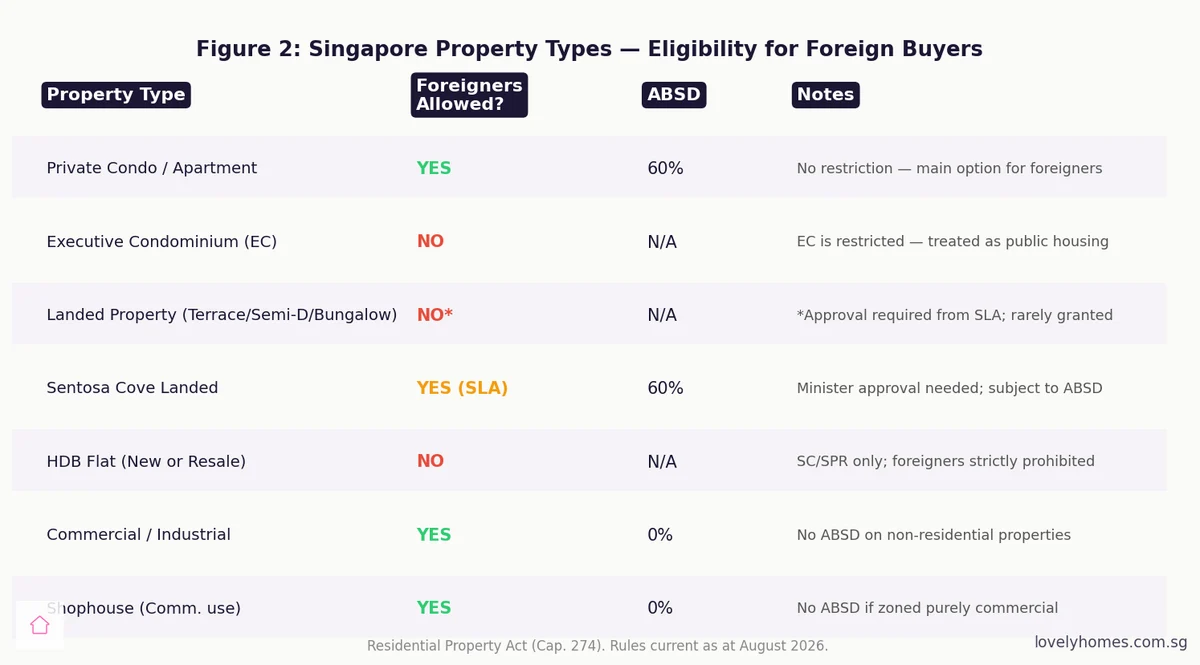
  • CPF can be used for HDB flats, private condominiums, and Executive Condominiums (ECs), but not for commercial or industrial properties.
  • For older leasehold properties, CPF usage is pro-rated or disallowed if the remaining lease does not cover the youngest buyer to age 95.
  • If you are aged 55 or older, you may only use CPF for property after setting aside the Basic Retirement Sum (BRS) in your Retirement Account (RA).
  • The accrued interest obligation can significantly reduce your net cash proceeds on sale — the worked example below shows the full mathematics.

What Is CPF OA and Why Does It Matter for Property?

The Central Provident Fund (CPF) Ordinary Account is one of three CPF sub-accounts held by every Singapore citizen and permanent resident. Administered by the CPF Board, the OA earns a minimum interest rate of 2.5% per annum (with a floor of 3.5% on the first S$20,000 of combined CPF savings under the Extra Interest policy, subject to conditions), making it one of the highest-yielding risk-free savings instruments in Singapore.

For most Singaporeans, CPF OA constitutes the single largest source of accessible funds outside their take-home pay. The rules governing how OA savings may be deployed for property are therefore among the most practically important aspects of personal finance in Singapore. Understanding them — including the less-publicised accrued interest obligation — is essential before committing to any property purchase.

The CPF Board regulates all property-related OA withdrawals under the CPF Act and the Housing Withdrawal Limits framework. The relevant rules apply to purchases from Housing and Development Board (HDB), private developers, and resale sellers alike.

What Can You Use CPF OA For?

CPF OA funds may be applied to four categories of property-related expenditure, subject to the limits described in the next section.

CPF OA usage table 2026 - down payment monthly instalments stamp duty accrued interest
Figure 1: CPF OA usage — what you can and cannot pay for. OA funds cover down payment, monthly loan instalments, stamp duty, and legal fees; commercial property and non-SC buyer shares are excluded.

Down Payment. For an HDB loan, there is no mandatory cash down payment — the full 10% option fee and 10% balance downpayment required by HDB may be funded from OA. For a bank loan on an HDB flat, the Loan-to-Value (LTV) ceiling is 75%, requiring a 25% downpayment of which at least 5% must be cash; the remaining 20% may come from OA. For private property with a bank loan at 75% LTV, the 25% downpayment may be funded entirely from OA subject to the Valuation Limit.

Monthly Mortgage Instalments. As long as the outstanding loan amount plus accrued CPF interest used does not exceed the Withdrawal Limit, OA may be applied monthly to reduce or eliminate your cash instalment. Many buyers use a combination of OA and cash once OA is running low.

Buyer’s Stamp Duty (BSD). BSD, payable to the Inland Revenue Authority of Singapore (IRAS) within 14 days of the Option to Purchase being exercised, may be paid from OA. On a S$750,000 HDB resale flat, BSD is S$18,600 — a substantial saving in upfront cash.

Legal and Conveyancing Fees. Solicitor fees for the purchase (typically S$2,000–S$3,500 for HDB, S$3,000–S$6,000 for private) may be paid from OA up to the actual amount charged.

How Much CPF Can You Use? Valuation Limit and Withdrawal Limit

CPF property withdrawals are governed by two thresholds set by the CPF Board:

  • Valuation Limit (VL): the lower of (a) the purchase price and (b) the market value assessed at the date of purchase. For new HDB BTO flats, the VL is the purchase price. For resale properties, the VL is whichever is lower — a resale flat purchased above valuation does not allow additional CPF withdrawals above the CPF Board’s assessed value.
  • Withdrawal Limit (WL): 120% of the Valuation Limit. Once total CPF withdrawals (including accrued interest) equal the WL, no further CPF may be used for that property. At that point, all further mortgage instalments must be paid in cash.

Example: a resale HDB flat purchased at S$680,000 where the CPF Board’s assessed value is S$660,000 gives a VL of S$660,000 and a WL of S$792,000. If you have used S$550,000 CPF principal and S$180,000 accrued interest (total S$730,000), you still have S$62,000 of headroom before hitting the WL.

The Accrued Interest Obligation — The Hidden Cost

This is the aspect of CPF property usage that catches many owners off guard. Every dollar of CPF withdrawn from your OA for property continues to earn the 2.5% OA interest rate as though it had never left. The CPF Board records the principal withdrawn plus the compound interest that would have accrued had the funds remained in OA. This running total is your accrued interest obligation.

When you sell the property, the full amount — principal plus accrued interest — must be refunded to your CPF account. It does not go to your bank account. You receive cash only from whatever is left after repaying the mortgage, returning CPF, and paying transaction costs.

CPF accrued interest compounding chart 2026 - principal and interest to return on HDB sale
Figure 2: Accrued interest grows at 2.5% p.a. on S$500K of CPF used. After 25 years, approximately S$172K in additional interest must be returned to CPF on top of the S$500K principal. The right panel illustrates net cash proceeds for an HDB sold at S$1.2M.

At 2.5% compounded monthly over 25 years, a S$500,000 CPF withdrawal balloons to approximately S$672,000 that must return to CPF — a S$172,000 obligation that reduces your cash-in-hand on sale. This is not a penalty; the money goes back to your own CPF account and continues earning interest. But it profoundly affects the cash you receive at the point of sale, which matters for upgraders who need proceeds to fund the next purchase.

CPF Usage by Property Type

The rules differ slightly depending on the type of property being purchased.

HDB BTO Flats. Citizens buying a new BTO flat enjoy the most straightforward CPF access. Down payment, BSD, legal fees, and monthly HDB loan instalments may all be paid from OA. There is no minimum cash requirement if you take an HDB loan.

HDB Resale Flats. CPF may be used in the same way for resale flats, subject to the Valuation Limit. If you pay a Cash-over-Valuation (COV) premium above the assessed value, that excess cannot be funded from CPF — it must be cash.

Private Condominiums and ECs. Bank loans for private property and ECs follow the same VL/WL framework. The minimum cash requirement of 5% of the purchase price still applies for first-time buyers under the Mortgage Servicing Ratio (MSR) rules for ECs, but the remainder of the 25% downpayment may come from OA. For private condominiums, only the Total Debt Servicing Ratio (TDSR) applies — there is no MSR constraint.

Executive Condominiums. ECs are treated as private property from the CPF perspective, but buyers must also satisfy HDB’s income ceiling (S$16,000 per month for standard ECs) and eligibility criteria. CPF usage follows the standard private property rules.

Leasehold Properties and the Age-95 Rule

Since 1 May 2019, CPF usage for properties with shorter remaining leases has been restricted under the CPF Housing Withdrawal Limits for properties with shorter leases framework. The core principle is that the lease must cover the youngest buyer to at least age 95 to allow unrestricted CPF usage.

If the remaining lease covers the youngest buyer to exactly age 95, full CPF usage up to the WL is allowed. If it falls short, the CPF usage cap is pro-rated in proportion to the remaining lease as a fraction of the age-95 benchmark. If the remaining lease at purchase is below 20 years, CPF cannot be used at all. This rule particularly affects older private condominiums and some HDB flats approaching the end of their 99-year or 103-year leases.

CPF OA eligibility matrix 2026 - which properties can use CPF Singapore
Figure 3: CPF OA eligibility matrix — leasehold restrictions, commercial exclusions, and joint-purchase rules summarised by property type.

Using CPF After Age 55

When a CPF member turns 55, a Retirement Account (RA) is created by transferring funds from the OA and Special Account. To continue using OA for property after age 55, the member must first set aside the Basic Retirement Sum (BRS) in the RA. For 2026, the BRS is S$106,500, the Full Retirement Sum (FRS) is S$213,000, and the Enhanced Retirement Sum (ERS) is S$319,500. Members who have pledged their property may use a lower threshold, but the pledge reduces eventual CPF LIFE payouts. Any OA balance above the BRS threshold remains available for property use.

Summary Table

Item HDB (Loan / Bank) Private Condo / EC Key Restriction
Down Payment Up to 100% OA (HDB loan); 20% OA + 5% cash (bank loan) Up to 20% OA + 5% cash min VL applies
Monthly Instalment Full from OA (up to WL) From OA (up to WL) Cash after WL hit
BSD From OA From OA Pay within 14 days of OTP
Legal Fees From OA From OA Capped at actual fees
Accrued Interest Rate 2.5% p.a. compounded monthly 2.5% p.a. compounded monthly Returned to CPF on sale
Valuation Limit Lower of price/value Lower of price/value COV must be cash
Withdrawal Limit 120% of VL 120% of VL No CPF use after WL hit
After Age 55 OA above BRS (S$106,500 in 2026) OA above BRS RA must be funded first
Leasehold <60yr remaining Pro-rated by age-95 rule Pro-rated by age-95 rule Nil if <20yr remaining
Commercial / Industrial Not permitted Not permitted Residential property only

Worked Example: Mr and Mrs Lim — HDB Resale in Bishan 2026

Mr and Mrs Lim (both Singapore Citizens, aged 32 and 30) purchase a 5-Room HDB resale flat in Bishan for S$780,000. The CPF Board assesses the market value at S$770,000, giving a Valuation Limit of S$770,000 and a Withdrawal Limit of S$924,000.

They take a bank loan at 75% LTV: loan S$585,000 at 3.0% p.a. over 25 years = S$2,773 per month. The 25% downpayment is S$195,000, of which 5% (S$39,000) must be cash; the remaining S$156,000 comes from their combined OA.

Item Amount (S$) Source
Down Payment (20%) 156,000 CPF OA
Down Payment (5% min cash) 39,000 Cash
BSD (1%x180K + 2%x180K + 3%x390K) 19,500 CPF OA
Legal Fees (est.) 3,200 CPF OA
Total CPF at Completion 178,700

After 15 years, assuming the Lims have used their combined OA consistently to service the mortgage, total CPF withdrawn is approximately S$498,000 (principal instalments plus upfront costs). At 2.5% p.a. compounded monthly, accrued interest over 15 years on the average CPF balance used is approximately S$112,000, bringing total CPF to return to S$610,000.

If the flat sells for S$1,050,000 (appreciation of approximately 35% over 15 years), the net position is as follows. Outstanding loan balance after 15 years of a 25-year mortgage: approximately S$255,000.

Item Amount (S$)
Sale Price 1,050,000
Less: Outstanding Loan Balance (255,000)
Less: Agent Commission (1%) (10,500)
Less: Legal Fees (conveyancing) (2,500)
Less: CPF Refund (principal plus accrued interest) (610,000)
Net Cash Proceeds 172,000
CPF Returned to Account (available for next property) 610,000

The S$172,000 cash proceeds plus S$610,000 returned to CPF gives the Lims a total of S$782,000 to deploy toward their next property — roughly equivalent to their original property purchase price. This illustrates how CPF recycling works across property transactions.

Why This Matters: The OA Rate vs. Mortgage Rate Decision

With CPF OA earning 2.5% and current bank mortgage rates ranging from 2.8% to 3.3% (3-month compounded SORA plus bank spread as of mid-2026), the gap between CPF earning rate and borrowing cost has narrowed substantially from the peaks of 4% and above seen in 2023–2024. This changes the calculus on whether to maximise CPF usage or conserve OA for retirement. When borrowing costs exceed OA returns by more than 1%, deploying CPF to reduce the loan balance is mathematically superior. When rates are close or below 2.5%, retaining OA to compound for retirement may be more advantageous.

The Monetary Authority of Singapore (MAS) and the CPF Board periodically review the OA rate floor. Currently, the OA floor of 2.5% has been maintained since 1 January 1999 as a legislative minimum under the CPF Act, providing a reliable benchmark for planning.

What Might Come Next

CPF housing policy tends to evolve incrementally rather than through sudden overhauls. The most likely near-term adjustments involve the leasehold age-95 rule, which may be extended or refined as Singapore’s ageing housing stock becomes a more pressing policy issue. The CPF Advisory Panel’s 2016 recommendations (on which the BRS/FRS/ERS structure is based) are due for periodic review, and the BRS itself rises by approximately 3.5% annually, making future property top-up obligations modestly more demanding for older buyers each year. Buyers considering leveraging CPF for property in 2027 and beyond should monitor the CPF Board’s annual circular for BRS adjustments, typically published each January.

Frequently Asked Questions

Can I use CPF OA to pay the Additional Buyer’s Stamp Duty (ABSD)?

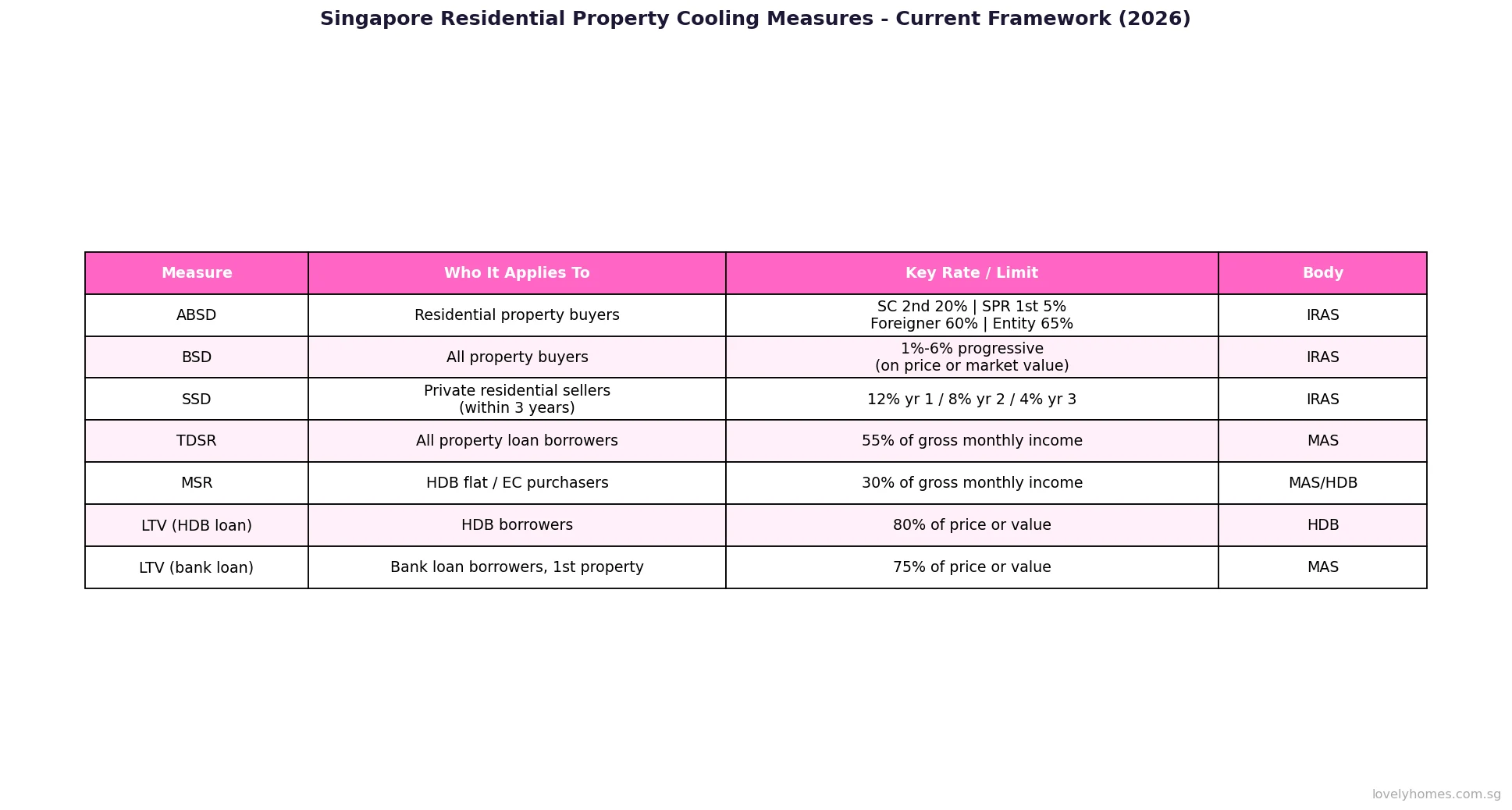
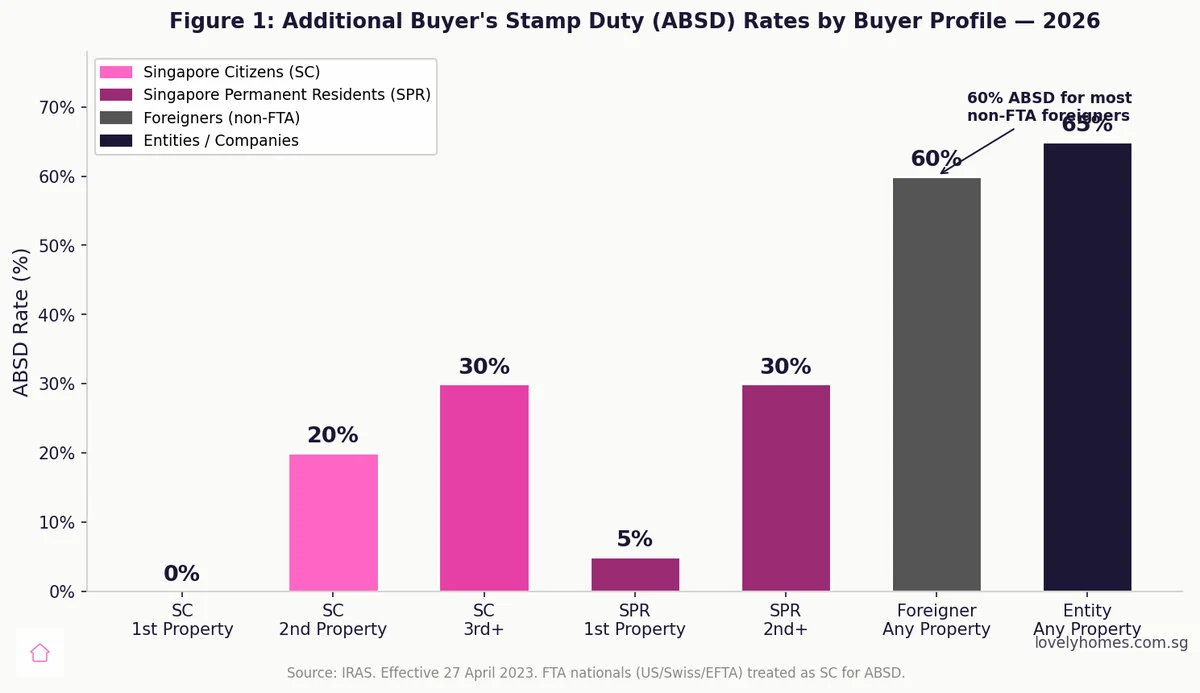
No. CPF OA cannot be used to pay ABSD. ABSD is a separate stamp duty charge levied by IRAS on top of the standard BSD, and the CPF Board’s Housing Withdrawal Scheme only permits OA withdrawals for BSD, not ABSD. ABSD must be paid in cash. On a second property purchase in 2026, a Singapore Citizen pays 20% ABSD — on a S$1.2M condo, that is S$240,000 in cash that cannot be sourced from CPF. This is one reason why the ABSD is a significant barrier to property investment for most CPF-dependent buyers. See our complete ABSD guide for full rate tables.

What happens to CPF accrued interest if I never sell the property?

If you never sell during your lifetime, the accrued interest obligation forms part of your estate. Upon your death, the property may be transferred to beneficiaries, but any CPF used must still be accounted for under the CPF Nomination and Housing Withdrawal Scheme. Beneficiaries who receive the property inherit both the asset and the outstanding CPF charge — if they subsequently sell, the full principal plus accrued interest still returns to the deceased’s CPF account (and is distributed per the nomination or Public Trustee rules). For a detailed discussion of property inheritance mechanics, see our Singapore Property Succession Guide 2026.

Can I use my spouse’s CPF OA for my property?

Yes, if you are co-owners on the property title. Both owners listed on the title deed may each deploy their individual OA toward the same property — the Valuation Limit and Withdrawal Limit apply to the property as a whole, not to each individual. The CPF Board tracks each member’s contribution separately. If one party’s OA is exhausted first, the other’s OA can continue funding monthly instalments. A spouse who is not listed on the title deed cannot use their CPF for that property. This is why adding a co-owner with strong CPF reserves is a common strategy for financing larger purchases.

Can a Singapore Permanent Resident (SPR) use CPF OA for property?

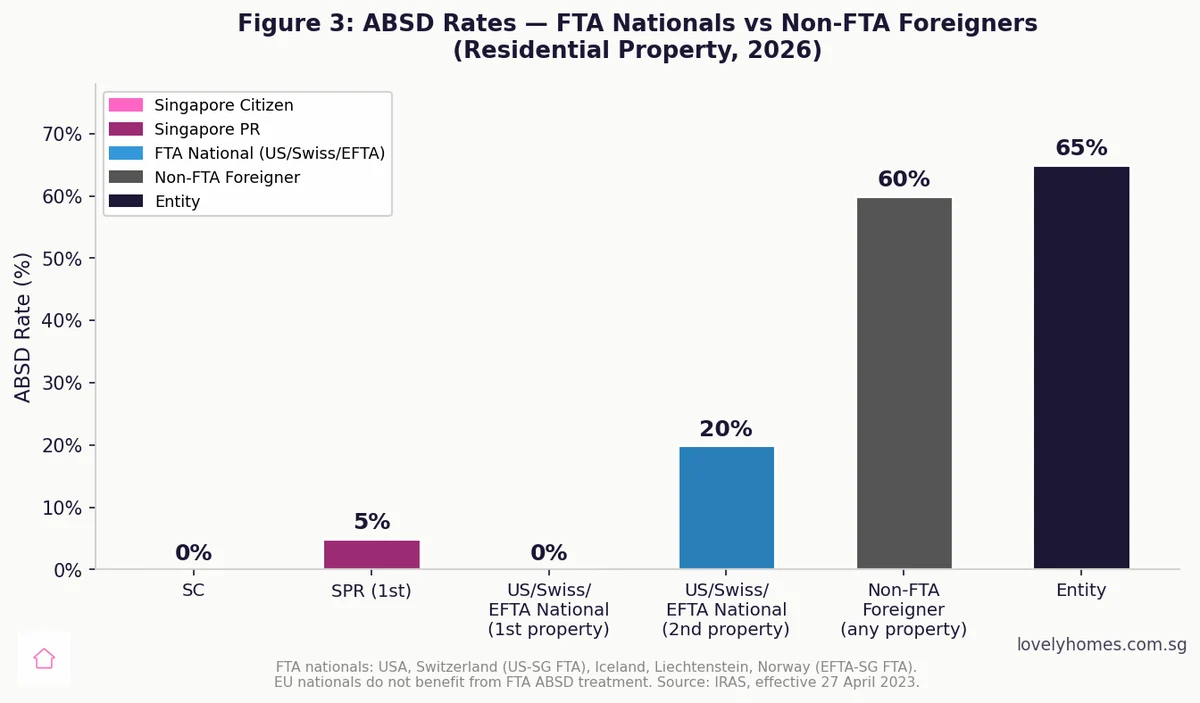
Yes. SPRs contribute to CPF and are eligible to use their OA for property under the same framework as Singapore Citizens, with two key differences: SPRs cannot purchase new HDB BTO flats (they may only buy resale HDB flats after obtaining SPR status for at least 3 years), and SPRs pay higher ABSD rates (5% on first property purchase as of 2026, versus 0% for SCs). Within those eligibility constraints, the OA usage rules — Valuation Limit, Withdrawal Limit, accrued interest, leasehold restrictions — apply identically to SPRs and SCs.

Should I maximise CPF OA use or pay more cash to reduce my loan?

The answer depends on the spread between your mortgage rate and the OA rate. If your bank mortgage rate is 3.0% and your OA earns 2.5%, deploying OA saves you 3.0% but foregoes 2.5% — a net benefit of 0.5% per annum. If rates fall below 2.5% (which occurred briefly in 2021), retaining OA is mathematically better. Beyond pure arithmetic, CPF provides a capital buffer for unexpected liquidity needs (subject to CPF Act withdrawal rules after age 55), whereas cash reduces the loan balance immediately. Most financial advisers in Singapore recommend a hybrid approach: use OA for monthly instalments while maintaining a cash buffer of 6–12 months of mortgage payments for emergencies.

Can I top up my CPF OA with cash specifically to pay for property?

Not directly. You cannot make a voluntary cash top-up designated for property payments — CPF top-ups go to the Special Account (for retirement savings) or Retirement Account (after age 55), not the OA. However, if you make a Voluntary Contribution to CPF (splitting across OA/SA/Medisave in proportion to the prevailing allocation rates), the OA portion increases and becomes available for property use in the normal way. The 2026 allocation rate for members below 35 is 23% of wages to OA out of a total 37% CPF contribution rate. Top-ups and their tax-relief implications are governed by IRAS guidelines.

Related Articles

Disclaimer

This article is intended for general informational purposes only and does not constitute financial, legal, or investment advice. CPF rules, interest rates, retirement sums, and withdrawal limits are subject to change — readers should verify all figures with the CPF Board at cpf.gov.sg, HDB at hdb.gov.sg, and IRAS at iras.gov.sg before making any property or financial decisions. Consult a licensed mortgage broker, financial adviser, or conveyancing solicitor for advice tailored to your personal circumstances.

Singapore En Bloc Seller’s Guide 2026: Collective Sale Process, Proceeds and What Owners Need to Know

Singapore En Bloc Seller’s Guide 2026: Collective Sale Process, Proceeds and What Owners Need to Know

Quick Answer: What Is an En Bloc Sale in Singapore?

  • An en bloc sale (collective sale) is where all owners of a strata-titled development — such as a private condo, HUDC estate, or cluster development — collectively sell the entire site to a developer or investor.
  • Governed by the Land Titles (Strata) Act (LTSA), a collective sale requires the consent of owners holding at least 80% by share value and strata area for developments over 10 years old (90% for developments under 10 years old).
  • Minority owners who refuse are bound by the decision if the Strata Titles Board (STB) or High Court approves the sale — they cannot block a properly executed collective sale.
  • Typical proceeds for a seller: the gross sale price for their unit, less their outstanding mortgage, CPF refund (principal + accrued interest at 2.5% p.a.), legal fees (~0.5–1%), and agent/marketing fees (~1.5–2.5% of total site price).
  • The ABSD on any replacement property purchase depends on the owner’s profile — a SC first-time buyer pays 0%; a SC buying a second property pays 20%. Planning the next purchase is essential before accepting the en bloc offer.
  • Typical timeline: 12–36 months from Collective Sale Committee (CSC) formation to completion. Some contentious sales take longer if STB or court proceedings are required.
  • ABSD remission may be available for SC couples who sell their only property and buy a replacement within 6 months — plan this sequence carefully.

What Is a Collective Sale (En Bloc)?

A collective sale — commonly called an “en bloc” sale — is a transaction under which all unit owners in a strata development sell their units simultaneously to a single buyer, typically a property developer. The buyer acquires the entire site in one transaction, usually with the intention of redeveloping it.

En bloc sales are governed by Part VA of the Land Titles (Strata) Act (Cap. 158) (LTSA), administered by the Singapore Land Authority (SLA). The legislative framework sets out the consent thresholds, procedural requirements, the role of the Collective Sale Committee, and the mechanism for binding dissenting minority owners through the Strata Titles Board (STB) or the High Court.

For property owners, an en bloc sale is both an opportunity and a disruption. The opportunity: receiving a premium above individual unit market value, because developers pay for the land redevelopment potential — the “en bloc premium.” The disruption: forced relocation, the need to find replacement housing quickly, and a complex tax and financial planning exercise involving ABSD, CPF, and mortgage settlement.

Figure 1: En Bloc Collective Sale Process Timeline Singapore 2026 - CSC Formation to Completion 12 to 36 Months
Figure 1: The en bloc process timeline — from Collective Sale Committee formation to proceeds disbursement. Source: LTSA Part VA, SLA, STB.

The Consent Threshold: Who Decides?

The LTSA requires that an en bloc sale be supported by owners holding at least 80% of the share value and 80% of the total strata floor area — for developments that are at least 10 years old from the date of the Temporary Occupation Permit (TOP) or the Certificate of Statutory Completion (CSC). For newer developments (under 10 years from TOP/CSC), the threshold rises to 90% in both measures.

Once the threshold is crossed, the sale can proceed even without the agreement of the remaining minority — provided it meets all other statutory requirements. The STB or High Court may approve the sale over dissenting owners’ objections if it is satisfied that the sale is in good faith, the proceeds are distributed equitably, and the transaction price represents fair market value.

Share value in a condo development is allocated to each unit at the time of strata subdivision, typically proportional to the unit’s floor area. A larger unit with a higher share value has proportionally more voting weight in the en bloc consent process. Strata floor area is the individual unit size as defined in the approved strata plan.

Requirement ≥10-Year Development <10-Year Development
Consent by share value 80% 90%
Consent by strata floor area 80% 90%
Minority bound? Yes, if STB/court approves Yes, if STB/court approves
STB Good Faith Test Required Required
Typical STB timeline 2–4 months 2–4 months

How Proceeds Are Calculated and Distributed

The total sale price for the entire development is determined by the tender or private treaty negotiation process. Each unit’s share of the total proceeds is then calculated according to an apportionment formula agreed upon in the Collective Sale Agreement (CSA). The most common apportionment methods are: by share value, by strata floor area, or a combination of the two.

From each unit’s gross proceeds, the following deductions apply before the owner receives net cash:

Figure 2: En Bloc Net Proceeds Calculation Singapore 2026 - Mortgage CPF Refund Legal Fees Agent Fees
Figure 2: Illustrative net proceeds calculation for one unit in a 40-unit development sold at S$2.0M per unit gross allocation. Actual figures depend on individual unit’s outstanding obligations. Source: CPF Board, SLA, industry estimates.

The most significant deductions — and the ones most commonly misunderstood by owners — are the CPF refund and the agent/marketing fees. The CPF refund is not a fee paid to an external party; it is the owner’s own CPF money being returned to their Ordinary Account (plus compounding at 2.5% per annum). However, because it is returned to CPF — not paid as cash — owners who have drawn heavily on CPF for mortgage servicing may find that their net cash proceeds are lower than they expect.

Agent and marketing fees are typically charged as a percentage of the total site sale price — not just one unit’s share. For a 40-unit development sold for S$200M, a 1.5% commission totals S$3M, or S$75,000 per unit on average. This is negotiable and should be agreed upon before the agent is formally appointed by the CSC.

The Role of the Collective Sale Committee (CSC)

The Collective Sale Committee is elected at an Extraordinary General Meeting (EGM) of the Management Corporation Strata Title (MCST). The CSC is the body that initiates and manages the en bloc process on behalf of all consenting owners. Its key responsibilities include engaging a licensed marketing agent (or conducting a public tender directly), appointing a law firm to prepare the CSA and manage the STB application, commissioning an independent valuation of the site, and setting the reserve price below which the development will not be sold.

The CSC owes a duty of good faith to all owners — including dissenting ones. It must ensure that the sale is conducted transparently, that the reserve price is not set below the independent valuation, and that all owners receive equal access to information about the proposed terms.

Under the LTSA, CSC members cannot be a party to any contract that gives them a personal benefit from the sale that other owners do not share — they must remain impartial fiduciaries. Owners who believe the CSC has acted improperly can lodge objections with the STB.

ABSD on the Replacement Purchase: Planning Ahead

An en bloc sale forces owners to buy replacement housing. The ABSD implications of that replacement purchase are significant — and the planning must begin well before the en bloc sale is completed.

Figure 3: ABSD on Replacement Property After En Bloc Sale Singapore 2026 - SC SPR Foreigner Rates
Figure 3: ABSD rates on a S$1.8M replacement condo, by buyer profile (2026). SC first-time buyers pay 0%; a SC buying a second property pays 20% = S$360,000. Source: IRAS Stamp Duties Act.

The key planning consideration is whether the owner will be a first-time buyer of their replacement property — i.e., will they own zero other properties at the time the replacement OTP is exercised. For most en bloc sellers, this depends on whether they have other private properties. If the en bloc unit is their only property, they will generally be a first-time buyer for ABSD purposes on the replacement purchase.

For Singapore Citizens who sell their only property and buy a replacement private residential property, the ABSD remission for SC couples may also be applicable: if they purchase the replacement property before selling their en bloc unit, they pay 20% ABSD upfront — but can apply to IRAS for a refund once they sell the en bloc property within 6 months of the replacement purchase. This sequence requires careful cash flow management, as the upfront ABSD may need to be funded while the en bloc proceeds are still in the completion pipeline.

Worked Example: The Ramasamy Family’s En Bloc Experience

Situation: Mr and Mrs Ramasamy are both Singapore Citizens. They own a 1,200 sq ft unit in a 48-unit Bishan condo originally purchased in 2010 for S$960,000. The development (TOP 2004, now 22 years old) has successfully obtained 83% consent for a collective sale at a total site price of S$420M. The Ramasamys’ unit’s gross share of proceeds is S$2,100,000 based on the apportionment formula.

Deductions from Gross Proceeds (S$2,100,000):
Outstanding mortgage balance: −S$320,000
CPF used (principal S$350,000 + accrued interest 2.5% p.a. for 16 years ≈ S$175,000): −S$525,000
Legal fees (~0.6%): −S$12,600
Marketing agent fees (their unit’s share at 1.5%): −S$31,500
Property tax apportionment and misc.: −S$5,200
Net Cash Proceeds: ≈ S$1,205,700
CPF OA top-up: S$525,000 (returned to their joint CPF OA accounts)

Replacement Property Planning:
The Ramasamys plan to purchase a S$1.9M freehold condo in District 20 as their replacement home. Since this will be their only property (the en bloc unit is sold), they are SC first-time buyers → ABSD: S$0.
BSD on S$1.9M: S$1,800 + S$3,600 + S$19,200 + S$4,000 (on last S$100K at 4%) = S$28,600 BSD
Downpayment (25%): S$475,000 — funded from net cash proceeds.
Bank loan: S$1,425,000 at 3.0% over 25 years → S$6,744/month.
Combined TDSR: S$6,744 ÷ S$15,000 (combined income) = 45.0% ✓
Net cash remaining after downpayment and costs: ≈ S$695,000

Key Timing Issue: The Ramasamys should confirm the en bloc completion date (typically 12 months after STB approval) before committing to a replacement OTP. If they need to purchase before completion, they may need bridging finance for the downpayment. Consult a mortgage adviser at least 6 months before the expected completion date.

What Minority Owners Can and Cannot Do

A minority owner (one who did not sign the CSA or who explicitly objects) has limited but meaningful protections under the LTSA. They may file an objection with the STB on the following grounds: (a) the sale price is not in good faith and does not reflect market value; (b) the proceeds distribution formula is inequitable; (c) the majority owners’ conduct has been improper; or (d) the sale will cause them a financial loss (i.e., their net proceeds after repaying their mortgage and CPF are negative).

The STB has the power to dismiss such objections if it finds that the sale meets the good-faith test and the distribution is equitable. Once the STB issues its approval order, all owners — including dissenters — are bound and must vacate and transfer title at completion. Refusal to do so may result in the court compelling the transfer.

Minority owners are entitled to receive the same gross proceeds per share as consenting owners. They cannot be offered a lower price for holding out — the CSA must apply the same formula to all units. The only difference is that dissenting owners bear their own legal costs for any STB objections they file.

Why En Bloc Matters: Singapore’s Urban Renewal Cycle

En bloc sales are a structural feature of Singapore’s built environment. Because 99-year leasehold land diminishes in value as the lease runs down, and because the island’s limited land area means underutilised sites are regularly returned to the urban system, collective sales serve as the primary mechanism for private-sector urban renewal. The Urban Redevelopment Authority (URA) monitors and facilitates this process through its Master Plan and development control rules that govern what can be built on a redeveloped site.

En bloc activity tends to be cyclical and correlated with developer land bank depletion and Government Land Sales (GLS) programme supply. When GLS supply is tight and developers need land, en bloc bids rise — driving the en bloc premium that makes collective sales attractive to owners. As of mid-2026, developer land bank levels are moderate, and the en bloc market remains selective — large, well-located developments with strong redevelopment potential continue to attract developer interest.

What Might Come Next

The LTSA en bloc framework has been revised several times — most recently in 2018, when procedural requirements were tightened to protect minority owners and ensure greater transparency in CSC governance. Regulators are unlikely to fundamentally alter the framework, which has proven effective at facilitating urban renewal while providing minority protections. However, incremental adjustments — such as minimum reserve price rules or stricter good-faith disclosure requirements — are possible in future Budget cycles.

For en bloc timing, owners in ageing developments (15–25 years from TOP) located in areas with active redevelopment potential — particularly in the Core Central Region and in major rejuvenation corridors designated in URA’s long-term plans — should monitor their development’s en bloc viability periodically. The window for maximum en bloc premium typically narrows as remaining lease runs below 60 years, at which point CPF and bank financing restrictions reduce the pool of eligible buyers for individual units, lowering their market value.

Frequently Asked Questions

Can I refuse to sell in an en bloc sale?

You can withhold your signature from the CSA — but you cannot ultimately block a sale that meets the LTSA consent threshold and passes the STB’s good-faith test. Once the STB issues its approval, all owners, including those who did not consent, are legally bound by the sale. The only recourse for a dissenting owner is to file an objection with the STB on specific grounds (e.g., financial loss, inequitable distribution, breach of good faith), and to appeal STB decisions to the High Court. Resistance beyond these legal channels will not prevent the sale from proceeding.

How is the reserve price determined?

The reserve price is the minimum price below which the CSC will not accept any offer. It is set by the CSC based on an independent valuation conducted by a licensed property valuer — the reserve price must not be set below this valuation, as doing so would fail the LTSA’s good-faith test. In practice, the reserve price is typically set at the independent valuation level or modestly above it, to reflect the en bloc premium that a developer would need to pay for the redevelopment potential. Once set, the reserve price is disclosed in the public tender documents and to all owners before the CSA signing exercise.

What happens to my HDB flat eligibility after an en bloc sale?

If you sold an en bloc private property and are now a “first-timer” (no current private property ownership), you may be eligible to purchase an HDB flat — provided you meet HDB’s income ceiling and citizenship eligibility criteria. However, if your household income exceeds S$14,000 per month (S$21,000 for extended families), you may not be eligible for a new BTO flat even as a displaced en bloc seller. The HDB Silver Housing Bonus and other schemes are available for elderly en bloc sellers downsizing. Consult HDB or a licensed real estate consultant before making assumptions about HDB eligibility.

Will my rental income from the en bloc unit continue until completion?

Yes, you retain the right to rent out your unit until the legal completion date — typically 12 months after STB approval for the transfer of legal title. However, any tenancy agreement must include a clause allowing early termination upon reasonable notice (usually 2 months) to accommodate the en bloc completion. Under the Residential Tenancies Act, tenants of en bloc units have specific rights regarding notice periods and relocation assistance. Ensure your tenancy agreement is reviewed by your solicitor in light of the en bloc proceedings.

What is the “good faith” test the STB applies?

The Strata Titles Board assesses whether the transaction price was arrived at in good faith, taking into account: (a) the sale price compared to the independent valuation; (b) the method of distributing sale proceeds among owners; (c) the relationship between the purchaser and any owner, or any agent; and (d) the latent defects of title affecting the development. If the STB finds that the transaction price was not arrived at in good faith — for example, if a CSC member had an undisclosed conflict of interest, or if the price was materially below valuation — it may refuse to approve the sale.

Can the developer delay completion and what recourse do I have?

Once the conditional SPA is executed, both parties are contractually bound to complete on the scheduled date, typically 12 months after the date of the Strata Titles Board Order. If the developer fails to complete, the CSA solicitors (acting on behalf of all owners) may pursue the developer for specific performance or damages under the SPA. Conversely, if owners cause delays by refusing to vacate, the purchaser may seek court orders compelling handover. Delays in en bloc completions, while uncommon, have occurred due to financing conditions in the SPA not being met — this should be flagged as a risk by your solicitor when reviewing the SPA terms.

What are the tax implications of receiving en bloc proceeds?

In Singapore, capital gains tax does not apply to individuals. The proceeds you receive from an en bloc sale — whether the gain is derived from an increase in property value or from the en bloc premium — are not subject to income tax for individual owners (as opposed to companies or developers, for whom different tax rules may apply). However, if IRAS determines that you are a “property trader” who regularly buys and sells properties for profit, the gains may be characterised as trading income and subject to income tax. For most homeowners with a single en bloc unit, this risk is low. Consult a tax professional if you are uncertain about your tax position.

Related Articles

Disclaimer: The information in this article is provided for general educational purposes only. LTSA provisions, ABSD rates, CPF rules, and STB procedures cited are based on legislation and regulatory guidance current as at June 2026 and are subject to change. LovelyHomes does not provide legal, tax, or financial advice. Before making any decisions regarding an en bloc sale — whether as a consenting owner, dissenting owner, or CSC member — consult a licensed conveyancing solicitor, a tax specialist registered with IRAS, and a MAS-licensed financial adviser. Authoritative sources: SLA (sla.gov.sg), IRAS (iras.gov.sg), URA (ura.gov.sg), CPF Board (cpf.gov.sg), Singapore Statutes Online (sso.agc.gov.sg).

Singapore Property Decoupling Guide 2026: How to Save ABSD by Transferring Ownership

Singapore Property Decoupling Guide 2026: How to Save ABSD by Transferring Ownership

Quick Answer: What Is Property Decoupling in Singapore?

  • Decoupling means one co-owner transfers their share of a jointly-owned property to the other, so the transferring party exits as an owner — and can buy a new property as a “first-time buyer” with 0% ABSD.
  • The most common use: a married SC couple who jointly own an HDB flat or private property uses decoupling to allow one spouse to buy an investment condo with 0% ABSD instead of 20%.
  • Costs include Buyer’s Stamp Duty (BSD) on the transferred share, legal fees (S$3,000–S$6,000 combined), and a fresh bank valuation — typically S$30,000–S$40,000 all-in for a S$1.8M property.
  • The decoupled (remaining) owner must pass TDSR at 55% as a sole borrower — this is the most common deal-killer.
  • Decoupling an HDB flat is generally not permitted to facilitate a subsequent private property purchase — HDB rules require both owners to occupy the flat; voluntary transfer usually requires HDB approval and income ceiling checks.
  • For private property owners, decoupling is a legal tax-planning strategy upheld by IRAS — provided there is genuine consideration and no sham arrangement.
  • Timeline: 6–12 weeks from lawyer engagement to SLA registration. Plan ahead before the intended new purchase.

What Is Property Decoupling?

Property decoupling is the process by which one co-owner of a Singapore property transfers their ownership share to the other co-owner. The transferring party is then legally no longer a property owner and — crucially — can buy a new property as a first-time buyer, paying 0% Additional Buyer’s Stamp Duty (ABSD) where they would otherwise have paid 20% (as a Singapore Citizen purchasing a second property) or 30% (as a Singapore Citizen purchasing a third property).

Decoupling is administered under the Land Titles Act (Cap. 157) and is regulated by the Singapore Land Authority (SLA), which updates the property register to reflect the new ownership structure. All stamp duties arising from the transfer are collected by the Inland Revenue Authority of Singapore (IRAS) under the Stamp Duties Act.

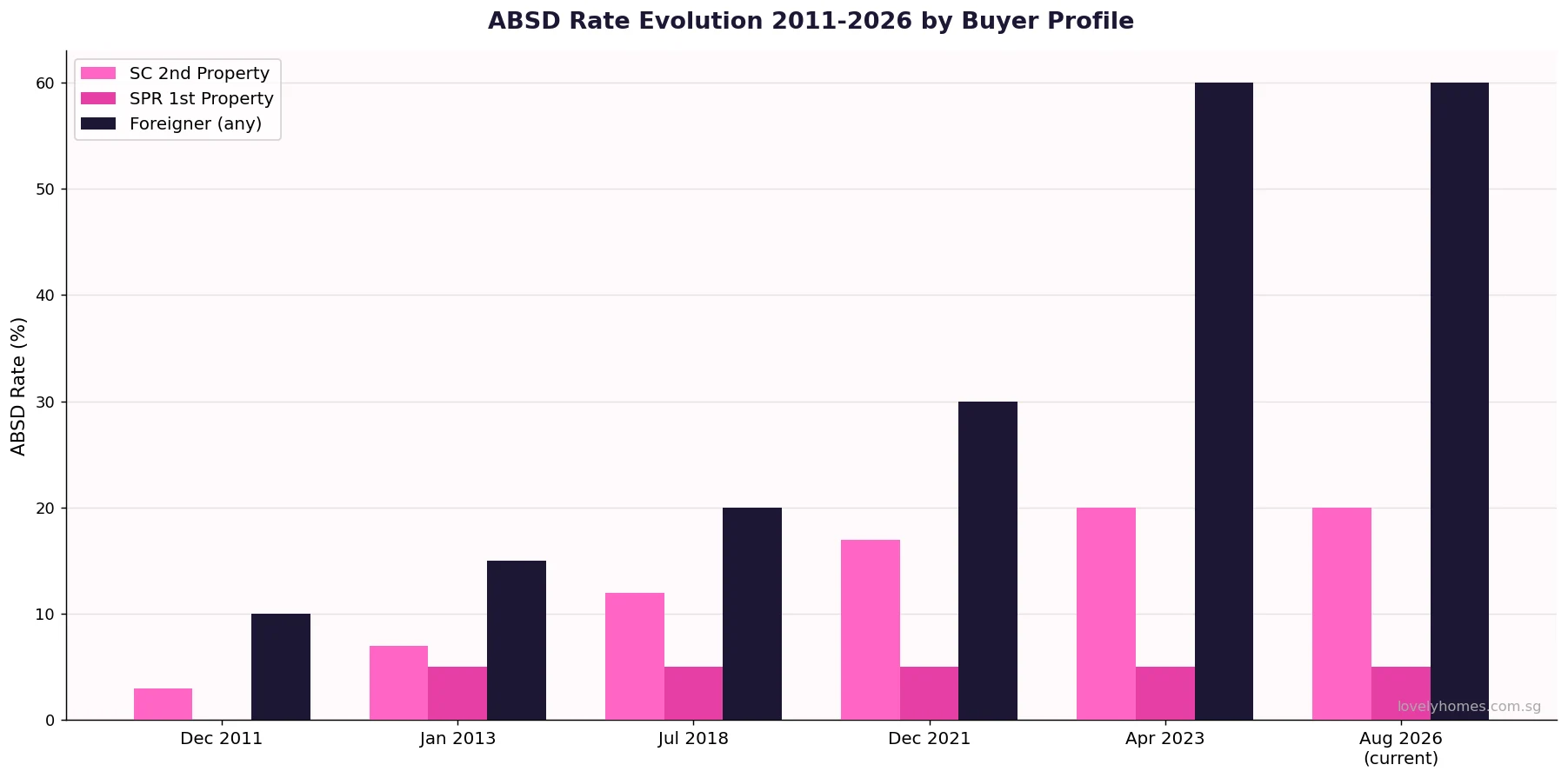
The strategy became widely discussed after successive rounds of ABSD increases — from 7% for Singapore Citizens’ second properties in 2011 to 20% today — made the tax difference between a first and second purchase extremely significant. At a S$1.8M condo, the ABSD delta between a first-time buyer (0%) and a second-time buyer (20%) is S$360,000. A decoupling transaction that costs S$32,000–S$37,000 therefore offers a potential net saving of over S$320,000.

Figure 1: Decoupling Cost Components 2026 - BSD Legal Fees CPF Refund for Property Share Transfer Singapore
Figure 1: Decoupling Cost Components — for a S$1.8M private condo (2026). Source: IRAS, SLA, industry estimates.

How Decoupling Works: The Mechanics

There are two main ways a co-ownership is structured in Singapore: Joint Tenancy (JT) and Tenancy-in-Common (TiC). In a Joint Tenancy, both owners hold an undivided equal share with right of survivorship — you cannot specify different percentages. In a Tenancy-in-Common, owners hold defined shares (e.g., 60/40) and can sell, will, or transfer their individual share independently.

Decoupling under Joint Tenancy first requires converting the ownership to Tenancy-in-Common (via a unilateral instrument of severance, filed with SLA), then one party transfers their defined share to the other. Under Tenancy-in-Common, the transfer can proceed directly. The receiving party pays Buyer’s Stamp Duty on the value of the acquired share; ABSD may or may not apply depending on how many properties the receiving party will own after the transfer.

Key consideration — CPF: If CPF Ordinary Account funds were used to service the mortgage, the CPF Act requires that when a co-owner transfers their share, the CPF principal plus accrued interest at 2.5% per annum must be refunded to the transferor’s CPF OA. This is not a cash expense but it reduces the seller’s CPF balance available for the next purchase.

Can You Decouple an HDB Flat?

This is one of the most frequently asked questions — and the answer is nuanced. Under HDB rules, the owners of an HDB flat must generally all be listed occupiers and must fulfil the Minimum Occupation Period (MOP) before they can own any private property. Voluntarily transferring a flat interest within a married couple (i.e., removing one spouse as owner) requires HDB approval and the remaining owner must still meet eligibility criteria, income ceiling rules, and the Essential Occupier scheme does not allow the transferring party to immediately buy a private property without potential complications.

IRAS has also scrutinised HDB decoupling arrangements and has in certain cases assessed that ABSD relief was not applicable where the transaction lacked genuine commercial consideration. As a result, HDB decoupling to facilitate immediate private property purchase is generally not a viable strategy — the risk of IRAS anti-avoidance provisions applying is high. Couples who own an HDB flat and wish to invest in private property are better served by completing the MOP, selling the HDB flat, and purchasing the private property — or examining the HDB upgrader ABSD remission scheme.

Private property decoupling, by contrast, has a cleaner legal basis and is widely recognised as a legitimate planning tool by IRAS and the courts, provided it is a genuine arms-length transaction with fair value consideration.

The Stamp Duty Costs of Decoupling

The transferee (receiving party) pays Buyer’s Stamp Duty on the value of the share being acquired. BSD is calculated on the higher of the purchase price and the market value of the share. For a S$1.8M condo where one party acquires the other’s 50% share:

BSD Tier Rate On S$900K share
First S$180,000 1% S$1,800
Next S$180,000 2% S$3,600
Next S$640,000 3% S$19,200
Remaining S$0 (capped at S$900K) 4%
Total BSD S$24,600

ABSD is payable if the transferee will own more than the number of properties that attracts 0% ABSD after the transfer. If the transferee is a Singapore Citizen and this is their only property after receiving the share, ABSD = 0%. If the transfer results in them owning a second property, 20% ABSD applies on the S$900K share value — S$180,000 in additional stamp duty — which would make decoupling economically unattractive in most cases.

Figure 2: ABSD Savings vs Decoupling Cost for SC Couple - Second Property at 20 Percent ABSD Singapore 2026
Figure 2: ABSD savings versus decoupling cost for a Singapore Citizen couple across four property price points (2026). The net saving column assumes the transferee buys a replacement property worth the same value as the original. Source: IRAS, LovelyHomes analysis.

TDSR: The Critical Constraint

The Total Debt Servicing Ratio (TDSR) — capped at 55% of gross monthly income by the Monetary Authority of Singapore (MAS) — applies to the remaining owner who takes on the full mortgage as a sole borrower. This is the single most common reason decoupling fails at the planning stage.

To illustrate: if a couple jointly earns S$18,000 per month and has an outstanding mortgage of S$1.2M on their existing condo at 3.0% interest, their joint monthly repayment is approximately S$5,056. Under joint ownership, their combined TDSR is 28.1% — well within the 55% cap. But if one party decouples, the remaining owner must demonstrate that on their own income they can service S$5,056 per month without exceeding TDSR 55%. If the remaining owner earns S$9,000 per month, their solo TDSR is 56.2% — which just exceeds the cap. The bank will require either the loan to be reduced (requiring a partial capital repayment) or the TDSR to be restructured (longer tenure).

Before proceeding with decoupling, both parties should obtain a bank indicative assessment for the sole-borrower scenario. This should be done before signing any transfer documents.

The Step-by-Step Decoupling Process

Figure 3: 8-Step Property Decoupling Process Singapore 2026 - Deed of Severance SLA Registration Timeline
Figure 3: The 8-step property decoupling process in Singapore. Typical timeline is 6–12 weeks. Source: SLA, legal industry practice.

The decoupling process follows a well-established sequence governed by the Land Titles Act and SLA’s conveyancing procedures. Critically, both the transferor and transferee must engage separate legal counsel — the same firm cannot act for both parties in a transfer.

  1. TDSR Pre-Assessment — The remaining owner checks with their bank whether they can service the existing mortgage as a sole borrower. The bank will apply the prevailing TDSR stress test (4% p.a. or the contractual rate, whichever is higher). This step is essential before spending on legal fees.
  2. Engage Two Law Firms — Transferor and transferee each appoint their own conveyancing solicitors. Each firm’s fees range from S$1,500 to S$3,000 depending on complexity.
  3. Agree on Consideration and Share Structure — The transfer is at market value (or at least not at gross undervalue) to avoid IRAS anti-avoidance. A fresh bank valuation (S$500–S$800) is typically required.
  4. Compute and Pay Stamp Duty — IRAS must receive the BSD (and ABSD if applicable) within 14 days of the date of the transfer instrument. Late payment attracts penalties.
  5. CPF Board Notification — If CPF OA funds were used, the lawyers notify CPF Board. The transferor’s CPF principal plus accrued interest (compounded at 2.5% p.a.) is refunded to their CPF OA from the transfer proceeds.
  6. SLA Registration — The transfer instrument is lodged with SLA. Title registration updates typically take 2–4 weeks. The property register is updated to reflect the sole owner.
  7. Bank Refinancing — The bank may require the mortgage to be restructured under the sole borrower’s name. This is the point at which TDSR compliance is formally verified by the lender.
  8. New Purchase by Transferor — Once the SLA title update is confirmed, the transferor (now holding zero properties) can purchase a new property as a first-time buyer — paying 0% ABSD (for Singapore Citizens).

Worked Example: The Wong Family’s Decoupling Plan

Situation: Mr and Mrs Wong are both Singapore Citizens. They jointly own a 99-year leasehold condo in District 19 purchased in April 2021 for S$1,450,000. Current market value: S$1,800,000. Outstanding mortgage: S$980,000 at 3.0% p.a. (25-year term remaining, monthly repayment S$4,644). Mr Wong earns S$10,000/month; Mrs Wong earns S$9,000/month.

Goal: Mrs Wong to decouple (transfer her 50% share to Mr Wong), then purchase a S$1.5M OCR investment condo in her own name at 0% ABSD.

Step 1 — TDSR Check for Mr Wong as sole borrower:
S$4,644 ÷ S$10,000 = 46.4% — within TDSR 55%. ✓ Bank confirms sole-borrower eligibility.

Step 2 — Transfer Costs:
Half of market value = S$900,000
BSD on S$900,000: S$1,800 + S$3,600 + S$19,200 = S$24,600
ABSD: 0% (Mr Wong receives 50% share → still 1 property for him)
Legal fees (two firms): ~S$5,500
Valuation: S$700
Total transfer cost: ≈ S$30,800

Step 3 — CPF Refund to Mrs Wong:
CPF used over 5 years: ~S$210,000 principal + S$26,500 accrued interest = S$236,500 returned to Mrs Wong’s CPF OA. This is not a cash cost — it is her retirement savings being restored.

Step 4 — Mrs Wong’s New Purchase (S$1.5M condo, as 1st-time buyer):
BSD: S$1,500 + S$3,000 + S$18,000 = S$22,500 (BSD on first S$1.5M)
Wait — S$1.5M: First S$180K @1% S$1,800 + next S$180K @2% S$3,600 + next S$640K @3% S$19,200 + remaining S$500K @4% S$20,000 = S$44,600 BSD
ABSD: S$0 (first property)
Bank loan: 75% LTV = S$1,125,000 at 3.1% over 30 years → S$4,802/month
TDSR check: S$4,802 ÷ S$9,000 = 53.4% — just within 55%. ✓

Net Benefit:
ABSD that would have been paid (20% on S$1.5M) = S$300,000 saved
Less decoupling cost: S$30,800
Net saving: S$269,200 — a 9× return on the decoupling cost.

Why This Matters: ABSD Rates Make Decoupling Highly Valuable

Singapore’s ABSD rates for Singapore Citizens stand at 20% for second properties and 30% for third properties — among the highest in the Asia-Pacific region. Compared to Hong Kong’s Buyer’s Stamp Duty (eliminated for non-permanent residents in 2024), Malaysia’s RPGT, or Australia’s state-level stamp duties, Singapore’s ABSD is calibrated specifically to discourage speculative multiple-property ownership by residents.

For Singapore Citizens in the income range of S$9,000–S$15,000 per month — the typical HDB upgrader profile — the ABSD on a second condo purchase ranges from S$240,000 (at S$1.2M) to S$500,000 (at S$2.5M). At these magnitudes, the one-time decoupling cost of S$30,000–S$50,000 represents a 6–10× return on the planning investment, making it one of the highest-value legal tax-planning exercises available to Singapore property owners.

IRAS has not indicated any intention to prohibit private property decoupling, though they have tightened scrutiny of sham arrangements and HDB transfers aimed at circumventing ABSD. The key requirement is that the transfer reflects genuine consideration and commercial reality.

What Might Come Next

Decoupling will remain a viable strategy as long as the ABSD gap between first and subsequent properties remains large. There has been periodic speculation that MAS or MOF might introduce new anti-avoidance provisions targeting systematic decoupling — such as a “look-through” rule treating decoupled couples as a single ownership unit. As of June 2026, no such rule has been announced, and the current legislative framework treats each individual’s property count independently.

However, buyers should note that the government regularly reviews ABSD rates at Budget time. Any reduction in the first-to-second property ABSD delta would reduce the economic case for decoupling. Conversely, any further ABSD increase would make decoupling even more valuable.

Summary: Is Decoupling Right for You?

Factor Favourable for Decoupling Works Against Decoupling
Property type Private condo / landed HDB flat (generally not viable)
TDSR (remaining owner) Well below 55% on sole income Tight or above 55% on sole income
CPF usage Low CPF drawn / paid mostly cash Heavy CPF use → large refund to OA
Property value Higher value → larger ABSD saving Low value → smaller saving relative to cost
Intended new purchase Same or higher value condo No specific next purchase planned
Timeline 3–6+ months before intended purchase Urgent (6–12 weeks minimum needed)

Frequently Asked Questions

Does decoupling trigger Seller’s Stamp Duty (SSD)?

SSD applies if the property is sold within 3 years of purchase: 12% in year 1, 8% in year 2, and 4% in year 3. A decoupling transfer is treated as a sale of the transferor’s share for SSD purposes. If the condo was purchased less than 3 years ago, SSD will apply on the value of the transferred share — significantly increasing the cost. For a S$900,000 share transferred in year 1, SSD would be S$108,000. Plan decoupling only after the SSD holding period has passed.

Can we use CPF to pay for the BSD and costs of decoupling?

Yes, the transferee (receiving party) may use their CPF OA to pay the BSD on the transferred share, provided the property is already within the approved CPF usage framework (e.g., remaining lease covers at least 30 years). The transferor cannot use CPF for costs; however, if their CPF was used in the original mortgage, they will receive a CPF refund which is credited back to their OA — this can then fund the downpayment for their new purchase.

Can a Singapore Citizen decouple with a Permanent Resident spouse?

Yes, but the ABSD implications are more complex. If the SC spouse is the transferee (receives the share), their property count determines the ABSD rate — 0% if it becomes their first or only property. If the SPR spouse is the transferee, they would pay ABSD at 5% (SPR first property) on the received share. Given that SPR ABSD rates are higher than SC rates, it is typically more efficient for the SC spouse to remain as sole owner post-transfer. However, IRAS anti-avoidance provisions require commercial justification — consult a tax lawyer before proceeding.

Does my bank need to approve the decoupling?

Yes. If there is an outstanding mortgage on the property, the bank is a secured creditor with a registered charge. The bank must consent to the transfer of ownership and will typically require the remaining borrower (sole owner post-transfer) to pass a new creditworthiness assessment, including TDSR at 55%. Some banks may require partial repayment to reduce the loan balance before approving the sole-borrower structure. Engage your bank early — before signing the transfer instrument.

Is there a risk that IRAS disallows the ABSD saving?

IRAS has broad anti-avoidance powers under section 33A of the Stamp Duties Act, which allows IRAS to disregard or vary any arrangement that has the effect of reducing stamp duty liability if the arrangement has no commercial substance. For private property decoupling between genuine co-owners at market value, the risk is low provided: (a) the transfer is at full market value supported by a bank valuation; (b) there is genuine consideration passing between parties (not a gift at zero value); (c) the parties are not transferring back within a short period. Sham decouplings — paper transfers with no actual cash or CPF refund — carry serious legal risk.

After decoupling, when can the transferor buy a new property?

As soon as the SLA register is updated to remove the transferor as an owner, they are legally a first-time buyer for ABSD purposes. There is no mandatory waiting period post-registration. However, practically, the buyer should obtain the SLA title search confirming the updated ownership before signing any Option to Purchase (OTP) for the new property — ABSD is assessed on the buyer’s ownership status at the time of OTP exercise.

Can we reverse a decoupling if plans change?

A reversal (transferring the share back) is legally possible but would incur fresh BSD on the re-transfer, and potentially ABSD if the re-acquiring party now holds a second property. The SSD clock also restarts from the date of the original purchase in most interpretations. Reversals are expensive and should be avoided. Decoupling should only be executed when there is a firm plan to proceed with the new purchase.

Related Articles

Disclaimer: The information in this article is provided for general educational purposes only. Stamp duty rates, CPF rules, and TDSR regulations cited are based on IRAS, MAS, and CPF Board guidelines current as at June 2026 and are subject to change. LovelyHomes does not provide legal, tax, or financial advice. Before executing any property transfer or decoupling arrangement, consult a licensed conveyancing solicitor, a tax specialist registered with IRAS, and a bank or MAS-licensed mortgage adviser. Authoritative sources: IRAS (iras.gov.sg), SLA (sla.gov.sg), MAS (mas.gov.sg), CPF Board (cpf.gov.sg).

Singapore Property Investment Portfolio Guide 2026: ABSD Strategy, Rental Yields and How to Build Wealth Through Property

Singapore Property Investment Portfolio Guide 2026: ABSD Strategy, Rental Yields and How to Build Wealth Through Property

Building a property investment portfolio in Singapore is one of the most effective wealth strategies available to citizens and permanent residents — but it comes with significant structural constraints. The Additional Buyer’s Stamp Duty (ABSD) at 20% on a second property and 30% on a third makes uninformed multi-property acquisitions extremely expensive. This Singapore property portfolio guide 2026 shows you how to sequence purchases, manage leverage, and balance yield against capital appreciation — while keeping your ABSD bill as low as legally possible.

Quick Answer: 10 Key Rules for Singapore Property Portfolio Building (2026)

  • ABSD for SC — 0% on 1st, 20% on 2nd, 30% on 3rd+ property. These rates effective 27 April 2023 are the primary portfolio constraint.
  • ABSD for SPR — 5% on 1st, 30% on 2nd, 35% on 3rd+. SPRs face a heavier cost burden for multi-property portfolios.
  • Decoupling — SC couples can split joint ownership so each spouse buys their next property as a “first” owner, deferring ABSD on the second purchase.
  • SC upgrader remission — SC couples who buy a second property while still owning a first can claim back the 20% ABSD paid if they sell the first within 6 months.
  • TDSR 55% — applies to all property loans. Each additional mortgage reduces your capacity to borrow for subsequent properties.
  • OCR gross yields top the regions at 3.5–4.2% for 1BR/studio units in Q2 2026; CCR yields are thinner at 2.2–2.8%.
  • Leveraged return — with a 25% downpayment on a S$1.5M property appreciating 3% (S$45,000/year), the levered equity return on your S$375,000 capital is 12% — before debt service.
  • Rental income is taxable — IRAS taxes net rental income (after allowable deductions) at your marginal personal income tax rate. See our full rental income tax guide.
  • CPF for investment property — you may use CPF OA to service a mortgage on an investment property, but the full principal + accrued interest at 2.5% p.a. must be refunded upon sale.
  • SSD (Seller’s Stamp Duty) — 12% if sold within 1 year, 8% within 2 years, 4% within 3 years of purchase. Hold for at least 3 years to avoid SSD entirely.

Why ABSD Is the Central Portfolio Planning Variable

Every Singapore property portfolio strategy must begin with ABSD as the primary cost driver. At 20% on a second purchase, the ABSD alone on a S$1.5M property equals S$300,000 — a figure that takes years of rental income to recoup. At 30% on a third purchase, the ABSD on the same property price is S$450,000.

This does not mean multi-property ownership is irrational — far from it. But it does mean that the holding period must be long enough for capital appreciation and rental income to justify the ABSD outlay. At Singapore’s long-run private residential price growth of approximately 3–4% per annum, a S$1.5M property appreciates by S$45,000–S$60,000 per year. At that pace, a 20% ABSD of S$300,000 is “recovered” through capital gains alone in approximately 5–7 years — before factoring in rental income.

ABSD rates by property count and buyer profile Singapore 2026 SC SPR foreigner
Figure 1: ABSD Rates by Property Count and Buyer Profile (2026). SC = Singapore Citizen, SPR = Singapore Permanent Resident. Click to enlarge.

Core Portfolio Strategies for Singapore Investors

Given the ABSD regime, Singapore investors have developed four primary multi-property acquisition strategies:

Strategy 1 — The Upgrader Path (Own Home + 1 Investment Property) is the most common approach for SC couples. You own a property as your primary residence, then purchase a second investment property absorbing the 20% ABSD. To minimise the ABSD hit, couples often time this acquisition after the first property has appreciated substantially, so the ABSD as a percentage of equity is relatively lower. The SC upgrader ABSD remission is irrelevant here because you are retaining both properties simultaneously.

Strategy 2 — Decoupling involves separating joint ownership so one spouse owns the first property outright and the other spouse (who now has zero property count) purchases a new property as a “first” buyer at 0% ABSD. The cost of decoupling is BSD on the transfer of share (typically S$20,000–S$35,000 for a S$1–S$1.5M property) plus legal fees (~S$3,000–S$5,000). This is compared against the ABSD saving of 20% on the new purchase. See our full decoupling guide for worked examples.

Strategy 3 — HDB Upgrader Sequence involves living in an HDB flat for the minimum occupation period (MOP), then purchasing a private property with the SC couple ABSD remission. Because SC couples buying a private property while still owning an HDB flat pay 20% ABSD upfront and claim it back upon HDB sale within 6 months, the effective cost of the upgrade (assuming timely HDB sale) is zero ABSD. This gives the couple one primary residence (private) plus the HDB sale proceeds to reinvest — most commonly into a second investment property at 20% ABSD.

Strategy 4 — Executive Condominium (EC) Early Entry involves purchasing an EC at initial launch price (subsidised below comparable private condo), fulfilling the 5-year MOP, then after the 10-year mark (full privatisation), treating the EC the same as any private property. At full privatisation, many EC owners have a substantial equity base from price appreciation — the average EC has appreciated 40–60% from launch to full privatisation — which they can redeploy as a private property downpayment.

Rental Yield Analysis: Where to Invest for Income

The gross rental yield is a primary investment return metric — it tells you the annual rent as a percentage of the purchase price before deducting costs. In practice, net yields (after maintenance, property tax at non-owner-occupier rates, vacancy, and management) are approximately 1.2–1.8% lower than gross yields.

Gross rental yields by region and unit type Singapore 2026 OCR RCR CCR
Figure 2: Gross Rental Yields by Region and Unit Type — Q2 2026 Estimates. Based on URA rental transaction data and industry figures. Click to enlarge.

OCR (Outside Central Region) small-format units consistently deliver the highest gross yields in Singapore — a 1-bedroom or studio in the OCR can command S$2,800–S$3,500/mth in rental while being priced at S$900,000–S$1.1M (resale). This translates to a gross yield of 3.5–4.2%. By contrast, a CCR (Core Central Region) 2-bedroom at S$2.5M may only fetch S$5,000–S$6,000/mth — a gross yield of approximately 2.4–2.9%.

However, capital appreciation potential does not always follow yield. CCR properties — especially freehold developments in Districts 9, 10, and 11 — have historically commanded a premium for scarcity and location, and tend to outperform in appreciation during recovery periods. An investor prioritising capital growth over income may rationally accept a lower yield in the CCR. Most Singapore retail investors optimise for a combination: OCR or RCR (Rest of Central Region) new launches or resale condos in MRT-proximate locations with decently-sized units (2–3 bedroom) that attract stable tenants (young professionals, expat families).

Financing Your Portfolio: TDSR and Leverage Management

Each additional property purchase consumes TDSR headroom. With a TDSR ceiling of 55% of gross income and a typical 30-year loan at 3.0% consuming approximately S$422/mth per S$100,000 borrowed, a household earning S$15,000/mth has a maximum total debt service capacity of S$8,250/mth. If their first home mortgage absorbs S$4,000/mth, only S$4,250/mth remains for a second mortgage — which at 3.0% over 30 years supports approximately S$1.0M in additional borrowing.

Gross Income TDSR Ceiling (55%) Existing Mortgage Remaining Debt Service Max Additional Borrowing (30yr, 3.0%)
S$10,000 S$5,500/mth S$2,200/mth S$3,300/mth ~S$780,000
S$15,000 S$8,250/mth S$3,500/mth S$4,750/mth ~S$1,125,000
S$20,000 S$11,000/mth S$4,500/mth S$6,500/mth ~S$1,540,000
S$25,000 S$13,750/mth S$5,500/mth S$8,250/mth ~S$1,955,000

Note that MAS applies a stress-test rate of 4.0% when computing TDSR for property loans — meaning your loan is assessed at 4.0% even if the actual contracted rate is 1.6%. This reduces maximum borrowing by approximately 12% compared to calculating at the actual market rate. See our mortgage guide for detailed stress-test calculations.

The ABSD remission timing also creates a short-term financing challenge: under the SC upgrader remission scheme, you pay 20% ABSD at purchase and recover it only after the first property is sold (within 6 months). If the sale is delayed or the price disappoints, the ABSD remains permanently forfeited. For many households, the 20% ABSD represents 1–2 years of total household income — a significant liquidity risk that demands careful sequencing.

Worked Example: The Wong Family’s Two-Property Strategy

💼 Case Study: SC Couple, S$18,000/mth Combined, Building a Portfolio

Profile: Mr and Mrs Wong, Singapore Citizens, combined gross income S$18,000/mth, no car loan, no personal debt. Current home: OCR condo purchased 2018 for S$1,100,000, now valued at S$1,480,000 (S$380,000 unrealised gain). Outstanding mortgage: S$580,000 @ 1.65% (recently repriced), monthly repayment S$2,124/mth.

Step 1 — Decouple the existing condo (cost: ~S$28,000): Mr Wong transfers his 50% share to Mrs Wong. BSD on S$740,000 (50% of S$1,480,000) = S$1,800 + S$3,600 + (S$380,000 × 3%) = S$16,800. Legal fees ~S$4,500. CPF accrued interest adjustment (Mr Wong’s share) refunded to his CPF. Total decoupling cost: ~S$21,300 (BSD + legal). Mrs Wong now owns 100% of the condo; Mr Wong has zero property count.

Step 2 — Mr Wong buys a second property as a first-time buyer (0% ABSD): Mr Wong purchases an OCR 2-bedroom resale condo at S$1,250,000. BSD = S$1,800 + S$3,600 + S$19,200 + (S$30,000 × 4%) = S$25,800. Bank loan 75% LTV: S$937,500 @ 3.0%, 30yr = S$3,951/mth. TDSR = (S$2,124 + S$3,951) ÷ S$18,000 = 33.8% ✓. Downpayment: 5% cash S$62,500 + 20% CPF S$250,000.

Portfolio outcome: Family owns two properties with S$0 ABSD paid (vs S$250,000 ABSD if bought jointly as second property). Total stamp duty cost of the strategy: S$25,800 (BSD on new purchase) + S$21,300 (decoupling) = S$47,100 vs S$275,800 (BSD + 20% ABSD if no decoupling). Saving: S$228,700.

Rental income from second property: OCR 2BR rented at S$3,400/mth, gross yield 3.26%. Deductible mortgage interest ~S$2,344/mth (year 1). IRAS net rental approximately S$12,672/year, taxable at Mr Wong’s marginal rate.

What This Means for Singapore Property Investors in 2026

The current environment presents a complex but workable picture for portfolio investors. Rental yields have compressed slightly from their 2022–2023 peak (when supply was constrained and rental prices spiked), but remain healthy relative to pre-pandemic norms. With the 3-month compounded SORA near 1.07% in Q2 2026, financing costs for floating-rate mortgages are at a multi-year low — improving net yield spreads for investors who borrowed on floating rates.

Capital appreciation prospects are moderate rather than exceptional: private residential prices are forecast to grow 2–4% in 2026, with OCR continuing to outperform on a volume basis. The 42,561-unit supply pipeline with 17,032 units unsold suggests that new launch developers will compete on pricing, limiting upside but also reducing downside risk for existing stock.

The key structural tailwind for portfolio investors remains Singapore’s land scarcity and population trajectory. As reported by URA, private residential land supply is inherently constrained, and the high-density GLS model ensures that new supply is priced to reflect market conditions. Long-term investors in freehold or 999-year leasehold assets benefit from this scarcity premium, which does not accrue to 99-year leasehold properties approaching the midpoint of their lease.

What Might Come Next for Portfolio Investors

Looking into 2H2026, several developments warrant attention. URA’s Q2 2026 Flash Estimates (expected early July 2026) will confirm whether Q1’s modest 0.9% price growth has sustained or slowed. The 2H2026 GLS Confirmed List released by URA includes nine sites totalling approximately 4,745 residential units — a healthy supply level that should prevent price overheating.

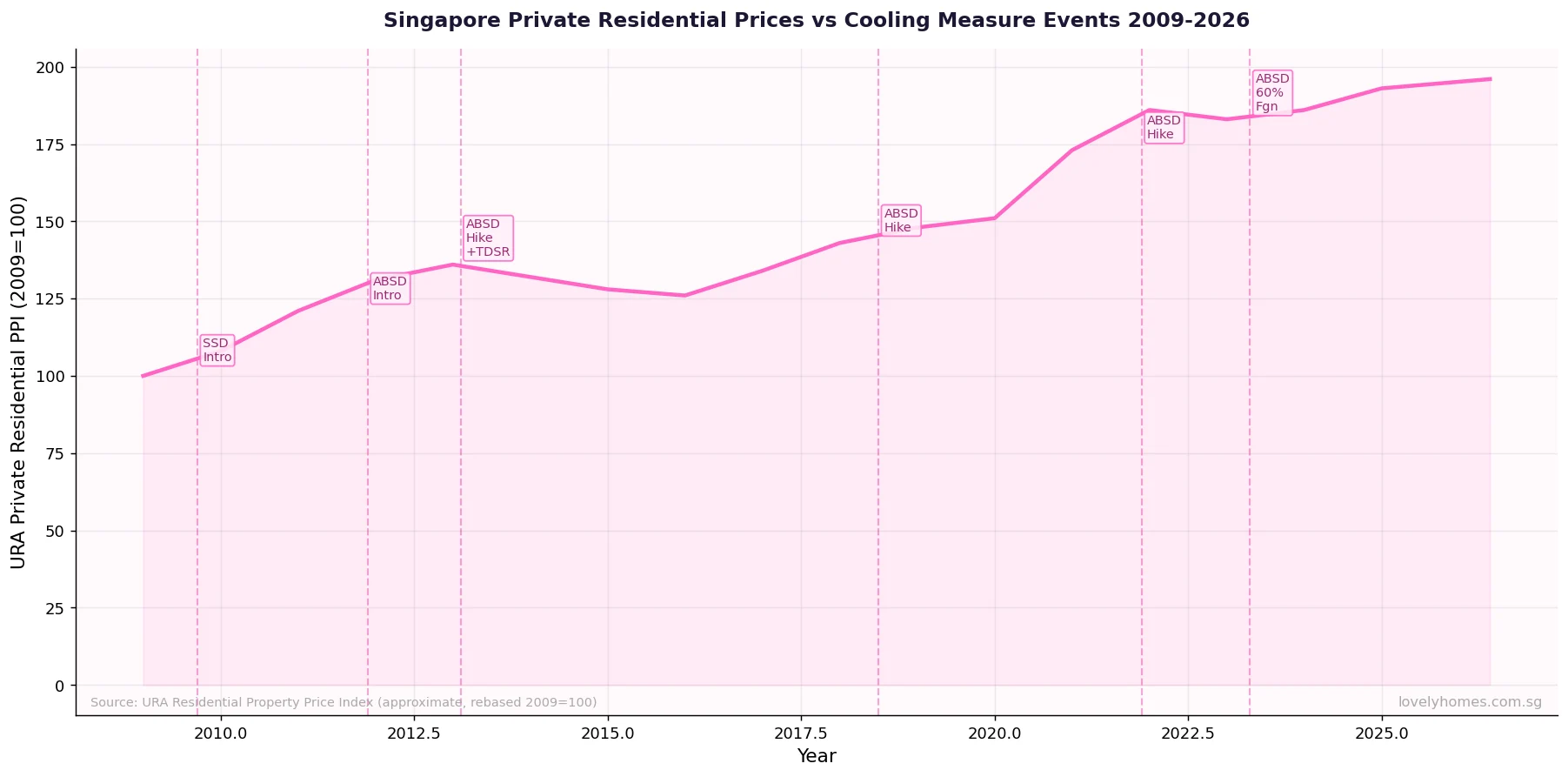
There is ongoing speculation within the investment community about whether the government will review ABSD rates, particularly for SC second purchases, given that the 2023 increase to 20% (from 17%) has effectively cooled multi-property acquisition volume. However, with property prices still elevated relative to household incomes, most analysts believe existing ABSD rates will remain unchanged through at least 2027.

Interest rate direction is the other key variable. MAS monetary policy operates via the Singapore Dollar exchange rate rather than interest rates directly, but global rate movements (particularly US Federal Reserve policy) feed through to SORA. If rates rise again in 2027, floating-rate borrowers may face higher servicing costs, tightening net yields.

Singapore multi-property portfolio strategies ABSD capital comparison 2026
Figure 3: Singapore Multi-Property Portfolio Strategies — ABSD and Capital Comparison (2026). Click to enlarge.

Frequently Asked Questions

Is it worth buying a second property in Singapore given the 20% ABSD?

It depends on your financial position, holding period, and investment objectives. At 20% ABSD on a S$1.5M second property, you are paying S$300,000 upfront that earns zero yield until recovered through capital gains or rental income. At a 3% annual capital appreciation rate, you recover that ABSD purely from price growth in approximately 6–7 years. If you also collect rental income (say S$3,500/mth gross on a 2BR OCR property), the combined return justifies the ABSD over a 5–7 year holding horizon. The key is ensuring you have the liquidity to absorb the ABSD, sufficient TDSR headroom to service both mortgages, and a realistic exit strategy if plans change.

Can my spouse and I both own a property individually without paying ABSD?

Yes — if you decouple your existing jointly-owned property first (so each spouse has a solo ownership) and then one spouse purchases a new property in their name alone, that new purchase is treated as their “first” property (0% ABSD for SC). The cost is the BSD on the transfer of share plus legal fees, which is typically far less than 20% ABSD on the new purchase. The technical process is a deed of severance (converting joint tenancy to tenancy-in-common) followed by a transfer of share from one spouse to the other. IRAS assesses BSD on the market value of the share transferred. See our joint ownership and decoupling guide for full details.

What is the Seller’s Stamp Duty and how does it affect portfolio management?

Seller’s Stamp Duty (SSD) applies to residential properties sold within 3 years of purchase: 12% if sold within 1 year, 8% within 1–2 years, and 4% within 2–3 years. Properties held for more than 3 years have no SSD. This means that any investment property must be held for at least 3 years to avoid SSD — a minimum holding period that should align naturally with a serious investment thesis. For portfolio investors, SSD effectively prevents short-term speculation and encourages medium-to-long-term holding strategies that are more consistent with genuine wealth building. Industrial and commercial properties are subject to separate SSD rules.

Can I use my CPF to buy an investment property?

Yes, CPF Ordinary Account (OA) funds may be used to service the downpayment and monthly mortgage of an investment property (a property you do not intend to reside in). However, all CPF principal withdrawn plus accrued interest at the CPF OA rate of 2.5% per annum (compounded) must be refunded to your CPF account when the property is sold. For a property held 15 years with S$300,000 CPF withdrawn over that period, the accrued interest alone could be S$130,000–S$150,000. This significantly reduces your net cash proceeds on sale. Using CPF for an investment property is a viable strategy but requires careful modelling of the CPF refund obligation before committing.

Is freehold always better than 99-year leasehold for investment?

Not necessarily — it depends on the purchase price differential, location, and your investment horizon. Freehold properties command a price premium of approximately 10–20% over comparable 99-year leasehold properties in the same location. For an investment property you intend to hold 10–15 years and sell, a 99-year leasehold in a prime location may offer equivalent or better returns if bought at the right price. The lease decay effect (where properties under 60 years remaining lose CPF and HDB loan eligibility) is most pronounced for leases approaching 40–60 years remaining — much less relevant for a new 99-year leasehold in 2026 (which would reach 60 years remaining only in 2087). Freehold is more valuable for generational wealth transfer where you intend to pass the property to heirs indefinitely.

How do I declare rental income from my investment property?

Rental income from Singapore properties is taxed as personal income under the IRAS progressive tax framework. You must declare gross rental income in your annual income tax filing, but you may deduct allowable expenses: mortgage interest (not principal repayment), property tax at non-owner-occupier rates, fire insurance premiums, maintenance and repair costs, and agent commission (if applicable). You cannot deduct renovation costs (capital expenses), furniture purchases, or personal expenses. The net rental income (after deductions) is added to your other income sources and taxed at your marginal rate (0% to 24%). IRAS requires you to file by 18 April each year.

What is the minimum down payment for a second investment property?

For a second property financed with a bank loan, the Loan-to-Value (LTV) limit is reduced from 75% (first property) to 45% if you have one outstanding property loan. This means a minimum downpayment of 55% — of which at least 25% must be in cash. If you have two or more outstanding property loans, the LTV drops to 35% (minimum downpayment 65%, with 25% in cash). This progressively higher downpayment requirement, combined with ABSD, makes third and fourth investment properties extremely capital-intensive. Most Singapore retail investors limit themselves to two residential properties — one primary residence, one investment.

Disclaimer: This article is for general information and educational purposes only and does not constitute financial, tax, or investment advice. ABSD rates, LTV limits, TDSR/MSR rules, and CPF policies are subject to legislative change. Always verify current figures with official sources: IRAS, MAS, URA, CPF Board, and HDB. Seek advice from a licensed financial adviser before making investment decisions.


Click anywhere to close

Singapore First-Time Buyer Complete Guide 2026: HDB BTO, Resale or New Launch

Singapore First-Time Buyer Complete Guide 2026: HDB BTO, Resale or New Launch

Buying your first home in Singapore is one of the most important financial decisions you will make. Whether you are eyeing a HDB BTO flat, a resale flat, or a new launch private condo, this Singapore first-time buyer guide 2026 walks you through eligibility rules, CPF housing grants, stamp duty, financing limits, and how to choose the right option for your income and life stage.

Quick Answer: 10 Things Every Singapore First-Time Buyer Must Know

  • No ABSD — Singapore Citizens (SC) buying their first residential property pay 0% Additional Buyer’s Stamp Duty.
  • HDB BTO is the cheapest entry — subsidised prices plus up to S$200,000 in CPF grants for eligible families.
  • MSR 30% — for HDB loans, your monthly mortgage cannot exceed 30% of gross income.
  • TDSR 55% — for any property loan, total debt obligations (including car, personal loans) cannot exceed 55% of gross income, administered by MAS.
  • HDB downpayment — 10% if using HDB concessionary loan; 25% (5% cash mandatory) if using a bank loan.
  • Private property downpayment — 25% total (5% cash OTP, 20% CPF/cash); maximum loan-to-value (LTV) is 75%.
  • Buyer’s Stamp Duty (BSD) is payable by all buyers — from 1% on the first S$180,000 to 6% on amounts above S$3M.
  • BTO wait time — typically 3 to 5 years; Shorter Waiting Time (SWT) flats offer ~3 years.
  • Resale HDB — ready immediately but no CPF housing grants via HDB loan if income exceeds ceiling; also subject to Cash-over-Valuation (COV).
  • New launch private — no HDB eligibility restrictions, but no CPF grants, higher prices, and progress payments apply.

Who Qualifies as a First-Time Buyer in Singapore?

The Singapore government defines a first-time residential property buyer as a person who has not previously owned or held any residential property (HDB flat, private condo, landed property) in Singapore. First-timers benefit from zero ABSD on their purchase, as well as priority balloting for HDB BTO flats.

For HDB flats specifically, citizenship and household composition also matter. Singapore Citizens (SC) can purchase both HDB flats and private property. Singapore Permanent Residents (SPR) may buy HDB resale flats (subject to Ethnic Integration Policy and Non-Citizen Quota) but cannot purchase new HDB BTO flats directly. Foreigners cannot purchase HDB flats at all and face a 60% ABSD on private property purchases since April 2023.

Income ceilings apply for HDB BTO and some grant schemes. For most BTO exercises in 2026, the gross monthly household income ceiling is S$14,000 (or S$21,000 for multi-generation families).

HDB BTO vs resale vs new launch comparison Singapore 2026 first-time buyer guide
Figure 1: HDB BTO vs HDB Resale vs New Launch Private — First-Timer Comparison (2026). Click to enlarge.

Understanding Your Budget: TDSR, MSR, LTV and Downpayment

Before choosing between HDB and private property, you must understand what you can actually borrow. Two MAS-administered rules govern this:

Rule Applies To Limit Administered By
MSR (Mortgage Servicing Ratio) HDB loans and bank loans for HDB/EC 30% of gross monthly income MAS / HDB
TDSR (Total Debt Servicing Ratio) All property loans 55% of gross monthly income MAS
LTV — HDB concessionary loan HDB flats, HDB loan 80% of flat value HDB
LTV — Bank loan (1st property) Any property, bank loan 75% of property value MAS
Minimum cash downpayment (HDB loan) HDB flat 0% cash; 10% from CPF/cash HDB
Minimum cash downpayment (bank loan) Any property 5% cash; remaining 20% CPF/cash MAS

Your TDSR calculation includes all monthly obligations — mortgage, car loan, student loan, credit card minimum payments. If you carry a car loan of S$900/mth, that reduces your maximum mortgage by the same amount.

For HDB buyers using an HDB loan, the HDB concessionary rate in 2026 is 2.60% per annum — 0.10% above the CPF Ordinary Account interest rate of 2.50%. Bank loan rates in Q2 2026 range from approximately 1.55% (1-year fixed) to 1.80% (SORA-linked floating), making banks cheaper in the short term but subject to rate revision. Read our full mortgage guide 2026 for a detailed comparison.

CPF Housing Grants for First-Time Buyers

One of the most powerful tools for Singapore first-time buyers is the suite of CPF Housing Grants administered by HDB. These are disbursed directly to reduce the purchase price or go towards the mortgage, and are not counted as income. Only HDB flats (BTO and resale) qualify — private property purchases do not attract CPF grants.

CPF housing grants by buyer profile Singapore 2026 EHG family grant PHG
Figure 2: Maximum CPF Housing Grants by Buyer Profile (2026). Stacked from left: EHG, Family Grant, Proximity Grant, Step-Up Grant. Click to enlarge.

Key grants in 2026 (updated from August 2024 enhancements):

Enhanced Housing Grant (EHG) — income-tested grant of up to S$120,000 for families and S$60,000 for singles. Administered by HDB. The amount scales with income: households earning up to S$1,500/mth receive the full S$120,000; the grant tapers to S$5,000 at S$9,000/mth (families). For a full breakdown, see our CPF Housing Grant Guide 2026.

Family Grant — S$50,000–S$80,000 for SC couples buying resale HDB flats; S$40,000–S$60,000 for SC+SPR couples. Administered by HDB. Available on resale flats only (not BTO). Amount depends on whether both applicants are SC or one is SPR, and on the flat type purchased.

Proximity Housing Grant (PHG) — up to S$30,000 (living with parents) or S$20,000 (living near parents, within 4 km) for resale purchases. Both buyer and parent must be SC. Recipients must maintain the proximity arrangement for five years or refund the grant pro-rata.

Step-Up CPF Housing Grant — S$15,000 for second-timers who previously stayed in a 2-room flat and are upgrading to a 2-room or 3-room BTO flat. Not applicable for most typical first-time buyers.

Buyer’s Stamp Duty for First-Time Buyers

Every property purchase in Singapore is subject to Buyer’s Stamp Duty (BSD), administered by the Inland Revenue Authority of Singapore (IRAS). BSD applies to all buyers regardless of nationality or ownership count. First-time SC buyers pay 0% ABSD but still pay BSD.

BSD 2026 rates (on the higher of purchase price or market value):

Property Value Band BSD Rate BSD Payable on Band
First S$180,000 1% S$1,800
Next S$180,000 2% S$3,600
Next S$640,000 3% S$19,200
Next S$500,000 4% S$20,000
Next S$1,500,000 5% S$75,000
Amount above S$3,000,000 6% On remainder

On a typical resale 4-room HDB flat at S$480,000, BSD = S$1,800 + S$3,600 + (S$120,000 × 3%) = S$9,000. BSD must be paid within 14 days of the Option to Purchase (OTP) being exercised. IRAS levies a 5% penalty for late payment.

For a deeper dive into all stamp duty rules including ABSD and the SC upgrader remission, see our complete ABSD Singapore 2026 guide.

HDB BTO vs Resale vs New Launch: Which Is Right for You?

The fundamental decision for every Singapore first-time buyer is which housing type to pursue. There is no single right answer — it depends on your income, timeline, family situation, and priorities.

HDB BTO is almost always the best value proposition for eligible first-timers. With government subsidies baked in and CPF grants on top, a typical SC couple earning S$8,000/mth could buy a 4-room BTO flat in a non-mature estate for S$280,000–S$350,000 before grants — effectively S$160,000–S$230,000 net after an EHG+Family Grant stack of up to S$120,000. The downside is the wait: 3 to 5 years before you receive your keys, although Shorter Waiting Time flats (around 2.5–3 years) are now available in every BTO exercise.

HDB Resale offers immediacy — you can move in within 8–12 weeks of OTP exercise. Resale flats are eligible for the Family Grant and PHG (but not EHG for buyers above the income ceiling), and there is no income ceiling for the resale purchase itself. However, prices have appreciated significantly: a Tampines 4-room resale in Q1 2026 averages around S$498,000, and Central-area mature estate 4-room flats exceed S$700,000. Cash-over-Valuation (COV) is not covered by CPF and must be paid in cash.

New Launch Private Condo is the most flexible option in terms of nationality eligibility (SC, SPR, foreigners all qualify) but also the most expensive. With OCR new launches from around S$1.3M for a studio/1-bedroom unit in 2026, the cash outlay — 5% OTP in cash, 20% in CPF/cash, BSD ~S$28,600 — is substantial. There are no CPF grants. The advantage is that ABSD is 0% for a first-time SC buyer and the development is brand new, but you will wait 3–5 years for TOP. See our complete new launch condo buying guide 2026 for the full process.

Maximum affordable property price by gross income Singapore first-time buyer 2026
Figure 3: Maximum Affordable Property Price by Gross Household Income (2026). Based on MSR 30% for HDB and TDSR 55% for private. Click to enlarge.

Worked Example: The Tan Family

👤 Case Study: SC Couple, S$8,500/mth Combined, First-Time Buyers — Sengkang

Profile: Mr and Mrs Tan, Singapore Citizens, combined gross income S$8,500/mth, no existing debt. Looking for a 4-room flat in Sengkang, both aged 30.

Option A — HDB BTO (Sengkang, 4-Room, estimated S$310,000):

  • EHG: S$50,000 (income-tested at S$8,500/mth); Family Grant: S$50,000 — total grants S$100,000
  • Net price after grants: S$210,000
  • HDB loan (80% LTV): S$168,000 @ 2.60%, 25 years → monthly S$759/mth
  • MSR: S$759 ÷ S$8,500 = 8.9% ✓ Well below 30%
  • BSD on S$310,000: S$1,800 + S$3,600 + (S$130,000 × 3%) = S$9,300
  • Total cash outlay: S$9,300 (BSD) + S$42,000 (10% DP) = S$51,300 (mostly CPF)
  • Wait: ~3–4 years

Option B — HDB Resale (Sengkang 4-Room, S$480,000):

  • EHG (if S$8,500 ≤ S$9,000 ceiling): S$30,000; Family Grant: S$50,000; PHG: S$20,000 — total grants S$100,000
  • HDB loan (80% LTV on S$460,000 valuation): S$368,000 @ 2.60%, 25 years → S$1,664/mth
  • MSR: S$1,664 ÷ S$8,500 = 19.6% ✓ Below 30%
  • BSD: S$1,800 + S$3,600 + (S$120,000 × 3%) = S$9,000
  • COV (S$480K purchase − S$460K valuation): S$20,000 in cash
  • Total cash outlay: S$9,000 (BSD) + S$48,000 (10% DP) + S$20,000 (COV) = S$77,000
  • Available immediately

Option C — New Launch OCR Studio, S$1,350,000:

  • No CPF grants available
  • Bank loan (75% LTV): S$1,012,500 @ 3.0%, 30 years → S$4,270/mth
  • TDSR: S$4,270 ÷ S$8,500 = 50.2% ✓ Below 55% but stretched
  • BSD: S$1,800 + S$3,600 + S$19,200 + S$20,000 + (S$30,000 × 5%) = S$46,100
  • Cash outlay: S$67,500 (5% OTP cash) + S$270,000 (20% CPF/cash) + S$46,100 (BSD) = S$383,600
  • Wait: ~4 years for TOP

Verdict: For the Tan family at S$8,500/mth, Option A (BTO) offers the best value. Option B (resale) is viable with a higher cash outlay. Option C (new launch) is technically possible but leaves minimal financial headroom. The right choice depends on their urgency for housing and CPF savings available.

What This Means for First-Time Buyers in 2026

Singapore’s first-time buyer landscape in 2026 is shaped by three big forces. First, interest rates have fallen significantly — 3-month compounded SORA sits near 1.07% as at Q2 2026, down from a peak of 3.52% in late 2023. This meaningfully improves affordability for bank-loan borrowers. A S$500,000 HDB loan at 3.4% cost S$2,475/mth; at 1.65% it costs S$1,999/mth — a saving of S$476/mth.

Second, HDB supply has increased substantially. With 19,600 BTO flats across three 2026 exercises (February, June, October), competition ratios for non-mature town BTO flats have eased compared to the pandemic-era crush of 2020–2022. The June 2026 BTO exercise alone launched 6,952 units including the first Bishan flats in 40 years. However, mature-town and Prime/Plus-classified flats remain competitive.

Third, HDB resale and private property prices remain elevated. Private property values rose 3% in 2025 and a further 0.9% in Q1 2026, making affordability a genuine concern for first-timers targeting private condos. HDB resale prices moderated slightly — the Resale Price Index fell 0.1% in Q1 2026, the first dip since Q1 2023 — but headline prices in mature estates are still at record highs.

What Might Come Next for First-Time Buyers

Looking into 2H2026 and 2027, several policy and market developments are worth monitoring. URA’s Q2 2026 Flash Estimates are expected in early July 2026 and will indicate whether the mild Q1 2026 slowdown in private prices has continued. The October 2026 BTO exercise is the third and final major exercise of the year — buyers who missed June should prepare for October.

On the financing front, analysts expect MAS to maintain its current TDSR and MSR thresholds, though any renewed inflationary pressure could prompt review. The CPF Ordinary Account interest rate (currently 2.50% p.a., underpinning the HDB loan rate of 2.60%) is reviewed quarterly.

En-bloc activity is also expected to increase in 2026–2028 as older estates mature. This will release more resale units into the market but also reduce the supply of older affordable stock. First-timers watching the URA pipeline would note that 17,032 units from the 42,561-unit private residential pipeline remain unsold, which should moderate new launch price growth through 2026.

Frequently Asked Questions

Can a Singapore Citizen buy a HDB flat and a private property at the same time?

Yes, an SC may own both — but strict sequencing rules apply. If you buy a private property while still owning a HDB flat, you must sell the HDB flat within six months of the private purchase. Failure to do so means the ABSD remission for SC upgraders is not available and 20% ABSD on the second purchase is permanently forfeited. There is no restriction on owning a private property first and then buying an HDB flat, provided you sell the private property before or at the time of the HDB purchase (subject to HDB eligibility rules including MOP restrictions).

Do first-time buyers pay ABSD in Singapore?

Singapore Citizens buying their first residential property pay 0% ABSD. Singapore Permanent Residents (SPR) buying their first property pay 5% ABSD. Foreigners pay 60% ABSD regardless of purchase count. BSD (Buyer’s Stamp Duty) is payable by all buyers on every purchase. Note: if you have previously owned any residential property — including inherited property or overseas property — you are technically not a first-time buyer for ABSD purposes, and the relevant ABSD rates for your second or subsequent purchase apply.

Can I use CPF to pay for my downpayment and BSD?

For HDB flats with an HDB concessionary loan, you may use your CPF Ordinary Account (OA) balance to fund the full 10% downpayment and to pay BSD. No minimum cash is required beyond normal living expenses. For bank loans (HDB or private), the mandatory 5% cash OTP payment cannot be funded by CPF — it must come from cash. The remaining 20% of the downpayment may be paid from CPF OA, cash, or a combination. BSD may be paid via CPF for both HDB and private purchases, provided sufficient OA balance exists.

What is the HDB Flat Eligibility (HFE) letter and is it mandatory?

The HDB Flat Eligibility (HFE) letter is a document issued by HDB confirming your eligibility to purchase an HDB flat (BTO or resale), your indicative CPF grant quantum, and your indicative HDB loan eligibility. From May 2023 onward, the HFE letter replaced the old HDB Loan Eligibility (HLE) letter and CPF Housing Grant eligibility letter. It is mandatory — you cannot exercise an OTP for a resale flat, or apply for a BTO flat, without a valid HFE letter. An HFE letter is valid for 9 months from the date of issue. Apply via the HDB website with your Singpass account.

I earn above S$14,000/mth. Can I still buy an HDB flat?

The S$14,000/mth gross household income ceiling applies to BTO flat applications in most (non-PLH) exercises. For resale HDB flats, there is no income ceiling — any SC/SPR household may purchase a resale flat regardless of income, subject to standard eligibility rules (MOP, family nucleus, citizenship). However, CPF housing grants (EHG, Family Grant, PHG) all have income ceilings: the EHG phases out completely above S$9,000/mth, and the Family Grant is available up to S$14,000/mth. If you earn above S$14,000/mth, a resale HDB flat remains an option but you will not receive any CPF grants.

What happens to my CPF when I sell my first home?

When you sell your property, you must refund your CPF Ordinary Account for all CPF principal withdrawn plus accrued interest at the CPF OA rate of 2.5% per annum, compounded annually. This refund goes back into your CPF account — it is not lost, but it is no longer immediately accessible as cash. For example, if you withdrew S$200,000 from CPF over 10 years, you must refund approximately S$255,680 (principal + accrued interest at 2.5% compound). This significantly affects your net cash proceeds on sale. See our complete guide to CPF accrued interest for a full worked example.

Should I buy a HDB flat first or a private condo first?

This is the classic Singapore property question. Buying HDB first (with grants) and upgrading to private later is the conventional path: you maximise government subsidies, build CPF equity, and then use the HDB sale proceeds plus CPF refund as your private downpayment. The ABSD remission for SC couples buying their second property while still owning an HDB flat means you pay 20% ABSD upfront but receive it back (net of nil) provided you sell the HDB within 6 months of the private purchase — this is the standard upgrader route. Buying private first and then buying HDB is allowed, but you must sell the private property first; you also miss out on the HDB grants entirely if you have previously owned private property.

Disclaimer: This article is for general information only and does not constitute financial or legal advice. Property prices, stamp duty rates, CPF policies, and HDB rules are subject to change. Always verify current figures with official sources: HDB, IRAS, CPF Board, URA, and MAS. Seek advice from a licensed financial adviser or HDB-appointed housing agent before committing to any purchase.


Click anywhere to close

Translate »