- What it is: Property decoupling is a legal strategy where joint property owners transfer one owner’s share to the other, allowing the “transferred-out” spouse or co-owner to purchase the next property as a first-time buyer , and avoid Additional Buyer’s Stamp Duty (ABSD).
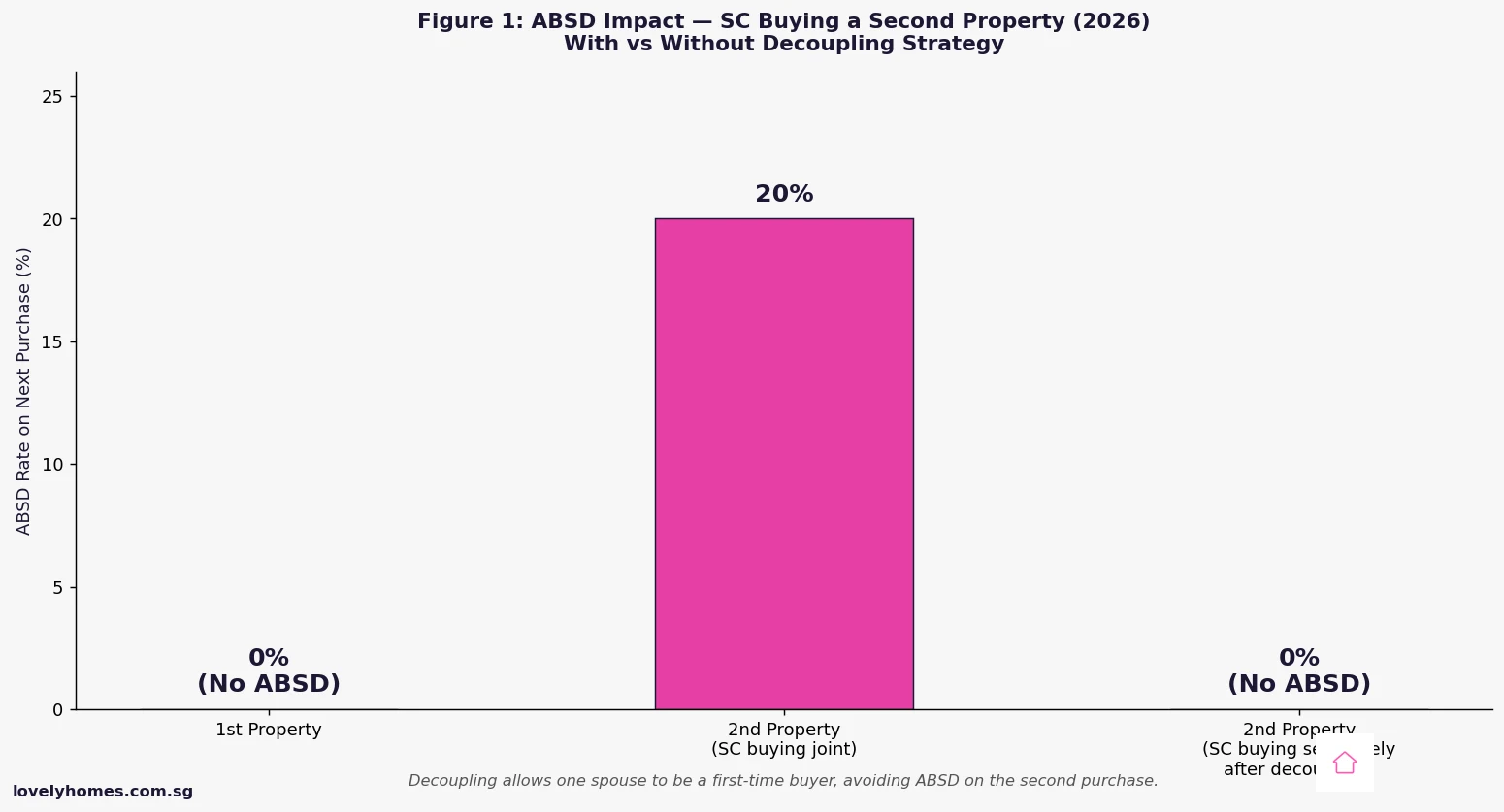
- Why it works: ABSD is assessed per-buyer based on the number of residential properties they own. After decoupling, one spouse owns zero properties and qualifies for the 0% ABSD rate on their next purchase (as a Singapore Citizen first-time buyer).
- Cost: BSD (Buyer’s Stamp Duty) is payable on the transferred share , typically S$15,000–S$30,000 depending on the share value. Legal fees add another S$3,000–S$5,000.
- Savings: ABSD for a SC buying a second property is 20% (as of 2026). On a S$1.5M purchase, that is S$300,000 saved , versus a decoupling cost of roughly S$20,000.
- SSD risk: If the property being decoupled is within 3 years of purchase, the intra-couple transfer may trigger Seller’s Stamp Duty (SSD) on the transferred share.
- HDB flats cannot be decoupled , only private residential properties and ECs (after MOP) are eligible.
- Legal advice is mandatory , decoupling has tax, CPF, and loan implications that require professional guidance tailored to your specific situation.
- IRAS monitors decoupling transactions closely , arrangements that lack genuine commercial rationale may be scrutinised under Section 33A of the Stamp Duties Act (anti-avoidance).
Of all the property strategies discussed in Singapore’s property community, decoupling is perhaps the most widely talked about yet least thoroughly understood. At its core, it is a legal ownership restructuring , couples who jointly own a property arrange for one partner to transfer their share to the other, so that the departing owner is then free to buy a new property without triggering Additional Buyer’s Stamp Duty (ABSD).
The strategy surged in popularity following the January 2013 ABSD hike, when the duty for Singapore Citizens buying a second property jumped from 3% to 7% (and has since risen further, to 20% effective 27 April 2023). With ABSD now at levels that represent S$200,000–S$600,000 on mid-range property purchases, decoupling has become a serious financial planning tool for owner-occupiers and investors alike.
However, decoupling is not without cost, risk, or complexity. This guide walks through exactly how it works, what it costs, when it makes sense, and what the government has said about it.
How Property Decoupling Works in Singapore
Decoupling is a sale-and-purchase transaction between co-owners. In the most common scenario, a married couple jointly owns a private condominium. They arrange for one spouse (the “transferee”) to buy out the other’s 50% share. After the transfer is complete:
- The transferee spouse now owns 100% of the existing property.
- The transferred-out spouse now owns zero properties , and is treated as a first-time buyer for ABSD purposes on any future purchase.
Crucially, the transaction is a genuine sale , the transferring spouse must receive fair consideration (typically the market value of their share, less any outstanding mortgage and CPF refund obligations). This is not a gift: IRAS assesses BSD on the sale at market value, and a below-market transfer would be treated as a gift for stamp duty purposes, still assessed at market value.
Why ABSD Is Avoided
ABSD is assessed at the point of purchase, based on how many residential properties the buyer owns at that time. After decoupling, the transferred-out spouse owns zero properties. When they subsequently purchase a new property, they are treated as a first-time buyer , attracting 0% ABSD if they are a Singapore Citizen. The government has confirmed that ABSD citizenship-and-count status is assessed at the buyer level, not the household level.
What “Joint Ownership” Means Here
In Singapore, joint ownership of private property can be structured as either joint tenancy (equal share, automatic survivorship) or tenancy-in-common (specified share, no automatic survivorship). Decoupling is most commonly done by tenants-in-common, as the share percentage is already documented , but joint tenants can first sever the joint tenancy and then proceed with a transfer. Both structures are eligible for decoupling.
The Decoupling Process: Step by Step
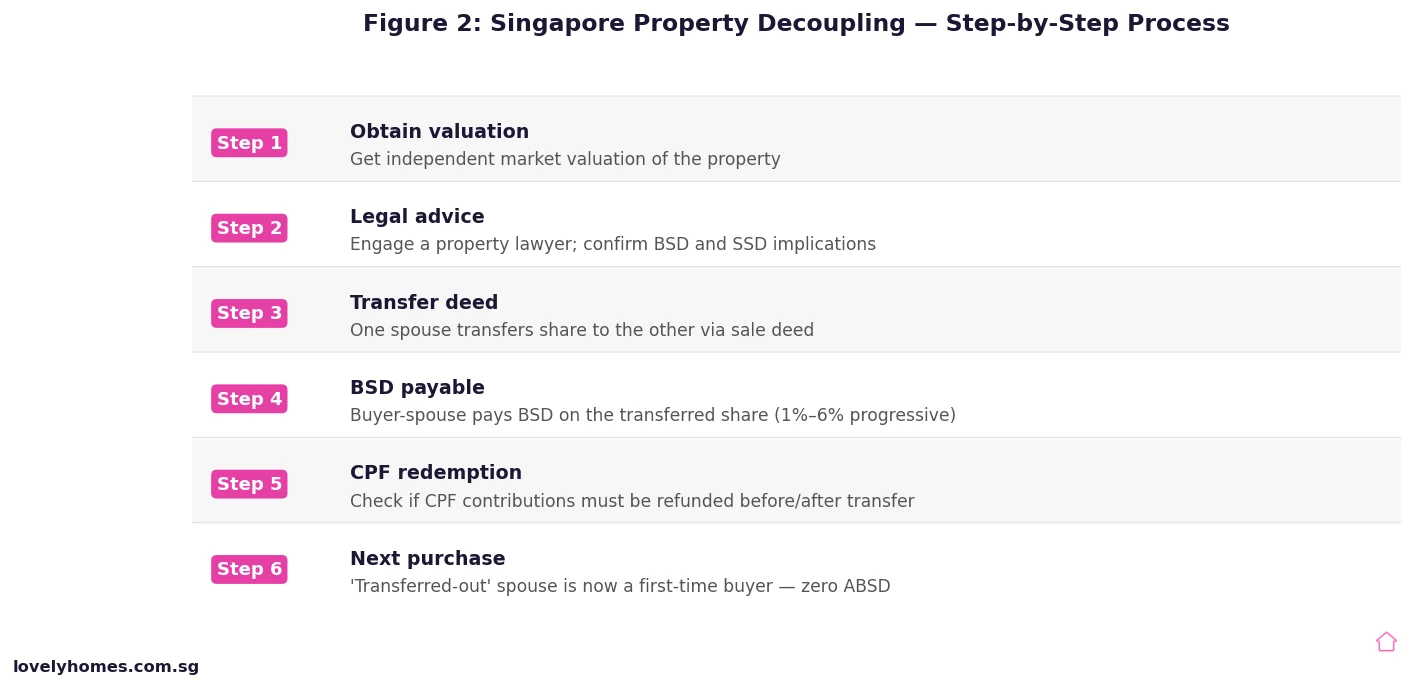
The decoupling process involves several sequential steps, each with distinct financial implications:
- Get an independent valuation of the property. IRAS will assess BSD on the higher of sale price or market value , so establishing market value is the first priority. Valuation costs S$500–S$1,000 and should be done by a licensed valuer.
- Engage a property lawyer experienced in stamp duty and conveyancing. The lawyer will advise on the transfer structure, draft the sale and purchase agreement, and submit the stamped documents to the Singapore Land Authority (SLA).
- Assess CPF implications. If both spouses used CPF funds to purchase the property, both CPF accounts must be refunded (principal + accrued interest) when the property is partially transferred. The transferring spouse’s CPF must be refunded before or as part of the transaction. This can reduce the net proceeds available to the transferred-out spouse for their next purchase.
- Assess mortgage implications. If the property carries an outstanding mortgage, the bank must consent to the restructuring of the loan. The transferee spouse will now own 100% and must demonstrate they can service the full loan under TDSR (Total Debt Servicing Ratio) rules. If TDSR is breached, the bank may require partial loan repayment before consenting.
- Execute the transfer deed. The sale and purchase agreement is executed, BSD is paid on the transferred share, and the SLA is notified to update the title register.
- Transferred-out spouse is now a first-time buyer. Once the title is updated, they are free to purchase a new property without ABSD (as a SC first-time buyer).
What Does Decoupling Cost?
The primary cost of decoupling is BSD on the transferred share. BSD is calculated on the market value of the transferred share (e.g. 50% of the property’s value). The BSD rate schedule (effective from 20 February 2018) is progressive:
| Property Value Band | BSD Rate |
|---|---|
| First S$180,000 | 1% |
| Next S$180,000 | 2% |
| Next S$640,000 | 3% |
| Next S$500,000 | 4% |
| Next S$1,500,000 | 5% |
| Remainder | 6% |
For a 50% share in a S$2M property (share value: S$1M), the BSD is approximately:
- 1% × S$180,000 = S$1,800
- 2% × S$180,000 = S$3,600
- 3% × S$640,000 = S$19,200
- Total BSD ≈ S$24,600
Additional costs include legal fees (S$3,000–S$5,000), valuation fees (~S$800), and potentially bank refinancing fees if the mortgage is restructured.
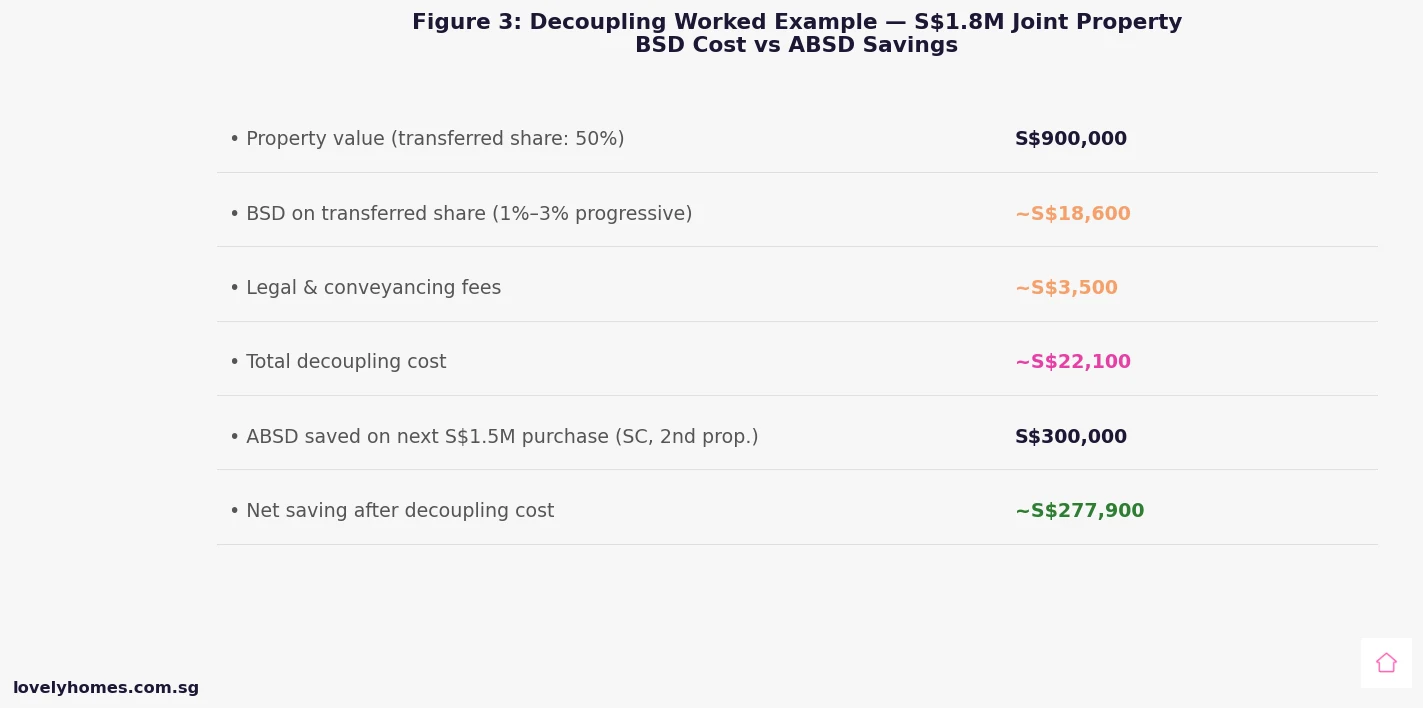
Decoupling Worked Example: S$1.8M Condo, Buying a S$1.5M Next Property
Scenario: Married SC Couple, Both SC, Own One Property Jointly
Existing property: District 15 condominium, purchased in 2021 for S$1.6M, now worth S$1.8M. Jointly owned 50/50. Purchased more than 3 years ago (no SSD risk). Outstanding mortgage: S$900,000. Combined CPF used: S$200,000 (both must refund on any disposal).
Goal: Husband wants to buy a S$1.5M investment property. Without decoupling, he pays 20% ABSD = S$300,000.
Decoupling plan: Wife transfers her 50% share to husband. Wife becomes a first-time buyer for the next purchase.
Decoupling costs:
Share value: 50% × S$1,800,000 = S$900,000
BSD on S$900,000: ~S$18,600
Legal fees: ~S$3,500
Valuation: ~S$800
Total decoupling cost: ~S$22,900
Net result:
Husband owns 100% of existing property (TDSR reviewed , he can support the loan).
Wife’s CPF refunded , she receives cash/equity from transfer.
Wife buys the new S$1.5M property as a first-time SC buyer , ABSD = 0%.
ABSD saved: S$300,000.
Net saving after decoupling cost: ~S$277,100.
Scenario B , What if SSD applies? If the property had been purchased in 2024 (within 3 years), the transfer would attract SSD at 8% on the share value: 8% × S$900,000 = S$72,000. Total decoupling cost rises to ~S$94,900. Net ABSD saving: ~S$205,100 , still very significant, but considerably less attractive.
The SSD Risk in Decoupling
The most significant financial risk in decoupling is Seller’s Stamp Duty (SSD). SSD applies to the disposing party , in a decoupling transfer, the spouse who sells their share may trigger SSD if the property was purchased less than three years ago.
SSD rates for residential property (from 1 January 2024): 12% within 1 year; 8% within 2 years; 4% within 3 years. Applied to the transfer price (or market value of the share, whichever is higher), SSD on a 50% share can amount to tens of thousands of dollars and significantly erode the ABSD savings.
Rule of thumb: Decoupling is financially viable only when the existing property is at least 3 years old (past the SSD window). If the property is newer, model both scenarios (with and without SSD) before proceeding.
What IRAS Says: Anti-Avoidance Provisions
IRAS is aware of decoupling as a stamp-duty planning strategy. Under Section 33A of the Stamp Duties Act, IRAS has the authority to disregard, vary, or counteract any arrangement that has the effect of reducing, avoiding, or postponing stamp duty that would otherwise be payable, where the arrangement lacks genuine commercial rationale.
To date, IRAS has not issued specific guidance declaring that all decoupling arrangements are impermissible. However, it has noted that each case is assessed on its facts. A decoupling that is clearly motivated purely by ABSD avoidance , with no other genuine reason for restructuring ownership , carries heightened scrutiny risk compared to one accompanied by legitimate estate planning, divorce proceedings, or business reorganisation rationale.
Practically, most lawyers advise documenting a genuine commercial rationale (e.g. the transferred-out spouse needs to purchase a property for a specific purpose, or the couple is restructuring their estate planning) alongside any decoupling transaction. Purely mechanical ABSD-motivated transfers, especially when immediately followed by a new property purchase, are more likely to attract IRAS review.
What Might Change: Future Regulatory Risk
The following is editorial analysis, not official policy.
The government has periodically tightened the ABSD regime when it judged that property market conditions warranted it. Decoupling, as a legal strategy that effectively reduces the ABSD burden on household property accumulation, sits in a policy grey area. As ABSD rates have increased significantly (SC second-property rate: 3% in 2011 → 7% in 2013 → 12% in 2018 → 17% in 2022 → 20% in 2023), decoupling has become more financially attractive , which means it attracts more policy attention.
Two potential regulatory changes are worth monitoring:
- Household-level ABSD assessment: IRAS could assess ABSD based on the total number of properties owned by a household (both spouses combined) rather than individually. This would eliminate the core mechanism behind decoupling.
- Stamp duty on transfers between related parties: A future rule could impose ABSD on transfers between spouses where the transferee is a first-time buyer purchasing within a defined period after the transfer.
Neither change has been announced, and the government has reiterated its general policy of not pre-announcing cooling measures. Property buyers considering decoupling should seek current legal advice rather than relying on the current regulatory framework persisting indefinitely.
Frequently Asked Questions About Property Decoupling
Can I decouple an HDB flat?
No. HDB flat ownership is governed by HDB rules which do not permit partial transfers to convert one owner into a first-time buyer for ABSD purposes. HDB regulations require that any flat transfer (including divorce-related transfers) must comply with strict eligibility criteria, and the result would still be treated as an HDB-flat ownership for ABSD purposes. Decoupling is only available for private residential property and Executive Condominiums (ECs) that have fulfilled their minimum occupation period (MOP) and crossed into the private market.
Does my CPF have to be refunded when I transfer my share?
Yes. When the transferring spouse sells or transfers their share in the property, any CPF funds they used (both the principal and accrued interest at the CPF Ordinary Account rate) must be refunded to their CPF account. This is not optional , the CPF Board requires the refund as a condition of releasing the property’s CPF charge. The cash available to the transferred-out spouse after decoupling is reduced by the amount they must refund to their own CPF. They can then use those CPF funds again for the next property purchase.
Is decoupling legal?
Yes, decoupling is a legal strategy under Singapore law. There is no legislation that expressly prohibits the transfer of a property share between co-owners for the purpose of ABSD planning. However, IRAS has anti-avoidance powers under Section 33A of the Stamp Duties Act, which allows it to disregard arrangements that lack genuine commercial rationale and are structured purely for tax avoidance. In practice, decoupling transactions accompanied by genuine commercial or personal rationale and properly documented are generally completed without IRAS challenge. This does not mean the risk is zero , it is advisable to obtain legal and tax advice before proceeding.
What if my bank doesn’t agree to the restructuring?
Bank consent is required because the mortgage is a charge over the entire property, and restructuring ownership changes the borrower profile. Banks will assess whether the remaining borrower (the transferee spouse) can service the full loan under Total Debt Servicing Ratio (TDSR) rules , currently 55% of gross monthly income. If the transferee cannot meet TDSR on their own, the bank may require partial loan repayment, a guarantor, or may decline the restructuring. It is critical to model the TDSR position before committing to decoupling, as a bank refusal after legal fees are incurred can be costly.
Can the transferred-out spouse buy the next property immediately?
The transferred-out spouse can technically commit to a new Option to Purchase (OTP) as soon as the decoupling transfer is legally registered with the Singapore Land Authority (SLA). Practically, this means waiting 4–8 weeks for the full decoupling process to complete. Committing to a new OTP before the SLA registration is complete creates risk , if the decoupling fails or is delayed, the buyer could be in breach of the new OTP. Always ensure decoupling registration is confirmed before signing a new OTP.
Does decoupling work for Executive Condominiums (ECs)?
Yes, but only after the EC has fulfilled its 10-year restriction period (when it becomes fully privatised) and both the MOP (5 years from key collection) and the additional privatisation lock-in are passed. During the MOP or private-restricted period, EC resale and transfers are restricted to Singapore Citizens and Permanent Residents who meet HDB eligibility criteria, making decoupling effectively unavailable. After full privatisation, an EC is treated as private property for stamp duty purposes and decoupling works the same way as for any private condominium.
What is the difference between decoupling and a divorce settlement?
Both involve transferring property ownership between spouses, but the context, process, and tax treatment differ. Decoupling is a voluntary, commercially-negotiated transaction that attracts BSD and potentially SSD. A divorce-related property transfer made pursuant to a court order may be eligible for stamp duty remission or exemption under IRAS’ family law provisions , though this is assessed case by case and is not automatic. Attempting to use a legal separation or divorce purely as a stamp-duty vehicle is likely to attract IRAS scrutiny and is not recommended. Genuine divorce-related transfers should be handled by a family lawyer who can advise on both matrimonial law and stamp duty implications simultaneously.
Related Articles
- ABSD Singapore 2026 , Complete Guide to Additional Buyer’s Stamp Duty
- Singapore SSD Guide 2026 , Seller’s Stamp Duty Rates and Rules
- Buyer’s Stamp Duty (BSD) Singapore 2026 , Complete Guide
- Singapore Joint Property Ownership Guide 2026: Tenancy-in-Common and Joint Tenancy
- Singapore ABSD Remission and Refund Guide 2026
- Singapore Property Investment Strategy 2026
- Singapore Stamp Duty Calculator 2026
Disclaimer: This article is for general informational purposes only and does not constitute legal, tax, or financial advice. Stamp duty rules, ABSD rates, and anti-avoidance provisions may change without notice. Property decoupling involves complex legal, tax, CPF, and mortgage considerations. Always obtain independent advice from a qualified property lawyer and tax adviser before proceeding with any property ownership restructuring. LovelyHomes is not a licensed financial adviser or property agent. Official information is available from IRAS, CPF Board, and the Monetary Authority of Singapore (MAS).
Supporting graphics
Original article illustrations are available below.
- Figure 1: ABSD impact with and without decoupling for a Singapore Citizen buying a second property in 2026. Decoupling converts a 20% ABSD liability into a 0% first-purchase rate.
- Figure 2: The decoupling process from valuation to next purchase. Each step has financial and legal implications that require professional advice.
- Figure 3: Decoupling cost vs ABSD saving breakdown for an illustrative S$1.8M property. The strategy is most powerful when the existing property is beyond the 3-year SSD window.