HDB Resale Levy Singapore 2026: Amounts, Who Pays, Exemptions and How It Works

HDB Resale Levy Singapore 2026: Amounts, Who Pays, Exemptions and How It Works

HDB resale levy Singapore 2026 complete guide
Figure 0: HDB Resale Levy Singapore 2026 — Complete Guide to Amounts, Exemptions and How It Works

Quick Answer — HDB Resale Levy at a Glance

  • The HDB Resale Levy is a payment required when a second-timer household buys a new subsidised HDB flat or an Executive Condominium (EC) unit after previously enjoying a housing subsidy.
  • Levy amounts range from S$15,000 (for a 2-Room Flexi sold) to S$55,000 (for a DBSS flat sold), with EC buyers paying 5% of resale price (capped at S$55,000).
  • It is paid by deduction from the CPF refund when your first flat is sold — you do not write a cheque.
  • Exemptions apply if you bought your first flat on the resale market without any CPF Housing Grant, inherited the flat, or received it via a court order.
  • The levy does not apply when buying a private property — only a second subsidised HDB flat or EC triggers it.
  • Getting the levy wrong can delay your second flat booking and result in owing HDB cash if your CPF proceeds are insufficient.
  • From 3 March 2006, all levy amounts were fixed at the flat-type level — they are not a percentage of the first flat’s resale price (except for EC).

What Is the HDB Resale Levy?

The HDB Resale Levy is a subsidy recovery mechanism administered by the Housing & Development Board (HDB) under Singapore’s public housing framework. When the government provides a housing subsidy — such as the Central Provident Fund (CPF) Housing Grant, the Additional CPF Housing Grant (AHG), the Special CPF Housing Grant (SHG), or the Enhanced CPF Housing Grant (EHG) — it does so on the understanding that this benefit is tied to one subsidised flat per household. If that household later purchases a second subsidised flat or Executive Condominium unit, they are required to “return” a portion of the earlier subsidy benefit in the form of the resale levy.

The policy was introduced to ensure that public housing subsidies are targeted at households that genuinely need them and to maintain the long-term sustainability of Singapore’s public housing system. HDB administers the levy and collects it automatically at the point of sale of the first flat — it is not a separate bill sent to you but a deduction from your CPF Ordinary Account (OA) proceeds before they are refunded.

As at July 2026, the levy framework has remained stable since the flat-type rate schedule was fixed on 3 March 2006. Understanding it correctly is essential for any second-timer household planning to upgrade or right-size within the public housing system.

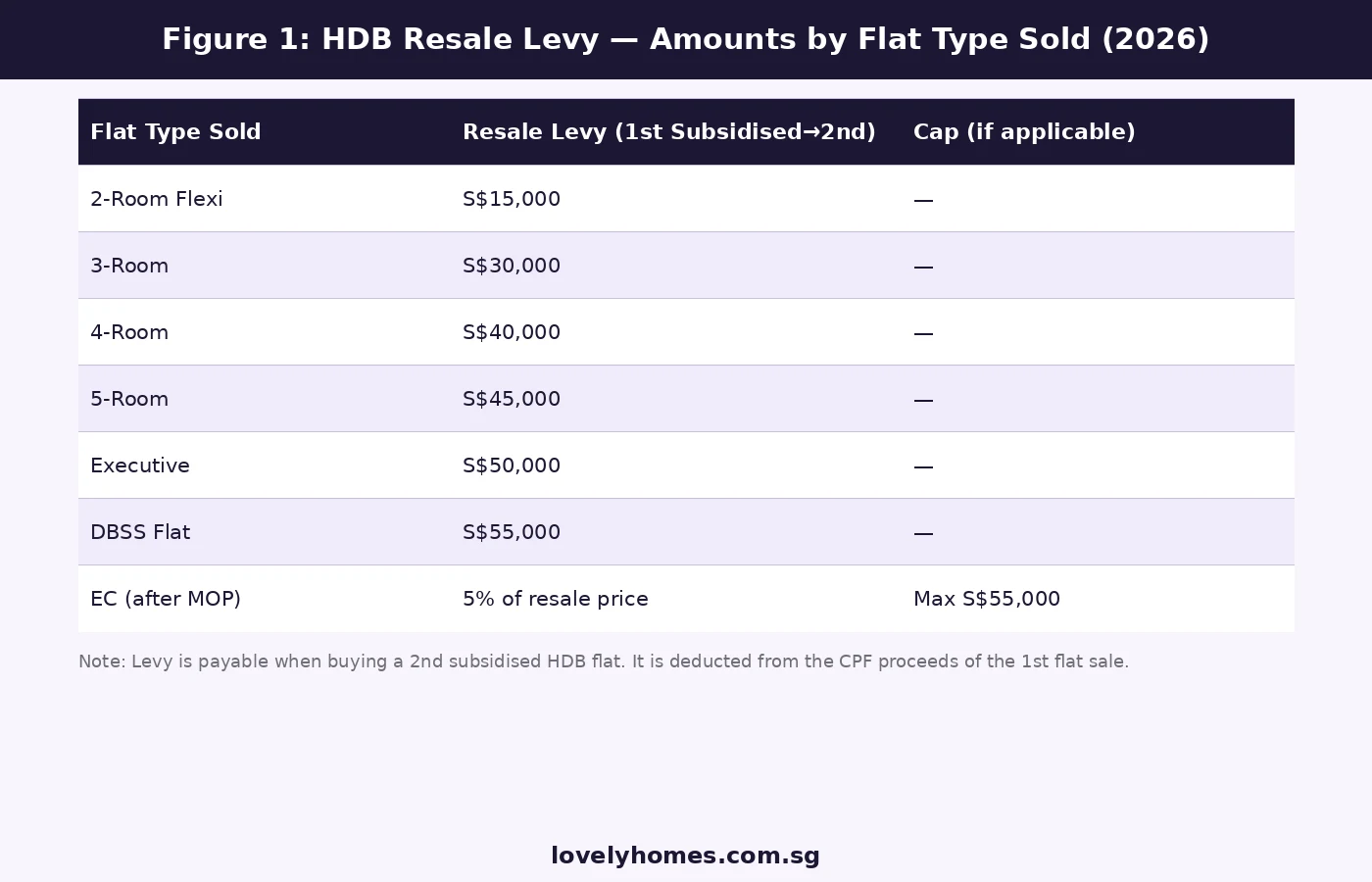
HDB resale levy amounts by flat type 2026 — S$15,000 to S$55,000 table
Figure 1: HDB Resale Levy Amounts by Flat Type Sold (2026). Fixed rates since 3 March 2006; EC applies a 5% rate with S$55,000 cap. Source: HDB Singapore.

Who Pays the HDB Resale Levy?

You are required to pay the resale levy if all three of the following conditions are met:

  1. You (or your co-applicant, spouse, or essential occupier) previously purchased a subsidised HDB flat — meaning you received a CPF Housing Grant, AHG, SHG, EHG, Step-Up CPF Grant, or bought directly from HDB at a subsidised price in a Build-To-Order (BTO) or Selective En-bloc Redevelopment Scheme (SERS) exercise.
  2. You subsequently sold that subsidised flat (or are in the process of doing so).
  3. You are now applying to buy a second subsidised flat from HDB — either a new BTO flat, a SERS flat, a Design, Build and Sell Scheme (DBSS) unit, or an Executive Condominium (EC) unit from a developer.

The key point is that the levy applies to subsidised second-time purchases only. If your second property is a private condominium, a landed home, a resale HDB flat (from the open market), or any commercial property, no resale levy is chargeable. Many upgraders mistakenly believe the levy applies whenever they buy a second property — it does not. It is specifically a tax on accessing public subsidies a second time.

Couples and Joint Applications

For married couples and joint flat buyers, the resale levy status of either party is taken into account. If either the main applicant or the co-applicant previously received a housing subsidy, the levy is applicable to the household. This prevents a household from circumventing the levy simply by swapping the person listed as main applicant on the second purchase. The rule is designed to capture the household’s cumulative subsidy benefit, not merely the individual’s.

Singles

Singles purchasing under the Single Singapore Citizen (SSC) scheme — eligible for 2-Room Flexi BTO flats — are also subject to the levy if they previously benefited from a housing subsidy. As the levy amount for a 2-Room Flexi flat is S$15,000, it is still a meaningful cost for solo buyers planning to upsize.

HDB Resale Levy Amounts (2026)

The levy amount depends on the type of flat you previously sold. Since 3 March 2006, the rates have been fixed at the following flat-type level:

Flat Type Sold (First Flat) Resale Levy Payable Notes
2-Room Flexi S$15,000 Applies to subsidised 2-Room Flexi BTO flats
3-Room S$30,000
4-Room S$40,000 Most common upgrader profile
5-Room S$45,000
Executive Flat S$50,000 HDB Executive flat (not EC)
DBSS Flat S$55,000 Design, Build and Sell Scheme (discontinued)
EC (Executive Condominium) 5% of resale price Capped at S$55,000; applies after the EC’s 5-year MOP when sold on the open market

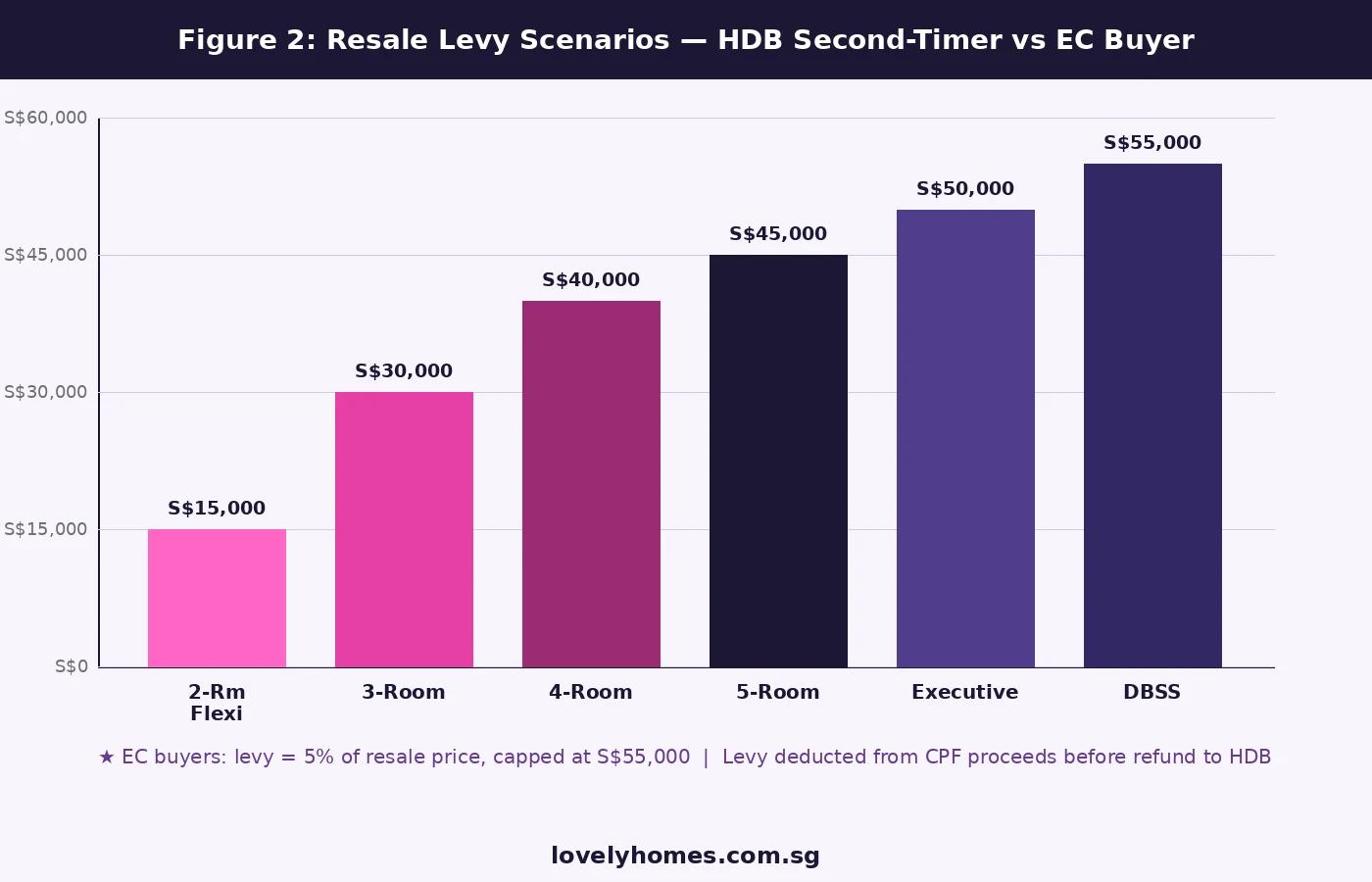
One common source of confusion is that the levy is based on the type of flat you sold, not on its resale price. Whether you sold your 4-Room flat for S$500,000 or S$900,000, the levy is always S$40,000. The EC rule is the sole exception: there the levy is 5% of the EC’s resale price (i.e. the proceeds from selling the EC), subject to a maximum of S$55,000.

HDB resale levy bar chart by flat type Singapore 2026 — S$15,000 to S$55,000
Figure 2: Resale Levy by Flat Type (2026). The levy is flat-based, not price-based — except for EC where it is 5% of resale price, capped at S$55,000. Source: HDB Singapore.

How and When Is the Resale Levy Paid?

The resale levy is settled automatically at the completion of the sale of your first flat. HDB deducts the levy amount from the CPF Ordinary Account (OA) refund you would otherwise receive when the flat sale is completed. You do not receive a separate invoice from HDB and you do not make a cash payment at any counter.

Here is how the sequence works:

  1. Apply to buy second flat: When you apply for a BTO flat or EC as a second-timer, HDB identifies your levy status at the point of application.
  2. HDB confirms levy payable: HDB notifies you of the levy amount in the appointment letter for your second flat booking.
  3. First flat sold: On the day of the legal completion of your first flat sale, the CPF Board refunds your OA principal and accrued interest as usual — but before the refund is credited to you, HDB deducts the levy amount directly from those CPF proceeds.
  4. Balance returned: The net CPF refund (after levy deduction) is credited to your OA account.

What If Your CPF Refund Is Less Than the Levy Amount?

This can happen in rare situations — for instance, if the outstanding HDB loan and CPF accrued interest together consume most of the sale proceeds. In such cases, the shortfall must be made up in cash. HDB will require you to pay the difference out-of-pocket before the second flat booking proceeds. This is one reason why financial planning ahead of an upgrade is important: always model your net CPF position against the levy amount before committing to a second BTO application.

Who Is Exempt from the HDB Resale Levy?

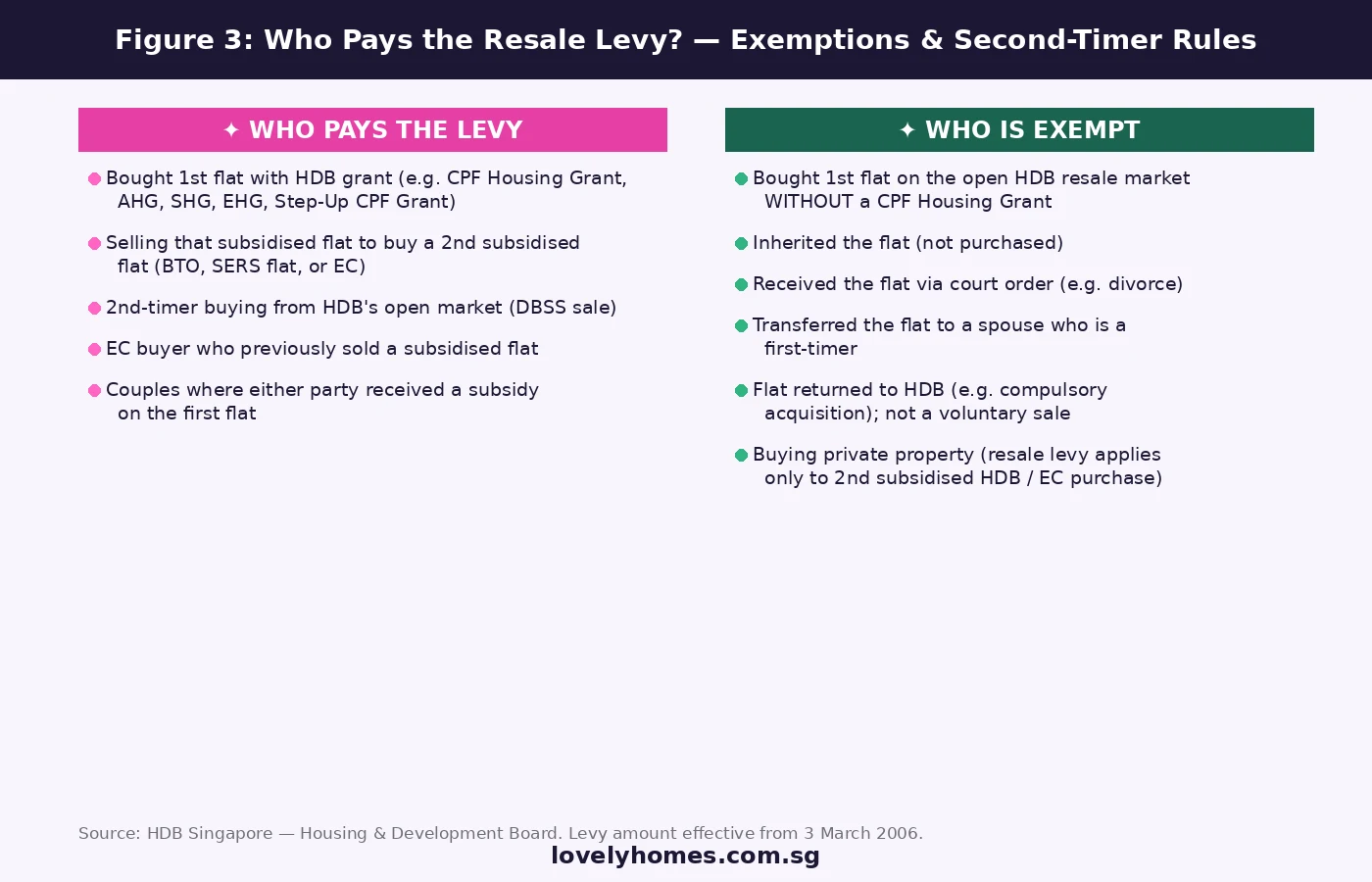
Not everyone who has previously owned an HDB flat will be required to pay the resale levy. Key exemptions include:

  • Resale flat purchased without a CPF Housing Grant: If you bought your first flat on the open HDB resale market and did not receive any CPF Housing Grant (Family Grant, Enhanced Housing Grant, Proximity Housing Grant, or any earlier-generation grant), you are not a “subsidised” flat owner for levy purposes. The levy reflects subsidy recovery — without a subsidy, there is nothing to recover.
  • Inherited flat: If the flat was left to you in a will or through intestacy, you did not receive a direct purchase subsidy, so the levy does not apply.
  • Court order transfer: Flats transferred to one party as part of a divorce settlement are generally exempt because the transfer is not a voluntary purchase attracting a subsidy.
  • Private property purchasers: The levy applies only when the second purchase is a subsidised BTO flat or EC. Upgraders to private property are not subject to the levy — though they face ABSD (Additional Buyer’s Stamp Duty) instead.
  • Flat returned to HDB involuntarily: If your first flat was compulsorily acquired by the government (e.g. for road widening or MRT works), this is not considered a voluntary sale and the levy is not triggered.

HDB resale levy exemptions and second-timer rules Singapore 2026 — who pays vs exempt
Figure 3: Who Pays vs Who Is Exempt — HDB Resale Levy 2026. Source: HDB Singapore.

Worked Example: The Tan Family’s Second BTO Application

Scenario

Mr and Mrs Tan (both Singapore Citizens) purchased a 4-Room BTO flat in Tampines in January 2019 at S$420,000, using a CPF Housing Grant of S$40,000. They have fulfilled the 5-year Minimum Occupation Period (MOP) and sell the flat in July 2026 for S$710,000.

They are applying for a new 5-Room BTO flat in Tengah at a subsidised price of S$620,000 — a second subsidised HDB purchase, making them second-timers.

Levy Calculation

Flat type sold 4-Room
Resale Levy payable S$40,000
Sale price of 1st flat S$710,000
Outstanding HDB loan (est.) S$235,000
CPF principal + accrued interest refund S$278,000
Levy deducted from CPF refund – S$40,000
Net CPF refund after levy S$238,000
Net cash proceeds S$710,000 − S$235,000 (loan) − S$278,000 (CPF) = S$197,000 cash

The Tans’ second flat purchase proceeds normally. The S$40,000 levy is handled automatically by HDB and CPF Board; neither party needs to make a separate payment. The net cash received is S$197,000, which can go toward the downpayment and costs of the new flat.

Special Situations and Edge Cases

EC Owners Selling and Buying a Second BTO

If you bought an EC (fully privatised after 10 years) and now wish to purchase a new BTO flat, you are subject to the resale levy at 5% of the EC’s resale price, subject to a maximum of S$55,000. Because EC prices have risen significantly — many ECs in mature estates now resale at S$1.2M–S$1.8M — the effective levy is almost always the capped S$55,000. For example, an EC sold for S$1.4M would attract a levy of S$70,000 in the absence of the cap; the cap holds it at S$55,000.

SERS Flat Recipients

Households that received a replacement flat under the Selective En-bloc Redevelopment Scheme (SERS) are treated as having received a housing subsidy. If they subsequently wish to buy a second new flat from HDB or an EC, the levy applies based on the type of flat they were re-housed in.

Divorce and Reassignment of Flat Ownership

When a flat is transferred to a divorced spouse under a court order, that spouse is considered a second-timer if the transferred flat was a subsidised purchase. If they later apply for a new BTO flat, the levy will apply. Seeking early legal advice on how divorce asset division affects CPF and HDB subsidy status is advisable.

Concurrent Applications

Some second-timers apply for a BTO flat while still occupying their first flat. HDB allows this — but the levy is held in reserve and deducted at the point of the first flat’s sale completion. You must sell your first flat within 6 months of collecting the keys to the second (this is the standard condition for second-timers purchasing new flats).

Why the Resale Levy Matters for Your Upgrade Strategy

The resale levy is one of several interlocking costs that second-timer households must budget for when planning an upgrade within the public housing system. It is easy to overlook because it is deducted automatically from CPF, making it feel invisible — but it directly reduces the cash and CPF resources available for your second flat.

Consider the total cost of a 4-Room BTO upgrade: beyond the flat price itself, a second-timer household must account for the Buyer’s Stamp Duty (BSD) on the new flat, legal fees, potential income grant reductions (second-timers receive smaller EHG amounts than first-timers), renovation costs, and the S$40,000 resale levy. These costs collectively can reduce the effective CPF buffer you have on hand.

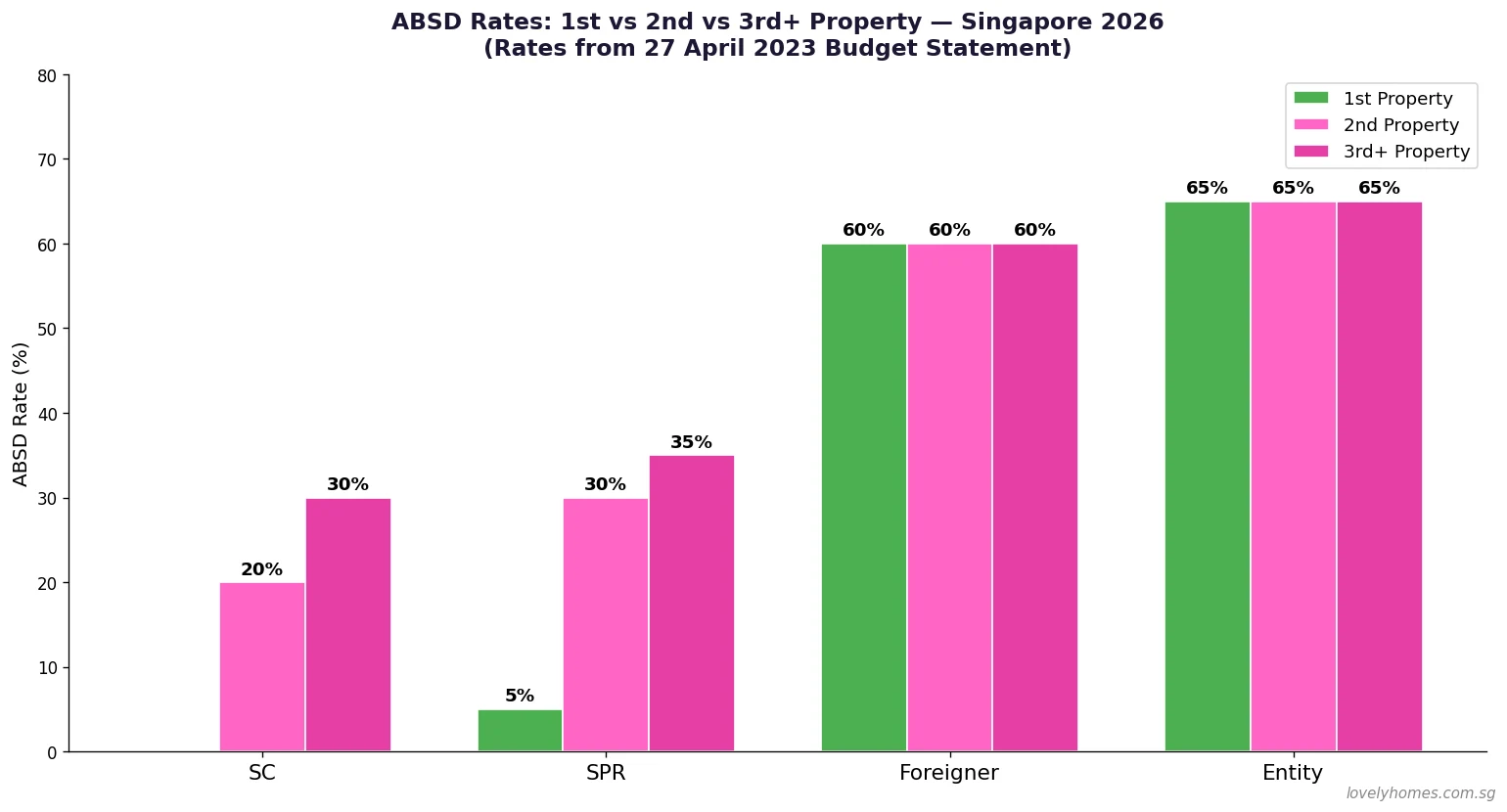
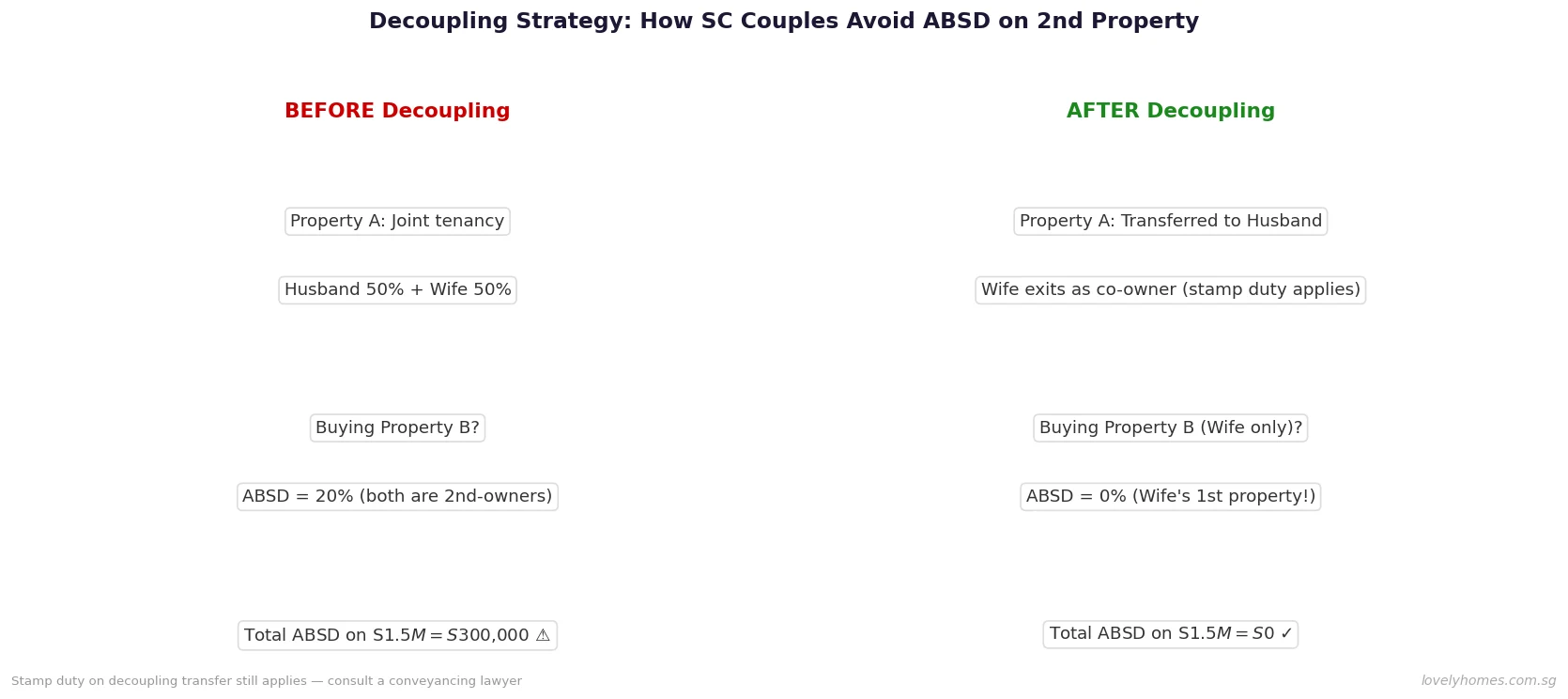
In contrast, upgrading to private property involves no resale levy — but attracts ABSD of 20% as a second property purchase (if you own the HDB flat at the time of buying private, and have not yet sold it). The ABSD on a S$1.5M private property would be S$300,000 — a very different magnitude. Households navigating this choice should consider the full cost picture of each route. Our ABSD Singapore 2026 Complete Guide and HDB Upgrader Guide 2026 cover the private-property upgrade path in detail.

Frequently Asked Questions — HDB Resale Levy 2026

Q1. Can I avoid the resale levy by selling my flat before applying for the BTO?

No. Your levy status is determined by your subsidy history, not by the sequence of sale and purchase. Whether you sell before or after booking the BTO flat, the levy still applies because you previously received a CPF Housing Grant. Selling early may give you more CPF OA funds to draw on, but it does not remove the levy obligation.

Q2. My spouse is a first-timer. Does the household still pay the levy?

Yes. HDB assesses the household as a unit. If either the main applicant or co-applicant has previously received a housing subsidy, the entire household is classified as a second-timer for levy purposes. There is no mechanism to apply as a “first-timer” household if one party is a second-timer. However, in this situation, the household may be eligible for a reduced levy in some cases — consult HDB directly for your specific profile.

Q3. Is the resale levy the same as the CPF accrued interest I must return?

No — these are two completely different obligations. CPF accrued interest (at 2.5% p.a.) is the amount you owe your own CPF account for the OA savings you withdrew to pay for the flat. It is returned to your OA upon sale — you are repaying yourself. The resale levy, in contrast, is paid to HDB as a subsidy recovery charge. Both deductions happen at the point of sale, but they serve entirely different purposes and go to different places.

Q4. Can I use CPF to pay the resale levy, or must it come from cash?

The levy is deducted automatically from the CPF OA refund you receive when your first flat is sold. You do not need to arrange a separate cash payment unless your CPF refund is insufficient to cover the levy — in which case HDB will require the shortfall in cash before releasing the booking fee for your new flat. Always check your estimated CPF refund against the applicable levy amount before committing to a second BTO booking.

Q5. Does the resale levy apply if I buy an EC as a first-time EC buyer but sold an earlier subsidised flat?

Yes. If you are buying an EC and you previously sold a subsidised HDB flat, the resale levy is payable. The EC levy is the higher of: 5% of the resale price of your sold flat or (if you are selling a non-EC subsidised flat) the flat-type levy amount — unless you are selling the EC itself, in which case it is 5% of the EC’s resale price (capped S$55,000). HDB’s levy assessment letter, issued before your EC booking, will specify the exact amount applicable to your situation.

Q6. Has the HDB resale levy changed recently? Will it increase?

The flat-type levy rates have been unchanged since 3 March 2006. As at July 2026, there has been no announcement by HDB or the Ministry of National Development (MND) of any impending change to the levy framework. Given that BTO prices have risen considerably since 2006, some analysts have speculated that a levy increase is overdue — but this is speculative. Decisions on the levy are policy matters resting with MND. Monitor HDB press releases and MND Budget announcements for any changes.

Q7. What happens if I cannot sell my first flat in time to pay the levy before the second flat completion?

Second-timers purchasing a new HDB flat must generally sell their existing flat within 6 months of collecting the keys to the new flat. If you have not sold your first flat by the time you need to complete the purchase of the new flat, HDB may defer key collection or require you to arrange an interim cash payment for the levy amount. Contact HDB directly if your sale is delayed — they may grant a time extension in genuine cases, but this is not guaranteed and is assessed case by case.

Related Articles

Disclaimer: The information in this article is intended for general educational purposes only. HDB policies, levy amounts, and eligibility rules can change. Always verify current requirements directly with the Housing & Development Board (HDB), the CPF Board, and the Ministry of National Development (MND). This article does not constitute financial, legal, or property advice. Consult a licensed property agent (CEA-registered), a qualified financial adviser, or a solicitor for advice specific to your situation.

×

Click anywhere outside to close

HDB Resale Flat Prices Singapore 2026: Complete Guide to Trends, COV and Valuations

HDB Resale Flat Prices Singapore 2026: Complete Guide to Trends, COV and Valuations

Quick Answer: HDB Resale Flat Prices in Singapore 2026

  • 4-room flats transact at a national median of S$498,000 in Q1 2026, up from S$448,000 in 2024.
  • 5-room flats reached a median of S$610,000 in Q1 2026; Executive Maisonettes hit S$710,000.
  • Mature estates like Bukit Timah and Queenstown command 4-room premiums above S$700,000.
  • The HDB Resale Price Index (RPI) stood at 183.1 in Q1 2026, up 8.7 points from Q1 2020.
  • Cash Over Valuation (COV) is the amount paid above HDB’s assessed value — it must be paid in cash, not CPF.
  • HDB resale prices are moderated by the Minimum Occupation Period (MOP), lease decay, and proximity grants.
  • Prices are expected to grow modestly (1–3% annually) through 2026, supported by tight BTO supply and strong household formation.

What Are HDB Resale Flat Prices and How Are They Set?

When you purchase a Housing and Development Board (HDB) resale flat, you are buying from a private seller in the open market — not directly from HDB. The price is negotiated between buyer and seller, but must reflect market conditions and is informed by HDB’s Comparable Transaction data and the official valuation commissioned by the buyer’s bank or HDB loan officer.

Unlike BTO (Build-To-Order) flats, where HDB sets the selling price with subsidies applied, resale flat prices are driven by supply and demand. Factors include the flat’s lease remaining, floor level, renovation condition, proximity to MRT stations and top primary schools, estate amenities, and recent comparable transactions in the same block or vicinity.

HDB monitors and reports resale transaction data every quarter via the HDB Resale Price Index (RPI) and releases median transaction prices by flat type and town. This transparency helps buyers and sellers negotiate from an informed position.

HDB Resale Prices by Flat Type: 2024 vs Q1 2026

Resale prices have risen consistently across all flat types since 2020. The table below and Figure 1 compare median transacted prices in 2024 versus Q1 2026.

HDB resale median prices by flat type 2024 vs Q1 2026 Singapore bar chart
Figure 1: Median HDB resale prices by flat type — 2024 vs Q1 2026. Source: HDB Resale Statistics.
Flat Type 2024 Median Q1 2026 Median Change
2-Room Flexi S$285,000 S$295,000 +3.5%
3-Room S$315,000 S$348,000 +10.5%
4-Room S$448,000 S$498,000 +11.2%
5-Room S$570,000 S$610,000 +7.0%
Executive / Maisonette S$658,000 S$710,000 +7.9%

Source: HDB Resale Statistics. Figures are national medians; individual transactions vary by town, floor, and condition.

Understanding the HDB Resale Price Index (RPI)

The HDB Resale Price Index (RPI) is published by HDB every quarter. It tracks the overall movement of resale flat prices relative to a base period (Q1 2009 = 100). It is the closest equivalent to a benchmark price index for the HDB resale market — similar in concept to the URA Private Residential Property Index for the private market.

In Q1 2026, the RPI stood at 183.1, meaning resale prices are 83.1% higher in nominal terms than they were in Q1 2009. The rate of increase has slowed significantly since the sharp pandemic-era run-up of 2021–2022, when prices rose almost 25 points in two years. The market has since entered a plateau phase with modest quarterly gains of 0.2–0.4%.

HDB Resale Price Index trend Q1 2020 to Q1 2026 Singapore
Figure 2: HDB Resale Price Index (RPI), Q1 2020 – Q1 2026. Base: Q1 2009 = 100. Source: HDB Resale Statistics.

The RPI is a useful trend indicator but does not tell you what any specific flat will transact at. The HDB Resale Portal’s Check Past Resale Transactions tool gives block-level data, which is far more actionable for buyers negotiating a specific unit.

HDB Resale Prices by Town: Where Are Prices Highest?

Resale prices vary enormously by location. The same flat type can fetch more than double in a mature, well-connected estate versus a young non-mature town. Figure 3 shows indicative Q1 2026 median 4-room prices for the ten most actively transacted towns.

HDB resale 4-room flat median prices by town Q1 2026 Singapore
Figure 3: Indicative median 4-room HDB resale prices by town, Q1 2026. Source: HDB Resale Statistics and LovelyHomes analysis.

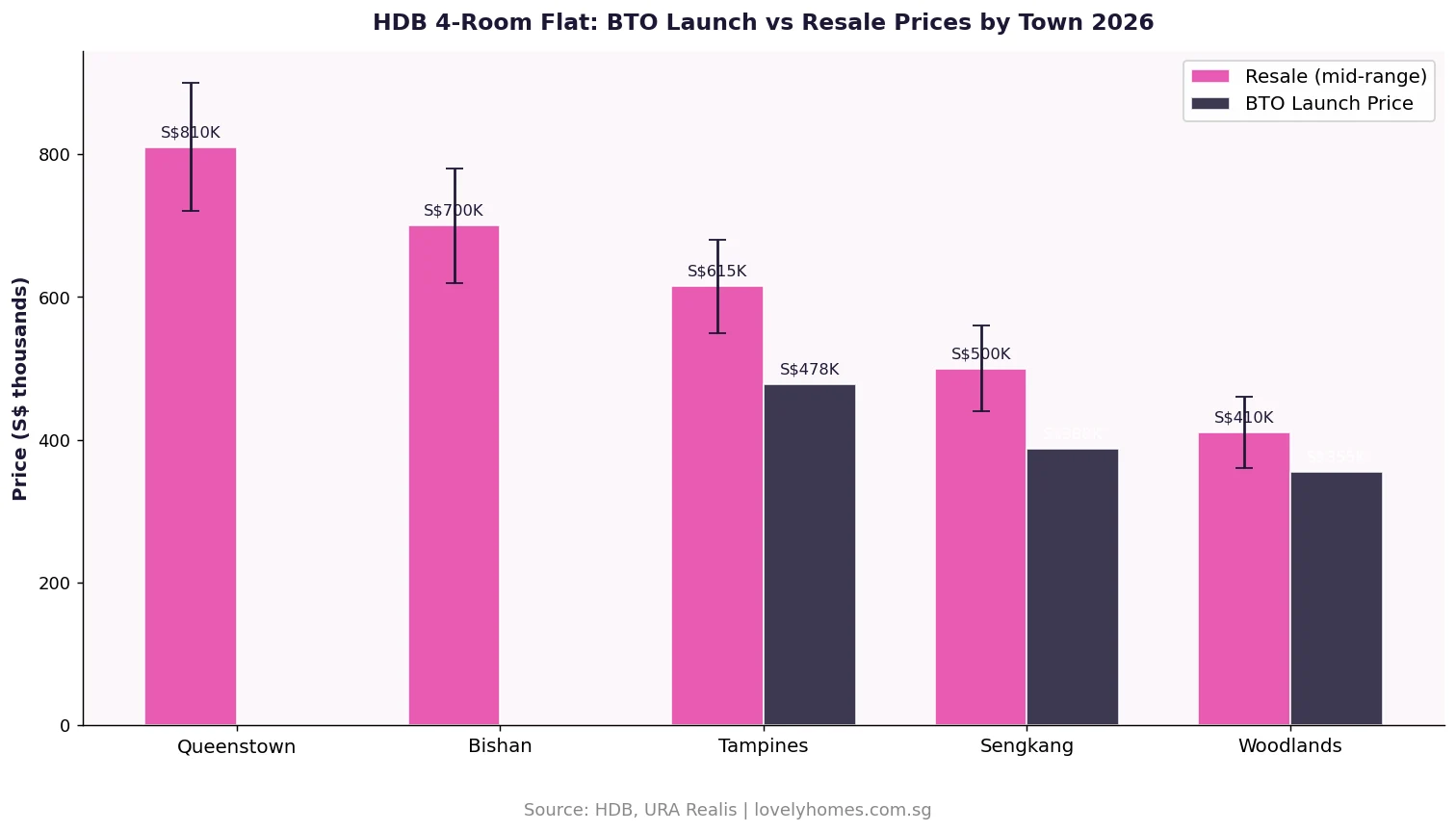
Bukit Timah (S$810,000), Queenstown (S$720,000), and Bishan (S$660,000) lead the premium tier, driven by central location, proximity to top primary schools (Nanyang, Henry Park, Raffles Girls’), and strong upgrader demand. At the other end, Sengkang (S$495,000) and Hougang (S$510,000) remain among the most affordable mature-ish estates with good MRT coverage.

What Drives HDB Resale Prices?

Understanding the key price drivers helps buyers estimate fair value and sellers price competitively. The main factors are:

1. Location and connectivity. Proximity to MRT stations (within 500 metres) adds a meaningful premium. Flats within 1 km of top primary schools command a further uplift due to the MOE P1 registration priority system — see our guide to buying near top schools.

2. Remaining lease. HDB flats are sold on 99-year leases from the date of construction. A flat with 70 years remaining is worth more than one with 50 years, because CPF usage is restricted for flats with shorter leases — specifically, if the flat’s remaining lease cannot cover the youngest buyer to age 95, CPF usage is prorated. Banks also apply stricter LTV ratios on short-lease flats. The HDB Lease Buyback Scheme and Lease Top-Up programme can extend some leases, but this remains a minority option.

3. Flat condition and renovation. Buyers frequently pay a S$20,000–S$80,000 premium for freshly renovated units with quality kitchen and bathroom fittings, versus an unrennovated unit in the same block. However, overbuilt or highly customised renovations do not recover their full cost at resale.

4. Floor level and orientation. High-floor units with unobstructed views or favourable orientations (e.g., north-south facing to minimise afternoon sun) attract 5–15% premiums over low-floor equivalents in the same block.

5. Flat size (actual square footage). HDB flat-type naming covers a range of actual sizes. A “4-room” flat can be anywhere from 80 to 110 square metres depending on the development era. Buyers should always divide the asking price by the actual size in square metres to compare on a per-square-metre basis.

6. HDB upgrading works. Flats that have completed the Home Improvement Programme (HIP) or Neighbourhood Renewal Programme (NRP) typically command a S$20,000–S$40,000 premium over pre-HIP equivalents, as buyers factor in avoided costs and improved common-area aesthetics.

Cash Over Valuation (COV) Explained

One of the most misunderstood concepts in HDB resale is Cash Over Valuation (COV). When a buyer agrees to pay a price higher than the official valuation of the flat (determined by an accredited valuer appointed by HDB, the buyer’s bank, or HDB’s own valuation office), the excess is the COV — and it must be paid entirely in cash. CPF Ordinary Account funds can only be used up to the officially assessed market value.

For example, if a flat is valued at S$550,000 but the negotiated transacted price is S$575,000, the COV is S$25,000. This S$25,000 must come from cash savings, not CPF. It is paid on top of the standard cash and CPF downpayments for the loan.

COV is common in popular estates and for well-renovated flats. Buyers should check the HDB Resale Portal at resale.hdb.gov.sg for recent transactions in the target block to gauge whether COV is likely and at what level before making an offer.

Worked Example: The Chew Family

Scenario: SC Couple Buying a 5-Room Flat in Tampines

Mr and Mrs Chew are Singapore Citizens. Mr Chew (34) earns S$6,200/month; Mrs Chew (33) earns S$5,100/month. Joint monthly income: S$11,300. They have S$120,000 in CPF Ordinary Account (combined) and S$60,000 in cash savings. They are first-time buyers and have never owned any property.

  • Target flat: 5-room HDB in Tampines, 92 sqm, lease commenced 2001 (remaining ~74 years), renovated 2022.
  • Negotiated price: S$640,000
  • Official valuation: S$618,000
  • COV: S$640,000 − S$618,000 = S$22,000 (cash, not CPF)
  • HDB loan (2.6% p.a., 25 years, LTV 80%): S$494,400 → monthly instalment S$2,240/month
  • MSR check: S$2,240 ÷ S$11,300 = 19.8% (below 30% MSR cap — PASS)
  • CPF downpayment: 20% × S$618,000 (valuation) = S$123,600 → covered by combined CPF OA of S$120,000 + S$3,600 top-up in cash
  • Cash required at exercise: COV S$22,000 + BSD S$12,950 + Legal S$2,800 + HDB admin fee S$80 + CPF shortfall S$3,600 = S$41,430
  • CPF Housing Grants applied: EHG S$50,000 (income S$11,300/mth, eligible) + Family Grant S$50,000 (resale 5-room) = S$100,000 total grants applied against purchase price via CPF OA

Result: The Chews’ effective net price after grants is S$540,000. Monthly instalment of S$2,240 is comfortably within the MSR. Their cash outlay of S$41,430 is manageable given their S$60,000 in savings. They retain approximately S$18,570 in liquid cash after the purchase.

Why HDB Resale Values Hold Up — and When They Don’t

Singapore’s public housing market has historically been resilient because HDB flats serve a fundamental shelter function for the majority of the population. Several structural factors support resale values:

Eligibility restrictions keep demand concentrated. Only Singapore Citizens and Permanent Residents may purchase HDB flats. This excludes the largest category of buyers (foreigners) who are entirely channelled into the private market. Within the eligible pool, demand is strong: household formation rates remain high, BTO supply takes 3–5 years to deliver, and the resale market is the only avenue for those needing a home now.

CPF integration creates a floor price. For most HDB buyers, CPF Ordinary Account savings constitute a large part of the downpayment. This effectively creates a price floor, as buyers are willing to commit CPF savings they might otherwise lose access to if they do not purchase a property. The CPF accrued interest mechanism means sellers must refund CPF usage plus accrued interest on sale, which effectively anchors the minimum sale price needed to recover the seller’s CPF commitment.

When values can soften. Short-lease flats (below 60 years remaining) face structural headwinds: CPF usage restrictions, tighter bank LTV, and lower pool of eligible buyers. Estates where residents have grown older without sufficient HIP investment, or where population resettlement has reduced catchment size, may also see below-average growth. A flat approaching 40–50 years of lease expiry may see steep valuation discounts.

What Might Come Next for HDB Resale Prices?

This section represents editorial analysis and forward-looking opinion, not a guarantee of future price performance.

The HDB resale market is likely to grow at a modest 1–3% annualised rate through 2026 and into 2027, based on the following dynamics. BTO supply delivered in 2023–2024 (from launches in 2020–2021) will start reaching MOP from 2025 onwards, gradually increasing resale supply. However, the June 2026 BTO exercise offering 6,900 flats in popular towns (Bishan, Bukit Merah, Ang Mo Kio) will only arrive on the resale market in 2031–2033 at the earliest.

Interest rate trends matter too. If the Singapore Overnight Rate Average (SORA) continues declining through 2026, bank loan attractiveness relative to the HDB loan (fixed at 2.6% p.a.) shifts. A sustained decline in SORA could bring more buyers back to the market, supporting demand for resale flats, particularly among those who prefer immediate occupation over the 3–5 year BTO wait.

Prime Location Public Housing (PLH) flats with 10-year MOPs, and any further cooling measures, could dampen speculative demand at the top end. However, the entry-level and mid-tier resale segments (3-room and 4-room in non-mature estates) appear structurally well-supported.

Summary Table: HDB Resale Prices at a Glance (Q1 2026)

Flat Type National Median Premium Town Range Affordable Town Range
2-Room Flexi S$295,000 S$380,000–S$450,000 S$220,000–S$270,000
3-Room S$348,000 S$480,000–S$650,000 S$280,000–S$330,000
4-Room S$498,000 S$650,000–S$900,000+ S$400,000–S$480,000
5-Room S$610,000 S$750,000–S$1,000,000+ S$490,000–S$570,000
Executive / Maisonette S$710,000 S$850,000–S$1,100,000+ S$580,000–S$660,000

Frequently Asked Questions: HDB Resale Flat Prices

How do I find out the recent transacted prices for a specific HDB block?

Use the HDB Resale Flat Prices tool on the official HDB website at resale.hdb.gov.sg. You can filter by town, flat type, street name, and period. The tool shows every registered resale transaction, including the transacted price, floor area, storey range, and flat model. This is the most reliable data source for gauging fair value for a specific unit. The URA Real Estate Information System (REALIS) also contains HDB transaction data for subscribers.

Are HDB million-dollar flats common, and what drives them?

HDB resale flats transacting above S$1,000,000 (colloquially called “million-dollar flats”) have become more frequent since 2022. They are overwhelmingly concentrated in mature central estates (Queenstown, Bishan, Toa Payoh, Ang Mo Kio) for large flat types (5-room, Executive Maisonette) on high floors with long remaining leases. In Q1 2026, approximately 80–120 units per quarter transact above S$1,000,000 — this represents less than 2% of total quarterly transactions and is not representative of the broader market. Most resale flats transact between S$300,000 and S$700,000.

Can I use CPF to pay COV?

No. Cash Over Valuation must be paid entirely in cash. CPF Ordinary Account funds can only be applied towards the purchase price up to the officially assessed valuation. If you agree to pay S$560,000 for a flat valued at S$540,000, the S$20,000 COV must come from your cash savings. This is an important planning point — buyers who have substantial CPF balances but limited cash savings may be unable to purchase a flat with a high COV without additional cash top-ups.

How does the Ethnic Integration Policy (EIP) affect resale prices?

The Ethnic Integration Policy (EIP) sets racial proportion limits for each HDB block and neighbourhood. If a block has already reached its Chinese, Malay, or Indian/Other quota for a given ethnic group, buyers of that ethnicity cannot purchase in that block — effectively reducing the pool of eligible buyers. When a block is at or near quota for a popular ethnic group, this can exert downward pressure on transacted prices because fewer buyers qualify. Conversely, a block with open quota availability across all ethnic groups attracts the widest buyer pool and tends to transact at or above comparable blocks with restricted quotas.

Does a shorter lease always mean a lower price?

Generally yes, but the discount is non-linear and depends on specific thresholds. Flats with more than 60 years remaining trade relatively normally. Once a flat’s remaining lease falls below 60 years, CPF restrictions begin to phase in — the amount of CPF that can be used is prorated based on how long the flat’s lease can cover the youngest buyer to age 95. Below 30 years remaining, the flat becomes effectively cash-only, dramatically reducing the buyer pool. Short-lease flats in desirable locations (e.g., Queenstown or Toa Payoh) may still trade at substantial absolute prices due to location premium, but will not appreciate at the same rate as longer-lease counterparts.

What happens to a flat’s price after HDB’s Selective En Bloc Redevelopment Scheme (SERS)?

When HDB announces a SERS for a block, the announcement itself typically causes an immediate uplift in nearby comparable flat prices as the market anticipates compensation plus new-flat allocation. However, SERS is administered selectively by HDB and cannot be applied for by residents — it is announced by HDB when redevelopment is deemed appropriate for planning reasons. Fewer than 5% of HDB estates have ever been selected for SERS, so it is not a reliable investment thesis for most buyers.

How do HDB resale prices compare internationally?

HDB resale flats remain remarkably affordable relative to comparable housing in global cities despite recent price growth. A national median 4-room flat at S$498,000 represents approximately 4–5 years of median household income for a dual-income SC couple — a price-to-income ratio that is far more favourable than Hong Kong, Sydney, or London. The key enabler is Singapore’s CPF-linked savings system, which channels mandatory pension contributions directly into housing affordability, and the Ethnic Integration Policy, which distributes demand across the island rather than concentrating it in a few prime postcodes.

Related Articles


Disclaimer: The information in this article is for general educational purposes only and does not constitute financial, investment, or legal advice. HDB resale flat prices, Resale Price Index figures, grant amounts, and loan parameters are subject to change. Always verify current data directly with the Housing and Development Board (hdb.gov.sg), CPF Board (cpf.gov.sg), IRAS (iras.gov.sg), and the Monetary Authority of Singapore (mas.gov.sg). Property transactions involve significant sums — engage a licensed housing agent accredited by the Council for Estate Agencies (CEA) and a solicitor for conveyancing before committing to any purchase.

HDB Resale Process Singapore 2026: Step-by-Step Guide from OTP to Key Collection

HDB Resale Process Singapore 2026: Step-by-Step Guide from OTP to Key Collection

Quick Answer: HDB Resale Process 2026

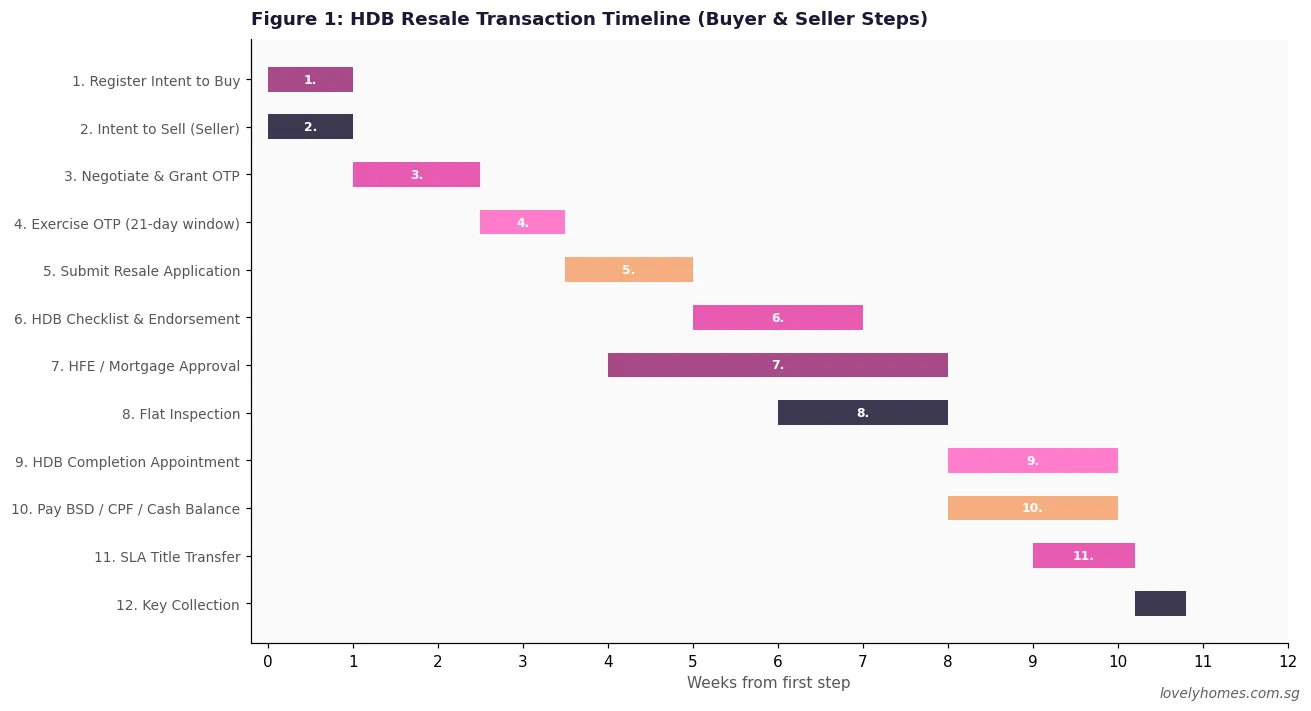
  • The HDB resale process typically takes 8–12 weeks from granting the Option to Purchase (OTP) to key collection.
  • Buyers must obtain an HDB Flat Eligibility (HFE) letter before granting or exercising an OTP — skipping this step is one of the most common costly mistakes.
  • Both buyer and seller register their intent on the HDB Resale Portal before any private negotiation. The portal manages all submissions, checklists, and appointment scheduling.
  • The OTP option fee is capped at S$1,000; the total option fee plus exercise fee cannot exceed S$5,000 (HDB administrative rule).
  • As of Q1 2026, the median HDB resale prices are: 3-room S$348K, 4-room S$498K, 5-room S$610K, Executive S$710K.
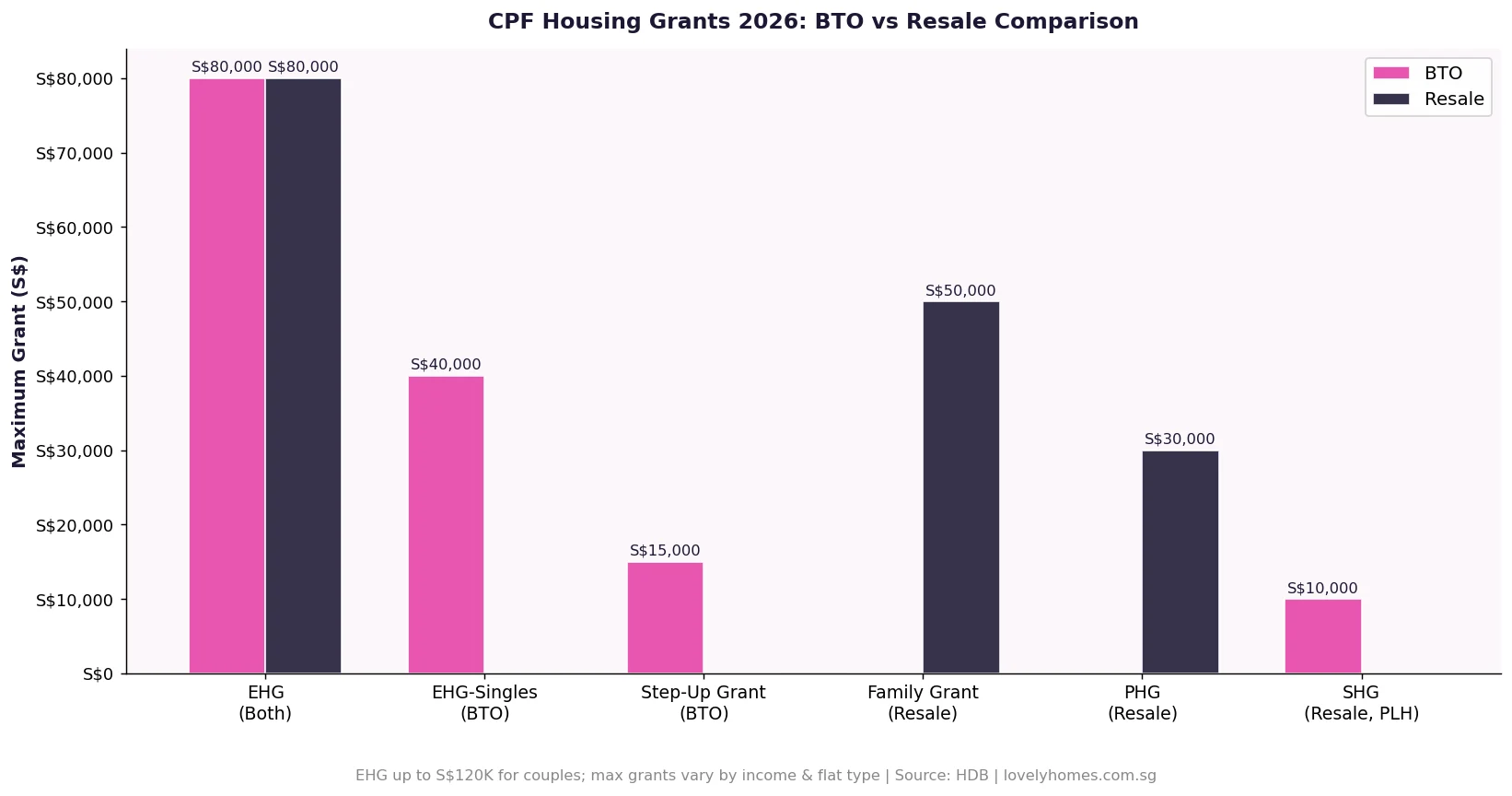
  • Resale flats are eligible for CPF Housing Grants including the Enhanced Housing Grant (up to S$120,000), the Family Grant (S$50,000), and the Proximity Housing Grant (S$30,000).
  • A buyer must meet the HDB eligibility conditions: at least one Singapore Citizen applicant, family nucleus, income ceiling (S$14,000 for resale with no income ceiling waiver), and the 30-month private property disposal requirement (if applicable).

The HDB Resale Market in 2026

Buying a resale HDB flat remains the most direct path to home ownership for many Singapore families. Unlike Build-To-Order (BTO) flats, resale units are available immediately — there is no construction wait of four to five years. You can inspect the actual flat, assess the neighbourhood, and negotiate directly with the existing owner. The tradeoff is price: resale flats generally command premiums over BTO prices, particularly for mature estates and well-located units.

In Q1 2026, HDB resale transaction volume remained robust at approximately 6,300 units, driven by the large cohort of flats completing their Minimum Occupation Period (MOP) — nearly 13,480 flats reached MOP in 2026 alone, roughly 70% more than in 2025. Resale prices have moderated from the 2022–2023 peak but remain elevated. The Housing & Development Board (HDB) continues to administer all resale transactions through its digital Resale Portal, which was significantly upgraded in 2022 to consolidate all buyer and seller steps in a single system.

Step 1: Check Eligibility and Obtain Your HFE Letter

The first practical step for any resale buyer is to apply for an HDB Flat Eligibility (HFE) letter via the HDB Resale Portal (accessible via Singpass at resale.hdb.gov.sg). The HFE letter replaces the former Eligibility Letter and is now mandatory — you cannot grant or exercise an OTP for an HDB resale flat without a valid HFE letter.

The HFE letter confirms your eligibility to purchase (flat type, location restrictions, income ceiling), the CPF Housing Grants you qualify for, and the maximum HDB loan you can obtain. It is valid for nine months from the date of issue. The application processing time is typically three to five working days.

Eligibility conditions for Singapore Citizens purchasing a resale HDB flat in 2026 include: at least one SC in the family nucleus, a minimum of one other member in the family nucleus (spouse, fiancé/e, parent, child, or sibling), no private property ownership by any applicant within the past 30 months, income not exceeding S$14,000/month for families (S$7,000 for singles), and compliance with the Ethnic Integration Policy (EIP) and Singapore Permanent Resident (SPR) Quota for the block.

Step 2: Register Intent to Buy (and Intent to Sell)

Once your HFE letter is in hand, register your Intent to Buy on the HDB Resale Portal. This is a formal declaration that you are actively seeking a resale flat and locks in your eligibility status for the transaction. Simultaneously, the seller must register their Intent to Sell before granting the OTP — a seller who issues an OTP without having registered their Intent to Sell is in breach of HDB procedures. Both registrations are free and can be done online. The Intent to Sell also auto-runs an eligibility check for the seller, confirming their right to sell and any Resale Levy payable.

At this stage, buyers typically engage a property agent (optional but strongly recommended for first-timers), shortlist units on HDB’s MyHDBPage or property portals, and begin flat viewings. When viewing a flat, confirm: the Ethnic Integration Policy (EIP) quota for your ethnicity at that block, the remaining lease (and its CPF implications), the Annual Value for property tax estimation, and any outstanding town council arrears the seller is responsible for clearing before completion.

Step 3: Negotiate and Grant the Option to Purchase (OTP)

The Option to Purchase (OTP) is a legally binding contract granting the buyer the exclusive right to purchase the flat at the agreed price within 21 calendar days. The seller issues the OTP after agreeing on the price and terms. Key parameters:

  • Option Fee: Paid upon signing the OTP, up to S$1,000 (negotiated between parties). This is non-refundable if the buyer does not exercise the OTP.
  • Option Period: 21 calendar days from the OTP date.
  • Exercise Fee: Paid when exercising the OTP. Total option fee + exercise fee cannot exceed S$5,000.
  • Cash Over Valuation (COV): If the agreed price exceeds HDB’s assessed market value, the excess must be paid fully in cash — CPF cannot be used for COV. COV can range from S$0 to over S$50,000 depending on demand for the specific unit.

Before exercising the OTP, buyers should commission a professional valuation (if not already done by HDB), confirm their bank or HDB loan quantum, and ensure sufficient CPF OA funds for the downpayment and instalment servicing.

HDB resale process timeline Singapore 2026 step by step OTP to key collection
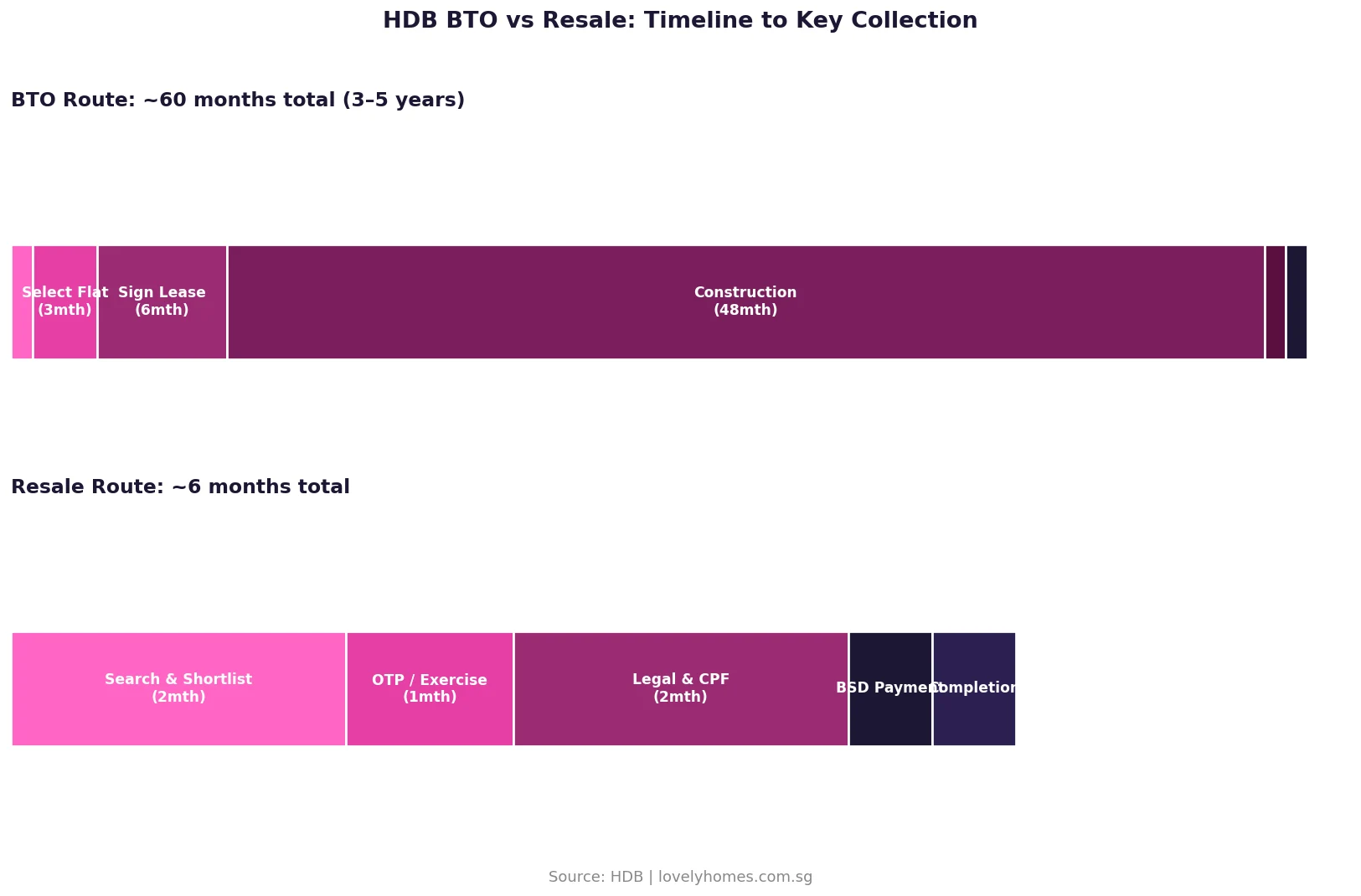
Figure 1: Complete HDB resale transaction timeline showing parallel buyer and seller steps. The typical transaction completes in 8–12 weeks from OTP granting, subject to HDB appointment availability.

Step 4: Exercise the OTP and Submit the Resale Application

To exercise the OTP, the buyer signs the “Acceptance to Purchase” section and pays the exercise fee before the 21-day option period expires. Within 7 calendar days of exercising the OTP, both buyer and seller must submit their respective halves of the Resale Application on the HDB Resale Portal. The submission is a critical legal step — failure to submit within 7 days of the other party’s submission voids the application and may lead to the OTP being treated as lapsed.

Each party submits their part independently: the buyer uploads financial documentation (HFE letter, CPF statements, mortgage approval letter) while the seller uploads proof of ownership, HDB flat particulars, and any relevant declarations. HDB issues a confirmation of receipt and a Resale Checklist for each party to sign and acknowledge before the transaction can proceed.

Step 5: HDB Valuation, Checklist Endorsement, and Mortgage Approval

After submission, HDB arranges a valuation of the flat by one of its approved valuers (the cost, approximately S$120–S$180, is borne by the buyer). The valuation determines the market value for CPF and grant purposes. Buyers should note: if the purchase price exceeds the valuation, the excess (COV) must be paid in cash at completion.

The HDB Resale Checklist — a legal document — must be endorsed by both parties via the portal. It confirms that both sides have understood key policies: MOP rules (the buyer’s new five-year MOP clock begins from key collection), flat eligibility conditions, CPF usage rules, and grant terms. For buyers using a bank loan, the formal Loan Offer Letter from the bank must also be submitted at this stage.

For buyers using a HDB Concessionary Loan (available to eligible Singapore Citizen households with income below S$7,000/month), the HFE letter already contains the loan quantum. For bank loans, buyers must have received a formal Loan Offer Letter (typically secured after the HFE letter stage) with the interest rate, tenure, and monthly repayment confirmed.

Step 6: HDB Completion Appointment and Key Collection

HDB schedules the completion appointment typically within 6–8 weeks of accepting the Resale Application. At the completion appointment (held at HDB Hub, Toa Payoh), the title of the property is formally transferred from seller to buyer. Both parties, or their solicitors, must attend. The following payments are settled at or before completion:

  • Buyer’s Stamp Duty (BSD) — must be paid within 14 days of OTP exercise or 14 days of completion, whichever is earlier. Payable via IRAS e-Stamping.
  • Outstanding purchase price balance — funded by the bank loan disbursement, CPF OA, and any cash balance (including COV).
  • Seller’s outstanding CPF refund — the seller’s CPF principal plus accrued interest is deducted from the sale proceeds and returned to the seller’s CPF OA.
  • HDB resale administrative fee — S$80 for each party.

After the completion appointment, keys are handed over, and the buyer’s five-year MOP period begins. The Singapore Land Authority (SLA) registers the transfer, and the buyer becomes the registered owner in the land register within a few working days.

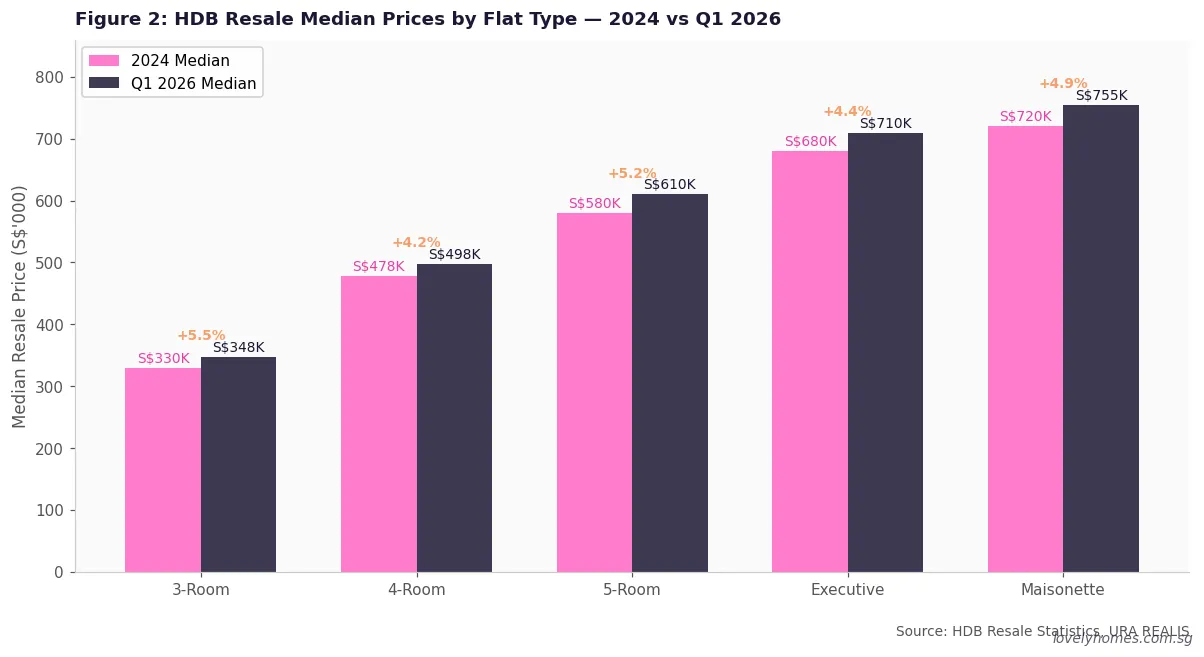
HDB resale median prices by flat type 2024 vs Q1 2026 Singapore property market
Figure 2: HDB resale median prices by flat type — 2024 versus Q1 2026. All flat types recorded positive growth, with 5-room flats (+5.2%) and Executive flats (+4.4%) leading the uptick.

Financing Your HDB Resale Purchase

Buyers have two primary financing options for a resale HDB flat: an HDB Concessionary Loan or a bank loan. The HDB loan is available only to Singapore Citizen-led households with no existing private property and income below S$7,000/month (or S$3,500 for single applicants). It offers 75% LTV (down from 80% in August 2024), no cash downpayment requirement, and a fixed rate tied to CPF OA rate + 0.1% (currently 2.6% p.a.). The full comparison is covered in our HDB Loan vs Bank Loan Guide 2026.

Bank loans offer lower interest rates (typically 1.5%–2.2% fixed for the first 2–3 years in mid-2026) but require a minimum 5% cash downpayment and are subject to the Monetary Authority of Singapore’s Total Debt Servicing Ratio (TDSR, 55%) and Mortgage Servicing Ratio (MSR, 30% of gross income for HDB property). The MSR cap of 30% is the binding constraint for most HDB buyers. A couple earning S$9,000/month combined is capped at S$2,700/month mortgage, which at 2.0% over 25 years supports a loan of approximately S$514,000.

CPF Housing Grants (EHG, Family Grant, PHG, Step-Up Grant) are applied against the purchase price and reduce the loan quantum needed. For eligible families buying a resale flat, total grants can reach S$200,000. See our CPF Housing Grant Guide 2026 for the full breakdown.

All-in Buyer Costs

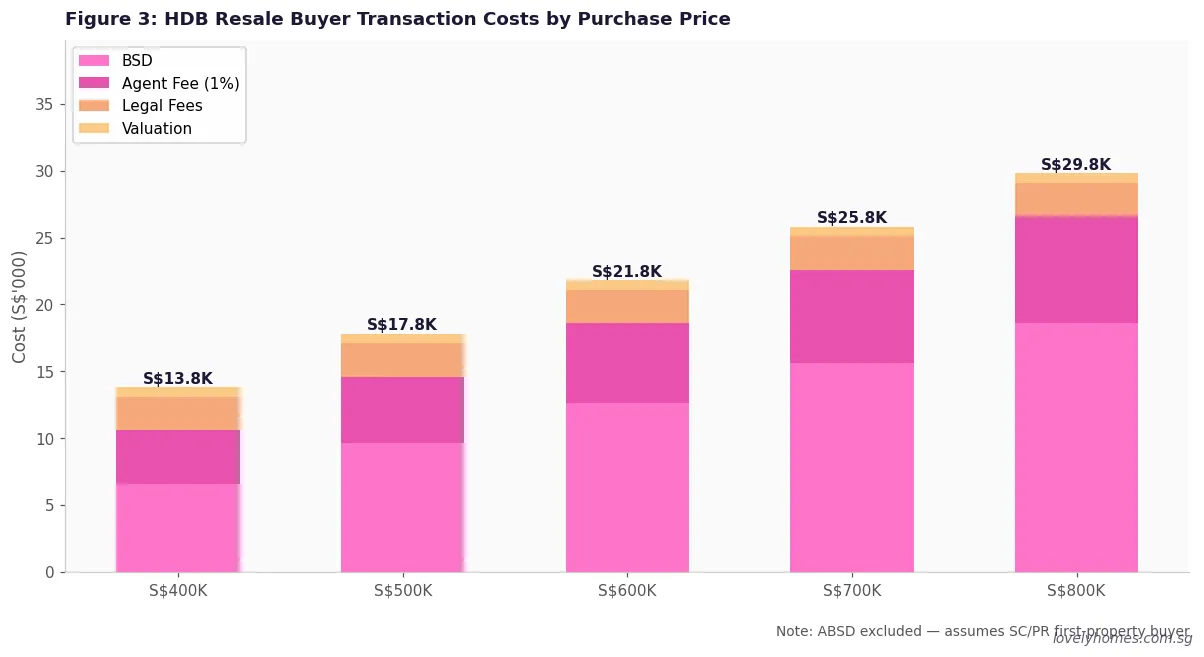
HDB resale buyer transaction costs BSD agent legal fees Singapore 2026
Figure 3: All-in buyer transaction costs for HDB resale purchases at five price points — S$400,000 to S$800,000. BSD is the largest transaction cost; agent commission at 1% and legal fees of approximately S$2,500 are the primary additional items.
Cost Item Who Pays Typical Amount Notes
Buyer’s Stamp Duty (BSD) Buyer S$5,400–S$20,600 (for S$400K–S$800K) Progressive rates 1%–6%; payable via IRAS e-Stamping
ABSD Buyer Nil (SC 1st property); 20% SC 2nd Most first-time buyers pay zero ABSD; HDB purchase counts as 1st property
Agent Commission Buyer (for buyer’s agent) ~1% of purchase price Seller pays 2% for seller’s agent
Legal Fees Buyer ~S$2,500–S$3,000 Conveyancing by HDB or appointed solicitor
Valuation Fee Buyer S$120–S$180 Arranged by HDB; determines CPF-eligible amount
HDB Admin Fee Buyer & Seller S$80 each Per party; paid at HDB completion appointment
Cash Over Valuation (COV) Buyer S$0–S$50,000+ (negotiated) Payable in cash only; CPF cannot be used

Worked Example: The Yeo Family

Mr and Mrs Yeo are Singapore Citizens (joint applicants, combined income S$8,500/month) purchasing a four-room resale flat in Tampines. They have an eligible HFE letter confirming: EHG S$45,000 (income S$8,500/month falls within the S$9,000 band for families), Family Grant S$50,000 (buying resale, both SC, first time applying for subsidy), and access to HDB loan at 75% LTV. The flat is offered at S$560,000 (valuated at S$558,000 — COV of S$2,000).

Item Amount
Purchase Price S$560,000
Less: EHG + Family Grant − S$95,000
Net price after grants S$465,000
HDB Loan (75% of S$558K valuation) S$418,500
CPF OA contribution (downpayment + ongoing) S$44,500
Cash for COV S$2,000
BSD (on S$560,000) S$11,400
ABSD Nil (SC 1st property)
Agent + Legal + Valuation + HDB Admin S$9,280
Total Cash Outlay ~S$22,680
Monthly HDB loan repayment (@2.6%, 25yr) S$1,894/month
MSR check: S$1,894 / S$8,500 22.3% — PASS (below 30%)

The Yeos’ total cash outlay of S$22,680 is very manageable, and their monthly repayment of S$1,894 comfortably clears the 30% MSR cap. Without the grants, their cash outlay would have been over S$117,000 — the grants are doing significant heavy lifting. Their new five-year MOP period starts from the day of key collection.

Common Mistakes to Avoid

The HDB resale process is well-documented, but buyers regularly stumble at several predictable points. Exercising an OTP before receiving the HFE letter is the single most consequential error — buyers have been forced to forfeit the option fee and restart the process after discovering ineligibility. Failing to check the Ethnic Integration Policy (EIP) quota before viewing is another: if your ethnicity’s quota for a block is already full, you cannot purchase in that block regardless of price or seller willingness.

On the financing side, many buyers secure informal bank “approval-in-principle” letters rather than formal Loan Offer Letters — these are not the same thing, and only the formal letter satisfies HDB’s submission requirements. Buyers should also verify their CPF OA balance accounts for the downpayment, ongoing instalments, BSD, and a buffer for unexpected costs before committing to an OTP price. Our guide on Singapore property downpayment requirements 2026 explains the full cash and CPF calculation.

What Might Come Next

This section reflects editorial analysis and is not official HDB policy.

HDB has signalled an intent to keep resale flat supply elevated through 2026 and 2027, with the large cohort of MOP-completing flats adding to available stock. The policy priority of affordable home ownership, reaffirmed in Budget 2026, supports the continued availability of EHG grants. There is ongoing academic and policy debate about whether COV — which is not tracked publicly — is re-emerging as a significant affordability barrier in mature estates.

The HDB Resale Portal is scheduled for a further update in late 2026 to integrate more seamlessly with SLA’s e-conveyancing platform, potentially reducing the completion timeline to below eight weeks for straightforward transactions. Buyers should track announcements at hdb.gov.sg.

FAQ: HDB Resale Process 2026

Do I need a property agent to buy a resale HDB flat?

No — HDB’s Resale Portal is designed for direct buyer-seller transactions without agents. However, most buyers and sellers engage agents for negotiation support, paperwork management, and expertise in checking EIP quotas, valuation, and neighbourhood comparables. Buyers do not pay agent commission for new launch properties, but for resale HDB they typically pay 1% commission to their own agent (the seller pays 2% to theirs). Using an agent registered with the Council for Estate Agencies (CEA) is strongly recommended; you can verify any agent’s registration at the CEA Public Register at cea.gov.sg.

What happens if the HDB valuation comes in below the agreed purchase price?

If HDB’s appointed valuer assesses the flat below the negotiated price, the difference (Cash Over Valuation, or COV) must be paid in cash — you cannot use CPF for COV. For example, if you agreed to pay S$580,000 but HDB values the flat at S$560,000, you owe S$20,000 COV in cash. Many buyers include a valuation clause in the OTP negotiations to give them the right to renegotiate or withdraw if the COV exceeds a specified amount, though sellers in a hot market may resist such clauses.

Can a Singapore Permanent Resident buy an HDB resale flat?

Yes, a Singapore PR may purchase an HDB resale flat as a joint purchaser with a Singapore Citizen (the essential occupier rule still requires at least one SC in the household). An SPR household (both applicants are PR and neither is SC) cannot buy an HDB flat. Additionally, SPR buyers are subject to a 5% ABSD on their first residential property purchase. An SPR couple buying a resale HDB where both are PR would pay 5% ABSD on top of BSD and other costs. The relevant ABSD rates are explained in our ABSD Singapore 2026 complete guide.

What is the difference between the Resale Checklist and the Option to Purchase?

The Option to Purchase (OTP) is a private contract between buyer and seller, granting the buyer an exclusive right to purchase at the agreed price within 21 days. The HDB Resale Checklist is a separate HDB administrative document — submitted via the Resale Portal — that both parties must acknowledge before HDB will process the resale application. The checklist confirms that both parties understand their legal obligations regarding MOP, CPF refunds, grant terms, and HDB regulations. Failing to submit the checklist endorsement within the required window delays the transaction and may require resubmission of the entire application.

Does buying an HDB resale flat affect my ability to buy a private property later?

Yes — once you buy any HDB flat (BTO or resale), you own an HDB property. If you subsequently wish to purchase a private residential property, you must either sell the HDB flat first (and observe HDB’s rules on timing and MOP) or hold both simultaneously and pay 20% ABSD as a Singapore Citizen buying a second property. For upgraders, the standard strategy is to sell the HDB flat within 6 months of purchasing the private property (for ABSD remission purposes) or to complete the HDB MOP before purchasing the private property. See our Stamp Duty Remission Guide 2026 for upgrader remission timing rules.

What happens to the seller’s outstanding CPF at completion?

When an HDB flat is sold, the seller’s CPF principal drawn plus accrued interest (at 2.5% p.a.) is deducted from the sale proceeds and returned to the seller’s CPF OA. This is not optional — it is a statutory obligation under the Central Provident Fund Act. The seller’s conveyancing solicitor or HDB will calculate the exact refund amount, which is paid directly by the buyer’s bank (or HDB loan disbursement) to the seller’s CPF account before the net cash balance is released to the seller. Long-term owners are sometimes surprised to find the CPF refund consumes much of the apparent price gain — our guide on CPF accrued interest for property 2026 explains this in detail.

Can I buy an HDB resale flat if I currently own a private property overseas?

Yes, with conditions. If you own private residential property overseas, you are not automatically disqualified from buying an HDB resale flat. However, from 9 May 2023 onwards, Singapore Citizen buyers of HDB flats (new or resale) who own private residential property — whether in Singapore or overseas — must dispose of that private property within six months of key collection. You also pay 20% ABSD on the HDB resale purchase if you already own one or more properties (including overseas ones) at the time of purchase, though you may apply for ABSD remission on disposal if you meet HDB’s approved buyer criteria.

Related Articles

Disclaimer

This article is for general informational purposes only and does not constitute financial, legal, or property advice. HDB eligibility conditions, grant amounts, loan rules, and stamp duty rates are subject to change. Always verify current HDB resale requirements at hdb.gov.sg and current CPF rules at cpf.gov.sg. Stamp duty rates are administered by IRAS at iras.gov.sg. For personalised guidance, engage a property agent registered with the Council for Estate Agencies (CEA) and, for financial planning, a licensed adviser regulated by MAS. LovelyHomes.com.sg accepts no liability for reliance on the information contained herein.


Click anywhere to close

Singapore Condo MCST Guide 2026: Maintenance Fees, AGM, By-Laws and Your Rights as a Subsidiary Proprietor

Singapore Condo MCST Guide 2026: Maintenance Fees, AGM, By-Laws and Your Rights as a Subsidiary Proprietor

Every condominium and privatised executive condominium in Singapore is governed by a Management Corporation Strata Title — the MCST. If you own a condo unit, you are automatically a member of the MCST. The monthly maintenance fees that hit your bank account, the Annual General Meeting (AGM) notice that lands in your letter box each year, the by-law that governs what colour your front door can be, the sinking fund that pays for the carpark resurfacing in 2030 — all of this flows from the MCST framework.

Yet the MCST is one of the least understood aspects of condo ownership in Singapore. Most buyers ask about price, location, and facilities; few ask about management fee trajectory, sinking fund adequacy, or the quality of the Management Council before they sign. This guide fixes that gap. It explains how MCSTs work, what your rights and obligations are as a Subsidiary Proprietor (SP), how maintenance fees are set, what the AGM process involves, and how to handle disputes — covering the full framework under the Building Maintenance and Strata Management Act (BMSMA) Cap 30C, administered by the Building and Construction Authority (BCA) and adjudicated at the Strata Titles Board (STB).

Quick Answer — MCST at a Glance

  • Every condo or privatised EC is automatically governed by an MCST from the moment the first subsidiary strata certificate of title is issued. You cannot opt out.
  • As a unit owner (Subsidiary Proprietor / SP), you must pay monthly contributions — a management fund charge (for day-to-day operations) and a sinking fund charge (for capital works). Together these form your “maintenance fee”.
  • The MCST is governed by an elected Management Council (MC) of up to 10 councillors chosen at the AGM. Day-to-day operations are usually delegated to a Managing Agent (MA).
  • The AGM must be held once a year. SPs can vote on the annual budget, elect the MC, pass special resolutions (which require a 75% majority by share value), and raise issues via a general meeting.
  • Typical monthly maintenance fees in 2026 range from about S$250 (studio in budget condo) to S$1,700+ (4BR in premium development).
  • The sinking fund must by law be maintained at no less than 10% of the total annual contributions, but most well-managed developments target significantly more.
  • Disputes between SPs and the MCST — or between SPs — are adjudicated by the Strata Titles Board (STB), which is a specialist tribunal under the BMSMA.
  • Before buying a condo, check the MCST’s annual accounts, AGM minutes, and sinking fund balance. A poorly managed MCST with a depleted sinking fund is a major hidden liability.

What Is an MCST?

An MCST — Management Corporation Strata Title — is the legal body that owns, manages, and maintains the common property of a strata-titled development. Common property is everything that is not part of an individual lot — the pool, gym, lobby, lifts, carpark, garden, external façade, rooftop, and all the pipes and cables running through the common areas. The MCST is a body corporate under the BMSMA: it can sue and be sued, enter contracts, hold bank accounts, and own property (specifically, the common property it manages).

Singapore’s MCST system derives from the Strata Titles Act (Cap 158) and the BMSMA. The MCST is formed automatically when the Commissioner of Buildings registers the strata roll. Each MCST has a unique strata title plan number — e.g., “MCST No. 1234” — which is filed with the Singapore Land Authority (SLA). An MCST covers exactly one strata development. There is no such thing as a shared MCST across multiple developments.

Share Values — The Key to MCST Voting and Fees

Each lot (unit) in the development is assigned a share value by the Singapore Land Authority at the time the strata plan is approved. Share values are calculated based on the floor area of the unit relative to all units in the development. A 2BR unit of 800 sqft in a development with a total share value of 1,000 might be assigned a share value of 8. Share values matter for two reasons: they determine your proportionate share of the maintenance fees; and they determine your voting weight at general meetings (each share value = one vote).

Singapore MCST monthly maintenance fees by condo tier and unit size 2026
Figure 1: Indicative Monthly MCST Maintenance Fees by Condo Tier & Unit Size (Singapore 2026). Click to expand.

The Management Fund and Sinking Fund

MCSTs collect contributions through two separate accounts, both mandatory under the BMSMA:

Management Fund

The management fund covers the operational costs of running the development. This includes the MA’s fees, security guard salaries and contracts, utilities for common areas, cleaning and landscaping, lift maintenance, swimming pool upkeep, pest control, insurance premiums (for fire and public liability), and minor repairs. The management fund is essentially the development’s operating budget.

Sinking Fund

The sinking fund is a capital reserve for major, long-term works — repainting the external façade, replacing the lifts (typically every 20–25 years), resurfacing the carpark, upgrading the security system, replacing ageing pipes, and replacing major mechanical and electrical plant. Under BMSMA s.38(4), the sinking fund must be maintained at no less than 10% of total annual contributions. In practice, a well-managed development that is 15+ years old will typically hold a sinking fund equal to 2–5 years of total annual contributions.

Typical Maintenance Fee Ranges in 2026

Singapore’s maintenance fee landscape in 2026 spans a wide range depending on development tier, facilities, and unit size. Industry figures suggest the following broad ranges:

Development Tier Studio / 1BR 2BR 3BR 4BR+
Budget / Small Boutique (<300 units, basic facilities) S$250–S$320 S$370–S$470 S$470–S$600 S$650–S$900
Mid-Tier (300–600 units, pool/gym/function room) S$320–S$450 S$500–S$700 S$700–S$950 S$950–S$1,250
Premium / Full-Facilities (600+ units, concierge, indoor sports, spa) S$500–S$700 S$800–S$1,100 S$1,100–S$1,500 S$1,500–S$2,500+

These are indicative only. In a large development like Tampines Concourse or The Pinnacle@Duxton (if it were private), the lower per-unit cost benefits from economies of scale. A boutique development of 20 units with a rooftop pool will have a disproportionately high per-unit fee because the fixed costs are spread over fewer owners. Maintenance fee rates are set annually by the MC at the AGM and can increase over time, particularly as buildings age and require more expensive maintenance.

The Management Council — How Your Condo Is Governed

The Management Council (MC) is elected at the AGM by the SPs of the development. The MC is responsible for the management and control of the use and enjoyment of the common property, and for carrying out the powers and duties of the MCST under the BMSMA. The MC can have up to 10 councillors. It elects a Chairperson, Secretary, and Treasurer from among its members. MC meetings are typically held monthly or bi-monthly.

In practice, many MC councillors are owner-occupiers with a genuine stake in how well the development is managed. Inactive or absentee-dominated MCs — where the majority of councillors are landlords who do not live in the development — can lead to conflicts between short-term cost minimisation and the long-term wellbeing of the asset. Owner-occupiers buying for the long term should consider attending AGMs and, if they have the time, standing for election to the MC.

Singapore MCST governance structure Management Council Managing Agent flowchart BMSMA 2026
Figure 2: MCST Governance Hierarchy — Subsidiary Proprietors, Management Council, and Managing Agent (BMSMA 2026). Click to expand.

The Managing Agent (MA)

Most MCSTs engage a professional MA to handle the operational day-to-day work. Singapore’s leading MAs include CBRE Property Management, Savills Property Management, Jones Lang LaSalle, Knight Frank Property Asset Management, and a number of specialist condo management firms. The MA is hired by and reports to the MC. The MA does not own or control the MCST — it is a contractor. The MA’s contract is typically a 1-to-3-year appointment, renewed (or re-tendered) at the MC’s discretion.

The MA typically handles: collection of maintenance fees, payment of invoices, procurement of service contracts (lifts, security, pest control), organising the AGM, keeping strata roll records, liaising with BCA on regulatory compliance, and managing day-to-day resident queries and complaints.

The Annual General Meeting (AGM)

The AGM is the primary mechanism through which SPs exercise democratic control over their MCST. Under BMSMA s.27, the first AGM must be held within 13 months of the MCST’s formation. Thereafter, the AGM must be held at least once every calendar year and not more than 15 months after the preceding AGM. Most Singapore condominiums hold their AGM between January and April, after the financial year end.

Standard AGM Agenda

A typical AGM agenda includes: (1) adoption of the previous year’s financial accounts and auditor’s report; (2) approval of the budget for the coming financial year (management fund and sinking fund contributions); (3) election of the Management Council; (4) appointment of the auditor; (5) any motions submitted by SPs; and (6) any other business. The budget approval item is the most consequential — it sets the monthly maintenance fee for the year ahead.

Voting at the AGM

Votes at an AGM are counted in one of two ways depending on the resolution type. Ordinary resolutions (routine decisions like budget approval and election of councillors) are decided by a simple majority of the share values of SPs present and voting. Special resolutions (which include significant changes like amending by-laws, changing the method of allocation of contributions, or entering major contracts above a threshold) require 75% of the share values of all SPs — not just those present. This is a high bar and means that contentious changes to how a development is managed require broad consensus.

Extraordinary General Meetings (EGMs)

EGMs can be called between AGMs by the MC, or by SPs representing at least 25% of the total share value submitting a written requisition. EGMs are used for urgent decisions — unexpected major repairs, a change of MA, or resolutions that cannot wait for the next AGM. The notice requirements for an EGM are the same as for an AGM: at least 14 days’ written notice must be given to all SPs.

Singapore MCST annual calendar AGM milestones condo management cycle 2026
Figure 3: MCST Annual Calendar — Key Milestones & AGM Cycle for Singapore Condominiums (BMSMA 2026). Click to expand.

By-Laws — What You Can and Cannot Do in Your Condo

By-laws are the rules that govern behaviour within a strata development. The BMSMA prescribes a set of default by-laws in the Second Schedule that apply to every development unless specifically amended by a special resolution at a general meeting. These default by-laws cover matters such as: not interfering with the peaceful enjoyment of other lots; keeping animals only with MC approval; not hanging laundry on the external façade; not obstructing common property; not making structural alterations without MC approval; and not creating noise nuisance.

Developments may add their own by-laws to supplement the statutory defaults. A development with a strict “no pets” policy, a ban on short-term rentals (Airbnb is already prohibited by law in Singapore for stays under 3 months), or a rule requiring parquet flooring to be covered by rugs to reduce noise transmission, can encode these in its registered by-laws. Registered by-laws are binding on all SPs, tenants, and residents — including buyers who purchase the unit after the by-law was registered.

Before buying a resale condo, ask your solicitor to obtain the MCST’s registered by-laws and review them carefully. A by-law prohibiting pets, for instance, may not be waivable even with the MC’s informal approval — the by-law governs.

Your Rights and Obligations as a Subsidiary Proprietor

As an SP, you have a set of substantive rights and corresponding obligations under the BMSMA:

Your Rights Your Obligations
Attend and vote at AGMs/EGMs Pay maintenance contributions on time (late fees apply)
Stand for election to the Management Council Comply with MCST by-laws and the BMSMA
Inspect the MCST’s financial accounts and strata roll Obtain MC approval before carrying out renovations affecting common property or load-bearing structures
Submit motions for consideration at general meetings Not cause nuisance or hazard to other residents
Apply to the Strata Titles Board to resolve disputes Maintain your lot in good repair so as not to damage common property
Share in the common property proportionate to share value Not carry out alterations to common property without consent

Renovation Approvals — The Most Common Flashpoint

Renovation disputes are the most frequent source of conflict in Singapore condominiums. The key rules under the BMSMA and HDB/BCA guidelines (for SPs who engage licensed renovation contractors) are: any works that affect or penetrate the floor slab, any works that affect the common property (including the external façade, windows, and any shared walls), and any hacking or structural works, require prior MC approval. The SP must submit a renovation application to the MA with details of the works, the contractor’s name and licence number, and drawings or specifications as required. The MC has the right to inspect the works and to require rectification if the works deviate from what was approved.

The MA will typically send a renovation notice to neighbours within the affected units before works commence. Renovation hours are governed by the BMSMA and the NEA: Monday to Saturday 9am–6pm; no works on Sundays and public holidays.

Dispute Resolution — The Strata Titles Board

The Strata Titles Board (STB) is the specialist tribunal established under the BMSMA to adjudicate disputes arising in strata developments. Filing a complaint with the STB is significantly cheaper and faster than going to court. The STB handles disputes between SPs, between SPs and the MCST/MC, and between the MCST and its MA. Common STB applications include: enforcement of by-laws; disputes over maintenance fee quantum; improper conduct at AGMs; failure of the MCST to carry out repairs; and disputes over the validity of a special resolution.

Before filing at the STB, parties are required to attempt mediation at the Singapore Mediation Centre (SMC). Many condo disputes — particularly neighbour noise complaints and renovation disputes — are resolved at mediation without proceeding to a full STB hearing.

Worked Example — Buying a Resale Condo: MCST Due Diligence

Ms Chen is purchasing a resale 3BR condominium in the East Coast (D15) for S$1,650,000. Before exercising the OTP, her solicitor requests the following MCST documents from the vendor’s solicitor:

  • The most recent 3 years of annual financial accounts (management fund and sinking fund audited statements).
  • The last 2 years of AGM minutes.
  • The current year’s approved budget and contribution rates.
  • Any outstanding arrears on the unit being purchased.
  • A copy of the registered by-laws (including any special by-laws passed since the development was completed).
  • Any pending special levies or special assessments (capital works that have been voted for at an AGM but not yet reflected in the monthly maintenance fee).

From the accounts, she notes that the sinking fund stands at S$1.2M for a 180-unit development — approximately S$6,700 per unit. Given the development is 18 years old and will need a major façade repainting and lift replacement within the next 5 years (estimated cost: S$2.5M), she raises with her agent that the sinking fund appears under-funded. At the AGM 3 months earlier, a special levy of S$3,000 per unit was voted through to top up the sinking fund. This is a real cash cost she factors into her budget. Armed with this analysis, she negotiates a S$20,000 price reduction. Monthly maintenance fee: S$780 (her 3BR unit’s share value × contribution rate of S$5.50 per share value per month).

What Might Change — MCST Reform and BCA Digitalisation

The BCA has been progressively digitalising MCST administration. By 2025, all MCST annual accounts and AGM minutes must be filed electronically with BCA via the Integrated Property Management System (IPMS). This creates a searchable public record of every registered MCST in Singapore — a significant transparency improvement for prospective buyers conducting due diligence. The BCA has also been reviewing minimum sinking fund contribution requirements, with a proposal to increase the 10% minimum for older developments (15 years+) to better reflect actual capital expenditure needs. Any regulatory change here would increase monthly fees for owners of older condominiums.

Frequently Asked Questions

Can the MCST prevent me from renting out my unit?

Generally, no. The MCST cannot prohibit an SP from renting out their lot — the right to rent out a freehold or leasehold unit is a fundamental property right. However, the MCST can and typically does require: (a) advance notice of any tenancy and the tenant’s details for the strata roll; (b) the SP to ensure the tenant complies with all MCST by-laws; and (c) that tenancy periods comply with the legal minimum of 3 months (short-term rentals are prohibited in Singapore for all private residential properties). If a tenant repeatedly violates by-laws, the MCST can take action against the SP (as the lot owner responsible for the tenant’s conduct) rather than against the tenant directly.

What happens if I do not pay my maintenance fees?

Under BMSMA s.40, the MCST may recover unpaid contributions as a debt due in any court. The MA will first send reminder letters and impose late payment charges (typically 2–5% per month on the overdue amount, as specified in the by-laws). If the arrears persist, the MCST may obtain a judgment against the SP and register a charge against the unit on the land register — effectively a lien on the property that must be discharged before any sale can proceed. In extreme cases, the MCST may apply for a court order for the sale of the unit to recover arrears, although this is rare in practice. Arrears do not disappear on a change of ownership — buyers should confirm there are no outstanding contributions before completing a resale purchase.

How is the monthly maintenance fee calculated for my specific unit?

Your monthly maintenance fee is calculated as: your share value × the contribution rate per share value per month. The MC sets the contribution rate annually at the AGM when it approves the budget. For example, if your unit has a share value of 8 and the MC has approved a contribution rate of S$60 per share value per month, your monthly maintenance fee is S$480. Within that, the split between management fund and sinking fund contributions is also set by the MC, subject to the BMSMA minimum sinking fund requirement. Your share value is fixed at the time the strata plan is registered and can only be changed by a unanimous resolution of all SPs plus approval from the Commissioner of Buildings — a very high bar in practice.

Can I paint my front door a different colour?

This is one of the most asked questions in Singapore condo forums. The answer depends on whether your front door is considered part of your lot or part of the common property, and whether the development’s by-laws specify approved colours. In most strata developments, the front door is considered a boundary element: the outer surface (facing the common corridor) is common property; the inner surface (facing your unit) is your property. This means you generally cannot change the exterior colour of your door without MC approval. Some developments have standardised door colours as part of the building’s design consistency and enforce this via by-law. Check the development’s by-laws and ask the MA before making any exterior changes.

What is a Special Levy and can the MC impose one without an AGM?

A special levy is a one-time additional contribution charged to SPs to fund a specific capital project — for example, an urgent roof repair, replacing ageing air-handling units, or upgrading the security system beyond what the sinking fund can cover. Under the BMSMA, the MC can impose a special levy for urgent works (where waiting for the AGM would cause disproportionate damage) without first convening a general meeting, but must seek ratification at the next general meeting. For non-urgent capital works, a special levy should ideally be approved by a general meeting before it is imposed. The quantum of the levy is typically proportionate to share value, so each SP pays in line with their proportionate interest in the development.

How do I check the sinking fund health of a condo before buying?

Request the MCST’s audited annual accounts for the past 3 years from the vendor’s solicitor or the MA. The sinking fund balance will appear as a liability in the MCST’s balance sheet. To assess adequacy, compare the sinking fund balance to the development’s age and condition, and any Capital Expenditure Plan (CapEx plan) that the MCST or MA has prepared. A useful rule of thumb: a development that is 10–15 years old in good condition should have a sinking fund of at least S$5,000–S$10,000 per unit; a development over 20 years old should ideally have S$15,000+ per unit. These are rough benchmarks — actual adequacy depends on the specific works required. Also review the AGM minutes for any discussions of upcoming capital works that may trigger a special levy.

Can I attend an AGM as a tenant rather than an owner?

No. Only Subsidiary Proprietors (unit owners) and their authorised proxies may attend and vote at MCST general meetings. Tenants have no standing at the AGM and cannot vote on MCST matters. If you are an SP but cannot attend the AGM in person, you may appoint a proxy by submitting a duly executed proxy form before the meeting. The proxy can be any person — it does not have to be another SP. If you rent out your unit and want a say in how the development is managed, you must attend the AGM personally or appoint a proxy.

Related Articles

Disclaimer

This article is published for general informational and educational purposes only. It does not constitute legal, financial, or property management advice. MCST rules, BMSMA provisions, and BCA regulations are subject to amendment. Always refer to the BCA BMSMA resources and the Building Maintenance and Strata Management Act on Singapore Statutes Online for authoritative guidance. For specific MCST disputes or governance issues, consult a Singapore-qualified lawyer or the Strata Titles Board. Maintenance fee figures quoted are indicative industry estimates and will vary by development.

Singapore HDB BTO Application Guide 2026: Eligibility, HFE Letter, Balloting and Key Collection Explained

Singapore HDB BTO Application Guide 2026: Eligibility, HFE Letter, Balloting and Key Collection Explained

📌 Quick Answer: HDB BTO Application 2026

  • BTO (Build-To-Order) flats are HDB flats built after a sales application — you apply first, HDB builds to the number of units needed, so there is no speculative inventory.
  • Eligibility essentials: at least one Singapore Citizen applicant, combined household income at or below the flat-type ceiling (S$7,000–S$14,000), and no private property ownership in the 30 months before application.
  • The HDB Flat Eligibility (HFE) Letter is now mandatory before you can submit a BTO application — obtain it through the MyHDBPage portal with Singpass; it takes about 2–3 weeks.
  • BTO exercises are held roughly 4–5 times per year; each exercise lists flats in multiple towns, with application windows typically 5–7 days.
  • A successful ballot means you are invited to select a flat during a flat selection appointment; unsuccessful applicants join the queue for subsequent exercises.
  • Completion times range from 3 to 4.5 years after booking, depending on the project and site conditions.
  • Standard Minimum Occupation Period (MOP) is 5 years from the date of key collection. Plus and Prime model flats carry a 10-year MOP and resale restrictions.
  • Grants available: Enhanced CPF Housing Grant (EHG) up to S$120,000 for families, S$60,000 for singles; Proximity Housing Grant (PHG) up to S$30,000 for buying near parents.

What Is an HDB BTO Flat and How Does It Work?

The Build-To-Order (BTO) scheme is the Housing & Development Board’s primary mechanism for supplying new public housing to eligible Singapore households. Unlike resale flats — which are purchased from existing owners on the open market — BTO flats are sold directly by HDB at subsidised prices before construction begins. HDB only proceeds with a project once sufficient applications have been received, hence the “build to order” terminology. This demand-led model keeps supply aligned with actual household formation needs and limits speculative overbuilding.

BTO flats come in a range of types from 2-Room Flexi (35–47 sqm) through to 5-Room (110–113 sqm) and the 3-Generation (3Gen) layout designed for multi-generational households. Prices are subsidised relative to private market equivalents; a 4-room BTO flat in a non-mature estate typically prices at S$350,000–S$520,000, compared to resale equivalents at S$490,000–S$720,000 in the same area. The subsidy is funded by HDB and supported through a system of CPF Housing Grants that further reduce the effective purchase price for eligible households.

The BTO process involves several distinct stages — eligibility checking, HFE letter application, ballot application, flat selection, signing of the lease, a construction wait of three to four-and-a-half years, and finally key collection and move-in. This guide walks through each stage in detail with the 2026-current rules, timelines, and the specific grant amounts that apply this year.

HDB BTO application to key collection timeline Singapore 2026
Figure 1: Typical HDB BTO Journey — From Eligibility Check to Key Collection (2026). Construction phase is 38–48 months for most projects. Source: HDB.

BTO Eligibility: Who Can Apply?

HDB BTO flats are available only to Singapore Citizens and, under certain schemes, Singapore Permanent Residents (PRs). The eligibility framework as at June 2026 is set out below.

Eligibility Criterion SC Family / Couple SC/PR Couple SC Single (35+)
Minimum age 21 years (main applicant) 21 years (SC applicant) 35 years
SC requirement At least 1 SC applicant SC + PR (PR must be spouse) Must be SC
Income ceiling (4-Room) S$10,000/mth combined S$10,000/mth combined S$7,000/mth
Income ceiling (5-Room / 3Gen) S$14,000/mth combined S$14,000/mth combined Not eligible for 5-Room
Private property rule No private property 30 mths before & at application Same Same
Flat types eligible All types All types 2-Room Flexi only
EHG grant available Up to S$120,000 Up to S$120,000 (if SC component) Up to S$60,000

Foreigners who are neither SC nor PR cannot apply for BTO flats under any scheme. PRs who are single also cannot apply. Under the SC/PR scheme, the PR must be the applicant’s spouse and must obtain SC status within a specified period after key collection or face resale restrictions. Additionally, applicants must not own or have disposed of any flat in a manner that disqualifies them under HDB’s ownership rules — for example, those who have previously received a HDB housing subsidy are not eligible for a second subsidised flat unless they meet specific criteria such as the Married Child Priority Scheme (MCPS) rules.

The HDB Flat Eligibility (HFE) Letter: Step One

Since May 2023, prospective BTO buyers must obtain a HDB Flat Eligibility (HFE) Letter before applying for a BTO flat. The HFE Letter replaced the old Housing Loan Eligibility (HLE) letter and the flat eligibility check — it combines both into a single document that confirms: (a) which flat types you are eligible to purchase; (b) the maximum HDB concessionary loan amount; and (c) the CPF Housing Grants you qualify for.

To apply for an HFE Letter, log in at hdb.gov.sg using Singpass. You will need to provide income documents (CPF contribution history is auto-retrieved), particulars of all household members, and details of any existing properties. HDB typically issues the HFE Letter within 21 business days. The letter is valid for 6 months; apply for it approximately one month before the BTO exercise opens to ensure it is ready in time.

HDB BTO June 2026 supply by town and flat type
Figure 2: HDB BTO June 2026 — Indicative Unit Supply by Town and Flat Type (approximately 6,900 units across 8 towns). Source: HDB (figures indicative based on announced supply).

Applying for a BTO Flat: The Exercise and Ballot

HDB launches BTO exercises approximately 4–5 times per year, typically in February, May, August, and November (with occasional additional exercises). Each exercise lists projects in multiple towns. The application window is usually 5–7 days, during which eligible applicants may submit one application per exercise via the HDB website or at an HDB Branch.

Key rules during application: applicants may apply for only one flat type in one town per exercise. An application requires a non-refundable application fee of S$10. Successful applicants in the 2-Room Flexi Ballot who do not eventually select a flat will have the S$10 refunded. Households with more children receive priority queue positions under the Parenthood Priority Scheme (PPS), and first-timers receive ballot priority over second-timers.

After the application window closes, HDB computer-ballots all applicants. Results are released approximately 3 weeks later. Successful applicants receive a ballot queue number and a flat selection appointment within approximately 3–6 months. If the ballot number is not reached (all flats selected before your turn), the applicant is treated as unsuccessful and is given an additional ballot chance (2nd timer status not triggered — first-timer status preserved for a stated number of unsuccessful attempts).

First-Timer Priority and Queue Balloting

HDB’s priority allocation system is designed to give first-time buyers and families with young children a better chance of success. In a standard BTO exercise, approximately 85–90% of flat supply is set aside for first-timers (those who have never owned or received a housing subsidy before). The remaining 10–15% is allocated to second-timers. Within the first-timer pool, the Parenthood Priority Scheme (PPS) reserves a further 30% of supply for families with Singaporean children aged 18 or below.

After three or more unsuccessful ballots, first-timer applicants (with children) may apply under the Additional Ballots Scheme, which gives them a higher chance. HDB has progressively expanded priority rules — from 2024, those who have collected a BTO flat and are applying again (e.g., for a larger flat after having more children) are classified as second-timers and face a smaller allocation pool.

HDB BTO eligibility by buyer profile Singapore 2026
Figure 3: HDB BTO Eligibility Assessment by Buyer Profile (2026). “Full” = fully eligible; “Partial” = eligible with conditions or restrictions. Source: HDB.

Flat Selection, Booking and Signing the Lease

Upon receiving a flat selection appointment, applicants visit an HDB Branch (or select online via the portal in more recent exercises) and choose their preferred unit from the remaining available options. At selection, a booking fee is payable: S$2,000 for 2-Room Flexi, S$4,000 for 3-Room, S$8,000 for 4-Room and 5-Room/3Gen (as at 2026; fees are reviewed periodically). The booking fee is non-refundable if you subsequently withdraw from the purchase.

After booking, HDB typically schedules the signing of the Agreement for Lease (Lease Agreement) within 4–6 months. At this appointment, applicants pay the down payment and stamp fees. For those taking an HDB concessionary loan, the down payment is 10% of the flat price (payable via CPF OA or cash); for those using a bank loan, the down payment is 25% (with 5% minimum in cash). Buyer’s Stamp Duty (BSD) is also payable at this stage. After signing, construction proceeds and buyers await key collection.

CPF Housing Grants for BTO Buyers (2026)

BTO buyers may be eligible for significant grant support that directly reduces the effective purchase price. As at June 2026, the key grants are:

  • Enhanced CPF Housing Grant (EHG): Up to S$120,000 for families (income ≤ S$9,000/mth average over 12 months before application) and up to S$60,000 for singles. The EHG is income-tiered — a family earning S$2,000/mth receives the full S$120,000; at S$9,000/mth, the grant is S$5,000. Effective from 20 August 2024.
  • CPF Housing Grant — Families (Family Grant): An additional S$10,000–S$30,000 for eligible first-timer families purchasing 4-Room or smaller BTO flats, depending on flat type and town classification.
  • Step-Up CPF Housing Grant: S$15,000 for second-timer SC families moving from a 2-Room to a 3-Room BTO flat.
  • Proximity Housing Grant (PHG): S$30,000 for buying within 4 km of parents’ or child’s home; S$20,000 for buying in the same town. Available for resale HDB purchases — not BTO directly, but may apply on the eventual resale.

Grants are disbursed as CPF credits into the recipient’s OA account, reducing the cash required at booking and lease signing. They do not reduce the outstanding loan; rather, they offset the cash/CPF down payment needed.

📌 Worked Example: Mr & Mrs Goh — First-Timer BTO Application, Tampines 4-Room

Mr Goh (SC, age 29) and Mrs Goh (SC, age 27) are first-timer applicants. Combined household income: S$7,200/mth (based on 12-month CPF contribution average). One child aged 2. They apply for a 4-room BTO flat in Tampines during the June 2026 BTO exercise, priced at S$478,000.

  • HFE Letter: Applied 30 days before exercise opens; issued in 16 business days. Confirms eligibility for 4-Room, HDB loan S$382,400 (80% LTV), EHG S$50,000 (income S$7,200 tier).
  • Ballot result: Successful; queue number 38 out of 220 applicants for 240 available units. Flat selection appointment in Month 4.
  • Flat price: S$478,000. Grants: EHG S$50,000 → effective price S$428,000.
  • Booking fee: S$8,000 (cash or NETS).
  • BSD: (1% × S$180,000) + (2% × S$180,000) + (3% × S$118,000) = S$1,800 + S$3,600 + S$3,540 = S$8,940 on S$478,000.
  • HDB Loan: S$382,400 at 2.6% p.a. over 25 years → monthly instalment S$1,731. MSR: S$1,731 ÷ S$7,200 = 24.0% ✓ (below 30% MSR limit).
  • Total upfront cash outlay at lease signing: Booking fee S$8,000 + down payment (10% S$47,800 less EHG S$50,000 already in CPF OA) → effectively S$5,800 cash + S$8,940 BSD (payable by CPF OA) = approximately S$14,740 in cash/CPF.
  • Key collection: Estimated 3 years 8 months from booking, approximately Q2 2030. MOP: 5 years from key collection date (standard flat).

Plus and Prime BTO Flats: Stricter Rules for Better Locations

From 2024, HDB restructured the BTO flat classification. “Standard” flats (in non-mature, non-central estates) carry the familiar 5-year MOP and standard resale/rental rules. “Plus” flats — in choicer locations such as Kallang/Whampoa, Queenstown fringe, and new towns with strong transport links — carry a 10-year MOP and cannot be rented out for the first 10 years. “Prime” flats — in the most central, highest-demand locations near the CBD and in mature estates — carry a 10-year MOP, are subject to a subsidy clawback on first resale (buyers must return a portion of their capital gain to HDB), and have additional resale restrictions to ensure the flats remain affordable for future first-timers. If you are considering a Plus or Prime flat, factor the longer holding period and clawback into your financial planning.

Why the BTO Route Matters for Most Singapore Families

For first-timer Singapore Citizens, the BTO route remains the most financially sound path to home ownership. The built-in subsidy can be S$100,000 or more relative to resale market prices in the same estate, and when layered with the EHG and other grants, the effective discount for a median-income family can approach S$200,000 over the life of ownership. The trade-off is the waiting period — typically three to four-and-a-half years from booking to key collection — which requires careful planning if you are currently renting or living with parents.

The Plus and Prime restructuring reflects HDB’s continuing effort to balance locational desirability with long-term affordability. By imposing longer MOPs and clawbacks on high-demand locations, HDB aims to prevent BTO flats from functioning as pure financial instruments for short-term gain, keeping them as genuine homes for resident families. For buyers who prize flexibility and liquidity, the standard resale market or an Executive Condominium (EC) may be more appropriate despite the higher entry cost.

📊 Upcoming BTO Exercises and Policy Signals (2026–2027)

This section reflects publicly available information and should not be treated as investment advice.

HDB has announced approximately 6,900 BTO units for the June 2026 exercise across Kallang/Whampoa, Queenstown, Bedok, Choa Chu Kang, Woodlands, Sembawang, Tengah, and Yishun. The next exercise is expected in August or September 2026, with further supply planned for Tengah (which is receiving the largest allocation as the new town builds up) and potentially a new site in the Jurong Lake District area. HDB’s annual BTO supply target for 2024–2025 was 19,000–20,000 units; this pipeline is expected to continue through 2027 to address the demand backlog from the COVID-era construction delays. Buyers who are unsuccessful in the June 2026 exercise should track MyNiceHome and the HDB press releases portal for the August–September launch announcement.

Frequently Asked Questions: HDB BTO Application 2026

How long does it take to get a BTO flat from application to key collection?

The total journey from submitting a BTO application to receiving your keys typically spans four to five years. Allow 2–3 weeks to obtain the HFE Letter, then 5–7 days for the application window. Ballot results are released in approximately 3 weeks; flat selection appointments are scheduled 3–6 months after that. Construction takes 38–48 months (roughly 3–4 years) from project launch. So the full door-to-door period is approximately 44–54 months, or about 4 years from application date. Some projects in non-mature estates have been delivered in under 40 months; complex urban-infill sites have taken longer. HDB publishes an estimated completion date for each project at the time of launch, which is the most reliable reference for your specific project.

Can Singapore Permanent Residents (PRs) apply for a BTO flat?

PRs can apply for a BTO flat only under the SC/PR scheme — that is, when they are applying jointly with a Singapore Citizen spouse. A PR cannot apply for a BTO flat on their own, nor can two PRs apply together. Under the SC/PR scheme, the PR must subsequently obtain Singapore Citizenship within a specified period after key collection (HDB’s latest requirement is that the PR spouse applies for citizenship if they have not done so within a reasonable time). PR singles and unmarried PR couples are not eligible for BTO. PRs who are single or not applying with an SC spouse should consider the HDB resale market under the HDB resale rules for PRs, which permit PR family/couple applications for resale flats.

What is the income ceiling for BTO flats in 2026?

The income ceiling depends on the flat type. For 2-Room Flexi and 3-Room BTO flats, the ceiling is S$7,000 per month gross household income. For 4-Room flats, the ceiling is S$10,000 per month. For 5-Room and 3-Generation (3Gen) flats, the ceiling is S$14,000 per month. Income is assessed based on the average gross monthly income over the 12 months preceding the application. Bonuses, commission, and variable pay are included in the calculation. For self-employed or commission-based applicants, IRAS Notice of Assessment income averaged over 12 months is used. If your income fluctuates, it is advisable to time your application to a 12-month window when your average income falls below the ceiling.

What happens if I am unsuccessful in the BTO ballot?

If you apply but do not receive a ballot queue number, or if your queue number is not reached (all flats are selected before your turn), you are treated as an unsuccessful first-timer applicant. Your first-timer priority status is retained, and HDB gives you one additional ballot chance: in the next BTO exercise, you will be issued two ballot chances instead of one for the same flat type and town category (non-mature or mature). After two or more consecutive unsuccessful attempts, first-timer families with children may apply under the Married Child Priority Scheme (MCPS) or the Additional Ballots Scheme for enhanced priority. There is no penalty for multiple unsuccessful applications. You may also wish to consider the HDB Sales of Balance Flats (SBF) exercises, which release unsold BTO units from previous exercises at (typically) lower prices and with shorter remaining construction wait times.

Can I rent out my BTO flat before the MOP?

No. You cannot rent out the entire BTO flat before completing the Minimum Occupation Period (MOP), which is 5 years from the date of key collection for standard flats (10 years for Plus and Prime flats). During the MOP, you and at least one listed occupier must be physically residing in the flat. You may rent out individual rooms (but not the entire flat) to eligible tenants, subject to HDB approval and the Non-Citizen Quota (NCQ) rules. Full subletting of the entire flat is only permitted after the MOP is complete and upon receiving HDB’s written approval. Violation of the MOP subletting restriction is a serious offence under the Housing and Development Act and can result in the compulsory acquisition of the flat by HDB with no compensation to the owner.

How much CPF can I use to buy a BTO flat?

For HDB flats (including BTO), CPF Ordinary Account (OA) savings may be used to pay the down payment, monthly mortgage instalments, BSD, and legal/conveyancing fees, subject to the Valuation Limit (VL) and Withdrawal Limit (WL). The Valuation Limit is the lower of the purchase price and the HDB assessed value at purchase; you may withdraw up to 100% of the VL from CPF. The Withdrawal Limit is 120% of the VL — beyond this, no further CPF can be used for housing and all mortgage repayments must be in cash. Since BTO flats are new and HDB sets the price equal to the assessed value, the VL and purchase price are the same and the 120% WL is typically reached only after many years of repayment. Any CPF withdrawn for housing is subject to accrued interest at the OA rate of 2.5% per annum, which must be refunded to your CPF account upon the eventual sale of the flat.

What is the difference between BTO, SBF, and ROF flat types?

HDB offers three main channels for buying new or near-new subsidised flats: BTO (Build-To-Order) — new flats that have not yet been built; buyers commit before construction and wait 3–4.5 years for key collection. SBF (Sales of Balance Flats) — unsold units from previous BTO exercises, typically with shorter wait times (1–3 years) as construction is already underway or complete; these are released approximately twice per year. ROF (Re-Offer of Balance Flats) — flats returned or unselected from prior exercises, offered in smaller batches more frequently. BTO offers the widest choice and (for popular estates) the lowest price relative to eventual resale value, but requires the longest wait. SBF and ROF can be good options for buyers who need to move sooner or who prefer a known, near-complete building. Eligibility rules are broadly similar across all three channels.

Related Articles on HDB and Property Buying in Singapore

Disclaimer

This article is for general informational purposes only and does not constitute financial, legal, or housing advice. HDB BTO eligibility criteria, grant amounts, income ceilings, and MOP rules are set by the Housing & Development Board (HDB) and may be updated at any time. Always verify current eligibility at hdb.gov.sg and consult a licensed HDB solicitor or financial adviser before making any application or commitment. CPF rules are governed by the CPF Board; verify current withdrawal limits at cpf.gov.sg. LovelyHomes is not an HDB-authorised agent and this article does not constitute an application, booking, or commitment to any HDB flat.

Translate »