Singapore Property Seller’s Complete Guide 2026: OTP, Timeline, Costs and Proceeds

Singapore Property Seller’s Complete Guide 2026: OTP, Timeline, Costs and Proceeds

Selling a property in Singapore involves a legal process that most people will go through only a handful of times in their lives. Whether you are selling a resale HDB flat, a condominium, or a landed home, the steps from decision to receiving your proceeds follow a structured sequence — one where mistakes at any stage can cost tens of thousands of dollars or delay completion by weeks.

This guide walks you through the complete selling process in 2026: from deciding to sell and appointing a property agent, through the Option to Purchase (OTP) and Sales and Purchase Agreement, all the way to receiving your sale proceeds and understanding exactly what comes back to you after CPF, mortgage repayment, agent commission, and stamp duties.

Quick Answer — Singapore Property Selling: Key Facts 2026

  • The standard selling timeline for resale HDB or private property is 4 to 6 months from decision to completion
  • HDB sellers must satisfy the Minimum Occupation Period (MOP) of 5 years (or 10 years for Prime and Plus classification flats) before selling
  • Seller’s Stamp Duty (SSD) applies to private property sold within 3 years of purchase: 12% (year 1), 8% (year 2), 4% (year 3)
  • Agent commission for HDB sellers: typically 1–2% of sale price; condo: 1–2% (negotiable); landed: 1–2%
  • CPF Ordinary Account funds used for the purchase must be refunded — with accrued interest at 2.5% p.a. — before you receive any cash proceeds
  • The OTP grants the buyer 14 calendar days to decide whether to exercise (HDB: 21 days); the seller is bound for that period
  • Completion (from S&P signing) for resale HDB: approximately 8 weeks; private property: typically 10–12 weeks
  • Legal conveyancing fees: S$2,000–S$4,000 for HDB; S$2,500–S$5,000+ for private property

Step 1: Decide to Sell — and Check Your Eligibility

Before instructing an agent or starting viewings, two eligibility checks must be completed. For HDB sellers, the most critical is the MOP. Under HDB rules, a flat purchased directly from HDB (BTO, DBSS, or direct sale) must be occupied for a minimum of five years from the date the keys are collected before it can be sold on the open resale market. For Prime Location Public Housing (PLH) and Plus model flats introduced from late 2021, the MOP is ten years. Selling before MOP is a criminal offence under the Housing and Development Act and can result in compulsory acquisition of the flat and other penalties.

For private property sellers, the eligibility question is Seller’s Stamp Duty. SSD was calibrated in January 2017 to discourage short-term flipping of residential property. If you sell within three years of purchase, SSD is payable at the rates below.
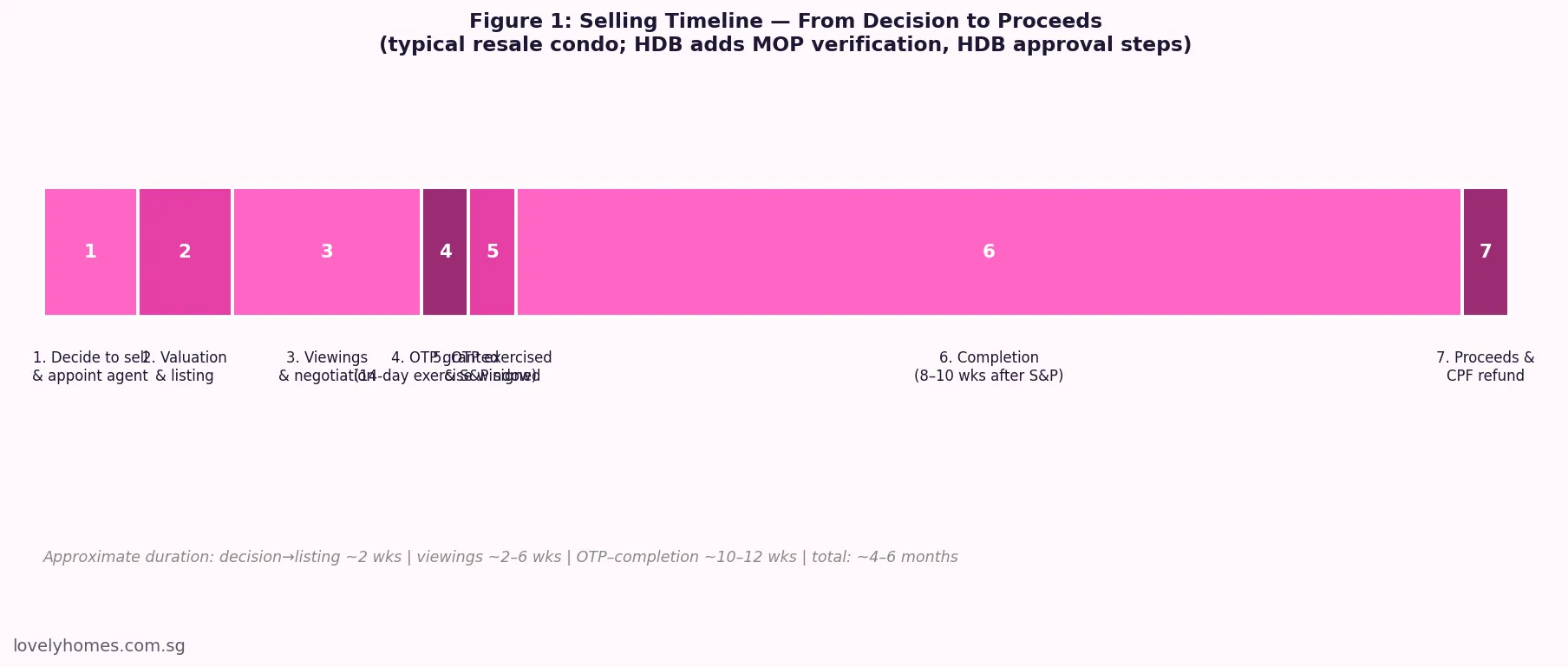
Singapore property selling timeline from decision to proceeds 2026
Figure 1: Typical Singapore property selling timeline — from decision to cash proceeds. HDB resale adds HDB approval steps (HFE Letter verification, HDB resale portal submission) between OTP and completion. Source: HDB, CEA.

Step 2: Valuation and Listing — Setting the Right Price

Pricing accurately is the single most important decision a seller makes. An overpriced listing sits on the market, accrues carrying costs (mortgage, maintenance fees, property tax), and acquires a stigma as buyers wonder what is wrong with it. An underpriced listing leaves money on the table. Getting it right requires a Comparative Market Analysis (CMA) — a structured review of recent transactions for comparable properties in the same estate or district, same flat type or size, and similar age and condition.

For HDB sellers, URA’s HDB Resale Statistics portal provides free access to actual transacted prices by town, flat type, storey range, and month. Use this data to identify the price band for your flat before allowing any agent to quote you a price. Agents sometimes inflate initial price estimates to win the listing — so cross-check every agent’s recommended listing price against the data yourself.

For private property, URA’s Property Data portal contains detailed transaction histories by project. Supplement this with a professional valuation from an IRAS-approved valuer if you are in doubt, particularly for older or unusual properties where comparables are scarce.

Step 3: Seller’s Stamp Duty — Know Your Exposure Before You List

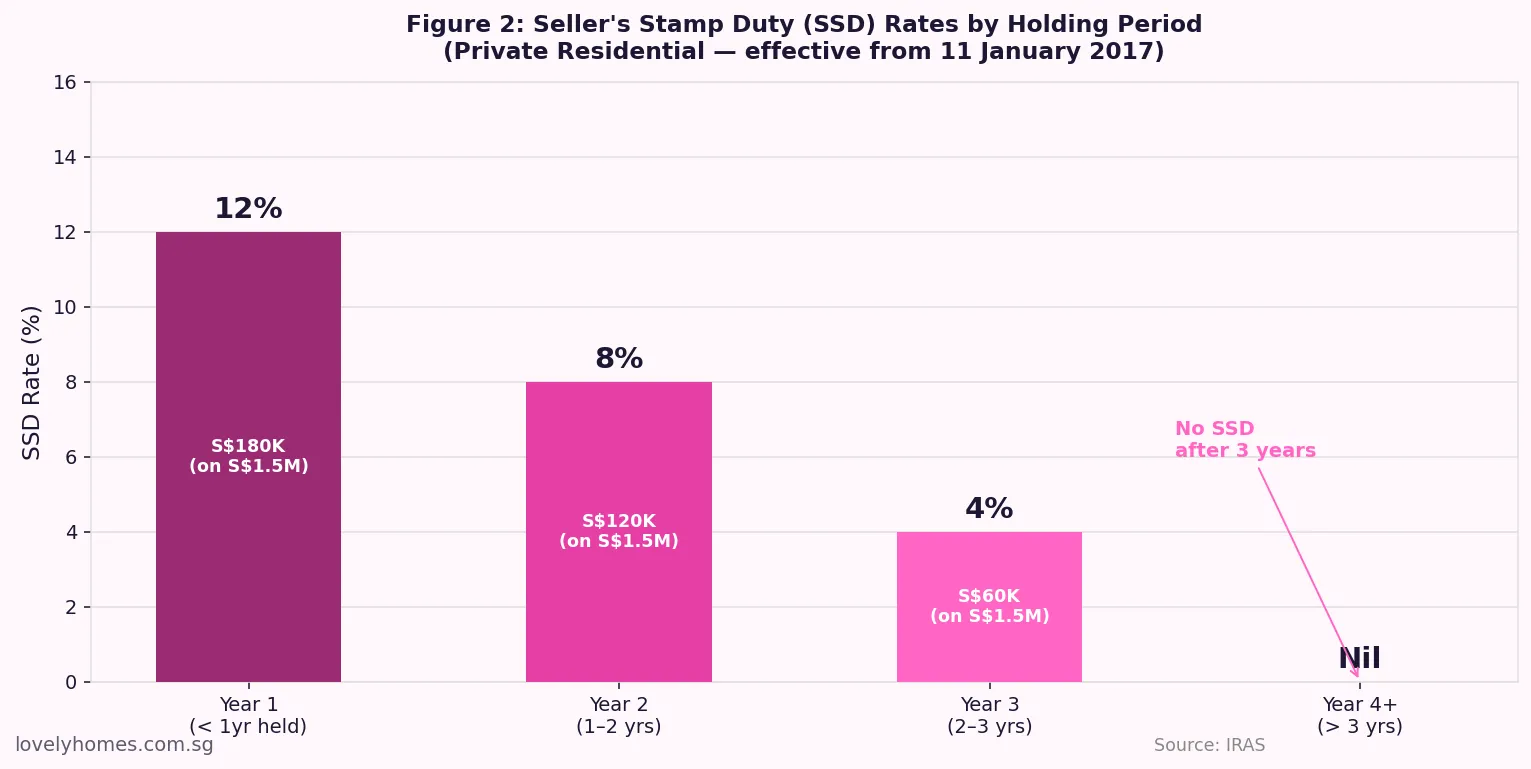
Seller’s Stamp Duty is a critical cost that many sellers either forget or underestimate. It applies to residential properties (private only — HDB resale is not subject to SSD). The rates in force from 11 January 2017 are:
Seller Stamp Duty SSD rates by holding period Singapore 2026
Figure 2: Seller’s Stamp Duty (SSD) rates for private residential property by holding period. Effective 11 January 2017. Source: IRAS.
Holding Period SSD Rate SSD on S$1,500,000 Sale SSD on S$2,500,000 Sale
Up to 1 year 12% S$180,000 S$300,000
More than 1 year, up to 2 years 8% S$120,000 S$200,000
More than 2 years, up to 3 years 4% S$60,000 S$100,000
More than 3 years Nil S$0 S$0

SSD is calculated on the higher of the sale price or market value. It is payable by the seller within 14 days of the date the OTP is exercised or the S&P Agreement is signed. IRAS administers SSD via its Stamp Duty portal. If SSD applies to your planned sale, model it explicitly into your net proceeds calculation before you list — it is a very large number at 12% on a S$2 million property.

Step 4: The Option to Purchase (OTP)

The OTP is the first legally binding document in any resale property transaction. Understanding it is essential for sellers.

When a buyer makes an offer that you accept, you grant them an OTP in exchange for an option fee. For private property, the option fee is negotiated — typically 1% of the purchase price, though it can be less for new launches or more for competitive situations. For HDB resale, HDB caps the option fee at S$1,000. The OTP grants the buyer the exclusive right to purchase your property at the agreed price, within a specified window (14 days for private property, 21 days for HDB).

During the option period, you cannot sell to anyone else or accept another offer. If the buyer exercises the OTP (pays the exercise fee and returns the signed copy), a binding Sale and Purchase Agreement comes into existence. If the buyer does not exercise, the OTP lapses, you keep the option fee, and you are free to sell to another party.

For HDB resale, the seller must obtain an HDB Resale Checklist acceptance before granting the OTP. Both buyer and seller submit declarations via the HDB Resale Portal. After the OTP is exercised, both parties have 8 weeks to register the resale application with HDB.

Step 5: Conveyancing and Completion

Once the OTP is exercised, your conveyancing lawyer takes over to complete the legal transfer of title. For private property, the buyer’s lawyer and seller’s lawyer correspond on the Sale and Purchase Agreement, conduct title searches, address outstanding caveats, and coordinate the CPF and bank discharge of your existing mortgage. Completion typically occurs 10 to 12 weeks after the S&P is signed.

At completion, the following typically happen simultaneously: the buyer pays the balance purchase price (via the bank’s loan drawdown and their own CPF OA funds); your outstanding mortgage is discharged and your mortgagee releases the property; CPF refunds your accrued principal and interest from the buyer’s funds; and after all deductions, the net cash proceeds are remitted to you.

Step 6: Net Proceeds — What You Actually Receive

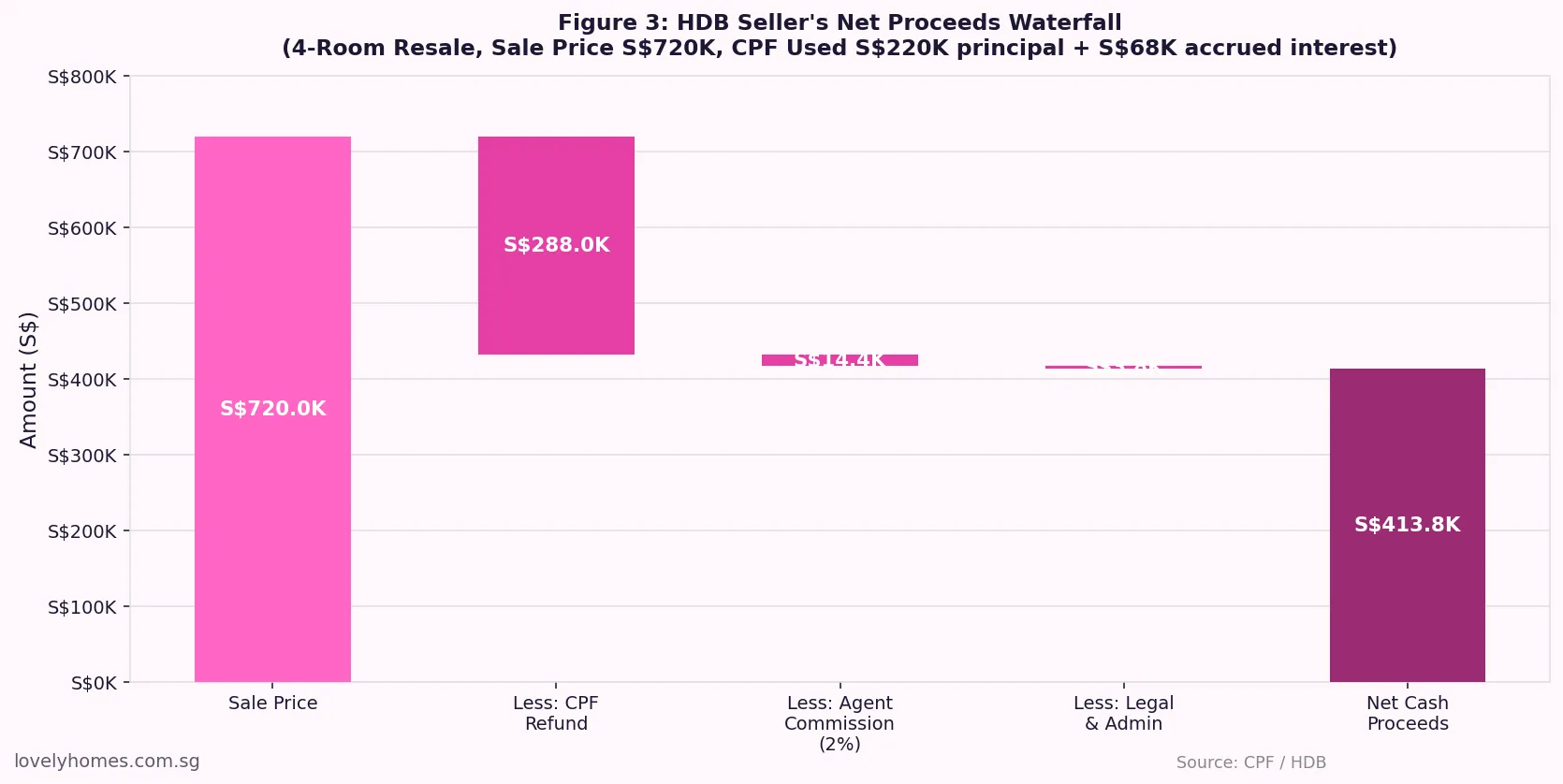
The gap between the headline sale price and the cash you receive in your bank account after completion is often a shock to first-time sellers. Here is how to model it:
HDB seller net proceeds waterfall CPF refund agent commission 2026
Figure 3: Illustrative HDB seller’s net proceeds waterfall. Sale price S$720K, CPF OA principal used S$220K plus accrued interest S$68K. Agent commission 2%. Source: CPF Board / HDB.
Proceeds Component HDB Example (S$720K sale) Private Condo Example (S$1.5M sale)
Gross sale price S$720,000 S$1,500,000
Less: CPF OA refund (principal + accrued interest) (S$288,000) (S$450,000)
Less: Outstanding mortgage discharge (S$0) (fully paid) (S$700,000)
Less: Agent commission (2% + 9% GST) (S$15,696) (S$32,700)
Less: Legal fees (seller’s conveyancing) (S$2,000) (S$3,500)
Less: HDB admin fee / miscellaneous (S$800) (S$0)
Net cash to seller S$413,504 S$313,800

The CPF refund is the item that surprises most sellers. Under CPF rules, all funds withdrawn from your Ordinary Account for housing — the initial downpayment, the monthly mortgage servicing amounts, and any lump-sum top-ups — must be refunded with accrued interest at 2.5% per annum upon sale. This money goes back to your CPF account, not into your bank account. So a seller who used S$220,000 of CPF and held the flat for 15 years might owe S$288,000 back to their CPF account at completion — even if the flat appreciated handsomely, a large portion of the paper gain goes back to CPF, accessible only for retirement or another property purchase.

HDB vs Private: Key Differences for Sellers

The mechanics of selling differ meaningfully between HDB and private property. The table below summarises the most important distinctions:

Factor HDB Resale Private Property (Condo / Landed)
MOP requirement 5 years (10 for PLH/Plus) None
Seller’s Stamp Duty Not applicable 12%/8%/4% if sold within 3 years
OTP option period 21 days 14 days (negotiable)
HDB approval required Yes — HDB Resale Portal submission No
Completion timeline 8 weeks after HDB registration 10–12 weeks after S&P
Valuation required HDB/SRX valuation (for CPF/loan purposes) Bank or IRAS valuation
Resale Levy (if buying subsidised flat next) Yes — S$15,000 to S$50,000 depending on flat type Not applicable
ABSD on next purchase May apply if buying before existing flat is sold May apply — plan carefully with sell-first strategy

Worked Example: Mr and Mrs Tan Sell Their Bishan 4-Room HDB Flat

Mr and Mrs Tan are Singapore Citizens who purchased a 4-room HDB flat in Bishan in June 2020 via the open resale market for S$590,000. They used a bank loan (S$442,500 at 75% LTV) and S$120,000 from their combined CPF OA. They have been servicing S$2,100 per month from CPF OA. As of August 2026 (6 years and 2 months of ownership), the MOP of 5 years has been satisfied.

  • Sale price agreed: S$780,000
  • Outstanding bank loan: S$312,000 (after 74 months of repayment)
  • CPF OA principal used: S$120,000 (downpayment) + S$2,100 × 74 months = S$275,400 total principal
  • CPF accrued interest at 2.5% p.a.: approximately S$34,000
  • Total CPF refund: S$309,400
  • Agent commission (2% + 9% GST): S$17,004
  • Legal fees: S$2,200
  • HDB admin fee: S$800
  • Net cash to Mr and Mrs Tan: S$780,000 – S$312,000 – S$309,400 – S$17,004 – S$2,200 – S$800 = S$138,596
  • CPF account top-up: S$309,400 (returned to their combined OA — available for future property purchase or retirement)

The Tans pocket S$138,596 in cash and have S$309,400 restored to their CPF accounts — a total economic gain of S$447,996 on a property that cost them S$590,000 six years ago, representing a 75.9% nominal return. The cash component, however, is much more modest at 17.8% of the sale price — a reminder that CPF recycling is a significant feature of the Singapore property selling experience.

Agent vs DIY: Should You Sell Without an Agent?

Singapore’s HDB and private resale markets do not legally require a licensed property agent (or Co-Broke Service / CBS for HDB). You can sell your HDB flat directly through the HDB Resale Portal as a DIY transaction, and private property through your conveyancing lawyer. The benefit is saving the agent commission — typically 1–2% of sale price — which on a S$1 million property amounts to S$10,000–S$20,000.

The risks are real, though. Negotiating effectively against buyers represented by experienced agents, writing and managing the OTP correctly, handling viewings and screening serious buyers from time-wasters, and navigating HDB’s administrative submissions are all tasks where professional help has tangible value. DIY is most viable when you have previous experience, when the property is straightforward and in high demand, and when you are willing to invest significant time. For most first-time sellers, the commission is well-spent insurance against costly errors.

What Might Come Next

For sellers active in H2 2026, the market environment is one of moderating prices (particularly for HDB resale and private OCR/RCR) and still-healthy volume. This is a reasonable time to sell if you have held for the requisite period — the market has not collapsed, but the risk of further softening in 2027 as BTO MOP supply increases is real. Private sellers who bought in 2019 to 2021 during the pre-cooling-measures run-up will have seen the strongest gains; those who bought in 2022 to 2024 may need to hold longer to realise meaningful appreciation. SSD for private sellers who bought after mid-2023 remains an active consideration: the three-year clock runs from the date the OTP was granted to you as a buyer, not the date you moved in.

FAQ: When does the Minimum Occupation Period (MOP) start for HDB?

The MOP begins on the date you collect the keys to your flat — not the signing date of the Sales and Purchase Agreement, not the HDB appointment date, and not the date you move in. The five-year MOP period runs from key collection to key collection plus five years. For BTO flats, this is straightforward. For resale flats, the MOP restarts from the date you as the new owner collect the keys after completion of your purchase, regardless of how long the previous owner occupied the flat.

FAQ: Can I rent out my flat during the MOP while planning to sell after?

For whole-flat subletting, you must first satisfy the MOP before applying for HDB’s permission to sublet. Room rental (subletting of individual bedrooms) is permitted during the MOP subject to HDB approval and conditions. You may not use the MOP period to simultaneously rent out the whole flat and purchase another property — that would amount to owning two properties, which violates HDB rules unless you are an approved private property owner who has given up your subsidy.

FAQ: What happens if the buyer pulls out after exercising the OTP?

If a buyer exercises the OTP (that is, pays the exercise fee and returns the signed document), a binding contract exists. If the buyer subsequently defaults — fails to complete on the scheduled completion date — you as the seller have legal remedies including: forfeiture of the deposit paid, specific performance action, and damages. In practice, most failed completions are resolved through negotiation and a revised completion date rather than litigation. Engage your conveyancing lawyer immediately if your buyer signals difficulty completing.

FAQ: Do I pay tax on the profit from selling my property?

Singapore does not impose a capital gains tax on residential property profits for owner-occupiers and most individual investors. The gains are yours to keep, subject to CPF refund obligations. However, if IRAS determines that you are trading in property — buying and selling repeatedly for profit in a manner that constitutes a business — the gains may be taxed as income. This is a case-by-case assessment. Selling one or two properties over a lifetime is almost never caught by this rule; serial short-term flippers may be. Seller’s Stamp Duty (for private property held under 3 years) is a separate tax on the transaction, not on gains.

FAQ: How do I calculate the CPF accrued interest I owe on sale?

CPF accrued interest is calculated at 2.5% per annum (the prevailing Ordinary Account rate) on the principal CPF amounts withdrawn, compounded monthly from the date each withdrawal was made. CPF Board provides an indicative CPF housing refund calculator on their website at cpf.gov.sg. The actual figure is confirmed by CPF Board during the conveyancing process. It is important to model this early — for long-held properties with substantial CPF usage, the accrued interest can exceed S$100,000.

FAQ: Can I sell my HDB flat and immediately buy a private condo?

Yes, provided you have satisfied the MOP on your HDB flat. Once you sell (or even once you have exercised the OTP to sell, provided you notify HDB), you are no longer counted as an HDB flat owner and can purchase private property without triggering the ABSD that would otherwise apply for owning two residential properties simultaneously. Timing is critical: if you buy the private property before your HDB flat is formally sold (OTP exercised by the buyer), you will own two properties simultaneously and ABSD applies. Most upgraders use the sell-first, buy-second approach or the married couple ABSD remission scheme to manage this sequencing.

FAQ: What is the Resale Levy and do I have to pay it?

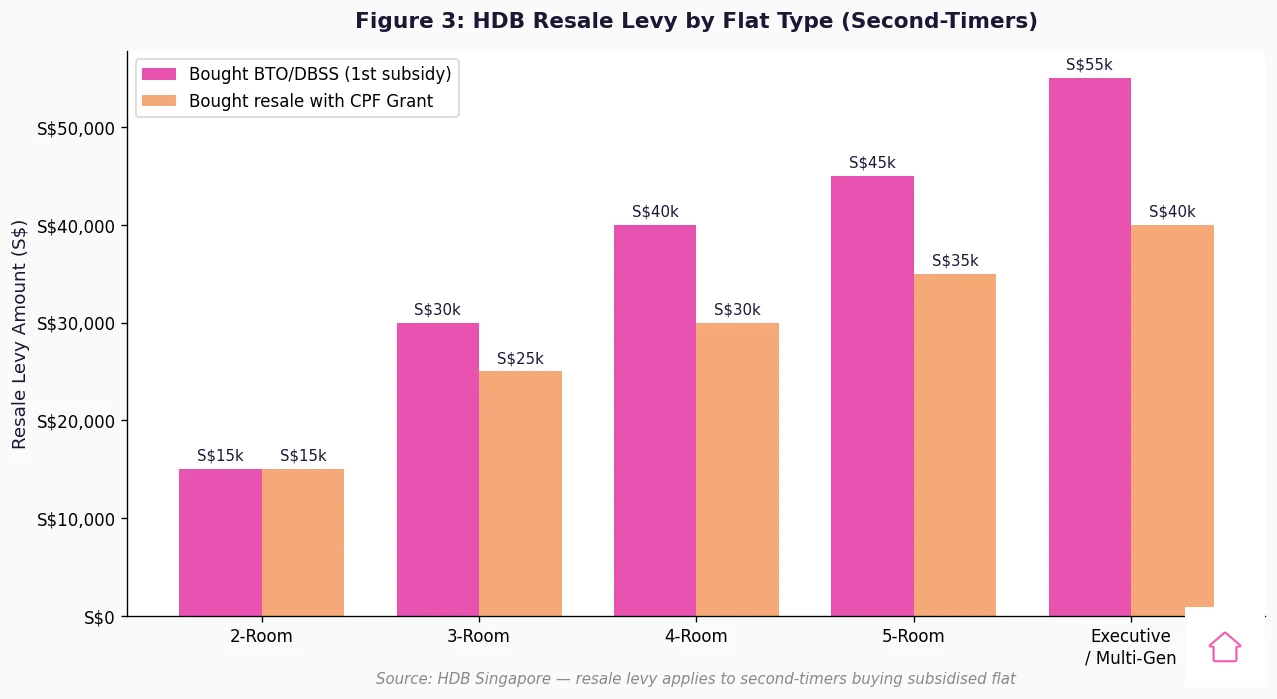
The Resale Levy is a charge imposed by HDB on sellers of a subsidised flat (BTO or DBSS) who subsequently buy another subsidised flat (a second or third BTO, an EC, or a DBSS). It does not apply if your next purchase is a resale HDB flat or private property. The levy ranges from S$15,000 for a sold two-room flat to S$50,000 for a sold five-room or executive flat. It is payable from the proceeds of the sale at the HDB appointment. If you are selling your first subsidised flat and planning to buy a resale flat instead of a new BTO, no levy applies.

Related Articles

Disclaimer: This guide is for general information only and does not constitute legal, financial, or property advice. CPF rules, stamp duty rates, HDB administrative requirements, and market conditions change over time. Always verify current requirements at hdb.gov.sg, cpf.gov.sg, and iras.gov.sg, and engage a licensed conveyancing lawyer and CEA-registered property agent before proceeding with any transaction.
Singapore Condominium Maintenance Fees Guide 2026: MCST, Sinking Fund and What to Expect

Singapore Condominium Maintenance Fees Guide 2026: MCST, Sinking Fund and What to Expect

Quick Answer: Condo Maintenance Fees & MCST in Singapore 2026

  • What is MCST? The Management Corporation Strata Title — the body of all unit owners in a strata development, governing shared facilities under the Building Maintenance and Strata Management Act (BMSMA).
  • Two funds: Every condo owner contributes to a management fund (day-to-day operations) and a sinking fund (long-term capital expenditure). The combined monthly levy is your maintenance fee.
  • How fees are set: The MCST’s Annual General Meeting (AGM) votes on the budget and each owner’s contribution is based on their share value — an integer relative to the development’s total, assigned at subdivision.
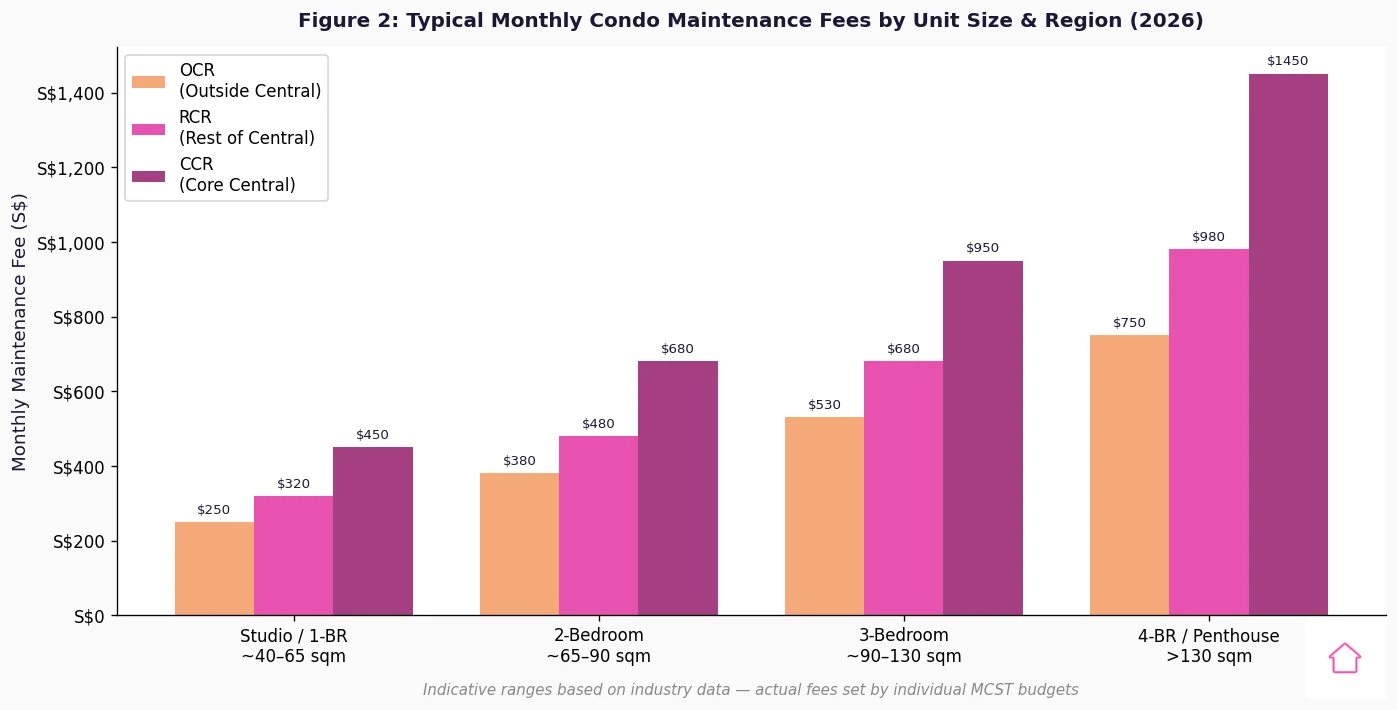
  • Typical ranges (2026): OCR studio ~S$250–S$320/mth; 2BR ~S$380–S$480/mth; RCR 2BR ~S$480–S$680/mth; CCR 3BR ~S$950–S$1,450+/mth.
  • Sinking fund minimum: The BMSMA mandates that at least 10% of total levies go to the sinking fund. Well-managed developments aim for 20%–35%.
  • Special levies: The MCST can pass a special levy at a general meeting for one-off capital expenditure that the sinking fund cannot cover.
  • Your rights: Unit owners can attend AGMs, inspect accounts, vote on budgets and challenge unreasonable fees via the Strata Titles Boards.
  • Due diligence: Always request audited MCST accounts and the sinking fund balance before purchasing any condo — a depleted sinking fund is a material financial risk.

I. Understanding the MCST and Strata Living

When you buy a condominium unit in Singapore, you become a member of the Management Corporation Strata Title (MCST), the legal body that owns and manages all common property in the development. Common property includes corridors, lifts, the swimming pool, gymnasium, car park, landscaping, guardhouse and all other shared facilities. Your unit’s four walls are yours; everything outside them is governed by the MCST.

The MCST operates under the Building Maintenance and Strata Management Act (BMSMA, Chapter 30C), administered by the Urban Redevelopment Authority (URA) with enforcement by the Commissioner of Buildings (COB). Every strata development with more than three units must have an MCST, which holds its first general meeting within one year of completion and thereafter conducts an Annual General Meeting (AGM) at least once per financial year.

The MCST’s management council — elected by unit owners at the AGM — handles day-to-day decisions: engaging contractors, approving minor expenditure and maintaining common property. Major decisions such as special levies, by-law amendments and large capital expenditure require an ordinary or special resolution at a general meeting attended by a quorum of owners.

Singapore condo MCST maintenance fees breakdown management fund sinking fund pie chart 2026
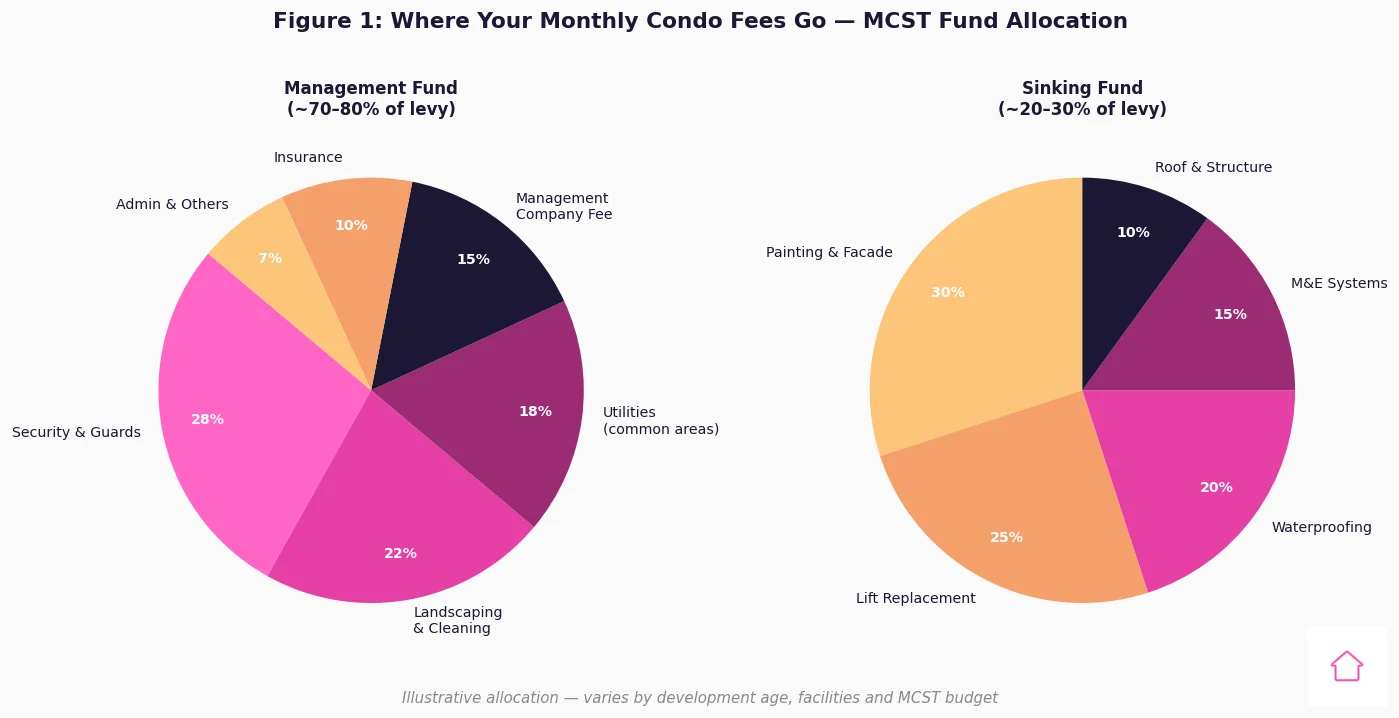
Figure 1: Where Your Monthly Condo Fees Go — Illustrative Allocation Between Management Fund and Sinking Fund (Source: Industry data, indicative only)

II. The Two Funds: Management Fund and Sinking Fund

Every Singapore condo owner contributes to two separate funds under the BMSMA framework. Understanding the distinction is essential to reading a development’s financial health.

The management fund covers recurring, day-to-day operating expenses: security guard salaries, cleaning and landscaping services, electricity for common areas, water, insurance for common property, and the fee paid to a professional managing agent. The management fund is the development’s operating account. Outflows are predictable and relatively stable year-on-year, growing with inflation and service-level expectations.

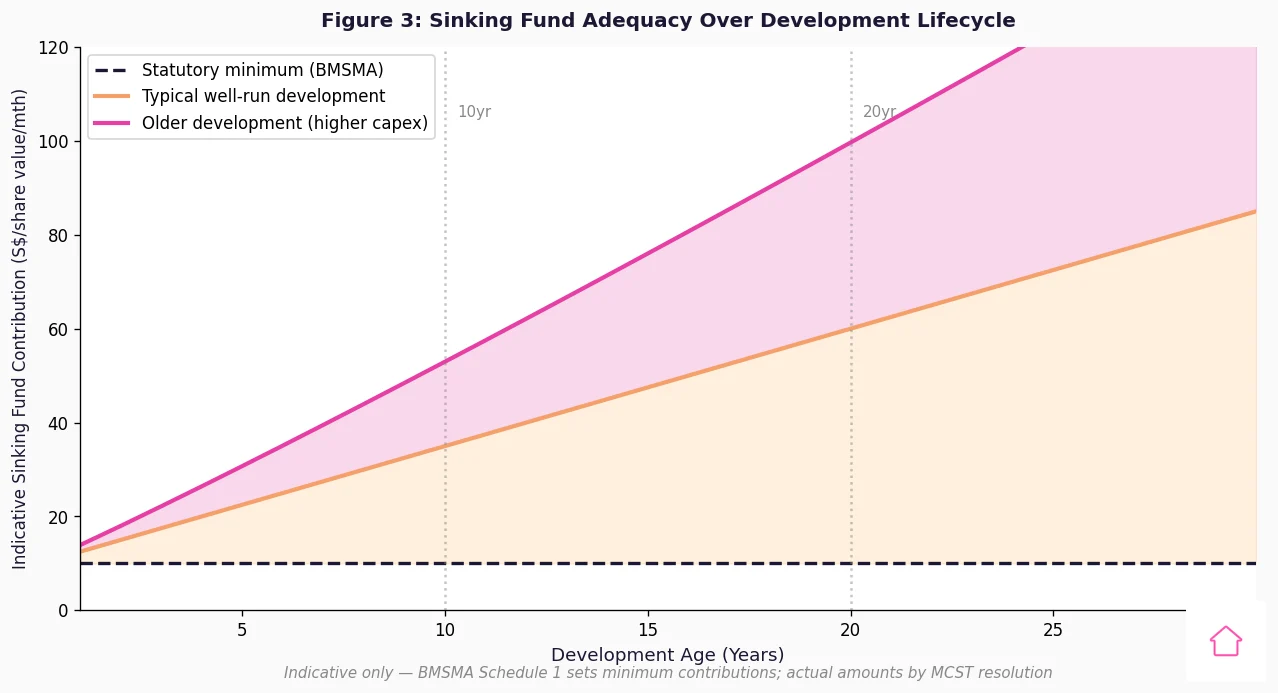
The sinking fund is the capital reserve — money set aside for major future expenditures: repainting the facade, replacing lifts, waterproofing the roof, upgrading mechanical and electrical systems, and structural repairs. The BMSMA mandates that at least 10% of each contribution period’s total levy must go to the sinking fund. In practice, a well-managed development with aging infrastructure should contribute 20%–35% to avoid special levies down the track. A depleted sinking fund in an older development is a strong indicator that past management was negligent or that major capex requiring a special levy is imminent.

III. How Maintenance Fees Are Calculated

Your monthly maintenance fee is computed from your unit’s share value, an integer assigned by a licensed strata surveyor at the time of subdivision and recorded in the strata title plan at the Singapore Land Authority (SLA). Share values range from 1 upward, with larger and more valuable units assigned higher values. A studio might have 5 shares; a penthouse in the same development might have 25 shares.

The MCST sets an annual budget at the AGM. The total budget is divided by the sum of all share values in the development to produce a rate per share per month. Multiply that rate by your unit’s share value and you have your monthly contribution. This is why units of similar size in different developments — one with five pools and 24-hour valet, another with basic amenities — have substantially different fees even if share values are similar: the total budget drives the per-share rate. Share values also determine your voting power at general meetings: you get one vote per share value.

Singapore condo monthly maintenance fees by unit size OCR RCR CCR region 2026 bar chart
Figure 2: Indicative Monthly Condo Maintenance Fees by Unit Size and Region (2026) — Actual fees vary by development, facilities and MCST budget (Source: Industry indicative data)

IV. Typical Maintenance Fee Ranges in Singapore (2026)

Maintenance fees vary substantially across Singapore’s condo landscape. The key drivers are location (CCR versus RCR versus OCR), unit size, development age, and facility loading. In the Outside Central Region (OCR), a studio or one-bedroom unit might pay S$250–S$320 per month; a two-bedroom ranges from approximately S$380 to S$480; a four-bedroom or penthouse in a large OCR development might reach S$700–S$800. In the Rest of Central Region (RCR), fees are typically 25–35% higher for equivalent unit sizes. In the Core Central Region (CCR), particularly in full-facility luxury developments on Orchard, River Valley or Sentosa Cove, a three-bedroom unit might pay S$950–S$1,300 per month, with larger units exceeding S$1,500.

Age of development also matters significantly. A 15-year-old condo with aging lifts, dated water features and deteriorating facade typically incurs higher ongoing maintenance costs than a new development — and if the sinking fund is inadequate, owners face the additional risk of a special levy for major renovation works.

V. Sinking Fund Adequacy and Special Levies

The sinking fund is where most buyer due diligence fails. Many purchasers focus entirely on the monthly maintenance fee and ignore whether the sinking fund is adequately capitalised for the development’s age and upcoming capital expenditure. A healthy sinking fund target varies by development age: a development between 5 and 10 years old should hold a balance equivalent to at least 24 months of total management levies; an older development approaching major facade or lift replacement works should hold considerably more.

When the sinking fund is insufficient for urgently needed works, the MCST passes a special levy — a one-time contribution required from all owners in proportion to share value. Special levies for major works (lift replacement, facade repainting, waterproofing) can range from S$5,000 to S$20,000 per unit in a typical mid-tier development — a significant unplanned financial commitment that buyers rarely budget for when assessing purchase affordability.

Singapore condo sinking fund adequacy development lifecycle chart BMSMA minimum 2026
Figure 3: Indicative Sinking Fund Adequacy Over Development Lifecycle — Older developments require accelerating contributions to avoid special levies (Source: Indicative, based on BMSMA minimums and industry practice)

VI. Summary Table — Key MCST Facts

Item Detail
Governing legislation Building Maintenance and Strata Management Act (BMSMA, Chapter 30C), administered by URA / Commissioner of Buildings
Management fund Day-to-day operations: security, cleaning, landscaping, utilities, insurance, managing agent fees
Sinking fund Long-term capital works: lifts, facade painting, waterproofing, M&E systems, roof repairs
Sinking fund minimum 10% of total levies per contribution period (BMSMA Schedule 1); well-run developments aim for 20%–35%
AGM frequency At least annually; extraordinary general meetings as required for urgent matters
Special levy Passed by ordinary resolution at a general meeting; payable in lump sum or instalments as determined by MCST
Disputing fees File with Strata Titles Boards (STB) — adjudicates disputes up to S$250,000; High Court for larger matters
Non-payment consequences Maintenance contributions are a first-priority lien on the strata title; MCST may take court action for recovery

VII. Worked Example — Buying a Two-Bedroom RCR Condo

Ms Yap is purchasing a two-bedroom, 72 sqm condominium in Potong Pasir (RCR) for S$1.18 million. The 8-year-old development has 220 units, a 50m lap pool, gymnasium and 24-hour security. Monthly maintenance fee: S$520. Share value of her unit: 10 (out of a development total of 2,200 shares).

Annual maintenance outflow: S$520 x 12 = S$6,240 per year. Over a 25-year ownership period (assuming 3% annual fee inflation), the total undiscounted maintenance cost exceeds S$220,000 — a material figure buyers often overlook when computing total ownership costs alongside mortgage payments, property tax and BSD.

Due diligence — sinking fund check: Before exercising the OTP, Ms Yap requests the MCST’s audited financial statements for the past three years and the management council’s latest sinking fund projection report. The development’s sinking fund balance is S$3.2 million against a projected five-year capital works requirement of S$4.8 million (lift refurbishment S$1.8M, facade painting S$1.2M, pool resurfacing S$600k, M&E upgrades S$1.2M). The shortfall of S$1.6 million implies either a fee increase or a special levy. Ms Yap factors a potential S$7,000–S$10,000 special levy into her purchase decision and negotiates a modest price reduction on this basis.

Key lesson: Always request three years of MCST audited accounts and the sinking fund projection report before committing to any condo purchase. The monthly fee headline figure tells you nothing about the development’s financial health.

VIII. Your Rights as an MCST Member

Every condo owner in Singapore is automatically a member of the MCST from the date of legal completion. Your rights under the BMSMA include attending and voting at general meetings (one vote per share value), inspecting the MCST’s financial records and minutes within the prescribed time (typically 14 days of written request), requesting a copy of the by-laws, and nominating yourself or another eligible person for election to the management council.

If you believe the MCST is acting unreasonably — charging fees not authorised by a general meeting resolution, failing to maintain common property in good order, or refusing to share financial records — you may file a dispute with the Strata Titles Boards (STB). The STB adjudicates strata disputes and can order remedies including fee adjustments, compulsory works and financial restitution for amounts up to S$250,000. Larger disputes proceed to the High Court.

IX. What Might Come Next

As Singapore’s condo stock ages — the first wave of 99-year leasehold condominiums built in the 1990s and early 2000s are now 25–35 years old — sinking fund adequacy and special levy risk are expected to become more prominent issues. Industry observers expect strengthened disclosure requirements for MCST financial health at point of sale, possibly including a mandatory sinking fund adequacy statement in the Option to Purchase paperwork, though no formal announcement has been made as at August 2026. The ongoing en bloc (collective sale) wave is partly a response to the economics of aging estates: where the cost of maintaining and upgrading an old development approaches the land value uplift from redevelopment, collective sale offers unit owners an exit that avoids escalating maintenance costs.

X. Frequently Asked Questions

Can I negotiate my maintenance fee or get an exemption?

No. Maintenance contributions are set by the MCST’s general meeting resolution and applied uniformly based on share value. Individual unit owners cannot negotiate a lower fee or claim an exemption. The only lawful way to reduce your contribution is to vote at the AGM for a lower budget, scrutinise management council expenditure, or join the management council to influence spending decisions. Some MCST constitutions allow payment by instalment (monthly versus quarterly), but the annual quantum is fixed once the general meeting resolution passes.

Are maintenance fees tax-deductible for investment property owners?

Yes, for investment properties that are rented out and generating rental income assessed to income tax in Singapore. The Inland Revenue Authority of Singapore (IRAS) allows property owners to deduct actual expenses — including maintenance fees, insurance, repairs and property tax — against rental income on an actual-cost basis rather than the simplified 15% deemed expenditure deduction. Keep all MCST statements and receipts as documentary evidence. For owner-occupied properties, no deduction applies as there is no assessable rental income.

What happens if the previous owner had unpaid maintenance fees when I buy the unit?

Under the BMSMA, unpaid maintenance contributions constitute a charge on the strata title and pass with the property unless discharged at completion. Buyers’ solicitors should conduct an MCST search as part of the conveyancing process to confirm the arrears position. If arrears exist, the purchase is typically structured so that the outstanding amount is deducted from completion proceeds and paid directly to the MCST before the remaining balance is released to the seller.

How do I find out how much is in my development’s sinking fund?

You may request the MCST’s most recent audited accounts and sinking fund balance report from the managing agent or management council secretary. As an MCST member, you have a statutory right under the BMSMA to inspect the financial records. Before purchasing, buyers can request these documents via the seller’s solicitors as part of due diligence. Some MCST websites publish annual reports that include sinking fund balances. The COB’s Strata Living portal (strataliving.ura.gov.sg) also maintains information on registered MCSTs.

Can the MCST charge more than what was voted at the AGM?

No. The management council cannot unilaterally increase contributions beyond the amount authorised by the general meeting resolution. Any increase in the levy rate must be approved at an AGM or EGM. If the MCST issues demands for amounts not authorised by a general meeting resolution, you may dispute the demand with the Strata Titles Boards. Note however that the management council may call an EGM to approve a special levy for urgent repairs — but a formal resolution is always required before additional contributions can be demanded.

Do I still pay maintenance fees if my unit is vacant or undergoing renovation?

Yes. Maintenance fees are payable from the date of legal completion and continue regardless of whether the unit is occupied, vacant, rented out or under renovation. The obligation to contribute arises from MCST membership, which attaches to ownership, not occupation. There is no provision for a fee waiver on grounds of non-occupation.

What is the difference between a condo maintenance fee and an HDB Town Council S&CC?

The S&CC (Service and Conservancy Charge) is charged by HDB Town Councils for the maintenance of common property in HDB estates — void decks, linkways, lifts, landscape — and is payable by HDB flat owners and residents. It does not apply to private condo owners. Condo maintenance fees serve the equivalent function for private strata developments but are administered by the MCST, not a statutory Town Council. Buying a condo exempts you from S&CC; buying an HDB flat exempts you from MCST maintenance fees. Executive Condominiums, once fully privatised at the 10-year mark, fall fully under MCST governance.

Disclaimer: This article is intended as general information and educational reference only. It does not constitute legal, financial or property management advice. MCST regulations, contribution requirements and BMSMA provisions may change. Always verify current requirements directly with the Urban Redevelopment Authority (ura.gov.sg), the Commissioner of Buildings, or the Strata Titles Boards (stb.gov.sg). For any specific MCST dispute or financial query, consult a licensed legal or property professional.

Singapore HDB Plus & Prime Classification Guide 2026: Standard, Plus and Prime Explained

Singapore HDB Plus & Prime Classification Guide 2026: Standard, Plus and Prime Explained

Quick Answer: HDB Plus & Prime Classification 2026

  • Three tiers: Standard, Plus and Prime — introduced from 22 October 2024 for new BTO flats and applicable resale transactions.
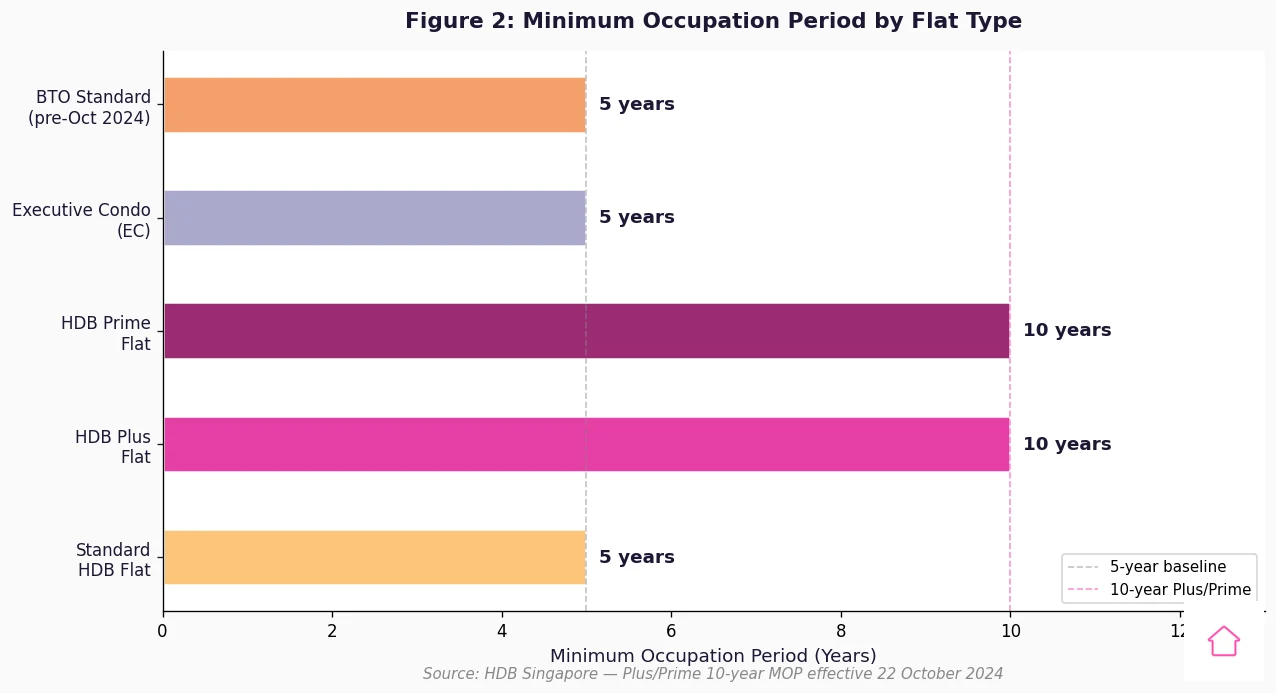
  • Minimum Occupation Period: Standard = 5 years; Plus and Prime = 10 years.
  • Resale restriction: Plus and Prime flats can only be sold to eligible buyers with household income at or below S$14,000 per month.
  • Rental restriction: Plus and Prime flat owners cannot rent out the entire flat — individual rooms may be rented after MOP.
  • Subsidy clawback: Plus flats attract a 6%–9% clawback on resale; Prime flats attract a 9% clawback payable to HDB on resale.
  • Higher grants: Plus and Prime buyers receive higher CPF Housing Grants to compensate for additional restrictions.
  • Geographic logic: Standard = general HDB estates; Plus = near MRT interchanges or well-connected nodes; Prime = central locations and mature estates.
  • Purpose: The tiered framework aims to keep public housing affordable across all income brackets while reducing speculative premiums on well-located HDB flats.

I. What Is the HDB Plus & Prime Classification System?

Singapore’s Housing & Development Board administers the world’s most successful public housing programme, housing over 80% of Singapore’s resident population. As land constraints intensify and well-located BTO sites grow scarcer, the HDB introduced a landmark policy overhaul in 2024: the Standard, Plus and Prime classification framework.

Announced by Minister for National Development Desmond Lee on 20 September 2023 and implemented from the October 2024 BTO exercise, the framework assigns every new BTO flat to one of three tiers based on the flat’s location, accessibility and proximity to amenities. The tier determines the buyer’s obligations for occupation, rental and resale, with more centrally located flats carrying longer hold periods and stricter resale conditions.

The policy addresses a longstanding tension in Singapore’s public housing market: flats in prime or centrally located estates command substantial resale premiums, allowing early buyers to profit considerably from a heavily subsidised asset. The Plus and Prime tiers reduce this premium by doubling the MOP to 10 years, imposing an income ceiling on future buyers, and levying a clawback on resale — ensuring that a portion of the capital gain flows back to the public purse rather than accruing entirely to the flat owner.

HDB Standard Plus Prime classification comparison table 2026 — MOP, restrictions, resale levy and eligibility
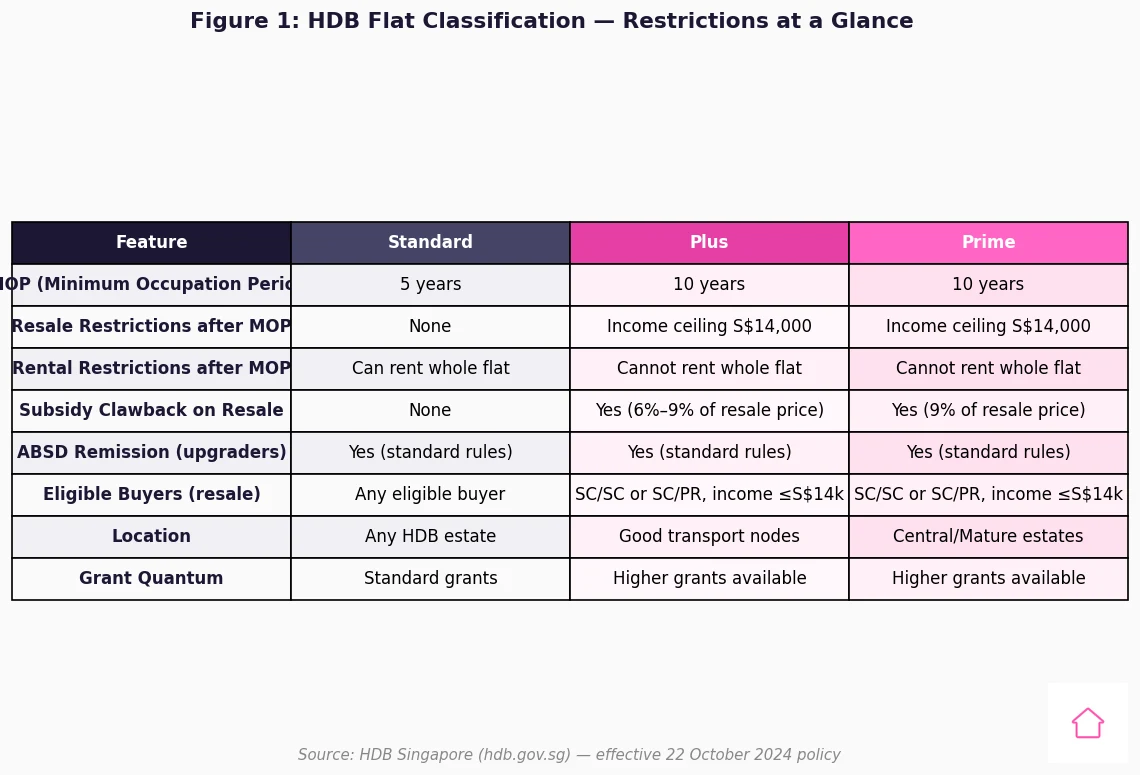
Figure 1: HDB Flat Classification at a Glance — Standard, Plus and Prime restrictions compared (Source: HDB Singapore, effective 22 October 2024)

II. Standard Flats — The Baseline Tier

Standard flats are the broadest category and follow the rules most Singaporeans are familiar with. They carry the original five-year Minimum Occupation Period: you must live in the flat as your principal place of residence for at least five continuous years before you are permitted to sell on the open resale market. There are no restrictions on the income of the buyer at the point of resale — any eligible HDB buyer may purchase a Standard flat on the resale market.

Standard flats also permit whole-flat rental once the MOP is satisfied, meaning an owner who has met the five-year occupation requirement may apply to HDB to rent out the entire flat. This flexibility is not available to Plus or Prime flat owners. No subsidy clawback applies on the resale of a Standard flat. Standard flats are located across all HDB estates but generally occupy sites that do not command a premium for centrality or transport connectivity — typically outer estates such as Woodlands, Sembawang, Sengkang and Punggol, though Standard flats also exist within mature towns where they are not classified Plus or Prime.

III. Plus Flats — Enhanced Restrictions for Well-Connected Sites

Plus flats occupy an intermediate tier. They are situated near MRT interchanges, town centres or nodes with above-average connectivity and amenities, but not in the premium core central location that defines Prime. The October 2024 BTO exercise introduced Plus flats in towns such as Kallang/Whampoa, Queenstown and specific sites in mature estates with outstanding transport access.

Buyers of Plus flats must satisfy a 10-year Minimum Occupation Period before selling on the resale market. After this period, Plus flat sellers can only transact with buyers who meet standard HDB eligibility requirements and whose household income does not exceed S$14,000 per month. Plus flat owners may rent out individual bedrooms but cannot rent out the whole flat — a restriction that applies permanently even after the MOP is satisfied.

Upon resale, a subsidy clawback ranging from approximately 6% to 9% of the transacted resale price is payable to HDB. The exact clawback rate depends on the original purchase price and the subsidy quantum embedded in that price — HDB will compute the clawback amount at the point of each resale transaction. To compensate, Plus flat buyers receive higher CPF Housing Grants than comparable Standard flat buyers, calibrated upward to reflect the longer holding obligation and reduced liquidity.

IV. Prime Flats — Maximum Restrictions for Central and Mature Estate Sites

Prime flats are the most tightly restricted tier. They occupy the most desirable HDB locations: centrally situated estates, highly connected sites near the CBD, or areas historically commanding the highest HDB resale premiums. Toa Payoh, Queenstown, Kallang, Bishan and certain city-fringe locations have been designated Prime. As the programme matures, HDB expects to designate additional BTO sites as Prime where they meet the locational criteria.

Prime flat buyers face a 10-year MOP — the same as Plus. After satisfying the MOP, sellers may only transact with buyers whose household income is at or below S$14,000 per month. The whole-flat rental ban also applies permanently. The subsidy clawback on Prime flats is set at 9% of the resale price — somewhat higher than Plus flats — to account for the greater capital gain potential in central locations. Prime flat buyers receive the highest CPF Housing Grant quantum in the entire HDB framework to make central-location ownership accessible to qualifying households.

HDB MOP comparison by flat type Standard Plus Prime Executive Condo 2026 bar chart
Figure 2: Minimum Occupation Period by HDB Flat Type — Standard 5 years vs Plus/Prime 10 years (Source: HDB Singapore)

V. Eligibility and Grant Mechanics

The income ceiling for purchasing a new BTO flat — regardless of tier — remains S$14,000 per month for families and S$7,000 for singles applying under the Single Singapore Citizen scheme. The income ceiling relevant to Plus and Prime resale transactions is also S$14,000, meaning buyers whose household income exceeds this threshold are ineligible to purchase a Plus or Prime flat on the resale market even after the MOP.

Grant eligibility follows the standard HDB framework. The Enhanced CPF Housing Grant (EHG) of up to S$120,000 for new BTO (income at or below S$9,000 per month), the Family Grant of up to S$50,000 for resale, and the Proximity Housing Grant (PHG) of up to S$30,000 for buyers living near parents or children all remain available. For Plus and Prime flats, the EHG quantum is calibrated to be higher than for equivalent Standard flats, reflecting the longer MOP obligation. Buyers should confirm the exact grant quantum with HDB at the application stage, as amounts are reviewed each BTO exercise.

The resale levy — applicable to second-timer buyers purchasing a new subsidised flat after having already enjoyed one housing subsidy — remains unchanged by the Plus/Prime framework. A second-timer buying a Plus BTO flat still pays the standard resale levy based on the flat type of their previous subsidised flat, ranging from S$15,000 for a 2-room up to S$55,000 for an Executive flat.

HDB resale levy amounts by flat type 2026 second-timers grouped bar chart
Figure 3: HDB Resale Levy Amounts by Flat Type for Second-Timers — Applicable Regardless of Standard, Plus or Prime Classification (Source: HDB Singapore)

VI. Summary Comparison Table

Feature Standard Plus Prime
MOP 5 years 10 years 10 years
Resale income ceiling None S$14,000/mth S$14,000/mth
Whole-flat rental (post-MOP) Permitted with HDB approval Not permitted Not permitted
Room rental (post-MOP) Permitted Permitted (owner must occupy) Permitted (owner must occupy)
Subsidy clawback on resale None ~6%–9% of resale price 9% of resale price
CPF Housing Grants Standard quantum Higher quantum Highest quantum
Typical locations Outer and general HDB estates Near MRT interchanges, town centres Central locations, mature estates
Introduced Legacy (all pre-Oct 2024 BTO) October 2024 BTO exercise October 2024 BTO exercise

VII. Worked Example — The Plus Flat Buyer in Queenstown

Mr & Mrs Chen are a Singapore Citizen couple, combined household income S$9,500 per month, applying for a Plus 4-room BTO flat in Queenstown in the February 2025 BTO exercise. Indicative flat price: S$620,000 (after government subsidy).

Grants received: EHG S$40,000 (income S$9,500, qualifying for mid-tier EHG for Plus flat) + Family Grant S$50,000 (SC+SC, 4-room equivalent) = S$90,000 total grants. Effective price paid after grants: S$530,000.

Financing: HDB concessionary loan at 2.6% per annum (LTV 80%). Loan amount: S$424,000. Monthly instalment on a 25-year loan: approximately S$1,924. MSR on S$9,500 household income = 20.3% — well within the 30% Mortgage Servicing Ratio cap.

BSD payable: 1% on first S$180,000 = S$1,800; 2% on next S$180,000 = S$3,600; 3% on next S$260,000 = S$7,800. Total BSD: S$13,200 (payable in cash or CPF).

At resale (10 years later, estimated): Assuming a resale price of S$850,000, the subsidy clawback is approximately 7.5% = S$63,750 payable to HDB at completion. The Chens also repay CPF principal + 2.5% accrued interest into their CPF Ordinary Account. Net cash in hand depends on outstanding loan balance and total CPF accrued interest at that date.

Key risk to note: The income ceiling of S$14,000 at resale restricts the buyer pool. Buyers planning to sell exactly at year 10 should factor in buyer pool depth and income distribution in Queenstown at that future point when planning their finances.

VIII. Why the Plus/Prime System Exists — Policy Context

Before October 2024, Singapore’s HDB resale market had seen growing divergence between price appreciation of well-located flats and those in outer estates. Mature-estate and central-location flats — particularly in Queenstown, Toa Payoh and Kallang/Whampoa — regularly transacted at S$1 million or more, with some 5-room flats approaching S$1.5 million. This created a perception that public housing in desirable locations had become a speculative vehicle rather than a housing utility, undermining one of HDB’s founding principles: that public housing should be affordable and accessible.

The Plus/Prime framework attacks this problem from two directions. First, the 10-year MOP discourages speculative flipping: a buyer must commit to a decade of owner-occupation. Second, the subsidy clawback ensures that a portion of the state subsidy embedded in the initial purchase price is returned to HDB when the flat is sold, recycling capital for future public housing programmes.

IX. What Might Come Next

As at August 2026, HDB has indicated that the Plus/Prime framework will continue to expand. Future BTO exercises will designate additional sites as Plus or Prime where the locational criteria are met. Analysts expect that as the Bayshore Drive and Greater Southern Waterfront sites mature, some of the new HDB developments in those areas may attract Prime designation given their coastal frontage and proximity to the city.

There has been industry discussion — as yet unconfirmed by HDB — about whether the framework might eventually be applied to resale transactions in designated Prime locations: specifically, whether resale buyers of pre-October 2024 legacy flats in Prime estates might face income ceiling restrictions. As at the date of publication, these restrictions apply only to new BTO flats purchased under the Plus/Prime classification and to future resale of those specific flats. Buyers purchasing legacy resale flats in Queenstown or Toa Payoh are not subject to any income ceiling or clawback.

X. Frequently Asked Questions

Can I sell a Plus or Prime flat to a buyer whose income exceeds S$14,000?

No. The income ceiling of S$14,000 per month applies strictly to the purchasing household’s combined income at the time of the resale transaction. If you attempt to transact with a buyer whose income exceeds S$14,000, HDB will not approve the resale application. This restriction narrows the buyer pool relative to Standard flats, which have no income ceiling at resale. Buyers planning to sell their Plus or Prime flat after the 10-year MOP should price this liquidity discount into their financial planning from the outset.

When does the 10-year MOP start — from key collection or from application?

The MOP is measured from the date of key collection (the date you receive the keys to the flat and it is registered in your name), not from the date of ballot success or application. For BTO flats, key collection typically occurs three to five years after the ballot date, given construction lead times. So if you collect keys in January 2026, your 10-year MOP expires in January 2036.

Can I convert a Plus flat to a Standard flat to avoid the restrictions?

No. The classification is permanently attached to the flat at the point of designation. There is no mechanism to reclassify a Plus or Prime flat as Standard once it has been built and allocated. This is deliberate: the restrictions must follow the flat, not the owner, to ensure that future resale buyers are also bound by the same conditions.

What happens to the subsidy clawback if I sell my Plus flat at a loss?

HDB computes the clawback as a percentage of the actual transacted resale price, not the original purchase price or the market value. If you sell at a price lower than your original purchase price, the clawback percentage still applies on the actual sale price. HDB has indicated that the clawback is waived only in exceptional circumstances, such as compulsory acquisition by HDB. In practice, most Plus/Prime flat sellers in central locations are unlikely to transact at a loss given the subsidy embedded in the initial purchase.

Does the Plus/Prime framework affect Executive Condominiums (ECs)?

No. ECs are a distinct housing type governed by the Housing Developers (Control and Licensing) Act, not the HDB Act. They are developed and sold by private developers on 99-year leasehold land sold by HDB. ECs carry a separate five-year MOP before the unit can be sold on the open market; after ten years, the EC is fully privatised. The Plus/Prime HDB framework does not affect EC restrictions.

Can Plus and Prime flat owners sublet rooms while still within the MOP?

No. During the MOP, Plus and Prime flat owners may not sublet any part of the flat — neither the whole unit nor individual rooms. The HDB’s subletting rules require the MOP to be satisfied before any subletting application can be submitted. After the 10-year MOP, room rental is permitted provided the flat owner continues to occupy the flat as their principal place of residence and holds a valid subletting permit from HDB. Whole-flat rental remains permanently prohibited for Plus and Prime flats.

I am a permanent resident buying a Plus flat with my SC spouse — are we subject to the restrictions?

Yes. The Plus and Prime restrictions apply to the flat itself, not solely to the citizen owner. An SC/PR couple purchasing a Plus BTO flat will be bound by the 10-year MOP, the income ceiling at resale, the whole-flat rental ban, and the subsidy clawback in exactly the same way as an SC/SC household. The restrictions follow the flat through its entire life on the market.

Disclaimer: This article is intended as general information and educational reference only. It does not constitute legal, financial or housing advice. HDB policies, grant amounts, income ceilings, clawback rates and classification criteria may change. Always verify current requirements directly with the Housing & Development Board at hdb.gov.sg before making any housing decision. Consult a licensed financial adviser or property professional for advice specific to your circumstances.

Singapore Property Downgrade Guide 2026: How to Sell Private and Buy HDB Resale

Singapore Property Downgrade Guide 2026: How to Sell Private and Buy HDB Resale

Quick Answer: Singapore Property Downgrade Guide 2026

  • From 28 July 2026, the 15-month wait-out period for private property owners buying a non-subsidised HDB resale flat (without an HDB loan) has been removed with immediate effect by the Ministry of National Development.
  • You may now buy the HDB resale flat before selling your private property — provided you dispose of the private property within six months of the resale flat purchase date.
  • The 30-month wait-out continues to apply for BTO flats, CPF housing grants on a resale flat, HDB concessionary loans, and EC purchases from developers.
  • ABSD on the HDB purchase is remitted upfront at the point of the transaction — no cash outlay — subject to completing the private property disposal within six months.
  • You cannot own both a private property and an HDB flat simultaneously; one must go within six months.
  • Singapore Citizens (SC) pay zero ABSD on a first property; if the HDB is technically a second property (private not yet sold), the 20% SC second-property ABSD is waived via remission.
  • Permanent Residents (PR) buying a resale flat while owning private property pay 30% ABSD on the HDB — this is not automatically remitted; PR downgraders should take specialist advice before transacting.
  • A resale levy (S$15,000–S$55,000) applies only if you previously received a housing subsidy from HDB and are buying a subsidised flat — not applicable to most private-property owners buying a market-rate resale.
  • No income ceiling applies to non-subsidised HDB resale purchases.

What Is “Downgrading” in Singapore Property?

In Singapore’s property lexicon, “downgrading” refers to the decision to sell a private residential property — a condominium, an executive condominium (EC) that has reached full privatisation, or a landed home — and purchase a Housing & Development Board (HDB) resale flat instead. It is the reverse of the classic HDB-to-private upgrader journey, and for a significant cohort of Singaporeans — particularly those nearing retirement, recent retirees, or households that have experienced a change in circumstances — it can be an exceptionally powerful wealth-management move.

Done correctly, downgrading allows a couple in their late 50s to unlock hundreds of thousands of dollars of private-property equity, right-size into a well-maintained HDB flat in a mature estate, and substantially reduce monthly housing costs. With Singapore’s HDB stock offering flats of up to 146 sqm in premium towns such as Queenstown, Buona Vista, and Bishan, “downgrading” in the pejorative sense is frequently a misnomer: the lifestyle trade-off is often marginal, while the financial gain can be transformative.

This guide explains the complete 2026 process, including the significant rule change that took effect on 28 July 2026, the ABSD remission mechanics, the six-month disposal rule, eligibility conditions, and a fully worked example in Singapore dollar terms.

The July 2026 Rule Change: 15-Month Wait-Out Period Removed

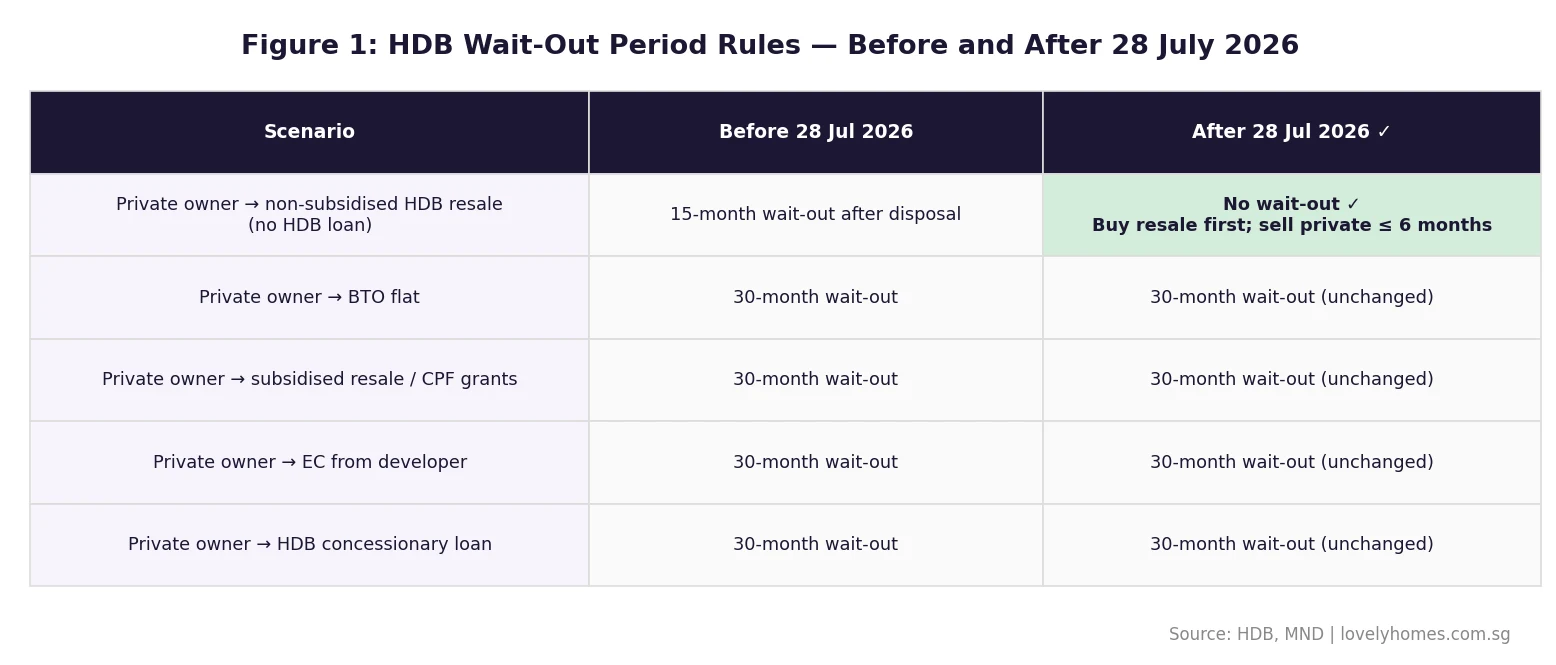
On 28 July 2026, National Development Minister Chee Hong Tat announced — with immediate effect — the removal of the 15-month wait-out period that had previously required private property owners and former owners to wait out a full 15 months before they could purchase a non-subsidised HDB resale flat. The removal was motivated by two consecutive quarters of HDB resale price decline: the Resale Price Index fell 0.1% in Q1 2026 and 0.3% in Q2 2026, the first back-to-back decline since 2014.

The practical consequences of this change are significant. A private property owner who signs an Option to Purchase (OTP) for an HDB resale flat on or after 28 July 2026 faces no mandatory wait-out period, provided they do not draw an HDB housing loan and are not applying for CPF housing grants. They may even purchase the HDB flat first — before listing their private property — and then sell the private home within six months of the HDB flat purchase date completing.

HDB wait-out period rules before and after 28 July 2026 Singapore property downgrade
Figure 1: Wait-Out Period Rules — Before and After 28 July 2026. The green row reflects the rule that has changed; orange rows reflect rules that remain unchanged. Source: HDB, MND.
Key point: The wait-out period removed on 28 July 2026 applies only to non-subsidised HDB resale flat purchases where the buyer does not take an HDB housing loan. All other scenarios — BTO, CPF grants, HDB loan, EC from developer — retain the 30-month wait.

Who Can Downgrade? HDB Eligibility Rules for Private Property Owners

Not every private property owner is automatically eligible to purchase an HDB resale flat. The following eligibility requirements apply under HDB’s various buying schemes, and each must be satisfied at the point of application:

Citizenship: At least one buyer must be a Singapore Citizen. Permanent Residents may buy an HDB resale flat together with an SC spouse or family member, but a PR-only household cannot own an HDB flat.

Family nucleus: Buyers must form an eligible family nucleus — married couples (or engaged couples using the Fiancé/Fiancée Scheme), SC buying with a child or parent under the Multi-Generation or joint-ownership provisions, or singles aged 35 and above purchasing under the Single Singapore Citizen Scheme (2-room Flexi only, for singles).

Income ceiling: For a non-subsidised HDB resale flat, there is no income ceiling. Income ceilings apply only to BTO flats and to resale flats purchased with CPF housing grants.

Concurrent property ownership: You may not own both a private residential property and an HDB flat at the same time. If you purchase the HDB resale flat first (permitted under the July 2026 rule change), you must dispose of your private property within six months of the date the HDB resale flat purchase is completed.

Minimum Occupation Period (MOP): If you have previously owned an HDB flat, you must have fulfilled the MOP before purchasing again. If you still own an HDB flat, you must sell it before or concurrently with buying the resale flat.

Resale levy (subsidised flat buyers only): If you previously received an HDB housing subsidy — for instance, you bought a BTO or an EC from a developer — and are now buying a subsidised resale flat, a resale levy of S$15,000 to S$55,000 applies. This levy does not apply when purchasing a non-subsidised market-rate resale flat, which is the typical scenario for a private-property downgrader.

ABSD Remission: How Downgraders Avoid the Stamp Duty Hit

At first glance, the stamp duty arithmetic looks forbidding for a downgrader. A Singapore Citizen who still owns a private property at the point of purchasing an HDB resale flat would technically be acquiring a second residential property, triggering Additional Buyer’s Stamp Duty (ABSD) at the SC second-property rate of 20%. On a S$660,000 HDB resale flat, that would amount to S$132,000 — a material sum.

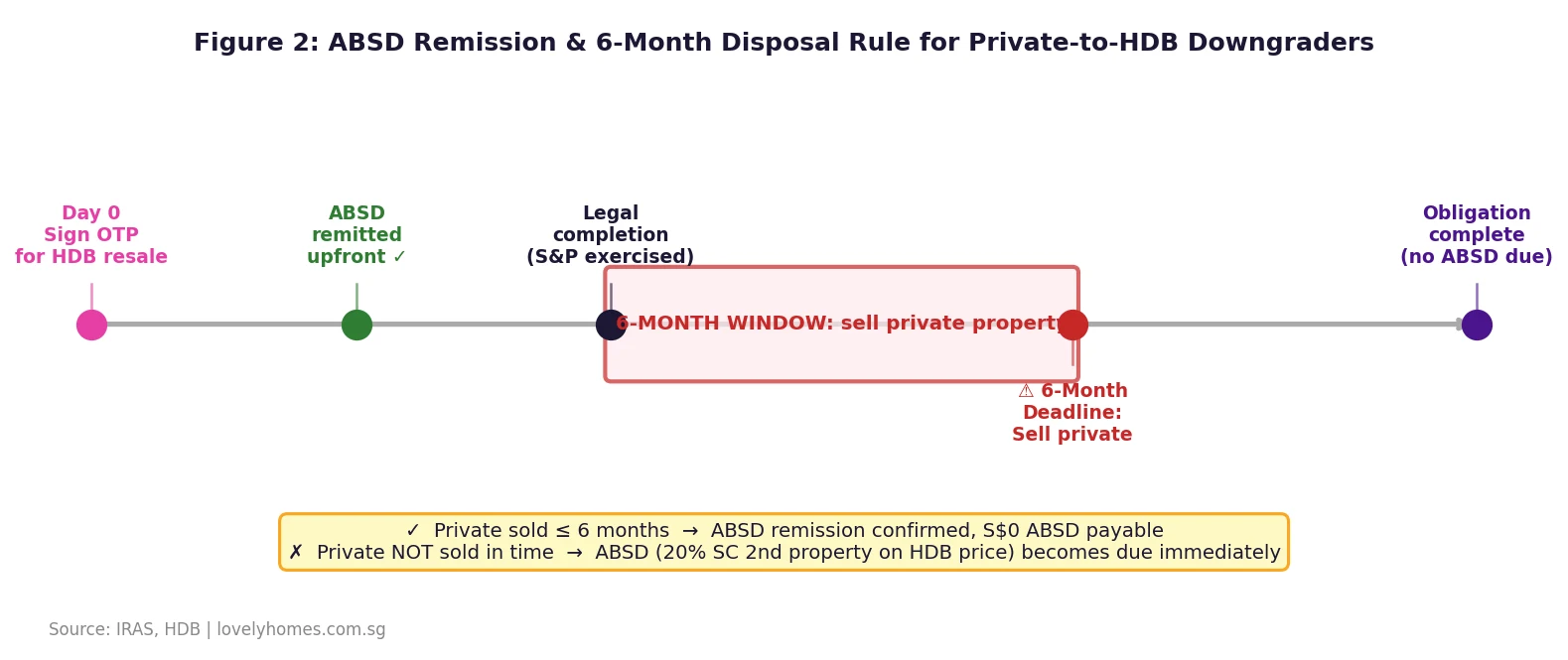
In practice, however, IRAS provides an upfront ABSD remission specifically for this scenario. Provided the buyer has committed to disposing of their private property within six months of the HDB resale flat’s purchase date (i.e., the date the transaction is legally completed), the ABSD is remitted at the point of purchase. There is no cash outlay; the ABSD simply does not appear in the completion statement. The remission is conditional — if the private property is not sold within six months, the full ABSD sum becomes payable immediately, with late-payment interest.

ABSD remission and 6-month disposal rule Singapore private property to HDB downgrade 2026
Figure 2: ABSD Remission & 6-Month Disposal Rule for Private-to-HDB Downgraders. The six-month window runs from the legal completion of the HDB resale flat purchase. Source: IRAS, HDB.

Permanent Residents should note: The ABSD remission described above applies to SC buyers. PR buyers purchasing a resale HDB flat while still owning a private property are subject to the PR second-property ABSD rate of 30%, and this is not automatically remitted in the same way as for SC buyers. PRs in this situation should seek specialist advice before transacting, as the stamp duty exposure could be substantial.

Only Buyer’s Stamp Duty (BSD) is payable on the HDB resale flat at completion. BSD is calculated on the higher of the transacted price or the market valuation, using the progressive rates in force since 20 February 2023: 1% on the first S$180,000; 2% on the next S$180,000; 3% on the next S$640,000; 4% on the next S$500,000; 5% on the next S$1.5 million; 6% on the remaining amount.

The Step-by-Step Downgrade Process (2026)

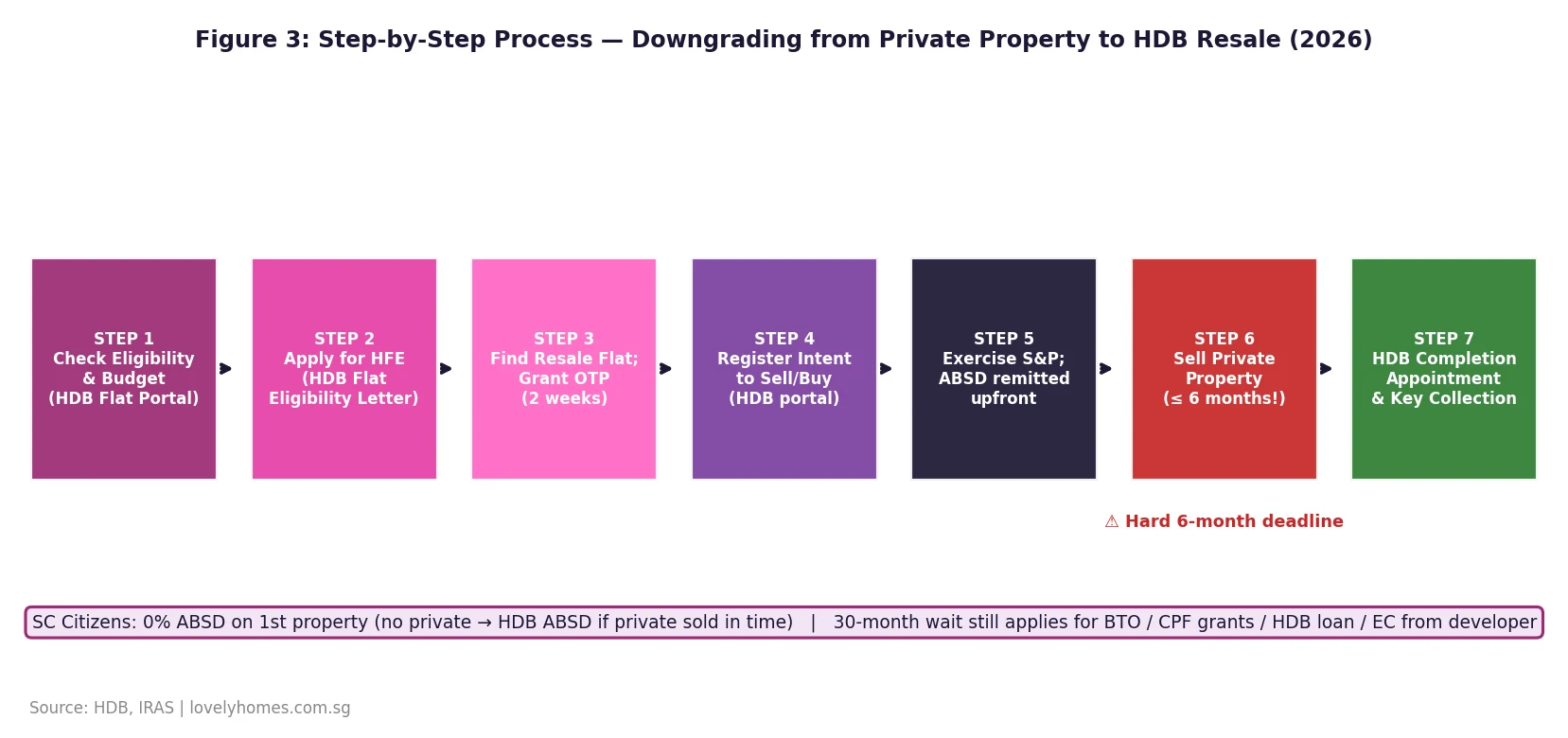
The end-to-end process for downgrading from a private property to an HDB resale flat in 2026 follows a logical sequence. The key flexibility introduced by the July 2026 rule change is that you may now undertake Steps 1–6 (acquiring the HDB flat) before completing Step 7 (selling the private property), subject to the six-month constraint.

Step-by-step downgrade process private property to HDB resale Singapore 2026
Figure 3: Step-by-Step Process for Downgrading from Private Property to HDB Resale (2026). Steps 1–5 secure the HDB flat; Step 6 (selling private property) must be completed within six months of Step 5. Source: HDB, IRAS.

Step 1 — Check HDB eligibility and budget: Log into the HDB Flat Portal (flat.hdb.gov.sg) and verify your household’s eligibility under the relevant scheme. Confirm that no outstanding MOP obligations exist. Assess your financial position: what CPF Ordinary Account (OA) monies are available, what cash reserves you hold, and what bank loan quantum (if any) you require.

Step 2 — Apply for the HDB Flat Eligibility (HFE) Letter: The HFE Letter has replaced the former Housing Loan Eligibility (HLE) letter as the single gateway document for all HDB flat purchases. It confirms your eligibility to buy and indicates any grants or loan quantum available. For a non-subsidised resale purchase without an HDB loan, you will note on the application that you do not require HDB financing — the HFE will confirm flat eligibility only.

Step 3 — Find the right resale flat: Search HDB’s Resale Flat Listings portal (resaleflatlistings.hdb.gov.sg) for flats that meet your requirements. Bear in mind that under the July 2026 rules, you can proceed immediately without waiting out any period. Negotiate the price and request a valuation report from a licensed valuer if required.

Step 4 — Grant Option to Purchase (OTP) and register intent: The seller grants you an OTP for a consideration of S$1 to S$1,000. Both parties must then register their Intent to Sell/Buy via the HDB Resale Portal within 7 days of the OTP being granted.

Step 5 — Exercise the S&P and ABSD remission: Within 21 days of the OTP grant, you exercise the Sale and Purchase agreement by paying the balance deposit. At this stage, BSD is computed and paid (via IRAS e-Stamping); ABSD is remitted upfront (no payment required) subject to the six-month disposal condition.

Step 6 — Sell your private property within six months: This is the hard constraint. Engage a property lawyer immediately after Step 5 and list your private property. The six months run from the completion date of the HDB resale flat, not from the OTP date. Given typical private-property sale timelines of 8–12 weeks, you have adequate runway — but delays in listing or protracted negotiations can threaten the deadline.

Step 7 — HDB completion appointment and key collection: HDB will schedule a completion appointment (typically 6–8 weeks after exercising the OTP) at which the legal transfer is effected, CPF funds are applied, and any bank loan is drawn down. Keys are collected at this appointment.

At a Glance: Downgrade Rules Summary (2026)

Rule / Condition Detail
Wait-out period (non-subsidised resale, no HDB loan) Removed from 28 July 2026 — no wait required
Wait-out period (BTO / CPF grants / HDB loan / EC developer) 30 months from private property disposal
Private property disposal deadline Within 6 months of HDB resale completion date
ABSD for SC buyers 20% on HDB price → remitted upfront; S$0 payable if sold in 6 months
ABSD for PR buyers 30% on HDB price — remission conditions differ; seek advice
BSD Progressive 1%–6% on higher of transacted price or valuation
HDB loan eligibility Not available while owning private property; also unavailable within 30 months of disposal
Income ceiling (resale, non-subsidised) None
Resale levy Applicable only if prior HDB subsidy was received and buying subsidised flat
Eligible buyers SC (mandatory at least one owner); PRs must co-own with SC family member

Worked Example: Mr and Mrs Wong Downgrade from OCR Condo to Tampines HDB

Mr and Mrs Wong are both Singapore Citizens in their mid-50s. They own a three-bedroom OCR condominium valued at S$1.80 million, purchased in 2012 for S$1.05 million. The mortgage is fully settled. They want to right-size into a four-room HDB resale flat in Tampines, which they find listed at S$660,000, and release equity for retirement.

Step 1 — Buy HDB resale flat (S$660,000):

  • BSD payable: 1% × S$180,000 + 2% × S$180,000 + 3% × S$300,000 = S$1,800 + S$3,600 + S$9,000 = S$14,400
  • ABSD (SC 2nd property, 20% × S$660,000 = S$132,000) → remitted upfront; S$0 payable
  • Legal/conveyancing fees (estimate): S$3,200
  • Funding: CPF OA S$100,000 + bank loan S$400,000 (60% LTV, since this is technically a 2nd property under bank TDSR rules) + cash S$160,000
  • Monthly bank instalment: S$400,000 @ 3.5% over 20 years ≈ S$2,322/month

Step 2 — Sell OCR condo within 6 months (S$1,800,000):

  • Assumed CPF OA accrued interest to refund: S$310,000 (CPF principal + interest since 2012)
  • Conveyancing & miscellaneous: S$5,000
  • Seller’s Stamp Duty: S$0 (property held more than 3 years; SSD does not apply)
  • Net cash proceeds after CPF refund: S$1,800,000 − S$310,000 − S$5,000 = S$1,485,000

Result: After completing the sale of the condo, the Wongs use a portion of the proceeds to repay the S$400,000 bank loan on the HDB flat (or continue servicing it monthly), keeping approximately S$1.0–1.1 million in net cash/CPF available for retirement — a substantial equity release that would not have been achievable while retaining the condo. Their monthly housing cost falls from a larger condo mortgage to a manageable S$2,322 (or S$0 if they repay the loan from proceeds), and their property tax obligations drop significantly from the private property AV-based bill to the HDB owner-occupier rate.

What the July 2026 Change Means for the Market

The removal of the 15-month wait-out period has two principal market effects. First, it reduces friction for private-property owners who have wanted to downgrade but were deterred by the requirement to sell their condo into a potentially falling market before being able to buy the HDB flat. They can now secure the HDB flat first — at today’s softening resale prices — and take a more measured approach to listing their private property.

Second, it injects new demand into the HDB resale market at a moment of gentle price weakness. HDB resale prices fell 0.1% in Q1 2026 and 0.3% in Q2 2026 — the government’s stated rationale for the relaxation. Policymakers evidently concluded that the cooling purpose of the 15-month rule had run its course and that removing it would provide a targeted demand boost without disturbing the broader private-property market, where the URA Private Property Index rose 0.5% in Q2 2026.

For sellers of private property, the change is broadly neutral in the short term: the pool of potential buyers for private units remains unchanged, since downgraders are exiting — not entering — that market. However, if the policy stimulates a meaningful uplift in HDB resale volumes, the knock-on confidence effect may modestly support private-property sentiment too.

What Might Come Next

The July 2026 rule change is widely read as a calibration, not a structural loosening of Singapore’s property market framework. Analysts speculate that HDB resale prices may stabilise in the second half of 2026 as the new demand cohort of downgraders enters the market — though the scale of that effect depends on how many private-property owners were genuinely deterred solely by the 15-month rule, rather than by income considerations, family circumstances, or MOP timing.

A further question is whether the 30-month wait for BTO flats will eventually be re-examined. This restriction prevents former private-property owners from purchasing new, grant-subsidised BTO flats for 30 months — a rule that retains broad support as it protects public-housing resources for first-timers. Any relaxation of the 30-month BTO wait would be a more significant policy shift, and most commentary as of mid-2026 does not anticipate it in the near term.

Frequently Asked Questions

Can I buy the HDB resale flat before selling my condo under the new July 2026 rules?

Yes. From 28 July 2026, private property owners may purchase a non-subsidised HDB resale flat before disposing of their private property, provided they are not taking an HDB housing loan and do not require CPF housing grants. The private property must be sold within six months of the legal completion of the HDB resale flat purchase. This reverses the earlier requirement to sell first and then wait 15 months before buying.

What is the ABSD exposure if I miss the six-month disposal deadline?

If you fail to sell your private property within six months of the HDB resale flat completion date, the ABSD that was remitted upfront becomes immediately payable. For a Singapore Citizen, this is 20% of the HDB purchase price (e.g., S$132,000 on a S$660,000 flat). IRAS also levies a late-payment surcharge. The six-month deadline is a hard legal obligation — it is not subject to discretionary extension except in extraordinary circumstances, and even then any extension requires formal application and is not guaranteed.

Do I have to pay resale levy when downgrading from private property to HDB?

A resale levy applies only if you (a) previously purchased a subsidised flat (BTO, Design Build & Sell Scheme, or EC from a developer) and (b) are now buying another subsidised HDB flat. Most private-property downgraders buying a market-rate, non-subsidised HDB resale flat do not pay resale levy, since their purchase involves no housing subsidy from HDB. However, if you sold a BTO flat previously and received grants, and are now buying a subsidised resale flat with grant assistance, the levy would apply — typically ranging from S$15,000 to S$55,000 depending on the type of flat you previously sold.

Can I take an HDB housing loan when downgrading?

No. HDB concessionary loans are not available to buyers who currently own or have disposed of a private property within the preceding 30 months. Private-property downgraders must therefore finance the HDB resale flat with a bank loan (at the prevailing Loan-to-Value limit of 75% for first bank loan on a 2nd property, or 80% if treating it as a first bank loan following full private disposal) or fund it outright from CPF and cash.

Does the six-month rule apply from the OTP date or the completion date?

The six-month clock runs from the legal completion date of the HDB resale flat — not from the date the OTP is granted. Given that the completion of an HDB resale transaction typically occurs six to eight weeks after the OTP is exercised, you effectively have the full six months from completion to conclude the private property sale. That said, you should list your private property for sale as soon as you exercise the HDB OTP, to maximise your marketing window.

What happens to my CPF accrued interest when I sell my private property?

When you sell a private property that was partially funded with CPF Ordinary Account (OA) monies, you must refund the principal CPF amount withdrawn plus the accrued interest that those CPF funds would have earned if left in the OA (currently at 2.5% per annum). This can be a significant sum for properties held over many years. The refunded amount goes back into your CPF OA and can subsequently be used towards the purchase of the HDB resale flat (for down payment, legal fees, or loan repayment) or retained for retirement.

Can a Permanent Resident downgrade to an HDB resale flat?

A PR cannot buy an HDB resale flat alone — HDB rules require at least one buyer to be a Singapore Citizen. A PR may co-purchase with an SC spouse or immediate family member under the Public Scheme or Fiancé/Fiancée Scheme. In such cases, the ABSD treatment for a downgrading household depends on the citizenship mix and which party is the “first buyer” on the HDB title. Additionally, the ABSD remission available to SC downgraders does not apply in the same way to PRs, making the stamp duty position for a PR-led downgrade considerably more complex.

Related Articles

Disclaimer

This article is intended for general informational purposes only and does not constitute financial, legal, or tax advice. Property prices, stamp duty rates, HDB eligibility rules, and CPF policies cited are accurate as at 12 August 2026 but may change. Readers should consult the Housing & Development Board (HDB), the Inland Revenue Authority of Singapore (IRAS), the Central Provident Fund Board (CPF), and a licensed financial adviser or lawyer before making any property transaction decisions. Stamp duty calculations are illustrative and may vary based on individual circumstances.

Singapore Property Selling Guide 2026: Costs, Process and Net Proceeds Explained

Singapore Property Selling Guide 2026: Costs, Process and Net Proceeds Explained

Quick Answer: Selling Property in Singapore 2026

  • The typical private property selling process takes 12–16 weeks from listing to completion. For HDB flats, the HDB-managed resale process adds administrative steps and typically takes 16–24 weeks from Option to Purchase to key handover.
  • Seller’s Stamp Duty (SSD) applies to private residential properties sold within four years of purchase (for properties bought on or after 4 July 2025): 16% in Year 1, 12% in Year 2, 8% in Year 3 and 4% in Year 4. HDB flats are not subject to SSD but must satisfy the Minimum Occupation Period (MOP) before resale.
  • Agent commission for sellers is typically 1% to 2% of the sale price, negotiable. It is not fixed by law but is governed by the Council for Estate Agencies (CEA) Code of Ethics. No commission is payable until a valid transaction is completed.
  • When you sell a property in which CPF Ordinary Account funds were used for the purchase, you must refund the CPF principal used plus accrued interest (at 2.5% p.a. compounded) before any cash proceeds are available to you.
  • Legal fees for a private property sale are typically S$2,500–S$5,000; for HDB resale, S$1,500–S$2,800. Conveyancing lawyers handle the title transfer, mortgage discharge and CPF charge release.
  • There is no capital gains tax in Singapore on property disposals. However, if IRAS determines that a seller is a property trader (buying and selling frequently for profit), gains may be assessed as income and taxed at the applicable income tax rate.
  • Upon completion, your proceeds flow in this order: mortgage redemption → CPF refund with accrued interest → agent commission → legal fees → net cash to seller.

Should You Sell? The Pre-Sale Decision

Deciding to sell a Singapore property involves more than agreeing on an asking price. Before you appoint an agent or list a property, three questions must be answered: Have you satisfied the applicable holding-period rules? What will the net proceeds look like after repaying CPF, the mortgage and transaction costs? And — if you own an HDB flat and plan to purchase a private property after selling — what are the ABSD implications of your next move?

For HDB flat owners, the key holding-period rule is the Minimum Occupation Period (MOP): five years for Standard flats, ten years for Plus and Prime flats introduced under the 2024 classification. You may not list your HDB flat for resale until the MOP is satisfied. Violating the MOP by selling prematurely (including sub-letting the entire flat during the MOP without HDB approval) can result in compulsory acquisition of the flat at the purchase price — a severe financial penalty.

For private residential property owners, the governing holding-period rule is the Seller’s Stamp Duty (SSD). Selling within the prescribed period triggers an SSD bill payable by the seller within 14 days of the disposal. For properties bought before 4 July 2025, the SSD holding period is three years; for those bought on or after 4 July 2025, it is four years. At SSD rates of up to 16%, selling too early can eliminate any capital gain and more.

Singapore property selling costs by property type 2026 — HDB resale, private condo and landed breakdown of agent commission, legal fees and misc
Figure 1: Indicative selling costs by property type — excluding SSD and CPF refund. Source: LovelyHomes estimates based on CEA standard commissions and typical legal fees (2026).

Stage 1: Pre-Sale Preparation

Before listing, you should complete four tasks. First, confirm your MOP or SSD position. For HDB sellers, log in to the HDB Flat Portal to verify the exact MOP end date. For private property owners, calculate the four-year SSD holding period from the date of the Option to Purchase or Sale and Purchase Agreement — not the date of legal completion.

Second, obtain a formal valuation. HDB sellers must submit a Request for Value through the HDB portal — this valuation determines the benchmark for Cash Over Valuation (COV) discussions. Private property sellers typically rely on comparative market analyses from agents and, for bank refinancing purposes, formal valuations commissioned by lenders.

Third, appoint a CEA-registered agent. The Council for Estate Agencies (CEA) maintains the Public Register of property agents (cea.gov.sg/public-register). You should verify your agent’s registration before signing an Exclusive Listing Agreement. The agreement specifies commission rate, exclusivity period, and the agent’s obligations — read it carefully before signing.

Fourth, consider decluttering, repainting and minor repairs. Data from industry surveys consistently shows that well-presented properties sell 10–15% faster and closer to the asking price than properties in poor condition. For HDB flats especially, fresh paint and clean common areas make a material difference in a competitive resale market.

Stage 2: Listing, Marketing and Negotiation

Once listed, your agent will market the property on portals (PropertyGuru, 99.co, SRX) and conduct viewings. A professionally photographed listing — including a virtual tour for private properties — is no longer optional in the current market; buyers routinely shortlist on the basis of photographs before agreeing to a physical viewing.

Negotiations typically proceed through the agent. Buyers will make verbal offers, and you may counter. Key negotiation levers include the asking price, the option fee quantum (typically 1% for private, S$1–S$10,000 for HDB), the option exercise period, the completion timeline, and what fixtures and fittings are included. For private property, it is common for sellers to grant a 14-day Option to Purchase after agreeing on the price and basic terms.

An important discipline: do not accept more than one option fee from different buyers for the same property at the same time. Granting multiple options simultaneously is unlawful. Once you accept an option fee and issue an Option to Purchase, the buyer has the exclusive right to exercise it within the validity period.

Singapore property selling process 2026 — 5 stages from pre-sale preparation through listing, OTP, exercise and completion
Figure 2: The Singapore property selling process — five stages from pre-sale preparation to key handover. Source: LovelyHomes, based on CEA procedures and HDB/URA guidelines (2026).

Stage 3: Granting the Option to Purchase (OTP)

For private property, the Option to Purchase is a bilateral agreement that grants the buyer an exclusive right to purchase at the agreed price within a specified period (typically 14 days). Upon receiving the option fee (usually 1% of the purchase price), you sign and date the OTP. You cannot sell the property to anyone else during the option period. If the buyer does not exercise the option by the deadline, the option lapses and you retain the option fee as compensation.

For HDB resale flats, HDB prescribes a standard OTP format. The seller grants the option after the HDB Flat Eligibility (HFE) letter has been issued to the buyer and the Request for Value submitted. The option fee for HDB is between S$1 and S$1,000 (negotiable), and the option exercise fee is between S$1 and S$5,000 (for 4-room and smaller) or S$1 and S$10,000 (for 5-room and larger). The total of option fee plus exercise fee must not exceed S$5,000 or S$10,000 respectively. The HDB OTP has a 21-day validity: the buyer has 14 days to decide and 7 days after exercise to register the resale application with HDB.

Stage 4: Exercise, S&P Agreement and BSD/ABSD

When the buyer exercises the Option to Purchase, they pay the balance of the agreed deposit (typically 4–9% for private property; the exercise fee for HDB). For private property, the parties then execute a formal Sale and Purchase (S&P) Agreement drafted by the buyer’s conveyancing lawyers. The seller’s lawyers review and negotiate the S&P terms.

The buyer must pay Buyer’s Stamp Duty (BSD) and Additional Buyer’s Stamp Duty (ABSD, if applicable) within 14 days of exercising the Option. This is the buyer’s obligation, not the seller’s — but understanding it matters to sellers because it can affect how quickly a buyer is willing or able to complete the transaction.

For HDB resale, after the buyer exercises the option, both parties submit the resale application through the HDB Resale Portal. HDB verifies eligibility, processes the CPF withdrawals and housing grant (if any), and sets the completion date — typically 8–10 weeks after the resale application is accepted.

Stage 5: Completion and Net Proceeds

Completion day (or key collection day for HDB) is when legal ownership transfers. On completion, the proceeds flow in a prescribed order:

  1. Mortgage redemption — the outstanding loan balance is repaid to the bank (or HDB). The bank simultaneously releases the mortgage charge on the title.
  2. CPF refund — the CPF Board is repaid the principal withdrawn for the property plus accrued interest at 2.5% per annum (compounded annually). This refund goes back into your CPF Ordinary Account, not to you in cash.
  3. Legal fees and disbursements — conveyancing and title search fees paid to your solicitors.
  4. Agent commission — typically deducted from proceeds or paid on completion date.
  5. Net cash to seller — the residual after all the above deductions.

Sellers are sometimes surprised to discover that their CPF refund obligation (including decades of compounded accrued interest) absorbs a substantial portion of the sale proceeds. For a property held for 15 years with CPF heavily used, the CPF refund may exceed the original CPF principal withdrawn by 30–40%.

Singapore property selling net proceeds waterfall 2026 — sale price minus agent commission, legal fees, mortgage discharge and CPF refund with accrued interest
Figure 3: Net proceeds waterfall — selling a S$1.8M private condominium with no SSD and a S$600,000 outstanding loan. Source: LovelyHomes worked example (2026).

Selling Costs at a Glance

Cost Item HDB Resale Private Condo Landed Property Payable By
Agent Commission ~1% (negotiable) ~1–2% (negotiable) ~1–2% (negotiable) Seller
Legal / Conveyancing S$1,500–S$2,800 S$2,500–S$4,500 S$3,500–S$6,000 Seller
HDB Admin Fee S$40 (resale levy admin) Seller
SSD (if within hold period) Nil (HDB exempt) Up to 16% Up to 16% Seller
CPF Refund (principal + interest) Yes — full refund required Yes — full refund required Yes — full refund required Seller (to CPF Board)
Mortgage Early Redemption Nil (no prepayment penalty on HDB loans) Check loan documents; typically nil after lock-in period Check loan documents Seller
Property Agent Registration Both agent and seller must use CEA-registered agents

Worked Example: Selling a Bishan 5-Room HDB Flat

Scenario: Mr and Mrs Lim, both Singapore Citizens, purchased their 5-room HDB flat in Bishan in June 2019 for S$450,000 using an HDB concessionary loan of S$360,000 (fully repaid by 2026) and CPF Ordinary Account withdrawals totalling S$200,000 over the seven-year holding period. In August 2026, they receive an offer of S$780,000. Their MOP was satisfied in June 2024.

CPF refund obligation: CPF principal used = S$200,000. Accrued CPF interest at 2.5% p.a. compounded over 7 years = approximately S$37,500. Total CPF refund to CPF Board: S$237,500. This amount re-enters their CPF Ordinary Account — it is not lost, but it is not available as liquid cash.

Agent commission (1%): 1% × S$780,000 = S$7,800.

Legal fees: approximately S$2,500.

HDB admin fee: S$40.

SSD: Nil — HDB flats are not subject to SSD.

Mortgage outstanding: Nil — fully repaid.

Net cash proceeds calculation:

Item Amount
Sale Price +S$780,000
CPF Refund (principal + interest) −S$237,500
Agent Commission (1%) −S$7,800
Legal Fees −S$2,500
HDB Admin Fee −S$40
Net Cash Proceeds S$532,160

The Lims walk away with S$532,160 in cash, plus S$237,500 back in their CPF OA. Their next move determines ABSD exposure: if they buy a private condo as their sole property (having sold the HDB), they pay 0% ABSD as SC buying a first residential property. If they retain the HDB and buy a private condo as a second property, they pay 20% ABSD — approximately S$300,000 on a S$1.5M condo. Selling first and buying second, with the 6-month overlap remission if needed, is therefore the financially dominant sequence for most upgraders.

Why This Matters: The Upgrade vs. Retain Calculation

The ABSD framework has fundamentally altered the upgrade decision for HDB owners. Before April 2023, a Singapore Citizen buying a second property paid 12% ABSD. At S$1.5 million, that was S$180,000 — significant but potentially manageable for a dual-income household with substantial HDB equity. After April 2023, the same transaction costs S$300,000 in ABSD — roughly equivalent to two years of median household income.

This has driven a structural shift in upgrader behaviour. Increasingly, HDB sellers opt to complete their HDB sale before purchasing their next home, accepting a period of rental tenancy (or temporary stay with family) to avoid the ABSD surcharge. This “sell first, buy later” approach has the incidental effect of increasing HDB resale supply and, by removing one source of demand from the private market, moderating private property prices — which is, of course, precisely the policy intention.

The SSD tightening of July 2025 (extending the holding period from three to four years) similarly reinforces long-term ownership. A private property investor who purchased in 2024 and wishes to exit in 2027 now faces 8% SSD rather than nil — adding a S$100,000–S$200,000 friction cost on a typical mid-market transaction.

What Might Change: Outlook for Sellers in 2026–2027

As at August 2026, no relaxation of SSD or ABSD has been announced. Private residential prices have been rising at a modest pace — 0.9% in Q1 2026 and approximately 0.8% in Q2 2026 — suggesting the government sees no imminent need to stimulate market activity through measure relaxation.

Sellers considering whether to hold or exit in 2026–2027 should note two supply-side dynamics. First, the GLS pipeline remains active: the 2H 2026 Confirmed List contains nine sites, and completions from 2023–2025 launches are adding supply through 2026–2028. Second, the June 2025 revision to the HDB Minimum Occupation Period for Plus and Prime flat types (extended to ten years) will continue to lock in HDB supply for years to come, keeping resale volumes for newer flats subdued.

For sellers who are approaching the end of their SSD holding period on private properties bought in 2022–2023, the fourth year of holding (now relevant for post-July-2025 purchases) may become a timing consideration. Sellers of properties bought in 2021 or earlier who have fully cleared the (then) three-year SSD window are in the most liquid position.

Frequently Asked Questions

Can I sell my HDB flat if I still have an outstanding HDB loan?

Yes. The outstanding HDB loan is repaid on completion using the sale proceeds. The sequence on key handover day is: sale proceeds arrive at the conveyancing account → HDB loan is redeemed in full → CPF principal and accrued interest are refunded to the CPF Board → legal fees and agent commission are deducted → the remaining cash is released to the seller. You do not need to clear the HDB loan before listing the flat for sale. However, you must have satisfied the Minimum Occupation Period (five years for Standard; ten years for Plus/Prime) before you can list. If you have a negative equity situation (unlikely on HDB flats given their price trajectory), you would need to top up the shortfall in cash to complete the sale.

Does selling my HDB flat and buying a private condo trigger ABSD?

No — provided you sell your HDB flat before you purchase the private condominium. A Singapore Citizen with no other property ownership pays 0% ABSD on the purchase of a first private residential property. The sequence matters: if you purchase the condo first and then sell the HDB, you own two properties simultaneously, and you will be assessed 20% ABSD on the condo purchase price. You may subsequently apply for an ABSD remission from IRAS after the HDB sale completes, provided the HDB is sold within six months of the private property’s Temporary Occupation Permit (TOP) or the date of purchase (for completed units). The remission is not automatic — you must file a claim with IRAS.

What happens to my CPF savings when I sell my property?

When a CPF-charged property is sold, the CPF Board must be refunded the full CPF principal withdrawn for that property plus accrued interest at 2.5% per annum (compounded annually from the date each withdrawal was made). This refund is deposited back into your CPF Ordinary Account — it is not a loss, but it is not cash-in-hand. On a property held for many years with large CPF withdrawals, the accrued interest component can be substantial. For example, S$200,000 of CPF used over ten years at 2.5% compounded produces approximately S$55,750 in accrued interest — total refund S$255,750, all back into CPF. You can subsequently use this CPF OA balance for your next property purchase, subject to CPF withdrawal limits.

Is there capital gains tax on property sales in Singapore?

Singapore does not have a capital gains tax. Gains on the sale of residential property are generally not taxable. However, IRAS monitors property transactions and may assess gains as income if it concludes that the seller is engaged in property trading (i.e., buying and selling properties with the primary intention of making a profit, rather than for personal use or long-term investment). Indicators that IRAS considers include frequency of purchases and sales, holding period, financing method, reasons for purchase, and whether the property was self-occupied. If IRAS categorises your gains as trading income, they are taxable at your marginal income tax rate. Most owner-occupiers and genuine long-term investors do not face this risk.

Can I sell a HDB flat before the MOP if I move overseas?

Generally no. The HDB Minimum Occupation Period applies regardless of where you live. You may not sell your flat, rent out the entire flat, or transfer ownership during the MOP without HDB’s approval, and such approval is rarely granted except in exceptional hardship circumstances. If you are posted overseas by your employer, the permitted approach is to sublet your flat (with HDB approval) subject to HDB subletting rules — not to sell it. Selling during MOP results in compulsory acquisition of the flat at the original purchase price, with you forfeiting any grant subsidies received and potentially being barred from applying for another HDB flat for a period.

What is the correct procedure for terminating an Exclusive Listing Agreement with an agent?

An Exclusive Listing Agreement binds the seller to one agent for the exclusivity period stated in the agreement, typically one to three months. To terminate early, you should give written notice to the agent. If the agent has performed their duties (conducting viewings, marketing the property) and you terminate without cause before the exclusivity period ends, you may be liable for a partial commission or reasonable marketing expenses. If the agent has breached the agreement (e.g., failing to conduct viewings, misrepresenting the property) you have grounds to terminate without liability. Disputes between sellers and agents may be referred to the CEA (Council for Estate Agencies) for mediation or adjudication.

Related Articles

Disclaimer: This article is for general informational purposes only and does not constitute legal, tax or financial advice. All figures, timelines, fees and regulatory requirements cited are based on information available as at August 2026 and are subject to change. SSD, ABSD and BSD computations should be verified with IRAS (iras.gov.sg). HDB transaction procedures should be confirmed via the HDB Resale Portal and HDB InfoWEB (hdb.gov.sg). Readers should engage a licensed conveyancing lawyer and a CEA-registered property agent for all property transactions. Official sources: IRAS (iras.gov.sg), HDB (hdb.gov.sg), CEA (cea.gov.sg), CPF Board (cpf.gov.sg), URA (ura.gov.sg).

Singapore Property Agent Commission Fees Guide 2026: What Buyers and Sellers Pay

Singapore Property Agent Commission Fees Guide 2026: What Buyers and Sellers Pay

📌 Quick Answer: Singapore Property Agent Commission 2026

  • No fixed commission rate in Singapore — all fees are negotiable between client and agent.
  • Sellers typically pay 1% for HDB flats and 1.5–2% for private properties (plus 9% GST).
  • Buyers usually pay no commission for resale private properties (co-broking covers the buyer's agent).
  • All agents must be CEA-registered — verify at cea.gov.sg.
  • An Estate Agent Agreement (EAA) must be signed before any marketing begins.
  • Commission is typically paid upon completion of the transaction.
  • GST-registered agencies charge 9% GST on top of the agreed commission.

Buying or selling property in Singapore involves engaging a licensed property agent — and understanding how much you will pay, and who pays, is essential before you sign anything. Unlike many countries, Singapore does not have a government-mandated commission rate. Instead, the Council for Estate Agencies (CEA), the statutory body that regulates Singapore's real estate industry, allows commission to be freely negotiated between the agent (or estate agent firm) and the client.

This guide explains how property agent commission works in Singapore in 2026, covering the typical rates for HDB flats, private condominiums, and landed properties, the CEA rules you need to know, how GST applies, and how to negotiate effectively — with a worked dollar example.

Bar chart showing typical property agent commission rates by property type Singapore 2026
Figure 1: Typical property agent commission rates by property type in Singapore (2026). Rates are indicative and fully negotiable. Source: CEA guidelines, industry practice.

Who Regulates Property Agents in Singapore?

The Council for Estate Agencies (CEA), established under the Estate Agents Act 2010, is Singapore's sole regulatory authority for the real estate industry. CEA licenses estate agent firms (agencies), registers individual salespersons, sets professional standards, and enforces conduct rules. Every individual who carries out estate agency work must hold a valid registration with CEA — there are no exceptions.

Before engaging any agent, you can verify their status on the CEA Public Register at cea.gov.sg. The register shows whether the agent is currently registered, which agency they are with, and their registration number. An unregistered person who carries out estate agency work commits a criminal offence under Section 28 of the Estate Agents Act and can be fined up to S$75,000.

CEA does not fix commission rates. Instead, it mandates that commission must be agreed in writing before any marketing commences. This written agreement, called the Estate Agent Agreement (EAA), protects both parties and forms the legal basis for the agent's entitlement to commission.

Property Agent Commission for HDB Flats

For resale HDB transactions, the long-established industry convention is 1% of the agreed sale price paid by the seller to the seller's agent. This convention is widely followed but not legally mandated — you can negotiate. The buyer's agent in an HDB transaction is typically paid through co-broking, where the seller's 1% is split between both agents (e.g. 0.5% each), or the buyer separately agrees to pay their agent a fee.

For HDB flats, buyers and sellers are free to proceed without any agent at all. HDB's resale portal allows direct transacting, though many parties engage an agent for the process management, paperwork, and negotiation support.

Transaction Party Typical Commission Notes
HDB Seller 1.0% of sale price Industry convention; fully negotiable
HDB Buyer 0% (co-broking) or negotiated Buyer's agent often paid from co-broke split
Rental landlord (HDB) 0.5–1 month rent Varies by lease term; negotiable
Rental tenant (HDB) 0.5 month rent (if engaged) Only if tenant directly engages own agent

Property Agent Commission for Private Properties

For private residential properties — condominiums, executive condominiums (ECs), and landed homes — the commission structure is more nuanced. The seller's agent typically charges between 1.5% and 2% of the sale price, plus 9% GST. For higher-value properties in the Core Central Region (CCR) or for complex transactions involving multiple units or overseas buyers, agents may negotiate towards the higher end of this range.

The buyer's agent commission for private property is also negotiable. In many transactions, the seller agrees to pay the total commission (e.g. 2%), which the agency then splits with the co-broking buyer's agent (e.g. 1% each). This co-broking arrangement means the buyer effectively pays nothing separately to their agent — the seller bears the entire commission cost.

However, some agencies representing buyers do charge a separate buyer's service fee, particularly for new launches where the developer does not offer co-broking terms. Always clarify this in writing before engaging an agent.

Dual panel chart showing agent commission cost HDB and private property Singapore 2026
Figure 2: Agent commission cost at key price points — HDB flat (left, 1% + GST) and private condo (right, 1.5% + GST). Source: Industry practice, LovelyHomes analysis.

Commission for New Launch Condominiums

New launch condominium transactions operate differently. The developer, not the seller, pays the agent's commission. Developers typically offer a standard commission schedule (often 1–3%, depending on the project and launch phase) to CEA-registered salespersons who bring buyers. Because the developer bears this cost, buyers of new launches generally pay zero commission to their agent.

This does not mean buyers should proceed without an agent. An experienced new launch agent provides floor plan analysis, comparisons with competing projects, and negotiation for early-bird pricing or furnishing vouchers — all at no cost to the buyer.

How to Engage a Property Agent: The 5-Step Process

CEA requires that a formal Estate Agent Agreement is signed before any estate agency work commences. Here is the standard process:

5-step flowchart for engaging a CEA-registered property agent in Singapore
Figure 3: The 5-step process for engaging a CEA-registered property agent in Singapore. The signed EAA is mandatory before any marketing activity begins.

The EAA must specify: the type of agency agreement (exclusive or non-exclusive), the duration, the agreed commission rate (in percentage or fixed dollar amount), and whether the commission is inclusive or exclusive of GST. An exclusive agreement means only that agent (and their agency) may market the property; a non-exclusive agreement allows the seller to engage multiple agents simultaneously. Most professional agents prefer exclusive arrangements, which give them incentive to invest in marketing.

GST on Property Agent Commission

CEA-registered estate agent firms that are registered for GST charge 9% GST on their commission (effective 1 January 2024, raised from 8%). This is a statutory requirement — if the agency is GST-registered, GST must be charged. Most established agencies are GST-registered. The GST component is non-negotiable once the agency is registered; only the pre-GST commission rate is negotiable.

Example: You agree to pay 1.5% commission on a S$1.5M condo sale. The pre-GST commission is S$22,500. GST at 9% adds S$2,025. Total payable: S$24,525.

Worked Example: Singapore Dollar Cost Breakdown

Consider Ms Tan, a Singapore Citizen selling her 4-Room resale HDB flat in Tampines for S$580,000, and simultaneously purchasing a 2-bedroom private condo in the OCR for S$1.35M.

HDB Sale — Agent Commission

Sale price S$580,000
Commission (1.0%) S$5,800
GST (9%) S$522
Total commission paid S$6,322

Private Condo Purchase — Agent Commission

Purchase price S$1,350,000
Commission (co-broke — buyer pays 0%) S$0
Total commission paid S$0

Note: Buyer's condo agent is paid via co-broking from the seller's 1.5–2% commission. Ms Tan pays no commission on her purchase.

Ms Tan's total out-of-pocket agent commission for both transactions is S$6,322 — a modest cost for professional representation on a combined S$1.93M transaction.

Why Agent Commission Matters for Your Budget

For buyers, the good news is that most Singapore residential property transactions involve zero out-of-pocket commission (the seller pays). For sellers, commission is a direct deduction from proceeds and should be factored into your net-of-sale calculation alongside Seller's Stamp Duty (SSD, if applicable), legal fees, and CPF refund obligations.

Singapore's commission framework compares favourably with many developed property markets. In the United Kingdom, estate agent fees average 1–2% for sole agency arrangements; in the United States, the National Association of Realtors' historic 5–6% total commission structure is currently under reform. Singapore's co-broking model, where one commission pool covers both agents, keeps overall transaction costs lower.

CEA's mandatory EAA requirement also provides stronger consumer protection than in many markets — you know exactly what you are paying before any work begins, and the agreement is legally enforceable.

What Might Come Next for Agent Regulation in Singapore

CEA has been progressively raising professional standards: mandatory Continuing Professional Development (CPD) hours, stricter enforcement of the CEA Prescribed Estate Agency Agreement, and increased penalties for misconduct. Industry observers expect CEA to introduce more granular disclosure requirements for dual representation situations (where one agent represents both buyer and seller), and potentially mandatory fee schedules for HDB transactions to increase transparency for first-time buyers. These remain proposals and have not been confirmed as of August 2026.

Frequently Asked Questions: Property Agent Commission Singapore

Is there a fixed commission rate set by the government in Singapore?

No. CEA does not prescribe any minimum or maximum commission rate. All commission is freely negotiated between the client and the agent, and must be documented in writing in the Estate Agent Agreement (EAA) before any estate agency work commences. Agents who receive undisclosed referral fees or bonuses outside the agreed EAA may be subject to disciplinary action by CEA.

Does the buyer pay commission in a resale private condo transaction?

In most resale private condo transactions, the buyer pays no direct commission. The seller pays a total commission (typically 1.5–2% + GST) which the listing agency then splits with the buyer's co-broking agency. The buyer's agent is thus compensated from the seller's commission pool. However, the buyer should always confirm this in writing with their agent at the outset — some agents do charge a separate buyer representation fee, particularly in unusual transactions or where no co-broking arrangement is in place.

Can I sell or buy a property without an agent in Singapore?

Yes. There is no legal requirement to use an agent for either HDB or private property transactions. HDB's resale portal supports direct seller-to-buyer transactions, and conveyancing lawyers handle the legal transfer without requiring an agent's involvement. That said, most sellers benefit from professional marketing exposure and negotiation support, and most buyers value having an experienced guide through the Option to Purchase and completion process. For complex transactions, dual representation, or properties subject to cooling measures, professional advice is strongly recommended.

What is co-broking, and how does it work?

Co-broking is the arrangement where the seller's agent agrees to share their commission with the buyer's agent. For example, a seller agrees to pay 2% commission. The listing agent keeps 1% and pays 1% to the buyer's agent through their respective agencies. Co-broking is the standard practice for resale private property in Singapore and incentivises buyer's agents to show the property to their clients. The co-broking split is agreed between the agencies and is not visible to the buyer or seller in most cases.

Is GST always charged on agent commission?

GST at 9% is charged only if the estate agent firm is GST-registered. Most established agencies with annual revenue above S$1M are required to be GST-registered. Sole proprietor agents with lower revenue may not be GST-registered, in which case no GST is added. Always confirm GST registration status at the time of signing the EAA, and ensure the agreed commission is documented as either inclusive or exclusive of GST to avoid disputes at completion.

What happens if the deal falls through? Do I still owe commission?

Commission is typically payable only upon successful completion of the transaction — i.e. when the Option to Purchase is exercised and the sale is legally completed. If the buyer backs out before exercising the Option, or if the transaction fails to complete due to financing issues, the commission obligation generally does not arise. However, the EAA may contain clauses around abortive commission or marketing expense reimbursement — read the agreement carefully and seek legal advice if any clause is unclear.

Related Articles


Disclaimer: The commission rates and guidelines in this article are based on industry practice, CEA regulations, and publicly available information as at August 2026. Commission structures are negotiable and may vary by agency, agent, and transaction type. This article is for general informational purposes only and does not constitute financial, legal, or real estate advisory advice. Readers should engage a CEA-registered property agent and consult qualified legal and financial advisers before making any property-related decisions. For the latest regulations, visit cea.gov.sg.

Translate »