Singapore Property Seller’s Complete Guide 2026: OTP, Timeline, Costs and Proceeds
Selling a property in Singapore involves a legal process that most people will go through only a handful of times in their lives. Whether you are selling a resale HDB flat, a condominium, or a landed home, the steps from decision to receiving your proceeds follow a structured sequence — one where mistakes at any stage can cost tens of thousands of dollars or delay completion by weeks.
This guide walks you through the complete selling process in 2026: from deciding to sell and appointing a property agent, through the Option to Purchase (OTP) and Sales and Purchase Agreement, all the way to receiving your sale proceeds and understanding exactly what comes back to you after CPF, mortgage repayment, agent commission, and stamp duties.
Quick Answer — Singapore Property Selling: Key Facts 2026
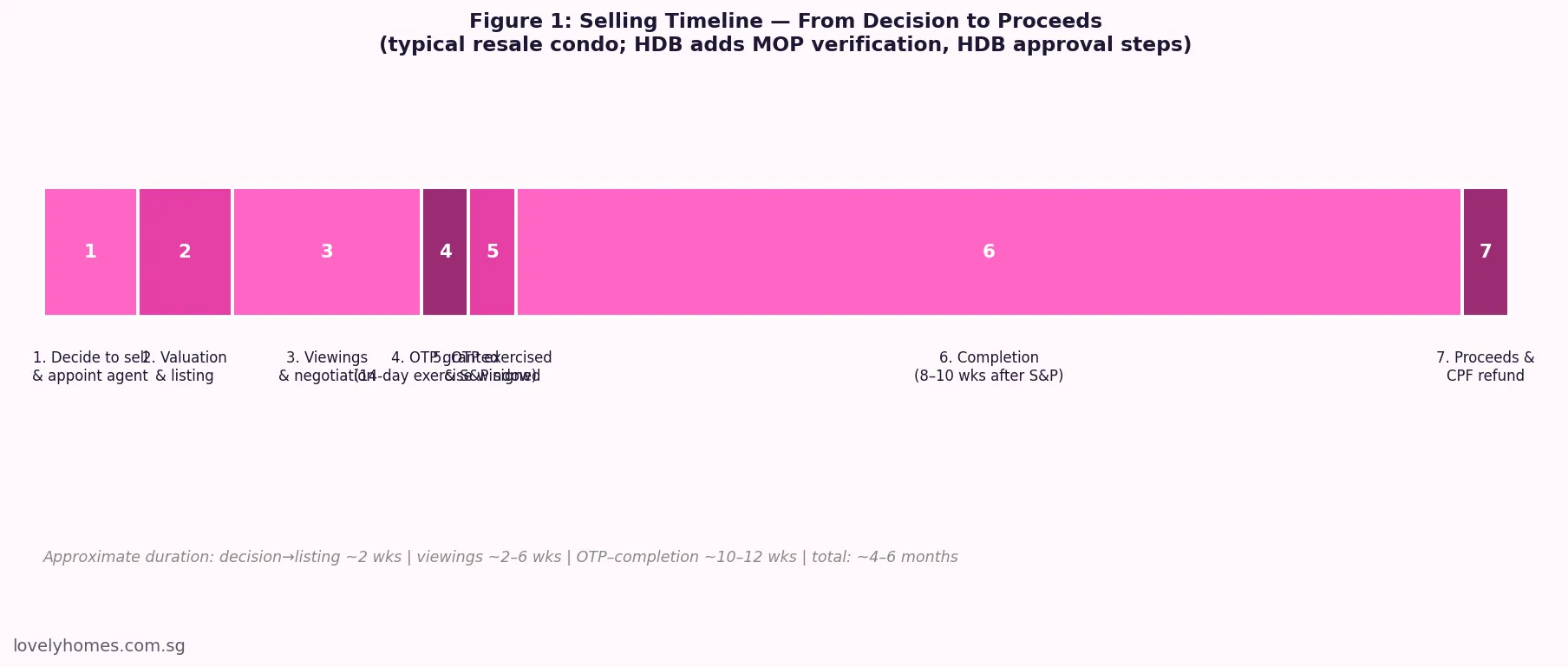
- The standard selling timeline for resale HDB or private property is 4 to 6 months from decision to completion
- HDB sellers must satisfy the Minimum Occupation Period (MOP) of 5 years (or 10 years for Prime and Plus classification flats) before selling
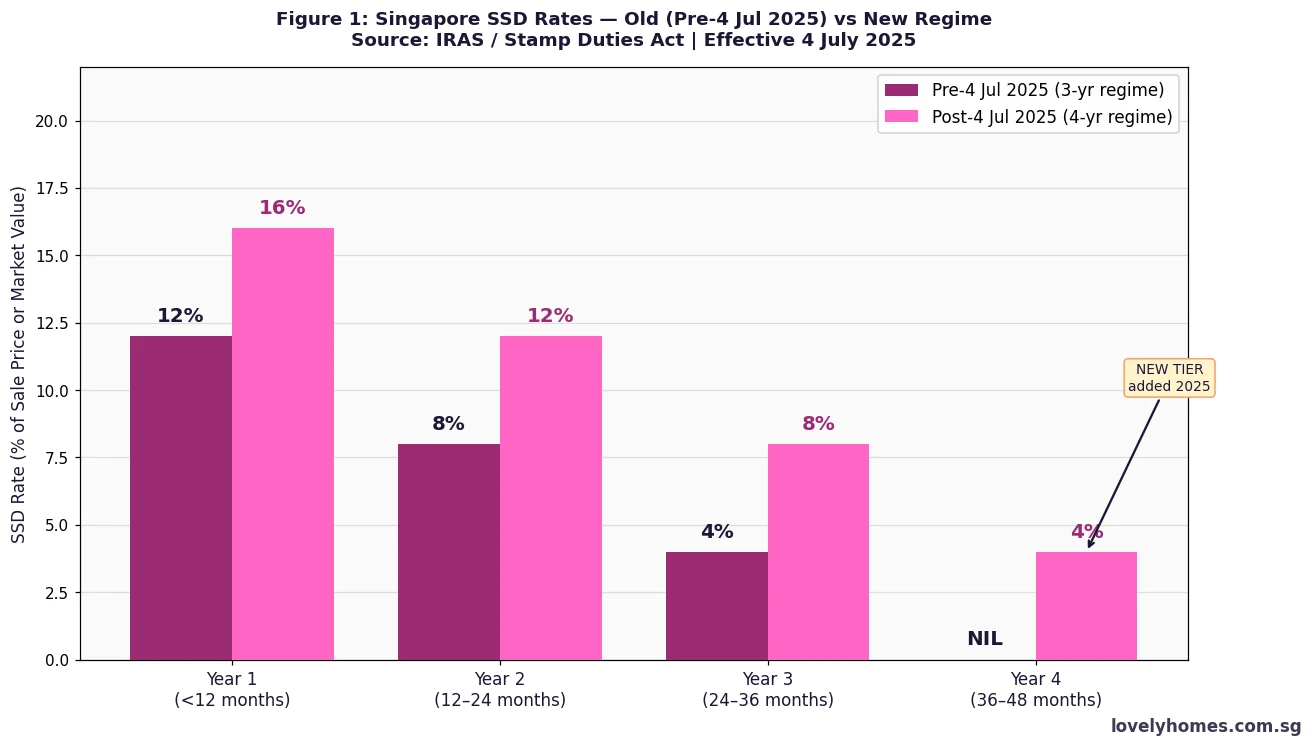
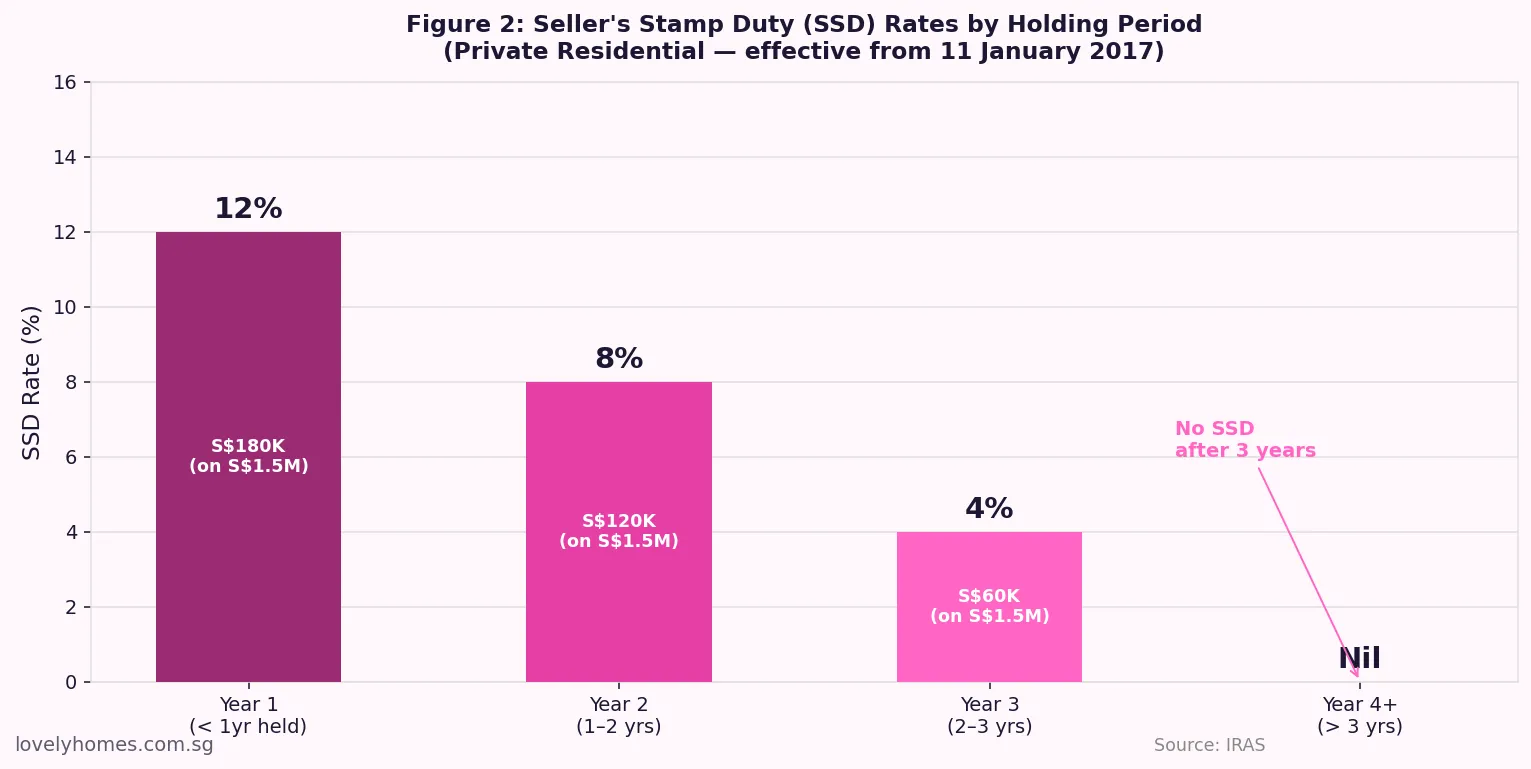
- Seller’s Stamp Duty (SSD) applies to private property sold within 3 years of purchase: 12% (year 1), 8% (year 2), 4% (year 3)
- Agent commission for HDB sellers: typically 1–2% of sale price; condo: 1–2% (negotiable); landed: 1–2%
- CPF Ordinary Account funds used for the purchase must be refunded — with accrued interest at 2.5% p.a. — before you receive any cash proceeds
- The OTP grants the buyer 14 calendar days to decide whether to exercise (HDB: 21 days); the seller is bound for that period
- Completion (from S&P signing) for resale HDB: approximately 8 weeks; private property: typically 10–12 weeks
- Legal conveyancing fees: S$2,000–S$4,000 for HDB; S$2,500–S$5,000+ for private property
Step 1: Decide to Sell — and Check Your Eligibility
Before instructing an agent or starting viewings, two eligibility checks must be completed. For HDB sellers, the most critical is the MOP. Under HDB rules, a flat purchased directly from HDB (BTO, DBSS, or direct sale) must be occupied for a minimum of five years from the date the keys are collected before it can be sold on the open resale market. For Prime Location Public Housing (PLH) and Plus model flats introduced from late 2021, the MOP is ten years. Selling before MOP is a criminal offence under the Housing and Development Act and can result in compulsory acquisition of the flat and other penalties.
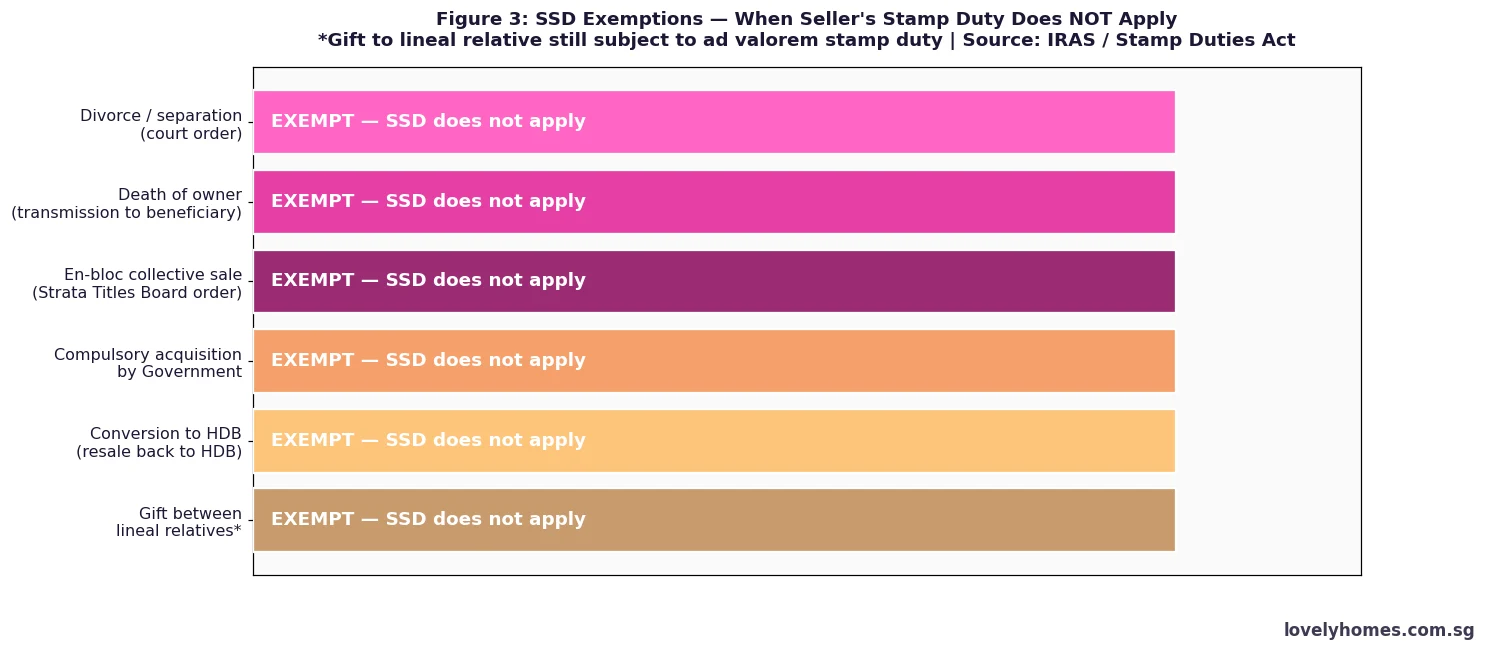
For private property sellers, the eligibility question is Seller’s Stamp Duty. SSD was calibrated in January 2017 to discourage short-term flipping of residential property. If you sell within three years of purchase, SSD is payable at the rates below.
Step 2: Valuation and Listing — Setting the Right Price
Pricing accurately is the single most important decision a seller makes. An overpriced listing sits on the market, accrues carrying costs (mortgage, maintenance fees, property tax), and acquires a stigma as buyers wonder what is wrong with it. An underpriced listing leaves money on the table. Getting it right requires a Comparative Market Analysis (CMA) — a structured review of recent transactions for comparable properties in the same estate or district, same flat type or size, and similar age and condition.
For HDB sellers, URA’s HDB Resale Statistics portal provides free access to actual transacted prices by town, flat type, storey range, and month. Use this data to identify the price band for your flat before allowing any agent to quote you a price. Agents sometimes inflate initial price estimates to win the listing — so cross-check every agent’s recommended listing price against the data yourself.
For private property, URA’s Property Data portal contains detailed transaction histories by project. Supplement this with a professional valuation from an IRAS-approved valuer if you are in doubt, particularly for older or unusual properties where comparables are scarce.
Step 3: Seller’s Stamp Duty — Know Your Exposure Before You List
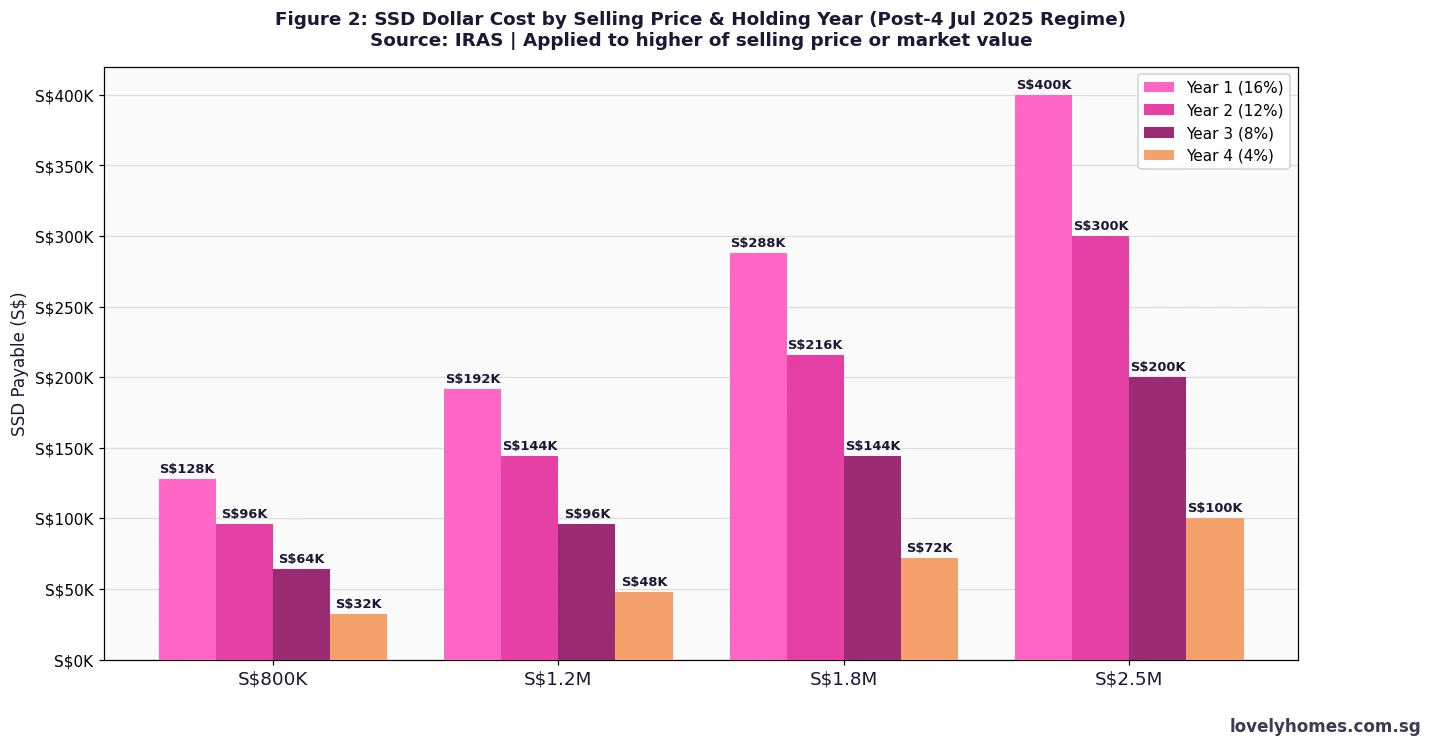
Seller’s Stamp Duty is a critical cost that many sellers either forget or underestimate. It applies to residential properties (private only — HDB resale is not subject to SSD). The rates in force from 11 January 2017 are:
| Holding Period | SSD Rate | SSD on S$1,500,000 Sale | SSD on S$2,500,000 Sale |
|---|---|---|---|
| Up to 1 year | 12% | S$180,000 | S$300,000 |
| More than 1 year, up to 2 years | 8% | S$120,000 | S$200,000 |
| More than 2 years, up to 3 years | 4% | S$60,000 | S$100,000 |
| More than 3 years | Nil | S$0 | S$0 |
SSD is calculated on the higher of the sale price or market value. It is payable by the seller within 14 days of the date the OTP is exercised or the S&P Agreement is signed. IRAS administers SSD via its Stamp Duty portal. If SSD applies to your planned sale, model it explicitly into your net proceeds calculation before you list — it is a very large number at 12% on a S$2 million property.
Step 4: The Option to Purchase (OTP)
The OTP is the first legally binding document in any resale property transaction. Understanding it is essential for sellers.
When a buyer makes an offer that you accept, you grant them an OTP in exchange for an option fee. For private property, the option fee is negotiated — typically 1% of the purchase price, though it can be less for new launches or more for competitive situations. For HDB resale, HDB caps the option fee at S$1,000. The OTP grants the buyer the exclusive right to purchase your property at the agreed price, within a specified window (14 days for private property, 21 days for HDB).
During the option period, you cannot sell to anyone else or accept another offer. If the buyer exercises the OTP (pays the exercise fee and returns the signed copy), a binding Sale and Purchase Agreement comes into existence. If the buyer does not exercise, the OTP lapses, you keep the option fee, and you are free to sell to another party.
For HDB resale, the seller must obtain an HDB Resale Checklist acceptance before granting the OTP. Both buyer and seller submit declarations via the HDB Resale Portal. After the OTP is exercised, both parties have 8 weeks to register the resale application with HDB.
Step 5: Conveyancing and Completion
Once the OTP is exercised, your conveyancing lawyer takes over to complete the legal transfer of title. For private property, the buyer’s lawyer and seller’s lawyer correspond on the Sale and Purchase Agreement, conduct title searches, address outstanding caveats, and coordinate the CPF and bank discharge of your existing mortgage. Completion typically occurs 10 to 12 weeks after the S&P is signed.
At completion, the following typically happen simultaneously: the buyer pays the balance purchase price (via the bank’s loan drawdown and their own CPF OA funds); your outstanding mortgage is discharged and your mortgagee releases the property; CPF refunds your accrued principal and interest from the buyer’s funds; and after all deductions, the net cash proceeds are remitted to you.
Step 6: Net Proceeds — What You Actually Receive
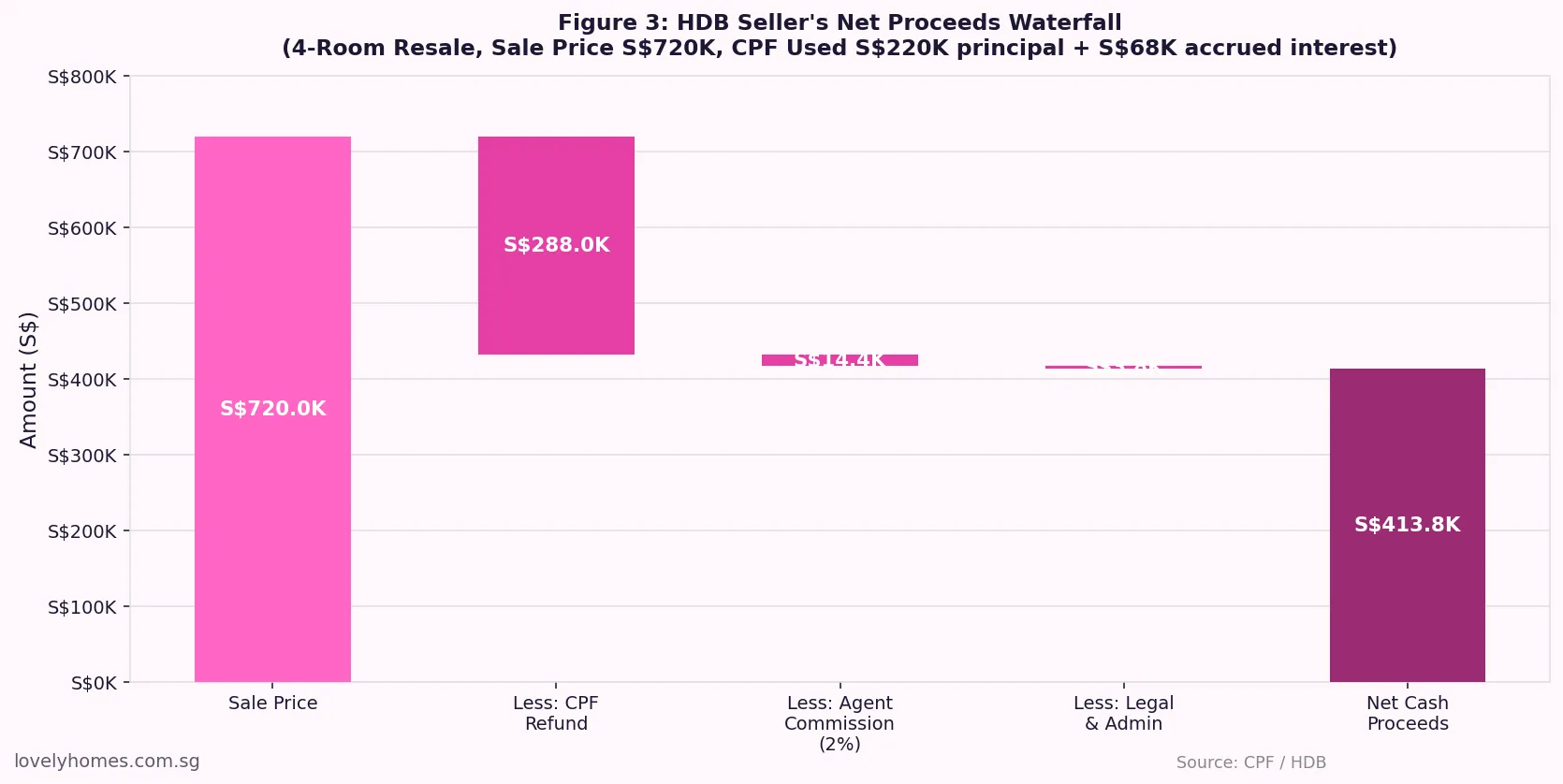
The gap between the headline sale price and the cash you receive in your bank account after completion is often a shock to first-time sellers. Here is how to model it:
| Proceeds Component | HDB Example (S$720K sale) | Private Condo Example (S$1.5M sale) |
|---|---|---|
| Gross sale price | S$720,000 | S$1,500,000 |
| Less: CPF OA refund (principal + accrued interest) | (S$288,000) | (S$450,000) |
| Less: Outstanding mortgage discharge | (S$0) (fully paid) | (S$700,000) |
| Less: Agent commission (2% + 9% GST) | (S$15,696) | (S$32,700) |
| Less: Legal fees (seller’s conveyancing) | (S$2,000) | (S$3,500) |
| Less: HDB admin fee / miscellaneous | (S$800) | (S$0) |
| Net cash to seller | S$413,504 | S$313,800 |
The CPF refund is the item that surprises most sellers. Under CPF rules, all funds withdrawn from your Ordinary Account for housing — the initial downpayment, the monthly mortgage servicing amounts, and any lump-sum top-ups — must be refunded with accrued interest at 2.5% per annum upon sale. This money goes back to your CPF account, not into your bank account. So a seller who used S$220,000 of CPF and held the flat for 15 years might owe S$288,000 back to their CPF account at completion — even if the flat appreciated handsomely, a large portion of the paper gain goes back to CPF, accessible only for retirement or another property purchase.
HDB vs Private: Key Differences for Sellers
The mechanics of selling differ meaningfully between HDB and private property. The table below summarises the most important distinctions:
| Factor | HDB Resale | Private Property (Condo / Landed) |
|---|---|---|
| MOP requirement | 5 years (10 for PLH/Plus) | None |
| Seller’s Stamp Duty | Not applicable | 12%/8%/4% if sold within 3 years |
| OTP option period | 21 days | 14 days (negotiable) |
| HDB approval required | Yes — HDB Resale Portal submission | No |
| Completion timeline | 8 weeks after HDB registration | 10–12 weeks after S&P |
| Valuation required | HDB/SRX valuation (for CPF/loan purposes) | Bank or IRAS valuation |
| Resale Levy (if buying subsidised flat next) | Yes — S$15,000 to S$50,000 depending on flat type | Not applicable |
| ABSD on next purchase | May apply if buying before existing flat is sold | May apply — plan carefully with sell-first strategy |
Worked Example: Mr and Mrs Tan Sell Their Bishan 4-Room HDB Flat
Mr and Mrs Tan are Singapore Citizens who purchased a 4-room HDB flat in Bishan in June 2020 via the open resale market for S$590,000. They used a bank loan (S$442,500 at 75% LTV) and S$120,000 from their combined CPF OA. They have been servicing S$2,100 per month from CPF OA. As of August 2026 (6 years and 2 months of ownership), the MOP of 5 years has been satisfied.
- Sale price agreed: S$780,000
- Outstanding bank loan: S$312,000 (after 74 months of repayment)
- CPF OA principal used: S$120,000 (downpayment) + S$2,100 × 74 months = S$275,400 total principal
- CPF accrued interest at 2.5% p.a.: approximately S$34,000
- Total CPF refund: S$309,400
- Agent commission (2% + 9% GST): S$17,004
- Legal fees: S$2,200
- HDB admin fee: S$800
- Net cash to Mr and Mrs Tan: S$780,000 – S$312,000 – S$309,400 – S$17,004 – S$2,200 – S$800 = S$138,596
- CPF account top-up: S$309,400 (returned to their combined OA — available for future property purchase or retirement)
The Tans pocket S$138,596 in cash and have S$309,400 restored to their CPF accounts — a total economic gain of S$447,996 on a property that cost them S$590,000 six years ago, representing a 75.9% nominal return. The cash component, however, is much more modest at 17.8% of the sale price — a reminder that CPF recycling is a significant feature of the Singapore property selling experience.
Agent vs DIY: Should You Sell Without an Agent?
Singapore’s HDB and private resale markets do not legally require a licensed property agent (or Co-Broke Service / CBS for HDB). You can sell your HDB flat directly through the HDB Resale Portal as a DIY transaction, and private property through your conveyancing lawyer. The benefit is saving the agent commission — typically 1–2% of sale price — which on a S$1 million property amounts to S$10,000–S$20,000.
The risks are real, though. Negotiating effectively against buyers represented by experienced agents, writing and managing the OTP correctly, handling viewings and screening serious buyers from time-wasters, and navigating HDB’s administrative submissions are all tasks where professional help has tangible value. DIY is most viable when you have previous experience, when the property is straightforward and in high demand, and when you are willing to invest significant time. For most first-time sellers, the commission is well-spent insurance against costly errors.
What Might Come Next
For sellers active in H2 2026, the market environment is one of moderating prices (particularly for HDB resale and private OCR/RCR) and still-healthy volume. This is a reasonable time to sell if you have held for the requisite period — the market has not collapsed, but the risk of further softening in 2027 as BTO MOP supply increases is real. Private sellers who bought in 2019 to 2021 during the pre-cooling-measures run-up will have seen the strongest gains; those who bought in 2022 to 2024 may need to hold longer to realise meaningful appreciation. SSD for private sellers who bought after mid-2023 remains an active consideration: the three-year clock runs from the date the OTP was granted to you as a buyer, not the date you moved in.
FAQ: When does the Minimum Occupation Period (MOP) start for HDB?
The MOP begins on the date you collect the keys to your flat — not the signing date of the Sales and Purchase Agreement, not the HDB appointment date, and not the date you move in. The five-year MOP period runs from key collection to key collection plus five years. For BTO flats, this is straightforward. For resale flats, the MOP restarts from the date you as the new owner collect the keys after completion of your purchase, regardless of how long the previous owner occupied the flat.
FAQ: Can I rent out my flat during the MOP while planning to sell after?
For whole-flat subletting, you must first satisfy the MOP before applying for HDB’s permission to sublet. Room rental (subletting of individual bedrooms) is permitted during the MOP subject to HDB approval and conditions. You may not use the MOP period to simultaneously rent out the whole flat and purchase another property — that would amount to owning two properties, which violates HDB rules unless you are an approved private property owner who has given up your subsidy.
FAQ: What happens if the buyer pulls out after exercising the OTP?
If a buyer exercises the OTP (that is, pays the exercise fee and returns the signed document), a binding contract exists. If the buyer subsequently defaults — fails to complete on the scheduled completion date — you as the seller have legal remedies including: forfeiture of the deposit paid, specific performance action, and damages. In practice, most failed completions are resolved through negotiation and a revised completion date rather than litigation. Engage your conveyancing lawyer immediately if your buyer signals difficulty completing.
FAQ: Do I pay tax on the profit from selling my property?
Singapore does not impose a capital gains tax on residential property profits for owner-occupiers and most individual investors. The gains are yours to keep, subject to CPF refund obligations. However, if IRAS determines that you are trading in property — buying and selling repeatedly for profit in a manner that constitutes a business — the gains may be taxed as income. This is a case-by-case assessment. Selling one or two properties over a lifetime is almost never caught by this rule; serial short-term flippers may be. Seller’s Stamp Duty (for private property held under 3 years) is a separate tax on the transaction, not on gains.
FAQ: How do I calculate the CPF accrued interest I owe on sale?
CPF accrued interest is calculated at 2.5% per annum (the prevailing Ordinary Account rate) on the principal CPF amounts withdrawn, compounded monthly from the date each withdrawal was made. CPF Board provides an indicative CPF housing refund calculator on their website at cpf.gov.sg. The actual figure is confirmed by CPF Board during the conveyancing process. It is important to model this early — for long-held properties with substantial CPF usage, the accrued interest can exceed S$100,000.
FAQ: Can I sell my HDB flat and immediately buy a private condo?
Yes, provided you have satisfied the MOP on your HDB flat. Once you sell (or even once you have exercised the OTP to sell, provided you notify HDB), you are no longer counted as an HDB flat owner and can purchase private property without triggering the ABSD that would otherwise apply for owning two residential properties simultaneously. Timing is critical: if you buy the private property before your HDB flat is formally sold (OTP exercised by the buyer), you will own two properties simultaneously and ABSD applies. Most upgraders use the sell-first, buy-second approach or the married couple ABSD remission scheme to manage this sequencing.
FAQ: What is the Resale Levy and do I have to pay it?
The Resale Levy is a charge imposed by HDB on sellers of a subsidised flat (BTO or DBSS) who subsequently buy another subsidised flat (a second or third BTO, an EC, or a DBSS). It does not apply if your next purchase is a resale HDB flat or private property. The levy ranges from S$15,000 for a sold two-room flat to S$50,000 for a sold five-room or executive flat. It is payable from the proceeds of the sale at the HDB appointment. If you are selling your first subsidised flat and planning to buy a resale flat instead of a new BTO, no levy applies.
Related Articles
- HDB Resale Market Q2 2026: Price Index Analysis
- HDB Minimum Occupation Period (MOP) Guide 2026
- Singapore Stamp Duty Remission Guide 2026
- ABSD Singapore 2026: Complete Guide
- TDSR and MSR Borrowing Limits Guide 2026
- Leasehold vs Freehold Property Guide 2026
- How to Choose a Property Agent in Singapore 2026
Disclaimer: This guide is for general information only and does not constitute legal, financial, or property advice. CPF rules, stamp duty rates, HDB administrative requirements, and market conditions change over time. Always verify current requirements at hdb.gov.sg, cpf.gov.sg, and iras.gov.sg, and engage a licensed conveyancing lawyer and CEA-registered property agent before proceeding with any transaction.