- Median HDB 4-room rent (OCR mature): S$2,100–S$3,200/month
- Median private condo 2BR (OCR): S$3,200–S$4,800/month; CCR: S$4,500–S$7,000/month
- HDB subletting allowed only after 5-year MOP; minimum tenancy: 6 months
- Private condo: can rent entire unit from day one; no MOP restriction
- Tenancy Agreement stamp duty: S$4 per S$250 of rent for leases up to 4 years (IRAS)
- Security deposit: typically 1 month per year of tenancy (by convention, not law)
- Rental income is taxable under IRAS; deductions permitted for mortgage interest, maintenance, and agent fees
- Foreigners may rent any residential property without restriction
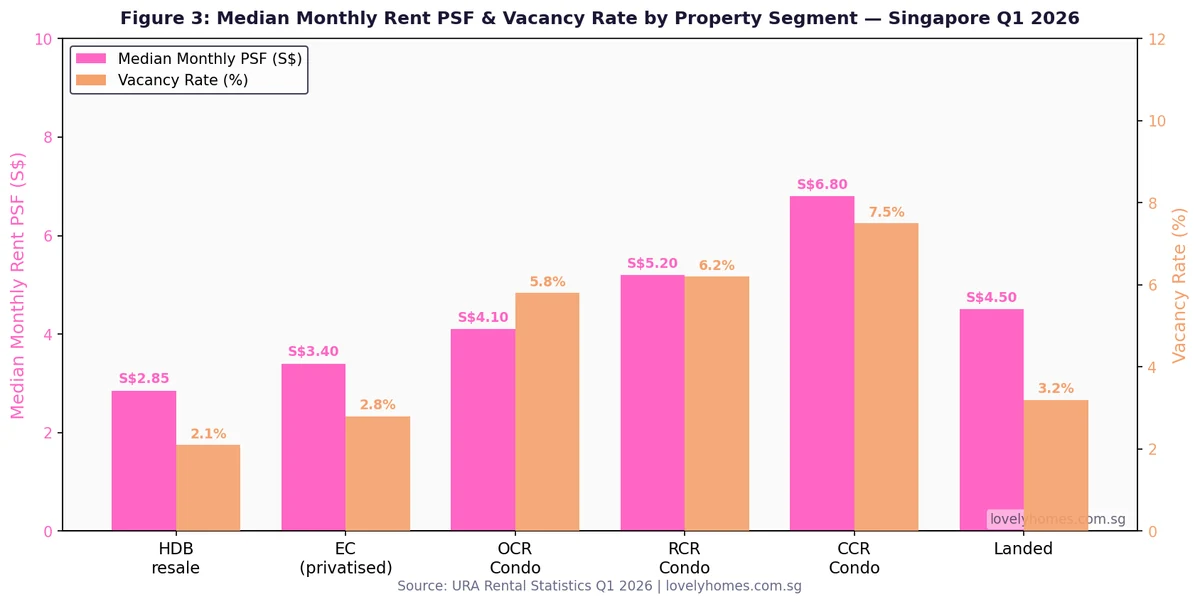
- Q1 2026 vacancy rate: ~5.8% (OCR condo), ~7.5% (CCR condo) , supply-side pressure easing
Singapore’s Rental Market in 2026: An Overview
Singapore’s residential rental market entered 2026 after two years of adjustment. The extraordinary rental surge of 2022–2023 , when median rents rose by 30–40% driven by returning expatriates, supply disruptions, and a flood of en-bloc proceeds , has given way to a more measured environment. Vacancy rates across private residential properties averaged 7.6% at end-2025 (URA), reflecting a significant influx of completed units from the 2021–2023 pipeline.
Yet demand remains structurally healthy. Singapore’s open-economy model, its position as a regional headquarters hub, and a steady pipeline of work-permit and employment-pass holders keep rental absorption strong in the OCR and mature HDB heartland districts. For first-time landlords considering a buy-to-let strategy, and for tenants navigating a complex regulatory framework, understanding the rules administered by the Housing & Development Board (HDB), the Urban Redevelopment Authority (URA), and the Inland Revenue Authority of Singapore (IRAS) is essential.
HDB Flat Subletting Rules: What Every Landlord and Tenant Must Know
HDB flats are subsidised public housing built for owner-occupation, not investment. Subletting an entire HDB flat , or even individual rooms , is subject to a strict ruleset administered by the HDB under the Housing and Development Act.
Minimum Occupation Period (MOP)
Before a flat owner may sublet the entire flat, the property must have completed its 5-year Minimum Occupation Period (MOP) from the date of key collection. For flats purchased under the Prime Location Public Housing (PLH) or Plus classification introduced under HDB’s new classification system (effective BTO exercises from October 2023), the MOP is 10 years.
Room Rental (Subletting a bedroom)
Room-only subletting , where the owner continues to reside in the flat , is permitted before MOP, subject to occupancy cap rules. From 22 January 2026, the HDB and URA implemented a temporary relaxation of the occupancy cap to allow up to 8 unrelated persons in a flat or private residential property (up from the standard 6), applicable until 22 January 2028.
Key HDB subletting rules at a glance
- Minimum tenancy term: 6 consecutive months per subletting period
- Maximum subletting term: 3 years per application (renewable)
- HDB subletting application must be made online at hdb.gov.sg before the subletting commences
- Subtenants must be Singapore Citizens, Permanent Residents, or foreigners with a valid long-term pass (Employment Pass, S Pass, Dependent Pass, Long-Term Visit Pass)
- Non-citizen (NR) subletting quota: no more than 8% of the HDB block may be sublet to non-Malaysian foreigners
Private Condo and Landed Property Rental Rules
Private residential properties , condominiums, apartments, and landed houses , are not subject to MOP restrictions. An investor who purchases a newly-launched private condo may sublet the entire unit immediately upon receiving the Temporary Occupation Permit (TOP), subject to two key rules administered by URA:
- Minimum tenancy term: 3 consecutive months for private residential properties (compared to 6 months for HDB)
- Occupancy cap: The standard cap is 6 unrelated persons per dwelling unit; the temporary relaxation to 8 persons applies through January 2028
- Short-term rental prohibition: Platforms such as Airbnb and similar short-stay apps are prohibited for private residential properties in Singapore. Rental terms below 3 months are illegal and carry fines of up to S$5,000
Landed properties , terraced houses, semi-detached, and bungalows , follow private property rules (3-month minimum, no MOP). Foreign ownership of landed property is restricted under the Residential Property Act 1976, but foreigners may rent any landed home freely.
Rental Rates in 2026: What to Budget as a Tenant
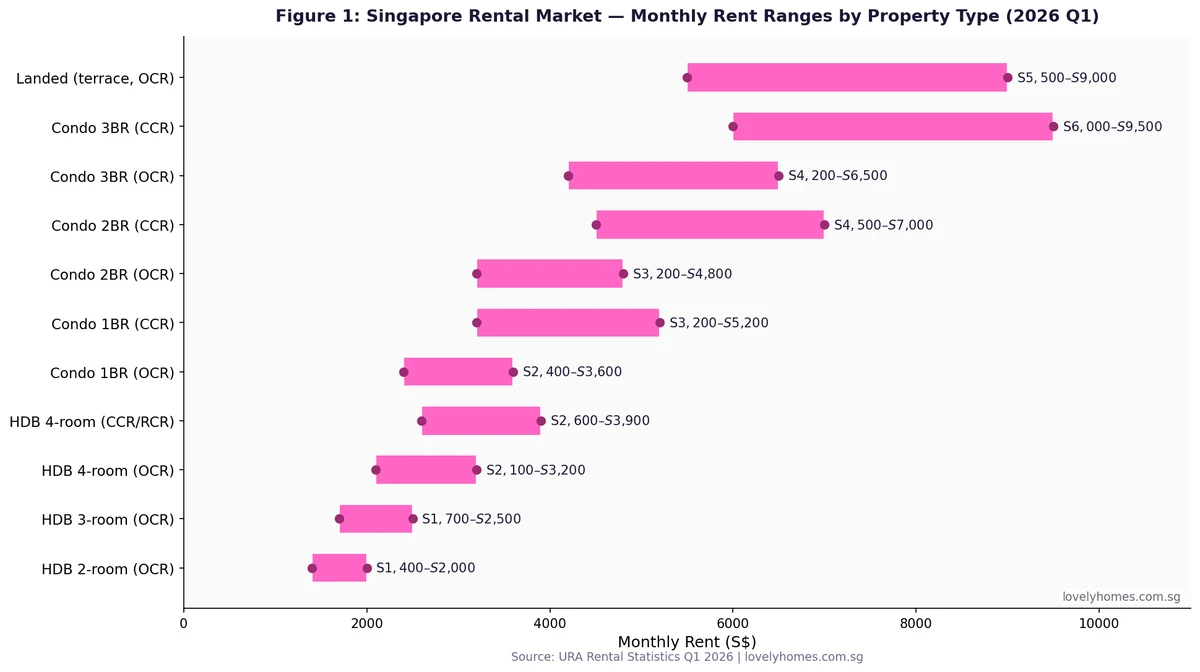
Singapore’s rental market is priced according to property type, location (CCR/RCR/OCR), floor level, condition, and proximity to MRT stations. The data below reflects URA and HDB Rental Statistics for Q1 2026. All figures are monthly rents in Singapore dollars.
| Property Type | Location | Typical Monthly Rent | Indicative PSF |
|---|---|---|---|
| HDB 2-room | OCR | S$1,400–S$2,000 | S$3.0–S$4.2 |
| HDB 3-room | OCR | S$1,700–S$2,500 | S$2.8–S$3.8 |
| HDB 4-room | OCR (mature) | S$2,100–S$3,200 | S$2.6–S$3.5 |
| HDB 4-room | CCR/RCR (Bishan, Toa Payoh) | S$2,600–S$3,900 | S$3.2–S$4.2 |
| Condo 1BR | OCR | S$2,400–S$3,600 | S$4.2–S$5.5 |
| Condo 1BR | CCR | S$3,200–S$5,200 | S$5.5–S$8.0 |
| Condo 2BR | OCR | S$3,200–S$4,800 | S$3.8–S$5.2 |
| Condo 2BR | CCR | S$4,500–S$7,000 | S$5.8–S$8.5 |
| Condo 3BR | OCR | S$4,200–S$6,500 | S$3.5–S$5.0 |
| Landed terrace | OCR | S$5,500–S$9,000 | S$2.8–S$4.5 |
Stamp Duty on Tenancy Agreements
In Singapore, the tenant bears the cost of stamping the Tenancy Agreement (TA) via IRAS e-Stamp within 14 days of signing. The stamp duty rate is:
- For leases of 4 years or less: S$4 for every S$250 (or part thereof) of the total rent payable over the term
- For leases exceeding 4 years (or indefinite term): calculated on the higher of total rent or 4× annual rent, at the same rate
Example: A 2-year tenancy at S$3,500/month = S$84,000 total rent. Stamp duty = S$84,000 ÷ S$250 × S$4 = S$1,344. This must be paid via the IRAS e-Stamping portal at iras.gov.sg.
Rental Yield and Investment Performance
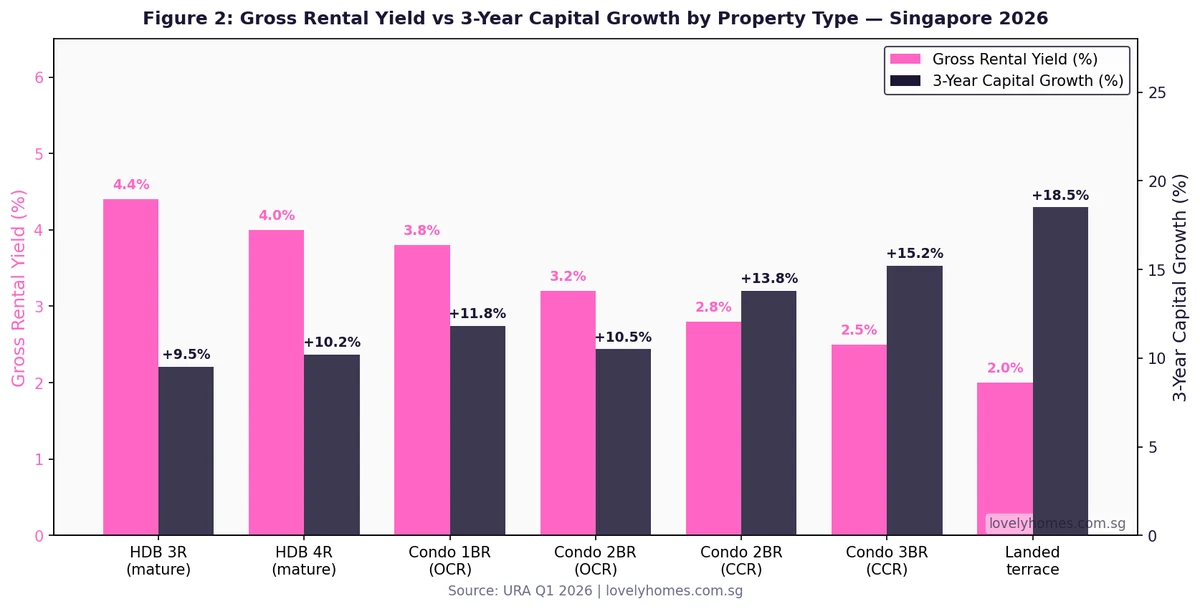
For property investors, gross rental yield is calculated as annual rent divided by purchase price. Singapore’s rental yields have compressed over the past decade as capital values outpaced rent growth, yet certain property types and locations still offer respectable returns , particularly HDB-adjacent OCR condos near MRT nodes and mature-town HDB resale flats after MOP.
HDB resale flats offer the highest gross rental yields (4.0–4.4%) among mainstream property types, owing to relatively affordable purchase prices and sustained heartlander demand. Private condo yields are lower (2.5–3.8%), but the CCR segment benefits from stronger long-term capital growth , up to +15.2% over three years for CCR 3-bedroom units , driven by the irreplaceable land scarcity in Districts 9–11. Landed property yields are modest (2.0%) but capital growth is exceptional (+18.5%), reflecting the structural restriction on new landed supply in Singapore.
PSF Benchmarks and Vacancy Rates Across the Market
Analysing median monthly rent on a per-square-foot (PSF) basis allows meaningful comparison across property types of different sizes. URA’s Q1 2026 Rental Statistics show that CCR condos command the highest PSF (~S$6.80/sqft/month) but also carry the highest vacancy rates (~7.5%), reflecting the elevated supply completions in the prime districts. OCR condos are priced more keenly (~S$4.10 PSF) with lower vacancy (~5.8%).
Rental Income Tax for Landlords
Rental income is taxable in Singapore under the Income Tax Act. Landlords must declare gross rental receipts in their annual tax returns (Year of Assessment for the preceding calendar year). Allowable deductions reduce the taxable rental income:
- Mortgage interest (for the period the property was rented out; capital repayments are not deductible)
- Property tax paid on the rented property
- Fire insurance premiums
- Maintenance and repair costs (not capital improvements)
- Agent commission (for securing the tenancy)
For individual landlords, the net rental income is added to total chargeable income and taxed at progressive rates (0–22% for residents in YA 2026). Non-resident landlords face a flat 24% withholding tax on gross rental income unless a lower treaty rate applies. IRAS cross-checks rental declarations against the HDB/URA subletting register, so non-disclosure carries significant risk.
Tenant Rights and Responsibilities in Singapore
Singapore does not have a dedicated Tenants’ Rights Act. Tenancy agreements are governed by general contract law and the Distress Act (Cap 84). However, several protections and obligations apply by convention and statute:
- Security deposit: typically 1 month per year of tenancy (2 months for a 2-year lease). The landlord must return the deposit within 14 days of lease expiry, less documented deductions for damage beyond fair wear and tear
- Good Faith Principle (HDB): HDB subletting landlords may not impose conditions on how subtenants use common areas of the flat
- Quiet enjoyment: A tenant in possession cannot be evicted without court order once a TA is duly executed and stamped
- Utilities: Tenants are solely responsible for utilities (SP Services) unless expressly stated in the TA
- Dispute resolution: Landlord-tenant disputes may be referred to the Community Disputes Resolution Tribunals (CDRT) or Small Claims Tribunals (SCT) for claims under S$20,000
Worked Example: The Nguyens Rent and Invest in Singapore
Mr & Mrs Nguyen, Vietnamese nationals on Employment Passes, arrive in Singapore in June 2026. They have a monthly EP allowance of S$12,000 combined and wish to rent a 3-bedroom condo in the east (D15/D16 Marine Parade/Bedok corridor) for a 2-year lease.
- Target unit: 3BR condo, 1,100 sqft, Marine Terrace area , asking rent S$5,200/month
- Security deposit: 2 months × S$5,200 = S$10,400 (refundable at end of lease)
- Advance rent: 1 month = S$5,200
- Tenancy Agreement stamp duty: Total rent = S$5,200 × 24 = S$124,800. Stamp duty = S$124,800 ÷ 250 × 4 = S$1,997
- Agent commission: Typically 1 month (half/half split with landlord) = S$2,600, usually borne by landlord for a 2-year lease from month 13 onwards per industry convention
- Total upfront cash outlay by tenant: S$10,400 + S$5,200 + S$1,997 = S$17,597
- Annual rental budget: S$5,200 × 12 = S$62,400 (51.7% of annual EP income , in the higher range, but Singapore’s 55% TDSR is a credit metric, not an expense-to-income rule for tenants)
Simultaneously, Mr & Mrs Nguyen consider whether to invest in a D16 OCR condo unit at S$1.65M. As foreigners, they would pay BSD S$51,800 + ABSD S$1,072,500 (65% of S$1.65M) = S$1,124,300 total stamp duty , effectively a 68% surcharge on the purchase price. ABSD for foreigners at 65% makes direct property investment by foreigners financially prohibitive in most cases; rental remains the rational choice for non-PR residents.
Why the Rental Market Matters for Property Investors
Singapore’s rental market is not a peripheral consideration , it directly influences property valuations, lending decisions, and investment returns. The MAS Total Debt Servicing Ratio (TDSR) framework allows a landlord to include up to 70% of verified rental income from existing investment properties when computing their debt-servicing capacity for new loan applications. This means a property generating S$4,000/month in verifiable rental income effectively allows the landlord to carry an additional S$2,800/month in debt obligations under TDSR calculations , a meaningful lever for portfolio expansion.
For owner-occupiers considering upgrading, rental yield is also an opportunity cost metric: if your HDB flat could generate S$3,000/month post-MOP but you remain in it rent-free, that S$3,000 is the implicit value of owner-occupation compared against renting out and renting elsewhere. The condo vs HDB upgrader analysis is informed significantly by this rental yield comparison.
What Might Come Next for Singapore Rentals
The near-term rental outlook points to continued moderation. The completion of large private condo projects in the OCR and RCR pipeline , particularly the Tengah, Bukit Timah, and Greater Southern Waterfront corridors , will keep vacancy elevated through 2026–2027. However, several countervailing forces support long-term demand: Singapore’s push to attract global business headquarters, the expanding one-north and JTC LaunchPad ecosystem, and the steady pace of permanent residence approvals all support rental absorption. If URA’s Q2 2026 data (expected July 2026) shows vacancy stabilising below 8%, that will be a positive signal for landlords. The HDB subletting market is likely to tighten further as the 2019–2021 BTO cohort approaches MOP in 2024–2026, releasing a new wave of HDB supply into the rental pool at precisely the moment private vacancy is also elevated. Tenants may benefit from negotiating power in this window.
Frequently Asked Questions
Can I rent out my HDB flat before completing the MOP?
You cannot sublet the entire HDB flat before completing the 5-year MOP (or 10-year MOP for PLH/Plus flats). However, you may sublet individual rooms , provided you continue to reside in the flat yourself. Room subletting does not require HDB approval, but the occupancy cap still applies (maximum 6 unrelated persons, or 8 during the temporary relaxation period through January 2028). Subletting the entire flat pre-MOP is a breach of the HDB terms and conditions and may result in compulsory acquisition of the flat by HDB.
What is the minimum tenancy period for a private condo in Singapore?
The minimum tenancy for a private residential property (including condominiums, apartments, and landed houses) in Singapore is 3 consecutive months, as set by URA regulations. Any lease shorter than 3 months is classified as short-term rental and is prohibited. For HDB flats, the minimum is 6 consecutive months. Short-stay platform listings (Airbnb-style) are illegal for all residential properties in Singapore and can result in fines of up to S$5,000 per offence.
Do I need to pay income tax on rental income in Singapore?
Yes. Rental income received by individuals is subject to income tax under the Income Tax Act (Cap 134). You must declare gross rental receipts in your annual income tax return. Allowable deductions include mortgage interest (not capital repayment), property tax, fire insurance premiums, maintenance and repair costs, and agent commission. The taxable net rental income is added to your other chargeable income and taxed at progressive rates (0–22% for residents in YA 2026; 24% flat for non-residents). IRAS cross-references HDB and URA subletting records, so undeclared rental income carries significant audit risk. You may file via myTax Portal at iras.gov.sg.
Who pays stamp duty on a Tenancy Agreement , landlord or tenant?
By convention and IRAS practice, the tenant bears the stamp duty on the Tenancy Agreement, unless the TA expressly states otherwise. The rate is S$4 per S$250 (or part thereof) of the total rent payable over the term (for leases up to 4 years). Stamp duty must be paid via IRAS e-Stamping within 14 days of signing the TA if signed in Singapore, or within 30 days if signed overseas. An unstamped TA is inadmissible in court as evidence, which is a significant risk if a landlord-tenant dispute later arises.
Can a foreigner rent a private condo or HDB flat in Singapore?
Foreigners may rent private residential properties (condominiums, apartments, landed houses) without restriction. However, foreigners may only rent HDB flats if they hold a valid long-term pass , specifically an Employment Pass, S Pass, Dependent Pass, or Long-Term Visit Pass. Tourist visa holders (SVP/STP) and short-term pass holders cannot legally rent an HDB flat. The HDB maintains a non-citizen (non-Malaysian foreigner) quota of 8% per HDB block , once that quota is reached, additional non-Malaysian foreigners cannot rent any flat in that block regardless of their pass type.
What security deposit is standard in Singapore rental agreements?
Singapore’s rental market follows the convention of 1 month’s deposit per year of tenancy , so a 1-year lease carries a 1-month deposit and a 2-year lease carries a 2-month deposit. This is not enshrined in statute but is industry standard enforced by the IRAS stamp-duty framework (which uses “gross rent” inclusive of any deposit payments). The landlord must return the full deposit within 14 days after the lease end date, less documented deductions for damage beyond normal fair wear and tear. Disputes over deposit deductions may be brought before the Small Claims Tribunal (SCT) for claims under S$20,000.
What happens if my landlord refuses to return my security deposit?
If a landlord unlawfully withholds a security deposit, the tenant may file a claim with the Small Claims Tribunal (SCT) for disputes involving sums up to S$20,000, or with the Community Disputes Resolution Tribunal (CDRT) if the dispute also involves neighbourly conduct. A stamped Tenancy Agreement is the primary piece of evidence; ensure you retain a signed copy and document the flat’s condition with photographs at both the start and end of the tenancy. The Consumer Association of Singapore (CASE) also provides mediation for tenancy disputes. Singapore’s courts have consistently upheld tenants’ rights to deposit recovery where the landlord cannot produce evidence of actual damage.
Related Articles
- ABSD Singapore 2026: Complete Guide to Additional Buyer’s Stamp Duty
- CPF Property Withdrawal Limits Singapore 2026: OA, Valuation Limit and Accrued Interest Explained
- Condo vs HDB Singapore 2026: The Upgrader’s Complete Decision Framework
- Singapore Property Buying Checklist 2026: 12 Steps from IPA to Key Collection
- Singapore Bridging Loan Guide 2026: How to Bridge the Gap Between Selling and Buying Property
- Rental Income Tax Singapore 2026: Complete IRAS Guide for Landlords
Disclaimer: The information in this guide is for general educational purposes only and does not constitute legal, tax, or financial advice. Rental rules, stamp duty rates, and HDB policies are subject to change by the relevant authorities , HDB, URA, IRAS, CPF Board, and MAS. Always verify current rules at the official government portals (hdb.gov.sg, ura.gov.sg, iras.gov.sg) and consult a licensed property agent or solicitor before entering into any tenancy or purchase transaction. LovelyHomes is an independent editorial platform and is not affiliated with any property agency.
Supporting graphics
Original article illustrations are available below.
- Figure 1: Singapore rental market , monthly rent ranges by property type and location, Q1 2026. Source: URA Rental Statistics.
- Figure 2: Gross rental yield vs 3-year capital growth by property type , Singapore Q1 2026. Source: URA / lovelyhomes.com.sg research.
- Figure 3: Median monthly rent PSF and vacancy rate by property segment , Singapore Q1 2026. Source: URA Rental Statistics.