⚡ Quick Answer: Singapore TDSR at a Glance (2026)
- What is TDSR? The Total Debt Servicing Ratio , a rule set by the Monetary Authority of Singapore (MAS) that caps your total monthly debt repayments at 55% of your gross monthly income.
- What counts as debt? All outstanding loan instalments: home loan, car loan, personal loan, student loan, credit card revolving balances (at 5% monthly outstanding), and investment property loans.
- When does it apply? For all bank loans for private property purchases. For HDB loans via banks (not HDB directly), both TDSR and the more restrictive MSR (30% cap) apply simultaneously.
- Stress test rate: Banks use 4.0% per annum (private property) and 3.0% p.a. (HDB bank loans) to compute the monthly instalment , regardless of the actual market rate offered.
- TDSR vs MSR: MSR (30%) applies only to HDB flat bank loans and covers only the home loan instalment. TDSR (55%) covers all debts and applies to all property types.
- Key pitfall: Undisclosed debts , even a S$500/month instalment , can push your TDSR above 55% and cause your home loan to be declined at the credit assessment stage.
- Who can be exempt? Owner-occupier refinancing with no cash-out, and certain HDB concessionary loans from HDB directly, may be partially exempt. MAS requires banks to apply TDSR consistently across borrowers.
When a Singapore bank evaluates a home loan application, one ratio sits at the centre of the credit decision: the Total Debt Servicing Ratio, or TDSR. Introduced by the Monetary Authority of Singapore (MAS) in June 2013 as part of a suite of property cooling measures, the TDSR framework remains one of the most consequential policies affecting Singapore property buyers in 2026. Get it right and your loan is approved; get it wrong and the sale falls through regardless of how large your down payment is.
This guide explains exactly how TDSR works, how banks compute it, the critical difference between TDSR and the Mortgage Servicing Ratio (MSR), the stress-test interest rates that apply in 2026, and the strategies Singapore buyers use to manage their TDSR effectively before applying for a loan.
What Is the TDSR Framework and Who Administers It?
The TDSR framework is a macro-prudential measure administered by the Monetary Authority of Singapore (MAS) under MAS Notice 645 (for banks) and various related notices for finance companies. Its stated purpose is to “ensure that borrowers do not borrow beyond their means” , it is a supply-side constraint on credit, not a market-price control.
In practice, every bank in Singapore must compute a borrower’s TDSR before approving any property loan. The MAS audits banks’ compliance with TDSR as part of its regular supervisory programme. Banks that consistently breach TDSR rules face formal censure, capital add-ons, and potential restrictions on their mortgage lending activities. TDSR is not a guideline , it is a hard regulatory requirement.
How to Calculate Your TDSR
The TDSR formula is straightforward:
TDSR = (Total Monthly Debt Obligations ÷ Gross Monthly Income) × 100
The result must not exceed 55%. “Total monthly debt obligations” includes every regular debt payment you have, and the home loan instalment is computed using a stress-tested interest rate rather than the actual rate the bank offers you. The stress test rate in 2026 is:
| Loan Type | Stress Test Rate (2026) | MAS Basis |
|---|---|---|
| Private property bank loan | 4.0% per annum | MAS Notice 645, para 7 |
| HDB flat bank loan (TDSR portion) | 3.0% per annum | MAS Notice 645, Annex A |
| HDB direct loan (HDB Loan) | No TDSR , MSR 30% applies | HDB Loan Policy |
| Refinancing (private, owner-occupier) | 4.0% per annum | MAS Notice 645 |
Importantly, the stress test rate does not reflect the actual rate you will pay. In 2026, three-month SORA (Singapore Overnight Rate Average) is approximately 2.8%, making bank fixed-rate packages generally available in the 3.0–3.6% range. The 4.0% stress test is deliberately conservative , MAS wants to ensure borrowers can still service their loan if rates rise by 100–130 basis points above current levels.
What Counts as Debt?
Banks must include the following in the TDSR computation:
| Debt Type | How Counted | Notes |
|---|---|---|
| Home loan (new) | Monthly instalment at stress-test rate, full tenure | Computed using 4.0% for private property |
| Car loan | Outstanding monthly instalment | Hire-purchase treated the same as bank loan |
| Personal loan | Outstanding monthly instalment | Includes renovation and education loans |
| Investment property loan | 30% of outstanding monthly instalment | Income from rental offsets some obligation |
| Credit card revolving balance | 5% of total outstanding monthly | Only revolving , not the full credit limit |
| Student loan | Outstanding monthly instalment | Government tuition fee loans included |
| Guarantees | Pro-rated based on guarantee exposure | Banks have discretion on treatment |
Notably, investment property loans are counted at only 30% of their instalment , MAS acknowledges that rental income offsets part of the servicing cost. This is significant for upgraders who retain their HDB flat for rental while buying a private property. However, HDB flat rental income must be verified and cannot be used to inflate gross income beyond what MAS permits.
TDSR vs MSR: The Critical Difference
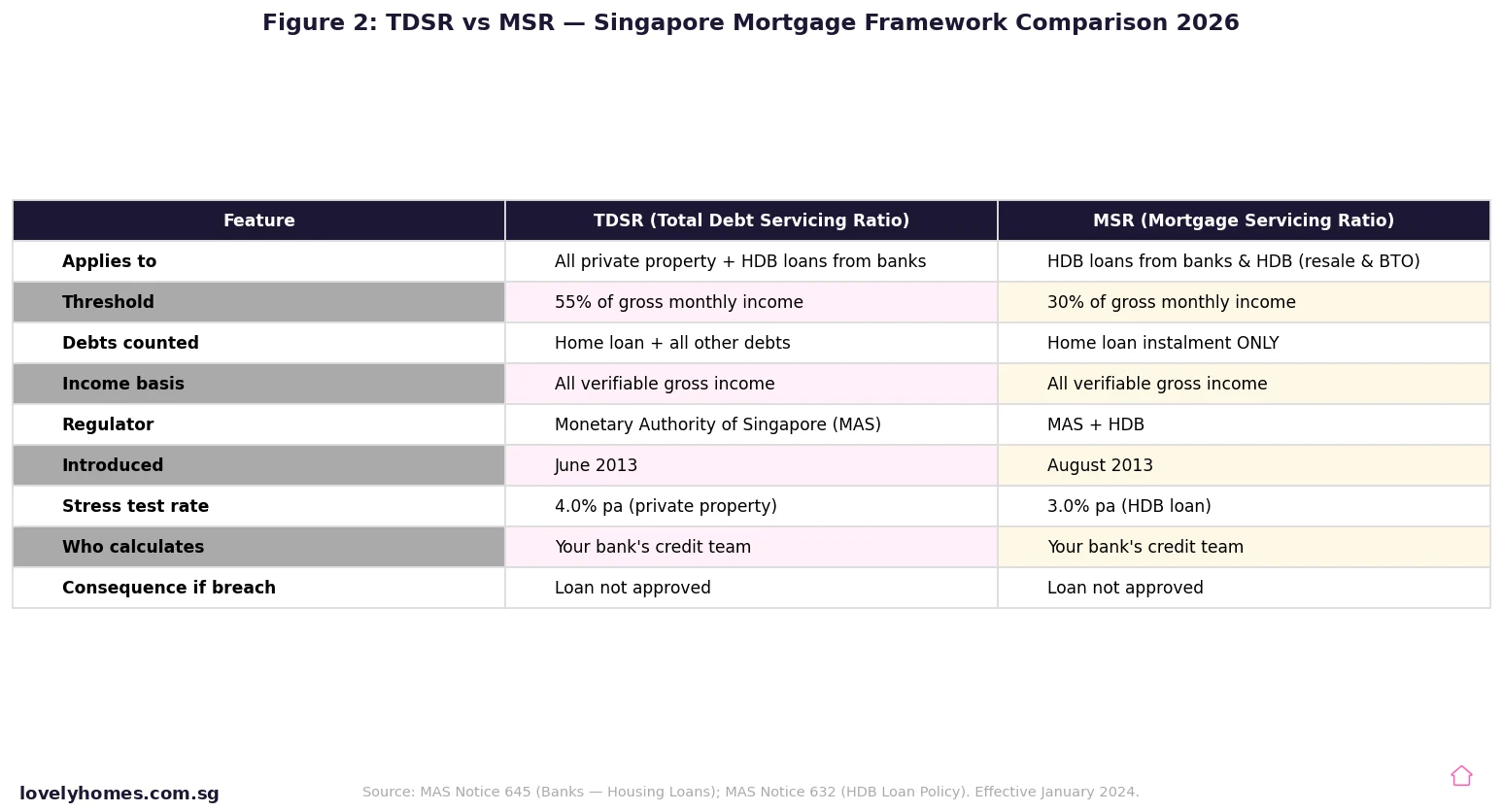
Singapore’s mortgage framework actually contains two separate ratio tests. Every buyer obtaining a bank loan for an HDB flat must satisfy both. For private property, only TDSR applies. Understanding the difference prevents misunderstanding your borrowing capacity.
The Mortgage Servicing Ratio (MSR) was introduced in August 2013, one month after TDSR. It caps monthly home loan instalments (and only home loan instalments , not other debts) at 30% of gross monthly income, and applies exclusively to bank loans for HDB flats. If you are buying an HDB resale flat with a bank loan, your bank will compute both TDSR and MSR. You must pass both , and the MSR at 30% is the binding constraint for the vast majority of HDB buyers, because 30% of most buyers’ incomes is reached before the 55% TDSR ceiling is hit.
For a buyer earning S$10,000 per month: the MSR cap means the home loan instalment cannot exceed S$3,000 per month; the TDSR cap means total debt (including that home loan) cannot exceed S$5,500 per month. For private property, only the S$5,500 TDSR ceiling applies (with no separate MSR constraint).
How Gross Income Is Measured
MAS defines gross monthly income for TDSR purposes to include: basic salary, fixed allowances, 12 months’ variable bonus averaged over 12 (or less if tenure is shorter), commission income averaged over 12 months, rental income (haircut to 70% of gross rental), and CPF contribution income. Self-employed income is typically assessed using the net trade income from the Inland Revenue Authority of Singapore (IRAS) Notice of Assessment, averaged over the most recent two years.
Banks apply haircuts to variable income to reflect its less certain nature. A senior banker’s S$20,000 monthly package consisting of S$12,000 base plus S$8,000 variable bonus may be assessed at only S$12,000 + (S$8,000 × 12 / 12 × 70%) = S$17,600 for TDSR purposes , not S$20,000. The bank’s credit officers have discretion within MAS’s guidelines on how to treat borderline income types.
Loan-to-Value Limits and TDSR: How They Interact
The TDSR tells you what instalment you can afford based on income; the Loan-to-Value (LTV) limit tells you what loan you can take based on property value. Both constraints operate simultaneously, and the binding constraint is whichever is lower.
For a first property purchase with no outstanding home loans: the LTV limit is 75% (for private property loans from banks). However, if TDSR limits your loan to, say, S$800,000 while 75% LTV on a S$1.5M property permits S$1,125,000, the TDSR is the binding constraint and you can only borrow S$800,000. If you are buying a second property while still servicing the first, the LTV drops to 45%, and TDSR must also accommodate both loans’ instalments.
| Outstanding Home Loans | LTV Limit (Private) | LTV Limit (HDB) | Additional TDSR Note |
|---|---|---|---|
| None (first property) | 75% | 80% (HDB loan) 75% (bank loan) |
Only home loan in TDSR |
| 1 outstanding loan | 45% | 45% | Both home loans in TDSR |
| 2+ outstanding loans | 35% | 35% | All home loans in TDSR |
Worked Example: Couple Buying a S$1.8M Condominium
🏢 Case Study , SC Couple Buying S$1.8M OCR Condo (31 July 2026)
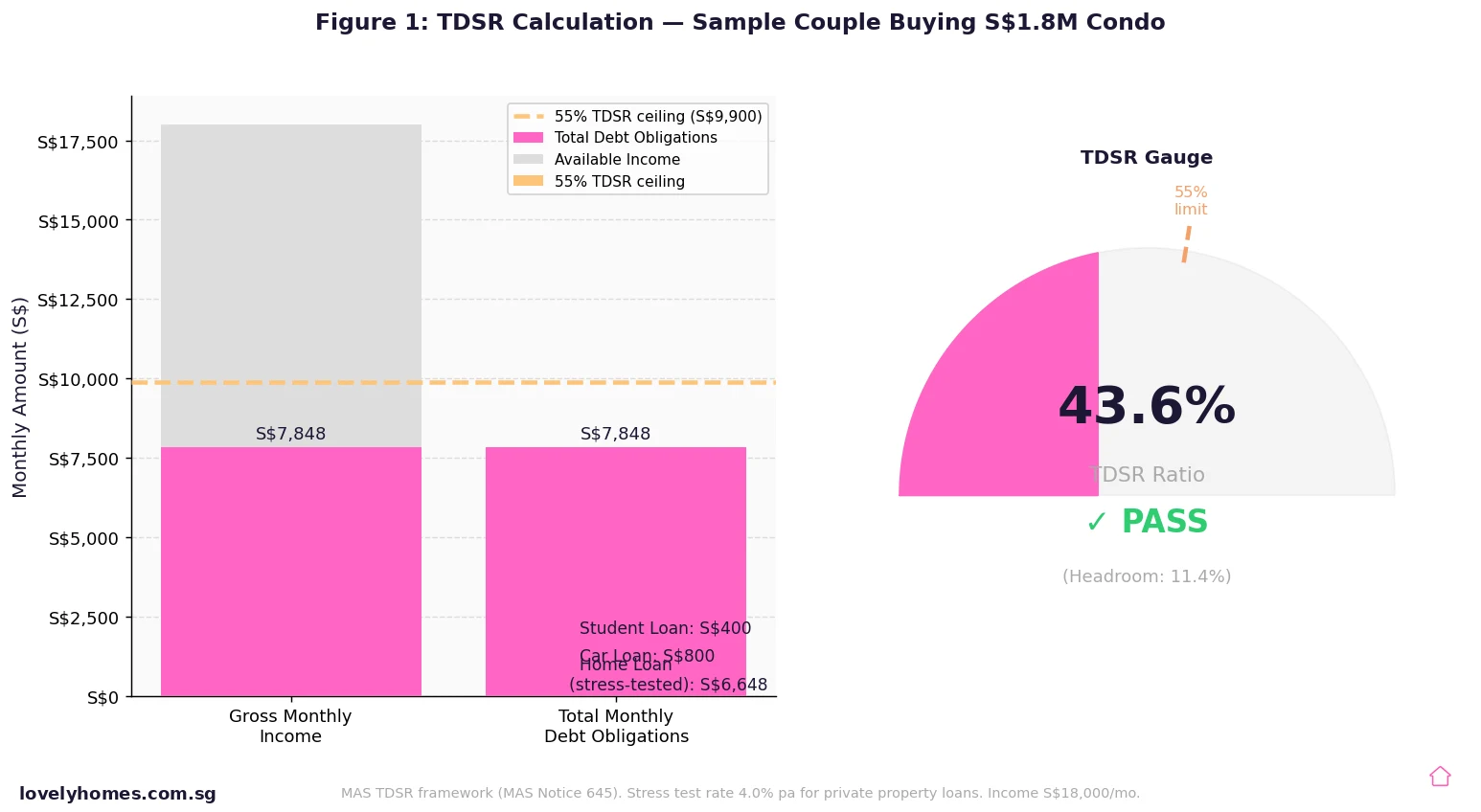
Buyer profile: Singapore Citizen couple (joint purchase). First property. Combined gross monthly income: S$18,000. No CPF withdrawal from prior property. Existing debts: car loan S$800/month, student loan S$400/month.
Proposed loan: S$1.26M (70% LTV). Tenure: 25 years. Bank fixed rate: 3.2% p.a. (years 1–2), thereafter SORA + 1.0%.
Step 1 , Compute stress-tested monthly instalment:
Rate: 4.0% p.a. ÷ 12 = 0.3333%/month. n = 300 months.
Monthly instalment = S$1,260,000 × [0.003333 × (1.003333)^300 / ((1.003333)^300 − 1)] = S$6,648/month.
Step 2 , Total monthly debt obligations:
S$6,648 (home loan, stress-tested) + S$800 (car) + S$400 (student loan) = S$7,848
Step 3 , TDSR check:
S$7,848 ÷ S$18,000 = 43.6% → below 55% ceiling → PASS ✓
Step 4 , Headroom: 55% − 43.6% = 11.4% headroom. Expressed in dollar terms: S$18,000 × 11.4% = S$2,052/month of additional debt capacity remaining after this purchase.
What if they had a personal loan of S$1,000/month on top?
TDSR = (S$6,648 + S$800 + S$400 + S$1,000) ÷ S$18,000 = 49.2% → still passes. But adding another S$1,500/month debt would push TDSR to 57.8% → FAIL ✗ , loan declined even though their actual rate would be 3.2%.
What This Means for Singapore Buyers in 2026
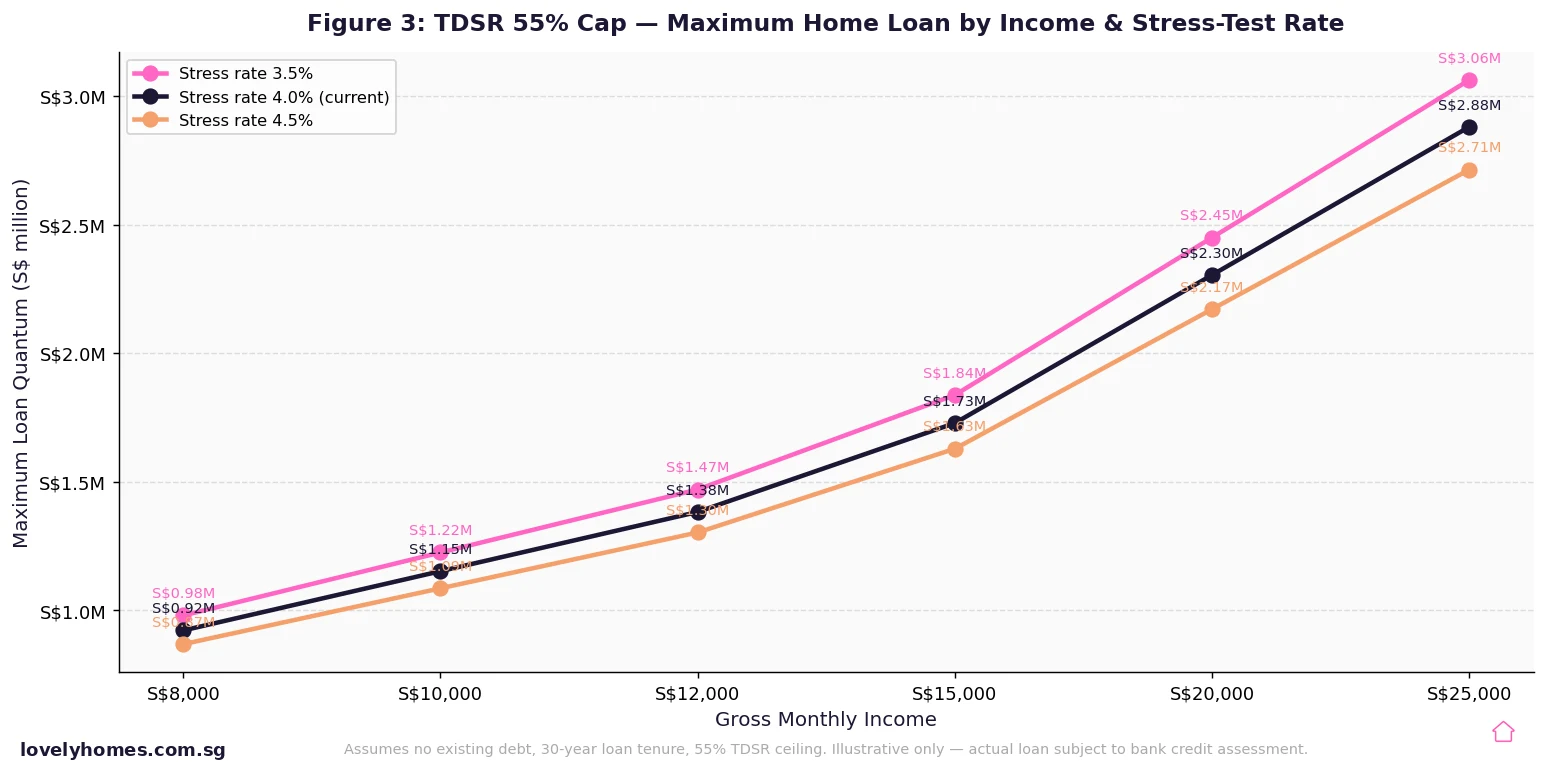
The TDSR framework has meaningfully shaped Singapore’s property market since 2013. By capping total debt at 55% of income, MAS has effectively anchored the maximum property price any given income bracket can access , regardless of how cheap credit temporarily becomes. This is a deliberate design choice: it insulates Singapore households from the kind of debt stress that accompanied property busts in countries without equivalent prudential frameworks.
In 2026, the stress test rate of 4.0% continues to act as a meaningful speed governor. Singapore’s three-month SORA (approximately 2.8%) sits well below the stress rate, which means that most borrowers are tested at a rate approximately 120 basis points above their actual cost of borrowing. This preserves a meaningful buffer if MAS or central bank rates rise. A buyer who passes TDSR at 4.0% can continue servicing their loan if rates rise to, say, 4.5% or even 5.0% without breaching income limits , provided no new debts are added.
Strategies for Managing TDSR
For buyers approaching the TDSR ceiling, several lawful strategies exist to manage the computation. First, paying down car loans or personal loans before the home loan application reduces the monthly debt obligations and directly lowers TDSR. Every S$500/month of debt eliminated translates into S$500/month of home loan capacity added. Second, extending the home loan tenure from 20 years to 30 years reduces the monthly instalment and thus the TDSR contribution from the new home loan, though it increases total interest paid over the life of the loan. Third, adding a co-borrower (e.g., a parent or sibling with stable income and low existing debts) expands the gross income base used in the TDSR denominator.
Buyers should note that deliberately concealing debts from a bank to pass TDSR is mortgage fraud. MAS has clear guidance that banks must conduct their own credit bureau checks through the Credit Bureau Singapore (CBS), which records all outstanding credit facilities. Undisclosed debts are typically discovered at the credit check stage , and at that point, the home loan will be declined regardless of how advanced the purchase is.
When the TDSR limit changed
The TDSR threshold was tightened from 60% to 55% with effect from 16 December 2021. It was not a temporary relaxation introduced in September 2022. See the joint MOF, MND and MAS announcement for the effective dates and transitional arrangements.
Frequently Asked Questions
Does the TDSR apply if I pay for a property fully in cash?
No. TDSR is a loan regulation , it governs when a bank can extend credit, not when you can purchase property. If you purchase a property entirely with cash (and CPF, which is not a bank loan), the TDSR framework does not apply because no bank is extending you credit. You are free to purchase any property in Singapore (subject to other regulatory restrictions such as ABSD and foreign ownership rules) without any TDSR constraint if no bank loan is involved. The practical significance: high-net-worth buyers who purchase in cash are not limited by TDSR and can acquire multiple properties without the leverage ceiling that applies to loan-dependent buyers.
If my spouse has high debts, does their TDSR affect my home loan application?
It depends on whether you are applying jointly or individually. If you and your spouse apply jointly for the home loan, the bank computes TDSR based on your combined gross monthly income and combined monthly debt obligations , so your spouse’s debts are fully included. If you apply individually (sole borrower), only your income and your debts are used; your spouse’s debts are excluded unless they are a guarantor. The implication: if one spouse has significant existing debt, it may be more favourable for the other spouse to apply as the sole borrower , provided their individual income is sufficient to support the loan quantum required. Note that if CPF OA funds from both spouses are used, both spouses become co-owners, which typically makes a joint loan application necessary.
How does rental income from my current HDB flat affect TDSR when I buy a private property?
If you intend to retain your HDB flat and rent it out after purchasing a private property, you may include that expected rental income in your gross income for TDSR purposes , but only at 70% of verified rental income (MAS applies a 30% haircut to rental income to account for vacancy and maintenance). Your existing HDB loan instalment (if you took an HDB loan) is not counted in TDSR for HDB direct loans, but the outstanding HDB loan is still considered for LTV purposes on the new private property purchase. Additionally, ABSD at 20% (SC second property) will apply to your private property purchase unless you sell the HDB flat first. See our ABSD complete guide for the full stamp duty implications.
Can I get a bank loan if my TDSR exceeds 55%?
Not under standard MAS-regulated lending. Banks are prohibited from granting mortgage loans to borrowers whose TDSR exceeds 55%. There are limited exceptions for owner-occupier refinancing (where no new money is drawn and the purpose is genuinely to reduce the borrower’s debt burden), but these exceptions are narrowly defined and do not apply to new purchases. Borrowers who cannot pass TDSR have three main options: (a) reduce existing debts before applying; (b) increase their provable gross income; or (c) reduce the loan quantum by increasing the down payment (which reduces the monthly instalment and hence the TDSR contribution from the home loan). Borrowing from unlicensed lenders to finance a property purchase is illegal and exposes buyers to significant legal and financial risk.
How does TDSR affect EC (Executive Condominium) purchases?
Executive Condominiums are a hybrid product: they are developed by private developers but subject to HDB eligibility rules during the first ten years. For new EC purchases (from developers), buyers take bank loans , not HDB loans. Both TDSR (55%) and MSR (30%) apply to EC bank loans under MAS Notice 645 and MAS Notice 632 respectively, in the same way they apply to HDB flat bank loans. The MSR constraint (30%) is typically the binding one for EC buyers. Once an EC is fully privatised after ten years, subsequent resale purchases are governed only by TDSR (not MSR), and can be purchased by foreigners and permanent residents subject to ABSD.
What is the difference between TDSR and Debt-to-Income ratio used in other countries?
Singapore’s TDSR is conceptually similar to debt-to-income (DTI) ratios used in the United States, United Kingdom, and Australia , all measure monthly debt obligations relative to income. The key differences are: (a) Singapore’s TDSR uses a stress-tested interest rate rather than the actual loan rate, making it more conservative than simple DTI calculations; (b) Singapore applies the ceiling at the point of origination but does not continuously monitor borrowers’ DTI, whereas some jurisdictions have ongoing monitoring requirements; and (c) Singapore’s 55% TDSR ceiling is among the stricter ceilings globally , Australia’s typical guideline is 30–35% for the housing cost alone, while UK mortgage rules use a stress test income multiple approach rather than a ratio. The MAS framework is widely credited as having contributed to Singapore’s relative residential mortgage market stability compared to other major cities.
📚 Related Articles on LovelyHomes
- ABSD Singapore 2026: Complete Guide to Additional Buyer’s Stamp Duty
- Singapore Conveyancing Fees Guide 2026: Legal Costs for Every Buyer and Seller
- CPF Housing Grants Complete Guide 2026: EHG, Family Grant and PHG Explained
- HDB HFE Letter Guide 2026: How to Apply, Check Status and Use Your Letter
- Singapore Property Ownership Types 2026: Tenure, Title and Restrictions
- Complete Guide to Buying an HDB Resale Flat in Singapore 2026
Disclaimer: This article is for general information purposes only and does not constitute financial or legal advice. The TDSR framework described is based on MAS Notice 645 as in effect in July 2026; readers should consult the current MAS notices and their mortgage banker for the most up-to-date requirements. LTV limits, stress test rates, and TDSR thresholds are subject to change by MAS without notice. Engage a licensed mortgage adviser or bank representative to assess your specific borrowing capacity. This article references official data from the Monetary Authority of Singapore, the Housing Development Board, and the Inland Revenue Authority of Singapore. LovelyHomes is not a licensed financial adviser and does not provide financial planning services.