
Your HDB Flat Eligibility letter is the starting point for a purchase budget, not a target to spend up to. Before choosing a flat, turn the assessed loan and grants into a dated funding plan, then test whether the household can still pay its ordinary bills after moving.
Get the issued letter before the commitment
HDB’s HFE guide distinguishes the preliminary check from the full application. A valid letter is needed before applying for a new flat, and before obtaining a resale seller’s OTP and submitting a resale application. A preliminary result does not replace it.
The full application must be submitted within 30 calendar days of starting the preliminary check. HDB says approval typically takes about a month after all required documents are received, with longer processing possible during peak periods. The issued letter is valid for nine months. These are different clocks: the preliminary application window, processing time and letter validity should have separate entries in your calendar.
Follow the portal’s requested documents and declarations for the actual household. An acknowledgement is evidence of submission, while the issued letter records the assessment. Avoid paying or arranging a move on the assumption that a pending application will be approved by a particular day.
If you miss the November ballot, prepare for February
For the November exercise, the HDB application window closes at 11:59 pm on 11 November. Submit only if you have a valid issued HFE letter and have checked that the flat type and project fit your budget. HDB uses a computer ballot, so submitting earlier in the window does not put you ahead in a queue.
If your letter is pending, use the time to prepare for the February 2027 sales exercises. In its 4 November announcement, HDB encouraged buyers targeting February to submit their HFE application and all required documents by 15 December 2026. Treat that as a planning date. Check your portal for outstanding documents and confirm the letter’s expiry date before the next exercise.
Run your funding plan for both a new flat and a resale alternative if your move cannot wait. For example, a hypothetical S$30,000 higher purchase price combined with S$12,000 less in grants adds S$42,000 to the amount you need to cover from borrowing, eligible CPF savings or cash. Put interim rent on a separate line so you can see whether the cheaper flat also makes sense by your move date. The November BTO supply guide explains how the current projects differ by flat type and classification.
Turn the result into a price-funding worksheet
Read the eligibility, grant and HDB-loan outcomes separately. Write down which amounts are confirmed for your purchase, which are estimates, and when the money can be used. If a bank loan is involved, obtain the bank’s own written assessment and terms. Do not treat an HFE result as a bank’s offer.
Hypothetical funding example: assume a S$500,000 flat, a S$300,000 assessed loan, S$100,000 of existing CPF usable towards the price and a confirmed S$40,000 grant also usable towards it. The remaining price funding is S$60,000: S$500,000 minus S$300,000 minus S$100,000 minus S$40,000. These are invented inputs, not a grant or loan entitlement.
If the household has S$90,000 cash and chooses to retain a S$20,000 reserve, only S$70,000 is available for the purchase and other upfront bills. After the assumed S$60,000 price contribution, S$10,000 remains for those other bills. Duties, fees, renovation and moving must fit within that amount or have another confirmed funding source. The example excludes valuation shortfalls and does not establish the timing of CPF or grant release.
Keep the grant distinct from existing CPF when preparing the worksheet. Once credited or included in a funding total, it must not be added again. Likewise, a deposit already credited towards the price reduces the balance; it is not a second purchase price.
A loan assessment and a monthly surplus answer different questions
Consider a second hypothetical worksheet using take-home income of S$6,000 a month. Assume S$3,000 for ordinary non-housing spending, S$1,500 for the mortgage and S$500 for other housing costs. The monthly surplus is S$1,000. All amounts are illustrative, including the mortgage payment; this is not an MSR or lender eligibility calculation.
With income falling by 20% to S$4,800 and spending unchanged at S$5,000, that surplus becomes a S$200 shortfall. Six months would use S$1,200 of savings before any new emergency. A household can change spending, but it needs a plan for which bills can realistically be reduced.
This test is especially useful if one income is variable or the household expects childcare, eldercare or a career change. Use dependable income for the base case and keep uncertain bonuses out of essential payment promises. Compare the reserve after purchase, rather than only the size of the approved loan.
Keep the next decision manageable
Before selecting a flat, place the issued HFE outcome, actual loan documents, price, usable CPF and grants, cash contribution and reserve in one file. Put the payment dates beside the amounts. If circumstances or household details change, ask HDB about the existing application before relying on the old assessment.
Our purchase cash calendar helps organise the dates. For borrowing terms, the home-loan comparison separates interest, upfront fees and remaining debt. A flat that leaves a workable reserve and monthly surplus gives the household more room to handle a changed plan.
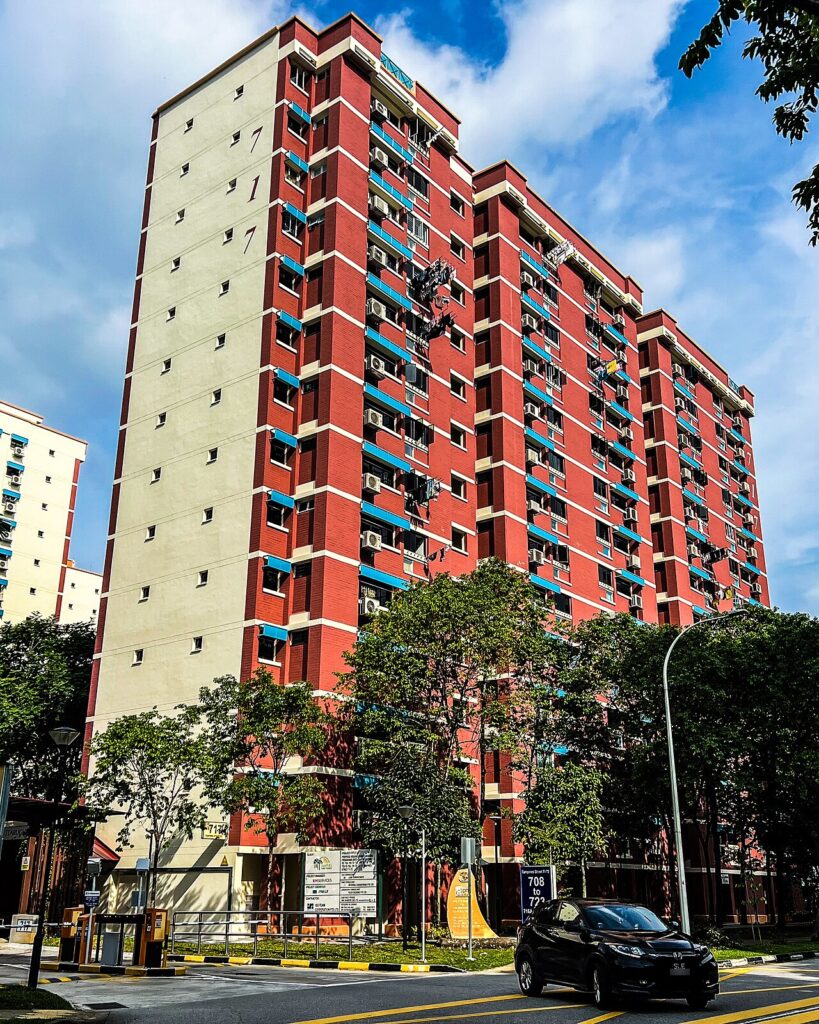
Photograph: Block 717 Tampines, photographed 17 May 2024, S5A-0043, CC BY 4.0. Source: commons.wikimedia.org/wiki/File:(SGP-Singapore)_Block_717_Tampines_2024-05-17.jpg. Licence: creativecommons.org/licenses/by/4.0/. Resized and displayed cropped. Archive housing context, not one of the November projects.
Need a brochure, price list or professional introduction?
Contact Lin Xuan at 82222556 or Ade at 81888871 or Benn at 83218774 for the full project brochure, latest available price list, a viewing, or introductions to bankers who can help you compare home-loan rates and packages to find the best available option for your needs. If you need legal advice on a property purchase, sale or tenancy, we can also put you in touch with property lawyers.
WhatsApp Lin Xuan | WhatsApp Ade. Let us know the project or property question you would like help with. Prices and availability are subject to developer confirmation, while loan terms and approval are determined by the bank.
Lin Xuan: ONG LIN XUAN, CEA registration R069812H. Ade: CHUA MUAY MUAY (ADE CHUA), CEA registration R014252F. ERA REALTY NETWORK PTE LTD, estate agent licence L3002382K.
Benn: TAN JUN FENG, BENNEDICT (BENNEDICT TAN), CEA registration R058941E. PROPNEX REALTY PTE. LTD., estate agent licence L3008022J.