
Updated 12 September 2026. This guide corrects earlier loan, grant and ownership advice and incorporates HDB’s August income-ceiling changes.
BTO vs resale vs EC is first a decision about when you need a home and what you can afford without stretching. A subsidised BTO may suit a patient buyer with a stable housing arrangement. A resale HDB flat gives you a specific home to inspect and a more immediate moving plan. A new executive condominium adds private facilities and a larger financial commitment, with eligibility and occupation rules that depend on the project.
Start with those constraints before comparing potential resale gains. None of these routes comes with a guaranteed profit, a guaranteed grant or a guaranteed maximum loan.
BTO vs resale vs EC: the practical comparison
| Route | Main reason to consider it | What can upset your plan |
|---|---|---|
| BTO flat | A new subsidised home, if an available project suits your household and you can wait. | An unsuccessful ballot, a long housing gap, or restrictions that conflict with your future plans. |
| Resale HDB flat | You can inspect the actual unit and choose a specific block near work or family. | A valuation shortfall, expensive repairs, a short remaining lease or an unsuitable handover date. |
| New EC from a developer | Condominium facilities within the EC eligibility framework. | Insufficient loan approval, staged cash demands, construction waiting time and a long occupation commitment. |
This comparison concerns a new EC bought from its developer. A resale EC is a separate purchase route with different eligibility and financing considerations. Do not apply new-EC grant or income rules to a resale listing.
1. Check which routes are actually open to you
HDB raised the general monthly household income ceiling for eligible families from S$14,000 to S$16,000 for HFE applications from 24 August 2026. The corresponding ceiling for eligible singles rose from S$7,000 to S$8,000. The changes cover the relevant subsidised-flat, resale CPF Housing Grant and HDB-loan eligibility. They do not make every household eligible for every flat or grant.
For new ECs, the S$18,000 ceiling applies to projects with land-sale tenders closing on or after 24 August 2026. Earlier projects and existing balance stock do not automatically move from S$16,000 to S$18,000. Check the project-specific ceiling before booking. HDB’s August announcement and transition annexes explain the effective dates, including arrangements for existing HFE holders.
The general family ceiling is not a universal BTO rule. HDB lists S$8,000 for a 99-year 2-room Flexi flat and S$8,000 or S$16,000 for a 3-room flat, depending on the project. Extended-family arrangements have separate provisions. For unclassified or Standard resale flats, there is no purchase income ceiling, but grant and HDB-loan ceilings still matter. Consult the conditions for your household.
Declare inherited shares, overseas homes and property held through trusts. An unmortgaged share in a parent’s property is not automatically exempt. Your citizenship, family composition, previous subsidies and property interests can change the outcome.
Singles also need their own eligibility assessment. It is incorrect to say that all singles are barred from new ECs: HDB permits two to four Singapore Citizen singles to apply jointly, each aged at least 35, subject to its other EC eligibility conditions.
2. Put your moving deadline ahead of the asking price
Write down the latest date you can remain in your current home. Then compare it with the actual project’s completion estimate or the resale seller’s proposed handover. A new EC is not necessarily ready sooner than a BTO. Resale avoids a construction wait, but legal completion, renovation and any agreed seller extension still take time.
For BTO, assess an available project, not a hypothetical flat in your favourite town. You choose what to apply for; a ballot does not guarantee that you will secure the unit you want. If you cannot tolerate another unsuccessful application, include that uncertainty in your decision.
As at this update, HDB says the next BTO exercise will be in November 2026, rather than October. It encourages applicants to submit their HFE application and all required documents by 25 September 2026. That is a preparation target, not a guarantee of approval or a successful ballot.
For resale, obtain your HFE letter before obtaining an Option to Purchase. HDB’s resale buying process explains the later milestones. Do not commit to a renovation start date simply because a seller has accepted your price.
3. Compare the funding gap, not just the headline grant
The maximum HDB loan-to-value limit is 75% for new flats and resale flats. For resale, the base is the lower of the price and valuation. The old 90% BTO and 80% resale loan figures are not a sound basis for a new purchase. Actual approval can be lower because of income, age, repayment period, financial commitments or the remaining lease. See HDB’s housing-loan guide.
A maximum loan percentage is also different from an instalment due at a particular purchase stage. BTO payments can be spread across milestones. Ask for the complete payment plan rather than treating an early downpayment as your total equity requirement.
New EC buyers arrange financing with a financial institution. HDB’s developer-purchase process lists a 5% booking payment and a later 15% balance downpayment. Those first payments are not proof that the lender will finance every remaining dollar. Obtain a written assessment and map the later construction payments with your solicitor.
EC support is called the CPF Housing Grant, not the Enhanced CPF Housing Grant. HDB lists a maximum of S$30,000 for an eligible first-timer SC/SC household with average monthly household income no higher than S$10,000. Amounts differ with income, citizenship and household status; eligibility to buy an EC does not itself establish grant eligibility. Use the official EC grant table.
A simple cash-and-CPF worksheet
The following figures are hypothetical, not market prices, a mortgage offer or a grant assessment. Suppose a resale flat costs S$600,000, its valuation is also S$600,000, and the buyer receives a S$450,000 loan. The purchase-price gap is S$150,000. If S$100,000 of the buyer’s existing CPF can be used and no grant is assumed, S$50,000 of cash is still needed for the price alone.
If the valuation instead comes in at S$580,000 and the loan is limited to 75% of that amount, the loan falls to S$435,000. The price gap rises to S$165,000. With the same S$100,000 usable CPF, cash for the price rises to S$65,000. This includes the S$20,000 above valuation, which must be funded in cash; it is not an extra amount to add again.
Neither calculation includes stamp duty, legal fees, renovation, moving costs or emergency reserves. Loan-specific minimum cash requirements still apply. Build these into a dated payment schedule using our downpayment and cash-budget guide. Grants should enter the worksheet only after eligibility and the amount are established, and should never be counted twice as both CPF and a separate contribution.
4. Test how long you can live with the decision
Under the Standard, Plus and Prime framework, Standard flats have a five-year minimum occupation period; Plus and Prime flats have ten years. Plus and Prime bring extra conditions, including subsidy recovery on the first resale and restrictions on renting out the whole flat. Read the terms for the actual project.
For an EC, HDB specifies a ten-year MOP from TOP where the land-sale tender closed on or after 8 May 2026. Other EC projects have a five-year MOP. This is a different cut-off from the August income-ceiling change. The EC occupation rules permit whole-unit renting only after the MOP; bedroom renting has separate registration requirements.
Do not build a first-home budget around an early sale or whole-home rental that the rules do not allow. Construction time also comes before the years you must occupy a new home. Think about a future child, a parent needing care or a job move, not only today’s commute.
5. Walk through an ordinary week before choosing
For an own-stay buyer, a useful comparison starts at the front door. Time the actual journey to work and childcare, including crossings and transfers. Visit the neighbourhood after dark and during peak traffic. For resale, inspect the unit’s heat, ventilation, noise, leaks and renovation condition. For an unbuilt home, separate what the drawings promise from what is already operating nearby.
For a buyer also concerned about future resale value, start with what another household would find useful: a workable layout, an affordable total price and access to everyday needs. A prediction that one category appreciates at 4% and another at 2% is not evidence. Avoid spending an extra dollar today solely because a spreadsheet assumes someone will pay more later.
An EC’s pool or gym may be worth paying for if you will use it. Include the project’s maintenance charges in your monthly budget and examine the usable floor plan. A larger loan for facilities you seldom use can make a less expensive home the more comfortable choice.
Your next step
Shortlist one realistic option from each route you qualify for. Beside each, write the move-in date, confirmed financing, cash needed before keys, monthly housing costs and earliest normal exit date. Cross out any option that fails your deadline or leaves your household without a reserve. Only then compare the remaining homes on location and everyday comfort.
For HDB purchases, start with the HFE application and validity guide. For a new EC, ask the developer and lender to confirm the project-specific eligibility, payment timetable and loan assessment before you book.
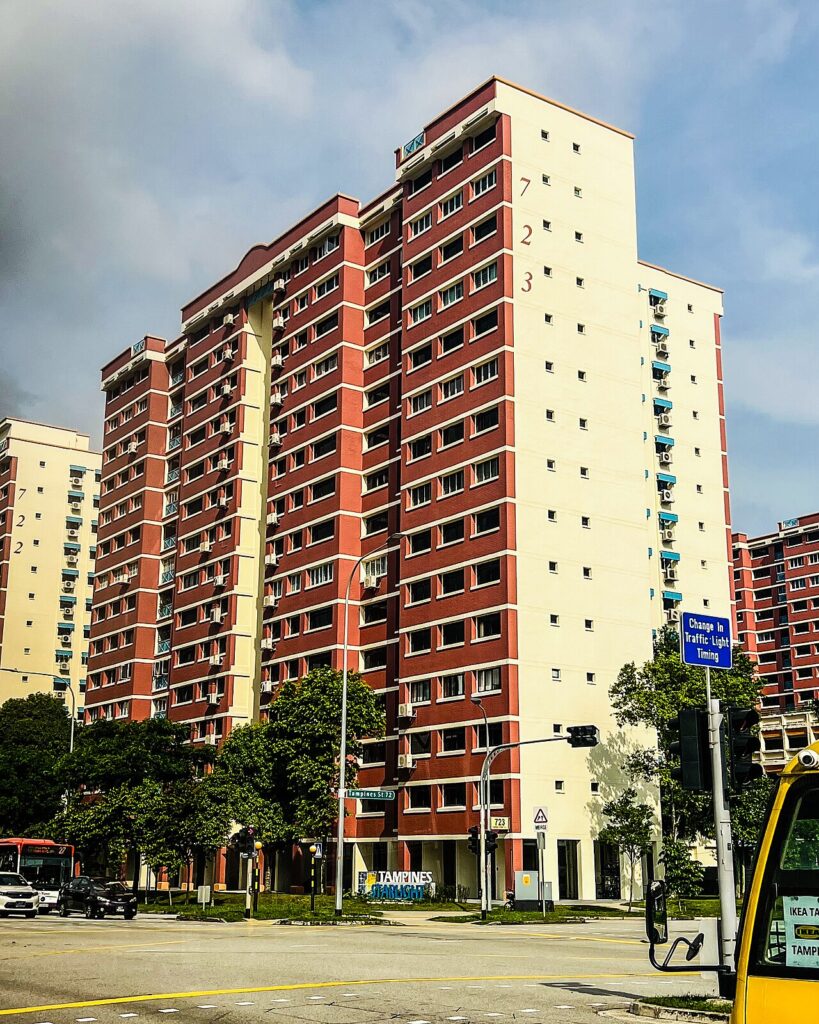
Featured photograph: Block 723 Tampines, photographed in May 2024 by S5A-0043, Wikimedia Commons, CC BY 4.0. Neighbourhood context, not a BTO or EC sales image. This guide provides general information; HDB, the developer and your lender determine your eligibility and financing.
_Block_723_Tampines_2024-05-17.jpg)