Jurong Lake District White Site 2026: Town Hall Link GLS Tender, 1,200 Homes and CRL CR19

Jurong Lake District White Site 2026: Town Hall Link GLS Tender, 1,200 Homes and CRL CR19

Quick Answer: JLD Town Hall Link White Site at a Glance

  • Site: Town Hall Link, Jurong Lake District (JLD), adjacent to the Jurong Town Hall national monument.
  • Total GFA: 186,139 sqm — one of the largest mixed-use sites launched in Singapore in recent years.
  • Residential: up to 1,200 private residential units.
  • Office: minimum 40,000 sqm — anchoring JLD’s ambition as the largest business node outside the city centre.
  • Complementary uses: up to 44,000 sqm for retail, serviced apartments, hotel, sports, community and medical facilities.
  • Connectivity: integrated with Jurong East MRT interchange (EWL/NSL), future JRL JE5 station, and upcoming CRL CR19 station (planned 2032).
  • Tender closes: 17 November 2026.
  • Why it matters: the White site designation gives developers flexibility to configure uses — residential, commercial, or mixed — based on market conditions at launch, making it one of Singapore’s most strategically significant land sales of 2026.

URA Launches JLD White Site: Singapore’s Most Anticipated 2H 2026 GLS Tender

The Urban Redevelopment Authority (URA) launched the tender for a White site at Town Hall Link in the Jurong Lake District (JLD) on 3 July 2026, marking one of the most significant Government Land Sales (GLS) moves of the year. At 186,139 sqm of total potential Gross Floor Area (GFA) — comprising a minimum 40,000 sqm of office, up to 1,200 private residential units, and 44,000 sqm of complementary uses — this site has the potential to define the next chapter of Singapore’s western regional centre.

The tender forms part of the Confirmed List for the 2H 2026 GLS Programme and will close at 12 noon on 17 November 2026. It comes less than two weeks after URA released its Q2 2026 property price flash estimate showing the overall private residential PPI rising a modest 0.5% — a market context that is stable enough for developers to bid with confidence, but not so frothy as to suggest over-payment risk.

JLD is Singapore’s flagship decentralisation initiative: a vision to create a vibrant live-work-play precinct in the western part of Singapore that can absorb commercial, residential, and civic activity without adding further pressure on the already-congested central business district. The Town Hall Link site occupies a prime position within this vision — sited next to the Jurong Town Hall national monument, directly connected to the Jurong East MRT interchange, and in the future path of two new MRT lines.

What Is a White Site?

A White site in Singapore’s GLS framework is a land parcel that developers may develop for any combination of uses permitted under the Master Plan, subject to a minimum requirement for one or more specified uses. Unlike purpose-specific GLS sites (e.g., residential-only or commercial-only), a White site allows developers to calibrate the use mix based on their read of market conditions at the time of design and launch.

For the Town Hall Link site specifically, the conditions are: minimum 40,000 sqm office; up to 1,200 residential units; and up to 44,000 sqm for complementary uses. The developer awarded the site will have latitude to decide the precise mix of hotel, serviced apartments, retail, community facilities, and sports/recreation components — creating significant design flexibility in exchange for the commitment to deliver a meaningful commercial core.

White sites have historically attracted strong bidding interest in Singapore because they reduce the development risk associated with committing entirely to a single use in a market that can shift between residential launch and commercial occupation. The last major White site in JLD — the site that became J Gateway and the surrounding cluster — generated keen bidding when it was first introduced.
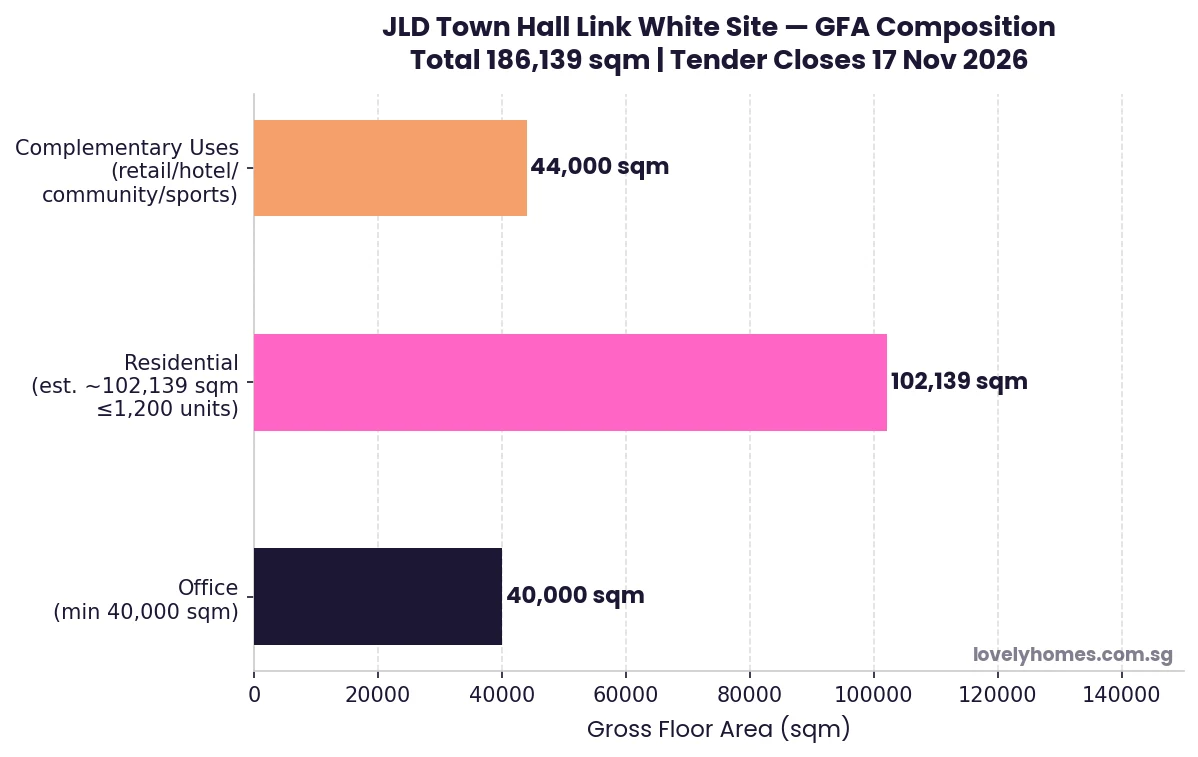
Jurong Lake District JLD Town Hall Link white site GFA breakdown office residential complementary 2026

Figure 1: Town Hall Link White Site — indicative GFA breakdown by use. Total 186,139 sqm. Source: URA pr26-53, 3 July 2026.

The JLD Masterplan: Context for This Site

JLD’s transformation has been driven by two decades of sustained government investment in infrastructure and planning. The revitalised Jurong Lake Gardens (90 hectares) provides the greenery spine at the district’s heart. Two new MRT lines are changing the connectivity calculus dramatically:

  • Jurong Region Line (JRL): JE5 station at Jurong East and JE6 station at International Business Park (planned to open 2028).
  • Cross Island Line (CRL): CR19 station at the heart of the new JLD precinct (planned to open 2032).

The addition of CRL is particularly significant: it will provide a direct east-west connection from JLD to Ang Mo Kio, Pasir Ris, and eventually Changi — transforming what has historically been perceived as a “western” destination into a genuinely cross-island node. For the Town Hall Link site, the multi-level pedestrian connections to Jurong East MRT interchange and the upcoming CR19 station mean that residents and office workers at this development will enjoy arguably the best public transport connectivity of any mixed-use site currently on the GLS market.

The site sits next to the Jurong Town Hall, a gazetted national monument. This adjacency imposes design constraints — any development will need to respect the monument’s visual and physical setting — but also provides a distinctive civic character that differentiates the JLD precinct from purely commercial developments elsewhere.

Development Mix Analysis

Use Component GFA (sqm) Status Commentary
Office 40,000 minimum Mandatory Anchors JLD’s role as business node; positions site as corporate headquarters address
Private Residential Up to ~102,139 (est.), max 1,200 units Optional (developer discretion) 1,200 units at typical 80–90 sqm average ≈ 102,000 sqm; adds residential critical mass to district
Complementary Uses Up to 44,000 Optional (developer discretion) Can include: retail, hotel, serviced apartments, sports/recreation, medical clinics, community facilities, visitor attractions
Total GFA 186,139 One of Singapore’s largest mixed-use GLS sites

At 1,200 residential units, this would represent one of Singapore’s larger single-site condominium developments — comparable in scale to recent developments like Canninghill Piers (696 units) and Lentor Modern (605 units), but notably larger. The scale is appropriate for JLD’s ambition to create residential density that sustains the commercial base.

Key Catalysts and Infrastructure Timeline

The development that occupies this site will benefit from a series of planned catalysts over the 2026–2035 horizon:

Catalyst Timeline Impact on Site
JRL JE5 (Jurong East) and JE6 (International Business Park) Phased opening, 2027–2028 Improved east-west connectivity within JLD; connects IBP to Jurong East interchange
New Science Centre at JLD Expected by 2027 Adds visitor attraction and civic anchor to the precinct; drives weekend footfall
Jurong Gateway Hub (bus interchange + office + retail + community club + library + sports) Expected by 2028 Integrated civic hub immediately adjacent; dramatically increases JLD’s daytime and evening population
CRL CR19 station at JLD Planned 2032 Cross-island connectivity; potential 15% to 20% capital value uplift for residential units at this site based on historical TEL/MRT proximity premiums

Residential Investment Angle: 1,200 Units in JLD

If the awarded developer proceeds with the full 1,200-unit residential allocation, this will be among the more significant new private residential supply additions to JLD since the area last saw major development activity in the 2013–2017 era (J Gateway, Westwood Residences, Lake Grande, Twin Vew). JLD has historically commanded a premium relative to other OCR locations — driven by the live-work-play narrative, the lake setting, and the Jurong East MRT interchange’s accessibility to both the western industrial belt and the central business district via the East-West Line.

A new-launch condo at this site, post-CRL connectivity, could plausibly target $2,000–$2,400 psf based on the trajectory of comparable new launches in OCR/RCR boundary locations in 2025–2026. The tender price paid by the developer will be the key determinant of eventual launch pricing — a high land bid will translate into a premium launch price, while a competitive-but-measured bid could allow the developer to price attractively and generate strong take-up. The tender close date of 17 November 2026 gives the market approximately four and a half months to assess these dynamics.

What This Means for the Broader Market

The JLD White Site launch is a policy signal as well as a commercial opportunity. URA’s decision to include a major White site in the 2H 2026 Confirmed List — rather than deferring it to the Reserve List — indicates confidence that developer demand is sufficient to support a committed bid within the current market cycle. The White site mechanism also signals flexibility: if the residential market softens before design completion, the developer can weight the mix toward commercial and serviced apartment uses.

For existing JLD residential owners — in projects like J Gateway, Lake Grande, Twin Vew, and the upcoming The LakeGarden Residences — the Town Hall Link development represents both an opportunity (improved amenity and connectivity as the precinct builds out) and a risk (increased residential supply within the immediate catchment). On balance, the infrastructure and amenity uplift from the New Science Centre, Jurong Gateway Hub, and CRL CR19 is likely to outweigh the supply effect, particularly for well-located existing units.

What Might Come Next

The following is editorial commentary — not official guidance.

Bidding for the Town Hall Link site is expected to attract Singapore’s larger developers and possibly joint ventures. The scale of the site (186,139 sqm) requires significant capital — a land price in the S$1.5–S$2.5 billion range would not be surprising, depending on the assumed residential launch pricing and the developer’s commercial income projections. International developers with Asian regional headquarters-in-a-hub ambitions could also consider the mandatory 40,000 sqm office component as a corporate campus opportunity.

The CRL CR19 station opening in 2032 is a known future catalyst — developers will model this into their land bid assumptions. A project that launches residential units in 2028–2029 (assuming a 2027 tender award, 1-year design/approval, and early 2028 launch) would be telling buyers that their units will be CRL-connected by the time they reach the 5-year mark of ownership.

Frequently Asked Questions

What does “White site” mean for buyers of the eventual development?

A White site designation affects the developer’s design choices, not individual buyers’ rights. When the eventual development is launched for sale, buyers will purchase units in a standard private condominium development. They will benefit from the mixed-use amenities — retail, food and beverage, possibly a hotel or serviced apartment building within the same development — that result from the White site configuration. The White site label itself conveys no special lease conditions or restrictions on buyers beyond the standard conditions of a freehold or 99-year leasehold private condominium.

When will the residential units at Town Hall Link be available for sale?

The tender closes 17 November 2026. Assuming the tender is awarded in Q1 2027, and accounting for design, planning approval, and construction timelines, the earliest a residential launch could realistically occur is late 2027 or 2028. Physical completion (Temporary Occupation Permit) would likely follow in 2030–2032. Prospective buyers interested in this development should monitor URA and the awarded developer’s announcements in 2027.

How does the JLD CRL station affect property values nearby?

Historical evidence from Singapore MRT openings — most recently the Thomson-East Coast Line (TEL) stages 1–4 and the Downtown Line — suggests that residential properties within 500 metres of a new MRT station tend to appreciate by 8–15% relative to comparable properties further away in the 3–5 years following station opening. The effect is partially priced in ahead of the opening as buyers and investors anticipate the connectivity uplift. For CR19 (planned 2032), properties in the immediate JLD precinct likely already incorporate some forward-looking CRL premium in 2026. The full premium crystallises as the opening date approaches and actual connectivity is confirmed.

Is the Town Hall Link site freehold or leasehold?

GLS sites in Singapore are typically sold on 99-year leasehold terms. The Town Hall Link site is expected to follow this standard. Buyers of units in the eventual development will hold 99-year leasehold titles, with the lease commencement date tied to the date of the land award. Leasehold tenure is the norm for new GLS-sourced developments in Singapore; the premium-location attributes of the site — MRT connectivity, JLD masterplan, CRL uplift — are expected to sustain long-term value notwithstanding the leasehold structure.

What other major GLS sites were launched in 2H 2026?

The 2H 2026 GLS Confirmed List provides a total of 4,745 private residential units. In addition to the Town Hall Link White site, URA also launched sites at Lorong Puntong/Sin Ming Avenue (~140 units, TEL Bright Hill MRT, tender closes 15 September 2026) and Kitchener Link (~145 units, Reserve List, Farrer Park MRT NEL). The full 2H 2026 GLS programme — including industrial and commercial sites — is available on the URA website at ura.gov.sg/land-sales.

Related Articles

Disclaimer

This article is for general informational purposes only and does not constitute financial or investment advice. Details of the Town Hall Link White site are sourced from URA press release pr26-53 (3 July 2026) and the URA website. Developer bidding, design outcomes, launch pricing, and project timelines are speculative editorial commentary and do not represent commitments by URA or any developer. For authoritative site details and tender conditions, refer to ura.gov.sg. Consult a licensed financial adviser before making any property investment decision.
URA Q2 2026 Singapore Property Price Index: Market Softens as CCR Rebounds

URA Q2 2026 Singapore Property Price Index: Market Softens as CCR Rebounds

Quick Answer: URA Q2 2026 PPI Flash Estimate

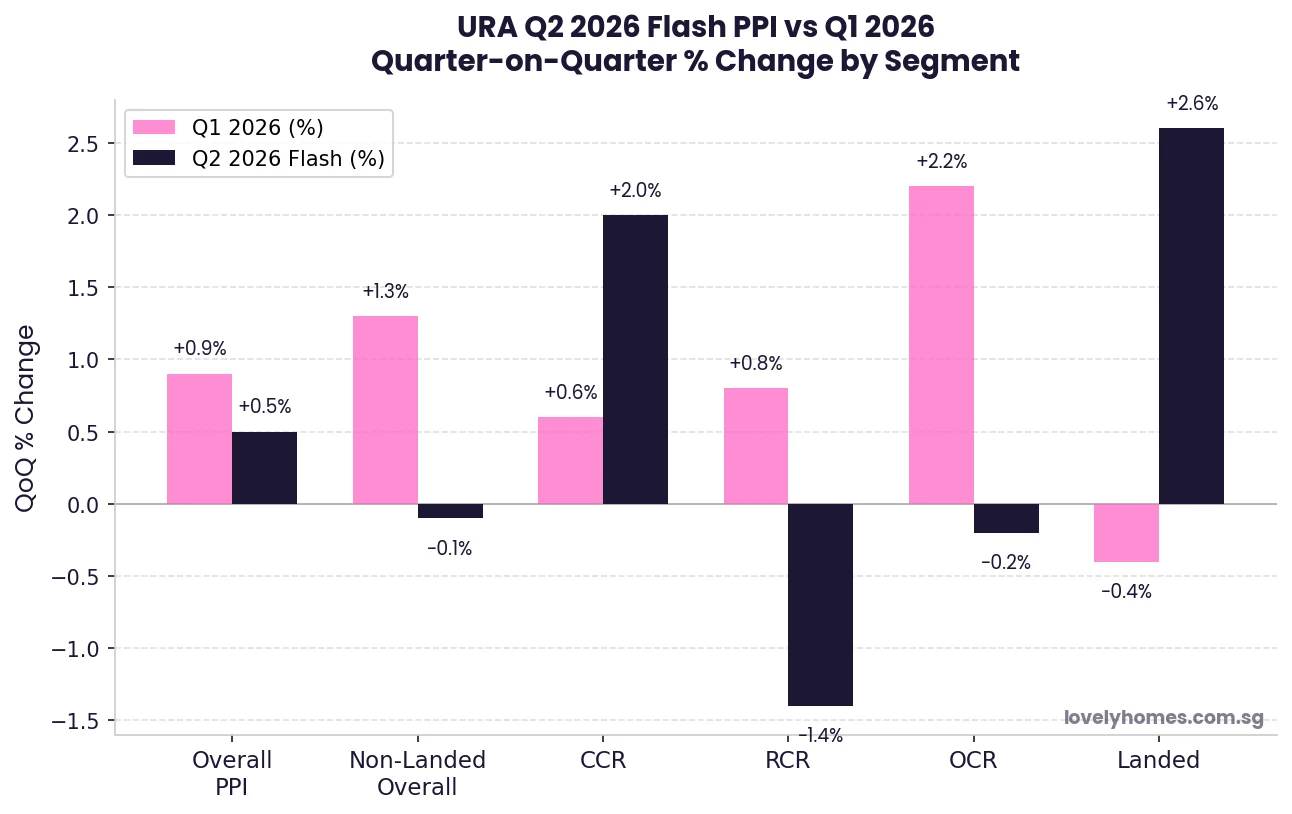
  • Overall PPI: +0.5% QoQ — a deceleration from +0.9% in Q1 2026. Prices are still rising but at a slower pace.
  • Core Central Region (CCR) rebounded: +2.0% (vs +0.6% in Q1 2026) — luxury segment recovering after two quarters of underperformance.
  • Rest of Central Region (RCR): −1.4% (vs +0.8% in Q1) — notable reversal; high-priced new launches in this segment may have peaked.
  • Outside Central Region (OCR): −0.2% (vs +2.2% in Q1) — mass market segment cools after a strong Q1.
  • Landed properties: +2.6% (vs −0.4% in Q1) — sharp rebound in the landed segment, driven by supply scarcity.
  • Transaction volume: 5,420 units (up to mid-June) — broadly comparable to Q1’s 5,413. No supply glut or demand collapse.
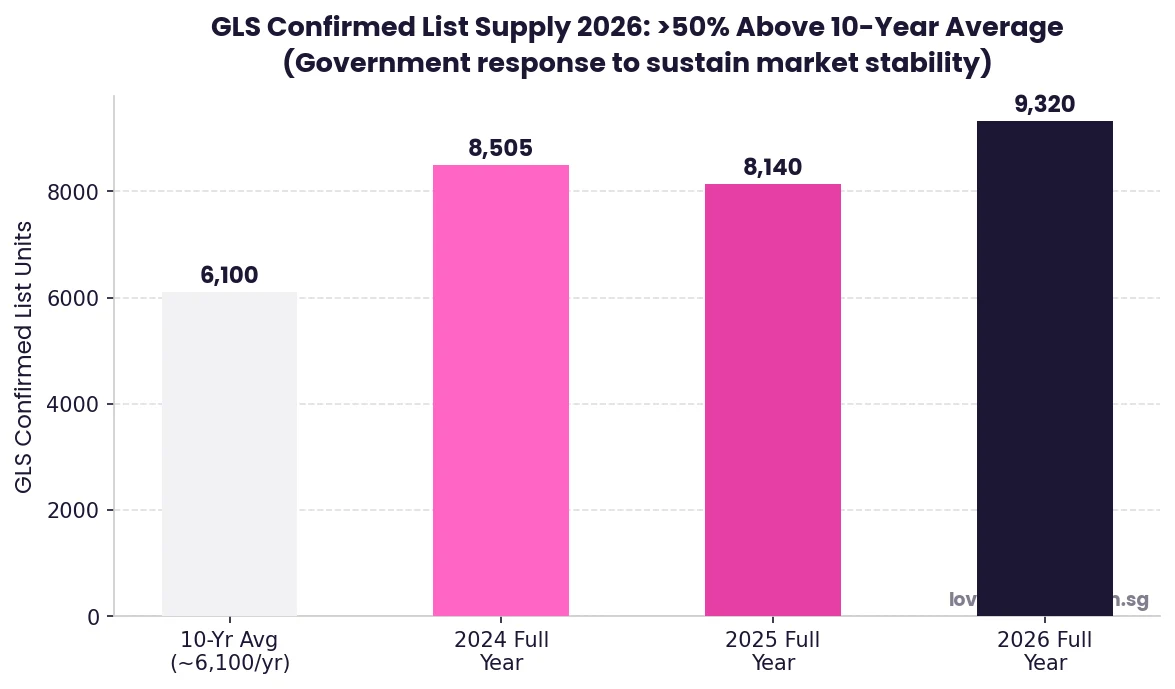
  • Government response: 2H 2026 Confirmed List GLS supply = 4,745 units; full-year 2026 Confirmed List = 9,320 units, over 50% above the 10-year average.
  • Full Q2 statistics will be released by URA on 24 July 2026.

Singapore Q2 2026 Private Residential Property Prices: A Measured Softening

Singapore’s private residential property market continued its gradual moderation in the second quarter of 2026, according to the flash estimate released by the Urban Redevelopment Authority (URA) on 1 July 2026. The overall Private Residential Property Price Index (PPI) rose by 0.5% on a quarter-on-quarter basis — a visible step down from the 0.9% gain recorded in Q1 2026 and a world away from the 3%+ quarterly swings seen during the 2021–2022 boom.

The headline figure conceals a striking divergence beneath the surface: the Core Central Region (CCR) — Singapore’s luxury prime district covering the traditional Central Business District fringe, Orchard Road, and Sentosa Cove — rebounded strongly with a 2.0% gain, while the Rest of Central Region (RCR) and Outside Central Region (OCR) recorded modest declines of 1.4% and 0.2% respectively. Landed properties, which had dipped 0.4% in Q1, surged 2.6% in Q2 — reflecting the structural supply scarcity of this asset class.

The flash estimate is based on transaction prices submitted for stamp duty payment and developer sales data from 1 April 2026 up to mid-June 2026. The full Q2 2026 real estate statistics — covering HDB resale, rental, and the complete development pipeline — will be published by URA on 24 July 2026.

URA Q2 2026 private residential property price index flash estimate QoQ by segment CCR RCR OCR Singapore

Figure 1: URA Q2 2026 PPI flash estimate — quarter-on-quarter % change by segment, compared to Q1 2026. Source: URA press release pr26-51, 1 July 2026.

Segment-by-Segment Analysis

Segment Q1 2026 QoQ % Q2 2026 Flash QoQ % Direction
Overall PPI +0.9% +0.5% ↓ Deceleration
Non-Landed Overall +1.3% −0.1% ↓ Turned Negative
CCR (Core Central Region) +0.6% +2.0% ↑ Sharp Recovery
RCR (Rest of Central Region) +0.8% −1.4% ↓ Sharp Reversal
OCR (Outside Central Region) +2.2% −0.2% ↓ Turned Negative
Landed Properties −0.4% +2.6% ↑ Sharp Rebound

CCR rebound: The 2.0% CCR gain in Q2 is the strongest single-quarter reading for this segment since early 2024. The CCR has historically lagged the OCR/RCR recovery because foreign buying — the CCR’s key demand driver — was hit hardest by the April 2023 cooling measures (which raised the foreigners’ ABSD from 30% to 60%). The Q2 2026 recovery suggests that either (a) some internationally mobile buyers are re-engaging despite the 60% ABSD, or (b) domestic upgrader demand from Singaporeans and PRs is filling the luxury segment. The URA’s full Q2 data release on 24 July will shed more light on the transaction mix.

RCR contraction: The −1.4% RCR reading is notable. The RCR has been the market’s most active new-launch corridor, with several high-profile projects launching in 2025–2026 at elevated per-square-foot prices. A reversion in Q2 may reflect buyers’ price resistance after the aggressive pricing of some recent launches, combined with increased competition from HDB upgraders who are now also being drawn by improving BTO supply timelines.

Landed recovery: The 2.6% landed rebound follows a brief Q1 pause. Singapore’s landed housing supply is essentially fixed — there is virtually no new landed housing land being released — and as such, landed prices reflect pure demand dynamics. The Q2 strength likely reflects pent-up demand from local ultra-high-net-worth families who had been watching the market from the sidelines.

Transaction Volume: Stable, Not Surging

Sale transaction volume for Q2 2026 (up to mid-June) totalled 5,420 units, broadly comparable to Q1 2026’s 5,413 units. This stability is significant: it indicates that the market is transacting at a healthy pace without the frenzied turnover of 2021–2022 (when quarterly volumes regularly exceeded 6,000–7,000 units). A market that transacts steadily at moderate volumes — without speculative churning — is precisely what Singapore’s property policy framework has been calibrated to achieve.

The comparable volume across Q1 and Q2, combined with decelerating overall price growth, is broadly consistent with URA’s characterisation of the market as “broadly stable.” There is no sign of a demand-side collapse, nor of a renewed speculative surge.

Government Policy Response: GLS Supply Elevated

In its press release accompanying the Q2 2026 flash estimate, URA noted that the Government is sustaining a high and steady supply of private housing through the Government Land Sales (GLS) Programme. Key supply data:

  • 2H 2026 Confirmed List: 4,745 private residential units to be launched.
  • Full-year 2026 Confirmed List: 9,320 units — over 50% higher than the past 10-year annual average of approximately 6,100 units.
  • Total pipeline (including ECs): around 61,000 private residential units expected to be completed over the next few years.
GLS confirmed list supply 2026 versus 10 year average Singapore government land sales

Figure 2: GLS Confirmed List supply — 2026 full year at 9,320 units is more than 50% above the 10-year average, reflecting the government’s commitment to market stability. Source: URA.

What This Means for Property Buyers and Sellers

For buyers, the Q2 2026 data reinforces a cautious but constructive outlook. The market is not in free fall, but neither is it in a runaway boom. Price growth is positive but subdued at the overall level, meaning buyers who act carefully — securing financing, doing diligent market research, and buying at realistic prices — are unlikely to face an immediately adverse market movement. The government’s elevated GLS supply commitment over the coming years means that the supply pipeline will continue to exert a moderating influence on prices in the medium term.

For sellers, the divergence between CCR strength and RCR/OCR softness matters. Sellers of mass-market condominiums in the RCR and OCR face a more challenging environment than they did in early 2026, when Q1 showed strong gains. Setting realistic asking prices — based on recent comparable transactions rather than the 2021–2022 peak — will be critical to achieving timely sales.

URA reminds buyers that “the macroeconomic outlook remains highly uncertain,” and that “households are advised to exercise prudence when purchasing property and taking out mortgage loans.” In a global environment where interest rates remain elevated and economic uncertainty persists, this is sound counsel.

What Might Come Next

The following is analytical commentary — not official guidance.

The Q2 2026 flash PPI reading, combined with the full-year supply trajectory, suggests the most likely scenario is continued modest positive overall price growth through H2 2026 — perhaps in the +0.2% to +0.8% range per quarter — with the CCR outperforming and OCR/RCR remaining relatively flat or slightly negative. A material downside scenario (sharp price falls) would require a severe external shock — a global recession, a sharp rise in Singapore unemployment, or a significant tightening of MAS monetary conditions. None of these appear imminent as at early July 2026.

The June 2026 JLD White Site tender launched by URA (Town Hall Link; tender closes 17 November 2026) adds a significant new mixed-use supply node to the western corridor. Investor sentiment around this site will be a useful bellwether for developer confidence in the H2 2026 market — a strong bid premium would signal that private developers remain bullish despite the moderating price environment.

Frequently Asked Questions

What is the URA PPI and how is it calculated?

The URA Private Residential Property Price Index (PPI) measures the change in prices of private residential properties in Singapore on a quarterly basis. It is compiled by URA using transaction data from stamp duty submissions and developer sale returns, covering all private residential transactions (both new sales and resale). The index uses a hedonic regression model that controls for property characteristics (size, location, floor level, age) to isolate pure price change from changes in the mix of properties transacted. The flash estimate, released around the first day of the following quarter, is a preliminary reading based on transactions up to mid-quarter; the full estimate, released three to four weeks later, incorporates complete quarter data and may differ from the flash figure.

Why did CCR prices rise so sharply in Q2 2026?

The CCR’s 2.0% rebound likely reflects a combination of factors: (1) limited new CCR supply coming to market in Q2 2026, creating upward price pressure on the available stock; (2) renewed demand from Singapore Citizens and PRs upgrading to prime-district condominiums, partially replacing the foreign demand that was curtailed by the 2023 cooling measures; and (3) the delayed effect of earlier GLS site launches around the Orchard / River Valley / Marina Bay corridors. The CCR has historically been more volatile than OCR/RCR — large individual transactions can move the segment average. The full Q2 data release on 24 July 2026 will clarify whether this rebound is broad-based or driven by a handful of high-value transactions.

What is 61,000 units in pipeline mean for future prices?

URA’s announcement that approximately 61,000 private residential units (including executive condominiums) are expected to be completed “in the next few years” represents a substantial supply pipeline. As a reference point, annual demand for private homes in Singapore has typically ranged from 8,000 to 13,000 units per year over the past decade. A pipeline of 61,000 units spread over approximately 5–6 years implies a continued period of elevated completions that is expected to moderate demand-supply imbalances and limit sharp price appreciation. This is a deliberate policy signal from the government: it is committed to keeping supply well ahead of demand to prevent the kind of price spike seen in 2021–2022.

Should I buy now or wait for the full Q2 data on 24 July 2026?

For most buyers, the difference between the flash estimate and the full Q2 data release (on 24 July 2026) will be immaterial to their purchase decision. The flash estimate is generally close to the final figure. Waiting for the full release — if you are ready to buy and have found a suitable property — is unlikely to reveal a dramatically different picture. More meaningful than the index number is individual property pricing relative to comparable transactions, your personal financing capacity, and your long-term holding horizon. The PPI is a broad market average; individual properties in specific locations can diverge significantly from the average.

Is now a good time to invest in Singapore property given this data?

This article does not constitute financial advice. The Q2 2026 data presents a mixed but broadly stable picture: limited overall price growth, elevated supply pipeline, divergent performance across segments. For owner-occupiers, Singapore property remains a significant but generally sound long-term asset — the fundamentals (limited land, stable governance, strong rule of law, robust demand from domestic upgraders) are intact. For investors, the combination of elevated ABSD (for second-property and foreign purchases), 4% SSD on early disposals, moderate rental yields (typically 2.5%–3.5% for private condominiums), and elevated mortgage rates means that the return calculus is tighter than it was in 2019 or 2021. Independent financial advice from a licensed professional is strongly recommended before making any investment property decision.

Related Articles

Disclaimer

This article is for general informational purposes only and does not constitute financial or investment advice. Property market data is sourced from URA press release pr26-51 (1 July 2026) and supplementary URA publications. All analysis and projections are LovelyHomes editorial commentary and should not be relied upon as predictions of future prices or market movements. For authoritative data, refer to www.ura.gov.sg. Before making any property purchase or investment decision, consult a licensed financial adviser and a licensed real estate salesperson registered with the Council for Estate Agencies (CEA).

Seller’s Stamp Duty Singapore 2026: Complete Guide to SSD Rates, Holding Periods & Exemptions

Seller’s Stamp Duty Singapore 2026: Complete Guide to SSD Rates, Holding Periods & Exemptions

Quick Answer: Singapore SSD at a Glance

  • What is SSD? Seller’s Stamp Duty is a tax charged by IRAS when you sell a residential property within 3 years of buying it.
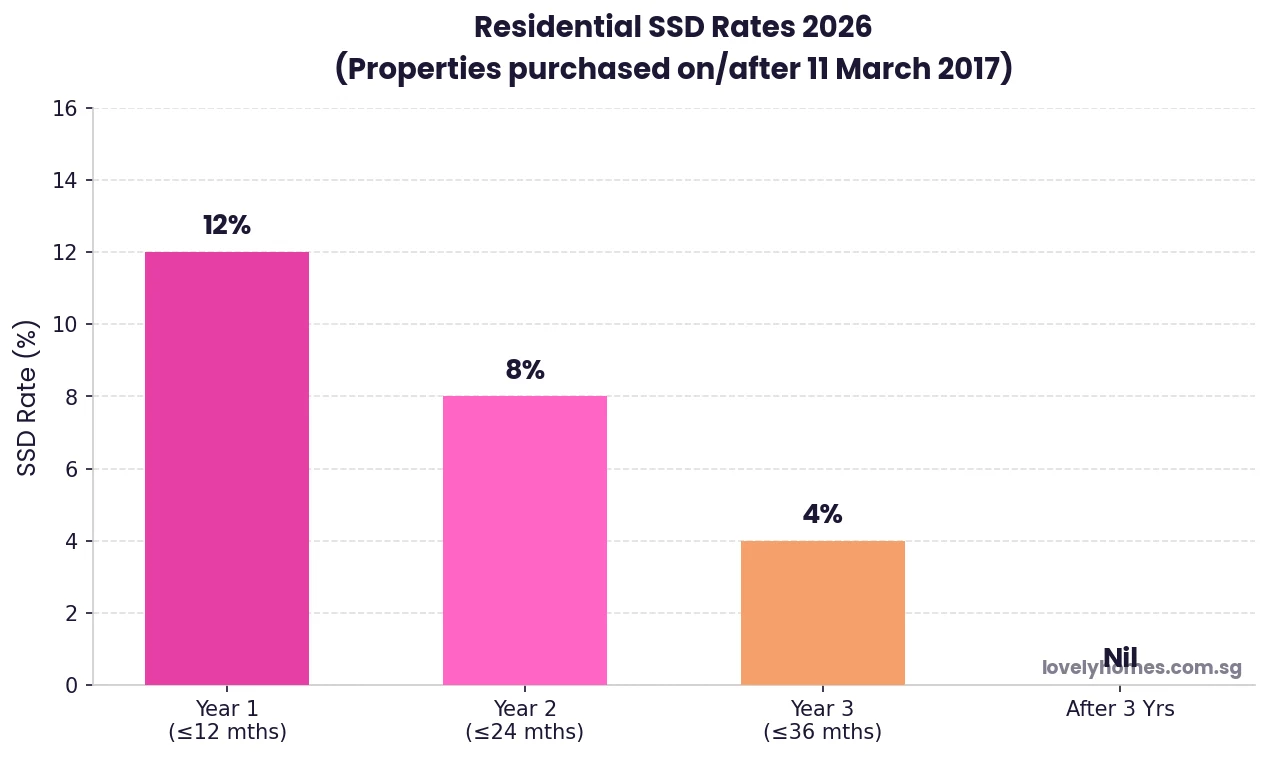
  • Current rates (properties purchased on/after 11 March 2017): Year 1 = 12%, Year 2 = 8%, Year 3 = 4%, after 3 years = Nil.
  • Calculated on: the higher of the sale price or market value — you cannot avoid SSD by under-declaring the price.
  • Who pays: the seller, not the buyer. SSD must be paid within 14 days of the sale contract date.
  • Commercial and industrial property: separate SSD rates apply; commercial property currently has no SSD.
  • Key exemptions: death of owner, divorce court order, en-bloc collective sale, HDB upgrading exercises, certain government acquisition.
  • Industrial SSD: 15%/10%/5% for Years 1/2/3 (effective 11 March 2023 for industrial properties).
  • Why it exists: introduced to curb short-term speculative “flipping” and protect housing market stability.

What Is Seller’s Stamp Duty (SSD)?

Seller’s Stamp Duty (SSD) is a stamp duty levied by the Inland Revenue Authority of Singapore (IRAS) on sellers who dispose of residential properties within a specified holding period after purchase. Unlike Buyer’s Stamp Duty (BSD) and Additional Buyer’s Stamp Duty (ABSD) — which the buyer pays on acquisition — SSD falls entirely on the seller. It is part of Singapore’s suite of property market stabilisation measures, designed to discourage speculative short-term trading that can inflate prices and reduce affordability for genuine owner-occupiers.

SSD applies to residential properties only: HDB flats, private condominiums, executive condominiums (ECs), terraced houses, semi-detached houses, and bungalows all fall within scope. Commercial shophouses, offices, industrial buildings, and strata retail units are treated separately under the industrial-property SSD framework introduced in 2011 and last updated in March 2023.

The Ministry of Finance (MOF) and IRAS jointly administer SSD policy. Rates and holding-period windows have been adjusted several times since SSD was first introduced on 20 February 2010, and understanding which era applies to a given transaction is critical — sellers who purchased property at different points in time face materially different SSD exposure.

Singapore residential SSD rates 2026 by year of sale bar chart

Figure 1: Residential SSD rates 2026 — properties purchased on/after 11 March 2017. Source: IRAS.

SSD Rate History: How the Rules Have Evolved

Singapore’s SSD has been tightened and loosened in tandem with each property market cycle. Understanding the history is essential because the era in which a property was purchased determines the applicable rate schedule — these do not update retrospectively.

February 2010 — SSD introduced. A flat 1% SSD was applied on residential properties sold within one year of purchase. This was a modest initial measure aimed at checking the most acute short-term flipping.

August 2010 — First tightening. The holding period was extended to 3 years and rates were raised: Year 1 = 3%, Year 2 = 2%, Year 3 = 1%. The government wanted to extend the disincentive horizon.

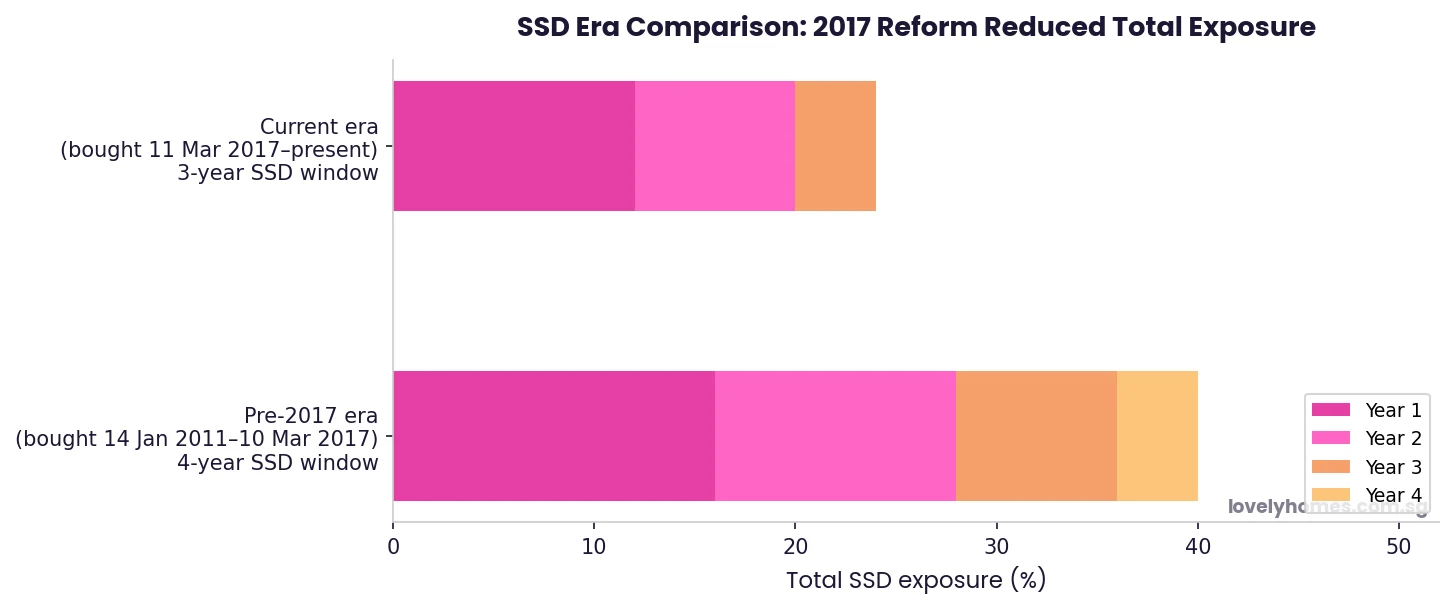
January 2011 — Major escalation. Rates jumped sharply: Year 1 = 16%, Year 2 = 12%, Year 3 = 8%, Year 4 = 4% (holding period extended to 4 years). This era lasted until March 2017.

March 2017 — Current framework. The 4-year window was trimmed to 3 years and top rates were reduced: Year 1 = 12%, Year 2 = 8%, Year 3 = 4%. This partial easing recognised the market had cooled following the 2013–2015 cooling measures. Properties purchased on/after 11 March 2017 fall under this framework.

The April 2023 cooling measures — which raised ABSD substantially for second-property buyers and foreigners — did not change residential SSD rates. Industrial property SSD was separately restructured in March 2023 to align more closely with the residential framework.

SSD cooling measure eras comparison 2011 versus 2017 reform total exposure

Figure 2: SSD eras — the 2017 reform shortened the holding window from 4 to 3 years and reduced the cumulative rate burden. Source: IRAS, MOF.

Current SSD Rates in Detail (2026)

For any residential property purchased on or after 11 March 2017, the SSD rates are as follows:

Year of Sale Holding Period at Sale SSD Rate Example (S$1.2M property)
Year 1 Sold within 12 months of purchase 12% S$144,000
Year 2 Sold in months 13–24 8% S$96,000
Year 3 Sold in months 25–36 4% S$48,000
After Year 3 Sold after 36 months Nil S$0

The SSD is calculated on whichever is higher — the agreed sale consideration or the property’s open market value as assessed by IRAS. This prevents artificial under-pricing of transactions between related parties.

The “year” is counted from the date of purchase (specifically, the date of the Sale and Purchase Agreement, or the date of the Option to Purchase if exercised). A property bought on 1 April 2024 sold on 31 March 2025 is in Year 1; sold on 2 April 2025, it enters Year 2. Getting the date calculation right — down to the day — materially affects the tax bill.

Payment of SSD is due within 14 days of the date of the contract to sell (or date of transfer if there is no formal contract). Late payment attracts penalties and interest charges from IRAS.

What Is SSD Calculated On?

SSD is assessed on the higher of: (a) the actual sale price agreed between buyer and seller, or (b) the open market value of the property as determined by IRAS at the time of sale. The practical effect is that artificially depressed selling prices do not reduce SSD liability — IRAS will use market value instead.

For most arm’s-length market transactions, the sale price is the market value, so there is no difference. However, where a property is sold between related parties (family members, or a company to a director), IRAS typically commissions its own valuation to verify. Sellers should obtain an independent valuation before transacting in such circumstances to avoid a surprise SSD reassessment.

In cases where the property is partially gifted (e.g., the seller receives S$500,000 for a property worth S$1M, with the remainder as a gift), IRAS treats the full market value of S$1M as the basis for SSD — the gift portion does not reduce the SSD calculation.

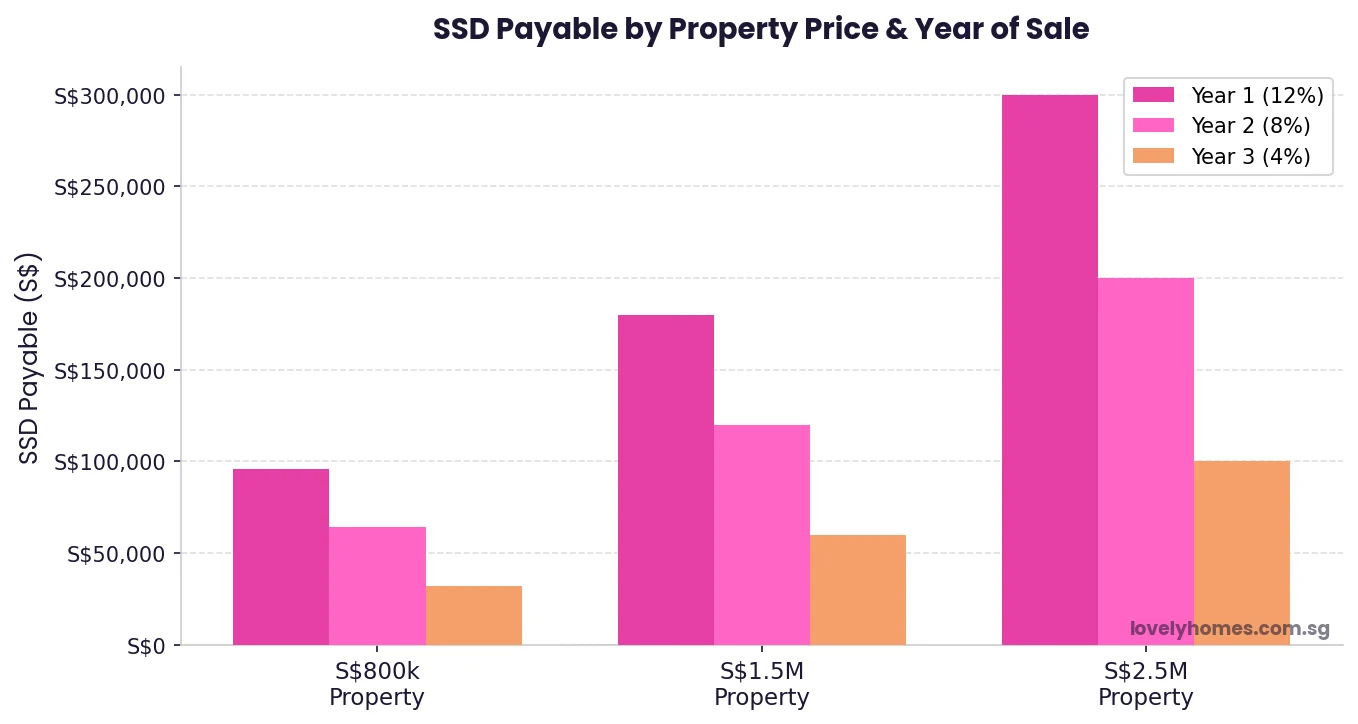
Singapore SSD payable in dollars by property price and year of sale 2026

Figure 3: SSD payable in absolute S$ terms across three price points — the tax is substantial in Years 1 and 2 even at moderate property values. Source: IRAS, LovelyHomes calculations.

Key SSD Exemptions

Not every sale within the 3-year window triggers SSD. IRAS recognises a set of circumstances where requiring SSD would be inequitable. The main exemptions are:

Exemption Conditions Who to Apply To
Death of owner Property is transferred to the estate or beneficiaries following the owner’s death IRAS (estate executor applies)
Divorce / separation order Property is transferred pursuant to a court order in divorce or separation proceedings IRAS with supporting court order
En-bloc / collective sale Property sold as part of an en-bloc (collective sale) exercised under the Land Titles (Strata) Act Automatically exempted by IRAS on production of the collective sale order
Compulsory acquisition Land or property compulsorily acquired by the government under the Land Acquisition Act IRAS notified by acquiring authority
HDB upgrading / SERS HDB flat acquired by HDB under SERS (Selective En-bloc Redevelopment Scheme) or similar exercises HDB administers; automatic
Certain matrimonial transfers Transfer to or from a spouse during the course of marriage (not divorce) — partial relief only; specific conditions apply IRAS advance ruling recommended

Notably, financial hardship is not an automatic SSD exemption. If a seller must sell early due to retrenchment or mortgage default, SSD still applies unless one of the listed exemptions is met. Sellers in distress should consult a property lawyer to explore whether any exemption is available before proceeding with a sale.

Industrial Property SSD (2026)

A separate SSD framework covers industrial properties — factories, warehouses, light industrial space, and business parks. This framework was introduced in January 2013 and was significantly revised with effect from 11 March 2023, when the MOF extended the industrial SSD holding period to match the residential framework:

Year of Sale SSD Rate (Industrial) Applicable To
Year 1 15% Industrial properties purchased on/after 11 March 2023
Year 2 10%
Year 3 5%
After Year 3 Nil All industrial property purchases

Industrial SSD rates are notably higher than residential rates — the government treats speculative activity in industrial property with particular concern given its importance to business productivity. Commercial properties (offices, shophouses, retail units) currently attract no SSD in Singapore.

Worked Example: Calculating SSD Before You Sell

Case Study — Mr Tan’s D5 Condo

Background: Mr Tan (Singapore Citizen) purchased a 2-bedroom condo in the Buona Vista area for S$1,200,000 on 15 March 2024 (OTP date). His job changed and he needs to relocate; he accepts an offer of S$1,280,000 on 20 February 2026.

Holding period calculation:

  • Purchase date: 15 March 2024
  • Sale date: 20 February 2026
  • Duration: 23 months 5 days → Year 2 (13–24 months)

SSD computation:

  • Higher of sale price (S$1,280,000) vs market value — assume arm’s-length transaction so S$1,280,000 applies.
  • Year 2 rate: 8%
  • SSD payable: S$1,280,000 × 8% = S$102,400
  • SSD due within 14 days of 20 February 2026: by 6 March 2026.

What if Mr Tan waits until after 15 March 2027 (i.e., holds for more than 3 years)?

  • Assuming the property appreciates modestly to S$1,310,000 by March 2027.
  • SSD: Nil. He saves S$102,400 in SSD, in exchange for holding 13 more months.
  • Net gain from waiting: S$30,000 (appreciation) + S$102,400 (SSD saved) = S$132,400 — significant for a 13-month wait.

This illustrates why the 3-year SSD window is a powerful behavioural anchor: even a modest price gain can be outweighed by SSD in Year 2, making it economically rational to hold.

SSD vs ABSD: Understanding the Difference

SSD and ABSD are both stamp duties on residential property transactions, but they serve different purposes and fall on different parties:

Feature SSD ABSD
Who pays Seller Buyer
Purpose Curb short-term speculation / flipping Cool demand; differentiate by residency status and property count
Time-dependency Yes — decreases with holding period; zero after 3 years No — flat rate on acquisition, regardless of how long buyer intends to hold
Maximum rate (residential, 2026) 12% (Year 1) Up to 60% (foreigners, any residential property)
Administered by IRAS IRAS
Applies to Residential + industrial property Residential property only (different rates for SCs, PRs, foreigners)

A property transaction can involve both SSD (payable by the seller) and ABSD (payable by the buyer) simultaneously. For example, a seller disposing of a condo within Year 2 of ownership (SSD: 8%) sells to a foreigner (ABSD: 60%). The total stamp-duty burden across both parties at a S$1.5M price point: seller pays S$120,000 SSD; buyer pays S$900,000 ABSD. These are legally separate obligations borne by separate parties, though in practice the combined tax burden may influence the negotiated sale price.

What Does This Mean for Property Sellers in 2026?

With residential property prices having risen materially since 2020, and with SSD remaining at its post-2017 structure through 2026, there are several practical implications for sellers:

First, the 3-year holding period is a real constraint. Sellers who purchased a resale condo in mid-2024 at the market peak may find that selling in mid-2026 still attracts 8% SSD on a potentially lower sale price — a double adverse outcome. Patience past the 3-year mark is financially rational for most sellers who are not under financial duress.

Second, en-bloc candidates require careful SSD analysis. If a strata development proceeds to collective sale, individual unit owners may have purchased at different points in time. Those who bought within 3 years of the en-bloc completion are SSD-exempt under the collective sale exemption, but only if the sale is completed (not merely approved) within the relevant window.

Third, gifting property to family members does not avoid SSD. If a parent bought a condominium in 2024 and attempts to transfer it to an adult child in 2025 as a gift, IRAS will still assess SSD on the market value at the time of transfer. The gift exemption does not extend to SSD (unlike some other jurisdictions).

What Might Come Next for Singapore SSD?

The following section represents analytical commentary based on publicly available signals — it is not government guidance.

As at July 2026, there has been no announcement of changes to the residential SSD framework. The market remains broadly stable: URA’s Q2 2026 flash estimate shows the private residential price index rose just 0.5% quarter-on-quarter, decelerating from 0.9% in Q1 2026. This suggests the government sees no immediate need to further tighten the SSD framework to address speculative activity.

Were prices to accelerate sharply — driven by strong en-masse foreign demand or a sudden speculative upcycle — the government’s historical playbook (most recently demonstrated in April 2023) suggests it would first deploy ABSD increases or LTV tightening before revisiting SSD, which is a blunter instrument.

A possible policy evolution that industry observers have discussed is the introduction of a sliding-scale SSD that integrates with ABSD and BSD into a unified transaction-tax framework. As yet, this has not been mooted officially. The current three-lever approach (SSD + BSD + ABSD) remains the operative framework for the foreseeable future.

Frequently Asked Questions

Do I pay SSD on an HDB flat?

Yes. SSD applies to HDB flats in exactly the same way as private residential properties. If you sell your HDB flat within 3 years of the date of purchase (or the date of the Temporary Occupation Permit for new BTO flats), you are liable for SSD at 12%/8%/4% for Years 1/2/3 respectively. However, if HDB compulsorily acquires your flat under SERS or similar exercises, you are exempt. Note that HDB’s own Minimum Occupation Period (MOP) of 5 years means most HDB sellers are already beyond the SSD window before they are even eligible to sell on the open market — so SSD is rarely an issue in practice for standard HDB resale transactions.

I am selling a property bought in 2012 — which SSD rates apply?

Any property purchased between 14 January 2011 and 10 March 2017 is subject to the then-current framework: a 4-year holding period with rates of 16%/12%/8%/4% for Years 1/2/3/4 respectively. However, if you purchased in 2012 and are selling in 2026, you have well exceeded the 4-year window — SSD is Nil. Only sellers who purchased in the 2012–2022 period and sold promptly would have faced these older rates. As at 2026, all pre-2017 purchase dates are beyond their respective SSD windows.

Can I get SSD remission if I am retrenched and cannot afford the mortgage?

Financial hardship is not a legislated SSD exemption in Singapore. Unlike some other countries that allow compassionate remissions, IRAS currently provides no general hardship exemption for SSD. If you are facing forced sale due to retrenchment, medical emergency, or financial difficulty, you should consult a property lawyer to determine whether any of the specific exemptions (e.g., divorce, death) apply to your situation. You may also consider requesting a payment plan from IRAS, though SSD is not automatically deferred. Engaging a lawyer before signing any sale contract is strongly recommended if SSD will create a significant financial burden.

How is SSD paid — is it deducted from sale proceeds automatically?

SSD is not automatically deducted. It is the seller’s legal obligation to file and pay the SSD to IRAS within 14 days of the date of the contract of sale (typically the date on which the buyer exercises the Option to Purchase). The conveyancing lawyer acting for the seller will typically compute the SSD, prepare the stamping documents, and arrange payment from the sale proceeds at completion. The SSD amount is effectively deducted from the sale proceeds at the point of legal completion, coordinated by the seller’s solicitor. You should ensure your conveyancing lawyer calculates SSD correctly and builds it into the net proceeds computation before you commit to a sale price.

Does SSD apply to properties held under a company or trust?

Yes. SSD applies to corporate entities and trusts that hold residential property in the same way as it applies to individual sellers. A company or trust that purchased a residential property in 2024 and sells it in 2025 is liable for 12% SSD on the higher of sale consideration or market value. This is relevant for family investment holding companies and real estate investment structures. There is no corporate exemption from SSD; entities are treated on the same basis as individual owners for the purposes of the holding-period calculation.

What is the difference between the SSD “Year 1” calculation for a property bought on 1 April 2024?

Year 1 SSD applies when the property is sold within the first 12 calendar months from the date of purchase. For a property bought on 1 April 2024 (using the date of the signed Option to Purchase as the purchase date), Year 1 ends on 31 March 2025. A sale contract signed on 31 March 2025 falls in Year 1 (12% SSD); one signed on 1 April 2025 enters Year 2 (8% SSD). The difference of a single day can reduce SSD liability at S$1.5M from S$180,000 to S$120,000 — a saving of S$60,000. Sellers should confirm the exact purchase date and holding-period boundary with their conveyancing lawyer before signing the Option to Purchase for the sale.

Does SSD apply if I am selling to my own company?

Yes. Selling a property to a related company — including one you own or control — does not exempt the transaction from SSD. IRAS looks through related-party arrangements and will assess SSD on the open market value if the agreed consideration is below market. Where you sell a property to your company within 3 years of purchase, SSD applies at the full market value. This is a common trap in restructuring transactions: what looks like an internal reorganisation from a commercial perspective is still a taxable disposal for SSD purposes.

Related Articles

Disclaimer

This article is for general informational purposes only and does not constitute tax, legal, or financial advice. SSD rates, exemptions, and administrative procedures are set by the Inland Revenue Authority of Singapore (IRAS) and the Ministry of Finance (MOF) and may change without prior notice. Readers should refer to the official IRAS website (www.iras.gov.sg) and the Stamp Duties Act for authoritative information. Before entering into any property transaction, you are strongly encouraged to seek independent advice from a licensed conveyancing solicitor and a qualified financial adviser.

Foreigner Buying Property in Singapore 2026: Complete Guide — ABSD, Eligible Properties and Process

Foreigner Buying Property in Singapore 2026: Complete Guide — ABSD, Eligible Properties and Process

Quick Answer: Can Foreigners Buy Property in Singapore?

  • Foreigners may freely purchase private condominiums and apartments in Singapore — there is no quota or prior approval requirement for these properties.
  • Additional Buyer’s Stamp Duty (ABSD) of 60% applies to any foreigner buying any Singapore residential property (effective 27 April 2023).
  • Foreigners cannot buy HDB flats (public housing) or Executive Condominiums during their 10-year Minimum Occupation Period.
  • Foreigners cannot buy mainland Singapore landed property without Singapore Land Authority (SLA) approval; Sentosa Cove is a designated exception.
  • Singapore Permanent Residents (PRs) pay 5% ABSD on their first residential property and 30% on subsequent purchases; PRs can buy HDB resale flats but not BTO flats.
  • The Loan-to-Value (LTV) limit is 75% for most foreign buyers on their first property from a Singapore-regulated bank — a minimum 5% cash downpayment is required.
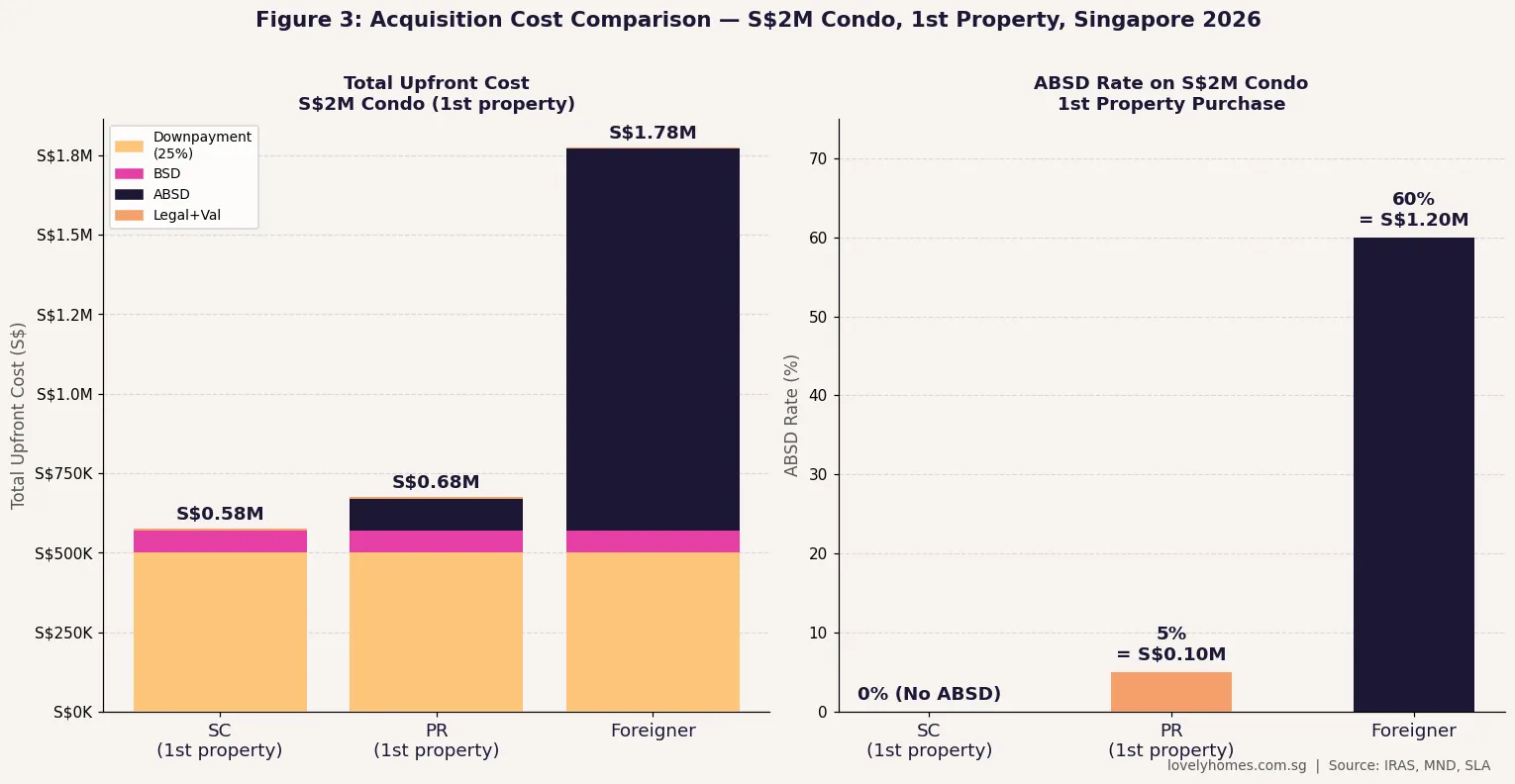
  • BSD (Buyer’s Stamp Duty) also applies to all buyers; on a S$2M purchase BSD is approximately S$69,600 (effective 3.48%).

Foreigners Buying Property in Singapore: The Full Picture

Singapore has long attracted foreign capital into its property market, offering political stability, rule of law, transparent ownership records, and strong capital preservation. Despite the 60% ABSD surcharge introduced in April 2023, the city-state remains one of Asia’s most liquid and credible real estate markets for overseas investors.

Understanding Singapore’s property restrictions is, however, non-negotiable before committing capital. This guide explains who qualifies as a foreign buyer, what you can and cannot purchase, the full stamp duty liability, the buying process, and what due diligence steps are essential before signing an Option to Purchase (OTP).

The statutory framework governing foreign property ownership in Singapore is primarily the Residential Property Act (Chapter 274), administered by the Singapore Land Authority (SLA), and the Stamp Duties Act, administered by the Inland Revenue Authority of Singapore (IRAS).

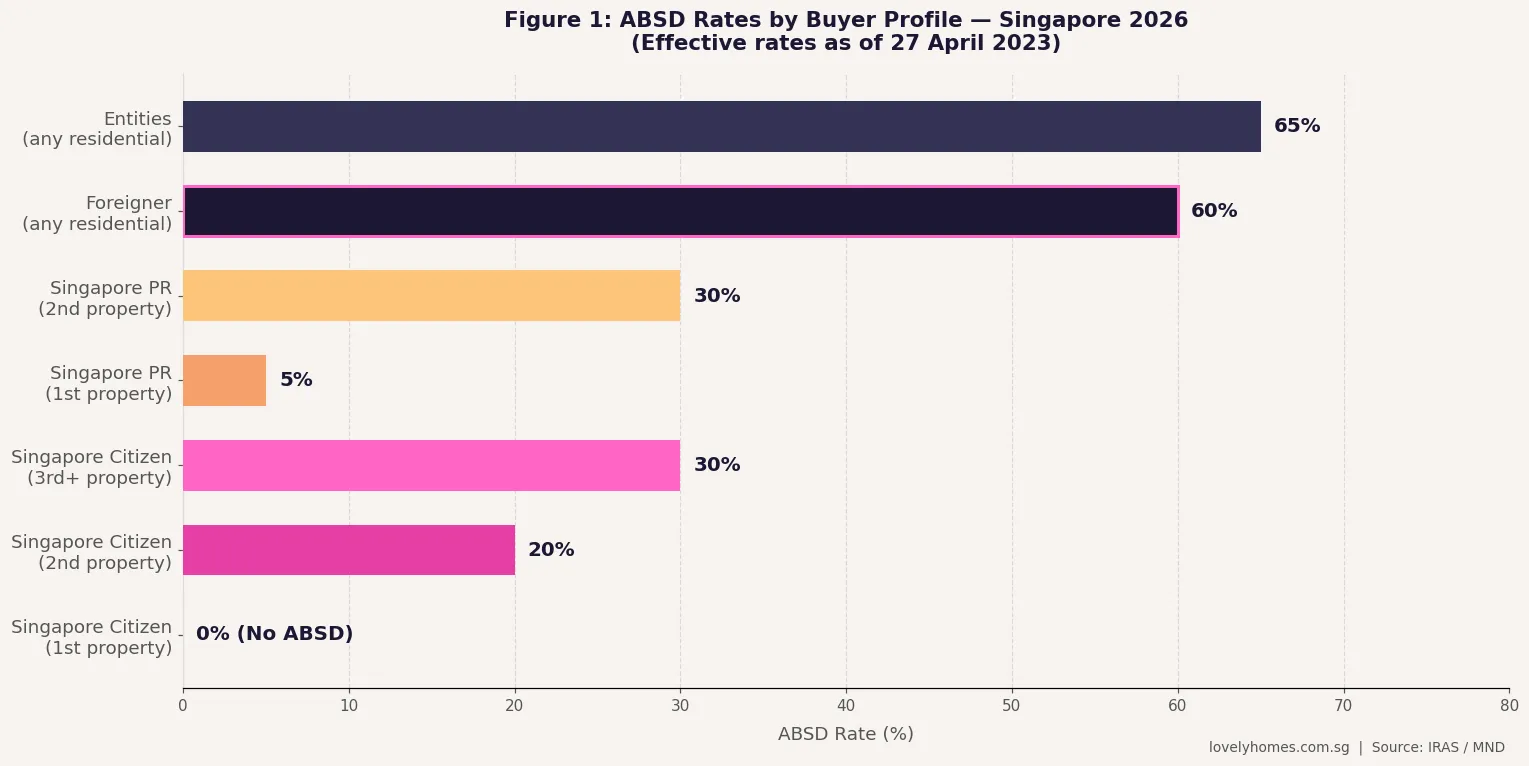
ABSD rates by buyer profile Singapore 2026 — foreigner 60%, PR 5%/30%, SC 0%/20%/30%
Figure 1: ABSD rates by buyer status, Singapore 2026. Effective rates per IRAS/MND as of 27 April 2023. Foreigner rate (any residential property) is 60%. Source: IRAS, Ministry of National Development.

Who Is Classified as a Foreign Buyer in Singapore?

For the purposes of Singapore property law and stamp duty, buyers are classified into three main groups:

Buyer Type Definition HDB Resale? Private Condo? ABSD (1st Prop.)
Singapore Citizen (SC) Holds Singapore citizenship 0%
Singapore Permanent Resident (SPR/PR) Holds Singapore PR (Blue IC) ✓ (with quota) 5%
Foreigner Neither SC nor PR 60%
Entity (company/trust) Any non-individual legal entity ✓ (with caveats) 65%

For couples where one partner is an SC and the other is a foreigner, the ABSD rate used depends on the higher-rated buyer — so an SC+foreigner couple purchasing together pays ABSD at the foreigner rate of 60% (or a remission may apply if the SC spouse is purchasing their first property — check with your solicitor). Married couples who are both SC and PR also have specific treatment and should get a stamp duty assessment before exercising an OTP.

What Can Foreigners Buy (and Not Buy) in Singapore?

The Residential Property Act places strict controls on foreign ownership of “restricted residential property”, which covers landed housing on the Singapore mainland. Non-restricted residential property (including all private condominiums and apartments in strata-titled developments) may be purchased freely by foreigners, subject to paying the applicable ABSD.

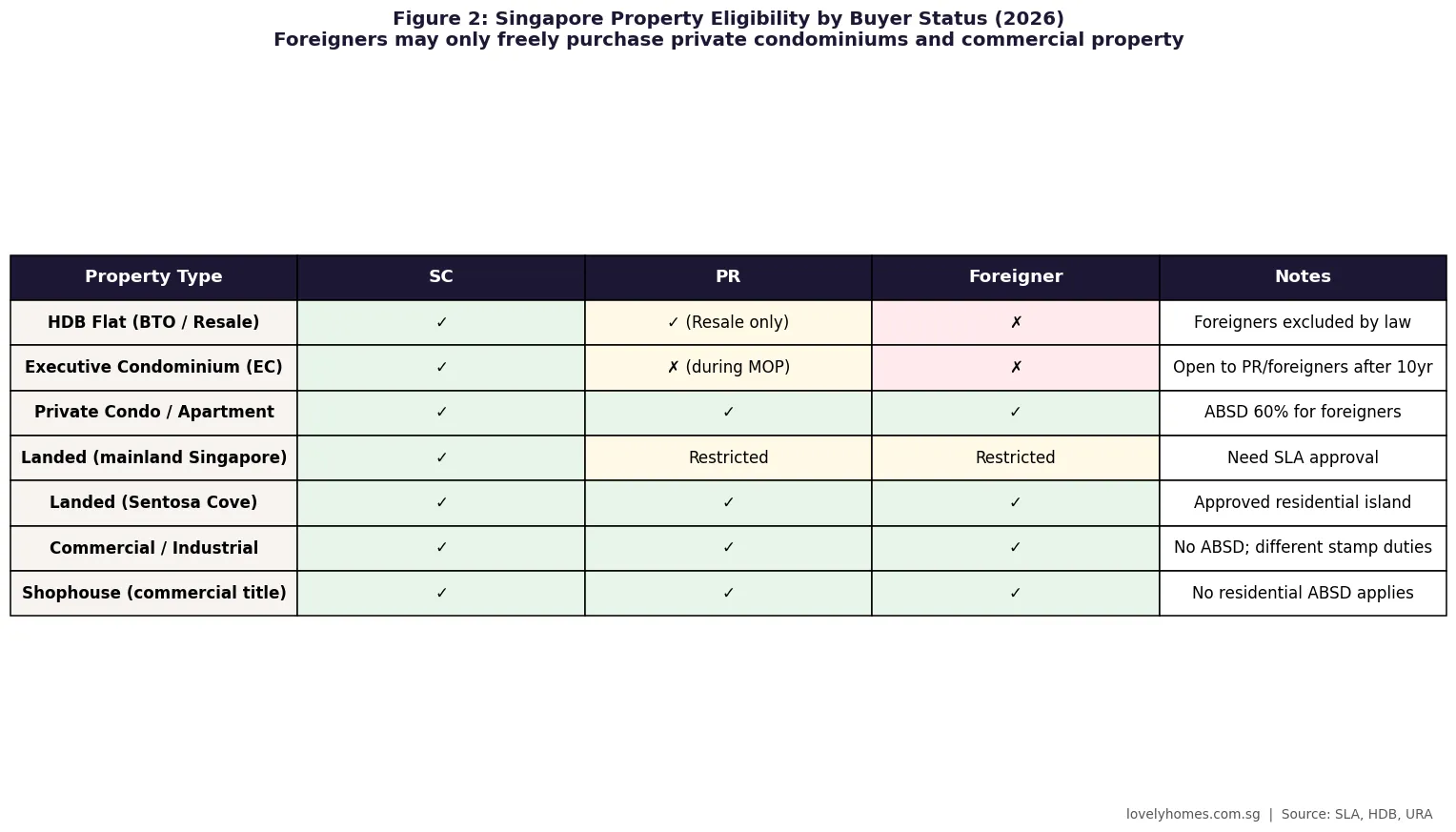
Singapore property eligibility matrix 2026 — what foreigners, PRs and citizens can buy
Figure 2: Property Eligibility Matrix for Singapore Buyers (2026). Foreigners have unrestricted access to private condominiums and commercial property, but are excluded from HDB flats, ECs during MOP, and mainland landed housing without prior SLA approval. Source: SLA, HDB, URA.

What Foreigners CAN Buy (Freely)

Private strata-titled condominiums and apartments are the primary vehicle for foreign property investment in Singapore. This includes condominiums in CCR (Core Central Region, Districts 9, 10, 11), RCR (Rest of Central Region), and OCR (Outside Central Region). Foreigners may purchase new launches from developers, resale units on the open market, and serviced apartments under residential titles.

Sentosa Cove landed property is an exception to the landed restriction. The government has designated Sentosa Cove as an approved area where foreigners may purchase bungalows, semi-detached and terrace houses. A Restricted Residential Property Approval is still processed through SLA, but approval is generally granted for bona fide purchasers. Sentosa Cove units attract a Land Betterment Charge (LBC) alongside normal stamp duties.

Commercial and industrial property — shophouses, office units, retail strata units, industrial buildings, and similar non-residential assets — may be purchased by foreigners without ABSD (though BSD and other charges apply). Many investors access Singapore property through shophouses and commercial strata units precisely to avoid the residential ABSD.

What Foreigners CANNOT Buy (Without Approval)

HDB flats (all types: BTO, resale, DBSS) are restricted to Singapore Citizens and Permanent Residents, and even PRs face sub-quotas under the Ethnic Integration Policy. Foreigners have no pathway to HDB ownership.

Executive Condominiums (ECs) are hybrid public-private housing. During the first 10 years (from TOP), ECs cannot be sold to foreigners. After 10 years, ECs are fully privatised and foreigners may purchase them, but ABSD at 60% applies.

Mainland Singapore landed residential property — including detached houses, semi-detached houses, terrace houses, and cluster housing — requires prior SLA approval. In practice, the SLA rarely approves applications from foreigners without substantive economic contribution to Singapore (e.g., Global Investor Programme). Applications that are approved often involve conditions and lengthy processing times.

Additional Buyer’s Stamp Duty (ABSD): The 60% Reality

The 60% ABSD rate for foreigners, introduced on 27 April 2023 under the Stamp Duties (Amendment) Act, doubled the previous rate of 30%. It is assessed on the higher of the purchase price or the market value of the property, and must be paid within 14 days of the exercise of the OTP (or within 30 days for documents executed overseas).

ABSD is administered by the Inland Revenue Authority of Singapore (IRAS). Penalties for late payment are 5% of the ABSD due per annum, and IRAS does not grant extensions except in extraordinary circumstances. Importantly, ABSD cannot be financed through a bank loan — it must be paid entirely in cash from the buyer’s own funds. On a S$2M purchase, that is S$1.2M in cash for ABSD alone, payable within two weeks of exercising the OTP.

For Singapore Permanent Residents, the ABSD rate on a first residential property is 5% (S$100,000 on a S$2M purchase) and 30% on any subsequent residential property. PRs who hold a joint purchase with an SC spouse buying their first property may apply for an ABSD remission to reduce the effective ABSD to 0% — this requires both parties to be first-time residential property owners.

ABSD remission schemes exist for certain qualifying situations: developers remission (for licensed developers undertaking development), housing upgrader remission (for SCs who sell their HDB/private property within six months of purchasing a new private property), and the joint-purchase SC/PR first-timer remission. None of these apply to typical foreigner purchasers.

Buyer’s Stamp Duty (BSD): Applies to Everyone

Buyer’s Stamp Duty applies to all property purchases regardless of nationality. The progressive rate schedule for residential property is: 1% on the first S$180,000; 2% on the next S$180,000; 3% on the next S$640,000; 4% on the next S$500,000; 5% on the next S$1,500,000; and 6% on the remainder. On a S$2M purchase, BSD amounts to approximately S$69,600 (an effective rate of about 3.48%). BSD must also be paid within the same 14-day window as ABSD.

Total acquisition cost comparison S$2M condo Singapore 2026 — SC vs PR vs foreigner
Figure 3: Total upfront acquisition cost for a S$2M private condominium (1st property) in Singapore 2026. For a foreign buyer, BSD + ABSD alone amount to S$1,269,600 — approximately 63.5% of the purchase price. Source: IRAS, MND.

Financing: LTV Limits, Downpayment and the TDSR

Contrary to some misconceptions, foreigners are not automatically barred from obtaining Singapore bank loans. Singapore-regulated banks (DBS, OCBC, UOB, Standard Chartered, Citibank, HSBC, and others) will assess foreign borrowers on the basis of their income, credit history, Total Debt Servicing Ratio (TDSR), and Loan-to-Value (LTV) limits set by the Monetary Authority of Singapore (MAS).

For a first property purchase, the LTV limit is 75%. The minimum 5% cash downpayment must come from the buyer’s own cash (CPF is only available to Singapore Citizens and PRs). Foreign buyers with no Singapore income need to satisfy the TDSR threshold — monthly total debt obligations must not exceed 55% of gross monthly income. Banks will typically require at least 12 months of salary crediting, employment letters, and often a personal visit to the branch or relationship manager in Singapore.

Foreign buyers should also note that rental income from the property cannot be used to service the TDSR calculation until it is actually received — only documented, existing income is recognised. A pre-approval (Approval-in-Principal) from the bank before exercising the OTP is strongly recommended.

Step-by-Step: How a Foreigner Buys a Singapore Condo

  1. Engage a Singapore-registered property lawyer before viewing properties. The lawyer will advise on eligibility, stamp duty liability, and contract review. (Note: marketing agents in Singapore are CEA-licensed but are not lawyers — do not rely on agents for legal advice.)
  2. Identify the property and negotiate the price with the seller or developer. For new launches, register for the sales chart; for resale, negotiate via the seller’s agent or directly.
  3. Obtain an Approval-in-Principal (AIP) from your chosen bank before committing to an OTP. This confirms your borrowing capacity and avoids the risk of losing your OTP fee if financing falls through.
  4. Exercise the Option to Purchase (OTP). For resale condos, an OTP fee (typically 1% of the purchase price) is paid to reserve the unit. The buyer then has 14 days to exercise the OTP by paying a further 4% (totalling 5% as initial deposit). For new launches, the process involves an Expression of Interest (EOI), booking fee (typically 5%), and signing the Sale and Purchase (S&P) Agreement.
  5. Pay ABSD and BSD within 14 days of exercising the OTP (or 30 days for overseas documents). Both must be paid in cash — ABSD cannot be financed.
  6. Complete legal requisitions. Your solicitor conducts title searches, confirms the title is free of encumbrances, and coordinates with the seller’s solicitor.
  7. Complete the purchase (typically 8–12 weeks after exercising the OTP for resale; longer for new launches under progressive payment). The balance of the purchase price is funded by the bank loan drawdown and your cash downpayment (after netting off the 5% deposit).
  8. Register the transfer at the Singapore Land Registry (part of SLA). Your solicitor handles this.

Worked Example: Mr Tanaka — Japanese Expat Buying His First Singapore Condo

Mr Tanaka is a Japanese national on an Employment Pass, working in Singapore in financial services. He earns S$22,000 per month and wants to purchase a 2-bedroom resale condominium in the Tanjong Pagar area (CCR, District 2) priced at S$2,200,000.

Stamp duties: BSD on S$2.2M = S$77,600. ABSD at 60% = S$1,320,000. Total stamp duties = S$1,397,600 (all payable in cash within 14 days of OTP exercise).

Downpayment: LTV 75% → bank loan S$1,650,000. Minimum 5% cash = S$110,000. Total cash for downpayment = S$110,000 (at minimum; remainder to 25% = S$440,000 may come from own funds).

Total cash required at exercise/completion: Stamp duties S$1,397,600 + cash downpayment (25% = S$550,000) + legal fees ~S$5,500 = approximately S$1,953,100 in cash.

Financing: Bank loan S$1,650,000 at 3.2% for 25 years = approx S$7,960/month. TDSR: S$7,960 / S$22,000 = 36.2% — within the 55% threshold. Mr Tanaka qualifies.

Annual property tax (non-owner-occupied, AV ~S$60,000): approximately S$8,100/year at the progressive non-owner-occupied rate.

Mr Tanaka proceeds. His total acquisition cost is S$2,200,000 (purchase) + S$1,397,600 (ABSD+BSD) + S$5,500 (legal) + S$1,200 (valuation) = S$3,604,300 — 63.8% more than the purchase price alone. This underscores why ABSD materially changes the investment economics for foreign buyers.

Permanent Residents (PRs): A Different Calculation

Singapore Permanent Residents occupy a middle ground between citizens and foreigners. PRs may purchase private condominiums and HDB resale flats (subject to EIP quotas). PRs cannot buy HDB BTO flats, HDB SBF flats, or DBSS flats. PRs cannot purchase Executive Condominiums in the open market during the first 5 years from TOP.

ABSD for a PR on a first residential property is 5%. On a S$2M condo, that is S$100,000 — significantly less than the 60% charged to foreigners. A PR who already owns one residential property pays 30% ABSD on any subsequent purchase.

PR couples where one spouse holds SC status buying their first property together may apply for ABSD remission to 0%, provided neither party has previously owned a Singapore residential property. This remission is claimed after purchase and ABSD must first be paid upfront — the refund is processed by IRAS typically within 6–9 months.

Is Singapore Property Still Worth Buying at 60% ABSD?

The 60% ABSD is a deliberate policy tool designed to cool speculative demand from foreign buyers while preserving market access for Singapore residents. For most retail foreign buyers, the financial case for buying residential property is difficult to justify when stamp duties exceed 60% of the purchase price — the break-even point on a 3% annual rental yield, after accounting for stamp duties, legal fees, property tax, and mortgage costs, extends beyond most reasonable investment horizons.

Where foreign buyers continue to transact is typically at the very high end of the market — ultra-high-net-worth individuals purchasing CCR properties as wealth preservation, Singapore-listed family offices, and buyers relocating permanently who intend to apply for PR or citizenship within a few years and factor in the eventual ABSD remission refund.

The data supports this: in the first half of 2026, foreign buyers accounted for approximately 3–5% of private residential transactions, compared to 8–12% before April 2023. That said, Singapore’s fundamentals — rule of law, transparent land registry, liquid resale market, strong SGD, and proximity to Southeast Asian business flows — mean demand endures at the right price point.

Could the 60% ABSD Come Down?

The 60% ABSD rate is not permanent by law but reflects current government policy priorities around housing affordability for Singaporeans. Any relaxation would require the government to be satisfied that the local property market has cooled sufficiently and that the risk of foreign-driven price inflation has abated. As of mid-2026, with private home prices continuing to rise modestly and HDB resale prices experiencing back-to-back quarterly declines, there is no indication the government intends to reduce the 60% rate in the near term. However, targeted remissions — for specific investor visa holders, for instance — are possible as policy instruments.

PRs seeking eventual SC status should also note that citizenship typically takes 2–5 years from the grant of PR, and SC buyers receive ABSD remission on their primary residence. Those who purchase property as a PR and subsequently acquire citizenship may apply to IRAS for a partial ABSD refund under the transitional remission framework, subject to specific conditions on timing and property use.

Frequently Asked Questions

Can a foreigner on an Employment Pass buy a Singapore condo?

Yes. Employment Pass or other work visa holders are classified as foreigners for property purchase purposes. They may freely purchase private strata-titled condominiums and apartments in Singapore, subject to paying 60% ABSD plus BSD. There is no minimum residency period, income requirement, or government approval needed — only sufficient funds and a qualifying bank loan assessment.

Does buying Singapore property help with a PR or citizenship application?

Property ownership does not directly count as a contribution for Permanent Residency or citizenship applications, which are assessed by the Immigration and Checkpoints Authority (ICA) based on employment, economic contribution, and community integration. However, property ownership may be a supporting indicator of long-term commitment to Singapore in an immigration file. Investing through the Global Investor Programme (GIP) — which involves minimum fund investments or business set-up — is a more direct pathway to PR for high-net-worth individuals.

Can foreigners buy landed property in Sentosa Cove?

Yes. Sentosa Cove is a designated area under the Residential Property Act where foreigners may purchase landed residential property (bungalows, semi-detached, and terrace houses) subject to SLA approval, which is generally granted for bona fide buyers. The 60% ABSD still applies to the purchase. Sentosa Cove units also attract Land Betterment Charge if the land use intensity is being maximised, and buyers should factor in the annual property tax, MCST fees for island-wide facilities, and the higher-than-average maintenance costs of landed property.

Can a foreigner avoid ABSD by buying through a Singapore company?

No — and attempting to do so is treated as tax avoidance under Singapore law. Entities (companies, trusts, LLPs) pay 65% ABSD on residential property, which is higher than the foreigner rate. The government has also introduced anti-avoidance provisions under the Stamp Duties Act to disregard arrangements that are designed to circumvent ABSD. IRAS has the power to assess ABSD on the underlying beneficial owner in such cases. The correct approach is always to take proper legal and tax advice before structuring any property acquisition.

Can a foreigner rent out a Singapore condo after buying?

Yes, subject to URA rules on short-term versus long-term rental. Private condominiums may be rented on leases of at least three consecutive months under URA’s guidelines (short-term rentals of less than three months require special use authorisation). Rental income is taxable under Singapore income tax; non-residents pay a flat 22% withholding tax on gross rental income unless a tax filing is made to IRAS to claim deductions for mortgage interest and maintenance, which typically reduces the effective tax rate. A tax agent or CPA familiar with Singapore non-resident landlord rules is recommended.

What happens to my property if I leave Singapore?

Foreigners may retain ownership of Singapore private property indefinitely regardless of their visa status or residence in Singapore. If you sell within three years of purchase, Seller’s Stamp Duty (SSD) of 12% (Year 1), 8% (Year 2), or 4% (Year 3) applies. There is no restriction on repatriating sale proceeds out of Singapore. Capital gains are not taxed in Singapore (there is no capital gains tax), and gains from the disposal of a property investment are generally treated as capital and not taxable income — though if disposal is frequent enough to constitute a trade, IRAS may take a different view.

What documents does a foreigner need to buy Singapore property?

You will need: a valid passport; evidence of source of funds (bank statements, investment account records, or proof of the sale of another asset); proof of income (payslips, employment contract, and — for business owners — audited accounts and bank statements for your business); an Approval-in-Principal (AIP) from a Singapore bank if financing; and a Singapore Tax Identification Number or NRIC/FIN for IRAS stamp duty payment purposes. Your Singapore property solicitor will guide you through the precise documentation checklist, which varies slightly by bank and by whether you are buying new launch or resale.

Related Articles

Disclaimer

This article provides general information about the rules applicable to foreigners purchasing property in Singapore as of July 2026. It is not legal, financial, or tax advice. The ABSD, BSD, and LTV figures cited reflect the most recently published rates from IRAS and MAS; always verify current rates at iras.gov.sg and mas.gov.sg before transacting. The Residential Property Act and Stamp Duties Act are administered by the SLA and IRAS respectively — consult both official sources and a Singapore-qualified lawyer before making any property purchase decision. Past property performance does not guarantee future returns.

Buyer’s Stamp Duty Singapore 2026: Complete Guide to BSD Rates, Calculation and Remissions

Buyer’s Stamp Duty Singapore 2026: Complete Guide to BSD Rates, Calculation and Remissions

Buyer’s Stamp Duty (BSD) is the foundational property transaction tax that every buyer in Singapore must pay, regardless of nationality, residency status, or how many properties they own. Unlike the Additional Buyer’s Stamp Duty (ABSD) — which targets second-and-subsequent-property buyers and foreigners — BSD is universal. Whether you are a first-time Singapore Citizen buying a public housing flat or a foreign investor acquiring a luxury penthouse, BSD applies equally. Get it wrong in your budget, and you will face an unexpected six-figure bill at the point of signing.

This guide covers everything you need to know about BSD in 2026: the current rates, exactly how the duty is calculated, what is included in the taxable base, how it differs from ABSD, and the complete picture of stamp duty costs for different buyer profiles. All rates reflect the framework introduced on 15 February 2023 for residential property and remain in force as at the date of publication. For official confirmation, always consult the IRAS Stamp Duty for Property page.

Quick Answer — BSD at a Glance

  • BSD applies to every buyer — Citizens, PRs, foreigners, companies, and trusts alike.
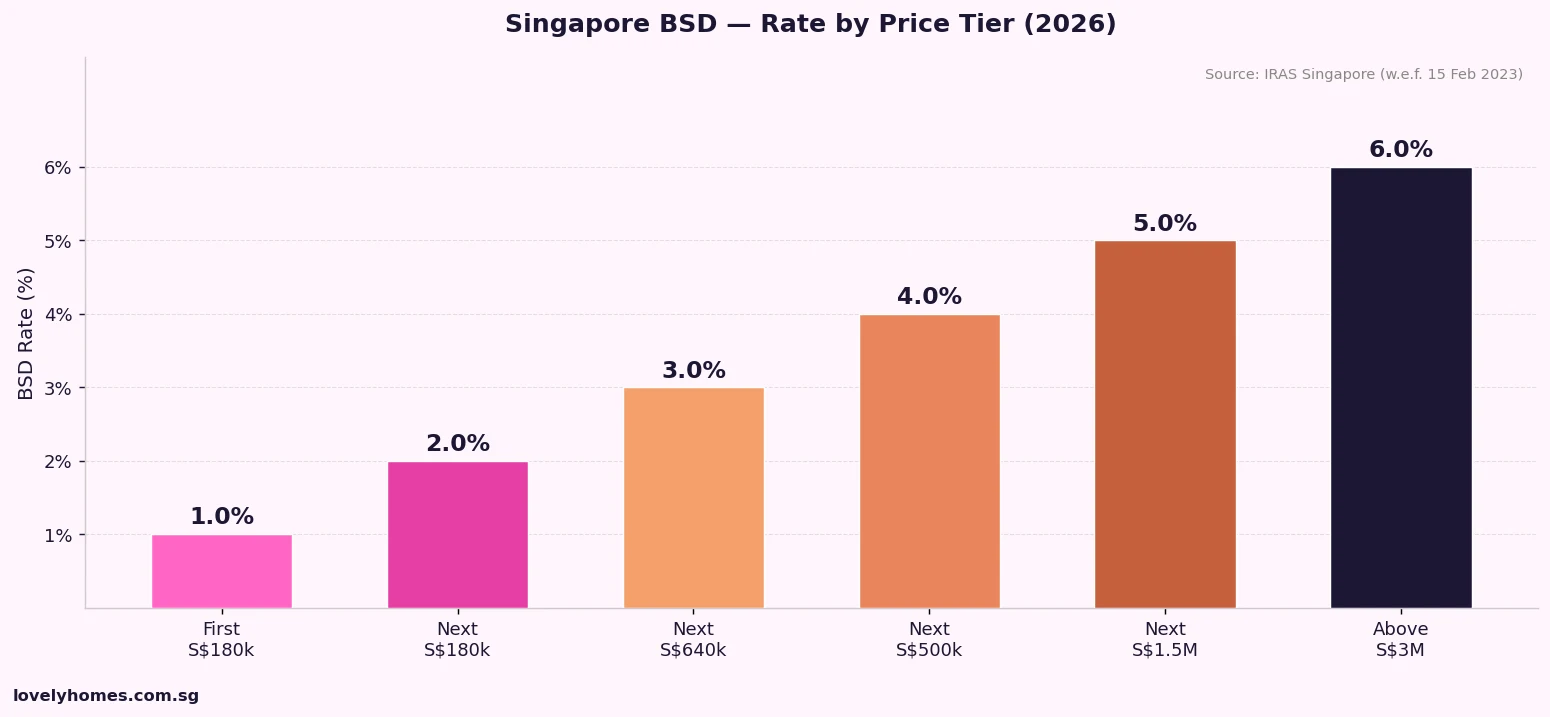
  • Residential rates: 1% → 2% → 3% → 4% → 5% → 6% in progressive tiers (w.e.f. 15 Feb 2023).
  • Non-residential rates: 1% → 2% → 3% (simpler three-tier structure, w.e.f. 20 Feb 2018).
  • Taxable base is the higher of the purchase price or the property’s open market value.
  • BSD must be paid within 14 days of signing the Option to Purchase (OTP) or Sale & Purchase Agreement.
  • BSD for a S$1.5 million condo: S$44,600 (effective rate: 2.97%).
  • BSD for a S$3 million condo: S$109,600 (effective rate: 3.65%).
  • BSD is administered by the Inland Revenue Authority of Singapore (IRAS).

What Is BSD and Why Does It Exist?

Buyer’s Stamp Duty is a documentary tax levied on instruments related to the purchase of property in Singapore. It has existed in Singapore law since the country was a British colony and is codified in the Stamp Duties Act (Cap. 312), administered by IRAS. In contrast to ABSD — which was introduced in December 2011 purely as a demand-management cooling measure — BSD is a revenue instrument: it is part of Singapore’s general tax base and applies to virtually all property acquisitions, not just speculative or investment-driven ones.

BSD was most recently restructured for residential property on 15 February 2023, when the Government added two new upper tiers (5% and 6%) targeting high-value transactions above S$1.5 million and S$3 million respectively. Prior to that, the top residential rate was 4%. The change was targeted at luxury-end transactions and was announced alongside the same cooling-measure package that raised ABSD rates significantly. You can read about the full cooling-measures context in our ABSD Singapore 2026 Complete Guide.

BSD Rates for Residential Property in Singapore (2026)

The current residential BSD rate schedule is progressive, meaning each tier applies only to the portion of the purchase price (or market value, if higher) that falls within that band. The table below sets out the tiers in full.

Singapore BSD rate by price tier 2026 bar chart — 1% to 6% progressive
Figure 1: BSD rate by purchase-price tier for residential property — effective 15 February 2023. Source: IRAS Singapore.
Purchase Price (or Market Value) Tier BSD Rate Maximum BSD from This Tier
First S$180,000 1% S$1,800
Next S$180,000 2% S$3,600
Next S$640,000 3% S$19,200
Next S$500,000 4% S$20,000
Next S$1,500,000 5% S$75,000
Amount exceeding S$3,000,000 6% Uncapped

Source: IRAS Singapore. Rates effective 15 February 2023.

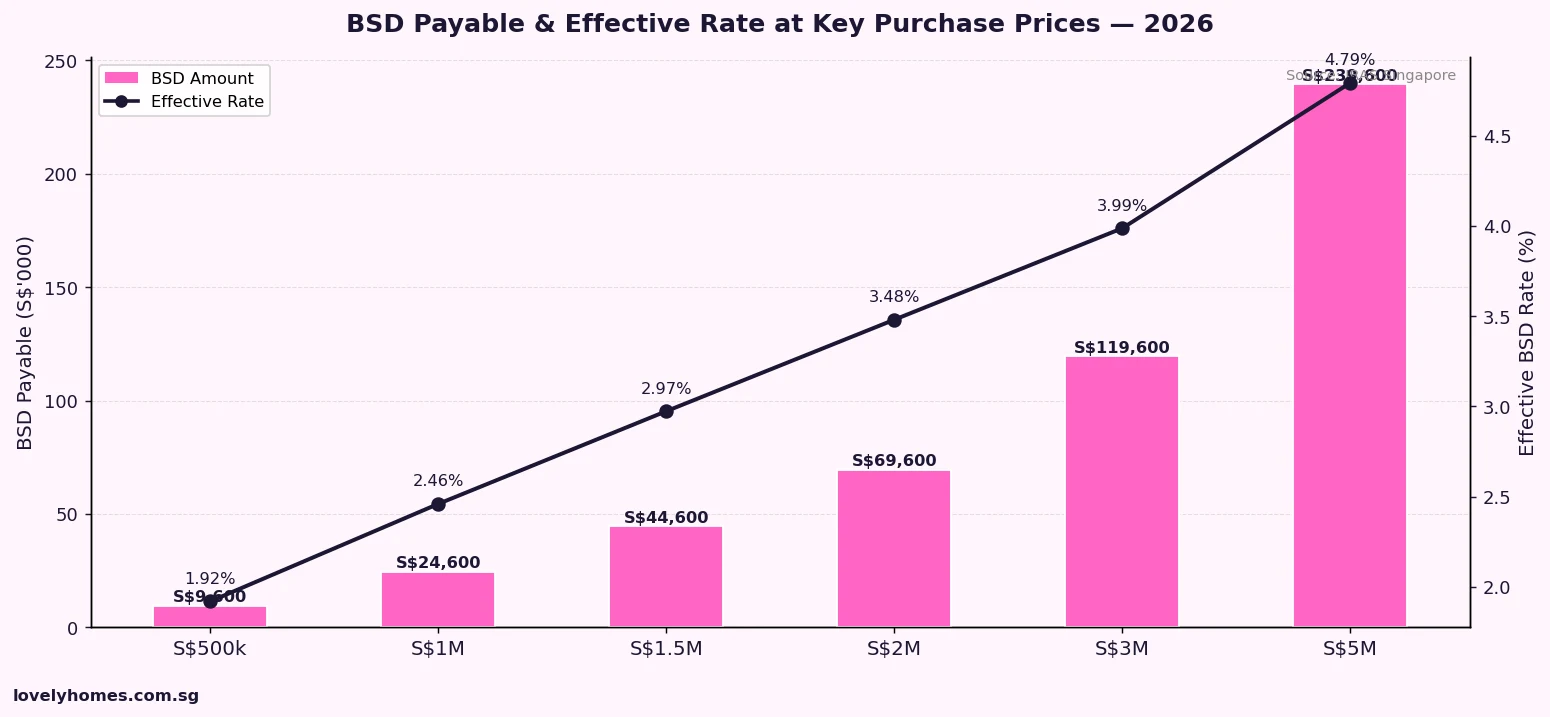
The cumulative BSD cap for a S$3 million property — the last tier before the 6% rate kicks in — is S$109,600. For every dollar above S$3 million, the marginal BSD rate is 6%. A S$5 million property, for instance, attracts BSD of S$109,600 + 6% × S$2,000,000 = S$229,600.

BSD for Non-Residential Property (Industrial, Commercial, Mixed-Use)

Non-residential property — offices, shops, industrial units, mixed-use strata titles, and HDB shophouses — attracts a simpler three-tier BSD structure that has been in place since 20 February 2018.

Purchase Price Tier BSD Rate
First S$180,000 1%
Next S$180,000 2%
Amount exceeding S$360,000 3%

Non-residential BSD is therefore considerably less progressive than its residential counterpart. A S$2 million commercial unit attracts BSD of: 1% × S$180,000 + 2% × S$180,000 + 3% × S$1,640,000 = S$1,800 + S$3,600 + S$49,200 = S$54,600 — compared to S$64,600 for a residential property at the same price. Notably, non-residential property is exempt from ABSD, making it an important consideration for investors who have already consumed their ABSD-free residential quota.

How BSD Is Calculated — Step by Step

BSD is calculated on a progressive basis, applying each tier’s rate only to the portion of value that falls within that band. The taxable base is the higher of the agreed purchase price and the property’s open market value as assessed by IRAS. In practice, for arm’s-length transactions, these figures are usually the same. Where a buyer acquires at below market value — for example, from a related party — IRAS will assess BSD on the market value.

BSD payable and effective rate at key purchase prices Singapore 2026
Figure 2: BSD payable (bars, left axis) and effective BSD rate (line, right axis) at six key purchase prices — Singapore residential property 2026.

The chart above illustrates a key feature of BSD’s progressive structure: the effective rate (total BSD as a percentage of purchase price) rises gradually but never reaches the 6% marginal rate. Even at S$5 million, the effective rate is approximately 4.6%. This distinguishes BSD from ABSD, where — for a foreigner — the entire purchase price is taxed at a flat 60%.

Worked Example — S$1,580,000 Resale Condominium

Mr and Mrs Lim are Singapore Citizens purchasing a resale 3-bedroom condominium in Clementi for S$1,580,000 as their first property. Here is the full BSD calculation:

Price Tier Tier Limit Rate BSD for This Tier
First S$180,000 1% S$1,800
Second S$180,000 2% S$3,600
Third S$640,000 3% S$19,200
Fourth S$500,000 4% S$20,000
Fifth S$80,000 (remaining) 5% S$4,000
Total BSD S$1,580,000 Effective 3.04% S$48,600

Since this is the Lims’ first residential property and both are Singapore Citizens, their ABSD is S$0. Their total stamp duty outlay is therefore S$48,600. This must be paid within 14 days of exercising the OTP. BSD is typically paid via IRAS’s myTax Portal (e-Stamping). Their lawyer will ordinarily manage this on their behalf as part of the conveyancing process.

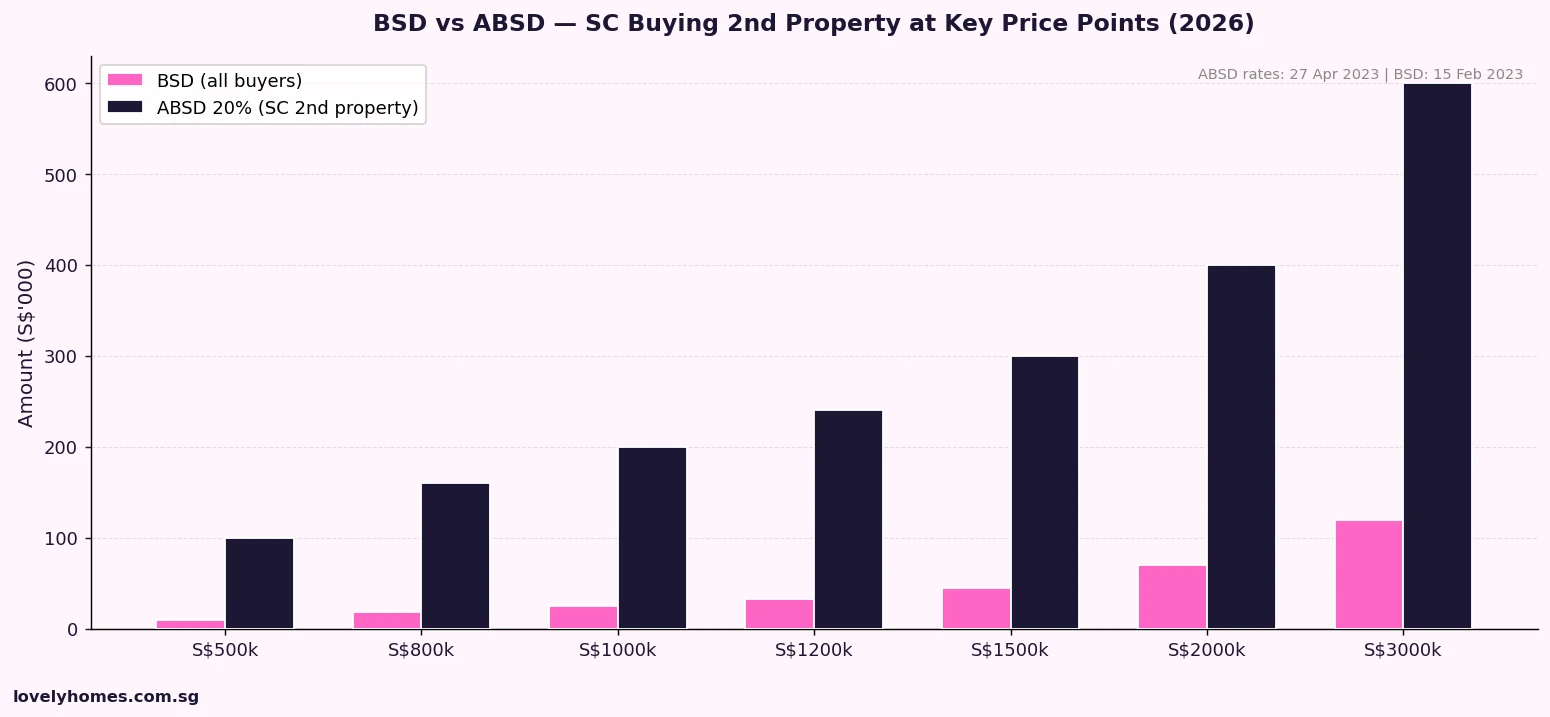
If this were instead the Lims’ second residential property, they would also owe ABSD at 20% × S$1,580,000 = S$316,000, bringing total stamp duty to S$364,600. The BSD component is identical regardless of how many properties they own.

BSD vs ABSD — Understanding the Key Difference

BSD and ABSD are two distinct taxes that can apply simultaneously to the same transaction. The confusion between them is understandable — both are calculated as a percentage of the purchase price and both are paid to IRAS — but they serve entirely different purposes and have very different rate structures.

BSD versus ABSD comparison Singapore citizen buying second property 2026 bar chart
Figure 3: BSD (universal) vs ABSD at 20% (SC buying a second property) at key purchase prices — Singapore 2026.
Feature Buyer’s Stamp Duty (BSD) Additional Buyer’s Stamp Duty (ABSD)
Who pays? All buyers Selected profiles only (see ABSD guide)
Policy purpose Revenue instrument (general tax) Demand-management cooling measure
Rate structure Progressive (1–6%) Flat rate on full purchase price (0–65%)
Maximum rate 6% (marginal, above S$3M) 65% (entities & trusts)
Remissions available? Very limited (developer builds only) Yes — married SC/SPR upgrader, developers, etc.
Applies to HDB? Yes Yes (but HDB buyers are usually SC 1st-timers at 0%)
Non-residential? Yes (1%/2%/3% structure) No — ABSD does not apply to non-residential

The practical upshot: for most Singapore Citizens buying their first property, BSD is the only stamp duty they pay. For all other buyer profiles — PRs, foreigners, second-time and subsequent Singapore Citizen buyers, and entities — both BSD and ABSD apply simultaneously. To model your full stamp duty liability, use our ABSD Complete Guide, which includes full worked scenarios for every buyer profile.

Total Stamp Duty by Buyer Profile — S$1.5 Million Residential Property

Buyer Profile BSD ABSD Rate ABSD Amount Total Stamp Duty
SC — 1st property S$44,600 0% S$0 S$44,600
SC — 2nd property S$44,600 20% S$300,000 S$344,600
SC — 3rd+ property S$44,600 30% S$450,000 S$494,600
SPR — 1st property S$44,600 5% S$75,000 S$119,600
SPR — 2nd+ property S$44,600 30% S$450,000 S$494,600
Foreigner — any property S$44,600 60% S$900,000 S$944,600
Entity / Trust S$44,600 65% S$975,000 S$1,019,600

BSD = S$44,600 on S$1.5M (1%×S$180k + 2%×S$180k + 3%×S$640k + 4%×S$500k). ABSD rates: 27 April 2023 framework. SC = Singapore Citizen; SPR = Singapore Permanent Resident.

When and How to Pay BSD

BSD must be paid within 14 days of signing the instrument that triggers the liability. For private residential property, the trigger is typically the Option to Purchase (OTP) or, if no OTP is issued, the Sale and Purchase Agreement (S&P). For HDB flats, the trigger is the signing of the HDB Agreement for Lease.

Payment is made through IRAS’s e-Stamping Portal (accessible via myTax Portal). In practice, your conveyancing lawyer will handle the stamping on your behalf as part of the standard legal process. The stamp certificate is generated electronically and must be produced at completion. Late payment attracts penalties of up to 4× the duty payable under Section 46 of the Stamp Duties Act.

BSD Remissions and Exemptions

Unlike ABSD, BSD has very limited remission provisions. The most relevant situations where BSD may not apply in full are:

Developer remissions for building residential property: Property developers who purchase residential land or existing residential property for the purpose of constructing and selling new residential units may apply to IRAS for BSD remission. This is a specific commercial exception designed to avoid double taxation in the development chain — it does not apply to individual buyers.

Transfers between spouses and immediate family members: The Stamp Duties Act provides for concessionary treatment in limited intra-family transfers, but these are narrow and do not eliminate BSD — they may affect the valuation base or trigger date. Consult a property lawyer before relying on any such arrangement.

HDB Resale Levy and BSD interaction: BSD applies normally to HDB resale flat purchases. There is no interaction between the HDB Resale Levy and BSD — they are entirely separate obligations.

In short: for the vast majority of buyers, there are no BSD remissions. Budget for BSD in full.

What BSD Means for Buyers in 2026

BSD’s restructuring in February 2023 materially increased the cost of high-value acquisitions. A buyer of a S$3 million property now pays S$109,600 in BSD alone — up from S$74,600 under the pre-February 2023 structure, a S$35,000 increase. For S$5 million properties, the increase is S$65,000. These are meaningful sums that affect both the budgeting and the financing of such transactions.

In the broader context of property affordability, BSD at the sub-S$1.5 million residential price range — where most HDB upgraders and first-time private property buyers transact — is relatively modest: S$44,600 on S$1.5 million is 2.97% of the purchase price. The real pinch of Singapore’s stamp duty system comes from ABSD, not BSD. For buyers planning their first property purchase with CPF Housing Grants and a bank loan, BSD is a known, budgetable cost that fits within standard conveyancing estimates.

Singapore’s BSD structure compares favourably with many comparable jurisdictions. Hong Kong charges a flat-rate stamp duty of up to 15% for non-first-time buyers. Australia’s stamp duty is state-based and can reach 5–6% of property value at lower price points. Singapore’s progressive structure, where the 6% rate only applies to the marginal amount above S$3 million, is notably more buyer-friendly at the S$1–2 million range where most transactions occur.

What Might Come Next

BSD rates for residential property have been adjusted three times in the past decade (2018, 2021, and 2023). Each adjustment has moved in one direction: upward, particularly at the high end of the market. If the Government continues its stated objective of moderating luxury segment demand and narrowing the wealth-effects gap between high-end and mass-market property, further BSD increases above S$3 million cannot be ruled out.

Conversely, at the sub-S$1.5 million end — where most owner-occupier transactions occur — there is no political appetite to raise BSD, given the Government’s ongoing commitment to ensuring that public and private housing remains accessible to ordinary Singaporeans. Any future BSD changes are therefore likely to be targeted at the top of the market only. As always, changes to stamp duty rates take effect immediately on the date of announcement and apply to all OTPs granted on or after that date.

Frequently Asked Questions

Does BSD apply to HDB flat purchases?

Yes. BSD applies to all residential property purchases in Singapore, including HDB resale flats, BTO flats (on the Agreement for Lease), and Executive Condominium units. There is no HDB exemption from BSD. For a typical 4-room resale flat at S$550,000, BSD would be: 1%×S$180k + 2%×S$180k + 3%×S$190k = S$1,800 + S$3,600 + S$5,700 = S$11,100.

Is BSD the same as ABSD?

No. They are two separate taxes paid to IRAS on the same transaction. BSD is universal (all buyers, all properties) and progressive (1–6%). ABSD is a surcharge that applies only to selected buyer profiles — foreigners, entities, PRs buying a first property, and all buyers from their second property onward — and is charged as a flat rate on the entire purchase price. You always pay BSD; you only pay ABSD if your buyer profile attracts it. See our ABSD Singapore 2026 Guide for the full rate schedule.

Can BSD be paid using CPF?

Yes, BSD can be paid from your CPF Ordinary Account (OA) for HDB flat purchases. For private residential property, CPF OA funds can also be used to pay BSD, but only after meeting the CPF Minimum Sum requirements and subject to CPF withdrawal limits. In practice, many buyers use cash for stamp duties to preserve their CPF balance for the monthly mortgage servicing — consult your financial planner or mortgage adviser on the optimal approach.

What happens if BSD is paid late?

Under Section 46 of the Stamp Duties Act, late payment penalties are substantial. The penalty is a multiple of the duty payable, depending on the length of the delay: one to three times the duty for delays up to six months, and up to four times for longer delays. In extreme cases, IRAS has the power to seek a court order to enforce payment. In practice, your conveyancing lawyer will ensure that BSD is stamped within the 14-day window. Late stamping almost always results from buyers attempting to handle the stamping themselves without legal assistance.

Does BSD apply to the purchase of a share in a property?

Yes. Where a buyer acquires a fractional share in a property — for example, a 50% interest in a jointly owned private property — BSD is calculated on the proportionate market value of the property that corresponds to the share being acquired. The progressive BSD tiers apply to the full market value of the underlying property first, and the resulting duty is then apportioned to the share acquired. This means the effective BSD rate on a 50% share of a S$2 million property is calculated as if the full S$2 million were the taxable base, then halved — not calculated on S$1 million at a lower tier. IRAS guidance on this is set out in their e-Stamping FAQ.

Is BSD refundable if the sale falls through?

BSD that has been paid on a stamped instrument is generally not refundable if the sale subsequently fails to complete. However, if the instrument itself is rescinded before it takes legal effect — for example, if the OTP lapses without exercise — and the buyer can demonstrate to IRAS that no property changed hands, a refund application under Section 22 of the Stamp Duties Act may be possible. The application must be made within six months of the date of the instrument. IRAS assesses each case on its facts. Always take legal advice before assuming a refund is available.

Do foreign buyers in Singapore pay more BSD than locals?

No. BSD rates are identical for all buyers regardless of nationality or residency status. A Singapore Citizen and a foreign national buying the same S$2 million property both pay exactly the same BSD — S$64,600. The difference in overall stamp duty cost arises entirely from ABSD, which for a foreigner is 60% of the purchase price (S$1,200,000 on a S$2M purchase) versus 0% for a Singapore Citizen buying their first home. This is why total stamp duty for a foreigner buying a S$2 million property (S$1,264,600) is dramatically higher than for a first-time SC buyer (S$64,600).

Related Articles

Disclaimer: This article is for general informational purposes only and does not constitute tax, legal, or financial advice. BSD rates and payment rules are governed by the Stamp Duties Act and IRAS administrative guidelines, which may be amended at any time. Always refer to the IRAS official website for the most current rates and verify your stamp duty liability with a licensed conveyancing lawyer or property tax adviser before transacting. LovelyHomes is not a licensed tax or legal advisory firm.

Translate »