Singapore Property Inheritance Guide 2026: Wills, CPF Nominations, HDB Flats and Stamp Duty Explained

Singapore Property Inheritance Guide 2026: Wills, CPF Nominations, HDB Flats and Stamp Duty Explained

Inheriting property in Singapore is rarely straightforward. Whether you are the surviving spouse of an HDB flat owner, a child named in a parent’s will, or a beneficiary who just discovered their loved one died without any estate planning, the rules governing how Singapore residential property passes on death are layered, sometimes counterintuitive, and — if you get them wrong — expensive. This Singapore property inheritance guide 2026 consolidates everything you need to know: the Intestate Succession Act, making a valid will, CPF nomination rules that override your will, HDB flat transfer procedures, stamp duty obligations, the probate process, and the legitimate planning strategies every property owner in Singapore should consider.

Quick Answer — Singapore Property Inheritance at a Glance

  • Without a will, the Intestate Succession Act (Cap 146) governs distribution — your spouse gets 50%, your children share the other 50% (or spouse takes all if no children).
  • CPF savings bypass your will entirely — they go to your CPF nominees, or to the Public Trustee if you have none.
  • HDB flats may be retained by eligible family members under the Right of Occupancy Scheme; if no eligible occupier exists, HDB buys back the flat at market value.
  • No estate duty applies in Singapore — abolished in February 2008. Inherited property itself is not subject to stamp duty on the death transfer.
  • However, a subsequent gift or sale of inherited property to another person can trigger Buyer’s Stamp Duty (BSD) and, critically, ABSD based on the recipient’s property count and citizenship.
  • A properly executed will, CPF nomination, and LPA can prevent months of delays, court applications, and avoidable costs.
  • Probate in Singapore typically takes 4–9 months for a straightforward estate; more complex multi-property or overseas-asset estates may take 12–24 months.

The Intestate Succession Act — What Happens Without a Will

When a Singapore resident who is not a Muslim dies without a valid will, the Intestate Succession Act (Cap 146), administered by the Family Justice Courts, determines who inherits the estate. The Act follows a fixed hierarchy of beneficiaries and applies to both HDB flats and private residential property (subject to the special HDB rules discussed later).

The most important thing to understand is that the Act’s rules are inflexible — the court has no discretion to vary them based on your wishes or circumstances. If you want a different outcome, you need a will.
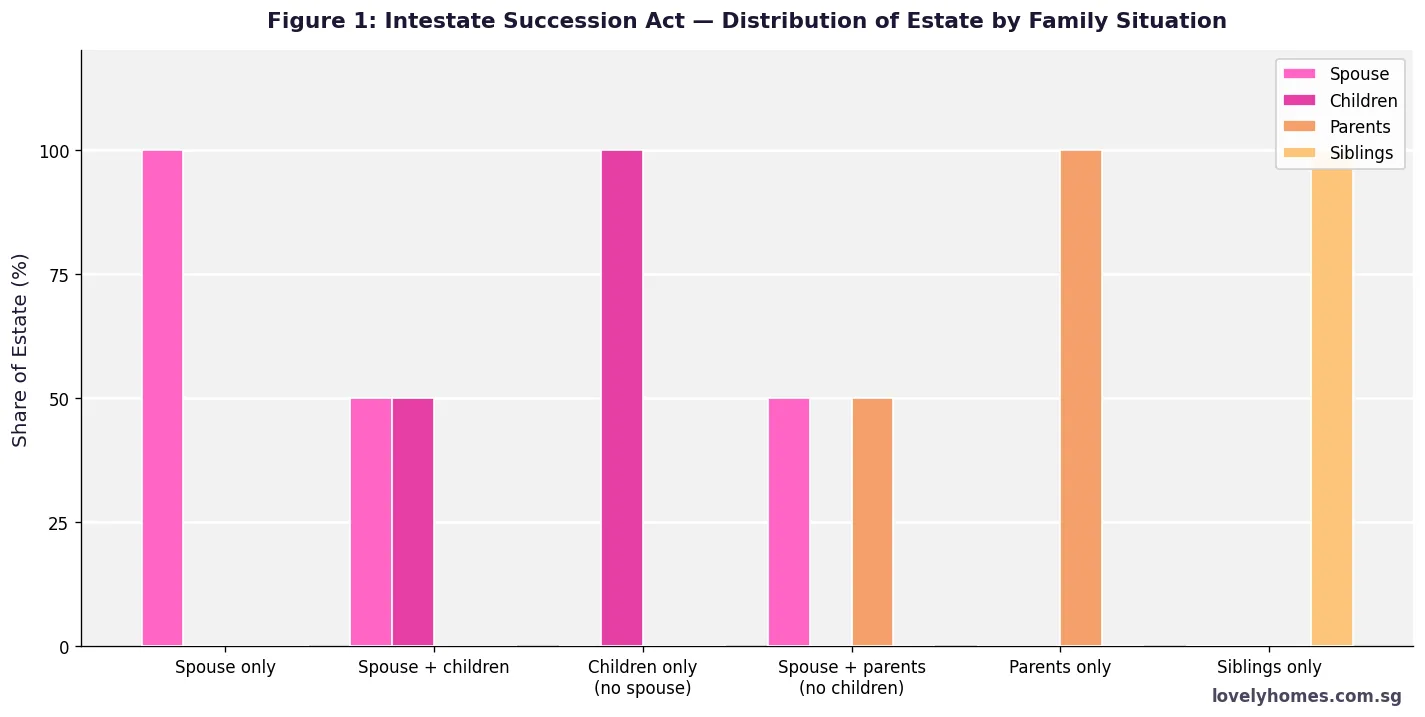
Singapore intestacy distribution chart by family situation 2026 — Intestate Succession Act shares for spouse, children, parents, siblings
Figure 1: Distribution of estate under the Intestate Succession Act by family situation. Percentages represent share of the full estate.
Survivors at Death Who Inherits (and Share)
Spouse only (no children, no parents) Spouse — 100%
Spouse + children Spouse 50% / Children share 50% equally
Children only (no spouse) Children — 100% shared equally
Spouse + parents (no children) Spouse 50% / Parents 50%
Parents only (no spouse, no children) Parents — 100% equally
Siblings only Siblings — 100% equally
No family at all Government — bona vacantia

Critically, the Intestate Succession Act does not apply to Muslims in Singapore — Muslim estates are governed by Islamic inheritance law (faraid) administered through the Syariah Court and Muslim Trust Fund (MUIS). If you are Muslim, consult a lawyer or MUIS directly.

Making a Valid Will in Singapore

A will is the cornerstone of any estate plan. Under the Wills Act (Cap 352), a valid Singapore will must be:

  • In writing (typed or handwritten).
  • Signed by the testator (the person making the will) at the foot of the document.
  • Witnessed by two independent witnesses — both present at the same time when the testator signs. Neither witness (nor their spouse) can be a beneficiary.
  • Made by a person aged 21 or older (or a member of the armed forces on active service).

There is no requirement to register a will with any government body in Singapore, though many solicitors recommend lodging it with the Wills Registry at the Singapore Academy of Law for a small fee (~S$50). A will can be revoked at any time by making a new one or by destroying the original with the intention to revoke. Marriage automatically revokes a prior will in Singapore.

What your will can do: direct who receives your private residential property; name your executor; appoint guardians for minor children; specify funeral wishes; establish testamentary trusts for minors or dependants. What it cannot do: override CPF nominations, bypass HDB rules on flat ownership, or transfer assets held in joint tenancy (these pass automatically to the surviving joint tenant by operation of law).

CPF Nominations — The Rule That Overrides Your Will

Many Singapore property owners are surprised to learn that their CPF Ordinary Account (OA) savings — which are frequently used to fund property purchases and monthly mortgage instalments — do not form part of their estate and cannot be distributed via a will. CPF monies are governed separately by the Central Provident Fund Act and paid out exclusively to CPF nominees upon death.

If you have not made a CPF nomination, your CPF savings (OA, SA, MediSave) will be transferred to the Public Trustee’s Office, which then distributes them according to the Intestate Succession Act — but charges an administration fee (0.75%–2.75% of the CPF balance, capped at S$6,000). This process can take 6–12 months. A CPF nomination is free, takes about 10 minutes via the CPF Board website, and can be updated any time.

Note also: if you bought your HDB flat using CPF, the CPF funds drawn plus accrued interest must be refunded to your CPF account on the sale or transfer of the flat. This affects the net cash proceeds available to your estate or your surviving family members.

HDB Flat Inheritance — Special Rules Apply

HDB flats come with a unique set of rules on death that do not apply to private residential property. The guiding principle is that an HDB flat should continue to be used as an owner-occupied home for a qualifying Singapore household — it is not freely tradeable inheritance that can be sold at will.

Scenario A: Joint tenancy — surviving joint tenant takes all

Most married couples own their HDB flat as joint tenants. On the death of one owner, the surviving joint tenant automatically becomes the sole owner by right of survivorship — no probate is required, and no will can override this. The surviving owner needs only to lodge a Notice of Death with HDB and the Singapore Land Authority (SLA) to update the title.

Scenario B: Tenancy-in-common — estate share passes via will or ISA

If the flat was held as tenancy-in-common, the deceased’s share passes to the estate and is then distributed via the will or the Intestate Succession Act. The beneficiary of the share must be an eligible person under HDB’s policies — meaning they must form a family nucleus with the remaining flat owner(s), be a Singapore Citizen or PR, and meet the HDB eligibility criteria. If the beneficiary is not eligible (e.g. a foreigner child), HDB will require the flat to be sold.

Scenario C: Sole owner dies — HDB’s Retention Scheme

If the deceased was the sole owner, HDB allows eligible occupiers (family members currently living in the flat who meet eligibility criteria) to apply to retain the flat under the Right of Occupancy Scheme. If no eligible occupier exists, HDB will buy back the flat at market value, and the proceeds go to the estate.

Importantly, the Minimum Occupation Period (MOP) for the inherited flat is assessed separately. An inheriting family member does not automatically “reset” the MOP clock — HDB’s rules on this have specific carve-outs. Always check with HDB directly at the time of inheritance.

Private Residential Property — Inheritance and Stamp Duty

Private condominiums, landed houses, and freehold/leasehold private apartments follow a different set of rules from HDB flats. There is no HDB eligibility requirement — foreigners can inherit private property — but stamp duty implications arise when the property is subsequently transferred or sold.
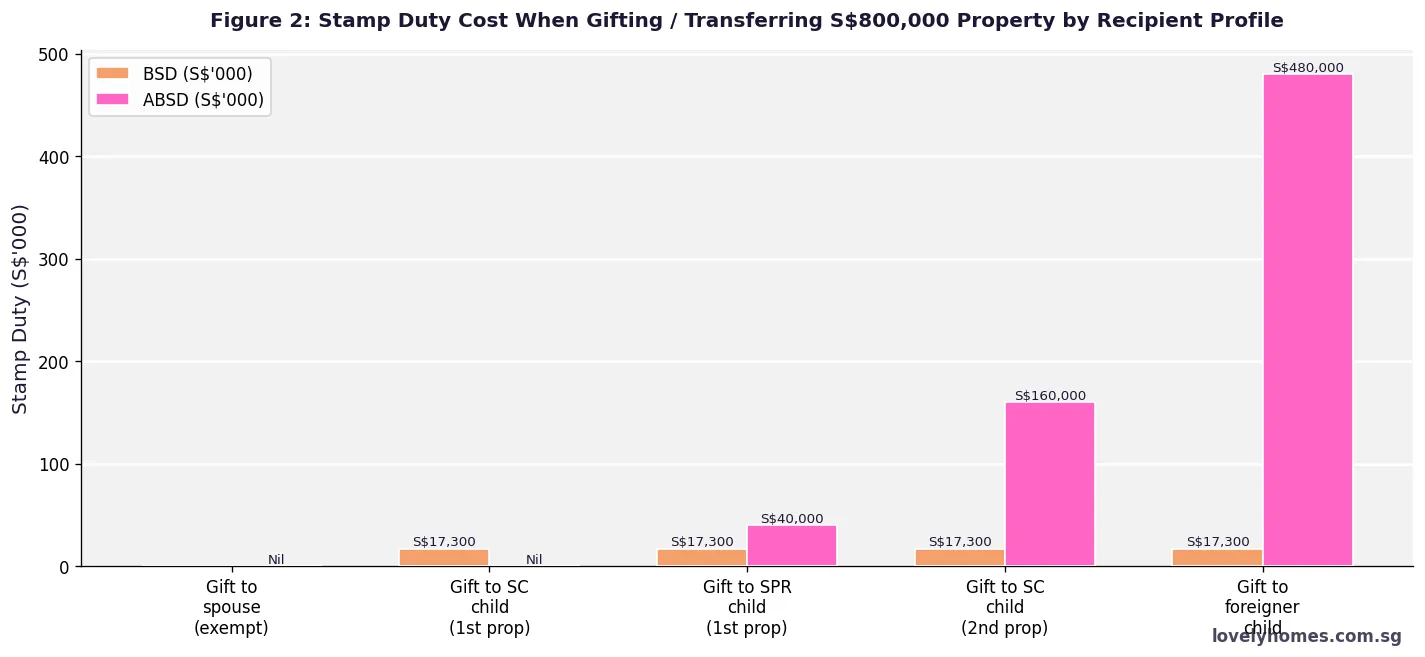
Stamp duty BSD and ABSD costs on property transfer by recipient profile Singapore 2026 — gifting S$800,000 property
Figure 2: Indicative BSD and ABSD payable when gifting/transferring a S$800,000 private residential property by recipient profile. Note: inheritance itself (via estate) is not subject to stamp duty; duty is triggered by a subsequent gift or sale.

No stamp duty on the death transfer itself

The transfer of property to a beneficiary via a will or intestacy is treated as a transmission on death. Under the Stamp Duties Act, such transmissions are exempt from Buyer’s Stamp Duty and ABSD. No duty is payable when the executor or administrator assents the property to the beneficiary. Singapore also abolished estate duty in February 2008, so there is no inheritance tax on the total value of the estate.

ABSD when you inherit a second or third property

However, the inherited property is counted toward your property count for future purchases. This is a critical but frequently misunderstood rule. If you are a Singapore Citizen who already owns one condominium and then inherb a second private property from a deceased parent, your property count becomes two. If you subsequently buy a third property, ABSD of 30% (SC rate for 3rd property) applies. Plan accordingly.

Gifting property inter vivos (lifetime transfers)

If you choose to gift a property to a family member during your lifetime (rather than leaving it via will), BSD is triggered on the market value of the property at the time of transfer. ABSD also applies based on the recipient’s citizenship and property count. A gift to your Singapore Citizen child who already owns one property would attract 20% ABSD on the market value — potentially hundreds of thousands of dollars.

🏠 Worked Example: The Tan Family Estate

Situation: Mr Tan (Singapore Citizen) passed away on 15 March 2026, leaving a 4-bedroom condominium in Bishan worth S$2,100,000 and a 5-room HDB flat in Ang Mo Kio worth S$780,000. Mr Tan had a valid will leaving both properties to his wife (Mrs Tan, SC) and two adult children (both SC, each with their own private condominiums). The HDB flat was held in joint tenancy with Mrs Tan; the condo was held in Mr Tan’s sole name.

HDB flat (joint tenancy):

  • Passes automatically to Mrs Tan by right of survivorship — no probate required for HDB.
  • Mrs Tan lodges a Notice of Death with HDB and SLA. Title updated in her sole name.
  • No stamp duty on this transmission. Mrs Tan now holds the HDB as sole owner.

Bishan condominium (sole name, covered by will):

  • Executor obtains Grant of Probate from the Family Justice Courts — estimated 4–6 months.
  • Will bequeaths the condo 50% to Mrs Tan and 25% each to Child 1 and Child 2.
  • Transmission to all three beneficiaries: BSD = Nil; ABSD = Nil (transmission on death exempt).
  • Mrs Tan’s property count: now HDB flat + 50% share in Bishan condo = 2 properties held.
  • Each child’s property count: now their existing condo + 25% Bishan share = 2 properties each.
  • If any of them buys another property, ABSD will be charged at the 3rd-property SC rate (30%).

BSD + Legal costs for probate:

  • Probate solicitor fees (estimated): S$3,500–S$6,000 for a clean estate
  • Court filing fee (estimated): S$750–S$1,500
  • Assent (Conveyancing for condo transfer): S$1,500–S$2,500 legal fees + SLA registration ~S$165
  • Total estate settlement cost: approximately S$6,500–S$10,000

Key lesson: Having a valid will allowed Mr Tan’s estate to be distributed efficiently. Without a will, the ISA would have given Mrs Tan 50% and split the other 50% equally between the two children — a similar result here, but in more complex family structures the ISA’s rigid hierarchy can produce very different outcomes from what the deceased intended.

The Probate Process in Singapore

When a person dies leaving a will, the executor named in the will applies to the Family Justice Courts for a Grant of Probate, which authorises the executor to administer the estate. If there is no will, the next-of-kin applies for Letters of Administration — a broadly equivalent process but typically requiring two sureties (guarantors).

Key steps in the process:

  1. Death registration — the attending doctor issues a Cause of Death certificate; the Registrar of Deaths (ICA) issues the Death Certificate, usually within a few days.
  2. Identify and value assets — bank accounts, CPF balances, property title searches (SLA), shareholdings, insurance policies, foreign assets.
  3. Engage a probate solicitor — unless the estate is very simple (below S$50,000 with no immovable property), legal representation is strongly recommended.
  4. File for Grant of Probate / Letters of Administration at the Family Justice Courts — fees are payable on a sliding scale based on the estate value.
  5. Advertise for creditors — in a local newspaper, to flush out any outstanding liabilities.
  6. Pay outstanding debts and liabilities — including any outstanding mortgage (the estate must redeem the mortgage or service it until the property is transferred or sold).
  7. Transfer or sell the property — the executor assents (transfers title) to the beneficiary or conducts a sale, remitting proceeds to the estate.
  8. Distribute balance to beneficiaries — with a proper estate account and receipts.

A straightforward Singapore estate with no overseas assets, no disputes, and a valid will typically takes 4–9 months from death to final distribution. Estates with overseas property can take significantly longer due to separate probate requirements in each jurisdiction.
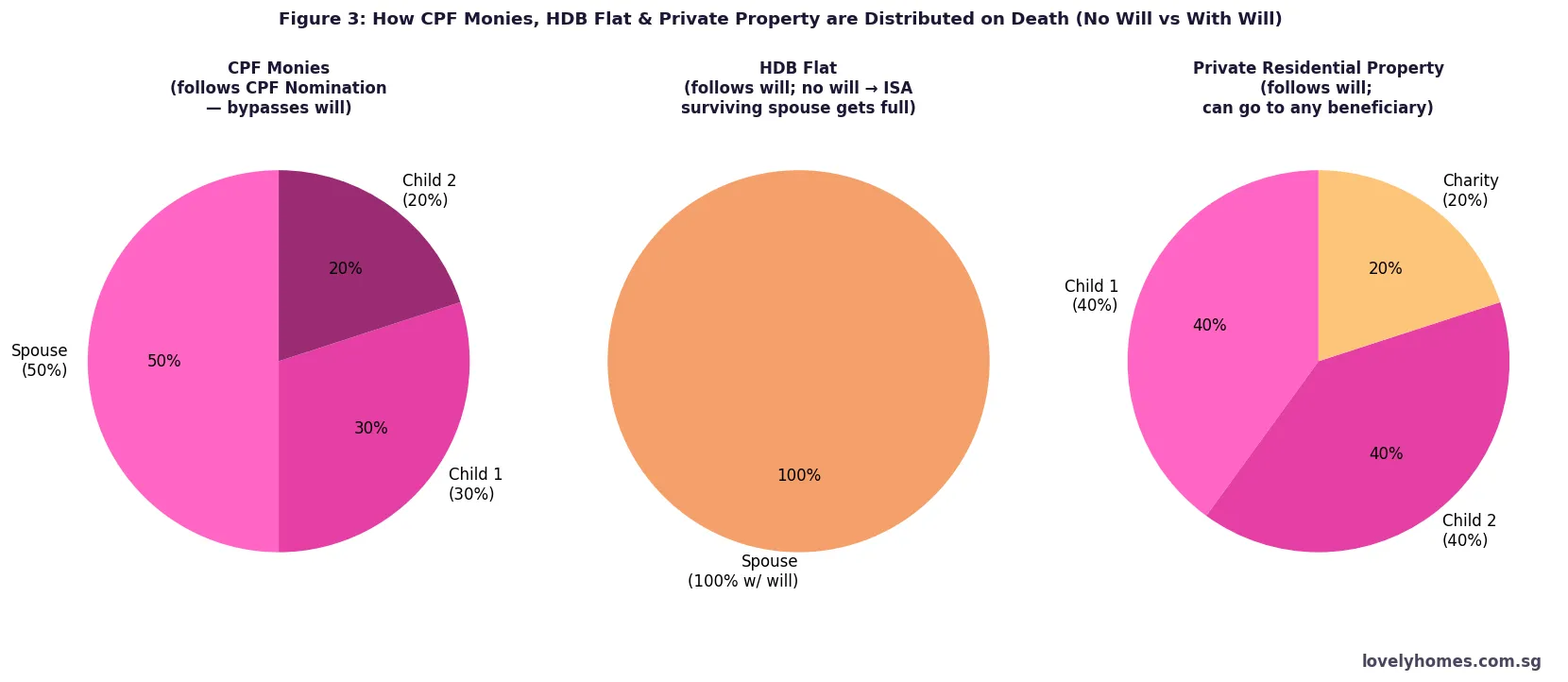
How CPF monies, HDB flat and private property are distributed on death with and without a will Singapore 2026
Figure 3: Distribution of CPF monies, HDB flat, and private residential property on death under different planning scenarios.

Estate Planning — What Every Singapore Property Owner Should Do

Singapore’s property market is one of the most valuable asset classes for most families. Leaving the transmission of that wealth to chance — or to the rigidities of the Intestate Succession Act — is a risk that is easily and cheaply avoided. A comprehensive estate plan for a property-owning Singapore family typically involves four instruments:

Instrument What it Covers Who Administers Cost (Approx.)
Will Private property, bank accounts, personal effects, guardianship of minor children Family Justice Courts (probate) S$300–S$1,200 (straightforward)
CPF Nomination CPF OA, SA, MediSave balances CPF Board (direct payment) Free
HDB Nomination (if applicable) Share in HDB flat (for tenancy-in-common owners) HDB Free
Lasting Power of Attorney (LPA) Decision-making if you lose mental capacity (not on death) Office of the Public Guardian S$75 (standard); free if certified by legal aid

Why Singapore Property Inheritance Matters in 2026

Singapore is in the midst of a significant intergenerational wealth transfer. According to industry estimates, the cohort of HDB flat owners who purchased under SERS and other early schemes in the 1970s–1990s are now in their 70s and 80s. Hundreds of thousands of HDB flats — many now in the S$600,000–S$1,100,000+ resale range — will change hands via inheritance over the next decade. Add private condominiums and landed property to the mix, and the scale of property wealth being inherited is unprecedented in Singapore’s history.

At the same time, the 2023 ABSD increase to 60% for foreigners and 20%/30% for Singapore Citizens on 2nd/3rd properties has made the counting of inherited properties a material financial issue. An unexpected inheritance that tips a SC buyer from “first property” to “second property” status can turn a planned purchase into an ABSD liability of 20% — potentially S$400,000+ on a typical CCR condominium.

What Might Come Next

This section contains editorial speculation and is clearly labelled as such.

Singapore’s government has occasionally reviewed the rules around HDB flat inheritance, particularly in the context of ageing lease profiles and the VERS (Voluntary Early Redevelopment Scheme) pipeline. There is some industry discussion about whether the Right of Occupancy Scheme might be tightened as Singapore’s HDB stock ages and more flats with shorter remaining leases pass between generations — since family members inheriting a flat with 30 or 40 years of lease remaining face a very different investment proposition from those inheriting a newer flat.

On the stamp-duty side, there is no indication that Singapore intends to reintroduce estate duty (abolished 2008). The MND and MOF have historically viewed the abolition as positive for Singapore’s competitiveness as a wealth hub. For now, the transmission-on-death BSD/ABSD exemption also appears stable. Changes to ABSD for inherited properties — e.g. a grace period or exemption from the property count for inherited shares — have been discussed in industry circles but have not been signalled by the Government.

Frequently Asked Questions

Does inheriting a property count toward my ABSD property count?

Yes. Once a property is transmitted to you as a beneficiary and you are registered as owner (or part-owner) at the Singapore Land Authority, it counts toward your residential property count for ABSD purposes. This means that if you already own one private property and you inherit a second one, you are considered a second-property owner. A subsequent purchase would attract the SC third-property ABSD rate of 30%. There is currently no grace period or inherited-property exemption from this counting rule. If you are planning a purchase and know an inheritance is likely, speak to a lawyer about the timing and sequencing.

My parent passed away and left an HDB flat in their sole name. What happens?

If the deceased was the sole HDB owner and there is a valid will, the executor will apply for Grant of Probate. HDB will then assess whether any of the occupiers listed in the flat (or beneficiaries named in the will) qualify to retain it under their eligibility criteria — they must be a Singapore Citizen or PR, form a proper family nucleus, and satisfy income/property ownership requirements. If an eligible person exists, the flat can be transferred to them (subject to HDB’s approval). If no eligible occupier or beneficiary qualifies, HDB has the right to buy back the flat at market value, and the proceeds form part of the estate. Contact HDB’s Branch directly early in the probate process to understand your options.

Can I sell an inherited private property immediately, or do I need to wait?

There is no mandatory holding period for private property inherited via an estate. Once the Grant of Probate or Letters of Administration is obtained and the title is assented to you, you can sell the property. However, Seller’s Stamp Duty (SSD) applies if the property is sold within 3 years of the deceased’s purchase date — not from the date you inherited it. SSD is 12%/8%/4% for disposals in the 1st/2nd/3rd year respectively. Check the original purchase date on the title register before deciding to sell quickly after inheritance. For HDB flats, the 5-year MOP from the original flat purchase date must also be observed before the flat can be sold on the open market.

What is the difference between a CPF nomination and a will for property?

A CPF nomination governs your CPF savings only (OA, SA, MediSave balances) and completely overrides your will for those assets. The CPF Board pays out directly to your nominees without going through probate. A will governs your private property, bank accounts, personal assets, and other estate assets — but not CPF savings. If you have bought your property using CPF funds and there is an outstanding CPF accrued interest amount, that is refunded to the CPF account on sale or transfer of the property, and then distributed to your CPF nominees. You should make both a valid will and a CPF nomination to ensure all assets are covered.

Is there any tax payable on inherited property in Singapore?

Singapore abolished estate duty in February 2008. No estate duty or inheritance tax is levied on the value of an estate. The transmission of a property to a beneficiary via will or intestacy is also exempt from Buyer’s Stamp Duty (BSD) and Additional Buyer’s Stamp Duty (ABSD) at the point of transfer. However, once you are registered as the owner of an inherited property, normal property tax (administered by IRAS) applies going forward at the prevailing rates — owner-occupied or non-owner-occupied depending on whether you live in the property. Annual property tax on a S$800,000 private condominium (non-owner-occupied) is approximately S$3,200–S$6,400 depending on the Annual Value assessed by IRAS.

What happens to an inherited HDB flat if none of the beneficiaries are eligible to own it?

If none of the will’s beneficiaries (or ISA-entitled family members) meet HDB’s eligibility criteria to retain the flat — for instance, all of them are foreigners, or they each already own private property — HDB will issue a directive requiring the estate to sell the flat on the open market or surrender it to HDB. If sold on the open market, any SC or PR eligible buyer can purchase it as a resale HDB flat in the normal manner. The net proceeds (after mortgage redemption and CPF refund obligations) are distributed to the estate’s beneficiaries. HDB typically allows up to 12 months for the estate to resolve the flat’s status before taking further action.

How long does probate take in Singapore and how much does it cost?

A straightforward Singapore estate with a valid will, no overseas assets, and no disputes typically takes 4–9 months from death to final distribution. An estate requiring Letters of Administration (no will) adds 1–3 months for additional surety and advertising requirements. Complex estates with foreign property, trust structures, or contested claims can take 12–36 months or more. Professional costs typically include: probate lawyer fees (S$3,500–S$8,000 for a clean estate, higher for complexity), Court filing fees on a sliding scale based on estate value, property assent legal fees (S$1,500–S$3,000 per property), and SLA registration fees (~S$165 per property). The Public Trustee’s Office also charges a fee of 0.75%–2.75% of CPF monies distributed where there is no CPF nomination.

Disclaimer: This guide is for general information only and does not constitute legal, tax, or financial advice. Inheritance and estate law is complex and fact-specific. Rules around HDB flat eligibility, CPF nominations, stamp duty, and probate procedures may change. Always verify the current position on the Intestate Succession Act (Singapore Statutes Online), the CPF Board nomination portal, and HDB’s official guidance. Consult a licensed Singapore lawyer for advice specific to your situation. For tax implications, refer to IRAS Property Tax.

×

Click anywhere outside the image to close
Conveyancing Fees Singapore 2026: Legal Costs for Buying & Selling Property

Conveyancing Fees Singapore 2026: Legal Costs for Buying & Selling Property

Buying or selling property in Singapore involves more than the purchase price and stamp duties. Every transaction — whether an HDB resale flat, a private condominium, or a landed house — requires a conveyancing lawyer to handle the legal transfer of ownership. These legal fees, plus the various disbursements that lawyers incur on your behalf, form part of the total transaction cost that every buyer and seller must budget for.

In Singapore, conveyancing is a regulated area of legal practice. The Law Society of Singapore previously prescribed a fixed fee scale, but that scale was abolished in 2009. Lawyers now charge based on the complexity of the transaction and market rates, though most firms price competitively within a fairly predictable band. This guide explains what conveyancing lawyers do, what you will pay, and how to manage the costs effectively in 2026.

Quick Answer — Key Takeaways

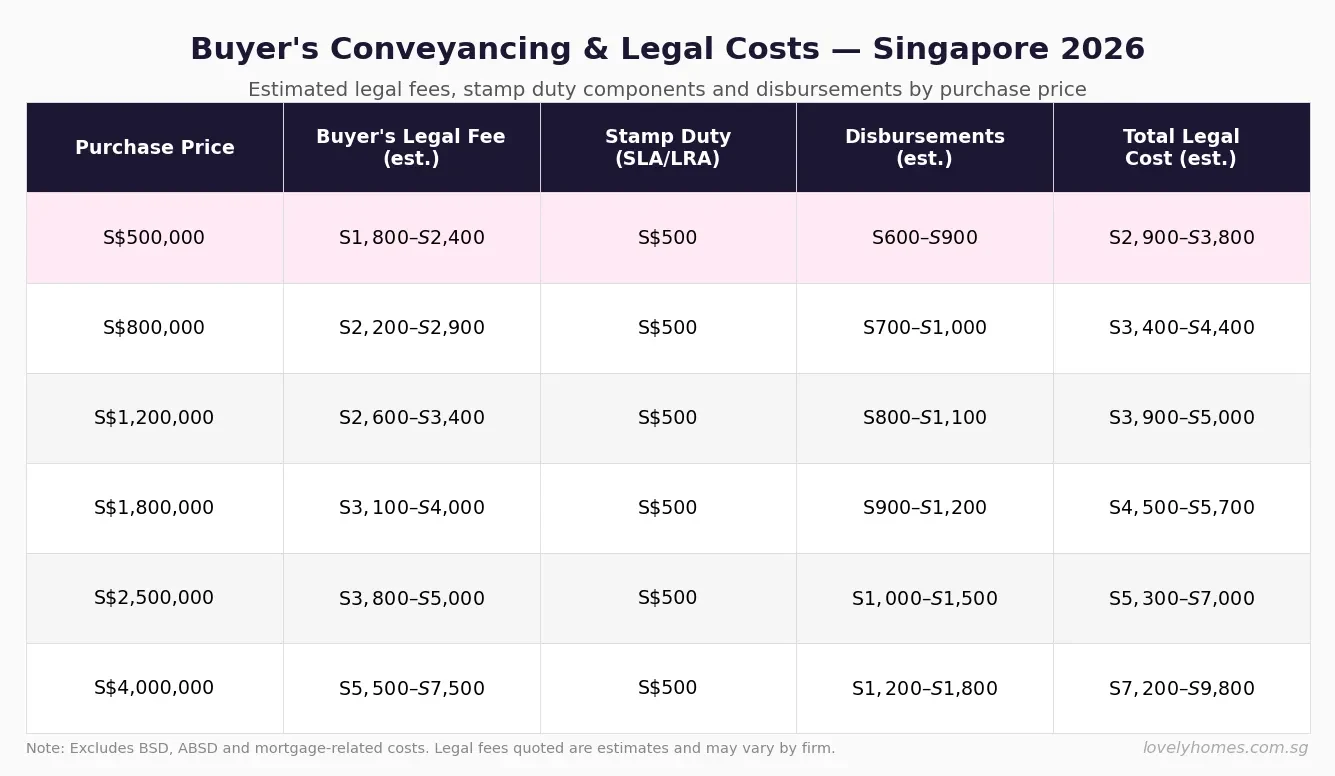
  • Buyer’s conveyancing fees for a S$1.5M private property typically range from S$2,800 to S$4,500 (legal fee) plus S$800–S$1,200 in disbursements.
  • Seller’s legal fees are generally lower — S$2,000 to S$3,500 plus disbursements of S$600–S$1,000.
  • For HDB resale flats, both buyer and seller pay separately for their own lawyers; HDB sets a guide for solicitors’ fees.
  • Disbursements are fixed government and third-party charges — Caveat filing, SLA searches, stamp duty lodgement — totalling S$400–S$1,000 for most transactions.
  • The conveyancing process from Option to Purchase (OTP) exercise to legal completion typically takes 8–12 weeks for private property and 12–16 weeks for HDB resale.
  • You may use the same law firm as the bank providing your mortgage loan (called an “acting for both” arrangement) to reduce total costs — though this is subject to the firm’s conflict-of-interest policies.
  • Buyers must pay Buyer’s Stamp Duty (BSD) within 14 days of exercising the OTP; ABSD (if applicable) is due at the same time.
  • GST at the prevailing rate (9% as at 2026) applies to lawyers’ professional fees but not to government disbursements.

What Is Conveyancing and Why Do You Need a Lawyer?

Conveyancing is the legal process by which ownership of a property is transferred from seller to buyer. In Singapore, this is a mandatory process overseen by qualified solicitors admitted to the Singapore Bar. Unlike some jurisdictions where buyers and sellers may self-represent, Singapore law requires a practising solicitor to execute the conveyancing documents, lodge the transfer with the Singapore Land Authority (SLA), and handle the settlement of funds.

For the buyer, the conveyancing lawyer: reviews the OTP and Sale and Purchase Agreement (SPA), conducts title searches to confirm ownership and encumbrances, lodges a caveat on the property title, handles stamp duty payment on your behalf, liaises with the bank (if you have a mortgage) to coordinate the mortgage documentation and drawdown, and oversees the completion — handing over the title in exchange for the purchase price.

For the seller, the conveyancing lawyer: reviews the OTP, liaises with the buyer’s solicitor, discharges any existing mortgage on the property, handles the discharge of the existing caveat, and receives and distributes the sale proceeds — repaying the outstanding loan to the bank and CPF (if CPF monies were used), and releasing the net balance to you.

buyers conveyancing legal costs Singapore 2026 by property price table
Figure 1: Estimated buyer’s conveyancing fees and disbursements by property price (Singapore 2026). Excludes BSD, ABSD, and mortgage costs. Legal fees are market estimates; actual quotes may vary by firm. Source: LovelyHomes research, Law Society of Singapore guidance.

How Conveyancing Fees Are Structured

Since the abolition of the prescribed scale in 2009, Singapore law firms price conveyancing work in one of three ways: a fixed fee (most common for straightforward residential transactions), an ad valorem fee (a percentage of the purchase price, typically 0.1–0.25%), or an hourly rate (rare for standard residential work). The legal fee is subject to 9% GST.

On top of the professional fee, the lawyer will charge disbursements — third-party costs incurred on your behalf. These are typically passed through at cost (no markup) and are not subject to GST. Common disbursements include: SLA title search fees, caveat registration, stamp duty lodgement fee, HDB resale levy search (if applicable), legal requisitions to various government bodies (URA, LTA, PUB, NEA, SLA, ACRA), and the Electronic Payment fee for the Legal Practitioners Fidelity Fund (LPFF).

Fee Component Typical Range Chargeable? GST?
Professional (legal) fee — buyer S$1,800–S$7,500 (price-dependent) Yes Yes (9%)
Professional (legal) fee — seller S$1,500–S$5,000 (price-dependent) Yes Yes (9%)
SLA title search S$30–S$60 per search Disbursement No
Caveat lodgement S$64.45 Disbursement No
Stamp duty lodgement / e-stamping S$10–S$25 Disbursement No
Government requisitions (URA, LTA, etc.) S$200–S$400 Disbursement No
LPFF contribution S$100 (standard) Disbursement No
Mortgage documentation (if bank appoints same firm) S$800–S$2,500 Yes (bank-to-borrower) Yes (9%)

The Full Picture: Transaction Costs Beyond Legal Fees

Legal fees are only one component of the total cost of buying or selling. The dominant costs for buyers are Buyer’s Stamp Duty (BSD) and, where applicable, Additional Buyer’s Stamp Duty (ABSD). Sellers bear the property agent’s commission (if an agent is engaged). Understanding the full transaction cost envelope is essential for accurate budgeting.

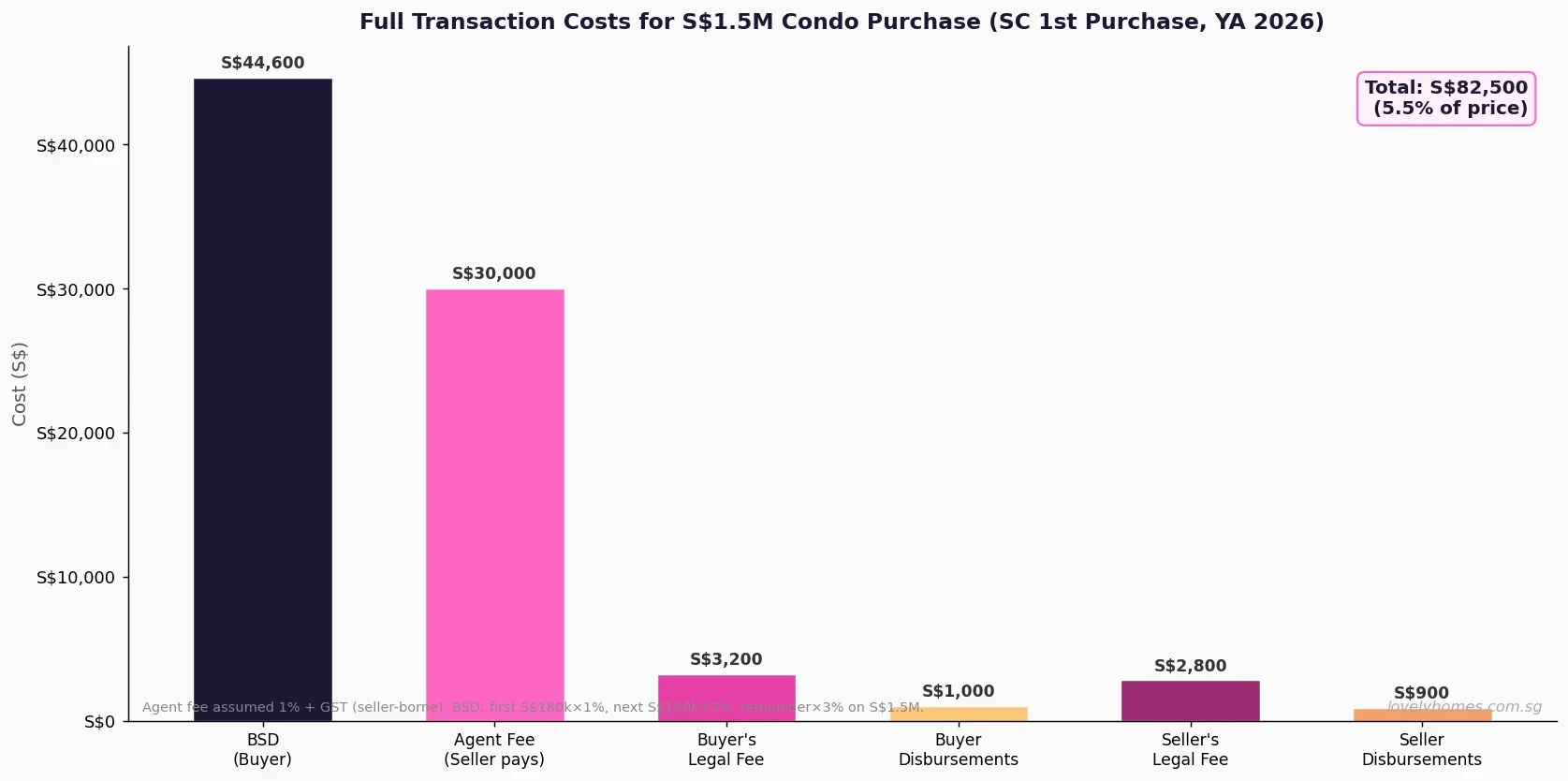
full transaction costs Singapore 1.5 million condo purchase 2026 BSD agent fee legal fees
Figure 2: Full transaction cost breakdown for a S$1.5M private condo purchase by a Singapore Citizen acquiring their first property (no ABSD). Agent fee assumed at 1% (seller-borne). BSD computed on the graduated scale. Source: IRAS, SLA, LovelyHomes research.

As the chart illustrates, BSD at S$44,600 dwarfs all other transaction costs for a first-time SC buyer at S$1.5M. BSD is calculated on the graduated scale: 1% on the first S$180,000, 2% on the next S$180,000, 3% on the next S$640,000, and 4% on the remainder. Total BSD on S$1.5M: S$180,000×1% + S$180,000×2% + S$640,000×3% + S$500,000×4% = S$1,800 + S$3,600 + S$19,200 + S$20,000 = S$44,600.

HDB Resale Flat — Conveyancing Fees

For HDB resale flat transactions, both buyer and seller must appoint their own lawyers. HDB no longer acts as the conveyancing party (it did so for many decades for straightforward HDB transactions, but now all HDB resale transactions go through private solicitors). The HDB sets a guide fee scale, though individual firms may charge within or beyond that band.

Purchase Price / Flat Type Buyer’s Legal Fee (Estimate) Seller’s Legal Fee (Estimate)
1- and 2-room flats (below S$300k) S$1,200–S$1,800 S$900–S$1,500
3-room flats (S$300k–S$450k) S$1,500–S$2,200 S$1,200–S$1,800
4-room flats (S$450k–S$650k) S$1,800–S$2,600 S$1,500–S$2,200
5-room / Executive flats (S$650k–S$900k) S$2,200–S$3,200 S$1,800–S$2,800
Maisonette / DBSS (above S$900k) S$2,800–S$4,000 S$2,200–S$3,500

HDB resale disbursements are broadly similar to private property: title searches, caveat registration (S$64.45), government requisitions (approximately S$150–S$250 for HDB-specific searches), and the LPFF contribution. The total HDB resale legal cost for buyer or seller is usually S$1,500–S$4,500 all-in, depending on flat value and firm.

Under HDB rules, a buyer using an HDB loan may use their lawyer to handle both the HDB loan documentation and the conveyancing — consolidating into one engagement. Buyers using a bank loan will need a separate mortgage solicitor engagement (often the same firm, as many firms act for both).

The Conveyancing Timeline: From OTP to Keys

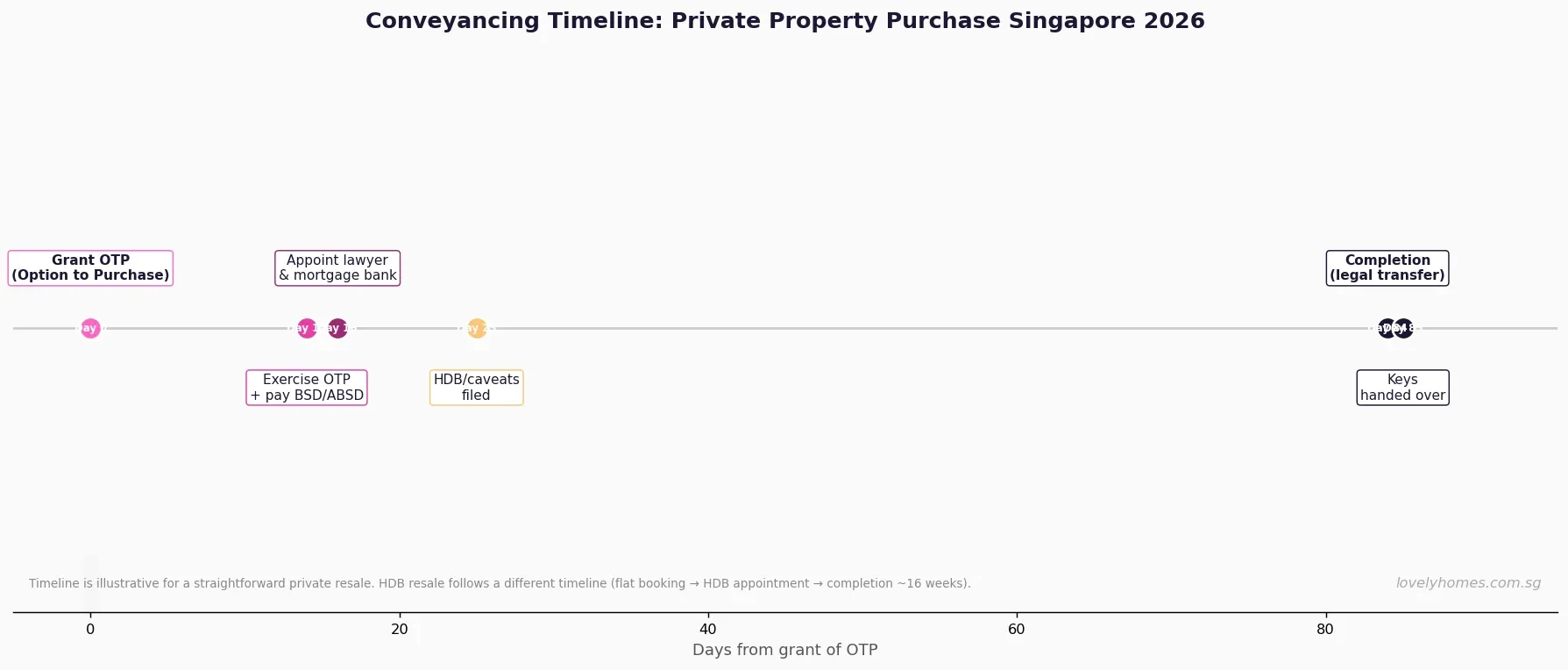
conveyancing timeline private property purchase Singapore 2026 OTP to completion
Figure 3: Illustrative conveyancing timeline for a private property purchase in Singapore (2026). Day 0 = grant of OTP. HDB resale follows a different timeline (approximately 16 weeks from flat booking to completion). Source: LovelyHomes research, SLA.

The timeline above reflects a standard, uncomplicated private resale transaction. Key milestones and deadlines:

  • Day 0 — OTP granted: The seller grants the buyer an Option to Purchase, typically with a 1% option fee. The buyer has 14 days (negotiable; commonly 14 days for private property) to exercise the OTP by paying the exercise fee (usually 4–9%, completing the 5–10% deposit).
  • Day 14 — OTP exercised and stamp duty due: BSD (and ABSD if applicable) must be paid to IRAS within 14 days of exercising the OTP, via e-Stamping or through your lawyer. BSD payment late by even one day attracts a 5–15% penalty.
  • Day 16 — Lawyer and bank formally appointed: Your lawyer receives the OTP, confirms instructions, and begins the legal due diligence — ordering title searches, government requisitions, and liaising with the seller’s solicitors to receive the draft SPA.
  • Day 25 — Caveat lodged: Your lawyer lodges a caveat on the property title with SLA, protecting your interest as buyer against any competing claims or encumbrances registered after this date.
  • Day 84 (approx.) — Legal completion: The seller’s lawyers hand over the property title documents; your lawyer simultaneously releases the purchase funds (mortgage drawdown + CPF withdrawal + cash) to the seller. The title is transferred.
  • Day 85 — Keys handed over: Typically the same day as legal completion or the following business day.

Worked Example: Total Legal Costs for Mr and Mrs Lee’s Condo Purchase

Property: 3-bedroom condominium in Buona Vista, purchase price S$1.9M. Singapore Citizens, first purchase — BSD applies, no ABSD. Bank loan of S$1.425M (75% LTV).

BSD calculation:

  • First S$180,000 × 1% = S$1,800
  • Next S$180,000 × 2% = S$3,600
  • Next S$640,000 × 3% = S$19,200
  • Remaining S$900,000 × 4% = S$36,000
  • BSD Total: S$60,600

Buyer’s legal costs (estimate):

  • Conveyancing professional fee: S$3,800 + 9% GST = S$4,142
  • Mortgage documentation fee (bank): S$1,800 + 9% GST = S$1,962
  • Disbursements (searches, caveat, requisitions, LPFF): S$980
  • Total buyer’s legal cost: S$7,084

Total upfront outlay by buyer:

  • Initial option fee (1%): S$19,000
  • Exercise fee (4%, completing 5% deposit): S$76,000
  • BSD: S$60,600
  • Legal fees + disbursements: S$7,084
  • Remaining cash portion at completion (25% – 5% deposit already paid): S$380,000 – S$95,000 = S$285,000 (if 25% down)
  • Total cash before completion: S$162,684 (option + BSD + legal)

Key insight: Legal fees account for approximately 4.4% of the total non-price transaction cost. BSD is the dominant cost at 37.3%. For planning purposes, budget at least S$165,000 in upfront costs (above the 5% deposit) for a S$1.9M purchase as a first-time SC buyer.

Practical Tips for Managing Conveyancing Costs

Get multiple quotes early. Contact two or three law firms before committing. Many reputable Singapore conveyancing firms provide free quotes via email or WhatsApp. The range across firms is usually S$400–S$800, which is worth shopping around for.

Use a panel firm for your mortgage bank. Banks maintain a panel of approved law firms for mortgage work. If your chosen conveyancing firm is also on your bank’s panel, the firm can act for both you and the bank in the same transaction, eliminating a duplicated engagement — saving S$1,500–S$3,000 in mortgage documentation fees. Ask your firm explicitly whether they are on your bank’s panel.

Understand what is included. When comparing quotes, check whether the stated fee includes disbursements or excludes them. A headline figure of S$1,800 that excludes all disbursements may end up costing more than a S$2,400 all-inclusive quote.

Keep records for rental income tax. If you are purchasing an investment property that you will rent out, your conveyancing fee is not itself deductible against rental income (it is capital expenditure). However, maintaining all records of your acquisition costs is important for computing any eventual capital gain or loss for income tax purposes if you sell (and for the base cost in any future en bloc or collective sale scenario).

Why Legal Costs Matter: Singapore vs Other Markets

Singapore’s conveyancing system is efficient and highly digitalised. The SLA’s integrated land registry means that title searches, caveats, and transfers are processed electronically and within days rather than weeks. Compared to the United Kingdom (where conveyancing often takes four to six months and legal fees on a comparable property can reach 0.5–1.0% of the purchase price), Singapore’s 8–12 week timeline and 0.15–0.25% legal fee benchmark represent a relatively streamlined and cost-effective system.

The most significant friction in Singapore’s property transaction costs remains stamp duty — BSD plus ABSD — which can amount to 5–40% of the purchase price depending on the buyer profile and property count. Legal fees are modest in comparison. For buyers focused on reducing transaction costs, understanding and minimising ABSD exposure (through careful timing, entity structure analysis, and buyer profile planning) yields far greater savings than shopping for the cheapest conveyancing quote.

What Might Change: Conveyancing Regulatory Outlook

This section is speculative. No major changes to the Singapore conveyancing framework are expected in 2026. The Ministry of Law has been examining ways to further digitalise the end-to-end property transaction process — including potential e-OTP frameworks and automated stamp duty computation — that could reduce reliance on solicitors for routine documentation in future years. However, the core requirement for a qualified Singapore solicitor to execute the transfer instrument and lodge with SLA is likely to remain in place for the foreseeable future. Any move toward a fully self-service model would require significant statutory amendment.

Summary: Conveyancing Fees at a Glance

Transaction Type Who Pays Legal Fee (est.) Disbursements (est.) Total (est.)
Private property purchase (S$1M–S$2M) Buyer S$2,600–S$4,200 + GST S$700–S$1,100 S$3,600–S$5,700
Private property purchase (S$2M–S$4M) Buyer S$3,800–S$6,500 + GST S$900–S$1,400 S$5,100–S$8,500
Private property sale Seller S$2,000–S$4,500 + GST S$600–S$900 S$2,800–S$5,800
HDB resale purchase (4-room, S$500k–S$650k) Buyer S$1,800–S$2,600 + GST S$400–S$700 S$2,400–S$3,500
HDB resale sale (4-room) Seller S$1,500–S$2,200 + GST S$350–S$600 S$1,985–S$3,000
Mortgage documentation (bank panel) Borrower S$800–S$2,500 + GST S$100–S$300 S$972–S$3,025

Frequently Asked Questions

Can I use one lawyer for both the buyer and the seller in the same transaction?

Generally, no. Under the Legal Profession (Professional Conduct) Rules, the same solicitor or firm cannot act for both buyer and seller in a property transaction, as the interests of the two parties are inherently conflicting. Each party must appoint their own lawyer. The exception applies to certain intra-family transfers or specific corporate restructurings — if in doubt, seek guidance from the Law Society of Singapore.

What happens if BSD or ABSD is paid late?

BSD and ABSD are due within 14 days of executing the Sale and Purchase Agreement (or exercising the OTP — whichever is the relevant instrument). If payment is late by up to three months, a 5% penalty surcharge applies on the outstanding stamp duty. For delays of three to six months, the penalty increases to 10%; beyond six months, 15%. In practice, your conveyancing lawyer will ensure stamp duty is paid on time — one of the core reasons why appointing a lawyer promptly after OTP exercise is important.

Do I need a separate lawyer for my mortgage, or can it be the same firm?

In most cases, the same law firm can handle both your conveyancing (title transfer) and the mortgage documentation for your bank — provided that firm is on your bank’s approved panel. This “acting for both” arrangement is standard practice in Singapore and reduces duplication. The mortgage documentation fee is a separate charge from the conveyancing fee, but using one firm is significantly cheaper than appointing two. Confirm with your chosen firm and your bank whether this arrangement is available for your specific loan product.

When should I appoint a conveyancing lawyer — before or after the OTP?

Ideally before, or at the very latest on the day the OTP is granted to you. Once you hold an OTP, you have a hard deadline (typically 14 days) to exercise it and pay BSD within another 14 days of exercise. If you appoint your lawyer only after exercising the OTP, you may lose time for the due diligence steps your lawyer needs to complete before recommending whether to proceed. For a first property purchase, most experienced buyers appoint a lawyer at the same time as they make their In-Principle Approval (IPA) application to the bank — months before finding a property.

What is a caveat, and why does my lawyer file one?

A caveat is a notice lodged on the land register with the Singapore Land Authority, alerting any third party who searches the title that you (the buyer) have an interest in the property. Once lodged, the caveat prevents the seller from transferring the property to anyone else, creating further encumbrances, or disposing of the property without your knowledge. The caveat costs S$64.45 to lodge and is typically filed within days of the SPA being signed. Your lawyer lodges it on your behalf as a standard step in every transaction.

Are conveyancing fees negotiable?

Yes, within limits. Since the prescribed scale was removed in 2009, law firms set their own fees. For straightforward transactions, fees are fairly competitive across firms and there is limited room to negotiate a significantly lower price without risking service quality. However, if you are transacting in multiple properties simultaneously (e.g., selling one and buying another), or if you are a repeat client of the firm, it is entirely reasonable to ask for a bundle discount. Always compare fee quotes from at least two firms before deciding.

What is the difference between the OTP and the Sale and Purchase Agreement (SPA)?

The Option to Purchase (OTP) is a short document — typically one to two pages — granted by the seller to the buyer for a consideration (the option fee, usually 1%). The OTP gives the buyer the exclusive right to purchase the property at an agreed price within the option period. The Sale and Purchase Agreement (SPA) is the full, binding contract that comes into force when the buyer exercises the OTP. For private properties, the SPA is a detailed document (often 20–50 pages) prepared by the seller’s solicitors and reviewed by the buyer’s solicitors. For HDB resale, a standard HDB Resale Agreement is used. Your conveyancing lawyer’s role includes reviewing both the OTP (before exercise) and the SPA (before and after execution).

Related Articles

Disclaimer

This article is for general informational purposes only and does not constitute legal, tax, or financial advice. Fee estimates are based on market research as at May 2026 and will vary by law firm, transaction complexity, and individual circumstances. Always obtain a formal written fee quote from a qualified Singapore solicitor before instructing them. For official guidance on stamp duties, consult the Inland Revenue Authority of Singapore (IRAS). For land registration and title matters, refer to the Singapore Land Authority (SLA). For lawyer referrals or complaints, contact the Law Society of Singapore.

Seller’s Stamp Duty (SSD) Singapore 2026: Complete Guide to Rates, Rules & Exemptions

Seller’s Stamp Duty (SSD) Singapore 2026: Complete Guide to Rates, Rules & Exemptions

Quick Answer — Seller’s Stamp Duty at a Glance

  • SSD applies when you sell a Singapore residential property within 3 years of purchase (for properties acquired on or after 11 March 2017).
  • Rates: Year 1 — 12%, Year 2 — 8%, Year 3 — 4%. No SSD after the 3-year holding period.
  • SSD is levied on the higher of the sale price or market value — IRAS may conduct an independent valuation.
  • SSD applies to both private residential properties and HDB resale flats — though HDB’s 5-year MOP means SSD is rarely triggered in practice for HDB owners.
  • SSD must be paid within 14 days of the date of the sale contract or transfer document.
  • There is no remission for SSD based on citizenship or residency status — it applies equally to Singapore Citizens, PRs and foreigners selling within the holding period.
  • Prior regime (properties acquired 14 Jan 2011–10 Mar 2017): 4-year holding period, rates of 16% / 12% / 8% / 4%.

What Is Seller’s Stamp Duty (SSD) and Why Does It Exist?

Seller’s Stamp Duty is a tax levied by the Inland Revenue Authority of Singapore (IRAS) when a property owner sells a residential property within a specified holding period after purchase. Unlike the Additional Buyer’s Stamp Duty (ABSD) — which targets the buyer — SSD targets the seller, specifically those who sell quickly after buying. The rationale is straightforward: rapid reselling of residential property is a hallmark of speculative activity. By making short-term flipping expensive, SSD reduces the incentive to buy property purely for a quick profit rather than for genuine occupation or long-term investment.

SSD was first introduced in February 2010 as part of Singapore’s broader property market cooling framework — the same suite of tools that also includes ABSD, the Total Debt Servicing Ratio (TDSR), and Loan-to-Value (LTV) limits. For a full account of how Singapore has used these levers over the years, see our Property Cooling Measures Timeline.

SSD Rates in Singapore — Current and Historical

The rates below reflect the current SSD regime, which has applied to all residential properties acquired on or after 11 March 2017. Properties purchased before that date are subject to the rates in force at the time of acquisition.

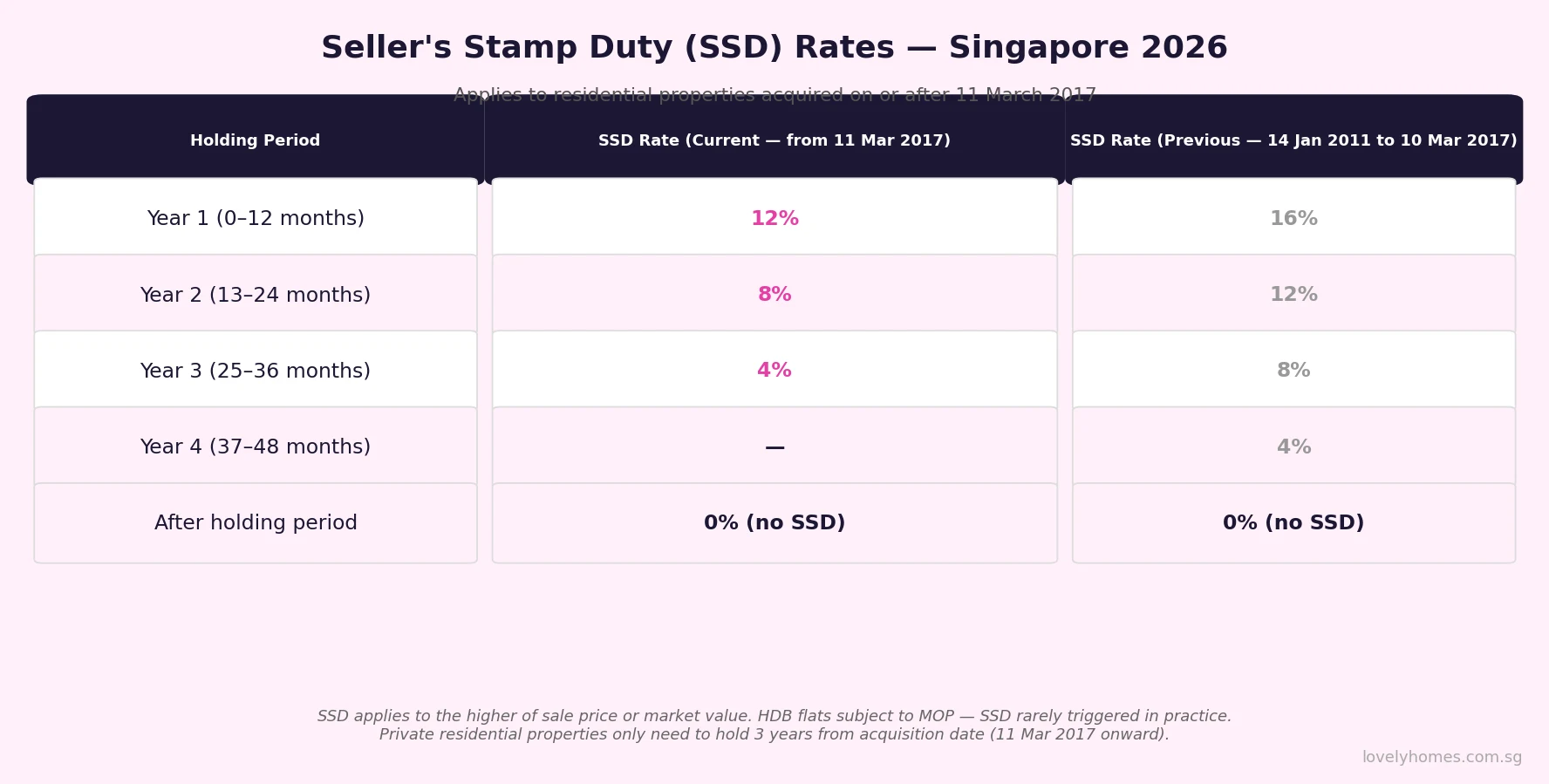
Seller's Stamp Duty SSD rates Singapore 2026 by holding year — current and previous regime
Figure 1: SSD rates by holding year — current regime (from 11 March 2017) versus the previous 4-year regime (14 January 2011 to 10 March 2017). Source: IRAS.
Holding Period SSD Rate — Current (from 11 Mar 2017) SSD Rate — Previous (14 Jan 2011–10 Mar 2017)
Year 1 (0–12 months from purchase) 12% 16%
Year 2 (13–24 months) 8% 12%
Year 3 (25–36 months) 4% 8%
Year 4 (37–48 months) 4%
After holding period 0% (no SSD) 0% (no SSD)

The holding period is measured from the date of purchase — specifically, the date the Option to Purchase (OTP) was exercised, or the date of the Sale & Purchase Agreement if no OTP was used. For an uncompleted property (buying off-plan), IRAS calculates from the date of the S&P Agreement, not the TOP date.

How Much SSD Will You Pay? A Worked Example

SSD is a flat rate applied to the entire sale price or market value — whichever is higher. It is not a progressive or tiered tax.

Example: Mr and Mrs Chen (Singapore Citizens) purchased a S$1.8 million District 10 resale condominium in April 2025. In November 2026 — 19 months after purchase — they receive a job relocation offer and decide to sell. The property is now valued by IRAS at S$1.95 million.

  • Holding period: 19 months → Year 2 — SSD rate 8%
  • SSD base: higher of S$1.95M (IRAS valuation) or sale price S$1.9M → S$1,950,000
  • SSD payable: S$1,950,000 × 8% = S$156,000
  • Payment due within 14 days of the date of the sale contract.

That S$156,000 would eliminate most of the capital appreciation they had hoped to realise. This is precisely the deterrent effect SSD is designed to create.

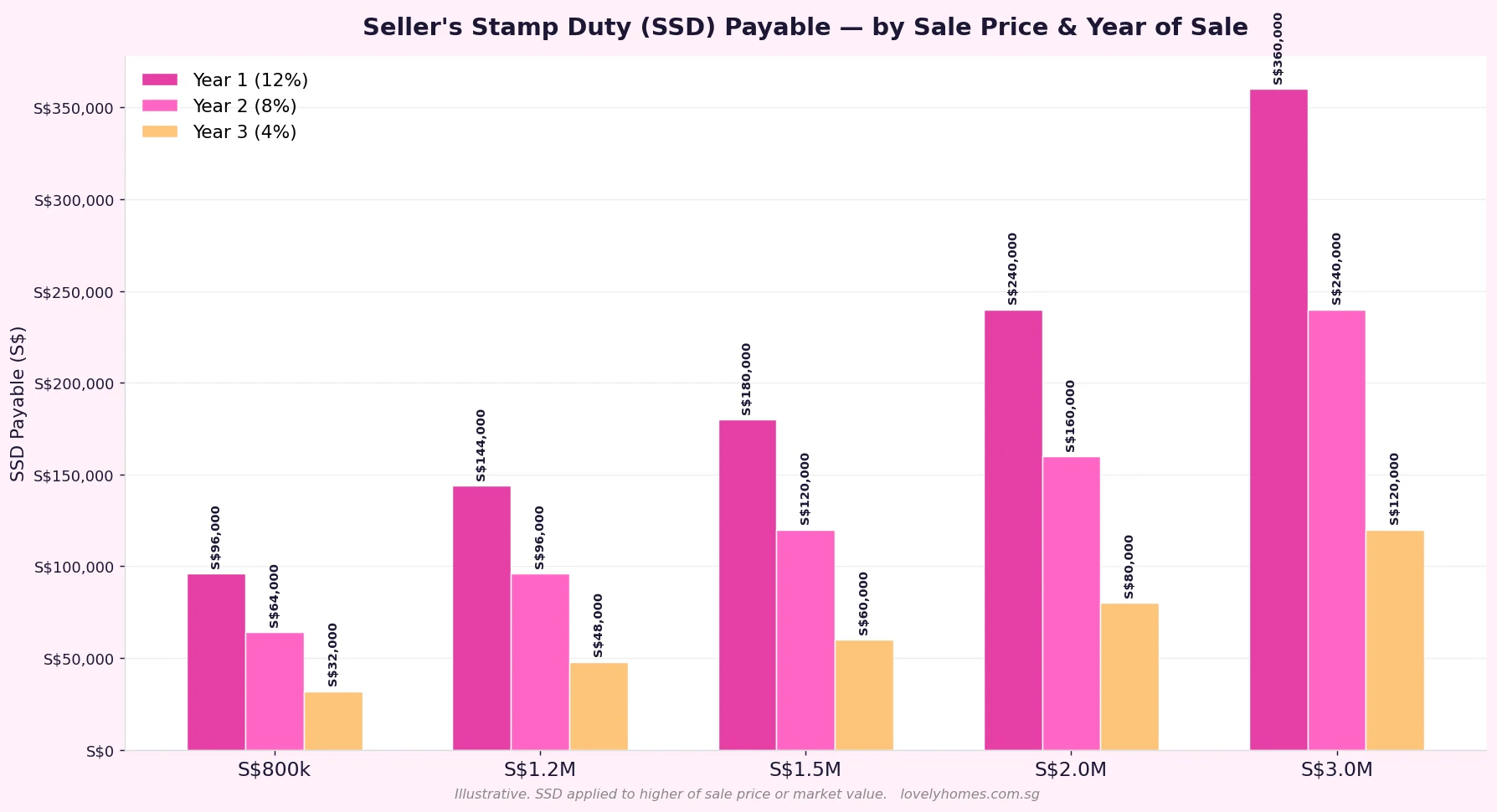
SSD payable by sale price and year of sale Singapore 2026 bar chart
Figure 2: Seller’s Stamp Duty payable by sale price and year of sale. All figures illustrative; SSD applied to the higher of sale price or market value.

Does SSD Apply to HDB Flats?

Yes — SSD applies to both private residential properties and HDB resale flats. There is no exemption for HDB sellers. However, in practice, SSD almost never applies to HDB flat sales because of the Minimum Occupation Period (MOP).

Most HDB flats — including BTO, resale, and EC purchases — require a 5-year MOP before the flat can be sold on the open market or rented out in full. Since the current SSD holding period is only 3 years, any HDB flat owner who has completed the MOP has also automatically cleared the SSD period. The SSD and MOP rules only interact in edge cases — for example, if an HDB owner obtains a special exemption to sell before MOP completion (which is rare and requires HDB approval), SSD may still apply to the transaction.

For private residential properties, there is no equivalent of the MOP, so SSD is the primary mechanism discouraging early resale.

SSD and the Different Holding Period Regimes

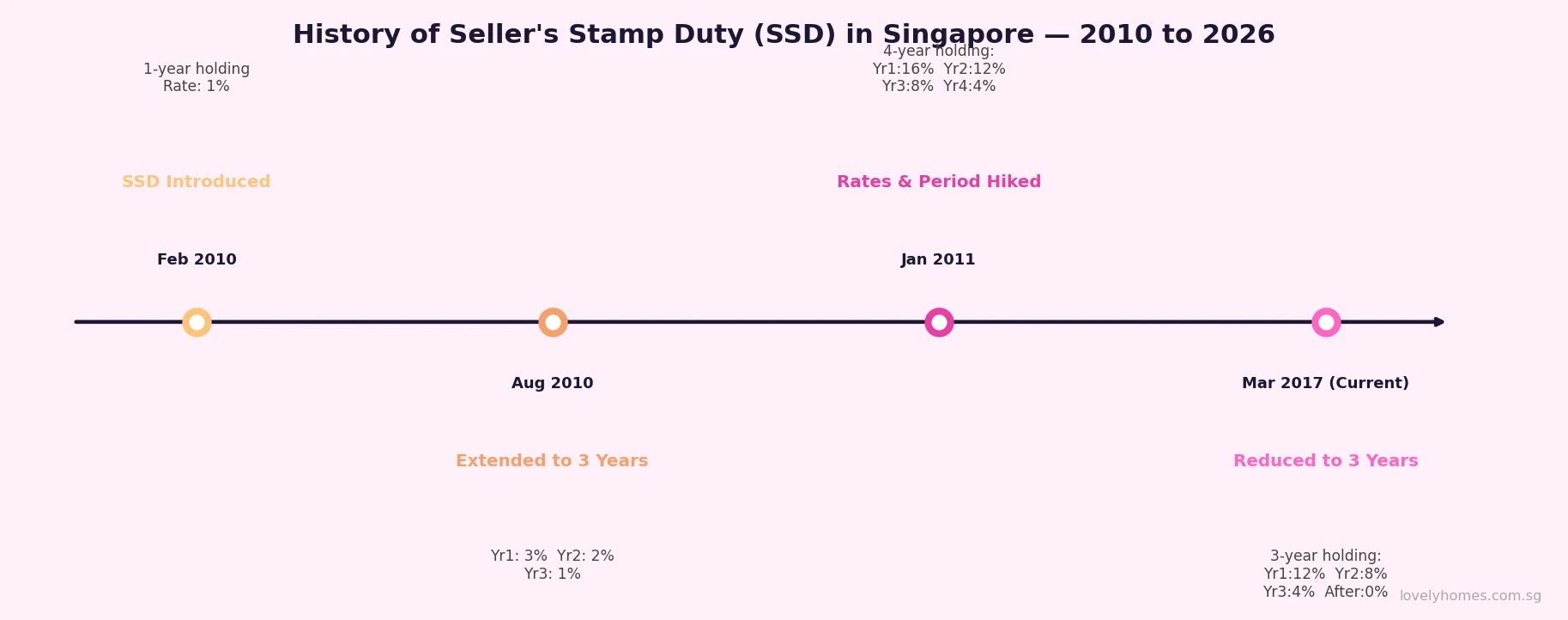
The holding period and rates under SSD have changed three times since its introduction. The applicable regime depends on when you purchased the property, not when you sell it:

  • Acquired on/after 11 March 2017: 3-year holding period; rates 12% / 8% / 4%.
  • Acquired 14 January 2011–10 March 2017: 4-year holding period; rates 16% / 12% / 8% / 4%.
  • Acquired 30 August 2010–13 January 2011: 3-year holding period; lower rates 3% / 2% / 1%.
  • Acquired 20 February–29 August 2010: 1-year holding period; rate 1%.
  • Acquired before 20 February 2010: SSD did not exist; no SSD payable.
History of Seller's Stamp Duty SSD Singapore timeline 2010 to 2026
Figure 3: Timeline of SSD regime changes in Singapore, February 2010 to present. Source: IRAS / Ministry of Finance.

What Transactions Attract SSD?

SSD is triggered on the disposal of a residential property within the applicable holding period. This includes:

  • Open-market resale of a private condo, landed house, or HDB resale flat.
  • Transfer of a property by way of sale (including between related parties at market value).
  • A gift of property — where IRAS deems a market value applies, SSD may be chargeable on the transferor.
  • Assignment of an OTP or S&P agreement where the sub-purchaser takes over before the property is transferred.

SSD is not triggered by:

  • Transfer of a residential property by way of inheritance or pursuant to a court order (e.g. in divorce proceedings) — though legal advice should be taken on the specifics.
  • Compulsory acquisition of land by the Government under the Land Acquisition Act.
  • Transfer between spouses pursuant to a divorce court order (subject to conditions).

Can SSD Be Avoided or Remitted?

Unlike ABSD — which has several remission schemes for qualifying buyers — there is no standard remission scheme for SSD. Once SSD is triggered, it is generally payable in full. The only legitimate ways to avoid SSD are:

  1. Hold for the full SSD period. The most reliable approach: simply do not sell within 3 years of purchase. Time your decision to sell around the anniversary of your OTP exercise date.
  2. Rely on a recognised exemption. Government compulsory acquisitions and specific court-ordered transfers may not attract SSD — take specialist legal advice.
  3. Negotiate for the buyer to absorb it. In strong markets, some sellers negotiate for the buyer to pay a higher price that effectively covers the SSD. This is a commercial negotiation rather than a legal remission.

Attempting to circumvent SSD through artificial schemes — such as inserting a related party as an intermediate buyer — is a criminal offence under the Stamp Duties Act. IRAS has the power to set aside transactions that it determines were structured to avoid stamp duty.

Selling Before the SSD Period: What to Consider

Occasionally, life events force a sale within the SSD window: a job relocation, financial hardship, divorce, or death. In such cases, SSD is generally unavoidable, but sellers should take steps to maximise their net proceeds:

  • Engage a conveyancing lawyer to confirm which SSD regime applies and calculate the exact sum due.
  • Factor SSD into your reserve price — selling for anything less than the minimum price required to cover SSD, mortgage redemption, and CPF refund (with accrued interest) will result in a cash shortfall.
  • Check whether any CPF accrued interest obligations further eat into proceeds.
  • If you are also buying a replacement property, account for the full chain of stamp duty costs: you may owe SSD on the sale and ABSD on the purchase.

SSD vs ABSD — What Is the Difference?

Feature SSD (Seller’s Stamp Duty) ABSD (Additional Buyer’s Stamp Duty)
Who pays? The seller The buyer
When triggered? Selling within the SSD holding period Buying a 2nd+ residential property (or any property as foreigner/entity)
Applies equally regardless of citizenship? Yes No — rates vary by citizenship & property count
Current rates 12% / 8% / 4% (years 1–3) 0%–65% depending on buyer profile
Remission available? Very limited Yes — married couple, developer, FTA nationals
Primary purpose Deter short-term speculation / flipping Moderate demand from investors and foreigners

What Might Come Next for SSD?

SSD was last adjusted in March 2017, when the Government reduced the holding period from 4 years to 3 years and lowered rates, signalling greater confidence in market stability. As of May 2026, there has been no indication from the Ministry of Finance or MAS of any imminent change to the SSD framework. That said, Singapore’s cooling-measures framework has historically been responsive to price pressures — if private residential prices were to accelerate meaningfully, a tightening of SSD (or other measures) cannot be ruled out. For up-to-date guidance, monitor IRAS and the Ministry of Finance.

Frequently Asked Questions

Is SSD payable on the sale price or the market value?

SSD is calculated on the higher of the actual sale price or the market value of the property at the time of sale, as determined by IRAS. If you sell a property at a price below its market value — for example, in a family transfer — IRAS will use the market value for the SSD calculation. This prevents sellers from artificially suppressing prices to reduce their SSD bill.

Does SSD apply to commercial or industrial property?

No. SSD applies only to residential properties — private condominiums, landed houses, HDB resale flats, and executive condominiums. Commercial shophouses, office units, industrial buildings, and pure-land plots are not subject to SSD. This is one reason some investors prefer commercial or industrial assets for shorter-term investment horizons.

When must SSD be paid after signing the sale contract?

SSD must be paid within 14 days of the date of the document that triggers the duty — typically the sale contract or the transfer document. Your conveyancing lawyer will stamp the document and collect the SSD as part of the closing process. Late payment attracts penalties and interest under the Stamp Duties Act.

I inherited a property less than 3 years ago. Do I pay SSD if I sell it?

A property acquired by way of inheritance is not a purchase — it is a transmission on death. IRAS’ position is that where a property is acquired through inheritance, the SSD holding period does not apply in the same way as a purchase. However, if the estate purchased the property (rather than having long held it), the executor’s position can be complex. You should seek specific advice from a conveyancing solicitor familiar with stamp-duty rules before proceeding with any sale of an inherited property.

Can I use CPF to pay SSD?

No. Stamp duties — including SSD and ABSD — cannot be paid directly from your CPF Ordinary Account. They must be settled in cash. Before committing to a sale within the SSD window, ensure you have sufficient liquid funds to cover the SSD liability on top of all other closing costs (agent commission, legal fees, mortgage redemption penalty if any).

My property was purchased jointly with my spouse. How does SSD apply?

For jointly owned property, SSD is assessed on the entire transaction — not split between owners. Both joint tenants or tenants-in-common are jointly and severally liable for the SSD. The holding period is measured from when the property was originally acquired. If you are selling a jointly owned property and the holding period has not expired, both parties must factor in the full SSD liability when planning the sale.

Does SSD apply to the sale of a new launch (uncompleted) condo?

Yes, but the holding period starts from the date of the Sale & Purchase Agreement (the date you signed the S&P with the developer), not the TOP date. This means that if you bought an uncompleted project in 2024 and it TOPs in 2027, you may already be past the SSD window by the time you are able to sell. However, some buyers who assigned or sub-sold their S&P agreements before completion have historically triggered SSD on the assignment — IRAS treats such assignments as a disposal.

Related Articles

Disclaimer

This article is for general informational purposes only and does not constitute legal, tax, or financial advice. SSD rates and rules are set by the Inland Revenue Authority of Singapore (IRAS) and are subject to change. The worked examples and figures in this article are illustrative only and do not constitute a valuation or legal opinion. Before entering into any property transaction — particularly one that may attract SSD — you should consult a licensed conveyancing solicitor, a certified financial planner, and verify the current position directly with IRAS.

×

Click anywhere or press Esc to close

Seller’s Stamp Duty (SSD) Singapore 2026: When You Pay, How Much, and How to Avoid It Legally

Seller’s Stamp Duty (SSD) Singapore 2026: When You Pay, How Much, and How to Avoid It Legally

Seller’s Stamp Duty (SSD) is the Singapore Government’s anti-flipping tax. If you sell a residential property within three years of buying it, you pay a percentage of the sale price — up to 12% — on top of every other selling cost. Get the holding period wrong by even a single day, and a profitable sale can flip into a six-figure loss.

This guide walks you through SSD in 2026: who pays it, how the rate ladder works, when the holding clock starts and stops, who is exempt, and the strategies sellers actually use to manage it. All rates reflect the framework in force since 11 March 2017, which remains current. For the authoritative figures, always check the IRAS Seller’s Stamp Duty page.

Quick Answer — SSD at a glance

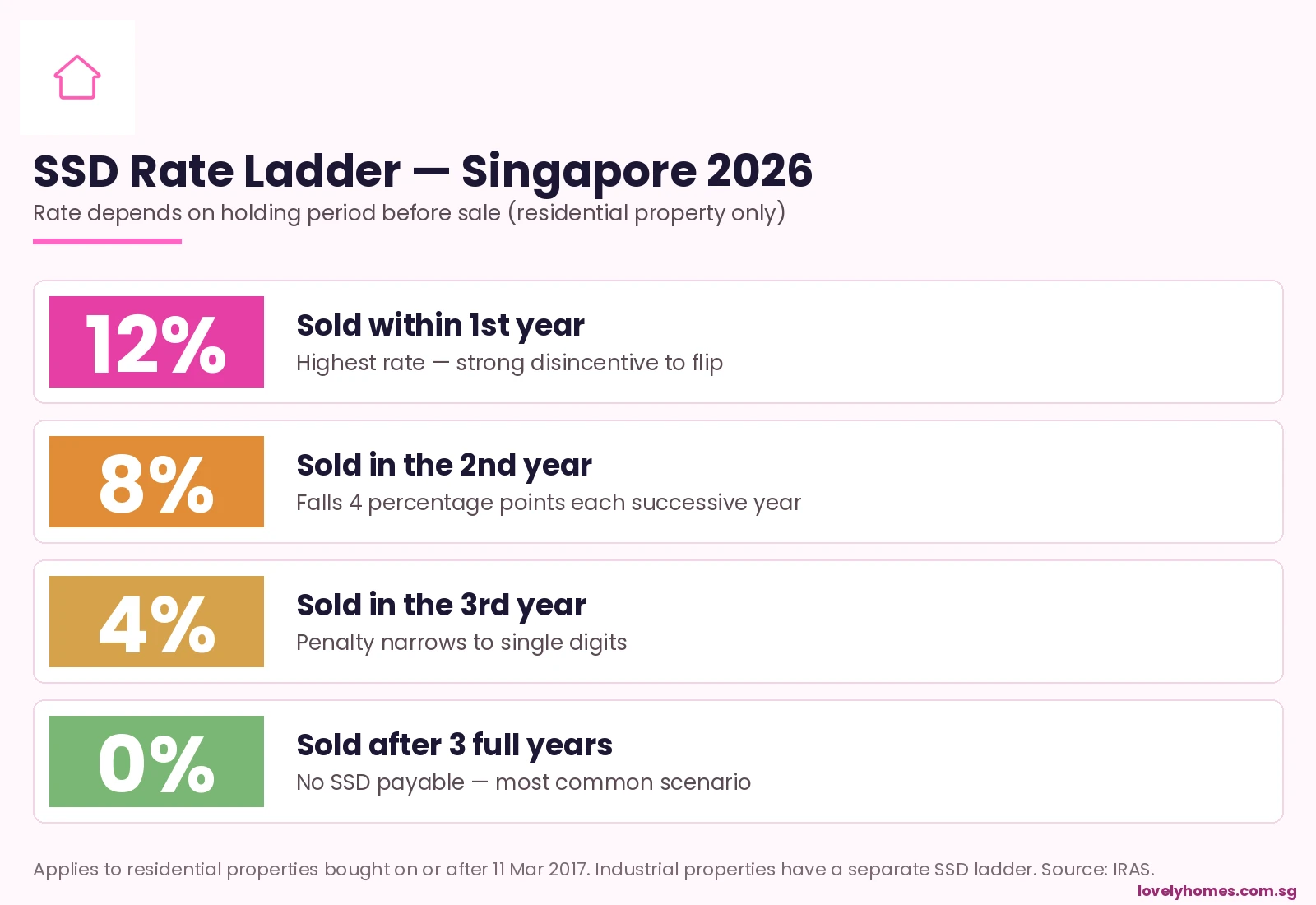
  • SSD applies only to residential property sold within 3 years of acquisition.
  • Rate ladder: 12% (year 1) · 8% (year 2) · 4% (year 3) · 0% thereafter.
  • The clock starts on the date you signed the OTP or accepted the S&P — not the day you collected the keys.
  • Payable within 14 days of contract for sale, on the higher of price or market value.
  • Most short-term sales are caught: divorce sales, job relocations, second properties — SSD applies to nearly all of them.
  • Industrial property has a separate (shorter) ladder; commercial property is exempt.

What Is SSD and Why Does It Exist?

SSD is a transaction tax levied on the seller of a residential property in Singapore when the property is sold within a defined holding period. It is administered by the Inland Revenue Authority of Singapore (IRAS), calculated on the higher of the sale price or the market value, and payable within 14 days of the contract for sale.

The tax was first introduced in February 2010 and progressively widened in 2011 and 2013 as part of the Government’s suite of property cooling measures. The most recent recalibration was in March 2017, which shortened the SSD holding period from four years to three and lowered the headline rate from 16% to the present 12% — a deliberate easing aimed at supporting genuine homeowners rather than speculators. The 2017 framework is still the live rule book in 2026.

The policy goal is simple: discourage speculative flipping while leaving genuine end-users untouched. By the time you have held a private condo or HDB flat for three full years, the cooling-measure case for taxing your sale is gone, and SSD falls to zero.

Seller's Stamp Duty Singapore 2026 — guide cover
Seller’s Stamp Duty Singapore 2026 — the cost of selling too soon.

The 2026 SSD Rate Ladder

The rate you pay depends entirely on how long you held the property before signing the contract for sale. The ladder is steep at the top and falls four percentage points each subsequent year:

SSD rate ladder Singapore 2026 — 12% within first year, 8% second year, 4% third year, 0% after
Figure 1: SSD rate ladder by holding period — residential property, 2026.
Holding period at sale SSD rate Apparent on a S$1.5M sale
Up to 1 year (within 1st year) 12% S$180,000
More than 1 to 2 years 8% S$120,000
More than 2 to 3 years 4% S$60,000
More than 3 years 0% Nil

The rate is applied to the higher of the contracted sale price or IRAS’s assessed market value — sellers cannot lower their SSD bill by deliberately under-pricing a transaction.

When Does the Holding Clock Start — and Stop?

This is where most disputes arise, because the holding period is calculated to the day. The general rule is:

  • Start: the date the buyer signs the Option to Purchase (OTP) or, if there is no OTP, the date of the Sale & Purchase Agreement (S&P).
  • End: the date the buyer signs the next OTP or S&P when reselling.

Note carefully — the keys handover (TOP for new condos, vacant possession for resale) is irrelevant to SSD. A buyer who signs an OTP on 1 March 2024 and signs the next OTP on 28 February 2027 has held for one day under three years — SSD at 4% applies. Sign on 2 March 2027 and SSD drops to zero. Conveyancers routinely time exercise dates around this calendar boundary.

For new launches under construction, the start date is the OTP exercise date, not the TOP date. This means a buyer who signed an OTP in early 2023 for a project that only TOP’d in 2026 is already past the SSD window when they collect the keys.

Who Is Exempt or Remitted?

The exemptions list is narrow. SSD remission is granted only in specific situations, including:

  • HDB flats — not subject to SSD because HDB has its own Minimum Occupation Period (MOP) regime, which generally bars resale within five years.
  • Compulsory acquisition by the State (for example, road or MRT line widening).
  • Bankruptcy of the owner, with proof of insolvency proceedings.
  • Owners required by HDB to sell on grounds of policy violation.
  • Inherited property — the holding period is reckoned from the original purchase by the deceased, not the date of inheritance.
  • Property transferred between spouses as part of a court-ordered division on divorce, in some cases.

Standard life events — relocation overseas for work, family expansion, or financial difficulty — are not grounds for SSD remission. The tax applies even if the seller is selling at a loss.

Worked Example — A S$1.5M Condo Flipped in 6 Months

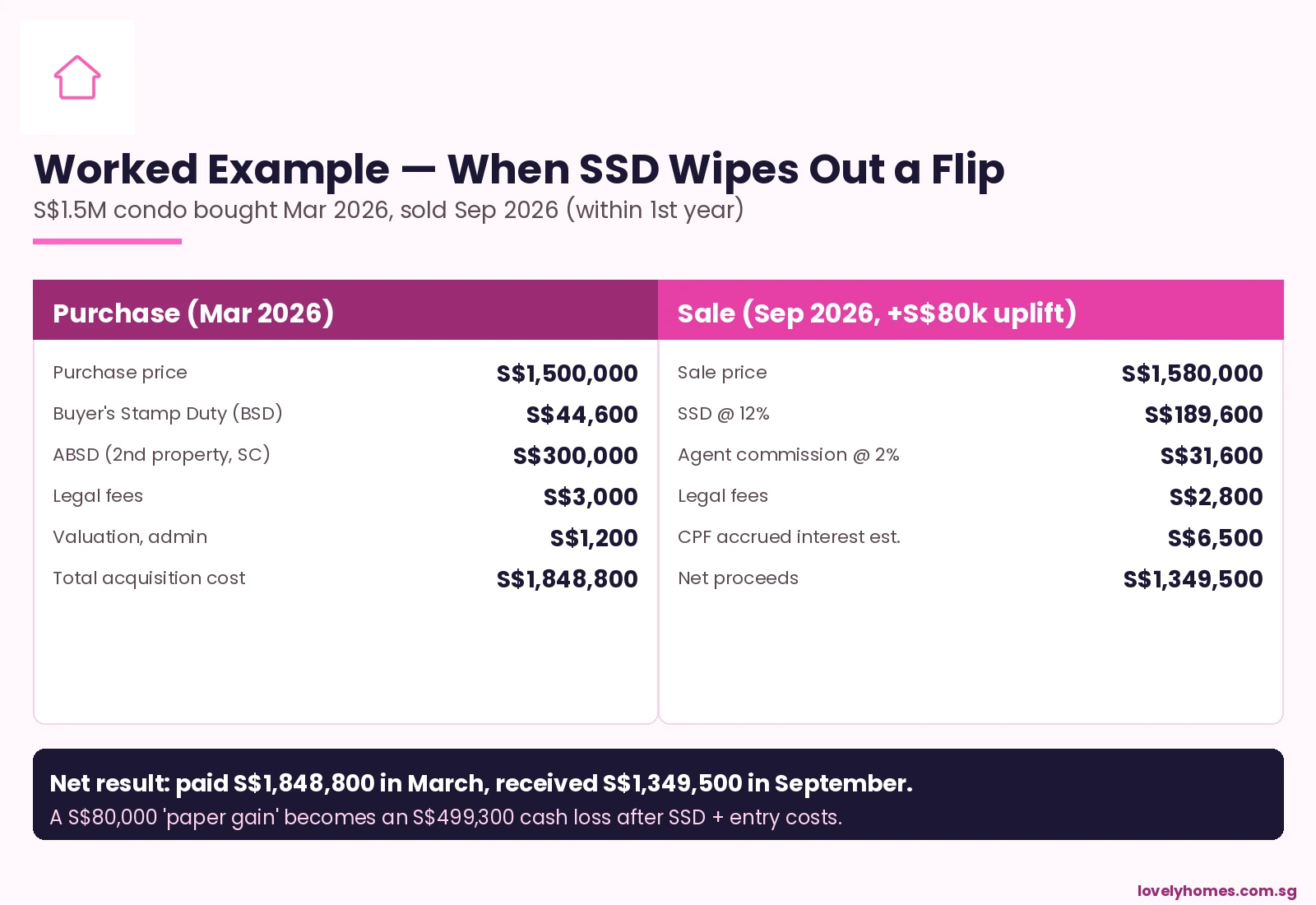
Imagine a Singapore Citizen who buys a S$1.5M private condo as a second property in March 2026, then receives a job offer in Hong Kong six months later and decides to sell at S$1.58M (a S$80,000 paper gain). Here is what the maths actually looks like:

SSD worked example: S$1.5M condo bought Mar 2026 sold Sep 2026 — S$499k cash loss after SSD
Figure 2: Worked example — an apparent S$80k gain becomes an S$499k cash loss when SSD is applied.

Acquisition costs (BSD, ABSD on the second property at 20%, legal fees) total S$348,800. The owner has paid S$1,848,800 to take possession. Six months later, the sale at S$1,580,000 attracts SSD at 12% (S$189,600), broker commission, legal fees, and CPF accrued interest. Net proceeds: S$1,349,500. Cash loss: S$499,300.

The lesson is brutal: SSD is designed to make short-term residential property sales economically unattractive even when the underlying market has moved up. For most second-property buyers, the only way to make the maths work is to stay invested for at least three years.

Strategies Sellers Actually Use

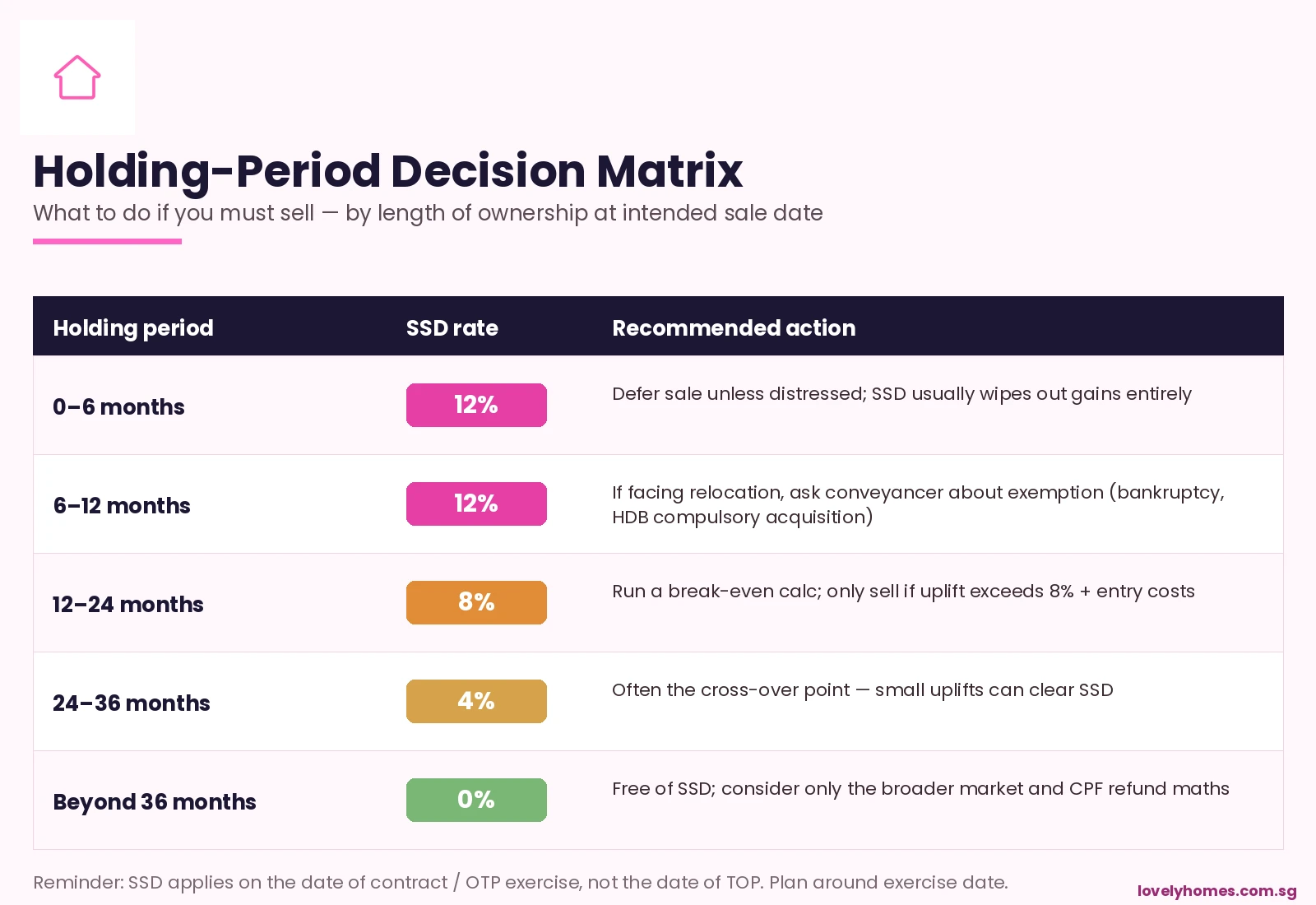
If you find yourself needing to sell within the SSD window, there are a small number of strategies practitioners commonly consider:

1. Run the holding-period calendar to the day

Conveyancers often time the OTP issue and exercise so that the sale falls just outside the next rate band. Selling on day 365 versus day 367 of the second year can mean a four-percentage-point swing on the sale price.

SSD holding-period decision matrix — what to do if you must sell, by length of ownership
Figure 3: Decision matrix — what to do if you must sell, by length of ownership.

2. Rent out instead of selling

If holding-period maths do not work, leasing the unit until SSD falls to zero can preserve value. Singapore rental yields on private condos run 3.0–3.8% gross in 2026, which often covers the carrying cost of the mortgage during the wait.

3. Decoupling within marriage

Where one spouse needs to free up ABSD allowance for a future purchase, transferring a property between spouses (a Part-Disposal arrangement) may attract SSD on the transferred share. Practitioners check carefully whether the holding clock survives the transfer.

4. Swap residential for commercial

Commercial property (offices, shops) is not subject to SSD. Investors with a short horizon sometimes pivot from residential plays to commercial plays specifically to avoid the SSD window. Commercial does carry GST, however, so the trade-off is real.

SSD on HDB — Yes, Technically — But MOP Comes First

Strictly, SSD does not apply to HDB flats sold during the SSD window because the HDB Minimum Occupation Period (MOP) usually prevents resale within five years anyway. The rare exceptions — flats sold under HDB’s compulsory-sale rules, or flats where MOP has been waived by HDB — are also exempt from SSD.

For practical purposes, most HDB sellers should treat MOP as the binding constraint and ignore SSD entirely.

SSD on Industrial Property — A Different (Shorter) Ladder

SSD on industrial property uses a separate, shorter ladder introduced in January 2013: 15% within the first year, 10% in the second year, 5% in the third year, and 0% thereafter — harsher in headline terms but with the same three-year horizon. Commercial property (offices, shops, hotels) attracts no SSD at all.

What This Means for You as a Buyer in 2026

The 2026 environment makes the holding-period calculus even more important. With ABSD at 20% on the second property for Singapore Citizens and 60% for foreigners, entry costs are already punishing. Adding a 12% SSD on a quick exit means roughly one-third of an investment property’s purchase price is consumed by transaction taxes if the holding period is mismanaged.

For buyer-occupiers, the practical advice is unchanged: buy what you can hold through three full years and a typical Singapore property cycle (roughly 7 to 10 years). For investors, the calculus is whether the projected three-to-five-year capital appreciation comfortably exceeds the entry-cost stack — not just SSD but BSD, ABSD, conveyancing, agent commission, and CPF accrued interest combined.

Frequently Asked Questions

Does SSD apply if I bought before 11 March 2017?

Yes, but at the older rate ladder applicable on the date of acquisition. Properties bought between 14 January 2011 and 10 March 2017 use the four-year, 16% / 12% / 8% / 4% ladder. Properties bought between 20 February 2010 and 13 January 2011 use a three-year, 3% / 2% / 1% ladder. IRAS publishes the historical rate tables for cross-reference.

Is SSD payable on the sale of a property at a loss?

Yes. SSD is calculated on the higher of the contracted sale price or the assessed market value, regardless of whether the seller realised a profit or loss on the transaction. Loss-making short-term sales remain fully taxable.

How is SSD different from ABSD?

ABSD (Additional Buyer’s Stamp Duty) is paid by the buyer at purchase based on residency status and number of properties already owned. SSD (Seller’s Stamp Duty) is paid by the seller at sale based on how long the property was held. They are independent taxes and can both apply to the same transaction at different ends.

What if I co-own a property with my spouse and only my spouse’s share is sold (decoupling)?

SSD applies to the share being transferred, calculated on the value of that share. The holding period for the transferred share is reckoned from the original date of acquisition. Conveyancers will typically structure the transfer documentation so that SSD exposure is calculated correctly for the share at issue.

Can I deduct SSD against my income tax?

No. SSD is a transaction tax, not a deductible business expense for an individual seller. Property held by a corporate vehicle may treat SSD differently — consult a Singapore tax adviser for any company-held holding.

Does SSD apply to gifts or transfers within the family?

Generally yes, where the transfer is treated as a sale at market value. There are limited remissions for transfers between spouses incident to divorce or for inherited property where the holding period is reckoned from the deceased’s original acquisition. Always verify with IRAS directly for non-arm’s-length transfers.

When exactly is SSD due?

SSD must be paid within 14 days of the contract for sale — that is, the date the buyer exercises the OTP or signs the S&P. Late payment attracts penalty interest of 5% on the unpaid duty per annum, plus possible additional charges. The seller’s conveyancer typically pays SSD out of the sale proceeds at completion.

Related Articles

Disclaimer

This article is intended as general information about Seller’s Stamp Duty in Singapore as at May 2026 and does not constitute tax, legal, or financial advice. Rates, exemptions, and procedures are set by the Inland Revenue Authority of Singapore and may be amended at any time without notice. For authoritative figures, refer to IRAS, the Housing & Development Board, the Monetary Authority of Singapore, the Urban Redevelopment Authority, and CPF Board for related procedures. For transactions of any size, engage a licensed Singapore conveyancing solicitor and, if relevant, a chartered accountant or tax practitioner before signing an OTP or S&P.

HDB Resale Levy Singapore 2026: Who Pays It, How Much, and How to Avoid It

HDB Resale Levy Singapore 2026: Who Pays It, How Much, and How to Avoid It

HDB resale levy Singapore 2026 — full guide hero image
HDB Resale Levy Singapore 2026 — who pays, when, and how to plan around it.

Quick answer — the resale levy in 30 seconds

  • The HDB resale levy is a one-off charge on second-timer households who take a second housing subsidy from HDB (BTO, Sale of Balance Flats, or a new Executive Condominium).
  • It does not apply if you sell your subsidised flat and buy on the open resale market without claiming any fresh HDB grant.
  • For first subsidised flats taken from 3 March 2006, the levy is a fixed amount — S$15,000 for a 2-room sold up to S$55,000 for an EC.
  • Households who got their first subsidy before 3 March 2006 pay a percentage levy of 10–25% of the resale price instead.
  • Singles Scheme buyers pay half the household amount.
  • The levy is paid in cash (or net cash proceeds from selling the first flat) — CPF cannot be used.
  • Payment is collected at the point of booking the second subsidised flat, before key collection.
  • Buying on the open market means no levy, but you still face BSD, ABSD (where applicable) and SSD if you sell within three years.

What is the HDB resale levy?

The resale levy is a charge that the Housing & Development Board (HDB) imposes on a household which has already enjoyed a housing subsidy and now wants a second bite at one. The Government’s logic is straightforward: public housing subsidies are taxpayer-funded, and a household should not collect them twice without contributing back. Selling the first subsidised flat is fine; what triggers the levy is the act of booking another subsidised flat — a fresh BTO, a Sale of Balance Flat, an open booking unit, or a brand-new Executive Condominium directly from the developer.

Crucially, the levy is administered by HDB, not IRAS. It is separate from Buyer’s Stamp Duty, ABSD, and Seller’s Stamp Duty. You can owe stamp duties and a resale levy in different scenarios, and they are calculated, paid, and tracked independently.

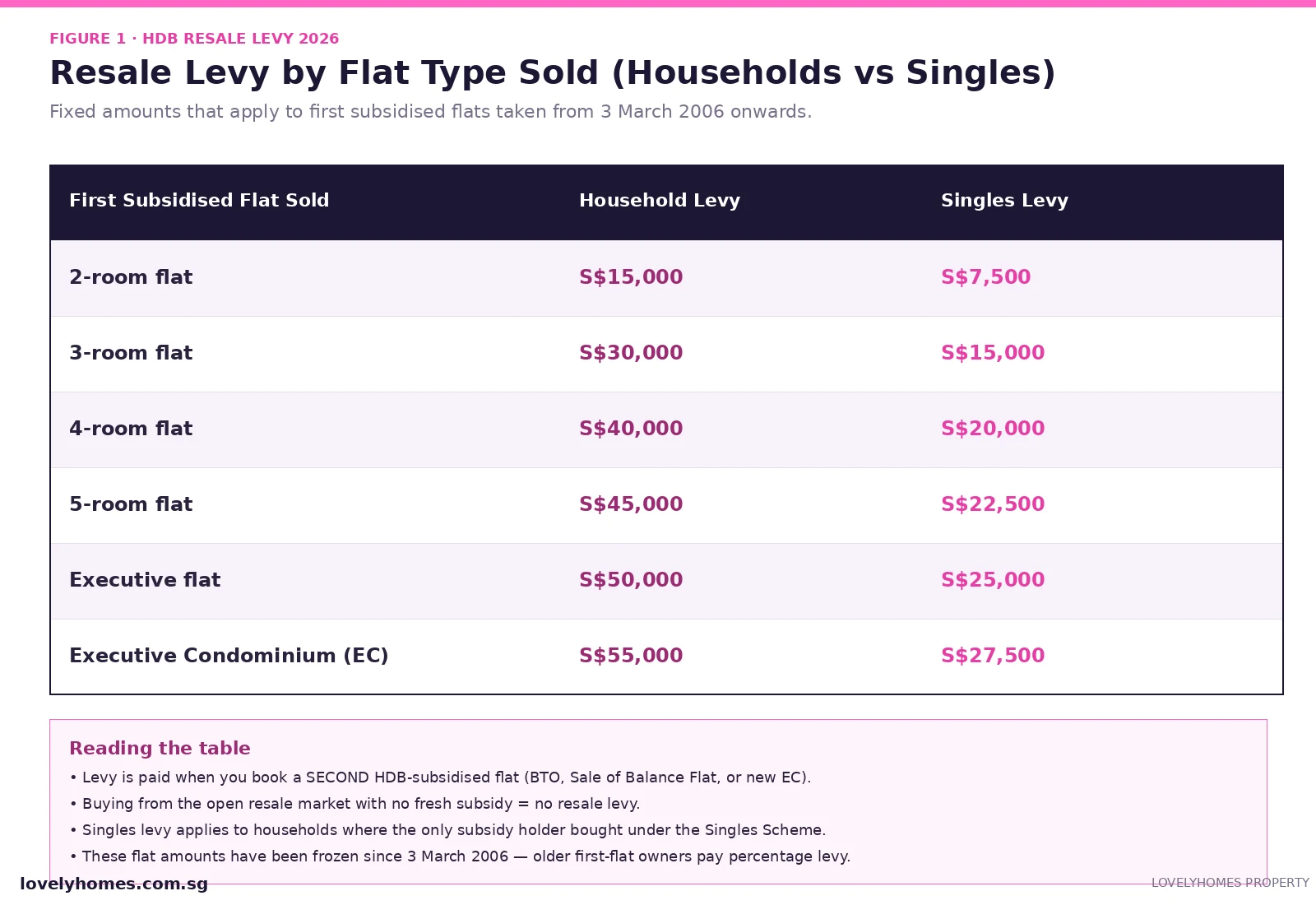
HDB resale levy Singapore 2026 — fixed levy amounts by flat type for households and singles
Figure 1 · Fixed-dollar resale levy amounts in force since 3 March 2006. Source: HDB.

Who actually pays the levy?

The resale levy travels with the household, not the property. If at any point in your housing history you (or your spouse, or your essential occupier) have already enjoyed an HDB subsidy, you are a second-timer in HDB’s eyes the next time you approach them for a fresh subsidy. The subsidies that count include:

  • A new flat purchased directly from HDB (BTO, Sale of Balance Flats, Re-Offer of Balance Flats, open-booking flats).
  • A Design, Build and Sell Scheme (DBSS) flat bought from a private developer.
  • An Executive Condominium bought directly from the developer (first hand).
  • A resale flat bought with one of the older Resale Application Grants — CPF Housing Grant for Family, Singles Grant, or Half-Housing Grant — taken before changes to the levy rules.
  • HUDC flats and SERS replacement flats taken under HDB schemes count similarly.

If your only subsidy was the Enhanced CPF Housing Grant (EHG) or the Family Grant on a resale flat purchased after 3 March 2006, you are not automatically deemed a levy-paying second-timer for the purpose of a future resale flat purchase — but you do pay the levy if you next buy a new flat or new EC.

How the levy is calculated

Two regimes apply, and the dividing line is the date of your first subsidised flat’s key collection (or in the case of an EC, the date you signed the Sale & Purchase Agreement).

Fixed-dollar levy (first flat from 3 March 2006)

This is the regime almost every modern buyer falls under. The amount is locked to the type of flat you sold:

First subsidised flat sold Household levy Singles Scheme levy
2-room flat S$15,000 S$7,500
3-room flat S$30,000 S$15,000
4-room flat S$40,000 S$20,000
5-room flat S$45,000 S$22,500
Executive flat / HUDC S$50,000 S$25,000
Executive Condominium S$55,000 S$27,500

The fixed amount does not move with property prices, which is good news for households whose first flat appreciated heavily in resale. A 4-room sold today for S$700,000 still owes only S$40,000 in levy — about 5.7% of the resale price.

Percentage levy (first flat before 3 March 2006)

Older second-timers face the legacy regime. Levy is set as a percentage of the higher of the resale price or 90% of the market valuation:

First subsidised flat sold Household levy % Singles Scheme levy %
2-room flat 10% 5%
3-room flat 20% 10%
4-room flat 22.5% 11.25%
5-room flat 25% 12.5%
Executive flat / HUDC 25% 12.5%

For a household that sold a 4-room legacy flat for S$650,000, the percentage levy lands at S$146,250 — markedly higher than the modern fixed levy. This is one reason long-time HDB owners often choose to remain in the resale market rather than ballot for a fresh BTO.

When and how the levy is paid

HDB collects the resale levy at the point of booking the second subsidised flat. In practice this means:

  1. You sell your first subsidised flat. CPF is refunded with accrued interest; the cash balance is yours.
  2. You ballot for, queue, and book a second BTO/SBF/SBF or sign for an EC.
  3. HDB issues a payment notice for the levy, payable in cash only. CPF cannot be used.
  4. Levy is paid before signing the lease agreement / S&P. Failure to pay forfeits the booking.

If the second flat is booked before the first has been sold, HDB defers the levy to the resale completion date and may require an undertaking. Some buyers structure it this way to avoid being homeless between sale and BTO completion, especially in long-build projects.

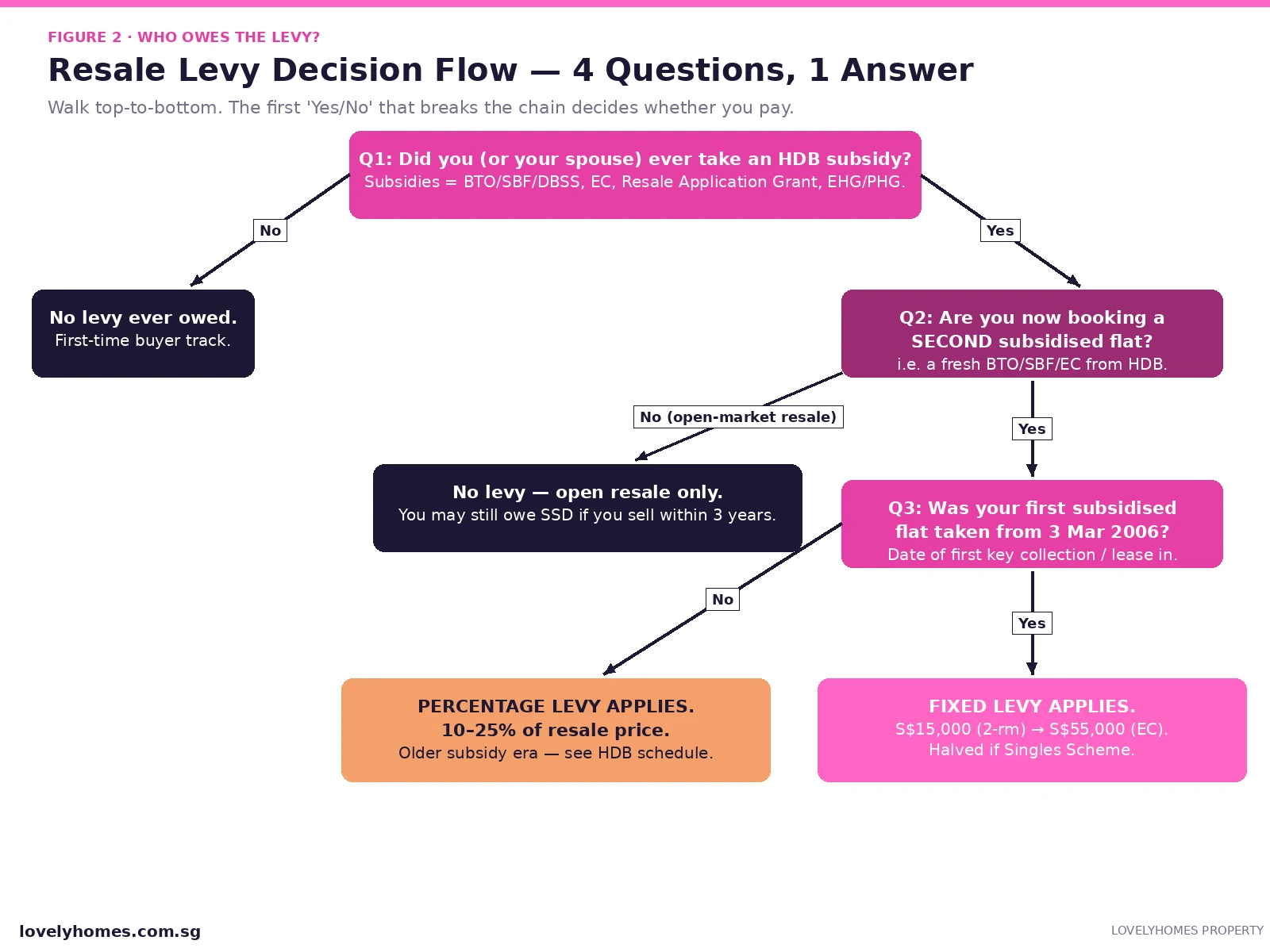
HDB resale levy 2026 decision flow — who owes the levy
Figure 2 · Walk the four questions in order — the first answer that breaks the chain decides your outcome.

Who is exempt or partially relieved?

HDB allows a small set of waivers and concessions, and these matter most for older households and downgraders:

  • Buying a 2-room Flexi flat on a short lease (45 years or less) at age 55 and above. The resale levy is waived in full to encourage right-sizing.
  • Buying a Studio Apartment / Community Care Apartment. No resale levy applies (these are senior-targeted typologies).
  • Divorce settlements where one party retains the existing flat. No levy event; only one of the parties may face a levy if they later buy a fresh subsidised flat.
  • Sub-letting income or rental of bedrooms does not trigger the levy. The levy only fires when the subsidised flat is sold and a new subsidised flat is booked.
  • Open-market resale purchases without grants are not levy events. You can move from a 4-room HDB to another resale 5-room without grant, and no levy is triggered.

Resale levy vs CPF refund vs stamp duty — separating the bills

It is easy to confuse three different cash flows that all hit a second-timer household at roughly the same time. They are independent and add up:

What you pay Who collects Triggers Source of funds
Resale levy HDB Booking second subsidised flat Cash only
CPF accrued interest CPF Board (refund into your OA) Sale of any flat Auto-deducted from sale proceeds
Buyer’s Stamp Duty IRAS Any property purchase Cash + CPF allowed
Additional Buyer’s Stamp Duty IRAS Second / third / foreign buyer purchase Cash + CPF allowed
Seller’s Stamp Duty IRAS Sale within 3-year holding period From sale proceeds

The CPF accrued interest is not a fee — it is your own money being returned to your OA — but it shrinks the cash you can deploy on the next purchase. Plan around it the same way you plan around the resale levy.

Worked example — same family, two paths

Take a Singapore Citizen couple, married 12 years, who bought a 4-room BTO in Punggol for S$320,000 in 2014 with a Family Grant. In 2026 they have hit the 5-year MOP, the flat is valued at S$680,000, and they are deciding whether to upgrade through a fresh BTO or to buy a private resale condo.

HDB resale levy worked example 2026 — second BTO vs private resale condo cost stack
Figure 3 · Whichever way they go, the resale levy is small relative to private stamp duty.

Path A — buying a 5-room BTO — costs S$40,000 in levy plus the new flat price of S$580,000. Path B — buying an S$1.4M open-market resale condo — skips the levy entirely but adds S$45,400 in BSD and S$280,000 in ABSD at the 20% citizen-second-property rate, totalling S$325,400 in stamp duty. The headline conclusion: the resale levy is real money, but it is dwarfed by ABSD whenever the alternative is a private-market upgrade. Couples often see this comparison only after they put pen to paper, which is why it pays to model both routes early.

Why the levy exists at all

Singapore’s housing model rests on two policy pillars: keeping public housing affordable to first-timers, and rationing taxpayer subsidies. Without a levy, a household could ride the BTO market repeatedly — cashing in on resale price growth at each cycle and stepping up to bigger flats with full subsidies each time. The levy is the friction that makes a second BTO a deliberate choice rather than a default. It also keeps queues for new BTOs balanced — first-timers always get priority, but second-timers compete for the remaining quota and pay the levy if they win one.

Compared with peer markets, the Singapore approach is unusual. Hong Kong’s Home Ownership Scheme uses a price clawback rather than a flat levy. Australia’s First Home Owner Grant has no second-time levy because grants there are smaller and time-limited. The Singaporean fixed-dollar approach is a useful piece of housing-policy plumbing that most buyers only encounter once.

What this means for you

If you are a current HDB owner thinking about your next move, the levy reshapes the decision in three concrete ways. First, it makes the open resale route surprisingly competitive — for many flat types the levy is comparable to the lawyer-and-valuer fees on a private resale and is comfortably under the BSD on a S$1.5M condo. Second, because the levy is fixed, smaller flat owners (2-room, 3-room) face a friendlier upgrade path than larger flat owners; the household that sold a 5-room or EC pays the most. Third, the levy is cash-only — that imposes a real liquidity hit at exactly the moment you are also funding the down-payment, legal fees, and renovation on the next home.

A common mistake is to treat the levy as one of many transaction costs and bake it into the budget late. Run the numbers up front, ideally on the same spreadsheet you use for down payment and LTV planning. If you are upgrading to a private property, the right comparison is the levy versus the ABSD and BSD on the alternative — almost always a smaller bill, in absolute terms, than the stamp duties on a S$1.5M+ condo.

What might come next

The fixed-dollar regime has been frozen since March 2006. Construction costs and median flat prices have roughly tripled since then, which has progressively eroded the real value of the levy. There has been periodic public commentary that the Government may reconsider the schedule — either by indexing it to a property price benchmark or by raising the EC and 5-room amounts. In the same vein, the percentage-based legacy regime continues to age out as pre-2006 first-flat owners exit the market.

Two policy directions are plausible from here. One is a recalibration that pushes the larger-flat levies upward to keep relative ratios stable as flat prices move. The other is a structural rethink that ties the levy to the resale price like the legacy regime, but capped to avoid punishing strong resale gains. Either direction would arrive with notice and a generous grace period for booked transactions; speculation is not a reason to rush a BTO ballot. The forward-looking view here is that some upward adjustment is likely over the next several years, but transparency and lead time are part of HDB’s playbook.

Frequently asked questions

Does the resale levy apply if I sell my HDB and buy a private condo?

No. The levy only triggers when you book another subsidised flat from HDB (BTO, SBF, fresh EC). Buying a private resale condo or a new condo from a developer does not engage the levy at all — although you will face full BSD plus ABSD where applicable.

Does the resale levy apply when I buy a resale flat with a CPF grant?

For first subsidised flats taken from 3 March 2006 onwards, second-timer households who buy a resale flat with grants are subject to a smaller adjustment rather than a full resale levy. Historically (pre-March 2006) a percentage levy did apply. Always check HDB’s resale flat eligibility letter for your specific case before you make an offer.

Can I pay the resale levy from my CPF Ordinary Account?

No. The levy is payable in cash. The cash you have on hand from the sale of your first flat — after CPF is refunded with accrued interest — is the typical source of funds. Some households top up with a small bridging loan to cover the gap between flat sale completion and second-flat booking.

What if my spouse and I both owned subsidised flats before marriage?

HDB looks at the household, not the individual. If either of you previously took an HDB subsidy, the next subsidised flat the new household books is treated as a second purchase. Only one resale levy is owed per household per flat sold.

Will the levy be waived if I am buying a smaller flat to right-size?

Only in tightly defined cases — chiefly the 2-room Flexi short-lease flat at 55+, and Studio Apartment / Community Care Apartment purchases. Right-sizing into a longer-lease 2-room or 3-room generally still triggers the levy if it is a fresh subsidised flat.

Does the resale levy apply to Executive Condominium buyers?

Yes — and it is the largest category, S$55,000 for households who previously sold an EC. Crucially, the levy fires on the first hand EC purchase only. After the EC’s 5-year MOP and 10-year privatisation, subsequent buyers are private-market buyers and never face the levy.

If I divorce and one of us keeps the flat, does the other party still owe the levy?

The party who retains the flat keeps the subsidy attribution; if they later remarry and book another subsidised flat, the levy applies. The other party’s eligibility is reviewed against their new household status — the levy is only assessed at the point of booking a fresh subsidised purchase.

Disclaimer: This article summarises the resale levy regime as administered by the Housing & Development Board (HDB) of Singapore. Levy amounts, eligibility rules and waivers may be updated by HDB from time to time. Always verify the current schedule against the HDB resale levy page on hdb.gov.sg, your eligibility letter, and where relevant the Inland Revenue Authority of Singapore (IRAS), the Central Provident Fund (CPF) Board, the Monetary Authority of Singapore (MAS), and SingStat for housing market data. This article does not constitute legal, financial or tax advice — speak to a licensed conveyancing lawyer, a HDB-listed mortgage advisor, or a registered financial adviser before transacting.

Translate »