ABSD Remission Singapore 2026: Complete Guide to Remissions & Concessions
⚡ Quick Answer: ABSD Remission Singapore 2026
- ABSD remission allows eligible buyers to receive a refund or waiver of Additional Buyer’s Stamp Duty (ABSD) — administered by the Inland Revenue Authority of Singapore (IRAS).
- Married Singapore Citizens buying their first joint residential property together pay 0% ABSD — no stamp duty remission claim needed; the rate is already zero.
- SC + SPR married couples buying their first residential property pay 5% ABSD upfront, then apply for a full remission if they meet the conditions — effectively 0% net.
- The 6-month remission lets SC or SPR buyers who already own one property get their ABSD refunded if they sell the first property within 6 months of purchasing the second.
- Developers receive remission of up to 35% ABSD on land purchases subject to conditions — this is the largest single remission in Singapore’s stamp duty framework.
- Trustees and executors may obtain ABSD remission when dealing with property held for others under specific estate and trust conditions.
- All remission claims are filed with IRAS — most claims must be submitted within 6 months of the triggering event. Late claims may be rejected.
- ABSD remission does NOT apply to Buyer’s Stamp Duty (BSD) — BSD is payable in full by all buyers regardless of ABSD status.
What Is ABSD and Why Does Remission Exist?
Additional Buyer’s Stamp Duty (ABSD) is a tax levied by the Singapore government — through IRAS under the Stamp Duties Act — on purchases of residential property. It sits on top of the standard Buyer’s Stamp Duty (BSD) and is deliberately tiered to discourage speculative purchases and manage demand in Singapore’s property market.
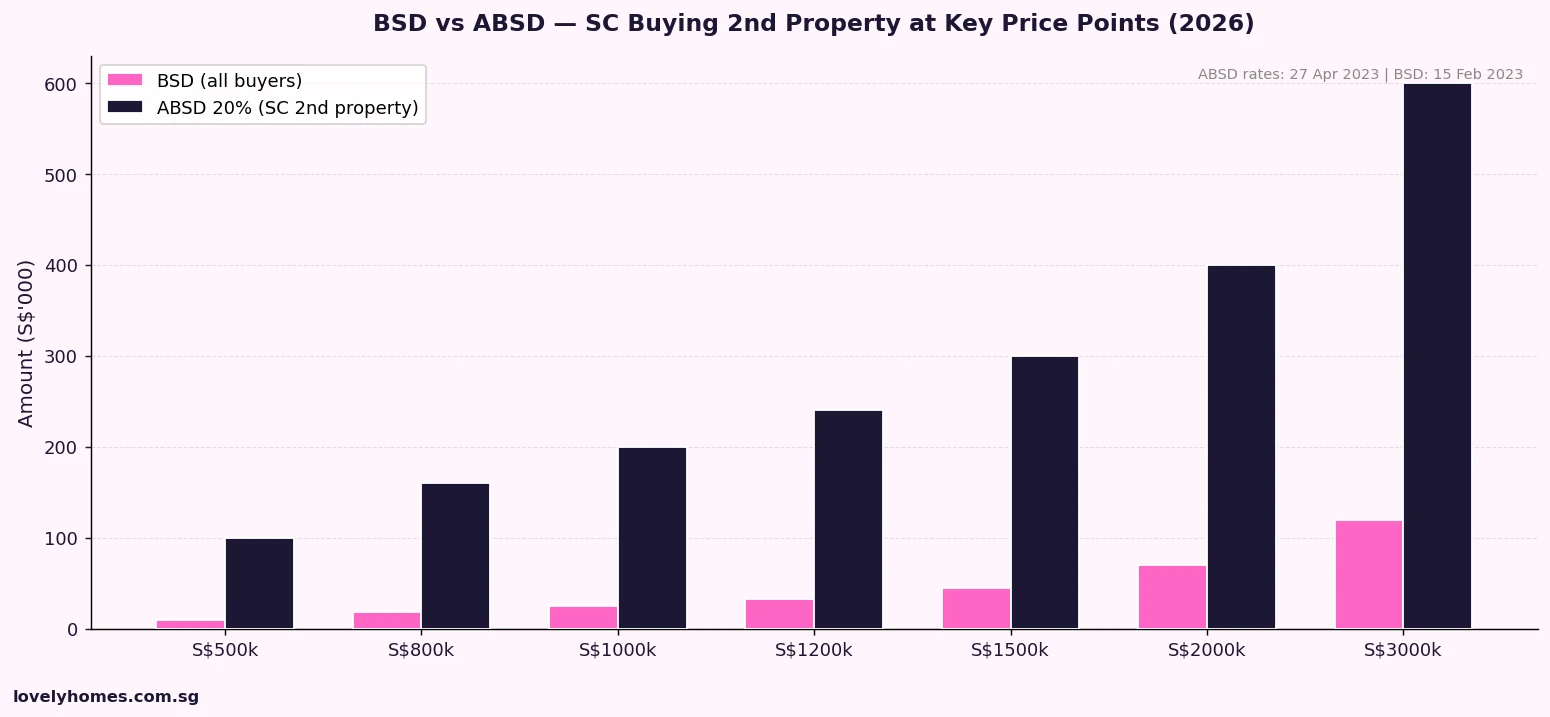
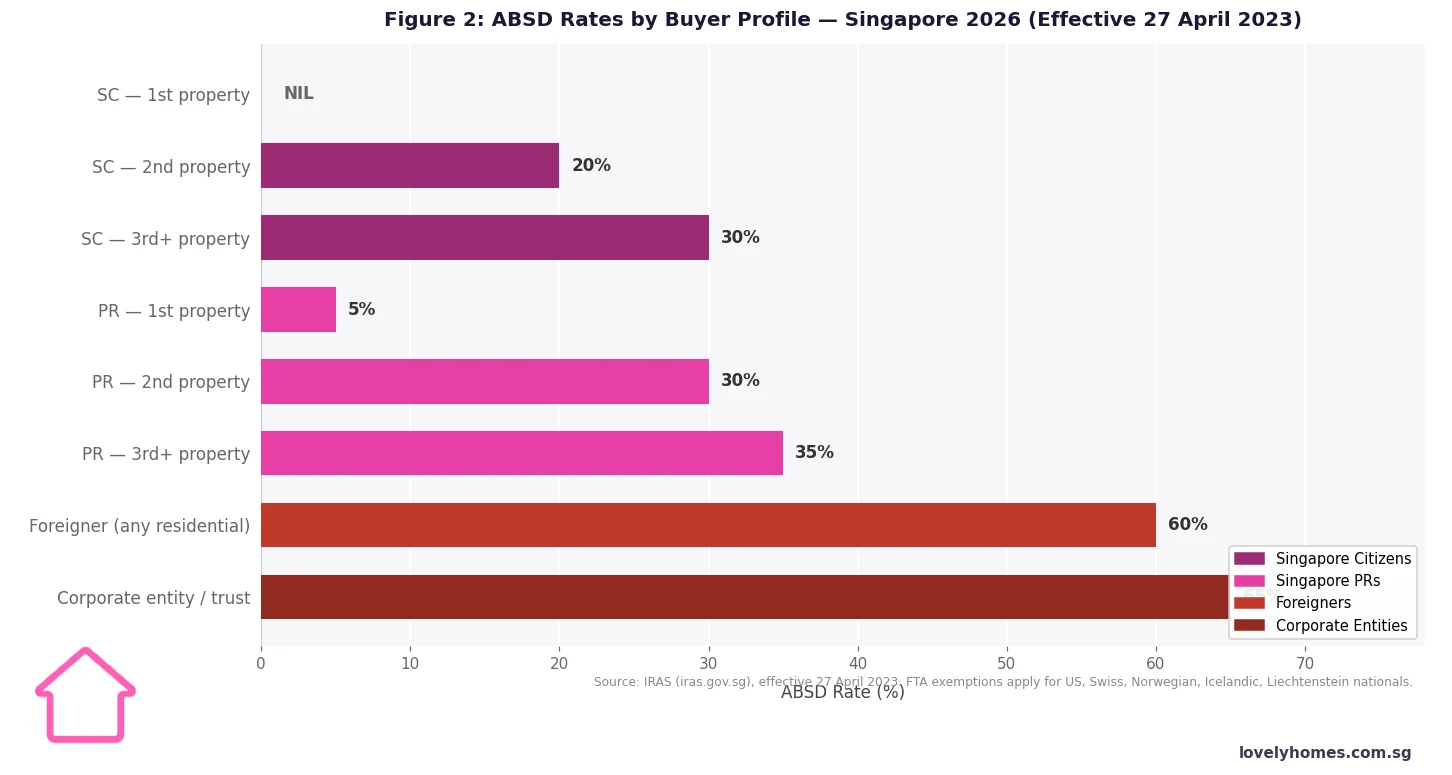
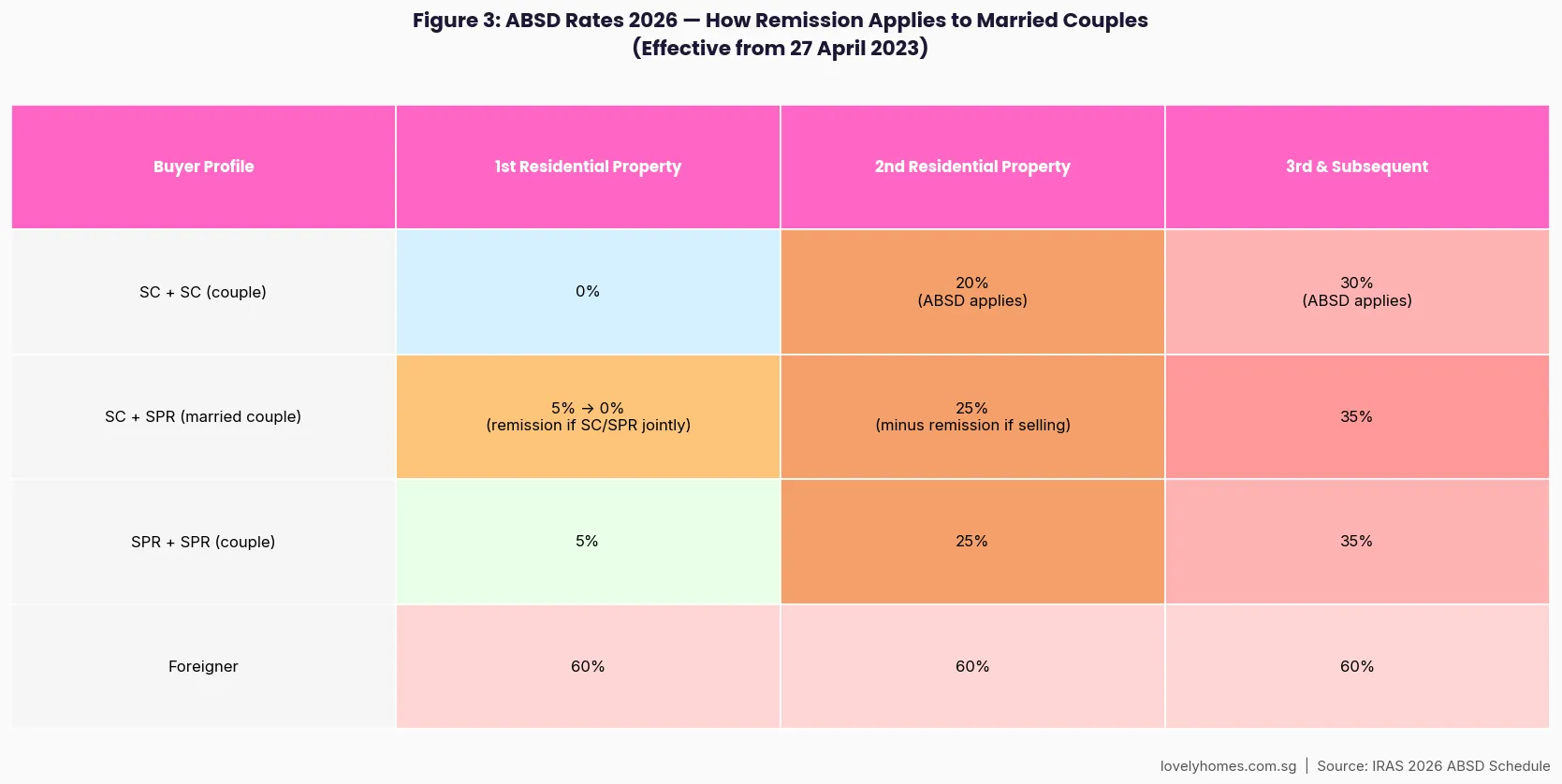
As at 2026, ABSD rates for Singapore Citizens range from 0% on a first property to 20% on a second and 30% on a third or subsequent residential property. Singapore Permanent Residents pay 5% on a first property and 30% on a second. Foreigners pay 60% on every purchase. Entities such as companies pay 65%.
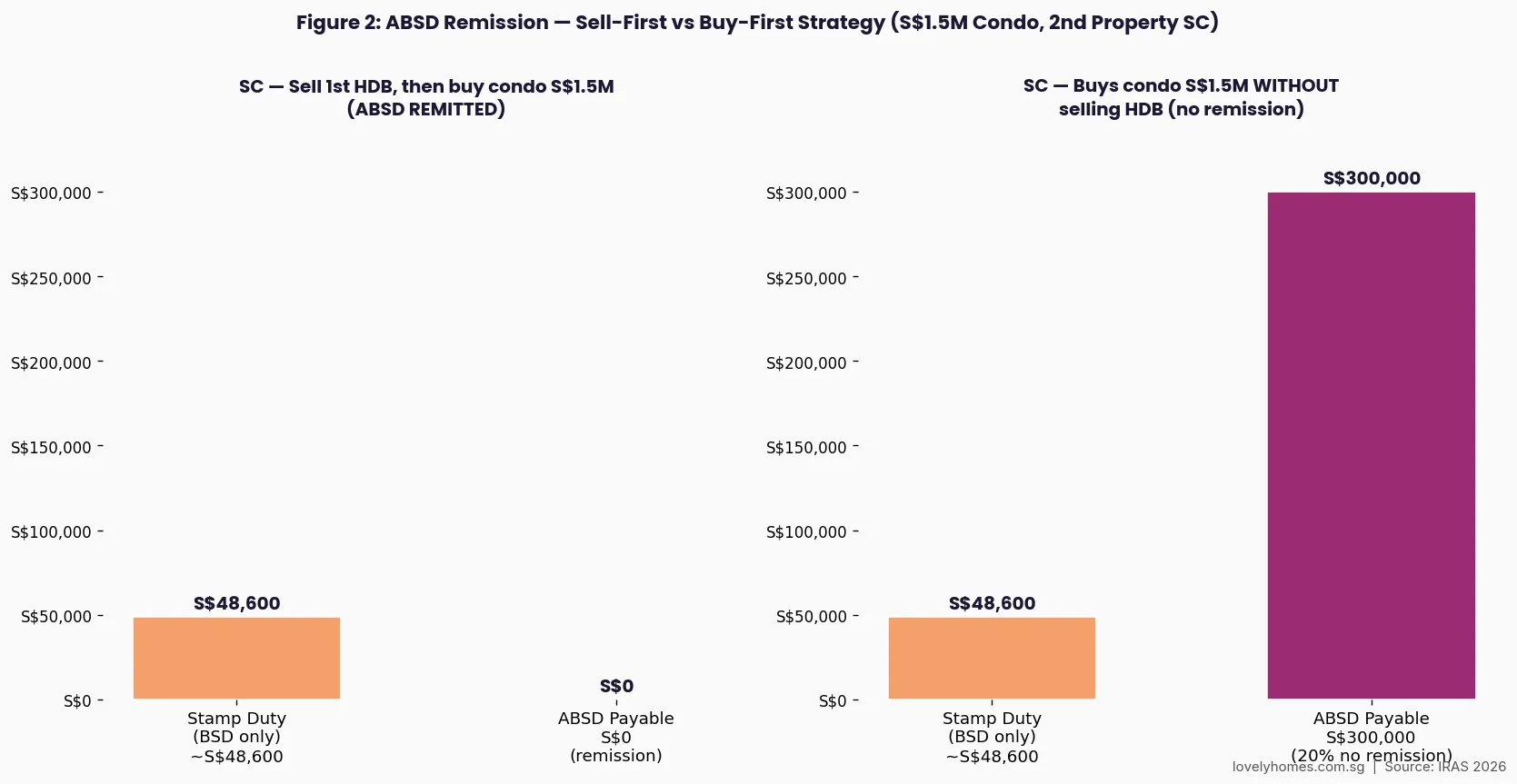
These rates were substantially raised in April 2023 as part of the government’s most recent round of property cooling measures. At those levels — S$300,000 ABSD on a S$1.5 million second-home purchase by a Singapore Citizen — the policy creates powerful behavioural incentives. Remission provisions exist to avoid penalising genuine situations such as married couples, housing developers acquiring land to build homes for sale, and executors administering estates. Understanding which remissions you qualify for, and how to claim them correctly, is one of the most valuable pieces of information any property buyer in Singapore can possess.

Remission Type 1: Married Couples Buying Their First Residential Property
This is the most commonly encountered ABSD remission in Singapore’s residential property market. The rules differ depending on the citizenship status of each spouse.
Both spouses are Singapore Citizens (SC + SC): The first residential property purchase by an SC couple is subject to 0% ABSD by default. There is no remission to claim — the rate schedule itself returns zero. Both spouses must not individually own any other residential property at the time of purchase. If one spouse already owns a residential property in their own name, the couple’s purchase is treated as a “second property” for the SC who owns one, and ABSD of 20% applies to the entire purchase price.
One spouse is an SC and the other is a Singapore Permanent Resident (SPR): The SPR-rate of 5% ordinarily applies to the first residential property purchased by an SPR. However, where the couple is legally married and both names appear on the purchase as joint buyers, IRAS provides a remission — the 5% ABSD paid upfront is refunded, resulting in a net 0% ABSD burden on the first property. The remission claim must be filed with IRAS, together with the marriage certificate and evidence that neither spouse owns any other residential property. The claim window is typically 6 months from the date of ABSD payment.
Both spouses are SPRs (SPR + SPR): There is no remission for an SPR couple buying their first property; the standard 5% ABSD applies and is not refundable.
Remission Type 2: The 6-Month Window for a Second Residential Property
This is arguably the most financially consequential ABSD remission in practice. It applies where a buyer — whether SC or SPR — already owns one residential property and wishes to purchase a replacement (i.e., upgrade or right-size) without being permanently saddled with the full 20% ABSD on the new purchase.
The mechanism works as follows. The buyer purchases the second property and pays ABSD upfront at the applicable rate (20% for SC, 30% for SPR). They then sell the first property within 6 months of the date of purchase (for a completed property) or within 6 months of the date the Temporary Occupation Permit (TOP) is issued (for an uncompleted unit). Once the disposal of the first property is registered, IRAS refunds the ABSD paid on the second property — subject to a successful remission claim.
This window is strictly enforced. A sale that completes even one day outside the 6-month window forfeits the entire remission. Buyers who rely on this strategy must plan carefully: factor in time to find a buyer, negotiate, and complete the conveyancing. In a slow market, the 6-month window may be uncomfortably short. A standard HDB resale transaction takes 8–14 weeks from Option to Purchase (OTP) grant to completion; a private property sale typically takes 10–12 weeks. Sellers should begin marketing the first property the moment the OTP for the new purchase is exercised.
Remission Type 3: Developer ABSD Remission
Housing developers in Singapore are required to pay ABSD when they purchase residential land for development. However, as a policy measure to encourage construction activity and housing supply, IRAS grants a remission of the developer ABSD — typically in the range of 25–35% of the purchase price — subject to conditions.
The primary condition is that the developer must complete the development and sell all residential units within a specified period. For sites acquired from the Government Land Sales (GLS) programme, the development must be completed and all units sold within 5 years of the date of the land purchase. For sites acquired through the open market (including en bloc sales), the timeframe is also 5 years. If the developer fails to sell all units within the window, ABSD plus 5% interest per annum becomes payable on the entire land price — a significant penalty that strongly incentivises developers to launch and sell quickly.
This is why new launches in Singapore are typically priced to sell: developers face a compounding ABSD penalty if they hold back units. Industrial-use developers face a lower 25% remission (versus up to 35% for residential developers) under a separate schedule.
Remission Type 4: SC Buying Jointly with Non-Resident Spouse
Where a Singapore Citizen is married to a foreigner (non-SPR, non-SC) and they jointly purchase a residential property, the foreigner rate of 60% ABSD would ordinarily apply to the foreigner spouse’s ownership interest. This creates a particularly punishing stamp duty burden on internationally married couples who wish to buy a home together in Singapore.
IRAS provides a remission in this specific scenario: if the property is their first jointly purchased residential property and neither spouse owns any other residential property in Singapore, the ABSD applicable to the foreigner spouse’s interest is remitted. The result is that the couple effectively pays ABSD at the SC rate for a first property — which is 0%. The claim process requires submission of marriage certificate, immigration documents, and a statutory declaration. Where the foreign spouse subsequently acquires citizenship or PR status, earlier remission claims are not affected.
Remission Type 5: Death of a Joint Owner
When a joint tenant dies, the surviving joint tenant automatically inherits the deceased’s share under the right of survivorship. No sale or transfer of property occurs in the legal sense — ownership vests by operation of law. IRAS acknowledges this by providing ABSD relief: the surviving joint owner is not treated as having “purchased” the share they inherit. Accordingly, no ABSD is levied on the survivor’s acquisition of the deceased’s interest through right of survivorship.
However, this relief does not extend to tenancy-in-common arrangements. Under tenancy-in-common, each owner holds a discrete, defined share of the property. On death, that share passes under the will or intestacy rules — which involves a transfer or transmission of an identifiable share. IRAS may levy ABSD on the recipient of a tenancy-in-common share if it causes them to own more than one residential property. Estate planning for property owners should account for this distinction; legal advice from a Singapore-qualified conveyancing lawyer is essential.
Remission Type 6: Trustee and Executor Remissions
Where a person holds residential property as a trustee for another (as is common in family trusts and estate planning structures), IRAS has provisions to avoid double-counting the trustee’s ownership interest when determining ABSD liability. Similarly, executors dealing with a deceased estate are generally not treated as personally owning the estate’s properties while administering them. The specific conditions and filing requirements for trust and executor remissions are fact-specific and should be confirmed directly with IRAS or a qualified property lawyer.
Summary Table: ABSD Remission at a Glance (2026)
| Remission Type | Who Qualifies | Condition | Amount Remitted |
|---|---|---|---|
| First property — SC + SPR couple | SC + SPR married, both first property | No other residential property held | 5% (full remission to 0%) |
| First property — SC + Foreigner couple | SC + foreign spouse, both first property | No other residential property held | 60% on foreign spouse’s interest |
| 6-month sell-first window | SC/SPR owning 1 property, buying replacement | Dispose of 1st property within 6 months | Full ABSD refund on 2nd purchase |
| Developer ABSD remission | Licensed housing developer | Complete + sell all units within 5 years | Up to 35% ABSD waived on land |
| Death of joint tenant | Surviving joint tenant | Right of survivorship vests | No ABSD on inherited share |
| Trustee/executor | Property trustees and estate executors | IRAS approval required | Case-by-case relief |
Worked Example: The 6-Month Remission Strategy in Practice
📋 Case Study: Mr & Mrs Tan — Upgrading from HDB to Condo
Profile: SC + SC married couple. Combined monthly income S$14,000. Mr Tan owns a 4-room HDB flat in Bishan, purchased 10 years ago at S$380,000 (fully paid, current market value ~S$650,000). They have fulfilled the 5-year Minimum Occupation Period (MOP).
New purchase: 2-bedroom condo in D20 Ang Mo Kio, price S$1,420,000.
Stamp duty without remission:
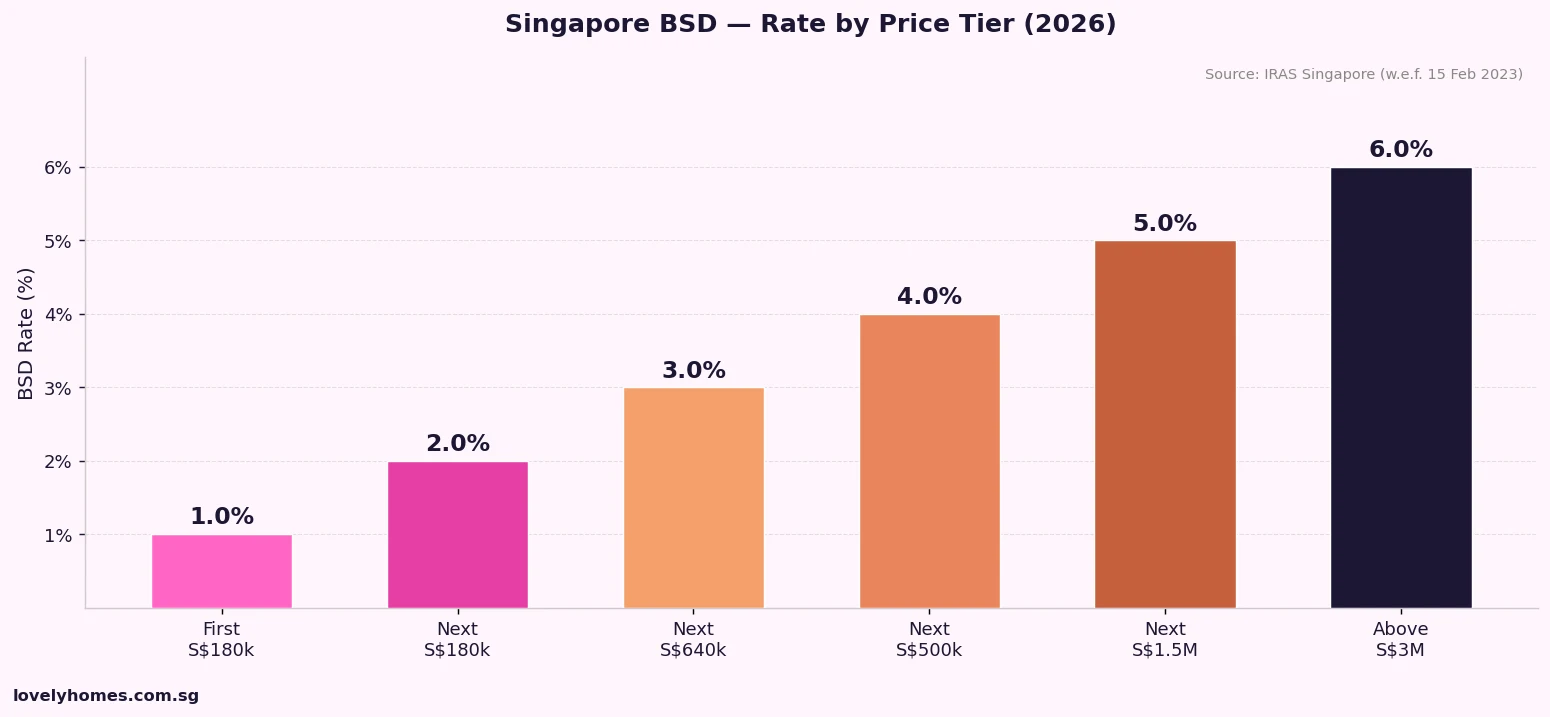
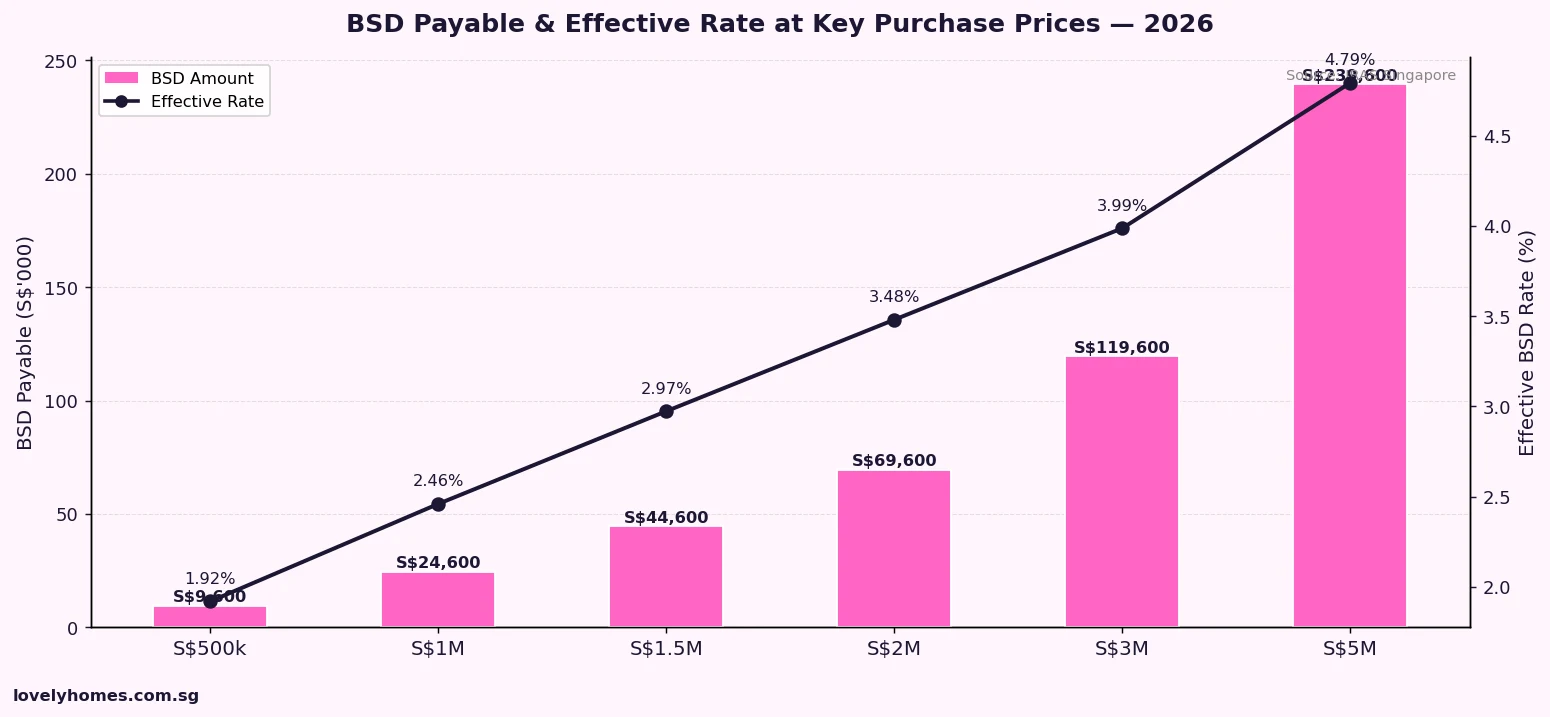
BSD: S$39,400 (standard — payable regardless)
ABSD (20% on 2nd property SC): S$284,000
Total stamp duty: S$323,400
Strategy — sell first, buy second: Mr Tan signs OTP for the condo on 1 August 2026. The 6-month window opens. He launches HDB resale exercise immediately, grants HDB OTP on 15 August 2026, and the HDB sale completes on 10 October 2026 — within the 6-month window. ABSD remission claim is filed with IRAS.
Outcome with remission:
BSD: S$39,400 (payable — no remission on BSD)
ABSD: S$0 (S$284,000 refunded by IRAS on successful claim)
Net stamp duty: S$39,400
Saving: S$284,000 in cash.
Note: Mr Tan must fund S$284,000 ABSD upfront at completion of the condo purchase and await refund after the HDB sale. Bridge financing or ensuring sufficient liquidity for the interim period is critical. The remission refund is typically processed by IRAS within 3–4 months of claim submission.
Why This Matters: ABSD Remission as a Cornerstone of Singapore Property Strategy
At S$284,000 on a S$1.42 million property, the difference between qualifying for the 6-month remission and missing the deadline by a single day is greater than many Singaporeans’ annual salary. No other single decision in the property purchase process — not negotiating the purchase price, not choosing the right mortgage rate — carries this magnitude of financial consequence.
ABSD remissions are therefore not simply a technical footnote to Singapore’s stamp duty framework. They are a central pillar of property planning strategy, particularly for the very large segment of HDB upgraders who constitute Singapore’s most active private property buyers. Every conveyancing lawyer in Singapore will walk clients through remission options; every financial planner working with property clients should understand the 6-month rule intimately.
By comparison, peers such as Hong Kong and Australia levy stamp duties on property purchases without equivalent remission provisions for married couples or trading-up scenarios. Singapore’s remission framework is a deliberate policy choice: it preserves the cooling effect of high ABSD rates on speculative demand while protecting genuine upgraders and owner-occupiers from punitive costs.
What Might Come Next: ABSD Policy Outlook
(This section represents editorial analysis and speculation — not IRAS or government guidance.)
Singapore’s ABSD rates have been raised five times since 2011. The April 2023 round — which doubled the SC second-property rate from 17% to 20% and raised foreigner ABSD from 30% to 60% — was the most aggressive. With the URA Q2 2026 private residential property price index showing a softening pace of growth (+0.5% QoQ versus +0.9% in Q1 2026), some market observers are beginning to speculate whether a partial relaxation of the foreigners’ 60% rate could be used as a catalyst to attract ultra-high-net-worth buyers if market conditions soften materially. The government has historically been cautious about signalling such relaxations prematurely, as the announcement effect can itself stimulate demand.
For remissions specifically, the 6-month window has been in place since 2013 and has survived multiple ABSD rate revisions. Its continued existence reflects the government’s view that genuine owner-occupier upgrading is a socially desirable activity. Any future tightening would most likely come through rate adjustments rather than removal of the remission mechanism itself.
Frequently Asked Questions
Can I claim the 6-month ABSD remission if I am buying an uncompleted new launch?
Yes, but the 6-month window for an uncompleted purchase runs from the date of issue of the Temporary Occupation Permit (TOP), not from the date you sign the Option to Purchase (OTP) or the Sale and Purchase Agreement (S&P). This means you may have several years between signing the S&P and the start of your 6-month window, giving you ample time to sell your existing property. However, you must still pay the ABSD upfront at completion of the new purchase and claim the refund after the existing property is sold. Confirm the expected TOP date with the developer before committing to this strategy.
What happens if I fail to sell my first property within 6 months?
The ABSD remission is forfeited entirely. IRAS does not grant extensions or partial remissions for late disposals. In practice, this means you permanently bear the full ABSD cost on the second property. If the 6-month deadline is at serious risk — for example, due to an unsuccessful resale attempt — some buyers resort to transferring the first property to a family member. However, this may itself trigger ABSD and additional buyer’s stamp duty on the transferee, and must be evaluated carefully with legal and tax advisers before taking action.
My spouse is a foreigner. Can we buy our first home together in Singapore and claim ABSD remission?
Yes, provided you are legally married (Singapore-registered marriage or a foreign marriage registered with the Registry of Marriages or Civil Marriages in Singapore), neither of you owns any other residential property in Singapore, and the property is intended as your primary family residence. The 60% foreigner ABSD applicable to your spouse’s interest is remitted, resulting in an effective ABSD rate of 0% on the purchase. You must file the remission claim with IRAS and submit supporting documents including the marriage certificate, declarations of no other residential property ownership, and your spouse’s immigration documents.
Does ABSD remission apply to HDB flats, or only private property?
ABSD does not apply to the purchase of a new HDB flat directly from HDB — HDB sales are exempt from ABSD regardless of the buyer’s profile. ABSD applies to resale HDB transactions and all private residential purchases. So if you are buying a resale HDB flat as a second property (having already sold your first), ABSD would ordinarily apply; the 6-month remission would apply if you had sold your first property within the qualifying window. In practice, most Singapore Citizen HDB resale buyers purchasing as a second property structure the sale-and-buy sequence to avoid ABSD entirely — the remission framework is essential to making this work.
How long does IRAS take to process an ABSD remission refund?
IRAS targets processing ABSD remission refund claims within 3 to 4 months of a complete claim submission. The process requires you to file IRAS Form SD-ABSD-REM (or the equivalent digital filing through myTax Portal) and attach all supporting documents — including the conveyancing documents for both the purchase and the disposal, proof of marriage (where applicable), and statutory declarations. Incomplete submissions will delay processing. If your remission claim involves a complex scenario — such as a trust or an estate — allow for up to 6 months. IRAS will not pay interest on delayed refunds, so accuracy and completeness at the time of initial filing are important.
Can I avoid ABSD entirely if I decouple ownership before buying a second property?
Decoupling — where one spouse transfers their share of a jointly owned property to the other, so that one spouse holds the property solely and the other is “freed up” to buy a new property as a first-time buyer — was a popular strategy before the April 2023 ABSD hikes. It remains technically legal, but the transferring spouse’s share will attract ABSD at the rate applicable to the receiving spouse (who is acquiring an additional ownership interest). Whether decoupling makes financial sense now depends on the current valuation of the existing property, the ABSD rate applicable, the legal costs of transfer, and the price of the intended second property. Detailed worked-number analysis with a qualified property lawyer is strongly recommended before proceeding.
Is ABSD remission the same as ABSD waiver?
Not precisely. A “remission” technically means the ABSD is paid upfront and then refunded upon meeting conditions — as in the 6-month sell-first window. A “concession” or “exemption” means the ABSD is not charged in the first place, as with the SC couple buying their first property at 0%. The practical difference matters for cash flow: under the remission mechanism, buyers must have sufficient liquidity to pay the full ABSD at completion and hold those funds in limbo until the refund arrives. Where ABSD quantum is S$200,000 or more, this creates a real bridging finance consideration. Discuss with your banker whether a bridging loan facility is available to cover the ABSD pending the remission refund.
Click anywhere to close