

QUICK ANSWER
Renting a home in Singapore usually takes 3–4 weeks. Budget roughly 3–4 months’ rent in cash upfront (first month + 1–2 months’ security + stamp duty + any agent fee), sign a tenancy agreement within 14 days of the LOI, and stamp it within 14 days of signing. At exit, expect your security deposit back within 14–30 days of a clean handover.
Whether you’re a local family bridging between homes, a PR upgrader, or an expatriate signing your first Singapore lease, the rental process runs on the same five-step rails. The rules are not complicated, but the upfront money moves fast and the deposit mechanics catch people out at exit. This tenant guide walks you through the full journey, the contract clauses that matter, and how to get every dollar of your security deposit back.
If you’re letting out a property instead, read our companion landlord’s guide to HDB and condo rentals.
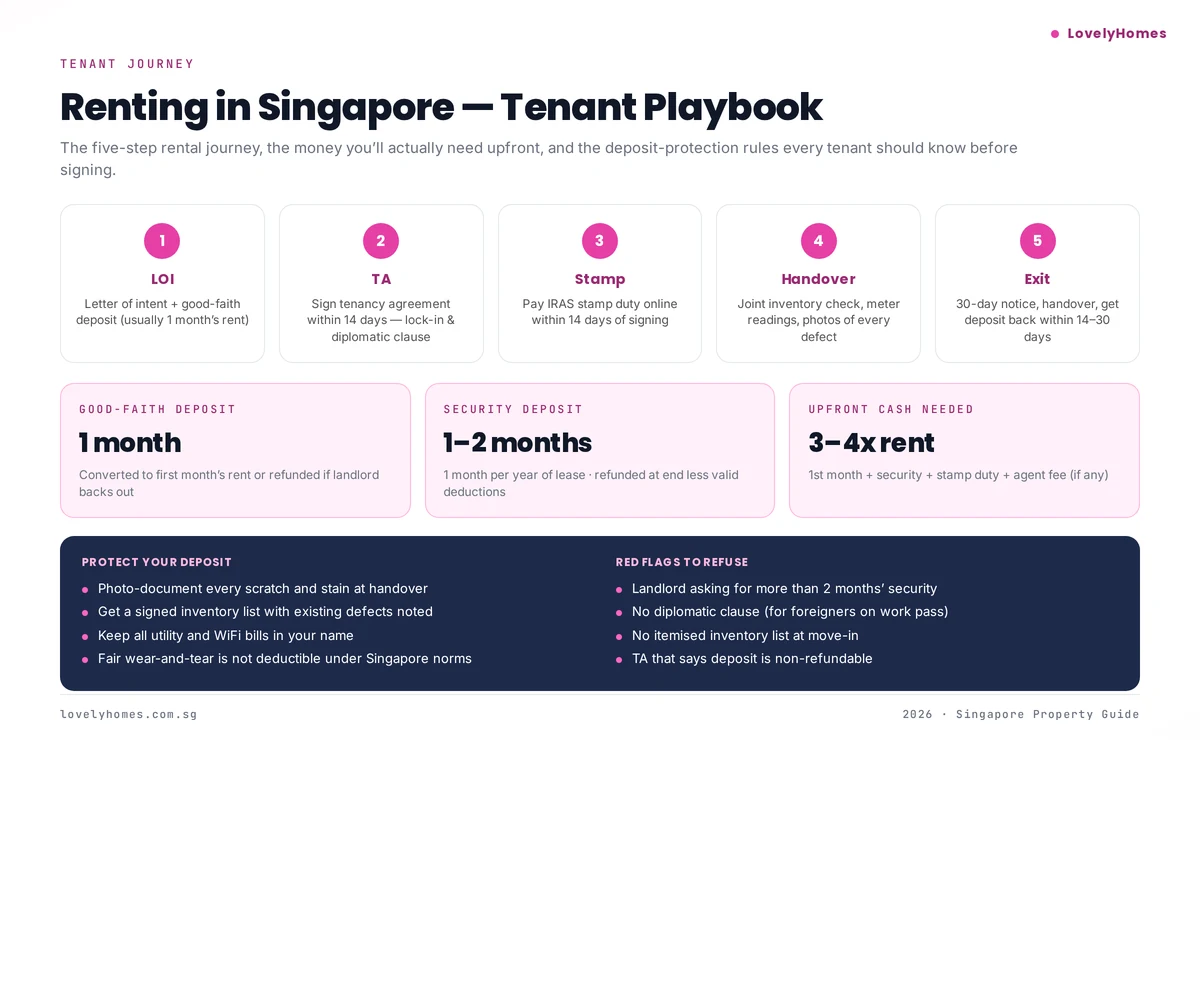
Step 1: Letter of Intent (LOI) + good-faith deposit
Once you’ve viewed a property and agreed to rent it, you (or your agent) sends the landlord a Letter of Intent. The LOI sets out the rent, tenancy length, lock-in period, diplomatic clause (for foreigners on work pass), inclusions (aircon servicing, white goods, furniture), and any special requests (painting, pest treatment, replacing faulty items).
You pay a good-faith deposit equal to one month’s rent when the LOI is signed. This is converted to the first month’s rent when the TA is signed. If the landlord backs out, you get it refunded; if you back out, you forfeit it.
Step 2: Tenancy Agreement (TA)
Within 14 days of the LOI, the landlord’s lawyer or agent drafts the Tenancy Agreement. Read it carefully before signing. The clauses that matter most:
- Security deposit: Market norm is 1 month per year of lease, capped at 2 months. Refuse anything higher.
- Diplomatic clause: Lets a foreign tenant break the lease if their work pass is revoked or they’re transferred overseas, usually after a 12-month minimum stay and with 2 months’ notice.
- Minor repair threshold: Repairs below S$150–200 are usually the tenant’s responsibility; above that, it’s the landlord’s. Make sure this threshold is explicit.
- Lock-in period: The period during which neither party can terminate. Usually the full lease term for fixed leases, or 12 months of a 24-month lease.
- Subletting: Almost always prohibited without written consent. Don’t list the unit on Airbnb.
Step 3: Stamp duty (within 14 days)
The tenancy agreement must be stamped with IRAS within 14 days of signing in Singapore (30 days if signed overseas). The duty is 0.4% of the average annual rent for leases up to 4 years. For most Singapore TAs, the tenant pays — check the TA. File via the IRAS e-Stamping portal. The full formula with worked examples is in our rental stamp duty guide.
Step 4: Handover and inventory check
On move-in day, do a joint inspection with the landlord or agent. This is the single most important step for protecting your deposit at exit:
- Photograph every existing scratch, stain, chip, and mark in every room.
- Note the condition of all appliances — test the aircon, oven, hob, washing machine, dryer, fridge.
- Take meter readings for electricity, water, and gas.
- Sign the inventory list — don’t leave any item unticked.
- Keep digital copies of everything, dated.
Step 5: Exit and deposit return
Give 30 days’ written notice before lease expiry (check your TA — sometimes 60 days). Do a joint handover check on your last day. If the landlord flags damage beyond fair wear-and-tear, negotiate from your move-in photos. The deposit must be returned within 14–30 days of the final handover per standard Singapore TAs.
Your upfront money — how much cash do you actually need?
| Item | Amount | Timing |
|---|---|---|
| Good-faith deposit (becomes 1st month rent) | 1 month rent | At LOI |
| Security deposit | 1–2 months rent | At TA signing |
| Stamp duty (tenant pays per TA) | 0.4% of AAR | Within 14 days of TA |
| Agent fee (if you engaged your own agent) | 0.5–1 month + GST | At TA signing |
A S$3,800/month condo with a 2-year lease typically needs roughly S$12,500–S$13,500 in cash at the start — be ready before you start viewing.
Getting your deposit back in full
Three rules of thumb:
- Professionally clean before handover. S$250–S$450 for a 3-bedder is standard — deducted from deposit if you skip it.
- Serve aircon units. Under most TAs, the tenant must service aircon at least once every 3 months and produce receipts at handover.
- Minor wall-fill and touch-up paint. Hole from a TV mount or picture hook? Patch it before inspection.
Frequently asked questions
Can the landlord refuse to return my deposit?
Only for documented breaches (unpaid rent, damage beyond wear-and-tear, unpaid utilities). They must itemise deductions in writing. Disputes above S$20,000 go to the Small Claims Tribunals or civil court; the stamped TA is your main evidence.
What counts as fair wear-and-tear?
Minor scuff marks, slight carpet flattening, faded paint from sunlight, light furniture indents on floors. What’s not fair: burn marks, broken fittings, unapproved modifications, pet damage (unless pets were allowed in the TA).
Do I need a property agent as a tenant?
Not mandatory, but agents help with contract negotiation, market rent benchmarking, and dispute handling. If both parties have their own agents, each pays their own. Using the landlord’s agent (“co-broke”) is free for you but they represent the landlord.
Disclaimer
This guide is for general information only. Singapore’s rental rules, HDB policies, and IRAS stamp duty rates change periodically. Always verify against the HDB, URA and IRAS websites before signing a lease or filing with IRAS. LovelyHomes is not a licensed property agent or tax adviser. For personalised advice, please engage a registered CEA agent or a qualified tax professional.