Singapore Expat Property Buying Guide 2026: What Foreigners and PRs Need to Know
Quick Answer: Buying Property in Singapore as a Foreigner or PR (2026)
- Foreigners can freely buy private condominiums and apartments — HDB flats and new executive condominiums during their launch period are not permitted.
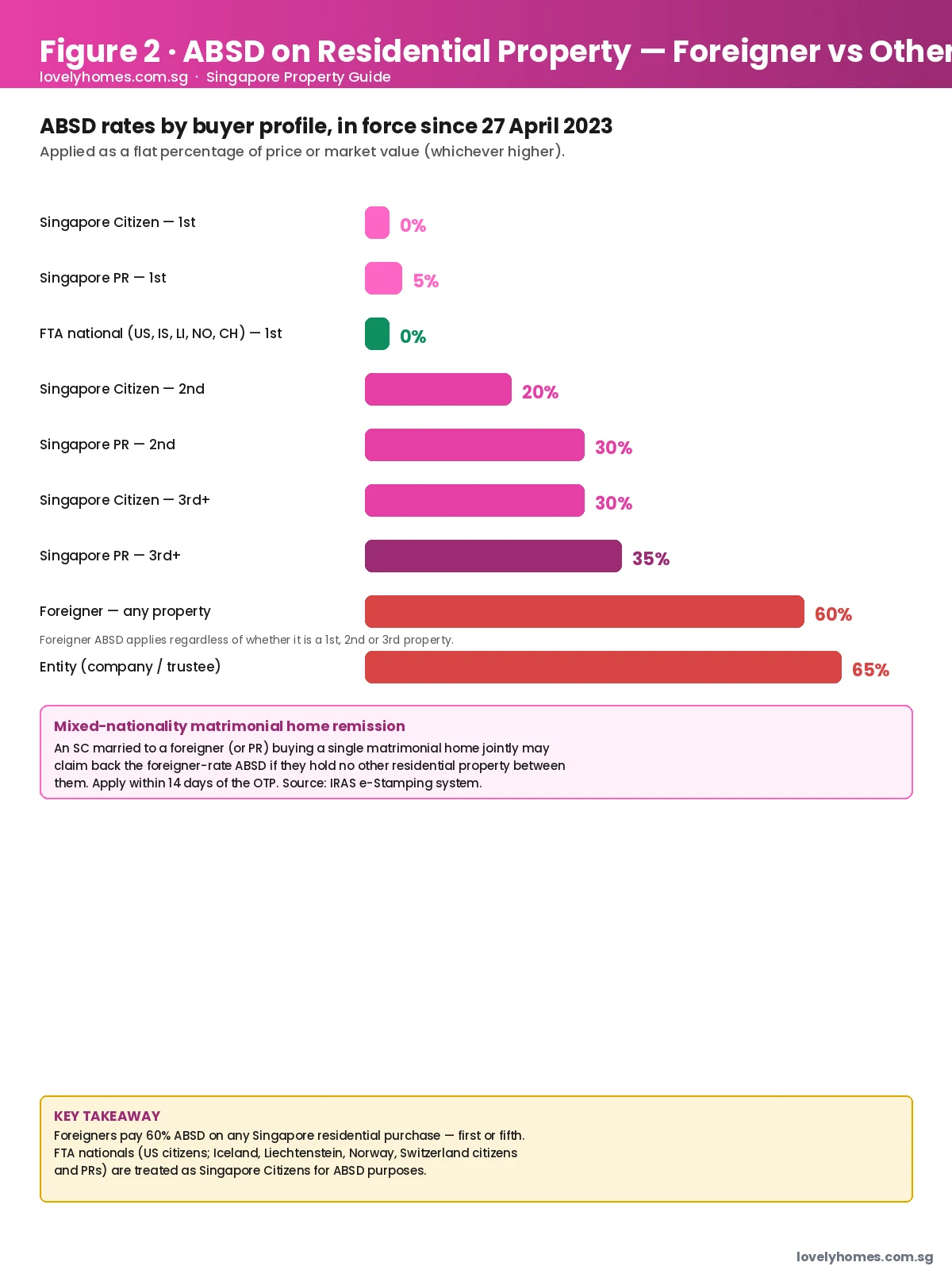
- Additional Buyer’s Stamp Duty (ABSD) for all foreign nationals: 60% (effective 27 April 2023), regardless of how many properties owned globally.
- Singapore Permanent Residents (PRs) pay 5% ABSD on a first property and 30% on a second — significantly lower than the foreign rate.
- Buyer’s Stamp Duty (BSD) applies to everyone: 1–6% in tiered bands on the purchase price.
- TDSR (Total Debt Servicing Ratio) cap of 55% applies to all buyers, citizen and foreign alike.
- Nationals of the USA, EU member states, Switzerland, Norway, Iceland and Liechtenstein receive SC-equivalent ABSD treatment under Free Trade Agreements — meaning 0% on a first property.
- A Singapore Citizen and foreign-national couple buying jointly pay SC rates, not foreign rates — a significant saving.
- On a S$1.8M RCR condo: a non-FTA foreigner pays S$59,600 BSD + S$1,080,000 ABSD. A US national with FTA remission pays only S$59,600 BSD.
Who This Guide Is For
Singapore’s property market attracts buyers from across the globe, drawn by the city-state’s political stability, strong rule of law, transparent title system administered by the Singapore Land Authority (SLA), and long track record of capital appreciation. This expat property buying guide Singapore 2026 is written for three audiences: foreign nationals (no Singapore citizenship or Permanent Residency) buying for personal occupation or investment; Singapore Permanent Residents weighing their first or subsequent purchase; and internationally mobile couples where one partner holds Singapore Citizenship and the other does not.
The rules differ meaningfully across these groups, and the financial consequences — particularly the Additional Buyer’s Stamp Duty — of getting the classification wrong are severe. This guide explains each rule clearly, with specific SGD figures, effective dates, and the government bodies that administer each requirement.
What Foreigners Can and Cannot Buy
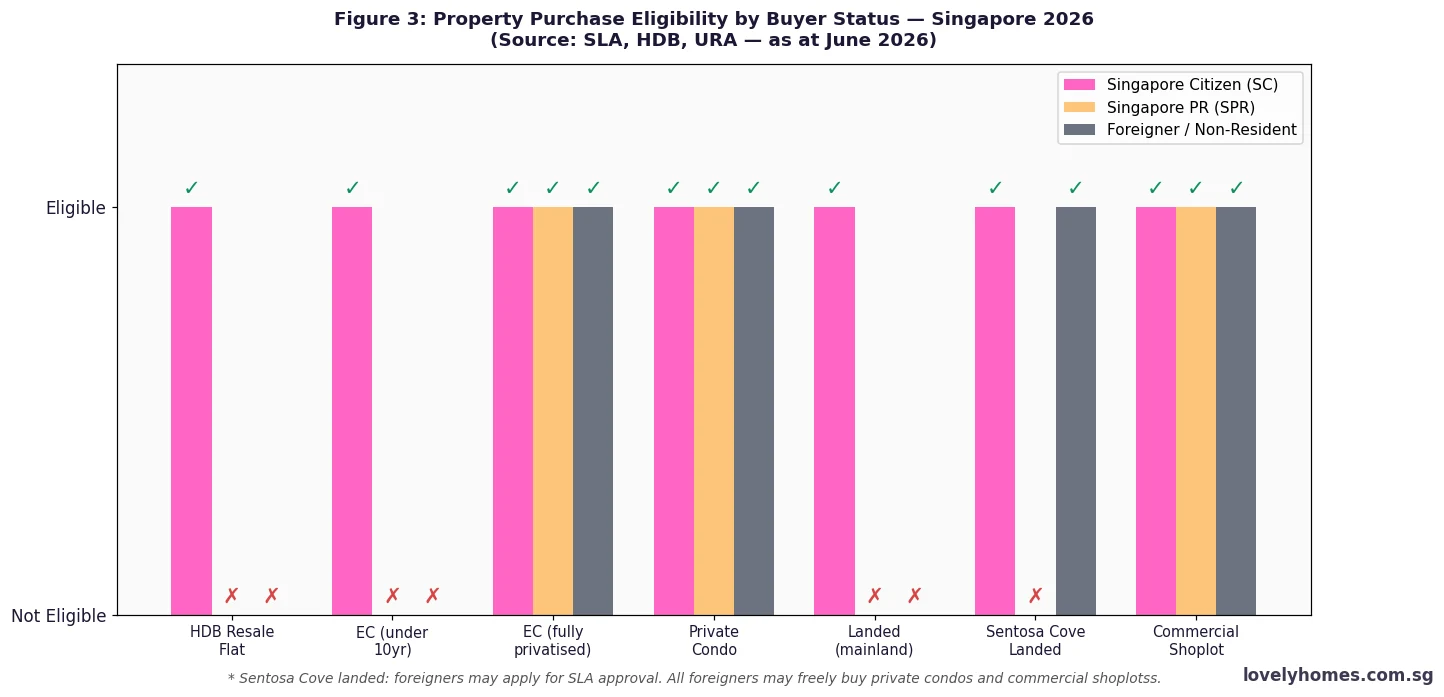
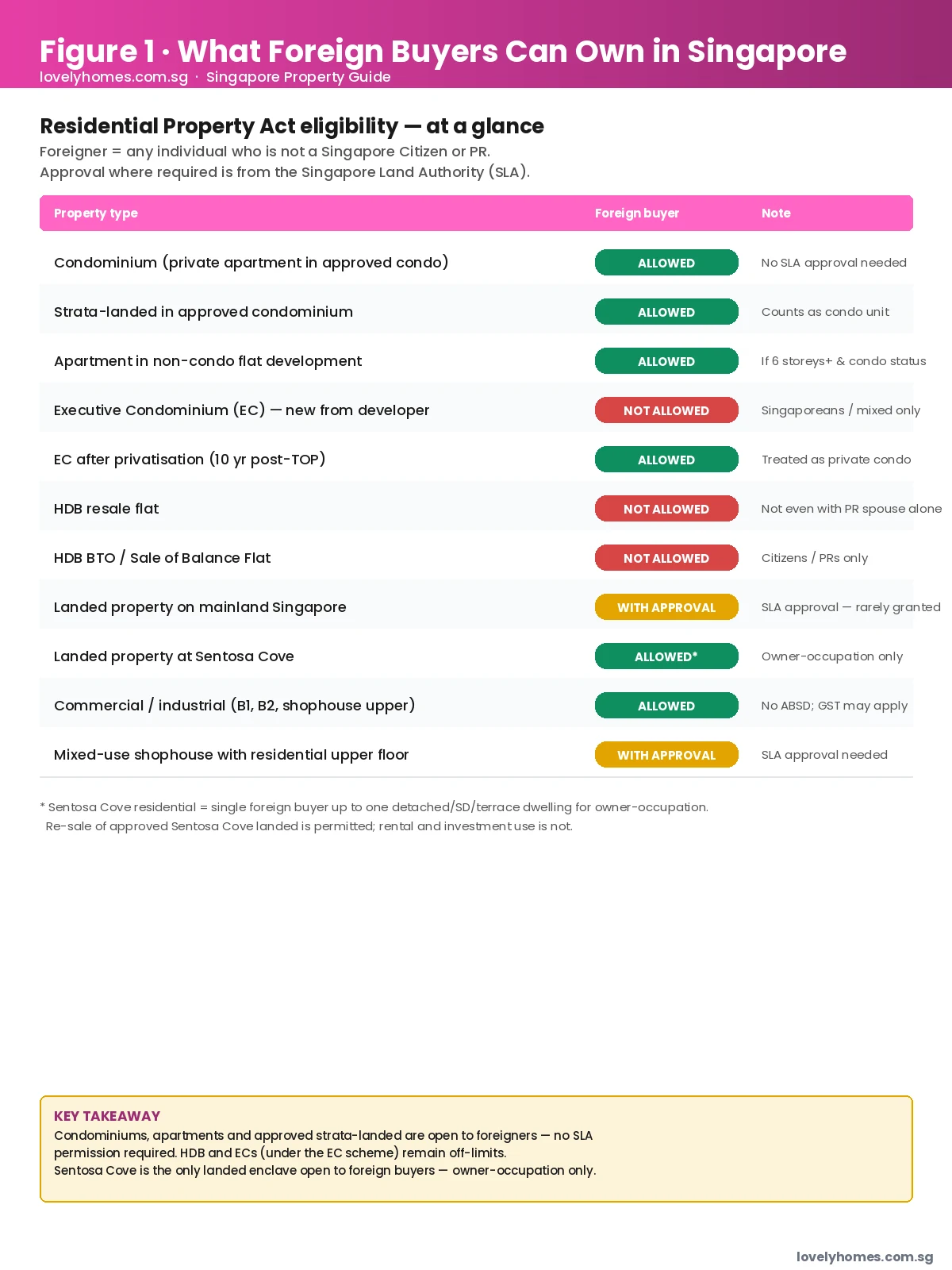
Under the Residential Property Act 1976 (Cap 274), a “foreigner” is any individual who is neither a Singapore Citizen nor a Permanent Resident. The Act restricts foreigners from owning certain types of residential property without approval from the SLA’s Land Dealings Unit (LDU). The practical landscape in 2026 is as follows:
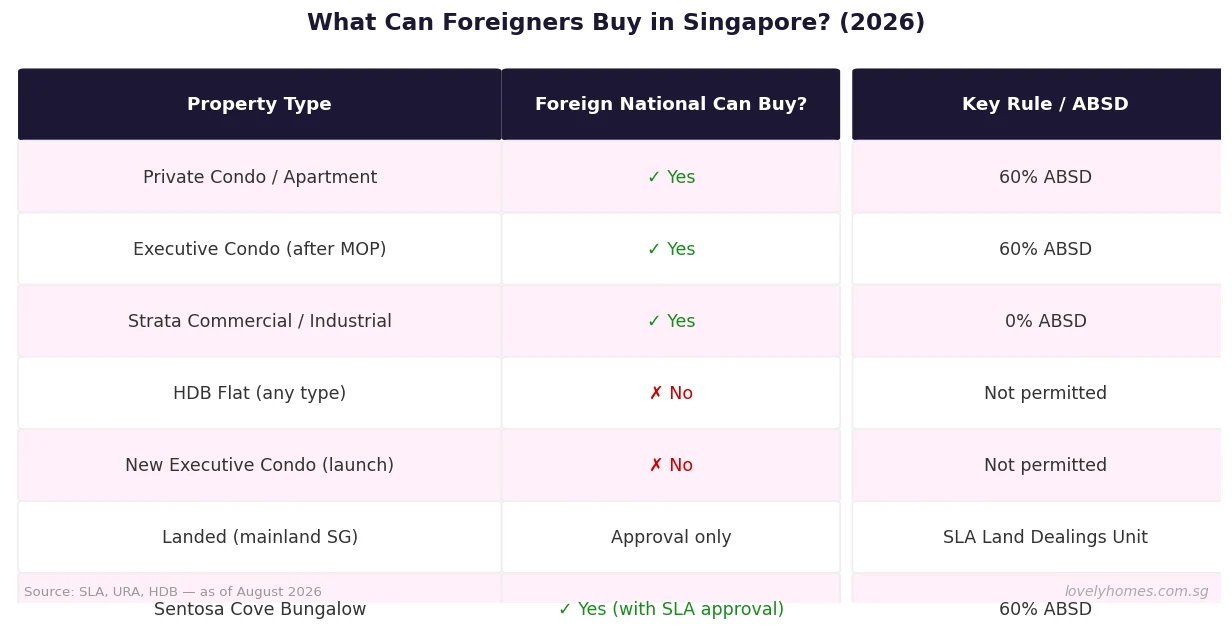
The key distinction is between strata-titled developments (floors or units within a multi-storey building) and landed residential property. Foreigners may freely purchase strata-titled private condominiums and apartments, including completed executive condominiums (ECs) that have passed their five-year Minimum Occupation Period (MOP). However, they cannot purchase HDB flats under any circumstances, and they cannot purchase new ECs during their initial launch and construction phases. Landed homes — terraced houses, semi-detached, bungalows on mainland Singapore — require individual SLA approval which is rarely granted, except in special circumstances such as exceptional economic contribution. Sentosa Cove is an exception: foreigners may purchase strata landed homes within Sentosa Cove subject to SLA approval, and the island’s bungalows are sold on leasehold titles specifically intended for the international market.
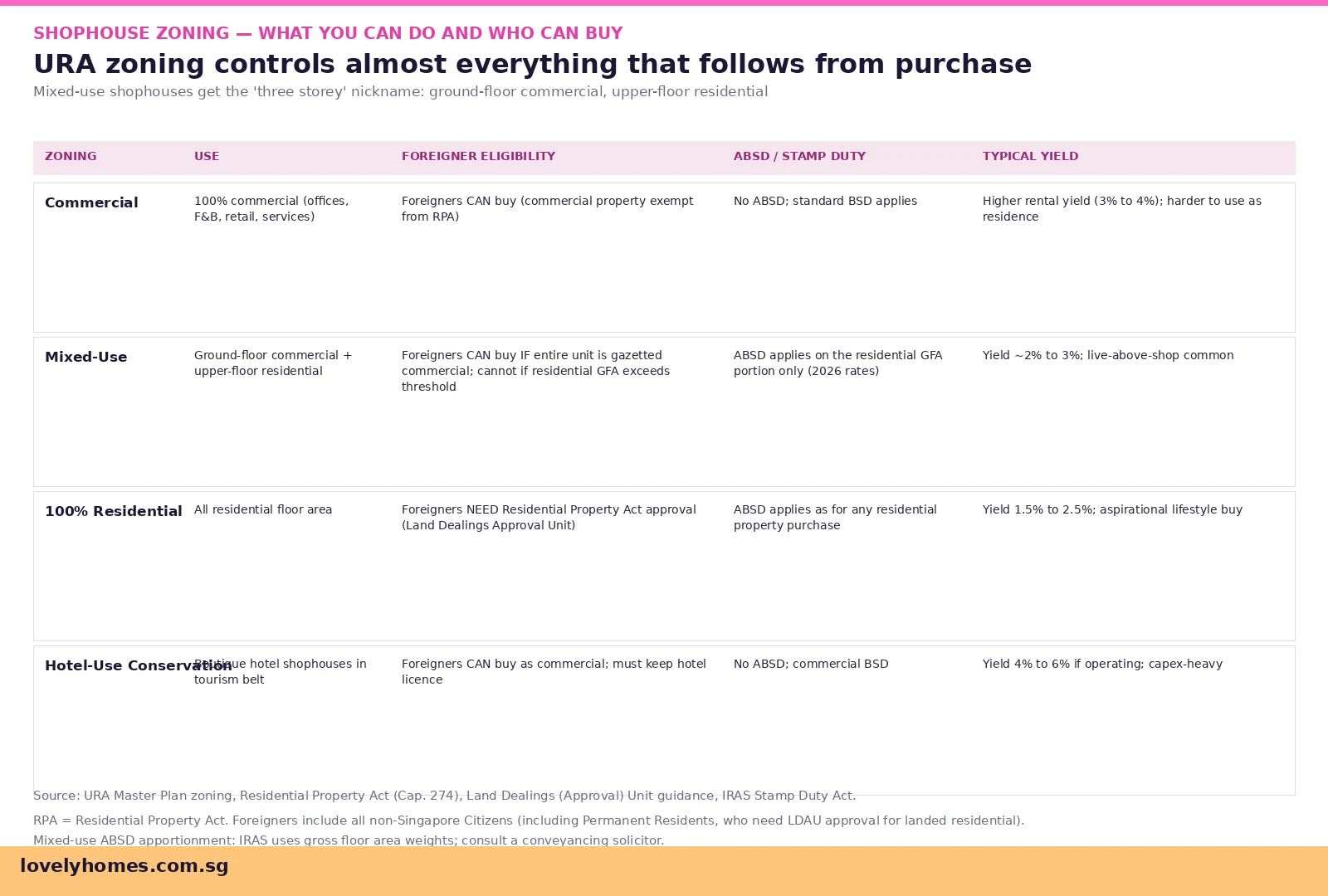
Strata commercial and industrial units (shophouses zoned commercial on all floors, office units, industrial strata units) carry no ABSD and no foreign ownership restrictions — making them an alternative avenue for those who want Singapore real estate exposure without the 60% ABSD burden.
ABSD Rates — The Defining Cost for Foreign Buyers
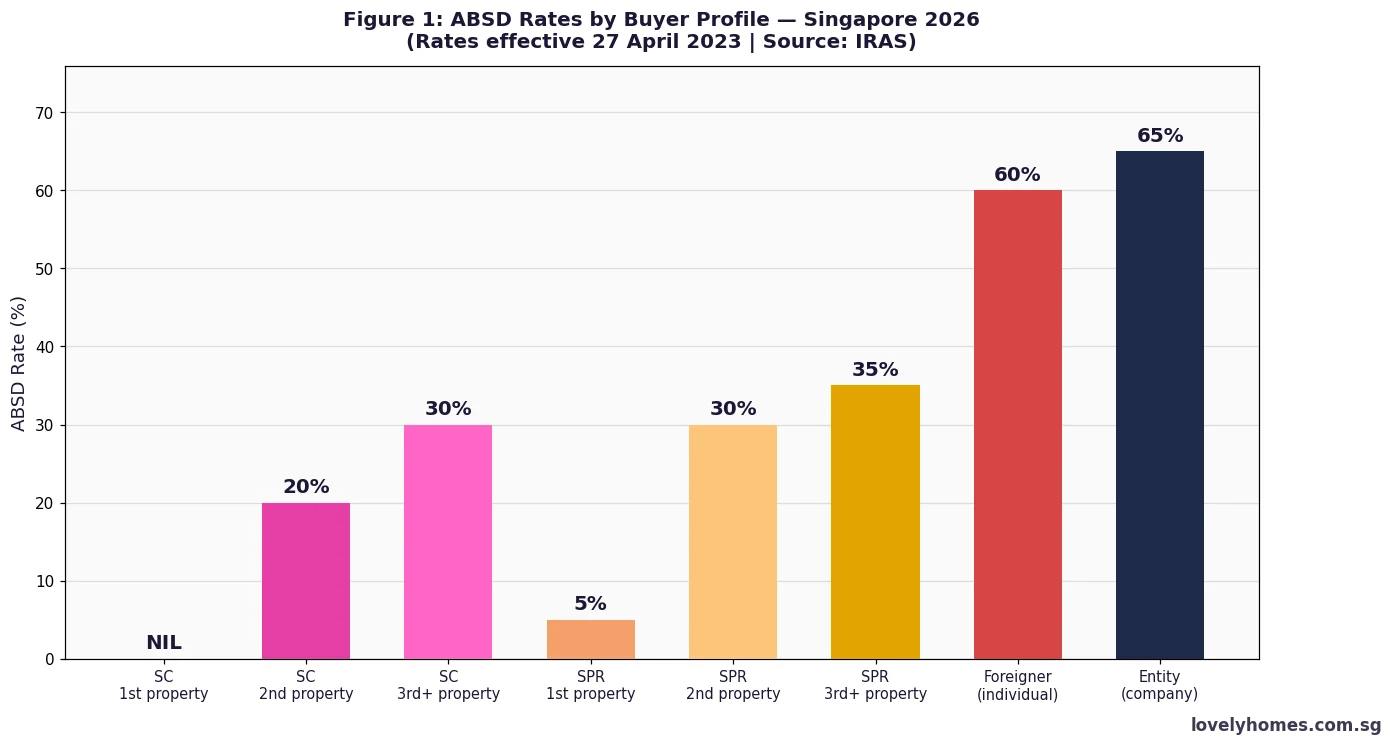
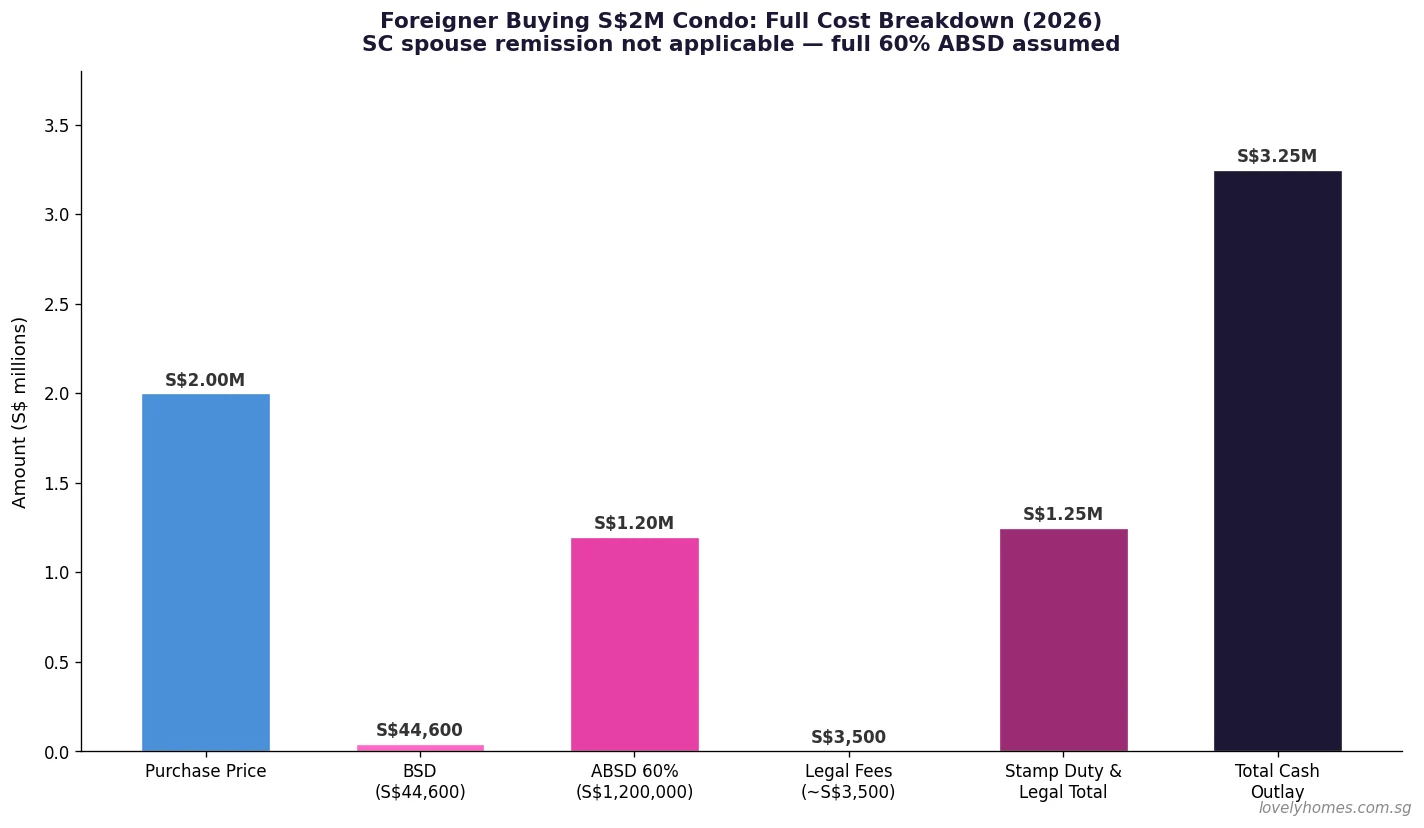
The Additional Buyer’s Stamp Duty, administered by the Inland Revenue Authority of Singapore (IRAS), is the single largest cost foreign buyers face. Since 27 April 2023, the rate for all foreign nationals — regardless of how many properties they hold globally — is 60% of the purchase price or market value, whichever is higher. For an entity or company, the rate rises to 65%.
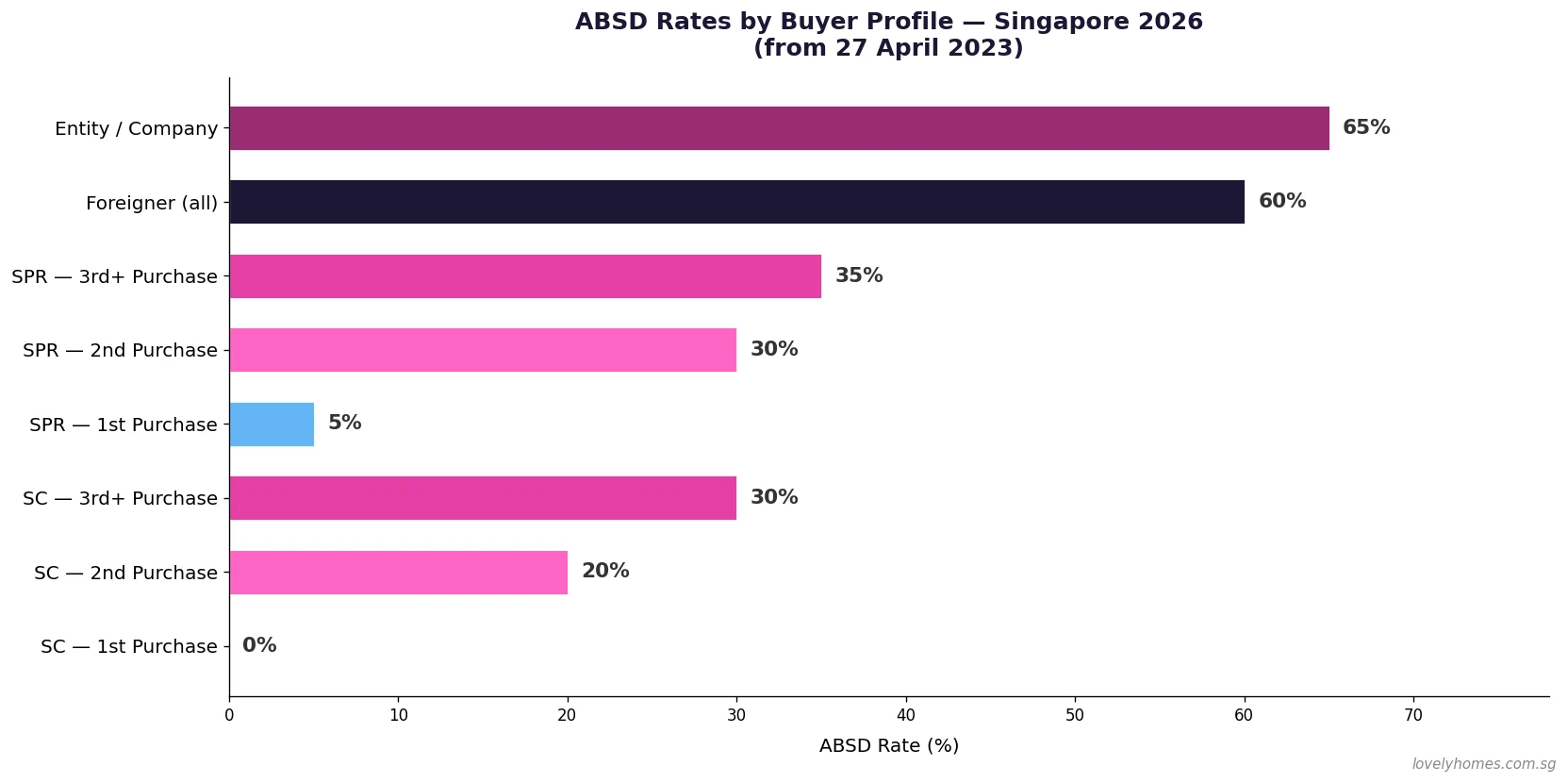
The 60% rate was introduced as part of the Government’s April 2023 cooling measures, more than doubling the previous 30% rate for foreign buyers. The government’s stated rationale was to prioritise Singapore residential property for citizens and PRs, and to dampen speculative foreign demand at a time when private residential prices had risen sharply since 2020. Singapore Citizens buying a first property pay 0% ABSD; a second property attracts 20% ABSD; third and subsequent properties attract 30%. PRs face 5% on a first property, 30% on a second, and 35% on third and subsequent. For a detailed breakdown of ABSD by buyer type, see our complete ABSD Singapore 2026 Guide.
FTA Remission — The Exception That Changes Everything
One of the least-known rules in Singapore’s stamp duty framework is the Free Trade Agreement (FTA) ABSD remission. Under bilateral trade agreements that Singapore has signed, nationals of certain countries are entitled to SC-equivalent ABSD treatment. In practice, this means 0% ABSD on a first residential property, 20% on a second, and 30% on a third — the same schedule that applies to Singapore Citizens. The qualifying nationalities as at August 2026 are:
| FTA | Qualifying Nationalities | ABSD Treatment |
|---|---|---|
| US–Singapore FTA (USSFTA) | United States nationals | SC-equivalent (0%/20%/30%) |
| EU–Singapore FTA (EUSFTA) | Nationals of all EU member states | SC-equivalent (0%/20%/30%) |
| EFTA–Singapore FTA | Swiss, Norwegian, Icelandic, Liechtenstein nationals | SC-equivalent (0%/20%/30%) |
This remission applies to natural persons only — not corporations, trusts, or investment vehicles. The individual must be a national of the qualifying country (passport holder), not merely a tax resident. The remission is claimed at the point of ABSD payment: the buyer’s lawyer lodges the appropriate IRAS declaration and the ABSD instrument reflects the remitted rate. If the buyer subsequently acquires additional Singapore properties, the graduated SC schedule applies (20% second, 30% third+), not the flat 60% foreign rate.
For buyers from these countries, Singapore’s market economics change dramatically. A US national buying a S$1.8M RCR condominium as their first property pays BSD of S$59,600 and zero ABSD — a total stamp duty liability of S$59,600. The same buyer without FTA protection would face S$1,080,000 in ABSD alone.
Singapore Permanent Residents — A Middle Path
SPRs occupy a privileged middle ground. A PR who buys their first residential property in Singapore pays 5% ABSD — far below the 60% foreign rate. The 5% applies even if the PR owns multiple properties abroad; only Singapore properties count for determining whether a purchase is a “first” or “second” property under the ABSD rules. On a second Singapore property, the PR pays 30% ABSD, and 35% on a third and beyond.
An important nuance: if a PR and a Singapore Citizen are buying a property jointly as co-owners, the applicable ABSD rate is the lower of the rates that would apply if either party were buying alone. Since a SC buying a first property pays 0% ABSD, a SC–PR couple buying their first home together pays 0% ABSD — not 5%. However, if one party already owns property, the ABSD rate is calculated based on the total number of residential properties owned by either party combined. The rules are applied conservatively and buyers should confirm their position with a conveyancing lawyer or IRAS’s stamp duty helpline before exercising any Option to Purchase (OTP).
PRs who later obtain Singapore Citizenship do not receive a retrospective ABSD refund. The citizenship date applies from that point forward for ABSD counting purposes.
Buyer’s Stamp Duty — What Everyone Pays
BSD, also administered by IRAS, is payable by all buyers of Singapore residential property — citizens, PRs, and foreigners alike. It is computed in tiered bands on the higher of the purchase price or market value. The current BSD schedule, effective from 15 February 2023, is:
| Purchase Price / Market Value | BSD Rate |
|---|---|
| First S$180,000 | 1% |
| Next S$180,000 | 2% |
| Next S$640,000 | 3% |
| Next S$500,000 | 4% |
| Next S$1,500,000 | 5% |
| Amount exceeding S$3,000,000 | 6% |
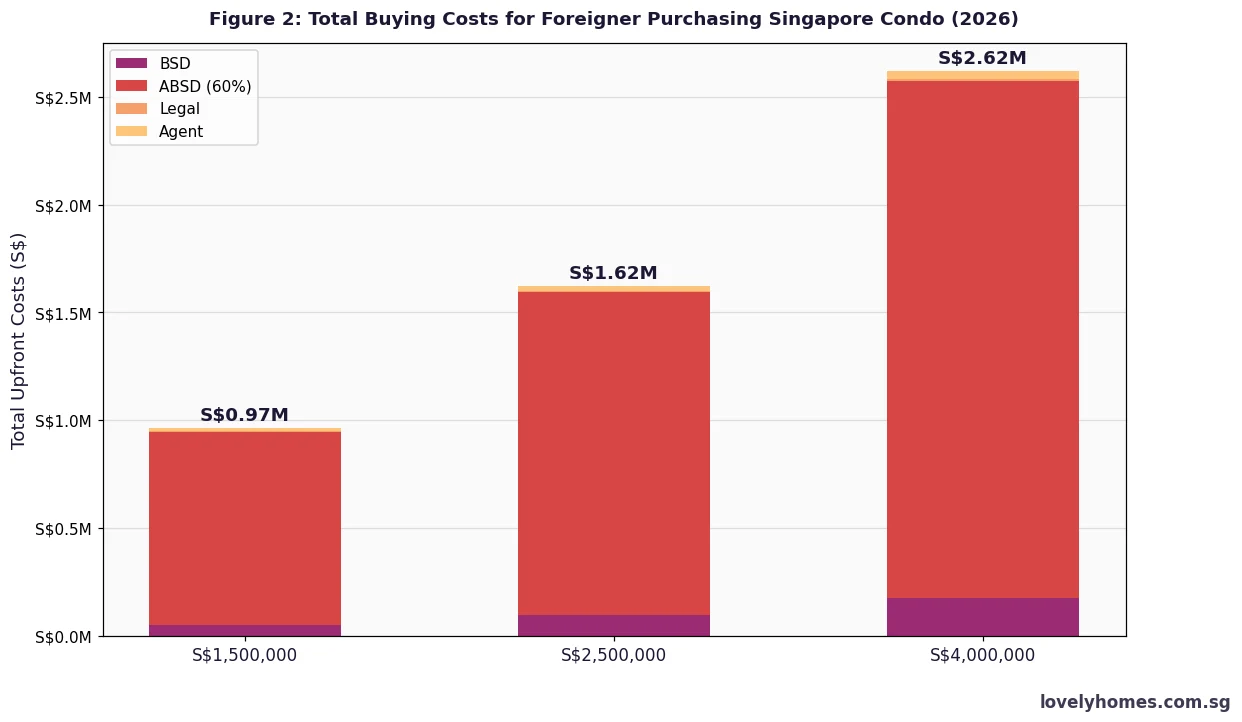
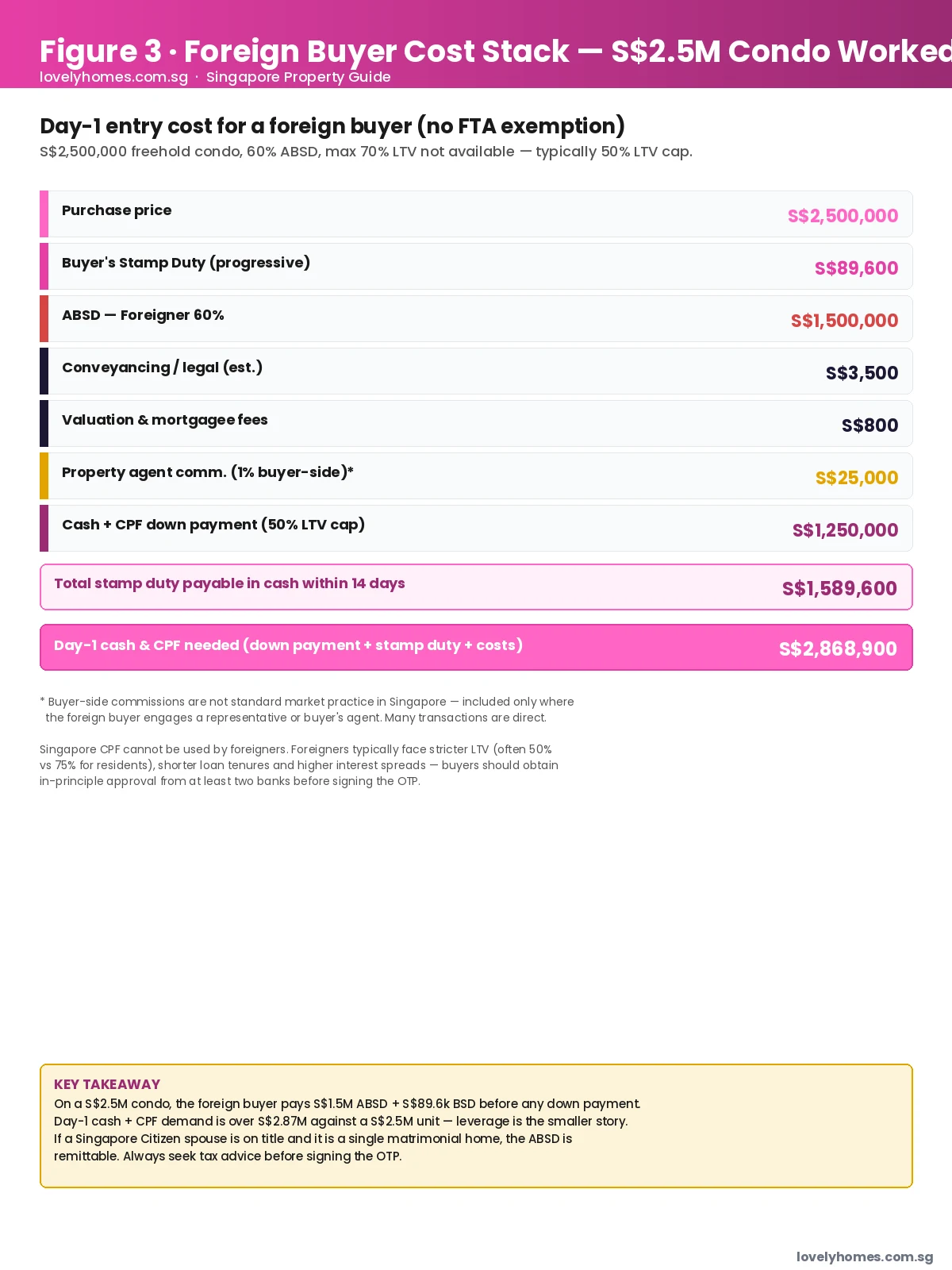
BSD must be paid within 14 days of signing the Sale and Purchase Agreement (or 30 days if the agreement is signed overseas). ABSD must be paid within the same window. Together with legal fees of approximately S$3,000–S$5,000 for a standard condominium purchase, these are the upfront transaction costs every buyer must budget for in addition to the down payment.
Financing a Singapore Property as a Foreigner
Foreign buyers can obtain mortgage financing from Singapore-licensed banks. Major lenders active in the foreigner and expat segment as at 2026 include DBS, UOB, OCBC, Standard Chartered, HSBC, and Maybank. The key constraints are set by the Monetary Authority of Singapore (MAS) under the Total Debt Servicing Ratio (TDSR) framework and the Loan-to-Value (LTV) rules.
The TDSR cap is 55% of gross monthly income for all borrowers regardless of nationality. This means the sum of all monthly debt obligations — including the new mortgage, car loans, personal loans, overseas mortgages, and any other committed repayments — cannot exceed 55% of the borrower’s verified gross income. For an Employment Pass (EP) holder earning S$25,000 per month, the maximum total monthly debt repayment is S$13,750.
LTV limits for a first property loan from a bank are 75% of the purchase price or market value (whichever is lower), requiring at least 5% in cash and a further 20% that may be CPF Ordinary Account savings for eligible borrowers. Foreigners typically do not hold CPF balances, so the 25% down payment and all other transaction costs must be funded entirely in cash. On a S$1.8M property, this means a minimum S$450,000 cash down payment before ABSD and BSD.
The property loan market is currently influenced by the 3-month compounded SORA rate, which stood at approximately 2.85–3.10% in August 2026. Most Singapore bank packages at the time of writing are SORA-pegged floating-rate packages in the range of 3.45–3.75% p.a. (SORA + bank spread), or fixed-rate packages at 2.90–3.40% p.a. for initial lock-in periods of two or three years. Foreigners may also access offshore financing for their Singapore property, though cross-currency mortgage arrangements add complexity. For refinancing considerations, see our Singapore Property Loan Refinancing Guide 2026.
Step-by-Step Buying Process for Foreign Buyers
Singapore’s property transaction process is well-regulated and straightforward once the applicable rules are understood. Below is the standard six-step sequence for a foreigner purchasing a private residential unit:
- Engage a conveyancing lawyer (day 0). A Singapore-licensed solicitor is mandatory for all property transactions. The lawyer reviews the title, checks for caveats, confirms ABSD eligibility (including FTA remission), and prepares the stamp duty declarations. Foreign buyers are advised to engage a lawyer before even signing any document.
- Exercise the Option to Purchase (OTP) and pay the option fee (day 1–14). The OTP, typically granted by the seller, gives the buyer an exclusive period (usually 14 days for private property) to decide on purchase. The option fee is typically 1% of the purchase price, paid in cash.
- Secure in-principle approval from bank (during OTP period). Apply to one or more banks for a letter of offer confirming the loan quantum, rate, and conditions. Foreign buyers should allow additional lead time as income verification may take longer.
- Exercise OTP and pay stamp duty (within 14 days of OTP grant). Sign the Sale and Purchase Agreement (SPA) and pay BSD and ABSD to IRAS through your lawyer within 14 days of execution (30 days if signed overseas). The balance option fee (typically 4% if total option fee is 5%) is paid at SPA signing.
- Completion (8–10 weeks after SPA). The bank disburses the mortgage. Remaining purchase price is paid (usually 90% less the option fee already paid). The seller’s lawyer discharges any existing mortgage; your lawyer registers the transfer at SLA and lodges a caveat protecting your interest. Keys are handed over.
- Post-completion: utility connections and MCST registration (week 1–4 after completion). Register with the Management Corporation Strata Title (MCST), connect utilities (SP Group, telecom), and if renting out, notify the Singapore Tourism Board and comply with rental regulations (minimum 3-month tenancy for private non-landed property).
Full Cost Comparison: Foreigner vs FTA National vs SC
| Buyer Profile | Purchase | BSD | ABSD | Total Stamp Duty | Cash Down (25%) | Total Day-1 Cash |
|---|---|---|---|---|---|---|
| Singapore Citizen (1st property) | S$1,800,000 | S$59,600 | S$0 | S$59,600 | S$450,000 | ~S$513,000 |
| US / EU national (FTA, 1st property) | S$1,800,000 | S$59,600 | S$0 | S$59,600 | S$450,000 | ~S$513,000 |
| Singapore PR (1st property) | S$1,800,000 | S$59,600 | S$90,000 | S$149,600 | S$450,000 | ~S$603,000 |
| Foreigner (non-FTA, any property) | S$1,800,000 | S$59,600 | S$1,080,000 | S$1,139,600 | S$450,000 | ~S$1,593,000 |
Worked Example: US National Buying First Singapore Property
Mr. Johnson, a 38-year-old American technology executive, holds an Employment Pass (EP) and earns S$25,000 per month gross. He intends to purchase a 2-bedroom condominium in the River Valley / Orchard vicinity for S$1,800,000 as his primary residence in Singapore. He has no outstanding loans in Singapore or overseas.
ABSD position: As a US national, Mr. Johnson qualifies for ABSD remission under the US–Singapore FTA. This is his first Singapore residential property. ABSD = S$0.
BSD calculation:
- First S$180,000 × 1% = S$1,800
- Next S$180,000 × 2% = S$3,600
- Next S$640,000 × 3% = S$19,200
- Next S$500,000 × 4% = S$20,000
- Remaining S$300,000 × 5% = S$15,000
- Total BSD = S$59,600
Financing: LTV at 75% = S$1,350,000 loan. Down payment required: S$450,000 cash (25%). Mr. Johnson does not hold CPF, so the full down payment is in cash. Legal fees: approximately S$3,500.
Monthly mortgage: At 3.65% p.a. over 30 years, instalment = approximately S$6,170/month. TDSR = S$6,170 / S$25,000 = 24.7%. Within the 55% TDSR cap — comfortably.
Total day-1 cash required: S$450,000 (down payment) + S$59,600 (BSD) + S$3,500 (legal) = approximately S$513,100.
Contrast: non-FTA foreigner, same property: Replace ABSD with S$1,080,000. Total day-1 cash becomes approximately S$1,593,100. The FTA remission saves Mr. Johnson S$1,080,000 on this single transaction.
What This Means for Foreign Buyers in 2026
Singapore’s property market continues to attract foreign buyers despite the 60% ABSD — a testament to the strength of underlying demand from globally mobile executives, regional wealth preservation, and investors who value Singapore’s transparent legal framework and scarcity of land. However, the mathematics of a 60% upfront tax on property value means that the investment case for non-FTA foreigners is more challenging than it was pre-2023.
The practical playbook for most non-FTA foreign buyers in 2026 involves one of three approaches: purchasing as a Singapore PR (which reduces ABSD to 5% on a first property), applying for PR status before purchasing if residency plans are long-term, or structuring purchases through a Singapore Citizen spouse where applicable. The government has consistently signalled that the 60% rate is not a temporary measure — it forms part of a deliberate housing policy to ensure that Singaporeans have priority access to residential property. Unlike earlier cooling measure cycles, there has been no indication of near-term reduction.
For FTA nationals — particularly US, EU, and Swiss citizens — Singapore’s market is accessible at SC-equivalent rates. For PRs, the 5% first-property rate keeps the market competitive relative to other global cities where foreign ownership is also taxed. For all other foreigners, the 60% ABSD means that Singapore property makes financial sense primarily as a long-stay home, not as a pure investment vehicle.
What Might Come Next
The possibility of ABSD moderation for foreigners is periodically discussed in the budget and monetary policy context. The Government’s stated position as at Budget 2026 is that cooling measures will be maintained for as long as necessary to ensure property market stability and affordability for Singaporeans. Any moderation would likely be gradual and tied to specific market conditions — for example, if private residential price indices declined materially or if external demand had clearly moderated. Buyers planning ahead for a 2027 or 2028 purchase should factor in the possibility that rates remain unchanged over that horizon, rather than rely on anticipated reductions. See our Singapore Property Cooling Measures Timeline 2009–2026 for the full history of government interventions.
Frequently Asked Questions
Can foreigners buy HDB flats in Singapore?
No. HDB flats — both new Build-to-Order (BTO) units and resale flats on the open market — are restricted to Singapore Citizens and Permanent Residents. Foreign nationals, regardless of income, employment, or length of residence, cannot purchase HDB flats under any circumstances. Similarly, new Executive Condominiums during their launch and construction phases are restricted to SC/PR buyers.
Do foreigners pay ABSD even on their first property?
Yes, unless they qualify for FTA remission. The standard 60% ABSD applies to all foreign nationals on every Singapore residential property purchase, regardless of whether it is their first, second, or third property. The “first property” graduated scale (which gives SC buyers 0% on their first purchase) does not apply to non-FTA foreigners. Nationals of the USA, EU member states, Switzerland, Norway, Iceland and Liechtenstein are the exceptions — they receive SC-equivalent treatment under their respective bilateral trade agreements.
Can a foreigner and Singapore Citizen buy together to avoid ABSD?
Yes, in part. When a Singapore Citizen and a foreign national or PR purchase jointly, the ABSD is assessed based on the lower rate applicable to either party — in this case, the SC’s rate. So an SC buying a first property jointly with a foreign spouse pays 0% ABSD (SC first-property rate), not 60%. However, if the SC already owns one property, the rate jumps to 20% (SC second-property rate), because the property count is based on both parties’ combined ownership history. Joint purchases require careful planning and legal advice before exercising any OTP.
Can foreigners get a mortgage in Singapore?
Yes. All major Singapore-licensed banks lend to foreign buyers of Singapore private residential property. The same TDSR (55%) and LTV (75% for a first loan) limits apply. Income verification may take longer for buyers whose salary is paid in a foreign currency or by an overseas employer, and some banks require a local employment pass or documented Singapore income source. Foreigners cannot use CPF for the down payment or monthly repayments, so the full 25% down payment must be funded in cash.
Is applying for PR a way to reduce ABSD?
PR status reduces ABSD from 60% to 5% on a first Singapore residential property — a very significant saving. However, PR applications are assessed by the Immigration and Checkpoints Authority (ICA) and approval is not guaranteed. Application processing typically takes 6–12 months, and there is no commitment to grant PR. Buyers who are considering applying for PR should do so as a genuinely long-term residency decision rather than purely for property tax purposes. That said, for EP holders who intend to remain in Singapore long-term, PR significantly improves property purchase economics.
Can foreigners rent out their Singapore property?
Yes. Private residential properties — condominiums, apartments, and strata landed — may be rented out by the owner, including foreign owners. The minimum rental period for private non-landed property is three months per rental contract, as stipulated by URA. There are no restrictions on renting to foreigners or locals. Rental income is taxable as income in Singapore, and foreign owners must file with IRAS. Property tax, at the residential non-owner-occupied rate of up to 36% on annual value (for the highest band, as at 2024), applies when the property is rented out rather than owner-occupied.
Related Articles
- ABSD Singapore 2026: Complete Guide to Additional Buyer’s Stamp Duty
- Buying Your Second Property in Singapore 2026: ABSD, Decoupling and the Upgrade Path
- Singapore Private Property Market Outlook H2 2026
- Singapore Property Loan Refinancing Guide 2026
- Singapore Leasehold vs Freehold Guide 2026
- Singapore First-Timer Property Guide 2026
Disclaimer: This article is for general informational purposes only and does not constitute legal, financial, or investment advice. Stamp duty rates, eligibility rules, FTA remission applicability, and lending policies are subject to change. Readers should verify current rates with IRAS, check foreign ownership rules with SLA, and consult a Singapore-licensed conveyancing lawyer and licensed financial adviser before making any property purchase decision. LovelyHomes is not a licensed estate agency and does not facilitate property transactions.