QUICK ANSWER
Singapore landlords must comply with HDB or URA rules (minimum 6-month lease for HDB, 3 months for private), screen tenants’ work/student pass validity, stamp the TA, declare rental income under Schedule I of their tax return, and refund deposits within 14–30 days. Gross yields of 4% typically net out to ~2.2% after expenses and 22% income tax.
Letting out a Singapore home can be a steady income stream, but it’s a licensed business that comes with tax, regulatory, and contractual obligations. This landlord’s guide covers what you must do (HDB approval, URA rules, TA clauses, tax declaration), how to screen tenants properly, and the yield maths that separate a profitable let from a break-even one.
If you’re a tenant instead, see our tenant’s guide to renting. For HDB-specific sublet rules, read the HDB subletting rules.
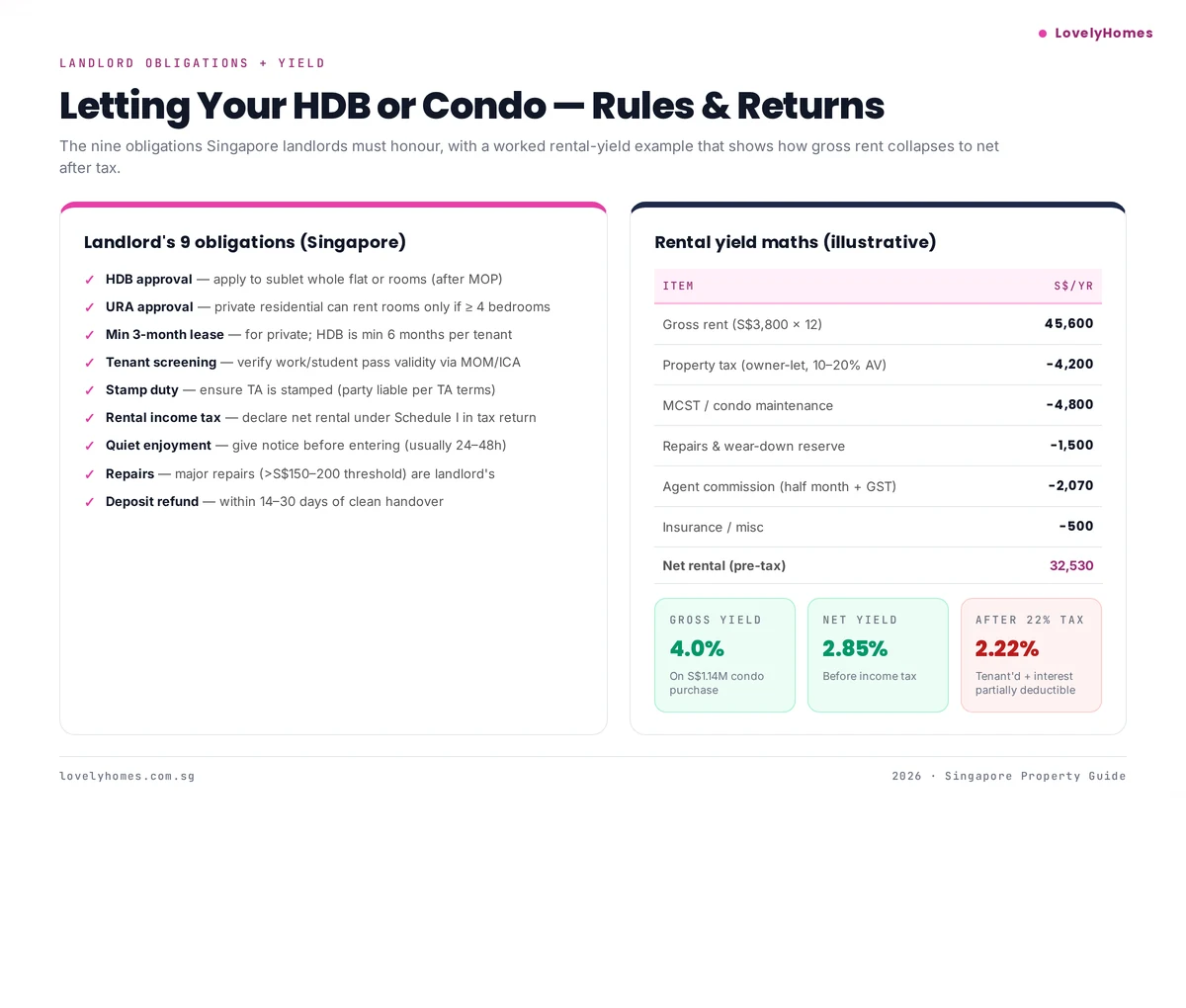
Your 9 legal obligations as a Singapore landlord
1. HDB or URA approval
HDB owners must apply for approval to sublet the whole flat (only after 5-year MOP) or register bedroom subletting online. Private residential landlords must ensure the unit has at least 4 bedrooms if renting rooms, and the overall occupant cap must not be breached.
2. Minimum lease terms
HDB: 6 months per tenant (no Airbnb, no short-stay). Private: 3 months per tenant. Anything shorter breaches URA rules.
3. Tenant screening
Verify work pass (MOM), student pass (ICA), or PR/citizen status before signing. For foreigners, sight the pass, not just a photocopy. Payslips or a CPF Statement for locals helps assess affordability. Credit-check via agents or services like CrimsonLogic.
4. Stamp duty
The TA must be stamped within 14 days of signing. Usually the tenant pays (see the TA), but you as the landlord must ensure it’s done — an unstamped TA is unenforceable in court. See the rental stamp duty guide for the formula.
5. Rental income tax
Declare net rental income (gross rent minus deductible expenses) under Schedule I in your personal income tax return. Deductibles include property tax, MCST fees, maintenance, insurance, fire insurance, and mortgage interest (on the rented property only). A flat 15% deemed-expense option exists for individuals — IRAS will apply whichever yields higher deductions.
6. Quiet enjoyment
Give the tenant 24–48 hours’ notice before entering for inspections or viewings (for prospective tenants at lease end). Barging in unannounced breaches quiet enjoyment.
7. Repairs and maintenance
Major repairs (structural, plumbing leaks, aircon compressor failure) are the landlord’s under standard TAs, above a threshold (usually S$150–200). Minor repairs below that threshold are the tenant’s.
8. Property tax uplift
When the unit is tenanted, property tax rises from owner-occupier rates (0–32%) to non-owner-occupier rates (12–36%). File Form IRIN1A with IRAS within 15 days of letting.
9. Deposit refund
Return the security deposit within 14–30 days of a clean handover, less itemised deductions. Withholding the deposit without documented cause invites Small Claims action.
The yield maths: gross is not net
A common trap: landlords quote gross yield and forget how much disappears to costs and tax. Here’s a worked example on a S$1.14M condo renting at S$3,800/month.
| Item | Amount (S$/year) |
|---|---|
| Gross rent (3,800 × 12) | 45,600 |
| Property tax (non-owner-occupier, est. AV S$42k) | –4,200 |
| MCST/condo maintenance | –4,800 |
| Repairs and wear-down reserve | –1,500 |
| Agent commission (half month + GST, if agent-let) | –2,070 |
| Insurance and misc | –500 |
| Net rental (pre-tax) | 32,530 (2.85% yield) |
| After 22% income tax (top marginal) | ~25,370 (2.22% yield) |
Mortgage interest on the rented property is also deductible — if you’re on a 4% interest-only loan, that swings the numbers further.
TA clauses to insist on
- Minor repair threshold (S$150–200) — anything below is the tenant’s cost.
- Aircon servicing every 3 months with receipts, tenant’s cost.
- No unauthorised subletting or Airbnb — immediate termination if breached.
- Damage deposit forfeit if TA is terminated during lock-in.
- Diplomatic clause only for foreign tenants on valid work/student pass — 12-month minimum stay, 2 months’ notice, pass cancellation required.
- End-of-tenancy cleaning at tenant’s cost with vendor receipt.
When to hire a property manager
Owner-managed suits local landlords with one unit and time. Hire a property manager (typically 8–10% of monthly rent) if you’re overseas, own 3+ units, or want a passive hands-off investment. The manager handles viewings, tenant issues, rent collection, and renewals — essentially turning your property into a running concern.
Frequently asked questions
Do I need a licence to be a landlord in Singapore?
No separate licence, but you must comply with HDB/URA rules. HDB owners need HDB approval to sublet whole flats. Short-term rentals (under 6 months for HDB, 3 months for private) breach URA rules — Airbnb is effectively illegal for most Singapore homes.
Can I claim mortgage interest against rental income?
Yes, but only the interest portion on the rented property (not principal, not on other properties). If the rental covers only part of the year, pro-rate accordingly. Alternatively, take IRAS’s 15% deemed-expense deduction — IRAS will use whichever gives the higher deductible.
Should I engage a tenant via a co-broke agent?
Co-broke means the tenant’s agent and your agent split the landlord-paid commission. It widens the pool of tenants (their agent brings them to you) at the same cost. Most Singapore landlords co-broke by default.
Disclaimer
This guide is for general information only. Singapore’s rental rules, HDB policies, and IRAS stamp duty rates change periodically. Always verify against the HDB, URA and IRAS websites before signing a lease or filing with IRAS. LovelyHomes is not a licensed property agent or tax adviser. For personalised advice, please engage a registered CEA agent or a qualified tax professional.