Singapore Rental Market Outlook 2026: Q3 Prices, Yields and What Tenants Need to Know
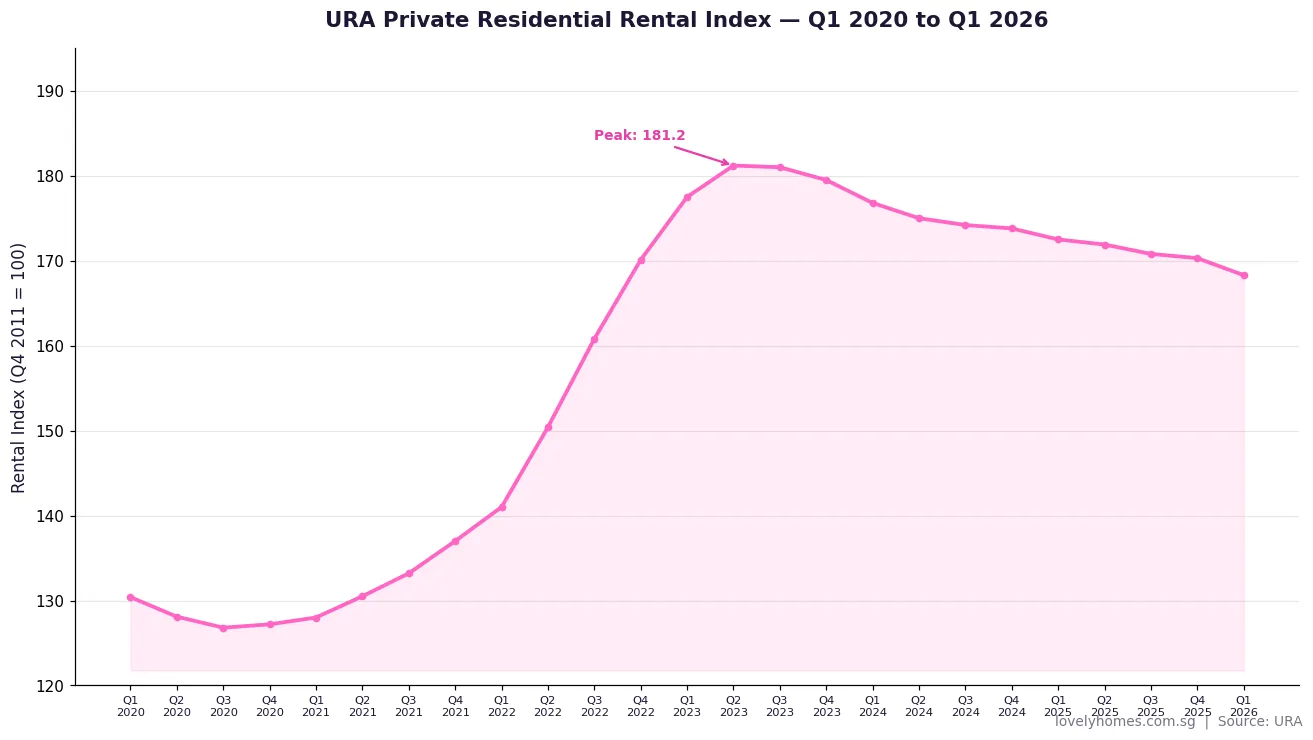
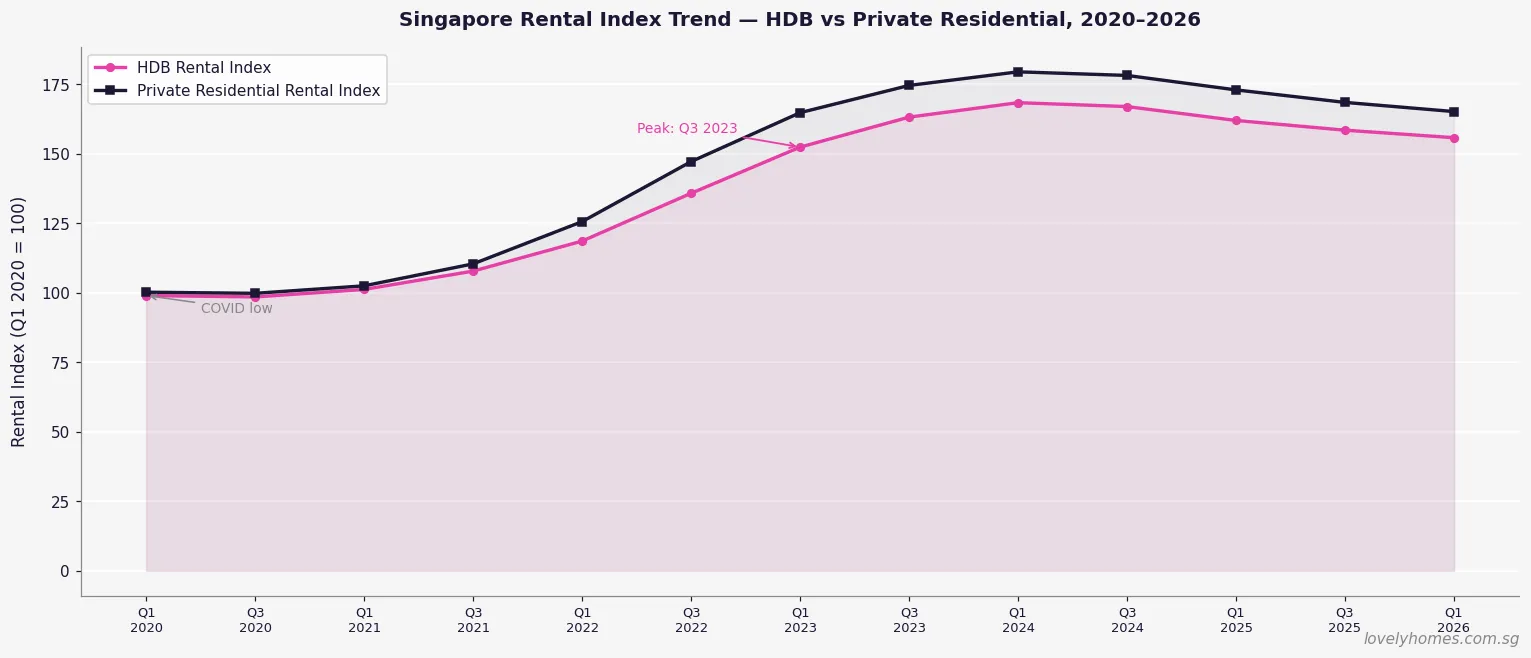
Singapore’s private residential rental market peaked in mid-2023 and has been on a measured correction since. By Q2 2026, the URA Rental Index stood at 152.3 — down 17.7% from the 2023 Q3 peak of 185.1. For tenants, this is welcome news after two years of record rents. For landlords and property investors, it demands a fresh look at yield expectations, void periods, and asset allocation. This guide gives you the full picture: where rents are now, why they are moving the way they are, and what the Q3 2026 outlook means for both sides of the market.
Quick Answer — Singapore Rental Market at a Glance (Q2 2026)
- URA Private Residential Rental Index: 152.3 (down from peak 185.1 in Q3 2023; still 2.4% above pre-COVID 2019 levels)
- HDB median rents: S$2,850–S$3,450/mth (3-room to 5-room); down approximately 8% from 2023 peaks
- Private condo median rents: S$3,700–S$6,200/mth (2BR–3BR, OCR to CCR); down 12–18% from peaks
- Private residential vacancy rate: approximately 9.2% (rising from 4.2% in 2022 as new supply arrives)
- Key drivers of moderation: substantial new completions in 2023–2025, slower EP/S Pass inflows, return of Singaporeans from overseas
- Outlook: further gentle softening in H2 2026; a structural floor exists from persistent under-supply of smaller units
What Is Driving Rental Moderation in 2026?
The 2022–2023 Singapore rental surge was a perfect storm: COVID-era construction delays created a supply cliff; returning expats and a surge in Employment Pass approvals after the border reopening supercharged demand; and near-zero vacancy left tenants with no negotiating power. Rents for some CCR condos doubled in 24 months. The unwinding since then reflects four structural shifts.
1. Record Completions Arriving
An estimated 20,000–25,000 private residential units completed in 2024–2025, with another 12,000–15,000 expected in 2026. The Housing and Development Board (HDB) simultaneously delivered over 30,000 BTO units across the same window. This supply avalanche — after years of below-average completions — is the single largest force pushing vacancy rates up and rents down. The URA forecasts continued elevated completions through 2027 before the pipeline normalises.
2. EP and S Pass Inflow Has Stabilised
The Ministry of Manpower (MOM) tightened Employment Pass and S Pass criteria multiple times between 2021 and 2023, raising qualifying salary thresholds substantially. Gross EP approvals peaked in 2022 and have since moderated. This reduced the pace at which new foreign professionals entered the market. Demand has not collapsed; it has simply normalised from an exceptional spike.
3. More Singaporeans Renting and Buying Differently
The 15-month wait-out period for private property owners who sold their homes and moved into non-subsidised HDB resale flats was removed with immediate effect on 28 July 2026. While this primarily affects the HDB resale market, it reduces the pool of Singaporeans temporarily renting private condos between transactions. Meanwhile, a cohort of Singaporeans who chose to rent rather than buy during the 2021–2023 price peak are now returning to home ownership as prices stabilise.
4. Some Expats Have Relocated
The surge in CCR condo rents pushed some cost-sensitive multinational corporate housing budgets past acceptable thresholds. A portion of expat tenants downgraded to OCR condos or were relocated by their firms to other Southeast Asian cities with lower accommodation costs. This has disproportionately affected top-end CCR rental demand and is one reason CCR rents have fallen further in percentage terms than OCR rents.

Rental Prices by Property Type (Q2 2026)
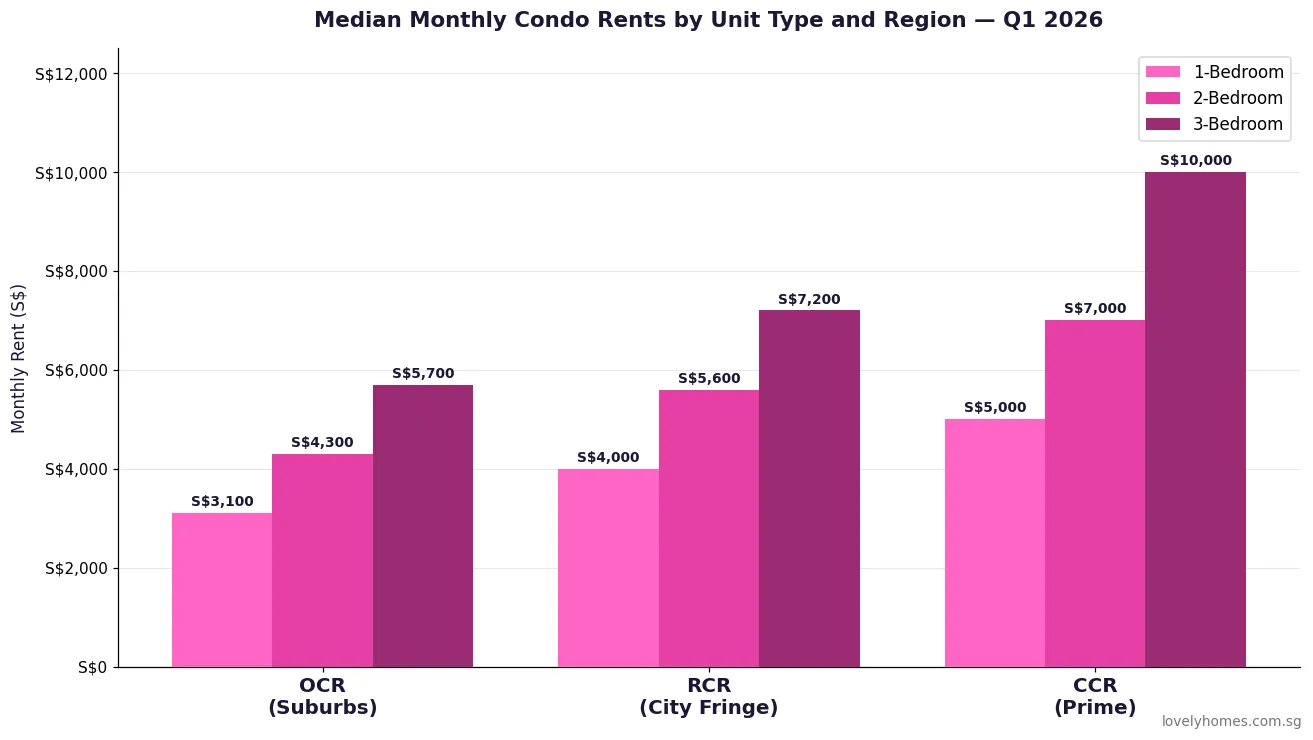
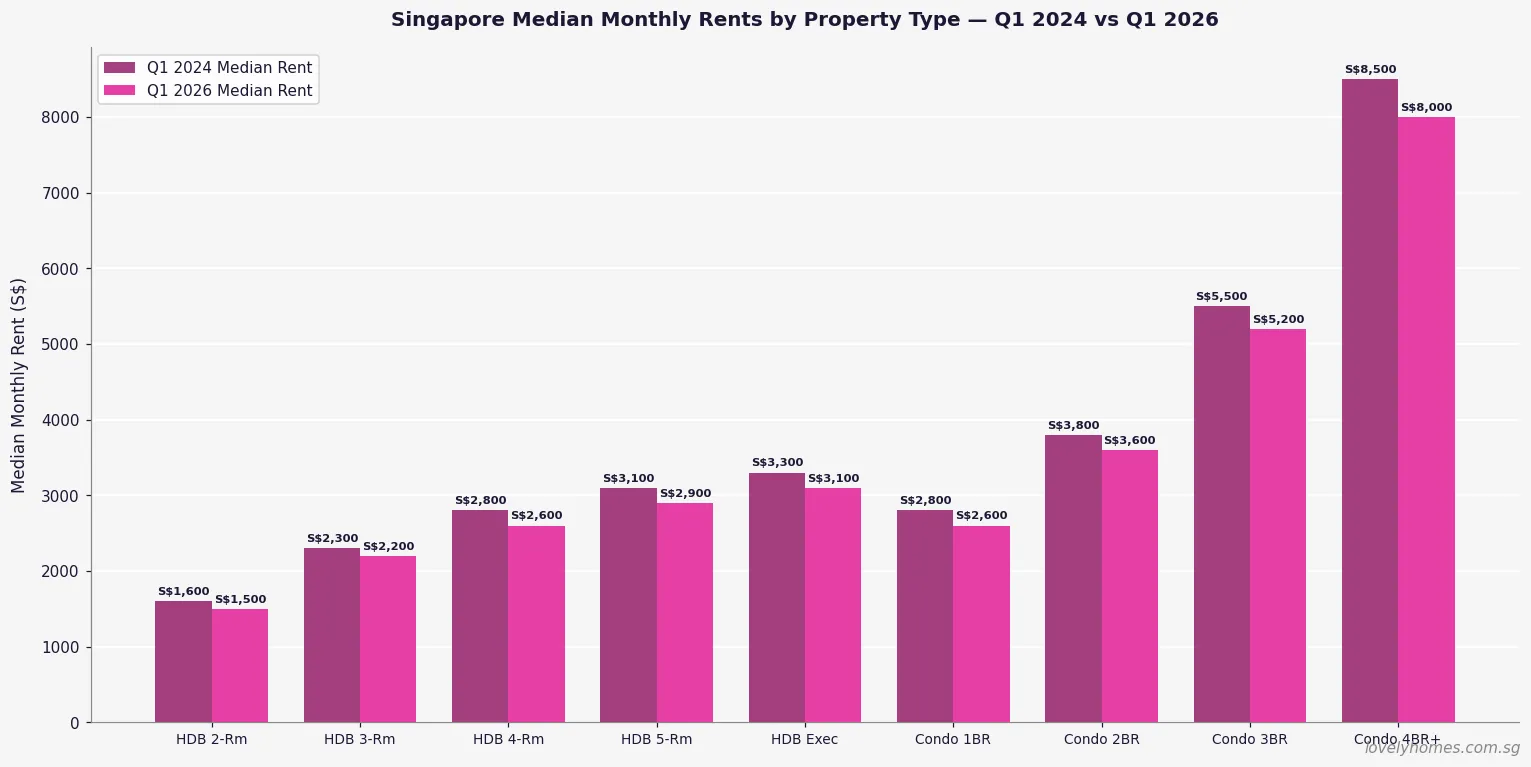
The rental market does not move uniformly. HDB rentals — which serve a different demographic and have their own supply dynamics — have softened less dramatically than private condo rents. The table and chart below summarise median transacted rent ranges across key segments.

| Property Type | Typical Size | Median Rent (Q2 2026) | Change from 2023 Peak |
|---|---|---|---|
| HDB 3-Room | 60–70 sqm | S$2,800–S$2,950/mth | −7% |
| HDB 4-Room | 90–110 sqm | S$3,050–S$3,300/mth | −8% |
| HDB 5-Room | 110–130 sqm | S$3,350–S$3,600/mth | −7% |
| Condo 1BR (CCR) | 40–55 sqm | S$4,000–S$4,500/mth | −15% |
| Condo 2BR (CCR) | 65–90 sqm | S$5,300–S$5,900/mth | −14% |
| Condo 2BR (RCR) | 60–80 sqm | S$4,500–S$5,000/mth | −12% |
| Condo 2BR (OCR) | 60–80 sqm | S$3,500–S$4,000/mth | −10% |
| Condo 3BR (RCR) | 90–110 sqm | S$5,900–S$6,500/mth | −13% |
| Condo 3BR (OCR) | 90–110 sqm | S$4,600–S$5,200/mth | −11% |
Median transacted rent ranges, Q2 2026. CCR = Core Central Region (Districts 1–4, 9–11); RCR = Rest of Central Region; OCR = Outside Central Region. Source: URA REALIS / SRX Property Rental Data.
Vacancy Rate: What Rising Voids Mean for Landlords
Singapore’s private residential vacancy rate hit a post-COVID low of approximately 4.2% in 2022. By Q2 2026, it had risen to an estimated 9.2%, the highest since 2016. For landlords, a rising vacancy rate means longer void periods between tenancies, greater willingness of tenants to negotiate reductions, and more competition from newly completed units. The structural floor exists because widespread landlord capitulation remains unlikely unless vacancy approaches 12–14%.

Rental Yield: What Are Investors Actually Earning?
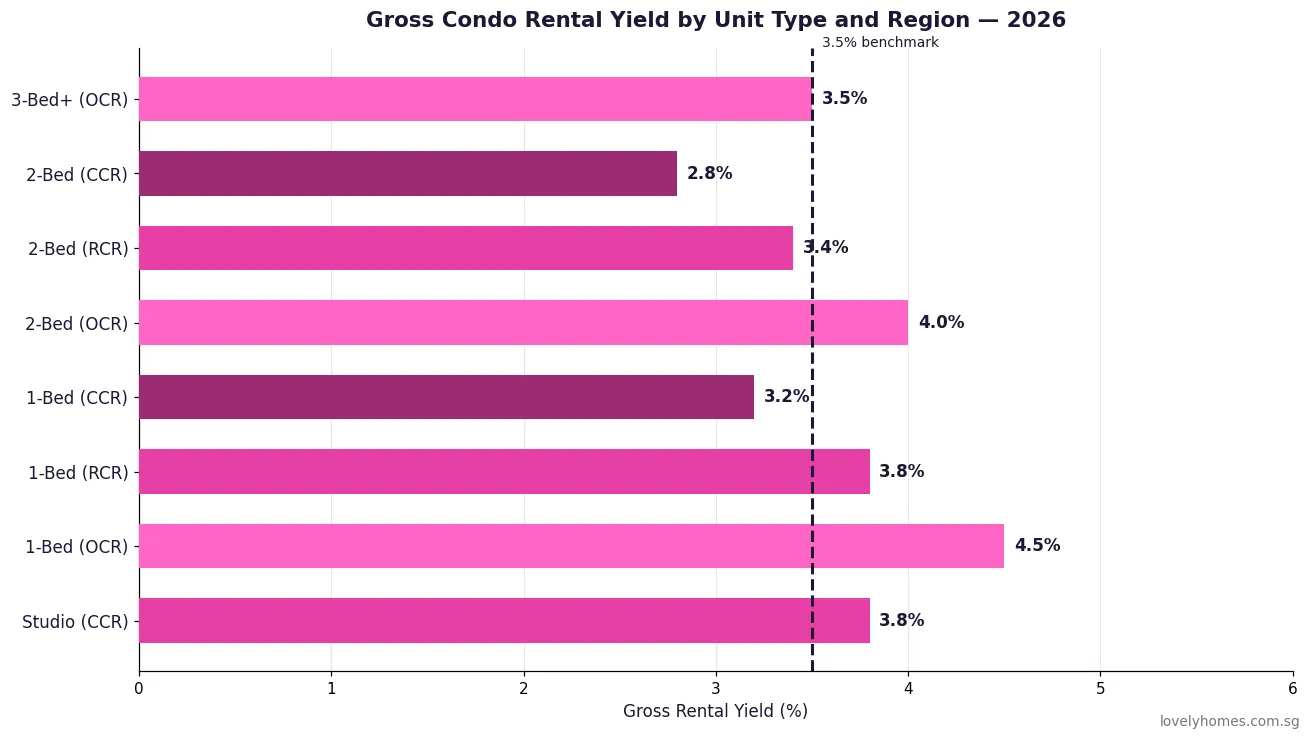
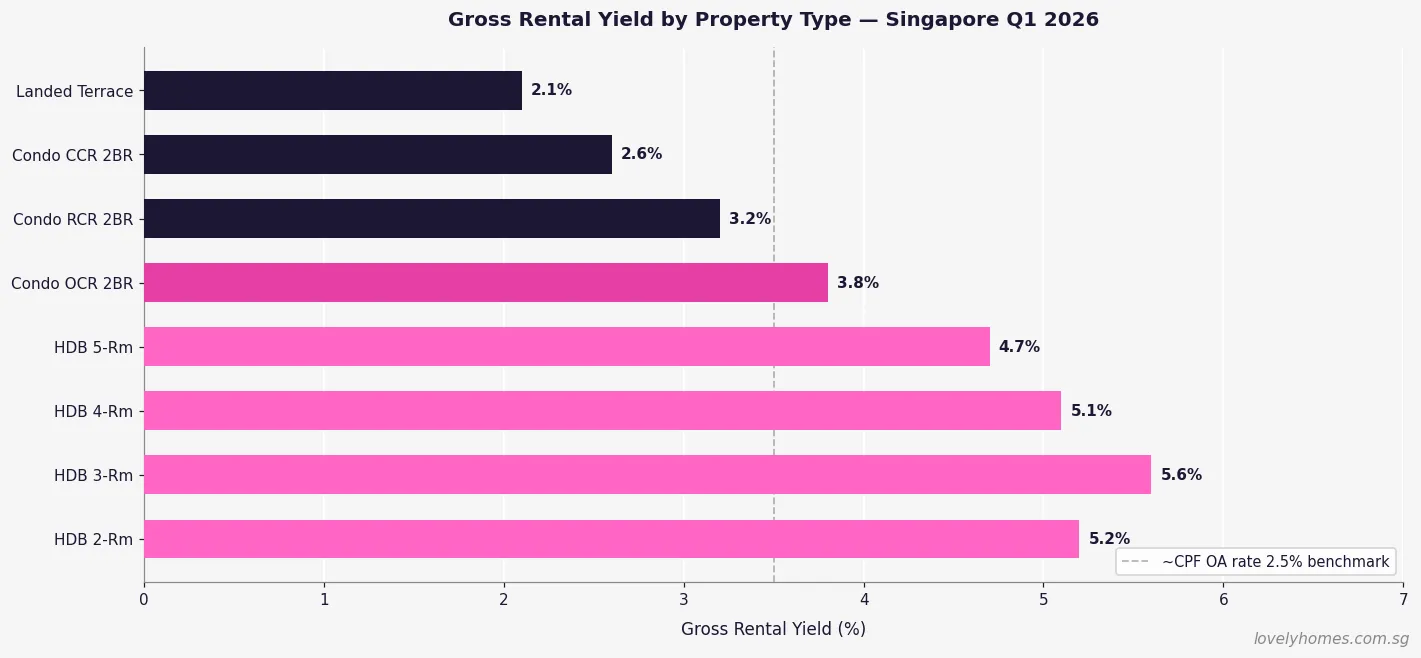
Gross rental yield — annual rent divided by current market price — is the headline figure investors use to compare rental income against capital deployed. With rents down 10–18% from their peaks but prices falling more slowly, gross yields have compressed from 2019 lows and remain under pressure at the top of the market.
| Property Type / Region | Approx. Price Range (2BR) | Approx. Annual Rent | Gross Yield (Approx.) |
|---|---|---|---|
| Condo 2BR OCR | S$1.1M–S$1.4M | approx. S$44,400/yr | 3.2–4.0% |
| Condo 2BR RCR | S$1.5M–S$2.0M | approx. S$56,400/yr | 2.8–3.8% |
| Condo 2BR CCR | S$2.2M–S$3.5M | approx. S$66,000/yr | 1.9–3.0% |
| HDB 4-Room Resale | S$520K–S$700K | approx. S$37,200/yr | 5.3–7.2% |
Gross yields before property tax, maintenance, agent fees, mortgage interest, and income tax. Net yields after costs are typically 1.0–2.0 percentage points lower. Source: LovelyHomes research based on URA and SRX data.
Worked Example: Landlord Returns on a S$1.5M RCR Condo
Mr Lee (Singapore Citizen) purchased a 2BR condominium in the Rest of Central Region for S$1.5 million in 2021. Here is how the economics looked at peak versus Q2 2026:
| Item | Peak (2023 Q3) | Q2 2026 |
|---|---|---|
| Monthly rent | S$5,400 | S$4,700 |
| Void allowance (1 mth/yr) | −S$5,400/yr | −S$4,700/yr |
| Effective annual rent | S$59,400 | S$51,700 |
| Estimated property tax (10%) | −S$5,940 | −S$5,170 |
| Maintenance fee (approx. S$600/mth) | −S$7,200 | −S$7,200 |
| Net rental income (pre-mortgage) | S$46,260 | S$39,330 |
| Gross yield on purchase price | 3.96% | 3.45% |
Net income has fallen by approximately S$6,930 per year (−15%) from peak to Q2 2026. For Mr Lee, who purchased without leverage, this is inconvenient but manageable. For investors who borrowed heavily in 2021–2022, the combination of higher interest rates and lower rents has compressed net yields significantly.
What This Means for Tenants in Q3 2026
If you are looking for a rental property in Singapore in mid-to-late 2026, the market is firmly more tenant-friendly than 18 to 24 months ago. Five practical takeaways: negotiate upfront with landlords who face rising vacancy; avoid committing to above-market rents on long leases without checking current comparables; look at new-completion buildings where landlords are motivated; consider OCR over RCR for value given expanded MRT connectivity; and compare the true cost of renting an HDB flat versus a private condo, where the gap has widened in HDB’s favour.
What Might Come Next for Singapore Rents (H2 2026 and 2027)?
The moderation in rents is unlikely to reverse sharply in the near term. The pipeline of completions remains elevated into 2027, vacancy is still rising, and no sudden demand spike is imminent. However, a complete collapse is equally unlikely: Singapore’s land scarcity and planning discipline mean the GLS programme will not over-supply the market indefinitely, and demand from EP and S Pass holders will recover with any pick-up in talent-sector hiring. A central forecast of a further 0–5% decline in the URA Rental Index through end-2026, followed by stabilisation in 2027, appears reasonable given current pipeline visibility.
Frequently Asked Questions
Can a foreigner rent an HDB flat in Singapore?
Yes. Non-citizens may rent entire HDB flats or individual rooms from eligible owners, subject to HDB’s subletting rules. The flat owner must have fulfilled the Minimum Occupation Period (5 years for standard flats, 10 years for Plus flats) before subletting the entire flat. Non-citizens must hold a valid Long-Term Visit Pass, Employment Pass, S Pass, Work Permit, or Student Pass. The HDB imposes a quota on the number of non-citizen tenants per block and precinct in order to maintain ethnic integration, and landlords must register each tenancy on the HDB Flat Portal. Room-only rentals are also subject to quotas.
Is rental income in Singapore taxable?
Yes. Rental income from Singapore property is subject to income tax, assessed by the Inland Revenue Authority of Singapore (IRAS). Allowable deductions include mortgage interest (subject to conditions), property tax, maintenance fees, insurance premiums, and certain repair costs. Net rental income (after deductions) is added to your assessable income and taxed at your marginal rate. Singapore Citizens and PRs pay up to 24% under the progressive resident scale; non-residents pay a flat 22% on net rental income.
What is the security deposit norm for Singapore rentals?
Standard practice in Singapore is one month’s rent deposit for a one-year lease, and two months’ rent deposit for a two-year lease. Deposits are held by the landlord and must be returned within 14 to 30 days of lease expiry, less documented deductions. There is no statutory deposit protection scheme in Singapore, so document the property condition thoroughly with time-stamped photographs at the start of the tenancy.
Can I negotiate mid-tenancy rent reductions in Singapore?
A tenancy agreement is a binding contract and the rent is a term of that contract. In general, a landlord is not obliged to reduce rent mid-tenancy unless there is a specific diplomatic clause, force majeure provision, or mutual agreement. With vacancy rates rising in 2026, some landlords are willing to offer modest concessions (2–5% reduction) in exchange for early renewal. The most effective strategy is to negotiate at renewal using current market comparables for similar units in your building.
What is the difference between CCR, RCR and OCR for rental purposes?
The Urban Redevelopment Authority (URA) divides Singapore’s residential market into three regions. The Core Central Region (CCR) covers Districts 1–4 and 9–11 — including Orchard Road, River Valley, and the CBD fringe — and commands the highest rents but has also seen the steepest correction from 2023 peaks. The Rest of Central Region (RCR) includes Toa Payoh, Buona Vista, Marine Parade, and Queenstown — well-serviced, mid-market locations. The Outside Central Region (OCR) covers the northern, eastern, and western suburbs, offering the best value per square foot in 2026.
Should I rent or buy in Singapore in 2026?
The decision depends heavily on citizenship status, time horizon, and CPF access. Singapore Citizens and PRs with a 5–7-year horizon and access to HDB grants can often achieve a lower effective monthly housing cost by buying, particularly in the HDB market where ABSD is zero for a first purchase. For foreigners paying 60% ABSD on their first purchase, the breakeven period for buying versus renting extends to 10-plus years, making renting the rational choice for most expatriate assignments. For those in the middle, a 2BR condo in the OCR at S$3,700/mth currently offers a meaningful cash-flow advantage over owning a similar unit at S$1.3 million with a 3.5% mortgage.
Related Articles
- ABSD Singapore 2026: Complete Guide to Additional Buyer’s Stamp Duty
- Buying Your Second Property in Singapore 2026: ABSD, Decoupling and the Upgrade Path
- Singapore Expat Property Buying Guide 2026
- Singapore Private Property Buying Procedure 2026
- Singapore HDB MOP Guide 2026
- Singapore Stamp Duty Guide 2026: BSD, ABSD and SSD Explained
Disclaimer: This article is for general information and educational purposes only. Rental data and yield figures are estimates based on publicly available transaction data and industry research as at 14 August 2026. Actual rents, yields, and market conditions may differ. This article does not constitute investment, financial, tax, or legal advice. Always verify current rates with the URA REALIS system and consult qualified professionals before making any property investment or tenancy decision.