
Property tax Singapore is a recurring annual tax levied by IRAS on all immovable property in Singapore. It is not based on your purchase price or your income — it is based on the Annual Value (AV) of the property, an IRAS estimate of what it would rent for on the open market. This design means even an owner who paid for their home decades ago faces a tax bill that rises with the rental market.
This 2026 guide walks through how Annual Value is set, the progressive rate bands for owner-occupiers and non-owner-occupiers, when the bill falls due, and a worked example that shows how the same property can create radically different tax bills depending on whether the owner lives in it or rents it out. For the official tables, see the IRAS Property Tax Rates page.
Quick Answer — Property Tax 2026
- Based on: Annual Value (AV), not purchase price or income.
- Owner-occupier rates: 0% on the first S$12,000, rising progressively to 32% on AV above S$100,000.
- Non-owner-occupier rates: 12% on first S$30k, rising to 36% above S$60k.
- Payable annually: bill issued in December, due 31 January. GIRO allows 12 monthly instalments.
- Late payment: 5% penalty, then additional 1% per month of delay.
What is Annual Value and How Is It Set?
Annual Value is IRAS’s estimate of the gross annual rent your property could fetch on the open market, excluding furniture, fittings and service charges. IRAS revises AVs periodically based on actual rental transactions in the area, demographic trends, and condition of the building.
AV has nothing to do with:
- Your purchase price
- The actual rent you may receive (if renting out)
- Your occupancy status (IRAS sets AV once; your occupancy decides which rate table applies)
- The mortgage outstanding
You can check your property’s current AV at any time via myTax Portal using your Singpass. If you believe the AV is wrong, you have 30 days from the date of notification to object and supply rental evidence.
The 2026 Owner-Occupier Rate Ladder
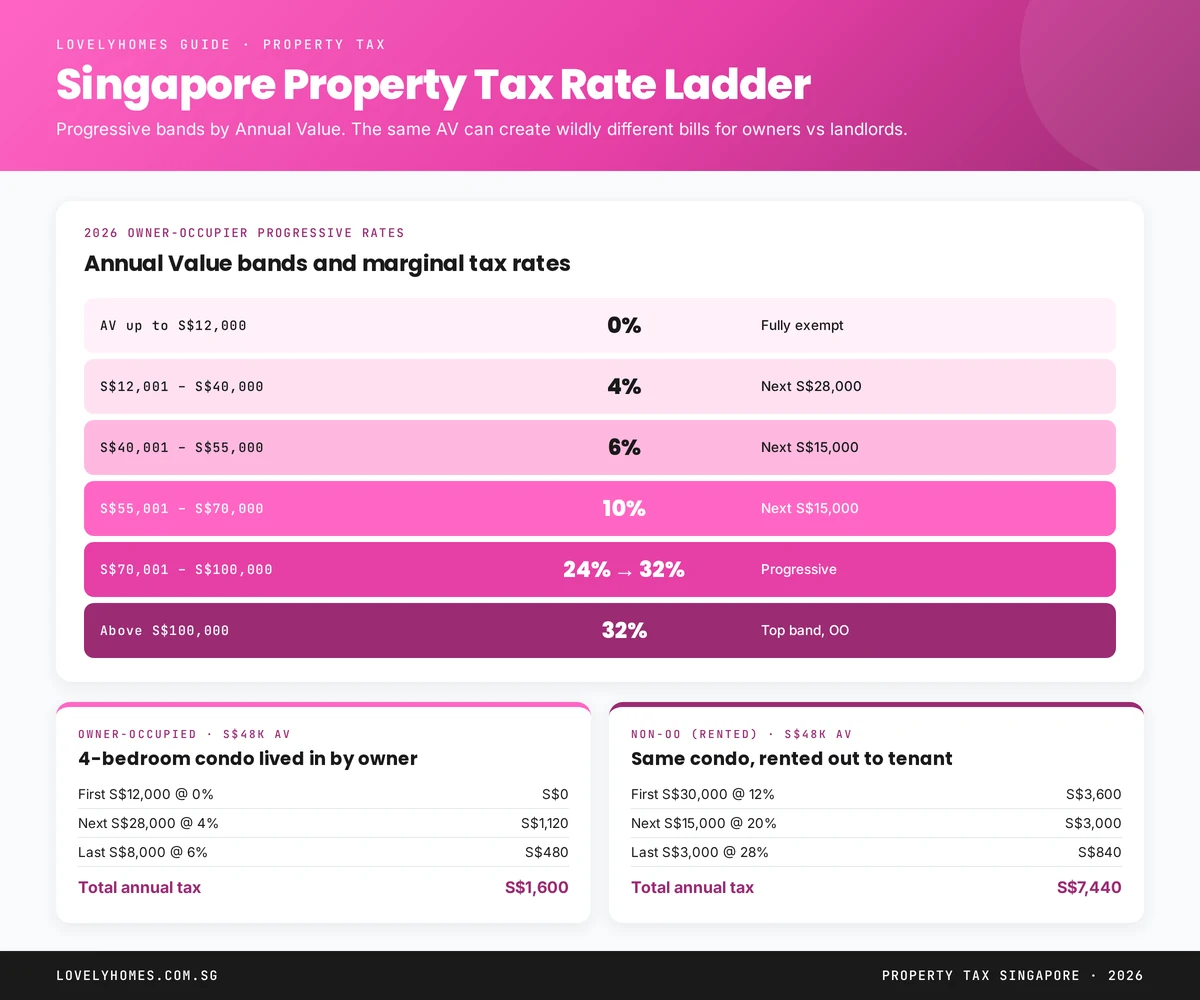
Owner-occupiers pay the lowest rates because the scheme is designed to encourage home ownership. The progressive bands as at 2026:
- First S$12,000 of AV: 0%
- Next S$28,000 (S$12,001–S$40,000): 4%
- Next S$15,000 (S$40,001–S$55,000): 6%
- Next S$15,000 (S$55,001–S$70,000): 10%
- Next S$15,000 (S$70,001–S$85,000): 14%
- Next S$15,000 (S$85,001–S$100,000): 24%
- Above S$100,000: 32%
Owner-occupier rates apply to the property you physically live in and where you are the legal owner. You cannot claim owner-occupier status on two properties simultaneously — the second (and subsequent) is taxed at non-owner-occupier rates.
The 2026 Non-Owner-Occupier Rate Ladder
If your property is rented out or vacant, the higher non-OO rates apply. These were raised significantly in 2023 and 2024:
- First S$30,000 of AV: 12%
- Next S$15,000 (S$30,001–S$45,000): 20%
- Next S$15,000 (S$45,001–S$60,000): 28%
- Above S$60,000: 36%
These rates apply to all forms of non-owner-occupation, including rental to tenants, use by family members who are not joint owners, and vacancy.
Worked Example: Same Condo, Two Tax Bills
Take a 3-bedroom condo in District 15 with an Annual Value of S$48,000.
Scenario A: Owner lives in it
| Band | Amount | Rate | Tax |
|---|---|---|---|
| First S$12,000 | S$12,000 | 0% | S$0 |
| Next S$28,000 | S$28,000 | 4% | S$1,120 |
| Next S$8,000 | S$8,000 | 6% | S$480 |
| Total | S$48,000 | — | S$1,600 |
Scenario B: Owner rents it out
| Band | Amount | Rate | Tax |
|---|---|---|---|
| First S$30,000 | S$30,000 | 12% | S$3,600 |
| Next S$15,000 | S$15,000 | 20% | S$3,000 |
| Next S$3,000 | S$3,000 | 28% | S$840 |
| Total | S$48,000 | — | S$7,440 |
The non-OO bill is 4.7× the OO bill on identical property with identical AV. That gap is exactly what the Government intends — a deliberate wedge against holding residential property as pure investment.
When the Bill is Due
Property tax for the calendar year is billed in December of the preceding year and due on 31 January.
Payment options:
- GIRO — recommended. Split into 12 monthly instalments automatically. No interest.
- Lump sum. Pay in full by 31 January via PayNow, AXS, or credit card (fees may apply).
- Late payment: 5% penalty on the unpaid amount, plus 1% additional per month of delay (capped at 12%).
Reliefs and Rebates
Several reliefs can reduce your property tax bill:
- Owner-occupier rates are automatic for the property that IRAS’s records show you living in. Update the records if you move.
- Property Tax Rebate (introduced in 2023 Budget and repeated in 2024, 2025, 2026) has provided up to 100% rebate on the first S$1,000–S$2,000 of tax for owner-occupied HDB flats. Check current year for details.
- Vacancy refund: historically available for vacant units; fully abolished from January 2014.
Frequently Asked Questions
Is property tax deductible for rental income tax?
Yes. Property tax is an allowable expense when computing taxable rental income on your annual personal income tax return.
What happens to the tax when I sell?
Property tax for the calendar year remains your obligation through the date of completion. The completion statement typically pro-rates the tax between seller and buyer based on occupancy days.
How does AV for new launches get set?
New launches are assigned a provisional AV based on comparable rentals in the area. Once the property is physically completed and rental evidence accumulates, the AV is reassessed.
Is there property tax on commercial or industrial property?
Yes, at a flat 10% of AV for most commercial and industrial categories. The progressive residential bands do not apply.
Can I reduce property tax by keeping the property vacant?
No. Vacancy attracts non-OO rates and AV remains based on market rental potential. There is no vacancy discount since 2014.
What to Do Next
- ABSD Singapore 2026 — the one-time transaction tax.
- BSD Singapore 2026 — paid at purchase on every property.
- All Stamp Duties & Taxes.
Disclaimer: This guide is general information, not tax advice. Rate bands and rebate schemes change annually via the Budget. Always verify current rules at iras.gov.sg and consult a tax professional for material decisions.