No ABSD — commercial property attracts 0% Additional Buyer’s Stamp Duty regardless of your citizenship, residency status, or number of properties owned.
No Residential Property Act restrictions — foreigners may purchase strata commercial units (offices, retail, shophouses) without special approval.
GST applies — if the seller is GST-registered, you pay 9% GST on the purchase price. This is the single largest “hidden” cost for commercial buyers.
Lower LTV — banks typically lend up to 55% (first commercial purchase) versus 75% for residential. Expect to deploy more equity upfront.
No SSD — Seller’s Stamp Duty does not apply to commercial property; you can sell at any time without a holding-period penalty.
Gross yields of 3.5–6.5% — strata offices and industrial units typically yield more than residential condos, but capital appreciation potential is generally lower.
Four main types — strata office, strata retail / shophouse, industrial (B1/B2), and conservation shophouse each have distinct lease terms, tenant profiles, and yield bands.
GST registration threshold — if your commercial rental income exceeds S$1 million per annum, you must register for GST and charge 9% to tenants.
What Is Commercial Property Investment in Singapore?
Singapore’s commercial real estate market encompasses office towers, retail podiums, shophouses, industrial buildings, and mixed-use developments. Unlike residential property, commercial assets are not governed by the Residential Property Act and are not subject to Additional Buyer’s Stamp Duty (ABSD) — making them a popular route for investors seeking rental income or portfolio diversification without the stamp-duty burden that residential purchases now carry.
Commercial property is regulated by the Urban Redevelopment Authority (URA) for planning matters, IRAS (Inland Revenue Authority of Singapore) for stamp duties and GST, and the Monetary Authority of Singapore (MAS) for financing rules. The key legislation governing transactions includes the Stamp Duties Act, the Goods and Services Tax Act, and the Land Titles Act.
The four main categories relevant to individual investors are strata offices, strata retail units, industrial properties, and conservation shophouses. Each carries a different lease tenure, typical tenant profile, yield band, and financing environment.
Strata Office Units
Strata offices are individual floors or partial-floor units in commercial buildings, sold as separate titles. Found predominantly in the Central Business District, Orchard, and Jurong Lake District, these units are popular with SME owner-occupiers and yield-seeking investors. Gross yields range from approximately 3.5% to 5.0% in 2026, with CBDpremium offices at the lower end and suburban offices at the higher end. Buildings may be freehold or 99-year leasehold; the distinction affects both capital values and bank financing terms.
Strata Retail Units and Conservation Shophouses
Retail strata units — including ground-floor shop spaces in mixed-use developments — offer yields of roughly 3.0% to 4.5%, with location being the dominant driver. Conservation shophouses (two- to three-storey terraced buildings in gazetted areas such as Chinatown, Little India, and Kampong Glam) are a distinct asset class. Most are freehold with strong scarcity value; gross yields typically run at 2.5% to 4.0%, but capital appreciation has historically been robust. The URA’s conservation guidelines impose strict rules on external façade alterations, which investors must factor into refurbishment budgets. LTV for shophouses tends to be lower — around 40% — because banks treat them as specialised assets.
Industrial Property (B1 and B2)
Industrial property in Singapore is stratified by use type: B1 (clean/light industrial) allows uses compatible with a residential environment, while B2 (general industrial) permits heavier manufacturing and logistics. Most industrial land is leased from JTC Corporation at 30- to 60-year tenures, depressing capital values but pushing gross yields to 4.5%–6.5% — the highest of the four main types. Key clusters include Jurong, Tuas, Ubi, and Tai Seng. Since September 2017, resale of strata industrial units is permitted only to end-users for the first three years, a rule introduced by the Ministry of Trade and Industry to curb speculation. Foreigners may invest in industrial property without additional restrictions.
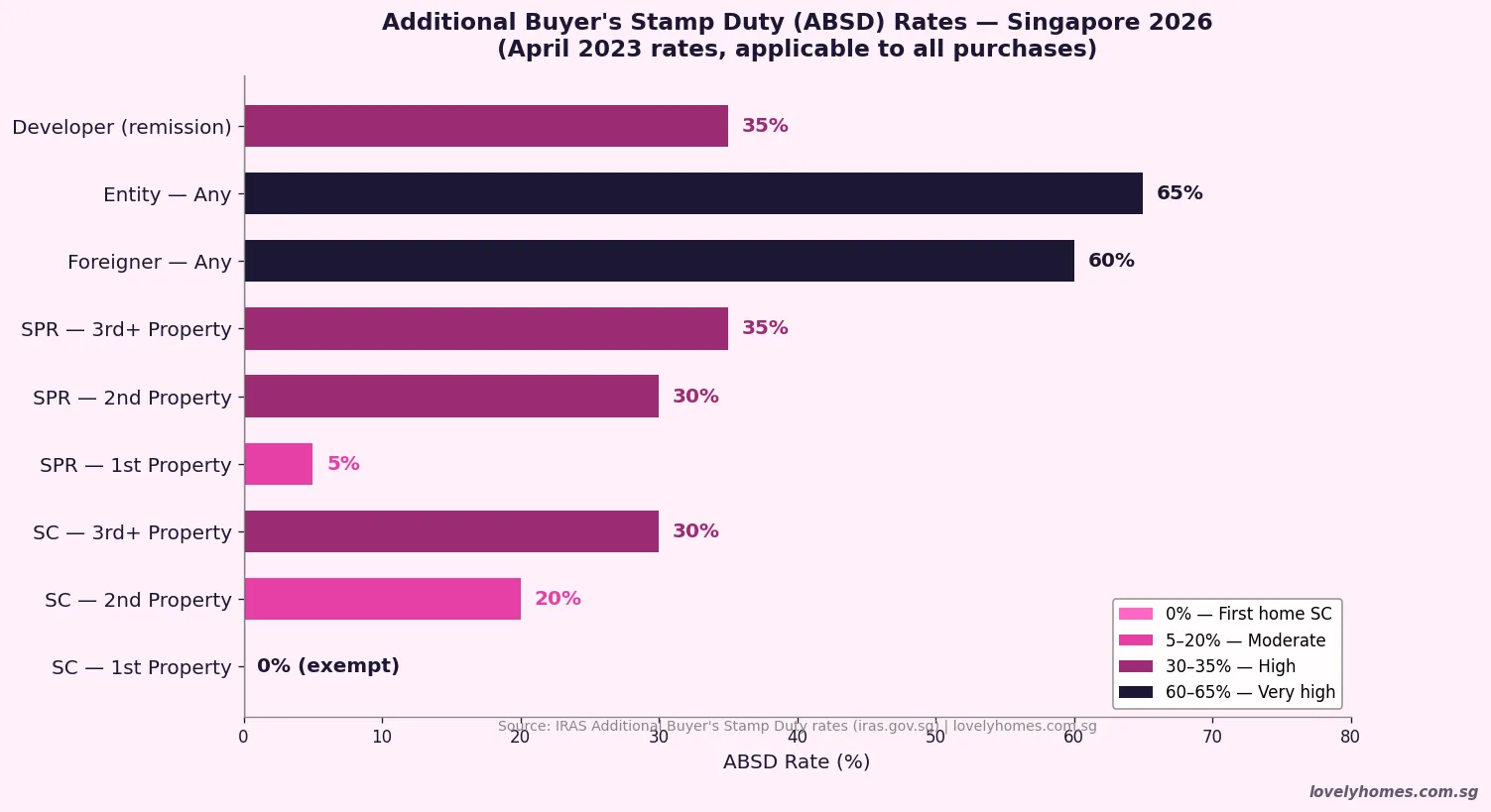
Figure 2: ABSD rates by buyer profile — residential vs commercial. Commercial property carries 0% ABSD for all buyer profiles. Source: IRAS 2026.
Why Commercial Property Attracts Zero ABSD
ABSD was introduced in December 2011 (and significantly increased in April 2023) specifically to cool demand in the residential housing market, which the government regards as a social good requiring price stability. Commercial and industrial properties serve business rather than shelter needs, and are therefore entirely outside ABSD’s ambit. This means a foreign investor purchasing a strata office pays the same stamp duties as a Singapore Citizen — solely Buyer’s Stamp Duty (BSD) at the standard progressive rates.
BSD rates on commercial property in 2026 are: 1% on the first S$180,000, 2% on the next S$180,000, 3% on the next S$640,000, 4% on the next S$500,000, 5% on amounts from S$1.5 million to S$1 billion, and 6% above S$1 billion. This mirrors the residential BSD schedule and was last revised in Budget 2023.
GST: The Hidden Cost Most Buyers Underestimate
Goods and Services Tax at 9% (effective 1 January 2024) applies to commercial property transactions where the seller is GST-registered. This is separate from BSD and is payable on the purchase price or market value, whichever is higher. On a S$2 million strata office, GST alone adds S$180,000 to the cost — a sum larger than the BSD on the same transaction. Buyers should always verify the seller’s GST registration status via the IRAS MyTax Portal before committing to an Option to Purchase.
If you are purchasing the commercial property for your own GST-registered business, you can claim the input tax credit — effectively recovering the GST through your quarterly GST returns. Investors who are not GST-registered absorb the full 9% as an acquisition cost. Rental income from commercial tenants must also include 9% GST if your annual rental income (across all commercial properties) exceeds S$1 million.
Figure 3: Full summary of stamp duties and GST applicable to Singapore commercial property purchases and leases. Source: IRAS 2026.
Financing Commercial Property in Singapore
Commercial property loans are not subject to MAS’s Total Debt Servicing Ratio (TDSR) framework in the same way residential mortgages are — though banks still apply their own stress-testing. The Loan-to-Value (LTV) ceiling for a first commercial property loan is approximately 55%, compared to 75% for a first residential property. This reflects the higher perceived risk of commercial assets. Expect to deploy at least 45% equity plus BSD, GST (if applicable), and legal fees on day one.
Interest rates on commercial loans are typically 20–50 basis points higher than equivalent residential loans, reflecting the lower liquidity and higher vacancy risk of commercial assets. Loan tenures are shorter — typically 25 to 30 years maximum for freehold assets, and capped at remaining lease term minus 5 years for leasehold properties. Conservation shophouses, viewed as specialised collateral, often face tighter LTV of around 40%.
Key Facts Summary
Parameter
Residential Condo
Strata Office
Strata Industrial
ABSD (SC 2nd)
20%
0%
0%
ABSD (Foreigner)
60%
0%
0%
SSD on resale
12/8/4% (≤3yr hold)
0%
0%
GST on purchase
None
9% if seller GST-reg
LTV (first purchase)
75%
~55%
~55–60%
Gross yield (2026)
2.5–4.0%
3.5–5.0%
4.5–6.5%
Foreigner eligible?
Yes (high ABSD)
Yes (no ABSD)
Yes (no ABSD)
CPF usable?
Yes (own use)
No
No
Worked Example: Ms Rajah Acquires a S$1.5M Strata Office in Tanjong Pagar
Ms Rajah, 45, is an Indian national on an Employment Pass. She already owns a residential condominium purchased with 60% ABSD (S$420,000 on a S$700,000 condo). She now wishes to diversify into commercial property.
Property: Strata office unit, 600 sq ft, Tanjong Pagar CBD, S$1.5 million. The seller is GST-registered.
Rental income: At 4.2% gross yield, monthly rent ≈ S$5,250. After property tax (10% of annual value of ~S$44,000 = S$4,400), maintenance, and agent fees, net yield is approximately 3.5%, or S$4,375/month.
Key insight: If Ms Rajah had purchased a residential condo of equivalent value as a second property, her ABSD alone would have been S$900,000 (60% of S$1.5M). By choosing commercial, she eliminates this entirely — and has no SSD exposure if she sells within three years.
Why Commercial Property Matters for Singapore Investors
The April 2023 ABSD increases — which pushed the foreigner residential rate to 60% and the SC second-property rate to 20% — dramatically changed the calculus for investors. Commercial property became the natural hedge: the same capital now buys a non-residential asset with no ABSD, no SSD, and typically a higher gross yield than residential. Between 2023 and 2026, URA data shows elevated transaction volumes for strata commercial and industrial units as investors sought ABSD-free alternatives.
Compared to regional peers, Singapore’s commercial property market benefits from rule-of-law certainty, transparent title, a deep pool of institutional tenants, and strong infrastructure connectivity. Hong Kong and Kuala Lumpur offer comparable tax advantages in some segments, but Singapore’s political stability and AAA-rated credit environment command a premium.
What Might Come Next for Singapore Commercial Property
(This section contains the editorial team’s forward-looking analysis; it does not constitute financial advice.)
The URA’s 2019 Master Plan designated the Greater Southern Waterfront, Jurong Lake District, and Woodlands Regional Centre as key nodes for commercial growth. These decentralisation drivers are expected to support demand for strata office space outside the CBD over the 2025–2030 planning horizon. Industrial REITs have flagged tightening vacancy rates in B1 space as the tech and biomedical sectors continue to grow, potentially supporting rental growth.
GST is not expected to rise above 9% before 2028 based on current MAS and MOF guidance. ABSD on commercial property has never been introduced in Singapore’s policy history, and any future imposition would require legislative change — there is no current signal of this from the government. The main risks for commercial investors are interest rate movements (commercial loan rates are closely tied to SORA and 3-month bank rates), potential oversupply in the CBD Grade A office segment following several large completions, and global economic uncertainty affecting tenant demand.
Frequently Asked Questions
Can foreigners buy commercial property in Singapore without restrictions?
Yes. The Residential Property Act (Cap 274) restricts foreigners from purchasing certain residential property categories (such as landed property and non-approved condominium units without special approval), but commercial property is entirely outside its scope. A foreigner may purchase a strata office, retail unit, shophouse, or industrial unit without any Ministry of Law approval, and pays 0% ABSD on the transaction. BSD and GST (if the seller is GST-registered) still apply.
Do I need to pay GST when buying a commercial property from a private individual who is not GST-registered?
No. GST only applies when the seller is a GST-registered entity. If you are purchasing a strata office from a private individual who has never registered for GST (which is common for smaller investors), no GST is payable. Always verify the seller’s GST registration status on the IRAS MyTax Portal before signing the Option to Purchase. If the seller is GST-registered, factor in the full 9% — this is non-negotiable and non-refundable unless you yourself register for GST and claim input tax.
Can I use my CPF savings to purchase a commercial property?
No. CPF Ordinary Account savings may only be used for the purchase of approved residential properties in Singapore — HDB flats, private residential apartments, and executive condominiums. Commercial and industrial properties are explicitly excluded from CPF usage. You must fund the entire purchase — including deposit, BSD, GST, legal fees, and the equity portion — using cash or cash equivalents.
Is rental income from commercial property taxable in Singapore?
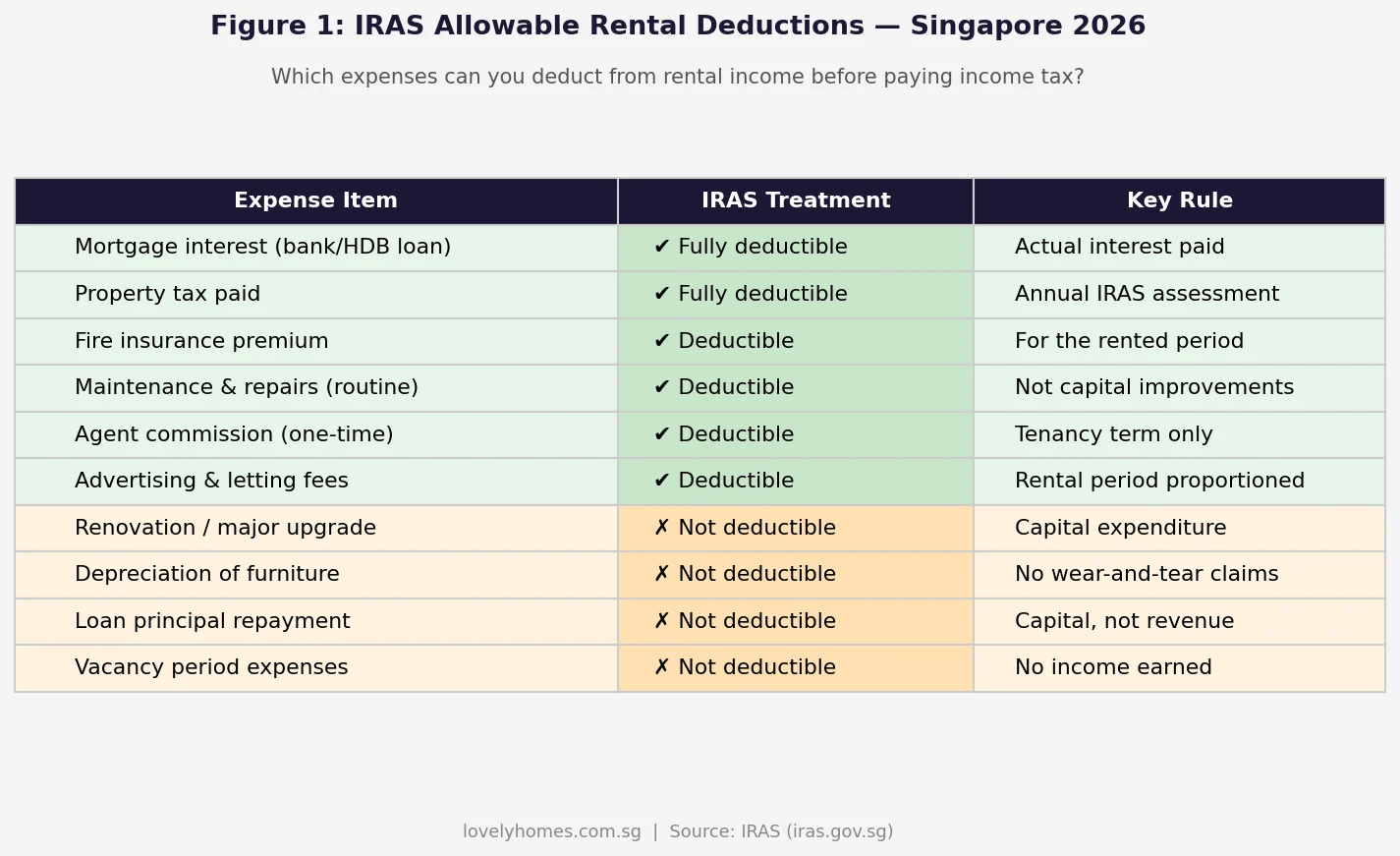
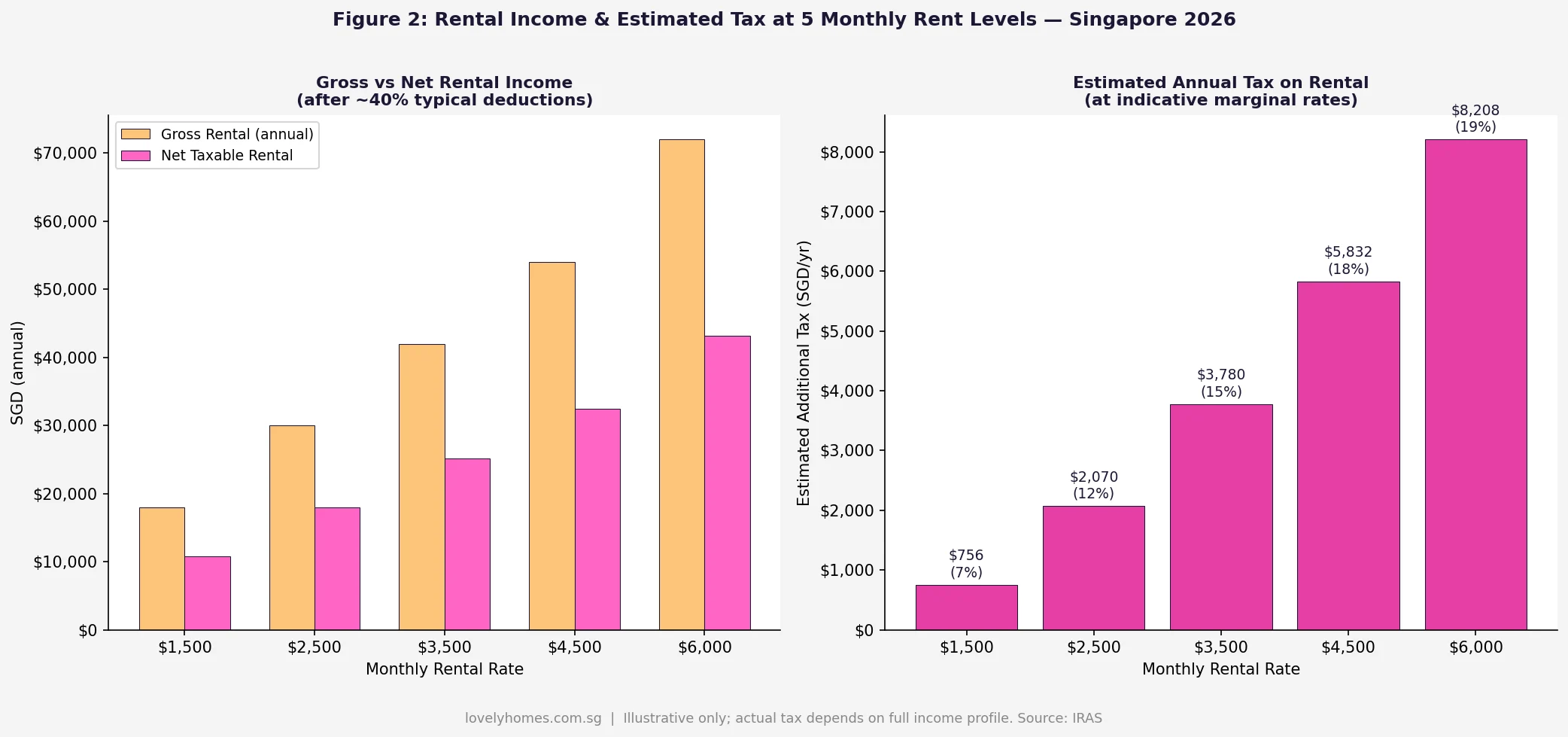
Yes. Rental income from commercial property is taxable under the Income Tax Act as part of your assessable income for the relevant Year of Assessment. You may deduct allowable expenses including mortgage interest, property tax, maintenance and repairs, insurance premiums, and agent commission. If your gross rental receipts exceed S$1 million per year, you must register for GST and charge 9% GST to tenants (which you then remit to IRAS quarterly, after claiming input tax credits on your own GST-bearing expenses).
What is the difference between B1 and B2 industrial property?
Both are industrial land-use categories defined by the URA. B1 (clean/light industrial) permits uses such as food production, light manufacturing, research-and-development labs, and data centres — activities compatible with a residential environment. B2 (general industrial) permits heavier manufacturing, storage, and logistics activities that may generate noise, vibration, or emissions. B2 properties tend to offer higher yields but a narrower tenant pool, and are located further from residential zones. Investors should check the specific approved uses of any industrial unit before purchase, as unauthorised use can result in URA enforcement action.
Are there any restrictions on reselling commercial property in Singapore?
Generally, no — commercial property may be resold at any time with no Seller’s Stamp Duty. However, strata industrial units sold under JTC leases have a restriction: they may only be sold to end-users (not investors) during the first three years of ownership, a rule introduced in September 2017 to reduce speculation. After three years, the restriction lifts and the unit may be sold to any buyer. Conservation shophouses may be subject to URA conservation conditions that restrict certain types of renovation or façade changes, which can affect marketability.
How does the Seller’s Stamp Duty (SSD) work for commercial property?
It does not. Seller’s Stamp Duty was introduced specifically for residential property to discourage short-term speculation. It applies at 12% (sold within one year), 8% (sold in year two), and 4% (sold in year three) for residential properties acquired after 16 December 2021. Commercial and industrial property are entirely exempt from SSD — you may sell a strata office one month after purchase with zero SSD liability. BSD and any applicable GST on the subsequent buyer’s transaction are unrelated to your SSD position as a seller.
Disclaimer: This article is for general informational purposes only and does not constitute financial, tax, or legal advice. Commercial property investment involves significant capital risk, and individual circumstances vary widely. ABSD rates, BSD rates, GST rates, and LTV limits are determined by IRAS, MAS, and the relevant authorities and may change without notice. Always consult a licensed real estate salesperson, a qualified lawyer, and an accountant or tax adviser before making any property investment decision. Official references: IRAS, URA, MAS, JTC.
Seller’s Stamp Duty (SSD) is the Singapore Government’s anti-flipping tax. If you sell a residential property within three years of buying it, you pay a percentage of the sale price — up to 12% — on top of every other selling cost. Get the holding period wrong by even a single day, and a profitable sale can flip into a six-figure loss.
This guide walks you through SSD in 2026: who pays it, how the rate ladder works, when the holding clock starts and stops, who is exempt, and the strategies sellers actually use to manage it. All rates reflect the framework in force since 11 March 2017, which remains current. For the authoritative figures, always check the IRAS Seller’s Stamp Duty page.
Quick Answer — SSD at a glance
SSD applies only to residential property sold within 3 years of acquisition.
The clock starts on the date you signed the OTP or accepted the S&P — not the day you collected the keys.
Payable within 14 days of contract for sale, on the higher of price or market value.
Most short-term sales are caught: divorce sales, job relocations, second properties — SSD applies to nearly all of them.
Industrial property has a separate (shorter) ladder; commercial property is exempt.
What Is SSD and Why Does It Exist?
SSD is a transaction tax levied on the seller of a residential property in Singapore when the property is sold within a defined holding period. It is administered by the Inland Revenue Authority of Singapore (IRAS), calculated on the higher of the sale price or the market value, and payable within 14 days of the contract for sale.
The tax was first introduced in February 2010 and progressively widened in 2011 and 2013 as part of the Government’s suite of property cooling measures. The most recent recalibration was in March 2017, which shortened the SSD holding period from four years to three and lowered the headline rate from 16% to the present 12% — a deliberate easing aimed at supporting genuine homeowners rather than speculators. The 2017 framework is still the live rule book in 2026.
The policy goal is simple: discourage speculative flipping while leaving genuine end-users untouched. By the time you have held a private condo or HDB flat for three full years, the cooling-measure case for taxing your sale is gone, and SSD falls to zero.
Seller’s Stamp Duty Singapore 2026 — the cost of selling too soon.
The 2026 SSD Rate Ladder
The rate you pay depends entirely on how long you held the property before signing the contract for sale. The ladder is steep at the top and falls four percentage points each subsequent year:
Figure 1: SSD rate ladder by holding period — residential property, 2026.
Holding period at sale
SSD rate
Apparent on a S$1.5M sale
Up to 1 year (within 1st year)
12%
S$180,000
More than 1 to 2 years
8%
S$120,000
More than 2 to 3 years
4%
S$60,000
More than 3 years
0%
Nil
The rate is applied to the higher of the contracted sale price or IRAS’s assessed market value — sellers cannot lower their SSD bill by deliberately under-pricing a transaction.
When Does the Holding Clock Start — and Stop?
This is where most disputes arise, because the holding period is calculated to the day. The general rule is:
Start: the date the buyer signs the Option to Purchase (OTP) or, if there is no OTP, the date of the Sale & Purchase Agreement (S&P).
End: the date the buyer signs the next OTP or S&P when reselling.
Note carefully — the keys handover (TOP for new condos, vacant possession for resale) is irrelevant to SSD. A buyer who signs an OTP on 1 March 2024 and signs the next OTP on 28 February 2027 has held for one day under three years — SSD at 4% applies. Sign on 2 March 2027 and SSD drops to zero. Conveyancers routinely time exercise dates around this calendar boundary.
For new launches under construction, the start date is the OTP exercise date, not the TOP date. This means a buyer who signed an OTP in early 2023 for a project that only TOP’d in 2026 is already past the SSD window when they collect the keys.
Who Is Exempt or Remitted?
The exemptions list is narrow. SSD remission is granted only in specific situations, including:
HDB flats — not subject to SSD because HDB has its own Minimum Occupation Period (MOP) regime, which generally bars resale within five years.
Compulsory acquisition by the State (for example, road or MRT line widening).
Bankruptcy of the owner, with proof of insolvency proceedings.
Owners required by HDB to sell on grounds of policy violation.
Inherited property — the holding period is reckoned from the original purchase by the deceased, not the date of inheritance.
Property transferred between spouses as part of a court-ordered division on divorce, in some cases.
Standard life events — relocation overseas for work, family expansion, or financial difficulty — are not grounds for SSD remission. The tax applies even if the seller is selling at a loss.
Worked Example — A S$1.5M Condo Flipped in 6 Months
Imagine a Singapore Citizen who buys a S$1.5M private condo as a second property in March 2026, then receives a job offer in Hong Kong six months later and decides to sell at S$1.58M (a S$80,000 paper gain). Here is what the maths actually looks like:
Figure 2: Worked example — an apparent S$80k gain becomes an S$499k cash loss when SSD is applied.
Acquisition costs (BSD, ABSD on the second property at 20%, legal fees) total S$348,800. The owner has paid S$1,848,800 to take possession. Six months later, the sale at S$1,580,000 attracts SSD at 12% (S$189,600), broker commission, legal fees, and CPF accrued interest. Net proceeds: S$1,349,500. Cash loss: S$499,300.
The lesson is brutal: SSD is designed to make short-term residential property sales economically unattractive even when the underlying market has moved up. For most second-property buyers, the only way to make the maths work is to stay invested for at least three years.
Strategies Sellers Actually Use
If you find yourself needing to sell within the SSD window, there are a small number of strategies practitioners commonly consider:
1. Run the holding-period calendar to the day
Conveyancers often time the OTP issue and exercise so that the sale falls just outside the next rate band. Selling on day 365 versus day 367 of the second year can mean a four-percentage-point swing on the sale price.
Figure 3: Decision matrix — what to do if you must sell, by length of ownership.
2. Rent out instead of selling
If holding-period maths do not work, leasing the unit until SSD falls to zero can preserve value. Singapore rental yields on private condos run 3.0–3.8% gross in 2026, which often covers the carrying cost of the mortgage during the wait.
3. Decoupling within marriage
Where one spouse needs to free up ABSD allowance for a future purchase, transferring a property between spouses (a Part-Disposal arrangement) may attract SSD on the transferred share. Practitioners check carefully whether the holding clock survives the transfer.
4. Swap residential for commercial
Commercial property (offices, shops) is not subject to SSD. Investors with a short horizon sometimes pivot from residential plays to commercial plays specifically to avoid the SSD window. Commercial does carry GST, however, so the trade-off is real.
SSD on HDB — Yes, Technically — But MOP Comes First
Strictly, SSD does not apply to HDB flats sold during the SSD window because the HDB Minimum Occupation Period (MOP) usually prevents resale within five years anyway. The rare exceptions — flats sold under HDB’s compulsory-sale rules, or flats where MOP has been waived by HDB — are also exempt from SSD.
For practical purposes, most HDB sellers should treat MOP as the binding constraint and ignore SSD entirely.
SSD on Industrial Property — A Different (Shorter) Ladder
SSD on industrial property uses a separate, shorter ladder introduced in January 2013: 15% within the first year, 10% in the second year, 5% in the third year, and 0% thereafter — harsher in headline terms but with the same three-year horizon. Commercial property (offices, shops, hotels) attracts no SSD at all.
What This Means for You as a Buyer in 2026
The 2026 environment makes the holding-period calculus even more important. With ABSD at 20% on the second property for Singapore Citizens and 60% for foreigners, entry costs are already punishing. Adding a 12% SSD on a quick exit means roughly one-third of an investment property’s purchase price is consumed by transaction taxes if the holding period is mismanaged.
For buyer-occupiers, the practical advice is unchanged: buy what you can hold through three full years and a typical Singapore property cycle (roughly 7 to 10 years). For investors, the calculus is whether the projected three-to-five-year capital appreciation comfortably exceeds the entry-cost stack — not just SSD but BSD, ABSD, conveyancing, agent commission, and CPF accrued interest combined.
Frequently Asked Questions
Does SSD apply if I bought before 11 March 2017?
Yes, but at the older rate ladder applicable on the date of acquisition. Properties bought between 14 January 2011 and 10 March 2017 use the four-year, 16% / 12% / 8% / 4% ladder. Properties bought between 20 February 2010 and 13 January 2011 use a three-year, 3% / 2% / 1% ladder. IRAS publishes the historical rate tables for cross-reference.
Is SSD payable on the sale of a property at a loss?
Yes. SSD is calculated on the higher of the contracted sale price or the assessed market value, regardless of whether the seller realised a profit or loss on the transaction. Loss-making short-term sales remain fully taxable.
How is SSD different from ABSD?
ABSD (Additional Buyer’s Stamp Duty) is paid by the buyer at purchase based on residency status and number of properties already owned. SSD (Seller’s Stamp Duty) is paid by the seller at sale based on how long the property was held. They are independent taxes and can both apply to the same transaction at different ends.
What if I co-own a property with my spouse and only my spouse’s share is sold (decoupling)?
SSD applies to the share being transferred, calculated on the value of that share. The holding period for the transferred share is reckoned from the original date of acquisition. Conveyancers will typically structure the transfer documentation so that SSD exposure is calculated correctly for the share at issue.
Can I deduct SSD against my income tax?
No. SSD is a transaction tax, not a deductible business expense for an individual seller. Property held by a corporate vehicle may treat SSD differently — consult a Singapore tax adviser for any company-held holding.
Does SSD apply to gifts or transfers within the family?
Generally yes, where the transfer is treated as a sale at market value. There are limited remissions for transfers between spouses incident to divorce or for inherited property where the holding period is reckoned from the deceased’s original acquisition. Always verify with IRAS directly for non-arm’s-length transfers.
When exactly is SSD due?
SSD must be paid within 14 days of the contract for sale — that is, the date the buyer exercises the OTP or signs the S&P. Late payment attracts penalty interest of 5% on the unpaid duty per annum, plus possible additional charges. The seller’s conveyancer typically pays SSD out of the sale proceeds at completion.
This article is intended as general information about Seller’s Stamp Duty in Singapore as at May 2026 and does not constitute tax, legal, or financial advice. Rates, exemptions, and procedures are set by the Inland Revenue Authority of Singapore and may be amended at any time without notice. For authoritative figures, refer to IRAS, the Housing & Development Board, the Monetary Authority of Singapore, the Urban Redevelopment Authority, and CPF Board for related procedures. For transactions of any size, engage a licensed Singapore conveyancing solicitor and, if relevant, a chartered accountant or tax practitioner before signing an OTP or S&P.
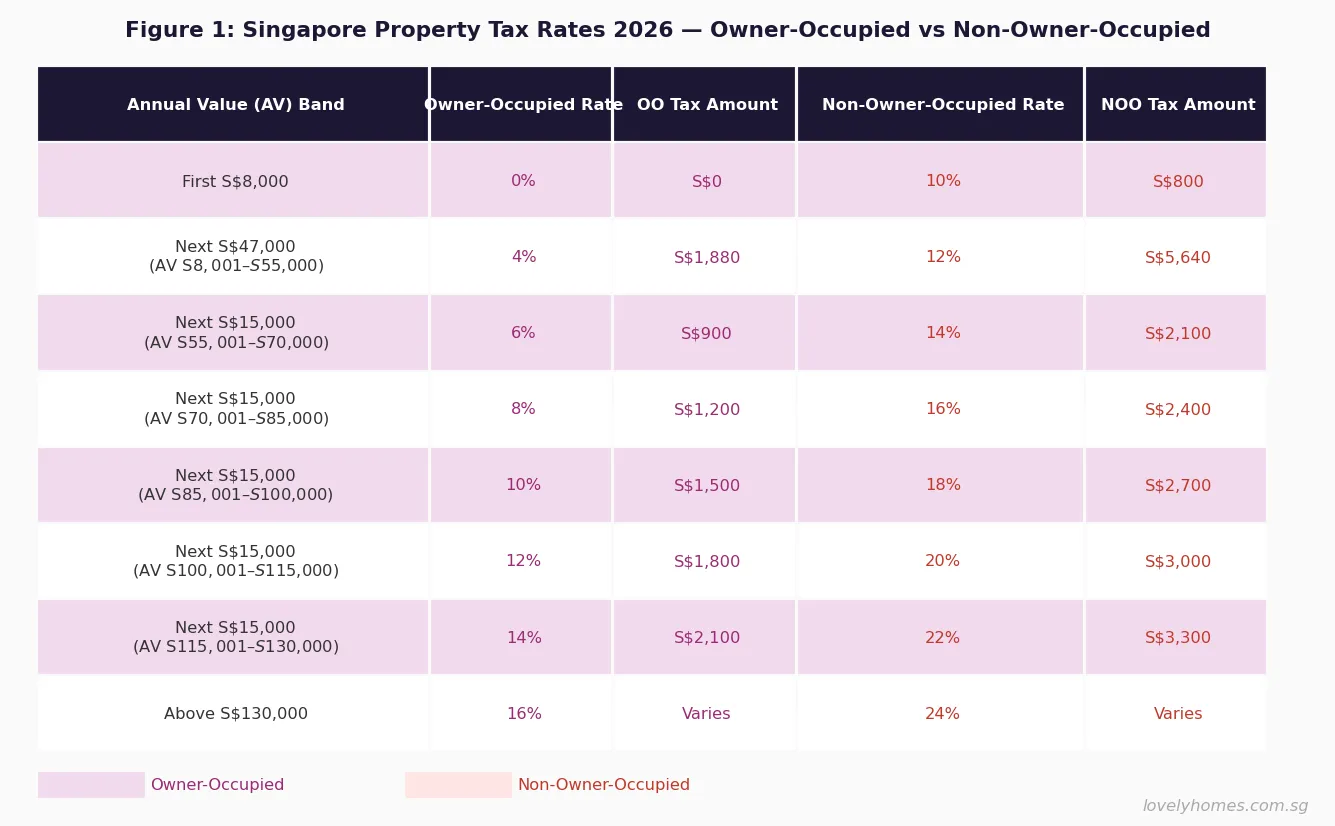
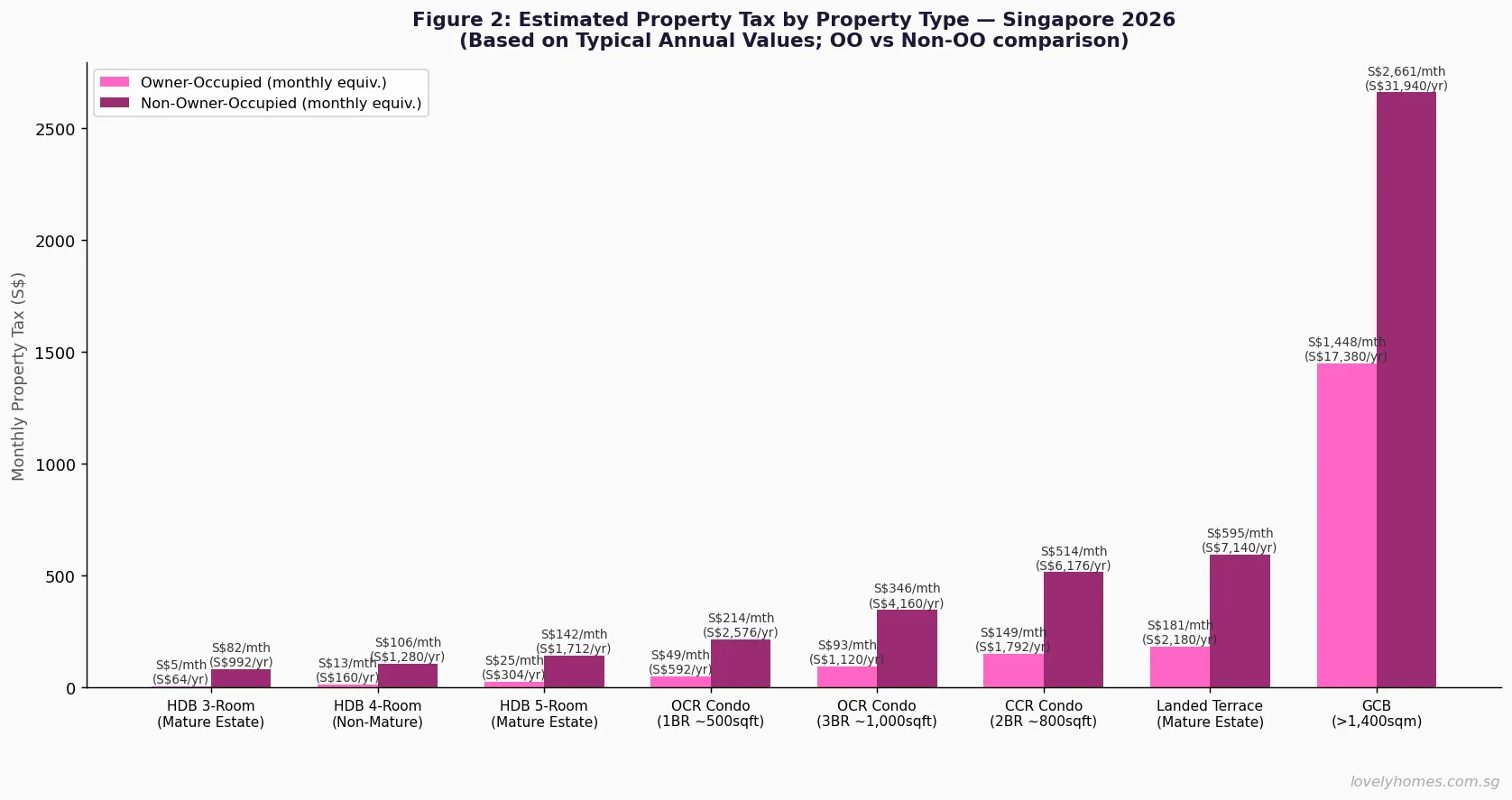
Property tax Singapore is a recurring annual tax levied by IRAS on all immovable property in Singapore. It is not based on your purchase price or your income — it is based on the Annual Value (AV) of the property, an IRAS estimate of what it would rent for on the open market. This design means even an owner who paid for their home decades ago faces a tax bill that rises with the rental market.
This 2026 guide walks through how Annual Value is set, the progressive rate bands for owner-occupiers and non-owner-occupiers, when the bill falls due, and a worked example that shows how the same property can create radically different tax bills depending on whether the owner lives in it or rents it out. For the official tables, see the IRAS Property Tax Rates page.
Quick Answer — Property Tax 2026
Based on: Annual Value (AV), not purchase price or income.
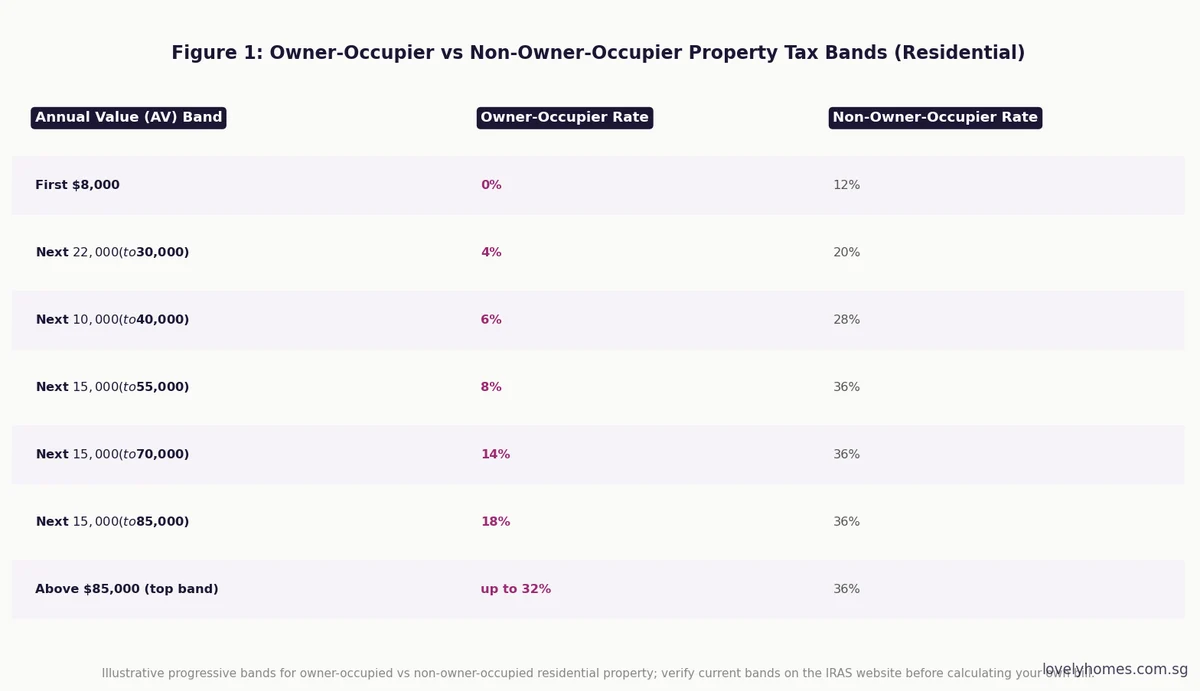
Owner-occupier rates: 0% on the first S$12,000, rising progressively to 32% on AV above S$100,000.
Non-owner-occupier rates: 12% on first S$30k, rising to 36% above S$60k.
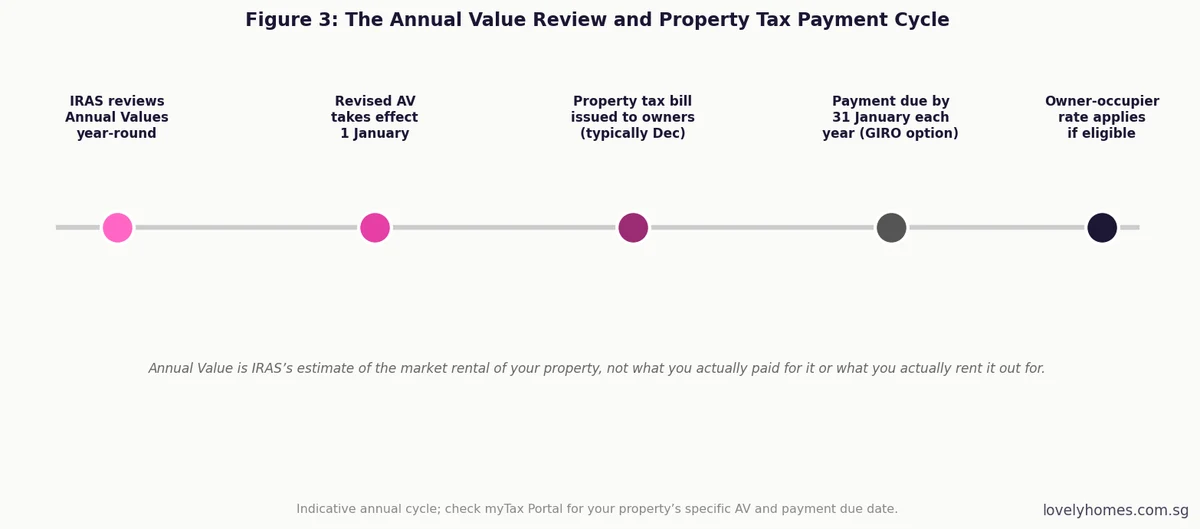
Payable annually: bill issued in December, due 31 January. GIRO allows 12 monthly instalments.
Late payment: 5% penalty, then additional 1% per month of delay.
What is Annual Value and How Is It Set?
Annual Value is IRAS’s estimate of the gross annual rent your property could fetch on the open market, excluding furniture, fittings and service charges. IRAS revises AVs periodically based on actual rental transactions in the area, demographic trends, and condition of the building.
AV has nothing to do with:
Your purchase price
The actual rent you may receive (if renting out)
Your occupancy status (IRAS sets AV once; your occupancy decides which rate table applies)
The mortgage outstanding
You can check your property’s current AV at any time via myTax Portal using your Singpass. If you believe the AV is wrong, you have 30 days from the date of notification to object and supply rental evidence.
The 2026 Owner-Occupier Rate Ladder
Figure 1: Singapore’s progressive property tax rates for owner-occupied residential property in 2026.
Owner-occupiers pay the lowest rates because the scheme is designed to encourage home ownership. The progressive bands as at 2026:
First S$12,000 of AV: 0%
Next S$28,000 (S$12,001–S$40,000): 4%
Next S$15,000 (S$40,001–S$55,000): 6%
Next S$15,000 (S$55,001–S$70,000): 10%
Next S$15,000 (S$70,001–S$85,000): 14%
Next S$15,000 (S$85,001–S$100,000): 24%
Above S$100,000: 32%
Owner-occupier rates apply to the property you physically live in and where you are the legal owner. You cannot claim owner-occupier status on two properties simultaneously — the second (and subsequent) is taxed at non-owner-occupier rates.
The 2026 Non-Owner-Occupier Rate Ladder
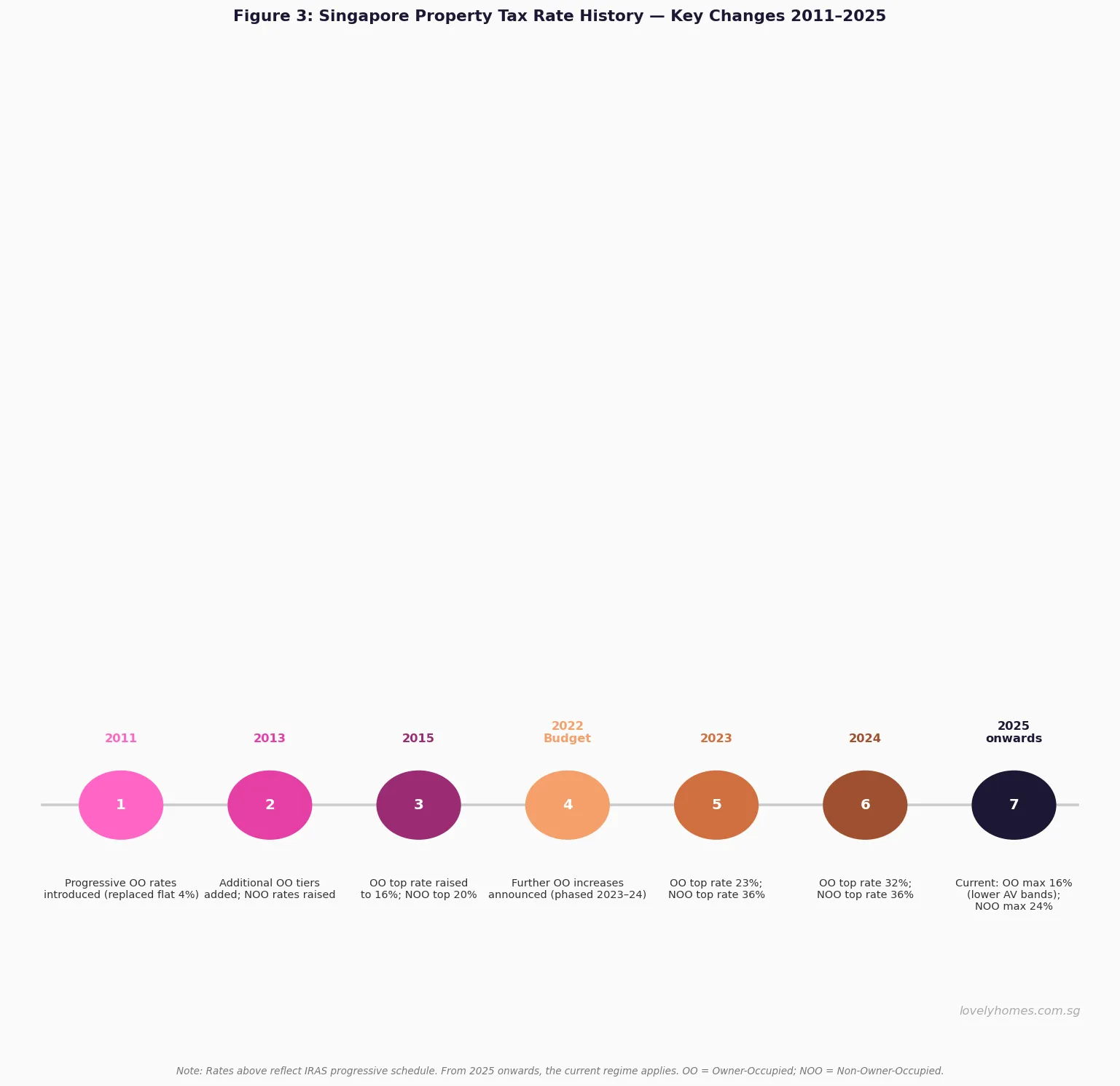
If your property is rented out or vacant, the higher non-OO rates apply. These were raised significantly in 2023 and 2024:
First S$30,000 of AV: 12%
Next S$15,000 (S$30,001–S$45,000): 20%
Next S$15,000 (S$45,001–S$60,000): 28%
Above S$60,000: 36%
These rates apply to all forms of non-owner-occupation, including rental to tenants, use by family members who are not joint owners, and vacancy.
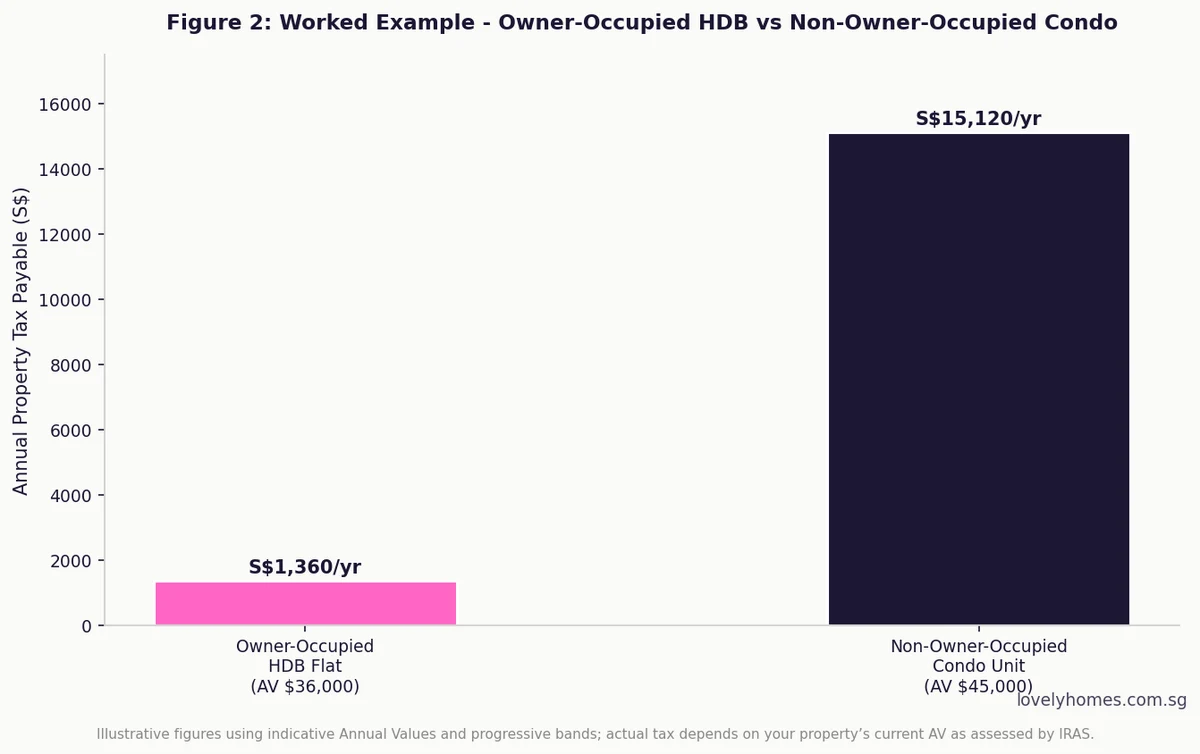
Worked Example: Same Condo, Two Tax Bills
Take a 3-bedroom condo in District 15 with an Annual Value of S$48,000.
Scenario A: Owner lives in it
Band
Amount
Rate
Tax
First S$12,000
S$12,000
0%
S$0
Next S$28,000
S$28,000
4%
S$1,120
Next S$8,000
S$8,000
6%
S$480
Total
S$48,000
—
S$1,600
Scenario B: Owner rents it out
Band
Amount
Rate
Tax
First S$30,000
S$30,000
12%
S$3,600
Next S$15,000
S$15,000
20%
S$3,000
Next S$3,000
S$3,000
28%
S$840
Total
S$48,000
—
S$7,440
The non-OO bill is 4.7× the OO bill on identical property with identical AV. That gap is exactly what the Government intends — a deliberate wedge against holding residential property as pure investment.
When the Bill is Due
Property tax for the calendar year is billed in December of the preceding year and due on 31 January.
Payment options:
GIRO — recommended. Split into 12 monthly instalments automatically. No interest.
Lump sum. Pay in full by 31 January via PayNow, AXS, or credit card (fees may apply).
Late payment: 5% penalty on the unpaid amount, plus 1% additional per month of delay (capped at 12%).
Reliefs and Rebates
Several reliefs can reduce your property tax bill:
Owner-occupier rates are automatic for the property that IRAS’s records show you living in. Update the records if you move.
Property Tax Rebate (introduced in 2023 Budget and repeated in 2024, 2025, 2026) has provided up to 100% rebate on the first S$1,000–S$2,000 of tax for owner-occupied HDB flats. Check current year for details.
Vacancy refund: historically available for vacant units; fully abolished from January 2014.
Frequently Asked Questions
Is property tax deductible for rental income tax?
Yes. Property tax is an allowable expense when computing taxable rental income on your annual personal income tax return.
What happens to the tax when I sell?
Property tax for the calendar year remains your obligation through the date of completion. The completion statement typically pro-rates the tax between seller and buyer based on occupancy days.
How does AV for new launches get set?
New launches are assigned a provisional AV based on comparable rentals in the area. Once the property is physically completed and rental evidence accumulates, the AV is reassessed.
Is there property tax on commercial or industrial property?
Yes, at a flat 10% of AV for most commercial and industrial categories. The progressive residential bands do not apply.
Can I reduce property tax by keeping the property vacant?
No. Vacancy attracts non-OO rates and AV remains based on market rental potential. There is no vacancy discount since 2014.
Disclaimer: This guide is general information, not tax advice. Rate bands and rebate schemes change annually via the Budget. Always verify current rules at iras.gov.sg and consult a tax professional for material decisions.
Seller’s Stamp Duty (SSD) is a tax payable by the seller when disposing of certain residential and industrial properties in Singapore within a specified holding period. Unlike Additional Buyer’s Stamp Duty (ABSD), which the buyer pays, SSD is borne entirely by the property seller.
Introduced in February 2010, SSD was designed as a cooling measure to deter short-term property speculation and encourage longer-term property ownership. Over the past 16 years, the rates and holding periods have changed multiple times in response to market conditions and Government policy objectives.
For sellers, understanding SSD is critical: it can significantly erode capital gains or even create a loss when selling within the holding period. Many property investors overlook SSD in their calculations and are shocked by the tax bill at completion.
Figure 1: The current four-year SSD ladder — 16%/12%/8%/4% on disposal value (IRAS, 2026).
Current SSD Rates in 2026 (Critical Update)
Quick Answer: What Are Today’s SSD Rates?
Residential properties: Depends on purchase date.
Purchased 11 March 2017 to 3 July 2025: 12% (Year 1) / 8% (Year 2) / 4% (Year 3) / 0% thereafter
Purchased on or after 4 July 2025: 16% (Year 1) / 12% (Year 2) / 8% (Year 3) / 4% (Year 4) / 0% thereafter
Industrial properties: 15% (Year 1) / 10% (Year 2) / 5% (Year 3) / 0% thereafter (unchanged since January 2013)
Commercial properties: 0% (retail shops, offices, no SSD applies)
Important: On 4 July 2025, the Government announced a significant restructure of residential SSD, effective for all properties purchased on or after that date. The holding period extended from 3 years to 4 years, and rates increased by 4 percentage points across all tiers.
Year of Disposal
Residential (Old: purchased ≤ 3 July 2025)
Residential (New: purchased ≥ 4 July 2025)
Industrial
Year 1
12%
16%
15%
Year 2
8%
12%
10%
Year 3
4%
8%
5%
Year 4
N/A
4%
N/A
Year 5+
0%
0%
0%
Figure 2: The July 2025 reset undid the 2017 easing — back to four years, up 4 percentage points per bracket.
A Brief History of SSD in Singapore
SSD rates have evolved significantly over the past 16 years, reflecting the Government’s shifting approach to cooling the property market:
February 2010: SSD introduced at 1% (Year 1) / 2% (Year 2) / 3% (Year 3) for sales within 1 year of purchase.
August 2010: SSD extended to cover sales within 3 years of purchase, maintaining the 1%/2%/3% rates.
January 2011: Rates escalated dramatically to 16% (Year 1) / 12% (Year 2) / 8% (Year 3) / 4% (Year 4) over 4 years, coinciding with the Global Financial Crisis aftermath and rising property prices.
January 2013: Industrial SSD introduced at 15%/10%/5% over 3 years, with no holding period extension thereafter.
11 March 2017: Residential SSD rates eased back to 12% (Year 1) / 8% (Year 2) / 4% (Year 3), and the holding period shortened from 4 years to 3 years. This marked a significant market cooling.
4 July 2025:Latest restructure: SSD rates for residential properties increased to 16% (Year 1) / 12% (Year 2) / 8% (Year 3) / 4% (Year 4), and the holding period extended back to 4 years. This applies to all properties purchased on or after 4 July 2025. Properties purchased before this date remain under the 12%/8%/4% regime (3-year holding period).
When Does SSD Apply? Key Conditions
SSD applies when all of the following conditions are met:
Property type: The property must be residential (private condo, terrace house, landed property) or industrial (factory, warehouse, B1/B2 zoned land). Commercial properties (retail shops, office units) are not subject to SSD.
Holding period: The property must be sold or disposed of within the holding period (3 years for pre-July 2025 purchases, 4 years for post-July 2025 purchases).
Disposal triggering event: The relevant date is when the Option to Purchase (OTP) is granted to the buyer or the Sale and Purchase Agreement (SPA) is signed, whichever is earlier. This date marks Day 1 of the holding period.
Acquisition date: The holding period starts from the date the OTP was exercised or the SPA was signed when you purchased the property (the date you acquired it).
SSD applies to most property disposals: sales to third parties, transfers to family members (unless specifically remitted), gifts, and even transfers in lieu of insolvency. The key trigger is the disposal date relative to the acquisition date.
HDB and SSD
Whilst SSD technically applies to HDB flats purchased after the legislative date (February 2010), in practice, SSD rarely applies to HDB owners because HDB imposes a Minimum Occupation Period (MOP). Most HDB flats have a 5-year MOP, meaning you cannot sell before 5 years have passed. By the time you can sell, the SSD holding period (3 or 4 years) has expired, and you owe no SSD.
However, if you own an HDB flat purchased before the SSD regime and sell early (during a defined period when some flats had shorter MOPs), SSD could theoretically apply. Consult your legal conveyancer for your specific flat’s MOP rules.
Executive Condominiums (ECs) and SSD
Executive Condominiums are subject to SSD if disposed of within the holding period after the MOP expires (typically 5 years). Once the MOP is completed and the property is decoupled from HDB rules, it is treated as a private residential property for SSD purposes.
Worked Examples: How SSD Is Calculated
Example 1: Private Condo Purchased January 2025, Sold June 2026
Scenario: You purchased a private condo on 15 January 2025 for S$1,800,000. You sold it on 20 June 2026 for S$2,000,000. At the time of sale, the property’s market value was assessed at S$1,950,000.
Analysis:
Purchase date: 15 January 2025 (before 4 July 2025 → old regime applies)
Sale date: 20 June 2026
Holding period: Approximately 17 months = Year 2
SSD rate: 8% (Year 2 rate under old regime)
Disposal value for SSD: Higher of sale price (S$2,000,000) or market value (S$1,950,000) = S$2,000,000
SSD payable: 8% × S$2,000,000 = S$160,000
Outcome: Despite a S$200,000 paper gain, you owe S$160,000 in SSD. Your actual net gain after SSD (and ignoring agent fees, legal costs, and ABSD if applicable to the buyer) would be only S$40,000—or entirely erased if other transaction costs are factored in.
Example 2: Private Condo Purchased March 2023, Sold April 2026
Scenario: You purchased a private condo on 10 March 2023 for S$1,600,000. You sold it on 5 April 2026 for S$1,750,000.
Analysis:
Purchase date: 10 March 2023 (before 4 July 2025 → old regime applies)
Sale date: 5 April 2026
Holding period: Approximately 3 years 3 months = beyond Year 3
SSD rate: 0% (holding period exceeded 3 years)
SSD payable: S$0
Outcome: You have held the property beyond the 3-year holding period, so no SSD is due. Your entire S$150,000 gain (less transaction costs and ABSD if applicable) is yours to keep.
Example 3: Industrial Property Purchased January 2025, Sold March 2026
Scenario: You purchased an industrial property (warehouse) on 20 January 2025 for S$2,000,000. You sold it on 15 March 2026 for S$2,100,000.
Analysis:
Property type: Industrial
Purchase date: 20 January 2025
Sale date: 15 March 2026
Holding period: Approximately 14 months = Year 2
SSD rate: 10% (Year 2 rate for industrial properties)
Disposal value for SSD: Higher of sale price or market value = S$2,100,000
SSD payable: 10% × S$2,100,000 = S$210,000
Outcome: Your S$100,000 paper gain is entirely wiped out by the S$210,000 SSD bill. You would need to pay S$110,000 from your own pocket to complete the sale. This illustrates why industrial property flippers face substantial tax penalties.
Example 4: New Regime – Residential Purchased July 2025, Sold November 2026
Scenario: You purchased a private condo on 10 July 2025 for S$1,500,000. You sold it on 15 November 2026 for S$1,650,000.
Analysis:
Purchase date: 10 July 2025 (on or after 4 July 2025 → new regime applies)
Sale date: 15 November 2026
Holding period: Approximately 16 months = Year 2
SSD rate: 12% (Year 2 rate under new regime)
Disposal value for SSD: S$1,650,000
SSD payable: 12% × S$1,650,000 = S$198,000
Outcome: Under the new, stricter regime, even a modest 10% appreciation is swallowed by a 12% SSD rate. The sale results in a net loss of approximately S$48,000 (before other transaction costs).
How SSD Is Calculated: Disposal Value
A critical point: SSD is calculated on the higher of the selling price or the market value of the property as at the date of sale.
If you sell below market value (e.g., to a family member at a discount, or in a distressed sale), the property’s assessed market value may still be used by IRAS to compute SSD. You cannot reduce your SSD bill by negotiating a lower sale price.
Market value is typically determined by a professional valuation, comparable sales data, or IRAS’s own assessment. If you believe IRAS’s valuation is incorrect, you can request a review, but the onus is on you to provide supporting evidence.
How to Legally Avoid or Minimise SSD
SSD is a significant liability for property sellers. Fortunately, several legitimate strategies exist:
1. Hold for the Full Period (3 or 4 Years)
The most straightforward approach: Hold your residential property for at least 3 years (if purchased before 4 July 2025) or 4 years (if purchased after) before selling. Once the holding period expires, SSD drops to 0%, and you keep your entire gain.
For industrial properties, hold for 3 years to eliminate SSD.
This strategy is ideal if you can afford to hold the property long-term. Many professional investors plan around these holding periods when structuring their portfolios.
2. Timing the OTP Carefully (Within Limits)
The key holding-period dates are:
Start date: The date you exercised the OTP or signed the SPA when you purchased the property.
End date: The date you granted the OTP to the buyer or signed the SPA when you sold the property.
If you purchased on 10 January 2025, the 3-year threshold is reached on 10 January 2028. If you can delay granting your buyer’s OTP until 10 January 2028 or later, SSD drops to 0%.
However, there are strict limits: You cannot artificially delay the OTP grant date if you have already agreed to sell. Doing so could constitute a breach of contract or fraud. The dates must reflect genuine transaction timings.
3. Properties Exempt or Remitted from SSD
Certain disposals qualify for full SSD remission or exemption:
Compulsory Acquisition (CA) by the Government: If your property is acquired under the Land Acquisition Act (e.g., for public housing, roads, or infrastructure), SSD is fully remitted.
Developer Repurchase: If a property developer repurchases a unit within a stipulated period (e.g., within 5 years of the original sale for some EC schemes), SSD may be remitted under the scheme’s terms.
Matrimonial Property Transfer: Transfers of residential property between spouses or ex-spouses as part of matrimonial or ancillary relief proceedings may qualify for remission if executed pursuant to a Court Order. However, this is a narrow exemption—consult a legal advisor.
HDB Repurchase by HDB: If HDB repurchases a flat from you (e.g., under right of first refusal schemes), SSD is typically remitted.
Bankruptcy or Insolvency: In certain insolvency situations, SSD may be remitted if the property is disposed of by a trustee or official receiver under court order.
These exemptions are narrow and require specific conditions. If you believe you qualify, consult a licensed conveyancing lawyer or contact IRAS directly for a ruling.
4. Decoupling Strategy (With Caution)
If you are married and own property as joint tenants, decoupling (transferring one spouse’s share to the other spouse) creates a new acquisition date for the transferred share. This means the holding period for that share restarts.
Example: You and your spouse bought a property jointly on 1 January 2025. On 1 July 2026, you transfer your spouse’s share to yourself. Your spouse’s share now has a new acquisition date (1 July 2026), so its holding period restarts. If you then sell the entire property on 1 January 2027, your share is subject to Year 2 SSD, but your spouse’s share (which was only held from July 2026 to January 2027 = 6 months = Year 1) would trigger Year 1 SSD on that portion.
This strategy is complex, has significant stamp duty and ABSD implications, and may not be worthwhile. Do not attempt without guidance from a tax professional and conveyancer.
5. Beware: Legitimate Avoidance vs. Tax Evasion
There is a clear legal line between legitimate tax planning and tax evasion:
Legitimate: Holding the property longer, timing transactions around the 3-year mark, claiming available exemptions.
Illegal: Falsifying transaction dates, under-declaring the sale price, splitting the sale into multiple transactions to circumvent SSD, or using straw buyers.
IRAS actively audits property transactions and has recovered substantial SSD arrears from taxpayers who attempted to evade the tax. The penalties (including interest and potential prosecution) far exceed any tax saved.
Figure 3: ABSD is charged when you buy; SSD is charged only if you sell within the holding period.
SSD vs. ABSD: What’s the Difference?
Many property sellers confuse SSD (Seller’s Stamp Duty) with ABSD (Additional Buyer’s Stamp Duty). They are separate taxes and can both apply to a single transaction:
Aspect
SSD (Seller’s Stamp Duty)
ABSD (Additional Buyer’s Stamp Duty)
Payable By
Seller
Buyer
When
At sale, if property sold within holding period (3 or 4 years)
At purchase, if buyer is foreigner, company, trust, or owns other properties
Applies To
Residential & industrial properties only
Residential properties only (no ABSD on industrial)
Purpose
Deter short-term speculation by sellers
Deter foreign ownership & multiple property purchases by buyers
Example Rate
12% (Year 1, old regime) or 16% (Year 1, new regime)
Key Point: Both SSD and ABSD can apply to a single transaction. If a Singaporean citizen (owner) sells a residential property within 3 years to a foreign buyer (or to another Singaporean who already owns 1+ properties), the seller pays SSD and the buyer pays ABSD. Each is computed on the transaction price and borne by the respective party.
Frequently Asked Questions (FAQ)
Q1: Who decides what the “disposal value” is for SSD calculation?
A: The disposal value is the higher of the actual selling price or the property’s market value as at the date of sale. If you sell at S$2M but IRAS assesses the market value at S$2.2M, SSD is computed on S$2.2M. You can appeal IRAS’s valuation, but the burden is on you to prove the value with evidence (comparables, professional appraisals). In most cases, the selling price is the disposal value, unless it is significantly below market (a rare event).
Q2: Can I use my CPF to pay SSD?
A: No. SSD is a seller’s cost and must be paid from the sale proceeds or your own funds. CPF can only be used to purchase residential property and to pay the conveyance duty (stamp duty) on the purchase itself, not on the sale or SSD. SSD is withheld from your sale proceeds at completion.
Q3: Does SSD apply if I gift my property to a family member?
A: Yes, in principle, SSD applies to gifts unless a specific remission is granted. The “disposal value” for a gift is the property’s market value (since there is no actual sale price), and SSD is computed on that value. However, if the gift is part of a matrimonial order or compulsory acquisition, remission may apply. For most family gifts without legal exemption, SSD is payable by the donor (gift-giver). Consult a lawyer before gifting property if within the holding period.
Q4: Does SSD apply if I inherited the property?
A: No, SSD does not apply to inherited properties. Inheritance is not a “disposal” triggering SSD; it is a transmission of title by operation of law upon death. Your holding period for SSD purposes starts from the date the original buyer (the deceased) purchased the property. If the deceased held it for more than 3 years before dying, there is no SSD when you (the heir) subsequently sell. If the deceased had held it less than 3 years and you sell shortly after, you may owe SSD, but the holding period is measured from the original purchase date, not your inheritance date.
Q5: Does SSD apply to HDB flats?
A: Technically, yes—SSD applies to HDB flats purchased after February 2010. However, in practice, SSD rarely triggers for HDB owners because HDB imposes a Minimum Occupation Period (typically 5 years). Once you can sell (after MOP), the SSD holding period has usually expired. If you own an older HDB flat or one with a shorter MOP and sell within the holding period, SSD would apply. Check your flat’s MOP with HDB before selling early.
Q6: Can I get SSD back if the buyer backs out?
A: SSD is paid at completion of the sale (when the sale is finalised and transferred to the buyer). If the buyer backs out before completion, the sale does not complete, and SSD is not triggered or payable. If the sale completes and you have paid SSD, but the buyer later defaults or the sale is reversed (rare), you would need to seek legal remedy or negotiate a refund directly with the buyer. IRAS does not refund SSD unless the underlying transaction is formally set aside by Court order.
Q7: How is SSD calculated on an incomplete property (Build-to-Completion, BUC)?
A: For a property sold before completion of construction (i.e., before the Completion Certificate is issued), SSD is calculated on the contract price (as stated in the SPA or OTP), not the actual completion value. The holding period is measured from the date the OTP was exercised on the original purchase. If you resale a BUC unit within the holding period, SSD is due on the resale price. This is an area where many investors get caught—ensure you understand the SSD implications before flipping an off-plan property.
Q8: What happens if I sell a property that is jointly owned with my spouse?
A: If you and your spouse own a property as joint tenants or tenants-in-common, the sale price is shared (usually 50/50 unless another ratio is agreed). SSD is calculated on the full sale price, but it is paid from the joint sale proceeds. The holding period is the same for both owners (it starts from the date the property was first acquired). No special relief applies merely because of joint ownership; both spouses are treated as single sellers of a single property. If you decouple (transfer one spouse’s share to the other), the transferred share gets a new acquisition date, which can complicate SSD calculations.
Q9: Can I defer or spread SSD payments over time?
A: No, SSD must be paid in full at the point of completion (when the sale is finalised). There is no option to spread the payment or defer it. Your conveyancer will calculate the SSD owed and ensure it is deducted from the sale proceeds before you receive your net amount. If you cannot afford the SSD, the sale cannot complete, and you remain the owner.
Q10: Are there any SSD changes coming in 2026/2027?
A: As of April 2026, no further changes to SSD have been announced. The most recent restructure took effect on 4 July 2025 (16%/12%/8%/4% over 4 years for properties purchased on or after that date). Keep monitoring IRAS’s official website and Government budget announcements for any future changes. However, do not assume changes; rely only on official announcements from IRAS and the Ministry of Finance (MOF).
This guide is provided for general informational purposes only and does not constitute legal, tax, financial, or investment advice. SSD rates, holding periods, and exemptions are subject to change at the discretion of the Government of Singapore and the Inland Revenue Authority of Singapore (IRAS).
Consult a licensed conveyancing lawyer to understand your specific SSD liability based on your property’s purchase and sale dates.
Obtain a professional valuation if you believe the market value of your property may differ significantly from the sale price.
Contact IRAS directly for clarification on any specific scenarios or exemptions that may apply to your situation.
Property laws change, and individual circumstances vary widely. LovelyHomes.com.sg and its authors assume no liability for actions taken based on this guide. Always seek independent professional advice before committing to a property transaction.
Every property buyer in Singapore pays Buyer’s Stamp Duty (BSD) — a transaction tax levied on the purchase price or market value (whichever is higher) of any residential, commercial, or industrial property. Unlike the Additional Buyer’s Stamp Duty (ABSD), which applies only to second and subsequent property purchases by residents and all properties purchased by foreigners, BSD is the baseline duty that every single buyer must pay, regardless of citizenship, residency status, or how many properties they already own.
Whether you are buying your first HDB flat, upgrading to a private condo, or acquiring commercial premises, understanding how BSD is calculated, when it must be paid, and how it differs from ABSD is essential to budgeting correctly for your purchase. Get BSD wrong, and it can consume tens of thousands of dollars in unexpected costs.
This guide walks you through the exact BSD rates in force in 2026, provides step-by-step calculation examples across multiple property types and price points, explains how CPF reimbursement works, and clarifies how BSD stacks with ABSD. All figures reflect the latest IRAS guidance.
Quick Answer — BSD at a glance
Applies to: Every property purchase (residential, commercial, industrial, land)
Basis: Higher of purchase price or market valuation
Payment timeline: Within 14 days of signing OTP/SPA
CPF: Cannot be paid directly from CPF; reimbursement available after stamping
Top residential rate: 6% on amounts above S$3,000,000
Top non-residential rate: 5% (raised 15 February 2023)
What is Buyer’s Stamp Duty (BSD)?
Buyer’s Stamp Duty is a progressive transaction tax imposed by the Inland Revenue Authority of Singapore (IRAS) on the acquisition of any property in Singapore. The term “stamp duty” originates from the historical practice of stamping documents as proof that tax had been paid; today, the duty is administered entirely through the Stamp Duty system managed by IRAS and supporting conveyancers.
BSD is:
Progressive: The rate increases in tiers as the property price rises
Compulsory: It applies to every buyer, without exception
Upfront: It must be paid within 14 days of executing the Option to Purchase (OTP) for resale, or the Sale & Purchase Agreement (SPA) for new launches
Non-recoverable: Unlike GST or certain taxes, BSD is not refundable
How BSD Differs From ABSD
The key difference between BSD and ABSD often confuses first-time buyers. Here is the distinction in plain terms:
Feature
BSD (Buyer’s Stamp Duty)
ABSD (Additional Buyer’s Stamp Duty)
Who pays
Every buyer
Only 2nd+ residential buyers; all foreigners buying residential
Rate structure
Progressive (1–6% for residential)
Flat (0–60% depending on profile)
Applied to
Residential, commercial, industrial, land
Residential properties only
Purpose
Government revenue; general property transaction tax
Cooling measure; discourages speculation and foreign ownership
Remission available
No
Yes (married couple, developer, etc.)
Example to clarify: A Singapore Citizen buying their first residential property pays BSD but zero ABSD. A Singapore Citizen buying their second residential property pays BSD plus 20% ABSD on top.
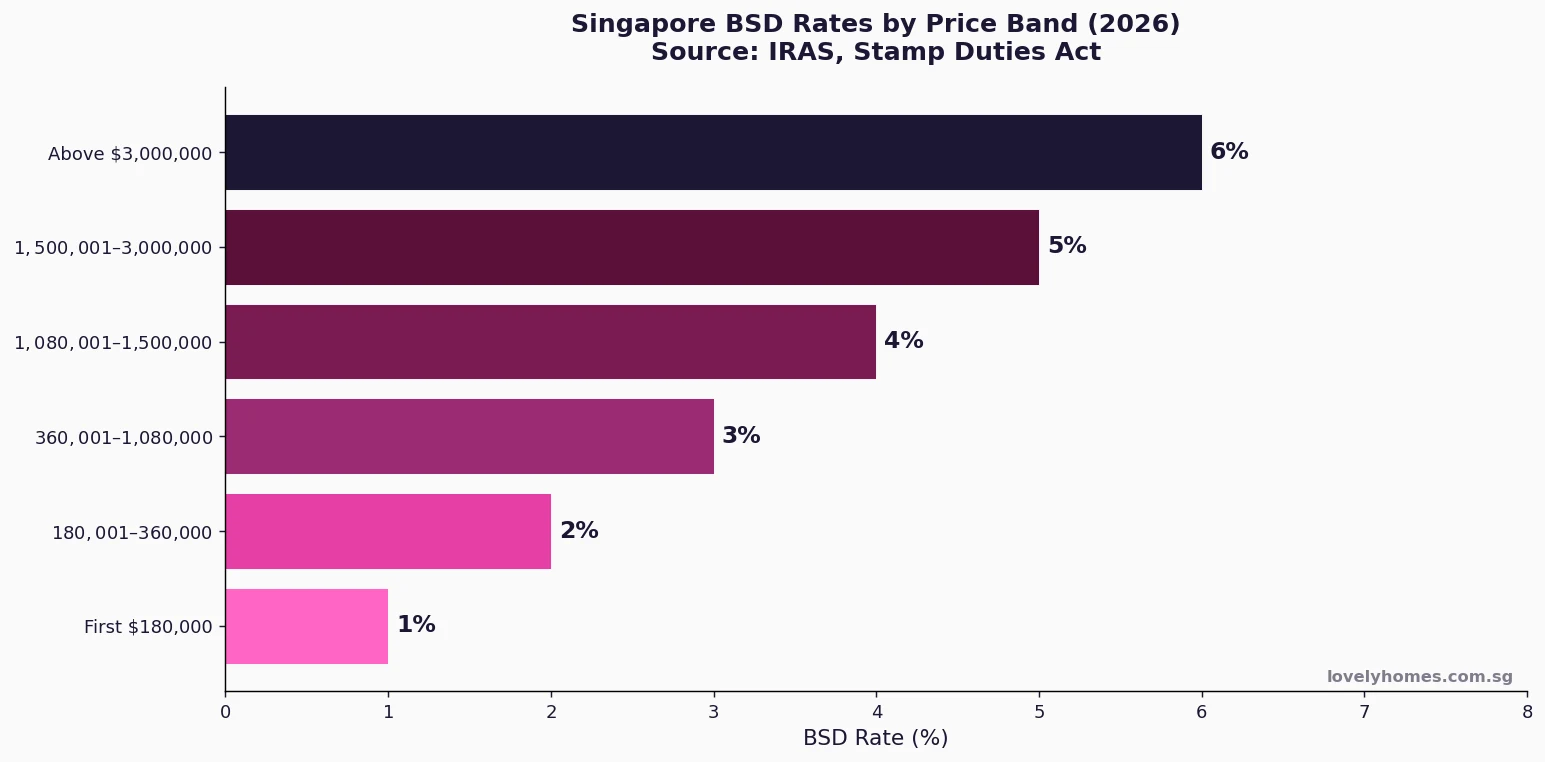
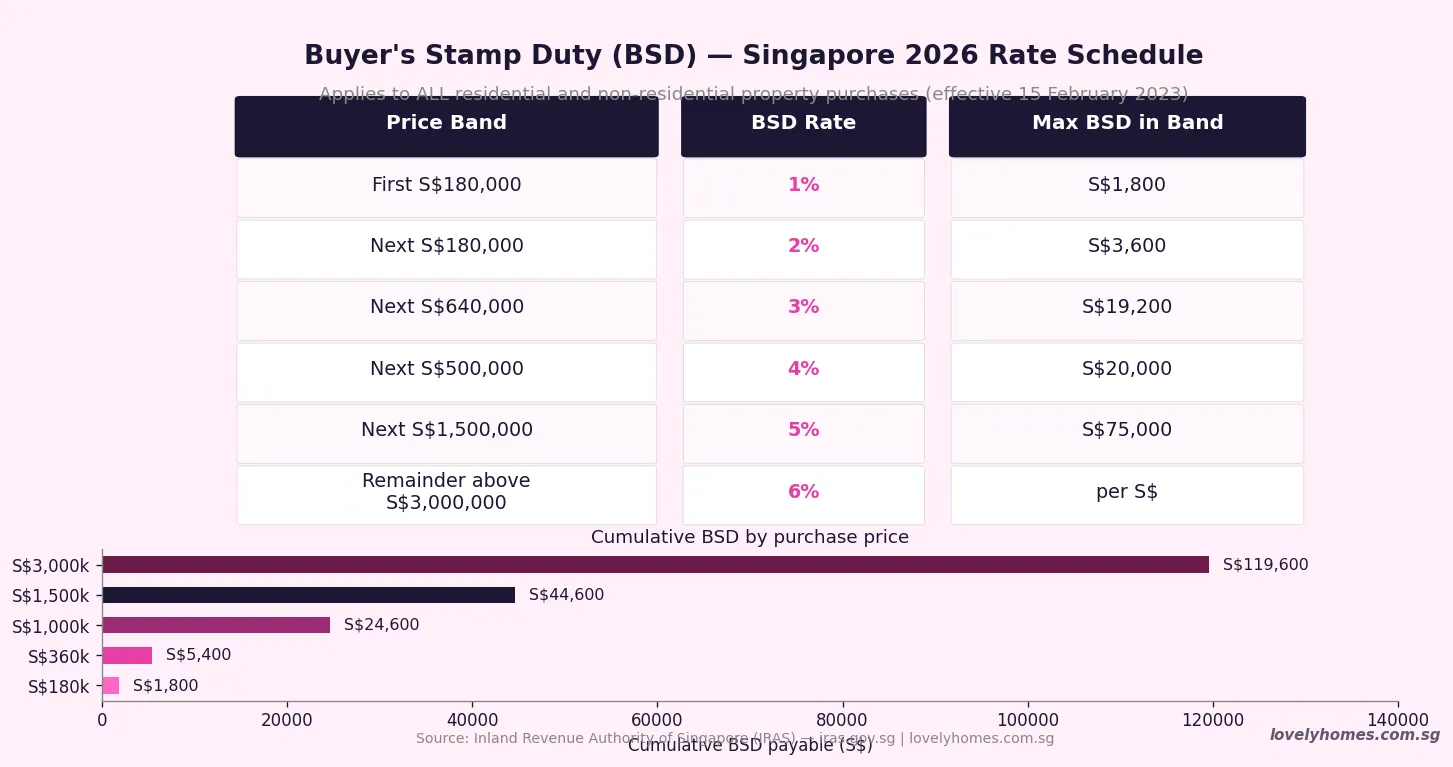
Figure 1: The six-bracket BSD rate ladder for residential property (1% to 6%, IRAS, 2026).
BSD Rates for Residential Properties (2026)
As of 15 February 2023, the residential BSD rates are:
Property Price Bracket
BSD Rate
Cumulative Duty (Example)
First S$180,000
1%
S$1,800
S$180,001 to S$360,000
2%
S$3,600
S$360,001 to S$1,000,000
3%
S$19,200
S$1,000,001 to S$1,500,000
4%
S$20,000
S$1,500,001 to S$3,000,000
5%
S$75,000
Above S$3,000,000
6%
6% on excess
Note: The 6% top rate for residential properties was introduced in July 2018. The 5% top rate for non-residential properties was raised from 4% on 15 February 2023.
BSD Rates for Non-Residential Properties (2026)
Non-residential properties (commercial, industrial, land for non-residential use) follow a similar progressive structure but max out at 5%:
Property Price Bracket
Non-Residential Rate
First S$180,000
1%
S$180,001 to S$360,000
2%
S$360,001 to S$1,000,000
3%
S$1,000,001 to S$1,500,000
4%
Above S$1,500,000
5%
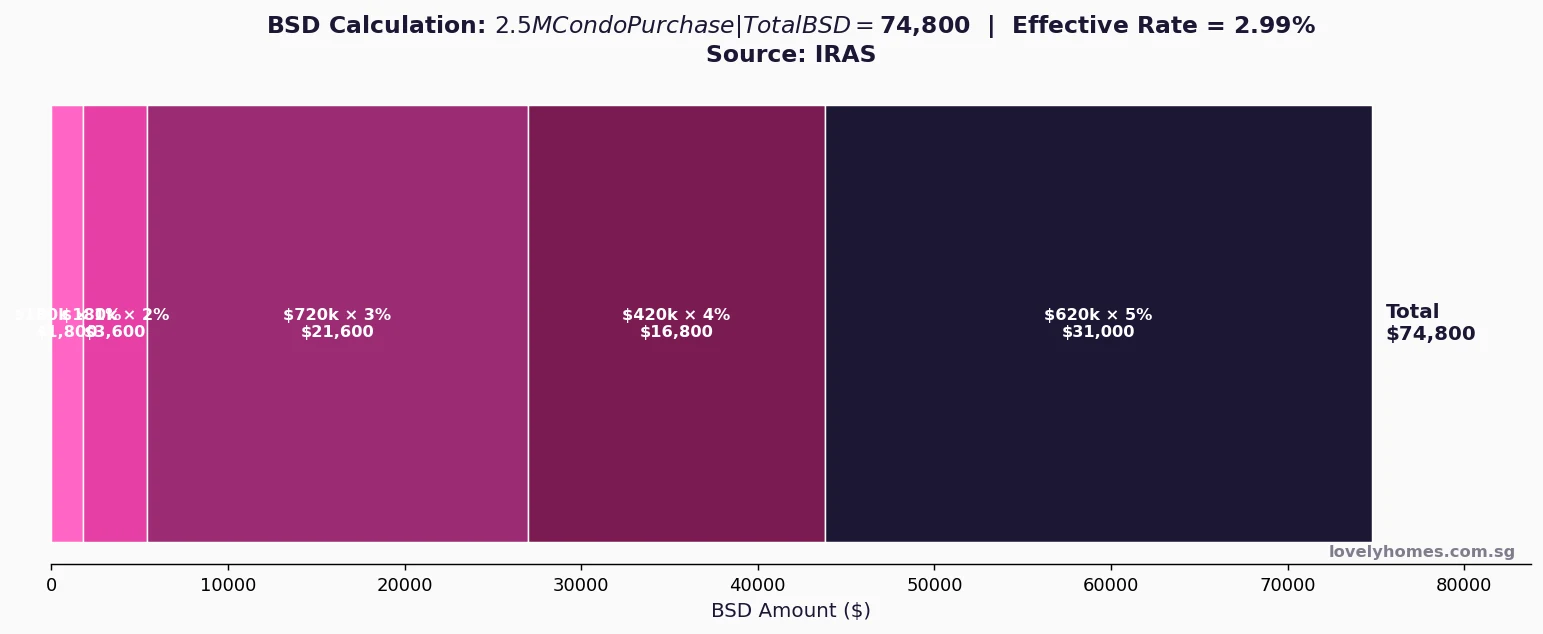
Figure 2: How the bill builds up on a S$1.8M private condo — S$59,600 BSD across five brackets.
How BSD is Calculated: Step by Step
BSD is calculated on the higher of the purchase price or the market value of the property at the time of acquisition. This is a critical point: if the market value (as assessed by IRAS or an independent valuer) exceeds your negotiated purchase price, you pay BSD on the higher figure.
Key rules:
BSD is rounded down to the nearest dollar, subject to a minimum of S$1
The calculation is tiered and progressive — you do not pay the top rate on the entire property price, only on the portion that falls into that bracket
BSD is computed using the property price or market value at the time the OTP is granted (for resale) or the SPA is signed (for new launches)
Worked Example 1: HDB Resale at S$650,000
A Singapore Citizen couple purchases a 4-room HDB resale flat in Yung Ho for S$650,000. This is their first joint property purchase.
Calculation:
First S$180,000 @ 1% = S$1,800
Next S$180,000 (S$180,001–S$360,000) @ 2% = S$3,600
Total BSD = S$1,800 + S$3,600 + S$8,700 = S$14,100
They also pay 0% ABSD (first residential property for a Singapore Citizen). Total stamp duty = S$14,100.
Worked Example 2: Private Condo Resale at S$1,800,000
A Singapore Citizen already owns one residential property and purchases a 3-bedroom condo resale in the central business district for S$1,800,000. This is their second residential property.
BSD calculation:
First S$180,000 @ 1% = S$1,800
Next S$180,000 (S$180,001–S$360,000) @ 2% = S$3,600
Next S$640,000 (S$360,001–S$1,000,000) @ 3% = S$19,200
Next S$500,000 (S$1,000,001–S$1,500,000) @ 4% = S$20,000
0% ABSD (first residential property for a Singapore Citizen)
Total stamp duty payable = S$209,600
Note how the 6% band kicks in at S$3,000,000 and above — on luxury properties, BSD becomes a significant cost.
Who Pays BSD? Property Types and Exemptions
BSD applies to the acquisition of any property in Singapore — residential, commercial, industrial, or undeveloped land — regardless of the buyer’s citizenship or residency status. However, certain transactions are exempt or treated differently:
Properties Subject to BSD
HDB flats (public housing)
Executive Condominiums (ECs) — during MOP and after privatisation
Land (whether for residential or non-residential development)
Transactions Not Attracting BSD
Transfers within families: If a property is transferred from one spouse to another (with no consideration), no BSD is triggered
Transmissions on death: When a property is transmitted via a will or intestacy, no stamp duty is payable on the transmission itself (though a later sale would trigger BSD)
Gifts: A gift of property attracts a nominal stamp duty (10 cents) but not the full BSD rate
Leasehold renewals: Renewing a lease on the same property does not trigger BSD
When Must BSD Be Paid?
BSD (together with ABSD, if applicable) must be paid within 14 days of the date the property transaction is formally documented:
For resale properties: Within 14 days of signing the Option to Purchase (OTP)
For new launch properties: Within 14 days of signing the Sale & Purchase Agreement (SPA)
For contracts executed overseas: Within 30 days of the contract being received in Singapore
Late payment penalty: If BSD is not paid within the prescribed timeframe, IRAS charges a penalty. For delays of up to three months, the penalty is typically 5% of the duty; beyond three months, it escalates to 10%. Interest also accrues.
Can You Pay BSD Using CPF?
No, BSD (like ABSD) cannot be paid directly from your CPF Ordinary Account at the point of purchase. You must pay in cash or by cheque/bank transfer to IRAS.
However, CPF reimbursement is available after the property is stamped:
Once IRAS has stamped your property document, you may apply for CPF reimbursement of BSD (and the purchase price) from your Ordinary Account
The reimbursement claim is typically submitted via the conveyancing lawyer and approved by the CPF Board within 1–2 months
Your CPF funds are refunded to your OA once your legal title to the property has been registered with the Land Authority
This two-step process — pay upfront, then reimburse from CPF — is a key budgeting consideration for many first-time HDB and condo buyers. Ensure you have sufficient cash reserves to bridge the gap between the OTP date and the CPF reimbursement.
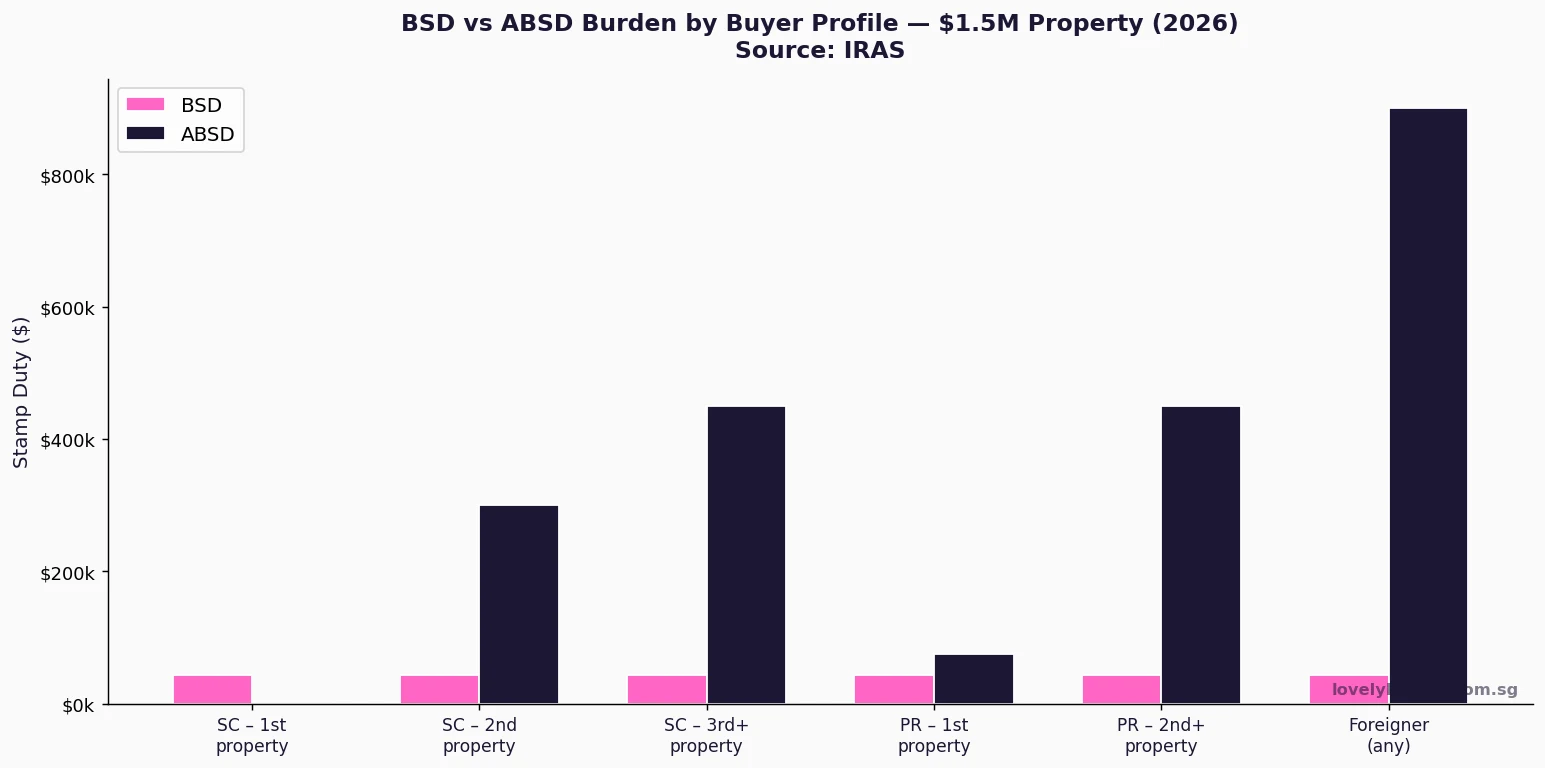
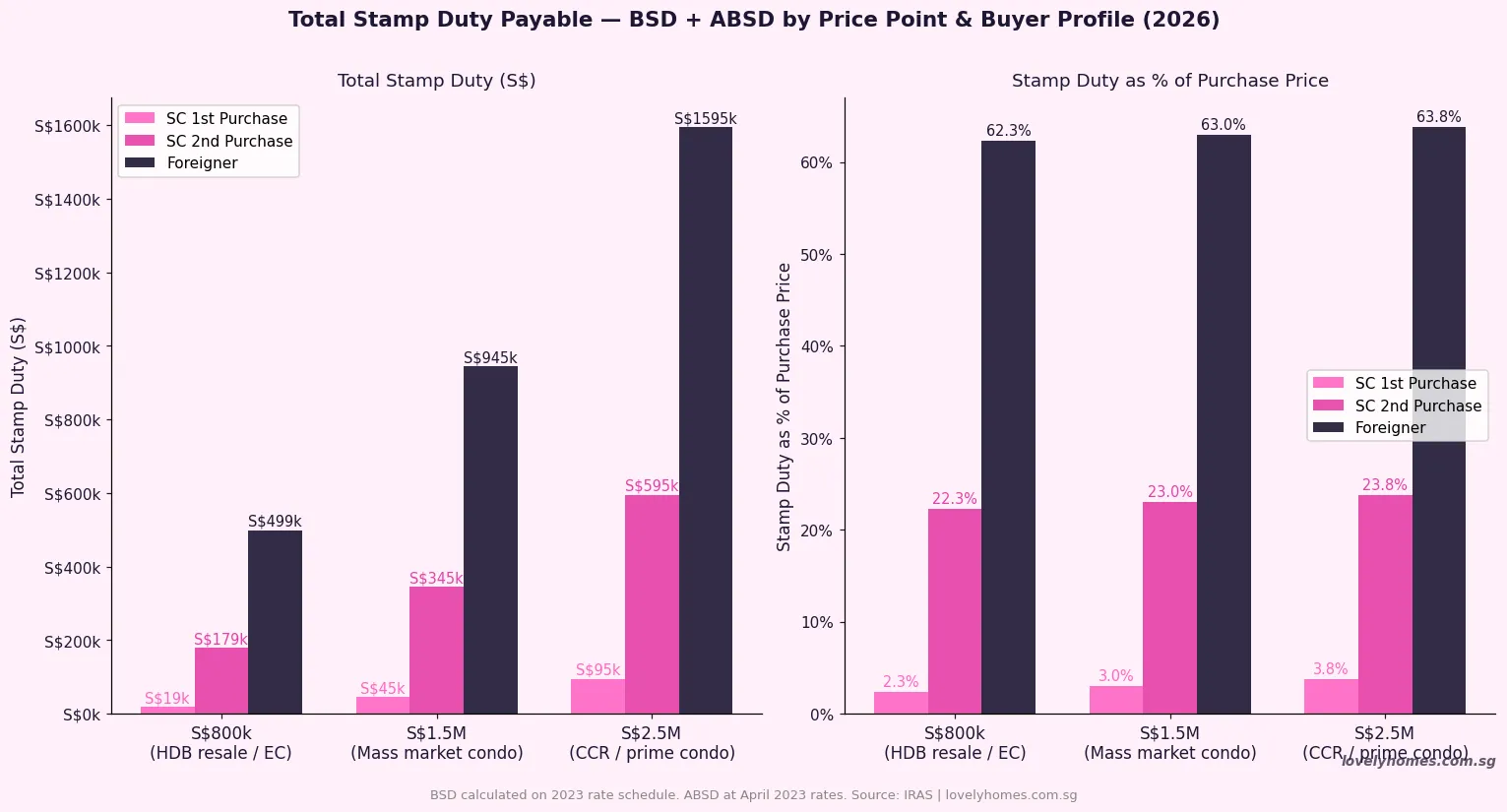
Figure 3: Two stamp duties, very different jobs — BSD is universal; ABSD is targeted.
BSD vs ABSD: Side-by-Side Comparison
To solidify understanding, here is a comprehensive comparison:
Aspect
BSD
ABSD
Full name
Buyer’s Stamp Duty
Additional Buyer’s Stamp Duty
Who pays
Every buyer
Second/third+ residential buyers; all foreigners (residential)
Payment basis
Higher of purchase price or market value
Rate type
Progressive (1%–6% residential)
Flat rate (0%–65% depending on buyer profile)
Applies to
Residential, commercial, industrial, land
Residential only
Example (SC, 2nd property, S$1.8M)
S$59,600
S$360,000
Payment deadline
14 days of OTP/SPA
14 days of OTP/SPA
CPF reimbursement
Yes (post-stamping)
No (non-refundable)
Remission/deferral schemes
No
Yes (married couple, developer, etc.)
The History of BSD in Singapore (2011–2026)
Understanding how BSD has evolved helps explain why the rates stand where they do today:
July 2018: The top residential rate was raised from 5% to 6% on amounts above S$3,000,000 — designed to moderate price growth in the luxury segment
15 February 2023: The top non-residential rate was raised from 4% to 5% in line with a broader cooling-measures update — reflecting rising commercial property prices in Singapore’s business core
The progressive structure itself has remained relatively stable, with the tier brackets unchanged since their introduction. This consistency allows developers and conveyancers to model costs with confidence.
Frequently Asked Questions (FAQ)
Is BSD the same as ABSD?
No. BSD is the baseline stamp duty every buyer pays. ABSD is an additional layer that only applies to second-and-subsequent residential purchases and purchases by foreigners. A first-time buyer pays BSD but zero ABSD; a second-time buyer pays both BSD and ABSD.
Can I pay BSD from my CPF Ordinary Account?
No, not directly at the point of purchase. You must pay BSD in cash. After the property document is stamped and registered, you can apply for CPF reimbursement of the purchase price and stamp duty from your CPF Ordinary Account.
What if the valuation is higher than my purchase price?
BSD is calculated on the higher of the purchase price or the market value. If IRAS or an independent valuer assesses the market value above your negotiated price, you pay stamp duty on the higher figure. This is common in the resale HDB market where transaction prices may lag official valuations. Always budget for this possibility.
Do I pay BSD on inherited property?
No. When property is inherited via a will or intestacy, the transmission to the heirs does not attract stamp duty. However, if you later sell that inherited property, the buyer (not the inheritor) pays BSD based on the sale price.
Is BSD payable on commercial property?
Yes. Commercial and industrial properties are subject to BSD. The rates are the same as residential up to S$1,500,000, then cap at 5% above S$1,500,000 (rather than 6% for residential).
How do I file and pay BSD?
Your conveyancing lawyer handles the submission and payment to IRAS. Upon signing the OTP/SPA, the lawyer prepares the stamped property document and submits it to IRAS for assessment and stamping. Payment is made on behalf of the buyer, typically before the completion date. The stamped document is then lodged with the Singapore Land Authority for registration.
What is the penalty for late BSD payment?
If BSD is not paid within 14 days of the OTP/SPA, IRAS charges a penalty of 5% for delays up to three months, escalating to 10% thereafter. Interest also accrues on the unpaid amount. Late payment can delay the registration of your legal title, so it is critical to meet the deadline.
Can BSD be remitted or waived in any circumstance?
No. Unlike ABSD, which has remission schemes for married couples and property developers, BSD is a fixed tax with no remission or deferral schemes. It must be paid in full within the prescribed timeframe.
What if I buy as a company or trust?
A property acquired by a company, trust, or other entity (not a natural person) is subject to the same BSD rates as a residential or non-residential property. However, such purchases often also trigger higher ABSD rates (65% for entities on residential property, depending on the nature and structure of the entity).
Key Takeaways: How to Manage Your BSD Bill
To wrap up, here are the core points to lock in as you plan a property purchase:
BSD is compulsory. Every buyer, on every property, pays it. There is no avoiding it, and no remission schemes apply.
It is progressive. The more expensive the property, the higher your effective rate, but you only pay the tier rate on each bracket of the purchase price.
Budget for both BSD and ABSD. If you are a second-plus buyer or a foreigner buying residential, both apply. Your total stamp-duty bill can easily exceed S$300,000–S$400,000 on a S$2 million upgrade.
Timing and staging matter. For upgraders, selling your existing property before buying your next one avoids the 20% ABSD entirely — potentially saving six figures.
The payment deadline is strict. 14 days from OTP/SPA signature. Delay incurs penalties and can freeze your legal-title registration.
CPF reimbursement is post-stamping. You must have cash at hand to pay BSD upfront; CPF refund follows weeks or months later.
Always verify with IRAS. This guide reflects the rates as of April 2026, but the Government can change BSD or introduce new cooling measures. Check the IRAS Stamp Duty page before signing an OTP.
What to Do Next
If you are in active purchase planning, we recommend three next steps:
Calculate your true cost of entry. Use our BSD calculator (if available) or work through the examples above with your target property price to see how much stamp duty you’ll owe. Don’t forget ABSD if applicable.
Review your CPF position. Check your CPF Ordinary Account balance via myGov.sg, and confirm that post-reimbursement, you’ll still have sufficient balance for housing withdrawal limits. Our Home Loans & Mortgages guide walks through the interaction between stamp duty, mortgage eligibility (TDSR, MSR, LTV), and CPF withdrawal rules.
If you’re upgrading, model the ‘sell-first’ scenario. Many upgraders can save tens of thousands by selling their existing property before buying the next. See our Upgrader Guide for detailed sequencing advice.
Unsure which property type is right for you? Our detailed property guides — HDB Buying Guide, Condo Buying Guide, Landed Buying Guide — break down the stamp-duty implications alongside financing and market comparison for each property class.
This guide is for general information only and does not constitute legal, tax, financial, or conveyancing advice. Buyer’s Stamp Duty rates, calculation rules, and remission schemes can change. Always verify the current position on the IRAS Stamp Duty page and consult a licensed conveyancing lawyer or tax specialist before committing to any property transaction. The worked examples in this guide are illustrative and assume no market valuation adjustments; your actual BSD may differ if IRAS determines a market value higher than the purchase price.