Property Tax Singapore 2026: Complete Guide to Annual Value, Owner-Occupier and Non-Owner-Occupier Rates
Quick Answer: Property Tax in Singapore
- Property tax is an annual tax administered by the Inland Revenue Authority of Singapore (IRAS) and payable by every property owner in Singapore, whether the property is occupied, rented out, or left vacant.
- The tax is calculated on the property’s Annual Value (AV), IRAS’s estimate of the market rent the property could reasonably fetch in a year, not the price you paid for it.
- Residential property tax uses a progressive rate structure, and critically, the rates differ sharply depending on whether the property is owner-occupied or non-owner-occupied (rented out, vacant, or a second/investment property).
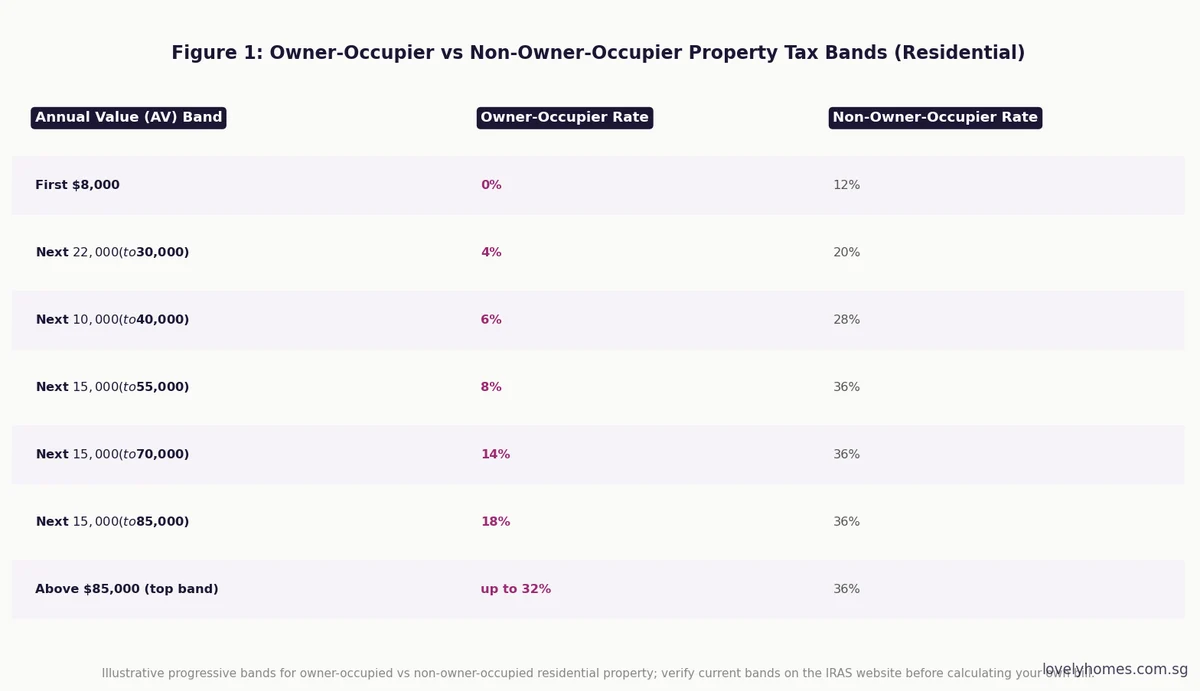
- Owner-occupier rates start at 0% for the first $8,000 of AV and rise progressively to a top marginal rate, while non-owner-occupier rates start at 12% and rise to a flat 36% on AV above a set threshold, a considerably heavier burden.
- Owners must proactively apply for owner-occupier tax rates if they move into a new home; the concession is not automatic for every property and can be missed if not filed correctly with IRAS.
- Property tax bills are typically issued in December for the year ahead, with payment due by 31 January; GIRO instalment plans are available to spread payments across the year.
- Property tax is separate from, and payable in addition to, one-off transaction taxes such as Buyer’s Stamp Duty (BSD) and Additional Buyer’s Stamp Duty (ABSD), which apply only once at purchase.
What Is Property Tax and Who Administers It?
Property tax is a recurring annual tax levied on the ownership of immovable property in Singapore, whether that property is an HDB flat, a private condominium, landed housing, or commercial and industrial premises. It is administered by the Inland Revenue Authority of Singapore (IRAS) under the Property Tax Act, and it applies regardless of how the property is actually used: an owner pays property tax whether they live in the property themselves, rent it out to a tenant, leave it vacant, or use it for business purposes. This makes property tax fundamentally different from income tax, since it is a tax on the ownership and notional rental value of an asset rather than a tax on income actually earned, and it is also distinct from one-off transaction taxes like Buyer’s Stamp Duty, which are payable only once at the point of purchase.
The policy rationale behind property tax is straightforward: it is one of Singapore’s core sources of recurring Government revenue, and its progressive, owner-occupier-favouring structure is deliberately designed to keep the tax burden light for Singaporeans living in their own homes, particularly lower- and middle-value HDB flats, while imposing a meaningfully higher burden on investment and rental properties. This dual-rate structure has become an increasingly important policy lever alongside Additional Buyer’s Stamp Duty (ABSD) in shaping how the Government manages demand for non-owner-occupied residential property.
Annual Value: The Number Your Tax Bill Is Based On
The single most important concept in understanding your property tax bill is Annual Value (AV). AV is IRAS’s estimate of the gross annual rent the property could reasonably be expected to fetch if it were rented out, based on estimated market rentals of comparable or similar properties in the vicinity, and excluding furniture, fittings and service charges. Critically, AV is not your purchase price, your outstanding mortgage, or the actual rent you personally charge if you do rent the unit out; it is IRAS’s own independent estimate, reviewed regularly to keep pace with market rental movements. You can check your property’s current AV, along with recent AV history, for free via the myTax Portal on the IRAS website.
Because AV is reviewed periodically rather than fixed at purchase, it typically rises when market rents in a neighbourhood climb, which in turn increases the property tax payable even if the owner has made no changes to the property and has not sold or refinanced it. This has been a point of public discussion in recent years as rental markets tightened, since a rising AV directly increases the annual property tax bill for existing owners, independent of any transaction taking place.
Owner-Occupier vs Non-Owner-Occupier Rates: Why the Gap Matters
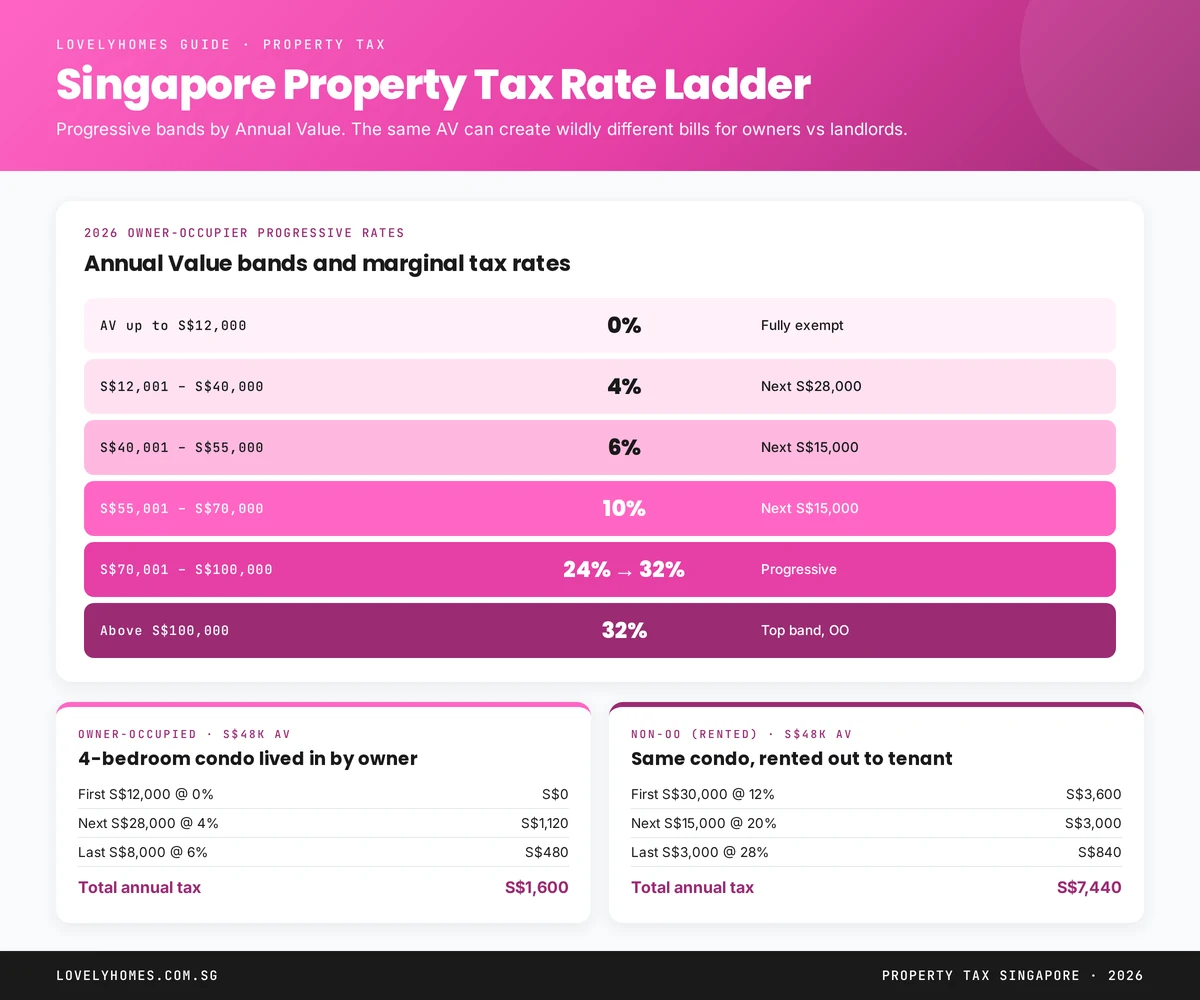
Singapore’s residential property tax structure is built around a deliberate and substantial gap between owner-occupier and non-owner-occupier tax rates. A property qualifies for owner-occupier rates when it is used exclusively as the residence of the owner or the owner’s family, with no part of it rented out. Under this concessionary structure, the first $8,000 of Annual Value is taxed at 0%, with progressively higher marginal rates applying to higher AV bands, topping out at a marginal rate well below the non-owner-occupier ceiling.
By contrast, a property is taxed at non-owner-occupier rates if it is rented out in full, left vacant, held as a second or subsequent residential property by the same owner, or otherwise not used as the owner’s own home. These rates start considerably higher, at 12% on the first band of AV, and rise steeply to a flat 36% on AV above the top threshold. The practical effect is that an investment property and an owner-occupied home with an identical Annual Value can attract vastly different annual tax bills, often multiples apart, which is precisely the policy intent: keep the tax light on the family home, and heavier on investment and rental housing.
Importantly, the owner-occupier concession is not automatically applied the moment you buy or move into a property. Owners must apply to IRAS for owner-occupier tax rates via the myTax Portal, typically shortly after moving in, and IRAS may conduct checks (such as verifying utility usage or requesting supporting documents) to confirm genuine owner-occupation. Owners who buy a new home but delay applying, or who forget to update their status when their living arrangements change, can end up being taxed at the far higher non-owner-occupier rate until the application is properly filed and approved.
What Happens If You Own Multiple Properties?
Owner-occupier tax rates are generally available for only one residential property per owner, being the one that is genuinely occupied as their home. Any additional residential property held by the same owner, whether vacant, rented out, or used by a family member who is not the registered owner, is taxed at the higher non-owner-occupier rates. This interacts closely with the broader suite of property-related taxes in Singapore: a second property purchase already typically attracts Additional Buyer’s Stamp Duty (ABSD) at the point of purchase, and thereafter, unless it becomes the owner’s primary residence, it will also be taxed annually at non-owner-occupier property tax rates, a combined effect that meaningfully raises the cost of holding multiple properties in Singapore.
The Annual Value Review and Payment Cycle
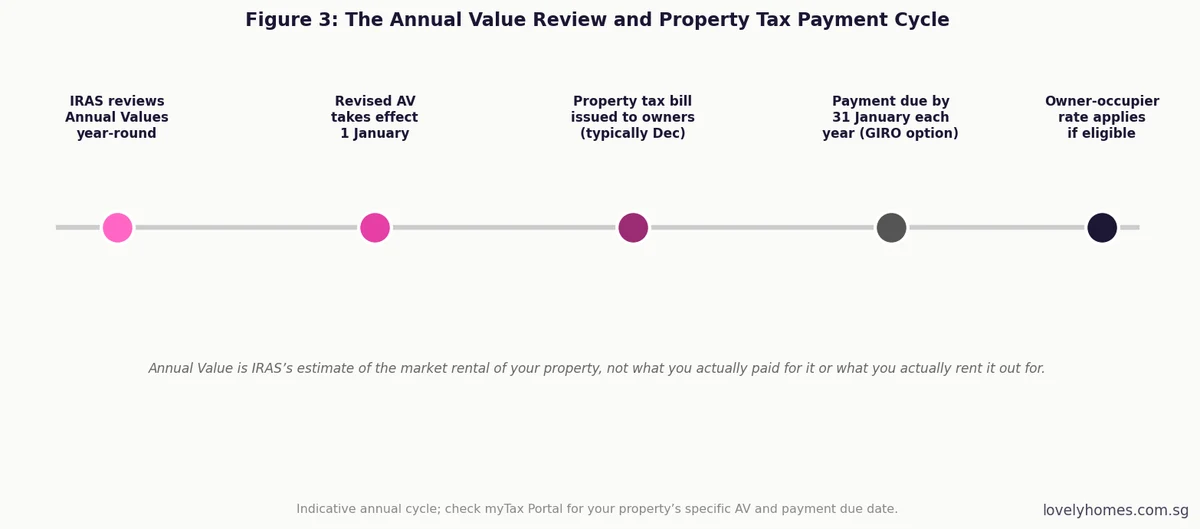
IRAS reviews Annual Values on an ongoing basis throughout the year, drawing on rental transaction data across the market, with any revision to a property’s AV generally taking effect from 1 January of the following year. Property tax bills for the coming year are typically issued in December, giving owners advance notice of what they owe, with the full amount due by 31 January. Owners who prefer not to pay the full amount as a lump sum can arrange to pay via GIRO, which spreads the annual bill across up to twelve monthly instalments starting in the new year, at no extra cost. Owners who believe their AV is inaccurate, for instance if it does not reflect the true condition or rentability of their unit, can lodge an objection with IRAS within the stipulated timeframe, though the onus is on the owner to provide supporting evidence for a lower valuation.
How Property Tax Differs from Stamp Duties
It is worth being precise about how property tax fits alongside Singapore’s other property-related levies, since the three are frequently confused. Buyer’s Stamp Duty (BSD) and Additional Buyer’s Stamp Duty (ABSD) are one-off taxes payable at the point a property is purchased, calculated on the purchase price or market value, whichever is higher. Seller’s Stamp Duty (SSD) is likewise a one-off tax, payable only if a property is sold within a specified holding period. Property tax, by contrast, is an annual, recurring tax payable for as long as the property is owned, calculated not on price but on the property’s estimated annual rental value. An owner who never sells a property will never pay stamp duty again on it, but will keep receiving a property tax bill every single year for as long as they hold it.
Summary: Property Tax Facts at a Glance
| Question | Short Answer |
|---|---|
| What is property tax based on? | Annual Value (AV), IRAS’s estimate of the property’s market rental, not its purchase price. |
| Is owner-occupier status automatic? | No, owners must apply to IRAS via myTax Portal. |
| When is the bill issued and due? | Typically issued in December, due by 31 January (GIRO instalments available). |
| Do vacant properties pay property tax? | Yes, generally at non-owner-occupier rates. |
| Is this the same as stamp duty? | No, stamp duty (BSD/ABSD/SSD) is one-off at purchase/sale; property tax is annual for as long as you own the property. |
| Can I own two owner-occupied properties? | Generally no, only one property per owner qualifies as owner-occupied at a time. |
Worked Example: Owner-Occupied HDB Flat vs Non-Owner-Occupied Condo
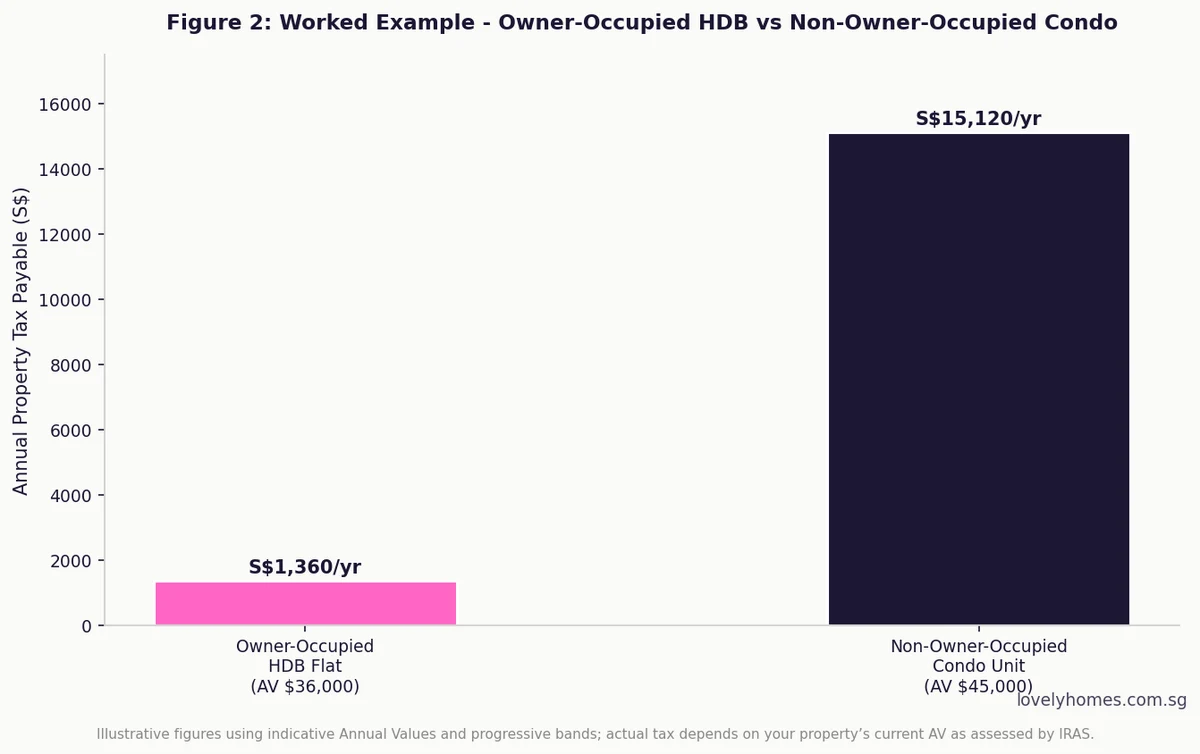
Scenario A – Owner-occupied HDB flat, AV $36,000: applying the progressive owner-occupier bands (0% on the first $8,000, 4% on the next $22,000, 6% on the remaining $6,000 up to $36,000), the illustrative annual property tax payable is approximately S$1,360.
Scenario B – Non-owner-occupied condo unit, AV $45,000 (rented out, second property, or otherwise not the owner’s residence): applying the steeper non-owner-occupier bands (12% on the first $8,000, 20% on the next $22,000, 28% on the next $10,000, and 36% on the remaining $5,000 up to $45,000), the illustrative annual property tax payable is approximately S$15,120.
The gap: despite a broadly comparable AV, the non-owner-occupied property’s annual tax bill is over eleven times higher than the owner-occupied flat’s, illustrating just how significant the owner-occupier concession is, and why correctly applying for it (and promptly, when moving into a new home) matters so much financially.
These figures are illustrative only, using indicative progressive bands; check the current bands and your property’s actual AV on the myTax Portal before estimating your own bill.
Why This Matters for Singapore Property Owners
Property tax is easy to overlook compared with the far larger, one-off sums involved in stamp duty at the point of purchase, but over a typical multi-decade holding period, cumulative property tax payments can add up to a very substantial sum, particularly for non-owner-occupied investment properties taxed at the steeper rates. Owners moving into a newly purchased home should treat filing the owner-occupier application with IRAS as an urgent administrative task, not an afterthought, since the gap between rates is large enough to materially affect a household’s annual budget. Owners holding investment or rental properties should likewise factor the non-owner-occupier property tax rate into their rental yield calculations from the outset, since it is a real, recurring cost that directly reduces net rental returns, alongside mortgage interest, maintenance fees and income tax on rental income.
What Might Come Next
The following is informed speculation, not confirmed policy. As Annual Values continue to be revised in line with rental market movements, further periodic adjustments to property tax rates or bands remain a plausible policy lever the Government could use to fine-tune housing demand, particularly for non-owner-occupied and investment property, in much the same way ABSD rates have been adjusted several times in recent years. Continued digitalisation of IRAS’s myTax Portal may also make the owner-occupier application and AV objection processes progressively simpler and faster over time, though no specific enhancement has been officially announced as at this writing.
Frequently Asked Questions
Do I need to pay property tax if my property is vacant?
Yes. Property tax is payable regardless of whether the property is occupied, rented out, or vacant. A vacant property that is not the owner’s residence is generally taxed at non-owner-occupier rates.
How do I apply for owner-occupier tax rates?
Apply via the IRAS myTax Portal shortly after moving into your property. IRAS may request supporting documents or conduct checks to verify genuine owner-occupation before approving the concessionary rate.
Is Annual Value the same as my property’s market value or purchase price?
No. Annual Value is IRAS’s estimate of the property’s annual market rental, not its sale price or market value. A property’s AV can rise or fall independently of its transacted price.
Can I get owner-occupier rates on more than one property?
Generally no. Owner-occupier rates are intended for the single property that is genuinely the owner’s own residence. Any additional residential property is typically taxed at non-owner-occupier rates.
What happens if I disagree with my property’s Annual Value?
You can lodge an objection with IRAS within the stipulated timeframe, providing supporting evidence such as comparable market rentals, for IRAS to review and potentially revise the AV.
Is property tax the same as stamp duty?
No. Stamp duties (BSD, ABSD, SSD) are one-off taxes tied to a purchase or sale transaction. Property tax is an annual recurring tax based on Annual Value, payable for as long as you own the property.
Can I pay my property tax in instalments?
Yes, via GIRO, which allows the annual bill to be spread across monthly instalments through the year at no additional cost, rather than paying the full amount as a lump sum by 31 January.
Related Articles on LovelyHomes
- ABSD Singapore 2026: Complete Guide to Additional Buyer’s Stamp Duty
- Buyer’s Stamp Duty (BSD) Singapore 2026 – Complete Guide
- Singapore Property Cooling Measures: Complete History and Guide
- Real Estate Crowdfunding Singapore 2026
- Home Equity Loan Singapore 2026: HEL, HLOA & Borrowing Guide
- Singapore Property Market Outlook 2027
Click anywhere outside to close