Quick Answer , Home Equity Loans in Singapore 2026
- What it is: A home equity loan (HEL) lets you borrow against the equity built up in your property , the difference between market value and outstanding mortgage.
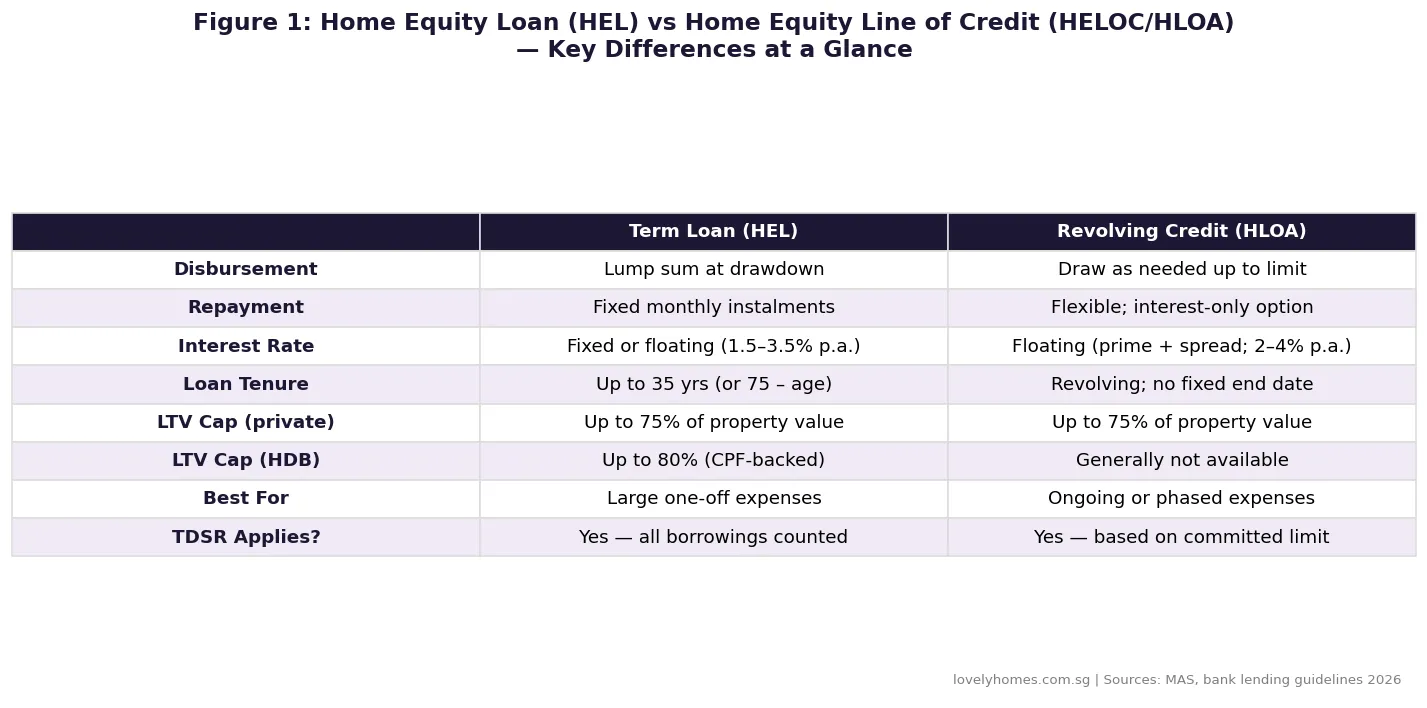
- Two forms: (1) Term loan , lump-sum disbursement, fixed repayment; (2) Home equity line of credit (HELOC / Home Loan Overdraft Account) , revolving credit, draw as needed.
- LTV cap (private property): Up to 75% of the property’s market value in total borrowings. With an existing mortgage of S$600,000 on a S$1.5M property, you can borrow at most S$525,000 more.
- LTV cap (HDB): Up to 80% if CPF Ordinary Account (OA) funds are pledged. Generally no HELOC on HDB.
- TDSR rule: All borrowings (including the home equity loan) must not exceed 55% of your gross monthly income. This is the binding constraint for most borrowers.
- Interest rates (2026): HEL term loans typically 1.8–3.5% p.a. floating or fixed; HELOC rates 2.0–4.0% p.a. floating.
- Regulated by: Monetary Authority of Singapore (MAS) under Notice 645 (property loans framework).
- Who should consider: Homeowners with significant equity who need large funds for renovation, investment, education, or business , and who have TDSR headroom.
What Is a Home Equity Loan?
A home equity loan (HEL) , sometimes called a “property equity loan” or “equity term loan” by Singapore banks , is a credit facility secured against the equity in your residential or commercial property. In plain English: you own a property worth more than you borrowed to buy it, and you ask a bank to lend you more money using that gap as collateral.
The concept sounds straightforward, but Singapore’s regulatory framework imposes specific constraints that every borrower must understand before applying. The Monetary Authority of Singapore (MAS) governs property lending through MAS Notice 645 (Banks , Residential Property Loans) and Notice 831 (Finance Companies), which set the Loan-to-Value (LTV) ratios and the Total Debt Servicing Ratio (TDSR) framework that all Singapore banks must observe. These rules were introduced in 2013 and have been refined through subsequent cooling measure rounds.
The TDSR framework, administered by MAS, caps total monthly debt obligations , including all property loans, car loans, personal loans, and the new home equity loan , at 55% of the borrower’s gross monthly income. This is the binding constraint for most borrowers seeking a large home equity facility, and it must be assessed before approaching a bank.
Two Types of Home Equity Facility in Singapore
Singapore banks offer two primary structures for accessing home equity. Understanding the difference is critical because they have different cost structures, repayment obligations, and suitability profiles.
The first is the Home Equity Term Loan (HEL). This is a conventional secured term loan: the bank disburses the full approved amount upfront, and you repay in equal monthly instalments over a fixed tenure (typically 5–30 years, subject to the property’s remaining lease and the borrower’s age). Interest is charged from disbursement. This structure suits borrowers who have a specific, large, one-off need , a major renovation, purchasing a vehicle outright, funding a child’s overseas university, or injecting capital into a business , and who prefer the certainty of a fixed monthly payment.
The second is the Home Loan Overdraft Account (HLOA) or Home Equity Line of Credit (HELOC). This is a revolving credit facility secured against the property, typically linked to an overdraft account. The bank approves a credit limit (based on LTV headroom and TDSR), and the borrower draws down as needed, repaying principal and interest only on the amounts drawn. This suits borrowers with irregular or phased funding needs , for instance, a business owner who needs periodic working capital top-ups, or a renovator who draws money in stages as invoices arrive. Interest accrues only on drawn amounts, which can make this more cost-effective than a full term loan if the borrower does not need the entire facility immediately.
LTV Limits , How Much Can You Borrow?
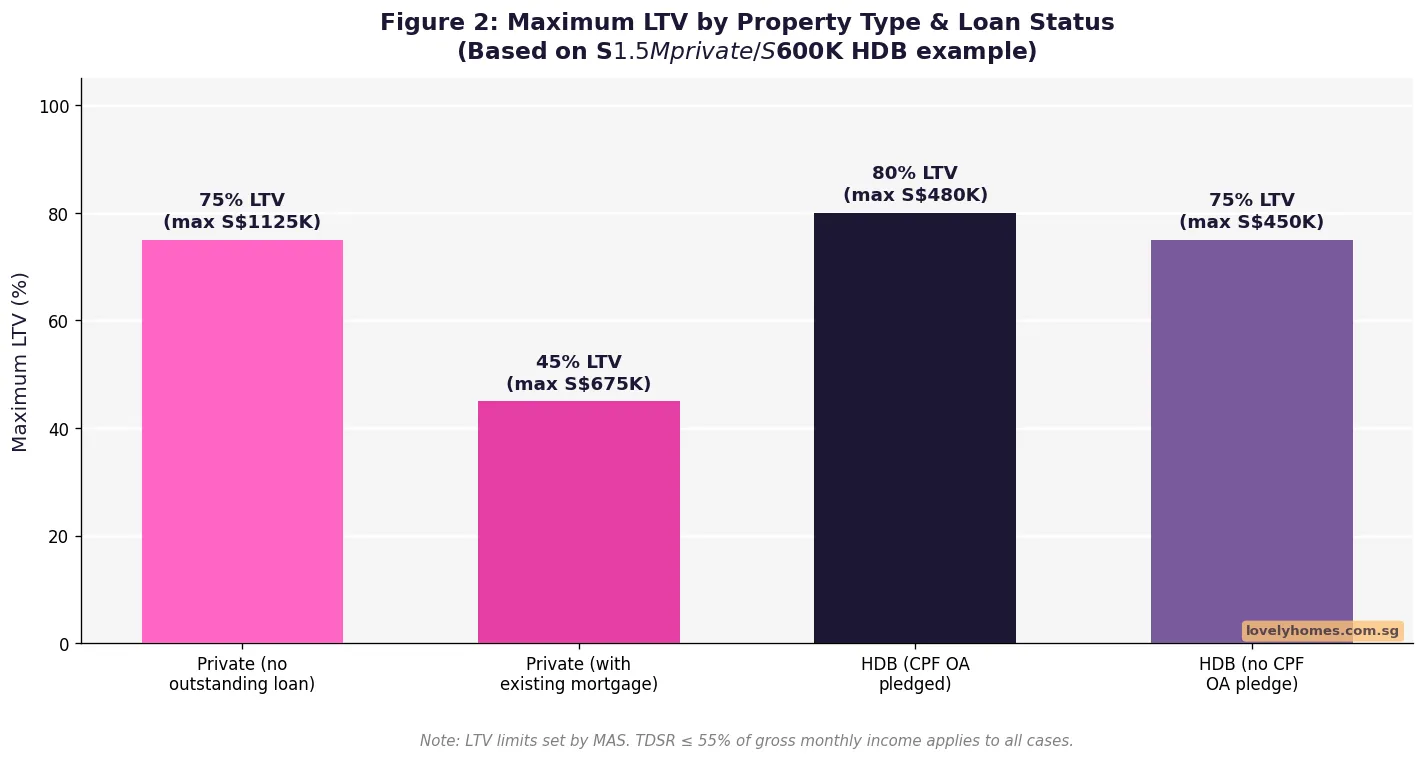
The LTV ratio determines the maximum total borrowings as a percentage of the property’s market value (or purchase price, whichever is lower). As at 2026, the MAS framework provides the following LTV caps for home equity borrowing:
| Property Type | Scenario | Max LTV | Notes |
|---|---|---|---|
| Private residential (freehold or 99-year) | No outstanding mortgage | 75% | Subject to TDSR 55%; Stress Test rate applies |
| Private residential | With 1 outstanding mortgage | 45% | LTV applies to total borrowings; new equity loan = 45% minus existing loan % |
| Private residential | With 2 or more outstanding mortgages | 35% | Increasingly restrictive for multi-property owners |
| HDB flat | CPF OA pledged for housing | 80% | HDB loan or bank loan; HDB’s concessionary rate loan at 2.6% p.a. vs bank rates |
| HDB flat | No CPF OA pledge | 75% | Bank loan only; HELOC generally not offered on HDB |
| Commercial / industrial | N/A | 80% | Separate framework; outside scope of this guide |
These LTV limits interact with the TDSR. Even if LTV headroom exists, the bank will refuse the loan if the borrower’s TDSR (all monthly debt payments ÷ gross monthly income) exceeds 55% when the new home equity instalment is added. Banks apply a stress test using a rate of 4% p.a. (or the actual loan rate if higher) when calculating TDSR, so the effective repayment used for TDSR purposes is higher than the actual contractual rate.
For HDB flat owners specifically, the situation is more constrained. HDB flat owners cannot take a HELOC secured against their HDB flat under normal circumstances , HDB’s rules restrict the forms of financing that can be secured against the flat. A bank-issued term loan secured against an HDB flat is permissible subject to HDB’s approval, but the process is more complex than for private property. Owners who need liquidity against HDB equity may alternatively consider HDB’s Lease Buyback Scheme if they are eligible seniors, or Silver Housing Bonus (SHB) under the CPF LIFE framework.
TDSR , The Real Binding Constraint
In practice, for most Singapore homeowners, LTV is not the binding constraint , TDSR is. The TDSR cap of 55% means that all monthly debt obligations must not exceed 55% of gross monthly income. This includes the existing home mortgage, car loan, credit card minimum payments, personal loan instalments, and the proposed new home equity loan instalment.
Banks apply a stress test interest rate of 4% p.a. (as at 2026) or the actual borrowing rate (whichever is higher) when computing monthly obligations for TDSR. This means a home equity loan at 2.5% p.a. is assessed at 4% p.a. for TDSR purposes , a significant difference that reduces the maximum approvable loan amount.
Borrowers who have large existing mortgages, car loans, or other credit facilities may find that TDSR leaves little room for a home equity loan even if they have substantial LTV headroom. This is by design: MAS introduced the TDSR framework specifically to prevent over-leveraging against property assets.
Interest Rates on Home Equity Loans in Singapore (2026)
Singapore banks offer a range of pricing structures for home equity facilities. As at July 2026, indicative rates are as follows:
| Bank | Product Type | Rate (indicative) | Structure |
|---|---|---|---|
| DBS / POSB | Property Plus Loan (term) | ~2.5–3.0% p.a. floating (3M SORA + spread) | Floating; re-priced quarterly |
| OCBC | HomeSuite Equity Loan | ~2.4–2.9% p.a. floating | Floating; board rate or SORA-linked |
| UOB | Home Equity Loan | ~2.5–3.2% p.a. floating / fixed package | Fixed for 1–3 yrs then floating |
| Standard Chartered | MortgageOne overdraft component | ~2.8–3.5% p.a. floating | Revolving; interest on drawn amount only |
| Maybank | MaxiHome Equity Term | ~2.3–2.9% p.a. floating | Floating; SORA-linked |
Note: Rates are indicative only and subject to change. SORA (Singapore Overnight Rate Average) replaced SIBOR as the primary floating rate benchmark in Singapore from 2024. Banks add a spread over SORA that varies by credit quality, loan quantum, and product.
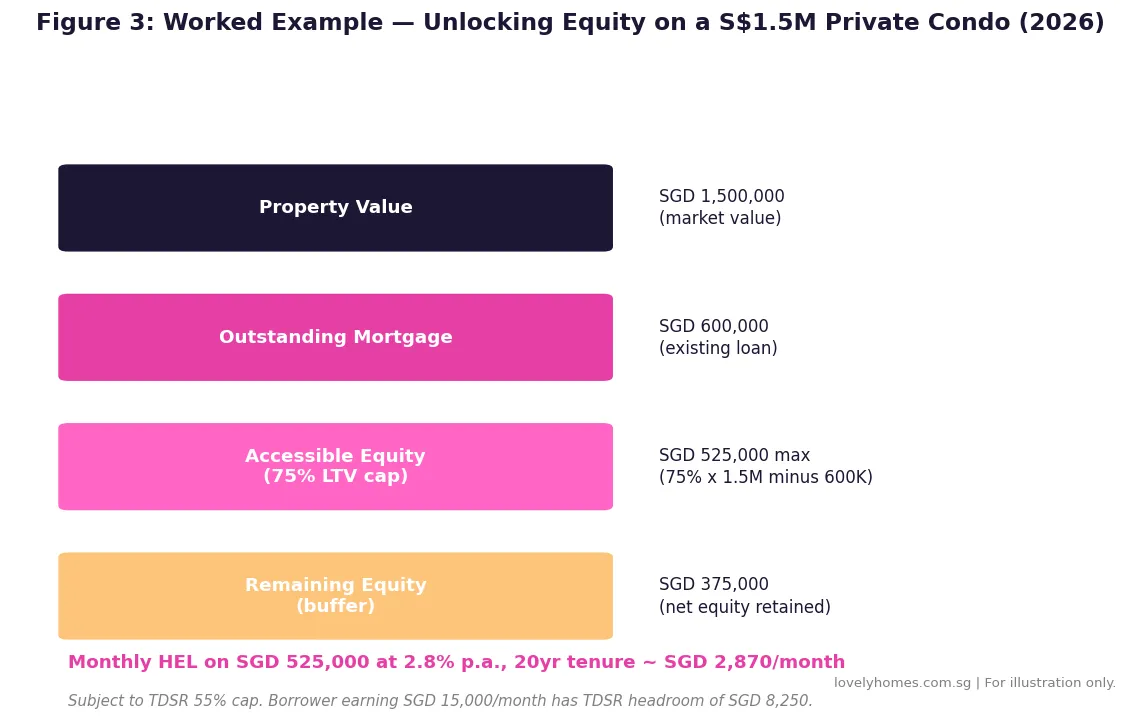
Worked Example , Unlocking Equity on a S$1.5M Private Condo (2026)
Scenario: Singaporean homeowner, age 45, owns a private condo currently valued at S$1,500,000. Outstanding mortgage: S$600,000 with 15 years remaining. Gross monthly income: S$15,000. Existing monthly mortgage payment: S$4,200. No car loan; no other debt.
- LTV headroom: 75% × S$1,500,000 = S$1,125,000 (total permitted borrowings). Existing mortgage: S$600,000. Maximum new equity loan: S$1,125,000 − S$600,000 = S$525,000.
- Wait , does 1-outstanding-loan rule apply? Yes. The borrower already has 1 outstanding mortgage. Under MAS rules, the LTV cap drops to 45% for the total. 45% × S$1,500,000 = S$675,000 total permitted. Existing loan: S$600,000. Maximum new equity loan: S$675,000 − S$600,000 = S$75,000.
- TDSR check: Current debt: S$4,200/month. TDSR ceiling: 55% × S$15,000 = S$8,250/month. TDSR headroom: S$8,250 − S$4,200 = S$4,050/month. Stress-tested instalment on a S$75,000 equity loan at 4% p.a. over 15 years ≈ S$555/month. This fits within TDSR headroom. ✓
- Outcome: Maximum approvable home equity loan in this scenario = S$75,000 (constrained by the 45% LTV cap for a borrower with 1 existing mortgage), with a monthly instalment of approximately S$492/month at 2.8% p.a. over 15 years.
- Key lesson: Homeowners who already have an existing mortgage face a significantly reduced LTV cap (45% versus 75%) under MAS rules. Clearing the existing mortgage before applying for an equity facility , where financially viable , unlocks the full 75% LTV headroom.
What Are Home Equity Loans Used For?
Singapore homeowners access home equity facilities for a range of purposes, some of which are more financially sound than others. The most common uses include:
Major renovation: Upgrading a private condo or landed property often costs S$150,000–S$500,000 for a full interior redesign, kitchen rebuild, and bathroom works. A home equity loan at 2.5–3% p.a. is typically cheaper than a personal loan (which may carry rates of 5–8% p.a.) and allows a longer repayment tenure, making it a cost-effective financing option for a value-enhancing renovation.
Investment in financial assets: Some homeowners access equity to invest in stocks, bonds, or REITs, seeking to earn a return above the cost of borrowing. This is a legitimate strategy but carries investment risk; if the investment underperforms, the homeowner remains liable for the loan while the property serves as collateral. Financial advisors generally caution against this approach for risk-averse investors.
Children’s overseas education: University tuition at overseas institutions for a four-year degree routinely costs S$150,000–S$300,000 (UK/Australia) or S$200,000–S$500,000 (US). A home equity facility can fund this at significantly lower interest than unsecured education loans.
Business capital injection: Self-employed homeowners and SME directors sometimes use home equity facilities to inject working capital or growth capital into their businesses. The property serves as security, and the borrower takes on personal liability.
Debt consolidation: Homeowners with multiple higher-rate personal loans or credit card debt may use a lower-rate home equity facility to consolidate obligations, reducing monthly cash flow pressure. This strategy is effective if the borrower maintains discipline not to re-accumulate consumer debt after consolidation.
Why This Matters , Home Equity in Singapore’s Property Context
Home equity is, for many Singaporean homeowners, their single largest financial asset. A household that purchased a private condo at S$900,000 in 2015 and has seen it appreciate to S$1.5M while paying down S$200,000 of principal holds S$800,000 of equity , a sum that exceeds most Singaporeans’ liquid savings and investment portfolios combined.
The question of whether to tap this equity , and how , is a live financial planning decision for a growing share of the population, particularly as interest rates have stabilised following the 2022–2024 SORA rate cycle and home equity lending has become competitive. Singapore banks actively market home equity products, and the MAS regulatory framework, while protective, does allow meaningful access for creditworthy borrowers.
Compared to countries such as Australia and the United Kingdom, where home equity release products (including reverse mortgages) are more developed and widely marketed, Singapore’s framework is conservative. MAS has deliberately constrained home equity lending to prevent the kind of housing-equity-fuelled consumer spending that preceded the 2008 global financial crisis in the US and UK. The TDSR and LTV architecture reflects this policy orientation , protecting both individual borrowers and systemic financial stability.
What Might Come Next , Home Equity Lending in Singapore
Several developments could shape home equity lending in Singapore over the 2026–2028 horizon. First, SORA convergence: as SORA rates normalise from the 2022–2024 elevation, floating-rate home equity facilities become cheaper in absolute terms, potentially increasing demand. Second, aging homeowners: Singapore’s demographic trajectory means a growing cohort of asset-rich, income-poor retirees who own fully paid-up or nearly paid-up properties. MAS and HDB’s existing programmes (Lease Buyback Scheme, Silver Housing Bonus) do not address all this cohort’s needs; a more developed reverse mortgage or equity release market seems a plausible policy evolution. Third, LTV policy adjustments: MAS has historically used LTV ratios as a macro-prudential tool. If property prices cool significantly, regulators may relax LTV constraints to support market liquidity , the converse of the tightening seen in 2013 and 2021.
Related Articles on LovelyHomes
- ABSD Singapore 2026: Complete Guide to Additional Buyer’s Stamp Duty
- Singapore Property Cooling Measures Timeline 2009–2026
- Singapore Property Downpayment Guide 2026
- HDB Housing Loan Eligibility (HLE) Guide 2026
- Singapore Property Rental Yield Guide 2026
- Joint Purchase of Property in Singapore 2026: Rules and Implications
Frequently Asked Questions , Home Equity Loans Singapore
Can I take a home equity loan on my HDB flat?
Yes, but with significant restrictions. HDB flat owners can take a bank-issued term loan secured against their HDB flat, subject to HDB’s approval and the applicable LTV limits (up to 80% with CPF OA pledged, 75% without). However, the revolving home equity line of credit (HELOC/HLOA) is generally not available for HDB flats , banks do not offer this product for HDB-secured facilities under the current regulatory framework. Additionally, the HDB flat’s remaining lease must be sufficient to cover the loan tenure. HDB owners who wish to unlock equity for retirement purposes should also consider the Lease Buyback Scheme, which is specifically designed for senior owner-occupiers in 3-room to 4-room flats and does not require debt repayment in the traditional sense.
Does a home equity loan affect my ABSD obligations?
No , ABSD (Additional Buyer’s Stamp Duty) is triggered by the purchase of residential property, not by borrowing against it. Taking a home equity loan on your existing property does not create a new ABSD liability because no property is being purchased. ABSD would only become relevant if you used the home equity loan proceeds to purchase additional residential property , in which case the usual ABSD rates (based on your property ownership count and residency status) would apply to that purchase transaction. The home equity loan itself is an ordinary secured lending arrangement and is taxed only through the standard banking income tax framework that applies to the lender, not through stamp duty.
What is the TDSR for a home equity loan in Singapore?
The Total Debt Servicing Ratio (TDSR) caps all monthly debt obligations at 55% of your gross monthly income. When assessing a home equity loan, the bank adds the proposed new monthly instalment (stress-tested at 4% p.a. or the actual rate, whichever is higher) to all your existing monthly debt obligations , mortgage(s), car loan, personal loan, credit card minimum payments , and checks that the total does not exceed 55% of gross monthly income. Gross monthly income includes base salary, allowances, and bonuses , but bonuses and variable income are typically haircut (reduced) by 30% for TDSR calculation purposes. Retired borrowers without regular income face particular difficulty qualifying for home equity loans, as their TDSR baseline is low. For precise TDSR assessment, approach your preferred bank directly with income documentation.
Can I use a home equity loan to invest in the stock market?
There is no legal prohibition on using home equity loan proceeds to invest in financial markets. However, financial advisors and MAS both caution against this approach. A home equity loan is a secured facility , your property is the collateral , meaning that if you cannot service the loan (because the investment performed poorly, you lost your job, or both), the bank has the right to enforce its security interest over the property. This introduces asset-class correlation risk: a broad market downturn that erodes your investment portfolio often coincides with economic conditions that may also affect your employment income and the property market. Using leverage to invest in equities amplifies both gains and losses. If you proceed, ensure that your emergency fund, income, and TDSR headroom are robust enough to service the loan independently of the investment returns.
How long does it take to get a home equity loan approved in Singapore?
The approval timeline for a home equity loan in Singapore typically ranges from 2 to 6 weeks, depending on the bank, the complexity of the application, and the speed at which the borrower supplies documentation. The standard process involves: (1) preliminary assessment (1–3 days) , income documents, existing loan statements, CPF statement; (2) property valuation (3–10 business days) , bank appoints a valuer to confirm current market value; (3) credit assessment and approval (5–10 business days); (4) documentation , loan agreement, mortgage deed (if not already mortgaged), caveat lodgement; (5) drawdown (1–3 business days after documentation is completed). Borrowers with clean credit history, complete documentation, and straightforward income structures tend to move through the process more quickly. Applications involving trust structures, multiple borrowers, or complex income sources take longer.
What happens if I cannot repay my home equity loan?
If you default on a home equity loan, the bank has the right to enforce its mortgage or charge over the property. In practice, banks prefer not to enforce security , the process is costly and time-consuming , and will typically offer restructuring, payment holidays, or other workout arrangements before moving to enforcement. However, if restructuring fails and the default is material, the bank may appoint a receiver to sell the property in order to recover the outstanding loan balance. Any proceeds above the outstanding secured debt are returned to the borrower; any shortfall (if the property sells for less than the outstanding debt) remains the borrower’s personal liability. Given these stakes, borrowers should only take a home equity facility if they are confident in their ability to service the loan through the full tenure and across potential income disruptions.
Are home equity loans tax-deductible in Singapore?
Singapore does not have a mortgage interest deduction for owner-occupied residential property , unlike, for example, the United States, where home mortgage interest is deductible for most homeowners. However, if you use home equity loan proceeds for an income-producing purpose , for instance, to invest in an income-generating asset or to fund a business , the interest may be deductible against that income for income tax purposes under Singapore’s Income Tax Act. The deductibility test under Singapore law is whether the expense is wholly and exclusively incurred in the production of income. You should consult a tax adviser or your accountant before claiming such deductions, as IRAS scrutinises mixed-purpose use of borrowed funds carefully.
Supporting graphics
Original article illustrations are available below.
- Figure 1: Home Equity Term Loan (HEL) vs Home Equity Line of Credit (HELOC/HLOA) , Key Differences. Source: LovelyHomes editorial compilation of MAS Notice 645, bank product disclosures, 2026.
- Figure 2: Maximum LTV by Property Type and Outstanding Loan Status , Home Equity Borrowing in Singapore 2026. MAS Notice 645 governs private residential LTV; HDB rates apply to HDB flat owners. Figures shown are per property, not per borrower.
- Figure 3: Worked Example , Equity Borrowing on a S$1.5M Private Condo with an Existing Mortgage. LTV constraints are tighter than many homeowners expect. Sources: MAS Notice 645, bank lending guidelines 2026.