Singapore Condo Rental Income Guide 2026: Yields, Tax and How to Maximise Returns
- Owning a private condominium in Singapore and leasing it generates rental income taxed as personal income by IRAS — but deductions are available for mortgage interest, property tax, maintenance, agent fees, and repairs.
- Gross rental yields for Singapore condominiums range from approximately 3.0% (CCR) to 4.1% (OCR fringe) in 2026; net yields after costs and tax are typically 1.8%–2.8%.
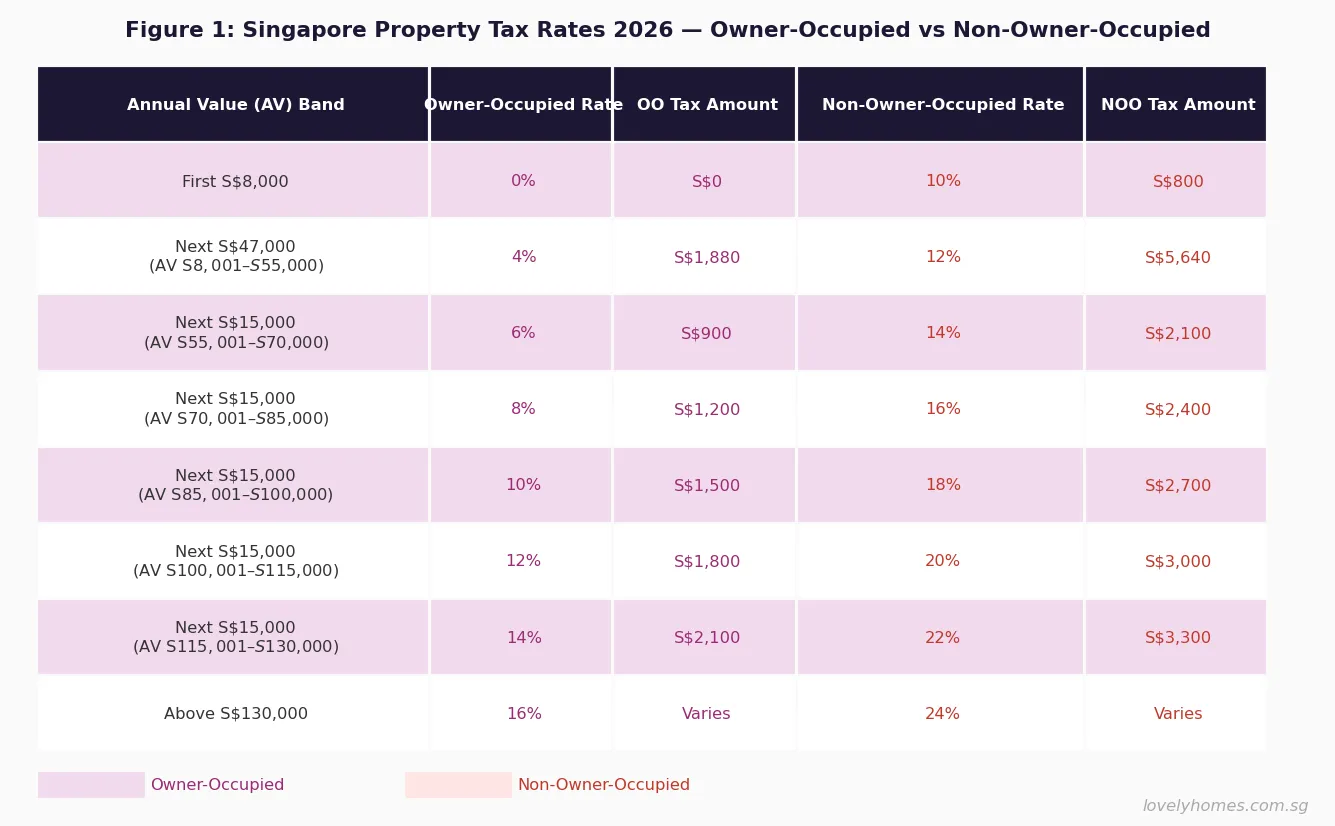
- Non-owner-occupied properties pay a higher property tax rate (10%–20% on Annual Value) compared to owner-occupied rates (0%–16%).
- Landlords must submit rental income in their annual IRAS tax return. Failure to declare is a strict-liability offence under the Income Tax Act.
- You do NOT need to register as a business — rental income from residential property is assessed as personal income (non-business source).
- Your tenant’s foreign status does not affect your tax obligation, but be aware of Minimum Stay Period rules: the Urban Redevelopment Authority (URA) mandates a minimum 3-month lease for all private residential tenancies (non-HDB).
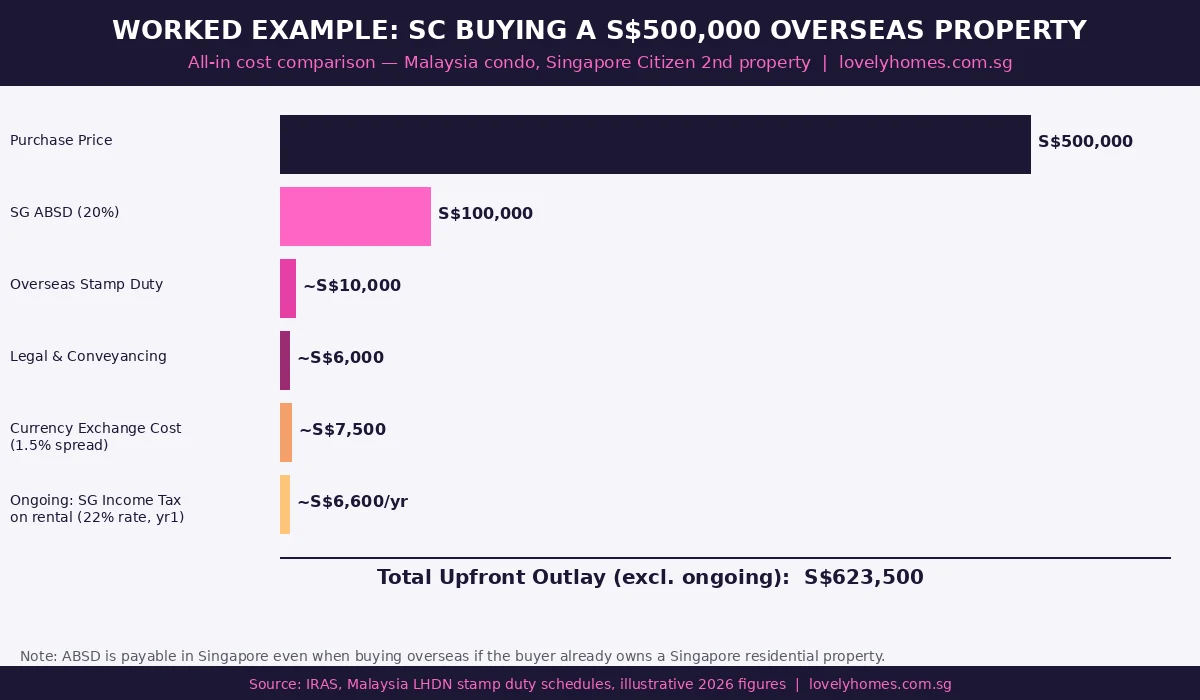
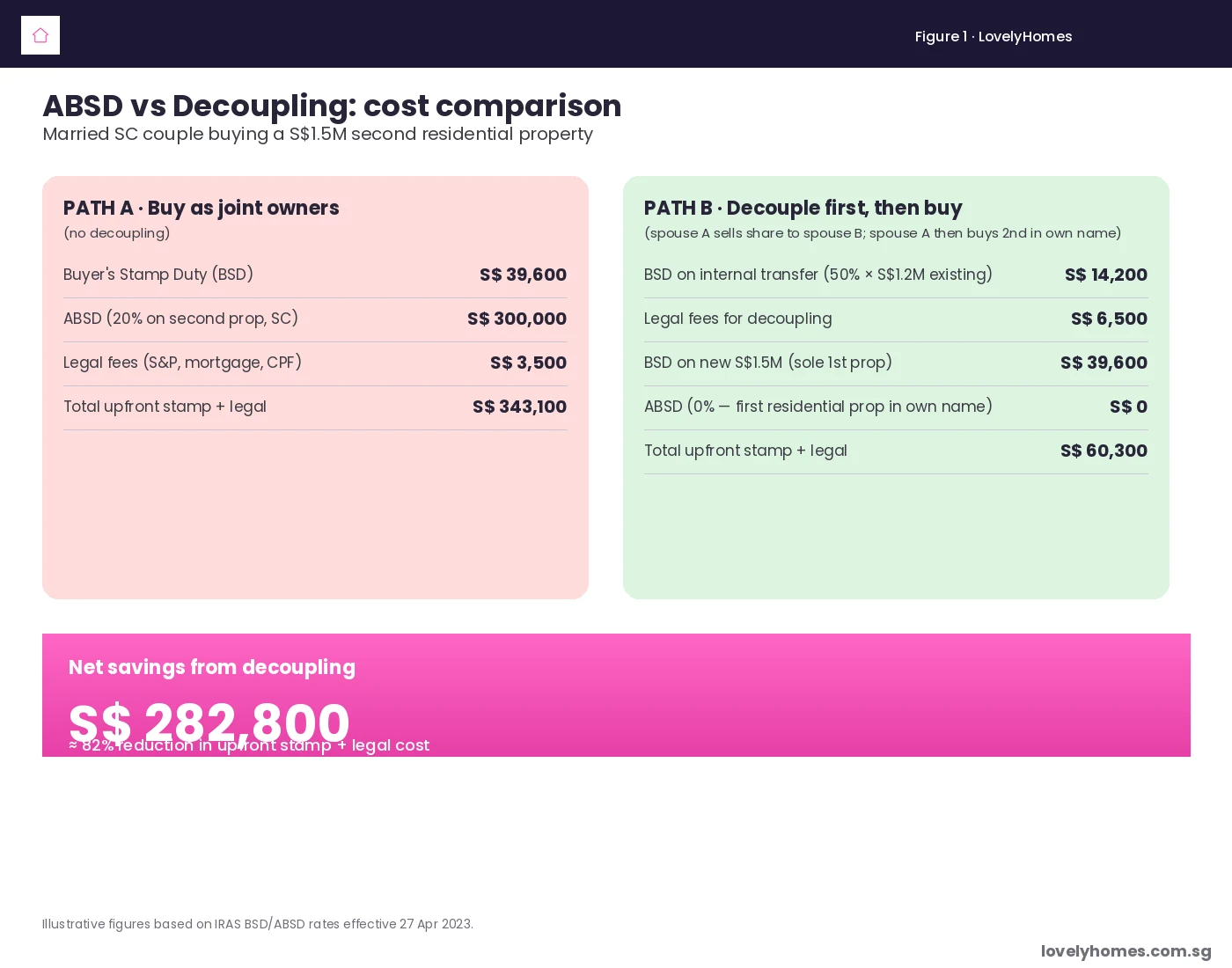
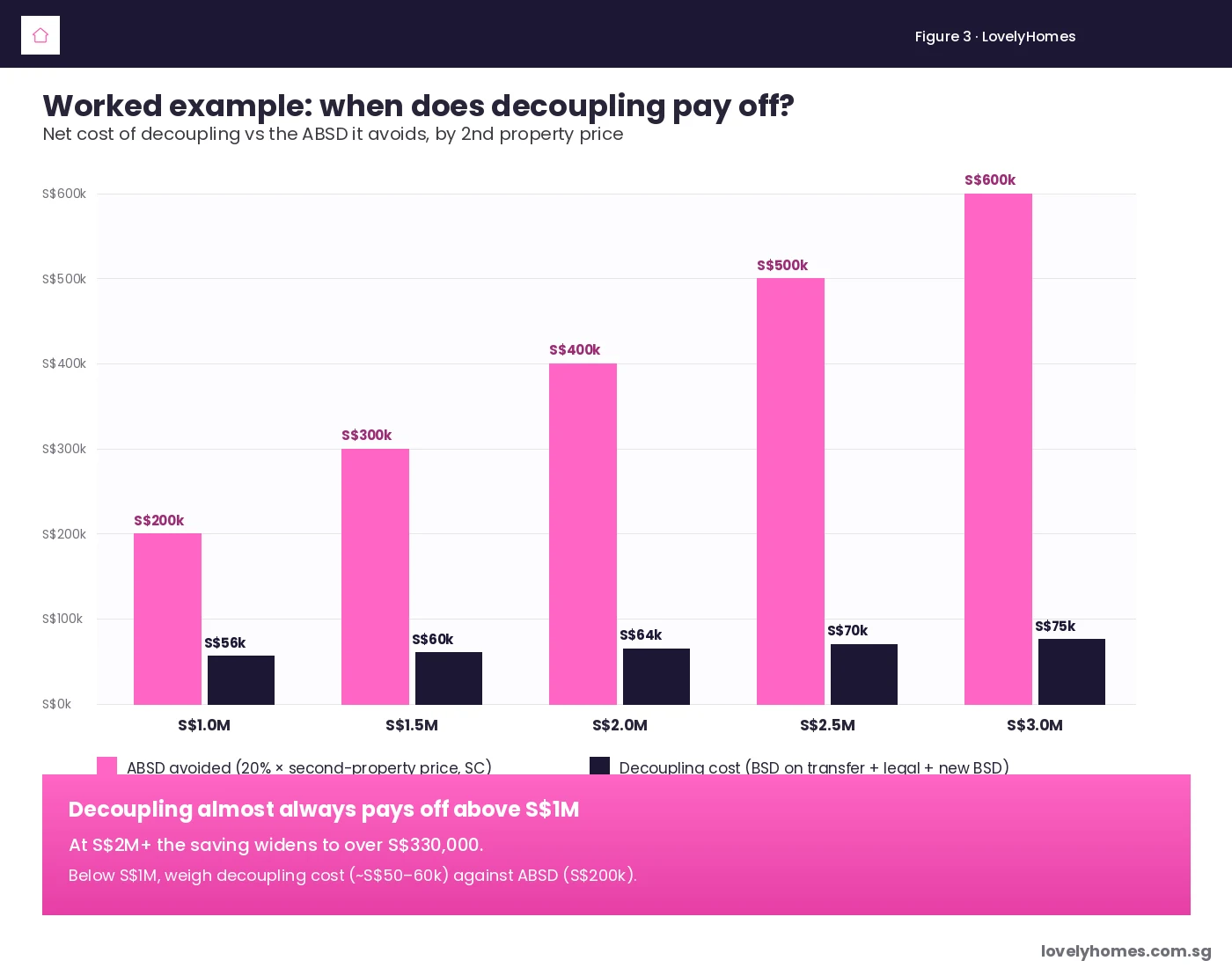
- The ABSD regime incentivises investors to keep only one property; owning a second property means paying 20% ABSD (Singapore Citizen) or 30% (PR) at purchase.
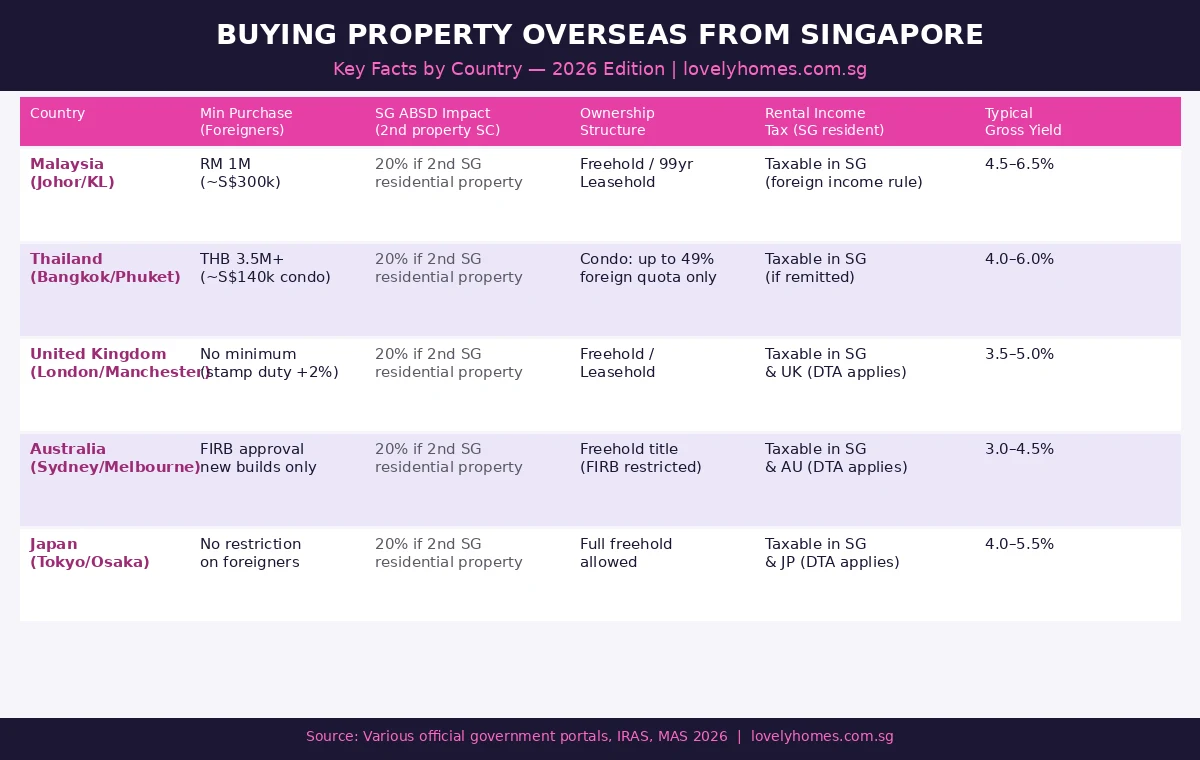
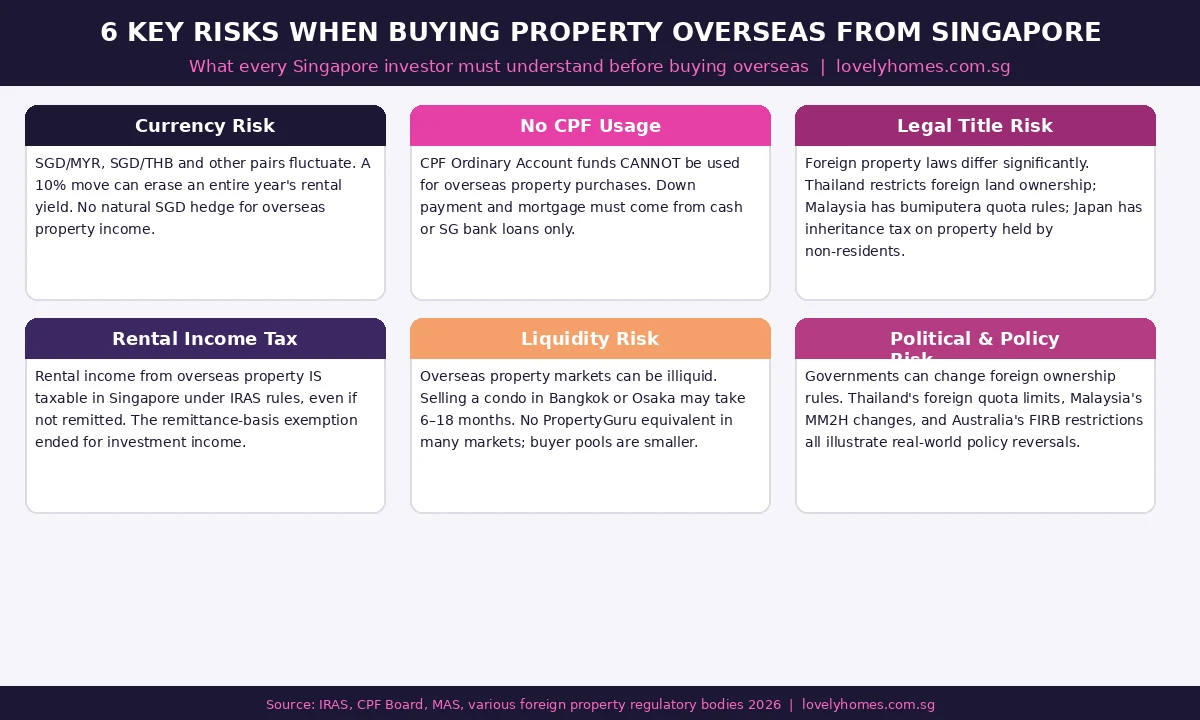
- Rental income on overseas property held by Singapore tax residents is remittance-based — it becomes taxable in Singapore when funds are brought into the country (from 1 Jan 2024 for certain foreign-sourced income).
Why Condo Rental Income Attracts Investors in Singapore
Singapore has one of the world’s most tightly regulated residential property markets, yet private condominium rental remains a resilient income source for property investors. The city-state’s status as a regional financial hub drives sustained demand from expatriates, foreign professionals on Employment Passes, and international students — a tenant base that is willing to pay premium rents for well-located, well-managed condominium units.
According to URA data for the second quarter of 2026, private residential rents rose 0.7% quarter-on-quarter, extending a sustained period of above-historical-average rents that began during the post-pandemic supply squeeze. Total leasing volume for private residential properties remains buoyant, with Districts 9, 10, 15, and 19 commanding the highest absorption rates.
For Singapore Citizen (SC) property investors who have already purchased their first property and wish to acquire a rental-generating second property, the framework is clear: ABSD of 20% applies on purchase, offset over a 10–15 year investment horizon by rental income, capital appreciation, and eventual resale proceeds. For those who bought pre-cooling-measure at lower prices, the calculus often still works in their favour.

How Singapore Taxes Rental Income
Rental income from Singapore residential property is assessed as personal income by the Inland Revenue Authority of Singapore (IRAS) under the Income Tax Act (Cap. 134). It is not classified as business income (unless you are running a rental business at scale with multiple properties and supporting staff), meaning it is reported on your individual tax return alongside employment and other income, and taxed at Singapore’s progressive personal income tax rates.
The deductions available to residential landlords are generous compared to many jurisdictions. IRAS allows the following as deductions against gross rental income:
- Mortgage interest — the interest component of your bank loan repayment (not the principal). This is typically the largest deduction for leveraged investors.
- Property tax — the annual property tax bill paid to IRAS (which is itself computed on Annual Value).
- Agent commission — leasing agent fees, typically one month’s rent per year for a 2-year lease.
- Maintenance fees — monthly maintenance contributions and sinking fund payments to the condo management corporation.
- Furniture, fittings, and repair costs — costs incurred wholly and exclusively in producing rental income.
- Insurance premiums — fire insurance and other property-related policies.
- Vacancy expenses — property tax and certain fixed expenses may be deducted even during vacant periods, subject to IRAS conditions.
Depreciation of the property itself (capital allowance) is not permitted for residential property. Only commercial and industrial properties may claim capital allowances under Singapore tax law. This distinguishes Singapore from the United States and Australia, where residential investors can depreciate the building structure.
| Income Tax Rate (2026) | Chargeable Income Band | Tax Payable on Band |
|---|---|---|
| 0% | First S$20,000 | S$0 |
| 2% | Next S$10,000 (S$20k–S$30k) | S$200 |
| 3.5% | Next S$10,000 (S$30k–S$40k) | S$350 |
| 7% | Next S$40,000 (S$40k–S$80k) | S$2,800 |
| 11.5% | Next S$40,000 (S$80k–S$120k) | S$4,600 |
| 15% | Next S$40,000 (S$120k–S$160k) | S$6,000 |
| 18% | Next S$40,000 (S$160k–S$200k) | S$7,200 |
| 19% | Next S$40,000 (S$200k–S$240k) | S$7,600 |
| 19.5% | Next S$40,000 (S$240k–S$280k) | S$7,800 |
| 20% | Next S$40,000 (S$280k–S$320k) | S$8,000 |
| 22% | Above S$320,000 | 22% on excess |
Singapore does not impose a capital gains tax; profits from selling your investment property are therefore not taxable (unless IRAS characterises you as a property trader based on your pattern of buying and selling, in which case gains are treated as business income).
Property Tax on Rental Properties
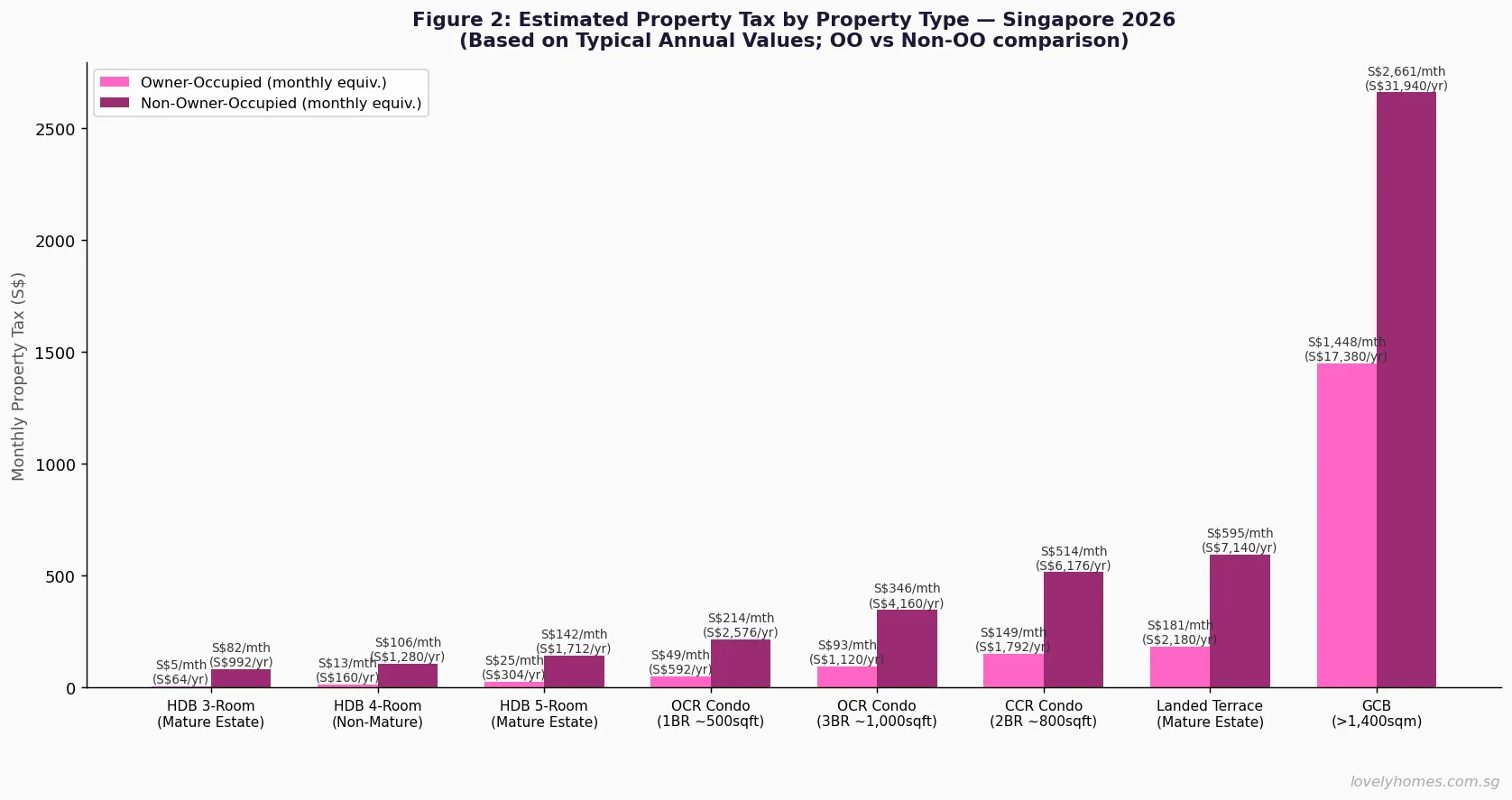
All Singapore property owners pay annual property tax assessed on the Annual Value (AV) — the estimated market rent of the property if it were unoccupied and let without furnishings. IRAS determines AV annually based on market rental data. For a typical OCR 2-bedroom condo generating S$3,200/month in actual rent, the IRAS AV might be set at approximately S$36,000–S$38,400 per year.
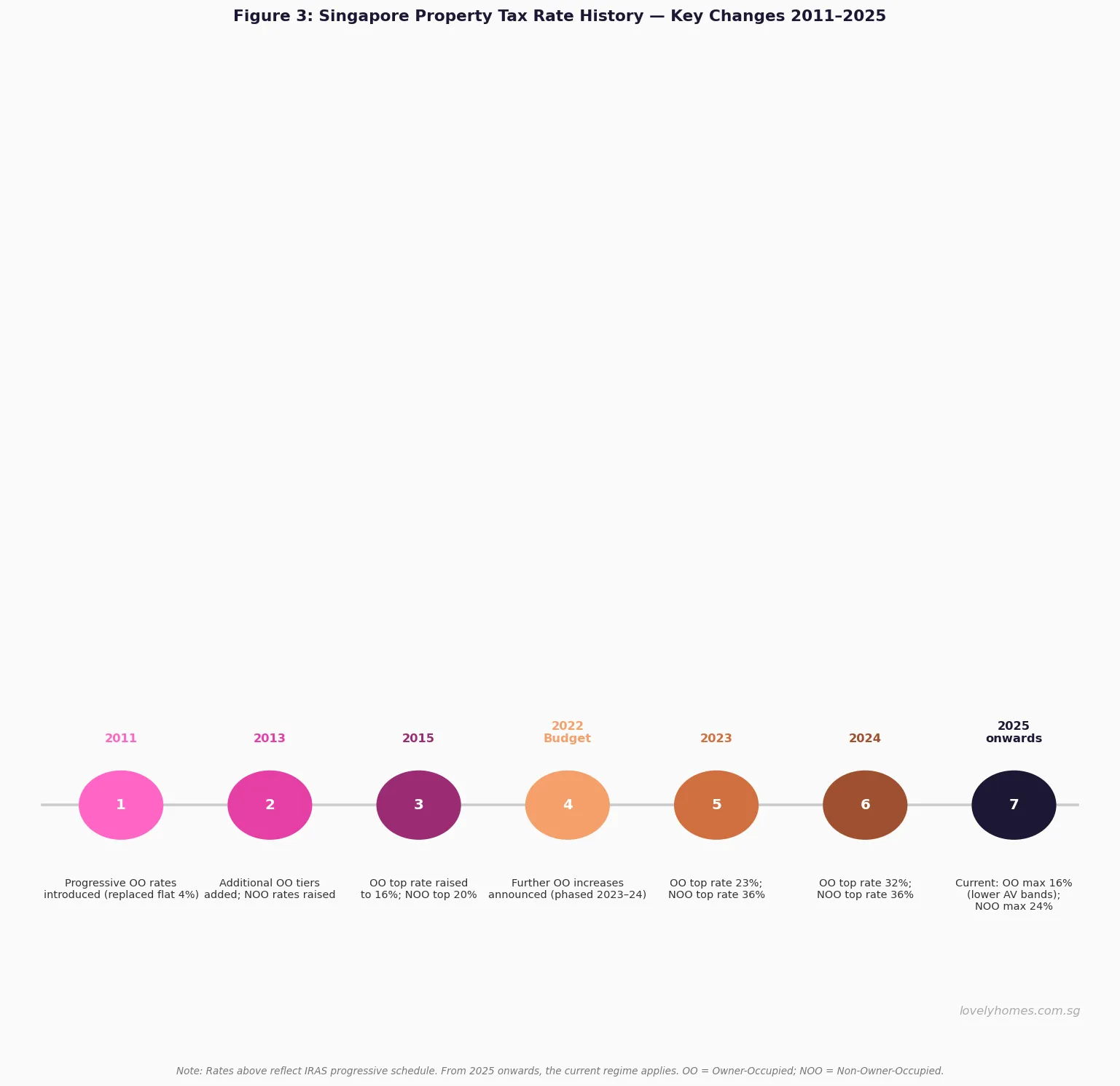
Owner-occupied residential properties enjoy significantly lower property tax rates (0% on the first S$8,000 AV, then 4%–16% progressively). For non-owner-occupied (i.e., rented-out) residential properties, the rates are higher: 10% on the first S$30,000 AV, then 12%, 14%, 16%, 18%, and 20% progressively on higher AV bands (effective from 1 January 2024 after the 2023 rate hike).
An OCR condo with AV of S$36,000 would attract annual property tax of approximately: 10% × S$30,000 + 12% × S$6,000 = S$3,000 + S$720 = S$3,720 per year (~S$310/month). This is a deductible expense against rental income in your IRAS tax return.

The Cash-Flow Reality: Yield vs Cost
One of the most important lessons for Singapore condo investors in 2026 is that gross rental yield almost never covers all monthly holding costs for a leveraged investor in the current interest rate environment. With SORA-linked mortgage rates at approximately 3.3%–3.8% and property prices at historic highs, the monthly mortgage repayment on a S$900,000 OCR condo with 75% LTV financing (loan S$675,000, 25 years) is approximately S$3,150–S$3,300 per month — already at or above the achievable rent for a 2-bedroom unit in many OCR areas.
Add property tax (S$310/month), maintenance fees (S$350/month), and agent commissions amortised (S$170/month), and total monthly outgoings approach S$4,200–S$4,500. With rent at S$3,200–S$3,500/month, the property generates a negative monthly cash flow of S$700–S$1,300 before accounting for tax savings from deductible interest.
This is not necessarily a reason to avoid rental investment — Singapore property has historically delivered capital appreciation that dwarfs the income return — but it underscores that the investment thesis for Singapore residential property rests primarily on capital growth rather than yield. Investors who need the property to be cash-flow positive from day one should focus on higher-yield OCR fringe areas, 1-bedroom units (where rent/price ratios are more favourable), or hold without leverage where cash holdings allow.
Worked Example: Mr Lim’s OCR Investment Property
Annual rental income: S$3,400 × 12 = S$40,800
Allowable deductions (Year 1):
• Mortgage interest (approx. 60% of repayment in early years): S$3,381 × 12 × 60% ≈ S$24,344
• Property tax (non-owner-occupied AV ~S$38,400): S$3,888
• Agent commission (1 month): S$3,400
• Maintenance fees: S$350 × 12 = S$4,200
• Repairs/misc: S$1,000
• Total deductions: S$36,832
Net chargeable rental income: S$40,800 − S$36,832 = S$3,968
Tax on incremental S$3,968 (Mr Lim’s marginal rate at S$150k total income is ~15%): ~S$595
Net rental income after tax: S$40,800 − S$36,832 − S$595 = S$3,373 per year (~S$281/month)
Monthly cash flow: Rent S$3,400 − Loan S$3,381 − Maintenance S$350 − Property Tax S$324 − Agent (amortised) S$142 = −S$797/month
Mr Lim’s effective monthly cost of holding the investment property is approximately S$797. His rationale: the ABSD of S$180,000 front-loaded his acquisition cost, and he expects 3–5% annual capital appreciation on the S$900,000 property (S$27,000–S$45,000/year) to more than compensate.

Tenancy Rules: URA Minimum Lease and Subletting
All private residential tenancies in Singapore are subject to URA’s minimum 3-month lease period rule. This means you cannot rent your condominium on a short-stay basis (e.g., Airbnb-style), as doing so violates planning conditions and carries penalties including fines and compulsory sale in repeat-offence cases. Only licensed short-stay accommodation (hotels, serviced residences, and approved guesthouses) may offer leases shorter than three months.
For long-term leases, the landlord’s obligations include: providing a signed tenancy agreement stamped with the Inland Revenue Authority of Singapore (stamp duty of 0.4% of total rent for leases exceeding one year); ensuring the property is in habitable condition; providing a security deposit receipt; and not refusing to refund the deposit without legitimate grounds. The Residential Tenancies Act (RTA), passed in 2022 and operationalised progressively, provides a statutory dispute resolution process for landlord-tenant disputes below S$30,000.
What Does This Mean for Rental Investors?
Singapore’s rental market in 2026 sits at a crossroads. Rents are elevated — materially above their 2018–2019 base — but the pace of increase has slowed as more completions come online. Projects that completed in 2023–2025 are adding supply to Districts 18, 19, and 23, which may cap rent growth in those areas. Central-zone properties continue to benefit from limited supply and sticky expatriate demand.
The net yield compression story is real. An investor who bought an OCR condo in 2015 at S$600 psf and now earns rent on a property worth S$1,100 psf has seen their yield halve in nominal terms — but their capital gain has more than compensated. For new entrants in 2026 buying at today’s prices, the yield mathematics require a realistic assessment of capital appreciation expectations and holding capacity during negative cash-flow periods.
Singapore’s macroprudential framework (Total Debt Servicing Ratio cap of 55%, Mortgage Servicing Ratio cap of 30% for HDB loans, ABSD escalation) means that the market is unlikely to see the kind of over-leveraged speculation that preceded the 1997 and 2008 crises. The downside risk for well-selected Singapore residential property is bounded — but so is the short-term income return.
What Might Come Next for Rental Property Policy
The Ministry of National Development (MND) and the Urban Redevelopment Authority have consistently signalled willingness to adjust cooling measures in response to market data. With rents still above historical averages but showing signs of moderation, and with significant completions in the pipeline for 2026–2028 from projects launched in 2021–2023, rental growth is expected to moderate. ABSD adjustment — particularly for second-property purchases — remains the most-watched policy lever. Speculation on changes to the non-owner-occupied property tax rates is also present in industry commentary. All forward-looking statements in this section are the editorial view of LovelyHomes and do not represent government policy.
Frequently Asked Questions
Do I have to declare rental income if I rent out only one room?
Yes. All rental income, including income from renting out a single room in your HDB flat or private property, is taxable in Singapore and must be declared in your IRAS tax return. However, IRAS allows a simplified deduction of 15% of gross rent as deemed expenses (in lieu of actual deductions) for HDB room rentals, which simplifies the computation for smaller-scale landlords. For private property owners renting out the entire unit, actual deductions are generally more advantageous.
Can I deduct the full mortgage repayment from rental income?
No. Only the interest component of your mortgage repayment is deductible, not the principal repayment. In the early years of a 25-year amortising loan, the interest portion is highest (often 60%–70% of each payment). As you pay down the loan, the interest component decreases and your deductible amount falls — meaning your taxable rental income increases over time on a leveraged property even if the rent stays constant.
How does IRAS determine the Annual Value of my rental property?
IRAS determines Annual Value (AV) by reference to market rental data for comparable properties in the same development or area. Your actual rent may be higher or lower than the IRAS AV, but property tax is always computed on IRAS’s assessed AV — not your actual rent. If you believe the AV is incorrect, you may file an objection with IRAS within 30 days of receiving the property tax notice.
What happens if I forget to declare rental income?
Failure to declare rental income is a strict-liability offence under Section 94 of the Income Tax Act. IRAS routinely cross-references URA tenancy data, stamp duty records, and CPF data to identify undeclared rental income. Penalties include a fine of up to 200% of the tax undercharged, and in serious cases, prosecution. IRAS operates a Voluntary Disclosure Programme that provides penalty remission for landlords who proactively declare previously omitted income before IRAS contacts them.
Can I rent out my condo while it still has an outstanding HDB loan?
Yes — your condo and HDB loan are separate financial obligations. There is no HDB rule preventing you from renting out a private condo unit you own, regardless of your HDB loan status. The HDB loan rules govern your HDB flat; your private property is subject to MAS regulations and URA tenancy rules. However, if you own an HDB flat and a private property simultaneously, you must note HDB’s Private Property Declaration rules: certain restrictions apply to HDB flat ownership when you also own private property, particularly regarding the 30-month waiting period for PRs and the subletting approval process for HDB flats.
Is rental income from overseas property taxed in Singapore?
Singapore moved to a modified territorial basis effective 1 January 2024. Foreign-sourced rental income received in Singapore on or after that date — meaning income remitted into a Singapore bank account or received from a Singapore-connected entity — is generally taxable in Singapore for Singapore tax residents, subject to applicable tax treaties. Foreign taxes paid may be creditable against Singapore tax to avoid double taxation. Consult a tax professional for your specific situation, particularly if you hold overseas real estate.
Related Articles
- Singapore Rental Guide 2026: How to Rent a Property
- Singapore Home Loan Guide 2026: HDB and Bank Loans Explained
- CPF Property Withdrawal Rules Singapore 2026
- ABSD Singapore 2026: Complete Guide to Additional Buyer’s Stamp Duty
- Singapore HDB Downsizing Guide 2026: Rightsize and Unlock Cash
- Singapore Property Buying Checklist 2026: Step-by-Step Guide
- Foreigner Buying Property Singapore 2026: Complete Guide
Disclaimer
This article is for general educational purposes only and does not constitute financial, legal, or tax advice. Singapore property tax rates, IRAS deduction rules, income tax rates, URA tenancy regulations, and ABSD rates are subject to change and should be verified directly with the relevant government agencies: IRAS (iras.gov.sg), URA (ura.gov.sg), MAS (mas.gov.sg), and HDB (hdb.gov.sg). Rental yields, prices, and all financial examples are illustrative only and based on market data available as at August 2026. Readers should consult a licensed real estate salesperson, qualified financial adviser, and tax professional before making any property investment decision.