

99-to-1 property ownership is a structure where one party holds a 99% interest in a property and another holds 1%. It came under intense IRAS scrutiny in 2023–2024 when the tax authority identified a specific pattern being used to sidestep Additional Buyer’s Stamp Duty (ABSD). This 2026 guide separates legitimate 99-to-1 arrangements from the red-flag pattern IRAS has been reassessing, and explains how it differs from classic decoupling.
For the official IRAS guidance, see IRAS’s stamp duty page. This article explains the practical picture.
Quick Answer — 99-to-1 in 2026
- The structure: one party holds 99% of a property, another holds 1%.
- Legitimate uses: loan eligibility, succession planning, investment allocation among co-owners.
- The flagged pattern: sole buyer signs OTP, then transfers 1% to another party within weeks.
- Clawback: original ABSD + 50% surcharge = 1.5x the amount saved.
- Different from decoupling: 99-to-1 happens at original purchase; decoupling happens long after purchase.
Why 99-to-1 Became Attractive
A standard 99-to-1 structure lets two parties co-own a property with minimal share for one. In isolation this is unremarkable — people use it for tax planning, succession, and pooled investment.
Under Singapore’s ABSD framework, though, it can also function as a loan-qualification tool. Here is the pattern IRAS identified:
- A buyer without enough income to qualify for a large bank loan wants to buy a S$2m condo.
- A family member with high income but who already owns a property agrees to be named on the loan.
- The high-income family member was added as a co-owner at 1%, while the main buyer takes 99%.
- The bank was willing to lend based on both incomes because the family member is a co-owner.
- But because the family member only owned 1%, the buyer’s main ownership would have qualified for first-timer ABSD treatment.
The effect: a high-income co-owner who already owned property was piggybacking on a first-timer buyer’s ABSD rate. IRAS identified this as a tax-avoidance pattern under the general anti-avoidance provision.
The IRAS Audit Pattern
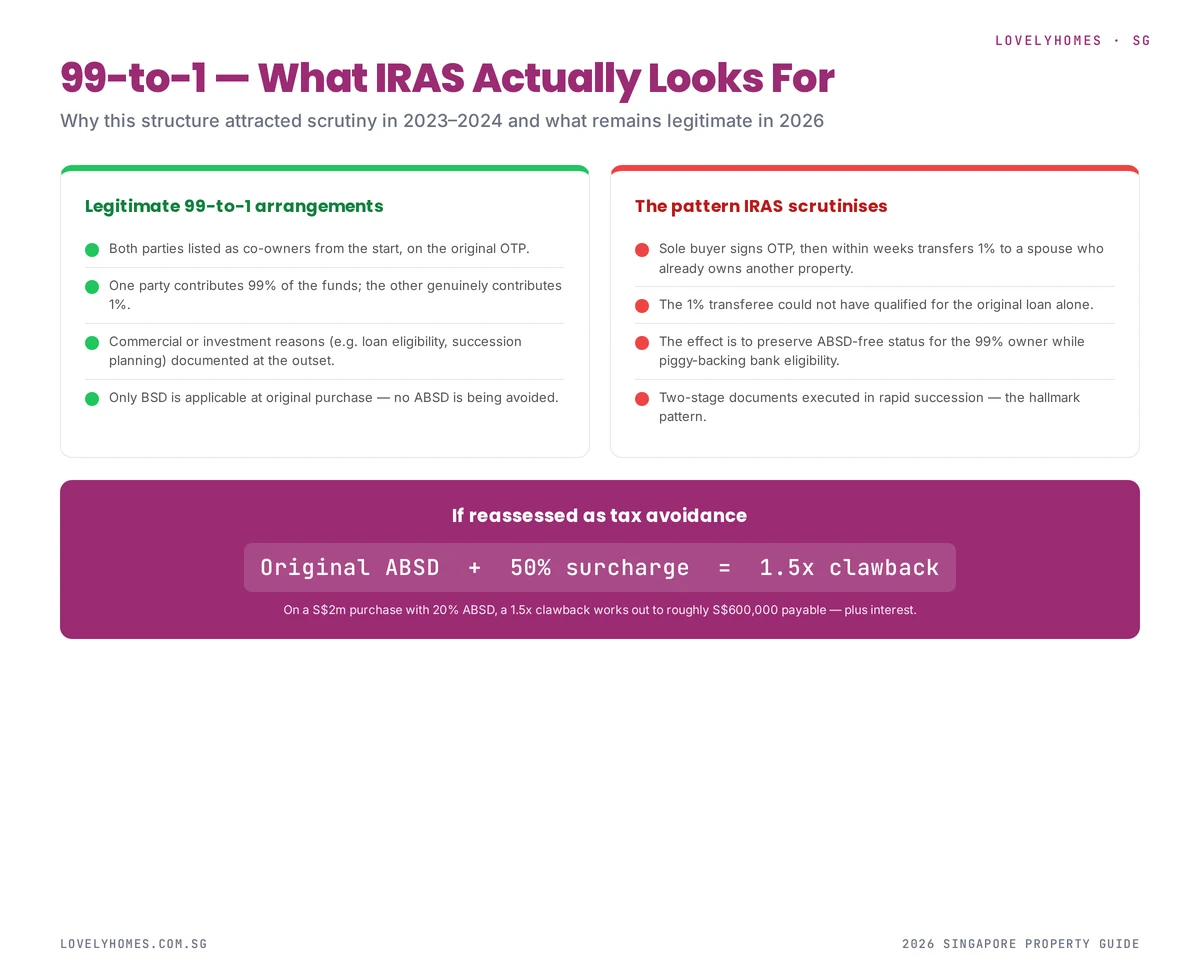
IRAS has been targeting a specific variant of 99-to-1:
- Sole buyer signs the OTP and pays BSD on the full purchase price at first-timer rates.
- Within weeks of OTP, a 1% share is transferred to a second party (often a spouse or parent).
- The 1% transferee already owns another property — they would have triggered ABSD if they had been on the OTP from day one.
- The two-stage structure avoids the ABSD that a direct joint purchase would have incurred.
IRAS reviewed approximately 300–400 such cases in its 2023–2024 sweep. Where the pattern matched, IRAS reassessed the transaction as if the 1% transferee had been a co-owner from the start, and issued an ABSD bill plus surcharge.
The 1.5x Clawback
When IRAS reassesses a 99-to-1 arrangement as tax avoidance, the remedy is:
- The full ABSD that would have applied had the transferee been on the OTP from day one
- Plus a 50% surcharge on that ABSD
On a S$2m purchase where avoided ABSD was 20% = S$400,000, the clawback works out to S$400,000 + S$200,000 surcharge = S$600,000 payable, plus any interest and legal costs. This is materially more punitive than simply paying the ABSD upfront.
Legitimate 99-to-1 Arrangements
Not every 99-to-1 is a red flag. IRAS has explicitly acknowledged the pattern is legitimate when:
Both parties are co-owners from day one
If both parties sign the original OTP and are named as co-owners in the Sale & Purchase Agreement at the 99:1 split, this is a single transaction and the full ABSD applies on the 1% transferee’s share from the outset. No two-stage manoeuvre, no IRAS issue.
Genuine investment-pooling
Multiple family members pooling funds for an investment property, with each contributing in proportion to their share, is legitimate — provided the shares reflect actual contribution.
Succession planning
A parent retaining 99% and transferring 1% to a child for succession reasons is legitimate, subject to the normal BSD on the 1%. Timing is usually far removed from any property transaction, which is itself a credibility signal.
Commercial co-ownership
Business partners sharing an investment property where one partner provides 99% of the capital and the other provides 1% (perhaps in exchange for operational management) is legitimate under normal commercial logic.
How 99-to-1 Differs from Decoupling
| Aspect | 99-to-1 | Decoupling |
|---|---|---|
| Timing | At or near original purchase | Years after purchase, before a new purchase |
| Ownership after | 99:1 split persists | One party becomes sole owner |
| What it enables | Two parties on loan | Freed spouse buys second home |
| ABSD mechanism | Avoided on the 99% party | Avoided on the transferring party’s next purchase |
| IRAS scrutiny | 2023–2024 sweep | Reviewed case-by-case |
Put simply: decoupling restructures an existing joint ownership; the flagged 99-to-1 pattern manipulates a fresh purchase to sidestep ABSD that would otherwise have applied.
If You Already Have a 99-to-1 Arrangement
If you set up a 99-to-1 before 2023–2024 and have not heard from IRAS, it is almost certainly not in the audit scope. However, if you receive an IRAS query letter:
- Do not respond on an informal basis. Engage a tax-focused solicitor immediately.
- Compile the documentary evidence for the legitimate commercial purpose of the arrangement.
- Be ready to pay the full clawback + surcharge if the pattern matches the flagged type. Appealing is expensive and the success rate has been low.
- Consider restructuring if the arrangement is ongoing — though retrospective fixes rarely help once IRAS has engaged.
Current Status in 2026
As of 2026, IRAS continues to monitor two-stage transfers with a 1% residual. The 2023–2024 sweep was not a one-off — it set a precedent that routine transaction audits now look for. Structures that superficially resemble the flagged pattern are far riskier than they were before 2023.
For buyers with legitimate pooling or succession reasons, the arrangement remains viable — but put the co-owner on the original OTP, keep documentation of commercial intent, and avoid the tell-tale timing pattern.
FAQ — 99-to-1 2026
Is 99-to-1 illegal?
No. The ownership structure itself is legal. What is scrutinised is whether the specific arrangement amounts to tax avoidance under the general anti-avoidance provision.
Can I still use 99-to-1 today?
Yes, provided both parties are on the original OTP and the arrangement has a genuine commercial purpose. The risky pattern is the two-stage transfer executed soon after OTP.
How does IRAS identify flagged arrangements?
By cross-referencing stamp duty records with property ownership data. If you owned property before the 1% transfer date, IRAS’s system will flag the transaction for review.
What about 95-to-5 or 90-to-10?
The same anti-avoidance principle applies. IRAS has focused on 99-to-1 because it is the most extreme variant, but the logic extends to any split where a high-income party with existing property takes a minor share to piggyback ABSD rates.
Can I unwind an existing 99-to-1 to avoid IRAS attention?
Possibly, but consulting a tax lawyer before any action is essential. Unwinding can itself trigger stamp duty and CPF complications, and retrospective “fixes” are often viewed as evidence of avoidance intent.
Disclaimer: This article explains a complex and evolving area of Singapore tax law. Specific cases require qualified legal and tax advice. IRAS enforcement practice may shift further.