Understanding gross yield, net yield and leveraged returns is essential before committing capital to any Singapore investment property. This guide breaks down the numbers honestly.
Quick Answer
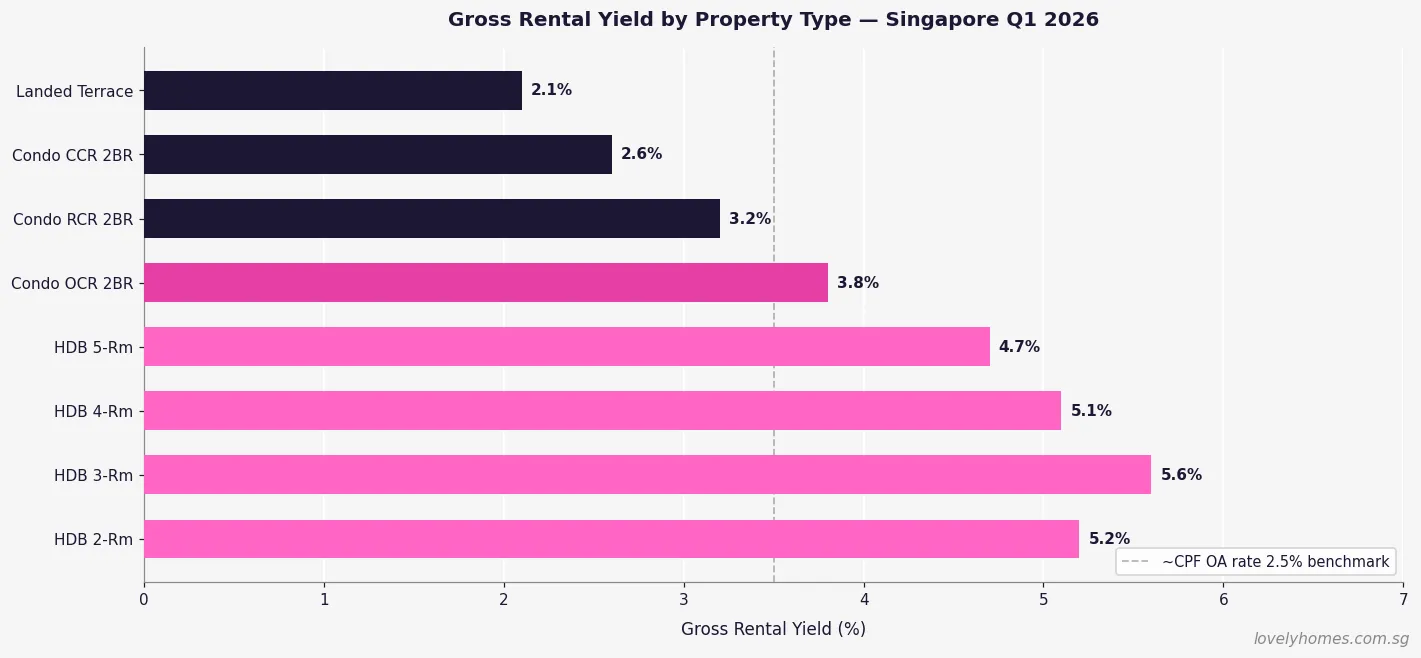
Gross rental yield in Singapore ranges from about 2.0% (landed) to 4.2% (HDB 3-room OCR) as of Q1 2026.
Net yield — after property tax, maintenance, agent fees and vacancy — is typically 0.9–1.4 percentage points lower than gross.
OCR condos (Jurong, Bukit Batok, Tampines, Sengkang) generally offer the best risk-adjusted net yields at 1.9–2.6% for condominiums.
HDB flats deliver the highest gross yields but come with restrictions: only Singapore Citizens and Permanent Residents may own them as investment vehicles through the resale market.
Leveraged net yields (30% equity down on a condo) can reach 7–10% in the early years — but this figure omits loan interest costs, which must be modelled separately.
The break-even period (years to recover purchase price via rent alone) ranges from ~38 years for an HDB flat to over 90 years for a landed property — reinforcing that rental income complements but does not drive Singapore property returns.
The Total Debt Servicing Ratio (TDSR) caps mortgage obligations at 55% of gross monthly income; rental income from the property counts only at a 30% haircut in TDSR calculations.
What Is Rental Yield and Why Does It Matter?
Rental yield is the annual rental income expressed as a percentage of the property’s purchase price or market value. It is the primary metric Singapore investors use to compare the income-generating efficiency of different asset classes — condominiums, HDB resale flats, commercial shophouses and industrial units — against each other and against fixed-income alternatives such as Singapore Savings Bonds (currently ~2.8% p.a.) or the CPF Ordinary Account rate (2.5%).
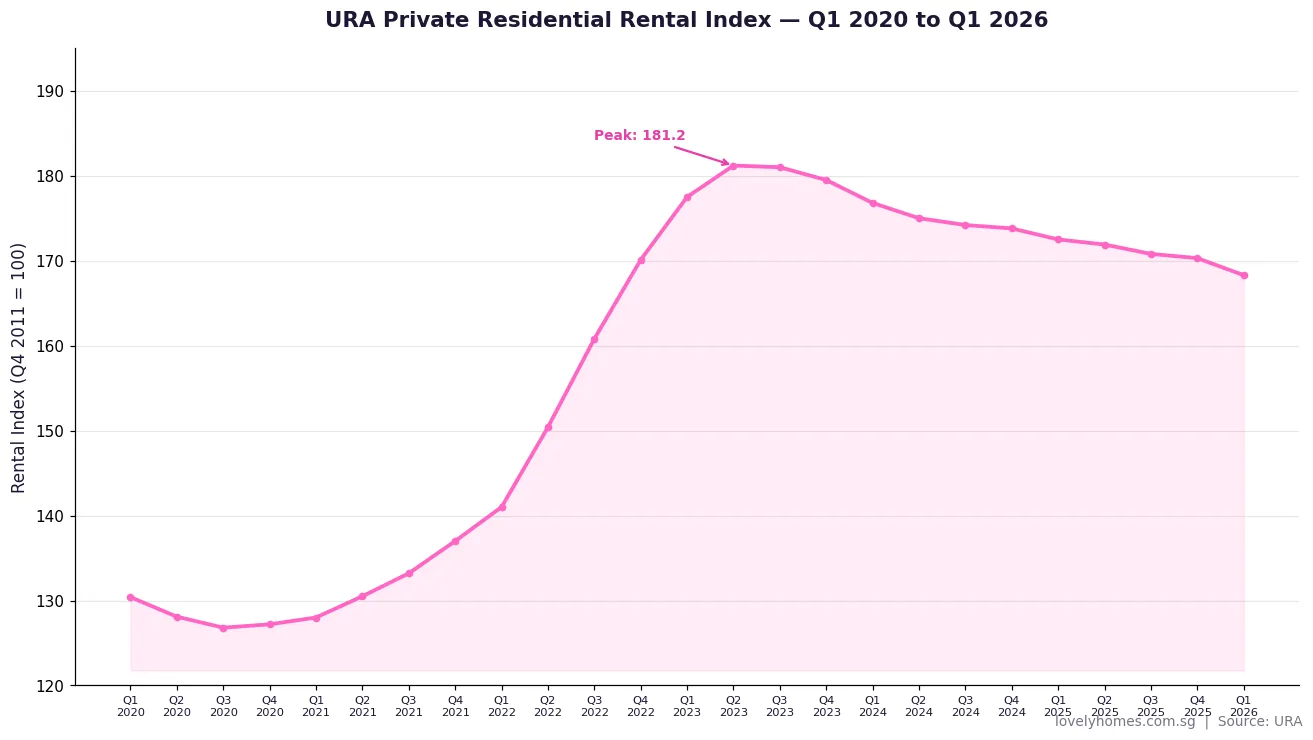
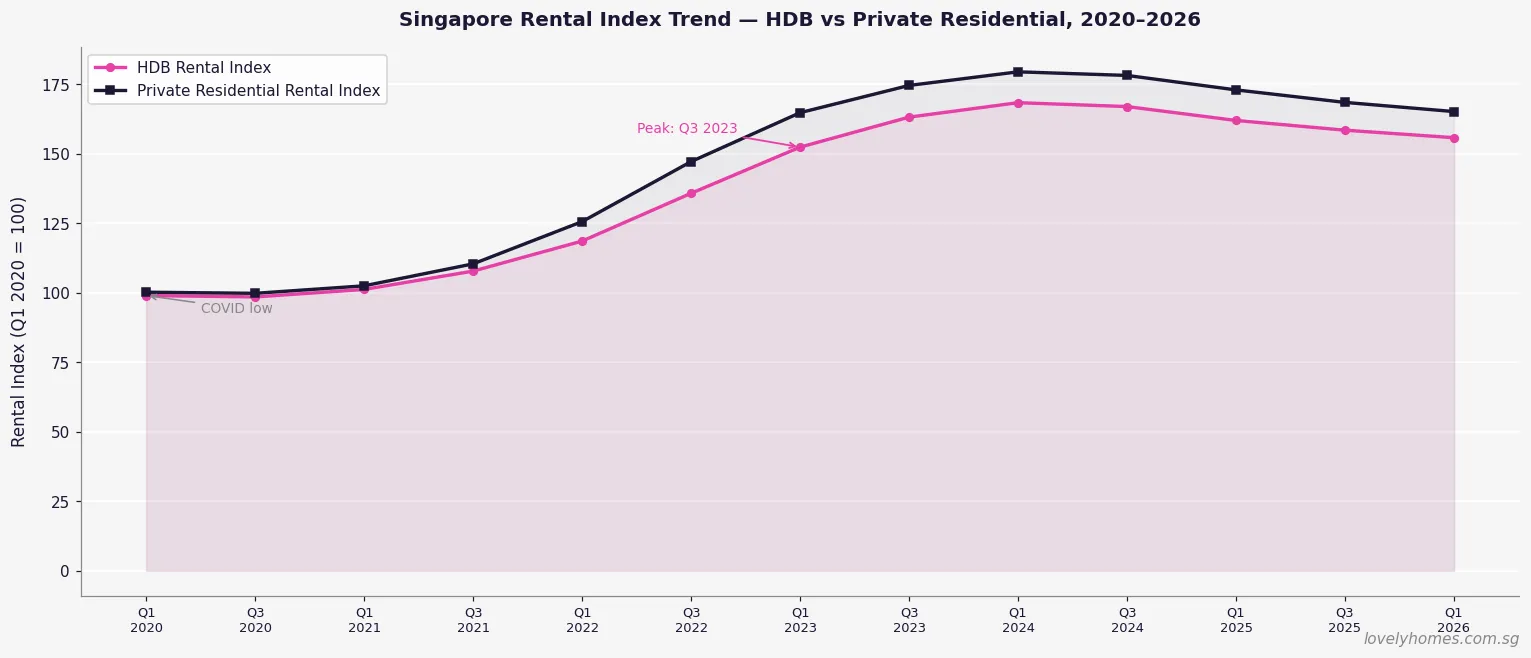
The Urban Redevelopment Authority (URA) publishes quarterly rental indices for private residential properties, and the Housing and Development Board (HDB) tracks the HDB Rental Index — both of which feed into the rental yield calculation. As of Q1 2026, private residential rents are broadly stable after a post-pandemic surge that saw CCR rents rise over 45% between 2021 and 2023. The correction phase has softened yields slightly from their 2022 peaks, but the OCR and RCR remain attractive relative to interest rates.
Gross Rental Yield by Property Type
Gross rental yield uses contract rent (what the tenant actually pays) divided by the property’s transacted or current market price. It ignores all costs on the landlord’s side.
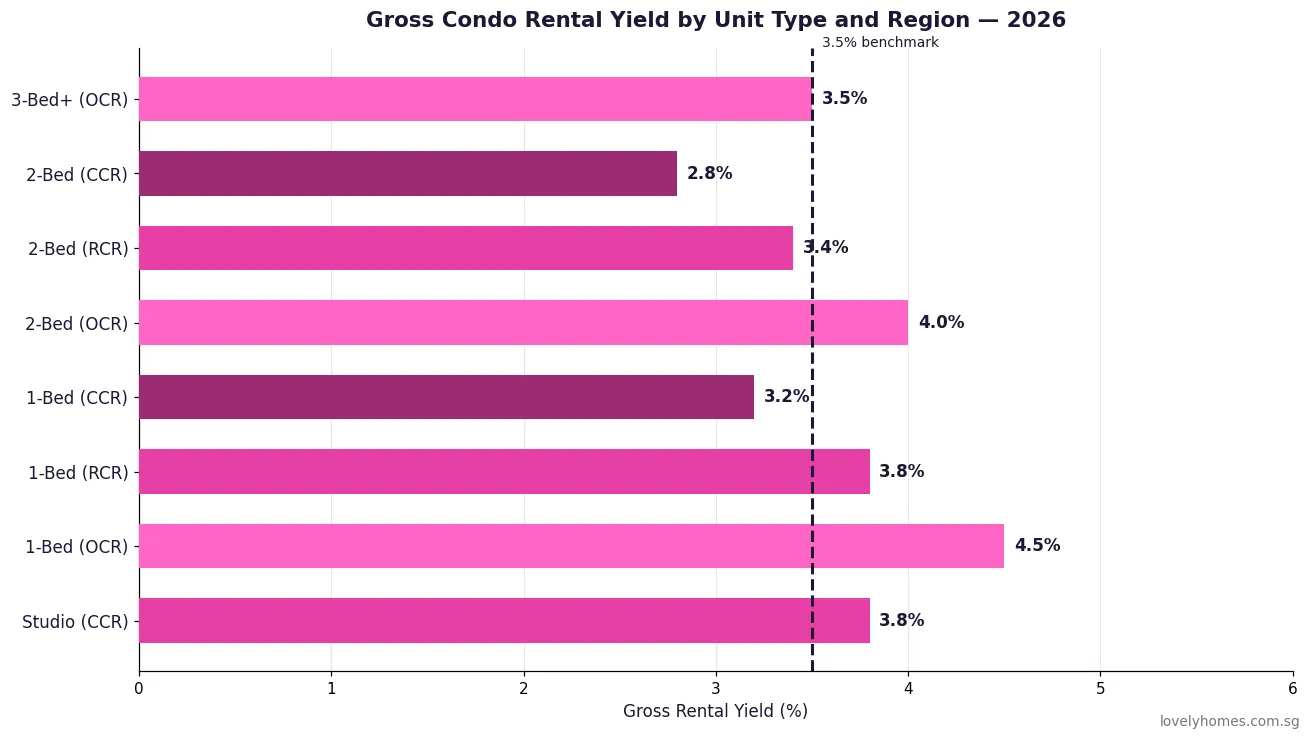
Figure 1: Indicative gross rental yield by property type — Singapore Q1 2026. Source: URA rental caveats; SingStat.
Key observations from the data:
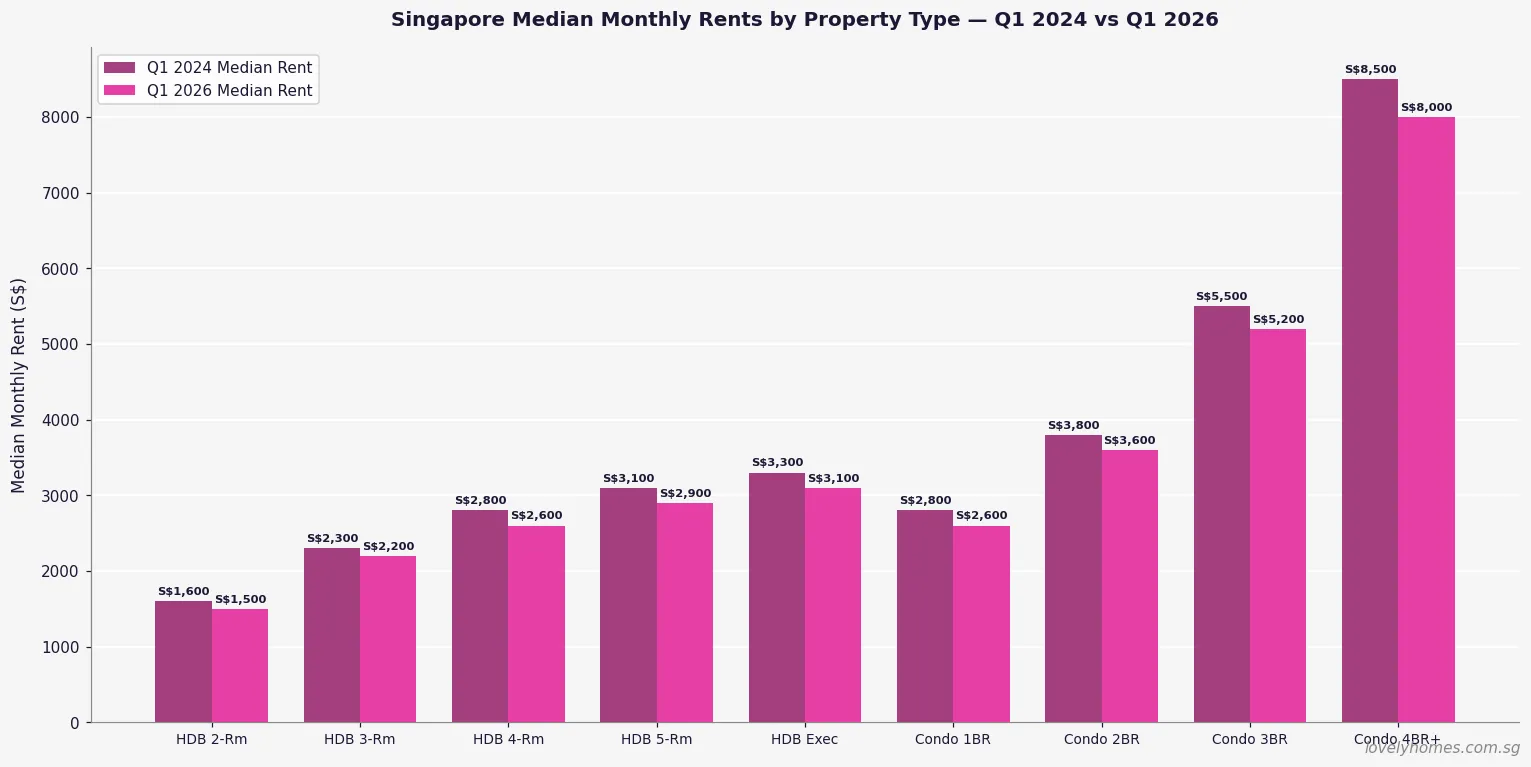
HDB 3-room OCR flats lead at ~4.2% gross, because median transaction prices remain moderate (S$450k–S$580k for non-mature estates) while monthly rents of S$2,200–S$2,500 remain robust, driven by PRs and upgraders who cannot yet buy a condo.
OCR 1BR condominiums (≤500 sq ft) typically achieve 3.3–3.7%, with median transacted prices of S$800k–S$1.05M and rents of S$2,800–S$3,200/month.
CCR 2BR units in Districts 9, 10, 11 deliver gross yields of only 2.2–2.6%, reflecting premium transaction prices of S$2.5M–S$3.5M against rents that have softened from 2022 peaks as expat headcount stabilises.
Net Rental Yield: What You Actually Pocket
Net yield strips out all landlord-side costs: property tax (levied by IRAS at 10–20% of Annual Value for non-owner-occupied residential property since 1 January 2023), maintenance and sinking fund, property management or agent fees (one month’s rent per tenancy for a 12-month lease, amortised annually), and a vacancy allowance of approximately 4–6% for the typical between-tenancy gap.
Figure 2: Gross yield vs net yield and implied break-even period — Singapore Q1 2026.
The deduction gap between gross and net yield widens as property value rises, because Annual Value assessments by IRAS scale with rental evidence in the district, while absolute maintenance costs rise more slowly. A Sentosa Cove villa carrying S$180,000 in annual gross rent might have an Annual Value of S$150,000, generating a property-tax bill of ~S$22,500 at the 15% non-owner-occupied tier — a disproportionate cost for a S$12M asset yielding only 1.5% gross.
Location-Adjusted Yields: OCR vs RCR vs CCR
Singapore’s three market regions — Outside Central Region (OCR), Rest of Central Region (RCR) and Core Central Region (CCR) — display structurally different yield profiles driven by tenant demographics, supply-demand dynamics and capital value trajectories.
Region
Typical Tenant
Avg Gross Yield (2BR)
Avg Net Yield (2BR)
Vacancy Risk
OCR
PRs, young professionals, upgraders
3.0–3.5%
1.9–2.5%
Low–Moderate
RCR
Mid-tier expats, dual-income households
2.7–3.1%
1.7–2.2%
Moderate
CCR
Senior expats, C-suite, institutional
2.2–2.6%
1.3–1.8%
Moderate–High
OCR condominiums have historically offered the best combination of rental stability and yield depth for individual investors. Districts 19 (Serangoon, Hougang), 22 (Jurong West), 23 (Bukit Batok, Hillview) and 27 (Yishun, Sembawang) consistently rank among the top-yielding non-landed private residential submarkets.
Worked Example: 2BR OCR Condo, S$1.1M
Figure 3: Worked example — 2BR OCR condo purchased at S$1.1M, monthly rent S$3,200 (Jurong/Bukit Batok area).
Worked Example: The Tan Family’s Investment Property
Mr and Mrs Tan — both Singapore Citizens, owning one HDB flat — purchase a second property, a 2BR OCR condo at S$1,100,000 in Bukit Batok, for investment. This is their second residential property, triggering a 20% ABSD charge of S$220,000 payable within 14 days of the option being exercised. They plan to rent it out immediately.
Purchase price: S$1,100,000
BSD: S$30,600 (1% on S$180k + 2% on S$180k + 3% on S$640k + 4% on S$100k)
Net yield on total acquisition cost (incl. ABSD + BSD): 2.09%
The ABSD drag is significant: when measured against total acquisition cost including ABSD, the net yield falls to 2.09% — well below the current Singapore Savings Bond rate of ~2.8%. This is the economic reality of owning a second residential property in Singapore. The investment case depends on capital appreciation — historically strong — rather than rental income alone.
HDB Rental Yield: The Special Case
HDB flats cannot be purchased as direct investments by most buyers: you must intend to occupy the flat, and only after the 5-year Minimum Occupation Period (MOP) — or 10 years for Plus/Prime classification flats — may you rent out the entire unit. That said, after MOP, many households do move to a private property and rent out the HDB flat, effectively converting it to an income asset.
Gross yields on HDB resale flats in non-mature estates (Punggol, Sengkang, Sembawang, Yishun) tend to be the highest in Singapore’s residential market at 3.8–4.5%, because resale prices have moderated while rents remain firm. The key restriction is that the tenant must also be a Singapore Citizen, PR, or hold a valid Employment Pass, Work Permit or Student Pass — and the flat cannot be sublet to more than 6 occupants without HDB approval.
Leveraged Yield: Handle With Care
When financed with a bank loan (maximum LTV 75% for a first private property; 45% for a second property under existing MAS guidelines), the return on equity deployed can look dramatically higher. For the Tan family’s example above: equity deployed of S$330,000 (30% downpayment) + S$220,000 ABSD + S$30,600 BSD = S$580,600 total cash outflow. Against an annual net rent of S$28,180, the leveraged yield on cash deployed is ~4.8% — better, but the loan interest (at current SORA-pegged rates of roughly 3.6–4.0% effective) must be deducted before any true profit is made. At 75% LTV on S$1.1M = S$825,000 loan at 3.8% for 25 years, annual interest in year 1 is approximately S$31,350 — which exceeds the annual net rent. The property is cash-flow negative until rents rise or the loan is substantially paid down.
What This Means for You: Is Singapore Property Worth Buying for Yield?
The honest answer, for most individual investors, is: not primarily for yield. Singapore property generates competitive income only if you own it free and clear (no mortgage) and have navigated the ABSD correctly (first property, or HDB after MOP). For leveraged investors or those paying ABSD on second/third properties, the rental income rarely covers holding costs in the near term.
The investment thesis for Singapore residential property has historically rested on capital appreciation — with the URA Private Residential Price Index rising approximately 3.8% per annum compounded over 20 years — augmented by rental income as a partial carry offset. Viewed that way, a 2.5% net yield on a leveraged position that appreciates at 3–4% per annum generates a total return of 5.5–6.5%, which compares reasonably well to a Singapore REIT yielding 5–6% with lower capital upside.
The structural advantages of direct property investment remain: leverage (not available in REITs), CPF usage (for the first property), exemption from capital gains tax (absent a finding of trading intent by IRAS), and the psychological comfort of a tangible, Singapore-based asset.
What Might Come Next for Singapore Rental Yields
Several structural forces could compress or expand rental yields over 2026–2028. On the supply side, MAS and URA have projected ~40,000 private residential units in the pipeline, with significant completions in 2026–2027. This supply overhang is most acute in the OCR, where the bulk of GLS sites have been awarded. On the demand side, Singapore’s S Pass and Employment Pass headcount — the backbone of the expat rental pool — is sensitive to global economic conditions and the pace of multinational relocations to Singapore. In a downside scenario where global firms retrench Asian headcount, CCR and RCR rents would feel the pressure first.
Interest rates remain the most important swing factor: a 100 basis-point fall in SORA over 2026–2027 would turn many currently cash-flow-negative second properties cash-flow-positive, potentially releasing pent-up investment demand. The converse — a rate spike — would further widen the gap between gross yield and financing cost.
Frequently Asked Questions
How is rental yield calculated in Singapore?
Gross rental yield = (annual rent ÷ property purchase price) × 100. For example, a condo bought at S$1.2M generating S$3,500/month rent has a gross yield of (S$42,000 ÷ S$1,200,000) × 100 = 3.5%. Net yield further deducts property tax (administered by IRAS), maintenance fees, agent commissions and a vacancy allowance — typically reducing the headline figure by 1.0–1.4 percentage points.
What is a “good” rental yield in Singapore?
Context matters enormously. In the current interest-rate environment (effective mortgage rates 3.5–4.0%), a gross yield below 3.5% on a mortgaged property means the rental income will not cover financing costs in the early years of the loan. A net yield above 2.5% is generally considered solid for a private residential property in Singapore. For HDB flats held after MOP, gross yields of 3.8–4.5% in non-mature estates are achievable and are broadly competitive with Singapore Savings Bonds or CPF rates.
Do I need to declare rental income to IRAS?
Yes. Rental income from Singapore properties is assessable income under the Income Tax Act (Cap. 134) and must be declared in your annual income tax return. You may deduct allowable expenses — mortgage interest, property tax, maintenance fees, agent commissions, fire insurance, and wear-and-tear on furnishings (at 20% of the cost of fittings under IRAS’s deemed-expense basis). IRAS offers two deduction methods: actual expenses (you must keep receipts) or a simplified 15% deemed-expense deduction of gross rental income.
Can I use CPF to finance an investment property?
Yes, subject to limits. CPF Ordinary Account savings may be used for the downpayment and monthly mortgage instalment on a private residential property (bank loan only — CPF cannot be used with an HDB concessionary loan for a private property purchase). However, for a second property, the Valuation Limit and Withdrawal Limit rules under the CPF Housing Withdrawal Scheme apply, and any CPF used attracts accrued interest that must be refunded to your CPF account upon sale. This accrued interest — compounding at 2.5% per annum from the date of each withdrawal — can significantly erode the net sale proceeds if the property is held for many years.
Is the rental income counted in TDSR for my next purchase?
Rental income from investment properties counts towards TDSR calculations, but only at a 30% haircut. That is, if you receive S$3,200/month in rent, only S$960/month is counted as eligible income for TDSR purposes. This conservative treatment, mandated by MAS, is intended to prevent investors from using projected rental income to qualify for larger loans than their employment income alone would support. You must also provide documentary evidence — a signed tenancy agreement — for the rental income to be included.
What are the ABSD implications of buying a second property for rental?
If you are a Singapore Citizen purchasing your second residential property (including condominiums, landed homes, or HDB resale flats), you pay 20% ABSD on the full purchase price, payable within 14 days of the Option to Purchase being exercised. This is a significant upfront cash cost — S$220,000 on a S$1.1M property — that meaningfully dilutes rental yield when measured against total acquisition cost. Singapore Permanent Residents purchasing a second residential property pay 30% ABSD. Foreigners pay 65% ABSD on any residential property. The ABSD is administered by IRAS and there is no remission for investment purposes.
How does Singapore rental yield compare to REITs?
Singapore-listed REITs (S-REITs) currently yield 5.5–7.0% in dividend terms for diversified and industrial sub-sectors, and 4.5–5.5% for retail-focused trusts — well above the 2.0–3.5% net yield available on direct residential property. However, S-REITs do not benefit from leverage in the hands of the individual investor (the REIT itself is leveraged at 30–45% gearing), CPF cannot be used to buy REITs in the same way as CPF investment scheme rules apply, and historical capital appreciation has been more muted. Many Singapore investors hold both — residential property for capital appreciation and CPF-backed stability, S-REITs for income stream and liquidity.
Disclaimer: Rental yield figures in this article are derived from publicly available URA rental caveats, HDB rental transaction data and SingStat as at Q1 2026. They are indicative and will vary by specific unit, floor, facing, condition and negotiated rent. This article is for general information only and does not constitute financial, investment or tax advice. Readers should consult a licensed financial adviser (MAS-regulated), a property tax specialist and IRAS official guidance before making any investment decision. For authoritative data, refer to the URA Real Estate Information System (REALIS), HDB’s InfoWeb resale portal, IRAS property tax guidelines, and MAS’s property loan rules at mas.gov.sg.
Last updated 28 April 2026. Reflects IRAS lease stamp duty rules current as at FY2026 and standard market norms reported by URA’s quarterly rental statistics.
Quick Answer — 30-second takeaways
A Singapore tenancy agreement is the binding contract between a landlord and tenant. It is governed by Singapore contract law and the principles of the Civil Law Act and the Conveyancing and Law of Property Act.
Standard residential terms are 12 or 24 months. Anything shorter than 3 months risks being treated as serviced accommodation, which is regulated separately.
Security deposit: typically 1 month’s rent per year of lease, capped at 2 months. Refundable within 14 days of handover, less reasonable deductions.
Diplomatic clause: standard on 24-month leases, lets the tenant terminate after 12 months on 2 months’ notice if posted out of Singapore.
Lease stamp duty (LSD): 0.40% of total rent across the lease term, payable by the tenant within 14 days of execution, e-stamped at iras.gov.sg.
Minor repairs cap: tenant pays first S$150–S$250 of any repair; landlord pays the excess. Aircon servicing 3-monthly is the tenant’s cost.
Disputes ≤ S$30,000 can be heard at the Small Claims Tribunals (SCT) with both parties’ consent. Larger disputes go to the State Courts.
What a tenancy agreement is — and what it isn’t
A tenancy agreement (often abbreviated TA) is the written contract that creates a legal lease between a property owner (the landlord) and an occupant (the tenant). It records the parties, the property, the term, the rent, the deposit, and the rules for living in and looking after the home.
Singapore does not have a dedicated Residential Tenancy Act. Tenancy agreements are governed by general contract law, supplemented by the Civil Law Act 1909, the Conveyancing and Law of Property Act 1886, and — for HDB rentals — by the rules of the Housing and Development Board. This means that what is “standard” in a Singapore tenancy is largely set by market practice and by widely-used template clauses, not by statute. Landlords and tenants who do not read every clause carefully can find themselves bound by terms the other side considers normal but they did not expect.
A tenancy agreement is not a Letter of Intent (LOI). The LOI is the pre-contract document the prospective tenant submits with a good-faith deposit. The TA is the binding lease that follows once the LOI is accepted. Stamp duty is payable on the TA, not the LOI.
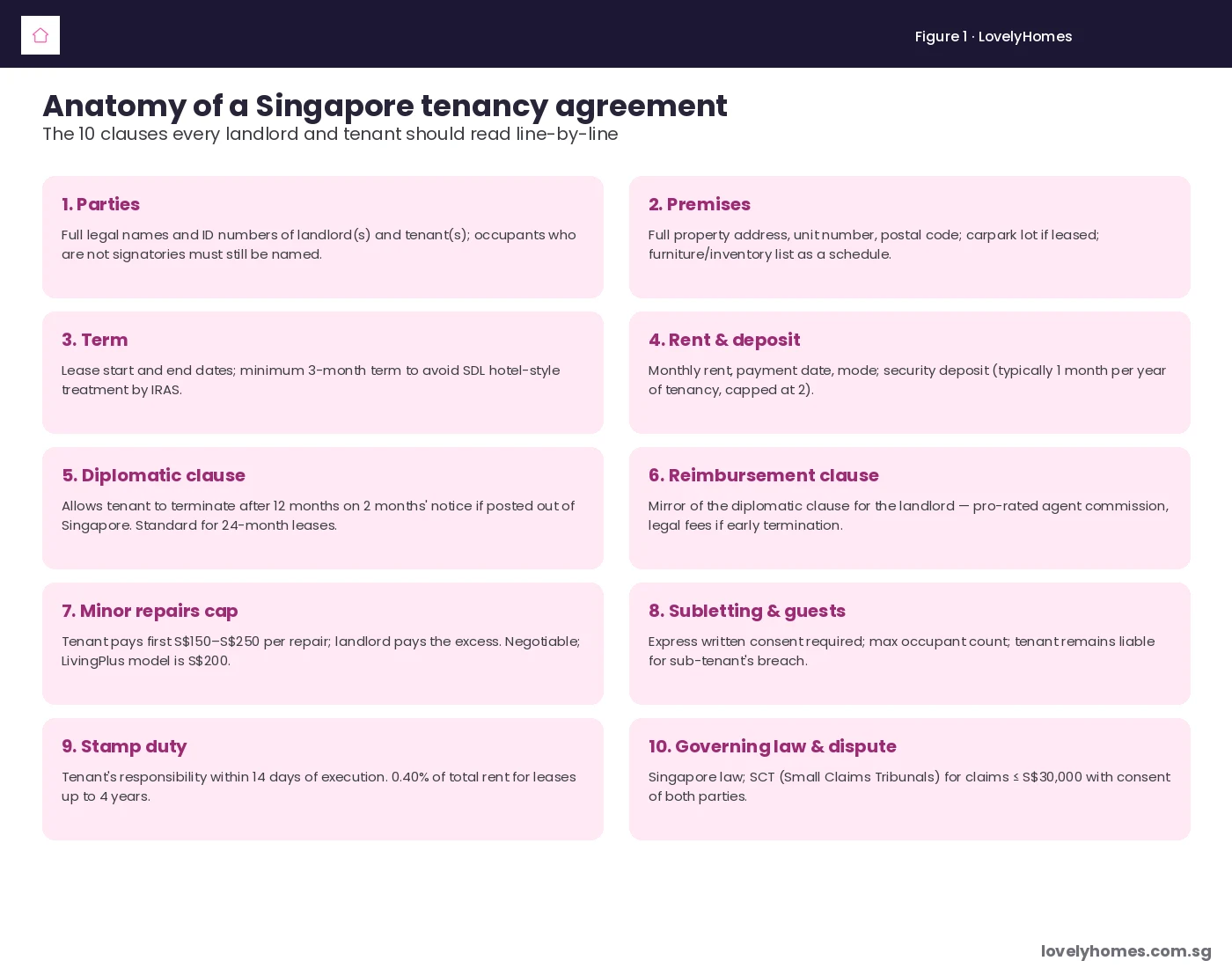
Figure 1: The 10 clauses that do most of the work in a Singapore tenancy agreement.
Who can be a landlord, and who can be a tenant
For private property, any property owner can lease their unit, subject to building by-laws and the conditions of any mortgage. The Urban Redevelopment Authority requires a minimum lease of 3 months for private residential property; below that threshold the lease is treated as short-stay accommodation and is generally not allowed unless the unit is licensed serviced apartment stock.
For HDB flats, the rental rules are stricter:
The flat must have met its Minimum Occupation Period (MOP), which is typically 5 years for new flats and 5 years for resale flats with grant.
The owner must apply for HDB approval to rent out the whole flat or individual rooms.
Rentals to non-citizen households must respect the Ethnic Integration Policy (EIP) and Singapore Permanent Resident (SPR) quota.
Maximum 6 unrelated occupants per flat (4 for 1- and 2-room flats).
The minimum rental period is 6 months for whole-flat HDB rentals.
Tenants can be Singapore Citizens, Permanent Residents, work-pass holders, students or any other lawfully present individual. For non-resident tenants, landlords must verify that the tenant holds a valid pass throughout the lease — leasing to an individual without a valid pass is an offence under the Immigration Act.
The 10 clauses that do all the work
A typical Singapore residential TA runs to 8–14 pages. Most of the legal heavy-lifting happens in ten clauses, summarised in Figure 1 above and explored below.
Term and renewal
The lease term is fixed: it has a defined start date and end date. Holding-over (continuing to occupy after expiry without a new TA) creates a tenancy at will, which is terminable on short notice and offers neither party much protection. Most landlords negotiate renewal 2–3 months before expiry; the LSD on the renewal lease must be re-stamped at the new rent.
Rent and security deposit
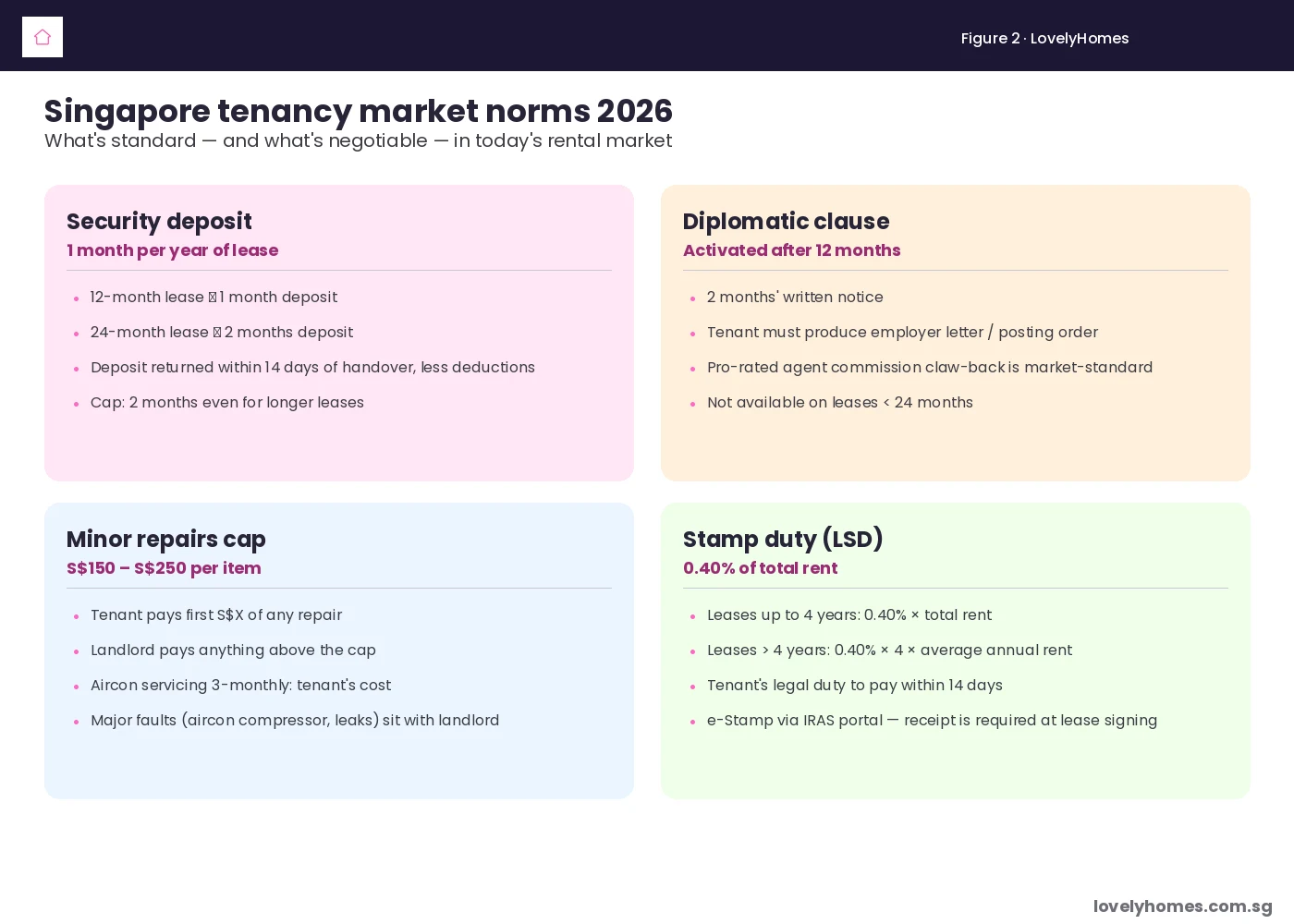
Rent is payable monthly in advance. The market norm for the security deposit is 1 month’s rent per year of lease, capped at 2 months. The deposit secures the landlord against damage beyond fair wear and tear, unpaid rent, and unpaid utility bills. It is refunded within 14 days of handover, less itemised deductions. Disputes over deposit deductions are the single most common Singapore tenancy dispute, and the Small Claims Tribunals see hundreds each year.
Diplomatic clause and reimbursement clause
The diplomatic clause allows a tenant to terminate after 12 months on 2 months’ written notice if they are required to leave Singapore (typically because of a job posting or visa cancellation). It is market-standard on 24-month leases and rare on 12-month leases. The mirror is the reimbursement clause: if the tenant terminates early, they must reimburse the landlord on a pro-rated basis for the agent’s commission and legal fees of the original lease.
Minor repairs cap
Tenants are responsible for minor repairs up to a contractual cap, typically S$150–S$250 per item. Landlords pay the excess. The clause prevents petty disputes about light bulbs and tap washers, while keeping major repairs (aircon compressor failure, roof leaks, structural defects) on the landlord’s account. Air-conditioner servicing every 3 months is the tenant’s cost; receipts must be produced at handover.
Inventory and handover
An inventory list — usually a schedule attached to the TA — records every item of furniture, every appliance, and every fixture provided. At move-in, both parties walk through and sign off. At move-out, deductions for missing or damaged items are calculated against this list. Photo evidence at both ends saves arguments.
Stamp duty clause
The TA will state which party is responsible for paying lease stamp duty. By Singapore market practice and IRAS guidance, the tenant pays. Failure to e-stamp within 14 days exposes the lease to a penalty of 4 times the duty or S$10, whichever is higher, and the unstamped lease is inadmissible as evidence in a Singapore court (the duty must be paid before the lease can be relied on in litigation).
Figure 2: The four “norms” most often negotiated — deposit, diplomatic clause, repairs cap, and stamp duty.
Lease stamp duty: the maths
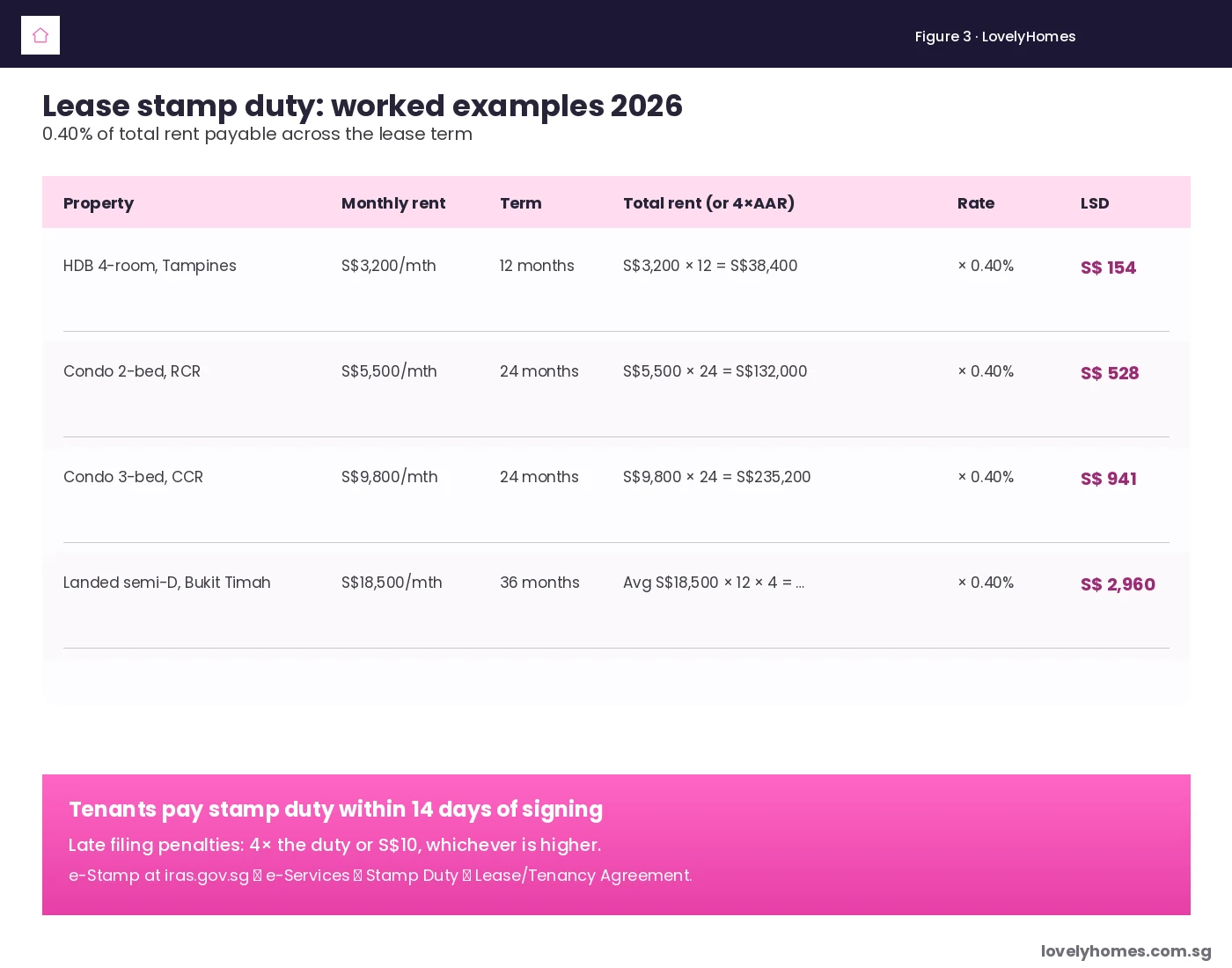
Lease stamp duty (LSD) is the only tax on a Singapore tenancy. It is levied at 0.40% of total rent across the lease term, capped at four times the average annual rent for leases longer than 4 years. The duty is the tenant’s legal obligation under section 33 of the Stamp Duties Act, payable within 14 days of execution.
Lease term
Stamp duty formula
Notes
≤ 4 years
0.40% × total rent across the term
Most common; covers all 12- and 24-month leases
> 4 years
0.40% × 4 × average annual rent
Caps the duty for long leases
Lease with premium / variable rent
BSD-style staircase rates apply to premium; LSD on the rent component
Rare in residential — common in commercial
Figure 3: Worked LSD examples across HDB and private property at 2026 market rents.
The IRAS portal e-stamps the lease in real time. The tenant pays via PayNow, eNETS or credit card, prints the certificate, and brings the original to the lease signing. Many landlords now make production of the e-stamp certificate a precondition to handing over keys — a sensible safeguard, because once keys are handed over the landlord’s leverage drops sharply.
Negotiating the lease — what to push on, what to leave alone
Singapore tenancy agreements are negotiable. The points that move most often:
Diplomatic clause activation date. Tenants often ask for activation at month 9 instead of month 12. Landlords typically refuse. The 12-month default holds.
Minor repairs cap. Tenants ask for S$300; landlords often want S$150. The S$200 LivingPlus number is the comfortable middle.
Whitegoods inclusion. Whether refrigerator, washer, dryer, microwave, oven, vacuum and rice cooker are included is line-by-line negotiation. List each item by brand and model in the inventory schedule.
Repainting before handover. A clause requiring the tenant to repaint before move-out used to be standard. It is increasingly replaced by a fixed reinstatement fee (S$300–S$800) plus normal wear-and-tear treatment.
Pet clause. “No pets” is the default. Tenants with pets must negotiate a specific carve-out and an additional deposit. HDB has its own approved-breed list for flats.
Smoking. “No smoking inside the unit” is now standard, and landlords reasonably claim against deposit if walls and curtains carry residual smoke odour.
What happens if things go wrong
The Singapore framework for tenancy disputes is informal but well-trodden:
Small Claims Tribunals (SCT). Hears disputes ≤ S$20,000 (or up to S$30,000 with both parties’ consent in writing) for tenancies of up to 2 years. Hearings are tenant- and landlord-friendly: no lawyers in the courtroom, fees from S$10, decisions usually within 4–6 weeks. The most common claims are deposit deductions, damage to inventory, and unpaid rent.
State Courts. Larger disputes, longer leases, and complex commercial-residential overlaps. Lawyers represent both sides; costs follow the event.
HDB and the Housing & Estate Disputes Resolution Centre. For HDB rental disputes specifically, HDB will mediate before parties resort to the SCT.
Mediation via the Singapore Mediation Centre. Voluntary and confidential. Useful where the parties want to preserve a working relationship — for example, a landlord who wants the tenant to stay another year.
What this means for you
For tenants: read every clause. Push back on anything ambiguous. Pay LSD on time and keep the certificate. Photograph the unit on move-in and move-out. Save every WhatsApp message about repairs — these are evidence in any future SCT claim.
For landlords: use a template TA from a Singapore conveyancing lawyer (not a generic internet template). Check the tenant’s pass status throughout the lease. Inspect the unit twice during a 24-month lease — once at month 6, once at month 18 — with proper notice. Reply in writing to repair requests. The landlord’s deposit deduction is much harder to defend in the SCT if the inspection trail is thin.
What might come next
The Ministry of National Development has been studying the case for codifying residential tenancy law in Singapore — the United Kingdom, Australia and several jurisdictions in continental Europe have moved in this direction. As at April 2026, no draft Bill has been tabled. The likeliest medium-term reforms are: a statutory deposit scheme along the lines of the UK Tenancy Deposit Scheme; a standard tenancy agreement template published by URA or HDB; and clearer rules on the deductibility of fair wear and tear. None of these are imminent, but landlords and tenants who structure their TAs around the existing market norms are well-positioned for any future statutory framework.
Frequently asked questions
Who pays the property agent’s commission?
Singapore market practice is that each side pays its own agent. The landlord pays the landlord’s agent (typically 1 month of annual rent on a 24-month lease, half a month on a 12-month lease). The tenant typically pays the tenant’s agent only on shorter or smaller-rent leases (under S$3,500/month) where the landlord’s agent’s fee is too thin to share. CEA’s Code of Ethics and Professional Client Care requires written disclosure of who pays whom before any signing.
Can a tenant break the lease before the diplomatic clause activates?
Only if the landlord agrees, or if the landlord is in fundamental breach (uninhabitable conditions, refusal to make repairs, harassment). Otherwise, an early termination is a breach of contract. The tenant remains liable for rent until the landlord re-lets the unit; the security deposit is forfeited; the original agent’s commission is clawed back pro-rata. Most landlords are willing to release a tenant if a replacement tenant on equivalent terms is presented.
Can the landlord enter the property without notice?
No. The TA grants the tenant exclusive possession. The landlord may enter only with reasonable notice (typically 24 hours in writing) and at reasonable times, except in emergencies (fire, flood, gas leak). Repeated unannounced visits are a breach of the covenant for quiet enjoyment and can support a tenant’s claim for damages.
What if the tenant has overstayed or won’t leave?
Self-help eviction is unlawful in Singapore. The landlord must give the contractual notice (or, if the lease has expired, a notice to quit), and if the tenant still does not leave, file for a Writ of Possession at the State Courts. Locking the tenant out, removing belongings, or cutting utilities is a criminal offence under the Protection from Harassment Act 2014 and the Distress Act 1872.
Does GST apply to residential rent?
No. Residential rent is exempt from GST under the Fourth Schedule to the GST Act. GST applies only to commercial leases — and only when the landlord is GST-registered (i.e., turnover above S$1 million in a 12-month period).
Can a tenant sub-let to a third party?
Only with the landlord’s written consent. Most TAs have an express anti-subletting clause. Even where consent is given, the head tenant remains liable to the landlord for the sub-tenant’s behaviour, rent and damage. For HDB rentals, all sub-letting must additionally have HDB approval; unauthorised sub-letting is a serious offence and can result in compulsory acquisition of the flat.
Is a verbal lease enforceable?
A verbal residential lease for 3 years or less is technically enforceable under the Conveyancing and Law of Property Act, but in practice it is almost impossible to prove the terms. For any lease over 3 years, the law requires a written, signed deed, registered with the Singapore Land Authority. As a landlord or tenant, you should never proceed without a written, e-stamped TA.
Disclaimer. This article is general guidance only and does not constitute legal advice. Singapore tenancy law is governed by the Civil Law Act 1909, the Conveyancing and Law of Property Act 1886, the Stamp Duties Act 1929, the Small Claims Tribunals Act 1984, and HDB regulations for public housing. Always read your specific tenancy agreement carefully and consult a licensed Singapore lawyer for high-value or unusual terms. Verify lease stamp duty rates against iras.gov.sg, HDB rental approval rules against hdb.gov.sg, and URA short-stay rules against ura.gov.sg.
Rental yield is the single metric that separates a property bought to rent out from a property bought to live in. In Singapore in 2026, gross rental yields on residential property have settled into a tight 2.5%–5.0% band, with the upper end reserved for suburban three-bedroom condominiums and smaller one-bedroom units in fringe micro-markets. This guide explains exactly how rental yield is calculated, which Singapore districts are delivering 4%+ gross yields in 2026, and the unit-type and tenure trade-offs that determine whether your rental yield translates into meaningful net cash flow after costs, taxes, and leverage.
Figure 1: Gross rental yield is the headline, net yield is what pays the bills.
Quick Answer
Gross yield = annual rent ÷ purchase price × 100.
Singapore average (private condo, 2026): 3.5% gross.
Best yielding sub-markets: Woodlands, Jurong East, Sembawang, Tampines and selected OCR one-beds at 4.2%–4.8%.
Lowest yielding: CCR luxury freehold (Orchard, River Valley) at 2.2%–2.7%.
Net yield after costs is typically 30%–40% lower than gross — budget for maintenance, property tax, agent fees, income tax and vacancy.
Smaller units yield more: 1BR beats 3BR on gross yield by 60–120 bps.
HDB resale yield is not directly comparable — subletting rules apply (MOP, subletting-of-whole-flat rules).
How Rental Yield Works in Singapore
Rental yield has two forms: gross and net. Gross yield is simply the annual rent divided by the purchase price. Net yield deducts all the carrying costs — property tax, maintenance fees, agent commission, minor repairs, vacancy provision, income tax on rental income — and shows you the actual return before financing.
A condominium renting at S$4,500/month on a S$1.5M purchase looks like a 3.6% gross yield. But after you subtract property tax (S$3,600), maintenance (S$4,200), agent commission on a 2-year lease (S$4,500), minor repairs (S$2,000), 1-month annual vacancy provision (S$4,500) and income tax at 22% on taxable rent (approximately S$8,800) — you are looking at a net yield of 1.8%, roughly half the headline number. That is before interest on your mortgage, which would push a leveraged investor into negative cash flow territory unless rents outperform or rates fall.
Key takeaway
Always underwrite to net yield. Singapore investors frequently overestimate returns by anchoring on gross yield figures and ignoring 1.5–2.0 percentage points of carrying costs.
Singapore Rental Yield Map 2026 — By Region
Core Central Region (CCR)
The CCR — Districts 1, 2, 4, 9, 10, 11 and parts of 6 and 7 — is Singapore’s prestige market. It houses the bulk of freehold stock, luxury condominiums, and branded residences. CCR has the lowest gross yields of the three regions:
Sub-Market
Tenure
Gross Yield Range
Orchard / Tanglin (D10)
Freehold / 99-yr
2.3% – 2.8%
River Valley (D9)
Freehold / 99-yr
2.4% – 2.9%
Sentosa Cove (D4)
99-yr
2.2% – 2.6%
Newton / Novena (D11)
Freehold / 99-yr
2.8% – 3.3%
Tanjong Pagar CBD (D2)
Freehold / 99-yr
2.8% – 3.2%
Rest of Central Region (RCR)
The RCR — the districts ringing the CCR — has become Singapore’s sweet spot for balanced yield and capital growth:
Sub-Market
Tenure
Gross Yield Range
Queenstown / Alexandra (D3)
99-yr
3.2% – 3.8%
Science Park / Pasir Panjang (D5)
99-yr
3.0% – 3.6%
Toa Payoh / Bishan (D12 / D20)
99-yr
3.3% – 3.9%
Marine Parade / East Coast (D15)
Freehold / 99-yr
2.9% – 3.5%
Bukit Merah / HarbourFront (D4 fringe)
99-yr
3.1% – 3.7%
Outside Central Region (OCR)
OCR — the suburbs — delivers the highest gross yields in Singapore, driven by cheaper acquisition costs, stable suburban rents and high tenant demand from upgrading locals and middle-management expats:
Sub-Market
Tenure
Gross Yield Range
Woodlands (D25)
99-yr
4.2% – 4.8%
Jurong East (D22)
99-yr
4.0% – 4.6%
Tampines (D18)
99-yr
3.9% – 4.5%
Sembawang / Yishun (D27)
99-yr
4.1% – 4.7%
Punggol / Sengkang (D19)
99-yr
3.8% – 4.3%
Clementi / West Coast (D5 West)
99-yr
3.5% – 4.0%
Unit-Size Effect: Why One-Bedders Lead the League Table
Within any single sub-market, smaller units yield more — a consistent pattern across OCR, RCR and CCR. The reason is mechanical: rent per square foot falls more slowly than purchase price per square foot as units grow. A 500 sqft 1BR in Jurong East might transact at S$930 psf and rent at S$3.80 psf/month (4.9% gross). The same project’s 1,100 sqft 3BR trades at S$1,150 psf and rents at S$3.20 psf/month (3.3% gross).
Unit Type
Region
Gross Yield
1-Bedroom (500–550 sqft)
OCR
4.3% – 4.9%
2-Bedroom (700–750 sqft)
OCR
3.8% – 4.3%
3-Bedroom (950–1,050 sqft)
OCR
3.3% – 3.8%
4-Bedroom + (1,250 sqft+)
OCR
2.8% – 3.3%
1-Bedroom (500–550 sqft)
RCR
3.5% – 4.0%
3-Bedroom (950–1,050 sqft)
RCR
2.8% – 3.3%
The trade-off: 1-bed demand is narrower — single tenants, young couples without children, international postings — meaning vacancy risk is higher in a downturn. Our shoebox unit guide dives deeper into the investment case.
Worked Example: OCR 1-Bedroom vs CCR 2-Bedroom
Consider two investors each deploying S$1.2M of equity:
Metric
Investor A — OCR 1BR (Cash)
Investor B — CCR 2BR (Leveraged)
Purchase Price
S$1,200,000
S$2,400,000 (75% LTV ⇒ S$1.2M equity)
Location
D22 Jurong East, 1BR 517 sqft
D09 River Valley, 2BR 732 sqft
Monthly Rent
S$4,000
S$5,800
Gross Yield
4.0%
2.9%
Annual Property Tax (non-owner)
S$4,440
S$8,700
Annual Maintenance
S$4,200
S$4,800
Annual Insurance
S$600
S$800
Annual Agent Fees (avg)
S$2,000
S$2,900
Vacancy Provision (1 month)
S$4,000
S$5,800
Gross Rent p.a.
S$48,000
S$69,600
Net Rent p.a. (pre-tax, pre-interest)
S$32,760
S$46,600
Net Yield on Price
2.7%
1.9%
Mortgage Interest p.a. (4% on S$1.2M)
S$0 (cash buyer)
S$48,000
Pre-tax Net Cashflow
S$32,760
−S$1,400
Investor A’s unleveraged OCR 1-bed generates positive cash flow of S$32,760 a year. Investor B’s leveraged CCR 2-bed is marginally cash-flow negative — which is fine if the strategy is capital appreciation on freehold tenure, but devastating if the investor miscalculated TDSR headroom. Stress-test using our TDSR/MSR guide.
The Six Factors That Drive Singapore Rental Yield
1. Transport Connectivity
Walk-to-MRT (within 400m) commands a 5%–8% rent premium over non-MRT peers, but also a price premium — so net yield effect is marginal. However, developments that are MRT-adjacent with a line upgrade coming (e.g. Cross Island Line or Jurong Region Line stations) see yields compress post-opening as prices re-rate faster than rents.
2. School Proximity
Tenants with Primary 1 registration imperatives pay a premium for the 1km and 2km catchment zones of sought-after primary schools. This is a tenant-pool effect, not a rent-per-sqft effect — it reduces vacancy rather than raising headline rents.
3. Unit Size and Facing
North-south facing with unblocked views, high-floor > 20th storey, and natural cross-ventilation all contribute 3–8% rent premium. Low-floor pool-facing units can underperform by 5%+.
4. Tenure
Contrary to popular belief, freehold commands a price premium but not a rent premium — tenants do not pay more for freehold because they are not buying. This directly compresses freehold yields below 99-year leasehold yields for otherwise-equivalent stock.
5. Age of Development
New launches rent at a premium in year 1–3 post-TOP, tapering towards market norms by year 5. 10–20 year old developments trade at the stable mid-range. 30+ year old freeholds often underperform on rent (dated finishes) but beat on yield (low purchase price).
6. Macro Cycle
Rental growth in Singapore tracks non-resident inflows (EP/PR approvals, multinational relocations). Expect outperformance during policy easing and underperformance when ICA and MOM tighten approvals. Check MAS Financial Stability Review annually.
Yield vs Capital Growth: The Eternal Trade-off
Singapore investors historically face a stylised choice:
OCR 1BR: 4.5% gross yield, 3% capital growth p.a. ⇒ 7.5% total return.
CCR freehold 2BR: 2.5% gross yield, 6% capital growth p.a. ⇒ 8.5% total return.
CCR wins on total return, OCR wins on cashflow. If you need the property to service its own mortgage, choose yield. If you can fund the shortfall from employment income and are playing for long-term wealth preservation, capital growth wins.
Tax Treatment of Rental Income
Singapore residents (citizens and PRs) are taxed on rental income at their marginal rate (up to 24% in 2026), with deductible expenses. Non-residents are taxed at a flat 24% without expense deductions (unless they elect to be taxed as tax-residents subject to the 183-day rule). Deductible expenses include mortgage interest, property tax, fire insurance, repairs, agent commission, and in certain cases, a 15% deemed rental expense in lieu of itemised receipts.
Furnish strategically. A S$20,000 furnishing package typically boosts monthly rent by S$300–S$500 — payback in 4–6 years, not 10+.
Optimise vacancy. List at market, not above. Every month of vacancy is 8.3% of annual income lost.
Frequently Asked Questions
What is a good rental yield in Singapore?
Anything above 3.5% gross for a condominium in 2026 is above market average. Above 4.0% gross is considered strong. Above 4.5% is exceptional and usually limited to OCR shoebox units or distressed stock.
Why is my CCR condo’s yield so low?
CCR prices are elevated due to freehold tenure, land scarcity, and aspirational demand. Rents do not scale at the same rate as price because tenants are indifferent between freehold and 99-year leasehold for the same product. Result: headline yields of 2.3%–2.9% in prime Orchard, Tanglin, Sentosa.
Is HDB subletting a better yield play than condo rentals?
HDB subletting yields can be strong (3.5%–4.5%) but come with strict rules: minimum occupation period (5 years), subletting-of-whole-flat approvals, citizenship mix limits. See our HDB subletting guide.
What is a typical agent commission on a lease?
Standard market practice: 0.5 months’ rent for a 1-year lease, 1 month’s rent for a 2-year lease, 1.5 months for a 3-year lease, payable by the landlord.
Can I claim mortgage interest as a deductible expense?
Yes — mortgage interest on the rented property is deductible against rental income, as are property tax, fire insurance, repairs (not improvements) and agent commission.
How does the 15% deemed rental expense rule work?
IRAS allows landlords to claim 15% of gross rental as a deemed expense in lieu of itemised deductions, on top of mortgage interest and property tax. This simplifies tax filing for small landlords.
What is cash-on-cash return?
Net annual cashflow divided by total cash equity (downpayment + stamp duty + legal + furnishing). This is the number you actually experience in your bank account. Often divergent from net yield when leverage is high.
Can foreigners earn rental income in Singapore?
Yes — foreigners who own Singapore residential property can let it and earn rental income, subject to 24% non-resident tax rate.
Disclaimer: Rental yields are indicative and compiled from URA rental contract data, public transaction records, and market-survey estimates current at the time of writing. Individual yields vary by unit facing, floor, tenant profile and macro cycle. Nothing on this page is financial, tax, or investment advice — consult a qualified advisor before committing to a purchase.
Singapore landlords must comply with HDB or URA rules (minimum 6-month lease for HDB, 3 months for private), screen tenants’ work/student pass validity, stamp the TA, declare rental income under Schedule I of their tax return, and refund deposits within 14–30 days. Gross yields of 4% typically net out to ~2.2% after expenses and 22% income tax.
Letting out a Singapore home can be a steady income stream, but it’s a licensed business that comes with tax, regulatory, and contractual obligations. This landlord’s guide covers what you must do (HDB approval, URA rules, TA clauses, tax declaration), how to screen tenants properly, and the yield maths that separate a profitable let from a break-even one.
The 9 landlord obligations and worked net-yield example
Your 9 legal obligations as a Singapore landlord
1. HDB or URA approval
HDB owners must apply for approval to sublet the whole flat (only after 5-year MOP) or register bedroom subletting online. Private residential landlords must ensure the unit has at least 4 bedrooms if renting rooms, and the overall occupant cap must not be breached.
2. Minimum lease terms
HDB: 6 months per tenant (no Airbnb, no short-stay). Private: 3 months per tenant. Anything shorter breaches URA rules.
3. Tenant screening
Verify work pass (MOM), student pass (ICA), or PR/citizen status before signing. For foreigners, sight the pass, not just a photocopy. Payslips or a CPF Statement for locals helps assess affordability. Credit-check via agents or services like CrimsonLogic.
4. Stamp duty
The TA must be stamped within 14 days of signing. Usually the tenant pays (see the TA), but you as the landlord must ensure it’s done — an unstamped TA is unenforceable in court. See the rental stamp duty guide for the formula.
5. Rental income tax
Declare net rental income (gross rent minus deductible expenses) under Schedule I in your personal income tax return. Deductibles include property tax, MCST fees, maintenance, insurance, fire insurance, and mortgage interest (on the rented property only). A flat 15% deemed-expense option exists for individuals — IRAS will apply whichever yields higher deductions.
6. Quiet enjoyment
Give the tenant 24–48 hours’ notice before entering for inspections or viewings (for prospective tenants at lease end). Barging in unannounced breaches quiet enjoyment.
7. Repairs and maintenance
Major repairs (structural, plumbing leaks, aircon compressor failure) are the landlord’s under standard TAs, above a threshold (usually S$150–200). Minor repairs below that threshold are the tenant’s.
8. Property tax uplift
When the unit is tenanted, property tax rises from owner-occupier rates (0–32%) to non-owner-occupier rates (12–36%). File Form IRIN1A with IRAS within 15 days of letting.
9. Deposit refund
Return the security deposit within 14–30 days of a clean handover, less itemised deductions. Withholding the deposit without documented cause invites Small Claims action.
The yield maths: gross is not net
A common trap: landlords quote gross yield and forget how much disappears to costs and tax. Here’s a worked example on a S$1.14M condo renting at S$3,800/month.
Item
Amount (S$/year)
Gross rent (3,800 × 12)
45,600
Property tax (non-owner-occupier, est. AV S$42k)
–4,200
MCST/condo maintenance
–4,800
Repairs and wear-down reserve
–1,500
Agent commission (half month + GST, if agent-let)
–2,070
Insurance and misc
–500
Net rental (pre-tax)
32,530 (2.85% yield)
After 22% income tax (top marginal)
~25,370 (2.22% yield)
Mortgage interest on the rented property is also deductible — if you’re on a 4% interest-only loan, that swings the numbers further.
TA clauses to insist on
Minor repair threshold (S$150–200) — anything below is the tenant’s cost.
Aircon servicing every 3 months with receipts, tenant’s cost.
No unauthorised subletting or Airbnb — immediate termination if breached.
Damage deposit forfeit if TA is terminated during lock-in.
Diplomatic clause only for foreign tenants on valid work/student pass — 12-month minimum stay, 2 months’ notice, pass cancellation required.
End-of-tenancy cleaning at tenant’s cost with vendor receipt.
When to hire a property manager
Owner-managed suits local landlords with one unit and time. Hire a property manager (typically 8–10% of monthly rent) if you’re overseas, own 3+ units, or want a passive hands-off investment. The manager handles viewings, tenant issues, rent collection, and renewals — essentially turning your property into a running concern.
Frequently asked questions
Do I need a licence to be a landlord in Singapore?
No separate licence, but you must comply with HDB/URA rules. HDB owners need HDB approval to sublet whole flats. Short-term rentals (under 6 months for HDB, 3 months for private) breach URA rules — Airbnb is effectively illegal for most Singapore homes.
Can I claim mortgage interest against rental income?
Yes, but only the interest portion on the rented property (not principal, not on other properties). If the rental covers only part of the year, pro-rate accordingly. Alternatively, take IRAS’s 15% deemed-expense deduction — IRAS will use whichever gives the higher deductible.
Should I engage a tenant via a co-broke agent?
Co-broke means the tenant’s agent and your agent split the landlord-paid commission. It widens the pool of tenants (their agent brings them to you) at the same cost. Most Singapore landlords co-broke by default.
Disclaimer
This guide is for general information only. Singapore’s rental rules, HDB policies, and IRAS stamp duty rates change periodically. Always verify against the HDB, URA and IRAS websites before signing a lease or filing with IRAS. LovelyHomes is not a licensed property agent or tax adviser. For personalised advice, please engage a registered CEA agent or a qualified tax professional.