URA Launches GLS Sites at Marina Gardens Lane and Orchard Boulevard: 500 New Homes for Singapore’s 2H 2026 Land Programme

URA Launches GLS Sites at Marina Gardens Lane and Orchard Boulevard: 500 New Homes for Singapore’s 2H 2026 Land Programme

Quick Answer: URA GLS Marina Gardens Lane and Orchard Boulevard — 6 Key Facts

  • The Urban Redevelopment Authority (URA) released two residential GLS sites on 13 August 2026 under the 2H 2026 Government Land Sales Programme.
  • Marina Gardens Lane (near Marina South MRT, Thomson-East Coast Line): ~390 residential units; tender closes 15 October 2026.
  • Orchard Boulevard (near Orchard Boulevard MRT, TEL): ~110 residential units; tender closes 29 October 2026.
  • Both sites form part of the 2H 2026 Confirmed List, which totals 4,745 residential units — more than 50% above the 10-year annual average Confirmed List supply.
  • Marina South is a planned car-lite, waterfront residential precinct that URA has been developing progressively since the early 2020s.
  • Orchard Boulevard offers rare prime District 10 (CCR) land in a location that has seen very limited new private supply in recent years.

Two Prime Sites Released Under Singapore’s 2H 2026 GLS Programme

The Urban Redevelopment Authority (URA) today released two residential land parcels for sale under the Confirmed List of the second-half 2026 Government Land Sales (GLS) Programme. The sites — at Marina Gardens Lane and Orchard Boulevard — are among the most closely watched land parcels in the 2H 2026 programme, given their locations in two distinctly different but equally sought-after precincts of Singapore.

The GLS programme is the Singapore government’s primary mechanism for releasing state land for private residential and commercial development. Sites on the Confirmed List are launched regardless of market demand signals; the Reserve List operates on application. Today’s release expands the already large 2H 2026 Confirmed List — one that URA has deliberately sized at well above historical norms to address the persistent supply-demand imbalance in Singapore’s private residential market.

I. Marina Gardens Lane: Marina South’s Next Chapter

The Marina Gardens Lane site is located in Marina South, a waterfront precinct that URA has been developing as Singapore’s newest large-scale residential neighbourhood. The area is positioned along the Greater Southern Waterfront, adjacent to Marina Bay, and is designed as a car-lite community with high-quality public transport connectivity via the Thomson-East Coast Line (TEL) at Marina South MRT station.

The Marina Gardens Lane site can potentially yield approximately 390 residential units. The tender closes at noon on 15 October 2026. This is consistent with previous Marina South GLS releases — the area has seen multiple sites released since 2021, and the emerging neighbourhood is beginning to take shape with the first residential towers under construction.

Marina South’s appeal to developers lies in several factors. It offers large, contiguous land parcels of a size that is extremely difficult to assemble through en bloc collective sales in the established private market. It has direct MRT connectivity. And it benefits from URA’s planning vision for the precinct — a walkable, green, waterfront residential community with proximity to Marina Bay’s business, lifestyle, and entertainment hub. Industry data suggests Marina South launches in the surrounding area have attracted significant buyer interest, particularly from upgraders and investors who see the long-term development trajectory of the precinct.

II. Orchard Boulevard: Rare Prime CCR Supply

The Orchard Boulevard site is located in District 10, one of Singapore’s most prestigious residential addresses. At approximately 110 units, it is a significantly smaller site than Marina Gardens Lane — reflecting both the limited scale of developable land in this part of the Core Central Region (CCR) and the very high land values that make large sites financially prohibitive.

The Orchard Boulevard site is near the Orchard Boulevard MRT station on the Thomson-East Coast Line, providing direct connectivity along the TEL corridor from Woodlands to the East Coast. New private residential supply in District 10 has been extremely limited over the past several years — the combination of high land costs, few available sites, and the long development timeline means that buyers seeking brand-new freehold or 99-year leasehold private apartments in this part of Singapore have had very few options. The tender for this site closes at noon on 29 October 2026.

Note on scale: With only ~110 potential units, the Orchard Boulevard site is likely to attract developers aiming at the luxury or ultra-luxury CCR buyer segment. Unit sizes are typically larger in CCR developments — this site may yield fewer than 110 units if the developer opts for larger floor plates, or could push to maximum plot ratio to maximise saleable area.

III. The Bigger Picture — 2H 2026 GLS Supply in Context

Both sites are part of the URA’s 2H 2026 GLS Confirmed List, which was announced earlier this year and totals 4,745 residential units across all confirmed sites for the second half of 2026. To put this figure in context:
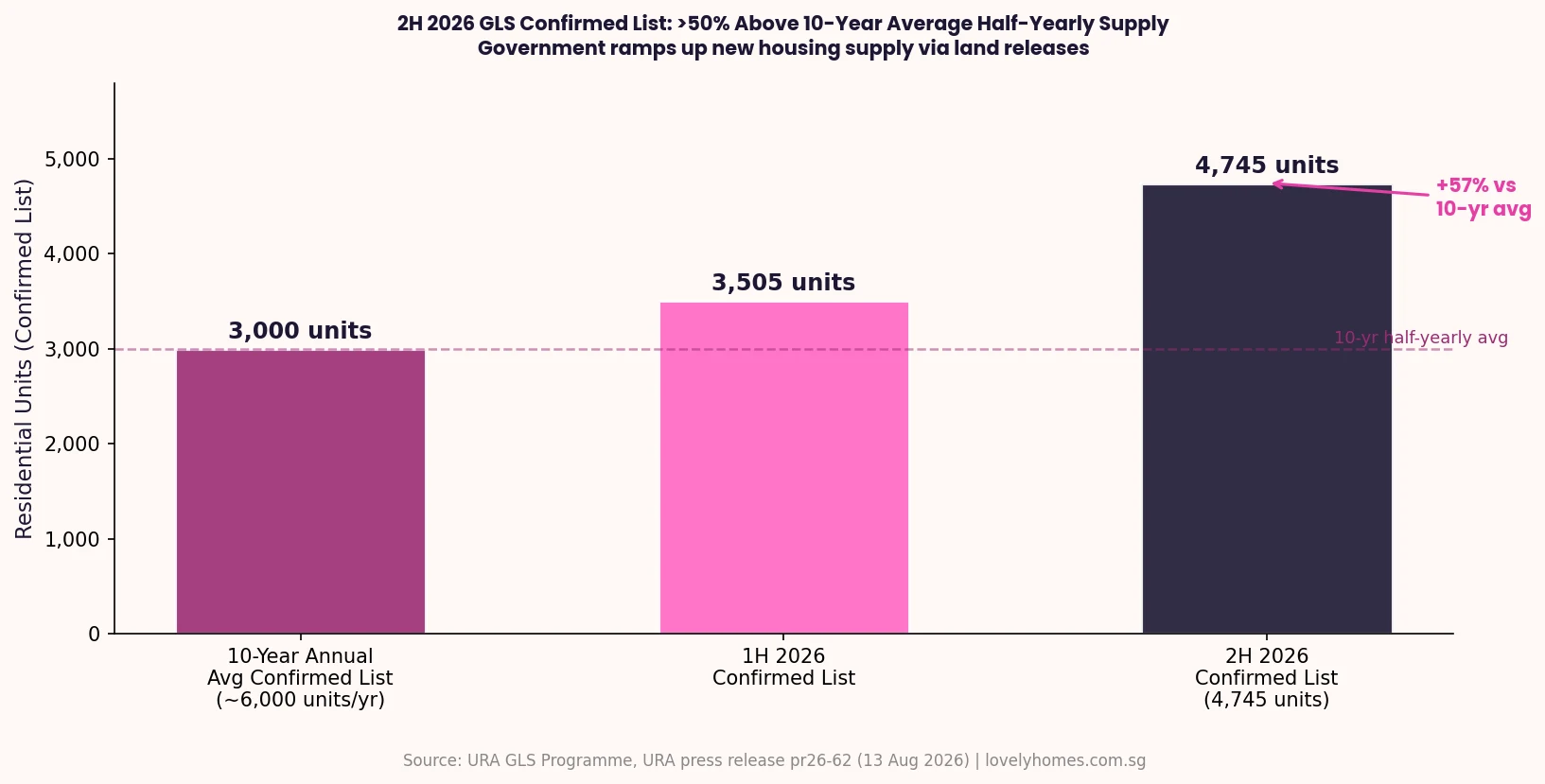
URA 2H2026 GLS Confirmed List 4745 units supply comparison Singapore 2026 bar chart
Figure 1: 2H 2026 GLS Confirmed List at 4,745 Units — More Than 50% Above the 10-Year Average Half-Yearly Confirmed List Supply. Source: URA GLS Programme, URA press release pr26-62 (13 August 2026)
GLS Period Confirmed List Units Vs 10-Yr Avg (half-yr)
10-Year Average (annual) — approx. ~6,000 per year (~3,000 per half) Baseline
1H 2026 Confirmed List ~3,505 units +17% vs half-yr avg
2H 2026 Confirmed List 4,745 units +58% vs half-yr avg

The 2H 2026 Confirmed List represents a deliberate policy decision by the Singapore government to front-load supply into the market at a time when private residential prices have continued to rise despite multiple rounds of ABSD adjustments. The view from URA is that the medium-term supply pipeline — comprising GLS sites, en bloc redevelopments, and executive condominium launches — must be sufficiently deep to moderate price growth and maintain housing affordability, particularly for Singaporean upgraders who face the 20% ABSD rate on their second purchase.

A larger GLS pipeline has two effects on the broader market. First, it increases future supply, which in time translates to more completed units available for buyers. Second, it gives developers alternatives to en bloc bids — with more GLS land available, developers are less compelled to pay high premiums for collective sale sites in the secondary market. Industry analysts suggest this is one reason the en bloc market has been comparatively muted in 2H 2026, even as individual sites like City Plaza (S$970M, 13 August tender) have attracted interest.

IV. What This Means for Buyers, Sellers and Investors

For buyers considering new launch properties in Marina South or the Orchard Boulevard corridor, the release of these sites signals that new developments are in the pipeline, but completion will be 3–5 years away from tender close. Buyers who need to transact now should look at existing new launches in adjacent areas (TEL-connected precincts, Marina Bay fringe) rather than waiting for these specific sites to be marketed.

For sellers of existing private residential properties in Marina South or District 10, a larger GLS pipeline may apply some price discipline to new launches (as developers face higher land costs from competitive bidding for GLS sites alongside a larger total supply). However, resale properties in established prime districts with immediate availability and leasehold tenure clarity continue to command buyer attention from owner-occupiers.

For en bloc owners in nearby precincts, the point made above is relevant: a more active GLS programme reduces developer urgency to acquire en bloc sites at significant premiums. Developments pursuing collective sales in Marina-adjacent or Orchard-adjacent locations may find that their expected premiums are moderated as developers weigh GLS alternatives.

V. What Might Come Next

The next GLS tender deadlines — 15 October 2026 for Marina Gardens Lane and 29 October 2026 for Orchard Boulevard — will be followed by a period of evaluation by URA. Developers typically submit a single sealed bid at tender close, and URA evaluates bids on the basis of price (highest acceptable bid) and development quality criteria (for some sites with specific design requirements). Results for both sites can be expected approximately 4–8 weeks after tender close.

Following any award, the developer typically has 5 years from the date of award to complete the development (with possible extensions). Given the 2026 award timeline, residents could expect new completions from these sites as early as 2030–2031, adding to Singapore’s private residential inventory in that period.

Frequently Asked Questions: URA GLS Sites 2026

What is the Government Land Sales (GLS) programme?

The Government Land Sales programme is administered by URA (for residential and commercial sites) and JTC (for industrial sites). Under the GLS, the government releases state-owned land for private development through competitive tender. The Confirmed List comprises sites that will be launched regardless of market demand; the Reserve List comprises sites that are only launched if a developer applies and the government accepts the proposed price. The GLS programme is the primary mechanism by which Singapore regulates the supply of private residential land and ensures that housing supply keeps broadly pace with demand.

What is Marina South and why is it significant?

Marina South is a planned residential and mixed-use precinct at the southern tip of the Marina Bay area, adjacent to the Gardens by the Bay waterfront. URA has designated it as a car-lite neighbourhood, meaning it is designed with high-quality public transport connections (Marina South MRT on the TEL), cycling infrastructure, and minimal surface car parking. It is part of the broader Greater Southern Waterfront transformation that will eventually link Tanjong Pagar, Keppel, Sentosa, and Marina Bay into a continuous waterfront live-work-play corridor. The Marina Gardens Lane site released today is one of several GLS sites URA has progressively released in the precinct since 2021 to build up the neighbourhood’s residential population.

When will the new developments on these sites be ready for buyers?

Developers who win the tender typically have 5 years from the award date to obtain Temporary Occupation Permit (TOP). With tender closes in October 2026 and a typical development timeline of 3–5 years post-award, buyers could expect TOP for these developments as early as 2030 and as late as 2031–2032. New launch marketing (sales prior to construction completion) would typically begin 6–18 months after the award, subject to the developer’s marketing strategy and the prevailing market conditions at that time.

Does a higher GLS supply mean property prices will fall?

Not necessarily, and not immediately. New GLS supply does not translate into completed units for 3–5 years. In the near term, a larger pipeline signals future supply additions, which can moderate buyer expectations of price appreciation and give buyers and sellers more negotiating latitude. Over the medium term, if completed supply outpaces demand growth, prices in certain segments may experience softer growth or modest corrections. However, Singapore’s property market is also supported by population growth, strong GDP, continued expatriate demand, and limited land — structural factors that underpin long-term demand. URA’s GLS calibration is designed to moderate prices, not engineer sharp falls.

Are these sites freehold or leasehold?

GLS sites released by the Singapore government are almost always on 99-year leasehold tenure, as the government retains underlying ownership of state land. Freehold land in Singapore predominantly comprises private land that has been in private ownership since colonial times or was converted. The Marina Gardens Lane and Orchard Boulevard sites released today are expected to be 99-year leasehold — the full terms and conditions are available in the eDeveloper’s Packet sold through URA’s One-Stop Developer Portal at digitalservice.ura.gov.sg.

Disclaimer: This article is for general information only and is based on publicly available information from URA press release pr26-62 dated 13 August 2026. Development unit counts, tender timelines, and site details are subject to change. Pricing and development outcomes will depend on competitive bidding and subsequent developer decisions. This article does not constitute financial or property investment advice. For official GLS site information, visit URA Land Sales (ura.gov.sg). For official property statistics, refer to URA Property Data.

×

Click anywhere to close

YK Land Wins Little India Conservation GLS at S$35.3M — Chitty Road Award 2026

YK Land Wins Little India Conservation GLS at S$35.3M — Chitty Road Award 2026

Quick Answer — What You Need to Know

  • On 7 August 2026, URA formally awarded the Chitty Road and Veerasamy Road conservation cluster in Little India to YK Land (a subsidiary of the Soon Hock Group) at S$35.3 million.
  • The top bid of S$962 psf was approximately 48% above the second-highest offer among seven bidders — an unusually wide spread that reflects strong conviction from YK Land in the site’s conservation premium.
  • The site comprises 18 conserved pre-war Art Deco terrace houses built in 1927, originally constructed as municipal quarters for government employees, now heritage-listed under the URA Conservation Guidelines.
  • Permitted uses are either long-stay serviced apartments (SA2 use, minimum 3-month stay) or strata landed housing — both low-density uses compatible with the heritage streetscape.
  • This is a rare conservation GLS: fewer than five comparable conservation clusters have been offered at public tender since 2010.

The Site: Little India’s Art Deco Municipal Quarters

The Chitty Road and Veerasamy Road site sits within the Little India Historic District, one of Singapore’s four designated conservation precincts under URA’s overarching Urban Conservation Programme. The 18 two-storey terrace houses — constructed in 1927 as quarters for municipal government employees — form two parallel rows linked by a back lane, a building typology characteristic of colonial-era government housing in the region.

The buildings are constructed in the Art Deco style, with characteristic geometric facades, moulded plaster cornices and timber louvred shutters. The URA’s conservation guidelines require owners to retain the external facade, fenestration pattern, roof form and architectural elements while permitting internal reconfiguration. This means any developer will work within a fixed exterior envelope — which both increases construction complexity and substantially enhances the finished product’s distinctiveness compared with a conventional development site.

The total site area is approximately 0.34 hectares — small by GLS standards — and the 18 units have a combined floor area of around 3,600 square metres (about 38,750 sq ft). The site is located in District 8, within walking distance of the Little India MRT station on the North East Line (NEL) and the future Rochor station on the Thomson-East Coast Line (TEL), with completion expected in 2027.

The Tender Result: Seven Bidders, One Clear Winner

The tender for the site closed on 28 July 2026. URA received seven bids — a competitive result that underscores genuine developer appetite for conservation sites despite their complexity. The top bid of S$35.3 million, submitted by YK Land (a vehicle of the Soon Hock Group), was approximately 48% above the second-highest bid. This spread is remarkable: in most GLS tenders, the gap between first and second bid is 5–15%. A 48% differential indicates either highly divergent views on value among bidders, or an unusually aggressive and well-researched conviction from the winning bidder.

Chitty Road Veerasamy Road GLS 2026 all 7 bids comparison bar chart
Figure 1: All 7 bids for the Chitty Road and Veerasamy Road GLS site. YK Land’s top bid of S$35.3M was 48% above the next offer. Source: URA (pr26-60), 7 August 2026.
Site Details Value
Location Chitty Road and Veerasamy Road, Little India (District 8)
Site Area ~0.34 hectares
Number of Buildings 18 conserved pre-war terrace houses (1927)
Tenure 99-year leasehold
Permitted Use Long-stay serviced apartments (SA2) or strata landed housing
Winning Bidder YK Land (Soon Hock Group)
Winning Bid S$35,300,000 (approximately S$962 psf of land area)
Number of Bids 7
Gap to 2nd Bid ~48%
URA Press Release pr26-60, 7 August 2026

Who Is YK Land?

YK Land Pte Ltd is a development vehicle of the Soon Hock Group, a Singapore-based privately held property developer with an established track record in conservation shophouse redevelopment, boutique hospitality and specialist residential projects. The Soon Hock Group has previously been involved in conservation property projects in Chinatown and Kampong Glam, both of which are located in URA-designated conservation precincts. Its focus on heritage properties suggests YK Land will likely pursue the serviced apartment route — leveraging Little India’s growing standing as a lifestyle and heritage tourism destination — rather than strata landed housing, though both uses remain permitted subject to URA’s prior written approval.

What Will It Become?

The two permitted uses are structurally different in their economics and market positioning:

Option A — Long-stay serviced apartments (SA2): SA2 use means minimum 3-month leases — targeting expatriates, relocated professionals and digital nomads rather than short-stay tourists. With 18 terrace units across a conserved block, a well-executed SA2 scheme could produce 18–36 serviced residences (depending on internal subdivision), positioned at the boutique end of the market. Given Little India’s MRT access and proximity to the Farrer Park medical cluster and Tekka Centre, demand from medical tourism and long-term expatriate tenants would be a natural fit. Comparable SA2 serviced residences in the area achieve gross yields of 4.5–6% at current rental levels.

Option B — Strata landed housing: This is the rarer option for a conservation cluster, but not unprecedented. Strata landed units within a conservation terrace row would be highly differentiated — freehold-quality character, limited supply, and a central location. Comparable conservation shophouses in Tanjong Pagar or Duxton Hill have achieved S$4,000–S$6,500 psf in recent transactions. At 3,600 sqm total floor area, a strata landed scheme could command total GDV well above S$150 million — implying very substantial development margins over the S$35.3M land cost, subject to construction, conservation-compliance and financing costs.

What This Means for Singapore’s Conservation Property Market

Conservation sites are a structurally constrained sub-segment of Singapore’s property market. URA’s conservation policy, administered under the Planning Act, protects approximately 7,000 pre-war buildings across six conservation areas (Chinatown, Little India, Kampong Glam, Singapore River, Cairnhill and Beach Road/Bugis). New conservation GLS sites are released rarely and on a project-specific basis — they do not follow the standard Government Land Sales Programme cycle.

The strong seven-bidder response and the winning bid’s 48% premium above second place signal that well-located conservation sites remain highly sought after by developers, even in a year where general residential GLS demand has been more measured. For buyers and investors tracking the conservation shophouse market, this result reinforces the view that authentic heritage stock in established precincts — particularly those with modern MRT connectivity — continues to attract a premium that is structural rather than cyclical.

For the Little India precinct specifically, the award adds momentum to a broader revival narrative. The upcoming completion of the TEL Rochor station, the continued development of the Farrer Park medical precinct, and the heritage-tourism investments along Serangoon Road all support the area’s transition from a neighbourhood with purely ethnic retail character to one that is actively sought by lifestyle and boutique hospitality operators.

Related Articles

Frequently Asked Questions

Can the public buy units from the Chitty Road conservation development?

That depends on the development use chosen by YK Land. If the site is developed as strata landed housing, the individual units may be offered for public sale as strata-titled properties — in which case buyers would be subject to the normal rules for strata landed housing (Singapore Citizens and PRs can purchase freely; foreigners require LDAU approval). If developed as long-stay serviced apartments (SA2), the units would likely be marketed on a rental basis rather than sold en strata, as SA2 serviced residences are commonly held by a single operator or investment entity. URA must approve the final use before development can proceed.

What is the difference between SA1 and SA2 serviced apartments?

Singapore’s planning framework distinguishes two categories of serviced apartments. SA1 (short-stay) applies a minimum tenancy period of 7 consecutive days and is used for hotel-style accommodation. SA2 (long-stay) requires a minimum tenancy of 3 consecutive months, targeting longer-term residents rather than tourists. SA2 use is URA-approved and common in conservation buildings where the boutique scale and heritage setting suits professional long-stay tenants rather than high-turnover hotel guests. The Chitty Road site’s permitted use is SA2 — meaning it cannot be operated as a short-stay hotel or home-sharing platform.

Why did the top bid come in 48% above the next bidder?

Wide bid spreads on conservation GLS sites are not unusual but a 48% gap is towards the extreme end. Possible explanations include: YK Land’s specific expertise and lower-risk construction assumptions for conservation work (which other bidders may have priced more conservatively); a unique business plan (such as a pre-arranged anchor tenant or joint venture partner) that justified a materially higher land cost; or a portfolio-level strategic value (e.g. completing a conservation precinct holding) that translated into a higher subjective valuation. The competitive result (seven bids) confirms that the site attracted genuine interest — the spread simply reflects divergent views on what the site is worth when fully realised.

What are URA’s conservation guidelines for redeveloping conservation buildings?

URA’s Conservation Guidelines require owners of gazetted conservation buildings to retain and restore the original external character: facades, fenestration, roof form, boundary walls, five-foot way (covered walkway) and any distinctive architectural features. Internal reconfiguration — combining units, inserting new floors within the existing envelope, upgrading services and finishes — is permitted with URA’s prior approval. Owners are also required to maintain the buildings in good repair. Demolition of conservation buildings is not permitted without URA’s express consent, which is granted only in exceptional circumstances such as structural irreparability. Developers who win conservation GLS sites typically engage URA’s Conservation team early in the planning phase to align on what works are permissible.

How does this compare with other recent conservation GLS awards?

Conservation GLS sites are released infrequently. Comparable recent conservation tenders include the Beach Road conservation cluster (awarded in 2019) and various individual shophouse sites in Chinatown and Kampong Glam offered since 2015. At S$962 psf of land, the Chitty Road result is at the higher end of conservation site pricing, reflecting the quality and completeness of the cluster (18 buildings in a coherent row), the improving connectivity from the TEL Rochor station, and the growing market depth for boutique hospitality and conservation residential assets in Singapore. The nearest comparison — individual conservation shophouses in the same precinct — have been changing hands at S$3,500–S$5,000 psf in recent private treaty transactions, suggesting a very wide development margin at the land cost achieved.

Disclaimer

This article is based on the URA press release pr26-60 (7 August 2026) and publicly available information as at 7 August 2026. It is for informational purposes only and does not constitute investment, property, legal or financial advice. Readers should conduct independent due diligence and consult qualified professionals before making any property-related decision. Source: URA pr26-60, URA Conservation Guidelines.

Singapore En Bloc Reform 2026: New Consent Thresholds for Older Developments Explained

Singapore En Bloc Reform 2026: New Consent Thresholds for Older Developments Explained

Quick Answer: Singapore En Bloc Consent Reform 2026

  • The Ministry of Law (MinLaw) tabled the Land Titles (Strata) (Amendment) Bill in Parliament on 4 August 2026.
  • The proposed Bill lowers the collective sale consent threshold from 80% to 70% for developments aged 40–59 years, and to 65% for those aged 60 years and above.
  • Consent thresholds remain unchanged at 90% for developments under 10 years old, and 80% for those aged 10–39 years.
  • Approximately 20,000 private non-landed residential units are more than 40 years old in Singapore — representing a substantial pool of potentially eligible sites.
  • The Bill has not yet been enacted. It will be debated in Parliament and voted upon before becoming law.
  • New safeguards for minority (non-consenting) owners are also proposed, including a higher requisition threshold for calling general meetings, a shorter signature-gathering window, and a longer restriction period after failed attempts.
  • Complementary policy changes announced on 28 July 2026 extend ABSD remission timelines for developers of large collective sale redevelopments, providing a more viable development economics framework for mega en bloc sites.
Note: This article is based on the Land Titles (Strata) (Amendment) Bill tabled in Parliament on 4 August 2026. The Bill has not yet been passed into law. All references to “new rules” or “proposed thresholds” reflect the Bill as tabled and are subject to Parliamentary debate and amendment.

The Proposed Changes: What MinLaw Has Tabled

Singapore’s Ministry of Law (MinLaw) tabled the Land Titles (Strata) (Amendment) Bill in Parliament on 4 August 2026, proposing the most significant overhaul of the collective sale (en bloc) framework since the regime’s inception in 1999. The centrepiece of the Bill is a tiered reduction in the consent thresholds required for older developments to proceed with a collective sale.

Under the current framework, any strata development — regardless of age — requires the agreement of owners representing at least 80% of the share value AND 80% of the strata area to proceed with a collective sale (or 90% for developments less than 10 years old). The amendment proposes a graduated approach: the older the development, the lower the threshold required to unlock a collective sale.

Singapore en bloc consent threshold reform 2026 old vs new by development age bar chart
Figure 1: Singapore en bloc consent thresholds — existing versus proposed under the Land Titles (Strata) (Amendment) Bill tabled 4 August 2026. Developments aged 40–59 years would see their threshold fall by 10 percentage points; those aged 60 and above would see a 15 percentage-point reduction. Source: Ministry of Law (MinLaw).

Why Now? The Ageing Estate Problem

Singapore’s private housing stock is ageing. Government records indicate that approximately 20,000 private non-landed residential units are more than 40 years old, compared with over 360,000 units below 40 years. The proportion of older units in the total stock has grown steadily since the 1999 collective sale regime was introduced, and MinLaw has flagged that many of these sites are not utilised to their fullest potential — particularly where new MRT lines, parks, and community facilities have since been developed in their neighbourhoods.

The practical problem is maintenance. Older developments face mounting costs to replace lifts, water pipes, electrical systems, and common-area infrastructure. Sinking fund balances built up over the decades are sometimes insufficient for major upgrades, requiring owners to make additional contributions at a time when many are retired or on fixed incomes. Where a collective sale provides a viable exit at market value, it offers a financially superior outcome for both the consenting majority and — with appropriate safeguards — the non-consenting minority.

About 40% of developments aged 40 years and above are located in prime Districts 9, 10, and 11, making them particularly attractive to developers given the scarcity of Government Land Sales (GLS) sites in those areas. The concentration of older private stock in the Core Central Region (CCR) means the potential development pipeline, if a new wave of collective sales materialises, would skew toward high-end residential and mixed-use projects in established precincts.

Development Age Existing Consent Threshold Proposed Threshold Change
Under 10 years 90% 90% No change
10–39 years 80% 80% No change
40–59 years 80% 70% −10 percentage points
60 years and above 80% 65% −15 percentage points

Source: Ministry of Law (MinLaw), Land Titles (Strata) (Amendment) Bill, tabled 4 August 2026.

Which Developments Could Benefit?

Industry data suggests there are approximately 150 private non-landed developments aged between 40 and 59 years, and fewer than 10 that are 60 years old or more. Among the most prominent older developments that have previously attempted and failed to achieve the 80% threshold — and that would now potentially fall within the new lower thresholds — are several large-scale projects in mature estates:

Braddell View (918 units, completed 1978, aged approximately 48 years) has made previous collective sale attempts that did not reach the 80% threshold. If redeveloped, the site could yield an estimated 2,600 new homes. Laguna Park (516 units, completed 1981, aged approximately 45 years) could yield around 1,700 new units. Pine Grove (660 units, completed 1984, aged approximately 42 years) has a site capable of supporting over 2,000 new homes.

Pandan Valley in District 21 is a freehold condominium development with 605 residential units across seven blocks, completed in 1978 (aged approximately 48 years). Its freehold tenure and district-21 location make it one of the more valuable potential collective sale candidates. Commercial mixed-use developments including People’s Park Complex (Chinatown, completed 1972, aged 54 years) and Far East Shopping Centre (Orchard Road, completed 1974, aged approximately 52 years) may also benefit — the Bill extends the reduced thresholds to commercial and mixed-use strata developments as well.

Complementary Policy Changes

The en-bloc threshold reform does not stand alone. The government announced two complementary housing policy changes on 28 July 2026 that collectively form a coherent urban renewal package:

Extended ABSD remission timelines for large redevelopments: Developers who acquire collective sale sites and redevelop them for residential sale currently face a five-year window to complete construction and sell all units, or face ABSD penalties. Under the revised framework, sites yielding between 700 and 1,399 units will be given up to six years; sites yielding 1,400 or more homes will receive up to seven years (with at least half their units to be sold within six years). This addresses a practical concern for mega-collective-sale sites — such as Braddell View — where the development timeline may genuinely require more than five years.

Removal of the 15-month wait-out period: Private property owners who wish to purchase a non-subsidised HDB resale flat no longer need to wait 15 months after selling their private property. This change, which took effect from 28 July 2026, effectively creates a more liquid pathway for private homeowners who receive collective sale proceeds and wish to downgrade to the HDB market — a meaningful exit for sellers in large-scale en bloc redevelopments who may not wish to re-enter the private market immediately.

Stronger Safeguards for Minority Owners

Recognising that lower consent thresholds increase the pressure on non-consenting minority owners, MinLaw has coupled the reforms with enhanced protections:

The support required to call a general meeting to form a collective sale committee is being raised from 20% of share value (or 25% of units) to 35% of either share value or units. This higher bar ensures that a well-organised small group of enthusiastic sellers cannot easily initiate a collective sale process in a development where the broader ownership base is indifferent or opposed.

Once formed, a collective sale committee will have only six months (reduced from 12 months) to obtain the signatures required to execute the collective sale agreement. The compressed timeline is intended to reduce prolonged pressure campaigns on holdout owners. The restriction period following an unsuccessful collective sale attempt will also be extended from two years to three years, meaning a failed bid cannot immediately be re-run with the same roster of owners.

For owners who ultimately do not consent but whose property is sold via the Strata Titles Board (STB), the cap on additional compensation will rise. Non-consenting owners may now receive up to 0.5% of their sale proceeds or S$2,000, whichever is higher — up from the previous 0.25% or S$2,000 cap.

Worked Example: How the New Threshold Changes the Calculus

Scenario: A 200-unit development completed in 1980 (aged approximately 46 years) has been attempting a collective sale at a reserve price of S$400 million. Under the existing 80% threshold, it needs owners representing 80% of share value AND 80% of strata area (approximately 160 units, assuming equal share values) to sign the collective sale agreement. After 18 months of engagement, it has achieved 71% — just below the 80% threshold.

Under the proposed new rule (70% for developments aged 40–59 years): The committee would need only 70% to proceed — meaning the 71% already achieved would be sufficient under the new framework. The committee could choose to terminate its existing agreement and re-execute under the new rules, subject to a seven-month transition window from the date the new law takes effect.

Key caveat: The Bill provides a transition option for committees currently gathering signatures. They may call a general meeting to decide whether to adopt the new rules. If they do, they have seven months from the commencement date of the new Act to achieve the required consent under the new framework.

What Does This Mean for Homeowners and Investors?

For owners of units in older developments, the reform is a double-edged proposition. On one hand, a successful collective sale typically delivers a premium above open-market individual sale prices — often 10%–30% above comparable valuations, depending on the development potential of the site. On the other hand, owners who wish to remain in their homes face a lower threshold of fellow owners who can outvote them.

The parallel strengthening of minority safeguards — higher requisition thresholds, shorter signature windows, extended restriction periods, and higher compensation caps — reflects MinLaw’s attempt to balance these competing interests. Whether the safeguards are sufficient will likely be debated vigorously in Parliamentary readings of the Bill.

For property investors and developers, the reform signals a more permissive environment for collective sale redevelopment, particularly in the CCR where new GLS sites are scarce. The extended ABSD remission timelines reduce the financial risk of undertaking mega-developments, potentially making large en bloc bids more economically viable.

What Might Come Next

The Land Titles (Strata) (Amendment) Bill will be debated in Parliament before being put to a vote. If passed, most provisions will apply prospectively — meaning ongoing collective sale exercises where the first signature to the collective sale agreement has not yet been obtained will transition to the new rules, while exercises where signatures are already being gathered will have an option to adopt the new framework via the seven-month transition mechanism.

Whether the reforms herald a new en bloc wave is uncertain. The last major collective sale boom (2017–2018) was characterised by 28 deals in 2017 worth a combined S$8.7 billion, followed by 38 deals totalling S$10.8 billion in the first half of 2018, before the government introduced development charge increases and cooling measures in July 2018. Market observers suggest that developer appetite, pricing expectations, and interest rates will remain the primary determinants of whether deals materialise — the threshold change is an enabler, not a trigger. This is editorial commentary and not confirmed forward-looking policy.

Frequently Asked Questions

When will the new en bloc consent thresholds take effect?

The Land Titles (Strata) (Amendment) Bill was tabled in Parliament on 4 August 2026 but has not yet been passed into law. It will be debated in Parliament and may be amended before a vote. Once enacted, MinLaw will gazette the commencement date. Collective sale exercises where the first signature to the collective sale agreement has not been obtained by the commencement date will generally fall under the new rules. For exercises already underway, a transition mechanism allows the committee to adopt the new framework within seven months of commencement, if a general meeting resolves to do so.

Does the lower threshold apply to both share value and strata area?

Singapore’s collective sale consent requirement is measured against both share value and strata floor area — both must meet the threshold. The Bill proposes to apply the lower thresholds (70% for 40–59 year developments, 65% for 60+ year developments) to both share-value and strata-area measurements simultaneously, consistent with the current framework’s dual-measurement approach.

Can a 55-year-old development use the new 65% threshold (applicable to 60+ years)?

No. The 65% threshold applies only to developments aged 60 years and above. A 55-year-old development would fall in the 40–59 year band and qualify for the 70% threshold. Age is measured from the date of the Temporary Occupation Permit (TOP) or Certificate of Statutory Completion (CSC) for the development, not the date of the strata title issuance.

What happens to collective sale committees already gathering signatures?

Collective sale committees that are currently gathering signatures when the new law takes effect will have a choice. If the first signature to the collective sale agreement has already been obtained, the existing framework continues to apply — the committee proceeds on the old 80% threshold. However, the committee may convene a general meeting to resolve to terminate the existing agreement and proceed under the new framework; if they do so, they have seven months from the commencement date to secure the consent required under the new rules.

Does a lower consent threshold mean a faster sale?

Not necessarily. Achieving the consent threshold is only the first hurdle in a collective sale. The process also involves marketing the property to developers, reviewing bids, convening a general meeting to approve the sale, and then applying to the Strata Titles Board (STB) if any minority owners object. The STB process can take months, particularly if objections are filed. The reduced threshold may make it easier to commence the process, but the overall timeline from consent to completion remains substantial — typically 18–36 months from first signature to completion of sale.

Related Articles

Disclaimer

This article is based on the Land Titles (Strata) (Amendment) Bill tabled in Parliament on 4 August 2026. The Bill has not been enacted and may be amended or rejected during Parliamentary proceedings. All information is for general educational purposes only and does not constitute legal advice. Readers who hold units in developments considering a collective sale should seek independent legal advice from a qualified Singapore solicitor. For official information on the collective sale regime, visit mlaw.gov.sg.

Berlayar Drive GLS: Sole Bid of S$576M Sets New RCR Land Price Record

Berlayar Drive GLS: Sole Bid of S$576M Sets New RCR Land Price Record

Quick Take: Berlayar Drive GLS — What You Need to Know

  • Single bid only — Hong Leong Holdings-GuocoLand JV was the sole bidder; analysts had expected 4–6 bids.
  • New RCR land price record — S$1,515 psf ppr surpasses Holland Plain (S$1,491 psf ppr, May 2026).
  • Total bid: S$576 million for a 99-year leasehold site of ~271,932 sqft yielding ~415 units.
  • Second sole-bid GLS of 2026 — Holland Plain (Sim Lian Group, May 2026) was the first.
  • Location: ~7 min walk to Telok Blangah MRT, near VivoCity, within Greater Southern Waterfront masterplan.
  • Berlayar Estate masterplan: ~10,000 homes total (7,000 HDB + 3,000 private) along Singapore’s southern coast.
  • Bid exceeded analyst projections of S$1,100–S$1,450 psf ppr by approximately 4.5%.

What Happened: The Berlayar Drive Tender Result

The Urban Redevelopment Authority (URA) closed the tender for the Berlayar Drive Government Land Sale (GLS) site on 4 August 2026, recording a single bid of S$576 million — or approximately S$1,515 per square foot per plot ratio (psf ppr) — submitted by a joint venture comprising Hong Leong Holdings and GuocoLand. The bid is the highest ever achieved for a Rest of Central Region (RCR) residential GLS site.

The result surprised the market on two counts: the thin participation (analysts had forecast four to six bids), and the price (the sole bidder paid above the top of the projected range). The site was released under Singapore’s 1H 2026 Confirmed List GLS Programme.

Singapore GLS 2026 sole-bid tenders land price comparison Berlayar Drive Holland Plain psf ppr
Figure 1: 2026 Sole-Bid GLS Tenders — Land Price Comparison. Berlayar Drive (S$1,515 psf ppr) sets new RCR record. Source: URA, industry analysts.

The Site: Waterfront Land in a Transforming Precinct

The Berlayar Drive site is a 99-year leasehold plot of approximately 271,932 sq ft within the nascent Berlayar Estate — a HDB-planned mixed-tenure waterfront neighbourhood in Bukit Merah, part of Singapore’s Greater Southern Waterfront (GSW) masterplan. The development will yield an estimated 415 private residential units.

Connectivity is a core draw: the future development is approximately a 7-minute walk from Telok Blangah MRT station (Circle Line), with Labrador Park MRT also nearby. VivoCity, Alexandra Retail Centre, and the upcoming HarbourFront redevelopment are all within easy reach. The Berlayar Estate masterplan envisions approximately 10,000 homes in total — around 7,000 public housing units and 3,000 private units — alongside 10 hectares of parks and green corridors.

The first BTO project in Berlayar Estate, Berlayar Residences, was launched in October 2025 (~1,000 flats). The Berlayar Drive GLS site (together with the earlier Telok Blangah Road GLS site) will account for more than one-third of the estate’s planned private residential supply. The most recent comparable private development in the immediate area — The Reef at King’s Dock, launched 2021 — has since sold out entirely.

A Year of Cautious Developer Participation

Berlayar Drive is the second 2026 GLS site to attract only a single bid. In May 2026, Sim Lian Group submitted the lone offer of S$454 million (S$1,491 psf ppr) for the Holland Plain site (~510 homes). Both outcomes reflect a broader pattern of more selective developer land banking, driven by elevated construction costs, tighter financing conditions, and ABSD headwinds on buyer demand.

Yet in both cases, the winning bidder priced the land above or near the upper end of analyst expectations — suggesting that for the right site with a compelling long-term narrative, developer conviction remains strong even in a cautious climate.

GLS Site Date Closed Bidder No. of Bids Bid (S$M) psf ppr Est. Units
Holland Plain May 2026 Sim Lian Group 1 S$454M S$1,491 ~510
Berlayar Drive 4 Aug 2026 HL-GuocoLand JV 1 S$576M S$1,515 ~415
Marina Gdns Crescent Jan 2024 GuocoLand-led consortium 1 S$770M S$984 ~790

Worked Example: Indicative Buyer Price at Launch

Projecting Future Launch Prices from Land Cost

Land cost per unit (S$576M / 415 units)~S$1,388,000
Est. construction cost (~S$480 psf on ~950 sqft avg)~S$456,000
Marketing, finance, design, other (~12%)~S$220,000
Implied breakeven~S$2,064,000 per unit
Developer margin (~20–25% on costs)~S$413,000–S$516,000
Indicative launch ASP (2BR ~950 sqft)S$2,500,000–S$2,580,000 (~S$2,630–S$2,716 psf)

These figures are indicative industry estimates based on comparable RCR land and construction costs. Actual pricing will be set by the developer. Independent research is strongly recommended.

What This Means for Buyers

The new RCR land cost benchmark at S$1,515 psf ppr will pull up price expectations for future launches in the Berlayar precinct and the wider Bukit Merah corridor. A development acquired at this land cost is likely to launch at well above S$2,500 psf for compact units. For buyers already tracking the GSW story, the tender result signals that entry-level pricing in the precinct may rise further before more supply comes to market. For the broader RCR resale market, a new GLS land record typically nudges comparable second-hand prices upward as sellers recalibrate their expectations.

The bifurcation in Singapore’s land market is now clearly visible: story-driven, location-advantaged sites continue to attract premium bids even from a single developer, while less differentiated suburban sites see thinner interest. Berlayar Drive falls firmly in the former camp.

What to Watch Next

Watch for URA’s formal acceptance of the bid (typically within a few weeks of tender close), and for any planning application submitted by the developer, which would give further clues on unit mix and development concept. LovelyHomes will continue tracking Berlayar Estate as HDB progresses its masterplan and as the private development takes shape — follow our New Launches section for updates as they emerge.

Frequently Asked Questions

What does psf ppr mean and why is it relevant to buyers?

PSF ppr (per square foot per plot ratio) measures the effective cost of a GLS site relative to how much floor space it can legally accommodate. A higher psf ppr means the developer is paying more per unit of buildable area, which pushes up the break-even price and ultimately the selling price of completed units. The Berlayar Drive land cost of S$1,515 psf ppr — the highest ever for an RCR GLS site — is a strong forward indicator that the eventual launch prices will be significantly higher than prior launches in the area.

Is a sole bid a negative sign for the project?

Not necessarily. A sole-bid outcome signals that only one developer saw the risk-reward profile as compelling at the prevailing market conditions — but the fact that the winning bid exceeded analyst price projections by 4.5% suggests Hong Leong-GuocoLand has strong conviction in the Berlayar location. Historical sole-bid GLS outcomes in Singapore have produced some successful projects (e.g., The Reef at King’s Dock, developed from the Keppel Club site). The thin bidder field is more a reflection of broader developer caution than a verdict on the site itself.

When might the Berlayar Drive condo launch for sale?

After URA formally accepts the GLS bid, the developer typically needs 12–24 months to complete planning, design, and sales licensing before launching. A plausible launch window is late 2027 to mid-2028, subject to URA planning approval timelines and market conditions. LovelyHomes will update when the developer files a development application or announces a showflat preview.

What is the Greater Southern Waterfront and why does it matter for property?

The Greater Southern Waterfront (GSW) is Singapore’s most ambitious urban transformation project — a ~2,000-hectare regeneration of the former southern port and industrial coastline. It will deliver tens of thousands of new homes, parks, and commercial spaces over decades, linking precincts from Pasir Panjang through Keppel, Tanjong Pagar, and Marina South. For buyers, it represents a long-horizon capital appreciation thesis: owning property in a precinct at an early stage of a government-led transformation with strong connectivity, waterfront, and greenery credentials.

How does ABSD affect demand for a high-priced RCR launch like this?

At indicative launch prices of S$2,500,000–S$2,580,000 per unit, the buyer profile shifts toward Singapore Citizens and PRs purchasing a second or subsequent property (ABSD 20–30%), investors, and — for foreigners — those who can absorb the 60% ABSD on a S$2.5M+ purchase (total stamp duty approaching S$1.5M). The developer’s marketing strategy will need to focus on owner-occupier first-time and upgrader buyers (who pay 0–5% ABSD) and may price smaller units to maximise SC owner-occupier accessibility. ABSD at current rates constrains investor demand significantly for higher-priced units.

Disclaimer: This article is an editorial summary based on publicly available information from URA, 99.co, and industry sources. Price projections are indicative estimates only and do not constitute investment advice. Conduct independent research and consult a licensed property professional before any purchase decision. Source data: URA (ura.gov.sg).

Chitty Road GLS Tender Closes: D08 Heritage Site Bids In, Award Decision Pending

Chitty Road GLS Tender Closes: D08 Heritage Site Bids In, Award Decision Pending

⚡ Quick Answer: Chitty Road / Veerasamy Road GLS Tender — 28 July 2026

  • What happened: The Urban Redevelopment Authority (URA) closed the public tender for the Government Land Sales (GLS) site at Chitty Road and Veerasamy Road on 28 July 2026 (URA pr26-58).
  • When was it launched: The site was put up for public tender on 5 March 2026 as part of the 1H2026 GLS Confirmed List programme.
  • Location: Chitty Road / Veerasamy Road, District 08 — adjacent to the Little India conservation district in the Rochor planning area.
  • What’s next: URA will evaluate the bids received. An award decision will be announced at a later date — this press release is a tender closing notice, not an award announcement.
  • Why it matters: GLS sites in the Rochor / Little India heritage precinct are rare; this tender offers investors a signal of developer confidence in D08’s long-term trajectory as a culturally distinctive, well-connected urban neighbourhood.

URA Closes Chitty Road / Veerasamy Road GLS Tender

The Urban Redevelopment Authority announced on 28 July 2026 that the public tender for the GLS site at Chitty Road and Veerasamy Road had officially closed. The site, which was launched for public tender on 5 March 2026 as part of the Government Land Sales 1H2026 Confirmed List, attracted bids from developers during the tender period. URA will now evaluate the submissions before announcing an award decision — a process that typically takes two to four weeks following tender close.

The announcement — URA press release pr26-58 — does not disclose the number of bids received or the bid quantum. That information is contained in Annex A of the press release, which lists all tender bids submitted. The bid details will become publicly available upon the award announcement. Historically, URA has awarded GLS tenders to the highest bidder subject to the development meeting URA’s planning parameters; very occasionally, URA rejects all bids if none meets a reserve price, though this is uncommon on the Confirmed List.

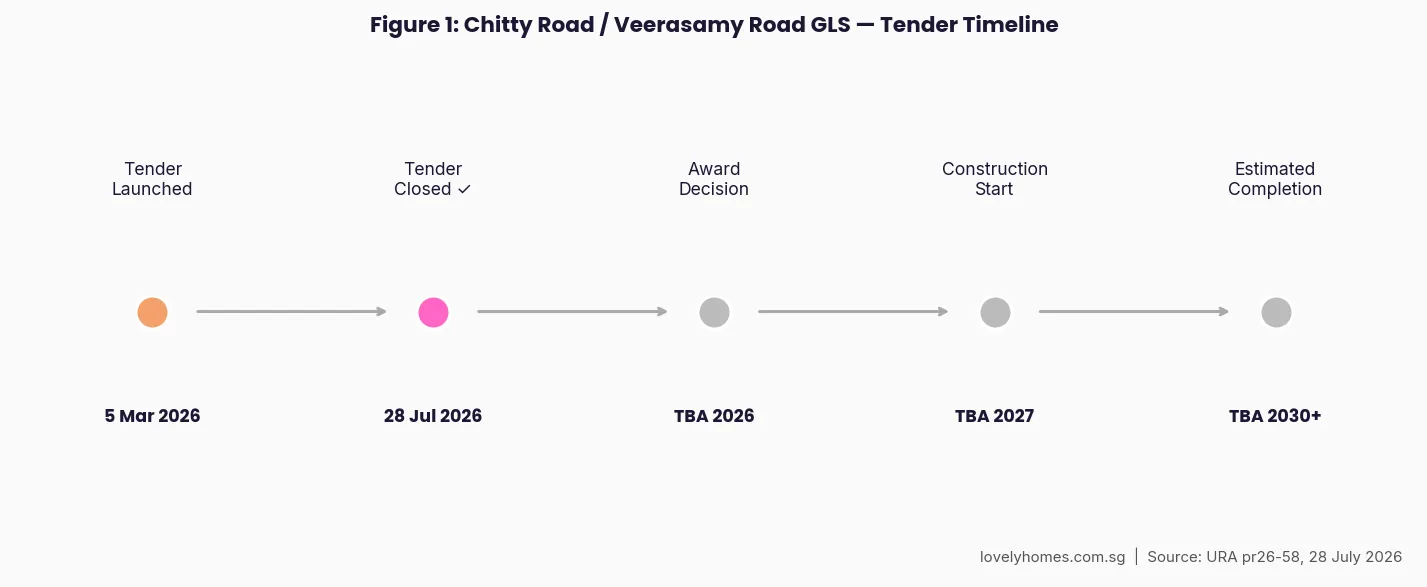
Chitty Road GLS tender timeline 2026 milestones Singapore
Figure 1: Chitty Road / Veerasamy Road GLS Tender — Key Timeline (Source: URA pr26-58, 28 July 2026)

Location and Significance: D08 Rochor Heritage Precinct

Chitty Road and Veerasamy Road sit in the heart of Singapore’s Little India precinct — one of the city-state’s most distinctive and historically significant urban neighbourhoods. The area, formally part of the Rochor planning area in District 08, is renowned for its conserved shophouse streetscapes, the Sri Veeramakaliamman Temple, the Tekka Centre wet market, and the vibrant commercial activity along Serangoon Road. It has been gazetted as a conservation area, and new development within its boundaries must be sensitive to the prevailing heritage character.

MRT access for the precinct is served by Little India MRT station on both the North-East Line (NEL) and Downtown Line (DTL) — two of Singapore’s busiest lines. This dual-line interchange gives residents and workers in the area direct access to the CBD via Dhoby Ghaut, Chinatown, and Bugis (DTL), and northward to Woodleigh, Potong Pasir, and Serangoon (NEL). The Farrer Park MRT station (NEL) is also within walking distance via Serangoon Road.

GLS releases within D08 and the Rochor area are notably infrequent compared with growth corridors such as Jurong or Tampines. This scarcity reflects both the conservation constraints in the Little India precinct and the relatively small developable land parcels available. The launch of this Chitty Road / Veerasamy Road site on the 1H2026 Confirmed List represented a rare opportunity for developers to acquire a centrally located, well-connected site adjacent to one of Singapore’s most culturally vibrant heritage districts.

Detail Information
Site address Chitty Road and Veerasamy Road, Singapore
Planning area Rochor (D08)
GLS programme 1H2026 Confirmed List
Tender launch date 5 March 2026
Tender close date 28 July 2026
Award decision To be announced (TBA)
Nearest MRT Little India (NEL/DTL), Farrer Park (NEL)
Conservation precinct Adjacent to Little India conservation area
Source URA pr26-58, 28 July 2026

What the Tender Outcome Will Tell Us

Developers’ bidding behaviour on GLS sites is one of the most closely watched leading indicators of private-sector sentiment toward Singapore’s property market. When developers bid aggressively — at high land prices per square metre of gross floor area (PSM GFA) — it signals confidence that the eventual launch prices will be sufficient to cover land costs, construction, financing, and margins. Conversely, a single low bid or an unawarded tender signals developer caution.

For the Chitty Road / Veerasamy Road site, the land cost per unit and per PSM GFA implied by the winning bid will carry particular significance for the D08 resale market. Existing owners of shophouses, conservation commercial properties, and the limited private residential stock in the area will be watching the award price closely. A robust winning bid would reinforce the precinct’s values; a below-expectation result could signal softer developer appetite for heritage-adjacent sites.

Industry observers will also scrutinise the number of bids. For recent comparable GLS sites — such as Bayshore Drive (awarded to industry figures at S$14,243 PSM GFA in July 2026) and Lorong Puntong/Sin Ming Avenue (closing September 2026) — market conditions have determined whether sites attracted competitive bidding from multiple parties or a narrow field. Given the conserved character of Chitty Road / Veerasamy Road and the development constraints it implies, the site is likely to attract specialised developers with experience in conservation-sensitive design.

Why Matters for Property Buyers and Investors

For end-buyers, a new development arising from this site would represent one of the very few opportunities to purchase a brand-new condominium or mixed-use property in the heart of D08. The Little India precinct’s rental demand is driven by a combination of food and beverage businesses, retail, professional offices, and residential tenants who value the neighbourhood’s connectivity and cultural energy. New residential units in this location would likely target a mix of owner-occupiers seeking a central, characterful urban address and investors targeting the professional expatriate rental market attracted by the dual-MRT convenience.

For property investors with existing exposure to D08 — whether through shophouses, conservation commercial properties, or the small number of private condominiums in the area — the Chitty Road GLS outcome provides a data point for land benchmarking. Shophouse transactions in Serangoon Road and Race Course Road have remained firm in 2026 on the back of strong buyer interest in conserved heritage assets; a robust GLS award price would add further price support to the precinct.

What Might Come Next

(This section represents editorial analysis and forward-looking commentary — not URA guidance.)

URA’s award decision for the Chitty Road / Veerasamy Road site is expected within the coming weeks. Once awarded, the winning developer will have a prescribed period to submit development plans for URA’s approval before commencing construction. Given the conservation-adjacent location, the development will likely need to incorporate heritage-sensitive design features — potentially including shophouse-style street-level facades, setback requirements, and height limitations consistent with the surrounding conservation area character.

Industry watchers will be looking at the Lorong Puntong / Sin Ming Avenue GLS site (tender closing 15 September 2026) and the Kitchener Link Reserve List site as further data points on developer appetite for inner-city GLS parcels in the months ahead. LovelyHomes will update readers once the Chitty Road award announcement is made.

Frequently Asked Questions

What is the difference between a GLS Confirmed List and Reserve List site?

In Singapore’s GLS Programme, Confirmed List sites are put up for public tender on a fixed schedule, regardless of developer demand — the government commits to releasing them. Reserve List sites are only triggered for tender when a developer submits an application to do so, with a minimum bid price that meets the government’s reserve. This distinction matters for market timing: Confirmed List releases like Chitty Road / Veerasamy Road reflect the government’s active intention to supply land at this location, rather than a response to a developer’s specific appetite.

When is the URA expected to announce the winning bid?

URA typically announces GLS tender awards within two to four weeks of the tender close date. Based on this timeline, the Chitty Road / Veerasamy Road award announcement is expected in August or September 2026. The announcement will disclose the winning developer, the accepted bid price in S$ and in PSM GFA, the site area, and the maximum gross floor area (GFA) permitted under the planning parameters. LovelyHomes will cover the award announcement as soon as it is released.

Will the new development affect property prices in the surrounding Little India area?

A new development at Chitty Road / Veerasamy Road is unlikely to have a direct negative effect on surrounding property prices — and may in fact support them. New GLS developments typically bring improved streetscape quality, new amenities, and increased foot traffic to a precinct. In conservation areas like Little India, new developments are required to complement the existing heritage character. The more meaningful signal will come from the land bid price: a high winning bid PSM GFA would confirm developer confidence in the precinct’s long-term values and provide a pricing benchmark for nearby resale transactions.

How does the Chitty Road site compare to the Bayshore Drive GLS awarded in July 2026?

The Bayshore Drive GLS site — awarded at S$2.128 billion to industry winners in July 2026, implying a land price of approximately S$14,243 PSM GFA — was a large-scale residential waterfront site in the East Coast District 16 area, with expectations of over 700 residential units and beachfront positioning. The Chitty Road / Veerasamy Road site is very different in character: it is a smaller, conservation-adjacent, mixed-use site in an inner-city heritage precinct. The two sites are not directly comparable on PSM GFA or expected unit count, but the Bayshore award price set a high benchmark for developer confidence in the 2H2026 GLS market that will inevitably influence bidding behaviour on inner-city sites like Chitty Road.

Where can I find the official bid details once they are released?

The full tender bid details — including the number of bids, each bidder’s identity, and the amounts tendered — will be published by URA as part of the award announcement press release. These are available on the URA website at www.ura.gov.sg/Corporate/Media-Room/Media-Releases. LovelyHomes will also cover the announcement once it is released. The Annex to pr26-58 contains the list of bids received at tender close; this document is available on the URA website.

Disclaimer: This news article is based on publicly available information from URA press release pr26-58 (28 July 2026) and other authoritative public sources. It does not constitute investment, legal, or financial advice. Land bid amounts and development details are not yet publicly available pending the URA award announcement; figures referenced in this article regarding comparable GLS sites are sourced from prior URA press releases. Readers should refer directly to the URA website at www.ura.gov.sg for official information and conduct independent due diligence before making any property or investment decisions. LovelyHomes.com.sg is an independent editorial platform not affiliated with URA or any government body.

×

Click anywhere to close

URA Closes Chitty Road & Veerasamy Road Conservation GLS Tender 2026

URA Closes Chitty Road & Veerasamy Road Conservation GLS Tender 2026

The Urban Redevelopment Authority (URA) closed bids today, 28 July 2026, for one of Singapore’s most unusual Government Land Sales (GLS) tenders: a cluster of 18 conserved two-storey pre-war terrace houses at Chitty Road and Veerasamy Road in the Little India Historic District. The site was launched for public tender on 5 March 2026, giving developers almost five months to assess the restoration scope and submit bids.

The properties were built in 1927 as municipal quarters for government employees — a heritage of civic purpose embedded in the heart of a district that Singapore has invested decades in preserving. The successful tenderer will be required to sensitively restore all 18 buildings and adapt them for either residential or long-stay serviced apartment use under URA’s conservation guidelines. An award announcement is expected in the coming weeks.

Quick Summary — Chitty Road & Veerasamy Road GLS Tender

  • 18 two-storey conserved buildings constructed in 1927; originally government employee quarters in the Little India Historic District.
  • Site area: 0.34 hectares in District 8 (Little India / Farrer Park MRT).
  • Permitted use: Residential or long-stay serviced apartments, subject to URA conservation guidelines.
  • Tender launched: 5 March 2026; tender closed: 28 July 2026.
  • Bids received as at close of tender; details in URA Annex A (pr26-58). Award expected to be announced in August/September 2026.
  • This is a conservation GLS sale — not a standard redevelopment site. The buildings must be retained and restored; they cannot be demolished and rebuilt.
  • Structural investigation reports have been prepared and made available to tenderers to assess restoration and strengthening works required.
  • The site sits within the Little India Conservation Area, one of four historic districts (alongside Chinatown, Kampong Glam, and Boat Quay) gazetted under Singapore’s Urban Conservation Programme.

What Makes This Tender Unusual

Standard GLS residential tenders ask developers to bid for a cleared site where they can design and build a new development from scratch. This tender is fundamentally different. The 18 buildings are conserved structures — gazetted by the URA and protected from demolition. The developer who wins must work within the existing building envelopes, adapting 1927 two-storey terrace construction for modern residential living or serviced apartment use.

This imposes unique constraints. Structural investigations have been carried out and the reports made available to tenderers, who must factor restoration and strengthening costs into their bids. These costs can be substantial — heritage conservation work typically runs at a significant premium over standard construction, reflecting specialist tradespeople, careful material matching, and the time required to comply with URA’s conservation guidelines on facades, rooflines, windows, and internal structural elements.

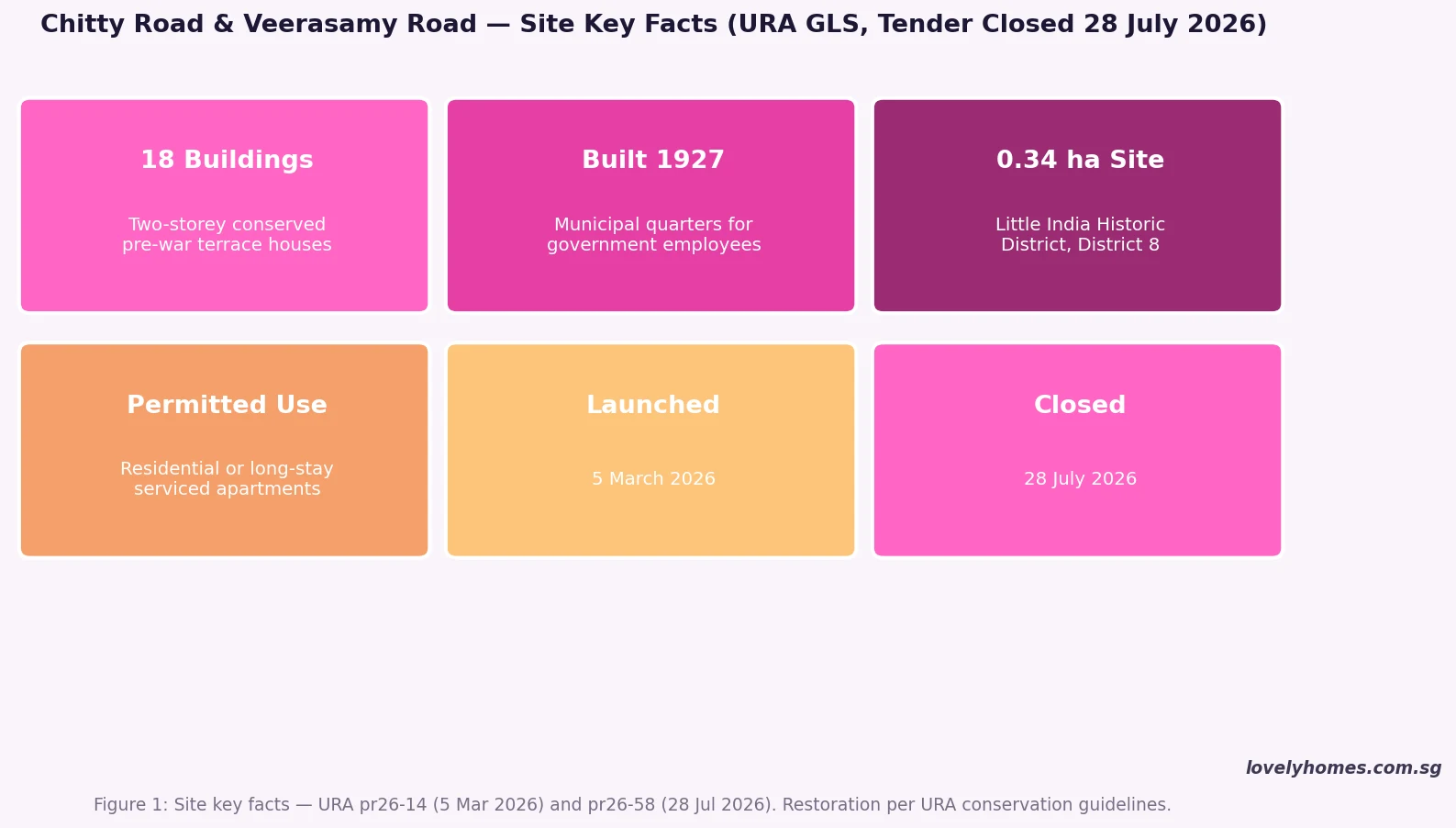
Chitty Road Veerasamy Road GLS conserved buildings key facts Singapore 2026
Figure 1: Key site facts for the Chitty Road and Veerasamy Road conservation GLS tender (URA pr26-14 and pr26-58, 2026). The site comprises 18 pre-war terrace houses built in 1927 on a 0.34-hectare site in the Little India Historic District.

The Little India Historic District: Heritage and Property Value

The Little India Historic District is one of Singapore’s four protected historic conservation areas. It encompasses the streets around Serangoon Road — Dunlop Street, Campbell Lane, Clive Street, Buffalo Road, and the Chitty Road / Veerasamy Road cluster — as a living cultural precinct rather than a museum. URA’s conservation philosophy for Little India is to maintain the area as a mixed-use residential, commercial, and cultural district where heritage architecture frames contemporary activity.

For property owners and investors, conservation districts carry a distinct set of supply constraints and price dynamics. New residential supply in Little India is severely limited by the conservation controls that prevent demolition and significant new development. The Chitty Road/Veerasamy Road cluster, once restored, will represent one of the few instances of new private residential supply entering the Little India Historic District in recent years.

Feature Chitty Road/Veerasamy Road Site
District D8 (Farrer Park / Little India)
Number of buildings 18 two-storey conserved terrace houses
Year built 1927
Site area 0.34 hectares (approx. 3,400 sq m)
Original use Municipal quarters (government employees)
Proposed use Residential or long-stay serviced apartments
MRT access Farrer Park MRT (NE Line), ~5 min walk
Conservation status Gazetted conserved buildings, Little India Historic District
Tender launched 5 March 2026
Tender closed 28 July 2026

What Happens Next: Award and Implications

URA’s press release (pr26-58, 28 July 2026) confirms that bids have been received and that this is not an announcement of tender award. Bids will now be evaluated and a decision announced at a later date — typically within four to eight weeks of tender close for GLS sites.

The award price will be a benchmark for conservation property values in Singapore’s historic districts. Unlike standard GLS land prices (expressed as price per square foot per plot ratio, or PSF PPR), conservation tender prices are harder to compare because the developer’s value is locked into the existing building footprints rather than a variable GFA. The implied per-unit price — after restoration, fit-out, and marketing costs — will give the market a signal about what well-restored conserved shophouses and terrace houses in Singapore’s historic districts are worth as residential or serviced apartment assets.

Comparable conserved property transactions in Little India and Kampong Glam have ranged from S$3.5 million to S$7 million per unit for restored shophouses used as residences or boutique hotels, depending on floor area, lease type, and frontage. The Chitty Road units, being terrace houses (typically shallower plots than shophouses), will likely command values at the lower end of this range — but the cluster format and central location near Farrer Park MRT may support premium pricing.

What This Means for Buyers and Investors

For buyers interested in heritage property, the completion of the Chitty Road/Veerasamy Road restoration — likely three to five years from award — will offer a rare opportunity to own a conserved pre-war residence in a protected historic district. Heritage homes in Singapore’s conservation areas have demonstrated strong capital resilience over time: their supply is permanently capped by conservation controls, and their aesthetic distinctiveness attracts buyers and tenants willing to pay for character that new-build developments cannot replicate.

The serviced apartment option is also significant. Singapore’s long-stay serviced apartment sector has tightened considerably since URA revised minimum stay requirements in 2023. A conservation-grade long-stay serviced apartment cluster in Little India — steps from the heritage shophouses of Serangoon Road and connected directly to the North-East Line — would be positioned at the premium end of the market for corporate relocations and diplomatic tenants.

Frequently Asked Questions

Can the winning developer demolish and rebuild the Chitty Road and Veerasamy Road terrace houses?

No. These buildings are conserved structures gazetted under Singapore’s Urban Conservation Programme, administered by the URA. Gazetted conserved buildings cannot be demolished. The successful tenderer must retain the external character of the buildings — facades, rooflines, windows, and other defining architectural elements — while adapting the interiors for the approved residential or serviced apartment use. The URA’s conservation guidelines set out in detail what can and cannot be altered. Any proposed adaptation must be submitted to URA for approval as part of a Development Application (DA) before works commence.

What is the difference between a conservation GLS tender and a standard residential GLS?

A standard residential GLS tender involves a cleared or clearable site where the developer has freedom (within GLS parameters) to design a new building to the maximum approved GFA, density, and height. A conservation GLS tender involves existing buildings that must be retained and restored. The developer’s value creation comes from the quality of restoration, the permitted use, and the location — not from maximising a new development. Conservation tenders typically attract a smaller, more specialised field of bidders because the required expertise in heritage restoration is narrower than standard residential development.

When will the award be announced?

URA’s press release pr26-58 states that the award decision will be made after the bids have been evaluated, and will be publicised at a later date. Based on URA’s typical practice for GLS tenders, award announcements generally occur four to eight weeks after tender close. Given the tender closed on 28 July 2026, an award announcement is most likely in August or September 2026. LovelyHomes will report on the award when URA makes the announcement. Monitor our Property News section for the update.

Who typically buys conserved property in Singapore’s historic districts?

The buyer profile for conserved shophouses and terrace houses in Singapore’s historic districts includes high-net-worth individuals (both Singaporean and foreign, noting that foreigners can buy conserved shophouses subject to the Residential Property Act), family offices, hospitality operators (for boutique hotels or serviced residences), and corporate entities. The limited supply, heritage prestige, and land scarcity in conservation zones make these assets a store of value. Unlike standard residential condos, conserved properties are not subject to Additional Buyer’s Stamp Duty (ABSD) if they are classified as commercial use (e.g., commercial shophouses) — but residential-only conserved properties are subject to standard residential stamp duty rules, including ABSD based on the buyer’s profile and existing property count.

How does Singapore’s conservation programme compare to those of other cities?

Singapore’s Urban Conservation Programme, launched in 1989 under Lee Kuan Yew’s government and administered by the URA, is widely regarded as one of the most systematic conservation frameworks in Southeast Asia. It has gazetted over 7,000 conserved buildings across four historic districts (Chinatown, Little India, Kampong Glam, Boat Quay) and numerous individual conservation areas. Unlike Hong Kong, where many pre-war buildings have been lost to redevelopment pressure, Singapore’s framework enforces conservation as a condition of all development and redevelopment in designated areas. Comparable programmes in Penang (George Town UNESCO World Heritage Site), Malacca, and Bangkok have adopted varying degrees of enforcement, but Singapore’s combination of statutory backing and active government sale of conserved properties for private adaptive reuse is a distinctive model.

Disclaimer: This article is based on URA press releases pr26-14 (5 March 2026) and pr26-58 (28 July 2026). Bid amounts, award decision, and restoration timeline have not been announced by URA at the time of publication. Property valuations and comparable transaction prices cited are market estimates only. This article does not constitute investment or financial advice. LovelyHomes recommends consulting the URA website (ura.gov.sg) and licensed property professionals for authoritative information on conservation guidelines and property purchase decisions.

Translate »