Co-Living in Singapore 2026: Complete Guide to Room Rental, Co-Living Operator Rules and Tenant Rights

Co-Living in Singapore 2026: Complete Guide to Room Rental, Co-Living Operator Rules and Tenant Rights

Quick Answer: Co-Living in Singapore

  • Co-living is a rental model where an operator master-leases a private residential unit or building, furnishes and subdivides the bedrooms, and rents them out individually with bundled utilities, wifi, cleaning and community programming.
  • This differs from traditional master-tenant subletting, where an individual tenant or owner sublets a spare room directly to another person, informally, with terms negotiated bilaterally and no bundled services.
  • URA planning rules require a minimum stay of around three consecutive months for private residential property, which is why co-living operators typically set a similar minimum lease term rather than offering true short-term or hotel-style stays.
  • HDB flats have stricter rules than private property: whole-flat subletting requires meeting the Minimum Occupation Period (MOP) and getting HDB approval; room-only subletting doesn’t require MOP but still needs HDB approval and is subject to occupancy caps.
  • Co-living rooms typically cost more per month than a comparable master-tenant room, reflecting the bundled services, flexibility and furnishing, but usually work out cheaper than renting an entire studio apartment alone.
  • Tenants should always check the tenancy agreement, security deposit terms and notice period carefully, and know that unresolved rental disputes below a certain amount can be brought to the Small Claims Tribunal.
  • Landlords and master tenants subletting rooms, whether through a co-living platform or informally, remain responsible for complying with HDB or URA rules depending on the property type.

What Is Co-Living, and How Is It Different From Traditional Room Rental?

Co-living has grown into a distinct segment of Singapore’s rental market over the past several years, sitting between a hotel-style serviced apartment and a traditional flatshare. In the typical co-living model, an operator signs a master lease with the property owner for an entire unit, or sometimes an entire building, then furnishes and subdivides the bedrooms, and markets each room individually to tenants. The monthly rent usually bundles in utilities, wifi, regular cleaning of common areas, basic furnishings and appliances, and often some form of community programming or shared workspace, all managed through a single point of contact rather than a private landlord.

This is a meaningfully different arrangement from traditional master-tenant subletting, where an existing tenant (or the property owner) simply rents out a spare bedroom directly to another individual on an informal, bilaterally negotiated basis. In a master-tenant setup, utilities and wifi are typically split manually between housemates, furnishing standards vary widely, and there’s no dedicated operator managing the property, disputes, or maintenance requests. Both models exist across HDB flats and private property, though co-living operators concentrate almost entirely on private residential units, since HDB’s subletting framework does not accommodate a commercial operator business model.

Monthly cost comparison co-living versus room rental versus studio apartment Singapore 2026
Figure 1: Indicative monthly cost comparison for a single working professional across three common rental options.

URA’s Minimum Stay Rules and Licensed Co-Living Operators

A key regulatory backdrop shaping how co-living operates in Singapore is URA’s planning framework around minimum stay periods for private residential property. To prevent private homes from effectively operating as unlicensed hotels, URA generally requires that private residential units be leased out for a minimum of three consecutive months per stay, rather than being let out on a nightly or weekly short-term basis. This is why most co-living operators in Singapore structure their standard lease terms around a similar minimum, commonly three months or longer, even though the pitch is often “flexible” compared to a conventional twelve-month tenancy.

Some co-living operators hold specific approvals or operate in properties zoned or approved for a use that allows shorter stays (broadly comparable to serviced apartments), but this is the exception rather than the norm for ordinary private residential co-living spaces. Tenants and landlords considering co-living arrangements shorter than three months should clarify directly with the operator what approval basis, if any, permits this, since operating outside URA’s planning rules can carry consequences for the property owner and the operator managing the unit.

HDB Flats vs Private Property: Subletting and Occupancy Rules

The rules governing room rental differ substantially depending on whether the property is an HDB flat or private residential unit, and this is one of the most important distinctions for anyone comparing co-living against a traditional HDB room rental.

Comparison of HDB and private property subletting and co-living rules Singapore 2026
Figure 2: How HDB flats and private property differ on subletting and co-living-style rental.

For HDB flats, subletting the whole flat requires the owner to have met the Minimum Occupation Period (MOP), typically five years from the point of key collection, and to obtain HDB’s approval before subletting. Subletting individual rooms within a flat the owner still occupies does not require MOP to be met, but still requires HDB approval and is subject to an occupancy cap that varies by flat type (roughly four occupants for a one- or two-room flat, up to around nine for a five-room or executive flat, though owners and any existing tenants count towards this cap). There are also quota restrictions on subletting to non-Singapore Citizens and non-PRs in certain blocks and neighbourhoods, so HDB owners should always check current conditions before advertising a room.

For private property, there is no MOP-style lock-in period and no need for government approval to sublet, whether the whole unit or individual rooms, though owners should check their mortgage terms and any tenancy restrictions in their title. The main constraint is URA’s minimum stay rule discussed above, plus practical considerations like MCST by-laws in condos, which sometimes restrict short-term letting or the number of unrelated occupants per unit. This more permissive framework for private property is a major reason why commercial co-living operators concentrate almost exclusively on private residential units rather than HDB flats.

What Co-Living Rooms Typically Include

Without endorsing any specific operator, co-living rooms in Singapore’s private residential market generally fall into a few common configurations: a private ensuite or shared-bathroom bedroom, fully furnished with a bed, wardrobe and desk, with utilities, wifi and regular common-area cleaning bundled into a single monthly fee. Many operators also offer flexible lease lengths starting from three months, a simplified move-in process without the need to separately arrange furniture or utility accounts, and shared amenities such as a communal kitchen, lounge or occasionally a coworking space, along with periodic social or networking events aimed at tenants who are new to the neighbourhood or to Singapore. The trade-off for this convenience and flexibility is typically a higher monthly rent compared to a bare, unfurnished room rented directly from a private landlord.

Tenant Rights, Deposits and Lease Terms

Whether renting through a co-living operator or a traditional master tenant, a few protections and practices apply broadly across Singapore’s rental market. A security deposit of around one to two months’ rent is standard, refundable at the end of the tenancy subject to the unit being returned in good condition and all outstanding payments settled; tenants should document the room’s condition with photos at move-in to avoid disputes later. The tenancy agreement, even for a co-living room, should clearly set out the rent, deposit, notice period for termination, what’s included (utilities, wifi, cleaning) and any house rules, and tenants should read this carefully before signing rather than relying on verbal assurances. For disputes over deposits or other tenancy-related claims within its monetary jurisdiction, tenants can bring a claim to the Small Claims Tribunal, which offers a relatively fast, low-cost avenue compared to formal litigation. Tenants should also confirm early on whether their room rental (co-living or informal) is being conducted in compliance with the applicable HDB or URA rules described above, since a rental arrangement that breaches these rules can create complications for the tenant as well as the landlord or operator.

Summary: Co-Living and Room Rental Facts at a Glance

Question Short Answer
Minimum stay for private co-living? Typically around 3 months, following URA’s minimum-stay planning rule.
Does HDB room subletting need MOP? No, but it still needs HDB approval and is subject to occupancy caps.
Does whole-flat HDB subletting need MOP? Yes, the flat must have met MOP, plus HDB approval.
Typical co-living deposit? Around 1-2 months’ rent, refundable subject to condition and payments.
Where to resolve a deposit dispute? The Small Claims Tribunal, for claims within its monetary jurisdiction.
Do co-living operators run in HDB flats? Rarely; the commercial model concentrates on private residential units.

Worked Example: Comparing Monthly Costs for a Working Professional

Profile: Ms Wong, a working professional earning S$5,500 a month, is comparing three rental options in the Central region for a single-person budget.

Option 1 – Co-living private room: a furnished private room with ensuite in a co-living operated unit, all-inclusive of utilities, wifi and cleaning, at S$1,800 per month, on a 3-month minimum lease with a 1-month deposit (S$1,800).

Option 2 – Traditional master-tenant room rental: an unfurnished room rented directly from a condo owner acting as master tenant, at S$1,300 per month plus an estimated S$150 per month for her share of utilities and wifi, totalling S$1,450 per month, on a 6-month minimum lease with a 2-month deposit (S$2,600), and Ms Wong would need to source and pay for her own furniture separately.

Option 3 – Studio apartment, renting alone: a small private studio apartment at S$3,000 per month plus around S$250 per month in utilities and wifi, totalling S$3,250 per month, typically on a 12-month lease with a 2-month deposit (S$6,500).

Comparison: the co-living option costs S$350 more per month than the master-tenant room but requires a smaller upfront deposit, no furniture purchase, and offers the shortest minimum commitment. The studio apartment costs roughly 80% more per month than co-living, reflecting the premium of having an entire unit to herself, and requires the largest upfront cash outlay and longest lock-in. For a professional prioritising flexibility and low upfront cost over privacy of an entire unit, co-living or a master-tenant room are the more budget-efficient choices; the studio suits someone valuing full independence and willing to pay for it.

HDB subletting occupancy caps by flat type Singapore 2026
Figure 3: Indicative maximum occupants for HDB room and whole-flat subletting by flat type.

Why This Matters for Tenants and Landlords

Singapore’s co-living sector has grown because it solves a genuine friction point for young professionals, students and newly arrived expatriates: the difficulty of quickly finding a furnished room with clear, all-inclusive pricing and no need to negotiate directly with an individual landlord or set up utility accounts from scratch. For landlords and property owners, master-leasing a private unit to a co-living operator can also simplify management, since the operator typically handles tenant sourcing, rent collection and day-to-day issues. The trade-off, for both sides, is that this convenience is priced in, and tenants comparing options purely on headline monthly rent without accounting for bundled utilities, furnishing, deposit size and lease flexibility risk comparing apples to oranges.

What Might Come Next

The following is informed speculation, not confirmed policy. As co-living continues to mature as a rental category in Singapore, it’s plausible that clearer, more standardised guidance around operator licensing, minimum stay enforcement, and tenant protections specific to co-living arrangements could develop over time, particularly if the sector’s share of the private rental market continues to grow. Some industry commentary has also raised the question of whether HDB might explore more structured room-rental frameworks given persistent rental demand from students and young workers, though no specific policy change extending a co-living-style model to HDB flats has been signalled as at this writing.

Frequently Asked Questions

Is co-living legal in HDB flats?

HDB’s subletting framework does not accommodate the commercial co-living operator model. Individual HDB owners can sublet rooms directly to tenants with HDB approval, subject to occupancy caps, but this is traditional room subletting rather than an operator-run co-living arrangement.

Can I rent a co-living room for less than 3 months?

Generally no, for ordinary private residential co-living spaces, because URA’s planning rules require a minimum stay of around three consecutive months for private residential property. Some operators may offer shorter stays only where the specific property holds separate approval for shorter-term use.

What’s the difference between subletting a whole HDB flat and subletting just a room?

Subletting the whole flat requires the owner to have met the Minimum Occupation Period (MOP) and get HDB approval. Subletting just a room while the owner continues living there does not require MOP but still needs HDB approval and is subject to an occupancy cap based on flat type.

Is my deposit protected if a co-living operator or master tenant disappears?

There is no government-run deposit protection scheme for private residential tenancies in Singapore, unlike some other countries. Tenants should choose reputable operators or landlords, keep clear written records of payment and the tenancy agreement, and pursue unresolved disputes through the Small Claims Tribunal if needed.

Do foreigners face any restrictions renting a co-living room or HDB room?

Private property co-living rooms are generally open to any tenant with a valid pass or visa status. HDB room subletting to non-Singapore Citizens and non-PRs is subject to quota restrictions in certain blocks and neighbourhoods, so this should be checked with HDB or the flat owner before committing.

Can my landlord raise the rent partway through a co-living lease?

Not during a fixed lease term, unless the tenancy agreement specifically allows for it. Rent can typically only be adjusted at renewal, so tenants should check the agreement’s terms on rent review and renewal notice periods before signing.

Is co-living cheaper than renting a whole condo unit by myself?

Usually yes, on a per-month basis, since co-living splits the cost of a unit’s utilities, furnishing and space across multiple tenants. Renting an entire unit alone offers full privacy and independence but at a substantially higher monthly cost, as shown in the worked example above.

Disclaimer: This article is intended for general informational purposes only and does not constitute legal advice. Subletting rules, minimum stay requirements, occupancy caps and quota restrictions are set by HDB and URA respectively and are subject to change and to case-specific conditions. Always confirm current rules with the Housing & Development Board (HDB) and the Urban Redevelopment Authority (URA) before entering into any subletting or co-living arrangement.
×

Click anywhere outside to close

Singapore Rental Guide 2026: How to Rent a Property — Tenants and Landlords Explained

Singapore Rental Guide 2026: How to Rent a Property — Tenants and Landlords Explained

Quick Answer: Singapore Rental Guide 2026

  • Average rents (2026): HDB 4-room S$2,000–S$3,200/mth; condo OCR S$2,800–S$4,500/mth; condo CCR S$5,000–S$10,000/mth.
  • Security deposit: 1 month’s rent for a 1-year lease; 2 months for a 2-year lease — paid at signing.
  • Stamp duty (tenant): 0.4% of total rent for leases of 1–3 years, stamped within 14 days of signing via IRAS.
  • HDB subletting: Owners must complete their 5-year Minimum Occupation Period (MOP) and obtain HDB approval before subletting the entire flat.
  • Key documents: Letter of Intent (LOI), Tenancy Agreement (TA), Diplomatic Clause (if needed), Inventory List.
  • Tenant protections: Landlord must give reasonable notice before entry, return deposit within reasonable time after lease end, and keep the flat habitable.
  • 7-step process: Search → View & Negotiate → LOI → TA → Deposit & Stamp → Handover → Move In.
  • Total upfront cost: Typically 3–4 months’ rent (deposit + advance + stamp duty + agent fee if applicable).

Renting a property in Singapore sits at the intersection of a competitive residential market, a tight regulatory framework, and one of Asia’s most internationally mobile workforces. Whether you are a first-time tenant arriving on an Employment Pass, a Singaporean family straddling the wait for a BTO flat, or a landlord managing a resale HDB unit, understanding the rental landscape — its prices, rules, documentation, and rights — can save you thousands of dollars and considerable stress.

Singapore’s Urban Redevelopment Authority (URA) tracks private residential rentals, while the Housing and Development Board (HDB) governs subletting of public flats. Together, these two bodies set the guardrails for the approximately 500,000 households that rent in Singapore today. This guide covers everything: rental price benchmarks, the step-by-step renting process, key documents, HDB subletting rules, tenant and landlord rights, and what to expect when the lease ends.

Monthly rental ranges by property type Singapore 2026 chart
Figure 1: Monthly rental ranges by property type — Singapore 2026. Sources: URA Rental Statistics, HDB Analytical Tool.

How Much Does It Cost to Rent in Singapore? (2026 Benchmarks)

Rents in Singapore have moderated from the peaks of 2022–2023 but remain elevated relative to pre-pandemic levels. URA’s rental index for private residential properties stood at approximately 156.8 in Q2 2026 (2009 base = 100), roughly 48% above the Q1 2020 level. For public housing, HDB’s Rental Statistics show the median rent for a 4-room flat in mature estates averaging S$2,800–S$3,200 per month as of mid-2026.

Property Type Size Range Monthly Rent (S$) Key Driver
HDB 2-room ~45 sqm S$1,200–S$1,800 Mainly singles/couples; limited supply
HDB 3-room ~60–70 sqm S$1,600–S$2,400 Small families; near MRT commands premium
HDB 4-room ~85–95 sqm S$2,000–S$3,200 Most popular rental size; mature estates higher
HDB 5-room ~110–125 sqm S$2,400–S$3,800 Families; limited availability
Condo (OCR) 500–900 sqft S$2,800–S$4,500 1–2 bedrooms; SORA mortgage normalising landlord yields
Condo (RCR) 500–900 sqft S$3,500–S$6,000 City-fringe; expatriate demand; premium for furnishing
Condo (CCR) 500–1,500 sqft S$5,000–S$10,000+ CBD/Orchard/District 9–11; corporate lets
Landed (terrace) 1,600–2,500 sqft S$6,000–S$10,000 Space, privacy; car porch; very low supply
Landed (semi-D/bungalow) 2,500 sqft+ S$10,000–S$25,000+ Ultra-premium; typically corporate tenants

The 7-Step Singapore Rental Process

Renting a property in Singapore follows a well-established process that typically takes two to four weeks from first viewing to key collection. Each step involves specific rights, obligations, and — in most cases — money changing hands.

Singapore rental process 7 steps timeline from search to move-in
Figure 2: The 7-step Singapore rental process — from search to move-in.

Step 1 — Search and Shortlist

Begin by setting a budget (as a rule of thumb, monthly rent should not exceed 30% of household income), desired district, property type, and key amenities (MRT proximity, school distance, pet policy). Listings are available on PropertyGuru, 99.co, and STProperty. Note that agents representing landlords typically charge the tenant one month’s rent as commission for a 2-year lease (negotiable) — factor this into your upfront budget.

Step 2 — Viewings and Negotiation

Visit at least two to three units. During viewings, check the condition of fixtures, air-conditioning servicing history, water pressure, and any existing defects. Negotiate on rent, furnishing inclusions, lease commencement date, and whether the landlord will repaint or service appliances before handover.

Step 3 — Letter of Intent (LOI)

Once terms are agreed, the tenant submits a Letter of Intent and pays a good-faith deposit — typically one month’s rent. The LOI sets out the agreed rent, lease term, commencement date, security deposit amount, furnishing condition, and any special clauses (e.g., pet permission). The LOI is not a binding tenancy agreement, but the good-faith deposit is forfeited if the tenant withdraws without cause.

Step 4 — Tenancy Agreement (TA)

The landlord’s solicitor or agent prepares the Tenancy Agreement. Review it carefully. Key clauses include: rent, lease term, security deposit, diplomatic clause (discussed below), maintenance obligations (air-conditioning servicing is typically the tenant’s responsibility for quarterly servicing; landlord handles structural repairs), subletting restrictions, and early-termination provisions.

Step 5 — Security Deposit and Stamp Duty

On signing, the tenant pays the security deposit (minus the good-faith deposit already paid) and one month’s advance rent. The tenancy agreement must then be stamped at IRAS within 14 days. Stamp duty for a residential lease is 0.4% of total rent for a lease term of 1 to 3 years, rounded up to the nearest S$4. For a 2-year lease at S$3,200/mth, total rent = S$76,800; stamp duty = S$307.20, rounded to S$308. This is payable by the tenant under the Stamp Duties Act (Cap. 312).

Step 6 — Handover and Inventory Check

Before moving in, conduct a joint walkthrough with the landlord or agent. Document every defect on an inventory list — scratches, damaged furniture, missing items. Both parties sign the inventory list. Photograph everything. This protects your security deposit at lease end.

Step 7 — Move In and Utilities

Transfer utilities into your name with SP Group (electricity and gas) and PUB (water). SP Group typically requires a deposit of S$200 for single-phase supply (most residential) or S$300 for three-phase. Register your Singapore address with the Immigration and Checkpoints Authority (ICA) if you hold a Long-Term Pass.

Upfront rental costs breakdown security deposit advance rent stamp duty agent fee Singapore 2026
Figure 3: Typical upfront rental costs for a S$3,200/mth condo OCR, 2-year lease (2026).

Security Deposit: What You Need to Know

The security deposit is held by the landlord as insurance against unpaid rent, damages beyond fair wear and tear, or early termination. Singapore law does not prescribe a maximum deposit amount, but market convention is:

Lease Term Market Standard Deposit Return Timeline
1-year lease 1 month’s rent Within 30 days of lease expiry (market practice; no statutory period)
2-year lease 2 months’ rent Within 30 days; deductions itemised in writing
3-year lease 2–3 months’ rent Negotiate return timeline in TA

Deductions are permitted only for: unpaid rent or utilities, damage beyond fair wear and tear (with evidence), and early termination without invoking the diplomatic clause. The landlord cannot deduct for normal wear and tear (faded paint, worn carpets from normal use). If a dispute arises, Singapore’s Community Disputes Resolution Tribunal (CDRT) handles neighbour-related disputes, while contractual disagreements over deposits are typically resolved through the Small Claims Tribunal (SCT) for claims up to S$30,000.

HDB Subletting Rules 2026

HDB flats may be rented out (sublet) by their owners, but strict conditions apply. Subletting without meeting these conditions is a breach of the Housing and Development Act and can result in fines or compulsory acquisition of the flat.

Requirement Detail
Minimum Occupation Period (MOP) 5 years from key collection for BTO; 5 years from completion date for resale
HDB approval Required for subletting the entire flat; room subletting does not need approval but owners must inform HDB online
Permitted occupants Maximum 6 persons per flat; all must hold a valid pass (SC, PR, WP, EP, DP, LTVP, etc.)
Subletting period Minimum 6 months; maximum 3 years per application (renewable)
Non-Citizen quota Maximum 8% of HDB flats per neighbourhood and 11% per block may be rented to non-Malaysian non-Citizens
Owner occupancy (rooms) If subletting rooms, the owner must continue to occupy the flat as their registered address
Reporting changes Landlord must notify HDB within 7 days of any change in tenant or occupant

To apply for HDB subletting approval, the flat owner logs in to the HDB My Flat Portal and submits the application online. Processing takes approximately 7–10 working days. Subletting approval is generally granted provided all eligibility conditions are met.

The Diplomatic Clause

Singapore’s internationally mobile workforce means the Diplomatic Clause is a near-standard feature of tenancy agreements for expatriates. The clause allows a tenant who is relocated, made redundant, or repatriated by their employer to terminate the lease early — typically after a minimum of 12 months — by giving one to two months’ written notice.

To invoke the Diplomatic Clause legitimately, the tenant must usually provide documentary evidence (e.g., employer letter of transfer or repatriation). Some landlords require proof that the tenant is leaving Singapore, not merely changing jobs. The security deposit is fully returned if the clause is properly invoked.

Worked Example: Total Rental Cost for a 2-Year Lease

Scenario: Ms Lee (EP holder) renting a 2-bedroom condo in D15 (East Coast)

  • Monthly rent agreed: S$3,200
  • Lease term: 2 years (24 months)
  • Good-faith deposit (with LOI): S$3,200 (= 1 month)
  • Security deposit at TA signing: S$3,200 (2nd month — total deposit 2 mths = S$6,400)
  • Advance rent at TA signing: S$3,200 (1st month)
  • Stamp duty: Total rent S$76,800 × 0.4% = S$307.20 → rounded to S$308
  • Agent commission (if applicable): S$3,200 (1 month; paid by tenant for 2-year lease)
  • SP Group utility deposit: S$200
  • Total upfront outlay: S$6,400 (deposit) + S$3,200 (advance) + S$308 (stamp) + S$3,200 (agent) + S$200 (utility) = S$13,308
  • Total rent over 24 months: S$3,200 × 24 = S$76,800

At the end of the lease, if no damage is found, S$6,400 is returned. Net rental expenditure over 2 years (excluding agent and utility deposit recovered): approximately S$73,908.

Why This Matters: Singapore’s Rental Market in Context

Singapore’s rental market is notably different from those in other global cities. There is no equivalent of the UK’s Tenants Fees Act restricting what landlords can charge, no New York-style rent stabilisation, and no long-term lease security analogous to Germany’s tenant-friendly laws. Renters in Singapore operate almost entirely under contract law — what is in the Tenancy Agreement governs, full stop.

This makes the Tenancy Agreement the single most important document in a tenancy. Unlike in many jurisdictions, there is no implied statutory minimum notice period for landlords to end a tenancy (unless specified in the TA), no right to remain beyond the lease term, and no automatic renewal. Tenants relying on verbal assurances without written TA protection have very limited recourse.

The Ministry of Law’s Law Reform and Revision Division has in recent years published consultation papers on introducing a Residential Tenancy Act, which would codify tenant rights. As of mid-2026, no such legislation has been enacted — watch this space.

What Might Come Next for Singapore’s Rental Market

This section contains editorial analysis and should not be relied upon as financial or legal advice.

Several forces are shaping Singapore’s rental market in the second half of 2026 and beyond. First, the BTO pipeline: with an estimated 100,000 new HDB flats under construction or recently completed, the displacement phase — where BTO buyers rent while waiting for their flat — should taper from 2027 onwards, easing demand in the HDB rental segment. Second, interest rate normalisation: as SORA continues to drift lower, some landlords who purchased investment properties at 3.5%–4% fixed rates in 2022–2023 will refinance, reducing their break-even rent and creating downward pressure on asking rents. Third, supply of private rental units: several large-scale private developments completed in 2025–2026 (the East Coast and Tengah corridors in particular) are entering the rental market, adding choice in the OCR segment. Analysts at institutions such as JLL and Knight Frank have projected private residential rents softening by 2–5% in full-year 2026, with further moderation possible in 2027.

Summary: Key Singapore Rental Facts

Topic Key Fact
Security deposit 1 month (1-year lease); 2 months (2-year lease)
Stamp duty 0.4% of total rent; 14-day stamping deadline (IRAS)
Agent commission 1 month’s rent for 2-year lease (tenant-side, negotiable)
HDB MOP before subletting 5 years from key collection
HDB max occupants 6 persons per flat
HDB sublet period Min 6 mths; max 3 years per approval
Diplomatic Clause Early exit after 12 mths, 1–2 mths’ notice; proof of relocation required
Deposit return No statutory period; market practice 30 days after lease expiry

Frequently Asked Questions: Singapore Rental Guide 2026

Can I rent an HDB flat as a foreigner?

Yes, foreigners holding valid passes (Employment Pass, S Pass, Work Permit, Dependant’s Pass, Long-Term Visit Pass, or Student Pass) may rent HDB flats, subject to the HDB’s Non-Citizen Quota. Under the quota, no more than 8% of flats in a neighbourhood and 11% of flats in any single block may be rented to non-Malaysian non-Citizens. If the quota is met in a particular block, the landlord cannot sublet to a non-Malaysian non-Citizen tenant even with HDB approval. Malaysians are exempt from this quota.

Who pays the agent commission in Singapore — landlord or tenant?

This is one of the most commonly misunderstood aspects of Singapore’s rental market. Typically, each party pays their own agent. For a 2-year lease, market convention is: the landlord pays their agent one month’s commission, and the tenant pays their agent one month’s commission. For a 1-year lease, only the landlord’s side typically pays commission; the tenant’s agent may charge the tenant half a month. If you deal directly with the landlord (no agent), you can negotiate away this cost entirely. Commission rates are not regulated and are fully negotiable.

What is fair wear and tear, and why does it matter for my deposit?

Fair wear and tear refers to the natural deterioration of a property through ordinary, careful use over time. Under Singapore law and market practice, a landlord cannot deduct from your security deposit for fair wear and tear. Examples of fair wear and tear include: slight fading of paint, minor surface marks on walls from furniture, worn soles on carpet from normal foot traffic. Examples that are NOT fair wear and tear (and may justify deductions) include: holes in walls, stained or burnt upholstery, broken fixtures, missing items from the inventory list, and mould resulting from tenant negligence. A thorough inventory list at move-in, jointly signed, is your strongest protection.

What if my landlord refuses to return my security deposit?

If the landlord refuses to return your deposit or makes deductions you consider unjustified, your first step is to request itemised deductions in writing. If no resolution is reached, you may file a claim at the Small Claims Tribunal (SCT) for amounts up to S$30,000 (or S$20,000 if both parties do not consent to the higher limit). The SCT is designed for self-representation, with filing fees from S$10. In practice, the threat of SCT proceedings often prompts a negotiated settlement. Keep all written communications, photographs, and the signed inventory list.

Do I need to pay stamp duty if I sublet a room (not the whole flat)?

Yes. The Stamp Duties Act applies to all tenancy agreements for residential premises in Singapore, whether for a whole unit or a room. For a room rental at S$800/mth on a 1-year agreement, total rent = S$9,600; stamp duty = S$9,600 × 0.4% = S$38.40, rounded up to S$40. IRAS e-Stamping is available online and the stamp certificate should be appended to the tenancy agreement. Failure to stamp within 14 days of signing attracts a penalty of up to S$500 or 4 times the duty, whichever is higher.

Can my landlord enter the property without notice?

No. Unless there is an emergency (such as a burst pipe or fire), a landlord does not have the right to enter a rented premises without giving reasonable advance notice to the tenant. While Singapore has no statute specifying a minimum notice period for landlord entry (unlike some other jurisdictions), the standard market practice — and what most well-drafted Tenancy Agreements provide — is 24 to 48 hours’ written notice. Entry for inspections or repairs without consent could amount to trespass. If your Tenancy Agreement is silent on this, you may wish to negotiate an explicit clause at the drafting stage.

What happens if my Employment Pass is cancelled mid-lease?

If your Employment Pass is cancelled (e.g., due to redundancy or resignation) and you are leaving Singapore, you can typically invoke the Diplomatic Clause in your Tenancy Agreement to exit early, provided the clause covers such circumstances. The clause usually requires: (a) the lease has been running for at least 12 months; (b) you give one to two months’ written notice; and (c) you provide documentary evidence of your pass cancellation or departure from Singapore. If your TA does not contain a Diplomatic Clause or your EP cancellation does not meet the clause conditions, early termination is a breach of contract and you may lose part or all of your security deposit.

Disclaimer: This article is for general informational purposes only and does not constitute legal, financial, or tenancy advice. Rental prices quoted are indicative market ranges based on published URA and HDB data as at mid-2026 and may vary by district, floor, furnishing condition, and market conditions. HDB subletting rules are set by the Housing and Development Board and are subject to change — always verify current requirements at www.hdb.gov.sg. Stamp duty rates are governed by the Inland Revenue Authority of Singapore (IRAS) — refer to www.iras.gov.sg for current rates. For advice specific to your circumstances, consult a licensed property agent, solicitor, or financial adviser.

Singapore Rental Stamp Duty Guide 2026: Rates, Calculation and How to Pay

Singapore Rental Stamp Duty Guide 2026: Rates, Calculation and How to Pay

🏠 Quick Answer — Singapore Rental Stamp Duty 2026

  • Rental Stamp Duty (RSD) is a tax administered by IRAS on tenancy agreements for property in Singapore. It applies to virtually all signed rental agreements, whether residential or commercial.
  • The standard rate is 0.4% of the total rent payable for leases of up to one year. For leases exceeding one year, the rate still works out to approximately 0.4% of the average annual rent, but the calculation base changes — making longer leases proportionally cheaper per dollar of rent.
  • Legally, the tenant pays RSD, but landlords and tenants may contractually agree otherwise. The obligation to stamp the agreement within the prescribed deadline remains regardless of who bears the cost.
  • Deadline: 14 days from signing if the tenancy agreement is executed in Singapore; 30 days if signed overseas. Late payment attracts penalties of up to four times the original stamp duty.
  • Payment is made via IRAS e-Stamping at mytax.iras.gov.sg. The stamped agreement serves as legally admissible evidence in court; an unstamped tenancy agreement cannot be produced as evidence without first paying the outstanding duty (plus penalty).
  • Exemptions are narrow: certain government-to-government leases and specific short-term licence arrangements may be exempt, but most residential and commercial tenancies are stampable.
  • Rental stamp duty is separate from and in addition to GST on rent (if the landlord is GST-registered), and should not be confused with ABSD/BSD on property purchases.

What is Rental Stamp Duty and Why Does It Exist?

Stamp duty in Singapore has a long history rooted in colonial taxation: the original principle was that documents conveying rights — whether over property, shares, or contracts — should bear a “stamp” as evidence that a duty had been paid to the Crown. Today, Rental Stamp Duty (RSD) — formally called “lease duty” under the Stamp Duties Act (Cap. 312) — is the charge IRAS imposes whenever a tenancy agreement or lease is executed for property located in Singapore.

Unlike BSD and ABSD, which fall on property purchases, RSD is a tax on the right to occupy rather than the right to own. Its effect is relatively modest in absolute dollar terms compared with purchase stamp duties, but it is frequently misunderstood — particularly by tenants who may not realise they are legally required to pay it, and by landlords who may not realise that an unstamped tenancy agreement is inadmissible in court should a dispute arise.

IRAS administers RSD under the Stamp Duties Act and has digitised the entire process through its e-Stamping Portal. Since 2017, physical revenue stamps have been abolished; all stamping is done electronically, and a Certificate of Stamp Duty (or Digital Stamp) is generated upon payment.

Singapore rental stamp duty 2026 chart — RSD payable by monthly rent and lease term 12 24 36 months
Figure 1: Rental Stamp Duty by Monthly Rent and Lease Term 2026. For all lease terms shown, the duty is 0.4% of the average annual rent (or total rent for ≤12 months). A S$7,000/month lease incurs S$336 stamp duty regardless of whether the lease is 12, 24 or 36 months — the duty is effectively annual. Source: IRAS Stamp Duties Act 2026.

How RSD is Calculated: The Three Lease-Term Formulas

Singapore’s Stamp Duties Act prescribes the duty rate based on the lease term. The rate is expressed as a fixed monetary charge per S$250 (or part thereof) of “chargeable rent” — which in practice simplifies to the percentages most property practitioners use.

Lease Term Chargeable Rent Base Effective Rate Formula
Up to 1 year Total rent for the entire lease 0.4% 0.004 × (monthly rent × number of months)
Over 1 year up to 3 years Average Annual Rent (AAR) 0.4% of AAR 0.004 × (total rent ÷ number of years)
Over 3 years 4× Average Annual Rent 0.4% × 4× AAR 0.004 × 4 × (total rent ÷ number of years)

In practical terms, for the most common residential lease length of 12 or 24 months, the stamp duty works out to 0.4% of the annual rent. A S$3,500/month 12-month lease has total rent of S$42,000; duty = 0.4% × S$42,000 = S$168. A S$3,500/month 24-month lease has AAR of S$42,000; duty = 0.4% × S$42,000 = S$168. The duty is identical: longer leases within the 1–3 year band do not incur higher total stamp duty.

For leases over 3 years, the multiplier of 4× the AAR effectively applies a penalty on very long-term leases. A S$5,000/month 5-year lease would have AAR = S$60,000; duty = 0.4% × 4 × S$60,000 = S$960. This is significantly higher than a S$5,000/month 36-month lease (AAR = S$60,000; duty = 0.4% × S$60,000 = S$240).

Where a lease includes an option to renew, IRAS takes the view that the full expected lease term — including the renewal period — should be used to determine the chargeable rent base, unless the renewal is genuinely at the tenant’s option with no assurance from the landlord. This is a common area of dispute, and tenants and landlords should take specific legal advice on complex renewal clauses.

Singapore rental stamp duty calculation steps 2026 — how to calculate RSD on tenancy agreement
Figure 2: How to Calculate and Pay Rental Stamp Duty in Singapore 2026. The four-step process: identify lease term → compute chargeable rent base → apply 0.4% rate → pay via IRAS e-Stamping within 14 days (Singapore) or 30 days (overseas). Source: IRAS Stamp Duties Act (Cap. 312).

Who Pays: Legal Obligation vs Contractual Practice

Under the Stamp Duties Act, the person liable to pay stamp duty on a lease is the lessee — the tenant. This is the default legal position. However, Singapore law does not prohibit parties from contractually agreeing that the landlord will bear the cost of stamping instead. Many commercial leases, for example, provide that the landlord stamps the agreement and the stamp duty is absorbed as part of the landlord’s cost of leasing.

In residential lettings, standard practice in Singapore varies. A typical HDB or condo tenancy agreement often states that the tenant pays the stamp duty; in practice, some landlords absorb it, particularly in competitive rental markets. Regardless of who pays, the legal obligation to ensure the agreement is stamped rests on the tenant. If a landlord promises to stamp but fails to do so, the tenant — not the landlord — faces the legal consequences: an unstamped agreement cannot be produced as evidence in court without first paying the outstanding duty plus a late-payment penalty.

This is a particularly important point for tenants who are new to Singapore. Rental contracts are legally binding once signed, but if the agreement is not stamped, neither party can rely on it in formal dispute resolution (e.g., in the Small Claims Tribunal or civil court) without first remedying the stamping deficiency.

How to Pay: The IRAS e-Stamping Process

IRAS requires all stamp duty on leases to be paid electronically through its e-Stamping Portal at mytax.iras.gov.sg. The process is straightforward:

First, log in using Singpass (for individuals with a Singpass account) or CorpPass (for companies). Second, navigate to “Stamp a Document” and select “Lease” as the document type. Third, enter the details of the tenancy agreement — property address, lease commencement date, monthly rent, lease duration, and any additional rent components (such as a maintenance contribution or parking charge, which may or may not be included in the chargeable rent depending on their nature). Fourth, confirm the computed stamp duty and make payment via PayNow, GIRO, or credit/debit card. IRAS immediately generates a Digital Stamp (a PDF certificate bearing the stamp reference number), which should be appended to the original tenancy agreement.

Foreign tenants or landlords without Singpass may use the Stamp Duty Calculator on IRAS’s website to compute the duty and then authorise a Singapore-registered solicitor or property agent to stamp on their behalf. The stamping must still be completed within the prescribed 14-day (Singapore execution) or 30-day (overseas execution) window.

Late Payment, Penalties and Unstamped Documents

IRAS imposes penalties for failure to stamp a lease agreement within the prescribed period. The penalty scale under the Stamp Duties Act is:

Delay Period Penalty
Up to 3 months late S$10 or the unpaid duty, whichever is higher
Over 3 months but not more than 6 months late S$25 or 4× unpaid duty, whichever is higher
Over 6 months late S$50 or 4× unpaid duty, whichever is higher

In addition to the monetary penalty, an unstamped document has serious evidentiary consequences. Section 52 of the Evidence Act provides that an unstamped instrument that should have been stamped is not admissible in evidence in civil proceedings until the stamp duty — together with any penalty — has been paid. In practice, this means that a landlord seeking to enforce a tenancy agreement in the Small Claims Tribunal or District Court, or a tenant seeking to rely on the lease to resist an unlawful eviction, may find their key document inadmissible until they have first remedied the stamping deficiency. Parties can often remedy this by paying the outstanding duty and penalty immediately before or during proceedings, but this adds cost and delay.

Variable Rent, Turnover Rent, and Inclusive vs Exclusive Clauses

Stamp duty on leases with variable rent — such as commercial leases tied to turnover (a percentage of the tenant’s sales) — is a more complex area. IRAS’ position is that the stamp duty should be computed on the highest annual rent payable, including variable components, at the time the lease is signed. Where the variable component is genuinely unascertainable, the parties may seek an assessment from IRAS.

Rent that is described as inclusive of maintenance charges or service charges is typically fully chargeable for stamp duty purposes if it is paid as a single lump sum under the lease. Landlords who break out maintenance charges as a separate contractual payment (not part of the “rent” clause in the tenancy agreement) may reduce the chargeable rent base, but this must be reflected accurately in the agreement — IRAS can disregard artificial arrangements that separate components of what is economically a single rent payment.

Rental incentives such as rent-free periods at the start of a lease reduce the total rent payable and therefore reduce the chargeable rent base. A 24-month lease at S$4,000/month with one month rent-free has effective rent of S$4,000 × 23 = S$92,000; AAR = S$46,000; stamp duty = 0.4% × S$46,000 = S$184 (not 0.4% × S$48,000 = S$192).

Singapore rental stamp duty 2026 worked scenarios — stamp duty amount and total rent for common lease types
Figure 3: RSD Amount and Total Rent for Common Lease Scenarios 2026. The stamp duty (left bars) remains constant whether the lease is 12, 24, or 36 months — because the formula uses average annual rent. The total rent (right axis, dashed line) doubles and triples correspondingly. Source: IRAS Stamp Duties Act.

Worked Example: The Ramirez Family’s HDB Lease

📊 Worked Example — Mr and Mrs Ramirez, Tenant

Mr and Mrs Ramirez (Employment Pass holders) are renting a 4-room HDB flat in Tampines from Mr Lim (SC landlord) at S$3,800/month for 24 months commencing 1 August 2026. The tenancy agreement was signed in Singapore on 28 July 2026.

Step 1 — Identify lease term: 24 months. This falls in the “over 1 year, up to 3 years” band. Chargeable rent base = Average Annual Rent (AAR).

Step 2 — Compute AAR: Total rent = S$3,800 × 24 = S$91,200. Number of years = 2. AAR = S$91,200 ÷ 2 = S$45,600.

Step 3 — Apply rate: RSD = 0.4% × S$45,600 = S$182.40. IRAS rounds up to the nearest S$1, so payable = S$183.

Step 4 — Deadline: Agreement signed in Singapore on 28 July 2026. Deadline = 28 July + 14 days = 11 August 2026. The Ramirez family (or their agent) must log in to mytax.iras.gov.sg and pay S$183 by 11 August 2026.

Responsibility: Under the tenancy agreement, the stamp duty is stated to be the tenant’s liability. Mrs Ramirez logs in via Singpass, selects “Stamp a Document → Lease”, enters the property address (HDB flat in Tampines), monthly rent (S$3,800), lease period (24 months), and pays S$183 via PayNow. She downloads the Digital Stamp and attaches it to the signed tenancy agreement. Both she and Mr Lim retain a copy.

What if they forget? If they stamp on 15 September 2026 (48 days late), the penalty for delay up to 3 months = maximum of S$10 or the unpaid duty. Duty = S$183. Penalty = S$183 (duty) + S$183 (penalty, since S$183 > S$10) = S$366 total. If they leave it 7 months, the penalty is 4× the unpaid duty = S$183 × 4 = S$732, paid in addition to the original duty of S$183 = S$915 total.

RSD on Commercial Property and Industrial Leases

Rental stamp duty applies equally to commercial and industrial leases — offices, retail shops, F&B units, factories, and warehouses. The same formula and deadline rules apply. Commercial leases often involve higher rent quantum and longer lease terms (3–5 years is common), meaning the “over 3 years” penalty multiplier (4× AAR) comes into play more frequently.

For commercial leases, it is standard practice for the landlord’s or tenant’s lawyers to handle the stamping at the time of execution, and the stamp duty cost is typically factored into lease negotiations. Commercial tenants should also note that if they sub-let part of the premises to a sub-tenant, the sub-lease is independently stampable — the stamp duty on the head lease does not cover the stamp duty on the sub-lease.

What Might Change in Singapore Rental Stamp Duty Rules

Singapore’s stamp duty regime is periodically reviewed as part of broader property market management. RSD rates have remained at 0.4% for decades — the most significant recent changes to Singapore’s stamp duty landscape have been on the purchase side (ABSD rounds in 2021, 2022, and 2023), not the lease side.

There are no publicly announced plans as at July 2026 to change RSD rates. However, the government has in recent years shown willingness to adjust property-related taxes quickly and without advance notice when market conditions warrant. Tenants and landlords entering multi-year leases should factor in that stamp duty regulations may change at renewal.

IRAS has also been digitalising its stamp duty administration progressively. The full move to e-Stamping was completed in 2017, and IRAS now processes the vast majority of stamp duty transactions without human review. Automated flagging of anomalous arrangements (suspiciously low rent, excessive rent-free periods, or rent structures that appear to understate chargeable rent) is improving. Parties should ensure their lease agreements accurately reflect the true economic rent.

Summary: Key Rental Stamp Duty Facts 2026

Item Detail
Governing law Stamp Duties Act (Cap. 312), administered by IRAS
Applies to All signed tenancy agreements / leases for Singapore property
Rate (≤1 year lease) 0.4% of total rent
Rate (1–3 year lease) 0.4% of average annual rent (AAR)
Rate (>3 year lease) 0.4% × 4 × AAR (effectively 1.6% of AAR)
Who pays (by law) Tenant (lessee) — contractually may be varied
Deadline (SG execution) 14 days from date of signing
Deadline (overseas execution) 30 days from date of signing
Payment channel IRAS e-Stamping Portal (mytax.iras.gov.sg)
Penalty (up to 3 mths late) S$10 or unpaid duty, whichever is higher
Penalty (3–6 mths late) S$25 or 4× unpaid duty, whichever is higher
Penalty (>6 mths late) S$50 or 4× unpaid duty, whichever is higher
Consequence of no stamping Tenancy agreement inadmissible in court (Evidence Act, s.52)
GST on stamp duty? No — stamp duty is a government tax, not subject to GST

Frequently Asked Questions

Does rental stamp duty apply to HDB flats sublet to non-citizens?

Yes. Rental stamp duty applies to all tenancy agreements for property in Singapore, regardless of whether the property is an HDB flat, a private condominium, a landed home, or a commercial unit. The citizenship or residency status of the landlord or tenant does not affect whether stamp duty is payable. Note, however, that HDB flat subletting has its own separate regulatory requirements — HDB must approve the subletting, and there are restrictions on who can rent an HDB flat and for how long. These HDB subletting rules are administered by HDB and are separate from the stamp duty obligation administered by IRAS.

Is stamp duty payable on a verbal or oral tenancy agreement?

No — stamp duty under the Stamp Duties Act is payable on written instruments (documents), not on oral agreements. A purely verbal tenancy arrangement does not attract stamp duty because there is no written document to stamp. However, this does not mean that oral tenancies are advisable: an oral tenancy agreement is extremely difficult to enforce in practice because neither party can produce a written contract in dispute resolution. IRAS cannot compel stamping of a document that does not exist. If the parties subsequently reduce the oral agreement to writing, that written document becomes stampable at that point. In practice, almost all residential tenancies in Singapore involve a written tenancy agreement, making stamp duty applicable in the overwhelming majority of cases.

Does rental stamp duty apply to short-term rentals like Airbnb?

Short-term rentals — typically defined as leases of fewer than 3 months for residential property in Singapore — occupy a complex regulatory space. First, under the Planning Act and HDB regulations, residential property in Singapore (HDB flats, condominiums, landed homes) may not legally be rented out for periods of less than 3 consecutive months. Short-term platforms such as Airbnb are therefore generally prohibited for residential property in Singapore. If a tenancy agreement for less than 3 months is signed (illegally, for residential property), it would technically be stampable under the Stamp Duties Act since the Act does not exclude short-term agreements. However, enforcing the tenancy itself would be problematic given the underlying regulatory breach. For commercial serviced apartments and licensed hotels, different rules apply and stamp duty on any written rental agreement would still be applicable.

If the rent is paid partly in cash and partly as a service charge, is all of it stampable?

This depends on how the tenancy agreement is structured. If a single monthly figure is described as “rent” in the contract, the entire amount is chargeable for stamp duty purposes. If the agreement separately itemises a “maintenance fee” or “service charge” as a genuinely distinct component — not part of the rent clause — IRAS may, depending on the specific facts, agree that the separate charge is not part of the chargeable rent. However, IRAS scrutinises arrangements where rent is split into components that appear artificial. If the effect is that the tenant pays a combined sum for the right to occupy the property and it is economically equivalent to rent, IRAS may treat the whole as chargeable. Parties wishing to structure leases with service charges separated from rent for stamp duty purposes should obtain specific advice from their solicitors and be prepared to justify the arrangement if queried.

What happens if the tenant breaks the lease early and the agreed rent is never fully paid?

Stamp duty is assessed at the time the tenancy agreement is executed — based on the contractually agreed rent for the full lease term — not based on the rent actually paid if the lease is terminated early. If a tenant signs a 24-month lease at S$4,000/month (stamp duty = S$192), pays 6 months, then breaks the lease, the stamp duty already paid is not refunded. IRAS does not retrospectively adjust stamp duty for lease breaks. The stamp duty is a tax on the right created by the document at execution, not a tax on the economic benefit eventually received. This is one reason why tenants should be cautious about committing to long lease terms with high rent — beyond the financial exposure of the rent itself, the stamp duty is crystallised upfront.

Can the stamp duty be paid by the landlord’s property agent on behalf of the tenant?

Yes. A licensed property agent or solicitor may handle the e-Stamping process on behalf of either party. The agent or solicitor logs into the IRAS e-Stamping Portal using their own credentials and stamps the document on the client’s behalf, then passes the Digital Stamp to the parties. The agent’s stamping on behalf of the tenant does not change the legal liability — the tenant remains legally responsible for ensuring stamping occurs within the deadline. Property agents in Singapore routinely handle the stamping as part of their transaction coordination service. Note that if the agent fails to stamp on time, any penalty falls on the legally liable party (the tenant), not the agent — though the tenant may have a separate claim against the agent for negligence if the agent explicitly undertook to handle stamping and failed to do so.

Disclaimer: The information in this article is provided for general educational purposes only and reflects the Stamp Duties Act (Cap. 312) and IRAS guidelines as publicly available up to July 2026. Stamp duty rates, deadlines, penalty scales, and administrative procedures are subject to change without notice. Nothing in this article constitutes legal, financial, or tax advice. Readers should verify stamp duty obligations directly with IRAS or seek advice from a qualified solicitor or tax professional before executing any tenancy agreement. Official IRAS resources: iras.gov.sg — Stamp Duty: Renting a Property. For property-related regulatory guidance: ura.gov.sg and hdb.gov.sg.

Singapore Condo Rental Guide 2026: Costs, Process, Stamp Duty and Tenant Rights

Singapore Condo Rental Guide 2026: Costs, Process, Stamp Duty and Tenant Rights

×Click or press Esc to close
Quick Answer — Renting a Condo in Singapore 2026

  • Who can rent: Singapore citizens, permanent residents, and most foreigners holding valid work or long-term passes may rent a private condo unit. There is no separate approval required from HDB or URA for non-landed private property rentals.
  • Typical upfront costs on a 1-year lease include the first month’s advance rent, a security deposit (typically one month’s rent for a 1-year lease), and stamp duty on the Tenancy Agreement.
  • Stamp duty on the lease is borne by the tenant and is approximately 0.4% of the total contract rent. A S$4,000/mth 1-year lease incurs approximately S$192 in stamp duty.
  • The Tenancy Agreement (TA) must be stamped with IRAS within 14 days of the date it was signed.
  • Lease durations are typically 1 or 2 years. 3-year leases exist but are less common for condos.
  • Diplomatic Clause: most landlords grant this for 2-year leases, allowing early termination (usually after 12 months) with 2 months’ notice — important for foreign tenants.
  • Rental prices in 2026 range from approximately S$2,400/mth for a studio in the Outside Central Region (OCR) to over S$14,000/mth for a 4-bedroom unit in the Core Central Region (CCR).
  • Property tax and maintenance fees are the landlord’s responsibility — not the tenant’s, unless otherwise agreed in the TA.

Singapore’s Condominium Rental Market in 2026

Singapore’s condo rental market is one of the most active in Asia. With a permanent resident and expatriate population generating sustained demand, and a growing professional class of Singaporeans choosing to rent rather than buy, private condominium rentals remain a key pillar of the residential property market. According to URA rental data, over 70,000 non-landed private residential rental transactions are registered annually in Singapore, the majority being condominiums.

Rental prices rose sharply between 2021 and 2023 as pandemic-era supply disruptions and surging demand from returning expatriates pushed rents to record highs. Since late 2023 and into 2024–2026, the market has moderated as a substantial pipeline of new completions — including major integrated developments and Build-To-Rent projects — has added supply. As at Q1 2026, URA’s condo rental index shows rents broadly stable, with pockets of softness in the OCR and selective strength in CCR luxury units.

Who Can Rent a Condo in Singapore?

Any person with a legal right to reside in Singapore may rent a private condominium unit. This includes Singapore citizens, permanent residents, Employment Pass holders, S Pass holders, Dependent Pass holders, and Long-Term Visit Pass holders. There is no application to HDB or the Urban Redevelopment Authority (URA) required for non-landed private property rentals — the agreement is directly between landlord and tenant, governed by general contract law and the Residential Tenancies Act framework.

However, landlords are obligated under the Residential Property Act and Immigration Act rules to verify that all tenants hold valid passes allowing them to reside in Singapore. Tourist visa holders may not enter into a rental agreement. Short-term rentals of less than three months are prohibited under URA’s short-term accommodation rules (which also restrict Airbnb-style platforms for private residential units).

Rental Prices by Region and Flat Type (2026)

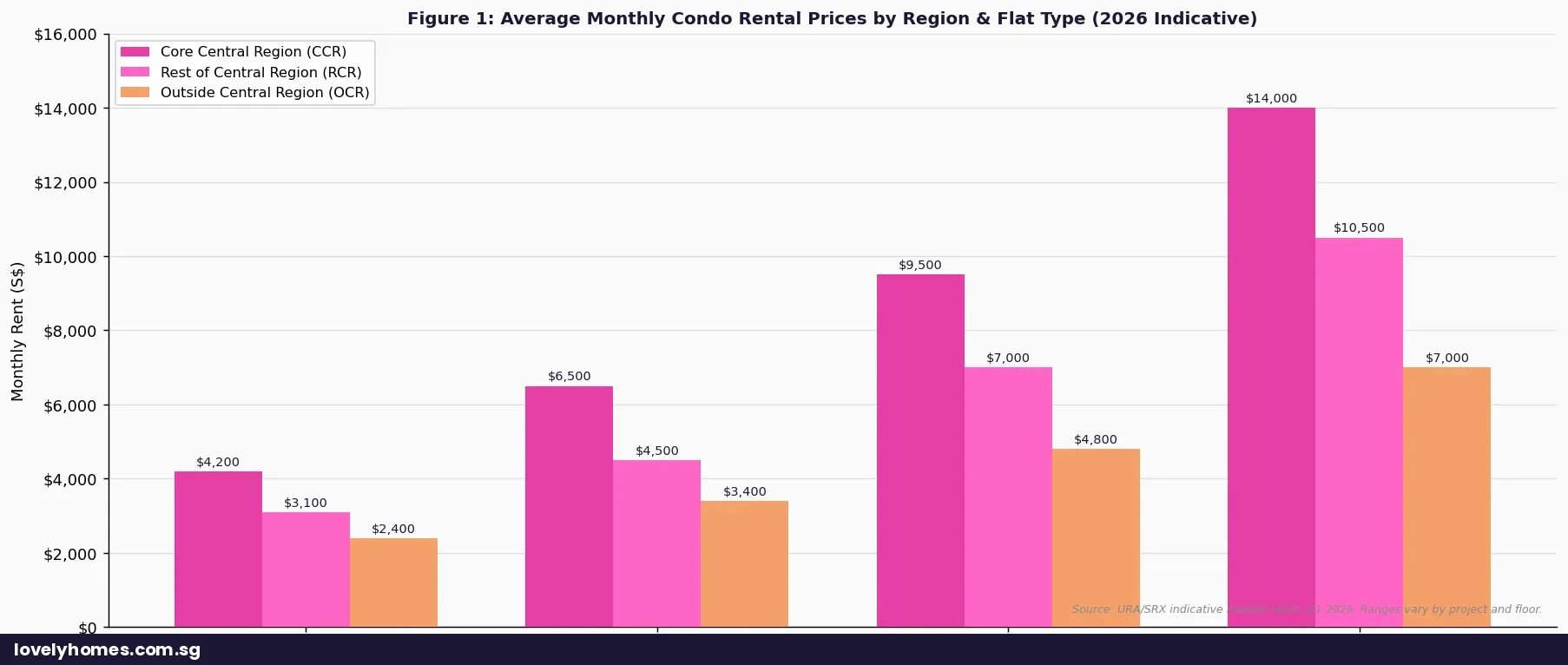
average condo rental prices Singapore 2026 by region CCR RCR OCR and flat type
Figure 1: Average Monthly Condo Rental Prices by Region and Flat Type — Indicative Q1 2026 (Source: URA/SRX median data)

Singapore’s condo rental prices differ substantially across the three planning regions. The Core Central Region (CCR) — comprising Districts 1–4, 9, 10, 11 and Sentosa Cove — commands premium rents driven by proximity to the Central Business District, prestigious schools, and international amenities. The Rest of Central Region (RCR) offers a middle ground, with maturing townships such as Queenstown, Bishan, and Toa Payoh appealing to both expatriates and local professionals. The Outside Central Region (OCR) spans the suburban heartlands from Jurong to Tampines, Woodlands to Pasir Ris, offering the most accessible rental entry points.

Flat Type CCR (Monthly S$) RCR (Monthly S$) OCR (Monthly S$)
Studio / 1-Bedroom S$3,500–S$6,000 S$2,800–S$3,800 S$2,200–S$3,000
2-Bedroom S$5,000–S$9,000 S$3,800–S$5,500 S$3,000–S$4,200
3-Bedroom S$8,000–S$14,000 S$5,500–S$8,500 S$4,200–S$6,000
4-Bedroom / Penthouse S$12,000–S$25,000+ S$8,500–S$13,000 S$6,000–S$10,000

Table 1: Indicative monthly condo rental ranges by region and flat type, as at Q1 2026. Actual rents vary by project, floor, furnishing, and lease tenure. Source: URA rental caveats and SRX median data.

The Condo Rental Process: Step-by-Step

Renting a condominium in Singapore follows a relatively standard process. Unlike buying a property, there is no government portal or pre-approval required — the process is market-driven, though stamp duty obligations and pass verification requirements are mandatory.

  1. Define your budget and requirements: determine your affordable monthly rent (typically no more than 30–40% of net take-home income), preferred region, flat type, and preferred MRT or school proximity.
  2. Search and viewings: search listings on property portals or engage a salesperson. Note that landlords and tenants typically each engage their own representative, with fees negotiated case by case — typically one month’s rent for a 1-year lease paid by the tenant, or co-broking arrangements.
  3. Letter of Intent (LOI) / Offer to Lease: once you identify a unit, submit a Letter of Intent with your proposed rental terms, key money (typically one to two weeks’ rent), and requested lease commencement date. The landlord may accept, reject, or counter.
  4. Tenancy Agreement (TA): upon acceptance, the TA is drafted (typically by the landlord’s salesperson). Review it carefully — key clauses include rent amount, lease period, security deposit, Diplomatic Clause, permitted use, and maintenance responsibilities. Seek legal advice for any non-standard terms.
  5. Sign and stamp: both parties sign the TA. The tenant pays the first month’s advance rent and the security deposit upon signing. The TA must be stamped with IRAS within 14 days of the signing date. Stamp duty is payable by the tenant.
  6. Move-in inventory check: conduct a joint inspection with the landlord on or before the lease commencement date. Document all existing defects in writing and by photographs — this protects both parties on the security deposit at the end of the tenancy.

Upfront Costs When Renting a Condo

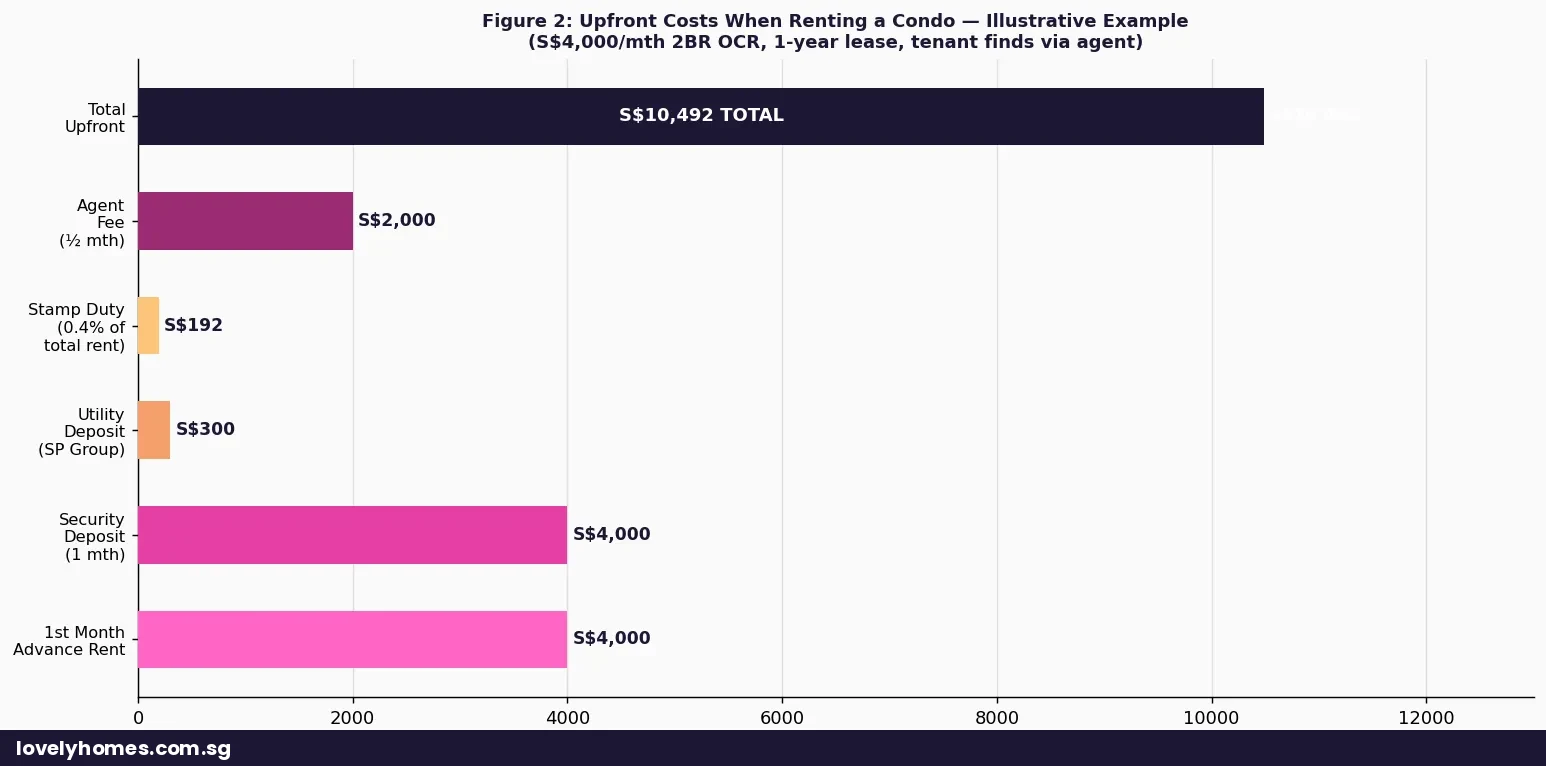
condo rental upfront costs Singapore 2026 security deposit stamp duty agent fee
Figure 2: Upfront Costs When Renting a Condo — Illustrative for a S$4,000/mth 2BR OCR 1-Year Lease (2026)

The security deposit is typically one month’s rent for a 1-year lease or two months’ rent for a 2-year lease. This deposit is held by the landlord (or sometimes in escrow) and refunded within a reasonable time after the tenancy ends, less any justified deductions for rent arrears or damages beyond fair wear and tear.

Stamp Duty on Tenancy Agreements

Under the Inland Revenue Authority of Singapore (IRAS), tenants are required to stamp their Tenancy Agreements. The stamp duty rate is:

  • 0.4% of the average annual rent for leases with a fixed term (simplified computation: 0.4% × total rent for leases up to 4 years).
  • For a 1-year lease at S$4,000/mth: total rent = S$48,000; stamp duty = S$48,000 × 0.4% = S$192.
  • For a 2-year lease at S$4,500/mth: total rent = S$108,000; stamp duty = S$108,000 × 0.4% = S$432.
  • Stamp duty is payable by the tenant, though this is occasionally negotiated otherwise in the TA.
  • Failure to stamp within 14 days incurs a late penalty (initially S$10, then escalating).

The TA must be stamped via the IRAS myStamp portal or at any IRAS service centre. Many salespersons handle this on behalf of their clients, but the legal obligation remains with the tenant unless the TA specifies otherwise.

Key Clauses to Check in Your Tenancy Agreement

The TA is a legally binding contract. Clauses worth scrutinising carefully include:

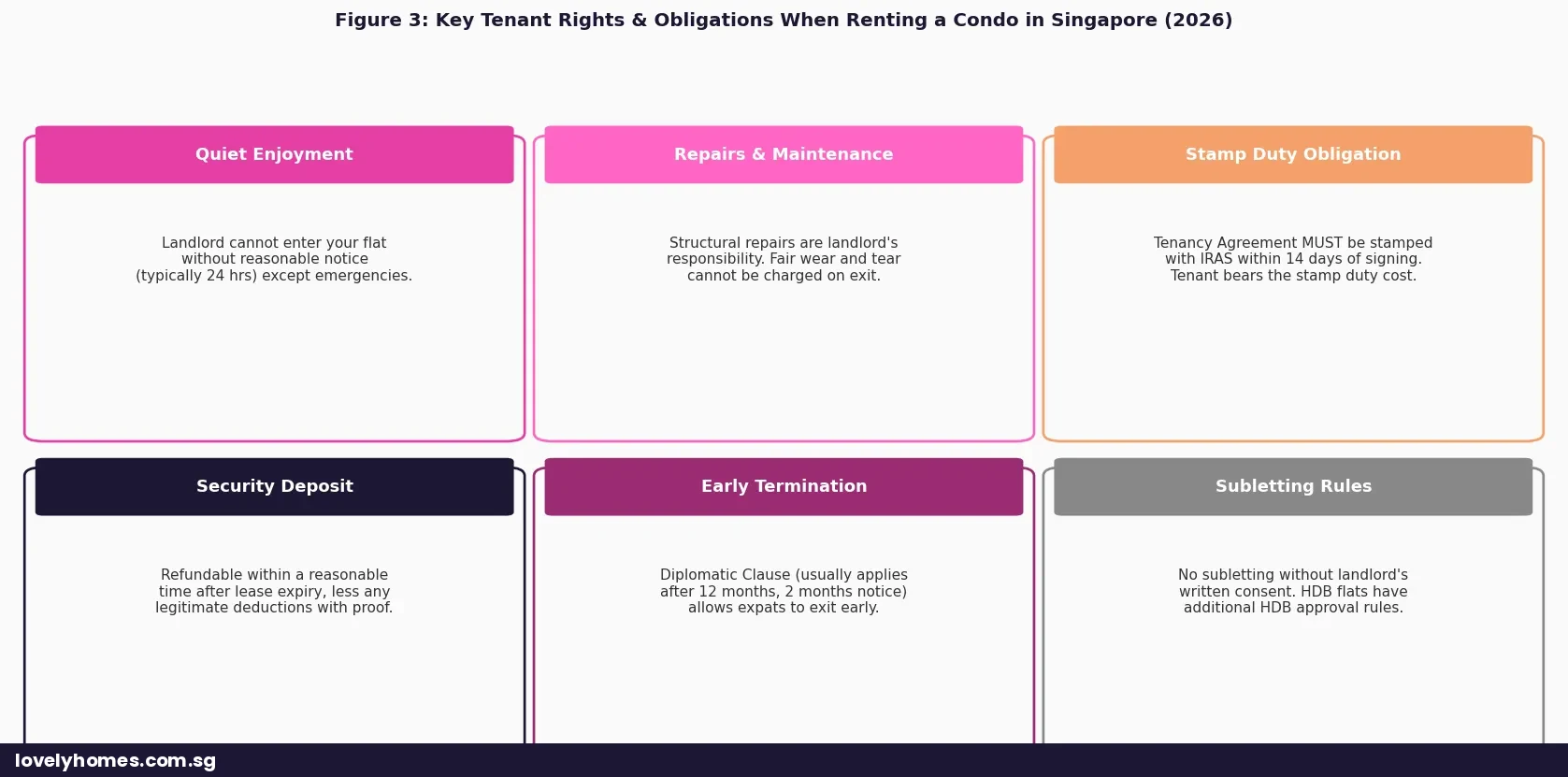
  • Diplomatic Clause: allows early termination after a minimum period (usually 12 months for a 2-year lease) with 2 months’ written notice. Essential for foreign tenants whose employment situation may change. Not standard on all leases — negotiate before signing.
  • Landlord’s access: the landlord should only enter the unit with reasonable advance notice (24 hours is customary) except in emergencies. Any clause allowing entry without notice should be queried or struck out.
  • Maintenance responsibilities: the TA typically requires the tenant to be responsible for minor maintenance (e.g., replacing light bulbs, unblocking drains) while the landlord covers structural and major appliance repairs. Clarify what constitutes “fair wear and tear”.
  • Air-conditioner servicing: standard practice is quarterly servicing at the tenant’s cost. This is often stated explicitly in the TA and is a reasonable tenant obligation.
  • Subletting: subletting the entire unit without the landlord’s written consent is generally prohibited. If you require the right to sublet individual rooms, negotiate this explicitly.
  • Handover condition: confirm the exact condition in which the unit must be returned (e.g., professionally cleaned, walls repainted).
tenant rights Singapore 2026 condo rental quiet enjoyment security deposit stamp duty diplomatic clause
Figure 3: Key Tenant Rights and Obligations in Singapore Condo Rentals (2026)

Worked Example: James Rents a 2BR OCR Condo

James is a British national on an Employment Pass, earning S$8,500/mth. He wants to rent a 2-bedroom unit in the OCR (Jurong East area) on a 2-year lease.

  • Agreed rent: S$3,500/mth for a 2BR 840 sqft unit at a leasehold condo 8 minutes’ walk from Jurong East MRT.
  • Lease period: 1 July 2026 to 30 June 2028 (2 years), with Diplomatic Clause from 1 July 2027 (12 months + 2 months’ notice).
  • Security deposit: 2 months × S$3,500 = S$7,000 (standard for 2-year lease).
  • 1st month advance rent: S$3,500 paid at signing.
  • Stamp duty: total rent = 24 × S$3,500 = S$84,000; stamp duty = S$84,000 × 0.4% = S$336 (stamped by salesperson via IRAS within 14 days).
  • Agent fee (co-broke): S$3,500 × 1 = S$3,500 (1 month’s rent, split between landlord’s and tenant’s representatives on co-broking basis; tenant’s representative absorbed by landlord in this example).
  • Total upfront outlay for James: S$7,000 (deposit) + S$3,500 (1st month) + S$336 (stamp duty) = S$10,836.
  • Monthly on-going: S$3,500 rent + quarterly air-con servicing ~S$80 + SP Group utilities (metered) ~S$200/mth estimated = approximately S$3,780/mth all-in.
  • Rental as % of income: S$3,500 / S$8,500 = 41.2% — on the higher end of affordability benchmarks, but manageable given no CPF obligations for EP holders.

What This Means for You

Renting a condo in Singapore is one of the most transparent and well-regulated rental experiences in Asia. The stamp duty obligation, while modest (0.4%), ensures leases are formally registered. The emphasis on written TAs and inventory checks protects both parties. The Diplomatic Clause — while not legally mandated — is widely accepted practice and critically important for expatriates.

From a cost perspective, 2026 represents a more balanced rental market than the peak of 2022–2023. Tenants have more negotiating power on lease terms, furniture packages, and rent-free periods than they did two years ago. Vacancy rates have risen in several OCR and newer RCR developments as completions accelerate, meaning landlords in these pockets are more willing to negotiate. The CCR luxury segment, however, remains tight — driven by sustained demand from financial sector and tech-sector professionals.

What Might Come Next

Singapore’s rental market in the medium term (2026–2028) faces two countervailing forces. On the supply side, a significant pipeline of private residential completions — approximately 8,000–10,000 units per year through 2027 according to URA’s construction data — should continue to exert moderating pressure on rents, particularly in the OCR and new RCR townships. On the demand side, Singapore’s continued attractiveness as a regional business hub and the government’s restrained foreign manpower policies mean rental demand from pass holders is unlikely to collapse.

Regulatory watch: MAS and URA are studying the residential tenancies framework, including possible standardisation of TA templates and security deposit handling. A formal Residential Tenancies Act — modelled on frameworks in Hong Kong or Australia — has been discussed but not yet enacted as at mid-2026. Any such legislation would likely strengthen tenant protections around deposit refunds and repair obligations, which are currently governed primarily by contract terms rather than statute.

Frequently Asked Questions

Can I negotiate on condo rental price in 2026?

Yes, and more so than in 2022–2023. With a softer rental market across the OCR and parts of the RCR, landlords are more flexible on headline rent, rent-free fit-out periods (1–2 weeks free rent at the start of the lease to allow for minor touch-ups), furniture packages, and minor TA terms. In the CCR luxury segment, negotiating room is narrower but still exists for high-quality tenants with strong employment credentials. Always make any rent concession explicit in the TA — verbal assurances are not enforceable.

What happens to my security deposit if the landlord sells the property during my lease?

Your Tenancy Agreement is binding on successors in title — a new owner takes the property subject to your existing lease. The security deposit should be transferred to the new owner at completion of the sale. However, this transfer is the landlord’s legal obligation, not yours. If the new owner denies holding your deposit, you may have a claim against the original landlord. It is therefore prudent to keep a stamped copy of the TA and your payment receipt for the deposit for the full duration of the tenancy. Some tenants negotiate for the deposit to be held in a separate account.

Can foreigners buy or rent a condo in Singapore?

Foreigners can freely rent any private condominium unit in Singapore, provided they hold a valid pass allowing them to reside here. Purchasing a private condominium (non-landed) is also legally permitted for foreigners, though the Additional Buyer’s Stamp Duty (ABSD) of 65% on the purchase price applies to all foreign buyers as at July 2026. There are no ownership restrictions on non-landed private residential property (condominiums and apartments) for foreigners — restrictions apply only to landed property (which requires SLA approval) and HDB flats (which foreigners cannot purchase). For a full breakdown of ABSD rates, see our ABSD Singapore 2026 Complete Guide.

What is a “break clause” or “diplomatic clause” and who benefits from it?

A Diplomatic Clause (also called a break clause) is a contractual provision in the TA that allows the tenant to terminate the lease early, typically after the first 12 months of a 24-month lease, by giving 2 months’ written notice. On termination under the Diplomatic Clause, the tenant forfeits no deposit and pays only rent up to the notice period. The clause exists to protect foreign tenants who may need to relocate due to job changes or repatriation at short notice. Most Singapore landlords accept the Diplomatic Clause for 2-year leases, particularly when renting to corporate-sponsored expatriate tenants. For 1-year leases, early termination is more complex as there is no standard clause — tenants seeking to break a 1-year lease typically negotiate a settlement with the landlord, often involving partial deposit forfeiture.

Is the tenant required to pay property tax or maintenance fees (MCST fees)?

No. Property tax (payable to IRAS) and MCST maintenance fees (payable to the condo’s Management Corporation Strata Title) are the landlord’s responsibility, not the tenant’s. These costs are factored into the landlord’s rental pricing decision but are not directly charged to or payable by the tenant, unless the TA explicitly (and unusually) states otherwise. You should confirm this in your TA. Conversely, the tenant is typically responsible for all utility costs (electricity, water, gas via SP Group), internet, and parking charges.

What should I do if the landlord refuses to return my security deposit?

If the landlord has deducted all or part of your deposit after the lease ends and you dispute the deductions, the first step is written communication — formally requesting an itemised breakdown of deductions with supporting receipts or quotes. If this fails, Singapore offers several avenues for resolution: the Community Disputes Resolution Tribunal (CDRT) handles disputes between neighbours; for financial claims below S$30,000, the Small Claims Tribunal (SCT) is a fast and inexpensive route to adjudication. Alternatively, Singapore Mediation Centre (SMC) offers pre-litigation mediation. As at 2026, there is no dedicated tenancy dispute tribunal in Singapore (unlike Hong Kong’s Lands Tribunal), which is why clear inventory documentation at move-in and move-out is critical.

Related Articles

Disclaimer

This article is published by LovelyHomes Editorial Team for general informational purposes only and does not constitute legal, financial, or property advice. Rental prices cited are indicative market ranges as at Q1 2026 and will vary by project, floor, furnishing level, and individual negotiation. Stamp duty obligations are administered by the Inland Revenue Authority of Singapore (IRAS). Tenancy law is governed by Singapore’s Residential Property Act, the Stamp Duties Act, and general contract law. Readers should refer to official URA, IRAS, and Ministry of Law publications for the most current regulations, and obtain independent legal advice before signing any Tenancy Agreement. Pass validity requirements for foreign tenants are governed by the Immigration and Checkpoints Authority (ICA) and the Ministry of Manpower (MOM).

Singapore Rental Tenant Rights Guide 2026: Deposits, Stamp Duty, Disputes and Your Legal Protections

Singapore Rental Tenant Rights Guide 2026: Deposits, Stamp Duty, Disputes and Your Legal Protections

Quick Answer: Singapore Tenant Rights at a Glance

  • Tenancy agreements in Singapore are governed by contract law; there is no specific landlord–tenant statute equivalent to the UK’s Housing Acts. The key laws are the Conveyancing and Law of Property Act (Cap 61) and common law contract principles.
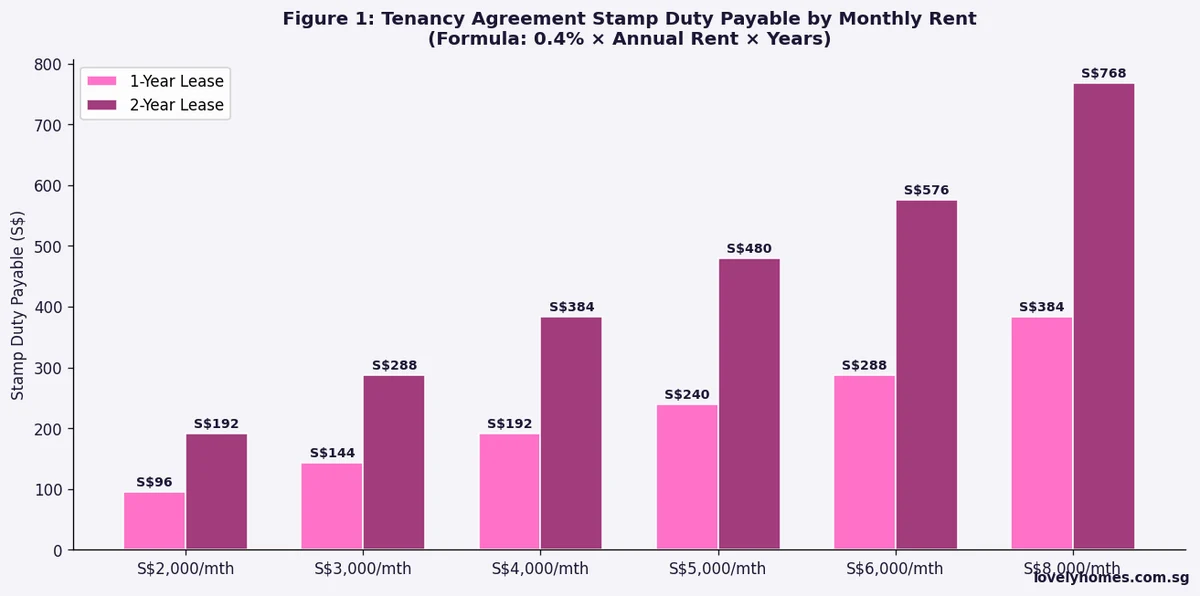
  • Stamp duty on a tenancy agreement: 0.4% × annual rent × number of years. Due within 14 days of signing (or 30 days if signed overseas). Payable by the tenant unless otherwise agreed. IRAS administers this.
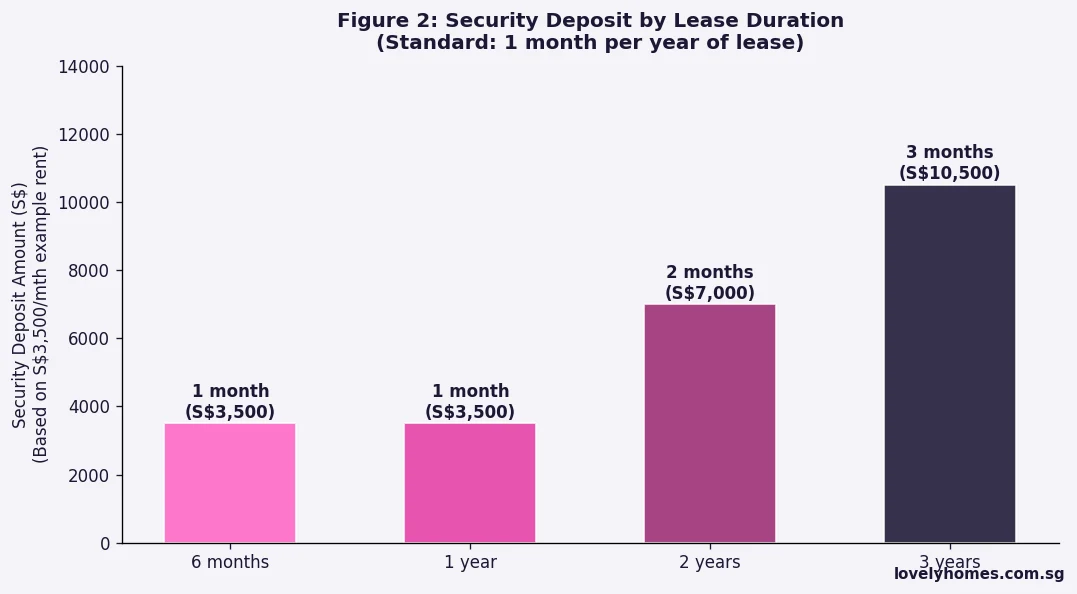
  • Security deposit: typically one month per year of lease (a 2-year lease = 2 months’ deposit). Not regulated by law but standard market practice; must be returned within a reasonable period (commonly 14 days) after lease end.
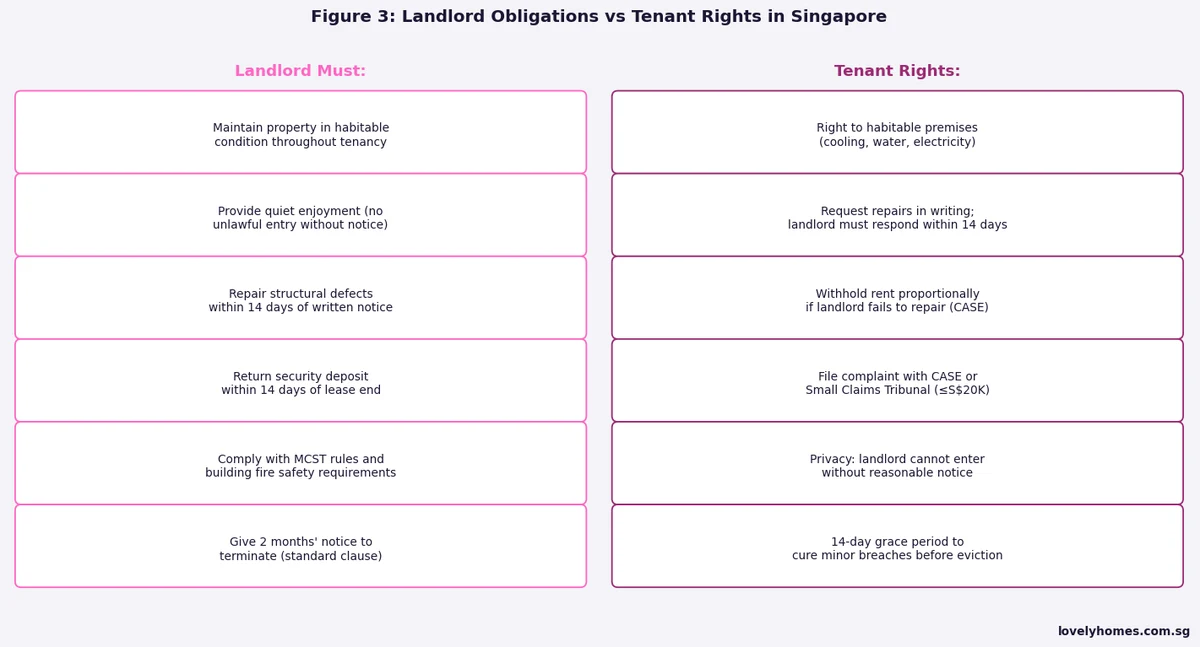
  • Landlord obligations: maintain the property in a habitable condition, respect quiet enjoyment, repair structural defects within a reasonable timeframe.
  • Tenant disputes: CASE (Consumers Association of Singapore) for mediation; the Small Claims Tribunal handles claims up to S$20,000; the General Division of the High Court handles larger claims.
  • Subletting an HDB flat requires HDB approval and is subject to quota rules; subletting a private condo requires landlord and MCST consent.
  • There is no “right to rent” certificate required in Singapore; however, foreign nationals must hold a valid pass (EP, S Pass, LTVP, etc.) to legally rent accommodation.
  • From 2024, URA requires all private residential rentals to be listed at minimum 3 months’ duration (short-term rental of under 3 months is illegal for private homes).

Understanding Tenant Rights in Singapore’s Rental Market

Singapore’s private rental market is large — over 160,000 private residential units are estimated to be tenanted at any given time, housing a mix of Singapore Citizens and Permanent Residents who have not yet purchased their own home, Employment Pass and S Pass holders, and long-term visitors. Yet unlike many jurisdictions, Singapore has no unified residential tenancy act. Tenant protections derive from general contract law, the Conveyancing and Law of Property Act (Cap 61), and, for HDB flat rentals, specific HDB regulations.

This guide explains what tenants are entitled to, what landlords are obligated to do, how security deposits work, how to stamp a tenancy agreement correctly, and how to resolve disputes — from the Consumer Association of Singapore (CASE) all the way to the Small Claims Tribunal.

Tenancy agreement stamp duty payable Singapore by monthly rent 2026
Figure 1: Stamp duty payable on tenancy agreements at various monthly rent levels, for 1-year and 2-year leases. Formula: 0.4% × annual rent × years. Payable to IRAS within 14 days of signing. Source: IRAS.

The Tenancy Agreement: What It Must Cover

A tenancy agreement (TA) is a legally binding contract between landlord and tenant. While there is no statutory form, a well-drafted TA for a Singapore private property should cover: the property address and description, the lease commencement and expiry dates, the monthly rent and payment date, the security deposit amount, permitted use (residential only), utility responsibility, pet policy, maintenance obligations, break clause (if any), diplomatic clause (if any), and the landlord’s and tenant’s notice periods.

The TA should be signed by both parties and two witnesses. The tenant then has an obligation — though in practice the cost is often borne by the tenant — to stamp the agreement with IRAS within 14 days. The stamp duty formula is straightforward: 0.4% × annual rent × number of years. For a S$4,000/month flat on a 2-year lease, that is 0.004 × S$48,000 × 2 = S$384. Failure to stamp does not render the agreement void, but it cannot be used as evidence in court until it is stamped with any late penalty paid.

A diplomatic clause (also called a break clause) allows a tenant to terminate the lease early — typically after the first 12 months on a 24-month lease — by giving 2 months’ written notice. This clause is especially important for expatriates on employment passes, whose work assignment may change. Landlords will often resist including it but will accept a modest rent premium in exchange.

Security Deposits: Your Rights and How They Work

Security deposit by lease duration Singapore rental tenancy 2026
Figure 2: Typical security deposit amounts by lease duration, based on a S$3,500/month example rent. The Singapore standard is 1 month’s deposit per year of lease, so a 2-year lease = 2 months’ deposit. Source: LovelyHomes market analysis.

Singapore law does not prescribe a maximum security deposit. Market practice has settled on one month’s deposit per year of lease (a 2-year lease = 2 months, a 3-year lease = 3 months). At S$3,500/month, a 2-year lease means the tenant hands over S$7,000 upfront before even taking the keys.

The landlord holds this deposit throughout the tenancy and must return it at lease end, typically within 14 days, less any legitimate deductions. Legitimate deductions include unpaid rent, cost of repairing damage beyond fair wear and tear, and unpaid utility bills that were the tenant’s responsibility. Fair wear and tear is a critical concept: fading of paint, worn carpets, and minor scuffs to walls from normal use are NOT deductible. A hole in a wall, a broken fitting, or a pet scratch on a wooden floor may be deductible.

If a landlord deducts more than is justified, or refuses to return the deposit, the tenant may file a claim at the Small Claims Tribunal (SCT) for amounts up to S$20,000, or the Magistrate’s Court for larger claims. The SCT is accessible, relatively fast (typically resolved within 2–3 months) and does not require legal representation. CASE also offers mediation services — useful if both parties prefer to avoid the tribunal.

Landlord Obligations Under Singapore Law

Landlord obligations and tenant rights Singapore rental comparison 2026
Figure 3: Key landlord obligations (left) and corresponding tenant rights (right) under Singapore contract law and the Conveyancing and Law of Property Act. Source: CASE, Singapore Statutes Online.

Singapore landlords have several implied obligations that exist regardless of what the tenancy agreement says, derived from common law and the Conveyancing and Law of Property Act:

Quiet enjoyment. The landlord must not interfere with the tenant’s reasonable use of the property. This means no entering without advance notice, no removing appliances mid-lease, no harassing behaviour, and no changing locks without consent.

Habitability. While Singapore law does not define a statutory minimum standard, common law implies that the property must be fit for residential use at commencement. A landlord who knowingly rents a property with a serious defect (e.g., a collapsed ceiling, non-functioning plumbing, pest infestation) may be liable for breach of the implied covenant of fitness.

Structural repairs. Landlords are generally responsible for structural maintenance — roofing, major plumbing, external walls. Tenants are typically responsible for minor repairs and maintenance of fixtures they use daily. The tenancy agreement should specify this division clearly. Where it is silent, the party that caused the damage is responsible.

Notice before entry. There is no statutory notice period in Singapore, but the general expectation — and what CASE recommends — is that landlords give at least 24–48 hours’ advance notice before entering, except in genuine emergencies (gas leak, burst pipe). Entering without notice may constitute a breach of the quiet enjoyment covenant.

Resolving Disputes: CASE, SCT and Beyond

When landlord–tenant relations break down, Singapore offers a tiered resolution pathway that tenants should be aware of:

Step 1 — Written notice. Always put complaints in writing (email is sufficient). A clear written record of when a defect was reported, what was requested, and whether the landlord responded is critical evidence for any later tribunal proceeding. Give the landlord a reasonable timeframe — typically 14 days for non-urgent repairs — and state what action you expect.

Step 2 — CASE mediation. The Consumers Association of Singapore offers free and low-cost mediation for landlord–tenant disputes. CASE mediators are neutral and their service is voluntary (both parties must agree to participate). Mediation outcomes, if reached, are binding and can be filed with the court as a consent order. CASE’s contact is 1800 773 3163 or case.org.sg.

Step 3 — Small Claims Tribunal (SCT). For monetary claims up to S$20,000, the SCT (part of the State Courts) is the primary forum. Filing is done online via the State Courts e-Services portal. Both parties appear in person; legal representation is generally not permitted at the SCT, making it accessible for self-represented claimants. Filing fees are modest (S$10–S$30 depending on claim amount).

Step 4 — Magistrate’s Court or District Court. For claims above S$20,000 (up to S$60,000 for Magistrate’s, up to S$250,000 for District Court), a more formal court process applies. Legal representation becomes advisable at this stage.

Renting HDB Flats: Additional Rules That Apply

HDB flats are subject to additional rental regulations that do not apply to private property. Key rules as at 2026 include: the whole flat may only be rented out after the 5-year Minimum Occupation Period (MOP) has been fulfilled (the MOP clock starts from the date the keys are collected); the owner must obtain HDB’s prior approval before renting out the entire flat; renting out individual rooms does not require HDB approval for SC/PR owners of flats that have met MOP, but the Ethnic Integration Policy (EIP) quota still applies to the composition of occupants in the flat.

HDB’s Non-Citizen Quota limits the proportion of non-citizen tenants (excluding Malaysian nationals) at both the neighbourhood and block level. A block may have no more than 8% of non-citizen non-Malaysian tenants; the neighbourhood cap is 5%. Landlords are responsible for checking quota headroom before committing to a non-citizen tenant — failure to comply results in HDB enforcement action against the owner, not the tenant.

Worked Example: Ms Lim’s Dispute over Her Security Deposit

Ms Lim, a Singapore Permanent Resident, rented a 2-bedroom apartment in D15 (East Coast) at S$3,800/month on a 2-year lease from January 2024 to December 2025. She paid a S$7,600 security deposit (2 months) and S$152 in stamp duty (0.4% × S$45,600 × 2).

At lease end in December 2025, the landlord deducted S$3,200 from the deposit, citing: (a) repainting of all walls — S$1,800; (b) replacement of kitchen tap — S$150; (c) professional carpet cleaning — S$400; (d) replacement of a cracked bathroom basin — S$850. Ms Lim disputed items (a) and (c), arguing the walls had only minor normal-use scuffs (fair wear and tear) and that carpet cleaning was the landlord’s routine maintenance cost.

Outcome: CASE mediation ruled that repainting of all walls after a 2-year lease was standard fair wear and tear unless there was evidence of deliberate damage; the landlord was directed to refund S$1,800 for repainting. The carpet cleaning deduction of S$400 was upheld because the tenancy agreement expressly stated the tenant must return the premises in professionally cleaned condition. The tap (S$150) and basin (S$850) deductions were upheld as verifiable damage. Net outcome: Ms Lim received S$1,800 back, retaining a total refund of S$5,400 of the original S$7,600 deposit.

Why Knowing Your Tenant Rights Matters in 2026

Singapore’s rental market has tightened considerably since 2021, with median rents for private 2-bedroom units rising over 35% between 2021 and 2023. While rental rates have moderated since the 2023 peak — median rents for non-landed private property fell approximately 1.2% quarter-on-quarter in Q1 2026 per URA data — the total cost of renting remains elevated relative to pre-pandemic levels. At the same time, vacancy rates in some sub-markets (notably CCR 1-bedroom and 2-bedroom units) have risen as the expat population adjusts to hybrid work models and some employers reduce Singapore headcount.

In this environment, tenants are in a somewhat stronger negotiating position than during the 2022–2023 peak, and understanding your legal rights means you are less likely to accept unfair deductions from security deposits or sub-standard maintenance from landlords who rely on tenant ignorance. Equally, understanding what landlords are legally entitled to — and what the practical limits of your rights are — helps you navigate tenancy disputes without litigation where avoidable.

What Might Come Next: Calls for a Residential Tenancy Act

Speculation: Singapore’s property market commentators and some civil society groups have periodically called for a codified residential tenancy law — similar to what exists in the UK (the Housing Act), Australia (state-level residential tenancy acts) or New Zealand (the Residential Tenancies Act). Such a law would standardise notice periods, define maximum security deposit multiples, mandate habitability standards, and create an independent dispute resolution tribunal specialising in tenancy disputes.

As of mid-2026, no such legislation has been announced by the Ministry of National Development (MND) or the Ministry of Law. The government’s stated preference is to allow the market to self-regulate with CASE mediation and SCT as backstops. Tenants and landlords should continue to operate under the current common-law framework and ensure their tenancy agreements are comprehensive, clearly drafted and properly stamped.

Singapore Tenancy: Key Rules at a Glance

Topic Rule / Standard Governing Body
Stamp duty on TA 0.4% × annual rent × years; due 14 days from signing IRAS
Security deposit Market standard: 1 month per year of lease (no statutory cap) Contract law
Minimum rental duration 3 months for private residential (URA rule since 2024) URA
HDB whole-flat rental Post-MOP (5yr from key collection); HDB approval required HDB
HDB room rental SC/PR owner post-MOP; non-citizen quota (8% block/5% neighbourhood) HDB
Quiet enjoyment Landlord must give advance notice before entry (≥24hrs recommended) Common law
Structural repairs Landlord responsible; minor maintenance typically tenant’s responsibility TA + common law
Security deposit return Within 14 days of lease end; deductions must be itemised Contract + CASE
Dispute resolution (small claims) CASE mediation → Small Claims Tribunal (up to S$20,000) CASE / State Courts
Subletting (private) Requires landlord + MCST consent; not a tenant’s automatic right TA + strata titles rules

Frequently Asked Questions

Can a landlord increase rent mid-tenancy?

No. Once a tenancy agreement is signed and stamped, the rent is fixed for the lease term. A landlord cannot unilaterally increase rent mid-lease without the tenant’s written agreement. Any rent increase must be negotiated — typically at renewal time — and the tenant has the right to reject any increase and leave at the end of the existing lease term, provided correct notice is given.

Who is responsible for paying the stamp duty — landlord or tenant?

IRAS rules are silent on who bears the cost — it is a matter of agreement between the parties. Market custom in Singapore is that the tenant pays the stamp duty. However, for landlord-furnished premium units, it is sometimes split or borne by the landlord. The obligation to ensure stamping happens within 14 days rests on both parties: if the agreement is not stamped it cannot be used in court, putting both at risk. Practically, the tenant typically stamps the agreement immediately upon receiving it.

What happens if the landlord sells the property during the tenancy?

In Singapore, a properly registered tenancy (where a caveat has been lodged by the tenant with SLA) binds the new owner. The new owner steps into the landlord’s shoes and must honour the tenancy agreement until its natural expiry. If the tenancy was not caveated, the position depends on whether the new buyer had constructive or actual notice of the tenancy. Tenants in high-value properties or long leases should consider instructing a solicitor to lodge a caveat to protect their leasehold interest.

Can a landlord evict a tenant without a court order in Singapore?

No. Self-help eviction — changing locks, removing a tenant’s belongings, cutting utilities to force a tenant out — is illegal in Singapore. A landlord who believes a tenant has breached the tenancy agreement must apply to the court for a Writ of Distress (for unpaid rent) or commence civil proceedings for possession. Unlawful eviction can expose the landlord to damages claims. Tenants who are physically locked out or whose utilities are cut off against their will should report the matter to the police and contact CASE immediately.

Is there a limit on how much a landlord can deduct from the security deposit?

There is no statutory cap on deductions — a landlord can deduct the entire deposit if verifiable damages and unpaid rent justify it. However, deductions must be reasonable, itemised, and documented (receipts, photographs, contractor quotes). Deductions for fair wear and tear — normal deterioration of paint, carpets, and furnishings through ordinary use over the lease term — are not legally defensible. The key test is whether the damage goes beyond what would reasonably be expected from a tenant in ordinary use, based on the property’s age and the duration of the tenancy.

Can I sublet a room in my rented condo without the landlord’s permission?

Almost certainly not. Most standard Singapore tenancy agreements for private property prohibit subletting without the landlord’s prior written consent. Subletting without consent is a breach of the tenancy agreement and can be grounds for termination. Even with landlord consent, you should check whether MCST by-laws (if you are in a strata development) impose any additional restrictions on occupation numbers or subletting. Short-term subletting on platforms like Airbnb for less than 3 months is illegal for private residential property under URA rules.

What is the diplomatic clause and how do I invoke it?

A diplomatic clause (break clause) allows a tenant to terminate a lease early — typically after the first 12 months of a 24-month lease — by giving 2 months’ written notice. It must be explicitly included in the tenancy agreement; it does not arise automatically. To invoke it, you send the landlord a written notice stating your intention to terminate and the proposed last day of tenancy, ensuring the notice complies exactly with the clause’s terms (timing, form, mode of delivery). You remain liable for rent through the 2-month notice period. The security deposit is refunded normally, subject to standard deduction rules.

Related Articles

Disclaimer: This article is for general informational and educational purposes only. It does not constitute legal advice. Singapore’s landlord–tenant law is based on common law principles and contract, not a codified residential tenancy statute; outcomes in any dispute depend on the specific terms of the tenancy agreement and the facts of the case. Tenants and landlords with specific disputes should seek legal advice from a qualified Singapore solicitor. Stamp duty obligations should be verified with IRAS (iras.gov.sg). HDB rental rules should be verified directly with HDB (hdb.gov.sg). CASE mediation can be accessed at case.org.sg or by calling 1800 773 3163.

Tenant Rights & Landlord Obligations Singapore 2026: Complete Guide

Tenant Rights & Landlord Obligations Singapore 2026: Complete Guide

Quick Answer: Tenant Rights Key Facts

  • Singapore’s Residential Tenancies Act 2023 (RTA) — in force from 1 July 2023 — provides statutory rights for tenants of private residential properties for the first time.
  • Security deposits are capped at 2 months’ rent for tenancies of 1 year or more; 1 month for shorter tenancies.
  • Landlords must refund the deposit (less valid deductions) within 14 days of the tenancy ending.
  • Unlawful eviction — including changing locks or cutting utilities — is a criminal offence under both the RTA and the Penal Code.
  • Disputes go to the Small Claims Tribunals (STB), which now have expanded jurisdiction to hear residential tenancy disputes up to $20,000 (or $30,000 by consent).
  • HDB flats let on the open market are subject to HDB subletting rules (minimum 6-month tenancy; HDB approval required; income / nationality restrictions on tenants).
  • Landlords must provide properties that are fit for habitation and maintain essential services (water, electricity, structural integrity).

Introduction: A New Era for Singapore Renters

For most of Singapore’s modern property history, private residential tenants had no statutory framework protecting their rights. Disputes were settled through the courts under general contract law — expensive, slow, and inaccessible for most tenants. The Residential Tenancies Act 2023 (RTA), passed by Parliament and gazetted in July 2023, changed this fundamentally. For the first time, Singapore tenants of private residential property have an accessible, low-cost tribunal — the Small Claims Tribunals — and a statutory baseline of rights that no tenancy agreement can contract out of.

This guide explains what those rights are, what landlords are legally obliged to do (and not do), how HDB subletting rules layer on top of the RTA, and what to do if things go wrong. Whether you are a tenant in a $3,000-a-month condominium in Orchard or a landlord renting out your second property in Jurong, understanding the RTA framework is essential reading in 2026.

Tenant rights and landlord obligations Singapore 2026 quick reference table
Figure 1: Tenant Rights & Landlord Obligations — Singapore 2026 Quick Reference. Source: Residential Tenancies Act 2023; STB guidelines.

What Does the RTA Cover?

The RTA applies to tenancy agreements for private residential properties in Singapore — condominiums, apartments, terrace houses, semi-detached and detached private homes, and private strata units let to individuals. It does not apply to:

  • HDB flats (which remain under the Housing and Development Act and HDB’s own subletting rules).
  • Commercial or industrial properties.
  • Residential premises let for fewer than 3 months (short-term accommodation; separate rules apply under the Planning Act).
  • Properties where the landlord and tenant share living space (i.e., the landlord lives in the property too).

This last exclusion is significant — the sizeable market of landlords who let out individual rooms whilst living in the same unit falls outside the RTA. The Consumers Association of Singapore (CASE) and housing advocates have called for this gap to be addressed in future legislative amendments.

Security Deposit Rules Under the RTA

One of the most practically important provisions in the RTA concerns the security deposit — the sum (usually equivalent to 1–2 months’ rent) that tenants pay upfront as protection for landlords against damage or unpaid rent.

Deposit Cap

Under the RTA, landlords may not require a security deposit exceeding:

  • 2 months’ rent for tenancies of 1 year or more.
  • 1 month’s rent for tenancies lasting less than 1 year.

Prior to the RTA, there was no statutory cap, and some landlords — particularly in the high-demand rental market of 2022–2023 — were demanding 3-month deposits for 2-year leases. The cap addresses this.

Deposit Receipt and Inventory

On receiving the deposit, the landlord must issue a written receipt and, if an inventory of the property’s contents is taken, a copy of that inventory. This is the baseline against which deductions will be assessed at the end of the tenancy.

Deposit Refund Timeline

The deposit (less any valid deductions for damage beyond fair wear and tear, or unpaid rent) must be refunded within 14 days of the tenancy ending. If the landlord makes deductions, they must provide a written itemised statement of deductions with supporting documentation (e.g., contractor quotes or invoices). Failing to refund within 14 days is a breach of the RTA and grounds for an STB application.

Security Deposit at a Glance

Feature Rule Source
Cap (tenancy ≥ 1 yr) Maximum 2 months’ rent RTA s.15
Cap (tenancy < 1 yr) Maximum 1 month’s rent RTA s.15
Receipt requirement Written receipt must be issued on payment RTA s.16
Inventory Inventory copy must be provided if one is taken RTA s.16
Refund timeline Within 14 days of tenancy end RTA s.19
Deductions Permitted for damage beyond fair wear and tear; unpaid rent RTA s.18
Deduction statement Written itemised statement with supporting evidence required RTA s.18
Dispute forum STB (claims up to $20,000; $30,000 by consent) Small Claims Tribunals Act

Residential Tenancies Act 2023 Singapore key timelines and deposit limits
Figure 2: Key Timelines & Limits Under the Residential Tenancies Act 2023. These are statutory minimums; tenancy agreements may not provide less than these protections.

Landlord Obligations: What the RTA Requires

Fitness for Habitation

Landlords must ensure the property is fit for habitation at the start of the tenancy and throughout its duration. This includes maintaining structural integrity, ensuring water and electricity supply, and keeping common fixtures (plumbing, electrical installations) in working order. If a landlord fails to carry out repairs that affect habitability — for example, a persistent roof leak or a non-functional water heater — the tenant may apply to the STB for a repair order or a reduction in rent.

Prohibition on Unlawful Eviction

Perhaps the most consequential provision in the RTA is the prohibition on unlawful eviction. A landlord may not:

  • Change the locks or remove the tenant’s belongings without a court order.
  • Cut off utilities (water, electricity, gas) to force a tenant out.
  • Harass, threaten or intimidate the tenant in connection with occupancy.

Breach of these provisions is a criminal offence under the RTA, with penalties of up to $5,000 for a first offence. Before the RTA, landlords in rent disputes sometimes resorted to these measures — the legislation now makes them clearly illegal, and tenants can call the police and file an STB application simultaneously.

Rent Increase Notice

For periodic tenancies (month-to-month tenancies with no fixed end date), landlords must give at least 2 months’ written notice before increasing the rent. This provision prevents sudden rent hikes that leave tenants unable to plan their finances or find alternative accommodation.

Tenant Obligations: What You Are Required to Do

Rights come with responsibilities. Under the RTA and standard tenancy agreement terms, tenants in Singapore are obliged to:

Pay Rent Punctually

Rent is due on the date specified in the agreement. Most agreements allow a 7-day grace period, but this is a matter of contract, not statute. Persistent late payment is grounds for landlord termination of the tenancy — and, in Singapore, the courts have historically upheld landlord rights to forfeit a lease on persistent non-payment even when the total arrears are modest.

No Subletting Without Consent

Subletting the whole or any part of the property without the landlord’s written consent is a breach of most tenancy agreements. For HDB flat tenants, subletting carries additional regulatory consequences — HDB’s approval is required, and the flat owner (the HDB landlord) must comply with HDB’s rules on permissible tenants, minimum tenancy periods (6 months) and total occupancy caps.

Allow Landlord Entry on Reasonable Notice

Tenants must permit the landlord (or their authorised agents) to enter the property for inspection, repair or valuation purposes — but only on reasonable notice. Most agreements specify 24–48 hours’ written notice. Entering without notice (except in genuine emergencies) is a breach of the tenancy agreement and potentially of the tenant’s right to quiet enjoyment.

HDB Subletting Rules: A Separate Framework

For HDB flat owners who sublet their flat to tenants, the RTA does not apply. Instead, HDB’s subletting framework — administered under the Housing and Development Act — governs the landlord-tenant relationship. The key rules as of June 2026:

HDB Subletting Rule Detail
Approval required HDB approval must be obtained before subletting; application via MyHDBPage
Minimum tenancy period 6 months per rental
Maximum occupancy 6 persons for 4-room flat and larger; 4 persons for 3-room and smaller
Non-citizen occupancy Foreigners from Malaysia, PRs and citizens of designated countries only; Malaysian non-PR nationals may rent only selected flat types
MOP compliance HDB flat must have fulfilled its Minimum Occupation Period (5 years) before subletting the entire flat
Rent registration Landlord must register the tenancy with HDB via MyHDBPage within 7 days of commencement
Subletting period cap Maximum 3-year approval; renewable. Total subletting period capped at 20 years for non-elderly owners; no cap for elderly-priority flat owners in some schemes

Non-compliance with HDB subletting rules — for example, subletting before the MOP or to ineligible tenants — can result in HDB compelling the flat owner to sell the flat within 6 months and retain the sale proceeds. These are serious consequences; both landlords and tenants should verify HDB approval status before executing any HDB flat tenancy agreement.

Worked Example: Deposit Dispute in a $4,200/month Condominium

Priya rents a 2-bedroom condominium unit in Toa Payoh for $4,200/month on a 2-year lease starting 1 July 2024. She pays a 2-month security deposit of $8,400 and signs an inventory list at the start.

At the end of the tenancy on 30 June 2026, the landlord claims $2,800 in deductions: $1,200 for repainting a bedroom wall, $800 for replacing a cracked bathroom tile, and $800 for general cleaning. Priya disputes the cleaning charge (the unit was professionally cleaned) and the repainting (she says the paint peeling was pre-existing — not in the inventory). The landlord does not refund the deposit by 14 July 2026.

Item Landlord Claim Priya’s Position Likely STB Outcome
Bedroom repainting ($1,200) Damage by tenant Pre-existing; not in inventory Likely disallowed — inventory gap favours tenant
Bathroom tile ($800) Cracked by tenant Disputed; no proof of cause May be split; depends on evidence
Cleaning ($800) Unit dirty at handover Professional cleaning done; receipt provided Likely disallowed if receipt produced
Late refund (breach) Deposit not refunded by Day 14 STB may award compensation in addition to refund

Priya files at the STB online (filing fee: $10). Mediation is scheduled within 3 weeks. The mediator helps both parties reach a settlement: landlord refunds $7,600 (retaining only the tile repair cost of $800) within 7 days. Total time from filing to settlement: 4 weeks.

STB dispute resolution process for tenancy disputes Singapore 2026
Figure 3: STB Dispute Resolution Flow — from filing to appeal. Approximately 70% of STB tenancy cases are resolved at the mandatory mediation stage.

Why This Matters: Singapore’s Rental Market in 2026

Singapore’s private rental market peaked in late 2022–early 2023 with median rents for non-landed properties hitting record highs. Although rental growth has moderated through 2024–2025 as additional housing supply came on stream — notably from the wave of new private completions — the market remains tight in central and near-city districts. With over 80,000 private residential units under long-term leases as of Q1 2026 (URA data), the RTA’s tenant protection framework is more relevant than ever.

The RTA has had a measurable impact on STB filings. The tribunal reported a significant increase in tenancy-related cases in its first year of operating under the expanded framework — consistent with tenants being newly empowered to assert rights they previously could not cost-effectively enforce. Industry figures suggest that deposit-related disputes account for the majority of STB residential tenancy filings.

What Might Change

The Ministry of Law has signalled that it will review the RTA’s coverage and effectiveness after its first full operating cycle. Areas flagged for possible amendment include extending the Act to cover room-only tenancies (where landlord and tenant share the property), clarifying the “fit for habitation” standard with more prescriptive criteria, and potentially increasing the STB’s monetary jurisdiction beyond $20,000 to reflect Singapore’s elevated rental levels. These remain proposals as of June 2026 and are not yet law.

Separately, the Urban Redevelopment Authority’s (URA) review of short-term rental regulations — covering platforms such as Airbnb — continues. Properties let for fewer than 3 months currently require URA approval; the regulatory framework is expected to be clarified before the end of 2026, with implications for both landlords considering short-stay models and tenants who may be displaced by landlords switching from long-term to short-term rental models.

Frequently Asked Questions

Can my landlord deduct the cost of repainting from my deposit?

It depends on the condition of the walls. Landlords may deduct for damage beyond normal fair wear and tear — for example, large holes in walls, graffiti, or staining that requires specialist treatment. They may not deduct for normal repainting required after a long tenancy, as gradual paint deterioration is considered fair wear and tear. If the property had freshly painted walls at the start (documented in the inventory) and the walls are now visibly damaged (beyond normal fading), a deduction may be justified. The STB applies an objective standard: what would a reasonable person consider normal wear given the length and nature of the tenancy?

My landlord changed the locks while I was away. What should I do?

This is unlawful eviction under the RTA (s.41). Call the police immediately — the landlord’s conduct is a criminal offence. Simultaneously, file an urgent application at the STB or seek an injunction at the Magistrates’ Court to compel the landlord to restore access. Document everything: photograph the changed locks, keep copies of your tenancy agreement and rent payment records, and note the date and time. An unlawfully evicted tenant may also be entitled to damages from the STB for loss of use of the property and reasonable moving costs.

Can a landlord increase rent in the middle of a fixed-term tenancy?

No. During a fixed-term tenancy (for example, a 12-month or 24-month lease at a fixed rent), the landlord cannot unilaterally increase the rent — the agreed rent is contractually binding for the entire fixed term. For periodic (month-to-month) tenancies, the RTA requires at least 2 months’ written notice before a rent increase takes effect. Any attempt to increase rent without proper notice during a periodic tenancy is a breach of the RTA and may be challenged at the STB.

How do I file a complaint at the STB?

You file online through the Community Justice and Tribunals System (CJTS) at statecourts.gov.sg. The filing fee is $10 for claims up to $10,000 and $20 for claims up to $20,000. You will need to submit your tenancy agreement, deposit payment receipt, inventory (if any), correspondence with the landlord, and any evidence supporting your claim. The STB will schedule a mandatory mediation session; if mediation fails, the matter proceeds to adjudication. The entire process typically concludes within 6–10 weeks.

Does the RTA apply to HDB flat rentals?

No. HDB flat rentals remain governed by the Housing and Development Act and HDB’s administrative rules, not the RTA. However, certain general principles of contract law still apply — for example, a tenant of an HDB flat may sue the landlord in court for breach of contract if the landlord wrongfully retains a deposit. HDB tenants who face deposit disputes may also approach HDB’s officer resolution services or seek help from CASE. The Ministry of Law has acknowledged the coverage gap and may extend RTA-style protections to HDB flat tenancies in a future legislative update.

What notice period must a landlord give to end a tenancy?

For fixed-term tenancies, neither party can terminate early without the other’s consent (unless specific break clauses have been included). At the end of the fixed term, the tenancy ends automatically unless renewed. For periodic tenancies, the RTA and industry practice require a minimum of 1 month’s written notice (from either party) to end a month-to-month tenancy. Many tenancy agreements specify 2 months’ notice — this is enforceable as a contractual term even if it exceeds the statutory minimum. Always check your specific tenancy agreement for the notice clause.

Can a tenant sublet a room to a friend or family member?

Only with the landlord’s written consent. Most Singapore tenancy agreements prohibit subletting (of the whole unit or any part of it) without prior written landlord approval. Subletting without consent is a breach of the agreement and may entitle the landlord to terminate the tenancy. For HDB flat tenancies, the occupant rules are even stricter — HDB prescribes who may occupy the flat, and the total occupant count is capped at 6 for larger flats. Tenants must comply with both their tenancy agreement and any applicable HDB rules.

Related Articles

Disclaimer: This article is for general information only and does not constitute legal advice. The Residential Tenancies Act 2023 is a relatively new statute and its application continues to be clarified through STB adjudication decisions. Landlords and tenants should seek independent legal advice for specific disputes or tenancy arrangements. Official resources: Ministry of Law, State Courts / STB, HDB (for HDB flat subletting rules). Information is accurate as of 10 June 2026.

Translate »