- Who can rent: Singapore citizens, permanent residents, and most foreigners holding valid work or long-term passes may rent a private condo unit. There is no separate approval required from HDB or URA for non-landed private property rentals.
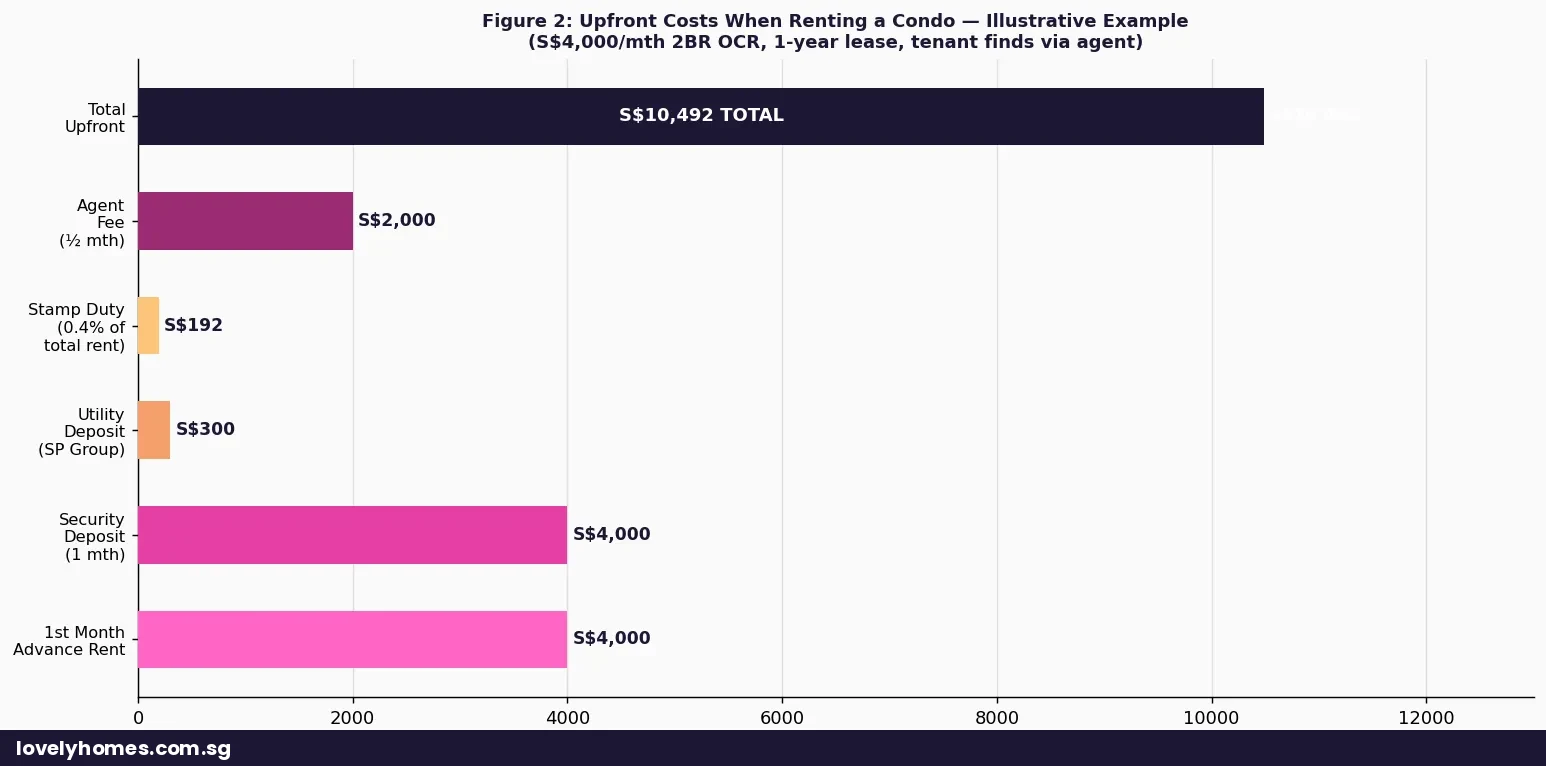
- Typical upfront costs on a 1-year lease include the first month’s advance rent, a security deposit (typically one month’s rent for a 1-year lease), and stamp duty on the Tenancy Agreement.
- Stamp duty on the lease is borne by the tenant and is approximately 0.4% of the total contract rent. A S$4,000/mth 1-year lease incurs approximately S$192 in stamp duty.
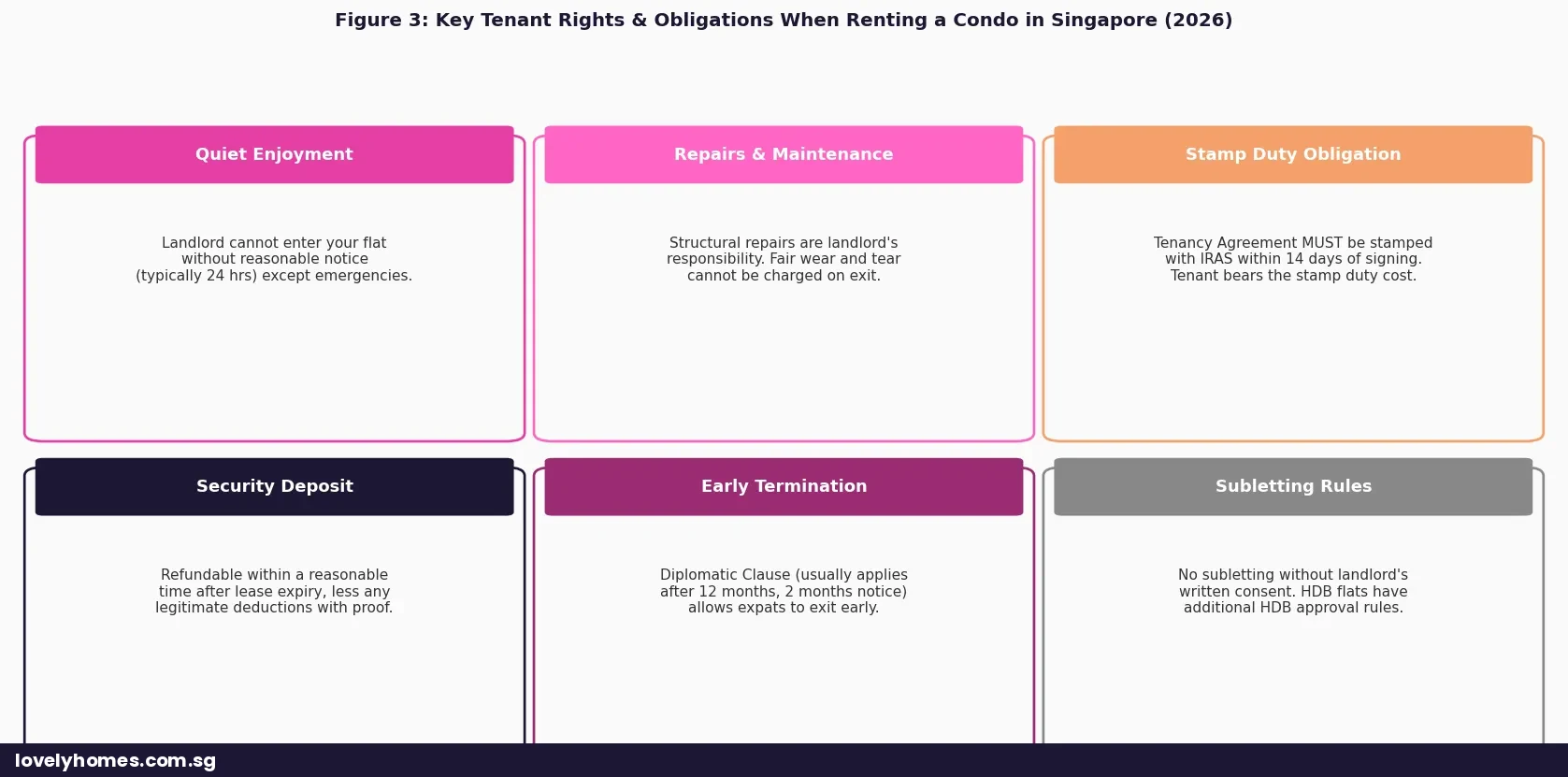
- The Tenancy Agreement (TA) must be stamped with IRAS within 14 days of the date it was signed.
- Lease durations are typically 1 or 2 years. 3-year leases exist but are less common for condos.
- Diplomatic Clause: most landlords grant this for 2-year leases, allowing early termination (usually after 12 months) with 2 months’ notice , important for foreign tenants.
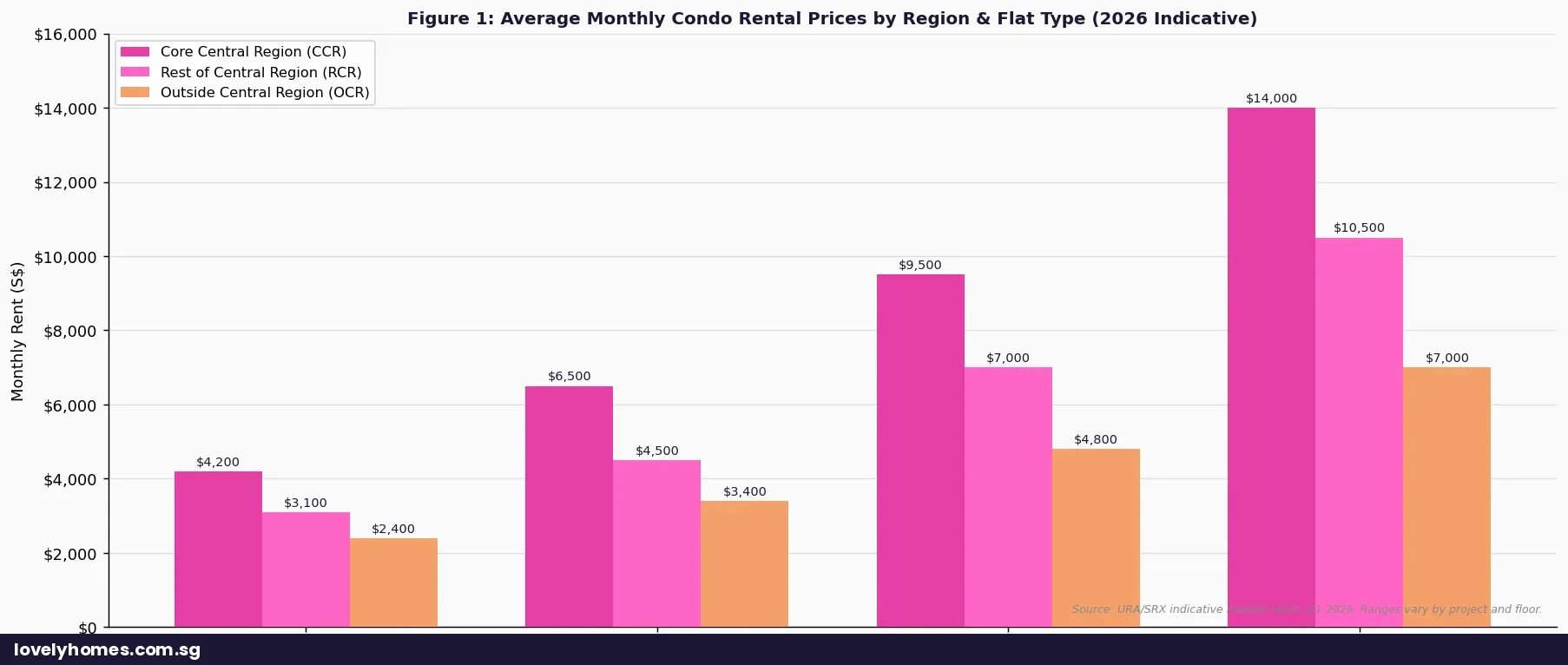
- Rental prices in 2026 range from approximately S$2,400/mth for a studio in the Outside Central Region (OCR) to over S$14,000/mth for a 4-bedroom unit in the Core Central Region (CCR).
- Property tax and maintenance fees are the landlord’s responsibility , not the tenant’s, unless otherwise agreed in the TA.
Singapore’s Condominium Rental Market in 2026
Singapore’s condo rental market is one of the most active in Asia. With a permanent resident and expatriate population generating sustained demand, and a growing professional class of Singaporeans choosing to rent rather than buy, private condominium rentals remain a key pillar of the residential property market. According to URA rental data, over 70,000 non-landed private residential rental transactions are registered annually in Singapore, the majority being condominiums.
Rental prices rose sharply between 2021 and 2023 as pandemic-era supply disruptions and surging demand from returning expatriates pushed rents to record highs. Since late 2023 and into 2024–2026, the market has moderated as a substantial pipeline of new completions , including major integrated developments and Build-To-Rent projects , has added supply. As at Q1 2026, URA’s condo rental index shows rents broadly stable, with pockets of softness in the OCR and selective strength in CCR luxury units.
Who Can Rent a Condo in Singapore?
Any person with a legal right to reside in Singapore may rent a private condominium unit. This includes Singapore citizens, permanent residents, Employment Pass holders, S Pass holders, Dependent Pass holders, and Long-Term Visit Pass holders. There is no application to HDB or the Urban Redevelopment Authority (URA) required for non-landed private property rentals , the agreement is directly between landlord and tenant, governed by general contract law and the Residential Tenancies Act framework.
However, landlords are obligated under the Residential Property Act and Immigration Act rules to verify that all tenants hold valid passes allowing them to reside in Singapore. Tourist visa holders may not enter into a rental agreement. Short-term rentals of less than three months are prohibited under URA’s short-term accommodation rules (which also restrict Airbnb-style platforms for private residential units).
Rental Prices by Region and Flat Type (2026)
Singapore’s condo rental prices differ substantially across the three planning regions. The Core Central Region (CCR) , comprising Districts 1–4, 9, 10, 11 and Sentosa Cove , commands premium rents driven by proximity to the Central Business District, prestigious schools, and international amenities. The Rest of Central Region (RCR) offers a middle ground, with maturing townships such as Queenstown, Bishan, and Toa Payoh appealing to both expatriates and local professionals. The Outside Central Region (OCR) spans the suburban heartlands from Jurong to Tampines, Woodlands to Pasir Ris, offering the most accessible rental entry points.
| Flat Type | CCR (Monthly S$) | RCR (Monthly S$) | OCR (Monthly S$) |
|---|---|---|---|
| Studio / 1-Bedroom | S$3,500–S$6,000 | S$2,800–S$3,800 | S$2,200–S$3,000 |
| 2-Bedroom | S$5,000–S$9,000 | S$3,800–S$5,500 | S$3,000–S$4,200 |
| 3-Bedroom | S$8,000–S$14,000 | S$5,500–S$8,500 | S$4,200–S$6,000 |
| 4-Bedroom / Penthouse | S$12,000–S$25,000+ | S$8,500–S$13,000 | S$6,000–S$10,000 |
Table 1: Indicative monthly condo rental ranges by region and flat type, as at Q1 2026. Actual rents vary by project, floor, furnishing, and lease tenure. Source: URA rental caveats and SRX median data.
The Condo Rental Process: Step-by-Step
Renting a condominium in Singapore follows a relatively standard process. Unlike buying a property, there is no government portal or pre-approval required , the process is market-driven, though stamp duty obligations and pass verification requirements are mandatory.
- Define your budget and requirements: determine your affordable monthly rent (typically no more than 30–40% of net take-home income), preferred region, flat type, and preferred MRT or school proximity.
- Search and viewings: search listings on property portals or engage a salesperson. Note that landlords and tenants typically each engage their own representative, with fees negotiated case by case , typically one month’s rent for a 1-year lease paid by the tenant, or co-broking arrangements.
- Letter of Intent (LOI) / Offer to Lease: once you identify a unit, submit a Letter of Intent with your proposed rental terms, key money (typically one to two weeks’ rent), and requested lease commencement date. The landlord may accept, reject, or counter.
- Tenancy Agreement (TA): upon acceptance, the TA is drafted (typically by the landlord’s salesperson). Review it carefully , key clauses include rent amount, lease period, security deposit, Diplomatic Clause, permitted use, and maintenance responsibilities. Seek legal advice for any non-standard terms.
- Sign and stamp: both parties sign the TA. The tenant pays the first month’s advance rent and the security deposit upon signing. The TA must be stamped with IRAS within 14 days of the signing date. Stamp duty is payable by the tenant.
- Move-in inventory check: conduct a joint inspection with the landlord on or before the lease commencement date. Document all existing defects in writing and by photographs , this protects both parties on the security deposit at the end of the tenancy.
Upfront Costs When Renting a Condo
The security deposit is typically one month’s rent for a 1-year lease or two months’ rent for a 2-year lease. This deposit is held by the landlord (or sometimes in escrow) and refunded within a reasonable time after the tenancy ends, less any justified deductions for rent arrears or damages beyond fair wear and tear.
Stamp Duty on Tenancy Agreements
Under the Inland Revenue Authority of Singapore (IRAS), tenants are required to stamp their Tenancy Agreements. The stamp duty rate is:
- 0.4% of the average annual rent for leases with a fixed term (simplified computation: 0.4% × total rent for leases up to 4 years).
- For a 1-year lease at S$4,000/mth: total rent = S$48,000; stamp duty = S$48,000 × 0.4% = S$192.
- For a 2-year lease at S$4,500/mth: total rent = S$108,000; stamp duty = S$108,000 × 0.4% = S$432.
- Stamp duty is payable by the tenant, though this is occasionally negotiated otherwise in the TA.
- Failure to stamp within 14 days incurs a late penalty (initially S$10, then escalating).
The TA must be stamped via the IRAS myStamp portal or at any IRAS service centre. Many salespersons handle this on behalf of their clients, but the legal obligation remains with the tenant unless the TA specifies otherwise.
Key Clauses to Check in Your Tenancy Agreement
The TA is a legally binding contract. Clauses worth scrutinising carefully include:
- Diplomatic Clause: allows early termination after a minimum period (usually 12 months for a 2-year lease) with 2 months’ written notice. Essential for foreign tenants whose employment situation may change. Not standard on all leases , negotiate before signing.
- Landlord’s access: the landlord should only enter the unit with reasonable advance notice (24 hours is customary) except in emergencies. Any clause allowing entry without notice should be queried or struck out.
- Maintenance responsibilities: the TA typically requires the tenant to be responsible for minor maintenance (e.g., replacing light bulbs, unblocking drains) while the landlord covers structural and major appliance repairs. Clarify what constitutes “fair wear and tear”.
- Air-conditioner servicing: standard practice is quarterly servicing at the tenant’s cost. This is often stated explicitly in the TA and is a reasonable tenant obligation.
- Subletting: subletting the entire unit without the landlord’s written consent is generally prohibited. If you require the right to sublet individual rooms, negotiate this explicitly.
- Handover condition: confirm the exact condition in which the unit must be returned (e.g., professionally cleaned, walls repainted).
Worked Example: James Rents a 2BR OCR Condo
James is a British national on an Employment Pass, earning S$8,500/mth. He wants to rent a 2-bedroom unit in the OCR (Jurong East area) on a 2-year lease.
- Agreed rent: S$3,500/mth for a 2BR 840 sqft unit at a leasehold condo 8 minutes’ walk from Jurong East MRT.
- Lease period: 1 July 2026 to 30 June 2028 (2 years), with Diplomatic Clause from 1 July 2027 (12 months + 2 months’ notice).
- Security deposit: 2 months × S$3,500 = S$7,000 (standard for 2-year lease).
- 1st month advance rent: S$3,500 paid at signing.
- Stamp duty: total rent = 24 × S$3,500 = S$84,000; stamp duty = S$84,000 × 0.4% = S$336 (stamped by salesperson via IRAS within 14 days).
- Agent fee (co-broke): S$3,500 × 1 = S$3,500 (1 month’s rent, split between landlord’s and tenant’s representatives on co-broking basis; tenant’s representative absorbed by landlord in this example).
- Total upfront outlay for James: S$7,000 (deposit) + S$3,500 (1st month) + S$336 (stamp duty) = S$10,836.
- Monthly on-going: S$3,500 rent + quarterly air-con servicing ~S$80 + SP Group utilities (metered) ~S$200/mth estimated = approximately S$3,780/mth all-in.
- Rental as % of income: S$3,500 / S$8,500 = 41.2% , on the higher end of affordability benchmarks, but manageable given no CPF obligations for EP holders.
What This Means for You
Renting a condo in Singapore is one of the most transparent and well-regulated rental experiences in Asia. The stamp duty obligation, while modest (0.4%), ensures leases are formally registered. The emphasis on written TAs and inventory checks protects both parties. The Diplomatic Clause , while not legally mandated , is widely accepted practice and critically important for expatriates.
From a cost perspective, 2026 represents a more balanced rental market than the peak of 2022–2023. Tenants have more negotiating power on lease terms, furniture packages, and rent-free periods than they did two years ago. Vacancy rates have risen in several OCR and newer RCR developments as completions accelerate, meaning landlords in these pockets are more willing to negotiate. The CCR luxury segment, however, remains tight , driven by sustained demand from financial sector and tech-sector professionals.
What Might Come Next
Singapore’s rental market in the medium term (2026–2028) faces two countervailing forces. On the supply side, a significant pipeline of private residential completions , approximately 8,000–10,000 units per year through 2027 according to URA’s construction data , should continue to exert moderating pressure on rents, particularly in the OCR and new RCR townships. On the demand side, Singapore’s continued attractiveness as a regional business hub and the government’s restrained foreign manpower policies mean rental demand from pass holders is unlikely to collapse.
Regulatory watch: MAS and URA are studying the residential tenancies framework, including possible standardisation of TA templates and security deposit handling. A formal Residential Tenancies Act , modelled on frameworks in Hong Kong or Australia , has been discussed but not yet enacted as at mid-2026. Any such legislation would likely strengthen tenant protections around deposit refunds and repair obligations, which are currently governed primarily by contract terms rather than statute.
Frequently Asked Questions
Can I negotiate on condo rental price in 2026?
Yes, and more so than in 2022–2023. With a softer rental market across the OCR and parts of the RCR, landlords are more flexible on headline rent, rent-free fit-out periods (1–2 weeks free rent at the start of the lease to allow for minor touch-ups), furniture packages, and minor TA terms. In the CCR luxury segment, negotiating room is narrower but still exists for high-quality tenants with strong employment credentials. Always make any rent concession explicit in the TA , verbal assurances are not enforceable.
What happens to my security deposit if the landlord sells the property during my lease?
Your Tenancy Agreement is binding on successors in title , a new owner takes the property subject to your existing lease. The security deposit should be transferred to the new owner at completion of the sale. However, this transfer is the landlord’s legal obligation, not yours. If the new owner denies holding your deposit, you may have a claim against the original landlord. It is therefore prudent to keep a stamped copy of the TA and your payment receipt for the deposit for the full duration of the tenancy. Some tenants negotiate for the deposit to be held in a separate account.
Can foreigners buy or rent a condo in Singapore?
Foreigners can freely rent any private condominium unit in Singapore, provided they hold a valid pass allowing them to reside here. Purchasing a private condominium (non-landed) is also legally permitted for foreigners, though the Additional Buyer’s Stamp Duty (ABSD) of 65% on the purchase price applies to all foreign buyers as at July 2026. There are no ownership restrictions on non-landed private residential property (condominiums and apartments) for foreigners , restrictions apply only to landed property (which requires SLA approval) and HDB flats (which foreigners cannot purchase). For a full breakdown of ABSD rates, see our ABSD Singapore 2026 Complete Guide.
What is a “break clause” or “diplomatic clause” and who benefits from it?
A Diplomatic Clause (also called a break clause) is a contractual provision in the TA that allows the tenant to terminate the lease early, typically after the first 12 months of a 24-month lease, by giving 2 months’ written notice. On termination under the Diplomatic Clause, the tenant forfeits no deposit and pays only rent up to the notice period. The clause exists to protect foreign tenants who may need to relocate due to job changes or repatriation at short notice. Most Singapore landlords accept the Diplomatic Clause for 2-year leases, particularly when renting to corporate-sponsored expatriate tenants. For 1-year leases, early termination is more complex as there is no standard clause , tenants seeking to break a 1-year lease typically negotiate a settlement with the landlord, often involving partial deposit forfeiture.
Is the tenant required to pay property tax or maintenance fees (MCST fees)?
No. Property tax (payable to IRAS) and MCST maintenance fees (payable to the condo’s Management Corporation Strata Title) are the landlord’s responsibility, not the tenant’s. These costs are factored into the landlord’s rental pricing decision but are not directly charged to or payable by the tenant, unless the TA explicitly (and unusually) states otherwise. You should confirm this in your TA. Conversely, the tenant is typically responsible for all utility costs (electricity, water, gas via SP Group), internet, and parking charges.
What should I do if the landlord refuses to return my security deposit?
If the landlord has deducted all or part of your deposit after the lease ends and you dispute the deductions, the first step is written communication , formally requesting an itemised breakdown of deductions with supporting receipts or quotes. If this fails, Singapore offers several avenues for resolution: the Community Disputes Resolution Tribunal (CDRT) handles disputes between neighbours; for financial claims below S$30,000, the Small Claims Tribunal (SCT) is a fast and inexpensive route to adjudication. Alternatively, Singapore Mediation Centre (SMC) offers pre-litigation mediation. As at 2026, there is no dedicated tenancy dispute tribunal in Singapore (unlike Hong Kong’s Lands Tribunal), which is why clear inventory documentation at move-in and move-out is critical.
Related Articles
- ABSD Singapore 2026: Complete Guide to Additional Buyer’s Stamp Duty
- Singapore Stamp Duty Calculator 2026: BSD and ABSD Explained
- Singapore Private Property Buying Guide 2026: Eligibility, ABSD, Financing and Step-by-Step Process
- Singapore Property Tax Guide 2026: IRAS Annual Value, Owner-Occupied Rates and How to Pay
- Singapore Strata Title and MCST Guide 2026: Management Fees, Sinking Fund, By-Laws and En Bloc Rights
- HDB BTO Process 2026: Complete Step-by-Step Guide from HFE to Key Collection
- En Bloc Sale Singapore 2026: Complete Guide to Collective Sales, 80% Consent and Owner Rights
Disclaimer
This article is published by LovelyHomes Editorial Team for general informational purposes only and does not constitute legal, financial, or property advice. Rental prices cited are indicative market ranges as at Q1 2026 and will vary by project, floor, furnishing level, and individual negotiation. Stamp duty obligations are administered by the Inland Revenue Authority of Singapore (IRAS). Tenancy law is governed by Singapore’s Residential Property Act, the Stamp Duties Act, and general contract law. Readers should refer to official URA, IRAS, and Ministry of Law publications for the most current regulations, and obtain independent legal advice before signing any Tenancy Agreement. Pass validity requirements for foreign tenants are governed by the Immigration and Checkpoints Authority (ICA) and the Ministry of Manpower (MOM).
Supporting graphics
Original article illustrations are available below.
- Figure 1: Average Monthly Condo Rental Prices by Region and Flat Type , Indicative Q1 2026 (Source: URA/SRX median data)
- Figure 2: Upfront Costs When Renting a Condo , Illustrative for a S$4,000/mth 2BR OCR 1-Year Lease (2026)
- Figure 3: Key Tenant Rights and Obligations in Singapore Condo Rentals (2026)