Singapore Landlord Guide 2026: Rental Income Tax, Tenancy Agreements, Property Tax and Landlord Rights

Singapore Landlord Guide 2026: Rental Income Tax, Tenancy Agreements, Property Tax and Landlord Rights

Quick Answer: Singapore Landlord Key Facts 2026

  • Rental income is taxable: Resident landlords pay progressive income tax (0–22%) on net rental income after allowable deductions. Non-residents pay a flat 24% on gross rent.
  • Allowable deductions include: mortgage interest, property tax, fire insurance, maintenance and repair costs, and agent letting fees. Furniture, renovation, and capital improvements are not deductible.
  • Property tax on rental property: the Non-Owner-Occupied (NOO) progressive rate applies — from 10% on the first S$30,000 of Annual Value up to 24% on amounts above S$75,000 (IRAS, from 1 January 2024).
  • Stamp duty on tenancy agreement: 0.4% of total rent for leases of one year or less; tiered rates for longer leases. Must be stamped via IRAS within 14 days of signing.
  • HDB landlords must complete their Minimum Occupation Period (MOP) — 5 years for standard flats, 10 years for Plus/Prime BTO — and obtain HDB’s written approval before renting out the entire flat.
  • Short-term rentals (e.g. Airbnb): prohibited for all residential properties in Singapore. Minimum rental term is three consecutive months under the Planning Act.
  • Security deposit: typically one to two months’ rent. Disputes up to S$30,000 can be filed at the Small Claims Tribunal (SCT).

What Does It Mean to Be a Landlord in Singapore?

A landlord in Singapore is any person or entity that lets a residential property to a tenant in exchange for rent. The term covers the full spectrum: from an HDB flat owner renting out a spare bedroom, to a property investor managing a portfolio of private condominiums in the Core Central Region.

Singapore’s rental market is regulated by multiple government bodies. The Inland Revenue Authority of Singapore (IRAS) collects income tax on rental proceeds and administers stamp duty on tenancy agreements. The Housing and Development Board (HDB) regulates the subletting of public housing flats. The Urban Redevelopment Authority (URA) sets rules for private residential properties, including the minimum rental period. The Building and Construction Authority (BCA) governs strata management corporations (MCSTs) for condominiums. Understanding who regulates what is the first step to staying compliant and protecting your net yield.

Singapore’s residential rental market encompasses an estimated 58,000 private units and 56,000 HDB flats listed for rent at any given time. With median gross rental yields at 2.5–3.5% for condominiums and 3.5–4.5% for HDB flats (indicative 2026 figures), understanding the full cost and compliance picture is essential for any landlord.

Rental Income Tax: What Landlords Owe IRAS

Rental income received by a Singapore tax resident is assessable income under the Income Tax Act 1947. It must be declared on IRAS Form B1 (individuals) or Form B (self-employed persons and those with non-employment income) by 15 April each year, covering income from the preceding calendar year.

IRAS defines rental income broadly: monthly rent, any payment for the right to use the property, furniture rent charged separately, and even a lump-sum premium or key-money received at the start of a tenancy are all assessable.

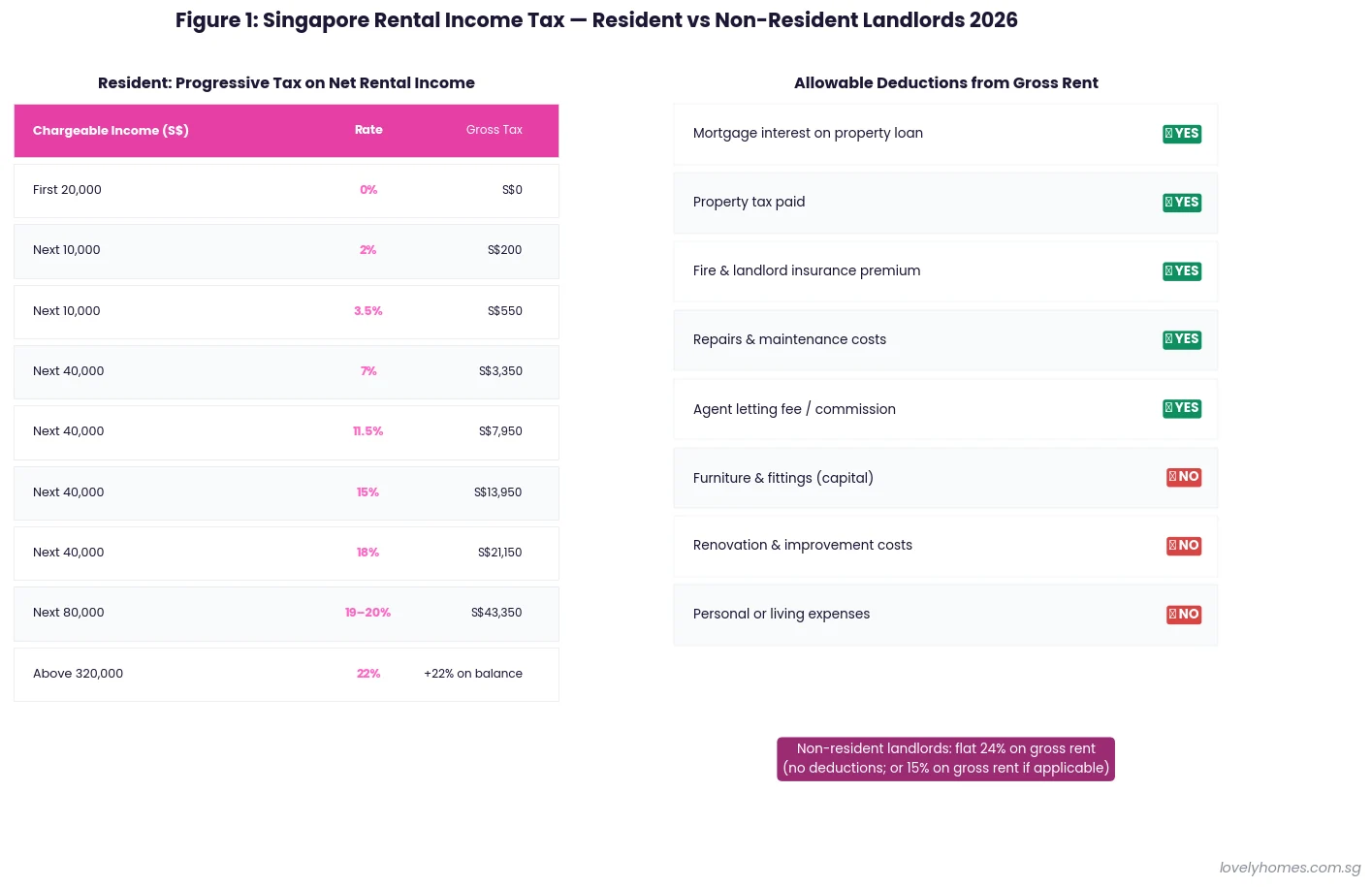
Singapore rental income tax rates 2026 resident vs non-resident landlords allowable deductions
Figure 1: Singapore Rental Income Tax — Resident Progressive Rates and Allowable Deductions (IRAS 2026). Non-resident landlords pay a flat 24% on gross rent with no deductions.

Resident Landlords: Net Income After Allowable Deductions

For Singapore tax residents, the taxable base is net rental income: gross rent received less the following allowable deductions recognised by IRAS:

  • Mortgage interest: interest on the loan used to purchase the property. Principal repayments are not deductible. For joint owners, only the portion of interest proportional to each individual’s share applies.
  • Property tax: the annual IRAS property tax bill for the rented property.
  • Fire and landlord insurance premiums taken out on the property.
  • Maintenance and repair costs: reasonable wear-and-tear repairs — replacing broken fixtures, repainting between tenancies. Capital improvements that enhance property value are not deductible.
  • Agent letting commission: the fee paid to a property agent for sourcing the tenant. Typically one month’s rent for a two-year lease, deductible in the year paid.

Net rental income is then added to the landlord’s total chargeable income and taxed at the applicable progressive resident rates: 0% on the first S$20,000, rising to 22% on amounts exceeding S$320,000.

Non-Resident Landlords: Flat-Rate Tax on Gross Rent

Non-resident individuals — for example, a foreigner who owns Singapore property but is not tax-resident here — are taxed at a flat rate of 24% on gross rent, with no deductions permitted. Non-residents may elect to be taxed at the resident progressive rates if this produces a lower liability, subject to IRAS rules. Where tax is withheld by a tenant, the landlord is responsible for ensuring accurate filing.

Property Tax for Landlords: The NOO Rate

Every property owner in Singapore pays property tax, regardless of whether the property is occupied or rented. When a residential property is rented out, the Non-Owner-Occupied (NOO) progressive rate applies — substantially higher than the owner-occupied (OO) rate. This differential is a deliberate policy to discourage speculative property holding.

The NOO rate is applied to the property’s Annual Value (AV) — IRAS’s estimate of the property’s annual market rent if let unfurnished. The AV is reviewed periodically. As a reference: a typical 4-room HDB flat in a mature estate carries an AV of approximately S$16,000–S$22,000; a mid-range condominium 2-bedroom unit in the Rest of Central Region may carry an AV of S$28,000–S$40,000. NOO property tax for a condo unit with AV S$30,000 is approximately S$3,000 per year (IRAS, 2024 rates).

Landlords should budget for this cost at the start of each financial year. IRAS issues property tax bills in December for the following year; the due date is 31 January.

Stamp Duty on Tenancy Agreements

A tenancy agreement is a dutiable document under the Stamp Duties Act. Stamp duty must be paid via the IRAS myStampDuty portal within 14 days of signing if the document is signed in Singapore, or within 30 days if signed overseas.

The stamp duty rate depends on the length of the lease:

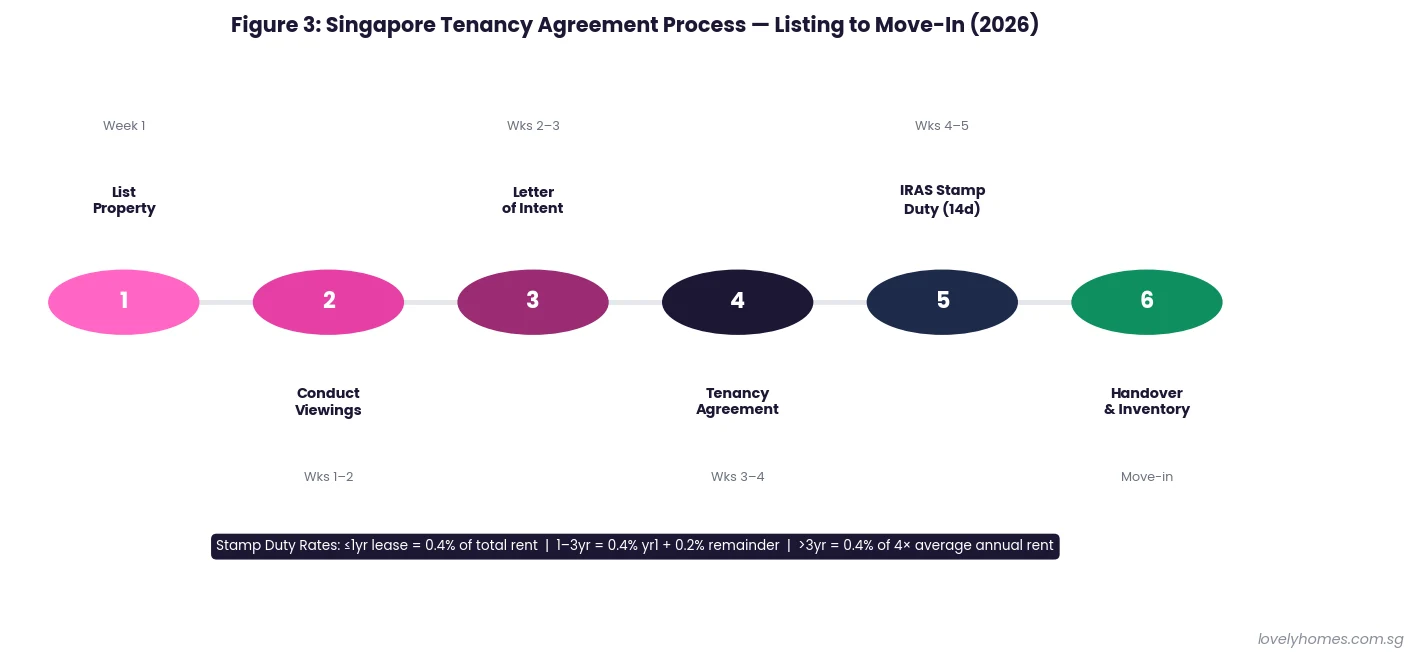
  • Lease of one year or less: 0.4% of the total rent for the full lease period.
  • Lease of more than one year up to three years: 0.4% of average annual rent for the first year, plus 0.2% of average annual rent for each remaining year.
  • Lease of more than three years or indefinite period: 0.4% of four times the average annual rent.

Who pays? By default, the tenant pays. However, landlord and tenant may agree otherwise and should record this in the tenancy agreement. Failure to stamp on time incurs a penalty of up to four times the duty owed.

Singapore tenancy agreement process timeline 2026 LOI stamp duty move-in
Figure 3: Tenancy Agreement Process in Singapore — Six Stages from Listing to Move-In (2026). IRAS stamping must be completed within 14 days of signing.

HDB-Specific Subletting Rules 2026

Owners of HDB flats face a more regulated environment than private property owners. The key rules as at 7 July 2026 are as follows.

Minimum Occupation Period (MOP): A flat owner must complete the MOP before renting out the entire flat. The MOP is five years for standard BTO, resale, and DBSS flats, measured from the date of key collection. For Plus and Prime BTO flats launched from the February 2024 exercise onwards, the MOP is ten years. There is no MOP restriction on renting out individual bedrooms, provided the owner continues to physically reside in the flat.

HDB Approval Required: Before renting out the entire flat, the owner must obtain HDB’s written approval via the HDB Resale Portal. Approval is granted online and must be renewed every three years. Renting out without approval may result in enforcement action, including compulsory acquisition of the flat by HDB.

Eligible Tenants: HDB flats may only be rented to Singapore Citizens, Singapore Permanent Residents, and non-citizens holding a valid long-term or work pass (Employment Pass, S Pass, Work Permit, Dependant’s Pass, Long-Term Visit Pass). Visitors and tourists are ineligible tenants for both entire flats and individual bedrooms.

Occupancy Cap: HDB 1- to 3-room flats: maximum four occupants total. HDB 4-room flats and larger: maximum six occupants. This includes all persons residing in the flat, whether family members, tenants, or sub-tenants.

Short-Term Rentals Prohibited: Renting any HDB flat or private residential unit for periods shorter than three consecutive months is prohibited under the Planning Act. URA enforces this actively; owners face composition fines and court action.

Annual Landlord Costs: What Eats Into Your Yield

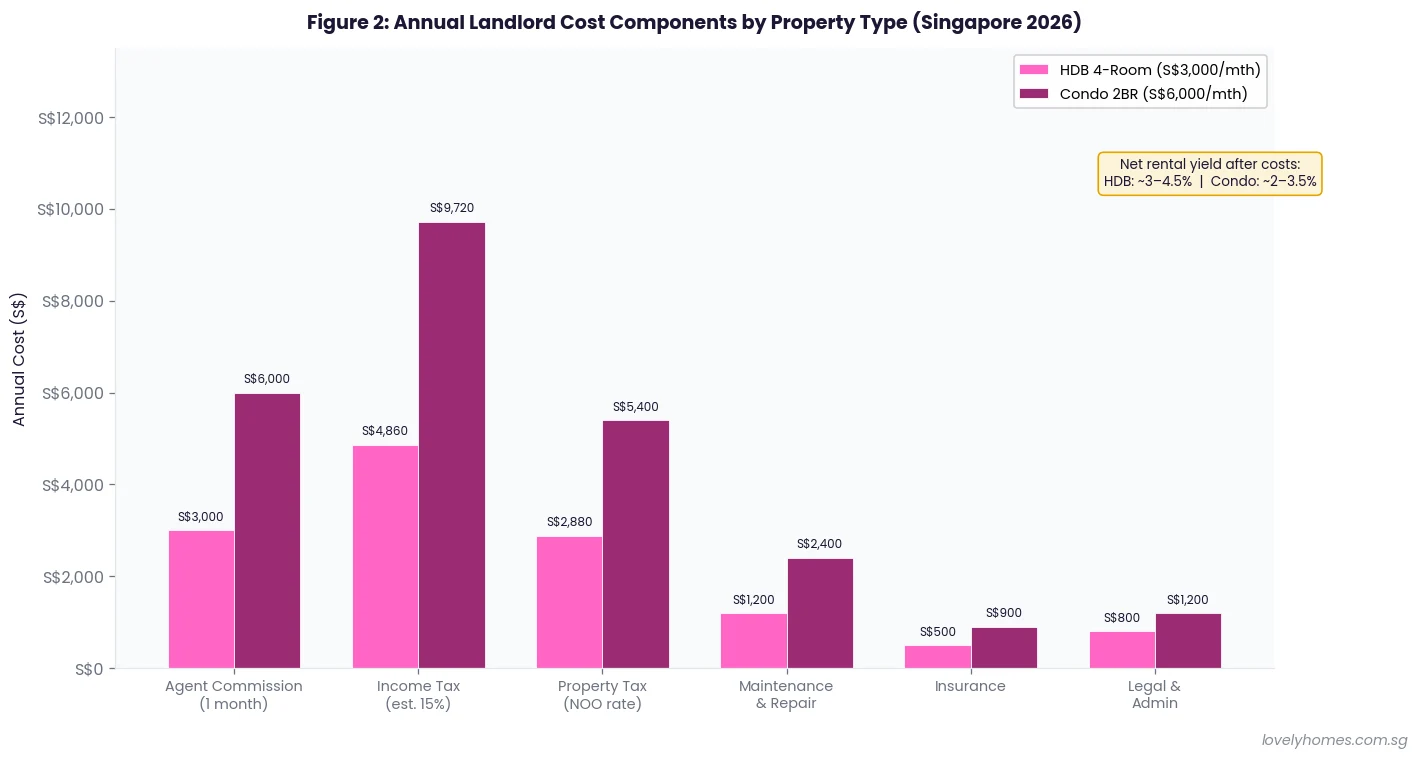
Singapore landlord annual cost components 2026 HDB condo income tax property tax maintenance
Figure 2: Annual Landlord Cost Components — HDB 4-Room (S$3,000/mth) vs Condo 2BR (S$6,000/mth) — Singapore 2026. Indicative estimates based on current IRAS rates and market data.

A landlord’s gross rent is not the same as net yield. Several recurring cost lines erode returns:

  • Agent commission: typically one month’s rent for a new two-year lease. Some landlords negotiate a reduced fee for renewal tenancies.
  • Income tax on net rental income: a landlord in the 11.5% marginal bracket with S$20,000 net rental income may pay approximately S$2,300 in tax attributable to rental.
  • NOO property tax: significantly higher than OO rates. An HDB 4-room flat with AV S$18,000 incurs approximately S$1,800/year at NOO rates; a condominium 2BR with AV S$30,000 incurs approximately S$3,000/year.
  • MCST maintenance fees (condo landlords): typically S$200–S$600/month. These continue even during vacancy periods and cannot be passed to tenants unless contractually agreed.
  • Void periods: vacancy between tenancies reduces annual yield. In 2026, average void periods range from two to eight weeks depending on property type, location, and prevailing demand.

Summary: Key Landlord Obligations at a Glance

Obligation Authority Requirement Penalty for Non-Compliance
Declare rental income IRAS Form B / B1, by 15 April annually Penalty, back taxes, and interest
Stamp tenancy agreement IRAS Within 14 days of signing Up to 4× stamp duty owed
HDB subletting approval HDB Before renting out entire HDB flat Compulsory acquisition possible
Minimum 3-month rental period URA All residential properties Composition fine; court action
Pay property tax (NOO rate) IRAS Annual bill; due 31 January 5% surcharge on arrears
Maintain structure and fittings Common law Quiet enjoyment and habitability Tenant may withhold rent or sue
Register HDB tenants HDB Register via HDB Resale Portal Warning and enforcement action

Worked Example: Mr Ng Rents Out His 4-Room HDB in Bishan

Mr Ng (Singapore Citizen) owns a 4-room HDB flat in Bishan. He completed his MOP in August 2023 and obtained HDB subletting approval in September 2023. He rents the entire flat to a Korean couple on Employment Passes for S$3,000/month on a two-year lease commencing 1 October 2023.

Annual gross rental income: S$3,000 × 12 = S$36,000.

Allowable deductions for Year of Assessment 2024:

  • Mortgage interest (HDB loan S$350,000, approximately 25 years remaining, ~3.2% annual interest): S$11,200
  • NOO property tax (AV S$18,000, first S$18,000 at 10%): S$1,800
  • Fire and landlord insurance: S$380
  • Maintenance and minor repairs: S$720
  • Agent letting commission (1 month, amortised over 2-year lease): S$1,500

Total deductions: S$15,600. Net rental income: S$20,400.

Stamp duty on tenancy (paid by tenant): 2-year lease, total rent S$72,000. Stamp duty = 0.4% × S$36,000 (Year 1) + 0.2% × S$36,000 (Year 2) = S$144 + S$72 = S$216.

Income tax on rental income: Mr Ng’s total chargeable income (employment income S$82,000 + net rental S$20,400 = S$102,400). Tax at resident rates: approximately S$5,920. Rental’s share (~20%): approximately S$1,184 attributable to rental income.

Net yield analysis: S$36,000 gross rent − S$15,600 deductions − S$1,184 rental-attributable tax = S$19,216 net annual income, on an assumed flat value of S$580,000. Net yield: approximately 3.3%. The effective tax rate on rental income is approximately 3.3% of gross rent — substantially lower than the nominal income tax bracket because mortgage interest and property tax heavily reduce the taxable base.

Why This Matters for Singapore Landlords in 2026

The Singapore rental market has undergone significant structural change since 2022. Post-COVID demand from expatriates pushed prime condominium rents 30–40% above 2019 levels by 2023. By 2025–2026, those gains moderated as a record Government land sales pipeline — 9,320 units in the 2026 Confirmed List alone — fed new supply into the market. HDB rents similarly softened by 4–8% in 2025 as demand normalised.

The HDB Resale Price Index fell for a second consecutive quarter in Q2 2026 (to 202.7, down 0.3% quarter-on-quarter), a sign of broader market softening that affects rental demand confidence. For landlords, pricing discipline and tenant retention matter more than they did in the peak years.

Compared with other regional cities, Singapore stands out for regulatory transparency: IRAS publishes clear guidance on rental tax, HDB’s portal is fully digital, and Small Claims Tribunal procedures are accessible to ordinary landlords and tenants alike. The administrative burden is manageable for compliant landlords who treat property rental as the regulated business activity it is.

What Might Come Next

Several policy developments are worth monitoring. The Government’s ongoing BTO completions in Tengah, Bidadari, and Bayshore — adding more than 30,000 units through 2027–2028 — will sustain downward pressure on HDB resale and rental prices in the medium term. IRAS is also expected to review Annual Values for private residential properties in late 2026, reflecting the more moderate rental market of 2025; any downward revision would reduce NOO property tax bills.

There are ongoing policy discussions about whether to introduce more formal licensing requirements for private residential landlords, similar to frameworks in the United Kingdom and Australia. No formal proposal has been tabled as at July 2026, but landlords with multiple properties should monitor parliamentary proceedings and Ministry of National Development announcements closely.

Frequently Asked Questions

Do I need to declare rental income if I am only renting out a spare bedroom?

Yes. Any payment received for the right to use your property — including a single bedroom — is assessable rental income. You may claim deductions proportional to the rented area (for example, 25% of mortgage interest and property tax if one of four rooms is let). Declare on Form B1 by 15 April. There is no de minimis exemption threshold for rental income in Singapore.

Can I use CPF to pay my property tax or income tax on rental income?

No. CPF Ordinary Account (OA) funds may only be used for specific property-related payments: the downpayment, monthly mortgage instalments, and Buyer’s Stamp Duty on purchase. Annual property tax, income tax on rental proceeds, agent commissions, and all other landlord costs must be paid in cash. This is a common point of confusion for first-time landlords.

What can I do if my tenant stops paying rent?

First, issue a formal written notice of the breach and allow a reasonable cure period (typically 14 days). If unpaid rent does not exceed S$30,000, the Small Claims Tribunal (SCT) provides a faster and lower-cost route than the civil courts. For larger amounts, a civil suit in the District Court or High Court may be necessary. The landlord may also apply for a Writ of Distress to seize the tenant’s goods. The security deposit held may be applied against arrears at the end of the tenancy, but not unilaterally mid-lease unless the agreement expressly permits this.

Do I need HDB approval to rent out a bedroom in my flat before completing the MOP?

The MOP restriction applies only to renting out the entire flat. Before completing the MOP, you may rent out individual bedrooms, provided you continue to physically reside in the flat alongside the tenants. You must still register the subletting of bedrooms with HDB via the Resale Portal. Tourists and visitors without valid passes remain ineligible as tenants for rooms as well as for entire flats.

Is the security deposit I receive from a tenant taxable income?

No, not when received. A security deposit is a refundable sum held as security against the tenant’s obligations; it is not income at the point of receipt. However, if you legitimately forfeit all or part of the deposit — for example, because the tenant terminated early and the agreement entitles you to retain one month as a penalty — the forfeited amount becomes assessable income in the year of forfeiture and must be declared to IRAS.

Can foreigners rent HDB flats in Singapore?

Foreigners may rent HDB flats provided they hold a valid long-term pass. Eligible pass types include the Employment Pass (EP), S Pass, Work Permit, Dependant’s Pass (DP), and Long-Term Visit Pass (LTVP). Tourists and visitors on Social Visit Passes, Student’s Passes used for short stays, and persons without a valid pass are not eligible tenants for HDB flats — whether for an entire flat or a room. The HDB Resale Portal enables flat owners to verify a prospective tenant’s eligibility before signing.

Disclaimer: This article is for general informational purposes only and does not constitute tax, legal, or financial advice. Rental income tax rules, property tax rates, and HDB subletting regulations are subject to change. Information reflects publicly available guidance from IRAS (iras.gov.sg), HDB (hdb.gov.sg), and URA (ura.gov.sg) as at 7 July 2026. Please consult a qualified tax adviser, conveyancing solicitor, or licensed property agent before making rental property decisions.

Singapore Condo Rental Guide 2026: Costs, Process, Stamp Duty and Tenant Rights

Singapore Condo Rental Guide 2026: Costs, Process, Stamp Duty and Tenant Rights

×Click or press Esc to close
Quick Answer — Renting a Condo in Singapore 2026

  • Who can rent: Singapore citizens, permanent residents, and most foreigners holding valid work or long-term passes may rent a private condo unit. There is no separate approval required from HDB or URA for non-landed private property rentals.
  • Typical upfront costs on a 1-year lease include the first month’s advance rent, a security deposit (typically one month’s rent for a 1-year lease), and stamp duty on the Tenancy Agreement.
  • Stamp duty on the lease is borne by the tenant and is approximately 0.4% of the total contract rent. A S$4,000/mth 1-year lease incurs approximately S$192 in stamp duty.
  • The Tenancy Agreement (TA) must be stamped with IRAS within 14 days of the date it was signed.
  • Lease durations are typically 1 or 2 years. 3-year leases exist but are less common for condos.
  • Diplomatic Clause: most landlords grant this for 2-year leases, allowing early termination (usually after 12 months) with 2 months’ notice — important for foreign tenants.
  • Rental prices in 2026 range from approximately S$2,400/mth for a studio in the Outside Central Region (OCR) to over S$14,000/mth for a 4-bedroom unit in the Core Central Region (CCR).
  • Property tax and maintenance fees are the landlord’s responsibility — not the tenant’s, unless otherwise agreed in the TA.

Singapore’s Condominium Rental Market in 2026

Singapore’s condo rental market is one of the most active in Asia. With a permanent resident and expatriate population generating sustained demand, and a growing professional class of Singaporeans choosing to rent rather than buy, private condominium rentals remain a key pillar of the residential property market. According to URA rental data, over 70,000 non-landed private residential rental transactions are registered annually in Singapore, the majority being condominiums.

Rental prices rose sharply between 2021 and 2023 as pandemic-era supply disruptions and surging demand from returning expatriates pushed rents to record highs. Since late 2023 and into 2024–2026, the market has moderated as a substantial pipeline of new completions — including major integrated developments and Build-To-Rent projects — has added supply. As at Q1 2026, URA’s condo rental index shows rents broadly stable, with pockets of softness in the OCR and selective strength in CCR luxury units.

Who Can Rent a Condo in Singapore?

Any person with a legal right to reside in Singapore may rent a private condominium unit. This includes Singapore citizens, permanent residents, Employment Pass holders, S Pass holders, Dependent Pass holders, and Long-Term Visit Pass holders. There is no application to HDB or the Urban Redevelopment Authority (URA) required for non-landed private property rentals — the agreement is directly between landlord and tenant, governed by general contract law and the Residential Tenancies Act framework.

However, landlords are obligated under the Residential Property Act and Immigration Act rules to verify that all tenants hold valid passes allowing them to reside in Singapore. Tourist visa holders may not enter into a rental agreement. Short-term rentals of less than three months are prohibited under URA’s short-term accommodation rules (which also restrict Airbnb-style platforms for private residential units).

Rental Prices by Region and Flat Type (2026)

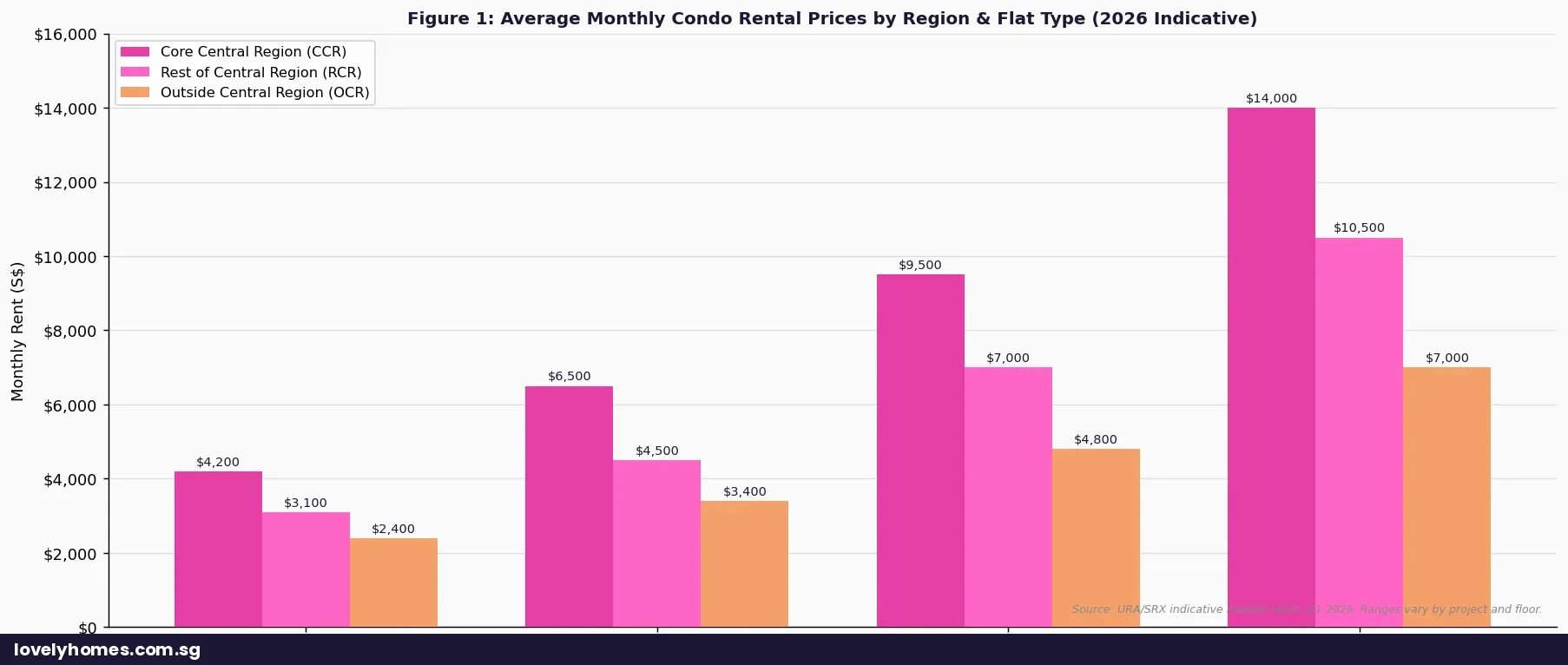
average condo rental prices Singapore 2026 by region CCR RCR OCR and flat type
Figure 1: Average Monthly Condo Rental Prices by Region and Flat Type — Indicative Q1 2026 (Source: URA/SRX median data)

Singapore’s condo rental prices differ substantially across the three planning regions. The Core Central Region (CCR) — comprising Districts 1–4, 9, 10, 11 and Sentosa Cove — commands premium rents driven by proximity to the Central Business District, prestigious schools, and international amenities. The Rest of Central Region (RCR) offers a middle ground, with maturing townships such as Queenstown, Bishan, and Toa Payoh appealing to both expatriates and local professionals. The Outside Central Region (OCR) spans the suburban heartlands from Jurong to Tampines, Woodlands to Pasir Ris, offering the most accessible rental entry points.

Flat Type CCR (Monthly S$) RCR (Monthly S$) OCR (Monthly S$)
Studio / 1-Bedroom S$3,500–S$6,000 S$2,800–S$3,800 S$2,200–S$3,000
2-Bedroom S$5,000–S$9,000 S$3,800–S$5,500 S$3,000–S$4,200
3-Bedroom S$8,000–S$14,000 S$5,500–S$8,500 S$4,200–S$6,000
4-Bedroom / Penthouse S$12,000–S$25,000+ S$8,500–S$13,000 S$6,000–S$10,000

Table 1: Indicative monthly condo rental ranges by region and flat type, as at Q1 2026. Actual rents vary by project, floor, furnishing, and lease tenure. Source: URA rental caveats and SRX median data.

The Condo Rental Process: Step-by-Step

Renting a condominium in Singapore follows a relatively standard process. Unlike buying a property, there is no government portal or pre-approval required — the process is market-driven, though stamp duty obligations and pass verification requirements are mandatory.

  1. Define your budget and requirements: determine your affordable monthly rent (typically no more than 30–40% of net take-home income), preferred region, flat type, and preferred MRT or school proximity.
  2. Search and viewings: search listings on property portals or engage a salesperson. Note that landlords and tenants typically each engage their own representative, with fees negotiated case by case — typically one month’s rent for a 1-year lease paid by the tenant, or co-broking arrangements.
  3. Letter of Intent (LOI) / Offer to Lease: once you identify a unit, submit a Letter of Intent with your proposed rental terms, key money (typically one to two weeks’ rent), and requested lease commencement date. The landlord may accept, reject, or counter.
  4. Tenancy Agreement (TA): upon acceptance, the TA is drafted (typically by the landlord’s salesperson). Review it carefully — key clauses include rent amount, lease period, security deposit, Diplomatic Clause, permitted use, and maintenance responsibilities. Seek legal advice for any non-standard terms.
  5. Sign and stamp: both parties sign the TA. The tenant pays the first month’s advance rent and the security deposit upon signing. The TA must be stamped with IRAS within 14 days of the signing date. Stamp duty is payable by the tenant.
  6. Move-in inventory check: conduct a joint inspection with the landlord on or before the lease commencement date. Document all existing defects in writing and by photographs — this protects both parties on the security deposit at the end of the tenancy.

Upfront Costs When Renting a Condo

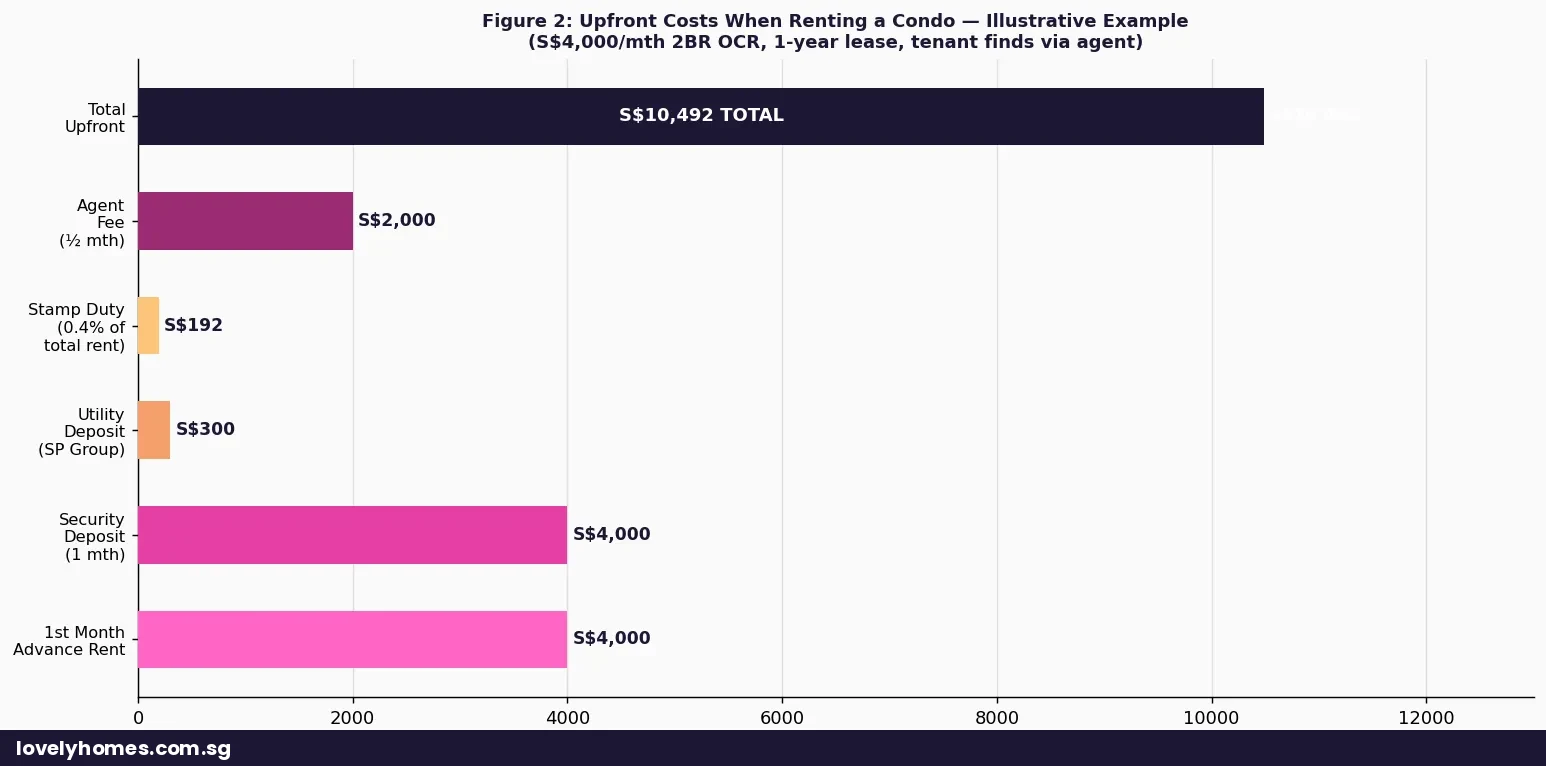
condo rental upfront costs Singapore 2026 security deposit stamp duty agent fee
Figure 2: Upfront Costs When Renting a Condo — Illustrative for a S$4,000/mth 2BR OCR 1-Year Lease (2026)

The security deposit is typically one month’s rent for a 1-year lease or two months’ rent for a 2-year lease. This deposit is held by the landlord (or sometimes in escrow) and refunded within a reasonable time after the tenancy ends, less any justified deductions for rent arrears or damages beyond fair wear and tear.

Stamp Duty on Tenancy Agreements

Under the Inland Revenue Authority of Singapore (IRAS), tenants are required to stamp their Tenancy Agreements. The stamp duty rate is:

  • 0.4% of the average annual rent for leases with a fixed term (simplified computation: 0.4% × total rent for leases up to 4 years).
  • For a 1-year lease at S$4,000/mth: total rent = S$48,000; stamp duty = S$48,000 × 0.4% = S$192.
  • For a 2-year lease at S$4,500/mth: total rent = S$108,000; stamp duty = S$108,000 × 0.4% = S$432.
  • Stamp duty is payable by the tenant, though this is occasionally negotiated otherwise in the TA.
  • Failure to stamp within 14 days incurs a late penalty (initially S$10, then escalating).

The TA must be stamped via the IRAS myStamp portal or at any IRAS service centre. Many salespersons handle this on behalf of their clients, but the legal obligation remains with the tenant unless the TA specifies otherwise.

Key Clauses to Check in Your Tenancy Agreement

The TA is a legally binding contract. Clauses worth scrutinising carefully include:

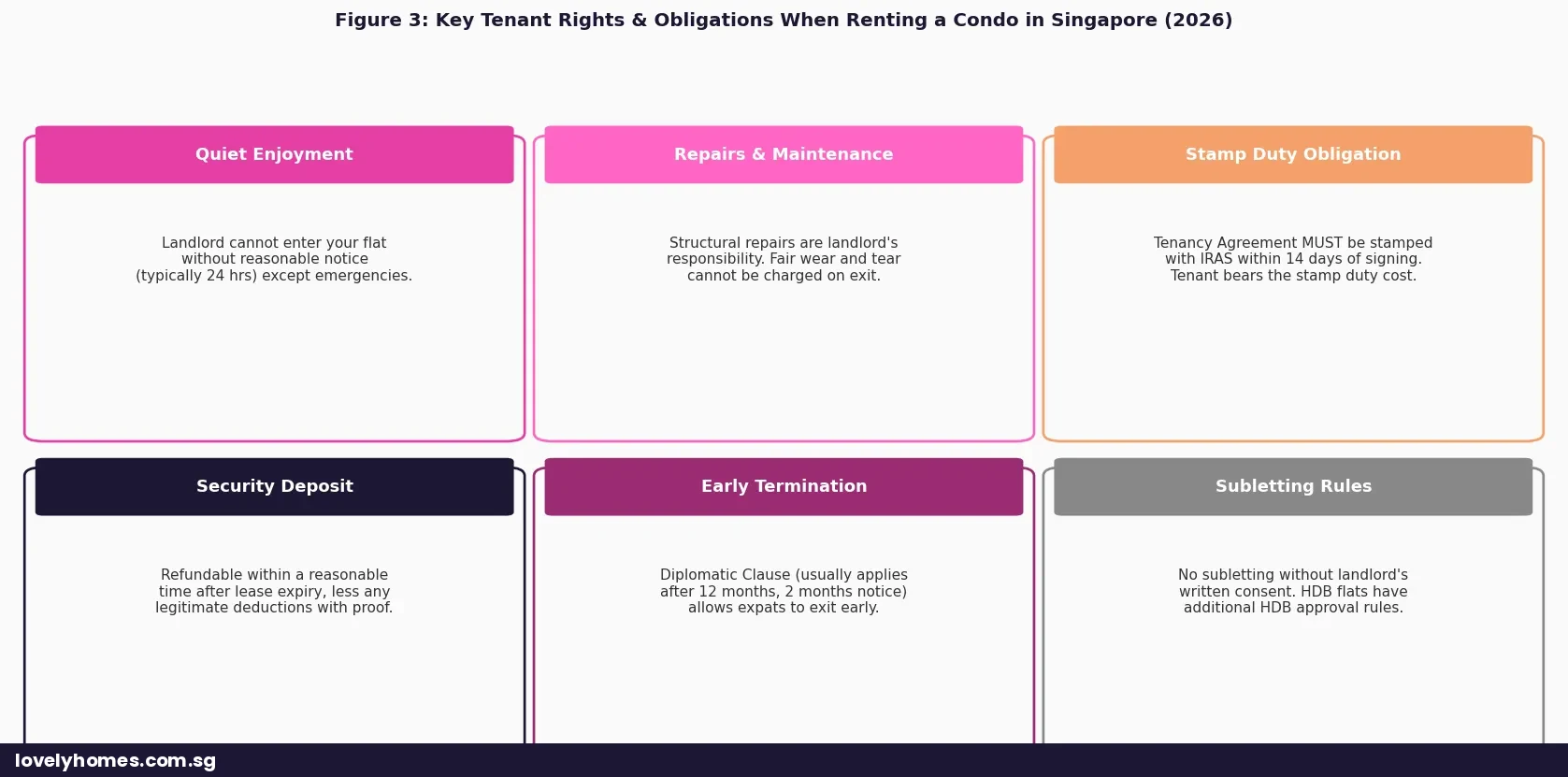
  • Diplomatic Clause: allows early termination after a minimum period (usually 12 months for a 2-year lease) with 2 months’ written notice. Essential for foreign tenants whose employment situation may change. Not standard on all leases — negotiate before signing.
  • Landlord’s access: the landlord should only enter the unit with reasonable advance notice (24 hours is customary) except in emergencies. Any clause allowing entry without notice should be queried or struck out.
  • Maintenance responsibilities: the TA typically requires the tenant to be responsible for minor maintenance (e.g., replacing light bulbs, unblocking drains) while the landlord covers structural and major appliance repairs. Clarify what constitutes “fair wear and tear”.
  • Air-conditioner servicing: standard practice is quarterly servicing at the tenant’s cost. This is often stated explicitly in the TA and is a reasonable tenant obligation.
  • Subletting: subletting the entire unit without the landlord’s written consent is generally prohibited. If you require the right to sublet individual rooms, negotiate this explicitly.
  • Handover condition: confirm the exact condition in which the unit must be returned (e.g., professionally cleaned, walls repainted).
tenant rights Singapore 2026 condo rental quiet enjoyment security deposit stamp duty diplomatic clause
Figure 3: Key Tenant Rights and Obligations in Singapore Condo Rentals (2026)

Worked Example: James Rents a 2BR OCR Condo

James is a British national on an Employment Pass, earning S$8,500/mth. He wants to rent a 2-bedroom unit in the OCR (Jurong East area) on a 2-year lease.

  • Agreed rent: S$3,500/mth for a 2BR 840 sqft unit at a leasehold condo 8 minutes’ walk from Jurong East MRT.
  • Lease period: 1 July 2026 to 30 June 2028 (2 years), with Diplomatic Clause from 1 July 2027 (12 months + 2 months’ notice).
  • Security deposit: 2 months × S$3,500 = S$7,000 (standard for 2-year lease).
  • 1st month advance rent: S$3,500 paid at signing.
  • Stamp duty: total rent = 24 × S$3,500 = S$84,000; stamp duty = S$84,000 × 0.4% = S$336 (stamped by salesperson via IRAS within 14 days).
  • Agent fee (co-broke): S$3,500 × 1 = S$3,500 (1 month’s rent, split between landlord’s and tenant’s representatives on co-broking basis; tenant’s representative absorbed by landlord in this example).
  • Total upfront outlay for James: S$7,000 (deposit) + S$3,500 (1st month) + S$336 (stamp duty) = S$10,836.
  • Monthly on-going: S$3,500 rent + quarterly air-con servicing ~S$80 + SP Group utilities (metered) ~S$200/mth estimated = approximately S$3,780/mth all-in.
  • Rental as % of income: S$3,500 / S$8,500 = 41.2% — on the higher end of affordability benchmarks, but manageable given no CPF obligations for EP holders.

What This Means for You

Renting a condo in Singapore is one of the most transparent and well-regulated rental experiences in Asia. The stamp duty obligation, while modest (0.4%), ensures leases are formally registered. The emphasis on written TAs and inventory checks protects both parties. The Diplomatic Clause — while not legally mandated — is widely accepted practice and critically important for expatriates.

From a cost perspective, 2026 represents a more balanced rental market than the peak of 2022–2023. Tenants have more negotiating power on lease terms, furniture packages, and rent-free periods than they did two years ago. Vacancy rates have risen in several OCR and newer RCR developments as completions accelerate, meaning landlords in these pockets are more willing to negotiate. The CCR luxury segment, however, remains tight — driven by sustained demand from financial sector and tech-sector professionals.

What Might Come Next

Singapore’s rental market in the medium term (2026–2028) faces two countervailing forces. On the supply side, a significant pipeline of private residential completions — approximately 8,000–10,000 units per year through 2027 according to URA’s construction data — should continue to exert moderating pressure on rents, particularly in the OCR and new RCR townships. On the demand side, Singapore’s continued attractiveness as a regional business hub and the government’s restrained foreign manpower policies mean rental demand from pass holders is unlikely to collapse.

Regulatory watch: MAS and URA are studying the residential tenancies framework, including possible standardisation of TA templates and security deposit handling. A formal Residential Tenancies Act — modelled on frameworks in Hong Kong or Australia — has been discussed but not yet enacted as at mid-2026. Any such legislation would likely strengthen tenant protections around deposit refunds and repair obligations, which are currently governed primarily by contract terms rather than statute.

Frequently Asked Questions

Can I negotiate on condo rental price in 2026?

Yes, and more so than in 2022–2023. With a softer rental market across the OCR and parts of the RCR, landlords are more flexible on headline rent, rent-free fit-out periods (1–2 weeks free rent at the start of the lease to allow for minor touch-ups), furniture packages, and minor TA terms. In the CCR luxury segment, negotiating room is narrower but still exists for high-quality tenants with strong employment credentials. Always make any rent concession explicit in the TA — verbal assurances are not enforceable.

What happens to my security deposit if the landlord sells the property during my lease?

Your Tenancy Agreement is binding on successors in title — a new owner takes the property subject to your existing lease. The security deposit should be transferred to the new owner at completion of the sale. However, this transfer is the landlord’s legal obligation, not yours. If the new owner denies holding your deposit, you may have a claim against the original landlord. It is therefore prudent to keep a stamped copy of the TA and your payment receipt for the deposit for the full duration of the tenancy. Some tenants negotiate for the deposit to be held in a separate account.

Can foreigners buy or rent a condo in Singapore?

Foreigners can freely rent any private condominium unit in Singapore, provided they hold a valid pass allowing them to reside here. Purchasing a private condominium (non-landed) is also legally permitted for foreigners, though the Additional Buyer’s Stamp Duty (ABSD) of 65% on the purchase price applies to all foreign buyers as at July 2026. There are no ownership restrictions on non-landed private residential property (condominiums and apartments) for foreigners — restrictions apply only to landed property (which requires SLA approval) and HDB flats (which foreigners cannot purchase). For a full breakdown of ABSD rates, see our ABSD Singapore 2026 Complete Guide.

What is a “break clause” or “diplomatic clause” and who benefits from it?

A Diplomatic Clause (also called a break clause) is a contractual provision in the TA that allows the tenant to terminate the lease early, typically after the first 12 months of a 24-month lease, by giving 2 months’ written notice. On termination under the Diplomatic Clause, the tenant forfeits no deposit and pays only rent up to the notice period. The clause exists to protect foreign tenants who may need to relocate due to job changes or repatriation at short notice. Most Singapore landlords accept the Diplomatic Clause for 2-year leases, particularly when renting to corporate-sponsored expatriate tenants. For 1-year leases, early termination is more complex as there is no standard clause — tenants seeking to break a 1-year lease typically negotiate a settlement with the landlord, often involving partial deposit forfeiture.

Is the tenant required to pay property tax or maintenance fees (MCST fees)?

No. Property tax (payable to IRAS) and MCST maintenance fees (payable to the condo’s Management Corporation Strata Title) are the landlord’s responsibility, not the tenant’s. These costs are factored into the landlord’s rental pricing decision but are not directly charged to or payable by the tenant, unless the TA explicitly (and unusually) states otherwise. You should confirm this in your TA. Conversely, the tenant is typically responsible for all utility costs (electricity, water, gas via SP Group), internet, and parking charges.

What should I do if the landlord refuses to return my security deposit?

If the landlord has deducted all or part of your deposit after the lease ends and you dispute the deductions, the first step is written communication — formally requesting an itemised breakdown of deductions with supporting receipts or quotes. If this fails, Singapore offers several avenues for resolution: the Community Disputes Resolution Tribunal (CDRT) handles disputes between neighbours; for financial claims below S$30,000, the Small Claims Tribunal (SCT) is a fast and inexpensive route to adjudication. Alternatively, Singapore Mediation Centre (SMC) offers pre-litigation mediation. As at 2026, there is no dedicated tenancy dispute tribunal in Singapore (unlike Hong Kong’s Lands Tribunal), which is why clear inventory documentation at move-in and move-out is critical.

Related Articles

Disclaimer

This article is published by LovelyHomes Editorial Team for general informational purposes only and does not constitute legal, financial, or property advice. Rental prices cited are indicative market ranges as at Q1 2026 and will vary by project, floor, furnishing level, and individual negotiation. Stamp duty obligations are administered by the Inland Revenue Authority of Singapore (IRAS). Tenancy law is governed by Singapore’s Residential Property Act, the Stamp Duties Act, and general contract law. Readers should refer to official URA, IRAS, and Ministry of Law publications for the most current regulations, and obtain independent legal advice before signing any Tenancy Agreement. Pass validity requirements for foreign tenants are governed by the Immigration and Checkpoints Authority (ICA) and the Ministry of Manpower (MOM).

Singapore HDB Subletting and Room Rental Guide 2026: Rules, Eligibility, Quota and How to Apply

Singapore HDB Subletting and Room Rental Guide 2026: Rules, Eligibility, Quota and How to Apply

Quick Answer: HDB Subletting Rules 2026

  • Whole flat rental requires HDB approval and completion of the 5-year Minimum Occupation Period (MOP); PLH flats require 10 years.
  • Room rental does not require HDB approval, but owners must notify HDB and stay within occupancy limits.
  • Eligible tenants include Singapore Citizens, PRs, and most valid pass holders (EP, S Pass, WP, LTVP+, DP).
  • Non-Malaysian foreign nationals are subject to a block/neighbourhood non-citizen quota. Check availability before committing to a foreign tenant.
  • Rental income from HDB flats is taxable; allowable deductions include mortgage interest, property tax, agent commission, and maintenance.
  • Stamp duty on tenancy agreements is borne by the tenant and calculated at 0.4% of annual rent per year of the lease.
  • Subletting without required HDB approval can result in compulsory acquisition of the flat at below-market prices.
  • As at Q1 2026, whole-flat 4-room HDB rents in mature estates range from S$2,800–S$3,800 per month; common rooms fetch S$700–S$1,100.

Singapore’s HDB subletting market is one of the most closely regulated rental ecosystems in the Asia-Pacific region. The Housing and Development Board (HDB), a statutory board under the Ministry of National Development, administers subletting rules for all 1.1 million HDB flats island-wide. Its objectives are twofold: to protect the social function of public housing as owner-occupied homes, and to preserve the ethnic and social integration that HDB estates are designed to foster. For flat owners who have fulfilled their ownership obligations, subletting — whether of the whole flat or individual rooms — is a permitted and often financially rewarding arrangement. This guide covers every rule, quota, application step, and tax implication you need to understand before listing your HDB flat on the rental market in 2026.

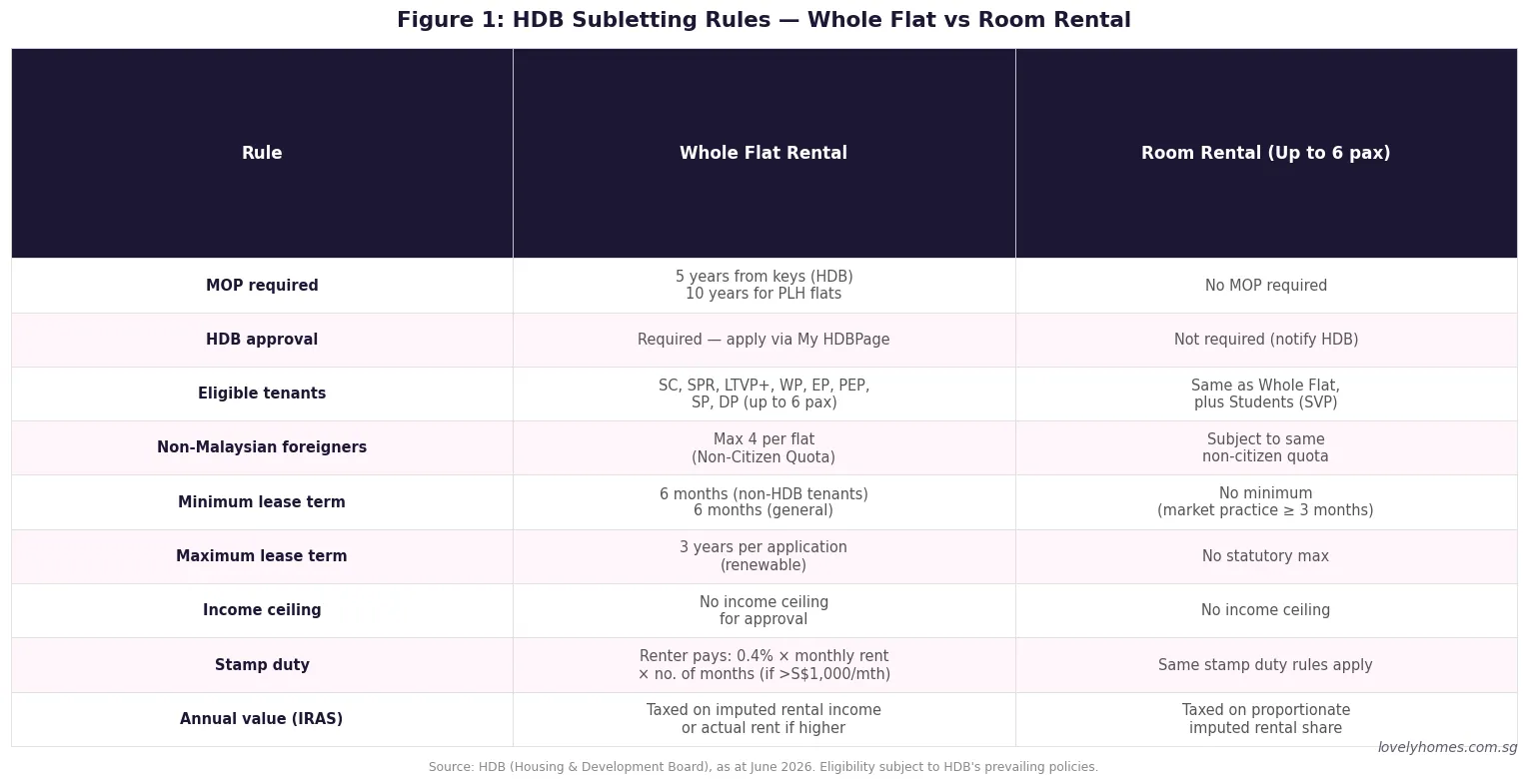
HDB subletting eligibility rules matrix — whole flat vs room rental comparison table 2026
Figure 1: HDB Subletting Rules — Whole Flat vs Room Rental. Source: HDB (Housing & Development Board), as at June 2026.

Understanding the Two Types of HDB Subletting

HDB distinguishes sharply between whole flat subletting — renting out the entire flat while you live elsewhere — and subletting of bedrooms — renting individual rooms to tenants while you continue to reside in the flat. The rules, approval requirements, and consequences differ materially between these two arrangements.

Whole flat subletting is governed by HDB’s subletting policy, which requires formal approval before the arrangement begins. You must have fulfilled the flat’s Minimum Occupation Period (MOP), and you must apply via the My HDBPage portal. HDB will assess the proposed tenancy, verify that the tenant nationality and headcount are within prescribed limits, and issue an approval letter. Each approval covers a tenancy of up to three years, after which you must renew. The key point: subletting without approval where approval is required exposes you to enforcement action, including — in the most serious cases — compulsory acquisition of the flat by HDB at below-market prices.

Room rental (subletting bedrooms while the owner remains resident) operates under a simpler framework. HDB approval is not required; however, you must register the arrangement via My HDBPage and ensure total headcount (owners and tenants combined) stays within your flat’s prescribed occupancy limit. Room rentals are also subject to the non-citizen subletting quota, and stamp duty rules apply in the same way as for whole-flat tenancies.

Minimum Occupation Period Requirements

The MOP for whole flat subletting mirrors the MOP for the right to sell: five years for standard BTO and resale HDB flats, counting from the date on which you received the keys. For flats classified as Prime Location Public Housing (PLH) — including certain Rochor and Queenstown sites — the MOP is 10 years. Executive Condominiums (ECs) have a separate MOP framework and are not governed by HDB subletting rules once the EC reaches 5 years from TOP, at which point it is treated as a privatised development.

PLH flats and subletting restriction. Prime Location Public Housing flats carry a 10-year MOP and an additional restriction: even after MOP, you may only sublet the whole flat for up to 5 years in aggregate over your ownership period. HDB introduced this rule in November 2021 to curb investment speculation in centrally located public housing.

Room rental (subletting individual bedrooms) has no MOP restriction. You may sublet rooms from day one of ownership, provided you are residing in the flat and the headcount limits are met. This makes room rental a popular arrangement for younger owners in the early years of their mortgage.

Eligible Tenants: Nationality and Pass Requirements

HDB maintains an approved list of eligible tenant groups. For both whole flat and room rental, the following categories are permitted:

  • Singapore Citizens (SC)
  • Singapore Permanent Residents (SPR)
  • Long-Term Visit Pass Plus holders (LTVP+)
  • Employment Pass (EP) holders
  • S Pass (SP) holders
  • Work Permit (WP) holders
  • Personalised Employment Pass (PEP) holders
  • Dependent Pass (DP) holders
  • Student Pass (SVP) holders — for room rental only

Visitor Pass and Short-Term Visit Pass holders are not eligible. Any person on a pass with fewer than three months remaining validity at tenancy commencement is also ineligible. Tourists and individuals on social visit passes may not be HDB tenants under any circumstances.

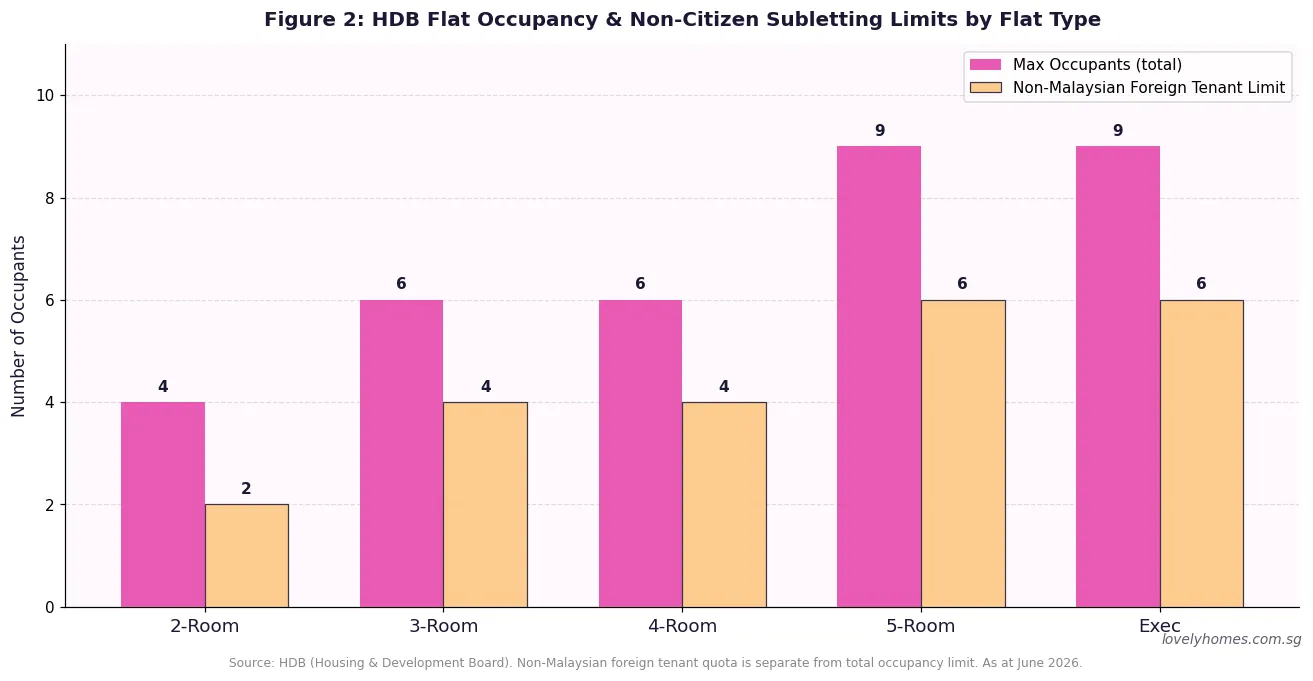
HDB flat occupancy limits and non-citizen subletting quota by flat type 2026
Figure 2: HDB Flat Occupancy & Non-Citizen Subletting Limits by Flat Type. Source: HDB, as at June 2026.

The Non-Citizen (Non-Malaysian) Subletting Quota

One of the more nuanced rules in HDB subletting is the non-citizen quota, commonly referred to as the non-Malaysian foreign tenant quota. This quota limits the proportion of non-Malaysian foreign nationals who may reside in any given HDB block or neighbourhood at any point in time. Malaysians are exempt from this quota because of Singapore’s longstanding demographic and historical ties with Malaysia.

HDB does not publish precise quota thresholds publicly for each estate, but landlords can verify whether a specific address is subject to quota restrictions via the My HDBPage portal before entering into any tenancy agreement. If the block is at or near its quota, HDB will not approve the tenancy or register the foreign national as an occupant.

Practical implication: if your block is popular with foreign tenant populations — often blocks near MRT stations, industrial zones, or international schools — check quota availability before committing to a non-Malaysian foreign national tenant. Failing to comply with the quota, whether intentionally or inadvertently, may result in HDB revoking your subletting approval.

The Application Process for Whole Flat Subletting

Applying to sublet your whole HDB flat is a straightforward process conducted through My HDBPage. The steps are:

  1. Log in to My HDBPage via your SingPass credentials and navigate to the subletting application under “Manage My Flat”.
  2. Submit tenant details: full name, NRIC or passport number, pass type and expiry date, and intended tenancy dates.
  3. HDB reviews the application and verifies eligibility. Processing typically takes three to five working days.
  4. Receive the approval letter. You must not allow the tenant to move in before receiving HDB’s written approval.
  5. Stamp the tenancy agreement with IRAS via the e-Stamping portal within 14 days of signing (if signed in Singapore) or 30 days (if signed overseas).
  6. Notify HDB of early termination if the tenancy ends before the approved period, via My HDBPage.

Stamp Duty on HDB Tenancy Agreements

Stamp duty on a tenancy agreement is governed by the Stamp Duties Act, administered by IRAS. The obligation to stamp falls on the tenant, unless contractually agreed otherwise. The formula is:

Tenancy Duration Stamp Duty Formula Example: S$2,800/mth, 24 months
Up to 1 year 0.4% of annual rent 0.4% x S$2,800 x 12 = S$134
1–3 years 0.4% x average annual rent x lease years 0.4% x S$2,800 x 12 x 2 = S$269
More than 3 years 0.4% x average annual rent x 4 (deemed) N/A for typical HDB 2-year tenancy
Room rental (per room agreement) Same formula applied to room rent amount if > S$1,000/mth 0.4% x S$1,100 x 12 = S$53

Stamp duty must be paid within 14 days of signing (in Singapore) or 30 days (overseas). Late stamping incurs a penalty of up to four times the unpaid duty.

Rental Income Tax: What HDB Landlords Must Declare

Rental income from HDB subletting — whether whole flat or room rental — is assessable income under the Income Tax Act and must be declared to IRAS in your annual personal income tax return. IRAS permits landlords to deduct allowable expenses against rental income:

  • Mortgage interest — only the interest component, not principal repayment.
  • Property tax — the annual tax levied on the flat by IRAS.
  • Fire insurance premium.
  • Maintenance and repair costs — not capital improvements or renovations.
  • Agent commission — if a licensed property agent facilitated the tenancy.
  • Furniture wear and tear — on an allowable depreciation basis, not full replacement cost.

For partial subletting (room rental), only a proportionate share of allowable expenses may be deducted, corresponding to the number of rooms sublet as a fraction of total rooms in the flat.

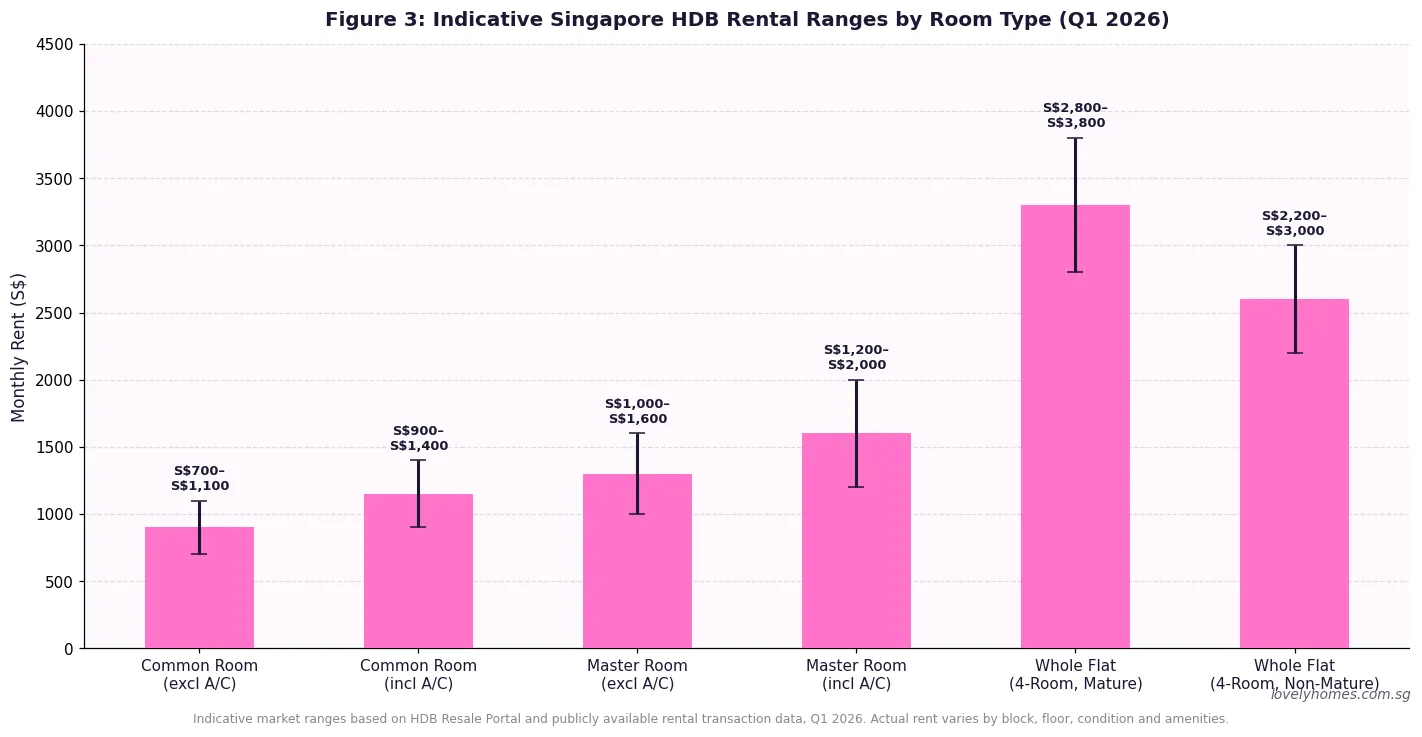
Indicative HDB room and whole flat rental price ranges Singapore Q1 2026
Figure 3: Indicative Singapore HDB Rental Ranges by Room Type, Q1 2026. Source: HDB Resale Portal transaction data. Actual rent varies by location, floor, condition and amenities.

Worked Example: 5-Room HDB Owner Subletting Two Rooms

Scenario: Mr and Mrs Tan, SC Couple — Bishan 5-Room HDB

Mr and Mrs Tan own a 5-room HDB flat in Bishan purchased in 2019. Their MOP was cleared in February 2024. They decide to sublet two bedrooms to offset their remaining HDB loan of S$450,000 at 2.6% per annum, equating to approximately S$2,038 per month.

Arrangement: Room rental — two bedrooms sublet; the Tans remain resident in the master bedroom. Total occupancy: 4 persons — within the 5-room flat’s prescribed limit of 9 persons.

Room 1 (common room, with A/C): S$1,150/mth
Room 2 (junior master, with A/C): S$1,500/mth
Total gross rental income per annumS$31,800
Proportionate deductible expenses (2 of 4 bedrooms = 50%):
  Mortgage interest (est. S$7,020 p.a.) x 50%S$3,510
  Property tax (est. S$1,700 p.a.) x 50%S$850
  Insurance and maintenance x 50%S$300
Total deductible expensesS$4,660
Net assessable rental incomeS$27,140
Estimated additional income tax (added to employment income at ~8% marginal rate)~S$2,170 p.a.

Stamp duty: Room 1 (12-mth lease, S$1,150/mth): S$1,150 x 12 x 0.4% = S$55. Room 2 (12-mth lease, S$1,500/mth): S$1,500 x 12 x 0.4% = S$72. Total: S$127 (borne by tenants under standard agreement terms).

Net monthly benefit: S$2,650/mth gross rental income minus approximately S$181/mth estimated tax cost leaves the Tans with approximately S$2,469/mth net — comfortably covering their S$2,038 monthly mortgage payment, with S$431/mth surplus.

What This Means for HDB Owners in 2026

The HDB rental market in 2026 remains favourable for landlords. Private rental supply has moderated as fewer expatriates take full-flat leases, and HDB flats — particularly in mature estates with MRT connectivity — continue to attract strong demand from both local and foreign tenants seeking affordable alternatives to private rentals.

The 13,480 HDB flats reaching their 5-year MOP in 2026 represent the largest single-year cohort to become MOP-eligible since 2020. Many owners are considering subletting the whole flat as part of an upgrade strategy: purchase a private property while the HDB flat generates rental income to offset the new mortgage, then sell the HDB within the ABSD remission window if applicable. This “bridge rental” strategy is legal and relatively common among upgraders, but requires careful timing to avoid ABSD clawback. See our ABSD remission guide for the full timing rules.

Room rental remains the most tax-efficient and legally low-friction subletting option for owner-occupiers. The absence of a formal HDB approval process, combined with the ability to start from day one of ownership, makes room rental attractive for younger owners in the early years of their mortgage. Common room rents in mature estates have held firm at S$900–S$1,400 per month inclusive of utilities, driven by demand from younger working professionals and foreign students attending universities in the Central and North regions.

What Might Come Next

HDB’s post-2022 policy adjustments have been focused primarily on the sales market rather than the rental market. However, policymakers have signalled awareness of affordability concerns in the rental sector. The February 2023 tightening of short-term letting rules — which strengthened the prohibition on Airbnb-style subletting of HDB flats for periods shorter than six months — was a reminder that HDB will act when rental patterns conflict with its social objectives. Future tightening could include stricter enforcement of occupancy limits, expanded PLH restrictions on subletting duration, or a broadening of the non-citizen quota framework to cover additional nationalities. For now, the rules described in this guide reflect HDB’s posture as at June 2026, and no changes to the subletting framework have been publicly signalled for the remainder of 2026.

Frequently Asked Questions

Can I sublet my whole HDB flat if I have not completed MOP?
No. Whole flat subletting requires you to have fulfilled the Minimum Occupation Period — five years for standard flats, ten years for PLH-designated flats. The MOP clock for BTO flats starts from the date you collect your keys. If you sublet your whole flat before MOP without HDB approval, you are in breach of HDB’s terms and conditions, and HDB may compulsorily acquire your flat at a price it determines — typically below market value.
Do I need HDB approval to rent out a room in my flat?
No formal approval is required for room rental, but you must notify HDB via My HDBPage. You must be residing in the flat yourself, and the total number of occupants must not exceed the prescribed limit for your flat type. You must also ensure any non-Malaysian foreign national tenant does not cause the block or neighbourhood to exceed its non-citizen quota. HDB will reject the registration if the quota is full for that nationality at your address.
Can foreigners rent HDB flats?
Yes, provided they hold an eligible pass (EP, S Pass, WP, DP, LTVP+, etc.) with at least three months’ remaining validity at tenancy commencement. However, non-Malaysian foreign nationals are subject to HDB’s non-citizen subletting quota. If the block or neighbourhood quota has been reached, HDB will not approve or register the tenancy of that foreign national. Landlords should check quota availability via My HDBPage before committing to a foreign tenant to avoid a situation where the tenancy agreement is signed but cannot be registered.
What happens if I sublet my HDB flat without required approval?
Subletting your whole HDB flat without HDB’s prior written approval is a serious breach. Enforcement actions escalate from written warnings and financial penalties to — in the most serious cases — compulsory acquisition of the flat at HDB’s assessed price, which is typically below market value. HDB conducts regular estate inspections and acts on public tip-offs. Subletting without approval is treated as a fundamental misuse of public housing resources, not a minor technical infraction.
Is rental income from my HDB flat taxable?
Yes. Rental income from HDB subletting must be declared to IRAS in your annual personal income tax return. You may deduct allowable expenses such as mortgage interest, property tax, fire insurance, agent commission, and maintenance costs. For partial subletting (room rental), only a proportionate share of these expenses is deductible. Capital expenditure — renovation, new air-conditioning installation, bathroom fitting — is generally not fully deductible, though a wear-and-tear allowance may apply to furnishings. IRAS provides detailed guidance at iras.gov.sg.
Can I increase rent mid-tenancy?
No, unless the tenancy agreement includes an explicit rent review clause permitting increases at specified intervals. A tenancy agreement is a legally binding contract, and unilaterally increasing rent outside its terms is a breach of contract that exposes you to a claim by the tenant. If you wish to revise the rent, negotiate a mutual variation to the agreement, have it signed by both parties, and stamp the variation document with IRAS. Alternatively, allow the fixed-term tenancy to expire and offer a new tenancy at the revised rent.
What is the maximum number of people allowed in my HDB flat?
HDB’s prescribed occupancy limits by flat type are: 2-Room Flexi — 4 persons; 3-Room — 6 persons; 4-Room — 6 persons; 5-Room — 9 persons; Executive — 9 persons. These limits apply to all persons physically residing in the flat — owners, authorised occupants, and tenants combined. HDB introduced these limits in 2012 to address overcrowding. For room rental, ensure that adding tenant headcount does not push the total above the prescribed limit for your flat type.
Disclaimer: The information in this article is for general educational purposes only and reflects HDB subletting rules as at June 2026. HDB policies may change; always verify current rules at hdb.gov.sg. Tax information is a general summary of IRAS rules; individual tax obligations depend on your specific circumstances. Stamp duty figures are illustrative. This article does not constitute legal, tax, or financial advice. Consult a licensed solicitor, a qualified tax adviser, or an HDB-registered property agent for advice tailored to your situation.

Singapore Rental Income Tax Guide 2026: IRAS Rules, Deductions and What Every Landlord Must Declare

Singapore Rental Income Tax Guide 2026: IRAS Rules, Deductions and What Every Landlord Must Declare

If you own a Singapore property and collect rent, that income is taxable — and IRAS expects you to declare it accurately each year. Yet many landlords either over-pay by missing legitimate deductions, or under-declare by misunderstanding what counts as gross rental income. This guide covers everything a Singapore landlord needs to know about rental income tax in 2026: what is taxable, what you can deduct, how progressive income tax rates apply, when non-residents pay a flat rate, and exactly how to file with IRAS — with a full worked dollar calculation.

Quick Answer: Singapore Rental Income Tax 2026

  • Rental income from Singapore properties is taxable under the Income Tax Act, administered by IRAS.
  • Gross rental income includes rent, furniture/fittings allowances paid by tenant, and any service charges you receive.
  • Key deductible expenses: mortgage interest (not principal), property tax, agent commission, insurance, and maintenance/repairs.
  • Mortgage principal repayment is not deductible — only the interest portion qualifies.
  • Net rental income (gross rent minus allowable deductions) is added to your other chargeable income and taxed at progressive rates up to 24% (YA2026).
  • For non-resident landlords, rental income is taxed at 22% (flat rate, regardless of amount).
  • Filing deadline: 18 April (e-filing) for income earned in the preceding calendar year.
  • HDB flat subletters must obtain HDB approval before subletting; failure to declare rental income is an IRAS offence.
  • Overseas property rental income is generally not taxable in Singapore unless remitted to Singapore through a Singapore partnership or business.
  • IRAS may conduct rental income compliance checks — keeping good records is essential.

What Counts as Rental Income in Singapore?

Under the Income Tax Act (Cap. 134), rental income is defined as income arising from the letting of immovable property in Singapore. This includes not just the monthly rent but all amounts you receive in connection with the tenancy. Specifically, IRAS includes the following as taxable rental income:

  • Monthly rent (whether paid in advance, in arrears, or as lump sum)
  • Furniture and fittings allowances paid directly to the landlord by the tenant
  • Service charges or maintenance charges collected by the landlord and not passed directly to a management corporation
  • Rental deposits that are applied as rent or that the landlord retains (deposits returned in full are not income)
  • Any consideration for granting, renewing, extending, or surrendering a lease

Notably, the security deposit is not income at the point of collection — it is the tenant’s money held in trust. Only if you retain part or all of the deposit at the end of the tenancy (as compensation for damage or unpaid rent) does it become taxable in that Year of Assessment. Similarly, amounts paid by a tenant directly to a third-party service provider (e.g., PUB utility bills in the tenant’s name) are not your income.

Allowable Deductions Against Rental Income

Singapore’s IRAS allows landlords to deduct revenue expenses that are incurred wholly and exclusively in the production of rental income. Capital expenses — improvements that extend the life or fundamentally alter the property — are generally not deductible (though you may claim an annual allowance on qualifying plant and machinery). The distinction between repairs (revenue, deductible) and improvements (capital, not deductible) is one of the most contested areas in rental tax disputes.

Figure 1: Deductible vs non-deductible rental expenses IRAS Singapore 2026
Figure 1: Deductible vs non-deductible rental expenses under IRAS rules (Singapore 2026). Mortgage interest is deductible; principal repayment is not. Source: IRAS | lovelyhomes.com.sg

Deductible Expenses

Mortgage interest: The interest portion of your home loan repayment is deductible in the year it is paid or accrued. You must obtain a statement from your bank each year showing the breakdown of principal and interest — most Singapore banks provide this as an annual mortgage statement or at the borrower’s request. Only interest on a loan taken to acquire or improve the property qualifies; refinancing costs (legal fees, valuation fees) are deductible as a revenue expense in the year incurred.

Property tax: Annual property tax paid to IRAS on the rental property is deductible. If you are renting out only part of the property (e.g., subletting spare bedrooms in your own home), only the proportionate share of property tax applicable to the sublet area is deductible.

Estate agent or property management commission: Commission paid to a CEA-registered agent for securing tenants is deductible. If you pay a property management company an ongoing monthly management fee, this is also deductible.

Insurance: Fire insurance, landlord’s liability insurance, and home contents insurance (where the landlord — not tenant — bears the premium) are deductible. Mortgage-linked MRTA or MLTA insurance premiums are not deductible against rental income.

Repairs and maintenance: Costs of maintaining the property in its existing state — plumbing repairs, painting, replacing broken fittings, and routine servicing — are deductible. Replacing a broken air conditioner with an equivalent unit is a repair; adding a new ducted air conditioning system where none existed before is a capital improvement and is not immediately deductible (though it may qualify for plant and machinery allowance).

Furniture and fittings — deemed deduction for HDB rooms: For HDB flat owners subletting individual rooms, IRAS allows a deemed deduction of S$150 per month per sublet room for furniture and fittings, without the need to produce receipts. For private property landlords letting the whole unit furnished, you may claim an annual allowance of 20% of the cost of qualifying furniture and fittings each year (over 5 years), or the actual replacement cost when items are replaced.

Non-Deductible Expenses

  • Mortgage principal repayment: Only the interest component is deductible. The principal reduces your loan balance and is considered a capital repayment — it creates a capital asset (equity in the property) and therefore cannot be expensed against rental income.
  • Capital improvements: Additions or alterations that increase the value or extend the useful life of the property (e.g., installing a lift, adding a new bathroom, full gutting and rebuilding) are capital in nature and not immediately deductible.
  • Renovation and reinstatement costs borne by tenant: If your tenant bears the cost of renovation or reinstatement directly, this is not your expense to claim.
  • Personal expenses: Costs that are partly personal — such as a home office deduction for a property you also use personally — are not allowable unless you can clearly demarcate the portion used exclusively for rental.

How Rental Income Is Taxed: Progressive Rates

Net rental income (after deductions) is added to your total chargeable income for the Year of Assessment (YA) and taxed at Singapore’s progressive personal income tax rates. The YA is the year following the income year — so rental income earned in calendar year 2025 is assessed in YA2026. Singapore’s personal income tax rates are among the more moderate in the Asia-Pacific region for middle incomes, but the top marginal rate was raised to 24% for chargeable income above S$1 million from YA2024 onwards.

Figure 2: Singapore personal income tax rates marginal rates by income band YA2026
Figure 2: Singapore personal income tax — marginal rates by chargeable income band (YA2026). Most landlords with one rental property fall in the 7–18% marginal range. Source: IRAS | lovelyhomes.com.sg
Chargeable Income (S$) Marginal Rate Tax on Band (S$) Cumulative Tax (S$)
First S$20,000 0% 0 0
Next S$10,000 2% 200 200
Next S$10,000 3.5% 350 550
Next S$40,000 7% 2,800 3,350
Next S$40,000 11.5% 4,600 7,950
Next S$40,000 15% 6,000 13,950
Next S$40,000 18% 7,200 21,150
Next S$40,000 19% 7,600 28,750
Next S$40,000 19.5% 7,800 36,550
Next S$40,000 20% 8,000 44,550
Next S$180,000 23% 41,400 85,950
Next S$500,000 23.5% 117,500 203,450
Above S$1,000,000 24%

Worked Example: Mr Chen’s Rental Income Calculation

Mr Chen is a Singapore Citizen, aged 45, working as a finance manager earning S$120,000 per year. He owns a 2-bedroom condominium in District 15 which he lets out fully furnished at S$3,800 per month. His mortgage on the property is S$1.4 million outstanding at 3.0% per annum (bank loan). Here is how his rental income is assessed for YA2026 (income year 2025):

Figure 3: Singapore rental income tax calculation gross rent to net tax payable waterfall
Figure 3: Rental income tax calculation — from gross rent to net tax payable (illustrative). Mortgage interest is the largest deduction for leveraged landlords. Source: IRAS | lovelyhomes.com.sg

Step 1 — Gross rental income: S$3,800 × 12 = S$45,600

Step 2 — Allowable deductions:

  • Mortgage interest (3% on S$1.4M, interest portion in Year 1): S$10,200
  • Property tax (Annual Value S$36,000 × 10% owner-occupier rate — but since fully let out, taxed at 12%): S$3,600 (illustrative; actual depends on AV)
  • Agent commission (secured 2-year tenancy at 1 month’s rent): S$3,800 ÷ 2 = S$1,900 (apportioned to 2025) + S$1,900 (renewal in 2024, deducted 2025) — total S$4,142 (illustrative)
  • Fire insurance: S$420
  • Maintenance and repairs: S$1,200
  • Furniture and fittings wear and tear (20% p.a. on S$9,000 of qualifying items): S$1,800
  • Total deductions: S$21,362

Step 3 — Net rental income: S$45,600 − S$21,362 = S$24,238

Step 4 — Total chargeable income: Employment income S$120,000 + Net rental S$24,238 = S$144,238, less earned income relief S$3,000 and CPF relief (capped) S$15,300 = total chargeable income approximately S$125,938.

Step 5 — Tax on chargeable income (YA2026): On S$125,938, the progressive tax calculation yields approximately S$12,700 total tax (effective rate ~10.1%). Without the rental deductions, chargeable income would be S$148,476 yielding tax of approximately S$17,600 — a saving of roughly S$4,900 from claiming legitimate deductions.

Special Rules for HDB Flat Subletting

HDB flat owners who sublet bedrooms (not the whole flat) must first obtain HDB’s approval before any subletting commences. This applies even if the subletting is to family members. HDB approval is granted for up to 2 years at a time and requires that the flat owner continues to reside in the flat. Income earned from approved bedroom subletting is taxable. The S$150-per-room-per-month deemed deduction for furniture and fittings applies.

If you own an HDB flat and have completed MOP, you may sublet the entire flat (subject to HDB approval and subletting quotas for foreigners). Whole-flat subletting income is taxed in the same way as private property rental income: gross rent minus allowable deductions, added to chargeable income. Subletting an HDB flat without HDB’s approval is a breach of the Housing & Development Act and can result in compulsory acquisition of the flat — independent of the IRAS tax liability.

Non-Resident Landlords: Flat 22% Withholding Tax

If you are a non-resident individual for tax purposes — broadly, someone who spends fewer than 183 days in Singapore in the basis year — your Singapore rental income is taxed at a flat rate of 22% on the gross rental income. You may still claim allowable deductions; the 22% applies to your net chargeable rental income. If you are a Singapore Citizen or Permanent Resident who is temporarily overseas (e.g., on an overseas posting), your Singapore tax residency status is assessed by IRAS on a case-by-case basis — most citizens on short overseas postings retain Singapore tax resident status.

Foreign companies or entities receiving Singapore rental income are subject to corporate tax at 17% on net rental income, subject to qualifying deductions and the standard corporate income tax framework.

Overseas Property Rental Income

Singapore operates on a territorial basis of taxation. Rental income from overseas properties is generally not taxable in Singapore — regardless of whether you remit the funds to Singapore — provided the income is not received through a Singapore partnership or business structure. For most individual Singapore resident landlords with overseas investment properties, the rental income from those overseas properties is assessed and taxed in the jurisdiction where the property is located, not in Singapore.

An exception arises if the overseas rental income is received through a Singapore-registered partnership, in which case it forms part of the partnership’s Singapore-sourced income and is taxable here. Individuals who use Singapore-incorporated investment holding companies to hold overseas properties should seek specific tax advice on the foreign-sourced income exemption provisions.

Filing Obligations and Deadlines

Rental income must be declared in your annual income tax return filed with IRAS. The key deadlines are:

  • 15 April — paper return deadline (Form B or B1)
  • 18 April — e-filing deadline via myTax Portal (strongly recommended; auto-saves and provides immediate acknowledgement)
  • IRAS may issue a notice of assessment based on information it holds; if the notice is incorrect, you have 30 days to object in writing.

You should retain rental income and expense records (bank statements, mortgage statements, receipts, tenancy agreements, and HDB approval letters where applicable) for at least 5 years after the YA in which the income was earned. IRAS has the power to raise estimated assessments if returns are not filed, and may impose penalties of up to 200% of the underpaid tax in cases of deliberate under-declaration.

Why This Matters: Rental Income Tax Is Widely Under-Optimised

Many Singapore landlords pay more rental income tax than necessary simply because they do not claim all allowable deductions. The single most commonly missed deduction is mortgage interest — particularly for landlords who received the property as a gift or inheritance and later mortgaged it, or who refinanced and forgot to track the interest breakdown. The second most commonly missed deduction is agent commission, particularly when the commission was paid across a year boundary. IRAS does not proactively inform landlords of missed deductions — the obligation to claim is entirely on the taxpayer.

Conversely, IRAS has increased its cross-referencing of HDB subletting approvals with declared rental income since 2022. Landlords who have approved subletting on record but who do not declare the corresponding rental income are at risk of compliance action. If you have missed declaring rental income in a prior year, IRAS’s Voluntary Disclosure Programme allows you to come forward with reduced penalties.

What Might Come Next

This section reflects analysis as of June 2026 and is speculative in nature.

With Singapore private residential rents having fallen approximately 1.2% quarter-on-quarter in Q1 2026 (after the sharp rises of 2022–2023), the net rental income of many leveraged landlords is narrowing. If mortgage interest rates remain elevated relative to the peak rent years, some landlords may find their rental properties generating a net loss for tax purposes — which, subject to IRAS’s anti-avoidance rules, could be carried forward to offset future rental income. A review of the deemed S$150-per-room deduction for HDB subletting (unchanged for many years) may be warranted as renovation and furniture costs have risen significantly since this figure was set.

Frequently Asked Questions

Can I deduct the full mortgage repayment from my rental income?

No. Only the interest portion of your mortgage repayment is deductible against rental income. The principal component reduces your loan balance and builds your equity — it is a capital item, not a revenue expense, and IRAS does not allow it as a deduction. To find your interest portion, request an annual loan statement from your bank; most Singapore banks provide a breakdown of principal and interest for each repayment month.

What if my rental property is vacant for part of the year — do I still pay tax?

You only pay tax on income actually received. If your property is vacant for, say, 3 months, you declare 9 months of rental income. However, during the vacant period, deductible expenses such as mortgage interest and property tax continue to accrue. IRAS allows you to deduct expenses proportionate to the period the property was available for letting — meaning expenses during a vacancy where you were actively seeking a new tenant are deductible. Expenses during a period when the property was taken off the market for personal use are not deductible.

I sublet two bedrooms in my HDB flat. Do I need to declare this income?

Yes. All rental income from approved HDB bedroom subletting is taxable. You must declare it in your annual income tax return. For each sublet room, you may claim the deemed deduction of S$150 per month for furniture and fittings without producing receipts. You may also claim your proportionate share of mortgage interest, property tax, and actual maintenance costs attributable to the sublet rooms. If you rent two rooms at S$1,200 per room per month in a 4-room flat, your gross rental income is S$28,800 per year and your deemed furniture deduction is S$3,600 (S$150 × 2 rooms × 12 months).

Is rental income subject to GST?

Residential property rental is exempt from Goods and Services Tax (GST). You do not need to charge GST on rent collected from residential tenants, and you cannot claim input GST on expenses related to residential rental. Commercial property rental, however, is a taxable supply for GST purposes — if your taxable turnover (including commercial rental) exceeds S$1 million per year, you must register for GST. Mixed-use properties (partly residential, partly commercial) require proportional GST treatment; seek specific advice from an IRAS-registered GST agent.

Can I claim renovation costs as a deduction?

It depends on the nature of the renovation. Repairs and maintenance that restore the property to its original condition — repainting, fixing plumbing, replacing broken tiles like for like — are revenue expenses and are deductible in the year incurred. Improvements that add new features, increase the property’s value, or extend its useful life — installing a new air conditioning system, adding built-in wardrobes where none existed, or extending a room — are capital expenditure and are not deductible as a revenue expense. Some items of qualifying plant and machinery (e.g., air conditioning units, kitchen appliances let with the property) may qualify for capital allowances spread over 3 years at the accelerated rate.

What happens if I forget to declare rental income from a prior year?

IRAS has a Voluntary Disclosure Programme (VDP) that allows taxpayers who discover past under-declarations to come forward voluntarily. Under the VDP, penalties are reduced significantly — typically waived or capped at 5% of the additional tax payable — compared to penalties of up to 200% if IRAS discovers the under-declaration through an audit. To make a VDP disclosure, you file a revised return or write to IRAS explaining the error and the correct amount. It is far better to disclose proactively than to wait for IRAS to contact you, as the VDP penalty concessions are only available if IRAS has not already commenced an audit of your account.

Do I pay tax if I rent my property to a family member at below-market rent?

You declare the actual rent received, not the market rent, when letting to family members at a concessionary rate. There is no IRAS rule requiring you to impute market rent on below-market tenancies with family members — unlike some other jurisdictions. However, if the arrangement results in a net loss (expenses exceed concessionary rent), IRAS may disallow the loss on the basis that the rental was not commercially conducted. If the property is genuinely available for letting at market rates and a family member happens to be the tenant at a reduced rate, keeping documentation of the commercial basis of the arrangement is prudent.

Related Articles


Disclaimer: This article is for general informational purposes only and does not constitute tax, legal, or financial advice. All tax rates, deduction rules, and filing deadlines cited are based on IRAS guidance as at June 2026 and are subject to change. Readers should verify current rules at iras.gov.sg and consult a registered tax professional or accountant before filing. The worked examples are illustrative; actual tax liability depends on individual circumstances, applicable reliefs, and IRAS’s assessment.

Singapore Private Property Rental Guide 2026: How to Rent Out Your Condo

Singapore Private Property Rental Guide 2026: How to Rent Out Your Condo

No Minimum Occupation Period, no HDB approval to wait for, no Non-Citizen Quota headaches — private property landlords in Singapore enjoy a straightforward path to rental income. This guide walks you through every step, from setting an asking rent to declaring income with IRAS, with figures drawn from URA transaction data for Q1 2026.

Quick Answer: Key Facts About Renting Out a Private Property in Singapore (2026)

  • No MOP applies to private condominiums, apartments, or landed houses — you may rent your property out immediately after purchase, regardless of nationality.
  • Minimum rental period: 3 consecutive months. Short-term lets under 3 months (including Airbnb-style arrangements) are not permitted without URA approval and carry fines up to S$200,000.
  • Occupancy cap: up to 6 unrelated persons for units <90 sqm; up to 8 for units ≥90 sqm (extended to 31 December 2026 by URA).
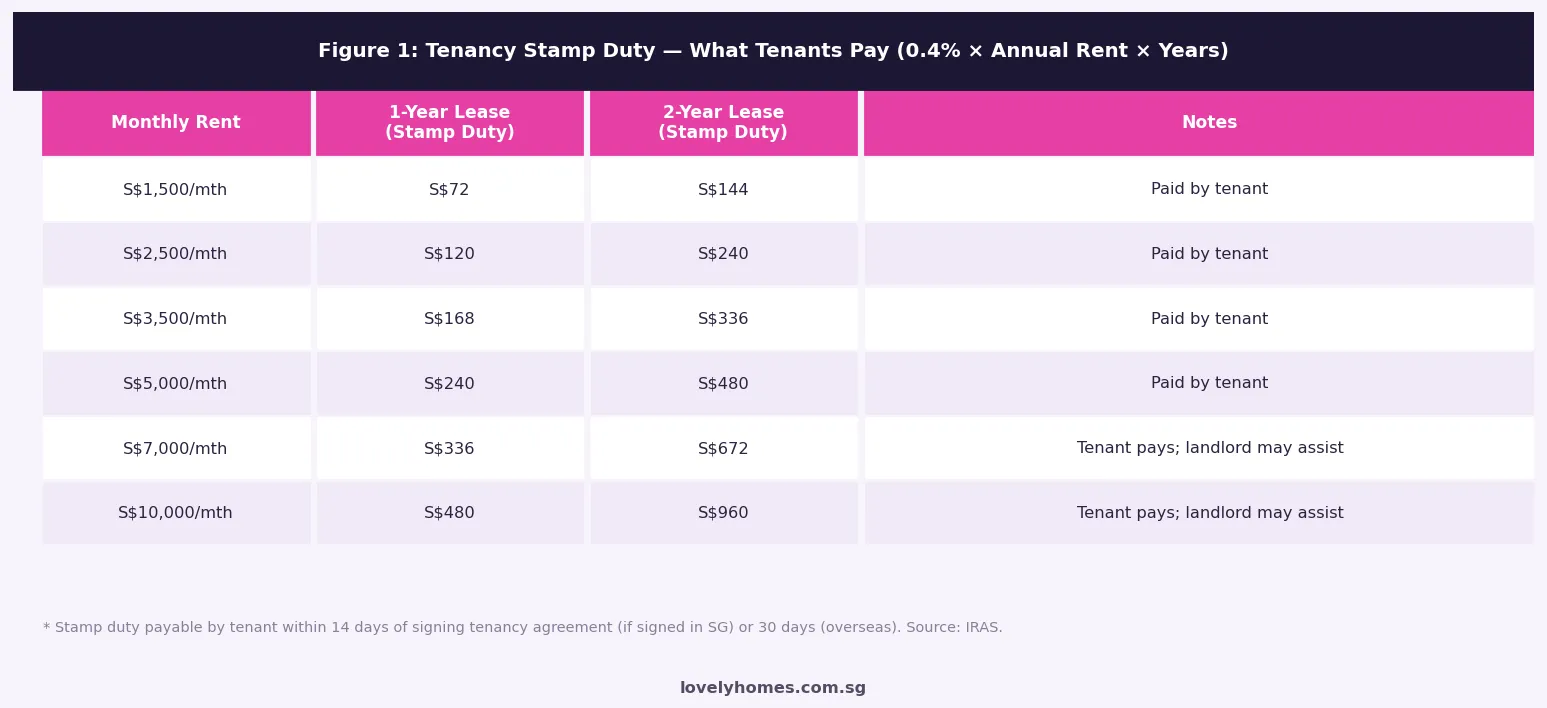
  • Stamp duty on tenancy is paid by the tenant, not the landlord: 0.4% × annual rent × lease years, payable within 14 days of signing.
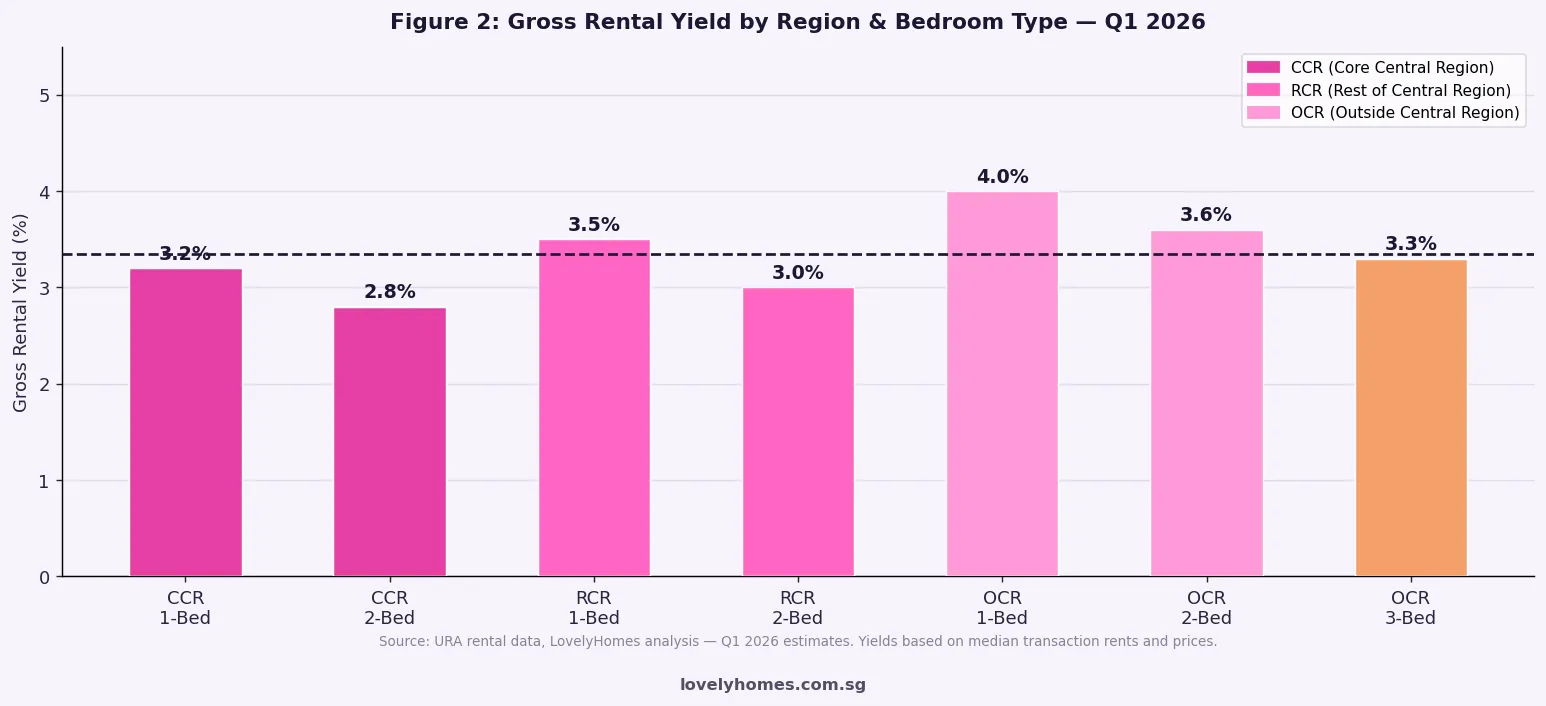
  • Gross rental yields range from 3.0% (CCR 2-bed) to 4.0% (OCR 1-bed) as at Q1 2026, based on URA median rent and price data.
  • Security deposit: 1 month for a 1-year lease; 2 months for a 2-year lease — held in trust by the landlord throughout tenancy.
  • IRAS taxable income: rental proceeds are assessable; allowable deductions include mortgage interest, property tax, agent commission, and qualifying repairs.

Who Can Rent Out a Private Property in Singapore?

Unlike HDB flats, private residential properties in Singapore carry no Minimum Occupation Period. A Singapore Citizen, Singapore Permanent Resident, or foreigner who legally owns a private condominium, apartment, or landed house may rent it out from the day of purchase. There is no HDB portal to seek approval through, and no requirement to occupy the property first.

The only eligibility constraint is that the property must have obtained its Temporary Occupation Permit (TOP) or Certificate of Statutory Completion (CSC) before a tenancy can commence. Properties still under construction cannot be occupied or rented, even if the Sale and Purchase Agreement has been executed.

Owners of Executive Condominiums (ECs) are subject to a different regime: during the first 5 years post-TOP, the EC is treated as a public housing flat and subletting is prohibited. After the 5-year Minimum Occupation Period but before the 10-year privatisation, ECs may be rented out subject to rules similar to HDB flats. Only after the 10-year mark do ECs become fully privatised and freely rentable.

URA Rules: Minimum Lease Period and Occupancy Limits

The Urban Redevelopment Authority (URA) is the primary regulator of private residential rentals. Two rules are non-negotiable:

Minimum 3-month tenancy. Every tenancy must cover at least 3 consecutive months. This rule was introduced to prevent the proliferation of short-term holiday lets that erode residential character. Violations attract fines of up to S$200,000 for the property owner. Platforms such as Airbnb and Agoda may not be used for listings below 3 months without a URA exemption, which is rarely granted for residential units.

Occupancy limits. URA caps the number of unrelated persons who may occupy a private residential unit simultaneously. For units smaller than 90 sqm, the limit is 6 unrelated persons. For units of 90 sqm or larger, URA raised the cap to 8 persons in 2024 and has extended this to 31 December 2026 to ease supply pressure in the rental market. Family members are not counted toward the unrelated persons cap.

Beyond the occupancy rule, URA also requires that any tenant who is a foreigner must hold a valid Long-Term Visit Pass, Employment Pass, S Pass, Work Permit, Dependent Pass, or Student Pass. Short-stay visitors on social visit passes may not be named tenants.

Setting Your Rental Price

Pricing a private property correctly is the single most important factor in minimising vacancy. A unit priced S$200–S$300 above market may sit empty for 4–6 weeks; at current yields of 3–4%, that vacancy erodes more income than a moderate price concession would.

The URA publishes median transacted rents quarterly, and the SRX portal aggregates live rental listings. As a starting point, research transactions in the same postal district for units of the same bedroom count, furnishing level, and floor range within the 6 months prior to your listing date. Use the URA Rental Transactions portal (freely accessible at ura.gov.sg) to pull the raw data, rather than relying on listing prices, which are asking prices and may sit above transacted levels.

Gross rental yield by region and bedroom type Singapore Q1 2026 bar chart
Figure 2: Gross rental yield by segment — OCR 1-bed leads at 4.0%; CCR 2-bed lags at 2.8%. LovelyHomes analysis of URA Q1 2026 median rent and price data.

Gross rental yield is a useful but incomplete metric. Net yield — after property tax, agent commission, mortgage interest, and maintenance — can be 0.8–1.2 percentage points lower than gross yield for a leveraged property. To calculate gross yield: divide the annual rental income by the purchase price and multiply by 100. A 3BR OCR condo purchased at S$1,550,000 and renting for S$4,200/mth yields approximately (S$50,400 / S$1,550,000) × 100 = 3.25% gross.

Finding Tenants: DIY vs Property Agent

Singapore landlords may list their units directly on rental portals (PropertyGuru, 99.co, SRX) or engage a licensed property agent. Each approach has trade-offs:

DIY listing: No commission payable. Listing fees range from S$0 (basic) to S$200–S$400 for featured placement. You conduct all viewings, screen tenants independently, and draft or adapt a standard tenancy agreement. Suitable for landlords with experience, flexible hours, and a well-priced unit in high demand.

Engaging an agent: Typically, the landlord pays commission of approximately 1 month’s rent for a 2-year tenancy, plus GST (currently 9%). For a 1-year tenancy, some agents charge 0.5 month, and it is common for the tenant to contribute the other 0.5 month. Agent commission rates are not fixed by law, though the Council for Estate Agencies (CEA) publishes guidelines that set expected ranges. All real estate agents in Singapore must hold a valid CEA registration, which you can verify at the CEA Public Register at cea.gov.sg.

The Tenancy Agreement: Key Clauses Every Landlord Must Know

The Tenancy Agreement (TA) is the binding contract between landlord and tenant. Singapore follows English common law on tenancy matters, and courts have generally upheld clearly drafted TA clauses. Always use a written TA, executed before the tenant takes possession, and stamp it through IRAS e-Stamping within 14 days.

Several clauses deserve particular attention:

Diplomatic Clause (DC). This clause is standard in leases where the tenant is an expatriate professional. It allows the tenant to terminate a 2-year lease early after a minimum stay of 12 to 14 months, upon giving 2 months’ written notice. The rationale is that expatriates may be transferred abroad or have their employment pass cancelled at short notice. Landlords should consider whether to include the DC carefully: for high-demand units in areas popular with international tenants (Tanglin, Orchard, Holland Village, East Coast), including the DC broadens the tenant pool and reduces vacancy risk. For units in OCR estates with a predominantly local tenant profile, the DC may be unnecessary.

Minor repairs threshold. The TA should specify a dollar threshold below which minor repairs are the tenant’s responsibility. The standard range in Singapore is S$150 to S$250 per incident. Repairs above that threshold — including plumbing, electrical faults, structural defects, and major appliances — are the landlord’s obligation. Air-conditioning servicing is typically quarterly at the tenant’s cost, with the landlord responsible for major AC overhauls.

No-subletting clause. Unless you explicitly permit subletting, include a clause prohibiting the tenant from subletting to any third party, including family members not named in the TA, without the landlord’s written consent.

Inventory and condition report. A photographic inventory and condition report, signed by both parties at the point of handover, is not legally mandated but is highly advisable. It forms the evidentiary baseline if disputes arise at the end of the tenancy over the return of the security deposit.

Tenancy Stamp Duty and Security Deposit

Stamp duty on the tenancy agreement is a cost borne by the tenant (not the landlord), calculated at 0.4% of the annual rent multiplied by the number of years of the lease. For a 2-year lease at S$4,000/mth, the stamp duty is: 0.4% × S$48,000 × 2 = S$384. The tenant must pay through IRAS e-Stamping within 14 days of signing the TA if executed in Singapore, or within 30 days if signed overseas.

Tenancy stamp duty table by monthly rent and lease duration Singapore 2026
Figure 1: Tenancy stamp duty payable by tenants at different rent levels. Formula: 0.4% × annual rent × years. Source: IRAS.

The security deposit is held by the landlord throughout the tenancy and is used to offset unpaid rent or damage beyond fair wear and tear. The standard quantum is:

  • 1-year lease: 1 month’s rent as security deposit
  • 2-year lease: 2 months’ rent as security deposit

The security deposit must be returned to the tenant within a reasonable timeframe after the end of tenancy — typically 14 to 30 days — less any properly documented deductions. Landlords who withhold deposits without justification may face claims in the Small Claims Tribunal.

Managing Your Tenancy: Obligations and Best Practices

Once the tenancy commences, the landlord’s ongoing obligations include maintaining the property in a habitable condition, attending to major repairs promptly, ensuring the property tax and mortgage (if any) remain current, and registering the tenancy with URA at a one-time administrative fee of S$20 per tenancy through the URA e-Service portal.

Although Singapore law does not require landlords to register every tenancy, the S$20 registration creates a formal record that is useful if disputes arise about the lease period or the identity of authorised occupants. It is considered best practice.

8-step landlord process flowchart for renting out Singapore private property 2026
Figure 3: End-to-end landlord process — 8 steps from property preparation to IRAS income declaration. Allow 3–6 weeks in total.

Summary Table: Private Property Rental at a Glance

Item Rule / Typical Rate Who Pays Authority
Minimum Occupation Period None for private property N/A URA
Minimum lease duration 3 consecutive months N/A URA
Occupancy cap (<90 sqm) Max 6 unrelated persons N/A URA
Occupancy cap (≥90 sqm) Max 8 persons (until 31 Dec 2026) N/A URA
Tenancy stamp duty 0.4% × annual rent × years Tenant (within 14 days) IRAS
Security deposit (1-yr lease) 1 month’s rent Tenant (to landlord) Market practice
Security deposit (2-yr lease) 2 months’ rent Tenant (to landlord) Market practice
Agent commission (2-yr lease) ~1 month’s rent + 9% GST Landlord CEA guidelines
URA tenancy registration S$20 one-time Landlord URA
IRAS rental income declaration Annual (with personal income tax return) Landlord IRAS

Worked Example: The Chen Family Rent Out Their D15 Investment Condo

Scenario: SC couple renting out a 2BR freehold condo in Marine Parade (D15)

Property: 2BR, 780 sqft (72 sqm), purchased in 2021 at S$1,050,000. Monthly mortgage: S$3,300 (bank loan at current SORA package ~1.65%).

Asking rent: S$3,800/mth (based on URA Q1 2026 comparables in D15 for 2BR 700–900 sqft, median S$3,700–S$4,000/mth).

Lease: 2-year lease, with Diplomatic Clause, to an Employment Pass holder. Agent engaged at S$3,800 + 9% GST = S$4,142 commission (one-time).

Stamp duty (tenant pays): 0.4% × S$45,600 × 2 = S$365.

Security deposit collected: S$7,600 (2 months).

Gross annual rental income: S$45,600.

IRAS allowable deductions (Year 1):

  • Mortgage interest component: ~S$10,200 (estimated; not principal repayment)
  • Property tax (non-owner-occupied AV ~S$13,200, non-OO rate ~4%): S$528
  • Agent commission: S$4,142
  • AC servicing (quarterly, tenant-borne under TA): S$0 to landlord
  • Minor repairs allowance: S$350
  • Total deductions: ~S$15,220

Net taxable rental income: S$45,600 − S$15,220 = S$30,380.

Gross yield: S$45,600 / S$1,050,000 = 4.34% (D15 slightly above RCR average due to freehold, sea view).

Net cash flow after mortgage: S$45,600 − S$39,600 (mortgage) − S$528 (property tax) = +S$5,472/yr surplus. Property is largely self-funding, with tax on net income approximately S$2,280/yr (at 15% marginal rate), leaving ~S$3,190/yr net after all costs.

Why Renting Out Makes Financial Sense — and the Risks

Renting out a private property is one of the few ways Singapore resident-owners can generate a recurring, inflation-linked cash stream from an asset that also appreciates over time. Unlike REITs or equities, direct property rental gives landlords full control over the asset, no management fee layer, and the ability to claim mortgage interest as a tax deduction — a benefit not available for investment portfolio interest in Singapore.

For HDB upgraders who purchase a private property and place their HDB flat on the market within 6 months (to claim the ABSD remission), renting out the private property during the transitional period can offset the carrying cost of two mortgages. For pure investors holding an investment property outright or with modest leverage, the rental stream provides a yield that — at current SORA rates — compares favourably with Singapore Government Securities yields.

The primary risks are vacancy (particularly acute during lease renewals in a softer rental market) and tenant quality. Singapore’s Small Claims Tribunal offers a relatively efficient remedy for rental disputes up to S$30,000, but eviction for non-payment requires court proceedings under the Distress Act — a process that can take 2–4 months during which the landlord typically cannot recover rent. Thorough tenant screening at outset is the most cost-effective risk mitigation.

What Might Come Next in Singapore’s Rental Market

Rental volumes in Q1 2026 remained broadly stable at approximately 22,000 condo leases transacted, roughly in line with Q4 2025. Median rents in the OCR, however, edged down by 1.2% from the cyclical peaks recorded in H2 2023, as the supply pipeline from 2022–2024 en-bloc redevelopments and new launches progressively delivered completions. Analysts anticipate moderate rental softening of 3–6% in the OCR through 2026, particularly for older suburban condos competing with newer Integrated Developments near MRT stations.

For landlords, this signals a need to maintain unit presentation to retain good tenants, and to build in realistic vacancy buffers of 3–4 weeks per year when modelling rental returns. CCR and RCR units in established expatriate catchments (Orchard, Novena, Marine Parade, East Coast, Buona Vista) remain structurally supported by continued inflows of professionals, and URA data suggests that sub-1,000 sqft condo rentals in these areas held their rents more firmly than larger units through H1 2026.

URA’s temporary increase of the occupancy cap for units above 90 sqm (to 8 persons) expires on 31 December 2026. Whether this is extended will depend on rental market conditions in H2 2026. Landlords of larger units benefit from the current flexibility; if the cap reverts to 6 persons, it may marginally reduce demand from coliving arrangements in larger apartments.

FAQ: Renting Out a Private Property in Singapore

Can I rent out my condo if I have an outstanding HDB loan or CPF housing refund?

Yes. The HDB loan and CPF usage relate to your HDB flat (if you own one), not your private property. Owning a private property and having an outstanding HDB loan simultaneously is not permitted under HDB rules — HDB flat owners who purchase private property must sell the HDB within 6 months or repay the HDB loan first. But if your private condo is your only or primary property and you hold a bank loan (not an HDB loan), there is no restriction on renting it out. The CPF refund obligation on your CPF-funded purchase only crystallises when you sell, not when you rent out.

Do I need to be in Singapore to manage a tenancy?

No. Many Singapore landlords manage their rental properties remotely from overseas. You can appoint a property manager or a licensed agent to handle viewings, inspections, maintenance coordination, and rent collection. A Power of Attorney may be executed to authorise a person in Singapore to sign the tenancy agreement on your behalf. Overseas landlords are subject to the same IRAS obligations and must declare Singapore-sourced rental income in their annual tax returns, which can be filed online.

What happens if my tenant refuses to leave at the end of the lease?

If a tenant holds over (remains in possession after the tenancy expiry) without your agreement, they become a statutory monthly tenant, and you are entitled to raise the rent to market rate or seek vacant possession through court proceedings. Singapore courts generally move relatively expeditiously on uncomplicated holdover matters. To minimise risk, issue a formal written notice to yield up possession at least 2 months before the lease expiry, and document all correspondence.

Can I rent out individual rooms rather than the whole unit?

Yes. Unlike HDB flats (which require approval to sublet a room), private property owners may rent individual rooms without URA approval, provided the overall occupancy cap is not exceeded (6 unrelated persons for <90 sqm; 8 for ≥90 sqm). Each room rental is still subject to the 3-month minimum lease rule. Landlords who live in the property and rent one or two rooms should note that they are still required to declare the room rental income to IRAS, though they may deduct a proportionate share of allowable expenses.

Is rental income from a furnished condo taxed differently from an unfurnished one?

No. IRAS does not distinguish between furnished and unfurnished rentals for income tax purposes. Rental income is assessed on the full rental amount received. If you charge a separate furniture rental fee in addition to the base rent, IRAS will aggregate both components as taxable income. You may, however, claim depreciation on furniture through the Renovation and Refurbishment (R&R) deduction, which IRAS generally caps at 1/3 of the qualifying expenditure per year over 3 years, subject to conditions.

What is the difference between the Diplomatic Clause and a break clause?

The Diplomatic Clause is specific to expatriate tenants whose residency in Singapore is contingent on their employment or immigration status. It allows early termination of the lease if the tenant’s employment in Singapore is terminated or they are transferred overseas, after a minimum occupancy period (usually 12–14 months) and upon 2 months’ written notice. A break clause is a more general early-termination mechanism available to either party (or both) at defined intervals during the lease, regardless of the reason. Landlords in Singapore rarely grant general break clauses; the Diplomatic Clause is the most common form of landlord-accepted early exit provision.

What CEA rules apply to me as a landlord?

If you are the direct property owner transacting as a principal (not as a licensed agent), CEA regulations do not restrict you from advertising your own property or signing your own tenancy agreement without an agent. You are not required to be CEA-registered to rent out your own property. However, any person you engage to facilitate the rental (conduct viewings, negotiate terms, execute documentation) must hold a valid CEA registration. Engaging an unlicensed intermediary exposes you to potential complications if disputes arise.

Disclaimer: This article is intended for general information purposes only and does not constitute legal, tax, or financial advice. Rental rules, stamp duty rates, occupancy limits, and tax treatment may change. Always consult official sources — including the Urban Redevelopment Authority (ura.gov.sg), the Inland Revenue Authority of Singapore (iras.gov.sg), the Council for Estate Agencies (cea.gov.sg), and the CPF Board (cpf.gov.sg) — and seek independent professional advice before making any property or investment decisions.

Singapore HDB Room Rental Guide 2026: Complete Guide to Renting Out Your HDB Room

Singapore HDB Room Rental Guide 2026: Complete Guide to Renting Out Your HDB Room

Quick Answer: HDB Room Rental Singapore 2026

  • No MOP required — you can rent out a room in your HDB flat immediately after taking possession; the Minimum Occupation Period applies only to whole-flat subletting.
  • HDB portal approval is required before any tenancy starts, including room rentals to non-citizens.
  • Non-Citizen Quota (NCQ): only 8% of flats in a neighbourhood and 11% in any block may house non-citizen, non-Malaysian tenants at any one time.
  • Malaysian citizens are NCQ-exempt — they may rent from any eligible HDB flat owner regardless of the quota.
  • Minimum tenancy is 6 months; maximum is 2 years per tenancy agreement (renewable).
  • Maximum occupancy for a 4-room or larger flat is 6 unrelated persons across all rooms.
  • All rental income is taxable under the Income Tax Act 1947; deductible expenses include mortgage interest, property tax, and maintenance fees.
  • IRAS filing deadline is 15 April each year for the preceding year’s rental income.

What Is HDB Room Rental and Who Administers It?

Renting out a room in your Housing Development Board (HDB) flat is one of the most tax-efficient ways to generate supplementary income in Singapore. Unlike renting out the entire flat — which requires the flat to have cleared its Minimum Occupation Period (MOP) — room rental has no MOP prerequisite. You can begin renting a spare bedroom the day after you collect your keys, provided you register the tenancy through the HDB e-Service portal and comply with the occupancy and quota rules administered by HDB.

HDB oversees room rental under the Housing and Development Act 1959 (Cap 129) and associated policies. The Inland Revenue Authority of Singapore (IRAS) governs the tax treatment of rental income under the Income Tax Act 1947. Both agencies updated their guidelines in 2024–2025; this guide reflects the rules as at June 2026.

Room rental is distinct from whole-flat subletting, which requires MOP clearance and a distinct approval process. For subletting of the entire flat, refer to our HDB Subletting Guide 2026.

HDB room rental eligibility matrix Singapore 2026 who can rent to whom
Figure 1: HDB room rental eligibility and tenant rules across citizenship categories — including the NCQ.

HDB Room Rental Eligibility Rules

To rent out a room in your HDB flat, you must be a registered owner who satisfies all of the following conditions:

  • Flat ownership: You must be a registered owner of the flat (joint or sole). Tenants of HDB flats cannot sublet rooms.
  • Residency: At least one owner must continue to reside in the flat during the rental period. You cannot rent out all bedrooms and vacate — that constitutes whole-flat subletting and requires separate approval.
  • No MOP restriction for room rental: Unlike whole-flat subletting, there is no MOP period to serve before renting a room. This applies to BTO, resale, and DBSS flats.
  • Citizen/PR ownership: Only Singapore Citizens and Singapore Permanent Residents may own HDB flats.

Who Can Be Your Tenant?

Eligible tenants include Singapore Citizens, Singapore Permanent Residents, and non-citizens holding long-term passes such as Employment Passes (EP), S Passes, Work Permits (WP), Long-Term Visit Passes (LTVP), Student Passes, and Dependent’s Passes. Short-term visitors and tourists are not eligible. Non-citizens are subject to the Non-Citizen Quota (NCQ) — with the important exception that Malaysian citizens are NCQ-exempt.

Before commencing any tenancy with a non-citizen tenant, verify that NCQ slots are available for your block and neighbourhood, then register the tenancy on the HDB e-Service portal. Tenancies with Citizens and PRs do not require quota checks but must still be registered.

The Non-Citizen Quota (NCQ): How It Works

Non-Citizen Quota NCQ HDB room rental Singapore 8 percent neighbourhood 11 percent block
Figure 2: The NCQ caps — 8% neighbourhood, 11% block — apply to all non-citizen, non-Malaysian tenants in HDB room rentals.

The Non-Citizen Quota was introduced by HDB to maintain social integration in public housing estates and prevent over-concentration of foreign nationals in any single block or neighbourhood. Under the NCQ:

  • No more than 8% of all HDB flats in a neighbourhood may be occupied by non-citizen, non-Malaysian tenants at the same time.
  • No more than 11% of all HDB flats in any single block may be occupied by non-citizen, non-Malaysian tenants at the same time.

If either limit is reached, no new tenancy with a non-citizen, non-Malaysian tenant may commence in that neighbourhood or block until an existing occupancy clears. Malaysian citizens are entirely exempt from the NCQ. You can check real-time NCQ availability using the HDB NCQ portal.

Tenancy Duration and Registration

Each room rental tenancy must have a minimum duration of 6 months and a maximum of 2 years per agreement. Tenancies of less than 6 months — including Airbnb-style arrangements — are strictly prohibited and may result in compounding or flat confiscation. Registration is completed online via the HDB e-Service portal within 7 days of the tenancy start date.

Maximum Occupancy Limits

Flat Type Max. Occupants (All Rooms Combined) Notes
1-Room / 2-Room 4 unrelated persons Including the flat owner(s)
3-Room 6 unrelated persons Including the flat owner(s)
4-Room and above 6 unrelated persons Including the flat owner(s)
Executive / DBSS 6 unrelated persons Including the flat owner(s)
Studio Apartment Not eligible for room rental Intended for elderly residents only

The occupancy cap includes the flat owner(s) and all residents. A 4-room flat with two owner-occupiers can therefore accommodate at most 4 additional persons as tenants across all rooms.

Rental Income Tax: What You Must Declare to IRAS

All rental income from HDB room rental is assessable income under the Income Tax Act 1947 administered by IRAS. There are no exemptions for small amounts or casual arrangements. IRAS allows a range of deductible expenses that significantly reduce your net taxable rental income.

HDB room rental income tax deductibles net taxable Singapore 2026
Figure 3: Gross rental income versus allowable deductibles and the net taxable position at three common rent levels.

What Is Taxable?

Your gross rental income includes all amounts received from tenants: monthly rent, any lump-sum advance payment, and reimbursements for utilities or services. Security deposits are not income when received but become income if forfeited.

Allowable Deductions

Deductible Expense Basis Notes
Mortgage interest Actual interest portion of HDB or bank loan payments Principal repayment is NOT deductible
Property tax Annual property tax paid to IRAS Deductible in full as a cost of letting
Maintenance and conservancy charges Monthly S&CC paid to Town Council Pro-rated to rental period if flat was partly vacant
Repairs and maintenance Revenue repairs to restore lettable condition Capital improvements are NOT deductible
Insurance premiums Fire/content insurance attributable to the rental Home Protection Scheme premiums are NOT deductible
Agent commission Fees to a licensed estate agent for securing the tenancy Deductible in full in the year paid

The net rental income is added to your other income and taxed at Singapore’s progressive personal income tax rates (0% on the first S$20,000 of chargeable income, up to 24% above S$1,000,000 effective from YA 2024).

When and How to File

Rental income must be declared annually in your income tax return via IRAS’s myTax Portal. The filing deadline is 15 April of the following year. Retain receipts and tenancy agreements for at least 5 years as IRAS may audit rental declarations.

Worked Example: The Tan Family, Tampines 4-Room

Mr and Mrs Tan are Singapore Citizens who own a 4-room HDB flat in Tampines. They have one spare room and decide to rent it to a Malaysian work-pass holder at S$1,500 per month from 1 April 2026.

Step 1 — Eligibility: No MOP required. NCQ check: Malaysian citizens are NCQ-exempt. HDB portal registration completed 29 March 2026.

Income calculation (Year of Assessment 2027, calendar year 2026):

  • Gross rental income: S$1,500 x 9 months (Apr–Dec 2026) = S$13,500
  • Mortgage interest (annual S$8,400, pro-rated 9/12): S$6,300
  • Property tax (annual S$720, pro-rated 9/12): S$540
  • Maintenance fees (S&CC S$56 x 9 months): S$504
  • Total allowable deductions: S$7,344
  • Net taxable rental income: S$13,500 minus S$7,344 = S$6,156

Tax impact: Mr Tan earns S$72,000/yr. Adding S$6,156 raises chargeable income to approximately S$78,156. Marginal rate: 7% (S$40K–S$80K band). Incremental tax: approximately S$431. Net monthly cash after all costs and taxes: approximately S$1,014/month.

Why HDB Room Rental Matters for Flat Owners

Singapore has one of the highest rates of homeownership in the world — roughly 90% of residents live in public housing. Room rental offers a way to monetise a spare bedroom without the complexity of selling or refinancing. Industry figures show median room rents ranging from S$900/month in non-mature estates to S$2,200/month in central areas as at early 2026. With Singapore’s economy drawing a continued influx of international professionals, demand for affordable HDB rooms is expected to remain resilient.

For retirees, room rental income can supplement CPF LIFE payouts and reduce dependence on drawing down CPF savings. The Silver Housing Bonus (SHB) scheme, administered by HDB, provides additional cash bonuses of up to S$30,000 for elderly flat owners who right-size to smaller flats.

What Might Come Next: Future Policy Considerations

This section is editorial speculation and does not constitute confirmed government policy.

Short-term rental platforms such as Airbnb remain prohibited in HDB flats, and HDB is expected to continue enforcing this restriction. IRAS is rolling out auto-assessment for rental income by 2027, cross-checking declared rental income against HDB portal tenancy registrations. Flat owners who have not been filing rental income should consider voluntary disclosure via IRAS’s myTax Portal before automated enforcement begins. The NCQ thresholds of 8% and 11% have remained unchanged since 2012 and selective adjustments in newer estates with lower foreign-national density remain a possibility, though no change has been signalled as at June 2026.

Frequently Asked Questions

Can I rent out my HDB room before completing the Minimum Occupation Period?

Yes. The MOP restriction applies only to renting out the entire flat (whole-flat subletting), not to individual rooms. Room rental may commence immediately after the flat is handed over to you, subject to HDB portal registration and compliance with tenant eligibility and NCQ rules. If you are in the MOP period, you must continue to reside in the flat.

My block’s Non-Citizen Quota is full. Can I still rent to my Malaysian colleague?

Yes. Malaysian citizens are entirely exempt from the Non-Citizen Quota. The NCQ applies only to non-citizens who are not Malaysian. Your Malaysian colleague does not count toward the 8% neighbourhood or 11% block quota regardless of the pass type they hold. You can proceed with registration on the HDB portal without a quota check for Malaysian tenants.

Does HDB rental income affect my CPF contributions?

No. Rental income from HDB room rental is not employment income and is not subject to CPF contributions. It is, however, assessable income under the Income Tax Act and must be declared to IRAS. CPF voluntary top-up contributions remain available regardless of whether you earn rental income.

What happens if I rent out my room without registering on the HDB portal?

Renting out a room without HDB portal registration is a breach of the HDB lease. Consequences include a formal warning and compounding fine of up to S$5,000 per breach. Repeated or serious violations can result in HDB compulsorily acquiring the flat at HDB’s assessed valuation, which may be below open-market value. HDB conducts enforcement raids and acts on complaints from neighbours and town councils.

Can I deduct renovation costs or furniture purchases against rental income?

Generally, no. IRAS distinguishes between capital expenditure (acquiring or improving an asset) and revenue expenditure (maintaining the asset in its existing condition). Only revenue repairs are deductible. Furniture purchases are capital in nature and are not deductible. For specific situations, seek advice from a qualified tax practitioner or consult IRAS’s e-Tax Guide on rental income at iras.gov.sg.

How do I calculate the deductible mortgage interest for a joint HDB loan?

For an HDB concessionary loan, your annual statement from HDB shows the principal and interest breakdown for each repayment. Add up the interest components paid during the calendar year — this is your deductible amount. For a bank loan, your bank provides an annual loan statement. If you jointly own the flat, each co-owner may only deduct interest in proportion to their ownership share.

Can I rent a room to a family member who is a foreigner?

Yes, provided the family member holds an eligible pass (EP, S Pass, WP, LTVP, DP, Student Pass) and the NCQ is not exhausted for your block and neighbourhood (unless the family member is Malaysian). You still need to register the tenancy on the HDB portal. Close family ties do not create any exemption from HDB’s room rental registration requirements, though there is no restriction on the commercial terms of the tenancy.

Related Articles

Disclaimer

This article is produced by the LovelyHomes Editorial Team for general information purposes only. It is not legal, tax, or financial advice. HDB rules and IRAS tax regulations are updated periodically; always verify current requirements on hdb.gov.sg and iras.gov.sg before entering into any tenancy agreement. For personalised tax advice, consult a qualified tax practitioner.

Translate »