Quick Answer: HDB Subletting Rules 2026
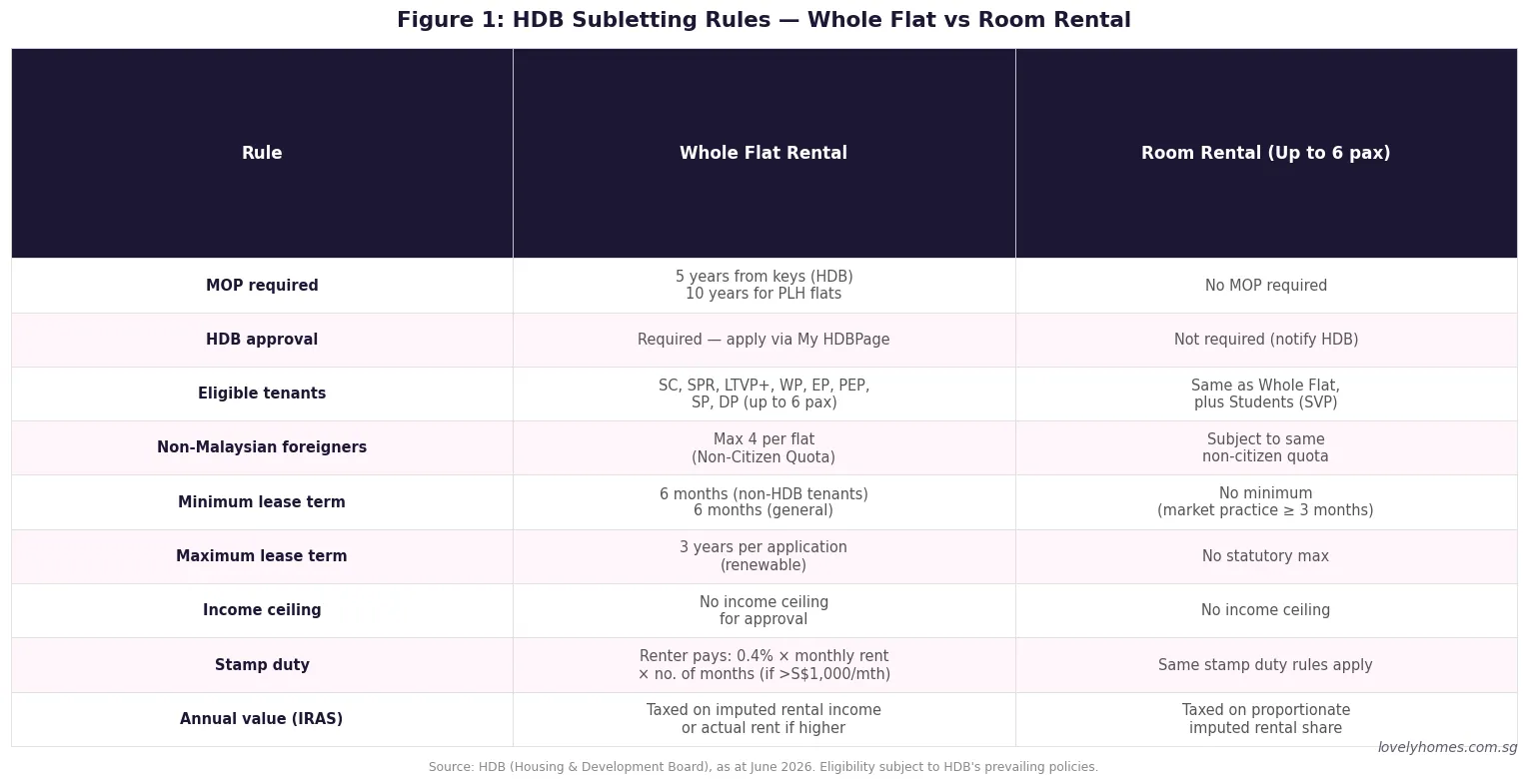
- Whole flat rental requires HDB approval and completion of the 5-year Minimum Occupation Period (MOP); PLH flats require 10 years.
- Room rental does not require HDB approval, but owners must notify HDB and stay within occupancy limits.
- Eligible tenants include Singapore Citizens, PRs, and most valid pass holders (EP, S Pass, WP, LTVP+, DP).
- Non-Malaysian foreign nationals are subject to a block/neighbourhood non-citizen quota. Check availability before committing to a foreign tenant.
- Rental income from HDB flats is taxable; allowable deductions include mortgage interest, property tax, agent commission, and maintenance.
- Stamp duty on tenancy agreements is borne by the tenant and calculated at 0.4% of annual rent per year of the lease.
- Subletting without required HDB approval can result in compulsory acquisition of the flat at below-market prices.
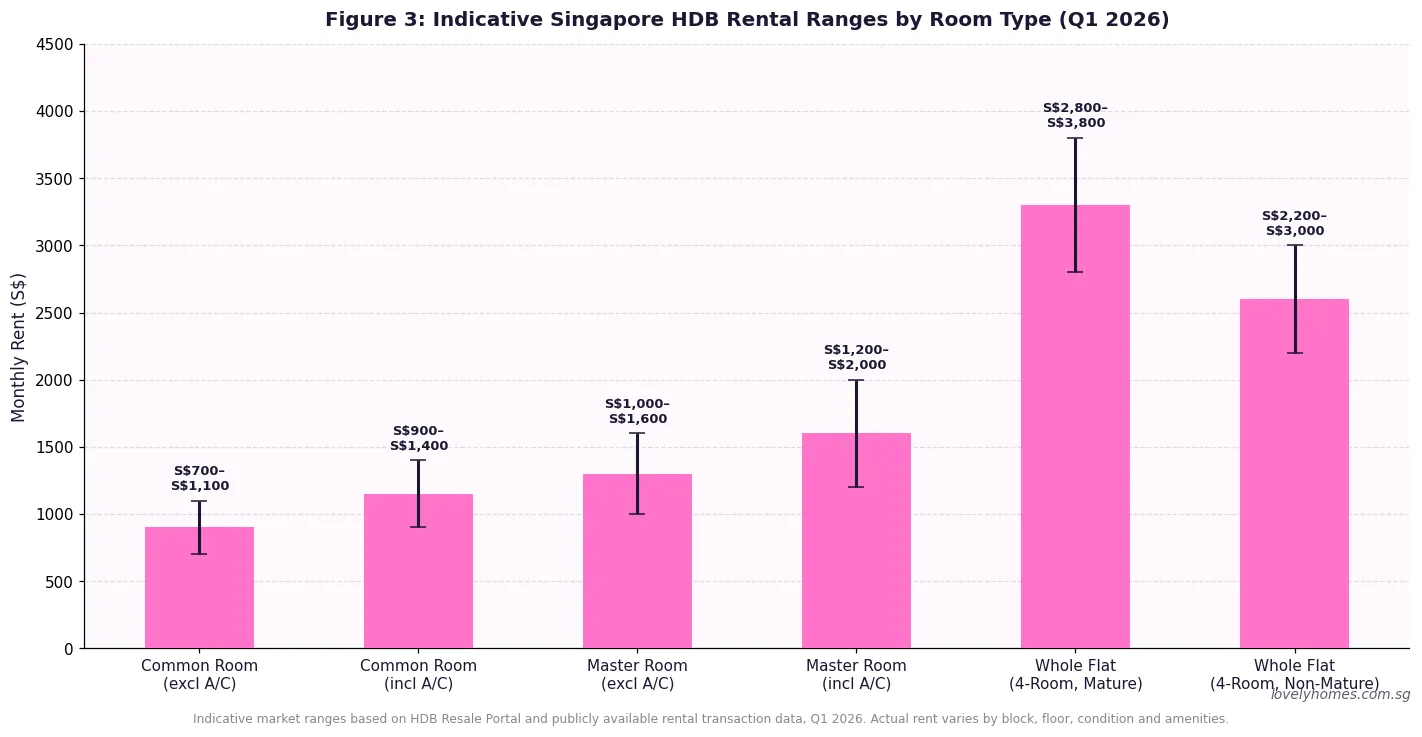
- As at Q1 2026, whole-flat 4-room HDB rents in mature estates range from S$2,800–S$3,800 per month; common rooms fetch S$700–S$1,100.
Singapore’s HDB subletting market is one of the most closely regulated rental ecosystems in the Asia-Pacific region. The Housing and Development Board (HDB), a statutory board under the Ministry of National Development, administers subletting rules for all 1.1 million HDB flats island-wide. Its objectives are twofold: to protect the social function of public housing as owner-occupied homes, and to preserve the ethnic and social integration that HDB estates are designed to foster. For flat owners who have fulfilled their ownership obligations, subletting , whether of the whole flat or individual rooms , is a permitted and often financially rewarding arrangement. This guide covers every rule, quota, application step, and tax implication you need to understand before listing your HDB flat on the rental market in 2026.
Understanding the Two Types of HDB Subletting
HDB distinguishes sharply between whole flat subletting , renting out the entire flat while you live elsewhere , and subletting of bedrooms , renting individual rooms to tenants while you continue to reside in the flat. The rules, approval requirements, and consequences differ materially between these two arrangements.
Whole flat subletting is governed by HDB’s subletting policy, which requires formal approval before the arrangement begins. You must have fulfilled the flat’s Minimum Occupation Period (MOP), and you must apply via the My HDBPage portal. HDB will assess the proposed tenancy, verify that the tenant nationality and headcount are within prescribed limits, and issue an approval letter. Each approval covers a tenancy of up to three years, after which you must renew. The key point: subletting without approval where approval is required exposes you to enforcement action, including , in the most serious cases , compulsory acquisition of the flat by HDB at below-market prices.
Room rental (subletting bedrooms while the owner remains resident) operates under a simpler framework. HDB approval is not required; however, you must register the arrangement via My HDBPage and ensure total headcount (owners and tenants combined) stays within your flat’s prescribed occupancy limit. Room rentals are also subject to the non-citizen subletting quota, and stamp duty rules apply in the same way as for whole-flat tenancies.
Minimum Occupation Period Requirements
The MOP for whole flat subletting mirrors the MOP for the right to sell: five years for standard BTO and resale HDB flats, counting from the date on which you received the keys. For flats classified as Prime Location Public Housing (PLH) , including certain Rochor and Queenstown sites , the MOP is 10 years. Executive Condominiums (ECs) have a separate MOP framework and are not governed by HDB subletting rules once the EC reaches 5 years from TOP, at which point it is treated as a privatised development.
Room rental (subletting individual bedrooms) has no MOP restriction. You may sublet rooms from day one of ownership, provided you are residing in the flat and the headcount limits are met. This makes room rental a popular arrangement for younger owners in the early years of their mortgage.
Eligible Tenants: Nationality and Pass Requirements
HDB maintains an approved list of eligible tenant groups. For both whole flat and room rental, the following categories are permitted:
- Singapore Citizens (SC)
- Singapore Permanent Residents (SPR)
- Long-Term Visit Pass Plus holders (LTVP+)
- Employment Pass (EP) holders
- S Pass (SP) holders
- Work Permit (WP) holders
- Personalised Employment Pass (PEP) holders
- Dependent Pass (DP) holders
- Student Pass (SVP) holders , for room rental only
Visitor Pass and Short-Term Visit Pass holders are not eligible. Any person on a pass with fewer than three months remaining validity at tenancy commencement is also ineligible. Tourists and individuals on social visit passes may not be HDB tenants under any circumstances.
The Non-Citizen (Non-Malaysian) Subletting Quota
One of the more nuanced rules in HDB subletting is the non-citizen quota, commonly referred to as the non-Malaysian foreign tenant quota. This quota limits the proportion of non-Malaysian foreign nationals who may reside in any given HDB block or neighbourhood at any point in time. Malaysians are exempt from this quota because of Singapore’s longstanding demographic and historical ties with Malaysia.
HDB does not publish precise quota thresholds publicly for each estate, but landlords can verify whether a specific address is subject to quota restrictions via the My HDBPage portal before entering into any tenancy agreement. If the block is at or near its quota, HDB will not approve the tenancy or register the foreign national as an occupant.
Practical implication: if your block is popular with foreign tenant populations , often blocks near MRT stations, industrial zones, or international schools , check quota availability before committing to a non-Malaysian foreign national tenant. Failing to comply with the quota, whether intentionally or inadvertently, may result in HDB revoking your subletting approval.
The Application Process for Whole Flat Subletting
Applying to sublet your whole HDB flat is a straightforward process conducted through My HDBPage. The steps are:
- Log in to My HDBPage via your SingPass credentials and navigate to the subletting application under “Manage My Flat”.
- Submit tenant details: full name, NRIC or passport number, pass type and expiry date, and intended tenancy dates.
- HDB reviews the application and verifies eligibility. Processing typically takes three to five working days.
- Receive the approval letter. You must not allow the tenant to move in before receiving HDB’s written approval.
- Stamp the tenancy agreement with IRAS via the e-Stamping portal within 14 days of signing (if signed in Singapore) or 30 days (if signed overseas).
- Notify HDB of early termination if the tenancy ends before the approved period, via My HDBPage.
Stamp Duty on HDB Tenancy Agreements
Stamp duty on a tenancy agreement is governed by the Stamp Duties Act, administered by IRAS. The obligation to stamp falls on the tenant, unless contractually agreed otherwise. The formula is:
| Tenancy Duration | Stamp Duty Formula | Example: S$2,800/mth, 24 months |
|---|---|---|
| Up to 1 year | 0.4% of annual rent | 0.4% x S$2,800 x 12 = S$134 |
| 1–3 years | 0.4% x average annual rent x lease years | 0.4% x S$2,800 x 12 x 2 = S$269 |
| More than 3 years | 0.4% x average annual rent x 4 (deemed) | N/A for typical HDB 2-year tenancy |
| Room rental (per room agreement) | Same formula applied to room rent amount if > S$1,000/mth | 0.4% x S$1,100 x 12 = S$53 |
Stamp duty must be paid within 14 days of signing (in Singapore) or 30 days (overseas). Late stamping incurs a penalty of up to four times the unpaid duty.
Rental Income Tax: What HDB Landlords Must Declare
Rental income from HDB subletting , whether whole flat or room rental , is assessable income under the Income Tax Act and must be declared to IRAS in your annual personal income tax return. IRAS permits landlords to deduct allowable expenses against rental income:
- Mortgage interest , only the interest component, not principal repayment.
- Property tax , the annual tax levied on the flat by IRAS.
- Fire insurance premium.
- Maintenance and repair costs , not capital improvements or renovations.
- Agent commission , if a licensed property agent facilitated the tenancy.
- Furniture wear and tear , on an allowable depreciation basis, not full replacement cost.
For partial subletting (room rental), only a proportionate share of allowable expenses may be deducted, corresponding to the number of rooms sublet as a fraction of total rooms in the flat.
Worked Example: 5-Room HDB Owner Subletting Two Rooms
Scenario: Mr and Mrs Tan, SC Couple , Bishan 5-Room HDB
Mr and Mrs Tan own a 5-room HDB flat in Bishan purchased in 2019. Their MOP was cleared in February 2024. They decide to sublet two bedrooms to offset their remaining HDB loan of S$450,000 at 2.6% per annum, equating to approximately S$2,038 per month.
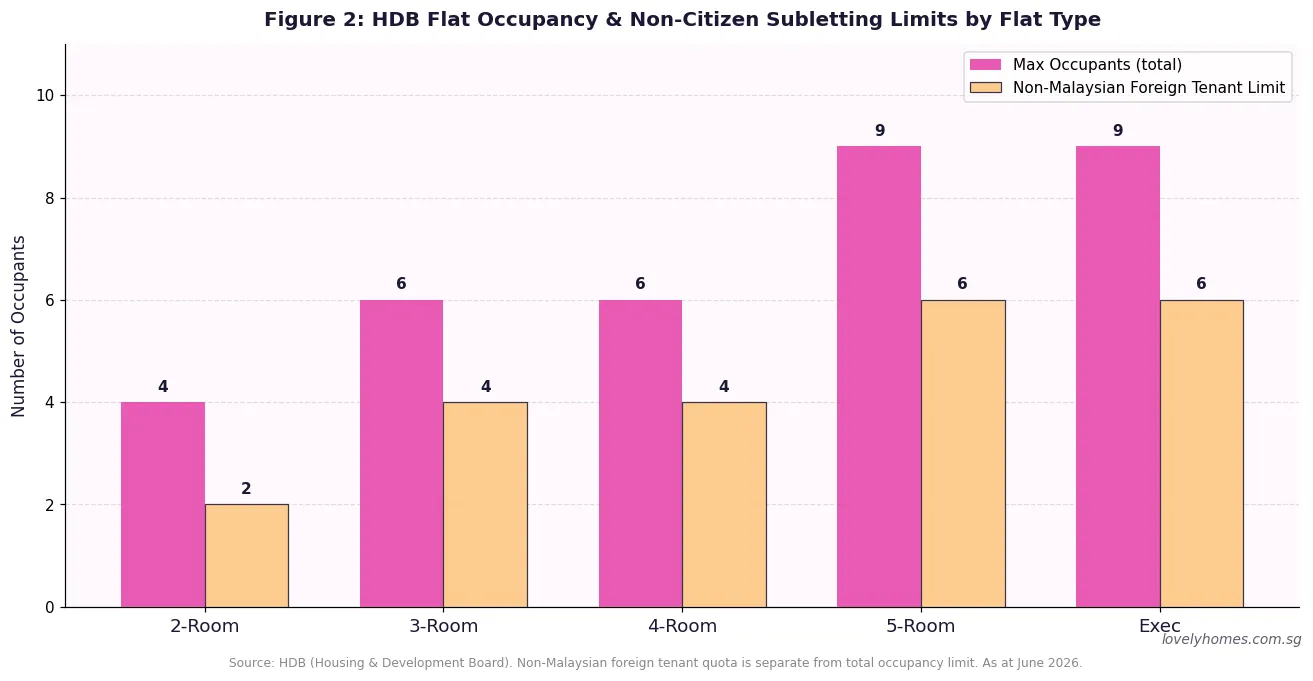
Arrangement: Room rental , two bedrooms sublet; the Tans remain resident in the master bedroom. Total occupancy: 4 persons , within the 5-room flat’s prescribed limit of 9 persons.
Stamp duty: Room 1 (12-mth lease, S$1,150/mth): S$1,150 x 12 x 0.4% = S$55. Room 2 (12-mth lease, S$1,500/mth): S$1,500 x 12 x 0.4% = S$72. Total: S$127 (borne by tenants under standard agreement terms).
Net monthly benefit: S$2,650/mth gross rental income minus approximately S$181/mth estimated tax cost leaves the Tans with approximately S$2,469/mth net , comfortably covering their S$2,038 monthly mortgage payment, with S$431/mth surplus.
What This Means for HDB Owners in 2026
The HDB rental market in 2026 remains favourable for landlords. Private rental supply has moderated as fewer expatriates take full-flat leases, and HDB flats , particularly in mature estates with MRT connectivity , continue to attract strong demand from both local and foreign tenants seeking affordable alternatives to private rentals.
The 13,480 HDB flats reaching their 5-year MOP in 2026 represent the largest single-year cohort to become MOP-eligible since 2020. Many owners are considering subletting the whole flat as part of an upgrade strategy: purchase a private property while the HDB flat generates rental income to offset the new mortgage, then sell the HDB within the ABSD remission window if applicable. This “bridge rental” strategy is legal and relatively common among upgraders, but requires careful timing to avoid ABSD clawback. See our ABSD remission guide for the full timing rules.
Room rental remains the most tax-efficient and legally low-friction subletting option for owner-occupiers. The absence of a formal HDB approval process, combined with the ability to start from day one of ownership, makes room rental attractive for younger owners in the early years of their mortgage. Common room rents in mature estates have held firm at S$900–S$1,400 per month inclusive of utilities, driven by demand from younger working professionals and foreign students attending universities in the Central and North regions.
What Might Come Next
HDB’s post-2022 policy adjustments have been focused primarily on the sales market rather than the rental market. However, policymakers have signalled awareness of affordability concerns in the rental sector. The February 2023 tightening of short-term letting rules , which strengthened the prohibition on Airbnb-style subletting of HDB flats for periods shorter than six months , was a reminder that HDB will act when rental patterns conflict with its social objectives. Future tightening could include stricter enforcement of occupancy limits, expanded PLH restrictions on subletting duration, or a broadening of the non-citizen quota framework to cover additional nationalities. For now, the rules described in this guide reflect HDB’s posture as at June 2026, and no changes to the subletting framework have been publicly signalled for the remainder of 2026.
Frequently Asked Questions
Can I sublet my whole HDB flat if I have not completed MOP?
Do I need HDB approval to rent out a room in my flat?
Can foreigners rent HDB flats?
What happens if I sublet my HDB flat without required approval?
Is rental income from my HDB flat taxable?
Can I increase rent mid-tenancy?
What is the maximum number of people allowed in my HDB flat?
Related Articles
- Singapore Rental Tenant Rights Guide 2026: Deposits, Stamp Duty, Disputes and Your Legal Protections
- Singapore Rental Income Tax Guide 2026: IRAS Rules, Deductions and What Every Landlord Must Declare
- Singapore Property MOP Guide 2026: HDB Minimum Occupation Period Rules Explained
- Singapore HDB Resale Market Guide 2026: Price Trends, What Drives Values and How to Read HDB Data
- Singapore ABSD Remission and Refund Guide 2026: SC Couple Scheme, 6-Month Window and Clawback Rules
- Singapore CPF Property Usage Guide 2026: OA Withdrawal, Accrued Interest and Retirement Sum Rules
Supporting graphics
Original article illustrations are available below.
- Figure 1: HDB Subletting Rules , Whole Flat vs Room Rental. Source: HDB (Housing & Development Board), as at June 2026.
- Figure 2: HDB Flat Occupancy & Non-Citizen Subletting Limits by Flat Type. Source: HDB, as at June 2026.
- Figure 3: Indicative Singapore HDB Rental Ranges by Room Type, Q1 2026. Source: HDB Resale Portal transaction data. Actual rent varies by location, floor, condition and amenities.