Home Loan Singapore 2026: HDB Concessionary Loan vs Bank Loan

For most Singaporeans, purchasing a home represents the single largest financial commitment they will ever make. A typical S$500,000 home loan over 25 years will cost between S$180,000 and S$280,000 in interest alone—making the difference between an HDB concessionary loan (fixed at 2.6%) and a bank loan (pegged to SORA, pegged to 3M compounded SORA plus a bank spread) the difference between financial security and prolonged vulnerability to rate shocks. This 2026 guide walks you through both options, the figures that matter, and how to choose the right one for your circumstances.

Quick Answer

HDB Loan: 2.6% fixed for the loan’s life; rate stable; 75% max LTV; no surprises—but higher than current bank rates and you must be eligible (SC or PR, income ≤ S$14,000/month for families).

Bank Loan: Currently cheaper (1.5%–3.0% depending on fixed or floating); rate risk if SORA rises; 75% max LTV; fewer eligibility restrictions—but your monthly repayment could jump 20%+ if rates climb.

Trade-off: HDB = stability + higher cost; Bank = potential savings + rate risk.

HDB Concessionary Loan: How It Works

The HDB concessionary loan is Singapore’s most accessible home financing product. It is pegged to the CPF Ordinary Account (OA) interest rate plus 0.1%—a formula that has held since 1999. For 2026, the OA rate is 2.5%, making the HDB loan rate exactly 2.6% per annum, fixed for the life of the loan (or until you choose to refinance into a bank loan, at which point you cannot switch back).

HDB Loan: Eligibility

  • Citizenship: At least one owner must be a Singapore Citizen (SC). Permanent Residents (PRs) and foreigners cannot apply.
  • Income ceiling (monthly household): S$14,000 for families; S$7,000 for singles under the Young Single Scheme; S$21,000 for extended family schemes. These are hard ceilings—exceed them and you are ineligible, regardless of other factors.
  • Age: At least 21 at the time of the application.
  • Repayment by age 65: Loan tenure is 25 years maximum, or until you reach age 65, whichever is earlier.

HDB Loan: Key Terms

Term HDB Loan
Interest Rate 2.6% p.a. (fixed; CPF OA + 0.1%)
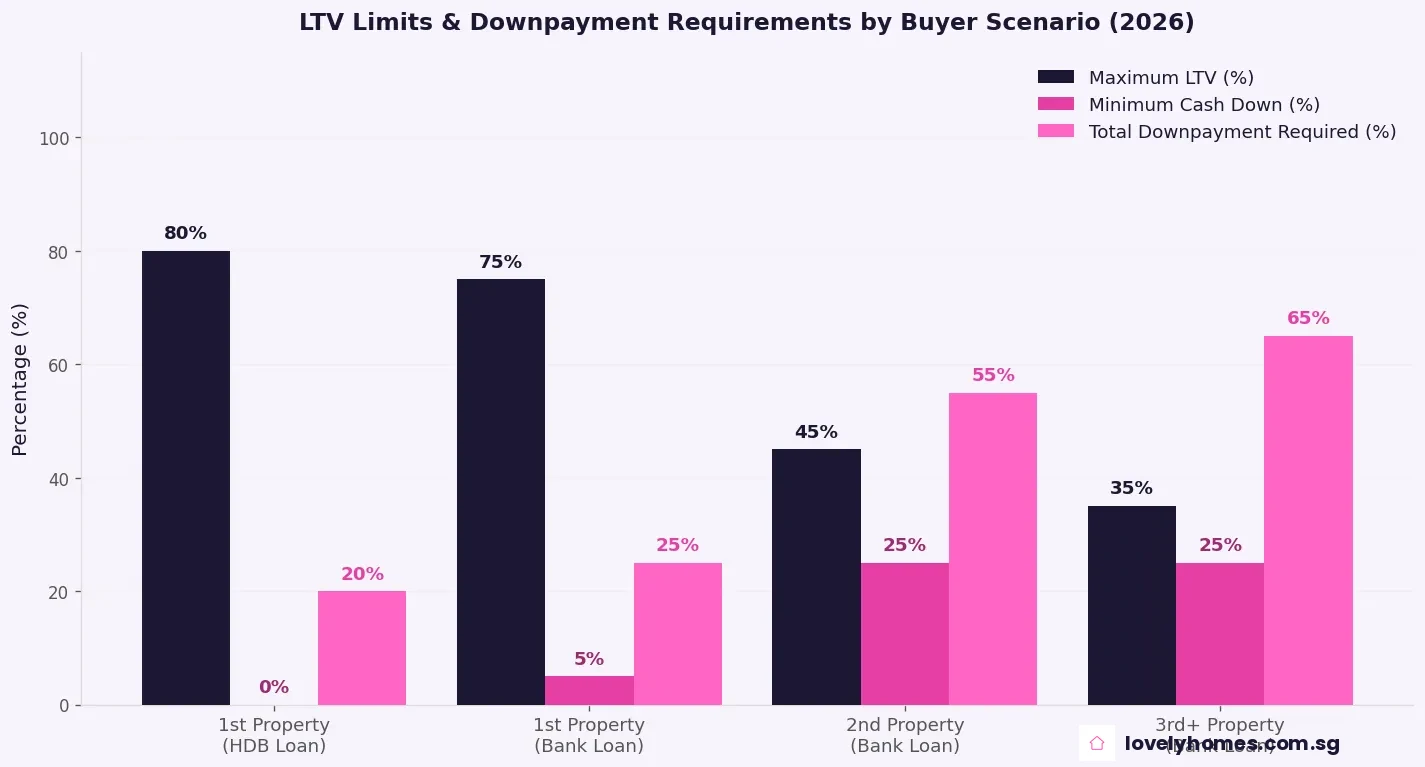
Maximum LTV 75% (lowered from 80% on 20 Aug 2024)
Minimum Down Payment 25% (mix of cash & CPF OA; no mandatory cash minimum)
Maximum Tenure 25 years or age 65, whichever is earlier
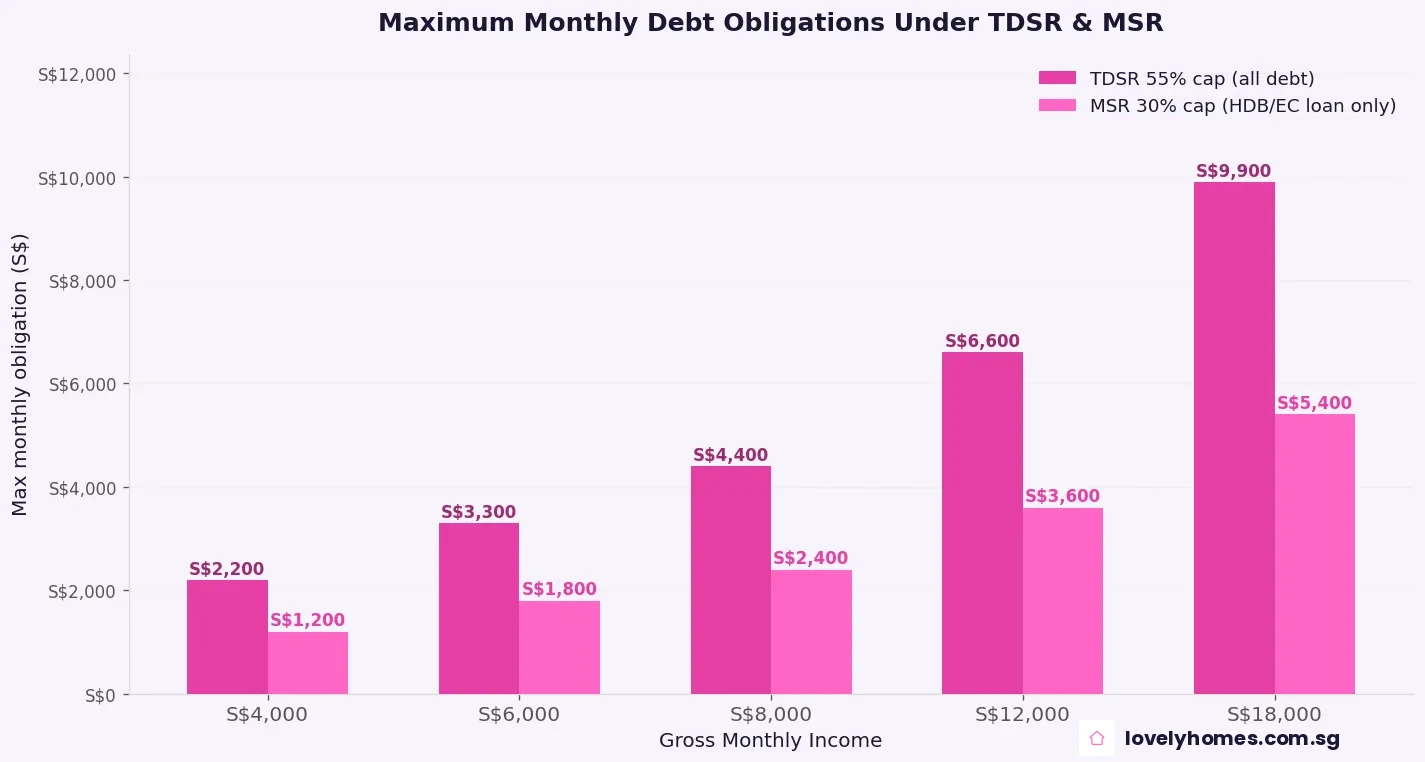
MSR Cap 30% of gross monthly income
TDSR Cap 55% of gross monthly income
Rate Lock Rate never increases; locked at 2.6% for life of loan
Early Repayment No penalty; can pay down anytime using CPF or cash
Refinancing to Bank Can refinance to bank loan (one-way; cannot switch back)

Example MSR Calculation: Your gross monthly household income is S$10,000. HDB MSR allows up to 30%, so your maximum monthly loan instalment is S$3,000. On a 2.6% 25-year loan, this translates to a maximum loan amount of roughly S$1,090,000 (before other debt).

Bank Loan: How It Works

Bank loans offer more flexibility than HDB loans but introduce interest-rate risk. Banks offer two primary structures: floating rates (pegged to SORA + spread) and fixed-rate packages (locked for 1–3 years, then typically floating). Check the current 3-month compounded SORA on the MAS domestic interest rates page. Banks typically add a spread of around 0.5%–1.0% on top. Fixed-rate packages range from 1.4% to 1.8% for 1–2-year locks.

Bank Loan: Eligibility

  • Citizenship: SCs, PRs, and even some foreigners can qualify (though foreigner terms are stricter, requiring higher down payments and lower LTV).
  • Income: No hard ceiling, but TDSR and MSR caps apply (see below).
  • Credit & Employment: Banks assess credit history, employment stability, and income verification.
  • Age: At least 21 at the time of application; typically loan must be repaid by age 60–75 (varies by bank).

Bank Loan: Key Terms

Term Bank Loan (HDB) Bank Loan (Condo)
Interest Rate (Floating) 3M SORA + 0.5–1.0% (current ~2.0%) 3M SORA + 0.5–1.0% (current ~2.0%)
Interest Rate (Fixed) 1.4%–1.8% for 1–2 yr lock 1.4%–1.8% for 1–2 yr lock
Maximum LTV (1st property) 75% (with 25-year tenure) 75% (with 30-year tenure)
LTV (2nd property outstanding) 45% max 45% max
Minimum Down Payment 25% (5% cash minimum; rest CPF or cash) 25% (5% cash minimum; rest CPF or cash)
Maximum Tenure 25 years (or to age 65) 30 years (or to age 65)
MSR Cap (HDB only) 30% of gross monthly income N/A
TDSR Cap 55% of gross monthly income 55% of gross monthly income
Interest Rate Floor (TDSR calc) 3% (for calculation only) 4% (for calculation only)
Early Repayment Penalty 1.5% of outstanding balance (typically during lock-in; 2–3 yr lock-in standard) 1.5% of outstanding balance (typically during lock-in)
Rate Risk After lock-in expires, rate floats; monthly payment can increase significantly After lock-in expires, rate floats; monthly payment can increase significantly

Important TDSR Note: Banks use a minimum interest-rate floor when calculating whether you are eligible, even if the actual rate is lower. For HDB loans, the floor is 3%; for private property, it is 4%. So even if a bank offers you 2.0% floating, they assume 3%–4% when working out your TDSR, making the true affordability ceiling lower than the headline rate suggests.

Side-by-Side Comparison: HDB vs Bank Loan

Factor HDB Loan Bank Loan
Interest Rate Type Fixed (pegged to CPF OA) Fixed (1–3 years) or Floating (SORA+)
Current 2026 Rate 2.6% 1.5%–1.8% (floating); 1.4%–1.8% (2yr fixed)
Maximum LTV (1st property) 75% 75% (HDB); 75% (Condo)
Min Cash Down 0% (full 25% can be CPF) 5% cash; remainder CPF or cash
Max Tenure 25 yrs or age 65 25 yrs (HDB) / 30 yrs (Condo), or age 65
MSR / TDSR MSR 30%; TDSR 55% TDSR 55% (no MSR for condo)
Rate Stability Locked forever; never increases Floating rate risk after lock-in; monthly payment can jump 20%+
Early Repayment Penalty None 1.5% during lock-in (typically 2–3 yrs)
Switching Flexibility Can refinance to bank (one-way; no switch-back) Can refinance to another bank; cannot switch to HDB
Eligibility Ceiling Income ceiling: S$14,000/mth (families); SC required No income ceiling; open to PRs & some foreigners

Worked Example: S$500,000 Loan, 25-Year Tenure

Let’s compare the true cost of an HDB loan versus two bank scenarios: a floating-rate loan and a fixed-then-floating loan.

Scenario 1: HDB Concessionary Loan at 2.6%

Loan Amount: S$500,000
Interest Rate: 2.6% p.a. (fixed for life)
Tenure: 25 years (300 months)
Monthly Instalment: S$2,269
Total Interest Paid: S$180,700
Total Amount Repaid: S$680,700

Scenario 2: Bank Floating Loan (SORA + 0.65%, Current ~2.0%)

Loan Amount: S$500,000
Interest Rate (Current): 2.0% p.a. (floating; SORA ~1.35% + 0.65% spread)
Interest Rate (Assumption: Average over 25 yrs): 3.0% p.a. (to account for expected rate normalisation)
Tenure: 25 years
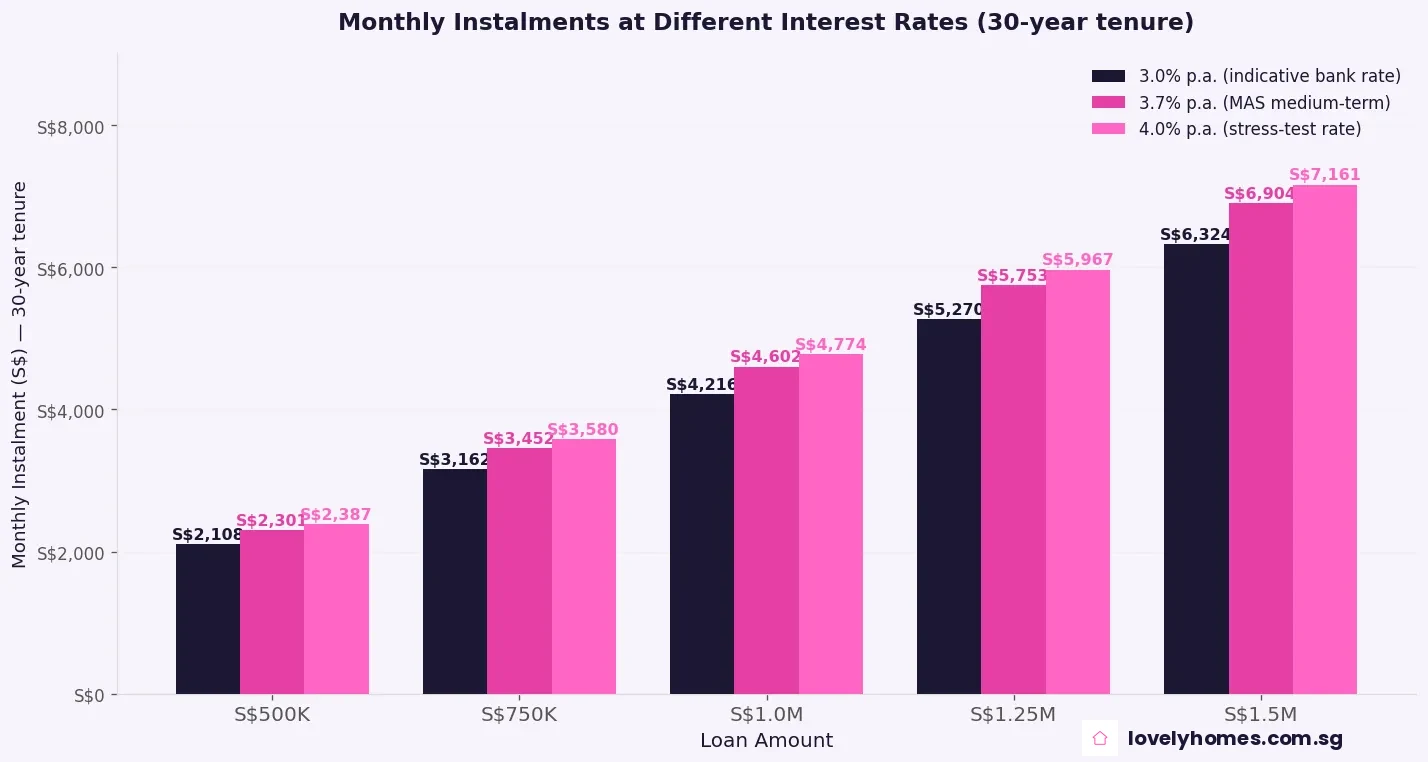
Monthly Instalment (at 2.0%): S$2,108
Monthly Instalment (at 3.0% average): S$2,372
Total Interest Paid (at 3.0% average): S$210,600
Total Amount Repaid: S$710,600
Life-of-Loan Difference vs HDB: +S$29,900 (approximately 3.5% higher total cost)

Note: The bank loan appears to save S$161/month initially, but that saving evaporates as rates normalise. Over the 25-year life, the HDB loan saves roughly S$30,000 despite starting at a higher rate.

Scenario 3: Bank Fixed (2.8%) for 3 Years, Then Floating (Assume 3.5%)

Years 1–3: 2.8% fixed
Monthly instalment: S$2,294

Years 4–25: 3.5% floating (after lock-in)
Recalculated instalment: S$2,506

Average Monthly Instalment: S$2,404
Total Interest Paid: S$221,200
Total Amount Repaid: S$721,200
Life-of-Loan Difference vs HDB: +S$40,500
Monthly Jump at Year 4: +S$212 (9% increase)

Key Insight: Even if you start with a bank loan at 2.0%–2.8%, the long-term cost edge of the HDB loan (at fixed 2.6%) becomes clear once you account for rate normalisation and the arithmetic of compound interest over 25 years. Moreover, the HDB loan offers psychological and budgetary peace of mind—your monthly repayment is guaranteed never to rise.

Sensitivity: What If Bank Rates Rise to 4.0%?

If 3M SORA drifts back toward 2.5% and bank spreads remain at 0.65%, a floating-rate loan would reset to approximately 3.15% base, but with TDSR floors at 4%, some borrowers would see repayments jump further. At a 4.0% effective rate:

S$500,000 loan, 25 years remaining (worst-case: rate shock in year 1):
Monthly Instalment at 4.0%: S$2,639
vs HDB at 2.6%: S$2,269
Monthly Shock: +S$370 (+16.3%)
Annual Impact: +S$4,440

For a household spending 30% of gross monthly income on the mortgage, a 16% rate shock could push TDSR above 55%, triggering a lender’s demand for early repayment or refinancing—a real risk during volatile rate environments.

Which Should You Choose?

Choose HDB Loan If:

  • You are eligible (SC, income ≤ S$14,000/mth for families).
  • Rate stability is a priority. You plan to stay in the home for 15+ years and want zero uncertainty about future payments.
  • You are risk-averse or budget-conscious. Your household income is tight, and a 10%–16% payment jump would strain your finances.
  • You value the psychological benefit of a locked rate and a simpler loan structure.
  • You expect rates to rise. If SORA normalises to 2.5%+ (and spreads remain), HDB’s 2.6% becomes increasingly competitive.

Choose Bank Loan If:

  • You exceed HDB income ceilings (e.g. dual-income household exceeding S$14,000/mth) or are a PR/foreigner.
  • You are comfortable with rate risk and have sufficient financial buffers to absorb a 10%–20% payment increase.
  • You plan to sell or refinance within 5–10 years. Lower initial rates and longer maximum tenures (30 years for condos) offer flexibility.
  • You believe rates will stay low. If you expect SORA averages well below 2.6% over the life of your loan, a floating bank loan saves vs the HDB concessionary rate. If it averages above 2.6%, HDB is cheaper.
  • You want to refinance easily. Bank loans can be refinanced to another bank mid-term; HDB loans, once converted to a bank, cannot be converted back.
  • You own a condo or landed property. Bank loans offer longer tenures (30 years) and higher potential LTV; HDB loans only apply to HDB flats and ECs.

Refinancing: When and Why to Switch

The option to refinance exists at any point in your loan journey. Understanding when and why to refinance is crucial to optimising your loan cost.

HDB to Bank Refinance

If you currently hold an HDB loan at 2.6%, you can refinance to a bank loan. This is a one-way decision—once you switch to a bank, you cannot switch back. Refinancing makes sense if:

  • Bank rates fall significantly below 2.6% and are locked in for an extended term (5+ years).
  • You exceed HDB’s income ceiling due to a salary increase and want to increase your loan amount.
  • You are refinancing to raise cash (e.g. home equity release) against your property.

Give HDB three months’ written notice of your intention to refinance. HDB will calculate the outstanding balance and any adjustment due to CPF contributions.

Bank to Bank Refinance (or HDB → Bank)

If you hold a bank loan, you can refinance to another bank or (once) to HDB, depending on your eligibility. Refinancing makes sense if:

  • Your current fixed-rate lock-in is about to expire and rates have fallen; refinance before the jump.
  • Another bank offers 0.3%–0.5% lower rates or a longer fixed-rate tenure.
  • You want to consolidate multiple loans or restructure your debt.

Typical lock-in periods: 2–3 years. Early repayment within the lock-in incurs a 1.5% penalty on the outstanding balance. After lock-in, partial or full repayments are fee-free.

Lock-In Mechanics

Most bank home loans come with a lock-in clause that penalises early repayment during the initial fixed-rate period. The lock-in typically lasts 2–3 years. Here’s what you need to know:

  • Lock-in Period: Typically 2–3 years from the date of drawdown.
  • Early Repayment Penalty: 1.5% of the outstanding loan balance if you repay (or refinance) before lock-in expires.
  • After Lock-In: You can repay in full or in part without penalty. You can refinance to another bank.
  • Fixed-Rate Lock vs Lock-In: Do not confuse the fixed-rate period (e.g. 2.8% for 2 years) with the lock-in period. A 2-year fixed rate typically comes with a 2–3-year lock-in penalty clause.

Frequently Asked Questions

1. Can I switch from HDB to bank and back?

No. Refinancing from HDB to bank is one-way. Once you switch to a bank loan, you cannot return to HDB financing. Choose carefully before making the switch. If you are considering it, ensure bank rates are significantly lower and locked in for at least 5 years to justify the irreversibility.

2. What happens if I miss an HDB or bank loan payment?

Missing a payment triggers late fees and can damage your credit score, making future refinancing more expensive. For HDB loans, persistent defaults can lead to legal action and, in extreme cases, repossession of the flat. For bank loans, the consequences are similar. Both lenders are empowered to initiate enforcement proceedings if you default for more than three months. Contact your lender immediately if you foresee difficulties; many offer restructuring or deferment options for borrowers facing temporary hardship.

3. Can I use CPF to pay my mortgage?

Yes. You can use CPF Ordinary Account (OA) funds to pay both HDB and bank home loan monthly instalments, subject to: 

  • Your CPF OA balance must be sufficient to cover the instalment.
  • CPF will automatically deduct the monthly instalment from your OA if you have set up standing instructions.
  • If your CPF OA is insufficient, you must pay the balance in cash.
  • You cannot use your CPF Medisave Account (MA) or Special Account (SA) for loan repayment.

After loan maturity, CPF regulations allow you to retain a minimum sum in your Retirement Account (RA) for healthcare and longevity protection; excess funds can be withdrawn.

4. What is SORA, and why does it matter?

SORA stands for Singapore Overnight Rate Average. It is the interest rate at which banks lend to each other overnight in the Singapore money market, published daily by the Monetary Authority of Singapore (MAS). Most bank home loans in Singapore are now pegged to 3-Month Compounded SORA (reviewed quarterly) rather than the older SIBOR benchmark.

Why it matters: Your bank loan interest rate is typically SORA + a bank spread (e.g. 0.65%). As SORA fluctuates, your loan rate (and monthly payment) fluctuates. Historically 3M SORA has moved widely — from well under 1% in 2020–2021, rising above 3% through 2023–2024, and moderating thereafter. Always check the latest rate on the MAS website before committing to a package. Understanding SORA trends helps you forecast your likely repayment path.

5. How does the interest-rate floor affect my loan amount?

When calculating whether you qualify for a loan (TDSR test), banks assume a minimum interest rate, even if the offered rate is lower. For HDB loans, the floor is 3%; for private property, it is 4%. This means:

  • If a bank offers you 2.0% floating but applies a 4% floor for TDSR calculation, you are approved based on 4% affordability, not 2%.
  • If your income is S$10,000/month and TDSR is 55%, your maximum total debt repayment is S$5,500/month.
  • At a 4% rate (the TDSR floor), a S$500,000 loan over 25 years costs ~S$2,639/month.
  • Even though the actual rate might be 2.0%, the lender approves you at 4% to protect against future rate rises.

This floor is a safeguard for lenders and borrowers alike, preventing over-leverage in a low-rate environment.

6. Can I take a joint loan with a family member?

Yes. Both HDB and bank loans can be taken jointly (e.g. spouse, parent, or adult child). Joint applicants must:

  • Both be on the property title (either as joint tenants or tenants-in-common).
  • Both pass the eligibility checks (citizenship, age, credit, income).
  • Both be liable for the loan; if one co-borrower defaults, the lender can pursue either or both.
  • Agree on the split of ownership (50:50 is common; other splits are possible but more complex for tax and CPF purposes).

Joint borrowing increases the combined household income for TDSR/MSR purposes, often allowing a larger loan. However, both parties remain responsible if the other defaults.

7. Is a fixed or floating rate better?

There is no universally correct answer; it depends on your risk appetite and rate outlook.

Fixed Rate (1–3 years): Choose if you want certainty and believe rates will rise. Lock-in at the lowest rate available (currently 1.4%–1.8% for 1–2 years). After lock-in expires, you will refinance or face a floating rate, so you are not truly “locked” for 25 years.

Floating (SORA+): Choose if you believe rates will stay low and you can afford a 20%–30% payment increase. Currently, floating rates are lower than fixed (around 1.5%–2.0% all-in vs 1.4%–1.8% fixed), so you pay a rate-stability premium if you lock in.

In 2026, most experts recommend a 2-year fixed rate as a compromise: you get near-current rates locked in for two years, and then you can reassess when the lock-in expires.

Summary: Making Your Decision

Choosing between an HDB loan and a bank loan is ultimately a question of values: stability vs savings, predictability vs flexibility. The HDB loan offers peace of mind and long-term cost protection but requires eligibility. The bank loan offers potential short-term savings and flexibility but introduces rate risk. Work through the decision tree below to clarify your path:

Start here: Are you a Singapore Citizen with household income ≤ S$14,000/month (families)?

  • Yes: You can access the HDB loan. Proceed to the next question.
  • No: You must use a bank loan. Skip to bank-loan considerations below.

Next: Is rate stability your top priority, or are you comfortable with rate risk?

  • Rate stability: Choose HDB. You cannot beat a fixed 2.6% rate that will not rise for 25 years.
  • Comfortable with risk: Compare HDB (2.6%) with current bank rates (floating 1.5%–2.0%; fixed 1.4%–1.8%). If bank rates are <2.2% and locked in for 5+ years, bank may be worthwhile. If rates are expected to rise to 3%+, HDB’s 2.6% becomes increasingly attractive.

For bank-loan applicants: What is your holding timeline?

  • Short term (5–10 years): Floating or short fixed-rate packages (1–2 years) are fine; refinance or sell before rate shock.
  • Long term (15+ years): Lock in a fixed rate (2.8%–3.0%) for as long as possible (5+ years if available). The certainty is worth 0.3%–0.5% in extra rate cost.

Key Takeaways

  • HDB loans are fixed at 2.6% (pegged to CPF OA + 0.1%). This rate will not increase for the life of the loan—a powerful advantage in a rising-rate environment.
  • Bank loans are currently cheaper (1.5%–2.0% floating; 1.4%–1.8% fixed for 1–2 years) but introduce rate risk. After lock-in expires (typically 2–3 years), your payment can jump 10%–30%.
  • Over a 25-year life, an HDB loan typically costs S$30,000–S$40,000 less than a bank loan that averages 3.0% over the tenor, even though it starts at a higher rate.
  • Eligibility is the first gatekeeper. If you are a SC with income ≤ S$14,000/month, HDB is an option; otherwise, you must use a bank.
  • Refinancing is possible but irreversible. HDB → bank is one-way; bank → bank is flexible. Plan before you switch.
  • Rate floors and TDSR caps mean that your true affordability is often lower than headline rates suggest. Always ask your lender what rate floor they use in their TDSR calculation.
  • In 2026, the optimal strategy for most Singaporeans is: (1) if HDB-eligible, take the HDB loan unless bank rates are locked below 2.2% for 5+ years; (2) if bank-eligible only, lock in a 2-year fixed rate at 1.4%–1.8% as a bridge, then reassess when lock-in expires.

Related Articles

Disclaimer

This guide is for general information only and does not constitute legal, tax, or financial advice. Interest rates, LTV limits, MSR/TDSR caps, and eligibility rules change frequently. Always verify current figures with HDB (hdb.gov.sg), MAS (mas.gov.sg), and your bank before committing to a loan package. For complex situations—mixed-nationality couples, self-employed income, or refinancing decisions—consult a licensed mortgage advisor or conveyancing lawyer. CPF rules, tax treatment, and grant eligibility have edge cases; always verify your specific situation with the relevant authority.

Singapore Property Cooling Measures: Complete Timeline (2009–2026)

Quick Answer – The cooling measures, in summary

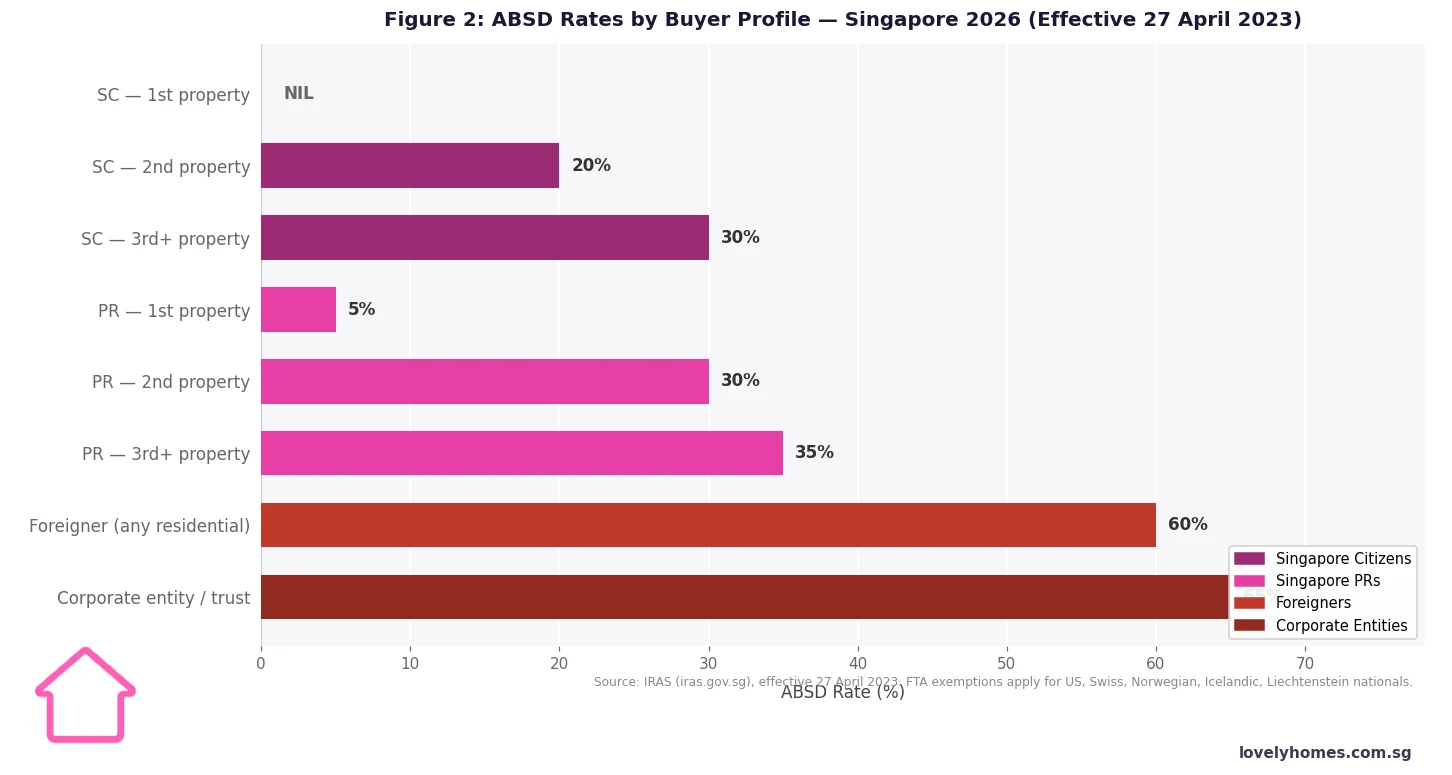
  • ABSD (Additional Buyer’s Stamp Duty): Tax on property purchases; Singapore Citizens pay 20–30% on 2nd+ homes; foreigners pay 60%; entities 65%.
  • SSD (Seller’s Stamp Duty): Tax on sale within 4 years; rates 16%, 12%, 8%, 4% depending on holding period.
  • LTV (Loan-to-Value): Maximum 75% for HDB loans; 70–80% for private residential, depending on circumstance.
  • TDSR (Total Debt Servicing Ratio): Your total monthly debt repayments cannot exceed 55% of gross monthly income.
  • MSR (Mortgage Servicing Ratio): HDB and EC buyers: mortgage alone cannot exceed 30% of income.
  • Interest-Rate Floor: Banks assume minimum 4% interest rate when calculating loan affordability.
  • Wait-Out Period: Private property owners must wait 15 months before buying HDB resale without grant.

What are Singapore’s Property Cooling Measures?

Singapore’s property cooling measures are a suite of policy tools designed to moderate demand, curb speculation, and ensure housing remains affordable. They exist because rapid property price growth can outpace wage growth, lock first-time buyers out of the market, and create unsustainable bubbles. Four key agencies administer these measures: the Monetary Authority of Singapore (MAS), the Urban Redevelopment Authority (URA), the Inland Revenue Authority of Singapore (IRAS), and the Housing and Development Board (HDB). Together, they apply tools such as stamp duties, loan limits, affordability tests, and holding periods to regulate the market and protect both buyers and the broader economy.

September 2009: The First Policy Tightening

Before the modern cooling era, the government moved to restrict lending practices. In September 2009, the Monetary Authority of Singapore (MAS) disallowed two risky loan products: the Interest Absorption Scheme (IAS) and Interest-Only Housing Loans (IOL). These products had allowed borrowers to defer principal repayment during the early years of a mortgage, increasing default risk during rate rises. By banning them, the government signalled a preference for prudent, full-amortising loans and set the stage for the more comprehensive cooling measures that would follow.

February 2010: The First Modern Cooling Round

On 20 February 2010, Singapore introduced its first comprehensive cooling package, reflecting rapid price growth and surging demand. The government introduced two major tools:

  • Seller’s Stamp Duty (SSD): Properties sold within one year were hit with a 3% SSD. The intent was to discourage “flipping”—rapid resale for short-term gain.
  • Loan-to-Value (LTV) limit: Reduced from 90% to 80%, requiring buyers to put down at least 20%. This reduced lender exposure and made buyers more cautious.

These measures reflected a key insight: when buyers can leverage heavily and exit quickly, prices can spiral. By raising the entry cost and the holding cost, the government aimed to attract only genuine buyers.

August 2010: Extended Holding Period

By mid-2010, demand remained strong. On 19 August 2010, the government extended the SSD holding period from 1 year to 3 years, raising the cost of short-term resale. For those with existing loans, the LTV limit tightened further to 70%, and cash downpayment requirements rose, particularly hurting leveraged investors.

January 2011: Sharp SSD Escalation

Recognising that the market was still overheating, the government on 8 January 2011 escalated the SSD significantly. The new structure was:

  • Year 1: 16%
  • Year 2: 12%
  • Year 3: 8%
  • Year 4: 4%

The rationale was unmistakable: hold for less than a year and lose a sixth of your sale price. LTV limits were also tightened to 60% for those with existing loans, making it much harder for property investors to string together multiple mortgages.

December 2011: ABSD Introduced

On 8 December 2011, Singapore introduced the Additional Buyer’s Stamp Duty (ABSD), its most powerful tool. ABSD was a second layer of stamp duty on top of the normal Buyer’s Stamp Duty (BSD), calibrated to buyer type:

  • Singapore Citizens buying a 2nd+ property: 3%
  • Singapore Citizens buying a 3rd+ property: 3%
  • Permanent Residents buying a 2nd+ property: 3%
  • Foreigners: 10%
  • Corporate entities: 10%

ABSD was revolutionary because it directly attacked investment demand, particularly from overseas. It signalled that Singapore prioritised homeownership for citizens over investment returns for outsiders.

October 2012: Loan Tenure Tightening

The Monetary Authority of Singapore further tightened lending on 19 October 2012. The maximum loan tenure was capped at 35 years, with a penalty: if LTV remained above 60% after 30 years, the LTV would be capped at 40% in year 31 onwards. This forced borrowers to repay principal faster, reducing their borrowing power and making loans less attractive.

January 2013: ABSD Escalation

On 11 January 2013, the government raised ABSD across the board:

  • Singapore Citizens (2nd property): 7%
  • Singapore Citizens (3rd+ property): 10%
  • Permanent Residents (2nd+ property): 10%
  • Foreigners: 15%
  • Entities: 15%

The hike reflected continued demand, particularly from foreign investors and corporate buyers. Cash downpayment requirements also rose, targeting multiple-property owners and entities.

June 2013: TDSR Framework Introduced

On 28 June 2013, the Monetary Authority of Singapore introduced the Total Debt Servicing Ratio (TDSR) framework. TDSR capped total monthly debt repayments (mortgage, car loan, credit cards, personal loans, etc.) at 60% of gross monthly income. The intention was to prevent over-leverage: even if house prices were rising, a banker couldn’t lend to someone whose entire income was going to debt service.

This was a game-changer because it wasn’t about house prices directly—it was about borrower health. It also forced banks to stress-test loans, assuming interest rates would rise, to ensure borrowers could survive a shock.

March 2017: Partial Easing

By 2016–2017, prices had stabilised and growth had slowed. On 5 March 2017, the government eased some measures:

  • SSD holding period reduced from 4 years to 3 years, though rates remained steep (12%/8%/4% for years 1–3).
  • TDSR and ABSD eased slightly for refinancing.

This signalled a shift: the government was confident the market was no longer overheating and could afford marginal relief.

July 2018: ABSD Raised Again

By mid-2018, there were signs of renewed speculative interest, particularly from foreign and corporate buyers. On 6 July 2018, the government raised ABSD sharply:

  • Foreigners: 20% (doubled from 15%)
  • Entities: 25% (doubled from 15%)
  • Permanent Residents (2nd+ property): 15%
  • Singapore Citizens (2nd property): 7%; (3rd+): 10%

LTV limits also tightened by 5 percentage points across all categories, making down payments larger and borrowing power lower.

December 2021: Significant Tightening

After years of near-zero interest rates post-COVID, demand surged again. On 16 December 2021, the government announced a comprehensive tightening:

  • ABSD raised again: foreigners to 30%; entities to 35%; PR 2nd property to 20%.
  • TDSR tightened from 60% to 55% of gross monthly income.
  • Interest-rate floor for TDSR/MSR calculations raised to 3.5% for private bank loans (previously 3%).
  • HDB LTV limits reduced across the board.

This was a significant hardening, reflecting real concern about affordability following three years of price growth.

September 2022: MSR and HDB Measures

On 30 September 2022, the government introduced new measures targeting the HDB resale market, where first-time buyers (and upgraders) primarily shop:

  • Mortgage Servicing Ratio (MSR) introduced: For HDB and Executive Condominium (EC) loans, monthly mortgage payments cannot exceed 30% of gross income—stricter than TDSR’s 55%.
  • 15-month wait-out period: Private property owners must wait 15 months after selling before buying an HDB resale flat, curbing investor demand for subsidised public housing.
  • Interest-rate floor for TDSR/MSR raised from 3% to 3.5% for private loans; 3% for HDB loans.

These moves directly sheltered first-time HDB buyers from investor competition.

April 2023: Largest ABSD Hike in History

On 27 April 2023, faced with renewed price acceleration in Q1 2023 (especially among owner-occupiers), the government announced its largest ABSD increase:

  • Foreigners: 60% (from 30%—doubled)
  • Entities: 65% (from 35%—nearly doubled)
  • Permanent Residents (2nd property): 30% (from 20%)
  • Permanent Residents (3rd+ property): 35% (new)
  • Singapore Citizens (2nd property): 20% (from 7%)
  • Singapore Citizens (3rd+ property): 30% (from 10%)

This was the most aggressive escalation since ABSD’s introduction, reflecting the government’s determination to prioritise homeownership for citizens and slow speculation. A foreign buyer purchasing a S$2 million condo now faced S$1.2 million in ABSD—an enormous barrier.

August 2024: HDB LTV Reduction

On 20 August 2024, the government reduced the Loan-to-Value (LTV) limit for HDB-granted housing loans from 80% to 75%. This meant HDB buyers now needed a 25% down payment instead of 20%, directly reducing borrowing power for this segment. Concurrently, higher CPF Housing Grants were introduced for first-time buyers to offset the impact, retaining affordability.

July 2025: SSD Extended and Raised

On 3 July 2025, the government responded to a spike in “flipping”—buyers purchasing uncompleted units (off-plan) and reselling before completion or soon after. The SSD holding period was extended from 3 years to 4 years, and rates were raised across the board by 4 percentage points:

  • Year 1: 20% (from 16%)
  • Year 2: 16% (from 12%)
  • Year 3: 12% (from 8%)
  • Year 4: 8% (from 4%)

This further discouraged short-term speculation while allowing long-term owners to exit penalty-free after four years.

Current Cooling Measures Framework (April 2026)

The current cooling-measures framework, established by the 27 April 2023 ABSD hike and subsequently adjusted by the 20 August 2024 HDB LTV reduction and the 4 July 2025 SSD restructure, remains in force as at April 2026. MAS, MND, URA and HDB jointly review the framework regularly and have repeatedly indicated they will recalibrate the measures — either tightening or easing — in response to market conditions.

Key Cooling Measures Tools at a Glance

Tool First Introduced Administered By Current Level (2026)
ABSD (Additional Buyer’s Stamp Duty) Dec 2011 IRAS SC 2nd: 20%; SC 3rd+: 30%; PR 2nd: 30%; PR 3rd+: 35%; Foreigner: 60%; Entity: 65%
BSD (Buyer’s Stamp Duty) Long-standing IRAS 1–3% on property value (capped S$15K)
SSD (Seller’s Stamp Duty) Feb 2010 IRAS Year 1: 20%; Year 2: 16%; Year 3: 12%; Year 4: 8%
LTV (Loan-to-Value) Feb 2010 MAS (private); HDB (HDB) HDB: 75%; Private: 70–80%
TDSR (Total Debt Servicing Ratio) June 2013 MAS Max 55% of gross monthly income
MSR (Mortgage Servicing Ratio) Sept 2022 MAS (HDB/EC loans) Max 30% of gross monthly income
Interest-Rate Floor (TDSR/MSR) June 2013 MAS 4% for private loans; 3% for HDB loans
Wait-Out Period (HDB Resale) Sept 2022 HDB 15 months after private property sale

The Cost of Cooling Measures: A Worked Example

Let’s illustrate the impact with a hypothetical Singapore Citizen (SC) buying a second property valued at S$2 million:

Year ABSD Rate ABSD Cost (S$) BSD + ABSD Total
2010 (Feb) 0% S$0 ~S$20,000 (BSD only)
2013 (Jan) 7% S$140,000 ~S$160,000
2018 (July) 7% S$140,000 ~S$160,000
2023 (April) 20% S$400,000 ~S$420,000
2026 (April) 20% S$400,000 ~S$420,000

Notice the leap from 2013 to 2023: the cost of buying a second home more than doubled in stamp duty alone, while the property value remained constant. This is the direct impact of cooling measures: they make property ownership more expensive, not by changing the property itself, but by raising friction and entry costs.

Why Have Cooling Measures Worked?

Singapore’s housing market has not crashed, despite aggressive cooling measures—a fact some cite as evidence of failure. But that misses the point. Cooling measures are designed to slow, not stop, price growth; to reduce speculation, not eliminate it; and to align prices with incomes, not freeze them.

Consider the evidence:

  • Slower growth: Private residential property annual price gains have typically stayed in the 2–5% range post-2013, compared to double-digit growth in the early 2010s. This moderation reflects a market rebalancing, where price appreciation has settled into a more sustainable trajectory aligned with economic fundamentals such as wage growth and rental yields.
  • Affordability preserved: First-time buyers, particularly HDB upgraders, have continued to buy; median house prices have not become so extreme relative to median incomes that the market has fractured. The price-to-income ratio in Singapore remains among the most manageable in developed Asia, allowing younger buyers to enter the market without undue hardship.
  • Comparison to global peers: Hong Kong, Vancouver, and Sydney have seen much steeper price-to-income ratios despite less stringent cooling measures. In Hong Kong, for example, a property may cost 20–30 times annual median household income; in Vancouver and Sydney, the ratio exceeds 12–15. Singapore’s pragmatic approach has kept the ratio at a more sustainable 8–10 times, making the market more accessible.
  • Investor activity moderated: The share of property transactions by investors (vs. owner-occupiers) has declined, indicating cooling measures are successfully crowding out speculative demand. This shift is crucial: when investors withdraw, price volatility typically decreases and stability improves.
  • Market resilience: The market has absorbed multiple rounds of tightening—seven major cooling packages since 2009—without experiencing a crash. This speaks to the underlying strength of Singapore’s economy and the government’s ability to calibrate policy precisely, neither so tight as to stifle the market nor so loose as to permit excess.

In short, cooling measures have succeeded in their core mission: managed, sustainable growth that preserves homeownership as an achievable goal for Singaporeans whilst safeguarding financial stability.

What Might Come Next?

Predicting future cooling measures is speculative, but several potential levers exist if the market overheats again. The government has shown it is willing to adjust policy swiftly when conditions warrant, and the following measures are within the realm of possibility:

  • Further LTV tightening: LTV could drop below 75% for HDB and 70% for private, forcing larger down payments. This would particularly affect HDB first-time buyers, though offsetting grants could mitigate the impact.
  • ABSD escalation on entities: Corporate and foreign entity purchases could face rates exceeding 70%, further discouraging institutional investors and offshore funds from treating Singapore residential property as an alternative asset class.
  • TDSR reduction: The 55% threshold could tighten to 50%, limiting borrowing power even further. This would reduce the quantum of debt banks could extend and force buyers to increase down payments or reduce property search prices.
  • Extended hold periods: SSD holding could extend beyond four years; MSR wait-out could lengthen beyond 15 months. A 5–7 year SSD period would effectively end short-to-medium-term flipping as an investment strategy.
  • Targeted HDB measures: Given HDB’s social mission, the government could ring-fence HDB buying further (e.g., longer wait-out periods for private owners, stricter owner-occupancy rules for upgrade purchases).
  • Differentiated ABSD by property type: Separate ABSD rates for landed (houses, land) vs. non-landed (condos, ECs) to focus cooling where prices are most extreme. Landed property prices have historically appreciated faster than condominiums, making them a natural target for stricter cooling.
  • Interest-rate floor adjustments: The MAS could raise the notional interest-rate floor used in TDSR/MSR calculations from the current 4% (private) to 4.5% or 5%, making loans seem more expensive during qualification, thereby reducing lending volumes.

These possibilities are illustrative, not predictions. The Government has consistently emphasised that cooling measures are reviewed against prevailing market conditions, and that any further recalibration — tightening or easing — will be driven by the data. Buyers and sellers should plan on the framework in force today and monitor MAS, URA, MND, IRAS and HDB announcements for updates.

Frequently Asked Questions

1. What’s the difference between ABSD and SSD?

ABSD (Additional Buyer’s Stamp Duty) is a tax paid by the buyer when purchasing a property (typically 2nd or 3rd+). It’s calibrated by buyer type (citizen, PR, foreigner, entity) and aims to dampen investment demand. SSD (Seller’s Stamp Duty) is a tax paid by the seller when selling within a holding period; it discourages flipping. Both reduce demand, but ABSD targets entry; SSD targets exit.

2. Are cooling measures permanent?

No. All cooling measures are policy tools, not constitutional laws. They can be eased or tightened depending on market conditions. For example, SSD was partially eased in March 2017, and TDSR has been adjusted twice (60% → 55%). The Government reviews the framework regularly against market conditions.

3. Can you appeal a cooling-measure penalty (e.g., SSD)?

No. Cooling measures are statutory levies applied uniformly. Once a property is sold within the SSD holding period, the duty is automatically calculated and due. There is no appeal mechanism, though you can seek professional tax advice if you believe your classification is incorrect. Early repayment of SSD (before expiry) is not available.

4. How do cooling measures affect HDB owners?

Cooling measures affect HDB owners primarily when upgrading (selling to buy private) or downgrading (selling private to buy HDB resale). HDB owners upgrading to private face ABSD. Private owners downgrading to HDB resale face a 15-month wait-out period and stricter MSR limits (30% vs. TDSR 55%). Cooling measures have also reduced HDB LTV to 75%, requiring larger down payments.

5. Do foreigners face the toughest measures?

Yes, unambiguously. Foreigners pay 60% ABSD (vs. 20% for SC 2nd property), and are excluded from some HDB categories altogether. The government’s policy framework explicitly prioritises owner-occupation for citizens and PRs over foreign investment. A foreigner buying a S$2M property pays S$1.2M in ABSD alone, making foreign residential investment significantly less attractive.

6. Will the government remove cooling measures if the market drops?

Possibly, but history suggests a “last in, first out” approach. When prices fell during COVID-19, cooling measures were retained (some were even tightened). The government views cooling measures as structural policy, not cyclical. However, if prices fell sharply and sustained (e.g., 15% decline year-on-year), measures like ABSD could be eased to stimulate demand. The government’s current stance (April 2026) is that stabilisation is preferable to rollback, unless emergency conditions warrant it.

Related Articles

Disclaimer

This guide is for general information only and does not constitute legal, tax, or financial advice. Cooling measures are subject to change at any time by the relevant authorities (MAS, URA, IRAS, HDB). Interest rates, property values, and policy frameworks are subject to modification. Before entering into any property transaction, verify the current ABSD rates, SSD holding periods, LTV limits, TDSR/MSR thresholds, and any other applicable cooling measures with the Inland Revenue Authority of Singapore (IRAS), the Housing and Development Board (HDB), or the Monetary Authority of Singapore (MAS). Consult a licensed conveyancing lawyer and a qualified mortgage specialist or financial adviser to assess your personal circumstances and borrowing capacity. LovelyHomes.com.sg takes no responsibility for losses or liabilities arising from reliance on this article.

Translate »