
Singapore Private Property Buying Guide 2026: Eligibility, ABSD, Financing and Step-by-Step Process

Singapore Private Property Buying Guide 2026: Eligibility, ABSD, Financing and Step-by-Step Process

⚡ Quick Answer: Private Property in Singapore 2026

  • Who can buy: Singapore Citizens (SC) and Permanent Residents (PR) may buy most non-landed private property freely; foreigners are restricted to non-landed condos and Sentosa Cove landed (with approval).
  • ABSD: SC buying their first property pay 0% Additional Buyer’s Stamp Duty; a second property incurs 20%; foreigners pay 60% on any purchase.
  • BSD: Buyer’s Stamp Duty applies to all buyers on a progressive rate schedule starting at 1% — see our full Stamp Duty Calculator Guide.
  • Financing: Bank loans for private property are subject to a 55% Total Debt Servicing Ratio (TDSR); Loan-to-Value (LTV) limits apply (75% for 1st loan, 45% for 2nd).
  • No MSR: The Mortgage Servicing Ratio does not apply to private property — only to HDB flats and Executive Condos.
  • EC eligibility: Executive Condos (ECs) require both applicants to be SC and a household income of ≤ S$16,000 per month.
  • Completion timeline: A typical private property purchase takes 10–16 weeks from Option to Purchase (OTP) to key collection.
  • No HDB loan: Private property buyers must use a bank loan — HDB concessionary loans are available only for HDB flats.

What Is Private Property in Singapore?

Private property in Singapore refers to residential real estate that is not built or sold by the Housing & Development Board (HDB). It encompasses a broad range of property types — from compact studio condominiums in the Outside Central Region (OCR) to bungalows in Good Class Bungalow (GCB) areas and shophouses in the city core. Unlike HDB flats, private property is bought and sold on the open market, is not subject to the HDB Minimum Occupation Period (MOP), and can generally be rented out freely.

The Urban Redevelopment Authority (URA) regulates private residential development and maintains Singapore’s Master Plan, which governs land use and zoning. The Inland Revenue Authority of Singapore (IRAS) collects Buyer’s Stamp Duty (BSD), Additional Buyer’s Stamp Duty (ABSD), and annual property tax on private property. The Singapore Land Authority (SLA) maintains the land-title register and approves certain restricted purchases by Permanent Residents and foreigners.

Understanding the full picture of eligibility, costs, and process before committing to a purchase is essential — particularly given that stamp duties alone can add tens to hundreds of thousands of dollars to the acquisition cost depending on the buyer’s profile.

Singapore private property types eligibility by buyer profile 2026
Figure 1: Private property types in Singapore and eligibility by buyer profile — SC, PR and foreigner. Click to zoom.

Types of Private Property in Singapore

Singapore’s private property market covers several distinct asset classes, each with its own eligibility rules, price range, and investment characteristics.

Non-Landed Condominiums and Apartments

Condominiums (condos) are the most widely traded form of private residential property in Singapore. A condominium development typically offers shared facilities — swimming pools, gyms, function rooms, and 24-hour security — and is governed by a management corporation (MCST). Any SC, PR, or foreigner may purchase a non-landed private residential unit without restriction, subject to applicable stamp duties. Apartments without condo facilities follow the same rules.

Prices range from roughly S$800,000 for a small studio in the OCR to well over S$10 million for a prime penthouse in the Core Central Region (CCR). As at mid-2026, OCR condos averaged around S$1,800–S$2,100 psf while CCR prime units commanded S$3,500–S$6,000 psf, according to URA transaction data.

Executive Condominiums (ECs)

ECs occupy a hybrid position between HDB and fully private housing. Developed by private developers on government land sold via the GLS (Government Land Sales) programme, ECs are HDB-subsidised at the point of sale to eligible buyers. They become fully privatised after 10 years, at which point they may be sold to foreigners.

To buy a new EC directly from a developer, both applicants must be SC and the combined household income must not exceed S$16,000 per month. A five-year MOP applies before the EC can be rented out or sold on the open market. After five years, it may be sold to SC or PR buyers; after 10 years, to any buyer including foreigners.

Landed Property

Landed homes — detached bungalows, semi-detached houses, and terrace houses — carry significant prestige in Singapore’s land-scarce market. SC may purchase any landed residential property without restriction. PRs, however, require approval from the SLA under the Residential Property Act, and approvals are rarely granted outside of the Sentosa Cove enclave. Foreigners are generally ineligible to purchase landed residential property, again with the exception of Sentosa Cove where Ministerial approval is required.

Entry prices for landed property start around S$2–3 million for a terrace in a non-mature estate and extend to S$20–50 million and beyond for a GCB in Districts 10, 11, or 21.

Shophouses and Commercial Properties

Conservation shophouses and commercial properties are not subject to ABSD — only BSD applies. This makes them attractive to investors who have already exhausted their residential ABSD concessions. Shophouses have been highly sought after as heritage assets, combining commercial ground-floor use with residential upper floors where permitted. Prices typically begin at S$3 million and can exceed S$20 million for prime Chinatown or Boat Quay conservation rows.

Eligibility to Buy Private Property

Singapore Citizens (SC)

SC face no eligibility restrictions on any category of private residential property. They may purchase non-landed condos, ECs (subject to income ceiling and partner-SC requirement), and landed property freely. ABSD on a first property is 0%, making the first purchase the most cost-efficient for SC buyers. A second property attracts 20% ABSD; a third or subsequent property attracts 30%.

Singapore Permanent Residents (PR)

PRs are treated similarly to SC for non-landed private residential purchases — they may buy without restriction beyond ABSD. However, the ABSD rates differ: 5% on a first property and 30% on a second and subsequent property. PRs cannot purchase new EC units at launch but may buy EC units on the resale market once the five-year MOP has passed. Landed property requires SLA approval.

Foreigners

Foreigners — those who are neither SC nor PR — may purchase non-landed private residential property (condos, apartments) and, with Ministerial approval, Sentosa Cove landed units. They are ineligible for new EC purchases and resale ECs within the first 10 years. The ABSD rate for any foreigner purchasing any residential property is 60%, regardless of how many properties they hold.

Entities and Trusts

Companies and trusts that purchase residential property face the highest ABSD rate of 65%. This rate was introduced to prevent institutional investors from using corporate structures to avoid buyer-profile ABSD tiering. The only exceptions are certain housing developers who may remit ABSD against a development bond.

ABSD rates and costs for private property purchases Singapore 2026
Figure 2: ABSD rates by buyer profile (left) and actual ABSD in dollars for S$1.5M and S$2.5M properties (right). Click to zoom.

Financing a Private Property Purchase

Loan-to-Value (LTV) Limits

The LTV ratio caps how much a bank can lend against the property’s value. For a borrower with no outstanding housing loans, the maximum LTV is 75%, meaning a minimum 25% downpayment is required — of which at least 5% must be cash (the remaining 20% may come from CPF Ordinary Account savings). A borrower with one existing housing loan sees the LTV cap fall to 45%, with at least 25% in cash. Two or more existing housing loans reduce the LTV to 35%.

Total Debt Servicing Ratio (TDSR)

The TDSR framework, administered by the Monetary Authority of Singapore (MAS), limits a borrower’s total monthly debt obligations to 55% of gross monthly income. All existing loan repayments — car loans, student loans, credit card minimum payments, and any other housing loans — are factored into the calculation alongside the new mortgage. For investment properties, rental income may be partially used to offset TDSR (typically 30% of declared rental income).

Unlike HDB purchases, private property purchases are not subject to the Mortgage Servicing Ratio (MSR). The MSR — which caps repayments at 30% of gross monthly income — applies exclusively to HDB and EC loans.

Interest Rates and Loan Tenure

Bank loans for private property in Singapore are typically priced at SORA (Singapore Overnight Rate Average) plus a spread, or offered as fixed-rate packages for 2–3 years. As at mid-2026, floating-rate mortgages hovered around 2.1–2.6% and fixed-rate packages at 2.4–3.0% depending on tenure and lender. Maximum loan tenure is 30 years for private property (or up to age 65, whichever is shorter for certain lenders).

Stamp Duties: BSD and ABSD

Two stamp duties apply to all private property purchases: Buyer’s Stamp Duty (BSD) and — for non-first-SC-buyers — Additional Buyer’s Stamp Duty (ABSD). Both are administered by IRAS and must be paid within 14 days of the exercise date or the date of the purchase agreement, whichever is earlier.

For a detailed breakdown of BSD rates and a worked calculator, see our Singapore Stamp Duty Calculator 2026 and our Complete ABSD Guide 2026. Key data points: BSD on a S$1.5M property is approximately S$44,600; ABSD at 20% for a second SC purchase adds S$300,000, bringing total stamp duties to S$344,600 — a significant upfront cash commitment.

Private Property Purchase Cost Summary

Cost Item SC — 1st Property SC — 2nd Property Foreigner Notes
BSD (on S$1.5M) ~S$44,600 ~S$44,600 ~S$44,600 Applies to all buyers; progressive rates
ABSD NIL (0%) S$300,000 (20%) S$900,000 (60%) Cash only — CPF cannot be used for ABSD
Minimum cash downpayment 5% of purchase price 25% of purchase price 25% of purchase price LTV 75% / 45% / 35% by loan count
CPF downpayment (OA) Up to 20% of valuation Up to 20% of valuation CPF not applicable Subject to CPF Valuation Limit
Legal fees ~S$2,500–S$5,000 ~S$2,500–S$5,000 ~S$3,000–S$6,000 Solicitor fees for S&P and mortgage
Total upfront funds (1st SC) ~S$426,100+ ~S$722,100+ ~S$1,316,600+ All-in estimate on S$1.5M property

Step-by-Step Private Property Buying Process

A typical private property purchase in Singapore takes 10–16 weeks from the granting of an Option to Purchase to completion and key handover. The SLA registers the title and the bank registers its mortgage charge at the conclusion of the process.

Private property buying process steps Singapore 2026
Figure 3: The 7-step private property buying process — indicative timeline 10–16 weeks. Click to zoom.

Step 1 — Eligibility and ABSD check: Confirm your buyer profile (SC, PR, foreigner), count existing properties for ABSD tier purposes, and verify any outstanding ABSD remission (for example, SC upgraders who sold their HDB within 6 months of buying a private property). Foreigners should confirm the property type is eligible — non-landed condos are unrestricted; landed property is not.

Step 2 — Secure financing (AIP): Approach banks to obtain an Approval In Principle (AIP), which locks in a loan quantum for typically 30 days. Review your TDSR position, existing loan commitments, and CPF balances. An AIP is not a binding commitment but gives sellers confidence and helps you set a realistic budget.

Step 3 — View units and negotiate: Once your budget is set, shortlist properties and arrange viewings. For new launches, attend the developer’s showflat; for resale, engage a solicitor early. Commission structures are typically 1% of the sale price, paid by the seller.

Step 4 — Exercise the OTP: Sellers grant an Option to Purchase (OTP), which is a contractual right to purchase within 21 days. Buyers typically pay a 1% option fee at this stage. Exercising the OTP commits both parties — a further 4% (or 9% for new launches) exercise fee is payable. BSD and ABSD must be calculated from this date for payment purposes.

Step 5 — Sign the Sale & Purchase Agreement and pay stamp duties: BSD and ABSD must be paid to IRAS within 14 days of the exercise date. Both may be paid via IRAS’ stamp duty system online. BSD may be paid from CPF OA; ABSD must be paid in cash.

Step 6 — Mortgage formalisation: The bank conducts a formal valuation and issues a Letter of Offer. Your solicitor reviews the terms, witnesses your signature, and lodges the mortgage with the SLA. Banks will usually disburse the loan in a single tranche at completion for resale properties, or progressively for new launches under the Progressive Payment Scheme (PPS).

Step 7 — Completion and key collection: On the completion date — typically 8–12 weeks after OTP exercise for resale properties — your solicitor settles the balance purchase price (less the option fee and exercise fee already paid), the outstanding BSD/ABSD if not yet paid, and any adjustments for property tax and maintenance. The seller hands over keys and the SLA registers the change of ownership.

Worked Example: SC Couple Buying a Second Property

Mr and Mrs Tan, both Singapore Citizens, own a 4-room HDB resale flat and wish to purchase an OCR condo for investment. They identify a 3-bedroom unit priced at S$1,650,000.

Stamp duties: BSD on S$1,650,000 works out to approximately S$49,600 (payable from CPF OA). ABSD at 20% = S$330,000 — payable entirely in cash.

Financing: With one existing housing loan (HDB), the LTV cap is 45%, meaning a maximum bank loan of S$742,500. Minimum cash downpayment is 25% = S$412,500, of which at least S$82,500 must be in cash (5% of purchase price); the remaining S$330,000 may be funded by CPF OA.

Monthly repayment: S$742,500 loan at 2.50% per annum over 25 years gives approximately S$3,329 per month. Combined household income of S$20,000 per month → TDSR: (S$3,329 + S$2,147 existing HDB repayment) ÷ S$20,000 = 27.4%. Well within the 55% TDSR cap.

Total upfront funds required:

  • Cash downpayment: S$82,500 (5% cash minimum)
  • ABSD: S$330,000 (cash, cannot use CPF)
  • CPF OA used: S$330,000 (20% of S$1.65M from CPF) + S$49,600 (BSD)
  • Legal fees: ~S$4,500
  • Total cash required: ~S$417,000; total CPF used: ~S$379,600

This example illustrates why second-property purchases — even for SC — require significant liquid cash reserves given the 20% ABSD alone on a S$1.65M purchase equates to S$330,000.

Why Private Property Matters as an Asset Class in Singapore

Singapore’s private residential market has delivered consistent long-term capital appreciation driven by constrained land supply, strong demand from both local and permanent resident buyers, and sustained economic growth. URA’s Private Residential Property Price Index (PPI) rose by over 75% from 2010 to mid-2026, significantly outpacing headline CPI over the same period.

Rental yields from private condos — while compressed by rising prices — have recovered since 2022 and averaged 3.0–4.0% gross on OCR units and 2.5–3.2% on CCR units as at mid-2026. Unlike HDB flats, there is no minimum occupation period before private property can be rented out, giving buyers immediate flexibility to generate income.

International comparison is instructive: Hong Kong’s ABSD equivalent (Special Stamp Duty) reaches 30% for non-permanent residents, making Singapore’s policy more punitive for foreigners (60%) but still competitively structured for SC. Australia charges no nationwide ABSD equivalent but states levy surcharge duties of 7–8% on foreign purchases.

What Might Come Next for Private Property Policy

The following represents editorial analysis and speculation — not official government guidance.

With the URA Q2 2026 Flash Estimate showing a +0.5% QoQ rise in the PPI — driven primarily by CCR — and HDB resale prices declining for two consecutive quarters, the market is bifurcating. A partial relaxation of ABSD rates for Singapore PRs buying their first property (currently 5%) is periodically discussed as a mechanism to attract high-net-worth permanent residents, though no policy change has been signalled as at July 2026.

The Government Land Sales (GLS) Confirmed List for 2026 supplies roughly 9,320 new private residential units across 1H and 2H, which should moderate supply constraints. Watch for Q2 2026 full URA data expected around 24 July 2026 for a clearer signal on transaction volumes and price trajectories by segment.

Frequently Asked Questions

Can I use CPF to pay ABSD on a private property purchase?

No. ABSD must be paid entirely in cash and cannot be funded from CPF Ordinary Account savings. Only Buyer’s Stamp Duty (BSD) may be paid using CPF OA funds. For a SC buyer’s second property attracting 20% ABSD, this means having significant liquid cash — S$300,000 in cash on a S$1.5M purchase — available at the time of signing the Sale and Purchase Agreement.

Can a Singapore PR buy a landed house?

PRs who wish to purchase landed residential property in Singapore must obtain approval from the Singapore Land Authority (SLA) under the Residential Property Act. Approvals are granted only in exceptional circumstances — for example, where the PR has made significant economic contributions to Singapore. In practice, the vast majority of PRs who wish to live in a landed home either rent one or wait until they obtain SC. Sentosa Cove is a partial exception where PRs may purchase landed units subject to Ministerial approval.

Is there a Minimum Occupation Period for private condos?

No. Unlike HDB flats and Executive Condos (during their first 5 years), private condominiums and apartments have no MOP. You may sell or rent out a private property at any time after completion. However, a Seller’s Stamp Duty (SSD) applies if you sell within 3 years of purchase — 12% in Year 1, 8% in Year 2, and 4% in Year 3. See our SSD Guide 2026 for details.

How does ABSD remission work for SC upgraders?

SC married couples buying their first private property while still owning an HDB flat must pay 20% ABSD upfront. However, if they sell their HDB flat within 6 months of the private property’s completion (or date of S&P, for resale), IRAS will remit (refund) the ABSD. This 6-month window is strict — missing it means the ABSD is forfeited. For a full walkthrough of this process, see our HDB Upgrader Guide 2026.

What is the difference between freehold and 99-year leasehold private property?

Freehold property means the owner holds the land and building in perpetuity; 99-year leasehold means the owner holds the property from the State for 99 years from the date the lease commenced. In practice, most leasehold property in Singapore does not significantly underperform freehold counterparts until the lease drops below 60–70 years, at which point CPF usage restrictions and bank lending constraints begin to bite. Freehold properties typically command a 10–20% premium over comparable leasehold units in the same area.

Can a foreigner get a Singapore bank mortgage for a private condo?

Yes, foreigners may obtain a mortgage from a Singapore bank for a private condo, subject to the same TDSR (55%) and LTV limits that apply to all buyers. Banks will typically require additional documentation — proof of overseas income, employment pass validity, foreign tax returns — and some lenders offer products specifically packaged for non-resident borrowers. Note that the 60% ABSD means foreigners need enormous cash reserves upfront regardless of financing, limiting the pool of foreign private property buyers to high-net-worth individuals.

Does buying a commercial property or shophouse count as a “property” for ABSD purposes?

No. ABSD is levied only on residential property purchases. Commercial properties — including shophouses zoned for commercial use, industrial units, office space, and retail strata units — do not count towards your ABSD property count and do not incur ABSD themselves. BSD still applies to commercial property at the standard rate. This is why some investors who have exhausted their ABSD concessions on residential property pivot to shophouses or commercial strata as their next investment.

Related Articles on LovelyHomes

Disclaimer: This article is for general information only and does not constitute financial, legal, or tax advice. ABSD rates, BSD schedules, LTV limits, and TDSR thresholds are subject to change by the Singapore Government. Always verify current rates with IRAS (iras.gov.sg) and URA (ura.gov.sg). Consult a licensed property agent (CEA registered), conveyancing solicitor, and/or a licensed financial adviser before making any property purchase decision. Property prices, interest rates, and market conditions can change rapidly.

×Click anywhere outside the image to close

Singapore CCR RCR OCR Property Guide 2026: Three Regions, Their Differences and Which Suits You

Singapore CCR RCR OCR Property Guide 2026: Three Regions, Their Differences and Which Suits You

Quick Answer: CCR, RCR and OCR at a Glance

  • CCR (Core Central Region) — Districts 1–4, 9, 10, 11 plus parts of D7, D8, D15. Singapore’s prime residential belt: Orchard, Marina Bay, Sentosa, Holland, Newton, Novena.
  • RCR (Rest of Central Region) — City-fringe zones just outside the CCR. Includes Queenstown, Toa Payoh, Bukit Merah, Bishan, Geylang, Katong and Clementi.
  • OCR (Outside Central Region) — All other districts. Mass-market heartlands: Tampines, Sengkang, Punggol, Jurong West, Woodlands, Yishun and Sembawang.
  • Price gap (Q1 2026): CCR median PSF ≈ S$2,420 (2BR); RCR ≈ S$1,950; OCR ≈ S$1,520 — roughly a 30–60% price premium in CCR over OCR.
  • Growth trend: OCR led price gains in Q1 2026 (+2.2% QoQ, +3.8% YoY); CCR grew more modestly (+0.3% QoQ, +1.2% YoY).
  • ABSD applies uniformly — no region-based concessions; the same buyer-profile rates apply across CCR, RCR and OCR.
  • Foreign buyers (60% ABSD) concentrate primarily in CCR; HDB upgraders and families dominate OCR demand.
  • URA uses these three classifications to publish its official Private Residential Property Price Index (PPI) every quarter.

What CCR, RCR and OCR Mean — and Why They Matter

Whenever a bank economist says “CCR prices rose 0.3% this quarter” or a developer advertises a “city-fringe RCR address”, they are using a classification system maintained by the Urban Redevelopment Authority (URA) since the early 2000s. Understanding these three zones is not just academic: they directly influence which grants you qualify for, how much ABSD you pay, which mortgage LTV ratios apply, and — most critically — how much you will pay per square foot for an otherwise identical apartment.

Singapore’s 28 postal districts are grouped into three residential planning regions. The URA publishes a quarterly Private Residential Property Price Index (PPI) broken down by these regions, forming the primary benchmark for analysts, investors and homebuyers tracking where the market is heading. The HDB Resale Price Index (RPI) is a separate measure that covers public housing and does not map onto CCR/RCR/OCR.

This guide explains each region in precise terms, shows the price differentials backed by Q1 2026 URA data, maps which districts sit where, and helps you decide which region best fits your buyer profile and budget.
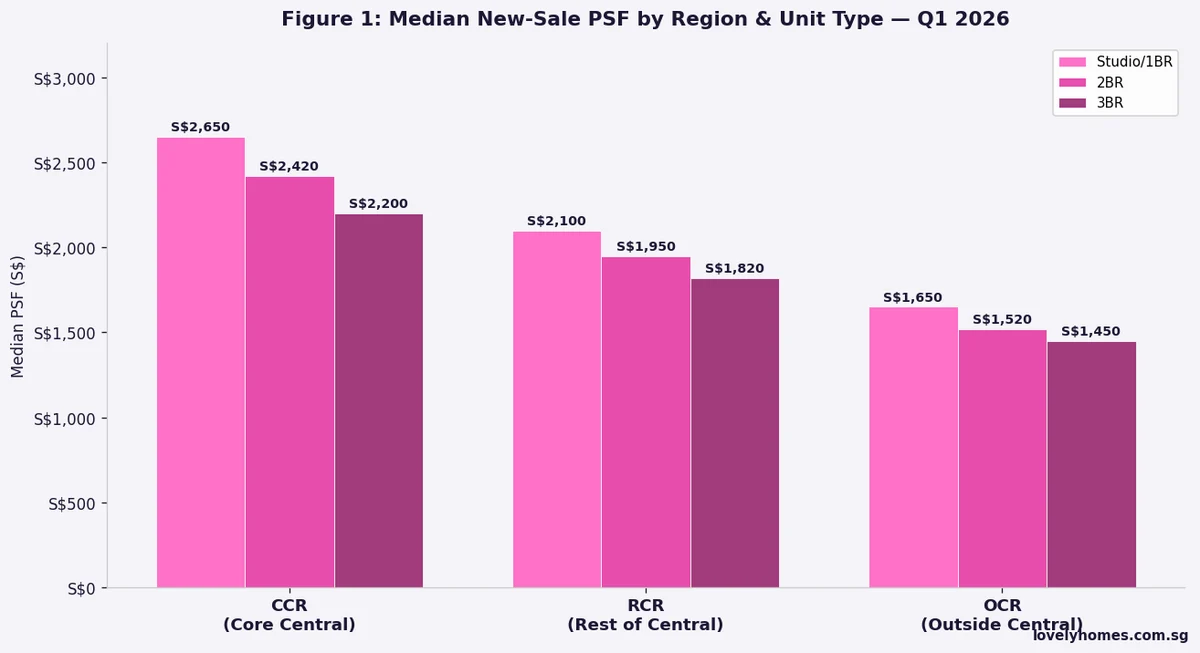
Median new-sale PSF by region CCR RCR OCR Singapore Q1 2026 by unit type
Figure 1: Median new-sale PSF by region and unit type, Q1 2026. CCR commands a 35–60% PSF premium over OCR. Source: URA, industry estimates.

CCR — Core Central Region: Singapore’s Prime Residential Belt

The Core Central Region encompasses the districts that form Singapore’s historic and financial core: Districts 1–4 (Marina Bay, Tanjong Pagar, Shenton Way, Sentosa), District 9 (Orchard Road, River Valley), District 10 (Tanglin, Holland Village, Bukit Timah), and District 11 (Newton, Novena, Thomson). Parts of Districts 7 (Beach Road/Bugis), 8 (Little India/Farrer Park) and 15 (East Coast/Katong) that fall within the Central Planning Area are also classified as CCR.

The CCR is where Singapore’s most exclusive condominiums, Good Class Bungalows and ultra-luxury developments are concentrated. Transactions at Nassim Road, Ardmore Park and Marina Bay Suites set national PSF records regularly. For non-landed private property, CCR typically commands median new-sale PSFs of S$2,200–S$2,650 depending on unit type and specific district, based on Q1 2026 caveats lodged with the Singapore Land Authority (SLA).

CCR demand is driven by high-net-worth Singapore Citizens (SCs), Permanent Residents (PRs) and foreign buyers — particularly those from Indonesia, mainland China, India and Malaysia — though the 60% ABSD levied on foreigners since April 2023 has significantly curtailed international volumes. Developer launches in CCR typically feature lower unit counts, higher finishes, and more bespoke services than OCR mass-market projects.

Key CCR planning districts and landmark projects: Orchard/Scotts area (D9): One Draycott, Klimt Cairnhill. Holland/Tanglin (D10): The Crest, Leedon Residence, 15 Holland Hill. Newton/Novena (D11): 19 Nassim, Pullman Residences. Marina Bay/Tanjong Pagar (D1–4): Marina One Residences, V on Shenton, Wallich Residence.

RCR — Rest of Central Region: The City-Fringe Sweet Spot

The Rest of Central Region occupies the transitional band between the prime CCR and the mass-market OCR. It covers key mature estates: Queenstown (D3), Pasir Panjang/West Coast (D5), Beach Road/Kampong Glam (D7 outside CCR-classified areas), Little India (D8 outside CCR), Toa Payoh/Balestier (D12), MacPherson/Potong Pasir (D13), Geylang (D14), and much of East Coast/Katong/Mountbatten (D15) and Bedok South/Upper East Coast (D16, in part).

RCR properties typically offer city-fringe convenience — short MRT commutes to the CBD, established amenities, and mature town infrastructure — at a meaningful discount to CCR. Median new-sale PSFs in Q1 2026 ranged from roughly S$1,820 to S$2,100 depending on location and unit size. Districts 3, 5 and 15 command the highest RCR premiums, owing to their proximity to the Central Business District, the upcoming Greater Southern Waterfront transformation, and East Coast’s enduring lifestyle appeal.

RCR has historically been the favoured zone for HDB upgraders who want proximity to the city without CCR prices, and for dual-income professional couples who prioritise commute times over absolute affordability. New RCR launches like those in Bukit Merah (Prime, Plus BTO classification for HDB counterparts) and Queenstown have attracted strong ballot demand in both the public and private housing markets.

OCR — Outside Central Region: Singapore’s Mass-Market Heartland

The Outside Central Region covers everything outside the Central Planning Area: the eastern districts (D16 Bedok, D17 Loyang/Changi, D18 Tampines/Pasir Ris), the north-east (D19 Serangoon/Sengkang, D20 Bishan/AMK, D28 Seletar), the north (D25 Kranji/Woodlands, D26 Upper Thomson, D27 Sembawang/Yishun), the west (D21 Clementi/Upper Bukit Timah, D22 Boon Lay/Jurong, D23 Choa Chu Kang/Bukit Panjang, D24 Lim Chu Kang), and Tengah, the newest district currently under development.

OCR dominates Singapore’s private residential volume. The majority of HDB upgraders, young families, and first-time private property buyers target OCR, where new-launch condo pricing (for 2BRs) typically ranges from S$1,400–S$1,700 PSF as at Q1 2026. OCR properties tend to carry longer commutes to the CBD but offer larger unit sizes, lower quantum, and better access to green spaces, schools and suburban amenities.

OCR saw the strongest price appreciation in Q1 2026: +2.2% quarter-on-quarter and +3.8% year-on-year — outpacing both CCR (+0.3% QoQ, +1.2% YoY) and RCR (+0.8% QoQ, +2.1% YoY). This outperformance reflects robust HDB upgrader demand, lower entry quantum making properties accessible to a wider buyer pool, and a pipeline of GLS projects in growth corridors such as Tampines, Tengah, Jurong Lake District, and the Lentor precinct in AMK.
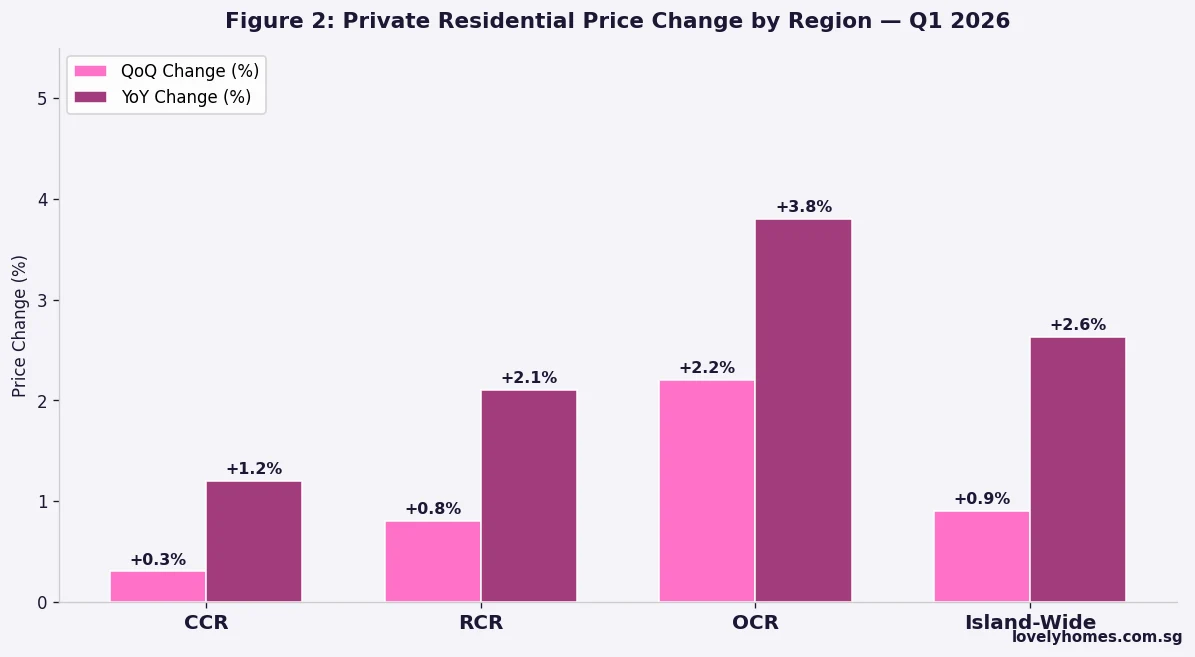
Singapore private residential price change by region CCR RCR OCR Q1 2026 QoQ YoY
Figure 2: Private residential price change by region, Q1 2026. OCR outperformed CCR and RCR on both quarterly and annual growth. Source: URA Q1 2026 Real Estate Statistics.

Price Differentials: What the PSF Gap Means in Dollar Terms

Understanding PSF differences in isolation can be abstract. A concrete comparison brings the gap to life. Consider a 700 sqft (65 sqm) 2-bedroom unit — a common floor plan across all three regions:

Region Median PSF (Q1 2026) Total Price (700 sqft) BSD (SC) ABSD (SC, 1st Property)
CCR S$2,420 S$1,694,000 S$43,120 S$0
RCR S$1,950 S$1,365,000 S$27,300 S$0
OCR S$1,520 S$1,064,000 S$18,280 S$0

The CCR-to-OCR price differential for this hypothetical 700 sqft unit is approximately S$630,000 — nearly 60%. That gap widens significantly for second-property buyers adding 20% ABSD (S$338,800 for CCR vs S$212,800 for OCR), and for foreign buyers at 60% ABSD (S$1,016,400 for CCR vs S$638,400 for OCR). Lifestyle and investment considerations aside, region choice has a material, immediate impact on stamp duty outlay.

Lifestyle and Practical Trade-offs by Region

Beyond price, each region offers a distinct living experience. CCR residents enjoy the most concentrated mix of international restaurants, luxury retail, premium healthcare (Gleneagles, Mount Elizabeth, Farrer Park Hospital), and cultural infrastructure (National Gallery, Singapore Art Museum). However, CCR neighbourhoods tend to be denser and offer less green-space per resident than suburban OCR estates.

RCR offers arguably the strongest lifestyle-value balance: city-fringe convenience, established hawker infrastructure, proximity to parks (Queenstown Park, Potong Pasir Community Club) and access to well-served MRT lines, at 20–40% lower PSF than CCR equivalents. The ongoing Greater Southern Waterfront development, which will transform the former Keppel Club site and Alexandra corridor, is expected to further raise RCR’s profile over the coming decade.

OCR living emphasises community and family infrastructure: larger void decks, PAP community centres, proximity to Primary 1 Registration schools (important for families planning early enrolment), HDB town malls, and, increasingly, direct MRT connections through expanding TEL and CRL lines. Commute times to the CBD can range from 30 to 60 minutes depending on the district.

Which Region Suits Which Buyer?
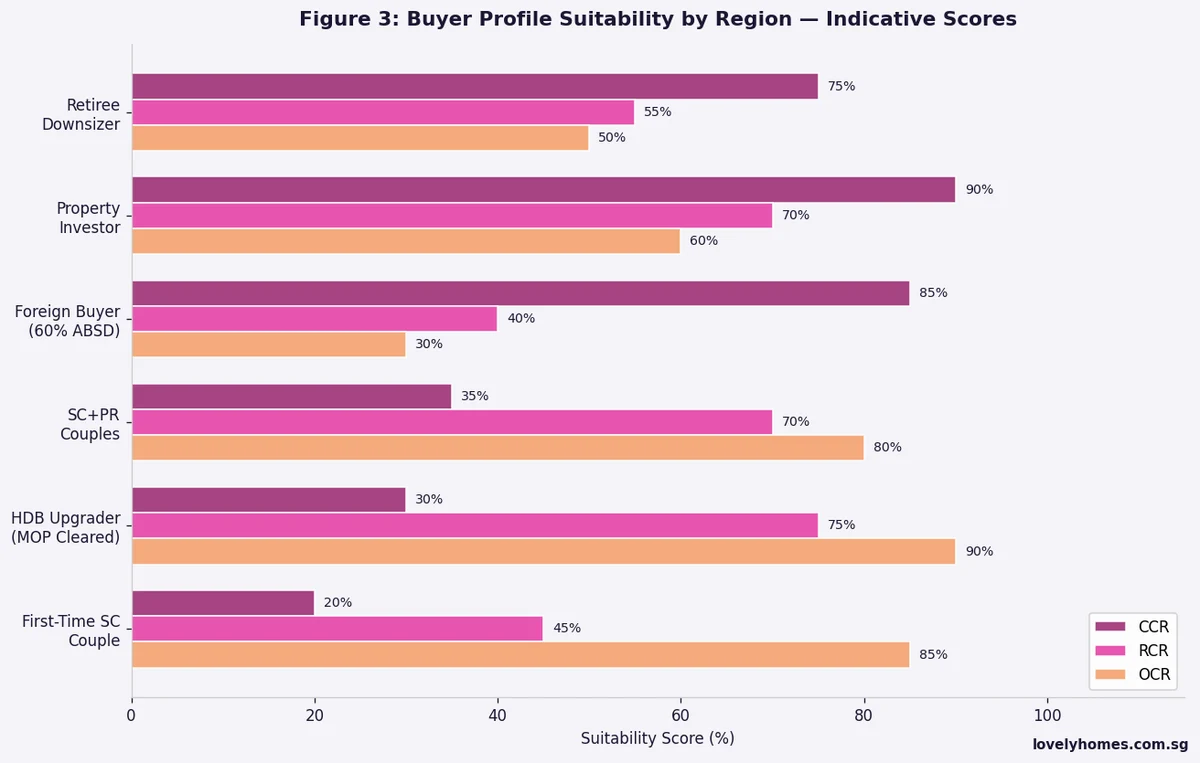
Buyer profile suitability by region CCR RCR OCR Singapore indicative scores
Figure 3: Indicative buyer profile suitability scores by region. OCR dominates for families and HDB upgraders; CCR for high-net-worth and foreign buyers; RCR is the versatile mid-range choice. Source: LovelyHomes editorial analysis.

The chart above summarises indicative suitability, but a few buyer groups merit deeper explanation. HDB upgraders who have cleared their 5-year MOP and hold meaningful CPF balances typically have loan eligibility of S$800K–S$1.4M, making OCR new launches their most accessible private market entry point. RCR remains an upgrade stretch for higher-income upgraders, but typical CCR quanta are prohibitive unless significant cash savings or investments exist outside CPF.

SC+PR couples with combined incomes above S$12,000/month often target RCR for its balance of price and location, but should note that a PR spouse is subject to a 5% ABSD on a first jointly-purchased property (SC gets 0%, but the higher of the two rates applies to the purchase). This effectively adds S$68,250 to a S$1.365M RCR unit — worth factoring into region comparison.

Foreign buyers (60% ABSD since April 2023) almost exclusively target CCR when investing in Singapore, given that the rental yield differential versus OCR rarely justifies the higher entry price at non-CCR locations. CCR’s international tenant base — expatriate professionals, corporate HQs — provides a liquidity premium that partially offsets the ABSD load.

CCR vs RCR vs OCR: Complete Comparison Table

Factor CCR RCR OCR
Key Districts D1-4, D9, D10, D11 D3, D5, D7–8, D12–15 D16–28
Median 2BR PSF (Q1 2026) S$2,420 S$1,950 S$1,520
Q1 2026 QoQ +0.3% +0.8% +2.2%
Q1 2026 YoY +1.2% +2.1% +3.8%
Typical Tenure Mix of FH, 999yr, 99yr Mostly 99yr, some FH Predominantly 99yr
Primary Buyer Profiles HNW, foreign, SC investor Upgrader, professional Family, first-time, HDB upgrader
Gross Rental Yield (est.) 2.5–3.2% 3.0–3.8% 3.5–4.2%
CBD Commute (MRT) 0–15 mins 10–25 mins 25–50 mins
Foreign Buyer ABSD 60% (applies equally) 60% (applies equally) 60% (applies equally)
Landed Property Available? Yes (GCB in D10–11) Limited Yes (most landed housing)

Worked Example: The Tan Family’s Region Decision

The Tan family — a Singapore Citizen couple, both aged 35, combined monthly income of S$14,000, CPF Ordinary Account balance of S$210,000 combined — are upgrading from their Tampines 4-room HDB (MOP cleared, estimated market value S$600,000, outstanding HDB loan S$120,000).

Option A — OCR (Tampines/Sengkang area): S$1.25M 3BR condo
BSD: S$24,100 payable via CPF. ABSD: S$0 (1st private property, SC). Bank loan: 75% LTV = S$937,500, at 3.0% fixed for 2 years / 25-year tenure = S$4,439/month. TDSR: 4,439 / 14,000 = 31.7% — PASS (below 55%). Cash upfront: 5% = S$62,500, plus BSD from CPF. HDB proceeds (≈S$480K after loan) fund CPF top-up and furnishing. Assessment: comfortable, achievable, long commute from current neighbourhood.

Option B — RCR (Queenstown/Bishan area): S$1.65M 3BR condo
BSD: S$47,600 via CPF. ABSD: S$0 (1st private property, SC). Bank loan: 75% LTV = S$1,237,500, at 3.0% / 25 years = S$5,867/month. TDSR: 5,867 / 14,000 = 41.9% — PASS. Cash upfront: 5% = S$82,500, plus BSD. After HDB proceeds the family has adequate liquidity but modest buffer. Assessment: viable, tighter cash flow, better city access and rental potential.

Verdict: On income of S$14,000/month, both options are TDSR-compliant, but Option A leaves a far more comfortable monthly buffer (≈S$9,561 vs ≈S$8,133). The family’s decision ultimately hinges on commute preference, proximity to school zones, and whether they intend to rent the property out within the first few years. Many families in this profile choose RCR as a one-step upgrade recognising they can access the city fringe without stretching to CCR prices.

Why the CCR/RCR/OCR Framework Matters for Buyers in 2026

The three-region framework shapes far more than quarterly URA statistics. Banks use it when calibrating their internal risk pricing; developers use it to position their projects and set launch prices; mortgage brokers use it when stress-testing TDSR across different loan sizes. For buyers, the most practical use is benchmarking: if a developer quotes S$1,800 PSF for a suburban project claiming it’s “competitively priced”, you can immediately check whether it is an OCR (where the median is S$1,520 PSF) or RCR (where S$1,800 PSF sits around the 50th percentile) project, and calibrate your offer accordingly.

The OCR’s recent outperformance is also a structural signal. Singapore’s ongoing MRT expansion — the Cross Island Line (CRL), the Thomson-East Coast Line (TEL) Stage 5, and future Jurong Region Line (JRL) extensions — is closing the commute-time gap between OCR and the CBD. As connectivity improves, OCR locations that once seemed remote are being repriced toward RCR norms, a trend that has been visible in Tampines, Pasir Ris and the Lentor precinct over the past three years.

What Might Come Next

Speculation: The CCR premium is unlikely to narrow significantly as long as the 60% ABSD on foreign buyers remains in place — these buyers were a key source of CCR liquidity, and their reduced participation has suppressed CCR transaction volumes even as prices held. If cooling measures are selectively eased for permanent residents or certain investment categories (which analysts do not expect before 2027 at the earliest), CCR could see a sharp repricing upward.

OCR, meanwhile, faces a pipeline risk: the 2H2026 Government Land Sales (GLS) Confirmed List offers 4,745 units including sites at Tampines, Bayshore Road and Lentor Gardens, which will add meaningful new OCR and OCR-adjacent supply over 2028–2030. Buyers targeting OCR investments with a 5–7 year exit horizon should model potential competition from these incoming projects when estimating resale premiums.

Frequently Asked Questions

Is CCR always more expensive than OCR?

In median PSF terms, yes — CCR has consistently traded at a significant premium to OCR since URA began publishing regional data. However, there are exceptions: a large OCR penthouse in a boutique freehold development can exceed the quantum of a small CCR studio. PSF is the more relevant metric when comparing like-for-like unit types. The median CCR 2BR PSF in Q1 2026 was approximately S$2,420, versus S$1,520 in OCR — a 59% gap.

Do cooling measures (ABSD, LTV, TDSR) apply differently across regions?

No. All cooling measures administered by the Ministry of Finance (MOF), MAS, and IRAS apply uniformly regardless of whether a property is in CCR, RCR or OCR. The ABSD rate is determined by your citizenship/residency status and the number of residential properties you own — not by the location of the property being purchased.

Can I use CPF to buy in any region?

Yes. CPF Ordinary Account (OA) funds can be used for the purchase of any private residential property in Singapore regardless of region, subject to the standard CPF withdrawal limits tied to the property’s Valuation Limit (VL) and any applicable Basic Retirement Sum top-up requirement. The same CPF rules apply in CCR, RCR and OCR.

Are HDB flats classified under CCR/RCR/OCR?

HDB flats use a separate classification system: Standard, Plus and Prime (introduced in October 2024 under the new BTO framework). HDB does not use CCR/RCR/OCR as official categories, though analysts often informally apply the same geographic boundaries to HDB data. The HDB Resale Price Index (RPI) covers all HDB flats islandwide and is published separately from URA’s PPI.

Which region has the best rental yield?

OCR generally offers the highest gross rental yields (estimated 3.5–4.2% for non-landed as at Q1 2026), followed by RCR (3.0–3.8%) and CCR (2.5–3.2%). The CCR’s higher entry prices compress yield percentages even though absolute rents are higher. Investors targeting yield over capital appreciation are often better served by OCR or RCR properties with strong MRT access, where tenant demand from Singapore’s large pool of mid-range expatriates and local professionals is robust.

What determines if a specific development is CCR or RCR?

The URA classifies developments based on their postal district and planning area boundaries. Specifically, a development is CCR if it falls within the defined Central Area boundary (which includes the downtown core, Marina Bay, Sentosa and selected planning areas) or within the Orchard, Newton, Buona Vista or Tanglin planning areas. Developments in planning areas like Queenstown, Toa Payoh or Geylang — which are geographically close to the city centre but outside these defined zones — are classified as RCR. You can verify a specific development’s classification using URA’s online planning maps at the URA Space portal.

Does the region affect my eligibility for grants or CPF schemes?

For private residential property purchases, no CPF housing grants are available — grants (EHG, Family Grant, PHG) are exclusively for HDB flat purchases. The CPF withdrawal rules and TDSR requirements are the same regardless of region. However, for HDB buyers using the new BTO classification framework, the type of grant available is influenced by whether the flat is classified as Standard, Plus or Prime — a parallel but separate system to CCR/RCR/OCR.

Related Articles

Disclaimer: This article is for general informational purposes only and does not constitute financial, legal or tax advice. PSF figures and price statistics are derived from URA real estate statistics (Q1 2026), SLA caveats and industry estimates. Property prices can fall as well as rise. Before making any property purchase decision, readers should consult a licensed property agent, qualified mortgage broker and independent legal counsel. Stamp duty obligations should be verified with the Inland Revenue Authority of Singapore (IRAS). CPF withdrawal eligibility should be confirmed with the Central Provident Fund Board. Grant eligibility should be checked directly with the Housing and Development Board (HDB). Cooling measure rules are subject to change by the Ministry of Finance and MAS.

Translate »