Singapore Property as a Safe Haven in 2026: What the URA Data Shows Amid Global Uncertainty

Singapore Property as a Safe Haven in 2026: What the URA Data Shows Amid Global Uncertainty

As trade tensions, currency volatility and geopolitical fractures reshape capital allocation globally, Singapore’s residential property market is drawing renewed attention from high-net-worth investors. This analysis examines what the data actually shows — and what it does not.

Quick Answer

  • Singapore’s private residential price index rose 0.3% quarter-on-quarter in Q1 2026, per URA flash estimates, with the OCR leading at +1.3% — a measured performance that belies the “booming market” narrative in some international headlines.
  • The CCR (Core Central Region) — the segment most exposed to foreign UHNW demand — has appreciated modestly but steadily since Q1 2024, driven by wealth-preservation flows from Europe, the Middle East and Southeast Asia.
  • Singapore’s 65% ABSD for foreign buyers, introduced in April 2023, has not reversed this structural demand — it has filtered out speculative short-term buyers while leaving long-horizon wealth-preservation purchasers largely undeterred.
  • The Asia-Pacific UHNW population grew by approximately 24.8% between 2021 and 2026, generating a larger pool of potential buyers even at elevated ABSD rates.
  • Singapore’s macroeconomic fundamentals — GDP growth forecast 2–4% in 2026, inflation ~1–2%, MAS-managed SGD, AAA sovereign credit — underpin the safe-haven thesis more than any single property market metric.
  • Key risks: rising private housing completions in 2026–2027, softening HDB resale prices, and TDSR constraints limiting domestic upgrader demand.

The Global Context: Why Investors Are Looking at Singapore

In the first quarter of 2026, global financial markets contended with renewed trade tensions, a volatile US dollar and a broader reassessment of risk assets in key emerging-market economies. Against this backdrop, Singapore has attracted significant commentary as a potential beneficiary of capital-flight demand.

Singapore offers a stable rule-of-law jurisdiction under the Singapore Land Authority and the Urban Redevelopment Authority; transparent property transaction records through the URA’s caveat system; a currency managed by MAS under a nominal effective exchange rate framework that has historically appreciated against peer currencies during risk-off periods; and a property market with deep liquidity in the resale condominium segment.

What Singapore does not offer — and this is the corrective that international analysis sometimes omits — is a low-friction entry for foreign buyers. The 65% ABSD on any residential property purchased by a non-Singapore national (excluding US/Iceland/Liechtenstein/Norway/Swiss nationals who receive SC-equivalent rates under FTA arrangements) means the effective purchase premium is extraordinary. A S$5M CCR condominium purchased by a foreign buyer carries an ABSD bill of S$3.25M, bringing total acquisition cost to approximately S$8.43M. That is the price of safe-haven status in Singapore.

URA private residential price index CCR RCR OCR Q1 2024 to Q1 2026
Figure 1: URA Private Residential Price Index — CCR, RCR and OCR sub-markets, Q1 2024 to Q1 2026. Source: URA pr26-31.

What the URA Data Actually Shows

URA’s Q1 2026 release (pr26-31, 25 April 2026) reported an overall private residential price increase of 0.3% q-o-q, down from 0.6% in Q4 2025. The sub-regional breakdown: OCR +1.3% (domestic upgrader and new-launch driven); RCR +0.9% (mid-tier, mix of domestic and regional demand); CCR +0.4% (internationally exposed, softest performer). Transaction volume softened to ~4,041 caveats in Q1 2026, 39.7% below Q4 2025’s 6,699 — a seasonal correction amplified by Chinese New Year, not a structural demand collapse.

UHNW Demand: Real But Measured

UHNW foreign buyer ABSD cost share S$5M CCR condo Singapore 2026
Figure 2: For a foreign UHNW buyer, the 65% ABSD represents 38.5% of total acquisition cost on a S$5M CCR condominium. Source: IRAS ABSD schedule 2023–2026.

Asia-Pacific UHNW population growth of ~24.8% between 2021 and 2026 has expanded the pool of potential buyers even at elevated ABSD rates. For buyers at this wealth tier, the 65% ABSD may represent an acceptable price for: no inheritance tax (abolished 2008), no capital gains tax on property, political neutrality in a fractured geopolitical environment, and world-class infrastructure supporting family relocation. The volume of such buyers is small — perhaps 200–400 transactions annually in the CCR above S$3M — but their price-setting impact is disproportionate.

Structural Safeguards: Why Singapore’s Market Is Different

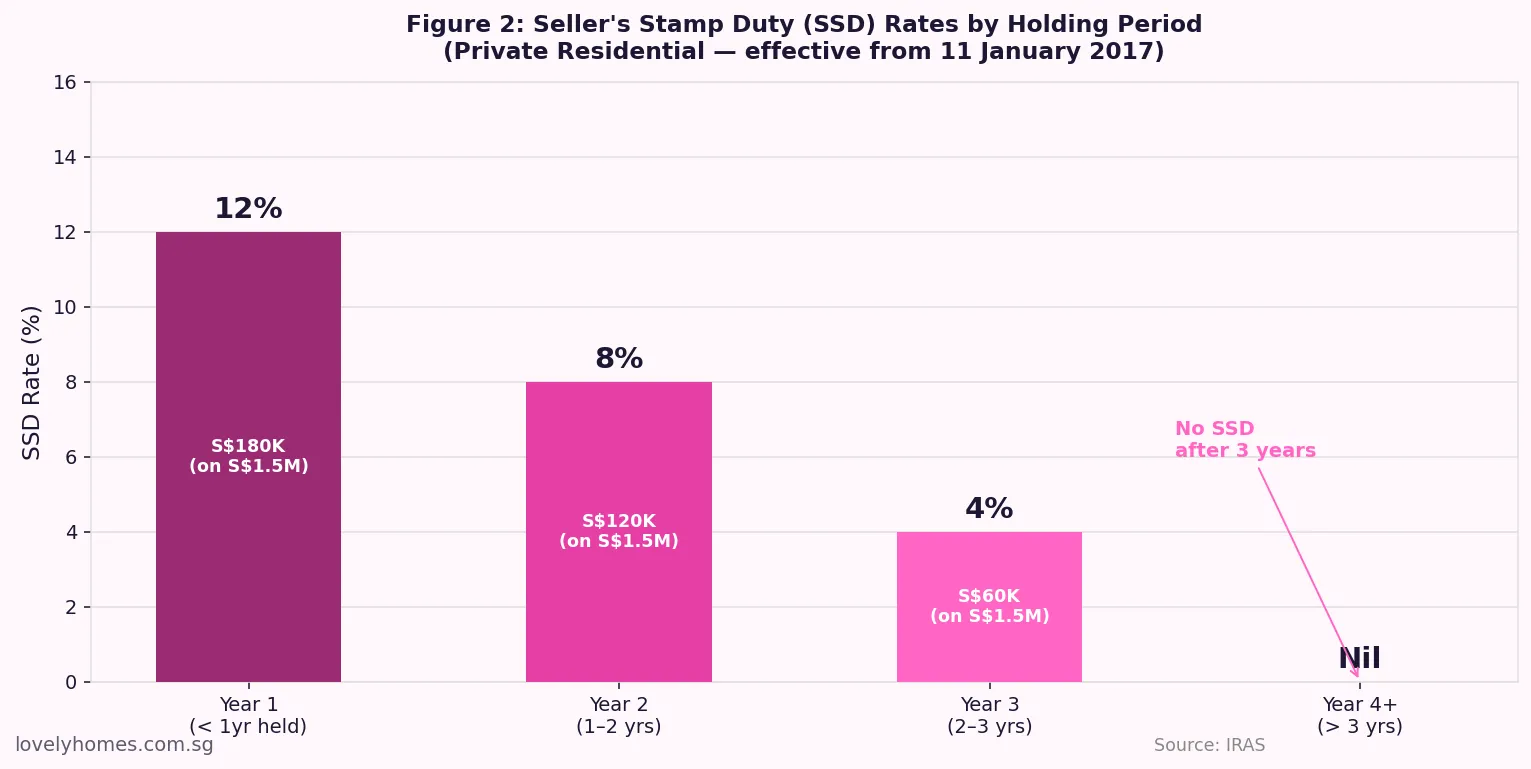
Singapore’s residential market benefits from structural safeguards that collectively reduce speculative volatility: MAS property loan rules (TDSR 55%, LTV 75%/45%, MSR 30%) enforced since 2013; Sellers’ Stamp Duty (12%/8%/4% on years 1–3) that eliminates short-horizon flipping; URA’s calibrated GLS programme managing supply against demand signals; and an approximately 90% homeownership rate among resident households providing a stable owner-occupier base. Taken together, these mechanisms make Singapore’s residential market more resistant to sharp price swings than most international comparators.

Summary: Singapore Property Safe Haven — Key Metrics at a Glance

Indicator Singapore (Q1 2026) Context
Overall private residential price growth (q-o-q) +0.3% Source: URA pr26-31
OCR price growth (q-o-q) +1.3% Strongest sub-market Q1 2026
CCR price growth (q-o-q) +0.4% UHNW-exposed segment — stable
ABSD for foreign buyers 65% Effective since 27 April 2023 (IRAS)
ABSD for FTA nationals (US/CH etc.) SC rates (0–30%) Only 5 nationalities qualify
Capital gains tax on property None Subject to IRAS badge-of-trade test
Sellers’ Stamp Duty (year 1) 12% Eliminates short-term flipping
SG GDP growth forecast 2026 2–4% MAS macroeconomic review
Private residential pipeline (2025–2027) ~40,000 units Key supply-side risk to watch

Worked Example: The UHNW Relocation Decision

A European technology entrepreneur, Ms K, relocating to Singapore on an Entrepreneur Pass targets a S$6M freehold 4BR unit in District 10. As a foreigner: ABSD 65% = S$3.9M. Total acquisition cost ~S$10.23M (plus BSD ~S$329,600 + legal). On a 10–15-year horizon, she foregoes yield (estimated gross yield 2.1%) and treats the property as a wealth-preservation vehicle. At a 3% annual SGD appreciation against EUR, the currency return alone adds S$2.4M over 10 years on a S$8M net asset position. For this buyer profile, the 65% ABSD is the cost of accessing the full Singapore safe-haven package — not a deterrent.

Key Risks to Watch

The safe-haven thesis for Singapore property in 2026 is credible but conditional. A synchronised global recession would pressure Singapore’s open economy (trade-to-GDP ratio above 300%), affecting employment, wages and domestic demand. The ~40,000-unit private residential completion pipeline for 2025–2027 could generate a supply overhang if demand softens concurrently. MAS’s higher-for-longer rate environment (effective mortgage rates 3.5–4.2%) keeps carrying costs elevated for leveraged buyers. And any relaxation of ABSD or TDSR rules — unlikely but not impossible — could paradoxically signal government concern about market weakness, dampening rather than stimulating confidence.

What Might Come Next

The URA April 2026 new home sales data (expected ~15 May 2026) will provide the next empirical test of whether OCR demand has been sustained after the strong Q1 new-launch take-up. If the April figure confirms momentum above 800–900 units sold, the safe-haven/OCR-upgrader thesis for 2026 looks intact. A print below 600 would flag a more cautious consumer posture and would likely see analysts revise full-year private residential price forecasts toward the lower end of the 3–5% annual range.

Frequently Asked Questions

Does the 65% ABSD apply to all foreigners buying Singapore property?

Yes, with one group of exceptions. Nationals of the United States, Iceland, Liechtenstein, Norway and Switzerland pay ABSD at Singapore Citizen rates under respective FTA provisions — 0% for first property, 20% for second, 30% for third and beyond. All other foreign nationals, including those on Employment Passes or Long-Term Visit Passes, pay 65% ABSD on any residential property purchase. The rate was set at this level effective 27 April 2023 by the Ministry of Finance and administered by IRAS.

Is Singapore property really capital gains tax free?

Singapore does not impose a capital gains tax. Gains from the sale of Singapore property are not taxed, provided the transaction is an investment rather than a trading activity. IRAS applies a “badges of trade” test (frequency of transactions, holding period, leverage, stated intent) to determine whether gains are assessable as income. For genuine long-hold investors, capital appreciation on Singapore property is effectively untaxed. This policy could change in future — investors should model scenarios that include a potential capital gains tax, which several peer jurisdictions have introduced in recent years.

How does Singapore compare to Hong Kong as a safe-haven property market?

Hong Kong reduced its Buyer’s Stamp Duty for non-permanent residents from 30% to 7.5% in February 2024 to revive its property market. Despite this, transaction volumes and prices in Hong Kong’s residential market have remained subdued, weighed by political uncertainty, reduced expatriate headcount and weak domestic economic confidence. Singapore, by contrast, has maintained its cooling measures and seen stable, positive price growth. Many international investors currently rate Singapore above Hong Kong for residential real estate, given rule-of-law certainty, financial-sector depth and the SGD’s track record of appreciation.

Can a Singapore PR benefit from safe-haven demand dynamics?

Yes, indirectly. PRs purchasing their first residential property in Singapore pay 5% ABSD — a fraction of the foreigner rate. If global uncertainty continues to drive wealth flows into Singapore, demand-support effects on CCR and RCR prices benefit all existing property owners, including PRs. PRs also benefit from the SGD’s safe-haven appreciation effect in their overall balance sheet if they hold Singapore-denominated assets. A PR who became a Singapore Citizen before purchasing a second property saves 25 percentage points in ABSD (0% SC first property vs 5% PR + 25% differential on second).

What are the most sought-after districts for UHNW foreign buyers in 2026?

Districts 9 (Orchard, River Valley), 10 (Tanglin, Bukit Timah, Holland) and 11 (Novena, Thomson) remain the primary targets for UHNW foreign buyers in Singapore’s CCR. Sentosa Cove (District 4) is the only area where foreigners may purchase landed property without separate government approval — though its pricing and yield dynamics are highly specific. D9 and D10 freehold condominiums with full-facility buildings in the S$5M–S$15M range have seen the most sustained foreign interest in 2025–2026 per URA caveat data.

Related Articles


Disclaimer: This article is a news analysis and commentary piece, not financial or investment advice. Data cited from URA, HDB, MAS and IRAS as at Q1–Q2 2026. ABSD rates, tax policies and MAS regulations are subject to change. Readers should consult a MAS-regulated financial adviser, a licensed property agent and qualified legal counsel before making any property investment decision. Foreign nationals should also obtain independent legal advice on residency, visa and tax implications in their home jurisdiction before purchasing Singapore property.

S$1.728M HDB Resale Record: City Vue @ Henderson Sets New All-Time High in April 2026

S$1.728M HDB Resale Record: City Vue @ Henderson Sets New All-Time High in April 2026

Click anywhere to close

Quick Answer — S$1.728M Henderson Road HDB Record

  • New record: A 5-room flat at 96A Henderson Road (City Vue @ Henderson) sold for S$1,728,000 in April 2026 — Singapore’s most expensive HDB resale flat on record.
  • Previous record: S$1,700,000 — a 5-room flat at SkyTerrace @ Dawson (92 Dawson Road), transacted in February 2026.
  • Price per square foot: Approximately S$1,421 psf on a 113 sq m (1,216 sq ft) floor area — reflecting the unit’s high floor, long remaining lease (92+ years), and prime city-fringe location.
  • Location premium: City Vue @ Henderson is in District 3/4, Bukit Merah — within walking distance of Redhill MRT and the CBD, straddling Tiong Bahru and the Greater Southern Waterfront redevelopment corridor.
  • Q1 2026 HDB resale market context: HDB resale prices fell 0.1% in Q1 2026 (first quarterly decline since Q2 2019), yet individual record transactions continue in premium projects where lease longevity, height, and location converge.
  • No capital gains tax: The seller pays no tax on the gain — Singapore does not impose capital gains tax on residential property profits (unless IRAS classifies the seller as a property trader).

Singapore’s HDB Resale Record Falls Again — S$1.728M at City Vue @ Henderson

Singapore’s HDB resale market has produced another all-time record. A five-room flat at 96A Henderson Road, in the City Vue @ Henderson development in Bukit Merah, was transacted in April 2026 for S$1,728,000 — eclipsing the previous record of S$1,700,000 set just two months earlier at SkyTerrace @ Dawson in Queenstown. The sale was first reported by EdgeProp Singapore and subsequently confirmed by multiple property media outlets citing HDB resale data.

The unit spans 113 square metres (approximately 1,216 sq ft), placing it at a price per square foot of roughly S$1,421 — significantly above the median resale psf for 5-room HDB flats in mature estates. The block is a high-rise development with the unit reportedly located between the 46th and 48th floor, delivering unobstructed views consistent with the premium that buyers in this market are demonstrably willing to pay.

Singapore HDB resale record price history 2019 to April 2026 bar chart
Figure 1: Singapore HDB resale all-time record price progression from 2019 to April 2026. Source: HDB resale caveats, EdgeProp, media reports. S$ million.

Why City Vue @ Henderson Commands Such a Premium

Several factors distinguish City Vue @ Henderson from other high-value HDB developments. The project’s 99-year lease commenced in 2019, meaning the unit sold in April 2026 still carries approximately 92 years and one month of remaining lease — an unusually long lease for resale HDB stock, and a key driver of bank financing terms (CPF usage and bank LTV are both tied to remaining lease calculations). Buyers’ CPF withdrawals are significantly less restricted on units with long leases, which expands the effective buyer pool and supports higher transaction prices.

The development sits at the nexus of three mature estates — Tiong Bahru, Redhill, and Bukit Merah — with convenient access to Redhill MRT (East-West Line), the Ayer Rajah Expressway, and the emerging Greater Southern Waterfront corridor. The proximity to the CBD (approximately 10–12 minutes by car or 20 minutes by MRT) makes City Vue a compelling alternative to city-fringe private condominiums that now command S$2,500–S$3,000 psf.

The Record in Context: Where Singapore’s HDB Prices Have Travelled

The S$1.728M transaction is the latest milestone in a decade-long upward march in Singapore’s most sought-after HDB units. The first time any HDB flat crossed S$1 million was in 2012, when a Bishan flat changed hands at that landmark price. Since then, the number of million-dollar HDB transactions has grown from a handful per year to 412 in Q1 2026 alone — a quarterly record that LovelyHomes reported in May 2026.

City Vue Henderson HDB record vs comparable high-value HDB resale flats Singapore 2026
Figure 2: The Henderson Road record transaction versus comparable high-value HDB resale flats since 2021. Source: HDB resale caveats, media reports. ★ = current all-time record.

The record has changed hands four times in the past four years: Pinnacle @ Duxton held it for much of 2021–2022, SkyTerrace @ Dawson took over in 2023 and again in February 2026, before City Vue @ Henderson set the current benchmark. All four record-holding projects share a common profile: post-2010 completion, high-rise towers (40+ storeys), long remaining lease, and prime or city-fringe locations.

The Broader Q1 2026 HDB Resale Market — A Paradox

What makes this record particularly striking is its timing. HDB resale prices fell 0.1% in Q1 2026 — the first quarterly decline in nearly seven years, according to HDB’s flash estimate released in April 2026. This retreat reflects the impact of cooling measures (particularly the tightening of HDB loan terms and tighter CPF usage rules on shorter-lease flats), a surge in BTO completions adding resale supply, and broader buyer caution. Yet the top end of the market appears immune to this softening: premium units in iconic developments continue to find buyers willing to pay record prices.

This bifurcation — where aggregate prices soften while individual top-tier transactions set records — reflects a structural feature of Singapore’s HDB resale market. The mass market is sensitive to interest rates, CPF limits, and HDB loan policy. But the sub-segment of luxury-equivalent HDB units (high-floor, long-lease, prime-location) attracts a different buyer profile: affluent upgraders, property investors seeking ABSD-free alternatives, and owner-occupiers prioritising lifestyle over value. For this cohort, S$1.7 million on a 92-year lease in the city fringe competes directly with a S$2.5–3M private condo nearby.

Summary: Key Facts About the Record Transaction

Detail Particulars
Block / Address 96A Henderson Road, Singapore
Development City Vue @ Henderson
Flat type 5-Room (113 sq m / approx. 1,216 sq ft)
Transaction price S$1,728,000
Price per sq ft ~S$1,421 psf
Transaction date April 2026
Remaining lease ~92 years 1 month (lease commenced 2019)
Nearest MRT Redhill MRT (East-West Line)
Previous record S$1,700,000 at SkyTerrace @ Dawson (Feb 2026)

What This Means for HDB Buyers and Sellers

For sellers of similar premium HDB units — high-floor, long-lease, city-fringe — the Henderson Road transaction provides a fresh comparable that may support higher asking prices. For buyers in this sub-segment, the record signals that the ceiling for what the market will pay is still rising, even as aggregate HDB resale prices soften. Buyers should note that at S$1.7M+, they are firmly in competition with suburban private condominiums (and paying significant premiums over mass-market HDB resale) — the decision must weigh the long lease, the ABSD savings versus a private purchase, and the resale liquidity of a premium HDB flat versus a private condo in the same location.

Is S$2 million the next HDB resale milestone? Multiple industry commentators cited in media coverage of this transaction believe so — pointing to the growing supply of post-2015 high-rise HDB blocks with 90+ year remaining leases, rising aspirations for public housing living standards, and the structural ABSD wedge that makes a high-value HDB more economical than a comparable private condo for a second-property buyer. LovelyHomes will track this space closely.

Frequently Asked Questions

Is the seller liable for any taxes on the S$1.728M gain?

Singapore has no capital gains tax, so the seller pays no tax on any profit from the sale. The Seller’s Stamp Duty (SSD) for HDB flats was removed in August 2010 — so unlike private residential property, there is no SSD on HDB resale transactions regardless of the holding period. The seller does have to refund any CPF monies withdrawn for the purchase (plus accrued interest at 2.5% per annum) to their CPF Ordinary Account, and repay any outstanding HDB or bank mortgage from the proceeds. The net cash in hand after those deductions is entirely tax-free.

Can foreigners or PRs buy a resale HDB flat?

Singapore Permanent Residents (SPRs) may purchase resale HDB flats under the Non-Citizen family scheme or the Non-Citizen Spouse scheme, subject to forming an eligible family nucleus and satisfying the Ethnic Integration Policy (EIP) and SPR quota for the block. Foreigners (non-PR, non-citizen) may not purchase HDB resale flats — HDB ownership is restricted to Singapore Citizens and approved SPRs. SPR buyers of resale HDB flats pay the standard buyer’s stamp duty; they do not pay ABSD on the resale HDB flat itself (ABSD applies only to the purchase of private residential property by PRs and foreigners).

Why does remaining lease length matter so much for high-value HDB flats?

Three key mechanisms tie HDB flat value to remaining lease: (1) CPF withdrawal rules — buyers can withdraw CPF savings only up to the portion of the purchase price proportionate to the remaining lease covering the buyer to age 95; flats with shorter leases restrict CPF usage, reducing effective buying power. (2) Bank financing — most banks cap the loan quantum so that the loan tenure does not extend beyond the remaining lease, meaning shorter-lease flats may only qualify for short-term loans at higher monthly repayments. (3) Resale liquidity — flats with very short leases (below 30–40 years) become increasingly difficult to sell, as buyers face compounding restrictions. City Vue @ Henderson’s 92-year remaining lease eliminates all three constraints entirely, making it as financeable as a new-build.

Are there income restrictions on buying a resale HDB flat at this price level?

No income ceiling applies to the purchase of a resale HDB flat — any eligible buyer (regardless of household income) may purchase a resale flat at any price. However, the grants available to help buyers are income-capped. At S$1.728M, the buyer almost certainly has a household income well above the S$9,000/month EHG ceiling and likely above the S$14,000/month Family Grant ceiling, meaning they probably received no CPF housing grants. The HDB Flat Eligibility (HFE) letter — now a mandatory pre-condition for any HDB resale purchase — will confirm a buyer’s grant eligibility before they exercise the OTP.

What is the Greater Southern Waterfront and how does it affect Henderson Road values?

The Greater Southern Waterfront (GSW) is Singapore’s largest urban transformation project — a 30-kilometre stretch of waterfront from Pasir Panjang to Marina East, including the relocation of Pasir Panjang terminal and the redevelopment of the former Keppel shipyard site into approximately 9,000 new homes and mixed commercial uses. Henderson Road sits at the northern fringe of this precinct. As GSW developments materialise over the 2025–2035 period, property analysts expect the surrounding Bukit Merah/Redhill area to benefit from improved amenities, green corridor access, and increased connectivity — providing a structural tailwind to property values in City Vue @ Henderson and similar developments in the area.

Related Articles

Disclaimer: This article is for general informational and editorial purposes only. Transaction data cited is sourced from publicly available HDB resale caveat records and media reports; individual transactions may be subject to verification. Property values, HDB policies, and grant conditions may change. This is not financial or property investment advice. Always consult a licensed property agent and your financial adviser before making any property decision. Official references: HDB, IRAS, URA.

HDB Income Ceiling Singapore 2026: BTO, EC, EHG & Resale Grant Limits Explained

HDB Income Ceiling Singapore 2026: BTO, EC, EHG & Resale Grant Limits Explained

Click anywhere to close

Quick Answer — HDB Income Ceiling Singapore 2026

  • Standard BTO: Household gross income ≤ S$7,000/month (family); S$3,500/month (singles applying for 2-room Flexi).
  • PLH and Plus BTO flats: Higher ceiling of S$14,000/month applies to flats in prime and plus locations (e.g., Pearl’s Hill, Rochor, Tengah Plantation).
  • Executive Condominium (EC): S$16,000/month — the highest income ceiling among subsidised housing schemes, effective 1 January 2025.
  • EHG (Enhanced CPF Housing Grant): S$9,000/month household income ceiling for grant eligibility; the lower your income, the higher the grant (up to S$120,000 for families).
  • Family Grant (resale flats): S$14,000/month ceiling; up to S$80,000 grant for buying a resale flat from a non-related seller.
  • Income is assessed on a household basis — all persons listed in the application must declare their income, including variable pay averaged over 12 months.
  • Investment income is excluded — dividends, capital gains, and interest income are not counted. NS allowance is also excluded.
  • No income ceiling for resale HDB flats — there is no maximum income limit to purchase a resale HDB flat itself, though the grants you can receive are income-capped.

What Is the HDB Income Ceiling?

The HDB income ceiling is the maximum gross monthly household income a family or individual may earn in order to be eligible to purchase a new HDB flat (BTO), an Executive Condominium, or to receive CPF housing grants for a resale flat. The ceilings are set by the Housing and Development Board (HDB) and the Ministry of National Development (MND) as part of Singapore’s public housing means-testing framework, which aims to ensure that subsidised housing resources are directed to households that genuinely need them.

Income ceilings have evolved significantly since HDB first introduced means-testing. The current standard BTO ceiling of S$7,000/month was set in September 2019 when the Enhanced CPF Housing Grant (EHG) was introduced, replacing the earlier S$12,000 cap for non-mature estate BTOs and S$8,000 for mature estate BTOs. The PLH and Plus flat ceilings of S$14,000 were introduced with the new housing classification framework in October 2021 and October 2024 respectively.

HDB income ceiling by flat type and grant Singapore 2026 comparison table
Figure 1: HDB income ceilings by scheme and grant type, Singapore 2026. All amounts are gross monthly household income. Source: HDB, CPF Board.

Income Ceilings by Flat Type — Full 2026 Breakdown

Standard BTO Flats: S$7,000/Month

For the majority of new HDB BTO flats in non-prime, non-plus locations (classified as “Standard” flats), the household gross income ceiling is S$7,000 per month. This applies to families — defined as a married or engaged couple (or family nucleus including parent/child). Singles applying under the Single Singapore Citizen scheme for a 2-room Flexi flat in the non-mature estates have a ceiling of S$7,000 per person (individual income, not household).

The S$7,000 ceiling is intentionally conservative — it targets the bottom 60–65% of Singapore’s household income distribution. Households above this ceiling are expected to either purchase an EC, a private condominium, or a resale HDB flat (where there is no income ceiling for the purchase itself, though grants are still capped).

PLH and Plus BTO Flats: S$14,000/Month

Introduced under HDB’s new flat classification framework that took effect in October 2024, Plus and Prime Location Housing (PLH) flats carry a higher income ceiling of S$14,000/month. These flats are located in attractive areas close to the city (e.g., Bukit Merah, Queenstown, Toa Payoh for PLH; Woodlands, Tengah for Plus). The higher ceiling reflects the greater demand for these locations and the recognition that buyers in these markets tend to have higher incomes, while still needing a subsidised option. Plus and PLH flats come with stricter resale conditions — a 10-year Minimum Occupation Period (compared to 5 years for Standard), and an income ceiling on resale (buyers of PLH resale flats must also satisfy a S$14,000 income ceiling).

Executive Condominiums: S$16,000/Month

The EC income ceiling was raised from S$14,000 to S$16,000 per month effective 1 January 2025. This makes ECs accessible to a wider band of dual-income professionals who earn too much for standard BTOs but are priced out of private condominiums. An EC is a hybrid housing type — built by private developers but sold at subsidised prices with HDB eligibility rules for the first 10 years, before it privatises and becomes fully marketable. The S$16,000 ceiling targets households at roughly the 80th percentile of Singapore’s income distribution.

What counts as income for HDB BTO application Singapore 2026
Figure 2: Income types and how they are treated in HDB income ceiling assessment. Source: HDB, CPF Board.

How HDB Calculates Household Income

HDB assesses household income based on the gross monthly income of all persons listed in the flat application (the applicant, occupiers, and any essential occupiers). The income of all listed individuals is summed to arrive at the household total.

Fixed Employment Income

For salaried employees, the assessed income is the gross monthly salary as reflected in the applicant’s payslip or CPF contribution records. Gross salary includes basic pay plus any fixed allowances, and is assessed before deduction of employee CPF contributions, income tax, or other deductions.

Variable, Commission, and Bonus Income

Variable income (commissions, performance bonuses, overtime pay) is averaged over the preceding 12 months. If the applicant has been employed for less than 12 months, the average is calculated over the actual period of employment. Applicants who received a large one-off bonus in a single month cannot exclude it — HDB takes the 12-month average, which will include that month’s higher figure.

Self-Employment and Gig Income

For self-employed persons, freelancers, and gig workers, HDB assesses income based on the average monthly income from the preceding 12 months, typically computed from the latest available Notice of Assessment (NOA) from IRAS, or from CPF contribution records for self-employed persons who make voluntary MediSave contributions. Applicants who have not filed an IRAS tax return may be required to submit a statutory declaration of income.

What Is Excluded

Investment income (dividends, interest, capital gains from shares or property) is explicitly excluded from HDB’s income assessment. National Service (NS) full-time allowances and NSmen in-camp training allowances are also excluded. A family member who is currently on no-pay leave, studying full-time, or retired with zero employment income contributes S$0 to the household total.

HDB income ceiling worked example Lim couple borderline case Singapore 2026
Figure 3: Worked example — the Lim couple’s borderline income assessment for standard BTO eligibility.

Grant Income Ceilings — EHG, Family Grant, and PHG

Even where a household meets the income ceiling for purchasing a flat, the grants available are separately subject to their own income tests. The Enhanced CPF Housing Grant (EHG) — the largest and most progressive grant — has a ceiling of S$9,000/month for families. Below this ceiling, the EHG scales from S$5,000 (household income S$7,001–S$9,000) up to S$120,000 (household income ≤ S$1,500). Families earning between S$7,001 and S$9,000 can still receive the EHG for a resale flat purchase even though they are ineligible for a standard BTO.

The Family Grant for resale flats (up to S$80,000 for buying from a non-related party) and the Proximity Housing Grant (up to S$30,000 for living near parents or married child) both have a ceiling of S$14,000/month. These grants can be stacked with the EHG where eligibility is met, for a maximum combined grant of S$230,000 on a resale flat.

Summary Table — Income Ceilings and Grant Amounts at a Glance

Scheme / Grant Income Ceiling (Family) Max Amount Notes
Standard BTO (purchase eligibility) S$7,000/mth No income ceiling for resale HDB purchase
PLH / Plus BTO S$14,000/mth 10-yr MOP; resale also income-capped
Executive Condominium (EC) S$16,000/mth Raised from S$14,000 effective Jan 2025
EHG (family) S$9,000/mth S$120,000 Progressive — lower income = higher grant
EHG (singles) S$4,500/mth S$60,000 2-room Flexi BTO or resale
Family Grant (resale) S$14,000/mth S$80,000 Buying from unrelated seller
Proximity Housing Grant (PHG) S$14,000/mth S$30,000 Within 4 km of parents/married child
Max combined grants (resale) Depends S$230,000 EHG + Family Grant + PHG stacked

Worked Example: The Lim Couple’s Borderline Income Situation

Mr Lim, 31, earns S$4,200 basic salary per month as a logistics executive, plus an average of S$400 monthly commission over the past 12 months. Mrs Lim, 29, earns S$2,800 as a primary school teacher. They are first-timer applicants hoping to ballot for a 4-room Standard BTO flat in Sengkang.

Income assessment: Mr Lim’s assessed income = S$4,200 + S$400 = S$4,600/mth. Mrs Lim’s assessed income = S$2,800/mth. Household total = S$4,600 + S$2,800 = S$7,400/mth.

Result: S$7,400 exceeds the S$7,000 standard BTO ceiling — the Lim couple is not eligible for a Standard BTO flat. They have three practical options: (1) apply for a PLH or Plus BTO flat (S$14,000 ceiling) in a prime location; (2) apply for a resale HDB flat (no income ceiling on the purchase itself, though their EHG would be capped at S$9,000 ceiling — which they meet, so they’d receive some EHG); or (3) consider an EC (S$16,000 ceiling). Note that if Mr Lim’s commission is reduced (e.g., in a slow quarter), his income for that 12-month window may average below S$400, potentially bringing the household total to or below S$7,000.

Why Income Ceilings Matter for Singapore’s Housing Market

Income ceilings are the primary demand-management tool for Singapore’s public housing system. By restricting BTO eligibility to lower- and middle-income households, HDB ensures that its heavily subsidised flat supply — which often prices new flats at 20–40% below comparable resale market values — reaches the households that most need the subsidy. Without income ceilings, wealthier households would compete for and crowd out subsidised flats, undermining the social purpose of public housing.

The existence of multiple ceiling tiers (S$7,000, S$14,000, S$16,000) also creates a housing ladder that mirrors Singapore’s income distribution: Standard BTOs for lower-middle income families, Plus/PLH and ECs for upper-middle income families, and the private market for those above S$16,000/month household income.

What Might Change: Income Ceiling Reviews

(This section contains editorial analysis; it does not constitute financial or housing advice.)

HDB reviews income ceilings periodically in line with median household income growth. The last major revision was in September 2019 (standard BTO ceiling reduced from varying rates to a uniform S$7,000 with EHG introduced simultaneously). The EC ceiling was raised from S$14,000 to S$16,000 in January 2025. With Singapore’s median household income having grown approximately 15–20% between 2019 and 2025, some housing analysts expect MND to review the standard BTO ceiling again in the 2026–2028 planning cycle. A rise to S$8,000 or S$8,500 would make a meaningful difference for dual-income couples earning in the S$7,000–S$8,500 range who are currently excluded from BTO eligibility.

Frequently Asked Questions

Is there an income ceiling to buy a resale HDB flat?

No — there is no maximum income ceiling for purchasing a resale HDB flat. Any Singapore Citizen or Permanent Resident who meets the general eligibility conditions (citizenship/PR status, family nucleus or age requirement, ownership restriction) may buy a resale flat regardless of how high their household income is. Income ceilings only apply to new BTO flats and ECs. However, the grants available for resale flat buyers (EHG, Family Grant, PHG) do have income ceilings as described in this article, so higher-earning households buying resale may receive reduced or zero grants.

What happens if my income exceeds the ceiling after I ballot for a BTO flat?

Income eligibility is assessed at the time of flat application (ballot) and again at the time of flat booking (signing the agreement for lease). If your household income exceeds the ceiling at the time of booking, HDB may disqualify the application. However, if income rises after booking but before key collection (completion), you generally remain eligible as the assessment was already made. Applicants should be honest about their income at both key assessment points, as a deliberate misrepresentation can result in disqualification and potentially being barred from future HDB applications.

Does my spouse’s income count if we apply together?

Yes. All persons listed in the HDB flat application — whether as applicants or occupiers — must declare their income, and all declared incomes are summed to form the household income. If your spouse is listed in the application (even as an occupier), their income is included. If your spouse has zero income (e.g., they are a homemaker or full-time student), their contribution to the household total is zero. Couples who are applying under the Fiancé/Fiancée scheme must also include their future spouse’s income.

Can I include rental income from my current property to meet the income threshold for EHG?

Rental income from non-HDB private property is generally included in HDB’s income assessment as it forms part of gross monthly income. However, this question is more often asked in the opposite direction — households trying to keep their income below the ceiling for grant eligibility. If including rental income pushes your household total above the relevant ceiling, you would lose eligibility for that grant tier. IRAS’ Notice of Assessment is the documentary basis for verifying rental income. Rental income from a sub-let HDB room (which is subject to HDB’s sub-letting rules) is also included in gross income.

What is the income ceiling for single Singaporeans buying a BTO?

Single Singapore Citizens aged 35 and above may apply for a 2-room Flexi BTO flat under the Single Singapore Citizen scheme. The income ceiling is S$7,000 per month (individual income, not household). Singles are not eligible for 3-room, 4-room, or larger BTO flats in the open market, though they may apply jointly with parents under the Joint Singles Scheme or with a single sibling. For resale flats, singles may purchase any size flat (from 2-room up to 5-room) without an income ceiling on the purchase, and may receive the EHG for Singles (ceiling S$4,500/month, max S$60,000).

How is income assessed for a person who recently started a new job?

For a person who has been employed for less than 12 months, HDB averages their gross income over the actual period of employment — not a full 12 months. For example, if Mr Tan started his job 6 months ago with a gross salary of S$5,000/month, his assessed income is S$5,000 (the monthly figure, not S$30,000 / 12 = S$2,500). Fixed monthly salary is straightforward; variable pay would be averaged over those 6 months. Someone who recently joined a new employer at a higher salary cannot use the income figure from their previous lower-paying job — HDB uses the current employment’s income for the averaging calculation.

Is the Ethnic Integration Policy (EIP) related to the income ceiling?

No. The Ethnic Integration Policy (EIP) and the SPR Quota are separate eligibility rules that restrict the racial composition of each HDB block and neighbourhood — they ensure no single ethnic group dominates any given HDB block. EIP applies at the point of resale flat purchase (you can only buy in certain blocks depending on your ethnicity and the current racial mix of that block) and has nothing to do with income. The income ceiling and the EIP are independent eligibility checks — a buyer must satisfy both, but they measure completely different things.

Related Articles

Disclaimer: This article is for general informational purposes only and does not constitute financial or housing advice. HDB income ceilings, grant amounts, and eligibility conditions may be revised by HDB, MND, or CPF Board at any time. Always verify the latest eligibility requirements directly with HDB at hdb.gov.sg or via the HDB Flat Portal before submitting any application. Additional references: CPF Board, IRAS.

Commercial Property Investment Singapore 2026: No ABSD, GST, Types & Yields Guide

Commercial Property Investment Singapore 2026: No ABSD, GST, Types & Yields Guide

Click anywhere to close

Quick Answer — Commercial Property Investment Singapore 2026

  • No ABSD — commercial property attracts 0% Additional Buyer’s Stamp Duty regardless of your citizenship, residency status, or number of properties owned.
  • No Residential Property Act restrictions — foreigners may purchase strata commercial units (offices, retail, shophouses) without special approval.
  • GST applies — if the seller is GST-registered, you pay 9% GST on the purchase price. This is the single largest “hidden” cost for commercial buyers.
  • Lower LTV — banks typically lend up to 55% (first commercial purchase) versus 75% for residential. Expect to deploy more equity upfront.
  • No SSD — Seller’s Stamp Duty does not apply to commercial property; you can sell at any time without a holding-period penalty.
  • Gross yields of 3.5–6.5% — strata offices and industrial units typically yield more than residential condos, but capital appreciation potential is generally lower.
  • Four main types — strata office, strata retail / shophouse, industrial (B1/B2), and conservation shophouse each have distinct lease terms, tenant profiles, and yield bands.
  • GST registration threshold — if your commercial rental income exceeds S$1 million per annum, you must register for GST and charge 9% to tenants.

What Is Commercial Property Investment in Singapore?

Singapore’s commercial real estate market encompasses office towers, retail podiums, shophouses, industrial buildings, and mixed-use developments. Unlike residential property, commercial assets are not governed by the Residential Property Act and are not subject to Additional Buyer’s Stamp Duty (ABSD) — making them a popular route for investors seeking rental income or portfolio diversification without the stamp-duty burden that residential purchases now carry.

Commercial property is regulated by the Urban Redevelopment Authority (URA) for planning matters, IRAS (Inland Revenue Authority of Singapore) for stamp duties and GST, and the Monetary Authority of Singapore (MAS) for financing rules. The key legislation governing transactions includes the Stamp Duties Act, the Goods and Services Tax Act, and the Land Titles Act.

Singapore commercial property types and rental yields comparison 2026
Figure 1: Singapore commercial property types, key attributes, and indicative gross rental yields (2026). Source: URA/IRAS.

Key Types of Commercial Property in Singapore

The four main categories relevant to individual investors are strata offices, strata retail units, industrial properties, and conservation shophouses. Each carries a different lease tenure, typical tenant profile, yield band, and financing environment.

Strata Office Units

Strata offices are individual floors or partial-floor units in commercial buildings, sold as separate titles. Found predominantly in the Central Business District, Orchard, and Jurong Lake District, these units are popular with SME owner-occupiers and yield-seeking investors. Gross yields range from approximately 3.5% to 5.0% in 2026, with CBDpremium offices at the lower end and suburban offices at the higher end. Buildings may be freehold or 99-year leasehold; the distinction affects both capital values and bank financing terms.

Strata Retail Units and Conservation Shophouses

Retail strata units — including ground-floor shop spaces in mixed-use developments — offer yields of roughly 3.0% to 4.5%, with location being the dominant driver. Conservation shophouses (two- to three-storey terraced buildings in gazetted areas such as Chinatown, Little India, and Kampong Glam) are a distinct asset class. Most are freehold with strong scarcity value; gross yields typically run at 2.5% to 4.0%, but capital appreciation has historically been robust. The URA’s conservation guidelines impose strict rules on external façade alterations, which investors must factor into refurbishment budgets. LTV for shophouses tends to be lower — around 40% — because banks treat them as specialised assets.

Industrial Property (B1 and B2)

Industrial property in Singapore is stratified by use type: B1 (clean/light industrial) allows uses compatible with a residential environment, while B2 (general industrial) permits heavier manufacturing and logistics. Most industrial land is leased from JTC Corporation at 30- to 60-year tenures, depressing capital values but pushing gross yields to 4.5%–6.5% — the highest of the four main types. Key clusters include Jurong, Tuas, Ubi, and Tai Seng. Since September 2017, resale of strata industrial units is permitted only to end-users for the first three years, a rule introduced by the Ministry of Trade and Industry to curb speculation. Foreigners may invest in industrial property without additional restrictions.

ABSD rates residential vs commercial property Singapore 2026
Figure 2: ABSD rates by buyer profile — residential vs commercial. Commercial property carries 0% ABSD for all buyer profiles. Source: IRAS 2026.

Why Commercial Property Attracts Zero ABSD

ABSD was introduced in December 2011 (and significantly increased in April 2023) specifically to cool demand in the residential housing market, which the government regards as a social good requiring price stability. Commercial and industrial properties serve business rather than shelter needs, and are therefore entirely outside ABSD’s ambit. This means a foreign investor purchasing a strata office pays the same stamp duties as a Singapore Citizen — solely Buyer’s Stamp Duty (BSD) at the standard progressive rates.

BSD rates on commercial property in 2026 are: 1% on the first S$180,000, 2% on the next S$180,000, 3% on the next S$640,000, 4% on the next S$500,000, 5% on amounts from S$1.5 million to S$1 billion, and 6% above S$1 billion. This mirrors the residential BSD schedule and was last revised in Budget 2023.

GST: The Hidden Cost Most Buyers Underestimate

Goods and Services Tax at 9% (effective 1 January 2024) applies to commercial property transactions where the seller is GST-registered. This is separate from BSD and is payable on the purchase price or market value, whichever is higher. On a S$2 million strata office, GST alone adds S$180,000 to the cost — a sum larger than the BSD on the same transaction. Buyers should always verify the seller’s GST registration status via the IRAS MyTax Portal before committing to an Option to Purchase.

If you are purchasing the commercial property for your own GST-registered business, you can claim the input tax credit — effectively recovering the GST through your quarterly GST returns. Investors who are not GST-registered absorb the full 9% as an acquisition cost. Rental income from commercial tenants must also include 9% GST if your annual rental income (across all commercial properties) exceeds S$1 million.

Stamp duties and GST on Singapore commercial property 2026
Figure 3: Full summary of stamp duties and GST applicable to Singapore commercial property purchases and leases. Source: IRAS 2026.

Financing Commercial Property in Singapore

Commercial property loans are not subject to MAS’s Total Debt Servicing Ratio (TDSR) framework in the same way residential mortgages are — though banks still apply their own stress-testing. The Loan-to-Value (LTV) ceiling for a first commercial property loan is approximately 55%, compared to 75% for a first residential property. This reflects the higher perceived risk of commercial assets. Expect to deploy at least 45% equity plus BSD, GST (if applicable), and legal fees on day one.

Interest rates on commercial loans are typically 20–50 basis points higher than equivalent residential loans, reflecting the lower liquidity and higher vacancy risk of commercial assets. Loan tenures are shorter — typically 25 to 30 years maximum for freehold assets, and capped at remaining lease term minus 5 years for leasehold properties. Conservation shophouses, viewed as specialised collateral, often face tighter LTV of around 40%.

Key Facts Summary

Parameter Residential Condo Strata Office Strata Industrial
ABSD (SC 2nd) 20% 0% 0%
ABSD (Foreigner) 60% 0% 0%
SSD on resale 12/8/4% (≤3yr hold) 0% 0%
GST on purchase None 9% if seller GST-reg 9% if seller GST-reg
LTV (first purchase) 75% ~55% ~55–60%
Gross yield (2026) 2.5–4.0% 3.5–5.0% 4.5–6.5%
Foreigner eligible? Yes (high ABSD) Yes (no ABSD) Yes (no ABSD)
CPF usable? Yes (own use) No No

Worked Example: Ms Rajah Acquires a S$1.5M Strata Office in Tanjong Pagar

Ms Rajah, 45, is an Indian national on an Employment Pass. She already owns a residential condominium purchased with 60% ABSD (S$420,000 on a S$700,000 condo). She now wishes to diversify into commercial property.

Property: Strata office unit, 600 sq ft, Tanjong Pagar CBD, S$1.5 million. The seller is GST-registered.

Acquisition costs:

  • BSD: 1% × S$180,000 + 2% × S$180,000 + 3% × S$640,000 + 4% × S$500,000 = S$1,800 + S$3,600 + S$19,200 + S$20,000 = S$44,600 BSD
  • ABSD: S$0 (commercial — not applicable)
  • GST at 9%: 9% × S$1,500,000 = S$135,000 (recoverable if Ms Rajah registers for GST)
  • Legal / conveyancing: approximately S$5,000
  • Total upfront cash (excluding mortgage): S$44,600 + S$135,000 + S$5,000 + 45% deposit = S$184,600 + S$675,000 = ~S$859,600

Rental income: At 4.2% gross yield, monthly rent ≈ S$5,250. After property tax (10% of annual value of ~S$44,000 = S$4,400), maintenance, and agent fees, net yield is approximately 3.5%, or S$4,375/month.

Key insight: If Ms Rajah had purchased a residential condo of equivalent value as a second property, her ABSD alone would have been S$900,000 (60% of S$1.5M). By choosing commercial, she eliminates this entirely — and has no SSD exposure if she sells within three years.

Why Commercial Property Matters for Singapore Investors

The April 2023 ABSD increases — which pushed the foreigner residential rate to 60% and the SC second-property rate to 20% — dramatically changed the calculus for investors. Commercial property became the natural hedge: the same capital now buys a non-residential asset with no ABSD, no SSD, and typically a higher gross yield than residential. Between 2023 and 2026, URA data shows elevated transaction volumes for strata commercial and industrial units as investors sought ABSD-free alternatives.

Compared to regional peers, Singapore’s commercial property market benefits from rule-of-law certainty, transparent title, a deep pool of institutional tenants, and strong infrastructure connectivity. Hong Kong and Kuala Lumpur offer comparable tax advantages in some segments, but Singapore’s political stability and AAA-rated credit environment command a premium.

What Might Come Next for Singapore Commercial Property

(This section contains the editorial team’s forward-looking analysis; it does not constitute financial advice.)

The URA’s 2019 Master Plan designated the Greater Southern Waterfront, Jurong Lake District, and Woodlands Regional Centre as key nodes for commercial growth. These decentralisation drivers are expected to support demand for strata office space outside the CBD over the 2025–2030 planning horizon. Industrial REITs have flagged tightening vacancy rates in B1 space as the tech and biomedical sectors continue to grow, potentially supporting rental growth.

GST is not expected to rise above 9% before 2028 based on current MAS and MOF guidance. ABSD on commercial property has never been introduced in Singapore’s policy history, and any future imposition would require legislative change — there is no current signal of this from the government. The main risks for commercial investors are interest rate movements (commercial loan rates are closely tied to SORA and 3-month bank rates), potential oversupply in the CBD Grade A office segment following several large completions, and global economic uncertainty affecting tenant demand.

Frequently Asked Questions

Can foreigners buy commercial property in Singapore without restrictions?

Yes. The Residential Property Act (Cap 274) restricts foreigners from purchasing certain residential property categories (such as landed property and non-approved condominium units without special approval), but commercial property is entirely outside its scope. A foreigner may purchase a strata office, retail unit, shophouse, or industrial unit without any Ministry of Law approval, and pays 0% ABSD on the transaction. BSD and GST (if the seller is GST-registered) still apply.

Do I need to pay GST when buying a commercial property from a private individual who is not GST-registered?

No. GST only applies when the seller is a GST-registered entity. If you are purchasing a strata office from a private individual who has never registered for GST (which is common for smaller investors), no GST is payable. Always verify the seller’s GST registration status on the IRAS MyTax Portal before signing the Option to Purchase. If the seller is GST-registered, factor in the full 9% — this is non-negotiable and non-refundable unless you yourself register for GST and claim input tax.

Can I use my CPF savings to purchase a commercial property?

No. CPF Ordinary Account savings may only be used for the purchase of approved residential properties in Singapore — HDB flats, private residential apartments, and executive condominiums. Commercial and industrial properties are explicitly excluded from CPF usage. You must fund the entire purchase — including deposit, BSD, GST, legal fees, and the equity portion — using cash or cash equivalents.

Is rental income from commercial property taxable in Singapore?

Yes. Rental income from commercial property is taxable under the Income Tax Act as part of your assessable income for the relevant Year of Assessment. You may deduct allowable expenses including mortgage interest, property tax, maintenance and repairs, insurance premiums, and agent commission. If your gross rental receipts exceed S$1 million per year, you must register for GST and charge 9% GST to tenants (which you then remit to IRAS quarterly, after claiming input tax credits on your own GST-bearing expenses).

What is the difference between B1 and B2 industrial property?

Both are industrial land-use categories defined by the URA. B1 (clean/light industrial) permits uses such as food production, light manufacturing, research-and-development labs, and data centres — activities compatible with a residential environment. B2 (general industrial) permits heavier manufacturing, storage, and logistics activities that may generate noise, vibration, or emissions. B2 properties tend to offer higher yields but a narrower tenant pool, and are located further from residential zones. Investors should check the specific approved uses of any industrial unit before purchase, as unauthorised use can result in URA enforcement action.

Are there any restrictions on reselling commercial property in Singapore?

Generally, no — commercial property may be resold at any time with no Seller’s Stamp Duty. However, strata industrial units sold under JTC leases have a restriction: they may only be sold to end-users (not investors) during the first three years of ownership, a rule introduced in September 2017 to reduce speculation. After three years, the restriction lifts and the unit may be sold to any buyer. Conservation shophouses may be subject to URA conservation conditions that restrict certain types of renovation or façade changes, which can affect marketability.

How does the Seller’s Stamp Duty (SSD) work for commercial property?

It does not. Seller’s Stamp Duty was introduced specifically for residential property to discourage short-term speculation. It applies at 12% (sold within one year), 8% (sold in year two), and 4% (sold in year three) for residential properties acquired after 16 December 2021. Commercial and industrial property are entirely exempt from SSD — you may sell a strata office one month after purchase with zero SSD liability. BSD and any applicable GST on the subsequent buyer’s transaction are unrelated to your SSD position as a seller.

Related Articles

Disclaimer: This article is for general informational purposes only and does not constitute financial, tax, or legal advice. Commercial property investment involves significant capital risk, and individual circumstances vary widely. ABSD rates, BSD rates, GST rates, and LTV limits are determined by IRAS, MAS, and the relevant authorities and may change without notice. Always consult a licensed real estate salesperson, a qualified lawyer, and an accountant or tax adviser before making any property investment decision. Official references: IRAS, URA, MAS, JTC.

Translate »