Singapore Condo Resale Guide 2026: Step-by-Step Buyer’s Complete Guide

Singapore Condo Resale Guide 2026: Step-by-Step Buyer’s Complete Guide

Quick Answer: Buying a Resale Condo in Singapore — Key Facts

  • Who can buy: Singapore Citizens, Permanent Residents, and foreigners may all purchase private resale condominiums — but ABSD rates differ dramatically by profile
  • Minimum cash outlay: At least 5% of purchase price in cash; the remaining 20% of downpayment can be CPF OA
  • Timeline: Approximately 10–12 weeks from Option to Purchase (OTP) to completion and key collection
  • BSD: Progressive 1–6% on purchase price, payable by all buyers; SC first property ABSD = S$0
  • Key eligibility check: TDSR (Total Debt Servicing Ratio) capped at 55%; no MSR applies for private property
  • Foreigner ABSD: 60% on purchase price as at 2026 — substantially increases total outlay
  • No MOP: Private condos have no Minimum Occupation Period; you may rent out immediately or sell at any time (but Seller’s Stamp Duty applies if sold within 3 years)
  • New vs resale: Resale condos offer immediate occupation, negotiable price, and visible condition — often priced at a discount to new launches in the same area

Buying a resale condominium in Singapore is the most straightforward route into the private residential property market. Unlike new launches, which require you to pay progressively as construction progresses, a resale unit lets you see exactly what you are buying, negotiate directly with the seller, and move in as soon as the transaction completes — typically within 10–12 weeks. That said, the process involves a specific sequence of legal, financial, and administrative steps that every buyer should understand before signing anything.

This guide walks you through the full condo resale purchase journey, from getting your finances in order to collecting your keys, explaining every cost, timeline, and regulatory check that applies in 2026. Whether you are a first-time buyer, an upgrader, or a Singapore Permanent Resident (SPR) navigating your first private property purchase, this is the definitive reference.

Figure 1: Singapore condo resale 8-step purchase process — from AIP to completion
Figure 1: The 8-step Singapore condo resale purchase process. Total timeline approximately 10–12 weeks from Option to Purchase to legal completion. Source: URA, conveyancing practice norms.

Step 1: Set Your Budget and Get an Approval-in-Principle (AIP)

Before you view a single property, you need a firm number in your head — and a bank’s provisional agreement to lend it. The Approval-in-Principle (AIP), sometimes called In-Principle Approval (IPA), is a letter from a bank confirming the maximum loan amount it will offer you based on your income, existing debts, and credit profile. It is not a committed loan offer, but it is the most reliable anchor you have for your property budget.

The two financial frameworks that govern how much you can borrow in Singapore are the Total Debt Servicing Ratio (TDSR) and the Loan-to-Value (LTV) limit:

Framework Rule Implication for Buyer
TDSR Monthly debt repayments ≤ 55% of gross monthly income Includes all loans: mortgage, car, personal, student. Stress-tested at the higher of actual rate + 0.5% or a floor rate set by the bank
LTV (1st property loan, 30yr) 75% of lower of purchase price or valuation Minimum 25% downpayment; 5% must be cash
LTV (2nd outstanding property loan) 45% 55% downpayment; 25% must be cash
LTV (3rd+ outstanding property loan) 35% 65% downpayment; 25% must be cash
Max loan tenure (private) 30 years; subject to age-65 cap Loan tenure ends when youngest borrower turns 65; longer tenures reduce monthly repayments but increase total interest

Get AIPs from at least two or three banks — rates and offered amounts can vary meaningfully. Processing typically takes 3–5 business days. Note that the AIP lapses after 30–90 days (varies by bank), so do not apply too early.

Step 2: Understand Your Full Stamp Duty Liability Before You Bid

Stamp duty is computed on the purchase price (or market valuation if higher) and is payable within 14 days of signing the OTP. For private resale condominiums, two duties apply: Buyer’s Stamp Duty (BSD) for all buyers, and Additional Buyer’s Stamp Duty (ABSD) for buyers who are not Singapore Citizens purchasing their first residential property.

Buyer Profile BSD (on purchase price) ABSD On S$1.5M — Total Stamp Duty
SC, 1st property 1%–6% progressive 0% S$43,600
SC, 2nd property Same 20% S$343,600
SC, 3rd+ property Same 30% S$493,600
SPR, 1st property Same 5% S$118,600
SPR, 2nd+ property Same 30% S$493,600
Foreigner (any) Same 60% S$943,600
Entity / trust Same 65% S$1,018,600

The BSD progressive scale on a S$1,500,000 purchase: 1% on first S$180,000 = S$1,800; 2% on next S$180,000 = S$3,600; 3% on next S$640,000 = S$19,200; 4% on next S$500,000 = S$20,000. Total BSD = S$44,600. (Note: the 5% tier applies on value above S$1.5M; the 6% tier applies above S$3M.)

Figure 2: Singapore condo resale upfront costs by buyer profile — BSD, ABSD, downpayment comparison
Figure 2: Total upfront cost breakdown for four buyer profiles at S$1,500,000 purchase price, with 75% LTV bank loan. Note: ABSD for foreigner (60%) dominates and nearly equals the property price. Source: IRAS, MAS guidelines.
Key Takeaway: For Singapore Citizens buying their first property, ABSD is zero — the entire stamp duty bill is BSD alone, which at S$1.5M works out to approximately S$43,600 or 2.9% effective rate. For foreigners, the 60% ABSD makes Singapore one of the most expensive markets globally for foreign residential buyers. Always compute your personal ABSD liability before any negotiation.

Step 3: Search for Your Property and Make an Offer

Private resale condominiums transact through the URA REALIS database (which records all caveats), property listing portals (PropertyGuru, 99.co), and via property agents. When searching, look up URA REALIS for recent transacted prices in your target building — this is your most reliable benchmark for market value and will help you assess whether a listed price is reasonable or inflated.

Key things to investigate before making an offer include: the remaining lease (for leasehold condos); the Annual Value (AV) as assessed by IRAS (affects property tax); whether the unit is subject to any caveats, legal charges, or mortgages (your conveyancing solicitor will conduct a title search); the Management Corporation Strata Title (MCST) financial health (ask for the last two AGM minutes and the sinking fund balance); and any pending special levies that could increase monthly maintenance fees post-purchase.

Step 4: Option to Purchase (OTP) — The Formal Offer

When you agree on a price, the seller issues you an Option to Purchase (OTP). Signing and returning the OTP with the option fee locks in the deal:

1

Option fee (1% of price): Paid in cash when you receive the OTP. This fee is held by the seller. If you exercise the OTP, it forms part of your deposit. If you do not exercise it within the option period (usually 14 days), you forfeit the option fee — so do not sign if you are not serious.

2

Exercise fee (4% of price): Paid in cash or CPF when you exercise the OTP — i.e., when you formally confirm purchase by signing and returning the OTP within the option period. Together, the 1% + 4% = 5% constitutes your initial downpayment cash tranche.

3

Remaining 20% of downpayment: Due at legal completion, from cash or CPF OA after the 5% initial deposit.

Step 5: Appoint a Conveyancing Solicitor

You must appoint a Singapore-licensed conveyancing solicitor to act for you in the purchase. Your solicitor will: conduct title searches to confirm the seller has clean title; check for encumbrances, mortgages, and caveats; prepare the Sale and Purchase Agreement (SPA); coordinate with the bank and seller’s solicitors; handle stamp duty submission to IRAS; and manage the legal completion on the agreed date.

Legal fees for a resale condo transaction typically range from S$3,500 to S$6,500, depending on complexity and the firm. Some banks offer free legal conveyancing if you take their mortgage — compare this offer against independent solicitor rates.

Step 6: Bank Valuation and Formal Loan Offer

Once the OTP is exercised, your bank will commission a formal property valuation by a licensed RICS/AVA-accredited valuer. This is separate from your AIP — it is a binding document that determines the maximum amount the bank will lend (75% of valuation or purchase price, whichever is lower). If the bank valuation comes in below your agreed purchase price, you must top up the shortfall entirely in cash — it cannot be covered by CPF or the loan.

After valuation, the bank issues a formal Letter of Offer (LO). Review the interest rate structure carefully: most banks in 2026 offer floating-rate packages pegged to SORA (the Singapore Overnight Rate Average) or fixed-rate packages for 2–3 years before floating. As at mid-2026, prevailing bank mortgage rates for new loans are in the 3.0–3.7% range depending on package and tenure.

Step 7: Legal Completion

On the completion date (agreed in the SPA, typically 8–10 weeks after OTP exercise), your solicitor coordinates fund transfers from CPF, your bank, and your own cash account to the seller’s solicitor. The total payment disbursed covers: the purchase price minus any deposits already paid; BSD and ABSD (already paid to IRAS directly); and any outstanding amounts. Simultaneously, any mortgage over the property is discharged by the seller’s bank and your own mortgage is registered. The Certificate of Title is issued in your name.

Step 8: Key Collection and First-Year Ownership Costs

On or shortly after completion, you collect the keys from the seller’s solicitor or the seller directly. At this point the property is yours. However, ongoing ownership costs begin immediately:

Cost Item Frequency Typical Amount (1,000 sqft condo)
Property tax Annual (IRAS) S$1,200–S$3,200 (based on Annual Value)
MCST maintenance fee Monthly S$280–S$600 (Management Fund)
MCST sinking fund Monthly S$30–S$80 (share of Sinking Fund)
Home insurance Annual S$200–S$600 (basic fire + contents)
Mortgage repayment Monthly Depends on loan amount and rate

Figure 3: Singapore resale condo transaction volume versus URA price index 2019–2026
Figure 3: Singapore private resale condo transaction volume (bars) vs URA Private Residential Price Index, non-landed (line), 2019–2026. 2026 volume is Q1+Q2 annualised. Sources: URA REALIS, URA PPI.

Resale vs New Launch: How to Choose in 2026

Figure 3 shows that resale transaction volumes peaked in 2022 (17,200 units) before moderating as prices hit all-time highs and higher interest rates compressed affordability. By mid-2026, the resale market has stabilised, with the Q2 2026 URA flash estimate showing overall private prices up just 0.5% quarter-on-quarter — a signal that the market is absorbing elevated price levels without sharp correction or fresh exuberance.

For buyers deciding between a resale unit and a new launch in 2026, the key trade-offs are: resale offers immediate occupation, disclosed condition, and typically a discount of 10–20% per square foot compared to new launches in the same vicinity; new launches offer deferred payment via the Progressive Payment Scheme, brand-new fittings, and in some cases longer remaining lease. In a rising-rate environment, the progressive payment structure of new launches is less compelling as the interest-servicing obligation on bridge financing grows. In 2026, resale condos offer compelling value in many districts — particularly CCR, where new launches are sparse and resale prices have softened relative to their 2022 peaks.

What Might Come Next for the Condo Resale Market

This section reflects editorial analysis and forward-looking commentary only. It should not be read as investment advice.

The URA Q2 2026 flash estimate revealed a CCR rebound of +2.0% QoQ against a softening RCR and OCR. If this trend sustains, savvy resale buyers targeting the CCR may have a narrowing window before CCR prices re-accelerate. The URA’s 2H 2026 GLS Confirmed List releases 4,745 units — a meaningful supply addition, but concentrated in RCR and OCR; CCR supply remains constrained. The mid-year data points suggest the two-year period of price consolidation (2024–mid-2026) may be in its final stages, though the trajectory of global interest rates remains the key variable. Buyers who complete purchases in Q3–Q4 2026 may benefit from current price softness.

Worked Example: Resale Condo Purchase — Full Cost Breakdown

Scenario: Mr and Mrs Lim (SC/SC, married couple), purchasing first home together

Property: 3-bedroom resale condo, D19 Serangoon, 1,200 sqft, listed at S$1,850,000. Bank valuation: S$1,820,000 (lower of two).

BSD (on S$1,820,000): 1%×S$180k + 2%×S$180k + 3%×S$640k + 4%×S$820k = S$1,800 + S$3,600 + S$19,200 + S$32,800 = S$57,400

ABSD: S$0 — SC first residential property

Downpayment:
— LTV: 75% of S$1,820,000 = bank loan S$1,365,000
— 25% downpayment on S$1,820,000 = S$455,000
— Of which 5% must be cash: S$91,000; remaining S$364,000 can be CPF OA

TDSR check: Combined income S$12,000/mth. At 3.5% for 25 years: monthly repayment on S$1,365,000 ≈ S$6,840. TDSR = 6,840/12,000 = 57.0% — exceeds 55% cap. Solution: extend tenure to 30 years or reduce loan. At 30yr: S$6,130/mth = TDSR 51.1% PASS.

Short-price issue: Purchase price (S$1,850,000) exceeds valuation (S$1,820,000). Shortfall of S$30,000 must be paid in cash — cannot use CPF.

Total cash required at completion:
— 5% option money paid (already paid): S$92,500 (5% of S$1,850,000 as negotiated)
— Shortfall: S$30,000
— Balance downpayment (20% of S$1,820,000 minus already-paid cash): funded from CPF OA
— BSD: S$57,400 (paid separately to IRAS, cash or CPF)
— Legal fees: ~S$5,200
Estimated total cash outlay: ~S$155,000–S$185,000 depending on CPF OA balance available

Lesson: Always check whether the bank valuation will match your offer price. A valuation shortfall can derail affordability if cash reserves are tight.

Frequently Asked Questions: Singapore Condo Resale Purchase

Can I use my CPF to pay for a resale condo?

Yes, CPF Ordinary Account (OA) savings may be used for: the downpayment (except the first 5% which must be cash), monthly mortgage repayments, and BSD/ABSD (you can instruct IRAS to debit your CPF OA for stamp duties, subject to having sufficient balance). However, CPF usage for property is subject to the CPF usage limit — you can use CPF only up to the Valuation Limit (VL, which is the lower of purchase price or valuation) and subject to the accrued interest rule: all CPF OA funds used, plus accrued interest at the CPF OA rate (currently 2.5% per annum compound), must be refunded to your CPF when you sell the property. Buyers with significant CPF usage from a prior HDB flat should obtain a CPF statement to understand how much OA is available before committing.

Is there a Minimum Occupation Period for resale condos?

No — private condominiums, whether purchased as new launches or resale, have no Minimum Occupation Period. You may rent out the unit immediately after purchase (though check your development’s by-laws regarding short-term rental via platforms), or sell it at any time. However, the Seller’s Stamp Duty (SSD) applies if you sell within 3 years of purchase: SSD is 12% (sold in Year 1), 8% (Year 2), or 4% (Year 3), computed on the higher of selling price or market value. Hold for at least 3 years to avoid SSD entirely.

What checks should I do on the MCST before buying a resale condo?

The MCST (Management Corporation Strata Title) is the body corporate that manages the common areas of the development. Before buying, request from the seller or managing agent: the last two AGM minutes (to understand any disputes, special levy proposals, or major works planned); the current sinking fund balance (adequate reserves = lower risk of special levies); the monthly maintenance fee quantum; and whether any arrears are owed by the unit. Your conveyancing solicitor will conduct a title search but will not necessarily review MCST financial health — that is your due diligence responsibility.

What happens if I need to sell before 3 years?

Selling within 3 years of purchase triggers SSD: 12% (Year 1), 8% (Year 2), 4% (Year 3), computed on the selling price or market value, whichever is higher. On a S$1.5M condo sold in Year 2, the SSD would be S$120,000 — a significant drag that can wipe out any appreciation gained. Genuine hardship cases (financial difficulty, death, divorce) may be considered for remission by the IRAS on application, but remission is not guaranteed and not a planning assumption. Buyers who are uncertain about their 3-year commitment should factor SSD into their exit scenario modelling.

Can a Singapore Permanent Resident (SPR) buy a resale condo?

Yes. SPRs may purchase private condominiums without restriction. However, SPRs pay ABSD of 5% on their first residential property purchase and 30% on second and subsequent purchases. An SPR married to a Singapore Citizen and purchasing jointly may be eligible for a remission of the ABSD (refunded after satisfying a 5-year joint ownership condition) under the ABSD Remission for Married Couples scheme. Check the current IRAS ABSD remission conditions before structuring your purchase.

How is the bank valuation determined and what if it differs from the asking price?

The bank appoints an RICS/AVA-accredited independent valuer who inspects the property and analyses recent comparable transactions in the same development and surrounding area from URA REALIS. The valuation is an arm’s-length professional opinion — it can come in above, at, or below the agreed purchase price. If it comes in below: the bank lends 75% of the valuation (not the purchase price), and you must fund the shortfall entirely in cash. If it comes in above: the bank still lends 75% of purchase price (the lower figure), but you face no shortfall. Banks typically complete valuations within 3–5 business days of being instructed.

What are the tax obligations after buying a resale condo?

After purchase, you are liable for annual Property Tax assessed by IRAS based on the property’s Annual Value (AV) — the estimated annual rental income. Owner-occupiers enjoy a preferential progressive rate (0% on first S$8,000 AV, rising to 23% on AV above S$100,000 as at 2026). Landlords (non-owner-occupied) face higher rates. IRAS will send you an annual property tax bill. Additionally, rental income is subject to Singapore income tax — you must declare rental income and can deduct allowable expenses such as mortgage interest, MCST fees, and repairs. Consult a tax professional for your specific situation.

Disclaimer: This guide is for general information and educational purposes only. Stamp duty rates, LTV limits, TDSR rules, and CPF usage policies are accurate as at July 2026 and subject to change by IRAS, MAS, CPF Board, and HDB. The worked example is illustrative only; individual transactions will vary. Nothing herein constitutes financial, investment, legal, or property advice. Consult a licensed property agent, conveyancing solicitor, and independent financial adviser before making any purchase decision. Official sources: IRAS, MAS, URA, CPF Board.

×

Click anywhere to close

Singapore Private Property Buying Guide 2026: Eligibility, ABSD, Financing and Step-by-Step Process

Singapore Private Property Buying Guide 2026: Eligibility, ABSD, Financing and Step-by-Step Process

⚡ Quick Answer: Private Property in Singapore 2026

  • Who can buy: Singapore Citizens (SC) and Permanent Residents (PR) may buy most non-landed private property freely; foreigners are restricted to non-landed condos and Sentosa Cove landed (with approval).
  • ABSD: SC buying their first property pay 0% Additional Buyer’s Stamp Duty; a second property incurs 20%; foreigners pay 60% on any purchase.
  • BSD: Buyer’s Stamp Duty applies to all buyers on a progressive rate schedule starting at 1% — see our full Stamp Duty Calculator Guide.
  • Financing: Bank loans for private property are subject to a 55% Total Debt Servicing Ratio (TDSR); Loan-to-Value (LTV) limits apply (75% for 1st loan, 45% for 2nd).
  • No MSR: The Mortgage Servicing Ratio does not apply to private property — only to HDB flats and Executive Condos.
  • EC eligibility: Executive Condos (ECs) require both applicants to be SC and a household income of ≤ S$16,000 per month.
  • Completion timeline: A typical private property purchase takes 10–16 weeks from Option to Purchase (OTP) to key collection.
  • No HDB loan: Private property buyers must use a bank loan — HDB concessionary loans are available only for HDB flats.

What Is Private Property in Singapore?

Private property in Singapore refers to residential real estate that is not built or sold by the Housing & Development Board (HDB). It encompasses a broad range of property types — from compact studio condominiums in the Outside Central Region (OCR) to bungalows in Good Class Bungalow (GCB) areas and shophouses in the city core. Unlike HDB flats, private property is bought and sold on the open market, is not subject to the HDB Minimum Occupation Period (MOP), and can generally be rented out freely.

The Urban Redevelopment Authority (URA) regulates private residential development and maintains Singapore’s Master Plan, which governs land use and zoning. The Inland Revenue Authority of Singapore (IRAS) collects Buyer’s Stamp Duty (BSD), Additional Buyer’s Stamp Duty (ABSD), and annual property tax on private property. The Singapore Land Authority (SLA) maintains the land-title register and approves certain restricted purchases by Permanent Residents and foreigners.

Understanding the full picture of eligibility, costs, and process before committing to a purchase is essential — particularly given that stamp duties alone can add tens to hundreds of thousands of dollars to the acquisition cost depending on the buyer’s profile.

Singapore private property types eligibility by buyer profile 2026
Figure 1: Private property types in Singapore and eligibility by buyer profile — SC, PR and foreigner. Click to zoom.

Types of Private Property in Singapore

Singapore’s private property market covers several distinct asset classes, each with its own eligibility rules, price range, and investment characteristics.

Non-Landed Condominiums and Apartments

Condominiums (condos) are the most widely traded form of private residential property in Singapore. A condominium development typically offers shared facilities — swimming pools, gyms, function rooms, and 24-hour security — and is governed by a management corporation (MCST). Any SC, PR, or foreigner may purchase a non-landed private residential unit without restriction, subject to applicable stamp duties. Apartments without condo facilities follow the same rules.

Prices range from roughly S$800,000 for a small studio in the OCR to well over S$10 million for a prime penthouse in the Core Central Region (CCR). As at mid-2026, OCR condos averaged around S$1,800–S$2,100 psf while CCR prime units commanded S$3,500–S$6,000 psf, according to URA transaction data.

Executive Condominiums (ECs)

ECs occupy a hybrid position between HDB and fully private housing. Developed by private developers on government land sold via the GLS (Government Land Sales) programme, ECs are HDB-subsidised at the point of sale to eligible buyers. They become fully privatised after 10 years, at which point they may be sold to foreigners.

To buy a new EC directly from a developer, both applicants must be SC and the combined household income must not exceed S$16,000 per month. A five-year MOP applies before the EC can be rented out or sold on the open market. After five years, it may be sold to SC or PR buyers; after 10 years, to any buyer including foreigners.

Landed Property

Landed homes — detached bungalows, semi-detached houses, and terrace houses — carry significant prestige in Singapore’s land-scarce market. SC may purchase any landed residential property without restriction. PRs, however, require approval from the SLA under the Residential Property Act, and approvals are rarely granted outside of the Sentosa Cove enclave. Foreigners are generally ineligible to purchase landed residential property, again with the exception of Sentosa Cove where Ministerial approval is required.

Entry prices for landed property start around S$2–3 million for a terrace in a non-mature estate and extend to S$20–50 million and beyond for a GCB in Districts 10, 11, or 21.

Shophouses and Commercial Properties

Conservation shophouses and commercial properties are not subject to ABSD — only BSD applies. This makes them attractive to investors who have already exhausted their residential ABSD concessions. Shophouses have been highly sought after as heritage assets, combining commercial ground-floor use with residential upper floors where permitted. Prices typically begin at S$3 million and can exceed S$20 million for prime Chinatown or Boat Quay conservation rows.

Eligibility to Buy Private Property

Singapore Citizens (SC)

SC face no eligibility restrictions on any category of private residential property. They may purchase non-landed condos, ECs (subject to income ceiling and partner-SC requirement), and landed property freely. ABSD on a first property is 0%, making the first purchase the most cost-efficient for SC buyers. A second property attracts 20% ABSD; a third or subsequent property attracts 30%.

Singapore Permanent Residents (PR)

PRs are treated similarly to SC for non-landed private residential purchases — they may buy without restriction beyond ABSD. However, the ABSD rates differ: 5% on a first property and 30% on a second and subsequent property. PRs cannot purchase new EC units at launch but may buy EC units on the resale market once the five-year MOP has passed. Landed property requires SLA approval.

Foreigners

Foreigners — those who are neither SC nor PR — may purchase non-landed private residential property (condos, apartments) and, with Ministerial approval, Sentosa Cove landed units. They are ineligible for new EC purchases and resale ECs within the first 10 years. The ABSD rate for any foreigner purchasing any residential property is 60%, regardless of how many properties they hold.

Entities and Trusts

Companies and trusts that purchase residential property face the highest ABSD rate of 65%. This rate was introduced to prevent institutional investors from using corporate structures to avoid buyer-profile ABSD tiering. The only exceptions are certain housing developers who may remit ABSD against a development bond.

ABSD rates and costs for private property purchases Singapore 2026
Figure 2: ABSD rates by buyer profile (left) and actual ABSD in dollars for S$1.5M and S$2.5M properties (right). Click to zoom.

Financing a Private Property Purchase

Loan-to-Value (LTV) Limits

The LTV ratio caps how much a bank can lend against the property’s value. For a borrower with no outstanding housing loans, the maximum LTV is 75%, meaning a minimum 25% downpayment is required — of which at least 5% must be cash (the remaining 20% may come from CPF Ordinary Account savings). A borrower with one existing housing loan sees the LTV cap fall to 45%, with at least 25% in cash. Two or more existing housing loans reduce the LTV to 35%.

Total Debt Servicing Ratio (TDSR)

The TDSR framework, administered by the Monetary Authority of Singapore (MAS), limits a borrower’s total monthly debt obligations to 55% of gross monthly income. All existing loan repayments — car loans, student loans, credit card minimum payments, and any other housing loans — are factored into the calculation alongside the new mortgage. For investment properties, rental income may be partially used to offset TDSR (typically 30% of declared rental income).

Unlike HDB purchases, private property purchases are not subject to the Mortgage Servicing Ratio (MSR). The MSR — which caps repayments at 30% of gross monthly income — applies exclusively to HDB and EC loans.

Interest Rates and Loan Tenure

Bank loans for private property in Singapore are typically priced at SORA (Singapore Overnight Rate Average) plus a spread, or offered as fixed-rate packages for 2–3 years. As at mid-2026, floating-rate mortgages hovered around 2.1–2.6% and fixed-rate packages at 2.4–3.0% depending on tenure and lender. Maximum loan tenure is 30 years for private property (or up to age 65, whichever is shorter for certain lenders).

Stamp Duties: BSD and ABSD

Two stamp duties apply to all private property purchases: Buyer’s Stamp Duty (BSD) and — for non-first-SC-buyers — Additional Buyer’s Stamp Duty (ABSD). Both are administered by IRAS and must be paid within 14 days of the exercise date or the date of the purchase agreement, whichever is earlier.

For a detailed breakdown of BSD rates and a worked calculator, see our Singapore Stamp Duty Calculator 2026 and our Complete ABSD Guide 2026. Key data points: BSD on a S$1.5M property is approximately S$44,600; ABSD at 20% for a second SC purchase adds S$300,000, bringing total stamp duties to S$344,600 — a significant upfront cash commitment.

Private Property Purchase Cost Summary

Cost Item SC — 1st Property SC — 2nd Property Foreigner Notes
BSD (on S$1.5M) ~S$44,600 ~S$44,600 ~S$44,600 Applies to all buyers; progressive rates
ABSD NIL (0%) S$300,000 (20%) S$900,000 (60%) Cash only — CPF cannot be used for ABSD
Minimum cash downpayment 5% of purchase price 25% of purchase price 25% of purchase price LTV 75% / 45% / 35% by loan count
CPF downpayment (OA) Up to 20% of valuation Up to 20% of valuation CPF not applicable Subject to CPF Valuation Limit
Legal fees ~S$2,500–S$5,000 ~S$2,500–S$5,000 ~S$3,000–S$6,000 Solicitor fees for S&P and mortgage
Total upfront funds (1st SC) ~S$426,100+ ~S$722,100+ ~S$1,316,600+ All-in estimate on S$1.5M property

Step-by-Step Private Property Buying Process

A typical private property purchase in Singapore takes 10–16 weeks from the granting of an Option to Purchase to completion and key handover. The SLA registers the title and the bank registers its mortgage charge at the conclusion of the process.

Private property buying process steps Singapore 2026
Figure 3: The 7-step private property buying process — indicative timeline 10–16 weeks. Click to zoom.

Step 1 — Eligibility and ABSD check: Confirm your buyer profile (SC, PR, foreigner), count existing properties for ABSD tier purposes, and verify any outstanding ABSD remission (for example, SC upgraders who sold their HDB within 6 months of buying a private property). Foreigners should confirm the property type is eligible — non-landed condos are unrestricted; landed property is not.

Step 2 — Secure financing (AIP): Approach banks to obtain an Approval In Principle (AIP), which locks in a loan quantum for typically 30 days. Review your TDSR position, existing loan commitments, and CPF balances. An AIP is not a binding commitment but gives sellers confidence and helps you set a realistic budget.

Step 3 — View units and negotiate: Once your budget is set, shortlist properties and arrange viewings. For new launches, attend the developer’s showflat; for resale, engage a solicitor early. Commission structures are typically 1% of the sale price, paid by the seller.

Step 4 — Exercise the OTP: Sellers grant an Option to Purchase (OTP), which is a contractual right to purchase within 21 days. Buyers typically pay a 1% option fee at this stage. Exercising the OTP commits both parties — a further 4% (or 9% for new launches) exercise fee is payable. BSD and ABSD must be calculated from this date for payment purposes.

Step 5 — Sign the Sale & Purchase Agreement and pay stamp duties: BSD and ABSD must be paid to IRAS within 14 days of the exercise date. Both may be paid via IRAS’ stamp duty system online. BSD may be paid from CPF OA; ABSD must be paid in cash.

Step 6 — Mortgage formalisation: The bank conducts a formal valuation and issues a Letter of Offer. Your solicitor reviews the terms, witnesses your signature, and lodges the mortgage with the SLA. Banks will usually disburse the loan in a single tranche at completion for resale properties, or progressively for new launches under the Progressive Payment Scheme (PPS).

Step 7 — Completion and key collection: On the completion date — typically 8–12 weeks after OTP exercise for resale properties — your solicitor settles the balance purchase price (less the option fee and exercise fee already paid), the outstanding BSD/ABSD if not yet paid, and any adjustments for property tax and maintenance. The seller hands over keys and the SLA registers the change of ownership.

Worked Example: SC Couple Buying a Second Property

Mr and Mrs Tan, both Singapore Citizens, own a 4-room HDB resale flat and wish to purchase an OCR condo for investment. They identify a 3-bedroom unit priced at S$1,650,000.

Stamp duties: BSD on S$1,650,000 works out to approximately S$49,600 (payable from CPF OA). ABSD at 20% = S$330,000 — payable entirely in cash.

Financing: With one existing housing loan (HDB), the LTV cap is 45%, meaning a maximum bank loan of S$742,500. Minimum cash downpayment is 25% = S$412,500, of which at least S$82,500 must be in cash (5% of purchase price); the remaining S$330,000 may be funded by CPF OA.

Monthly repayment: S$742,500 loan at 2.50% per annum over 25 years gives approximately S$3,329 per month. Combined household income of S$20,000 per month → TDSR: (S$3,329 + S$2,147 existing HDB repayment) ÷ S$20,000 = 27.4%. Well within the 55% TDSR cap.

Total upfront funds required:

  • Cash downpayment: S$82,500 (5% cash minimum)
  • ABSD: S$330,000 (cash, cannot use CPF)
  • CPF OA used: S$330,000 (20% of S$1.65M from CPF) + S$49,600 (BSD)
  • Legal fees: ~S$4,500
  • Total cash required: ~S$417,000; total CPF used: ~S$379,600

This example illustrates why second-property purchases — even for SC — require significant liquid cash reserves given the 20% ABSD alone on a S$1.65M purchase equates to S$330,000.

Why Private Property Matters as an Asset Class in Singapore

Singapore’s private residential market has delivered consistent long-term capital appreciation driven by constrained land supply, strong demand from both local and permanent resident buyers, and sustained economic growth. URA’s Private Residential Property Price Index (PPI) rose by over 75% from 2010 to mid-2026, significantly outpacing headline CPI over the same period.

Rental yields from private condos — while compressed by rising prices — have recovered since 2022 and averaged 3.0–4.0% gross on OCR units and 2.5–3.2% on CCR units as at mid-2026. Unlike HDB flats, there is no minimum occupation period before private property can be rented out, giving buyers immediate flexibility to generate income.

International comparison is instructive: Hong Kong’s ABSD equivalent (Special Stamp Duty) reaches 30% for non-permanent residents, making Singapore’s policy more punitive for foreigners (60%) but still competitively structured for SC. Australia charges no nationwide ABSD equivalent but states levy surcharge duties of 7–8% on foreign purchases.

What Might Come Next for Private Property Policy

The following represents editorial analysis and speculation — not official government guidance.

With the URA Q2 2026 Flash Estimate showing a +0.5% QoQ rise in the PPI — driven primarily by CCR — and HDB resale prices declining for two consecutive quarters, the market is bifurcating. A partial relaxation of ABSD rates for Singapore PRs buying their first property (currently 5%) is periodically discussed as a mechanism to attract high-net-worth permanent residents, though no policy change has been signalled as at July 2026.

The Government Land Sales (GLS) Confirmed List for 2026 supplies roughly 9,320 new private residential units across 1H and 2H, which should moderate supply constraints. Watch for Q2 2026 full URA data expected around 24 July 2026 for a clearer signal on transaction volumes and price trajectories by segment.

Frequently Asked Questions

Can I use CPF to pay ABSD on a private property purchase?

No. ABSD must be paid entirely in cash and cannot be funded from CPF Ordinary Account savings. Only Buyer’s Stamp Duty (BSD) may be paid using CPF OA funds. For a SC buyer’s second property attracting 20% ABSD, this means having significant liquid cash — S$300,000 in cash on a S$1.5M purchase — available at the time of signing the Sale and Purchase Agreement.

Can a Singapore PR buy a landed house?

PRs who wish to purchase landed residential property in Singapore must obtain approval from the Singapore Land Authority (SLA) under the Residential Property Act. Approvals are granted only in exceptional circumstances — for example, where the PR has made significant economic contributions to Singapore. In practice, the vast majority of PRs who wish to live in a landed home either rent one or wait until they obtain SC. Sentosa Cove is a partial exception where PRs may purchase landed units subject to Ministerial approval.

Is there a Minimum Occupation Period for private condos?

No. Unlike HDB flats and Executive Condos (during their first 5 years), private condominiums and apartments have no MOP. You may sell or rent out a private property at any time after completion. However, a Seller’s Stamp Duty (SSD) applies if you sell within 3 years of purchase — 12% in Year 1, 8% in Year 2, and 4% in Year 3. See our SSD Guide 2026 for details.

How does ABSD remission work for SC upgraders?

SC married couples buying their first private property while still owning an HDB flat must pay 20% ABSD upfront. However, if they sell their HDB flat within 6 months of the private property’s completion (or date of S&P, for resale), IRAS will remit (refund) the ABSD. This 6-month window is strict — missing it means the ABSD is forfeited. For a full walkthrough of this process, see our HDB Upgrader Guide 2026.

What is the difference between freehold and 99-year leasehold private property?

Freehold property means the owner holds the land and building in perpetuity; 99-year leasehold means the owner holds the property from the State for 99 years from the date the lease commenced. In practice, most leasehold property in Singapore does not significantly underperform freehold counterparts until the lease drops below 60–70 years, at which point CPF usage restrictions and bank lending constraints begin to bite. Freehold properties typically command a 10–20% premium over comparable leasehold units in the same area.

Can a foreigner get a Singapore bank mortgage for a private condo?

Yes, foreigners may obtain a mortgage from a Singapore bank for a private condo, subject to the same TDSR (55%) and LTV limits that apply to all buyers. Banks will typically require additional documentation — proof of overseas income, employment pass validity, foreign tax returns — and some lenders offer products specifically packaged for non-resident borrowers. Note that the 60% ABSD means foreigners need enormous cash reserves upfront regardless of financing, limiting the pool of foreign private property buyers to high-net-worth individuals.

Does buying a commercial property or shophouse count as a “property” for ABSD purposes?

No. ABSD is levied only on residential property purchases. Commercial properties — including shophouses zoned for commercial use, industrial units, office space, and retail strata units — do not count towards your ABSD property count and do not incur ABSD themselves. BSD still applies to commercial property at the standard rate. This is why some investors who have exhausted their ABSD concessions on residential property pivot to shophouses or commercial strata as their next investment.

Related Articles on LovelyHomes

Disclaimer: This article is for general information only and does not constitute financial, legal, or tax advice. ABSD rates, BSD schedules, LTV limits, and TDSR thresholds are subject to change by the Singapore Government. Always verify current rates with IRAS (iras.gov.sg) and URA (ura.gov.sg). Consult a licensed property agent (CEA registered), conveyancing solicitor, and/or a licensed financial adviser before making any property purchase decision. Property prices, interest rates, and market conditions can change rapidly.

×Click anywhere outside the image to close

Singapore Condo Sinking Fund and Maintenance Fee Guide 2026: What Every Owner Needs to Know

Singapore Condo Sinking Fund and Maintenance Fee Guide 2026: What Every Owner Needs to Know

When Singaporeans talk about the monthly cost of owning a condominium, they usually quote the mortgage repayment. What often gets overlooked — until the first few months after moving in — are the maintenance fee and sinking fund levy: two mandatory monthly contributions that every strata-titled condo owner must pay to the Management Corporation Strata Title (MCST). Together, these can add S$300 to S$1,200 per month to the cost of condo ownership, and failing to pay them has real legal consequences. This guide explains exactly what these charges are, how they are set, what they pay for, and how to plan for them when buying a condo in Singapore.

Quick Answer — Condo Fees at a Glance

  • Maintenance fee: monthly contribution for day-to-day estate running costs (security, cleaning, utilities, landscaping).
  • Sinking fund levy: monthly contribution to a reserve for major capital expenditure (lift replacement, roof waterproofing, facade repainting).
  • Both are collected by the MCST, the legal body representing all owners in a strata development.
  • Contributions are set at the Annual General Meeting (AGM) based on unit share value — larger units pay more.
  • Typical total condo fee (maintenance + sinking fund): S$300–S$1,200/month, depending on development size, age, and facilities.
  • The sinking fund must be maintained at a minimum of 10% of the preceding year’s management fund under the BMSMA.
  • Non-payment can result in MCST filing a court order against the owner. There is no grace period in law.
  • Governed by the Building Maintenance and Strata Management Act (BMSMA), administered by the Commissioner of Buildings (COB) under HDB.

What Is the MCST and Who Sets the Fees?

Every strata-titled development in Singapore — from a two-unit walk-up to a 1,000-unit mega-project — is governed by a Management Corporation Strata Title (MCST). The MCST is a body corporate constituted automatically when the strata title plan is registered with the Singapore Land Authority (SLA). It has its own legal personality: it can sue, be sued, hold property, and enter contracts.

The MCST is governed by a Management Council, elected by subsidiary proprietors (owners) at the AGM. The Council sets annual budgets for two distinct funds: the Management Fund (covering day-to-day operations) and the Sinking Fund (covering capital expenditure). Individual owner contributions to each fund are proportional to their unit’s share value — an integer assigned to each lot at the time of development based on floor area and usage. A 1,500 sqft unit might have a share value of 10; a 600 sqft studio might have a share value of 5. Your monthly levy is therefore your unit’s share value divided by the total share values of all units in the development, multiplied by the total annual budget for that fund, divided by 12.

The legal framework governing all of this is the Building Maintenance and Strata Management Act (BMSMA), Cap. 30C. Key rules include: the sinking fund must hold at least 10% of the management fund budget; the MCST must prepare audited accounts annually; and owners who are in arrears can have their contribution recovered as a civil debt.

Feature Management Fund Sinking Fund
Purpose Day-to-day operations Long-term capital expenditure reserve
Examples of use Security, cleaning, gardening, utilities Lift replacement, waterproofing, facade repainting
BMSMA minimum No statutory minimum set Must equal at least 10% of management fund budget
Planning horizon Annual (reset each year) Cumulative — builds over time; does not reset
Typical monthly levy S$200–S$1,200 (varies by unit size) S$30–S$200 (10–15% of management fee)
Recoverable on sale? No — stays with MCST No — stays with MCST

Maintenance Fee — What It Covers

The maintenance fee (sometimes called the management fee or conservancy charge) finances the Management Fund, which covers the development’s recurring, day-to-day operating costs. These typically include:

Security services (24-hour guardpost, patrols, CCTV monitoring), cleaning and housekeeping of common areas, landscaping and horticultural maintenance, utility bills for common area lighting and lifts, pool and gymnasium upkeep (water treatment, equipment servicing), insurance for the building fabric and common property, property management agent fees, and routine maintenance and minor repairs. For luxury developments with concierge services, valet parking, or hotel-grade amenities, the management fund also covers these premium services — which is why fees in such projects can reach S$900+ per month for a large unit.

Monthly condo maintenance fee range by flat size Singapore 2026
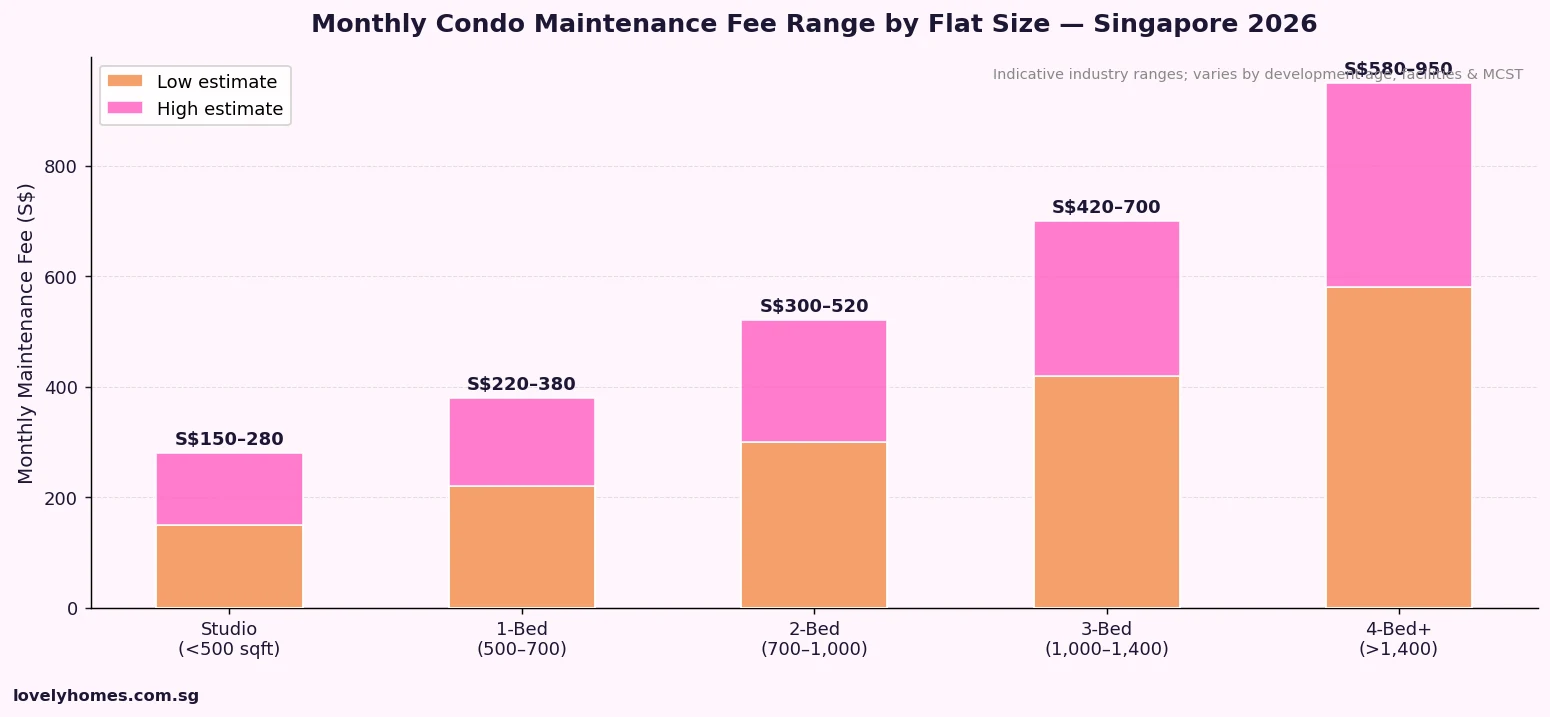
Figure 1: Indicative monthly maintenance fee range by unit size — Singapore private condominium 2026. Actual amounts vary by development age, facilities, and MCST budget.
Unit Size Typical Monthly Maintenance Fee Key Variables
Studio / 1-bed (<500–700 sqft) S$150–S$380 Older projects, fewer facilities: lower end
2-bedroom (700–1,000 sqft) S$300–S$520 Most common resale condo bracket
3-bedroom (1,000–1,400 sqft) S$420–S$700 City-fringe projects with full facilities
4-bed / large unit (>1,400 sqft) S$580–S$950 CCR luxury projects at high end
Penthouse / duplex (>2,000 sqft) S$900–S$1,500+ Top-tier city projects, concierge, valet

Sinking Fund — What It Covers and Why It Matters

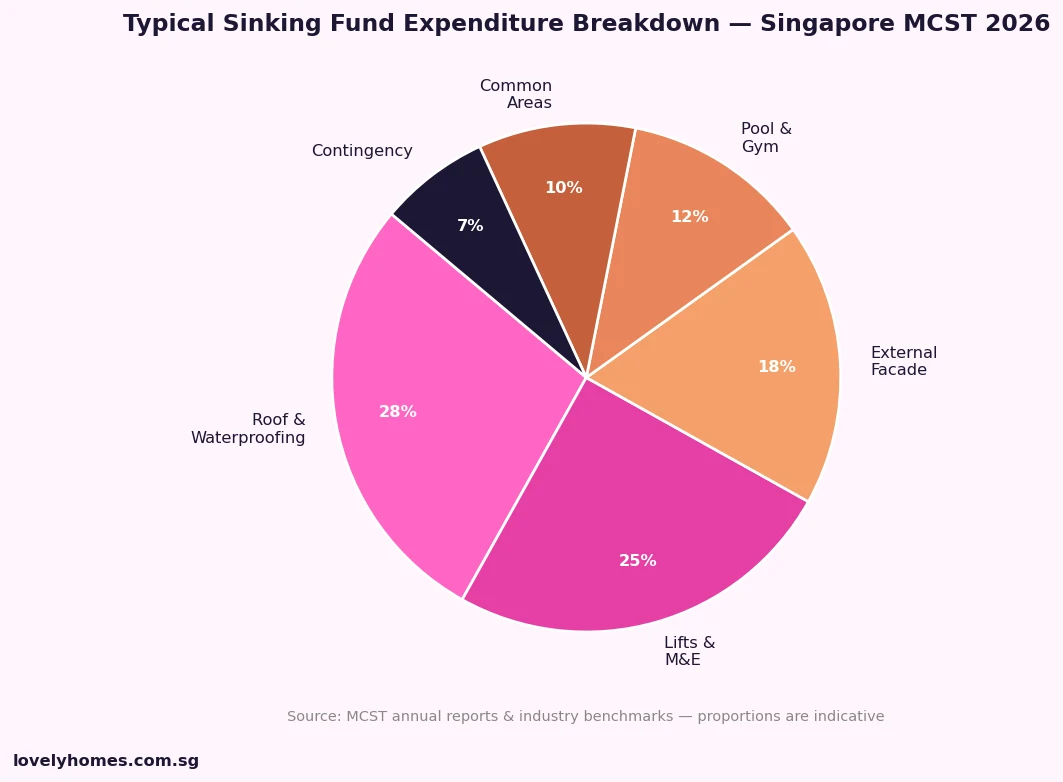
The sinking fund is a long-term capital reserve. Where the management fund covers ongoing operating costs, the sinking fund accumulates money for expenditure that is infrequent but extremely expensive — the kind of expenditure that cannot be funded from a single year’s management budget without creating a financial crisis for the MCST. Examples include: full lift replacement (typically every 20–25 years, S$200,000–S$500,000 per lift), external facade repainting (every 5–7 years for projects with extensive external surfaces), roof waterproofing membrane replacement, major mechanical and electrical (M&E) infrastructure overhaul, and swimming pool resurfacing.

Singapore condo MCST sinking fund expenditure breakdown pie chart 2026
Figure 2: Typical sinking fund expenditure allocation by category — Singapore MCST 2026. Proportions vary significantly by development age and building system profile.

The BMSMA requires the sinking fund to be maintained at a minimum of 10% of the preceding year’s management fund amount. In practice, well-managed MCSTs maintain a sinking fund that is a multiple of this minimum — particularly for older developments approaching major capital expenditure cycles. A prudent MCST will commission a 5-year capital expenditure plan and set sinking fund contributions accordingly. Buyers of older condos (15+ years old) should always ask for the current sinking fund balance and the 5-year capex plan before purchasing, as a depleted sinking fund may result in a special levy — a one-time extraordinary contribution demanded of all owners to fund urgent repairs.

Worked Example — Monthly Fees for a 3-Bedroom Condo in Clementi

Mr and Mrs Tan are purchasing a 1,100 sqft 3-bedroom resale condominium in Clementi (District 5) for S$1,580,000. The development has 320 units, was built in 2008, and has a shared value allocation of 8 for their unit. Total share values across all units sum to 2,240. The MCST’s annual budgets are: Management Fund S$1,680,000; Sinking Fund S$210,000.

Item Calculation Monthly Amount
Management Fund contribution (8 ÷ 2,240) × S$1,680,000 ÷ 12 S$500
Sinking Fund contribution (8 ÷ 2,240) × S$210,000 ÷ 12 S$62.50
Total monthly MCST levy S$562.50

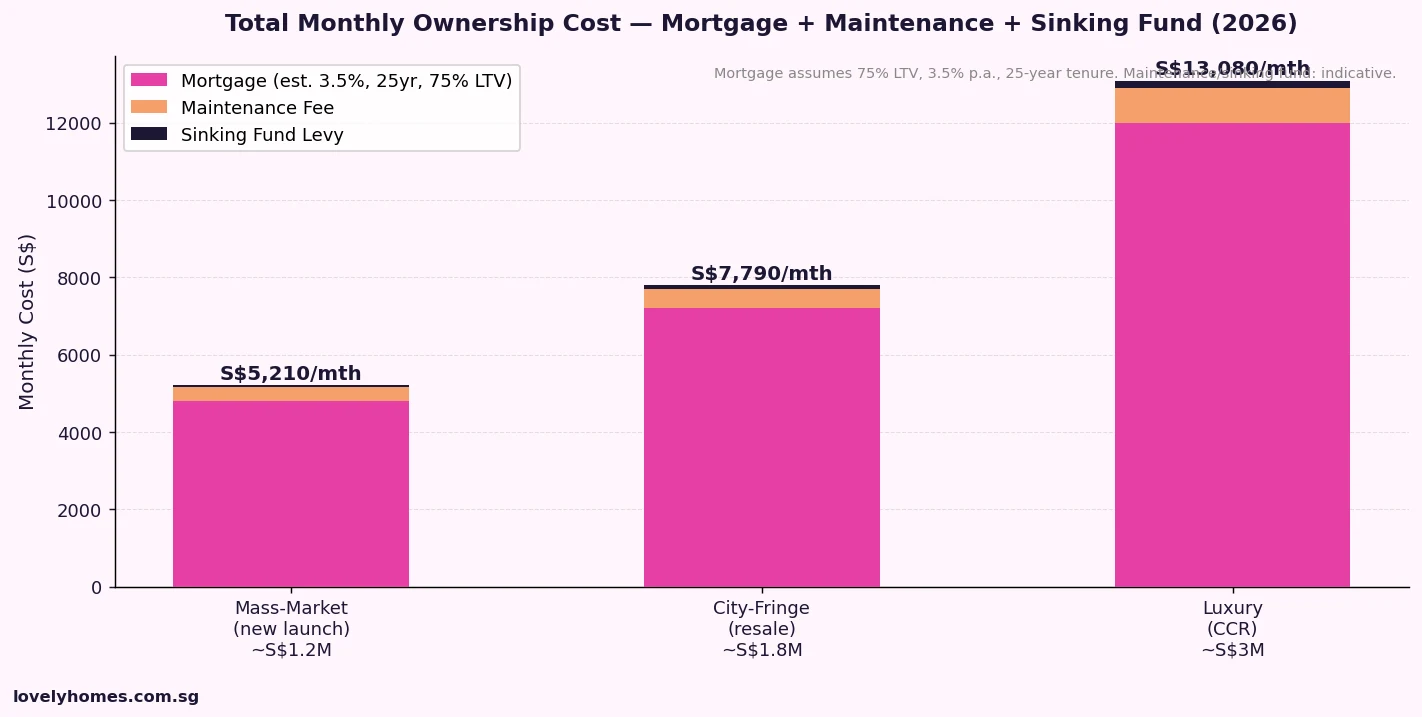
On top of this, the Tans’ estimated monthly mortgage repayment on a bank loan of S$1,185,000 (75% LTV) at 3.5% over 25 years is approximately S$5,926. Their total monthly ownership cost is therefore approximately S$6,488. When running TDSR calculations, the bank will factor in the maintenance fee as a financial commitment — check with your mortgage adviser on how this is treated.

Total Monthly Ownership Cost — Mortgage, Maintenance and Sinking Fund

Total monthly condo ownership cost Singapore 2026 — mortgage plus maintenance fee plus sinking fund
Figure 3: Estimated total monthly cost of owning a condo at three market segments — Singapore 2026. Mortgage assumes 75% LTV, 3.5% p.a., 25-year tenure.

What Happens If You Don’t Pay?

MCST contributions are not optional. Under Section 40 of the BMSMA, unpaid contributions (whether management fund or sinking fund) are a debt recoverable by the MCST in the same way as any civil debt. The MCST can file a Magistrate’s Court claim for outstanding amounts and, if judgment is obtained, apply for enforcement including attachment of the owner’s bank accounts or garnishment of rental income. The MCST also has the right to charge interest on late contributions at a rate fixed in its by-laws (commonly 10–12% per annum).

For landlords renting out their unit, unpaid MCST contributions remain the owner’s liability — not the tenant’s. If a seller has outstanding arrears at the point of property transfer, the arrears must be settled before the strata certificate of title is transferred. In practice, the conveyancing lawyers for both sides will conduct an MCST search to confirm that no arrears exist before completion.

Checking Sinking Fund Health Before You Buy

Before committing to a resale condo purchase, particularly in an older development, always request the following from the seller’s lawyers or directly from the MCST:

The current sinking fund balance (a healthy reserve is generally more than 3× the annual sinking fund budget); the 5-year capital expenditure plan (if available — well-run MCSTs have one); any pending special levies that have been voted on at an AGM but not yet collected; and the MCST financial statements for the past two years. A development with a healthy sinking fund and a documented capital plan is significantly lower risk than one that is underfunded and approaching major lift or roof works. In the latter case, you may be buying into an imminent S$10,000–S$50,000 special levy per unit.

What This Means for Condo Buyers in 2026

Condo maintenance fees have risen materially over the past three years, driven by higher labour costs for security and cleaning personnel, increased utility tariffs, and the generally higher cost of building materials for maintenance works. Industry data suggests average maintenance fees in mass-market condos have increased by 10–20% since 2022. For buyers underwriting their total monthly cost of ownership, this trend means that the maintenance fee is no longer a rounding error — it is a genuine budget line item that deserves the same scrutiny as the mortgage rate.

For investment buyers, maintenance fees directly affect net rental yield. A S$4,500/month rental on a unit with S$600/month in MCST fees represents a net operating yield (before mortgage) of about 3.2% on a S$1.5 million purchase — meaningful compression compared to the gross yield of 3.6%. Understanding and modelling the net yield after maintenance and sinking fund is essential for any investment analysis.

What Might Come Next

The COB has been increasingly attentive to poorly managed MCSTs. In 2024, the Building and Construction Authority (BCA) and COB jointly issued updated guidance on sinking fund adequacy, pushing MCSTs toward more rigorous 5-year planning. There is also ongoing discussion in the property management industry about whether the statutory minimum sinking fund (10% of management fund) is adequate for older developments — some practitioners argue it should be raised to 15–20% for projects over 20 years old. If such a change were legislated, monthly sinking fund levies would rise accordingly. Buyers of properties approaching their 15–20 year mark should factor in this regulatory risk.

Frequently Asked Questions

Can the management fee change from year to year?

Yes. The MCST Council proposes the annual budget at each AGM, and subsidiary proprietors vote on it. If costs have risen — for example, because security guard wages have increased or a landscaping contract was renewed at a higher rate — the management fee will be adjusted upward. Conversely, if the MCST finds cost savings, fees can decrease. In practice, fees rarely decrease; they tend to rise gradually with inflation. Buyers should ask for the last three years of AGM minutes to understand the fee trajectory of any development they are considering purchasing.

What is a special levy and when can the MCST charge one?

A special levy is an extraordinary, one-time contribution that the MCST can demand from all owners to fund urgent capital expenditure that cannot be covered by the existing sinking fund balance. Special levies require approval by a resolution at a general meeting (either an AGM or an Extraordinary General Meeting). They are most common in older developments where the sinking fund is under-provisioned and a major repair (such as lift replacement or waterproofing) is overdue. Special levies can range from S$5,000 to S$50,000 per unit depending on the size of the development and the scope of work. For this reason, checking the sinking fund balance before purchasing is critical.

Do maintenance fees apply to Executive Condominiums (ECs)?

Yes. Executive Condominiums are privately managed after the 10-year mark and are subject to the same BMSMA rules as private condominiums. During the initial period when HDB retains certain oversight, the management corporation is still constituted and maintenance fees apply from the date of key collection. EC buyers should budget for maintenance fees in the same way as any private condo buyer. EC maintenance fees are often somewhat lower than comparable private condos because ECs are typically built without the premium facilities found in luxury private developments, but the difference is not dramatic for mass-market comparisons.

Can landlords pass maintenance fees on to tenants?

In Singapore’s private residential tenancy market, there is no legal prohibition on a landlord including maintenance fees in the rent (i.e., charging a gross rent inclusive of the condo fee). In practice, however, most residential leases are structured on a net basis — the landlord pays the MCST contributions from the rental income and quotes the rent as an all-in figure. Some tenancy agreements explicitly state that maintenance fees are the landlord’s responsibility. Whatever the arrangement, the legal obligation to pay the MCST remains with the owner — the MCST cannot pursue the tenant for arrears.

How does share value affect my monthly levy?

Share value is a fixed integer assigned to each lot in the strata title plan at the time of development. It is broadly proportional to floor area but is also influenced by unit type and usage. A larger unit will have a higher share value and therefore pay a proportionally higher monthly levy. Share value cannot be changed by the MCST — it is set in the strata plan lodged with SLA and can only be altered by a unanimous resolution of all subsidiary proprietors followed by an amendment to the strata plan. Before buying, you can find out a unit’s share value by requesting the strata title plan from the developer, property agent, or MCST.

Is the sinking fund transferable when I sell?

No. The sinking fund belongs to the MCST, not to any individual owner. When you sell your unit, the accumulated sinking fund contributions you have made over the years remain with the MCST for the benefit of the development as a whole. You do not receive a refund of your share of the sinking fund balance on completion of sale. This is one reason why buying into a development with a healthy, well-funded sinking fund is in your interest even if you plan to sell within a few years — the sinking fund supports the quality of the common property, which in turn supports property values.

Where can I find out the exact maintenance fee before I buy?

For new launch condominiums, the developer is required to provide an estimated monthly maintenance fee in the sales documentation. For resale condos, the actual fee is best confirmed by requesting a copy of the latest MCST notice of contribution (which sets out the monthly levy per share value) or by asking the seller’s lawyer to conduct an MCST search. The MCST search will confirm the contribution rate, any arrears on the specific unit, and the sinking fund balance. This search is a standard step in any Singapore property conveyancing and costs approximately S$150–S$200.

Related Articles

Disclaimer: This article is for general informational and educational purposes only and does not constitute legal, financial, or property management advice. MCST contribution rates, sinking fund balances, and BMSMA requirements are subject to change and vary by development. Always verify actual maintenance fees with the relevant MCST, confirm current statutory requirements with the Commissioner of Buildings (HDB Strata Management portal), and obtain independent legal and financial advice before purchasing any property. LovelyHomes is not a licensed property management, legal, or financial advisory firm.

Singapore Property Insurance Guide 2026: Fire, MRTA, HPS & Contents Cover Decoded

Singapore Property Insurance Guide 2026: Fire, MRTA, HPS & Contents Cover Decoded

Property insurance in Singapore is one of those topics most homeowners discover only when something goes wrong — a kitchen fire, a burst pipe, a borrower’s sudden death. By then it is too late to negotiate a better policy. This 2026 guide walks you through every layer of cover a Singapore property owner can buy: HDB Fire Insurance, the Home Protection Scheme (HPS), private Mortgage Reducing Term Assurance (MRTA), Home Contents Insurance, and the building cover that sits inside your condo’s management corporation budget. Premiums, what each policy actually pays for, common gaps, and the cheapest legitimate way to cover yourself in 2026 — it is all here.

Quick Answer — what every Singapore homeowner should hold

  • HDB owners: Fire Insurance is compulsory. If you use CPF Ordinary Account to service your HDB loan, the Home Protection Scheme (HPS) is also auto-enrolled.
  • Condo owners: Building cover is paid through your monthly maintenance fees (MCST policy). You still need Home Contents and a private MRTA if you have a bank loan.
  • MRTA protects your family from a forced sale by repaying the outstanding mortgage on death, terminal illness, or total & permanent disability.
  • Home Contents covers furniture, electronics, jewellery, and personal liability — items the building policy excludes.
  • Indicative annual outlay for a S$1.5M condo with a S$1.05M loan: ~S$1,000–1,200 across MRTA + Contents + topped-up Fire cover.
  • Premiums vary 15–35% between insurers for identical cover — always compare 3+ quotes.

What “Property Insurance” Actually Means in Singapore

The phrase “property insurance” covers four distinct policies in the Singapore context, and the rules around each one differ by housing type. Understanding which is mandatory, which your bank insists on, and which you can safely skip is the difference between an over-insured budget and a real protection plan.

The four pillars are:

  • Fire Insurance — covers the building structure (walls, floors, ceilings, fixed fittings). Compulsory for HDB flat owners; built into the maintenance fees of every condominium via the Management Corporation Strata Title (MCST).
  • Home Protection Scheme (HPS) — a CPF-administered group term assurance that pays off your outstanding HDB loan if you die, become totally and permanently disabled, or are diagnosed with a terminal illness. Compulsory for HDB owners using CPF Ordinary Account funds to service the loan.
  • Mortgage Reducing Term Assurance (MRTA) — the private-sector equivalent of HPS, sold by life insurers. Most banks strongly recommend (and some require) MRTA for private property loans.
  • Home Contents Insurance — covers everything inside the four walls: furniture, white goods, electronics, jewellery, watches, plus personal liability if a guest is injured at your home.
Singapore property insurance guide 2026 — Fire vs HPS vs MRTA vs Home Contents comparison matrix
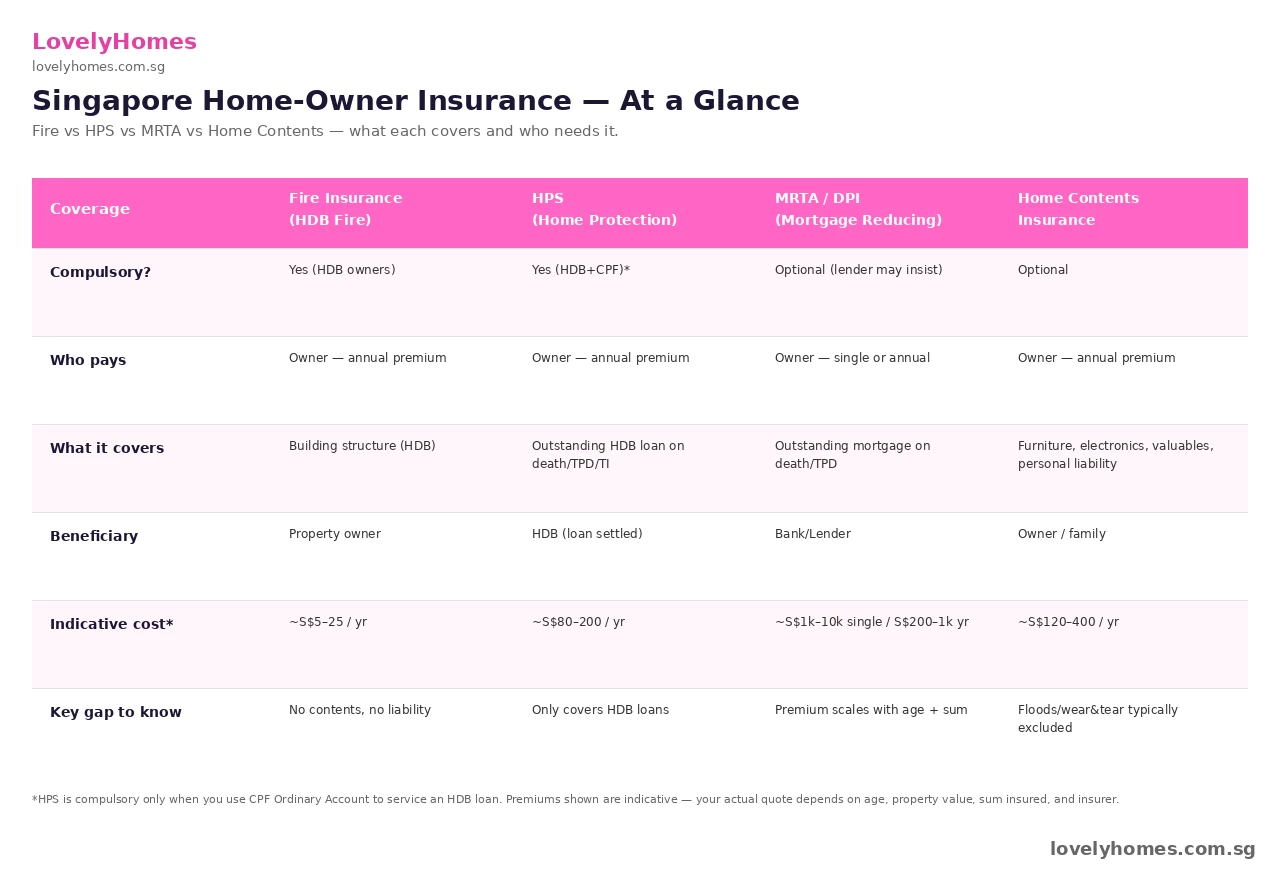
Figure 1: At-a-glance comparison of the four core property-insurance pillars in Singapore.

Fire Insurance — Compulsory for HDB, Bundled for Condos

Every HDB flat owner is required by law to maintain a Fire Insurance policy on the structure of the flat. The Housing & Development Board has appointed a single insurer (currently FWD Singapore) to underwrite a basic policy with a uniform 5-year premium of around S$5.30 to S$25.40 depending on flat type. The cover sum is set to rebuild the structure, not the contents — if you assume your renovation, kitchen cabinets, or solid-timber flooring is included, you are mistaken. Most HDB owners then top up with a Home Contents policy from a private insurer.

For private condominium owners, fire insurance for the building is paid for collectively by the MCST and recovered through monthly management fees. The MCST policy is typically a Comprehensive HOOIS (Home Owner’s Outline Insurance Schedule) covering the structure, common property, and original developer fittings. What it excludes: any owner-installed renovation upgrades, fitted furniture beyond the original handover spec, and contents. If your condo unit has been substantially renovated, you should buy a top-up renovation cover — insurers will assess your defects-handover-to-current condition and quote accordingly.

For landed property owners, building fire insurance is bought directly from a general insurer. Sums insured are based on the rebuilding cost (excluding land value) rather than market price, which is why a S$10M Good Class Bungalow on a 15,000 sq ft plot may insure for only S$2.5M of structure.

Home Protection Scheme (HPS) — HDB’s Built-In Mortgage Cover

The Home Protection Scheme is a mortgage-reducing term assurance plan administered by the CPF Board for HDB flat buyers. It is compulsory for any flat owner using their CPF Ordinary Account to service their HDB loan, and is auto-enrolled at the point you commit to using CPF for the monthly instalment. The premium is paid annually from your CPF OA — typically S$80 to S$200 per year for a healthy 30-something with an outstanding loan in the S$300,000–500,000 range.

HPS pays off the outstanding HDB loan in three scenarios: death, total and permanent disability (TPD), or terminal illness. The flat then passes to the surviving co-owners or beneficiaries free of mortgage debt. There is no payout to the family beyond clearing the loan — if you want a cash sum on top, HPS will not deliver it. For that you need a separate term-life policy.

You may apply to opt out of HPS only if you already hold an equivalent or better term-assurance policy — a deliberate carve-out designed to prevent over-insurance. The CPF Board reviews your alternative policy against minimum sum-assured and tenure benchmarks before granting the exemption.

Mortgage Reducing Term Assurance (MRTA) — The Private-Sector Equivalent

MRTA, also marketed as Decreasing Term Assurance (DTA) or Mortgage Insurance, performs the same function as HPS but for buyers of private properties or those servicing their HDB loan entirely in cash. It is sold by every major life insurer in Singapore and underwritten as a single-premium or annual-premium policy whose sum assured tracks the falling balance of your mortgage as you pay down principal.

Premiums depend on age, gender, smoking status, sum assured, and tenure. As a rough guide, a 35-year-old non-smoker buying MRTA on a S$1,050,000 25-year loan will see single-premium quotes of S$15,000–22,000, equivalent to about S$600–900 per year if paid annually. Many buyers fund the single premium from their CPF OA at the point of property completion — CPF rules permit this provided the policy is assigned to the property.

If you are buying a condo on a bank loan and your mortgage is your largest financial liability, MRTA is the single most cost-effective protection product available. A S$700/year MRTA premium pays off in any month you are unable to work, where the alternative (a forced sale into a falling market) destroys decades of equity.

Singapore property insurance guide 2026 — annual premium cost stack for a S$1.5M condo
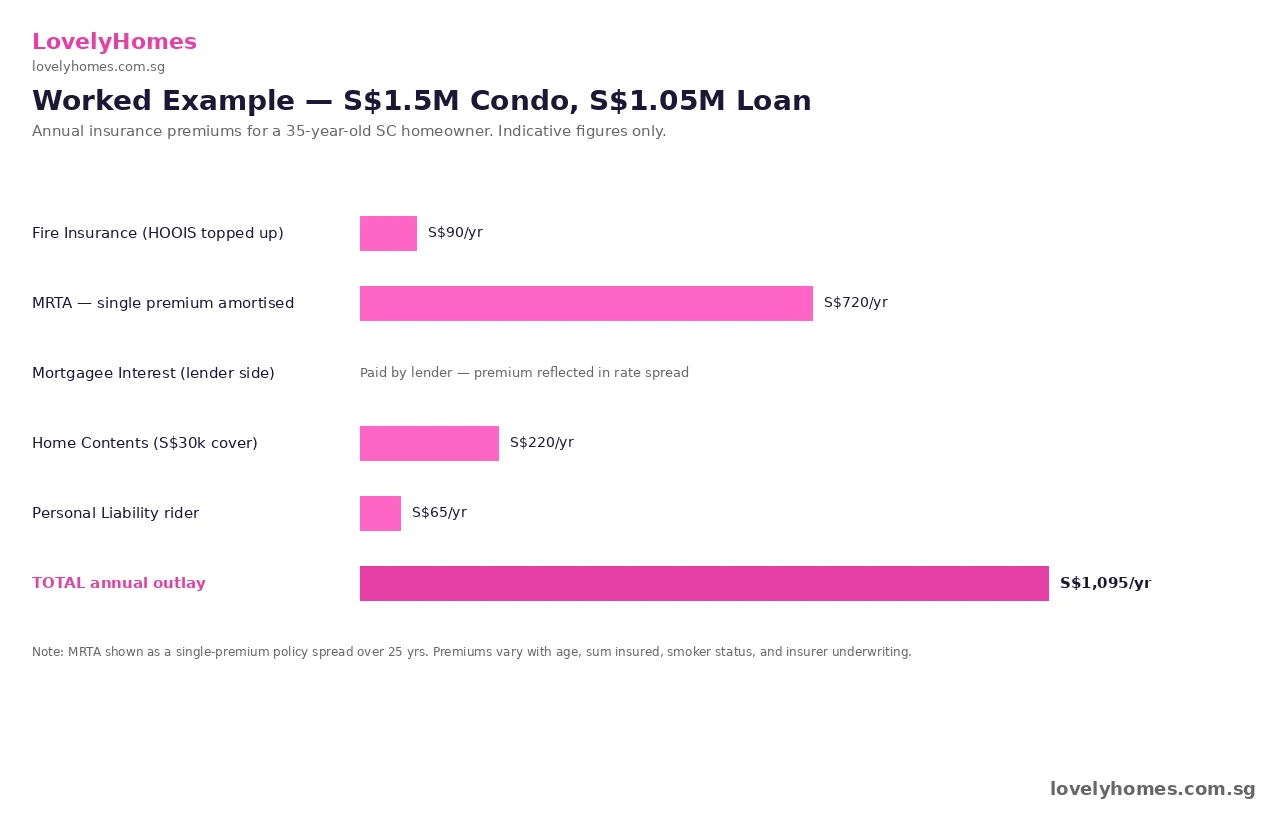
Figure 2: Indicative annual premium outlay for a 35-year-old SC homeowner with a S$1.5M condo and S$1.05M loan.

Home Contents Insurance — The Most Underbought Policy

Home Contents Insurance is the most commonly skipped policy and, statistically, the one that pays out most often. It covers the loose property inside the four walls of your home: furniture, white goods, televisions, computers, kitchen appliances, jewellery, watches, art, musical instruments, and (within sub-limits) cash. It also covers personal liability — the legal cost if your child accidentally injures a visitor on your premises, or if water damage from your unit affects the unit below.

Premiums are remarkably affordable. A standard policy with S$30,000 contents cover and S$500,000 personal liability costs around S$120–220 per year at major insurers (NTUC Income, Etiqa, FWD, Tokio Marine, MSIG). Higher contents sums, jewellery riders, or all-risks cover for valuables sit at S$300–500 per year.

What is typically excluded: gradual wear and tear, mould, vermin damage, intentional damage by a household member, cosmetic damage, and items left in common corridors. Read the schedule carefully — the differences between insurers on what counts as “valuables” (above S$2,500 per article) and which valuables need declaration are material.

Which Policies Do You Actually Need?

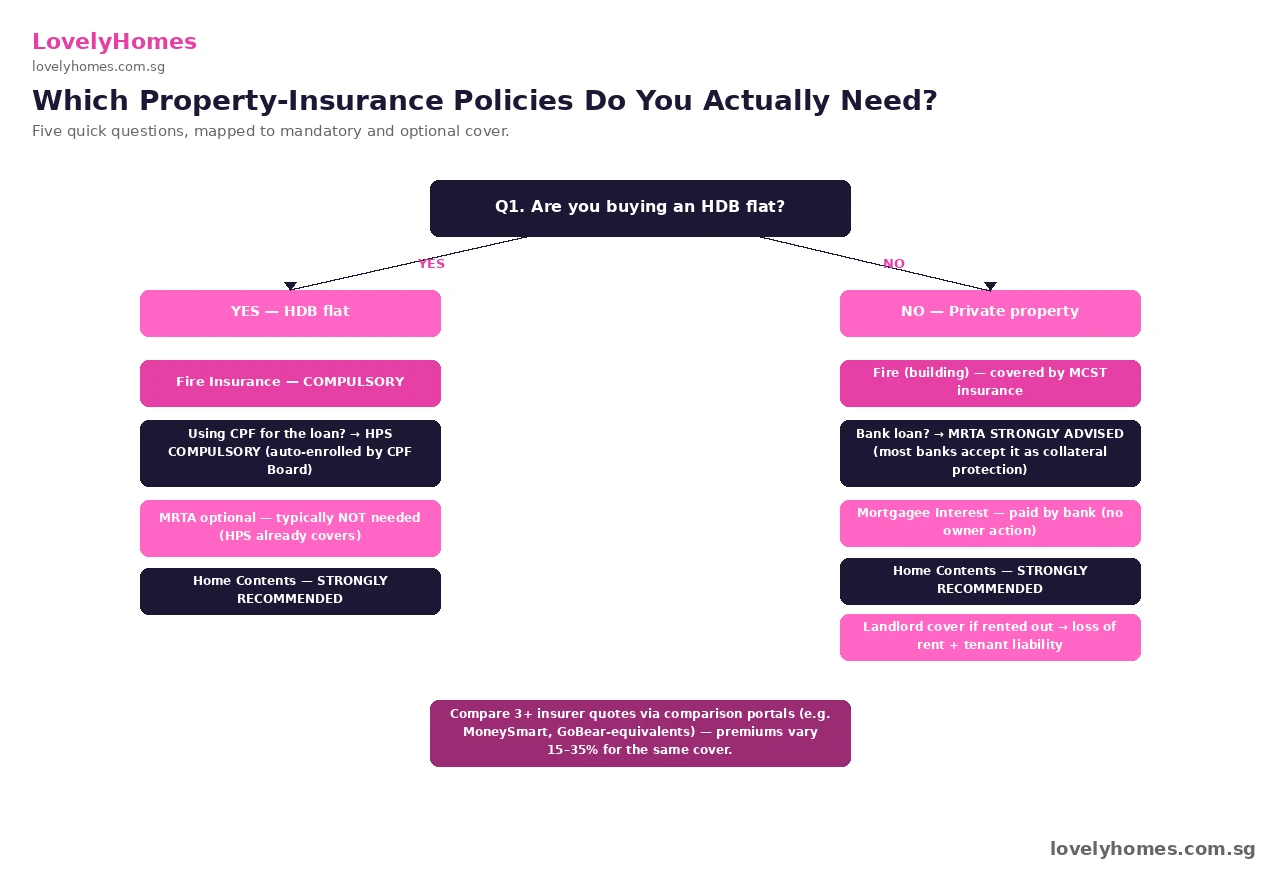
The right insurance stack depends on whether you live in HDB or private property, how the property is financed, and whether you intend to rent it out. The flowchart below traces the decisions.

Singapore property insurance guide 2026 — decision flowchart showing which policies HDB and private buyers need
Figure 3: Five-question decision flow mapping owner profile to mandatory and recommended policies.

Summary — Indicative Annual Premiums by Property Profile

Profile Fire / Building HPS / MRTA Contents Total / Year
4-rm HDB owner-occupier (CPF loan) ~S$5 (5-yr premium) ~S$120 HPS ~S$140 ~S$265
5-rm HDB owner-occupier (cash loan) ~S$25 (5-yr premium) ~S$650 MRTA ~S$160 ~S$835
S$1.5M condo owner-occupier (bank loan) MCST top-up ~S$90 ~S$720 MRTA ~S$220 ~S$1,030
S$2.5M condo investor (rented out) MCST top-up ~S$140 ~S$1,200 MRTA Landlord cover ~S$420 ~S$1,760
Landed property (S$5M, owner-occupier) ~S$650 fire ~S$2,400 MRTA ~S$520 ~S$3,570

Worked Example — The Tan Family, S$1.5M Condo Buyer

Mr Tan (35, SC, non-smoker) and his wife (33, SC, non-smoker) have just collected keys to a S$1.5M condo in District 19. Their bank loan is S$1,050,000 over 25 years at a SORA-pegged rate currently at about 3.7%. They have no children but plan to start a family within two years. Here is how their insurance stack lines up.

  1. Fire / Building cover: Provided through the MCST policy — included in their monthly S$420 maintenance fee. They top up with a S$50,000 renovation cover at S$90/year, since their renovation upgrades (kitchen cabinetry, full marble flooring) are not part of the original developer handover.
  2. MRTA: Mr Tan is the sole borrower for tax-deduction reasons. They take a single-premium MRTA of S$17,500 funded from his CPF OA — equivalent to about S$700/year over the 25-year tenure. Sum assured starts at S$1,050,000 and decreases linearly with the loan balance.
  3. Home Contents: S$50,000 contents sum + S$1M personal liability + jewellery rider for Mrs Tan’s heirloom pieces. Annual premium: S$285.
  4. Mortgagee Interest: The bank carries this internally — Mr Tan does not pay separately, but it is one reason the bank’s spread sits at +0.75% over SORA rather than +0.5%.

Total annual outlay: ~S$1,075, or about S$90 a month. Against a household income of S$15,000/month, the protection is rounding error — but it is the difference between Mrs Tan keeping the home if Mr Tan dies, and being forced into a distressed sale.

Insurance Riders Worth Considering

Beyond the four core pillars, riders address specific risk pockets that many homeowners discover only after a claim:

  • Renovation cover — tops up the MCST policy to include your renovation upgrades. Premium scales with renovation spend; rule of thumb is 0.1–0.2% of renovation value per year.
  • Domestic helper liability — covers the legal liability of accidents your foreign domestic helper causes inside or outside your home. ~S$50–120/year, often bundled with helper accident insurance.
  • Loss of rent cover — for landlords. Pays a defined monthly rent if the property becomes uninhabitable due to an insured peril (e.g. fire). ~S$80–200/year on a Home Contents Landlord policy.
  • All-risks worldwide for valuables — covers jewellery, watches, art whether at home or away. Stacks cleanly on top of Home Contents.
  • Public-liability extension — raises personal liability cover from the standard S$500K up to S$2M, useful for landed property owners and high-rise condo owners on upper floors where falling object claims can be material.

Common Mistakes Singapore Owners Make

Because property insurance is dull and the worst-case scenarios feel remote, most owners default to the cheapest single-quote option and discover the gaps when a claim is denied. The five most common mistakes:

  1. Assuming HDB Fire Insurance covers contents — it does not. The FWD/HDB policy covers structure only.
  2. Letting MRTA lapse after refinancing — if you refinance to a different bank, you must re-assign your MRTA policy or switch to a fresh one. A surprising number of owners hold an MRTA policy that no longer points to their current lender.
  3. Not declaring jewellery and valuables — high-value items above S$2,500 each must be specified separately. Otherwise, the Home Contents policy caps any single-item claim at the unspecified-items sub-limit (typically S$5,000–10,000).
  4. Renovating extensively without telling the insurer — if a fire or flood damages your premium kitchen, the MCST policy will only restore the original developer spec. Without your own renovation cover, you self-fund the gap.
  5. Trusting bank-bundled policies — banks earn referral fees on bundled MRTAs and contents policies. Compare independently against direct insurer quotes; you will routinely save 10–25%.

What This Means for You

Insurance is the cheapest part of homeownership and the part with the lowest psychological return until something happens. The exercise to do today, regardless of how long you have owned your home, is simple: list every policy you currently hold, the sum insured, the renewal date, and the bank or insurer you bought it from. If you cannot complete that list in fifteen minutes, you almost certainly have a gap or a duplication. The total cost of being properly covered — even on a S$2.5M condo — rarely exceeds S$2,000 a year, less than a single mortgage instalment for most owners.

What Might Come Next

The Monetary Authority of Singapore has signalled interest in reforming retail insurance disclosure under its Financial Advisers Act review. Expect to see standardised “policy summary” documents for MRTA and Home Contents in 2027, similar to the Product Highlights Sheet for unit trusts. CPF Board has also been studying whether HPS should be extended to cover serious-illness scenarios beyond the current TPD definition; any such expansion would materially raise HPS premiums but reduce the case for private MRTA on top.

Frequently Asked Questions

Is HDB Fire Insurance enough on its own?

No. HDB Fire Insurance covers only the structure of the flat — the walls, floor slab, ceiling, and original developer-fitted items. It does not cover renovations, furniture, electronics, or any of your possessions. Owner-occupiers should pair it with Home Contents Insurance, which is sold separately by every major insurer for around S$120–220 per year.

Can I opt out of HPS if I have a private term-life policy?

Yes — the CPF Board permits HPS exemption if you can demonstrate an equivalent or better term-assurance policy is in force. The alternative policy must cover at least the outstanding HDB loan amount and run for the remaining loan tenure. Apply online via the CPF website with the policy schedule and a recent statement; approval typically takes 2–3 weeks. If the alternative policy lapses, HPS auto-resumes.

Should I buy single-premium or annual-premium MRTA?

Single-premium gives you a fixed cost upfront, payable from CPF OA, and locks in your insurability based on today’s health profile. Annual-premium spreads the cost but is repriced if you ever change tenure or sum assured. For most buyers under 40 in good health, single-premium delivers a 10–15% lifetime saving once you account for the CPF interest you forgo, but the convenience of paying from CPF rather than cash is significant. Annual-premium suits buyers who want the flexibility to switch insurers later.

Does my MCST condo policy cover my renovations?

Generally no. The Management Corporation Strata Title (MCST) policy covers the building structure and the original developer fittings — the kitchen and bathroom finishes that came with the unit at handover. Any subsequent renovation work, custom carpentry, designer fittings, or upgraded flooring is your responsibility. Buy a renovation cover or top-up through your home contents policy, sized to your actual renovation spend.

Will Home Contents Insurance pay out for a stolen Rolex?

Only if you specified it. Most policies treat any single article above S$2,500 as a “valuable” that must be individually declared on the schedule. Watches, jewellery, art, and rare collectibles fall into this category. If you have not declared a S$25,000 Rolex and it is stolen, the insurer pays the unspecified-items sub-limit (typically S$5,000–10,000), not the full value. Add a jewellery and watches rider for an extra S$50–120 per year per S$10,000 of declared value.

What happens to MRTA when I refinance?

The policy is assigned to a specific lender as collateral. When you refinance to a new bank, the policy must either be reassigned to the new lender or be replaced with a fresh policy. If you do nothing, the original MRTA may continue paying out to the old lender (now without a loan to settle), which means your family may eventually receive the residual but only after a contested administration process. Always notify your insurer the day you complete a refinance.

Does Home Contents cover my domestic helper’s belongings?

Most do not. The standard contents policy covers items belonging to the policyholder and household members — helpers are typically excluded. If you want to protect their personal items, look for a domestic-helper extension or take out a separate helper insurance policy (most foreign-domestic-helper insurance plans bundle a small personal effects cover at no extra cost).

Related Articles

Disclaimer

This guide is for general information only and does not constitute financial, insurance, or legal advice. Premiums, sum-insured guidelines, scheme rules, and exemption criteria are illustrative as at April 2026 and subject to change at the discretion of the CPF Board, the Housing & Development Board, the Monetary Authority of Singapore, and individual insurers. Always verify the latest figures with primary sources — the CPF Board HPS page, the HDB Fire Insurance page, the Monetary Authority of Singapore, and the Inland Revenue Authority of Singapore — and consult a licensed financial adviser before purchasing or replacing any policy.

Translate »