A Good Class Bungalow, or GCB, is the most tightly regulated and most exclusive form of landed housing in Singapore. Fewer than 3 in 1,000 homes here qualify. This guide sets out exactly what makes a GCB a GCB, who is allowed to buy one, what it actually costs, how it compares with other landed housing types, and the approval pathway a foreigner must clear before even making an offer.
Quick Answer — Good Class Bungalows at a glance
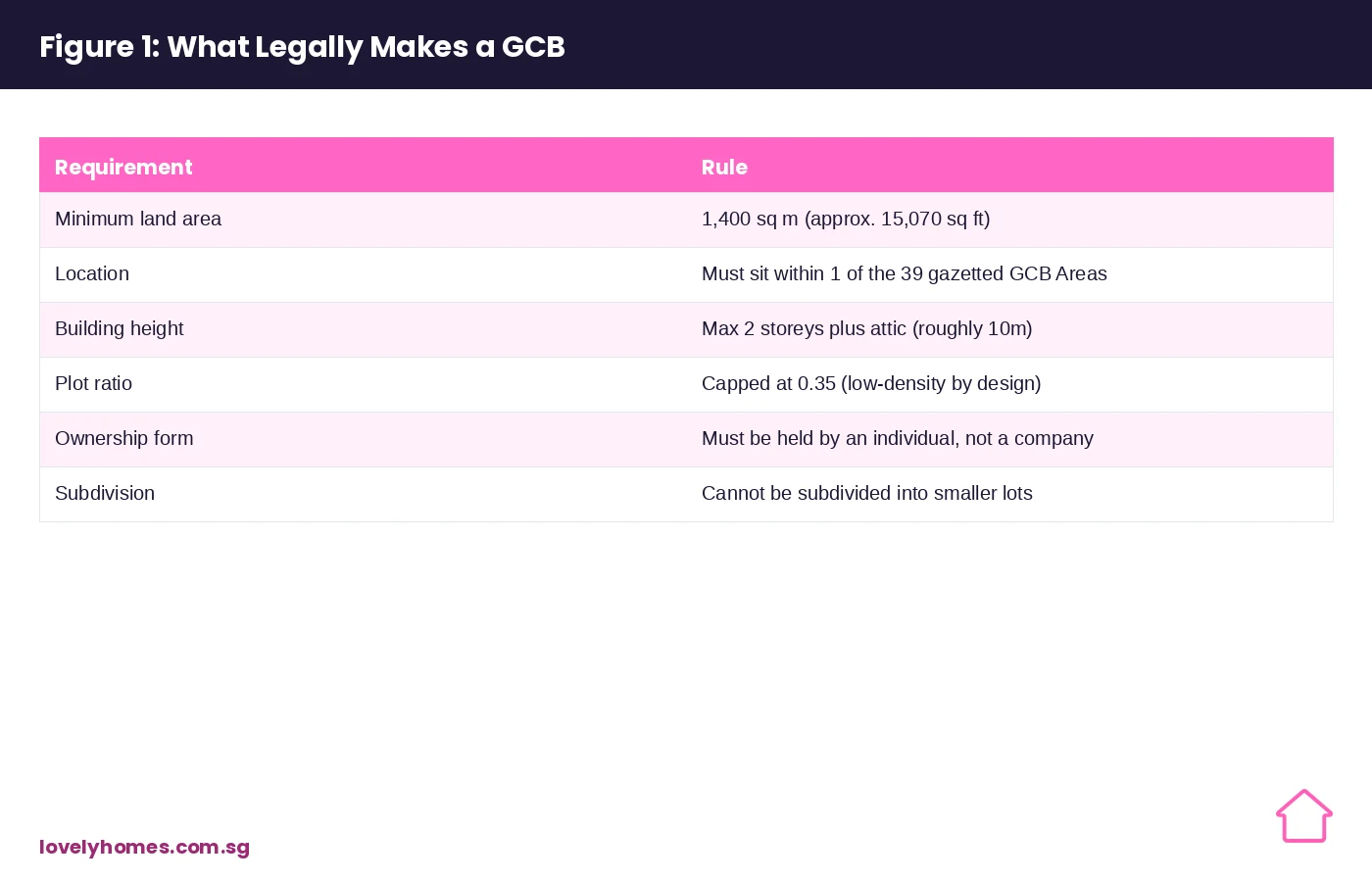
- A GCB must sit on at least 1,400 sq m of land within one of 39 gazetted Good Class Bungalow Areas
- Building height is capped at 2 storeys plus an attic, with a plot ratio of 0.35
- GCBs may only be owned by individuals, never companies or trusts holding beneficially for a corporation
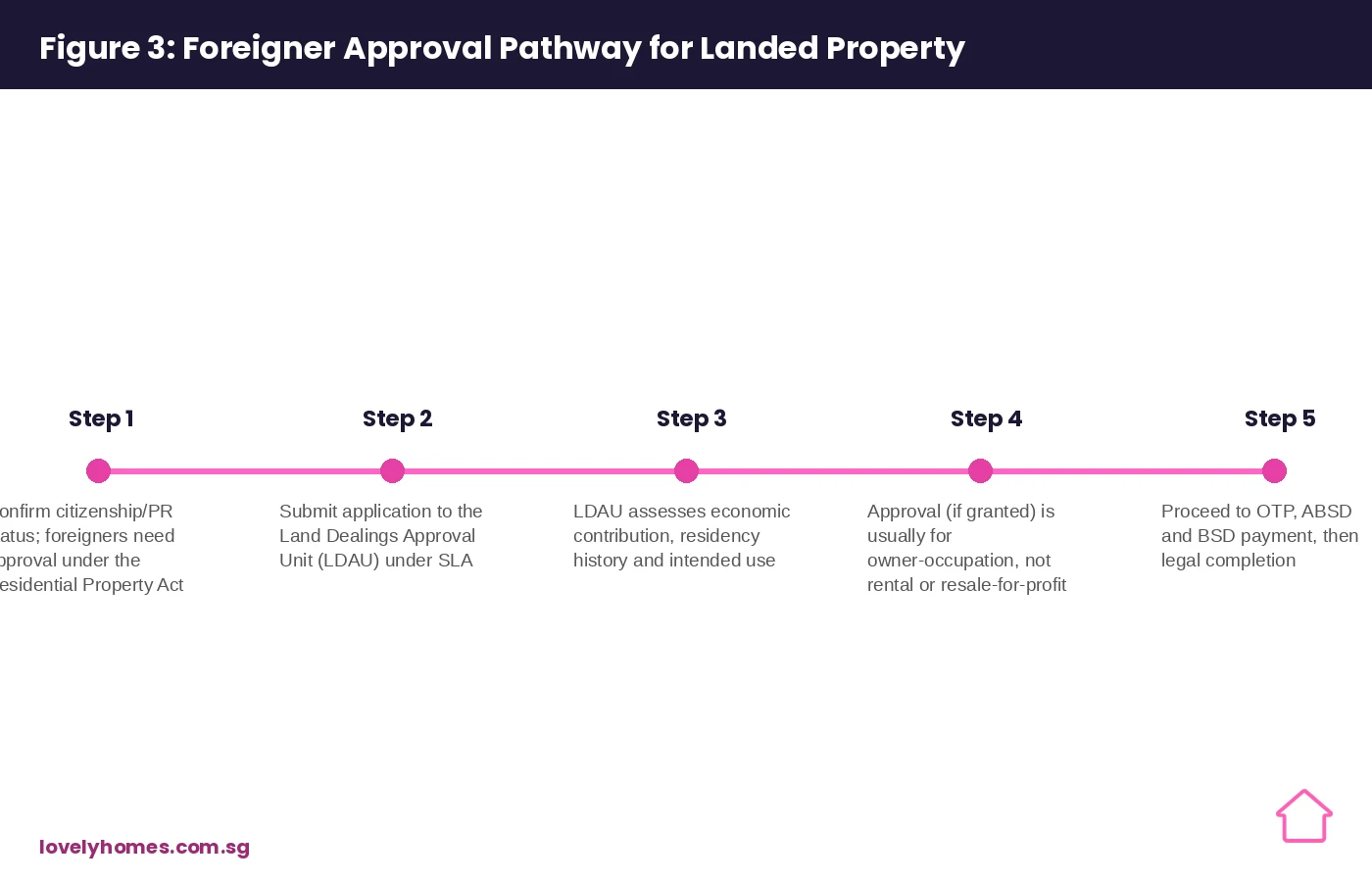
- Foreigners generally need approval from the Land Dealings Approval Unit (LDAU) under the Singapore Land Authority before buying any landed home, GCBs included
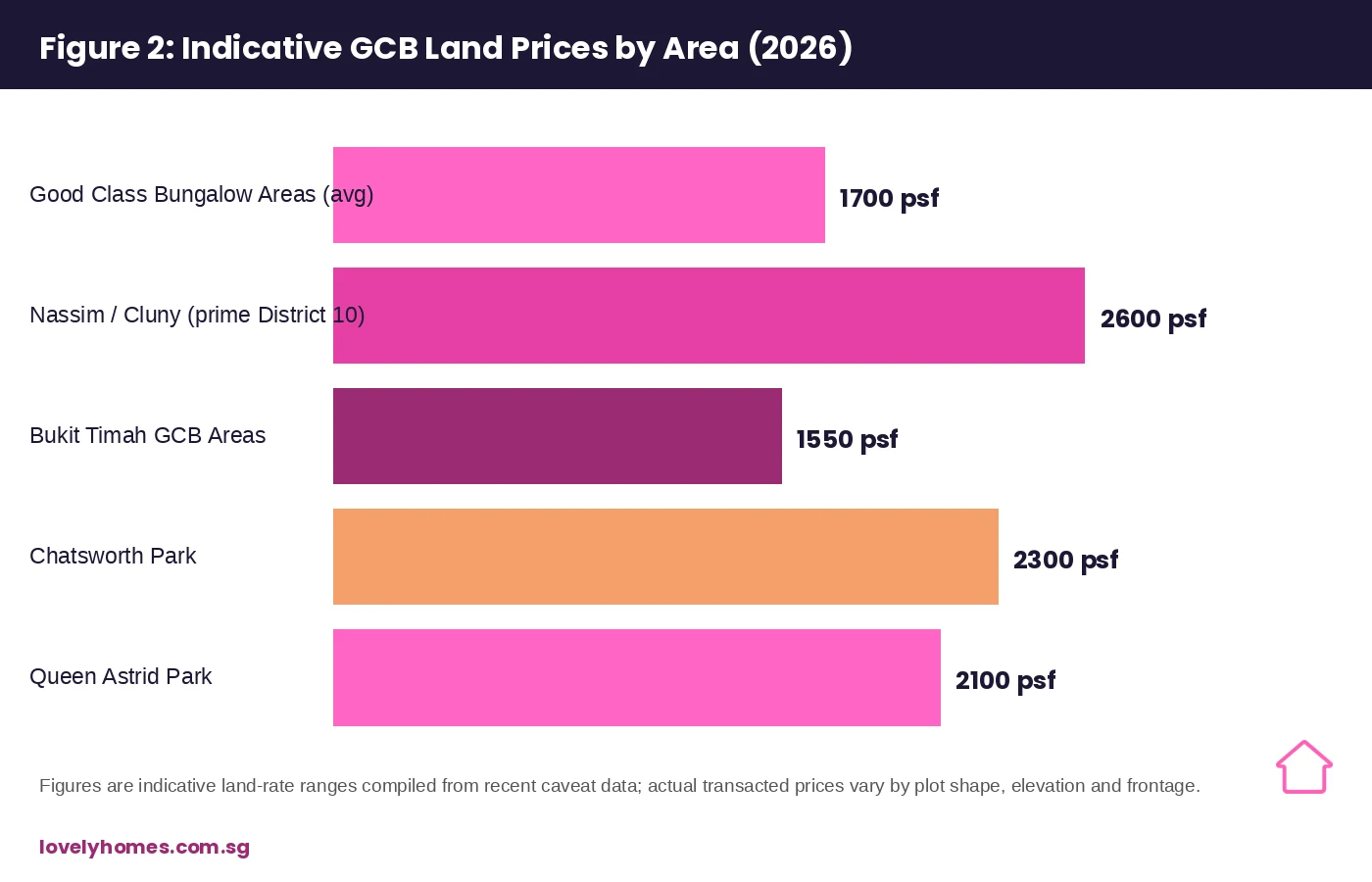
- Indicative land rates in 2026 span roughly $1,500 to $2,600+ psf depending on the Good Class Bungalow Area
- Buyer’s Stamp Duty (BSD) applies on a rising scale up to 6% on the top slice of the price; Additional Buyer’s Stamp Duty (ABSD) applies on top of that for second properties, entities, or (where approved) foreign buyers
- GCB plots cannot be subdivided, which is precisely what preserves their scarcity and long-run value
Singapore has roughly 2,800 GCB plots in total, spread across neighbourhoods that Urban Redevelopment Authority (URA) planning rules have deliberately kept low-rise since the framework was formalised in 1980. Unlike a “bungalow” in everyday speech, a Good Class Bungalow is a defined planning term with hard numerical thresholds attached — get any one of them wrong and a property is not, legally, a GCB, no matter what a listing calls it. This distinction matters commercially as much as legally: GCB status carries a pricing premium over an equivalent-sized landed house that merely sits nearby, because scarcity and planning protection are baked into the classification itself.
What Legally Makes a Property a GCB
URA’s planning guidelines set five conditions that a property must meet simultaneously to be classified as a Good Class Bungalow. Miss any one and the home is a large landed house, not a GCB, which matters enormously for financing, resale positioning and long-term redevelopment rights.
The minimum 1,400 sq m land area is the threshold most buyers hit first — it rules out the great majority of landed houses in Singapore, including most terraces, semi-detached homes and even many detached houses outside a Good Class Bungalow Area. The plot ratio cap of 0.35 is what keeps GCB neighbourhoods feeling spacious: on a 1,400 sq m plot, total gross floor area is capped at around 490 sq m, so even a large, well-appointed GCB rarely feels crowded on its land.
GCB vs Other Landed Housing Types in Singapore
Singapore’s landed housing stock forms a hierarchy, and buyers new to the segment often conflate the tiers. A GCB sits at the very top; below it sit detached bungalows outside gazetted areas, semi-detached houses, terrace houses and, at the more affordable end, cluster (strata) landed homes.
| Housing Type | Typical Minimum Land Area | Subdivision Allowed? | Foreign Ownership |
|---|---|---|---|
| Good Class Bungalow | 1,400 sq m | No | LDAU approval, rarely granted |
| Detached bungalow (non-GCB) | 400–600 sq m | Sometimes | LDAU approval required |
| Semi-detached house | 200–350 sq m | Sometimes | LDAU approval required |
| Terrace house | 150–200 sq m | No | LDAU approval required |
| Cluster (strata) landed | Varies, typically 150–250 sq m share | No | Generally no approval needed (strata title) |
The one carve-out worth knowing: cluster landed developments held on strata title are treated similarly to condominiums for foreign-ownership purposes, since the Residential Property Act’s restrictions target land title, not strata title. This is why cluster landed schemes are sometimes marketed to foreign buyers as an entry point into “landed living” without the LDAU approval hurdle — but a strata-titled cluster home is never a GCB and does not carry GCB-style land appreciation dynamics.
The 39 Gazetted Good Class Bungalow Areas
URA maintains a closed list of 39 Good Class Bungalow Areas. No new areas have been added to the list in decades, which is itself a large part of why GCB land values have compounded so consistently over time. Well-known GCB Areas include Nassim Road, Cluny Hill, Bukit Timah’s various GCB pockets (Coronation Road, Chestnut Avenue, White House Park), Chatsworth Park, Queen Astrid Park, Belmont Park, Swiss Club Road and Binjai Park. Each area carries its own micro-market: proximity to the Botanic Gardens, Nassim and Cluny consistently command the highest land rates, while GCB Areas further from the central region trade at a meaningful discount despite carrying identical planning status.
Because the list is closed, a property either sits inside a gazetted boundary or it does not — there is no partial or “almost GCB” status. Buyers should always verify a plot’s boundary against URA’s official GCB Area map before treating a listing’s “GCB” label as fact, since the term is sometimes used loosely in marketing for large landed homes that do not actually meet all five criteria.
Who Can Buy a GCB: Citizens, PRs and Foreigners
Ownership of any landed residential property in Singapore, GCBs included, is restricted under the Residential Property Act, administered by the Singapore Land Authority (SLA). Singapore Citizens face no restriction. Singapore Permanent Residents and foreigners must apply for approval through SLA’s Land Dealings Approval Unit (LDAU) before they can purchase.
In practice, LDAU approval for a GCB specifically is granted only sparingly, and typically to Permanent Residents who can demonstrate a substantial and sustained economic contribution to Singapore — usually assessed over a period of residency, tax contribution and, in many cases, local investment or employment creation. Approval, where granted, is generally conditioned on owner-occupation: the buyer cannot rent the GCB out in full, and reselling shortly after acquiring approval can itself invite scrutiny.
GCB ownership must also sit with a natural person. A company, even one wholly owned by a Singapore Citizen, generally cannot hold a GCB in its own name under the same relaxed terms available to individuals — a rule that closes off a common route used to sidestep ownership restrictions on other property types. Some families instead structure long-term succession through a trust arrangement or careful estate planning, but the underlying land title still needs to satisfy the individual-ownership requirement, so professional legal advice at the structuring stage is essential rather than optional.
What a GCB Actually Costs in 2026
GCB pricing is quoted, and largely driven, by land rate rather than built-up area, because the house itself is usually rebuilt at least once across a multi-decade holding period. Indicative 2026 land rates vary substantially by Good Class Bungalow Area.
| Good Class Bungalow Area | Indicative Land Rate (psf) | Approx. Price for a 1,400 sq m Plot |
|---|---|---|
| Nassim / Cluny (District 10) | ~$2,600 psf | ~$39.2 million |
| Chatsworth Park | ~$2,300 psf | ~$34.7 million |
| Queen Astrid Park | ~$2,100 psf | ~$31.7 million |
| Bukit Timah GCB Areas | ~$1,550 psf | ~$23.4 million |
Figures are indicative, compiled from recent caveat data and market commentary; actual transacted prices vary with plot shape, frontage, elevation and the condition of any existing structure. Always verify against a recent professional valuation before committing.
Worked Example: Buying a GCB in Chatsworth Park
To make the numbers concrete, consider a Singapore Citizen buying a 1,400 sq m GCB plot in Chatsworth Park at an indicative $2,300 psf land rate, as a second residential property.
- Land price: 1,400 sq m ÷ 0.0929 × $2,300 psf ≈ $34,670,000
- Buyer’s Stamp Duty (BSD): calculated on the tiered scale up to 6% on the portion above $3 million — on this price, BSD works out to roughly $2,057,000
- Additional Buyer’s Stamp Duty (ABSD): at 20% for a Citizen’s second residential property — approximately $6,934,000
- Legal and conveyancing fees: typically 0.2%–0.4% of price for a transaction this size — roughly $100,000
- Total upfront government duties and fees: approximately $9,091,000, on top of the $34.67 million land price
This example excludes the cost of demolishing and rebuilding the house itself, which for a new-build GCB typically runs from $600 to $1,200 per sq ft of built-up area depending on specification — a further multi-million-dollar outlay before the home is habitable. Buyers who purchase a GCB with an existing, well-maintained house sometimes choose to renovate rather than rebuild, which can defer this cost by years, though most GCB transactions in Singapore are ultimately land-value transactions: the buyer is paying for the plot and its planning status, not the structure standing on it.
Renovating, Rebuilding and Holding a GCB Long-Term
Because subdivision is barred, and land supply within the 39 gazetted areas is fixed, most owners hold a GCB for the long term and treat renovation or a full rebuild as the primary way to add value, rather than land banking for a future subdivision sale. A full rebuild requires planning permission from URA and must respect the 0.35 plot ratio and 2-storey-plus-attic height limit regardless of how ambitious the design brief is. Owners occasionally retain a portion of an existing structure for conservation or sentimental reasons, but there is no requirement to do so unless the specific bungalow itself carries separate conservation status, which is uncommon within GCB Areas.
Because GCB transactions are infrequent, valuers and buyers alike lean heavily on the handful of comparable land transactions within the same GCB Area over the preceding one to two years. This makes timing less about broad market cycles and more about which specific plots have changed hands recently nearby — a nuance that a specialist landed-property valuer can help buyers and sellers navigate.
Why This Matters: Financing and Liquidity
Banks treat GCB financing conservatively. Loan-to-value ratios for landed property, and GCBs in particular, tend to sit below the ceilings available for private condominiums, and valuations lean heavily on recent comparable land transactions within the same GCB Area, which can be thin in any given year. Buyers should expect to hold a larger cash and CPF component relative to loan quantum than they would for a condominium purchase of equivalent value.
Liquidity is the other side of the coin. GCB transaction volumes are low — often only a handful of trades across an entire GCB Area in a given year — so holding periods tend to be long, and sellers who need to exit quickly can face a materially longer marketing period than in the private condominium market. This is not necessarily a downside for a buyer who intends to hold across a generation, since the same scarcity that limits liquidity is also what has historically supported land values through multiple property cycles.
What Might Come Next
The 39 gazetted GCB Areas have not been expanded in decades, and there is no public signal that URA intends to change this. If anything, continued scarcity, combined with steady wealth creation in Singapore and the region, points toward GCB land values remaining structurally supported over the long run. This is a forward-looking observation, not a guarantee: cooling measures, interest rate cycles and any future review of the Residential Property Act’s foreign-ownership framework could all shift the picture, and buyers should treat any view on future pricing as speculative.
Frequently Asked Questions
Can a Singapore company own a GCB?
Generally no. GCB ownership is reserved for individuals under URA’s planning conditions, which closes off the corporate-holding structure sometimes used for other private property types.
Do Singapore Permanent Residents need approval to buy a GCB?
Yes. All landed property, including GCBs, requires Land Dealings Approval Unit approval for Permanent Residents and foreigners under the Residential Property Act. Singapore Citizens do not need this approval.
Can a GCB plot be subdivided and sold as two smaller lots?
No. Subdivision is expressly prohibited under the planning conditions that define a GCB. This restriction is a core reason GCB land has remained scarce and highly sought after.
How tall can a house on a GCB plot be built?
URA guidelines cap GCB buildings at two storeys plus an attic, roughly 10 to 12 metres, keeping the low-rise, low-density character consistent across all 39 gazetted areas.
Is ABSD payable on a GCB purchase?
Yes, on the same basis as any other residential property. A Singapore Citizen pays 0% on a first property, 20% on a second and 30% on a third or subsequent property; Permanent Residents and foreigners face higher tiers under the framework set out in our ABSD complete guide.
Are all large landed houses in prime districts automatically GCBs?
No. A large landed house outside one of the 39 gazetted GCB Areas, or one that fails the 1,400 sq m minimum, does not qualify as a GCB regardless of size, price or marketing description.
Can a GCB be redeveloped into multiple smaller homes?
No, because subdivision is barred by the same planning conditions that define GCB status. An owner can rebuild the existing house within the plot ratio and height limits, but cannot split the land itself.
Related Articles
- Singapore Landed Property Selling Guide 2026
- Bukit Timah (District 21) Property Guide 2026
- Singapore Foreigner Property Buying Guide 2026
- Singapore Private Property Buying Guide 2026
- Singapore Strata Landed Property Guide 2026
- Singapore Property Cooling Measures 2026
- ABSD Singapore 2026: Complete Guide
Disclaimer: This guide is for general information only and does not constitute legal, tax or financial advice. GCB approval criteria, stamp duty rates and planning conditions change over time. Always verify the current position with the Singapore Land Authority, the Urban Redevelopment Authority and IRAS, and consult a licensed conveyancing lawyer before acting on any property transaction.
Supporting graphics
Original article illustrations are available below.