
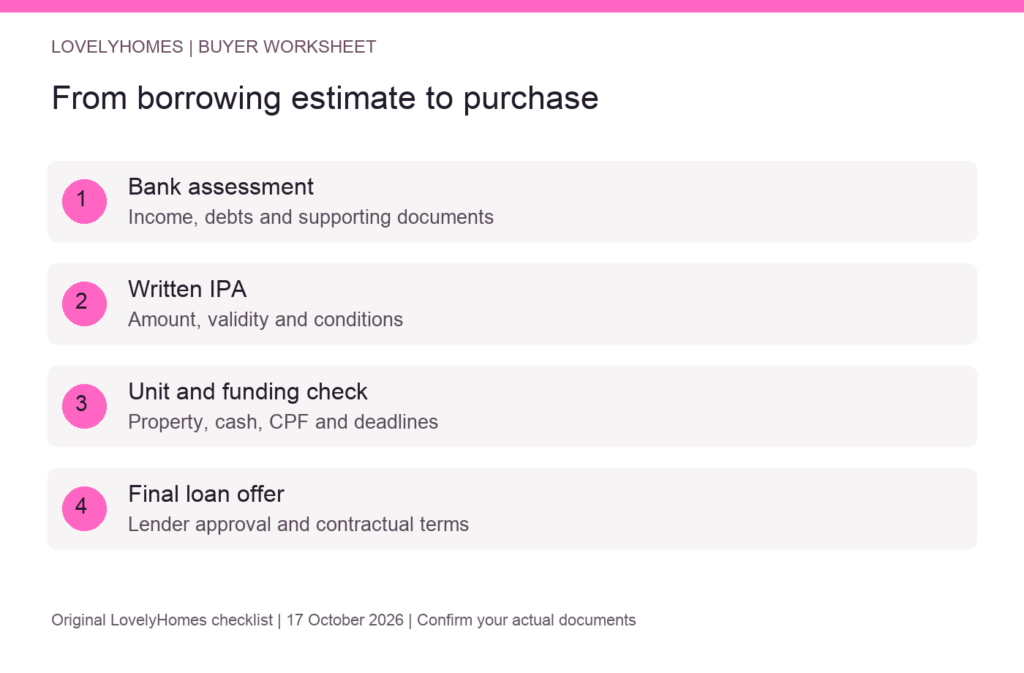
Checked 17 October 2026. Get an in-principle approval (IPA), also called approval in principle (AIP), before committing to a new-launch home. It helps you understand the borrowing amount a bank is prepared to assess based on your circumstances. It does not replace the final property-specific loan approval or the bank’s Letter of Offer.
This guide covers a private condominium purchase with a bank loan. Executive condominium and HDB purchases require additional checks. Start with our new-launch buying guide and use the showflat checklist once you have a realistic budget.
What an IPA does, and what remains conditional
An IPA is useful for narrowing your search, deciding your walk-away price and finding financing problems before a booking commitment. Ask the bank which income, debts, borrowers, tenure and assumptions it used. A quick online calculator and a document-assessed application may provide different levels of assurance.
The final loan remains subject to the bank’s checks and the actual property. DBS describes its IPA as non-binding and says the final loan depends on purchase price, valuation and other checks. Its published validity is 30 days. That is a DBS example, not a universal deadline for every bank. Read the validity and conditions on your own approval. Source: DBS private-property loan process and FAQ.
Step 1: prepare an honest household borrowing picture
List the intended borrowers, ages, employment arrangements and recurring financial commitments. Include existing mortgages, vehicle loans, personal loans and credit facilities. Identify income that varies, such as commissions, bonuses, overseas income or self-employment earnings. Ask the bank how it will recognise each component rather than treating all receipts as qualifying monthly salary.
Keep a separate household spending budget for food, school, insurance, transport, childcare, support for relatives and savings. These expenses matter even when a lender’s debt-ratio calculation does not capture your full lifestyle. Decide what repayment you would still accept if one income fell or interest costs rose.
Step 2: gather documents through the bank’s official channel
The exact list depends on the lender and your employment situation. As a concrete example, DBS’s published purchase-loan checklist asks for identification, income evidence and statements of financial commitments. Its salaried-income list includes a Notice of Assessment, CPF contribution history, payslips and salary-crediting statements. The full purchase-loan checklist also includes property documents that may become available later in the purchase. Ask which are required for your IPA stage. Read the bank’s current document checklist.
- Ask self-employed applicants’ banks which assessment years and business-income records are needed.
- Explain recent job changes, probation, unpaid leave or an unusual bonus before relying on an indicative amount.
- Tell the bank about existing properties and housing loans, including plans to sell a home.
- Ask whether joint borrowers need to submit separate applications or linked supporting documents.
- Keep copies of the bank’s written requests and what you submitted.
Send sensitive financial documents only through the bank’s approved secure process. A request for a banker introduction does not require sending identity documents or income statements to an article’s contact number.
Step 3: ask for a written result you can actually use
Check the maximum loan amount, proposed tenure, expiry date and conditions. Ask whether the amount is based on a stated property price or a general affordability assessment. Confirm what could change it, and whether a job change, new borrowing or a different joint-borrower arrangement requires reassessment.
Keep this question in your notes: “If I choose a unit at S$X, what is the maximum loan you expect to offer, what remains unverified, and how much cash and eligible CPF do I need before each payment?” It is more useful than asking only for the lowest advertised rate.
Step 4: turn the loan result into a purchase budget
MoneySense explains that loan-to-value limits and debt-servicing assessments affect bank lending. A qualifying private-property bank borrower with no outstanding housing loan may have an LTV limit of up to 75%, with a minimum cash downpayment; lower limits can apply because of existing loans, age or tenure. Do not use “75% financing” as a promise. Confirm the amount that applies to your actual borrowers and property. Source: MoneySense affordability guide.
Illustration, not a lending offer: a S$2 million unit with an approved S$1.5 million loan leaves S$500,000 to fund before stamp duties, legal costs and other expenses. If the bank instead approves S$1.4 million, that purchase funding gap becomes S$600,000. Your CPF eligibility and cash timing must be assessed separately. A higher available credit-card limit cannot be treated as a solution to a housing cash shortfall.
Build a dated cash-flow sheet showing deposits, contract payments, duties and later construction-linked calls. Have your lawyer and banker confirm which amounts can come from eligible CPF, when disbursements can occur, and what must first be paid in cash. Sale proceeds from another home should appear only when their expected availability is realistically established.
Step 5: compare loan terms beyond the first-year rate
Ask each lender to quote on the same loan amount and tenure. Compare fixed and floating structures, the period covered by the quote, subsequent pricing, lock-in conditions, repayment flexibility, cancellation charges and any subsidy clawback. Ask which rates apply while a property is being built and how repayments change as more of the loan is drawn.
For your own stress test, model the fully drawn loan rather than relying on a small early construction-stage payment. MoneySense’s home-loan explanation is a useful starting point for understanding principal, interest and loan structures. Your bank’s actual offer controls your contractual obligations.
Step 6: move from IPA to final loan approval
After selecting the unit, provide the bank with the requested property and purchase documents promptly. Ask for a timeline that fits the actual purchase deadlines. Read the final Letter of Offer with your lawyer and clarify outstanding conditions before accepting it. Do not assume the final offer must reproduce an earlier indicative quote.
If your IPA expires before booking, ask for renewal or reassessment. If the bank reduces the amount, stop and rebuild the funding plan before committing more money. A salesperson’s confidence that financing “should be fine” does not substitute for the lender’s decision.
Questions to send a banker before your first showflat
- What documents do you need for a properly assessed IPA in my employment situation?
- How much of my income will you recognise, and what debts have you included?
- What loan amount, tenure and validity apply to me?
- Which conditions remain before a property-specific offer?
- How much cash and eligible CPF will I need at each purchase stage?
- What happens to repayments as construction payments are drawn?
- What changes in my circumstances require a fresh assessment?
- What fees, restrictions and later rates should I compare?
For a banker introduction, use the contacts below. Tell them you are buying a private new-launch home, your expected timing and whether you need an IPA. The bank will assess eligibility and provide its own secure document-submission process.
Need a brochure, price list or professional introduction?
Planning your next property purchase? Contact Lin Xuan at 82222556 or Ade at 81888871 to request a project’s full brochure and latest available price list, discuss a viewing, or ask for introductions to bankers who can help you compare home-loan rates and packages to find the best available option for your needs.
WhatsApp Lin Xuan | WhatsApp Ade. Please include the project name and your question. Brochures, prices and unit availability are subject to developer confirmation; loan eligibility, rates and approval are determined by the bank.
Lin Xuan: ONG LIN XUAN, CEA registration R069812H. Ade: CHUA MUAY MUAY (ADE CHUA), CEA registration R014252F. ERA REALTY NETWORK PTE LTD, estate agent licence L3002382K. If you need legal advice, contact Lin Xuan or Ade and we can introduce you to property lawyers.