
October’s utility and conservancy rebates can ease an eligible HDB household’s bills, but they should not be treated as cash for a renovation deposit or a larger mortgage. The useful saving is the reduction in the relevant account’s payment requirement.
The Ministry of Finance’s 30 September announcement sets out October 2026 support: up to S$190 in U-Save and up to one month of Service & Conservancy Charges (S&CC) rebate, depending on flat type. Eligible households receive the credits automatically in their SP Services utilities and Town Council S&CC accounts respectively.
Two credits with different eligibility rules
For U-Save, a flat that is not wholly rented out needs at least one Singaporean owner or occupier; a wholly rented flat needs at least one Singaporean tenant. Households with members owning more than one property are excluded. S&CC excludes households without a Singaporean owner or occupier, those whose owners or essential occupiers have any private-property interest, and wholly rented flats. Use the announcement’s conditions rather than assuming both rebates follow the same test.
That difference matters when a household moves, rents out a flat or buys another property. One rebate appearing on a statement is not proof of entitlement to the other. A landlord and tenant should also separate the account receiving a credit from the responsibility for bills under their agreement.
Read the statement before changing the budget
A rebate is easiest to use well when you can see the bill it offsets. Keep the current statement, the credit entry and the resulting amount payable together. An account balance may include previous credits, earlier unpaid bills or adjustments, so a headline rebate amount alone cannot tell you what your next payment will be.
For an invented example, take a utilities account with S$220 of charges, no earlier balance and a S$150 credit. The remaining liability is S$70. The household has S$150 less to fund for that bill; it has not received S$150 into its spending account. This example is arithmetic only and does not establish any household’s entitlement or actual utilities charges.
Now suppose the same hypothetical account also has S$80 unpaid from an earlier period. The starting liability becomes S$300 and the same credit leaves S$150 payable. Keeping the earlier balance visible prevents a household from budgeting only for the latest month’s consumption.
A quarterly benefit is not a permanent monthly income
A household can record a credit when it appears, or spread an expected annual benefit across its planning worksheet, but it should not do both. Double counting makes the housing budget look stronger without creating another dollar of support.
Imagine an annual planning allowance of S$600, purely for illustration. Dividing by 12 gives S$50 a month. If the worksheet already reduces monthly costs by S$50, deducting a S$150 quarterly credit again would count the same assumed support twice. Actual disbursement dates and account balances still determine the payments due.
Keep recurring costs in their own columns: mortgage, insurance, property tax, utilities and conservancy charges. Add irregular spending such as appliance replacement separately. A reduction in one category does not remove the others, and a larger home may change several of them at once. Our HDB versus condo comparison helps organise the broader decision.
For buyers, preserve the move-in cash
Before committing to works, list the deposits and final payments due before you can move. Then compare those dates with cash actually available. Account credits tied to utility or conservancy bills should not be entered as money available to pay a contractor.
If a purchase would only be manageable by assuming future support at the same level indefinitely, reduce the commitment or build a larger buffer. Use a second version of the budget without an assumed rebate. The difference shows how much of the plan depends on support rather than recurring household income.
The next step is to reconcile the utilities and Town Council statements, establish which eligibility conditions apply, and keep the resulting bill savings within the household plan. Use our purchase funding guide for the separate question of deposits, valuation and approved finance.
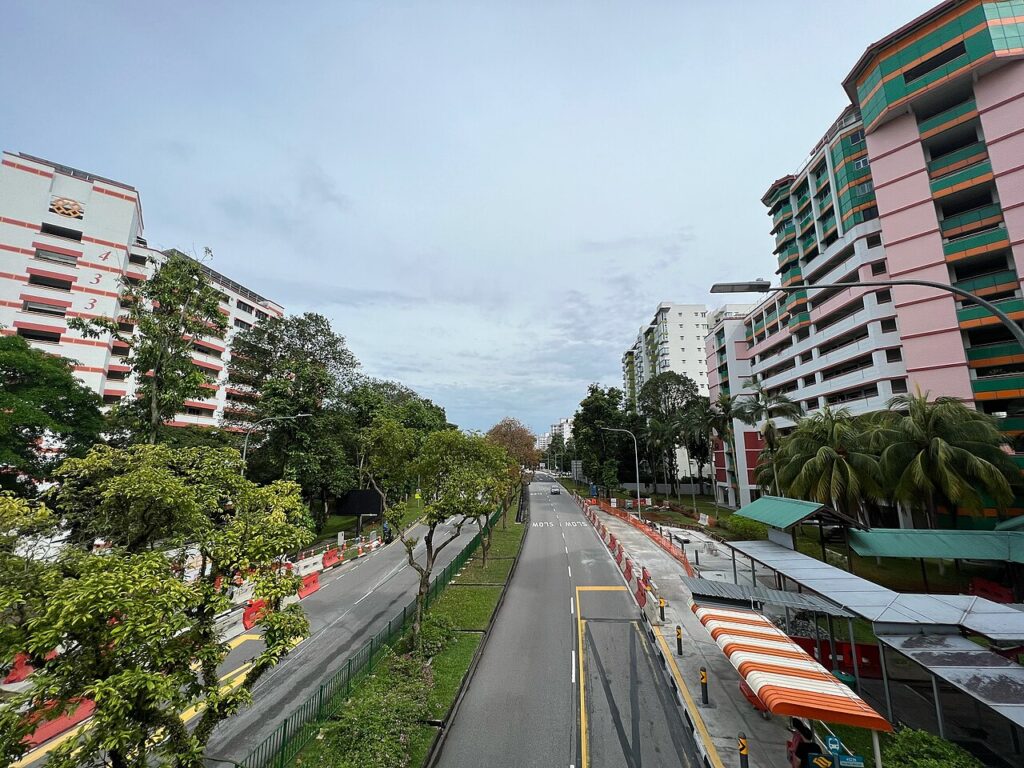
Choa Chu Kang Way, photographed 31 October 2022. Photo: Wzhkevin, Wikimedia Commons. CC BY-SA 4.0. Resized for web. Housing context; no claim about the households shown. Source: https://commons.wikimedia.org/wiki/File:Choa_Chu_Kang_Way_2.jpg. Licence: https://creativecommons.org/licenses/by-sa/4.0/.
Need a brochure, price list or professional introduction?
Contact Lin Xuan at 82222556 or Ade at 81888871 for the full project brochure, latest available price list, a viewing, or introductions to bankers who can help you compare home-loan rates and packages to find the best available option for your needs. If you need legal advice on a property purchase, sale or tenancy, we can also put you in touch with property lawyers.
WhatsApp Lin Xuan | WhatsApp Ade. Let us know the project or property question you would like help with. Prices and availability are subject to developer confirmation, while loan terms and approval are determined by the bank.
Lin Xuan: ONG LIN XUAN, CEA registration R069812H. Ade: CHUA MUAY MUAY (ADE CHUA), CEA registration R014252F. ERA REALTY NETWORK PTE LTD, estate agent licence L3002382K.