Quick Answer: Is Punggol a Good Place to Buy Property in 2026?
- Punggol is Singapore’s flagship “Smart and Sustainable” eco-town, rebuilt from the early-2000s “Punggol 21” masterplan into a waterfront new town anchored by the Punggol Waterway, completed in 2011.
- The Punggol Digital District (PDD), also known as Punggol Digital Hub, integrates a business park with the Singapore Institute of Technology (SIT) campus, targeting an eventual base of roughly 28,000 digital economy jobs once fully built out.
- Waterway Point, a mall of more than 350 shops, sits at the midpoint of the Waterway and anchors day-to-day retail and dining for the whole town.
- Northshore, Punggol’s newest precinct, comprises HDB developments including Northshore Residences and Northshore Straits alongside Piermont Grand, Punggol’s only Executive Condominium (EC) to date.
- Transport runs on the Punggol LRT East and West Loops feeding into the North East Line (NEL) interchange at Punggol MRT, with the future Cross Island Line (CRL) planned to add a further interchange at Punggol.
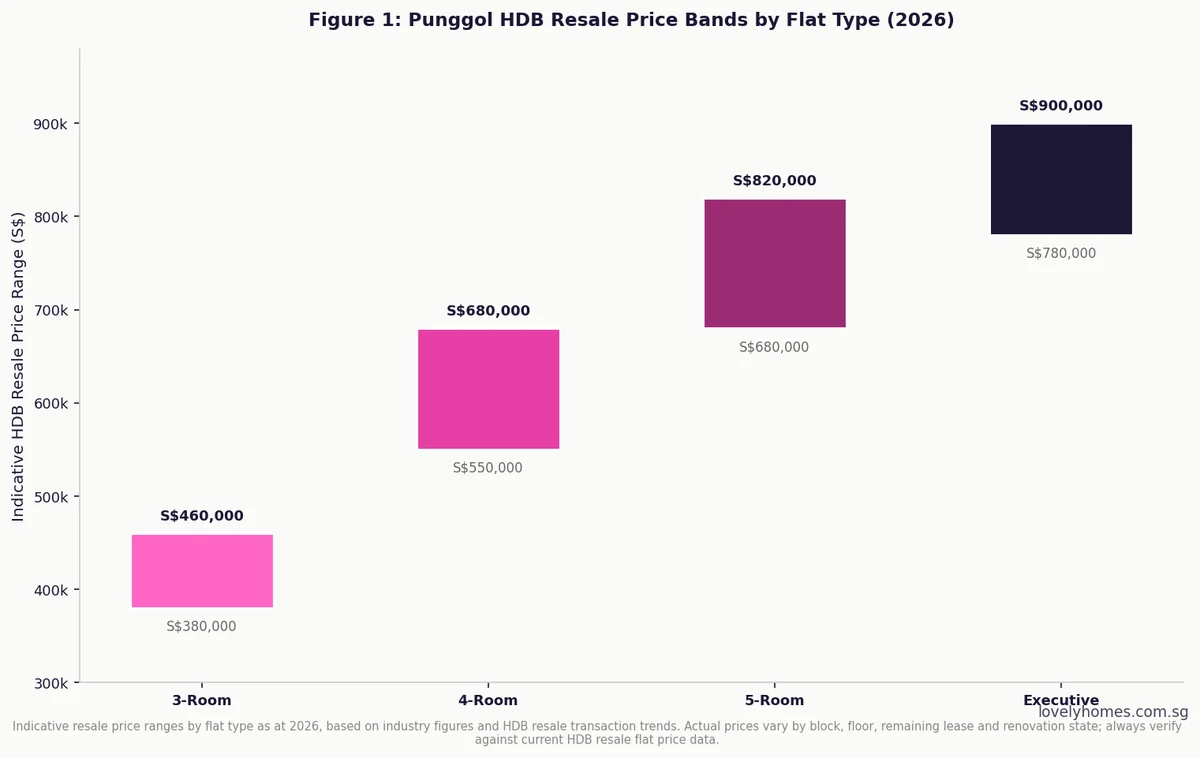
- Indicative HDB resale prices in 2026 span roughly S$380,000-460,000 for a 3-room flat up to S$680,000-820,000 for a 5-room flat, according to industry figures, among the more accessible price bands in the North-East Region.
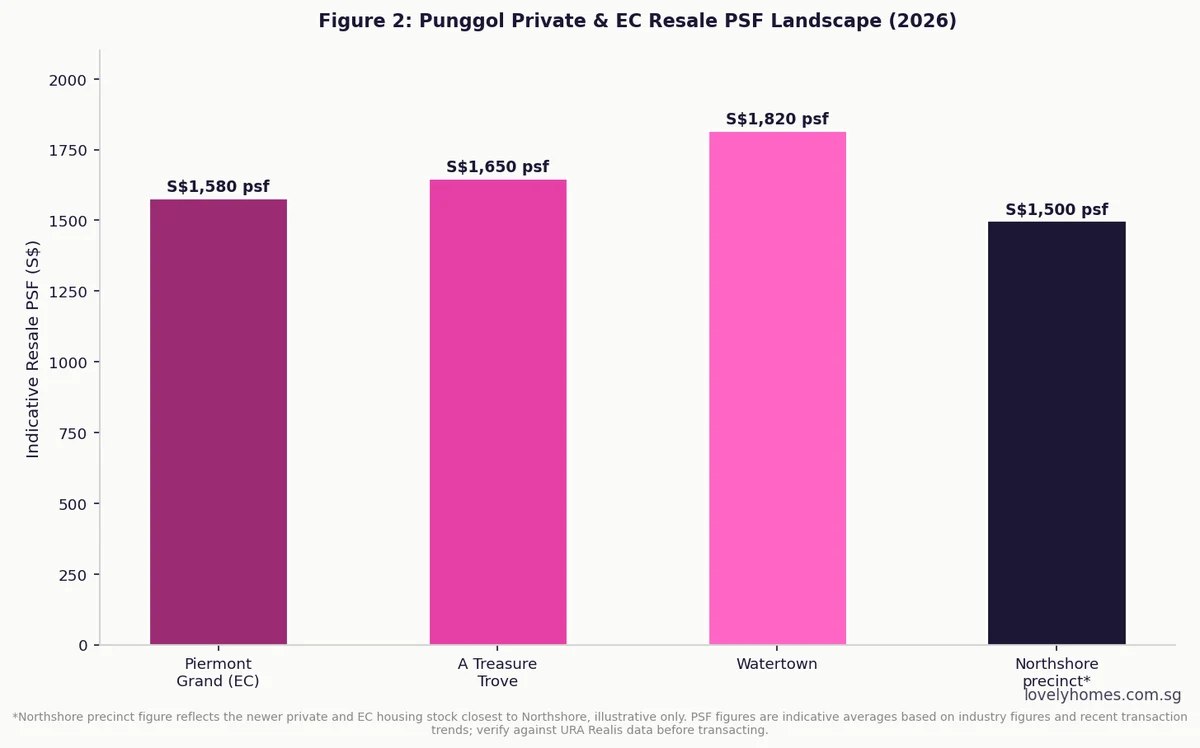
- Punggol’s private and EC resale landscape (Piermont Grand, A Treasure Trove, Watertown) trades at indicative PSF ranges of roughly S$1,500-1,850 psf as at 2026.
- The investment thesis rests on young-family demand, a further EC pipeline, and waterfront lifestyle appeal, weighed against 99-year leasehold decay and reliance on the PDD jobs story maturing on schedule.
Punggol has spent the last two decades transforming from farmland and fish farms on Singapore’s north-eastern coast into one of the country’s most closely watched “model towns”, a live demonstration of what HDB’s planners believe a smart, sustainable, waterfront new town should look like. What started as the 1996 “Punggol 21” vision, paused and substantially reworked after the Asian Financial Crisis, re-emerged from 2007 as “Punggol 21-plus” and later “My Waterway @ Punggol”, giving the town its defining feature: a 4.2km man-made waterway threading through the estate. Today Punggol is a genuine mixed-use town with its own business park, a full-fledged university campus, an LRT network, and a growing stock of HDB, Executive Condominium and private housing. This guide walks through how Punggol got here, what is actually being built now, indicative pricing across flat types and condo developments, the schools nearby, and what the investment case for buying into Punggol in 2026 really looks like.
From Punggol 21 to Smart and Sustainable Eco-Town
Punggol’s modern story begins with the 1996 “Punggol 21” masterplan, an ambitious vision for a waterfront town that was significantly slowed by the 1997-98 Asian Financial Crisis. The plan was revived from 2007 as “Punggol 21-plus”, later rebranded “My Waterway @ Punggol”, with the centrepiece Punggol Waterway officially opened in October 2011. Since then, planners have consistently positioned Punggol as Singapore’s “Smart and Sustainable” eco-town, a test bed for centralised waste collection via pneumatic conveyance, smart lampposts, and community-first design such as pocket parks and waterfront promenades. The result is a town of well over 100,000 residents, skewing notably younger and more family-heavy than Singapore’s older estates.
Punggol Digital District and the Singapore Institute of Technology
The single biggest change to Punggol’s long-term trajectory is the Punggol Digital District (PDD), sometimes called Punggol Digital Hub, a 50-hectare development combining a business park for cybersecurity, digital technology and other knowledge-based industries with a purpose-built campus for the Singapore Institute of Technology (SIT). Students, researchers and industry tenants share adjacent facilities, intended to shorten the distance between academic research and commercial application. On full build-out, planners have cited an eventual target of around 28,000 jobs at PDD, a figure that would make Punggol one of very few HDB towns with a genuine large-scale employment base of its own, reducing reliance on commuting to the CBD or one-north.
Punggol Waterway and Waterway Point
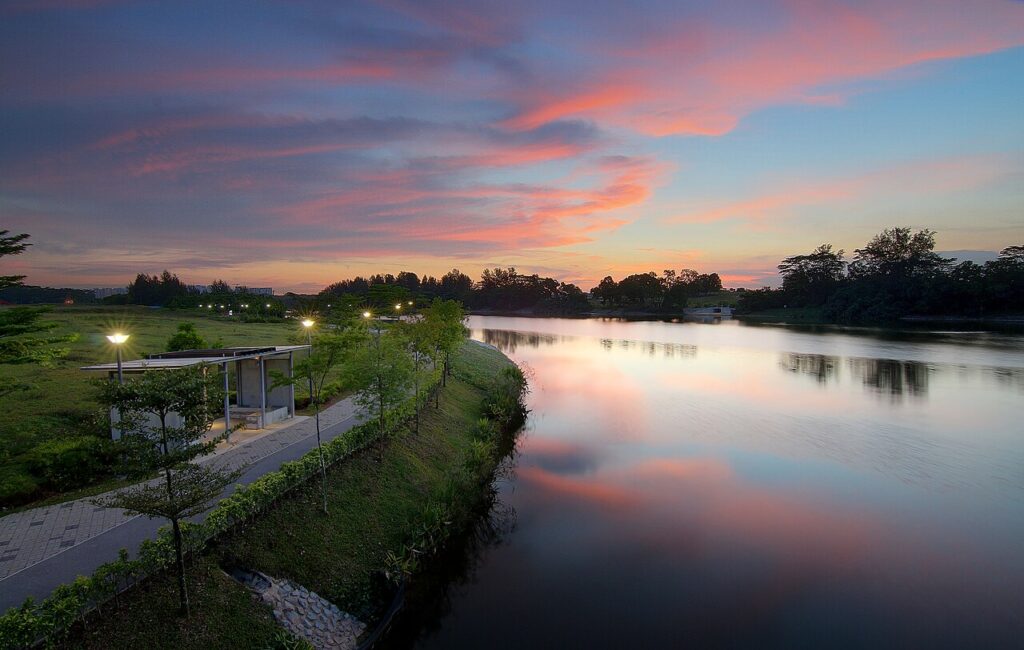
The Punggol Waterway is a 4.2km engineered waterway looping through the town, connecting to the sea at both ends and serving flood management, recreational and aesthetic purposes, complete with kayaking, waterside boardwalks and Waterway Cove, a landscaped inlet near the town centre. At its midpoint sits Waterway Point, a mall of more than 350 shops jointly developed by Frasers Property and Far East Organization, directly linked to Punggol MRT/LRT station and the Town Hub. Waterway Point functions as Punggol’s de facto town centre, deliberately sited beside the transport interchange so residents from every precinct can reach it by a short LRT ride without a car.
Northshore: Punggol’s Newest Precinct
Punggol’s newest wave of development sits under the Northshore banner, a coastal precinct on the town’s northern edge facing Serangoon Harbour and Coney Island. Northshore comprises HDB Build-To-Order (BTO) projects including Northshore Residences and Northshore Straits, alongside Piermont Grand, an Executive Condominium developed by CDL and TID that reached Temporary Occupation Permit (TOP) status in 2023 and remains, as at 2026, Punggol’s only EC. Northshore emphasises waterfront living and proximity to Coney Island Park, and continues Punggol’s smart-town design features. For buyers, Northshore represents the newest housing stock in Punggol, generally commanding a premium over older precincts nearer Punggol MRT.
Punggol Town Hub: The Community Heart
Punggol Town Hub is an integrated municipal development directly adjacent to Waterway Point and Punggol MRT/LRT station, bringing together the Community Club, a public library, a hawker centre, and sports facilities including a swimming complex and stadium under one masterplanned precinct. Its clustering with the transport interchange and the mall reflects Punggol’s broader walkable, transit-oriented planning philosophy, an approach that has become something of a template for HDB’s newer towns since.
Getting Around: LRT, the North East Line and the Future Cross Island Line
Punggol’s internal transport backbone is its LRT network, split into the Punggol East Loop and Punggol West Loop, both converging at Punggol MRT/LRT interchange station, which also sits on the North East Line (NEL), giving direct rail access into the city via Dhoby Ghaut. Punggol Coast, a newer NEL extension station, adds heavy-rail access closer to Northshore and the coast. Looking ahead, the Cross Island Line (CRL), Singapore’s eighth MRT line and largely an underground orbital route linking the eastern and western parts of the island without passing through the city centre, is planned to add a further interchange at Punggol. Exact opening dates should be verified directly with LTA, but a future CRL interchange would materially cut cross-island travel time for residents heading toward Jurong and other parts of the island that today require a change of line via the city.
HDB Resale Prices in Punggol by Flat Type (2026)
As at 2026, indicative HDB resale prices in Punggol, based on industry figures and HDB resale transaction trends, span roughly S$380,000 to S$460,000 for a 3-room flat, S$550,000 to S$680,000 for a 4-room flat, S$680,000 to S$820,000 for a 5-room flat, and S$780,000 to S$900,000 for the more limited stock of Executive flats. These ranges place Punggol among the more accessible towns in the North-East Region relative to more mature estates such as Bishan or Toa Payoh, reflecting both Punggol’s younger housing stock (which typically carries a longer remaining lease, a point in its favour) and its position slightly further from the city centre. Actual transacted prices vary by block, floor, remaining lease and proximity to the LRT or Waterway Point, so buyers should always check current prices via the HDB Resale Portal before making an offer.
The Private Condo Landscape and Indicative PSF
Punggol’s private and EC resale market is comparatively young, with the notable developments being Piermont Grand (the town’s only EC), A Treasure Trove, and Watertown, the latter directly integrated with Waterway Point via a linked basement and widely regarded as one of Punggol’s most established private addresses given its town-centre location. Indicative resale PSF as at 2026, based on industry figures and recent transaction trends, runs from roughly S$1,500 psf for some of the newer Northshore-area private and EC stock, through S$1,580-1,650 psf for Piermont Grand and A Treasure Trove, up to around S$1,820 psf for Watertown, reflecting its integrated-mall location premium. As with the HDB figures above, these are indicative averages only; buyers should check URA’s Realis database for comparable caveats before forming a view on fair value.
Schools in Punggol
Families are central to Punggol’s demographic profile, and the town has built out a deep bench of schools. Meridian Primary School and Endeavour Primary School serve the western and central parts of the town, while Mee Toh School, a long-established primary school that relocated to Punggol, is also well regarded locally. Buyers with school-going children should verify current MOE Primary One registration distances from a specific unit, since priority admission is address-based and catchments are periodically reviewed.
Investment Thesis: Why Buyers and Investors Watch Punggol
The case for Punggol as an investment rests on three pillars. First, sustained young-family demand supports steady owner-occupier demand for both HDB upgraders and EC buyers over time. Second, an EC pipeline: with further Government Land Sales sites available in and around Punggol, additional EC launches remain plausible, and EC buyers historically benefit from a discount to comparable private condos that narrows once the unit’s Minimum Occupation Period (MOP) ends. Third, waterfront and lifestyle appeal: the Waterway, Coney Island and the scale of green and blue space are difficult to replicate in older, denser estates. Against these strengths, buyers should weigh the ordinary caution of any 99-year leasehold purchase, and that the PDD jobs thesis, while credible, still depends on continued build-out rather than being a completed fact today.
Summary: Punggol Facts at a Glance
| Question | Short Answer |
|---|---|
| When did the Punggol Waterway open? | October 2011, under the “My Waterway @ Punggol” masterplan. |
| What is the Punggol Digital District? | A combined business park and SIT campus targeting around 28,000 digital economy jobs. |
| What is Punggol’s only Executive Condo? | Piermont Grand, TOP 2023, in the Northshore precinct. |
| Indicative 4-room HDB resale price in 2026? | Roughly S$550,000-680,000, per industry figures. |
| How do residents get around Punggol? | Punggol LRT East/West Loops feeding the NEL interchange; CRL interchange planned. |
| Where is Punggol’s main mall? | Waterway Point, beside Punggol MRT/LRT and Punggol Town Hub. |
Worked Example: 4-Room BTO/Resale Flat vs Executive Condo in Punggol
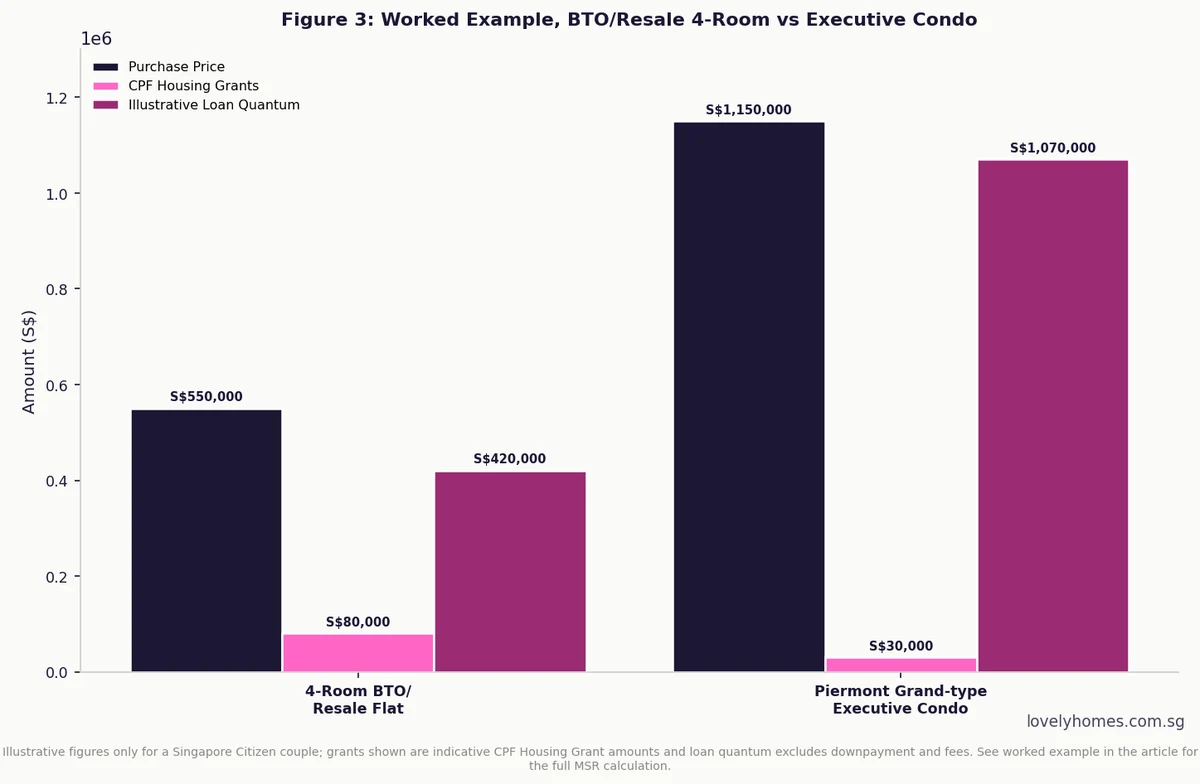
The scenario: A Singapore Citizen couple, both first-time buyers in their late twenties with a combined gross monthly income of S$9,000, is deciding between a Punggol 4-room resale flat priced at S$550,000 and a resale Executive Condo (Piermont Grand-type) priced at S$1,150,000.
Grants available for the resale flat: As a first-time couple buying an HDB resale flat with a combined income under the relevant CPF Housing Grant income ceiling, they are eligible for the Enhanced CPF Housing Grant (EHG) of up to S$50,000 and the Family Grant of up to S$30,000 for a resale flat, giving up to S$80,000 in grants, subject to meeting all HDB eligibility conditions including the flat’s remaining lease covering the youngest buyer to age 95 for the full EHG quantum.
Grants available for the EC: ECs attract only the Family Grant, up to S$30,000, and only for a new EC bought directly from a developer, not a resale unit; a resale EC such as this worked example typically does not qualify, so the S$30,000 in Figure 3 should be read as illustrative of a new-sale scenario rather than this specific resale case.
The MSR check: Both HDB flats and ECs are subject to the Mortgage Servicing Ratio (MSR), capping monthly repayments at 30% of gross monthly income. On S$9,000 combined income, the MSR ceiling is S$2,700. For the resale flat, a loan of S$450,000 over 25 years at an illustrative 3.0% gives a monthly instalment of approximately S$2,133, comfortably within the ceiling. For the EC, a loan of roughly S$920,000 (80% LTV) over 25 years at the same rate gives approximately S$4,357 a month, which fails MSR on this income; the couple would need a higher income, a larger cash downpayment, or a longer tenure to bring the instalment within MSR, illustrating why EC affordability is far more income-sensitive than HDB resale.
These figures are illustrative only; actual grant eligibility, loan terms and MSR outcomes depend on the buyers’ specific circumstances and should be confirmed with HDB and a bank or HDB loan officer before committing to a purchase.
Why This Matters for Buyers and Investors
Punggol is one of the few HDB towns where the underlying infrastructure story, PDD, the Waterway, Northshore and the LRT network, is substantially delivered rather than purely aspirational. For an owner-occupier household, especially a young family, Punggol offers a rare combination of new housing stock, green and blue space, and a walkable town centre, at price points more accessible than mature central and north-eastern towns. For an investor, the comparison between HDB, EC and private product in the same town matters because affordability and financing constraints differ sharply by product type; the MSR ceiling can be the binding constraint long before the Total Debt Servicing Ratio (TDSR) or absolute price becomes an issue, especially for EC purchases where quantum rises sharply relative to HDB resale.
Frequently Asked Questions
Is Punggol considered a mature or non-mature HDB estate?
Punggol is classified as a non-mature estate, which generally means longer BTO waiting times are offset by a larger CPF Housing Grant quantum for eligible first-time buyers compared with mature estates.
What is the difference between the Punggol LRT and Punggol MRT?
The Punggol LRT is a light rail network of two loops (East and West) that circles the town’s HDB precincts, all converging at Punggol station, which is also the North East Line MRT interchange providing direct heavy-rail access to the city.
Is Piermont Grand still the only Executive Condo in Punggol?
As at 2026, Piermont Grand remains Punggol’s only completed Executive Condominium, though further EC sites could in principle be released in the area if included in a future Government Land Sales programme.
Can Permanent Residents or foreigners buy an EC in Punggol?
A new EC can only be purchased directly from a developer by a Singapore Citizen and PR/Citizen household meeting eligibility conditions; a resale EC past its Minimum Occupation Period may be bought by PRs, and after the 10-year mark from launch, by foreigners, subject to prevailing rules.
What is the Mortgage Servicing Ratio and why does it matter in Punggol?
MSR caps monthly repayments on an HDB flat or EC loan at 30% of gross monthly income. It matters in Punggol because the gap between HDB resale and EC quantum is large, so MSR can bind well before TDSR for buyers considering an EC upgrade.
How far is Punggol from the city centre?
Punggol sits on the North East Line, generally around 35-45 minutes by MRT to the Raffles Place/CBD area depending on the specific journey and interchange, though a future Cross Island Line interchange is planned to improve cross-island connectivity.
What schools are within or near Punggol?
Meridian Primary School, Endeavour Primary School and Mee Toh School are among the primary schools serving Punggol; buyers with school-going children should verify current MOE Primary One registration distances for a specific address.
Related Articles on LovelyHomes
- Tampines Neighbourhood and Property Guide 2026: HDB Prices, Condos, Schools and the CRL
- Sengkang Singapore Neighbourhood Guide 2026: HDB, MRT and Schools
- Pasir Ris Neighbourhood Guide Singapore 2026: HDB Prices, Condos, Schools and the CRL Opportunity
- Singapore HDB Resale Price Guide 2026: Complete Breakdown by Town and Flat Type
- HDB BTO vs Resale Singapore 2026: Price, Wait Time, Grants and Which Is Right for You
- TDSR and MSR Singapore 2026: Complete Guide to Mortgage Servicing Limits and the Stress Test Rate
Supporting graphics
Original article illustrations are available below.