Conservation shophouses are one of the few property types in Singapore that let a foreigner buy freely, without approval, while still sitting in some of the most land-scarce streets in the country. This guide explains how shophouse zoning, stamp duty and financing actually work, and what a realistic entry cost looks like in 2026.
Quick Answer — Shophouse investment at a glance
- Over 6,500 shophouses across Singapore carry conservation status under URA, concentrated in about 100 designated Conservation Areas
- A fully commercial shophouse is not subject to Additional Buyer’s Stamp Duty (ABSD), making it one of the few freely foreign-purchasable property types in the city centre
- A shophouse with a residential component is treated as residential property for stamp duty purposes on that portion, and ABSD can apply
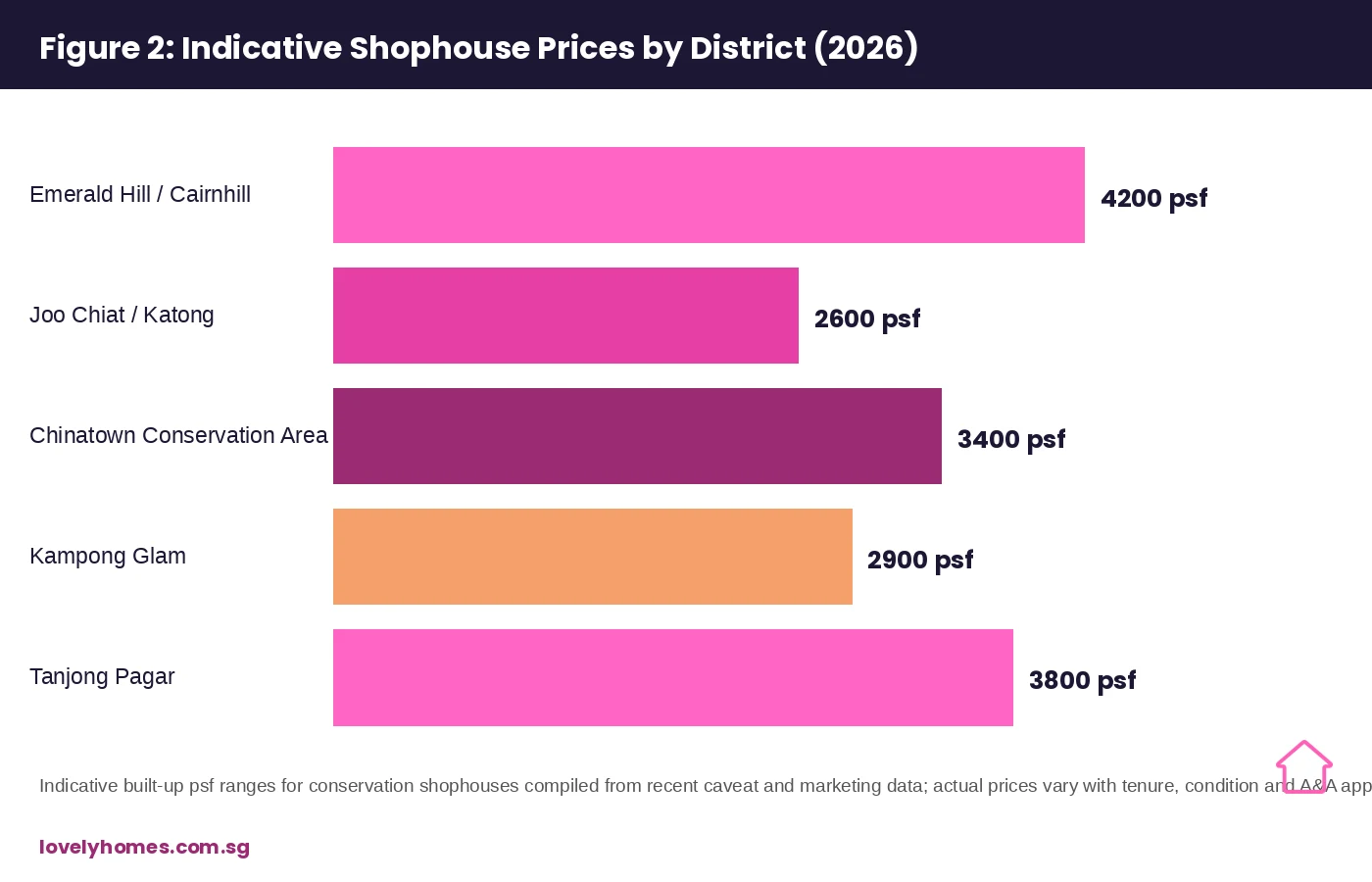
- Indicative 2026 prices range from roughly $2,600 to $4,200+ psf of built-up area depending on district and conservation grade
- Bank financing for commercial-use shophouses is typically capped lower than residential financing, often around 70–80% loan-to-value
- Any renovation to the facade or structure requires Addition & Alteration (A&A) approval from URA’s Conservation and Urban Design team
- Rental demand comes from F&B, boutique retail, professional offices and short-stay hospitality operators, giving conservation shophouses a distinct tenant mix from ordinary commercial space
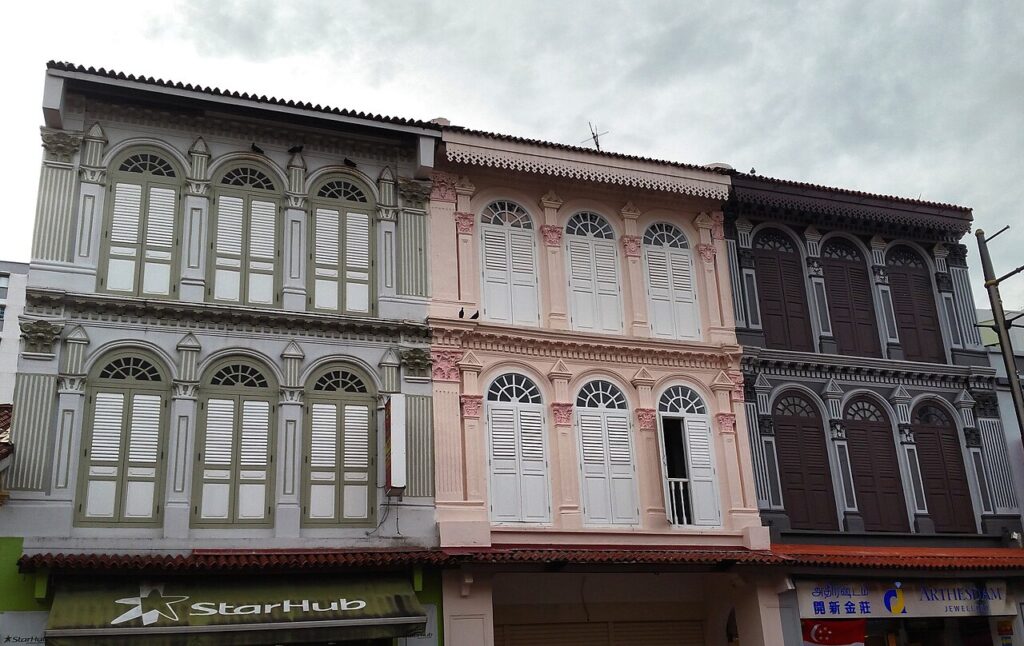
Singapore’s shophouses date largely from between the 1840s and 1960s, and URA’s conservation programme, formalised from 1989, protects their facades and streetscapes while allowing the interiors to be adapted for modern use. For investors, this combination of heritage protection and flexible internal use is precisely what makes shophouses attractive: the building cannot simply be redeveloped away by a neighbour, and the interior can still be fitted out for a café, an office, a boutique hotel or a private residence.
Understanding Shophouse Zoning
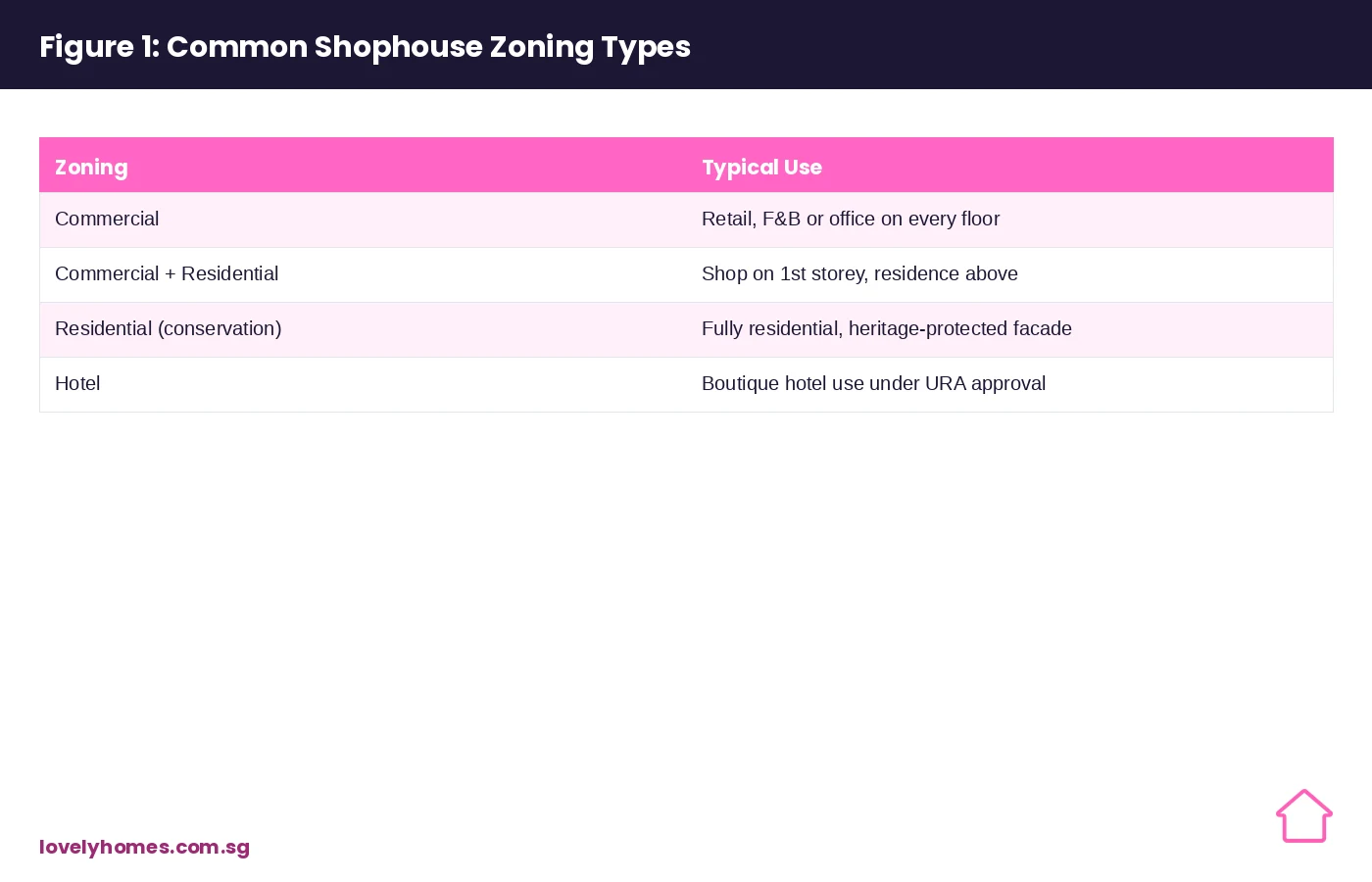
Not every shophouse can be used the same way. URA’s Master Plan assigns each conservation shophouse a zoning designation that determines what activities are permitted, and this zoning is the single most important factor in both financing and stamp duty treatment.
A shophouse zoned fully commercial can be used for retail, food and beverage, or office purposes on every floor, and can be bought by a foreigner without Land Dealings Approval Unit clearance, since the Residential Property Act’s restrictions apply to residential land use, not commercial. A commercial-plus-residential shophouse, the classic historic configuration with a shop on the ground floor and living quarters above, is more complex: the residential portion is generally treated as residential property for stamp duty and, in some cases, ownership-approval purposes.
Where the Conservation Areas Are
Shophouses vs Other Ways to Invest in Singapore Commercial Property
Investors weighing a shophouse purchase are usually also weighing two alternatives: a strata-titled commercial unit in a purpose-built development, or exposure through a listed Real Estate Investment Trust (REIT). Each sits at a different point on the control, liquidity and ticket-size spectrum.
| Route | Typical Entry Size | Control Over Asset | Liquidity |
|---|---|---|---|
| Conservation shophouse (direct) | $3 million and up | Full, subject to A&A rules | Low |
| Strata commercial unit | $500,000 and up | Partial, shared MCST decisions | Moderate |
| Listed REIT units | Any amount | None (pooled vehicle) | High |
A direct shophouse purchase suits an investor who wants a tangible, appreciating asset with full control over tenanting and renovation decisions, and who can accept a long holding period and a large single-asset concentration. A strata commercial unit lowers the entry ticket but introduces shared decision-making through a Management Corporation Strata Title (MCST), and does not carry the same heritage scarcity premium. A REIT offers instant diversification and daily liquidity but no direct control and no exposure to the specific upside of owning and improving a single heritage asset.
Prime conservation shophouse clusters include Emerald Hill and Cairnhill near Orchard Road, Joo Chiat and Katong in the east, the Chinatown Conservation Area, Kampong Glam around Arab Street and Haji Lane, and Tanjong Pagar. Each area has a distinct character and tenant profile: Chinatown and Tanjong Pagar skew toward F&B and professional offices given their Central Business District proximity, while Joo Chiat and Katong have built a reputation for boutique retail and heritage-led hospitality concepts.
| Conservation Area | Indicative Price (psf, built-up) | Typical Tenant Profile |
|---|---|---|
| Emerald Hill / Cairnhill | ~$4,200 psf | Boutique F&B, private residences |
| Tanjong Pagar | ~$3,800 psf | Professional offices, F&B |
| Chinatown Conservation Area | ~$3,400 psf | F&B, retail, boutique hotels |
| Kampong Glam | ~$2,900 psf | Creative retail, F&B |
| Joo Chiat / Katong | ~$2,600 psf | Heritage F&B, lifestyle retail |
Figures are indicative built-up psf ranges compiled from recent caveat and marketing data; actual prices vary with tenure, condition, conservation grade and A&A approval history.
Stamp Duty and Foreign Ownership: Why Shophouses Are Different
This is the single biggest reason investors look at shophouses at all. Additional Buyer’s Stamp Duty exists to cool residential demand, and it applies based on the use of the property being acquired, not simply its address. A shophouse that is zoned and used fully commercially falls outside ABSD entirely, and outside the Residential Property Act’s foreign-ownership restrictions, meaning a foreigner can buy one without Land Dealings Approval Unit clearance and without the 60% ABSD that would otherwise apply to residential property.
The moment a residential component is added — living quarters on the upper floor, for instance — that portion is assessed for stamp duty as residential property, and Buyer’s Stamp Duty is apportioned between the commercial and residential elements based on their respective values or floor areas, as determined by IRAS. Getting this apportionment wrong is one of the most common and costly mistakes first-time shophouse buyers make, so a conveyancing lawyer experienced specifically in mixed-use shophouse transactions is essential, not optional.
Worked Example: Buying a Commercial Shophouse in Chinatown
Consider a foreign investor buying a fully commercial three-storey shophouse in the Chinatown Conservation Area, 1,800 sq ft built-up, at an indicative $3,400 psf.
- Purchase price: 1,800 sq ft × $3,400 psf = $6,120,000
- Buyer’s Stamp Duty (BSD): tiered up to 5% on the portion above $1.5 million (non-residential BSD scale) — approximately $233,000
- Additional Buyer’s Stamp Duty (ABSD): not applicable, since the property is zoned and used fully commercially
- Legal and conveyancing fees: approximately $15,000–$25,000 for a transaction of this size
- Indicative bank financing: at 75% loan-to-value, a loan of approximately $4,590,000, leaving a cash/equity requirement of roughly $1,530,000 plus duties and fees
Compare this with a residential condominium of equivalent value bought by the same foreign investor, which would attract 60% ABSD — more than $3.6 million in additional duty alone. This gap is precisely why commercial shophouses have become a recognised alternative asset class for foreign capital seeking direct property exposure in Singapore without the ABSD drag.
Financing a Shophouse Purchase
Banks assess shophouse loans differently from ordinary commercial property, largely because conservation status limits what a lender can do with the asset if a loan defaults — the building cannot be demolished and replaced with a larger, more liquid asset. Loan-to-value ratios for commercial-use shophouses commonly sit in the 70–80% range, somewhat below what is typically available for standard commercial units in a purpose-built development, and lenders will scrutinise the tenancy profile and rental track record closely where the shophouse is bought with an existing tenant in place.
Renovation Rules: What Addition & Alteration Approval Covers
Every conservation shophouse sits under URA’s Conservation Guidelines, and any work that touches the protected facade, roof form, five-foot way or key architectural features requires Addition & Alteration (A&A) approval before work begins. Internal reconfiguration is generally more flexible, but structural changes, rear extensions and services upgrades (electrical, plumbing, fire safety) still typically require submission and approval. Buyers should always request the building’s approved plans and any outstanding Fire Safety and Shelter Department or Building and Construction Authority requirements before completing a purchase, since rectification costs for non-compliant prior works can be substantial and fall on the new owner.
Due Diligence Checklist Before You Sign
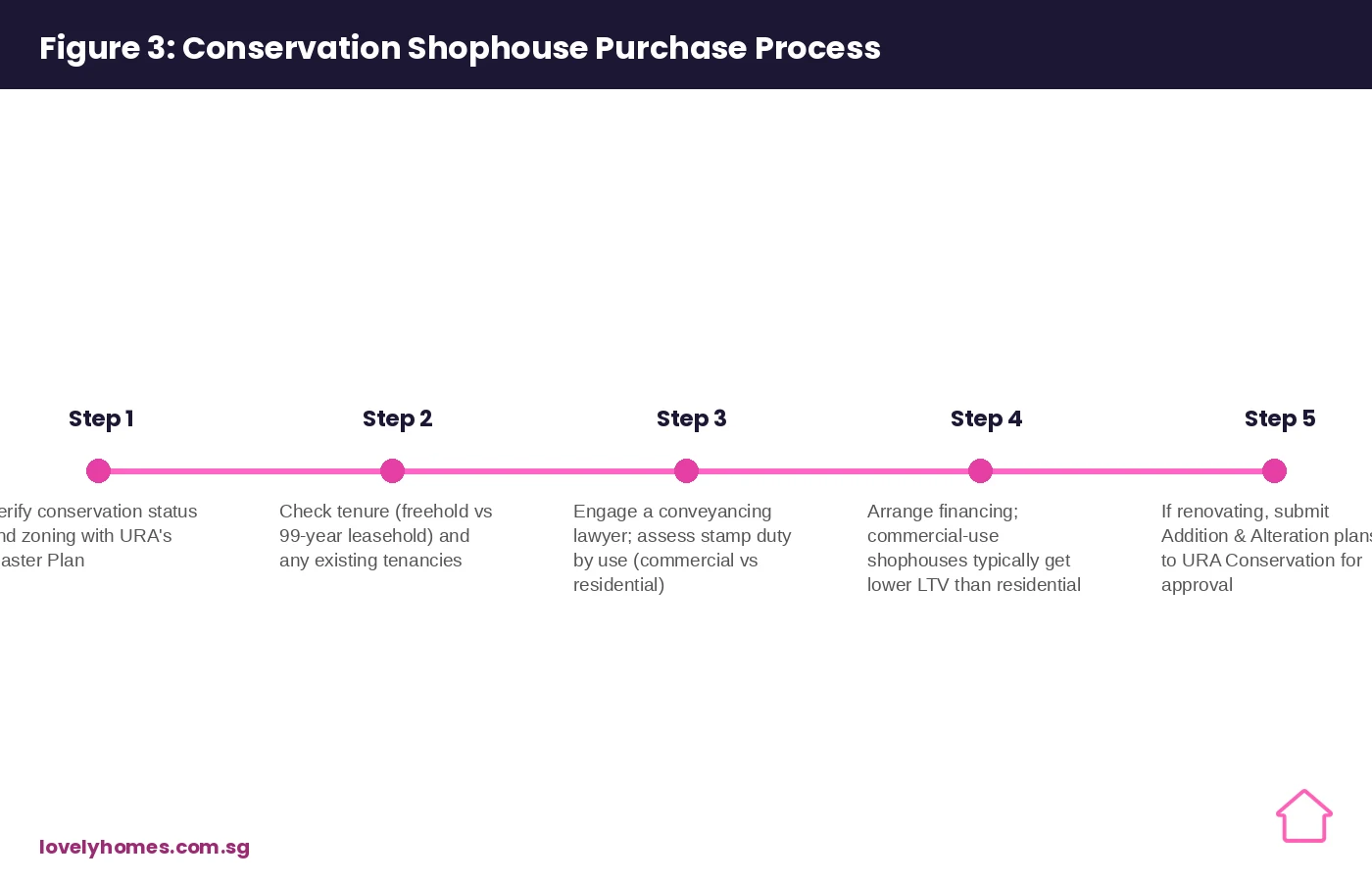
Shophouse transactions carry more moving parts than a standard condominium purchase, so a disciplined due-diligence sequence matters. At minimum, buyers should verify: the property’s exact zoning and permitted use under the URA Master Plan; whether any residential component exists and how it will be apportioned for stamp duty; the tenure (freehold or the remaining term on a 99-year lease); the building’s approved plans versus its as-built condition, to catch any unauthorised past works; outstanding requirements from the Fire Safety and Shelter Department or the Building and Construction Authority; the existing tenancy agreement, if any, including break clauses and rent review terms; and the conservation grading, which determines how much latitude any future Addition & Alteration application will have.
Because so much of this due diligence is document- and approval-driven rather than purely financial, engaging a conveyancing lawyer and, where renovation is planned, a conservation-experienced architect before signing the Option to Purchase is standard practice among experienced shophouse investors, not an optional extra.
Why This Matters: Rental Demand and Yield
Conservation shophouses draw a tenant base that purpose-built commercial towers cannot easily replicate: heritage-conscious F&B concepts, boutique retail brands, wellness operators and creative agencies frequently pay a premium for the character and street-level visibility a shophouse offers. Rental yields vary by area and configuration, but well-located, fully-tenanted commercial shophouses in established conservation precincts have historically offered yields broadly comparable to, and in some cases exceeding, prime office and retail space, reflecting both the scarcity of the stock and continued demand from operators seeking a distinctive address.
Rental Income Tax and GST for Shophouse Landlords
Rental income from a commercial shophouse is taxable in Singapore regardless of whether the landlord is an individual or a company, and regardless of residency. An individual landlord is taxed at progressive personal income tax rates after deducting allowable expenses such as property tax, mortgage interest, repairs and maintenance and agent fees; a company holding the shophouse pays Singapore’s corporate tax rate of 17% on net rental profit, though the actual effective rate is often lower once available tax exemptions for new and small companies are applied.
Goods and Services Tax (GST) is a separate consideration that catches many first-time landlords by surprise. If a landlord’s total taxable turnover, including rental income from commercial property, exceeds $1 million over a 12-month period, GST registration with IRAS becomes compulsory, and GST at the prevailing rate must then be charged on commercial rental income going forward. Residential rental income remains GST-exempt, which is one more reason the commercial-versus-residential zoning question at the start of this guide carries consequences all the way through to the landlord’s ongoing tax compliance.
What Might Come Next
URA’s conservation programme has steadily expanded protection over recent decades rather than contracted it, and there is no indication that this direction will reverse. Demand from both owner-occupier businesses and investors for conservation shophouses has remained resilient through multiple property cycles, partly because the ABSD-free structure for commercial use remains intact. This is a forward-looking view, not a certainty: any future extension of ABSD or ownership restrictions to commercial property, or a tightening of A&A approval timelines, would change the investment calculus, and prospective buyers should treat this outlook as speculative rather than assured.
Frequently Asked Questions
Can a foreigner buy a shophouse in Singapore without approval?
Yes, if the shophouse is zoned and used fully commercially. The Residential Property Act’s foreign-ownership restrictions and ABSD apply to residential property, not commercial property, so a fully commercial shophouse can generally be bought freely by a foreigner.
Does ABSD apply to a shophouse with a residential upper floor?
The residential portion is assessed separately and can attract ABSD and ownership restrictions, while the commercial portion generally does not. IRAS apportions Buyer’s Stamp Duty between the two components based on value or floor area.
Do I need approval to renovate a conservation shophouse?
Any work affecting the protected facade, roof, five-foot way or key architectural features requires Addition & Alteration approval from URA before work begins. Purely internal, non-structural changes may have more flexibility, but approval requirements should always be confirmed before purchase.
How much can I borrow to buy a shophouse?
Commercial-use shophouses typically attract loan-to-value ratios of around 70 to 80 percent, somewhat lower than standard commercial property, reflecting the constraints conservation status places on redevelopment if a loan were to default.
What is the difference between freehold and leasehold shophouses?
Some conservation shophouses are held freehold, particularly in older established districts, while others sit on 99-year state leases. Tenure materially affects both price and financing terms, so it should always be confirmed early in due diligence.
Can a shophouse be used as a boutique hotel?
Hotel use is possible in some conservation shophouses but requires specific zoning approval from URA, along with licensing from the Singapore Tourism Board. Not every conservation shophouse is zoned to permit hotel use, so this must be verified before purchase.
Are shophouse rental yields better than office or retail space?
Yields vary by location and tenant, but well-tenanted commercial shophouses in established conservation precincts have historically achieved yields broadly comparable to prime office and retail space, supported by the scarcity of conservation stock.
Related Articles
- Singapore Foreigner Property Buying Guide 2026
- Singapore Property Conveyancing Process Guide 2026
- Good Class Bungalow (GCB) Buying Guide Singapore 2026
- ABSD Singapore 2026: Complete Guide
- Singapore Real Estate Crowdfunding Guide 2026
- Singapore Stamp Duty Guide 2026
Disclaimer: This guide is for general information only and does not constitute legal, tax or financial advice. Shophouse zoning, stamp duty apportionment and conservation approval requirements are assessed case by case. Always verify the current position with URA, IRAS and the Singapore Land Authority, and consult a licensed conveyancing lawyer and tax specialist before acting on any property transaction.
Supporting graphics
Original article illustrations are available below.