When you search for a private condo in Singapore, listings often display two letters , CCR, RCR or OCR , that silently determine prices, stamp-duty eligibility, CPF usage rules, buyer profiles and even the types of tenants you will attract. Understanding what these regions mean and how they performed in Q2 2026 (per the URA’s 24 July 2026 release) is essential before you commit to any private residential purchase.
Quick Answer: CCR vs RCR vs OCR 2026
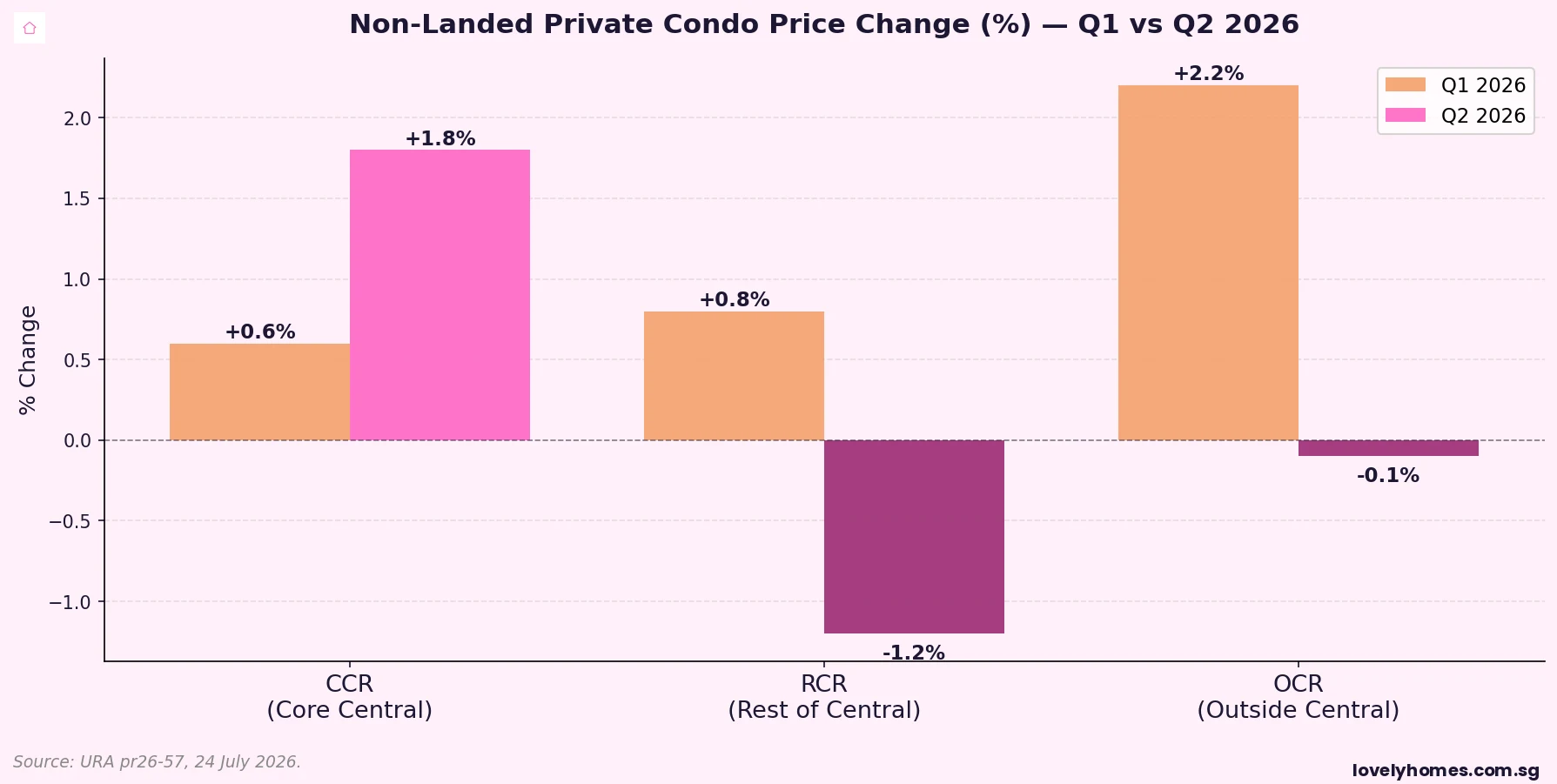
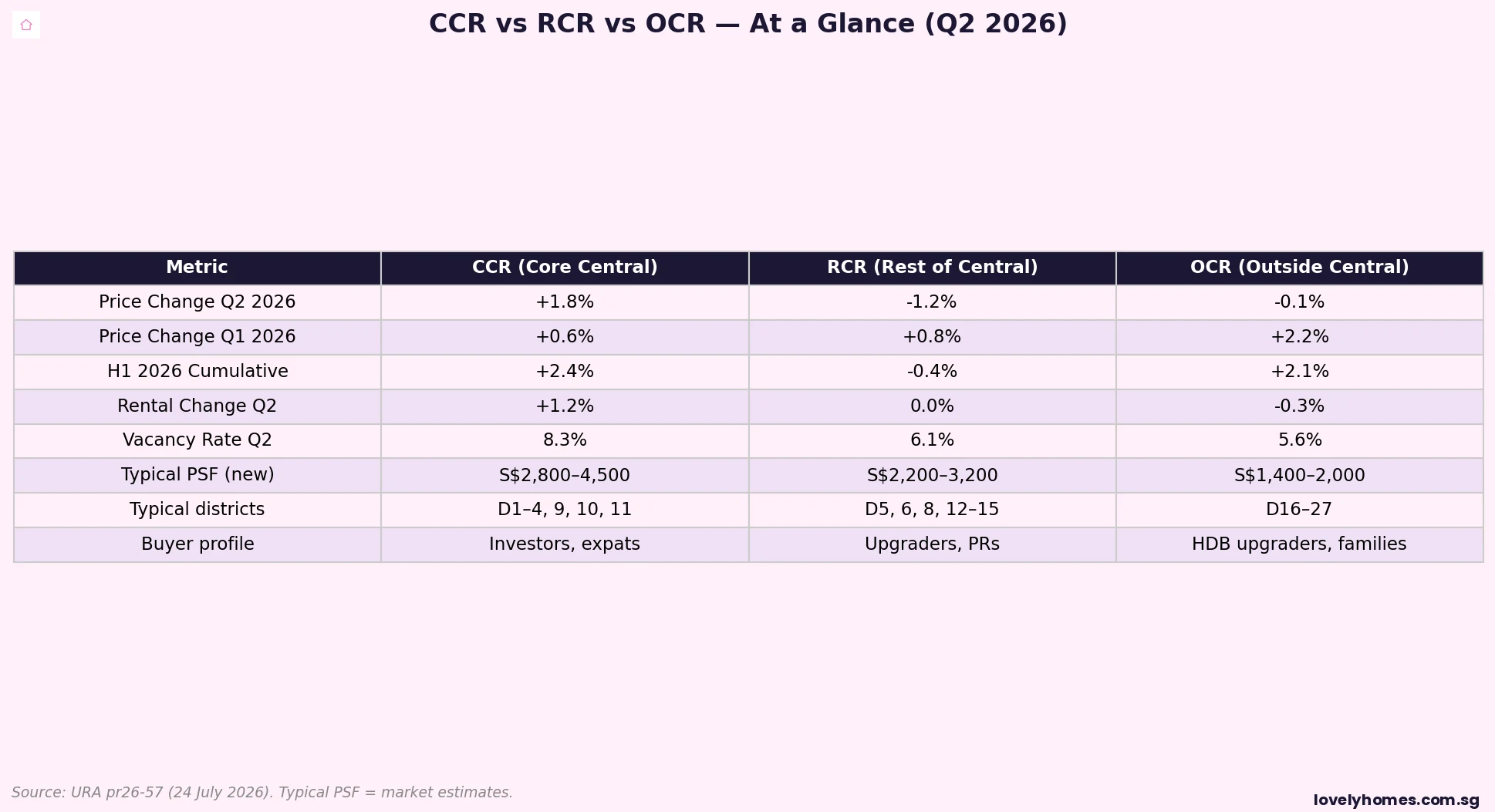
- CCR (Core Central Region): Districts 1–4, 9, 10, 11 , Singapore’s prime/luxury zone; non-landed prices rose +1.8% in Q2 2026, the strongest of the three regions
- RCR (Rest of Central Region): Districts 5, 6, 8, 12–15 and fringe CCR parts , mid-market/city-fringe; non-landed prices fell 1.2% in Q2 2026
- OCR (Outside Central Region): Districts 16–27 , mass-market/suburban; non-landed prices edged down 0.1% in Q2 2026
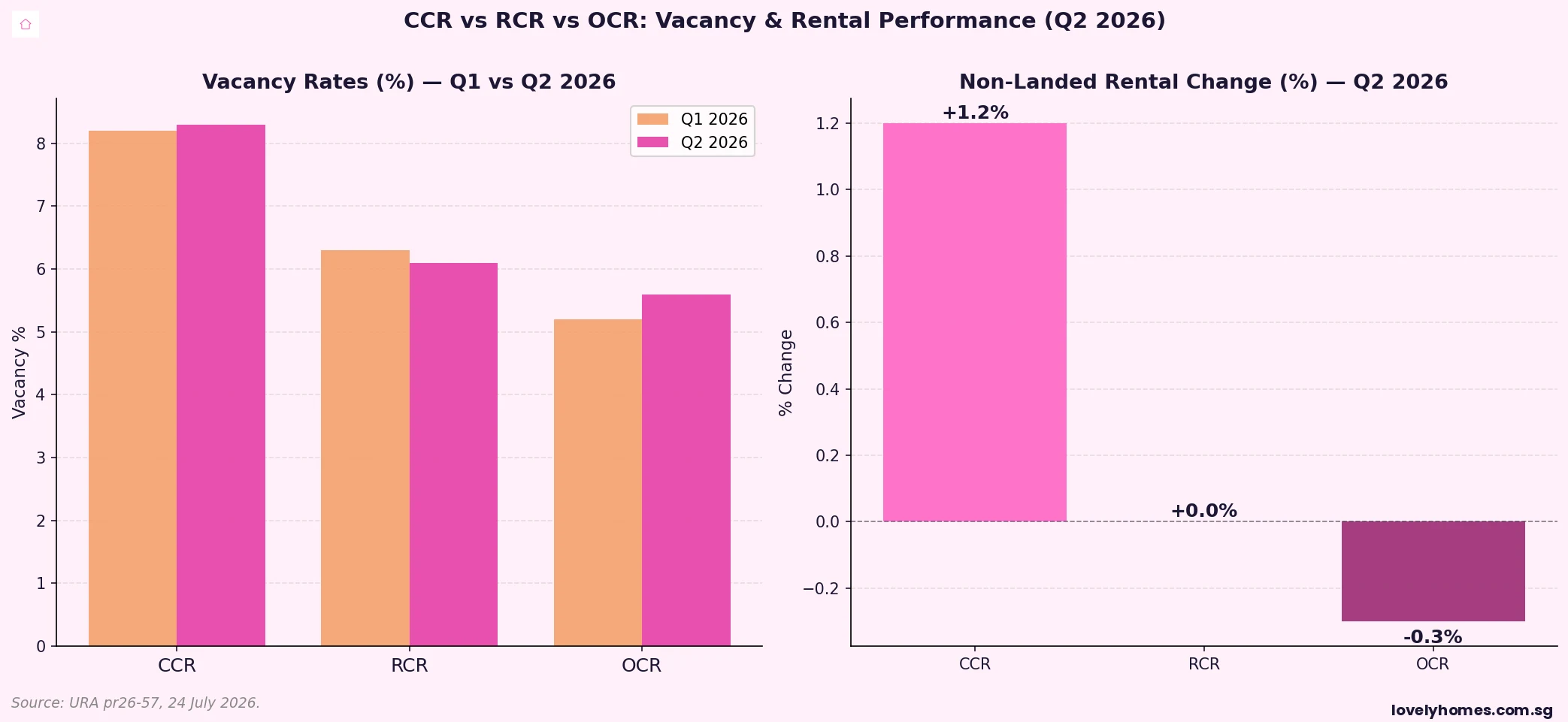
- Vacancy rates Q2 2026: CCR 8.3% (highest); RCR 6.1%; OCR 5.6% (lowest)
- Rentals Q2 2026: CCR +1.2%; RCR 0.0%; OCR -0.3%
- CCR does not allow CPF for purchase price above valuation; OCR/RCR condos often fall within CPF withdrawal limits for HDB upgraders
- ABSD applies uniformly across all three regions; BSD brackets are the same regardless of region
What Are CCR, RCR and OCR?
The Urban Redevelopment Authority (URA) divides Singapore into 28 postal districts and groups them into three market segments for the purpose of its private residential statistics. These groupings reflect not just geography but the historical market positioning of each area , the CCR encompasses Singapore’s traditional prime residential and CBD-fringe addresses; the RCR covers the intermediate city fringe; and the OCR covers the suburban heartland.
CCR: Core Central Region
The CCR comprises Postal Districts 1, 2, 3, 4, 9, 10 and 11. These include Tanjong Pagar (D2), Orchard/Nassim (D9/10), Newton/Novena/Moulmein (D11), Marina Bay (D1), Sentosa Cove (D4) and Harbourfront (D4). Properties here are targeted at high-net-worth individuals, foreign purchasers, and institutional investors. New launches in the CCR routinely exceed S$3,000–S$5,000 psf for luxury and ultra-luxury projects.
RCR: Rest of Central Region
The RCR includes Districts 5 (Buona Vista/West Coast), 6 (City Hall/Clarke Quay), 7 (Middle Road), 8 (Little India/Farrer Park), 12 (Balestier/Toa Payoh), 13 (Macpherson/Potong Pasir), 14 (Geylang/Eunos) and 15 (East Coast/Katong). The RCR is the “sweet spot” for many Singapore Permanent Residents and Citizens upgrading from HDB, offering city-fringe positioning at a significant discount to CCR.
OCR: Outside Central Region
The OCR covers all remaining districts from D16 (Bedok/Upper East Coast/Tampines) through D27 (Sembawang/Yishun). This is the domain of HDB upgraders, first-time private buyers and families seeking larger units. OCR condos are priced in the S$1,300–S$2,000 psf range for most projects, and most new OCR launches qualify as “Rest of Singapore” for the Government’s definition of affordable private housing.
Q2 2026 Performance: Price Changes by Region
The URA’s full Q2 2026 release (pr26-57, 24 July 2026) revealed a clear bifurcation: the CCR returned to outperformance as interest rates stabilised and prime-district demand from non-resident buyers , many of whom had sat out the 2023 ABSD hike period , returned to the market.
Reading the Q2 2026 Numbers
The CCR’s +1.8% quarterly gain reverses several quarters of underperformance and likely reflects pent-up demand from wealthy buyers who had deferred purchases after the April 2023 ABSD increase to 60% for foreigners. The RCR’s -1.2% decline is more pronounced than the Q1 data suggested and may partly reflect large-unit pricing corrections in city-fringe projects. The OCR’s near-flat -0.1% outcome, after the strong +2.2% in Q1 2026, suggests that the mass-market rally driven by strong BTO-deferred demand has run its course for now.
Vacancy Rates and Rental Performance (Q2 2026)
Vacancy rates and rental trends tell a complementary story. The CCR has the most units sitting empty (8.3% as at Q2 2026), reflecting oversupply from a spate of completions and a shortage of qualifying foreign tenants since post-pandemic corporate relocation budgets tightened. The OCR’s 5.6% vacancy is the tightest, supported by HDB upgraders who often own a private condo but rent it out while continuing to live in their HDB during MOP.
CCR vs RCR vs OCR: Summary Comparison
CPF and Financing Rules by Region
One of the most practically significant differences between regions is how CPF can be used. Under CPF Board rules, Ordinary Account (OA) savings may be used to pay for private property up to the Valuation Limit (VL) , the lower of the purchase price or market valuation. Above the VL, no OA funds may be used.
For OCR condos priced at S$1.5M–S$2M, many buyers find that CPF OA savings comfortably cover the 25% downpayment (under the 75% LTV bank loan limit). For CCR condos at S$3M–S$6M, the absolute CPF amount available per buyer (maximum OA savings plus annual contribution) makes CPF useful only for a portion of the purchase price, and many CCR buyers rely primarily on cash.
The Total Debt Servicing Ratio (TDSR) of 55% of gross monthly income applies uniformly across all three regions. For private property loans, the 75% LTV (or 45% LTV for properties with existing mortgage on another property) is set by MAS Notice 645 and applies regardless of whether the property is in CCR, RCR or OCR.
ABSD and BSD: Same Rules Across All Regions
Additional Buyer’s Stamp Duty (ABSD), administered by IRAS, does not differentiate between CCR, RCR and OCR. A Singapore Citizen buying a second property pays ABSD at 20% whether the condo is in Orchard Road (CCR) or Tampines (OCR). Similarly, Buyer’s Stamp Duty (BSD) is calculated on the same tiered schedule irrespective of region: 1% on the first S$180,000, 2% on the next S$180,000, 3% on the next S$640,000, 4% on the next S$500,000, 5% on the next S$1.5M, and 6% on any remainder above S$3M (as at 2026, per IRAS).
Worked Example: Comparing a Purchase in Each Region
Consider a Singapore Citizen couple (both first-time private property owners) comparing similar-quality 2-bedroom + study condos in the three regions in Q3 2026:
| Item | CCR (Orchard) | RCR (Toa Payoh) | OCR (Tampines) |
|---|---|---|---|
| Unit size | 850 sqft | 850 sqft | 850 sqft |
| PSF | S$3,500 | S$2,300 | S$1,550 |
| Purchase Price | S$2,975,000 | S$1,955,000 | S$1,317,500 |
| BSD | S$118,350 | S$67,350 | S$37,300 |
| ABSD (1st property SC) | Nil | Nil | Nil |
| 25% Downpayment (cash/CPF) | S$743,750 | S$488,750 | S$329,375 |
| Monthly mortgage (75% LTV, 3.5% p.a., 25 yr) | ~S$11,100 | ~S$7,300 | ~S$4,920 |
| Estimated gross rental yield | 2.5–3.2% | 3.0–3.8% | 3.5–4.5% |
BSD and ABSD figures are indicative, calculated per IRAS tables effective in 2026. Rental yields are market estimates based on H1 2026 transaction data and are not guaranteed.
What Does This Mean for Buyers?
The Q2 2026 data reinforces a pattern that has persisted since Singapore’s 2023 ABSD recalibration: the CCR and OCR tend to have different buyer pools with limited substitution between them. Foreign buyers and ultra-high-net-worth Singaporeans drive CCR demand independent of mortgage rates; OCR demand is heavily influenced by HDB upgrader timing, CPF accumulation and national housing policies. The RCR sits between these dynamics and therefore tends to display the most volatility when sentiment shifts.
What Might Come Next (H2 2026 and Beyond)
Speculative outlook based on current market data. Not investment advice.
The CCR’s return to outperformance in Q2 2026 may be partly driven by a one-time release of deferred demand from foreign buyers who waited out the ABSD shock. If global interest rates stabilise and Singapore’s investment appeal remains intact, CCR prices could consolidate or nudge higher in H2 2026. However, the vacancy rate of 8.3% and upcoming pipeline completions in districts 9 and 10 are medium-term headwinds. The OCR’s near-flat movement reflects a market in equilibrium: new supply (Tampines North BTO, Woodlands North launch) is meeting demand, preventing significant appreciation but also providing resilience against sharp corrections.
Frequently Asked Questions About CCR, RCR and OCR
What does CCR mean in Singapore property?
CCR stands for Core Central Region, one of three market segments defined by the Urban Redevelopment Authority (URA) for reporting private residential statistics. The CCR includes postal districts 1–4, 9, 10 and 11, covering areas such as Orchard, Nassim, River Valley, Tanjong Pagar, Marina Bay and Sentosa Cove. Properties in the CCR are generally the most expensive in Singapore and are popular with foreign buyers and high-net-worth individuals.
Is RCR better than OCR for investment?
This depends on your investment objectives. RCR properties typically offer higher potential for capital appreciation due to their city-fringe positioning and often attract a broader rental pool (including expatriates and professionals working in the CBD). However, they also carry higher entry prices and can be more volatile. OCR properties generally offer higher gross rental yields (3.5–4.5% vs 3.0–3.8% for RCR, in H1 2026 estimates) and a more stable HDB-upgrader resale market, but lower absolute dollar appreciation. Both regions can perform well over a long holding period of 7–10 years.
Does ABSD differ between CCR, RCR and OCR?
No. ABSD rates are set by IRAS and applied uniformly based on the buyer’s citizenship and existing property count , not on the region or type of property. A Singapore Citizen buying their second residential property pays ABSD at 20% whether it is in Orchard Road or Pasir Ris. The full ABSD table is available at iras.gov.sg.
Can Singapore PR buy CCR property?
Yes. Singapore Permanent Residents may purchase private residential properties (condos, landed , with SLA approval for landed, or executive condos that have reached privatisation) in any region including CCR. PRs buying their first private property in Singapore pay ABSD at 5%. PRs buying a second property pay ABSD at 30%. There are no additional restrictions specific to the CCR.
Why is the CCR vacancy rate so much higher than OCR?
CCR properties depend heavily on expatriate tenants , senior professionals, MNC executives and foreign business owners who lease high-end condos. When global corporate relocation slows (as happened post-COVID and during global interest-rate tightening), CCR rentals weaken and units sit vacant longer. OCR properties rent primarily to Singapore PRs, HDB owners in MOP, and young local couples , a much larger and more stable domestic rental pool. This structural difference has maintained the CCR vacancy premium throughout recent market cycles.
What is the typical PSF in CCR, RCR and OCR in 2026?
Based on H1 2026 URA transaction data: CCR typically S$2,800–S$4,500+ psf for non-landed private residential (with ultra-luxury above S$5,000 psf); RCR approximately S$2,200–S$3,200 psf; OCR approximately S$1,400–S$2,000 psf for mainstream condos. Executive Condominiums (OCR/RCR) sell at a discount to equivalent private condos, typically S$1,200–S$1,500 psf on initial launch pricing.
Related Articles
- ABSD Singapore 2026: Complete Guide
- Singapore Property Cooling Measures Timeline 2009–2026
- OMG at Marina Gardens Lane , Pricing and Floor Plans
- THE ORIE at Toa Payoh , RCR New Launch
- Aurea at Marina Bay , CCR New Launch
Disclaimer
This article is for general informational purposes only and does not constitute financial, investment, legal or tax advice. Price, rental and yield figures cited are market estimates derived from published URA data and industry sources as at July 2026; actual transaction prices may differ. ABSD, BSD and CPF rules are subject to change by IRAS, the Singapore Government and CPF Board. Always verify current rates at iras.gov.sg and cpf.gov.sg and consult a Singapore-licensed property professional, lawyer and financial adviser before transacting. Official market data: ura.gov.sg/property-data and eservice.ura.gov.sg/reis.
Tags: CCR, RCR, OCR, Core Central Region, Singapore property 2026, condo regions, non-landed property, buying guide, URA Q2 2026, private residential
Supporting graphics
Original article illustrations are available below.