
Quick Answer: Singapore Mortgage SORA Guide 2026
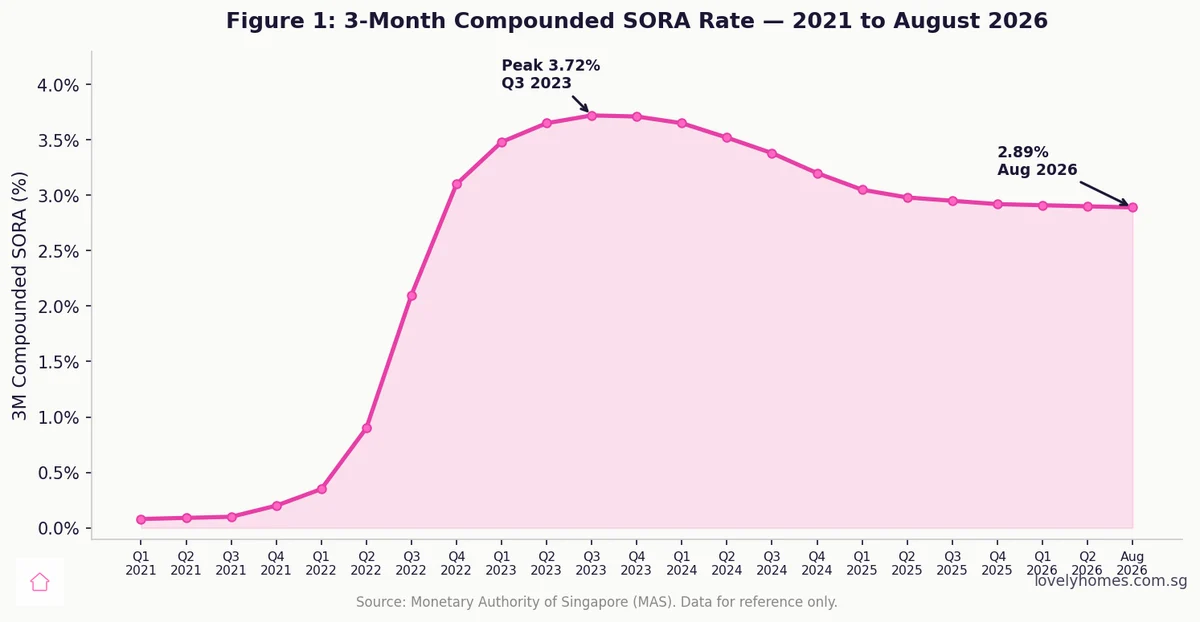
- The 3-Month Compounded SORA rate stood at approximately 2.89% as at August 2026, down from its peak of 3.72% in Q3 2023.
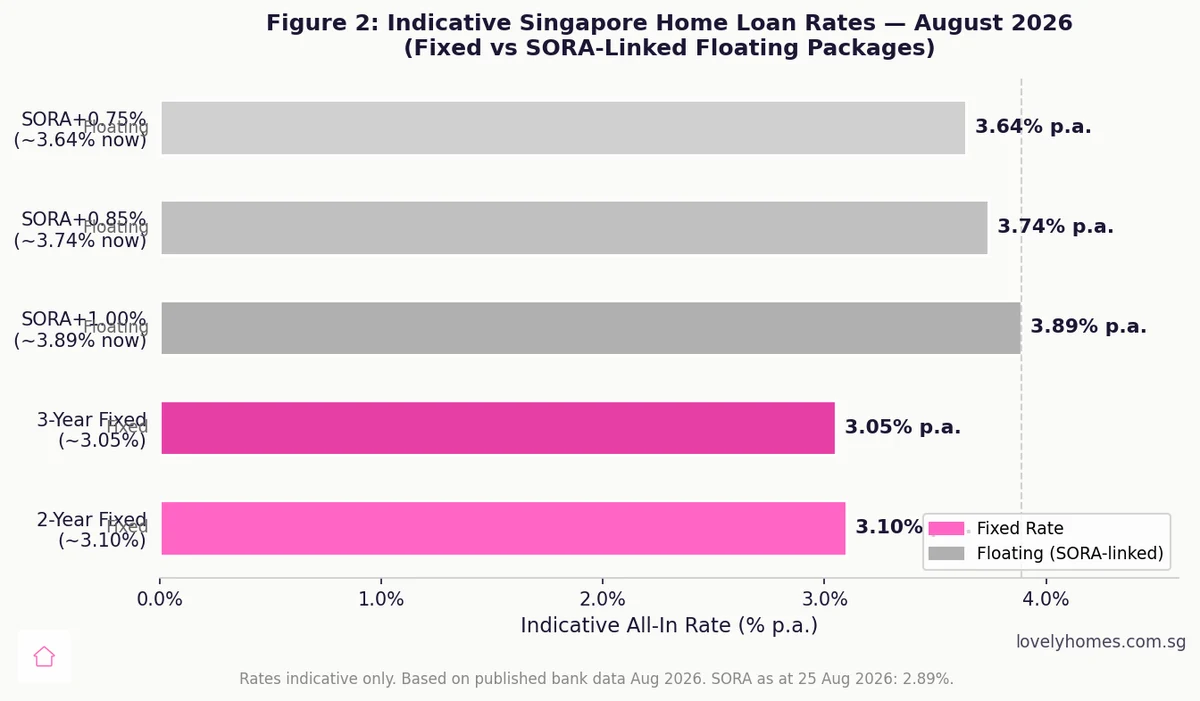
- Most Singapore home loans are either fixed-rate packages (2–3 year fixed at ~3.05%–3.10% p.a.) or SORA-linked floating packages (SORA + bank spread of 0.75%–1.00%).
- SIBOR and SOR , the old benchmarks , are gone. SIBOR was discontinued on 31 December 2024; all floating-rate mortgages now use SORA.
- MAS publishes SORA daily based on actual overnight SGD interbank transactions; it is the official risk-free benchmark for Singapore dollar interest rates.
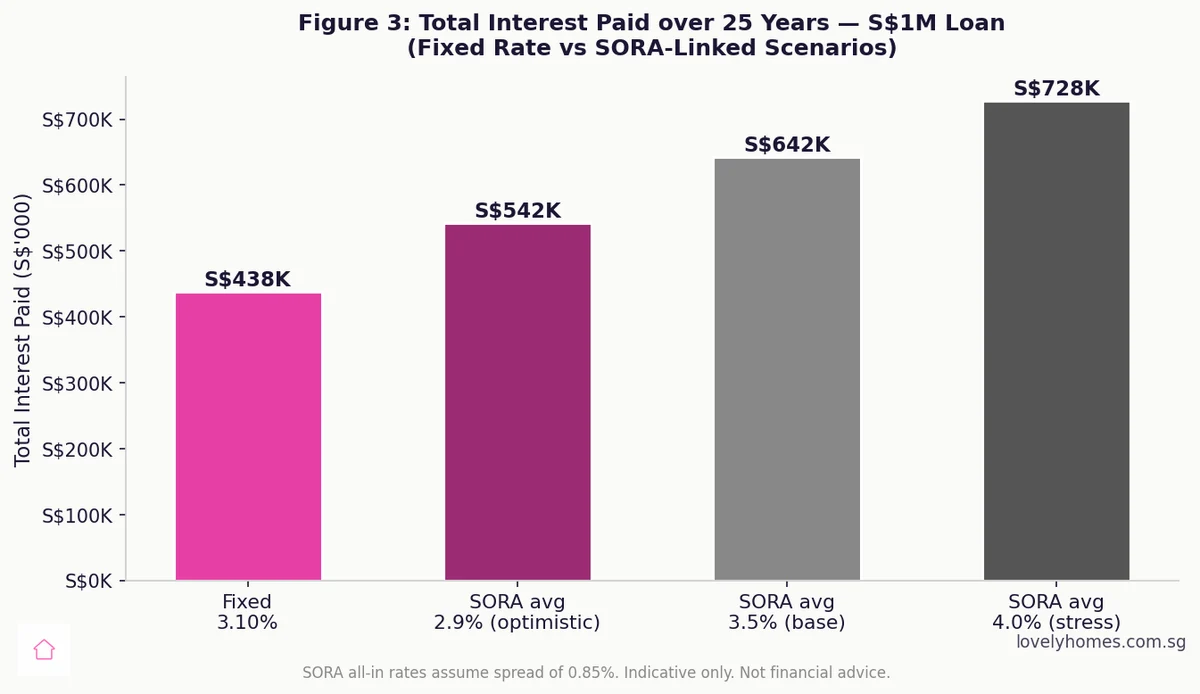
- For a S$1,000,000 loan over 25 years, each 0.50% difference in average interest rate adds roughly S$70,000–S$80,000 in total interest.
- The Total Debt Servicing Ratio (TDSR) cap of 55% of gross monthly income applies to all property loans; the Mortgage Servicing Ratio (MSR) of 30% applies only to HDB and EC loans.
- Refinancing is typically available after the lock-in period expires , usually after 2 or 3 years. A rate differential of 0.30%–0.50% is often cited as a trigger point.
What Is SORA and Why Does It Matter for Your Mortgage?
When you take out a home loan in Singapore, the interest rate you pay is not plucked from thin air. For floating-rate mortgages, it is anchored to a benchmark , and since 2021, that benchmark has been the Singapore Overnight Rate Average (SORA), published daily by the Monetary Authority of Singapore (MAS).
SORA reflects the volume-weighted average rate of actual overnight SGD-denominated interbank lending transactions conducted between 8:00 am and 6:15 pm each business day. Because it is based on real transactions rather than estimates or quotes, it is considered more robust and transparent than its predecessors, SOR (Swap Offer Rate) and SIBOR (Singapore Interbank Offered Rate).
SOR was discontinued on 30 September 2021. SIBOR , once Singapore’s dominant floating-rate benchmark for mortgages , was retired on 31 December 2024. Since then, all new floating-rate home loans in Singapore are SORA-based. If you are on an existing SIBOR loan, your bank will have transitioned you to SORA by the end of 2024.
Understanding SORA , how it moves, how it feeds into your monthly repayment, and how it compares to fixed-rate packages , is essential knowledge for any Singapore home buyer or property owner refinancing in 2026.
How SORA-Linked Home Loans Work
Your SORA-linked mortgage rate is expressed as: Compounded SORA + bank spread. The compounded SORA is typically the 3-month or 1-month compounded average, lagged by a brief period (usually two business days). The bank spread , sometimes called the bank margin , is fixed for the loan term and reflects the bank’s cost of funds, operational margin, and competitive positioning. It typically ranges from 0.75% to 1.00% for residential loans.
So if the 3-Month Compounded SORA is 2.89% and your spread is 0.85%, your all-in rate is 3.74% per annum. This rate resets periodically , typically every quarter for a 3-month SORA product , meaning your monthly repayment can change when SORA moves.
Lock-in Period and Clawback Clauses
Most floating-rate SORA packages come with a lock-in period of one to three years. During this period, full or partial prepayment attracts a clawback penalty , typically 1.50% of the outstanding loan amount. Refinancing to another bank is also restricted until the lock-in expires. Once the lock-in ends, you are free to refinance or reprice without penalty (though repricing within the same bank may involve a fee of around S$500–S$800).
Fixed-Rate Packages: Payment Certainty at a Premium
Fixed-rate mortgage packages in Singapore offer a guaranteed interest rate for a defined period , typically 2 or 3 years , after which the loan reverts to a floating rate (usually SORA-linked or the bank’s board rate). As at August 2026, indicative 2-year fixed rates from major Singapore banks sit at around 3.10% per annum, while 3-year fixed packages are priced at approximately 3.05%.
Fixed rates are attractive when SORA is expected to rise, or when a borrower simply cannot tolerate payment volatility. The trade-off is that you pay a premium for certainty , if SORA falls significantly, you will pay more in interest than a floating-rate borrower. In a declining rate environment, floating borrowers benefit first.
TDSR, MSR and How They Affect Your Loan Quantum
Before any bank will approve your home loan, it runs two key affordability tests mandated by MAS:
| Ratio | Full Name | Cap | Applies To |
|---|---|---|---|
| TDSR | Total Debt Servicing Ratio | 55% | All property loans |
| MSR | Mortgage Servicing Ratio | 30% | HDB flat and EC loans only |
The TDSR counts all monthly debt obligations , including credit card minimum payments, car loans, student loans, and the proposed mortgage , as a percentage of your gross monthly income. Banks typically apply a stress-test rate of 4.50% (or the actual contract rate plus 1.00%, whichever is higher) when computing affordability. This stress test ensures borrowers can still service their loans if rates rise materially.
Summary: Fixed Rate vs Floating SORA , At a Glance
| Factor | Fixed Rate | SORA Floating |
|---|---|---|
| Rate certainty | High , rate locked for 2–3 years | Low , resets quarterly |
| Current all-in rate (Aug 2026) | ~3.05%–3.10% p.a. | ~3.64%–3.89% p.a. |
| Benefits when rates fall | No , locked in at higher rate | Yes , repayment drops |
| Benefits when rates rise | Yes , protected for lock-in period | No , repayment rises |
| Typical lock-in period | 2–3 years | 1–2 years |
| Refinancing flexibility | After lock-in expires | After lock-in expires |
| Best suited for | Risk-averse borrowers; rising-rate environment | Rate-savvy borrowers; falling-rate environment |
Worked Example: Mr and Mrs Kumar’s Condo Purchase
Profile: Mr and Mrs Kumar, both Singapore Citizens. Combined gross monthly income: S$15,000. No existing loans. Purchasing a 3-bedroom condo in Queenstown for S$1,800,000 , their first residential property.
Stamp duties:
- Buyer’s Stamp Duty (BSD): S$1,800,000 at progressive rates → S$58,600 (1% on first S$180K = S$1,800; 2% on next S$180K = S$3,600; 3% on next S$640K = S$19,200; 4% on next S$500K = S$20,000; 5% on remainder S$300K = S$15,000)
- Additional Buyer’s Stamp Duty (ABSD): 0% , first residential property for SC
Bank loan: 75% LTV → S$1,350,000 loan. Over 25 years.
Scenario A , Fixed rate 3.10%: Monthly repayment = S$1,350,000 × [0.031/12 / (1 − (1+0.031/12)^{−300})] ≈ S$6,461/mth. TDSR = S$6,461 / S$15,000 = 43.1% , comfortably within the 55% cap.
Scenario B , SORA floating (SORA 2.89% + spread 0.85% = 3.74% all-in): Monthly repayment ≈ S$6,921/mth. TDSR = 46.1% , still within cap, but S$460/mth more than the fixed option at current rates.
Total interest difference over 25 years: If SORA averages 3.00% over the loan tenure (spread 0.85% = all-in 3.85%), total interest under floating ≈ S$779,000 vs fixed at S$638,000 , a difference of ~S$141,000 favouring the fixed rate in this scenario. However, if SORA falls to average 2.00%, the floating borrower pays only ~S$640,000 in total interest , roughly the same.
What This Means for You: Choosing in 2026
As at August 2026, fixed-rate packages are priced below current all-in SORA floating rates , a reversal of the situation seen in 2021 and early 2022 when SORA was near zero. This makes fixed rates comparatively attractive right now. The decision, however, depends on your view of where SORA will move over your intended holding period.
MAS has maintained a tight monetary policy stance through 2025 and into early 2026 via its exchange rate-based approach, which has contributed to SORA remaining above 2.80%. If global rate-cutting cycles (particularly by the US Federal Reserve) gain pace in late 2026 and 2027, SORA could drift lower , benefiting floating borrowers. If inflation proves sticky, SORA may remain elevated and fixed-rate borrowers will be better positioned.
A pragmatic approach: if your lock-in period is 2 years, a fixed-rate package lets you review the situation in late 2028 when the macro picture may be clearer. If cash-flow certainty is paramount , for example, if your TDSR is tight or your household income is variable , a fixed rate reduces financial stress.
Refinancing: When and How
Most borrowers refinance at the end of their lock-in period. A common rule of thumb is to consider refinancing when the new package offers a rate at least 0.30%–0.50% lower than your current effective rate, and you have more than 10 years remaining on the loan (so the interest savings outweigh transaction costs). Legal and valuation fees for refinancing typically run S$2,500–S$4,500. Some banks offer cashback refinancing packages that cover part of these costs.
Note that your new bank will re-apply the TDSR stress test at the point of refinancing. If your income has fallen or you have taken on additional debts since your original loan, you may find your approved loan quantum reduced.
What Might Come Next for SORA and Mortgage Rates
Speculating on rate movements is inherently uncertain. What we can say is that MAS has signalled a data-dependent approach, watching Singapore’s core inflation and output gap carefully. Economists polled in mid-2026 expect 3-Month Compounded SORA to remain in the 2.70%–2.90% range through the end of 2026, with potential for a slow decline toward 2.40%–2.60% through 2027 if the US Federal Reserve cuts rates by a cumulative 75–100 basis points. That said, these are forecasts , not commitments , and the actual path could deviate significantly.
Borrowers should stress-test their affordability at rates at least 1.00% above current levels before committing to a floating-rate package, and should read the fine print of any lock-in clauses carefully before signing.
Frequently Asked Questions
What is the difference between SORA and SIBOR?
SIBOR (Singapore Interbank Offered Rate) was a quote-based benchmark derived from rates that banks said they would lend at , not necessarily rates from actual transactions. It was discontinued on 31 December 2024. SORA is transaction-based, computed from overnight interbank lending that actually took place, making it more transparent and manipulation-resistant. MAS publishes SORA daily on its website.
Can I switch from a SORA loan to a fixed-rate loan mid-term?
Within the lock-in period, switching incurs a clawback penalty (typically 1.50% of the outstanding loan amount). After the lock-in expires, you can reprice within the same bank or refinance to a different bank. Some banks allow a one-time repricing during the lock-in for a flat fee, but this is product-specific. Read your facility letter carefully.
Is the stress-test rate the same as the actual loan rate?
No. Banks compute your TDSR using a stressed interest rate , typically 4.50% or the contract rate plus 1.00%, whichever is higher. This is a regulatory requirement by MAS to ensure that borrowers can service their loans even if rates rise. Your actual monthly repayment is calculated using the contract rate (e.g. 3.10% for fixed, or SORA + spread for floating).
How does the MSR differ from the TDSR?
The Mortgage Servicing Ratio (MSR) applies only to loans for HDB flats and Executive Condominiums. It caps monthly mortgage repayments at 30% of gross monthly income , stricter than the TDSR’s 55% cap. The TDSR applies to all property loans and includes all debt obligations (not just the mortgage). For private condominiums, only TDSR applies; for HDB/EC, both TDSR and MSR apply, and the tighter of the two governs.
Can I use CPF to repay my mortgage?
Singapore Citizens and Permanent Residents can use their CPF Ordinary Account (OA) savings to service monthly mortgage instalments for HDB flats and private residential property, subject to the CPF Valuation Limit and Withdrawal Limit rules. There is a key condition: if the remaining lease of the property cannot cover the youngest buyer to age 95, CPF usage is pro-rated or disallowed. Foreigners cannot use CPF.
What is the maximum loan tenure for a Singapore home loan?
For HDB loans: maximum 25 years (or up to age 65, whichever is shorter). For bank loans on HDB flats: maximum 25 years. For bank loans on private property: maximum 30 years (or up to age 75). Loan tenures above 25 years for HDB or above 30 years for private property attract a lower LTV cap of 55% (instead of 75%).
Where can I find the daily SORA rate?
MAS publishes SORA on its website at mas.gov.sg/monetary-policy/sora. The page shows the overnight rate and the 1-month, 3-month, and 6-month compounded averages. Banks use the 3-month compounded SORA as the standard reference for most residential home loan packages.
Related Articles on LovelyHomes
- Singapore TDSR and MSR Guide 2026 , How They Affect Your Borrowing Power
- Singapore Property Loan Refinancing Guide 2026
- Using CPF for Property Purchase , Complete Guide 2026
- Singapore First-Timer Property Buyer Guide 2026
- ABSD Singapore 2026 , Complete Guide to Additional Buyer’s Stamp Duty
- Buyer’s Stamp Duty (BSD) Singapore 2026 , Complete Guide
Supporting graphics
Original article illustrations are available below.