
Do not budget for an automatic CPF housing refund or an automatic ABSD bill simply because you inherit a Singapore home. First identify how the property is passing to you, whose money was used and what the proposed transfer document actually does.
This guide helps a family check the tax and CPF assumptions in an inheritance budget. It does not determine beneficiaries’ shares, a disputed will, foreign succession law or permission to retain a particular property. Updated 29 Sep 2026.
Separate three questions that often get mixed together
| Question | What to establish |
|---|---|
| Is estate duty due? | The date of death. Singapore estate duty was removed for deaths on and after 15 February 2008. |
| Is the property transfer dutiable? | Whether it is a qualifying assent, a purchase of another beneficiary’s interest, a gift or a different arrangement. |
| Is a CPF housing refund needed? | Whose CPF was used. The deceased owner’s housing savings do not have to be refunded to that owner’s CPF account. |
The IRAS estate-duty page includes historical material. Its pre-2008 rules should not be applied to a later death. Absence of estate duty does not mean there are no mortgage, administration, tax or upkeep costs to investigate.
Qualifying inheritance is different from buying out a sibling
IRAS says stamp duty is not payable when a beneficiary acquires property by assent in accordance with the deceased’s will, the Intestate Succession Act or Muslim inheritance law. The condition matters. A family calling an arrangement “inheritance” does not establish that every later transfer falls within it.
For example, suppose two siblings are entitled to shares and one wants to pay the other to become sole owner. Ask the estate lawyer to identify the documents and duty treatment of that additional acquisition. Do not extend the assent treatment to a buyout without checking. IRAS’s BSD guidance also identifies estate distributions that do not follow the will or applicable succession law as potentially dutiable.
Ask for a written calculation that states the property interest, valuation date, transaction type, recipient’s profile and any relief being relied on. If someone proposes a trust or a change in ownership as a tax solution, obtain advice on the actual arrangement before signing; this article does not certify a tax-saving structure.
The deceased owner’s CPF housing use is not an inheritance bill
CPF Board confirms that savings used to buy the property need not be refunded to the deceased member’s CPF account. Its separate answer about a later sale confirms that the late owner’s housing refund is not required when the property is sold. The earlier version of this article incorrectly imposed such a refund.
Keep the owners separate in your working papers. This answer concerns the deceased member’s CPF use. It does not settle a surviving co-owner’s own CPF position, release a bank mortgage or establish what an insurer will pay. Ask CPF Board, the lender and the estate lawyer for the relevant records instead of subtracting a fictional refund from the inheritance.
Check authority before promising the property to anyone
The Singapore Courts explain the ordinary routes: probate for a named executor under a valid will, and letters of administration where there is no valid will. Other circumstances need advice. A beneficiary’s expectation of receiving the home is not a substitute for establishing who can administer or transfer it.
Ownership form also matters. CPF Board’s guidance distinguishes a tenancy-in-common share forming part of the estate from joint-tenancy property passing to surviving owners. Obtain the title record and ask which assets need a grant. Do not assume a survivorship arrangement removes the need to administer the rest of the estate.
Before agreeing to retain, rent out or sell the home, ask the lawyer to check any HDB or restricted-property requirements that apply to the actual beneficiary. There is no universal retention answer based only on being a child or spouse. Avoid signing a sale promise until authority, title and relevant approvals are clear.
Build a payment file with evidence
List each proposed payment, its supporting statement or invoice, its due date, the person authorised to arrange it and the account from which it can lawfully be paid. Include the mortgage statement, property bills, insurance information and administration quotations. Record pending claims separately from money already available.
For the household staying in the home, establish how utilities and essential upkeep will continue while the estate is administered. For a beneficiary considering another purchase, check the next transaction before committing: IRAS counts inherited residential interests for later ABSD purposes, including partial interests. A qualifying assent without duty today does not guarantee a first-property rate tomorrow.
Use our property estate-planning guide to align title, will and CPF nomination. If you are choosing a lifetime transfer instead, read the gift versus inheritance comparison.
Correction, 29 Sep 2026: removed the false inheritance ABSD and deceased-owner CPF refund calculations, misleading diagrams, unsupported trust savings, fees, probate timings, beneficiary hierarchies and foreign-heir claims. Official sources were checked for this revised scope. This is general editorial information, not advice on an individual estate or lawyer approval.
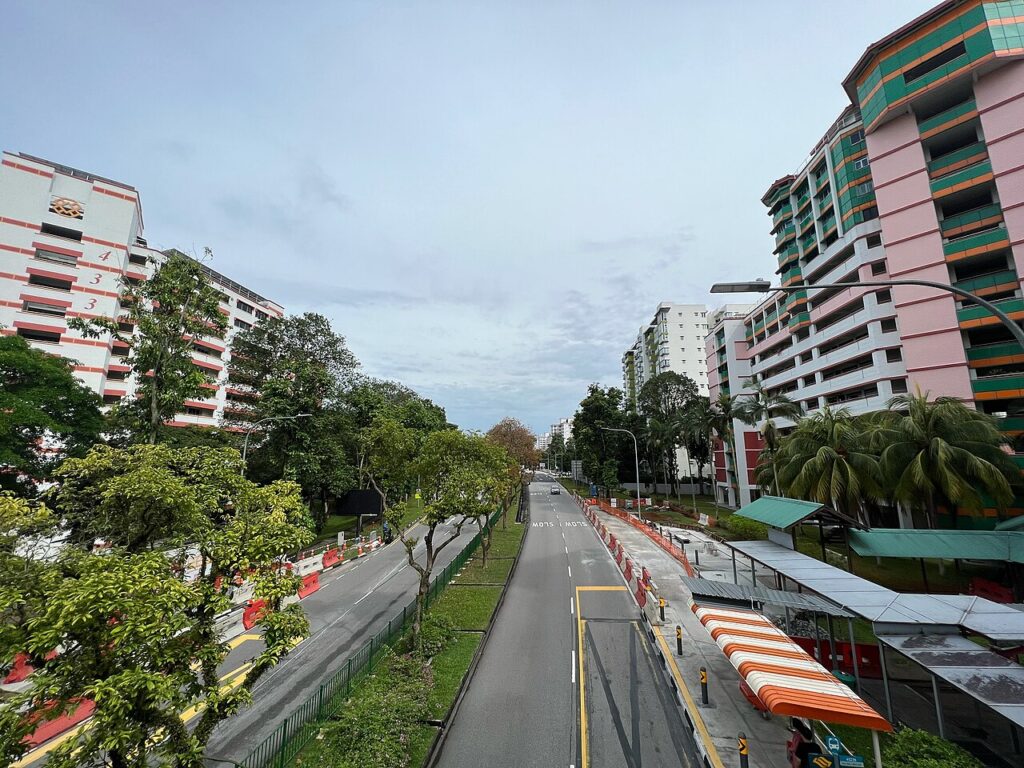
Archive photograph for context, not evidence of an individual property’s condition or an identified family transaction. Choa Chu Kang Way 2 (photographed 2022). Photo: Wzhkevin. Source · CC BY-SA 4.0. Image resized for this website.
