Singapore’s property market is governed by a web of borrowing rules designed to keep household debt manageable and the market stable. Two rules sit at the heart of every property loan application: the Total Debt Servicing Ratio (TDSR) and the Mortgage Servicing Ratio (MSR). Get either wrong and a bank will decline your mortgage , even if your income looks healthy on paper.
This guide explains what TDSR and MSR are, how they are calculated, and what they mean for your purchasing power in 2026. All figures use current MAS thresholds effective as at 26 July 2026.
⚡ Quick Answer: TDSR & MSR at a Glance
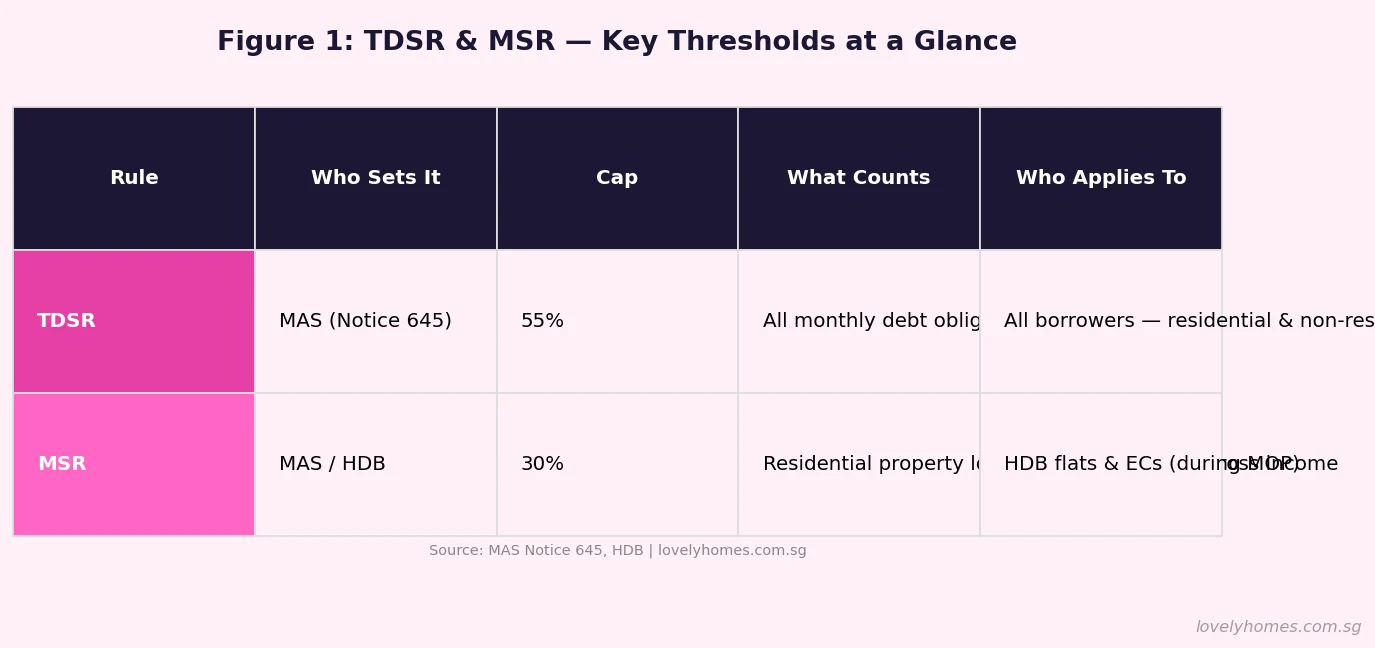
- TDSR cap: 55% , your total monthly debt repayments (all debts combined) cannot exceed 55% of gross monthly income. Applies to all property types and all borrowers.
- MSR cap: 30% , your property loan repayment alone cannot exceed 30% of gross monthly income. Applies only to HDB flat purchases and EC purchases within the Minimum Occupation Period (MOP).
- Both rules are set by the Monetary Authority of Singapore (MAS) under Notice 645, effective from 2013 and tightened in 2022.
- Banks apply a stress-test interest rate (floor of 4.00% for residential loans as of July 2026) , higher than the actual loan rate , to calculate the notional monthly repayment used in TDSR/MSR calculations.
- Credit card balances, car loans, student loans, and personal loans all count against your TDSR headroom , clear them before applying for a mortgage if possible.
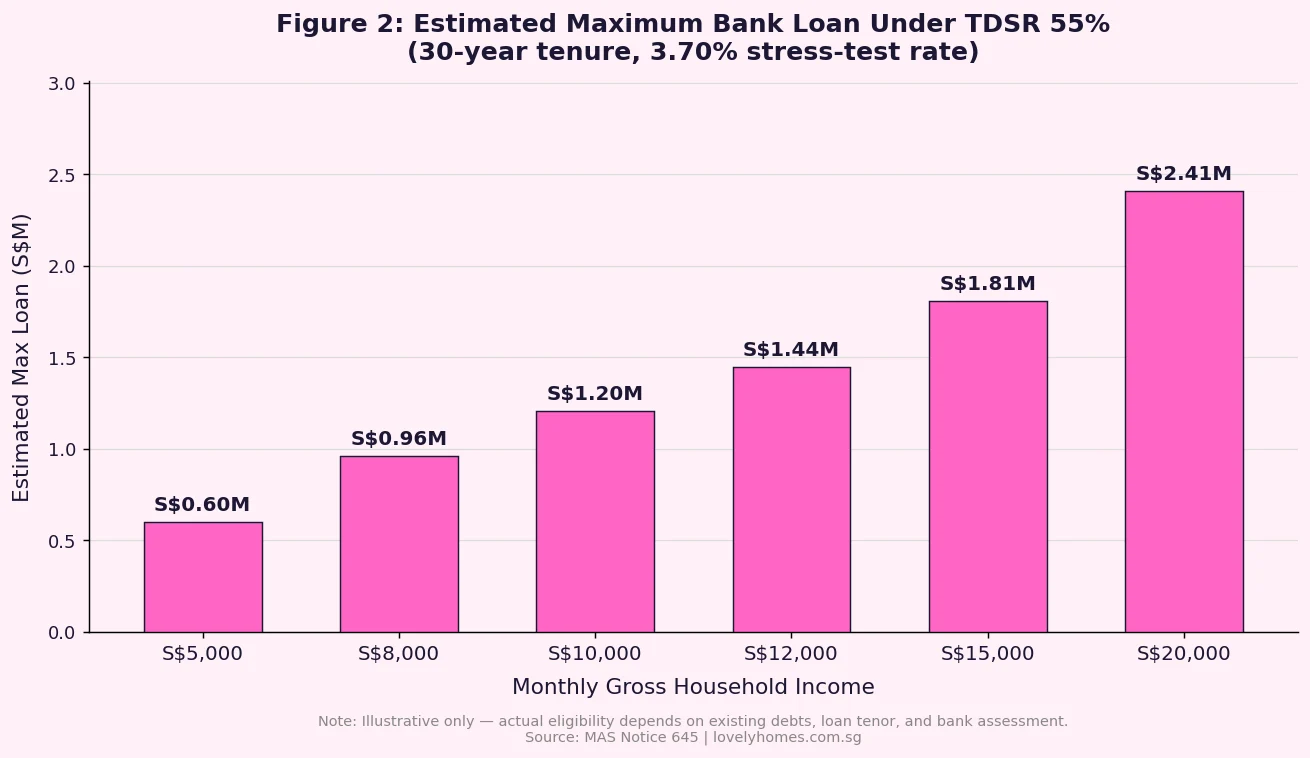
- A couple earning S$12,000 combined can borrow approximately S$1.21 million under TDSR (assuming no other debts and a 30-year loan tenure).
- The same couple buying an HDB flat or EC in MOP is further constrained to approximately S$787,000 under MSR.
What Is TDSR? The MAS Rule That Caps All Your Debt
The Total Debt Servicing Ratio was introduced by the Monetary Authority of Singapore on 29 June 2013 as part of a package of macro-prudential measures to prevent households from taking on unsustainable levels of debt. The cap was subsequently tightened from 60% to 55% on 30 September 2022, where it remains today.
The formula is straightforward:
TDSR = (Total Monthly Debt Obligations) ÷ (Gross Monthly Income) × 100%
A borrower’s TDSR must not exceed 55% for a bank to grant a property loan. “Total monthly debt obligations” means every credit facility currently being repaid: mortgages (including the new one being applied for), car loans, personal loans, student loans, and credit cards. For credit cards, MAS requires banks to count 5% of the outstanding balance as a monthly obligation, even if the borrower intends to pay it off in full.
“Gross monthly income” captures employment income, self-employment income, rental income (discounted to 70% of actual rental receipts), and investment income (also 70%). The MAS discount on variable income sources reflects the risk that they may not continue at their current level.
What Is MSR? The Tighter Rule for HDB and EC Buyers
The Mortgage Servicing Ratio applies only to two specific categories of property purchase: HDB flat purchases (both BTO and resale) and Executive Condominium purchases within the Minimum Occupation Period. It was introduced on 12 January 2013 and has been set at 30% since 10 December 2021 (reduced from 35% to align with the MAS stress-test revision at the time, and subsequently maintained).
The formula is:
MSR = (Monthly Property Loan Repayment) ÷ (Gross Monthly Income) × 100%
Note the difference from TDSR: MSR counts only the property loan repayment, not all other debts. However, a borrower must pass both TDSR and MSR. The binding constraint is usually TDSR for buyers with existing debts and MSR for first-time HDB/EC buyers with high loan-to-value needs.
Private condominiums, landed property, and commercial property purchases are not subject to MSR , only TDSR applies.
The Stress-Test Rate: Why Your Actual Loan Rate Does Not Drive the Calculation
A common misconception is that banks use your quoted loan interest rate (e.g. SORA + 0.80%) when computing TDSR and MSR. They do not. MAS requires banks to use a minimum floor interest rate for the stress-test calculation to ensure borrowers can still service their loan if rates rise.
As at July 2026, the MAS-prescribed minimum stress-test rate for residential property loans is 4.00% per annum. If the bank’s actual rate exceeds 4.00%, the higher rate is used. This stress-test floor has been adjusted over time: it was raised from 3.50% to 4.00% in the 30 September 2022 tightening round, reflecting the higher interest rate environment.
In practice: at a 4.00% stress rate over a 30-year loan tenure, the monthly repayment per S$100,000 borrowed is approximately S$477. This is the figure banks divide into your TDSR/MSR headroom to determine the maximum loan quantum.
How Banks Actually Compute Your TDSR Headroom
When you apply for a property loan, your bank collects payslips, CPF statements, and credit bureau reports. It then constructs your TDSR profile as follows:
- Calculate total gross monthly income , employment income from payslips (12-month average for variable-pay employees), 70% of rental income, 70% of investment income.
- Identify all existing monthly debt obligations , pull each from the CBS (Credit Bureau Singapore) report: loan repayments, car finance, 5% of credit card outstanding balances.
- Compute TDSR headroom , Income × 55% minus existing obligations = the maximum monthly repayment the new property loan can carry.
- Back-calculate the loan quantum , headroom ÷ stress-test rate factor × loan tenure factor = maximum loan principal.
- Apply MSR if applicable , for HDB/EC only: Income × 30% = MSR monthly ceiling; if this is lower than the TDSR headroom, the MSR figure is binding.
Self-employed applicants face additional scrutiny: income is assessed at the lower of the two most recent years of Notice of Assessment (NOA) from IRAS, and banks typically apply a further haircut of 10–20% for variable business income.
Summary of TDSR and MSR Rules (2026)
| Parameter | TDSR | MSR |
|---|---|---|
| Regulatory basis | MAS Notice 645 (2013, tightened Sep 2022) | MAS Notice 645 / HDB policy (2013) |
| Current cap | 55% of gross monthly income | 30% of gross monthly income |
| What is counted in numerator | All monthly debt obligations | Residential property loan repayment only |
| Property types subject to rule | All , residential and non-residential | HDB flats and ECs (within MOP) only |
| Stress-test rate (July 2026) | 4.00% floor (or actual if higher) | 4.00% floor (or actual if higher) |
| Credit card treatment | 5% of outstanding balance / month | N/A (not counted in MSR) |
| Rental income haircut | 70% of actual rental receipts | 70% of actual rental receipts |
| Exemption | Owner-occupier refinancing of pre-TDSR loan (bought before 29 Jun 2013) | None |
Worked Example: What TDSR and MSR Mean for a Singapore Couple in 2026
📈 The Scenario
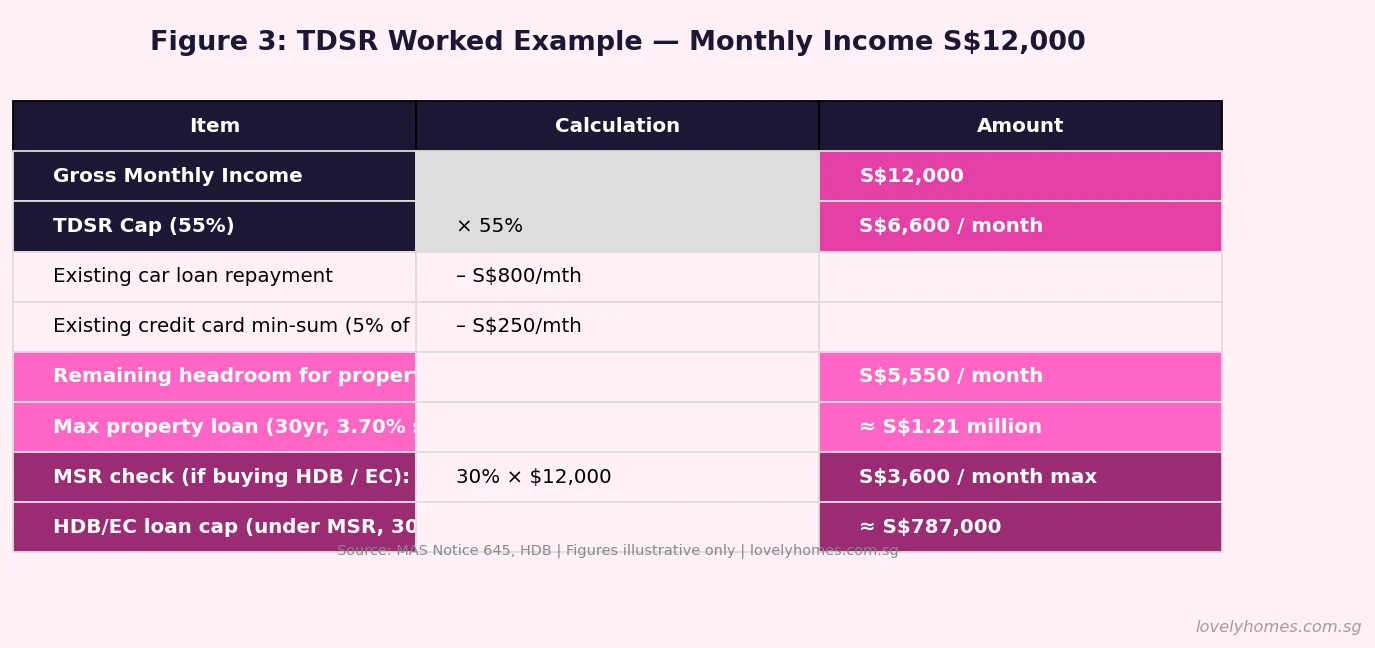
Lim and Wei Ling are first-time buyers. Combined gross monthly household income: S$12,000. Existing debts: one car loan at S$800/month; credit cards with S$5,000 outstanding (5% = S$250/month). They want to buy a 4-room HDB resale flat in Tampines.
Step 1 , TDSR headroom:
Income × 55% = S$12,000 × 55% = S$6,600/month
Less car loan: – S$800
Less credit card min-sum: – S$250
TDSR headroom for property loan: S$5,550/month
Step 2 , Loan quantum under TDSR:
At 4.00% stress rate over 30 years, monthly repayment per S$1,000 ≈ S$4.77
Max loan = S$5,550 ÷ S$4.77 × S$1,000 ≈ S$1,163,000
Step 3 , MSR check (HDB applies):
Income × 30% = S$12,000 × 30% = S$3,600/month
At 4.00% stress rate over 30 years: max loan = S$3,600 ÷ S$4.77 × S$1,000 ≈ S$754,000
Binding constraint: MSR at S$754,000 , significantly below the TDSR limit. The couple’s HDB loan is capped at approximately S$754,000 despite TDSR headroom of over S$1.1 million.
Practical implication: If the flat is priced at S$900,000 and they can pay a 25% down payment (S$225,000 in cash/CPF), they need a loan of S$675,000 , which fits within the MSR cap. If they can only afford a 10% down payment, the required loan of S$810,000 would exceed MSR and require a larger down payment or a lower-priced flat.
What This Means for Buyers in 2026
TDSR and MSR are deliberately conservative rules. Their purpose is macro-prudential: protecting individual households from over-leveraging and shielding the broader financial system from correlated defaults in a rising interest-rate environment. The stress-test floor of 4.00% means that even if you take out a loan at SORA + 0.80% today (effectively below 4.00%), your qualifying headroom is calculated at 4.00% , a built-in buffer of approximately 150–200 basis points above actual rates as of July 2026.
For buyers, this has three practical consequences. First, clearing existing debt before applying for a mortgage can meaningfully expand your loan quantum. A car loan costing S$800/month reduces your TDSR headroom by S$800 , equivalent to roughly S$168,000 less in loan capacity at a 30-year tenure. Second, increasing your down payment reduces the loan quantum needed and can be the difference between passing and failing MSR on a particular property. Third, extending loan tenure reduces the monthly repayment figure and increases the loan quantum available , but Singapore banks cap residential loan tenures at 30 years (25 years for HDB), and MAS levies an age cap: the loan term cannot extend the borrower’s age at maturity beyond 65 years for HDB loans and 75 years for bank loans.
Compared to peer markets, Singapore’s TDSR framework is broadly similar to Hong Kong’s debt-servicing ratio caps (60% for non-owner-occupiers) and slightly more conservative than Australia’s APRA-regulated assessment rate framework (which uses a 3.00% serviceability buffer above the bank rate). The MSR layer applied to HDB and EC purchases is unique to Singapore and reflects the government’s intent that subsidised public housing be accessible to genuine owner-occupiers rather than leveraged investors.
What Might Come Next
As of July 2026, there is no publicly signalled intention from MAS to adjust either the TDSR or MSR caps. The most recent tightening (September 2022) coincided with the global interest-rate cycle turning upward; with rates having stabilised at a higher plateau, MAS’s public communications have focused on monitoring rather than further immediate tightening.
That said, industry analysts have flagged several scenarios that could prompt MAS to revisit these thresholds. If private residential prices resume the rapid upward trend seen in 2021–2022 (the URA Q2 2026 data showed a modest +0.5% quarterly price increase), a further tightening of the stress-test rate or a reduction of the TDSR cap to 50% could be deployed without the bluntness of a stamp-duty increase. Conversely, if economic conditions soften materially, MAS has historically relaxed the stress-test floor , as it did briefly during COVID-19 in 2020 , to support affordability.
Buyers planning a purchase in the next 12–24 months should assume current TDSR/MSR rules remain intact and size their purchase accordingly. Working with a licensed mortgage broker or bank relationship manager to stress-test your own TDSR profile before committing to an option fee is strongly advisable.
Frequently Asked Questions: TDSR and MSR Singapore 2026
Does TDSR apply if I am buying a commercial property or industrial unit?
Yes , TDSR applies to all property purchases financed by a bank loan, whether residential, commercial, or industrial. There is no exemption for commercial buyers. MSR, however, applies only to residential property loan repayments for HDB and EC purchases; it does not apply to commercial or industrial property. This means commercial buyers face only the 55% TDSR cap, while HDB and EC buyers face both the 55% TDSR and the 30% MSR, with the lower of the two being binding.
My employer gives me a car allowance of S$1,500/month. Does this count as income for TDSR?
It depends on the nature of the allowance. Fixed monthly allowances that appear on your payslip and are not tied to claimable expenses are generally counted as part of gross income by banks. Variable allowances , particularly reimbursement-type claims , are typically excluded. You should check with your bank what they will accept, as they have discretion on variable income components within MAS’s framework. Bring your payslips, employment letter, and the most recent 12 months of CPF contributions to demonstrate the consistency of the allowance.
I have a student loan with S$40,000 outstanding. How does this affect my TDSR?
Student loans with a repayment schedule (monthly instalments) are counted in full in your TDSR calculation. If your monthly student loan repayment is S$600/month, that S$600 reduces your TDSR headroom by the same amount , equivalent to approximately S$126,000 less in mortgage borrowing capacity at a 30-year tenure and 4.00% stress rate. Many borrowers choose to settle or reduce student loans before applying for a property loan, or to refinance at a longer tenure to reduce the monthly obligation, before proceeding with a property purchase.
Can I use rental income from an existing property to boost my TDSR income figure?
Yes, but only at 70% of actual rental receipts. MAS requires a 30% haircut on rental income to account for vacancy risk, agent fees, and maintenance. You will need to produce a tenancy agreement and bank statements showing rental payments received. If the rental property itself has an outstanding mortgage, that monthly mortgage repayment is also counted as a debt obligation in your TDSR , so the net effect on your TDSR profile depends on the rental yield relative to the loan repayment on the rental property.
My spouse and I are buying a property jointly but our spouse has an existing property loan. How is TDSR calculated?
For joint borrowers, TDSR is calculated on the combined gross monthly income of all co-borrowers, and all debt obligations of all co-borrowers are aggregated. Your spouse’s existing mortgage repayment will therefore appear in the denominator of the TDSR calculation. This means joint applications effectively pool both income and debt, which may be advantageous (higher combined income) or disadvantageous (higher combined debt) depending on your individual financial profiles. If one co-borrower has significantly more debt than the other, consider whether a sole-name purchase (with the higher-income, lower-debt spouse as the sole borrower) might produce a better TDSR outcome.
If I refinance an existing property loan, does TDSR still apply?
Yes, for most refinancing transactions. The main exemption is for owner-occupiers refinancing a residential property loan originally taken out before 29 June 2013 (when TDSR was first introduced). Such borrowers can refinance at a bank’s prevailing rate without the TDSR calculation being applied, provided the property remains owner-occupied and the loan amount is not increased. For all other refinancing , including properties purchased after June 2013, investment properties, and any increase in loan quantum , full TDSR assessment is required.
Related Articles on LovelyHomes
- ABSD Singapore 2026: Complete Guide to Additional Buyer’s Stamp Duty
- Singapore Property Cooling Measures: Timeline 2009–2026
- BSD Singapore 2026: Complete Guide to Buyer’s Stamp Duty
- Home Equity Loan Singapore 2026: HEL, HLOA & Borrowing Guide
- CPF Housing Grants Singapore 2026: EHG, PHG & Full Guide
- Seller’s Stamp Duty Singapore 2026: Rates, Rules & Guide
Supporting graphics
Original article illustrations are available below.
- Figure 1: TDSR vs MSR , who sets each rule, the cap, what income counts, and who it applies to. Source: MAS Notice 645, HDB.
- Figure 2: Estimated maximum bank loan under TDSR 55% for different income levels, assuming a 30-year tenure at the 4.00% stress-test floor and no existing debts. Source: MAS Notice 645.
- Figure 3: Step-by-step TDSR and MSR calculation for a S$12,000/month household , showing how existing debts reduce headroom and how MSR creates the binding constraint for HDB buyers. Source: MAS Notice 645.