Quick Answer: What Happened at High Point
- High Point, a 59-unit freehold condominium at 30 Mount Elizabeth in District 9, has been relaunched for collective sale at a guide price of S$580 million.
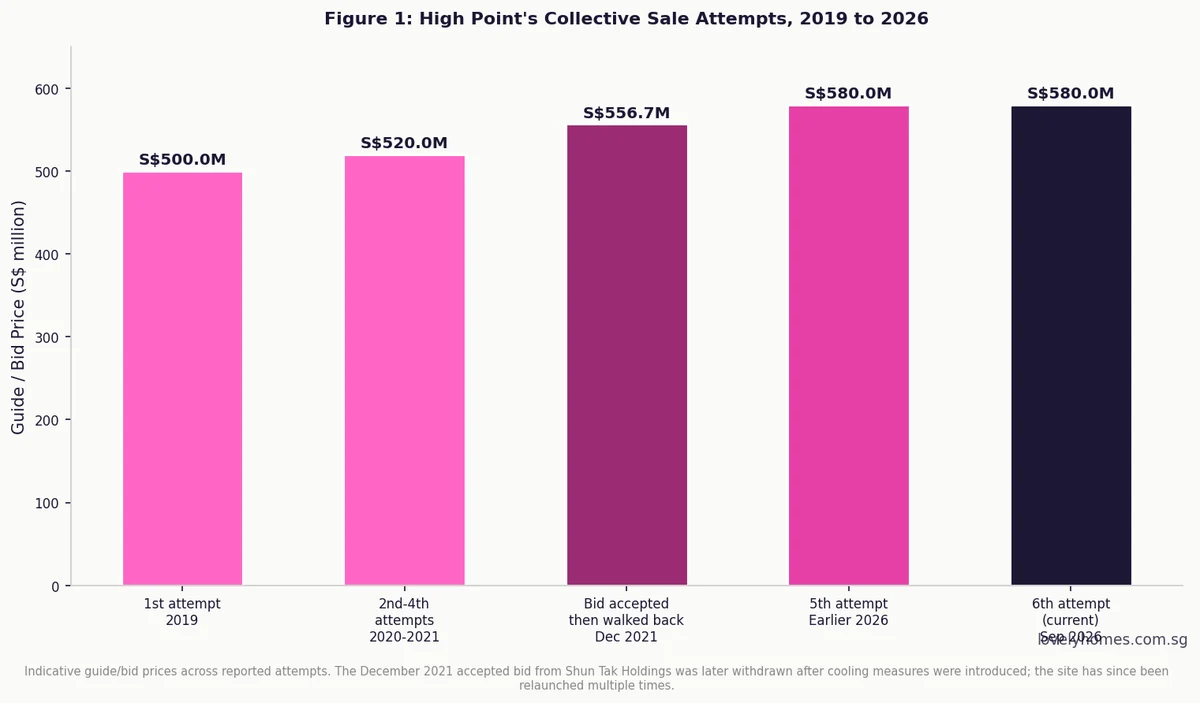
- This is the site’s sixth collective sale attempt since it first tried to go en bloc in 2019.
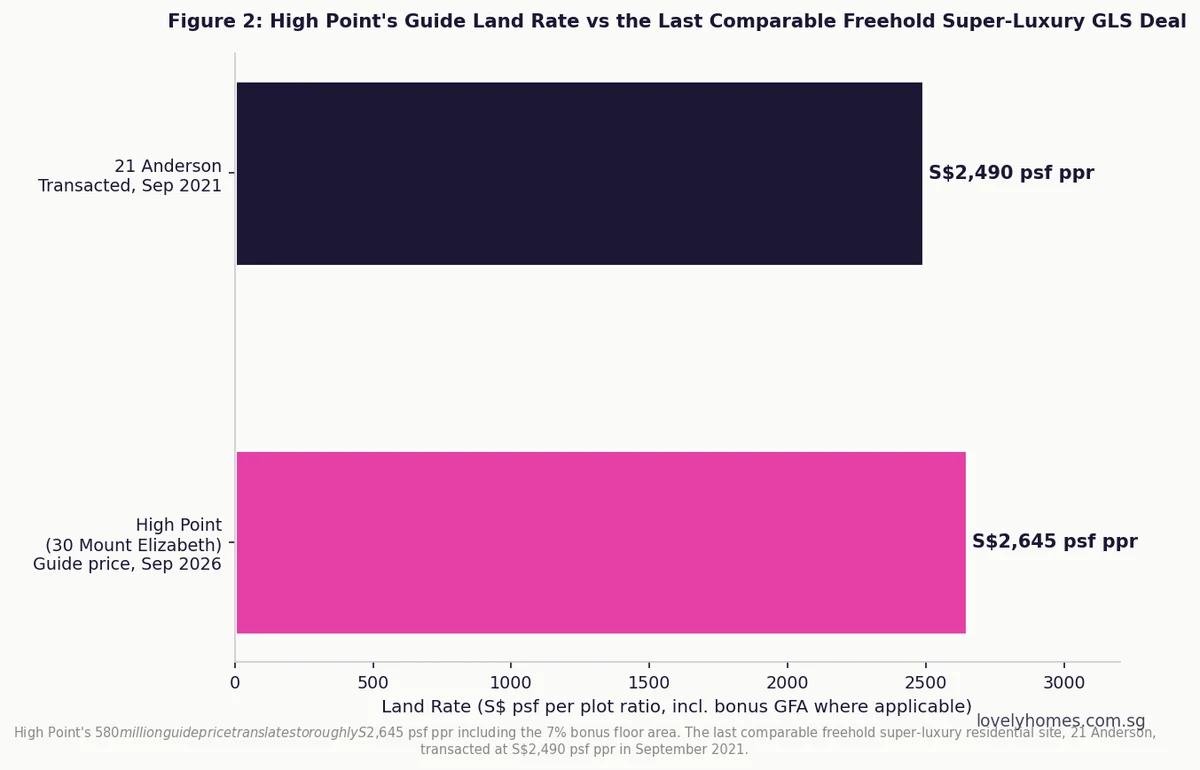
- The guide price works out to roughly S$2,645 psf per plot ratio (ppr), including a 7% bonus floor area allowance.
- The plot spans about 47,607 sq ft, is zoned residential, and carries a height control of up to 36 storeys with a baseline plot ratio of 4.45.
- No land betterment charge applies to redevelopment at the baseline plot ratio.
- The most notable prior attempt was in December 2021, when a S$556.7 million winning bid was later withdrawn after the Government introduced fresh cooling measures.
- High Point sits within a five-minute drive of Orchard Road and within 1km of Anglo-Chinese School (Junior).
High Point, a low-rise freehold condominium perched on an elevated site at 30 Mount Elizabeth, is back on the market for collective sale, marking the development’s sixth attempt at a deal since 2019. The relaunch was announced on 3 September 2026 at a guide price of S$580 million, matching the guide price of the fifth attempt earlier this year, which lapsed without a successful sale.
The 59-unit development occupies a plot of roughly 47,607 sq ft in one of Singapore’s most tightly held freehold enclaves. For a market that has watched Orchard Road’s supply of large freehold sites shrink year after year, High Point’s repeated relaunches are as much a story about land scarcity as they are about one building’s difficulty finding a buyer.
Why High Point Keeps Coming Back to Market
Collective sales in Singapore require the consent of owners holding at least 80% of share value and 80% of total floor area (for developments over 10 years old), then a Strata Titles Board or High Court order if any minority owners object. Getting there is rarely straightforward, and High Point’s history illustrates just how long an en bloc process can drag on even at a well-located, freehold site.
The clearest example was December 2021, when a bid from Hong Kong-listed developer Shun Tak Holdings at S$556.7 million was accepted, only for the developer to walk away after the Government’s cooling measures package that month raised Additional Buyer’s Stamp Duty (ABSD) rates and tightened Total Debt Servicing Ratio (TDSR) settings, reshaping developers’ feasibility studies overnight. That collapse set the tone for a run of attempts since then that have started, stalled, and restarted as guide prices and market appetite shifted.
The Numbers Behind the S$580 Million Guide Price
At S$580 million, the guide price for the current tender translates to about S$2,645 psf ppr, a figure that already accounts for the 7% bonus gross floor area typically available for developments that meet certain design and sustainability criteria. That land rate sits meaningfully above the S$2,490 psf ppr paid for 21 Anderson, a nearby freehold super-luxury site that Kheng Leong Co bought in September 2021, which remains the last comparable freehold transaction of its kind in the Orchard and Mount Elizabeth area.
| Detail | Figure |
|---|---|
| Address | 30 Mount Elizabeth, District 9 |
| Tenure | Freehold |
| Existing units | 59 |
| Site area | Approximately 47,607 sq ft |
| Guide price | S$580 million |
| Implied land rate | Approximately S$2,645 psf ppr (incl. 7% bonus GFA) |
| Baseline plot ratio | 4.45 |
| Height control | Up to 36 storeys |
| Collective sale attempt number | Sixth, since 2019 |
Worked Example: What an En Bloc Payout Could Mean for an Owner
To make the numbers concrete, consider an illustrative High Point owner holding a 1,800 sq ft unit. If the collective sale proceeds at the S$580 million guide price and legal, agent and other transaction costs come to roughly 3% of the gross sale price, a rough share-value-weighted allocation could look like this for a unit representing about 1.5% of total share value:
- Gross sale price: S$580,000,000
- Less illustrative transaction costs (approximately 3%): S$17,400,000
- Net proceeds for distribution: S$562,600,000
- Illustrative 1.5% share value allocation: S$8,439,000 (before the owner’s own outstanding mortgage, CPF refund with accrued interest, and any applicable Seller’s Stamp Duty are deducted)
This is illustrative only. Actual payouts in a real collective sale are determined by each owner’s share value as fixed at the time consent is sought, not simply by floor area, and every owner’s net proceeds will differ once their own mortgage, CPF refund obligation and tax position are taken into account.
Why This Matters
For the broader market, High Point’s relaunch is a signal that appetite for prime freehold land has not disappeared, even after a run of failed and withdrawn bids going back to 2021. Developers weighing a bid have to underwrite not just the land cost but also construction cost inflation, financing costs at prevailing interest rates, and the risk that further cooling measures could be introduced before a new development is completed and sold. The gap between High Point’s guide land rate and the last comparable transacted rate at 21 Anderson, roughly S$155 psf ppr, suggests sellers are pricing in some of that risk premium already, even as they hold firm on price after five earlier attempts.
For existing owners, a sixth relaunch after a string of earlier attempts, including one accepted bid that later fell through, underscores how uncertain the collective sale process can be even at a desirable, well-located site. Owners weighing whether to consent again have to balance the prospect of a substantial payout against the real possibility that this attempt, like the ones before it, does not conclude in a sale.
What Might Come Next
This section is forward-looking and speculative. If the tender proceeds without a further round of cooling measures, a sale at or near the S$580 million guide price would make High Point one of the largest freehold residential land deals in the Orchard planning area in recent years, and would likely be watched closely by owners of other ageing freehold developments nearby considering their own collective sale prospects. If the tender lapses again, as the fifth attempt did, it would reinforce a pattern in which guide prices for prime freehold sites have stayed persistently above what developers are currently willing to pay, a gap that may only close if construction costs ease, financing costs fall, or sellers adjust their price expectations in a future relaunch.
Frequently Asked Questions
What is a collective sale (en bloc sale)?
A collective sale, commonly called an en bloc sale, is the sale of an entire strata-titled development, such as a condominium, to a single buyer, usually a developer, with the consent of a qualifying majority of owners under the Land Titles (Strata) Act. For a development more than 10 years old, owners holding at least 80% of both share value and total floor area must consent; for developments 10 years old or younger, the threshold rises to 90%.
Why has High Point failed to sell en bloc five times before?
Publicly reported history shows High Point has attempted a collective sale multiple times since 2019, including a December 2021 attempt where an accepted bid of S$556.7 million from Shun Tak Holdings was later withdrawn after the Government introduced cooling measures that month, which changed the financial feasibility of the deal for the developer. Subsequent attempts, including one earlier in 2026 at the current S$580 million guide price, have lapsed without a sale, most likely reflecting a gap between what owners are willing to accept and what developers are willing to pay given construction and financing costs.
What does “psf ppr” mean and why does it matter?
Psf ppr stands for price per square foot of plot ratio, a standard way of expressing land value in Singapore that accounts for how much gross floor area can be built on a site, not just its physical land area. It allows sites of different sizes and planned densities to be compared on a like-for-like basis, and is the key metric developers use when deciding whether a site is worth bidding on.
How is money divided among owners in a collective sale?
Sale proceeds are distributed according to each unit’s share value, a figure fixed by the Singapore Land Authority and printed on the strata title, not simply by floor area. Each owner’s net proceeds are further reduced by their own outstanding mortgage balance, any required CPF refund with accrued interest, applicable Seller’s Stamp Duty if the unit was bought within the SSD holding period, and a pro-rated share of the collective sale’s legal and marketing costs.
Could new cooling measures affect this tender?
Any future cooling measures affecting ABSD, TDSR or other settings could change a developer’s feasibility calculations the same way the December 2021 package did for High Point’s earlier accepted bid. This is a live risk for any long-running collective sale process, though it is not possible to predict whether or when further measures might be introduced.
What happens if this sixth attempt also fails?
If the tender lapses without a qualifying bid, the collective sale committee and owners would typically review the guide price, extend or relaunch the tender, or pause the process entirely to reassess timing. High Point’s history shows owners have been willing to keep trying across multiple market cycles rather than abandon the process outright.
Related Articles on LovelyHomes
- Gilstead Court En Bloc 2026: Novena Freehold Site’s Fourth Collective Sale Bid at S$198 Million
- Ex-HUDC Estates in Singapore 2026: History, Privatisation and What Buyers Should Know Before an En Bloc Windfall
- SERS Guide Singapore 2026: Selective En Bloc Redevelopment Scheme, Compensation and Replacement Flats
- Singapore GLS Programme Guide 2026
- Singapore Property Cooling Measures: Timeline 2009-2026
- ABSD Singapore 2026: Complete Guide to Additional Buyer’s Stamp Duty
Supporting graphics
Original article illustrations are available below.