Quick Answer: What Are Ex-HUDC Estates?
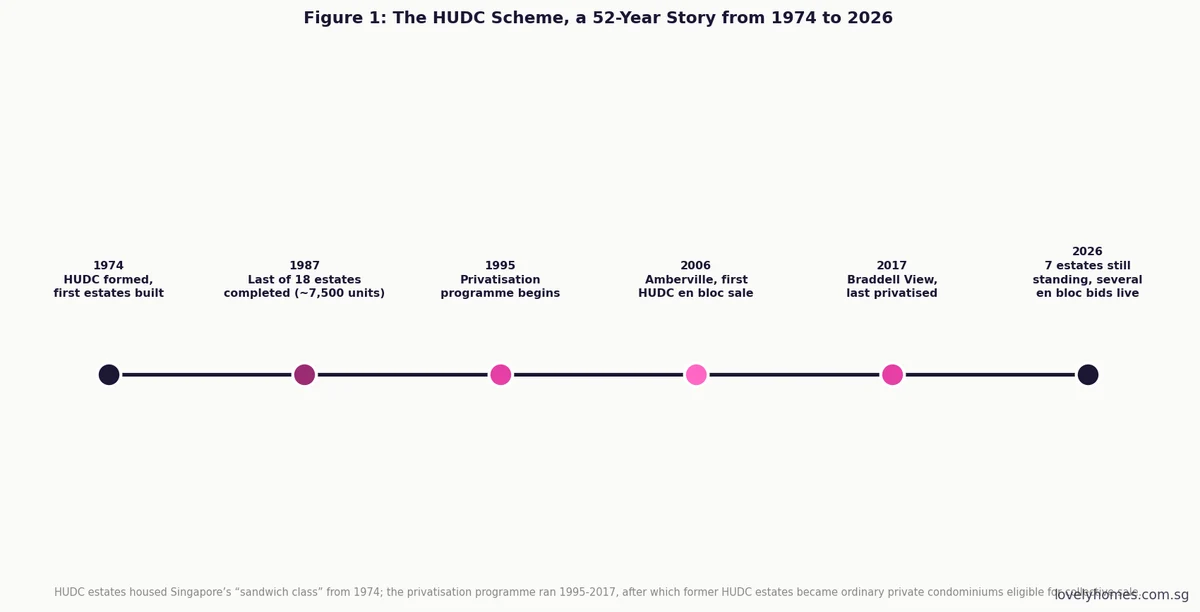
- The Housing & Urban Development Company (HUDC) built 18 estates, roughly 7,500 units, between 1974 and 1987 for Singapore’s “sandwich class”: households earning too much for HDB but not yet ready for private property.
- The Government’s HUDC privatisation programme ran from 1995 to 2017, converting estates to full private condominium status under a Management Corporation. Braddell View was the last, privatised on 17 March 2017.
- Once privatised, an ex-HUDC estate is legally an ordinary private condominium: no HDB-style Minimum Occupation Period, and open to Singapore Citizens, PRs and, subject to prevailing ABSD, foreigners alike.
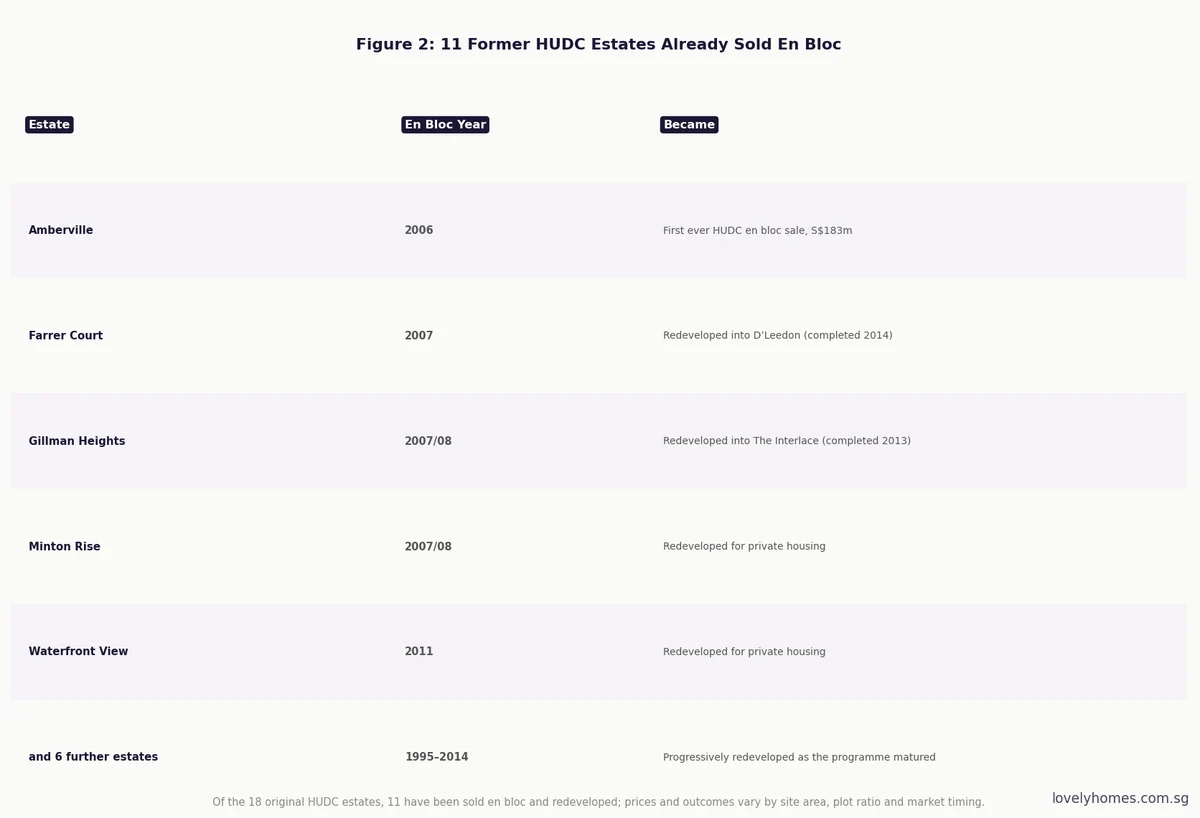
- 11 of the 18 original estates have already been sold en bloc and redeveloped, starting with Amberville in 2006 (S$183 million, the first HUDC estate ever to go en bloc).
- Well-known redevelopments include Farrer Court, sold en bloc in 2007 and reborn as D’Leedon, and Gillman Heights, redeveloped into The Interlace.
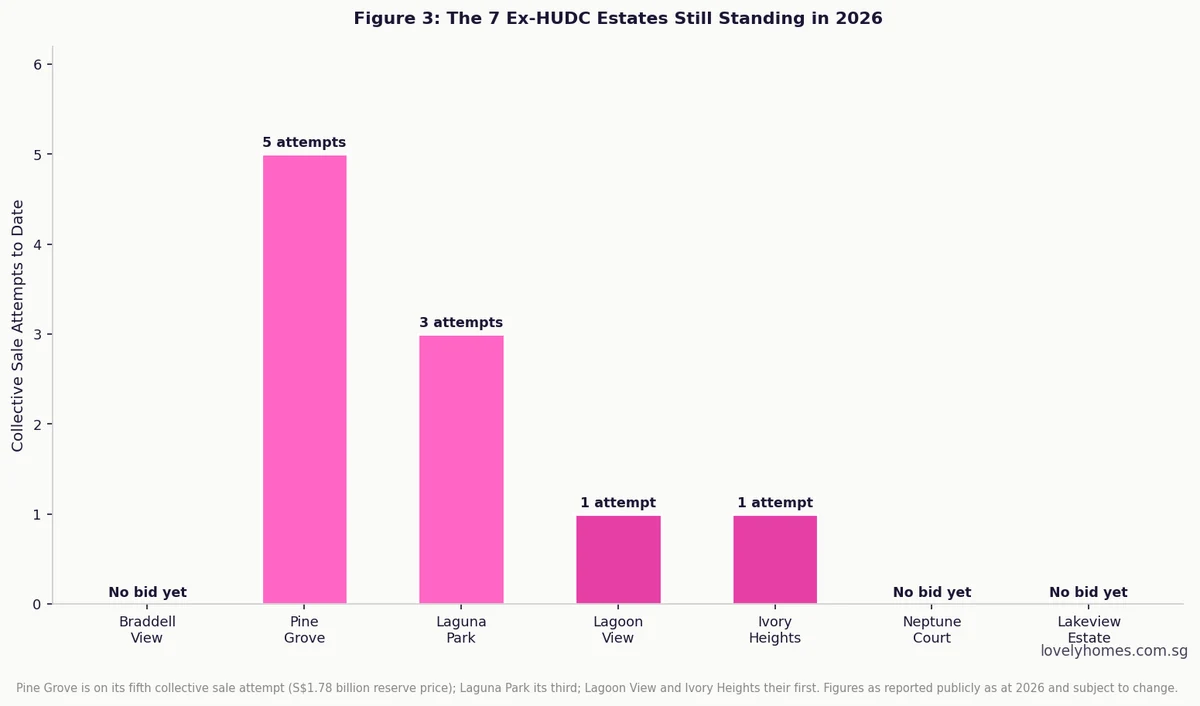
- 7 estates remain unsold as at 2026: Braddell View, Pine Grove, Ivory Heights, Neptune Court, Lakeview Estate, Laguna Park and Lagoon View.
- Several are actively chasing a collective sale in 2026: Pine Grove is on its fifth attempt (S$1.78 billion reserve price), Laguna Park its third, and Lagoon View and Ivory Heights their first.
- Buying an ex-HUDC unit today means buying into a mature, typically well-located 99-year leasehold estate with genuine (though never guaranteed) en bloc upside, alongside the ordinary risks of an ageing building and a lease that is already decades into its term.
Long before “en bloc fever” became a fixture of Singapore property talk, the Housing & Urban Development Company (HUDC) was quietly solving a very specific housing problem: what to do with families who earned too much to qualify for an HDB flat but were not yet ready, financially or otherwise, to buy private property. Half a century later, the 18 estates HUDC built have become some of the most closely watched sites in Singapore’s property market, not for how people live in them today, but for what they might be worth if their owners agree to sell. This guide explains where ex-HUDC estates came from, how the privatisation programme actually worked, which estates have already cashed out, and what buying into one of the seven still standing in 2026 really involves.
What Was HUDC and Why Did Singapore Build These Estates?
The Housing & Urban Development Company was set up as a subsidiary of the Housing & Development Board (HDB) in the 1970s specifically to serve middle-income Singaporeans caught in a housing gap: their income disqualified them from a new HDB flat, but private condominiums of the era were still out of reach or considered an unnecessary luxury for a public-minded government keen to keep this “sandwich class” within the public housing fold. Between 1974 and 1987, HUDC built 18 estates comprising roughly 7,500 units across locations including Braddell, Ghim Moh (Pine Grove), Marine Parade (Laguna Park and Lagoon View) and elsewhere. These estates were built to a noticeably higher specification than standard HDB flats of the time, larger units, more greenery, swimming pools and tennis courts in several cases, while remaining part of the public housing system, with resale and ownership restrictions similar to HDB flats of that era.
From HUDC Flats to Private Condos: How Privatisation Worked (1995-2017)
As Singapore’s private property market matured and the original rationale for a subsidised “sandwich class” tier faded, the Government began privatising HUDC estates from 1995, a process that converted each estate’s management from an HDB-style town council arrangement to a proper Management Corporation Strata Title (MCST) and removed the HDB-era ownership restrictions. Privatisation had to be agreed to by residents estate by estate, and it took more than two decades to work through all 18 sites; the process for Braddell View, the largest of the 18 estates at 918 flats and two shops across two separate state land leases with different expiry dates, was especially drawn out, and it was not until 17 March 2017 that Braddell View’s privatisation was completed, formally closing the HUDC privatisation programme that had begun 43 years earlier in 1974.
Privatisation itself does not force a sale. What it does is convert the estate into an ordinary private condominium in the eyes of the law, which means, among other things, that the estate becomes eligible for a collective (en bloc) sale under the Land Titles (Strata) Act on the same basis as any other private condominium, typically requiring at least 80% consent by share value and by strata area for estates over 10 years old. This single change in legal status is precisely why every one of the estates now attempting a collective sale could not have done so while still under the original HUDC housing scheme.
The 11 Estates That Already Went En Bloc
Of the 18 original HUDC estates, 11 have already been sold en bloc and redeveloped into new private housing. Amberville made history in 2006 as the very first HUDC estate to be sold collectively, fetching S$183 million and netting each homeowner roughly S$1.089 million, a striking sum at the time for owners of what had originally been subsidised public housing. The pattern repeated at larger scale in the years that followed: Farrer Court was sold en bloc in 2007 and eventually reborn as D’Leedon, completed in 2014, while Gillman Heights, sold around the same period, was redeveloped into the architecturally distinctive The Interlace, completed in 2013. Minton Rise and Waterfront View Estate followed a similar trajectory, along with several further estates redeveloped as the privatisation programme matured through to 2014.
The 7 Estates Still Standing in 2026
Seven ex-HUDC estates remain as private condominiums that have never successfully completed a collective sale: Braddell View, Pine Grove, Ivory Heights, Neptune Court, Lakeview Estate, Laguna Park and Lagoon View. Several of these are actively in the middle of a fresh attempt as at 2026. Pine Grove, a large 660-unit estate in Ghim Moh whose two adjoining Government Land Sales parcels have already been redeveloped into Pinetree Hill and a further Sinarmas Land-MCL Land project, is on its fifth collective sale attempt since 2008, most recently at a reduced reserve price of around S$1.78 billion after a fourth attempt at S$1.95 billion closed in late 2023 without any bids. Laguna Park, a 506-unit estate at Marine Parade comprising seven residential blocks plus penthouses and commercial units, is on its third attempt, most recently marketed at around S$1.48 billion. Lagoon View, a 480-unit estate originally built in 1977 to house Singapore Armed Forces personnel and their families before later privatisation, and Ivory Heights are both pursuing their first collective sale attempts.
What Buying an Ex-HUDC Unit Actually Means Today
For a buyer in 2026, an ex-HUDC unit is, legally, simply a private condominium unit on typically 99-year leasehold state land, subject to exactly the same eligibility, financing and stamp duty rules as any other private condo of similar tenure and no different from buying into any older strata estate. There is no HDB-style Minimum Occupation Period, no citizenship restriction beyond the ordinary Additional Buyer’s Stamp Duty schedule that applies to all foreign and entity buyers, and no special approval process. What genuinely differs is the character of the estate itself: most were designed with generous grounds, mature landscaping and lower plot ratios than a typical modern condo, which is precisely why several sit on land parcels attractive enough to interest developers for redevelopment at a much higher density. Buyers should also expect the ordinary trade-offs of an older building, ageing mechanical and electrical systems, dated facilities, and a lease that, having started decades ago, has fewer years remaining than a newly launched project, which can affect financing (banks may restrict loan tenure once the remaining lease falls below certain thresholds) and eventual resale.
Summary: Ex-HUDC Facts at a Glance
| Question | Short Answer |
|---|---|
| How many HUDC estates were built, and when? | 18 estates, around 7,500 units, built 1974-1987. |
| When did privatisation start and end? | Started 1995, closed 17 March 2017 with Braddell View. |
| How many estates have been sold en bloc? | 11 of 18, starting with Amberville in 2006. |
| Which 7 estates remain unsold in 2026? | Braddell View, Pine Grove, Ivory Heights, Neptune Court, Lakeview Estate, Laguna Park, Lagoon View. |
| Is an ex-HUDC unit still subject to HDB rules? | No, once privatised it is an ordinary private condominium. |
| Is an en bloc sale guaranteed? | No. Pine Grove has tried and failed five times since 2008. |
Worked Example: What a Laguna Park Owner Might Actually Receive
The scenario: Laguna Park’s third collective sale attempt was marketed at a reserve price of around S$1.48 billion, across 506 apartment units, 10 penthouses and 12 commercial units (roughly 516 residential units).
The illustrative maths: Dividing the total quantum across the 516 residential units alone gives an average gross payout of roughly S$2.87 million per unit before any allocation adjustment. In practice, no two owners receive exactly the average: the collective sale committee’s approved distribution formula weights each owner’s share by original share value and floor area, so an owner of a larger unit or a higher floor typically receives proportionately more than an owner of a smaller, lower-floor unit, and the 12 commercial units are valued separately again.
What owners must still deduct: From that gross figure, an owner must still settle any outstanding mortgage, refund CPF principal and accrued interest used for the purchase, and pay the Seller’s Stamp Duty if the sale falls within the holding period (rarely relevant for decades-old HUDC purchases), before arriving at true net cash proceeds.
These figures are illustrative only, based on the publicly reported reserve price and unit count for one collective sale attempt; actual sale prices, allocation formulas and outcomes vary by estate and by attempt, and a sale is not final until contracts are signed and any legal objections are resolved.
Why This Matters for Buyers and Investors
Ex-HUDC estates occupy an unusual niche in the Singapore market: they combine the space, greenery and lower density of an older estate with a genuine, if unpredictable, redevelopment story that ordinary resale condos rarely offer. For an owner-occupier, the calculus should start with whether the unit works as a home today, given its age, layout and remaining lease, with any eventual en bloc payout treated as a bonus rather than a certainty. For an investor specifically buying in hope of a collective sale, the more instructive lesson is Pine Grove’s five attempts since 2008: consensus among hundreds of individual owners on price and timing is genuinely difficult to achieve, and an estate can sit in limbo for years, or indefinitely, between attempts. Buyers should also budget for the practical realities of an older strata estate: higher maintenance fees relative to unit size, ageing common facilities, and financing terms that may be more conservative once the remaining lease shortens further.
What Might Come Next
The following is informed speculation, not confirmed outcome. Given that Pine Grove, Laguna Park, Lagoon View and Ivory Heights all have live or recent collective sale processes as at 2026, it is plausible that at least one of these estates could achieve the required consensus and complete a sale within the next few years, particularly if reserve prices continue to be adjusted downward to meet market appetite, as Pine Grove has already done. It is equally plausible that some estates, Neptune Court and Lakeview Estate among them, could remain unsold for a considerably longer period if owners cannot agree on price, or if broader market conditions make developers cautious about large land parcels. No outcome is confirmed until a sale is actually completed and lodged.
Frequently Asked Questions
Can foreigners buy a unit in an ex-HUDC estate?
Yes. Once privatised, an ex-HUDC estate is an ordinary private condominium, so Singapore Citizens, PRs and foreigners may all purchase, subject to the Additional Buyer’s Stamp Duty rates applicable to the buyer’s residency status.
Is there a Minimum Occupation Period for ex-HUDC units?
No. The Minimum Occupation Period is an HDB flat rule. Once an HUDC estate is privatised, it is treated as private property and carries no MOP.
Why did it take so long to privatise all 18 estates?
Each estate had to secure resident consent and complete its own administrative process, and some sites, such as Braddell View with its two separate state land leases, involved additional legal complexity that extended the timeline.
Does privatisation guarantee an en bloc sale will eventually happen?
No. Privatisation only makes an estate legally eligible to attempt a collective sale. Pine Grove, for example, has attempted a collective sale five times since 2008 without success until its most recent bid.
What consent threshold is needed for a collective sale?
Under the Land Titles (Strata) Act, estates over 10 years old generally need at least 80% consent by both share value and strata floor area to proceed with a collective sale application.
Are ex-HUDC estates freehold or leasehold?
Typically 99-year leasehold on state land, the same tenure structure as most HDB and many private condominium sites, though buyers should verify the specific remaining lease for any estate they are considering.
Which ex-HUDC redevelopment is best known today?
D’Leedon (formerly Farrer Court) and The Interlace (formerly Gillman Heights) are among the most recognisable redevelopments of former HUDC land.
Related Articles on LovelyHomes
- En-Bloc Sale Process Singapore 2026: A Homeowner’s Step-by-Step Guide
- Singapore Property Auction & Mortgagee Sale Guide 2026: How Bank Repossession Sales Really Work
- Singapore Leasehold vs Freehold Guide 2026: What Every Buyer Needs to Know
- Condominium Maintenance Fees & MCST Guide Singapore 2026
- Singapore Property Investment Strategy 2026: Rental Yields, Capital Gains and Net Returns
- Singapore Property Market Outlook 2027
Supporting graphics
Original article illustrations are available below.