⚡ Quick Answer: Marina Bay Neighbourhood Guide Singapore 2026
- District: D01 (Core Central Region, CCR) , Singapore’s premier waterfront financial and residential district.
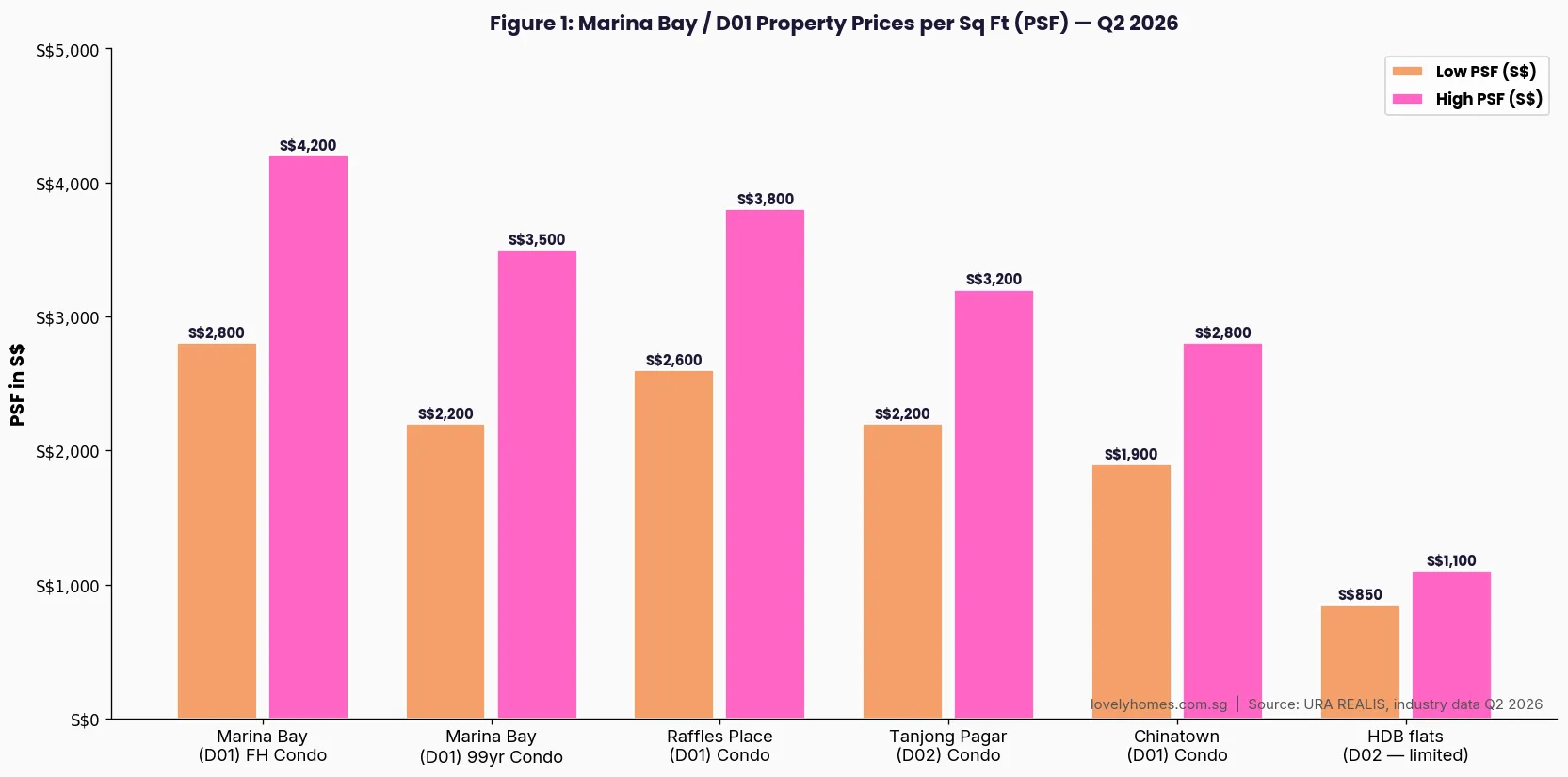
- Condo PSF range: S$2,800–S$4,200 PSF for freehold units; S$2,200–S$3,500 PSF for 99-year leasehold condos. Among the highest in Singapore.
- MRT access: Served by three MRT lines , Circle Line (CCL: Bayfront, Promenade, Marina Bay stations), East-West Line (EWL: Raffles Place), and Thomson–East Coast Line (TEL: Marina Bay station).
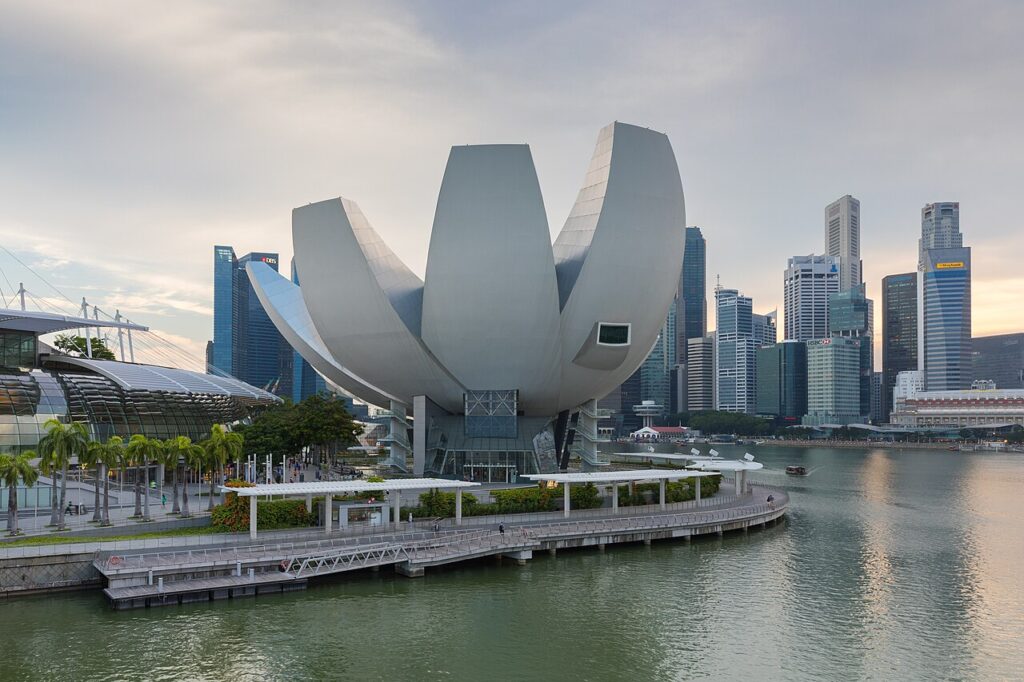
- Key attractions: Marina Bay Sands, Gardens by the Bay, Marina Bay Financial Centre (MBFC), ArtScience Museum, Merlion Park, Esplanade.
- Property types available: Luxury condominiums, Grade A office space, high-end serviced residences. No HDB flats within the core Marina Bay precinct; limited D02 HDB stock exists at Tanjong Pagar fringe.
- New residential supply: Very limited , no major GLS residential sites released within the core Marina Bay waterfront since the early 2020s. Supply scarcity is a structural feature.
- Rental yield: 3.0%–4.0% gross for residential; higher for serviced residences targeting expatriate tenants.
- Major upcoming catalyst: Greater Southern Waterfront (GSW) , the 2,000-hectare master plan connecting Marina Bay to Pasir Panjang, representing a multi-decade transformation of Singapore’s southern coastline.
Marina Bay: Singapore’s Financial and Leisure Waterfront District
Marina Bay sits at the very heart of Singapore’s urban geography , literally so, as the bay itself is bounded by the Central Business District (CBD) on the west and north, the Marina Bay Sands integrated resort and Gardens by the Bay on the south and east, and the Esplanade arts precinct to the north-west. Administratively, the core precinct falls within District 01 (D01) of Singapore’s property map, which is part of the Core Central Region (CCR). Postal districts D01 and D02 together encompass the areas from Anson Road and Cecil Street northward to the Singapore River and Esplanade foreshore.
For property buyers and investors, Marina Bay represents Singapore’s aspirational ceiling. It is where the city-state presents itself to the world through its most iconic skyline , the triple towers of Marina Bay Sands, the supertrees of Gardens by the Bay, and the gleaming facades of Marina Bay Financial Centre. Residential property within walking distance of this precinct commands a persistent premium over the broader CCR, driven by the area’s ultra-low supply, strong expatriate rental demand, and its status as an address of unambiguous prestige.
Property Landscape: What Can You Buy in Marina Bay?
Marina Bay is primarily a commercial and hospitality district. Residential options are concentrated in a handful of high-end condominium developments along the waterfront and in the adjacent Raffles Place–Cecil Street corridor. Notable residential projects in D01 include The Sail @ Marina Bay, Marina Bay Residences, V on Shenton, and Icon (in the Tanjong Pagar fringe of D02). These are a mix of 99-year leasehold and freehold developments built predominantly between 2008 and 2015, reflecting the URA’s early-2000s vision to inject residential life into the CBD.
Freehold condominiums in D01 typically trade at a significant premium to 99-year leasehold equivalents , a PSF difference of S$400–S$700 is common, reflecting the long-term land value retention of perpetual ownership. Strata office units within Marina Bay Financial Centre and One Raffles Quay are also available on the open market, offering investors exposure to Grade A CBD commercial property. However, residential buyers should note that Marina Bay’s residential stock is relatively small , a few thousand units in total across all projects , which contributes directly to price resilience: in periods of broadly softening market conditions, D01 waterfront units tend to hold value better than most.
There are no new HDB flats in the core Marina Bay precinct. The nearest HDB estates are at Tanjong Pagar (D02) and across the Singapore River at Chinatown (D01 fringe), where older HDB blocks exist but represent a very different value proposition from the waterfront condominiums.
MRT Connectivity: Three Lines, Maximum Accessibility
Few locations in Singapore offer the MRT connectivity of Marina Bay. The district is served by three separate MRT lines at multiple stations:
- Circle Line (CCL): Bayfront (interchange with DTL), Promenade (interchange with DTL), and Marina Bay stations. The CCL forms an orbital ring that connects directly to Harbour Front, Dhoby Ghaut, and Serangoon without requiring interchange at City Hall.
- East-West Line (EWL): Raffles Place station, which also provides direct access to Tanjong Pagar. The EWL runs east to Changi Airport and west to Jurong.
- Thomson–East Coast Line (TEL): Marina Bay station opened as part of TEL Stage 3. The TEL connects directly north to Orchard, Newton, and eventually Woodlands, and south to Shenton Way, Marina South Pier, and through to the East Coast districts (Stages 4 and 5).
This triple-line coverage means that residents of Marina Bay can reach virtually any part of Singapore , including Changi Airport, Jurong East, Woodlands, and the East Coast , without changing lines more than once. It is one of only a handful of locations in Singapore with such multi-modal MRT reach, and it is a key driver of the area’s premium rental yields, particularly from the expatriate professional community that values efficient commuting.
Price Trends and Market Performance
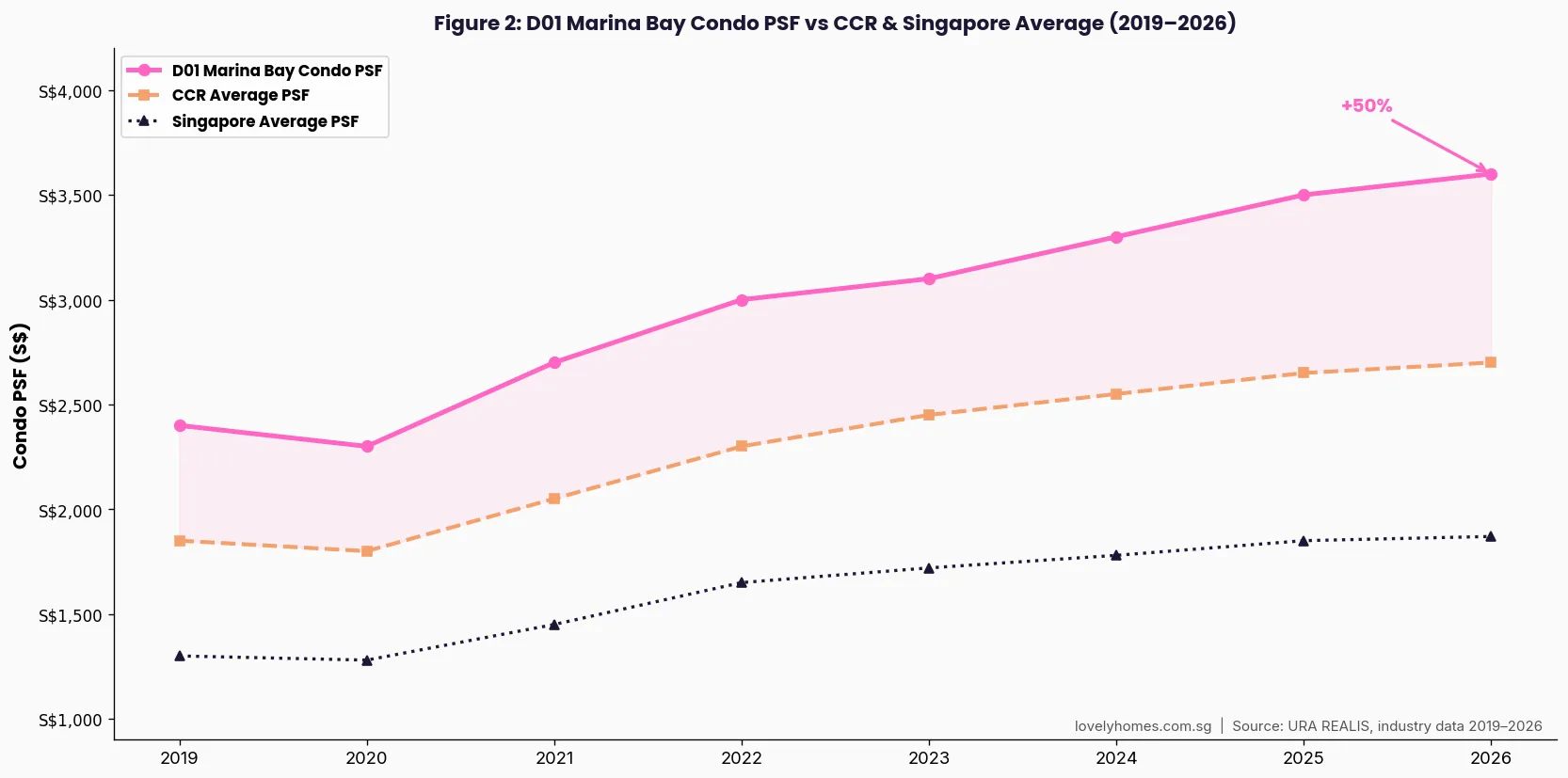
D01 residential properties have delivered consistent capital appreciation over the 2019–2026 period, broadly in line with the CCR average despite , or perhaps because of , the area’s extreme supply scarcity. URA REALIS data indicates median transacted PSF for non-landed condominiums in D01 increased from approximately S$2,400 per square foot in 2019 to S$3,600 per square foot in Q2 2026, representing a compound appreciation of approximately 50% over seven years, or roughly 6% per annum.
The CCR as a whole , which includes Districts 9, 10, 11, 1, 2, 6, and 7 , registered price increases of 1.8% quarter-on-quarter in Q2 2026 according to URA’s Q2 2026 statistics (pr26-57, 24 July 2026), reversing the more modest 0.6% gain in Q1. This CCR outperformance was notable given that the broader private residential market grew only 0.5% over the same quarter. D01’s ultra-prime positioning within the CCR means it tracks , and often leads , the CCR cycle rather than the broader OCR or RCR market.
Rental performance has also remained solid. Marina Bay Grade A serviced residences and luxury condos command monthly rents in the range of S$6,000–S$15,000 for two-bedroom and three-bedroom units respectively, with gross yields of 3.0%–4.0% , lower than OCR condos in absolute yield terms, but with significantly stronger tenant quality and lower vacancy risk given the proximity to MBFC and the financial district’s employment base.
Key Property Statistics at a Glance
| Metric | Marina Bay / D01 | CCR Average | Singapore Average |
|---|---|---|---|
| Condo median PSF (Q2 2026) | ~S$3,600 | ~S$2,700 | ~S$1,870 |
| QoQ price change (Q2 2026) | +1.5% to +2.5% | +1.8% | +0.5% |
| Gross rental yield | 3.0%–4.0% | 2.8%–3.8% | 3.5%–4.5% |
| MRT lines | 3 (CCL, EWL, TEL) | Varies | Varies |
| Vacancy rate (CCR) | 8.3% (Q2 2026) | 8.3% | 6.4% |
| New GLS residential supply | Minimal since 2020 | Limited | 9,320 units FY2026 Confirmed List |
The Greater Southern Waterfront: Marina Bay’s Long-Term Catalyst
No analysis of Marina Bay’s property investment outlook is complete without addressing the Greater Southern Waterfront (GSW) , URA’s 30-year master plan to transform approximately 2,000 hectares of Singapore’s southern coast from Pasir Panjang Port to Marina East. The GSW is arguably the single most significant urban planning initiative in Singapore since the transformation of Jurong Lake District, and Marina Bay sits at its north-eastern gateway.
Key elements of the GSW as they relate to Marina Bay-area property include: the relocation of Pasir Panjang Terminal (phases 1 and 2 already underway), which will free up large parcels of prime waterfront land for mixed residential and commercial development; the extension of the waterfront promenade from Tanjong Pagar southward; and the integration of Marina South (immediately south of Marina Bay Sands) into a new urban precinct with direct MRT (TEL) access at Marina South Pier station.
Near-term, the GSW catalyst is a decade-long narrative rather than an immediate price driver. But for buyers considering long-horizon holds of 10–20 years, Marina Bay’s positioning as the nucleus of Singapore’s most ambitious urban transformation project represents a structural support for values that few other Singapore districts can claim.
Worked Example: Purchasing a 2-Bedroom Condo in Marina Bay
📋 Case Study: Mr & Mrs Koh , First Property, SC + SC Couple
Profile: SC + SC married couple. Combined monthly income S$22,000. No prior residential property ownership. Targeting a 2-bedroom unit in a D01 99-year leasehold condominium.
Property: 2-bedroom, 818 sq ft, at S$2,800 PSF = S$2,290,400 (rounded to S$2,290,000).
Stamp duty:
BSD: first S$180,000 at 1% = S$1,800; next S$180,000 at 2% = S$3,600; next S$640,000 at 3% = S$19,200; next S$500,000 at 4% = S$20,000; remaining S$790,000 at 5% = S$39,500; total BSD ≈ S$84,100
ABSD (first property, SC + SC): S$0
Total stamp duty: S$84,100 (payable from CPF OA)
Financing: Bank loan at 75% LTV = S$1,717,500; down payment 25% = S$572,500 (minimum 5% cash = S$114,500; remaining S$458,000 from CPF OA)
At 3.5% fixed for 3 years, 30-year tenure: estimated monthly repayment ~S$7,715
TDSR: S$7,715 / S$22,000 = 35.1% , PASS (TDSR limit 55%)
Upfront cash required:
5% cash down payment: S$114,500
BSD: S$84,100 (CPF OA)
Legal fees (est.): S$4,500
Valuation fee: S$600
Total cash outlay: ~S$114,500 | Total CPF usage: ~S$542,500
Note: Marina Bay condominiums are predominantly 99-year leasehold, which means CPF usage is subject to CPF Withdrawal Limits , the Valuation Limit (VL) is the lower of the purchase price and market valuation, and CPF usage reduces as lease remaining falls below 95 years. For a new purchase with 99 years remaining, full CPF usage is permitted.
Why Marina Bay Matters: Investment and Lifestyle Analysis
Marina Bay occupies a unique position in Singapore’s property market: it is simultaneously Singapore’s busiest commercial district, its most dramatic waterfront, and one of its most sought-after luxury residential addresses. This combination , commercial vitality, leisure infrastructure, and residential prestige , is extremely difficult to replicate in other Singapore districts and explains why the area commands a persistent price premium.
For owner-occupiers, the trade-off is clear: you pay a significant PSF premium relative to the broader CCR or RCR, but you gain an address with unmatched lifestyle infrastructure (dining, entertainment, arts, waterfront), three-line MRT access, and the security of knowing that new supply is structurally limited. For investors, the case rests on rental yield from high-quality expatriate tenants, capital preservation through low supply, and long-horizon capital appreciation driven by the Greater Southern Waterfront transformation.
Compared with other global financial district residential markets , London’s Canary Wharf (where office-to-residential conversion is creating new supply pressure), Hong Kong’s Central (where geopolitical uncertainty has dampened demand), or New York’s Financial District (where vacancy remains elevated) , Marina Bay’s underlying demand drivers are arguably more durable. Singapore’s political stability, its status as Asia’s premier wealth management hub, and its continued attraction of Ultra-High-Net-Worth Individuals (UHNWIs) provide a structural demand floor that is not replicated in peers.
What Might Come Next: Marina Bay Property Outlook
(This section represents editorial analysis and speculation , not URA or government guidance.)
Several factors point to Marina Bay continuing to outperform the broader CCR over the medium term. The TEL Stage 3 connection, now fully operational, has improved accessibility for existing residents considerably. The forthcoming completion of Marina South , the new precinct directly south of Marina Bay Sands, anchored by TEL’s Marina South Pier station , will expand the premium residential footprint and attract further amenities to the D01 waterfront over the 2027–2032 horizon.
Supply remains the key support. Unless URA chooses to release major residential GLS sites within D01 (which has not occurred since the early 2010s), the existing stock of approximately 3,000–4,000 residential units in the core Marina Bay precinct is unlikely to grow materially in the next decade. In an environment where the broader Singapore private residential market sees 9,320 Confirmed List units annually, Marina Bay’s island of scarcity stands out distinctly for long-hold investors.
Frequently Asked Questions
Is Marina Bay good for families with children, or is it primarily for professionals and investors?
Marina Bay caters predominantly to professional couples, single expatriates, and investors rather than young families with school-age children. The district lacks the neighbourhood schools, parks, and community amenities (wet markets, hawker centres, heartland malls) that families typically prioritise. The nearest primary schools require a taxi or MRT ride. That said, the lifestyle infrastructure , Gardens by the Bay, Marina Bay Sands, the waterfront promenade , is world-class, and families who prioritise convenience and urban vibrancy over neighbourhood feel do choose Marina Bay. For families seeking school proximity in the CCR, Districts 9, 10, and 11 (Orchard, Tanglin, Newton) are typically better suited.
Are there any HDB flats I can buy in or near Marina Bay?
There are no HDB flats within the core Marina Bay precinct. The nearest HDB estates are at Tanjong Pagar (District 02), Chinatown (District 01 fringe), and across the river at Outram / Tiong Bahru. These are older HDB towns with resale prices typically in the range of S$800,000–S$1,200,000 for 4-room units, considerably below the private property market in the same district. If proximity to the CBD is a priority and HDB is the preferred tenure, these fringe D01/D02 HDB towns are the closest viable option.
What are the best condominiums to consider buying in Marina Bay?
Without naming or endorsing specific projects, the key considerations when evaluating Marina Bay condominiums are: (1) Lease type , freehold units command a significant premium but retain CPF flexibility over the long term; (2) Floor level and view , waterfront-facing units facing Marina Bay itself trade at a 10–20% premium over units facing inland; (3) Age and management , older developments from the 2008–2012 era have established MCST bodies and known sinking fund positions; (4) Unit size , Marina Bay condominiums skew toward larger layouts (800–1,500 sq ft) which suits the expatriate rental market; and (5) Facility quality , concierge-level facilities (pool, gym, function rooms) matter significantly to the tenant segment. Buyers should conduct thorough due diligence, including a title search, a review of MCST minutes, and an independent valuation.
What is the vacancy rate for rental properties in Marina Bay, and how stable is the rental market?
URA Q2 2026 data shows a CCR vacancy rate of 8.3% , among the higher rates in Singapore. Marina Bay specifically experiences some cyclicality tied to the expatriate professional population, which fluctuates with the financial services and tech sectors’ headcount. During periods of corporate downsizing (as occurred in 2022–2023 across global banking), Marina Bay rents softened. However, the area’s position as the de facto home for senior financial industry professionals , many of whom are on company housing allowances , provides a demand floor that less premium districts lack. Well-priced 2-bedroom units below S$8,000/month typically find tenants within 2–4 weeks in normal market conditions.
How does Marina Bay compare to Orchard Road as a residential investment?
Both precincts are CCR and command premium prices, but they serve different profiles. Orchard (Districts 9–10) has more diverse residential stock , from freehold bungalows to mass-market condominiums , larger family-friendly developments, and proximity to top international schools. Marina Bay is more concentrated on financial-district professionals, smaller luxury units, and waterfront lifestyle. Capital appreciation has been broadly similar over the medium term; Marina Bay enjoys a supply-scarcity advantage that Orchard does not, since Orchard has seen several new launches in recent years. For investors targeting the expatriate corporate-let market, Marina Bay’s proximity to MBFC is a distinct advantage. For owner-occupiers and family tenants, Orchard’s lifestyle infrastructure and school proximity make it the preferred choice.
Will the Greater Southern Waterfront raise Marina Bay property prices significantly?
The Greater Southern Waterfront (GSW) is a 30-year master plan , its full impact will unfold over multiple property market cycles. Near-term (2026–2030), the GSW’s effect on Marina Bay prices is likely to be sentiment-driven rather than supply-driven: awareness of the long-term plan reinforces buyer confidence in holding Marina Bay property for the long term, but new GSW residential units are not expected to reach the market in volume before 2030 at the earliest. When they do arrive, they will expand the premium southern waterfront neighbourhood rather than compete directly with the core Marina Bay precinct , URA has historically positioned new GSW precincts (such as Marina South) as complementary rather than competing with existing D01 stock.
Related Articles
- Tanjong Pagar Neighbourhood Guide Singapore 2026: D02 Prices, GSW and Investment Outlook
- Novena Neighbourhood Guide Singapore 2026: D11 Medical Hub, Prices & Investment Outlook
- URA Q2 2026 Private Property Market Data: CCR Leads as Overall Growth Slows
- CCR, RCR & OCR Singapore 2026: What the District Classifications Mean for Buyers
- Singapore Condo Resale Guide 2026: Step-by-Step Buyer’s Complete Guide
- Singapore Property Investment Strategy 2026: Rental Yields, Capital Gains and Net Returns
Supporting graphics
Original article illustrations are available below.
- Figure 1: Marina Bay / D01 Property Prices per Square Foot (PSF) , Q2 2026 (Source: URA REALIS, industry data)
- Figure 2: D01 Marina Bay Condo PSF vs CCR & Singapore Average (2019–2026) , Long-term Capital Appreciation Trend (Source: URA REALIS)
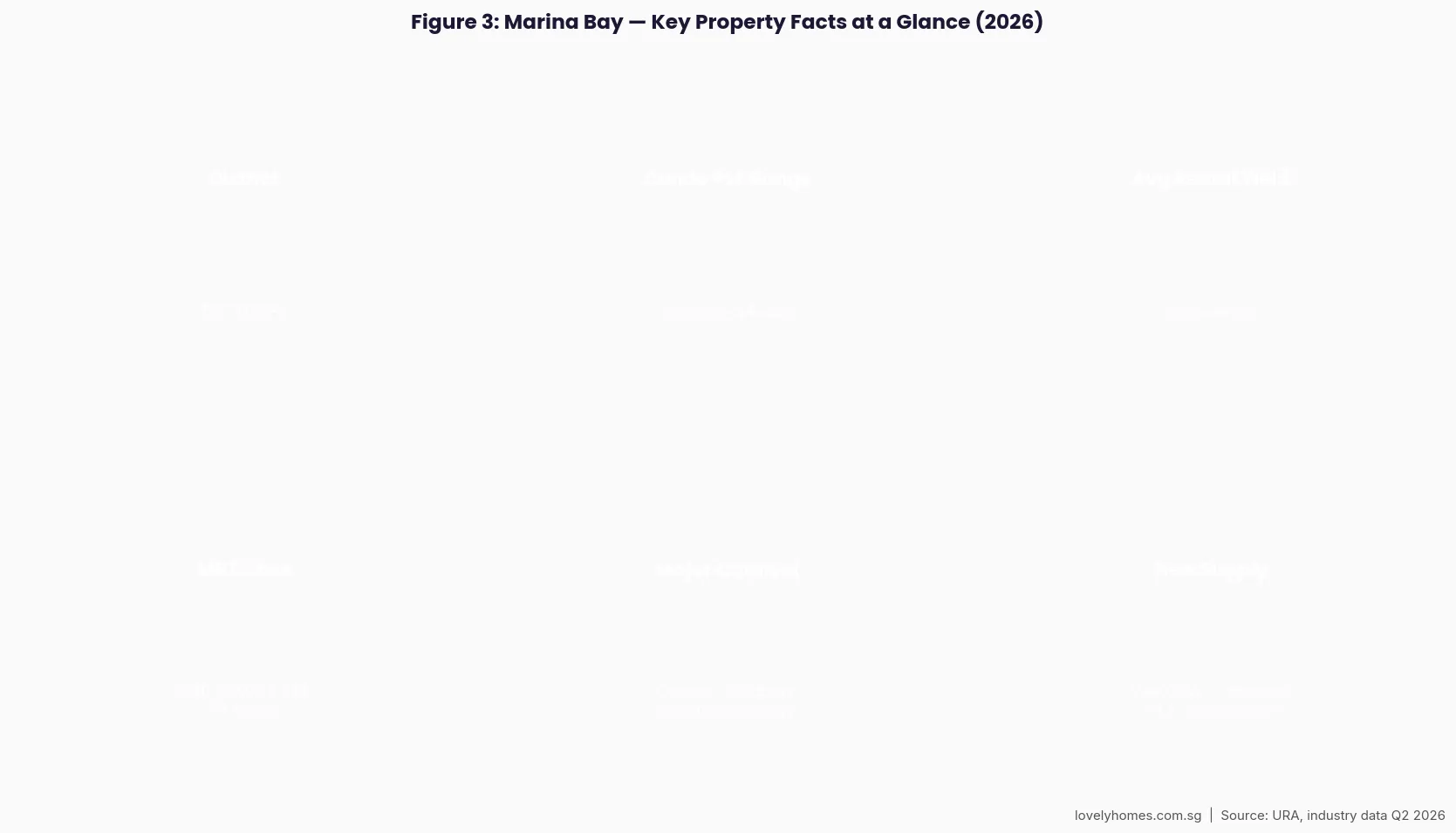
- Figure 3: Marina Bay / D01 , Key Property Facts at a Glance (2026)