Quick Answer: What Is the EASE Scheme?
- EASE (Enhancement for Active Seniors) is a government programme that subsidises senior-friendly home fittings, such as grab bars, ramps, handrails and slip-resistant floor treatment, so that older residents can move around their homes more safely.
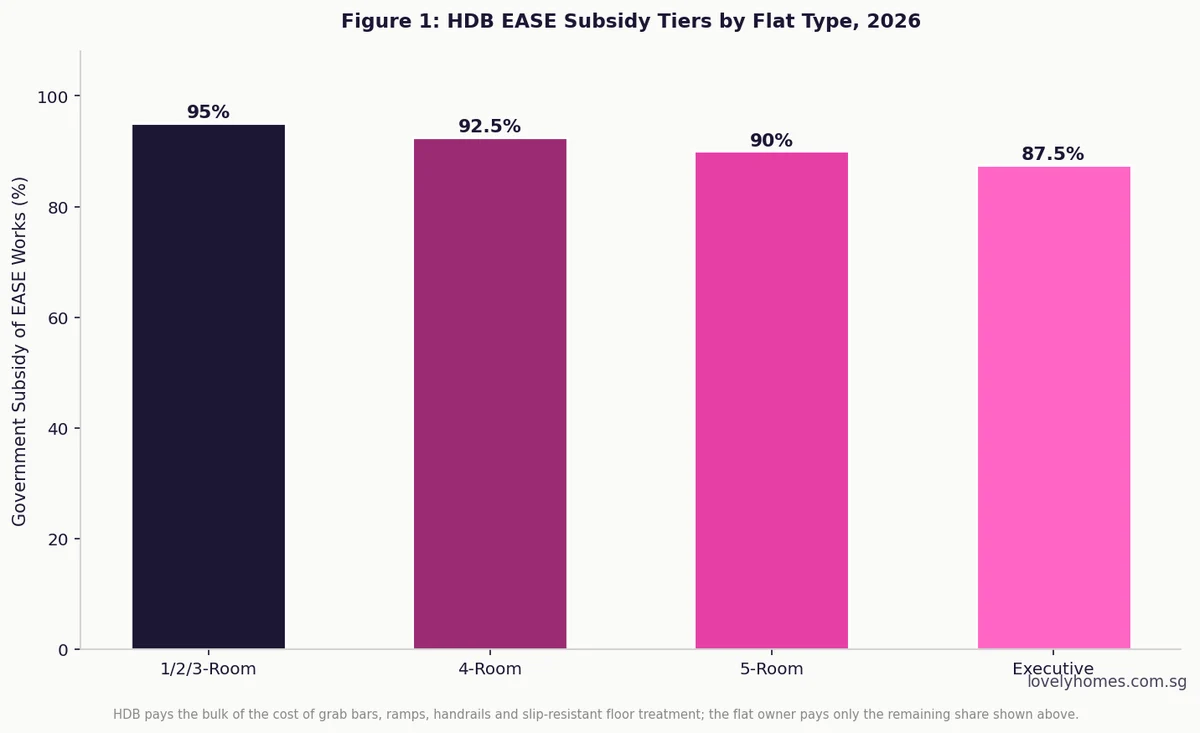
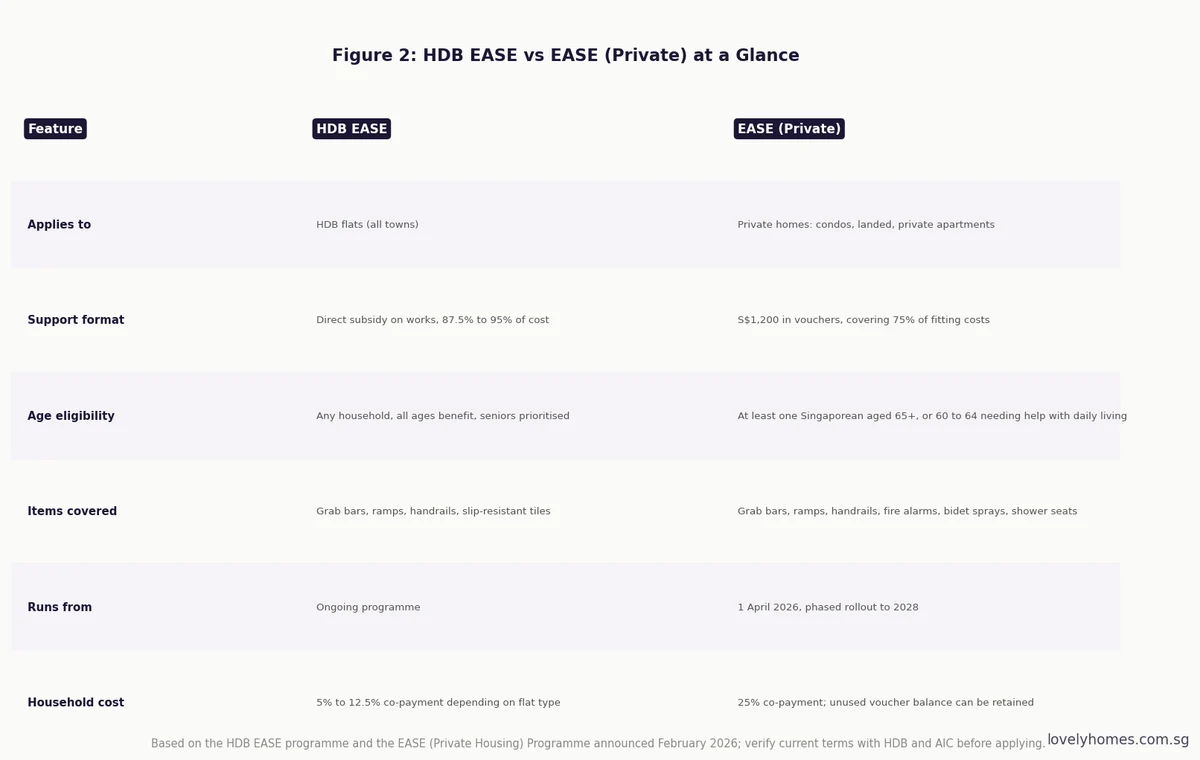
- HDB EASE has existed since 2012 and covers HDB flats, with the Government paying between 87.5% and 95% of the cost of approved works depending on flat type.
- From 1 April 2026, a new companion scheme, EASE (Private), extends similar support to private homes for the first time, running as a three-year programme from 2026 to 2028.
- EASE (Private) gives eligible households S$1,200 in vouchers, covering 75% of the cost of installing selected fittings; the household pays the remaining 25%.
- To qualify for EASE (Private), a household needs at least one Singapore Citizen aged 65 or above, or aged 60 to 64 and requiring help with at least one activity of daily living.
- Both schemes are jointly administered by the Agency for Integrated Care (AIC) and HDB, with an assessment step for younger applicants who need help with daily living.
- Over 80,000 private households are expected to be eligible for EASE (Private), with applications phased by age group starting 1 April 2026.
- Unused voucher balances under EASE (Private) can be retained for later use if a household later decides to install further fittings.
Singapore’s population is ageing quickly, and one of the most common, practical risks that comes with it is something as ordinary as a fall in the bathroom or a trip over a raised doorstep. The EASE scheme exists to reduce exactly that risk, by heavily subsidising simple, proven home modifications, grab bars, ramps, handrails and slip-resistant flooring, rather than leaving households to fund these upgrades entirely out of pocket. What began in 2012 as an HDB-only programme has now been extended, from 1 April 2026, to private housing for the first time, through a new companion scheme called EASE (Private). This article explains who qualifies for each version, what is covered, how much it actually costs a household after subsidy, and how to apply.
HDB EASE: What It Covers and How the Subsidy Works
HDB EASE, short for Enhancement for Active Seniors, was introduced by the Housing & Development Board in 2012 and is jointly administered with the Agency for Integrated Care (AIC). It covers a defined list of items: a first set of 8 to 10 grab bars for the main toilet and other parts of the flat, a second set of up to 6 grab bars for a second toilet where technically feasible, up to 5 ramps or accessibility solutions (including single-step ramps, portable ramps, customised ramps for staircased entrances, and wheelchair lifters for multi-step entrances), a handrail at the main entrance where there are steps, and slip-resistant treatment applied to the existing floor tiles of up to 2 bathrooms or toilets.
The Government pays the bulk of the cost, with the household’s co-payment share fixed by flat type: 1-room, 2-room and 3-room flats pay only 5% of the cost (a 95% subsidy), 4-room flats pay 7.5% (92.5% subsidy), 5-room flats pay 10% (90% subsidy), and Executive flats pay 12.5% (87.5% subsidy). This tiered structure means smaller flats, which are more likely to house lower-income or elderly-only households, receive the highest level of support.
Who Can Apply for HDB EASE, and How
Any Singapore Citizen or Permanent Resident household living in an HDB flat can apply for EASE items directly, and applications can also be bundled in as part of a block’s Home Improvement Programme (HIP) works when that block is due for an upgrade. For households where the person needing assistance is aged 60 to 64, an additional step applies: a Functional Assessment Report (FAR) must first confirm that the individual needs help with at least one of the recognised activities of daily living, such as washing, dressing, feeding, toileting, transferring or moving around. This assessment can be carried out by a doctor registered with the Singapore Medical Council, a registered nurse, or a physiotherapist, and is intended to ensure the subsidised items go to households where they genuinely improve day-to-day safety.
Applications can be made online through HDB’s EASE e-service, and installation is typically carried out by HDB-appointed contractors, so households do not need to separately source and vet their own renovation contractor for the specific EASE items.
EASE (Private): Extending Support to Condos, Landed Homes and Private Apartments
Until 2026, households living in private property had no equivalent government subsidy for senior-friendly home fittings, even though the same fall risks apply regardless of tenure. The new EASE (Private) Programme closes that gap. Announced in February 2026 and taking effect from 1 April 2026, it runs as a three-year scheme through to 2028 and is expected to benefit more than 80,000 private households across Singapore.
Eligible households receive S$1,200 in vouchers, which subsidise 75% of the cost of installing a broader list of fittings than the HDB version: grab bars, slip-resistant floor treatment, single-step ramps, handrails, home fire alarm devices, bidet sprays and shower seats. The household pays the remaining 25% of the cost, and any unused voucher balance is not forfeited; it can be retained and drawn down later if the household chooses to install further fittings before the scheme ends.
To qualify, a household must have at least one member who is a Singapore Citizen aged 65 or above, or aged 60 to 64 and assessed as needing help with at least one activity of daily living, mirroring the logic of the HDB scheme’s assessment requirement for younger applicants. Applications are phased by age to manage rollout: households with a member aged 80 and above (and those aged 60 to 64 needing assistance) can apply from 1 April 2026, households with a member aged 70 and above from 1 July 2026, and households with a member aged 65 and above from 1 October 2026.
Why These Small Fittings Make a Real Difference
It is easy to underestimate how much a S$50 grab bar or a single-step ramp can matter, but falls remain one of the leading causes of injury and hospitalisation among older residents in Singapore, and a large proportion happen at home, in the bathroom or at a raised threshold. Wet, tiled bathroom floors and steps at a flat’s main entrance are two of the most common fall hazards, which is precisely why EASE targets slip-resistant treatment and ramps as core, subsidised items rather than optional extras. Because the fittings are simple, non-structural, and can usually be installed within a single visit, EASE tends to have a fast, tangible safety benefit relative to its modest cost.
Summary: EASE Scheme Facts at a Glance
| Question | Short Answer |
|---|---|
| What does EASE stand for? | Enhancement for Active Seniors, a subsidy scheme for senior-friendly home fittings. |
| How much does HDB subsidise? | Between 87.5% (Executive flats) and 95% (1 to 3-room flats) of the cost of approved works. |
| Can private property owners get help too? | Yes, from 1 April 2026 under EASE (Private), which gives S$1,200 in vouchers covering 75% of costs. |
| Who administers EASE? | The Agency for Integrated Care (AIC), in partnership with HDB. |
| What is the minimum age to qualify? | 65 and above generally qualifies; 60 to 64 qualifies if the person needs help with at least one activity of daily living. |
| Is there a deadline to apply? | HDB EASE is an ongoing programme; EASE (Private) is phased by age from 1 April 2026 and runs to 2028. |
Worked Example: A 4-Room Flat Installs a Full EASE Package
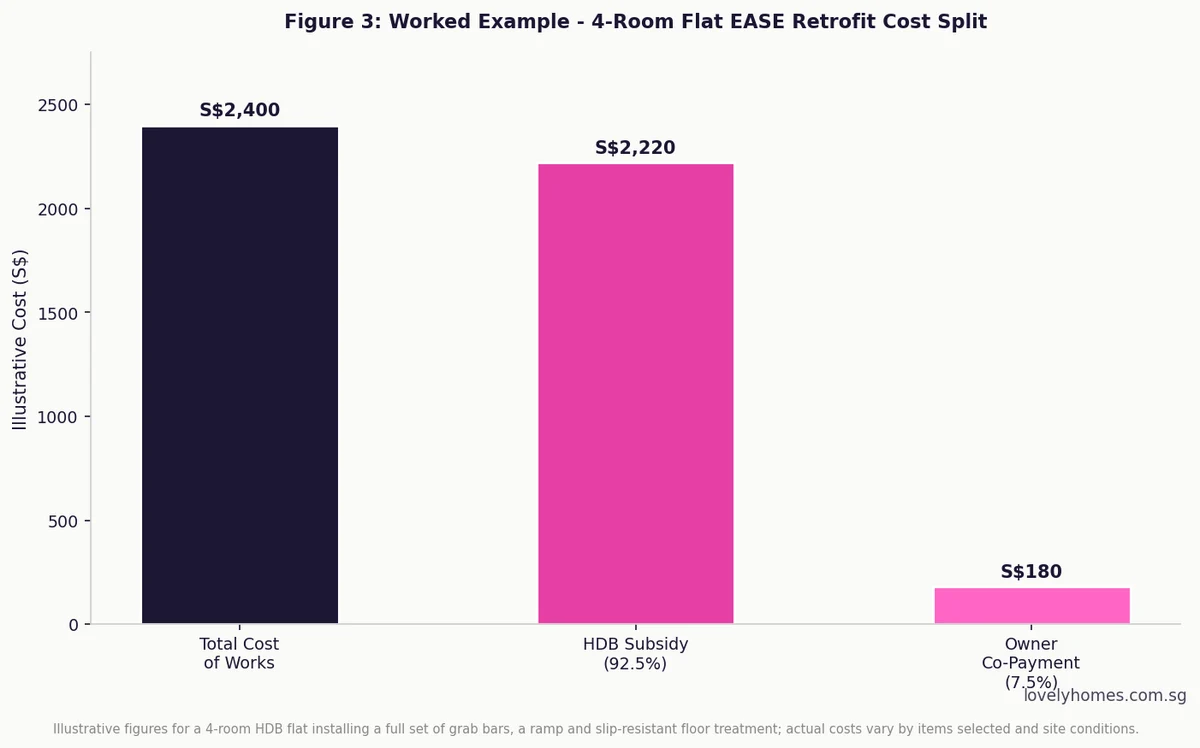
The scenario: Mr and Mrs Koh live in a 4-room HDB flat with Mrs Koh’s 78-year-old mother, who has become increasingly unsteady on her feet. They apply for HDB EASE to install a full set of grab bars, a single-step ramp at the main entrance, and slip-resistant treatment for both bathrooms.
The cost: The total cost of the approved works comes to S$2,400. As a 4-room flat, the household’s co-payment share is 7.5%, meaning HDB’s subsidy covers 92.5%, or S$2,220, leaving the Kohs to pay only S$180 out of pocket.
If they lived in a private condo instead: Under EASE (Private), a similar package (grab bars, a ramp and slip-resistant treatment) costing S$2,400 would be subsidised at 75% through the S$1,200 voucher, up to the voucher’s value; assuming the voucher fully covers the eligible 75% share, the household’s out-of-pocket cost would be around S$600 for that first package, with any unused voucher balance retained for future fittings such as a home fire alarm or bidet spray.
These figures are illustrative only; actual costs depend on the specific items selected, the flat or unit’s layout, and site conditions such as the number of steps at the entrance.
Why This Matters for Families and Caregivers
For adult children caring for ageing parents, EASE is one of the most cost-effective, low-friction ways to reduce a genuine safety risk at home. Because the household co-payment is so small relative to the value of the works, cost is rarely the real barrier; awareness and the extra step of arranging the assessment or application tend to be the bigger obstacles. Families with elderly relatives in HDB flats should consider applying well before a fall happens rather than after, and families with elderly relatives in private property now have, for the first time, a comparable subsidy to draw on once EASE (Private) applications open for their age band. For caregivers managing multiple properties, such as an ageing parent’s flat and a separate private home, it is worth checking eligibility separately for each address, since the two schemes have different administering rules and application windows.
What Might Come Next
The following is informed speculation, not confirmed policy. Given that EASE (Private) is explicitly framed as a three-year pilot running from 2026 to 2028, it is plausible that its scope, voucher value or eligibility age bands could be reviewed or adjusted before or at the end of that window, depending on take-up rates and demand. It is also plausible, though not confirmed, that the list of subsidised private-property fittings could be expanded over time to more closely match the HDB list, or vice versa, as the Government gathers data on which items deliver the most safety benefit. No further changes have been announced at the time of writing.
Frequently Asked Questions
Is HDB EASE only for elderly-headed households?
No. Any HDB household can apply for EASE items; an additional Functional Assessment Report is only required where the person needing the fittings is aged 60 to 64 and needs help with daily living. Those aged 65 and above generally do not need this extra assessment step for the core HDB scheme.
Can I choose my own contractor for EASE works?
For HDB EASE, installation is typically carried out by HDB-appointed contractors as part of the programme, so households generally do not need to separately source their own contractor for the listed items.
What happens if my EASE (Private) voucher does not cover the full 75%?
The voucher is worth S$1,200 in total; if the eligible 75% share of a larger project exceeds that amount, the household pays the difference plus its usual 25% share. Unused balances can be retained for future fittings within the scheme period.
Can Permanent Residents apply for EASE (Private)?
Eligibility is based on the household having at least one Singapore Citizen meeting the age or assistance-need criteria; the specific treatment of mixed-citizenship households should be verified directly with the Agency for Integrated Care when applying.
Does EASE cover full bathroom renovations?
No. EASE covers a defined list of accessibility items, such as grab bars, ramps, handrails and slip-resistant floor treatment for existing tiles; it does not fund a full bathroom retile, retrofit or structural renovation.
Can I apply for EASE more than once?
Households can generally apply again if further eligible items are needed later, subject to the scheme’s rules at the time; for EASE (Private), any unused voucher balance can specifically be retained and drawn down for later fittings.
Where do I apply for EASE?
HDB households can apply via HDB’s EASE e-service or as part of Home Improvement Programme works; private households should apply through the Agency for Integrated Care channels once their age band’s application window opens from 1 April 2026.
Related Articles on LovelyHomes
- HDB Community Care Apartments Singapore 2026: Complete Guide
- HDB 2-Room Flexi for Seniors Singapore 2026: Short Lease, Silver Housing Bonus and Lease Buyback Explained
- Singapore HDB Lease Buyback Scheme Guide 2026: Monetise Your Flat, Stay in Your Home
- Singapore HDB Renovation Guide 2026: Costs, Rules, Timeline and Grants
- Singapore Property Renovation Guide 2026: HDB Rules, Costs, Permits and Renovation Loan Explained
- CPF Housing Grant for Resale Singapore 2026: Complete Guide to EHG, PHG and Step-Up Grant
Supporting graphics
Original article illustrations are available below.