⚡ Quick Answer , HDB Community Care Apartments Guide 2026
- Community Care Apartments (CCAs) are HDB flats designed specifically for seniors who want to age independently with care services integrated into their home , a hybrid of housing and light residential care.
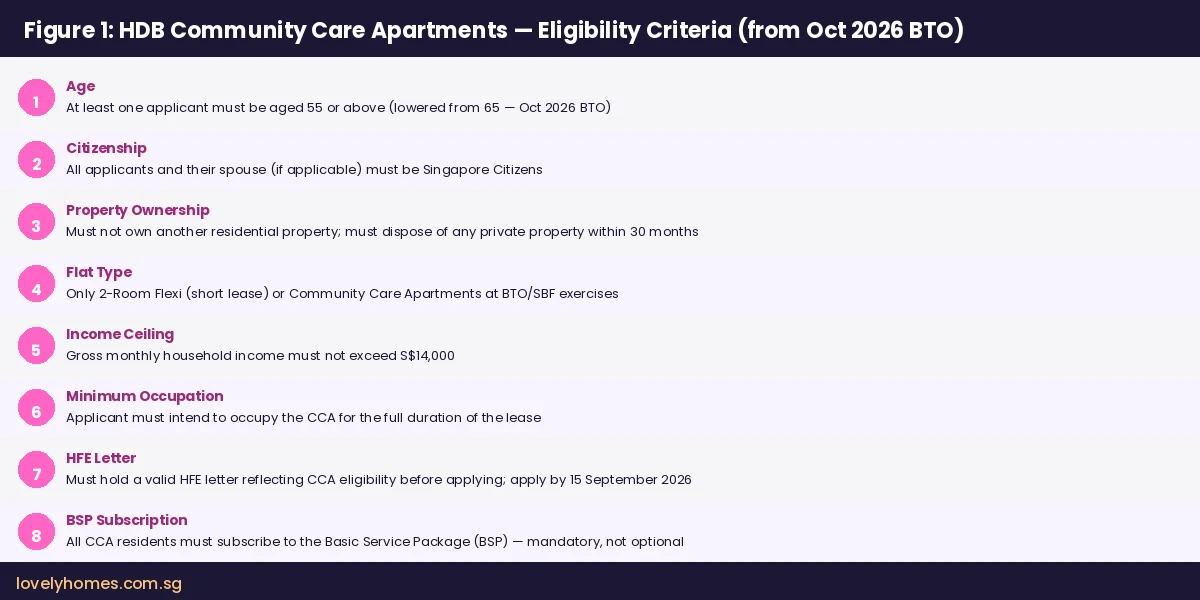
- Following a joint announcement by MOH, MND and HDB on 13 July 2026, the minimum age for CCA eligibility has been lowered from 65 to 55 years old, effective from the October 2026 BTO exercise.
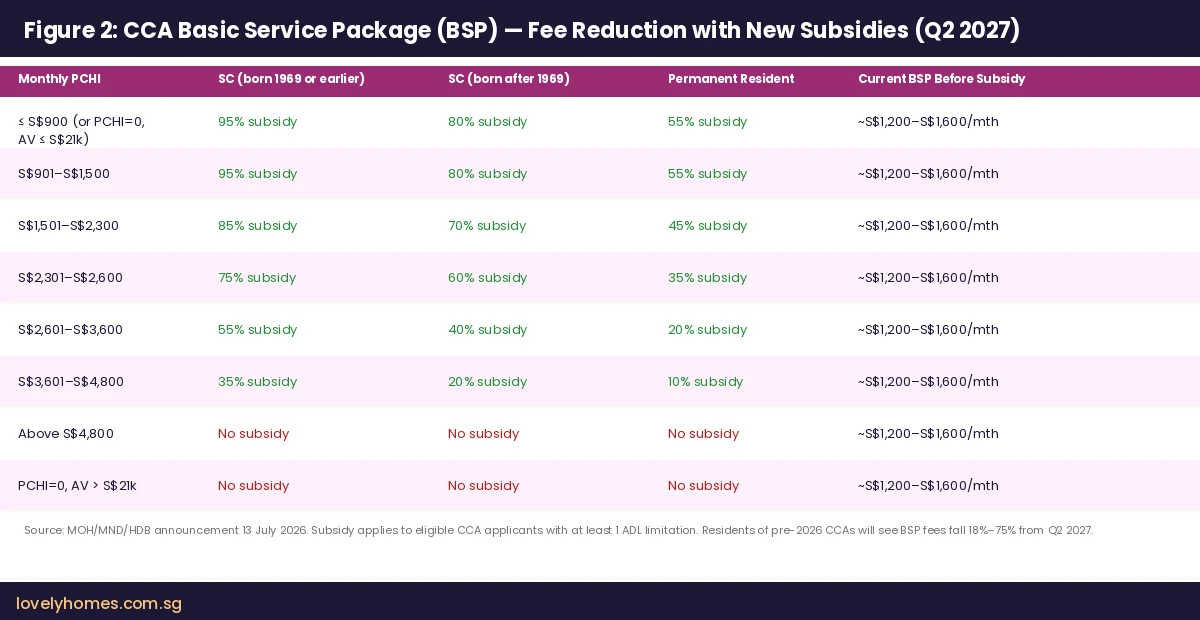
- Monthly Basic Service Package (BSP) fees will fall by 18%–75% for residents of existing CCAs once new subsidies and the streamlined scope take effect from Q2 2027.
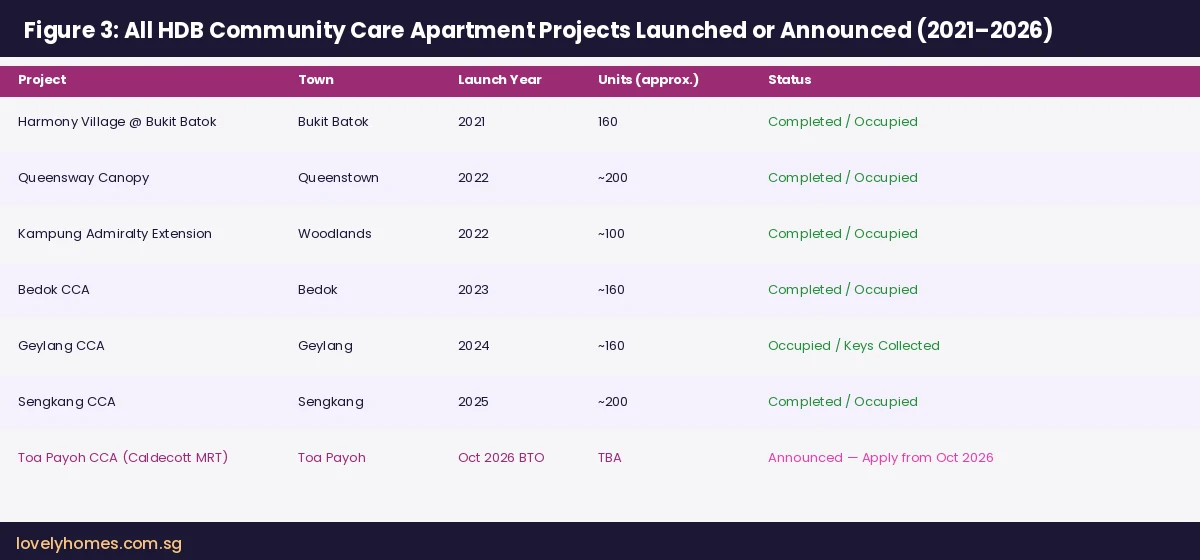
- A sixth CCA development will be launched in Toa Payoh (next to Caldecott MRT station) in the October 2026 BTO sales exercise.
- All CCA residents must subscribe to the BSP, which provides CCA staff support, 24-hour emergency response, and assistance with care arrangements. Social activities will be delivered via nearby Active Ageing Centre (AAC) touchpoints.
- The BSP subsidy is means-tested, with Singapore Citizens on lower per capita household income receiving up to 95% subsidy on eligible BSP components.
- Seniors wishing to apply for the October 2026 BTO must have a valid HFE letter reflecting CCA eligibility. Apply to HDB by 15 September 2026.
- CCAs are only available to Singapore Citizens; the short-lease 2-Room Flexi flat remains the alternative option for seniors who want standard HDB housing without the integrated care package.
What Are HDB Community Care Apartments?
Community Care Apartments (CCAs) are a distinctive housing type introduced by HDB in 2021. They are purpose-designed HDB flats for seniors who can still live independently but benefit from integrated care services , a model positioned between standard public housing and residential care facilities. Unlike aged care homes, CCA residents live in their own self-contained flat, retain full privacy and autonomy, and receive support services through the mandatory Basic Service Package (BSP) rather than round-the-clock nursing care.
The concept recognises that many Singaporean seniors do not need , and do not want , institutional care, but would benefit from living in a community where support is readily available. Each CCA unit features senior-friendly design: easy-to-slide partitions between living and bathroom areas, built-in wardrobes and cabinets, wheelchair-accessible bathrooms with slip-resistant flooring and grab bars, and raised power points at accessible heights. These modifications are built into the flat from the outset, eliminating the need for expensive renovations.
CCAs are sold on short leases calibrated to the resident’s age , typically 15 to 35 years, designed to last to age 95. This distinguishes them from standard HDB flats (99-year leases) and means the purchase price is substantially lower, making them accessible to seniors who right-size from larger family flats.
The July 2026 Announcement: Lower Age, Lower Fees
On 13 July 2026, the Ministry of Health (MOH), Ministry of National Development (MND) and HDB announced two major enhancements to the CCA programme. The first and most structurally significant change is the lowering of the minimum age eligibility from 65 to 55 years old. This change takes effect from the October 2026 BTO exercise and means that Singaporeans who reach 55 , the age at which CPF funds become accessible, the Minimum Occupation Period for private properties starts to reset, and the first HDB right-sizing options typically become available , can now consider CCAs alongside short-lease 2-Room Flexi flats as part of their retirement housing planning.
The second enhancement addresses affordability. The current BSP, which covers a broad range of services, will be streamlined and supplemented by a new subsidy framework. Social activities, previously bundled into the BSP at cost, will be folded into the Active Ageing Centre (AAC) network that already serves broader community needs and is largely subsidised or free. The emergency alert device, previously mandatory under the BSP, will become optional , residents who prefer to rely on CCA staff for 24-hour emergency response can choose not to pay for the device separately. Together, these changes reduce the operating cost base of the BSP, which flows through to lower monthly fees.
How the Basic Service Package Works
The BSP is the mandatory service layer that distinguishes CCAs from standard HDB flats. All CCA residents must subscribe to it from the time of taking possession of the flat. The package is not optional , it is a condition of CCA tenancy, reflecting the fact that the purpose of the CCA model is to provide an integrated housing-plus-care environment, not merely lower-cost housing for seniors.
Under the streamlined BSP for CCAs launched in 2026 onwards (and as revised for existing CCAs from Q2 2027), the BSP includes three core components. First, a dedicated CCA staff member who provides residents with assistance on simple household matters such as changing light bulbs, reading letters, interpreting bills, and coordinating basic household logistics. Second, 24-hour emergency response: CCA residents can reach a trained responder at any time of the day or night through an in-unit system. Third, care coordination support: the CCA staff helps residents navigate and access additional care services if their needs intensify over time , these include shared caregiving services, day care, housekeeping and home nursing, all of which are available from external providers at additional charge.
The key change introduced from 2026 is the removal of in-house social programming and standalone communal facilities from the BSP scope. These will be provided through AAC touchpoints at or near the CCA development, with most activities free-of-charge under government subsidy , the same model used for seniors across Singapore. This both improves the economics of the BSP and gives CCA residents access to a broader community rather than limiting them to in-house programmes.
The New BSP Subsidy Framework
The Government will introduce means-tested subsidies for BSP components that parallel services already subsidised under national Long-Term Care (LTC) schemes. Eligibility for the subsidy requires the CCA applicant to be assessed as unable to perform at least one Activity of Daily Living (ADL) , the standard functional assessment used across Singapore’s LTC system. The subsidy tiers are based on monthly per capita household income (PCHI) and citizenship status.
The highest subsidy tier , 95% for Singapore Citizens born in 1969 or earlier, or 80% for those born after 1969 , applies to households with a PCHI of S$900 or below. At the other end, households with PCHI above S$4,800 receive no subsidy. This progressive structure ensures that CCA living is genuinely affordable for lower-income seniors, which is the demographic the programme is primarily designed to serve. For a resident with a BSP of S$1,400/mth and a 95% subsidy, the net monthly cost reduces to approximately S$70 , comparable to a basic utilities bill.
All Six CCA Projects at a Glance
HDB has launched or announced six CCA projects since the programme’s introduction in 2021. The first five , at Bukit Batok, Queenstown, Woodlands (Kampung Admiralty), Bedok, Geylang and Sengkang , are either completed or in occupation. The sixth project, in Toa Payoh adjacent to Caldecott MRT station, will be launched as part of the October 2026 BTO sales exercise. Its proximity to the Thomson-East Coast Line provides excellent connectivity for residents who remain active and mobile.
How to Apply for the October 2026 BTO Exercise
The CCA in Toa Payoh will be available for application during the October 2026 BTO sales exercise. The application process follows the standard HDB BTO procedure, with one additional requirement: applicants must hold a valid HDB Flat Eligibility (HFE) letter that specifically reflects their eligibility to purchase a CCA. Because the age criterion is changing, HDB will handle HFE letters in three ways depending on the applicant’s situation.
Applicants who do not have an HFE letter should apply and submit all required documents by 15 September 2026 to ensure the letter is ready before the exercise opens. Applicants who already hold a valid HFE letter and were aged 55 or above at the time of their HFE letter application will have their letter automatically updated by HDB to reflect CCA eligibility , no action is needed. Applicants with a valid HFE letter who were below 55 at the time of application but will turn 55 before the exercise opens must re-apply for a new HFE letter, again by 15 September 2026. The HDB website at hdb.gov.sg provides the HFE letter application service; applicants may also check their existing HFE letter from 1 October 2026 to confirm whether CCA eligibility is reflected.
CCA vs 2-Room Flexi Flat: Which Is Right for You?
| Feature | Community Care Apartment (CCA) | 2-Room Flexi Flat (Short Lease) |
|---|---|---|
| Minimum age | 55 (from Oct 2026) | 55 (short lease for seniors) |
| Citizenship | Singapore Citizens only | SC; SC+SPR couples also eligible |
| Flat size | ~35–45 sqm (one bedroom + living) | ~36–45 sqm |
| Lease term | 15–35 years (calibrated to age) | 15–45 years (buyer’s choice) |
| Integrated care services | Yes , mandatory BSP included | No , standard residential flat |
| Monthly service fee | BSP ~S$70–S$1,400/mth (after subsidy) | Normal town council S&CC charges only |
| Emergency response | 24-hour via CCA staff (BSP) | Standard civil emergency services |
| Active social programming | Via nearby AAC (subsidised/free) | Via nearby AAC or community centre |
| Purchase price (approx.) | Lower than standard flat (short lease) | Similar to CCA; slightly lower |
| Design features | Senior-friendly built-in design standard | Standard HDB design (renovate separately) |
| Subletting | Not permitted | Not permitted on short lease |
| Resale (on open market) | Restricted; check HDB conditions | Restricted; subject to MOP and eligibility |
Worked Example: A Couple Right-Sizing at 57 and 55
🏠 Case Study: Mr and Mrs Chen , Applying for a Toa Payoh CCA in October 2026
Profile: Mr Chen (age 58, SC, born 1968) and Mrs Chen (age 57, SC, born 1969). Currently in a 5-Room HDB flat in Bishan, fully paid. Combined gross monthly income S$2,200 (part-time work and CPF LIFE payouts). Household of 2; PCHI = S$1,100.
Eligibility check:
✓ Both aged 55+ (Mr Chen 58, Mrs Chen 57)
✓ Both Singapore Citizens
✓ Bishan flat is their only residential property; they will sell it on the open market
✓ PCHI S$1,100 (within S$14,000 income ceiling)
✓ Plan: sell Bishan flat, buy Toa Payoh CCA (25-year lease to age ~82)
They must apply for (or update) their HFE letters before 15 September 2026.
BSP fee estimate:
Pre-subsidy BSP for a 2026 CCA: approximately S$900–S$1,200/mth (streamlined scope).
PCHI S$1,100 falls in the S$901–S$1,500 bracket. Mr Chen born 1968 (before 1969): 95% subsidy. Mrs Chen born 1969: 80% subsidy. Taking the higher subsidised rate (primary applicant): 95% subsidy.
Net BSP: ~S$900 × 5% = approximately S$45–S$60/mth , highly affordable.
Proceeds from Bishan flat sale (indicative):
5-Room HDB in Bishan, resale market mid-2026: approximately S$880,000–S$950,000. After CPF OA repayment (~S$250,000 incl. accrued interest), net cash proceeds: approximately S$630,000–S$700,000. This will comfortably fund the CCA purchase and provide a retirement nest egg.
CCA purchase price (indicative):
25-year lease CCA in Toa Payoh: estimated S$180,000–S$220,000 based on comparable short-lease flats. No ABSD (SC first residential purchase after selling Bishan flat).
What This Means for Homeowners Aged 55–65
The reduction in eligible age from 65 to 55 is a significant policy shift that effectively doubles the window in which a Singapore Citizen can consider a CCA as part of their retirement housing plan. From age 55, when CPF savings become accessible and the first right-sizing decisions typically arise, seniors now have a genuine choice between three options: retaining their current flat, right-sizing to a standard short-lease 2-Room Flexi flat, or moving into a CCA.
For those with moderate care needs or who anticipate their health needs will grow over time, the CCA offers certainty: care support is built in and will scale with need, rather than requiring a disruptive move to a different type of facility later. The integrated design removes the need for costly home modifications. And the lower purchase price of a short-lease flat, combined with the cash proceeds from selling a larger HDB flat, can materially improve retirement financial security.
For those aged 55–64 who are still relatively healthy and active, the key question is whether the mandatory BSP represents good value. With subsidies potentially reducing BSP fees to under S$100/mth for lower-income applicants, the incremental cost of having 24-hour emergency response and staff support is very low. For those with PCHI above S$4,800 who receive no subsidy, the decision is more financially nuanced.
What Might Come Next
This section is editorial analysis and does not represent official government policy.
The CCA programme has expanded steadily from its 2021 launch. With six projects launched or announced by end 2026 and eligibility now extended to 55-year-olds, the programme is clearly entering a phase of accelerated growth. Industry observers have noted that Singapore’s rapidly ageing population , the Department of Statistics projects that residents aged 65 and above will make up 25% of the population by 2030 , creates structural long-term demand for housing solutions that blend independence with accessible care.
Looking ahead, it is possible that future CCAs will be integrated into larger mixed-use BTO developments, rather than standalone projects, as HDB seeks to normalise senior-friendly housing as a standard feature of residential estates rather than a separate category. The Toa Payoh launch , part of a broader BTO project next to Caldecott MRT , suggests this integration is already underway. Whether further eligibility changes (for instance, allowing SPR spouses to apply) will follow is a matter for HDB and MOH to determine; no such changes have been announced as at August 2026.
Frequently Asked Questions
Can a Singapore Permanent Resident apply for a Community Care Apartment?
No. As at August 2026, CCAs are restricted to Singapore Citizens only. Both the applicant and their spouse (if any) must be Singapore Citizens. Singapore Permanent Residents are not eligible to purchase a CCA even if they meet the age and income criteria. PRs may consider 2-Room Flexi flats as part of SC-PR couple applications for standard HDB housing, but the CCA remains a citizen-only product. This restriction reflects the Government’s policy of prioritising Singapore Citizens for housing programmes that include government-subsidised care services.
What happens to my CCA when I pass away?
When a CCA resident passes away, the short-lease flat reverts to HDB at the end of the lease or upon death (whichever comes first). Because the lease is calibrated to last until approximately age 95, the remaining lease value at death may be small. Any remaining monetisable value may form part of the estate, subject to HDB’s specific conditions for each CCA development. Unlike a standard 99-year lease flat, there is no significant residual asset to pass to children or beneficiaries , this is by design. Seniors who wish to leave a significant housing asset to their family should consider standard flats or private property rather than a short-lease CCA. The CCA is designed for those who prioritise retirement living quality over estate planning considerations.
Can I sublet my CCA unit?
No. Subletting is not permitted for Community Care Apartments. The CCA is designed for owner-occupation; the integrated care model (including the BSP and community monitoring) requires the resident to be physically present. If a CCA resident leaves the flat for an extended period , for example, for a long hospital stay or to live with family , they should inform HDB and the CCA operator, Vanguard Healthcare, as the BSP subscription and monitoring arrangements may need to be adjusted. CCAs are not investment properties and should not be purchased with any rental income objective.
What is the difference between a CCA and a Silver Housing Bonus flat?
These are two separate and complementary programmes. The Silver Housing Bonus (SHB) is a CPF-based cash incentive of up to S$30,000 for seniors who right-size from a larger HDB flat to a shorter-lease HDB flat and use part of the sale proceeds to top up their CPF Retirement Account. The SHB is a grant, not a flat type. A CCA is a specific flat type with integrated care services. A senior can potentially receive the SHB when purchasing a CCA, as the CCA is a short-lease flat that qualifies under the right-sizing criteria , subject to meeting the SHB eligibility conditions, which are administered separately by CPF Board. The two programmes work together for seniors who qualify for both.
How does the CCA compare to private retirement villages or nursing homes?
CCAs occupy a middle ground between standard HDB flats and residential care facilities. Private retirement villages (such as those in Jurong West and Yishun) are private sector developments that offer freehold or long-lease units with lifestyle amenities; they are significantly more expensive than CCAs and not subsidised. Nursing homes provide 24-hour nursing care and are for residents who cannot live independently; they are not residential properties in the housing sense. A CCA resident can still perform at least most Activities of Daily Living, cooks their own meals, and is fully independent , they simply have a support layer via the BSP in case of emergencies or care needs. Think of the CCA as an apartment with a concierge who can call an ambulance and arrange home help, rather than a care facility.
Can I use CPF to buy a Community Care Apartment?
Yes, CPF Ordinary Account (OA) savings can generally be used to purchase HDB flats, including CCAs. However, the Withdrawal Limit rules apply: CPF usage is capped at the Valuation Limit (the lower of the purchase price or the flat’s value), and accrued interest at 2.5% per annum must be refunded upon sale. Because CCAs are short-lease flats, the CPF proration rules also apply: if the remaining lease at the time of purchase does not cover the youngest buyer to age 95, the amount of CPF that can be used is prorated accordingly. Prospective buyers should use the CPF Board’s online calculator at cpf.gov.sg to estimate their CPF usage quantum for a specific CCA purchase.
What if I am already 65 and interested in CCAs , do I still benefit from the July 2026 changes?
Absolutely. If you are already aged 65 or above, you remain fully eligible to apply for CCAs under the original criteria (and now with the lower age threshold also extending eligibility to the 55–64 cohort). The most tangible benefit for existing and prospective CCA residents aged 65+ from the July 2026 announcement is the reduction in BSP fees from Q2 2027. Residents of the first five CCAs (Bukit Batok, Queenstown, Woodlands, Bedok, Geylang and Sengkang) will see their monthly BSP fees fall by between 18% and 75% once the streamlined scope and new subsidies take effect. Vanguard Healthcare, the CCA operator, will contact existing residents with details of the specific fee changes applicable to their unit and location.
Related Articles on LovelyHomes
- Singapore HDB Lease Buyback Scheme Guide 2026 , Monetise Your Flat, Stay in Your Home
- Singapore HDB CPF Usage Guide 2026
- HDB BTO vs Resale 2026 , Which Should You Buy?
- Singapore HDB Priority Schemes Guide 2026
- Singapore HDB Grants for Singles 2026
- Singapore HDB Resale Checklist 2026
- Singapore Property Financing Options Guide 2026
Supporting graphics
Original article illustrations are available below.
- Figure 1: CCA eligibility criteria effective from October 2026 BTO exercise (Source: MOH/MND/HDB, 13 July 2026)
- Figure 2: CCA BSP subsidy tiers by monthly PCHI and citizenship (Source: MOH/MND/HDB announcement, 13 July 2026)
- Figure 3: All CCA projects launched or announced by HDB, 2021–October 2026 (Source: HDB)