The Executive Condominium (EC) occupies a unique position in Singapore’s housing landscape: priced and governed closer to HDB than to the private market on launch day, yet destined to become fully privatised a decade later. For buyers who earn too much to qualify for a standard BTO flat but find private condo prices out of reach, an EC can offer remarkable long-term value , provided you understand the rules.
This guide explains how ECs work, who can buy them, what the income ceiling and MOP rules look like in 2026, and how to evaluate whether an EC fits your circumstances. All figures reflect current HDB and MAS rules as at 26 July 2026.
⚡ Quick Answer: Executive Condominium Key Facts (2026)
- What it is: A hybrid housing type built and sold by private developers but subsidised at launch by HDB rules, with income ceilings and an MOP. Fully privatised 10 years after Temporary Occupation Permit (TOP).
- Income ceiling: Combined gross monthly household income must not exceed S$16,000. At least one applicant must be a Singapore Citizen (SC); co-applicant can be SC or Singapore Permanent Resident (SPR).
- Minimum Occupation Period (MOP): 5 years from TOP before you can sell on the open market. During MOP, you may not sublet the whole unit. After MOP, you may sell to SC/SPR.
- Full privatisation: 10 years from TOP, after which the EC is treated as a private property , foreigners may buy, HDB rules no longer apply, and en bloc proceedings become possible.
- Typical launch prices: S$1,100–S$1,450 psf as at mid-2026 , a significant discount to comparable private condos in the same area, which typically trade at S$1,500–S$2,500 psf.
- CPF grants available: Eligible first-timer SC families may apply for CPF Housing Grants of up to S$30,000 for an EC purchase from a developer (HDB Proximity Housing Grant does not apply at launch).
- Key risk: EC projects typically have a 3–4 year construction period. Buyers commit at BTO-style sales before the project is built and must manage a prolonged TOP wait combined with the 5-year MOP before any liquidity.
What Is an Executive Condominium? Origins and Purpose
The EC scheme was introduced by the Singapore government in 1995 to address a gap in the public housing ladder: professionals and dual-income couples earning above the HDB income ceiling but unable to afford private condo prices were left without a suitable housing option. The solution was a public-private hybrid , developed, built, and marketed by private developers, but subject to HDB eligibility rules and subsidy recovery mechanisms at the point of sale, for the first ten years of the unit’s life.
HDB selects EC sites on the Government Land Sales (GLS) programme, invites developers to tender, and sets the eligibility rules. The developer then markets and sells units to qualifying buyers at launch , typically at prices meaningfully below comparable private condos in the same precinct, reflecting the income ceiling constraint that limits demand.
Over the past decade, ECs have proven to be one of Singapore’s best-performing asset classes by capital appreciation for long-term owners. Units purchased at launch in 2012–2015 at S$700–$850 psf have in many cases transacted post-privatisation at S$1,200–$1,600 psf, generating substantial gains for owners who held through the 10-year window.
Who Can Buy an EC? Eligibility Criteria (2026)
EC eligibility is governed by HDB and must be verified at the point of booking with the developer. The primary eligibility conditions for a new EC launch in 2026 are as follows.
Citizenship and family nucleus
At least one applicant must be a Singapore Citizen. The co-applicant may be a Singapore Citizen or a Singapore Permanent Resident. Common eligible family nuclei include married or engaged couples, SC/SPR families with children, and SC parents applying with SC children. Singles and SPR-only households cannot apply for a new EC launch.
Income ceiling
The combined gross monthly household income of all persons listed in the application must not exceed S$16,000. This ceiling was raised from S$12,000 to S$14,000 in August 2019 and further raised to S$16,000 in August 2024, reflecting income growth and housing affordability pressures. Income is assessed at the point of application on the basis of the most recent 12 months of payslips or, for self-employed persons, the most recent Notice of Assessment from IRAS.
Property ownership history
Applicants must not own any private residential property (in Singapore or overseas) or have disposed of one within the 30 months preceding the application date. If any applicant owns or has recently sold a private property, they are ineligible to purchase a new EC. For resale EC transactions (secondary market, post-MOP), the private property restriction does not apply , foreigners may buy after full privatisation at the 10-year mark.
Previous HDB / EC subsidy history
An applicant who has previously received an HDB housing subsidy (purchased a BTO flat, received a resale grant, or purchased an EC from a developer) is considered a second-timer and is eligible but does not qualify for the first-timer CPF grants. Both HDB flat owners and EC flat owners must ensure they have not benefited from two prior housing subsidies , HDB limits each household to two subsidised purchases over a lifetime in most circumstances.
The MOP Rules: What You Can and Cannot Do During the First 10 Years
The EC’s MOP framework is more nuanced than that of a standard HDB flat and operates in two phases.
Phase 1 , First 5 years from TOP: Full MOP lockup
From the date of TOP, the EC owner enters a strict 5-year MOP. During this period: the unit cannot be sold on the open market; the entire unit cannot be sublet (renting out individual rooms is permitted, but the owner must continue to occupy the unit); and the EC remains subject to all HDB rules on ownership, nationality, and family nucleus.
Phase 2 , Years 5 to 10: Partial opening
Once the 5-year MOP has been served, the EC may be sold on the open market , but only to Singapore Citizens and Permanent Residents. Foreigners remain ineligible as buyers. The selling price is negotiated freely on the open market with no government reference pricing; by this stage, post-MOP EC resale prices typically reflect a significant uplift over the original launch price. Whole-unit subletting is also permitted from the end of MOP.
Phase 3 , 10 years from TOP: Full privatisation
At the 10-year anniversary from TOP, the EC is fully privatised. From this date, all HDB rules cease to apply. Foreigners may purchase units (subject to ABSD at the applicable foreign-buyer rate). En bloc sales become legally possible. The EC is indistinguishable from a freehold or leasehold private condominium for all practical purposes, except that all ECs are sold on 99-year leasehold land from the date of purchase.
Summary of EC Rules at a Glance (2026)
| Rule | Detail (2026) |
|---|---|
| Developer | Private developer (HDB selects GLS site; developer builds and sells) |
| Income ceiling (launch) | S$16,000 gross combined household income / month |
| Citizenship requirement | At least 1 SC; co-applicant can be SC or SPR |
| Minimum Occupation Period | 5 years from TOP (partial opening); 10 years (full privatisation) |
| Subletting (whole unit) | Prohibited during first 5 years; permitted after MOP |
| Eligible buyers (5–10 yr) | SC and SPR only |
| Eligible buyers (after 10 yr) | All nationalities (foreigners pay ABSD) |
| Tenure | 99-year leasehold |
| CPF grant (first-timer SC family) | Up to S$30,000 (CPF Housing Grant for EC) |
| ABSD (SC first property) | Nil (BSD only applies at purchase) |
| Resale levy applicable | Yes, if applicant previously received HDB subsidy on a flat sold within last 30 months |
| Typical launch PSF (2026) | S$1,100–S$1,450 psf (varies by location) |
Worked Example: Buying an EC in 2026 , Full Cost Breakdown
📈 The Scenario
Daniel and Priya are a married couple. Daniel is a Singapore Citizen; Priya is a Singapore Permanent Resident. Combined gross monthly income: S$14,500 (below the S$16,000 ceiling). They are first-timers with no prior HDB or EC purchase. They are interested in a new EC launch at S$1,250 psf for a 1,076 sq ft (100 sqm) 3-bedroom unit.
Step 1 , Purchase price:
1,076 sq ft × S$1,250 psf = S$1,345,000
Step 2 , Buyer’s Stamp Duty (BSD):
On S$1,345,000: 1% on first S$180K = S$1,800 + 2% on next S$180K = S$3,600 + 3% on next S$640K = S$19,200 + 4% on next S$500K (capped at S$345K remaining) = S$13,800
Total BSD ≈ S$38,400
Step 3 , Additional Buyer’s Stamp Duty (ABSD):
Daniel is SC, Priya is SPR; both first-time. For a joint purchase, IRAS levies ABSD based on the buyer attracting the highest rate. SPR first property = 5%; SC first property = 0%. Highest rate governs the entire transaction. ABSD = 5% × S$1,345,000 = S$67,250. (Note: holding the property in the SC’s sole name avoids ABSD entirely , a common approach for mixed SC/SPR couples. Seek legal advice before structuring.)
Step 4 , CPF Housing Grant:
Daniel (SC first-timer) qualifies for the CPF Housing Grant for EC. With combined income of S$14,500, the grant is S$10,000 (grant tapers above S$12,000; check CPF Board’s grant schedule for the exact tier). This is credited to CPF-OA and used toward the purchase.
Step 5 , Down payment and loan:
EC purchases must be funded with a bank loan (HDB concessionary loans are not available for ECs). Maximum LTV is 75% of purchase price for first-time borrowers with no outstanding housing loans.
Loan: 75% × S$1,345,000 = S$1,008,750
Down payment: 25% = S$336,250 (minimum 5% in cash; remainder from CPF-OA)
Cash minimum: 5% × S$1,345,000 = S$67,250
Step 6 , TDSR/MSR check:
At 4.00% stress rate, 30-year tenure, monthly repayment on S$1,008,750 ≈ S$1,008,750 × (4.77/1,000) ≈ S$4,812/month
MSR check: S$14,500 × 30% = S$4,350/month. Monthly repayment S$4,812 > S$4,350 → MSR breach.
Solution: Reduce loan quantum or increase tenure (if age permits) or consider a smaller unit. Alternatively, if Daniel’s name alone is used, income drops , likely worse. At a lower unit price of S$1.2M, loan = S$900K, monthly repayment ≈ S$4,293 < S$4,350 → MSR passes.
Why ECs Often Outperform: The Long-Term Value Proposition
The EC’s structural advantage is its launch discount. Because the income ceiling constrains the buyer pool at launch, developers price ECs below the prevailing private market , typically a 15–25% discount to comparable private condos in the same estate at the time of launch. Yet once the 10-year privatisation window opens, the EC trades freely against all private properties in the same precinct, including those that have always been fully private. The discount disappears, but the unit remains the same.
Historical data from URA Realis confirms this pattern. EC projects launched in Districts 19, 23, and 27 between 2011 and 2015 at S$700–$850 psf have, post-privatisation, transacted at S$1,100–$1,600 psf , a compound annual appreciation of 5–8% for long-term holders. This significantly outpaces the HDB resale index over the same period and is broadly comparable to private condo appreciation in those estates.
The key risk is illiquidity. During the 10-year window, your capital is locked into the property. Unlike a private condo, you cannot quickly exit if your circumstances change , a job loss, a divorce, or a sudden need to upgrade or downsize requires either selling within the post-MOP SC/SPR pool or waiting for full privatisation. Buyers who are not confident they can remain in the unit for at least 5–7 years should think carefully before committing.
What Might Come Next for ECs
The EC pipeline as at mid-2026 remains active. Several GLS sites awarded in 2024 and 2025 are expected to yield new EC launches between Q4 2026 and 2028 in areas including Tengah, Bukit Timah Link, and Plantation Loop. Supply is expected to run at approximately 2,000–2,500 new EC units per year , comparable to recent averages.
Whether the S$16,000 income ceiling will be raised again is a matter for periodic HDB review. Prior adjustments (2015, 2019, 2024) have tracked income growth with a lag; with the next HDB review cycle typically every 3–5 years, the ceiling is unlikely to change before 2027 at the earliest. Buyers currently at or near the S$16,000 ceiling should apply before their income exceeds the limit , income is assessed at the point of application, not at TOP.
There is no indication from HDB that the 10-year privatisation rule will change. This has been a structural feature of the EC scheme since its inception and underpins the long-term investment thesis for EC buyers.
Frequently Asked Questions: Executive Condominium Singapore 2026
Can a single Singapore Citizen buy an EC?
No , singles cannot apply for a new EC launch from a developer. HDB requires EC applicants to form one of the eligible family nuclei: a married or engaged couple, a family with children, or in certain cases a joint application between SC parents and their SC child. Singles wishing to own an EC must wait until the post-MOP secondary market opens (5 years from TOP) and purchase from a resale EC seller. Note that after full privatisation at 10 years from TOP, foreigners , and therefore also SPR singles , may also purchase ECs on the open market. There are no restrictions on singles once full privatisation has occurred.
My spouse owns a private condo. Can we still apply for an EC?
No. If your spouse owns any private residential property in Singapore or overseas, or has disposed of one within the 30 months preceding the EC application date, you are ineligible to apply for a new EC launch. This restriction applies to all persons listed on the application. If your spouse’s private property was sold more than 30 months before the application date, you would generally be eligible , but you should verify this against HDB’s official eligibility checker, as rules can be nuanced depending on the timing of sale and grant history.
Do I have to take a bank loan for an EC, or can I use an HDB concessionary loan?
ECs must be financed entirely through a bank loan or your own funds , HDB concessionary loans (which offer below-market interest rates and are available for HDB flat purchases) are not available for EC purchases. This means EC buyers must pass the TDSR and MSR requirements applicable to bank loans, including the 4.00% stress-test rate. The maximum Loan-to-Value (LTV) for a first housing loan from a bank is 75% of the purchase price; buyers must fund the remaining 25% from CPF-OA savings and cash. At least 5% must come from cash.
What happens to my EC if I get divorced during the MOP?
A divorce during the MOP creates complications because neither party can sell the EC on the open market. HDB has a formal process for this situation: either one spouse can take over the full ownership (subject to eligibility checks), or HDB may grant an early release from the MOP in exceptional circumstances involving a court order. The resolution typically requires the couple to obtain a court order on the division of matrimonial assets, after which HDB will assess whether a transfer of ownership is permitted. Given the complexity, buyers contemplating separation during MOP should consult a family law practitioner and approach HDB directly.
Can I rent out my EC during the MOP?
You may rent out individual rooms during the MOP, provided you (and the other registered occupiers listed on the application) continue to occupy the flat. Renting out the entire unit is prohibited during the MOP. Violations can result in HDB taking action, including compulsory acquisition of the flat. Once the 5-year MOP is served, you may rent out the entire unit without restriction , at this point the EC opens to the SC/SPR resale market and standard market rents apply. This flexibility makes post-MOP ECs popular with investors who previously lived in the unit and wish to rent it out while residing elsewhere.
Is the EC income ceiling assessed on the date I book the unit or the date I sign the Sale and Purchase Agreement?
Income eligibility for an EC is assessed at the point of application to HDB for eligibility check , which typically occurs at or before the booking date. HDB issues an Eligibility Letter (or a similar approval) confirming the income ceiling assessment. If your income changes between the assessment date and the date of signing the Sales and Purchase Agreement, HDB’s rules require you to report any material change; if income has risen above the ceiling, eligibility may be withdrawn. Buyers close to the S$16,000 ceiling should time their application carefully and avoid taking on additional income sources (such as substantial freelance work) in the months preceding application.
Related Articles on LovelyHomes
- ABSD Singapore 2026: Complete Guide to Additional Buyer’s Stamp Duty
- HDB PLH Model Singapore 2026: Rules, MOP & Clawback Guide
- TDSR & MSR Singapore 2026: Complete Guide to Borrowing Limits
- CPF Housing Grants Singapore 2026: EHG, PHG & Full Guide
- Singapore Property Cooling Measures: Timeline 2009–2026
- BSD Singapore 2026: Complete Guide to Buyer’s Stamp Duty
Supporting graphics
Original article illustrations are available below.
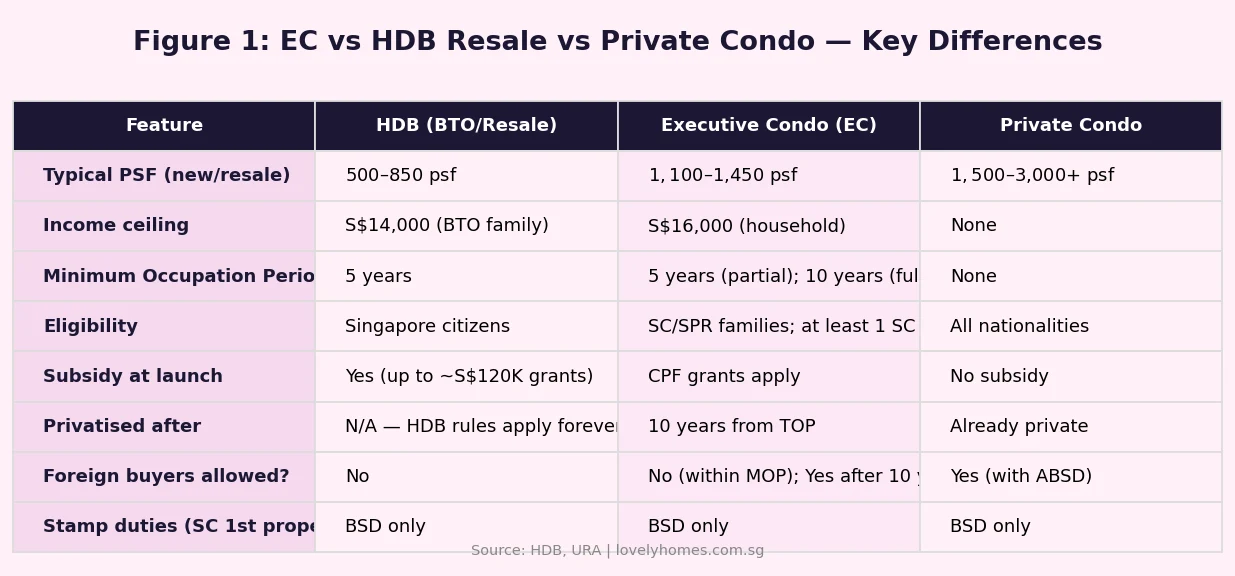
- Figure 1: How ECs compare to HDB resale and private condos across price, eligibility, MOP, and ownership rules. Source: HDB, URA Realis.
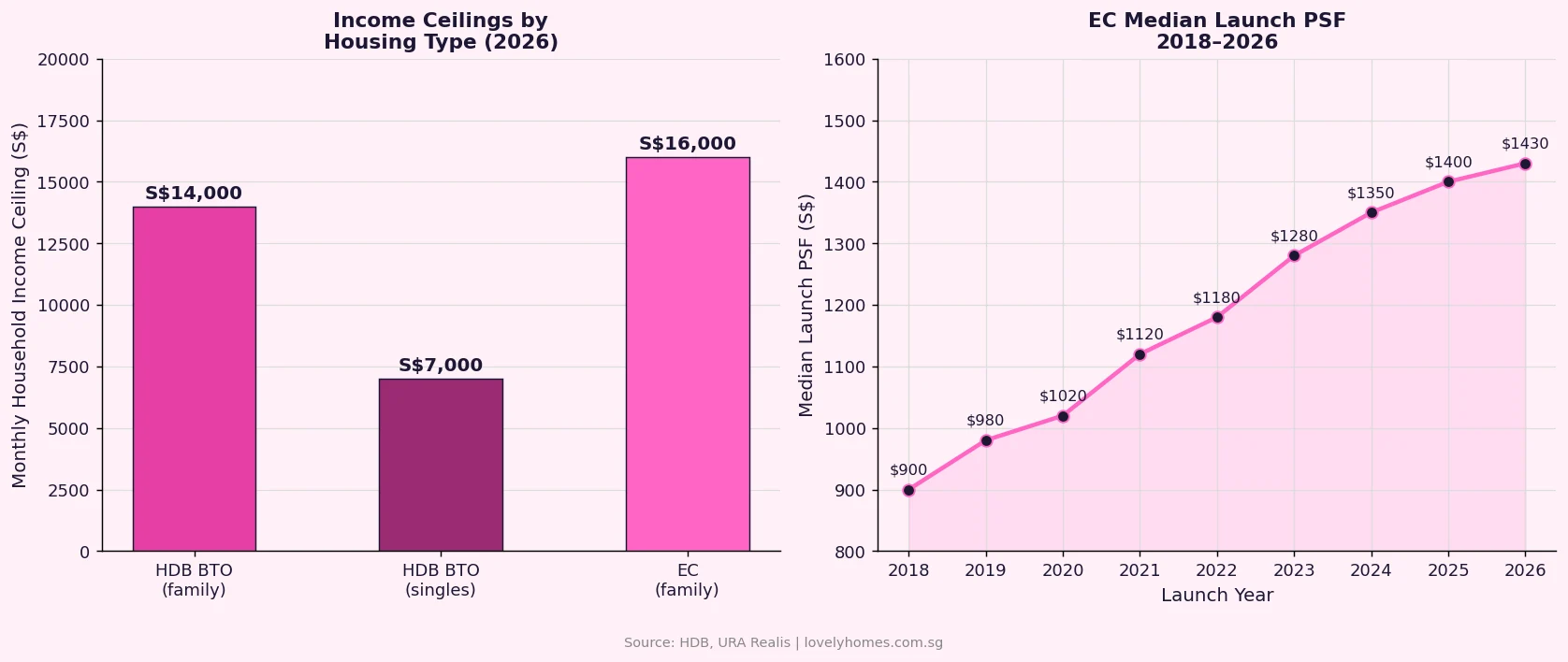
- Figure 2 (left): Income ceilings by housing type in 2026 , HDB BTO (S$14,000 family), HDB BTO singles (S$7,000), EC (S$16,000). (right): EC median launch PSF trend 2018–2026. Source: HDB, URA Realis.
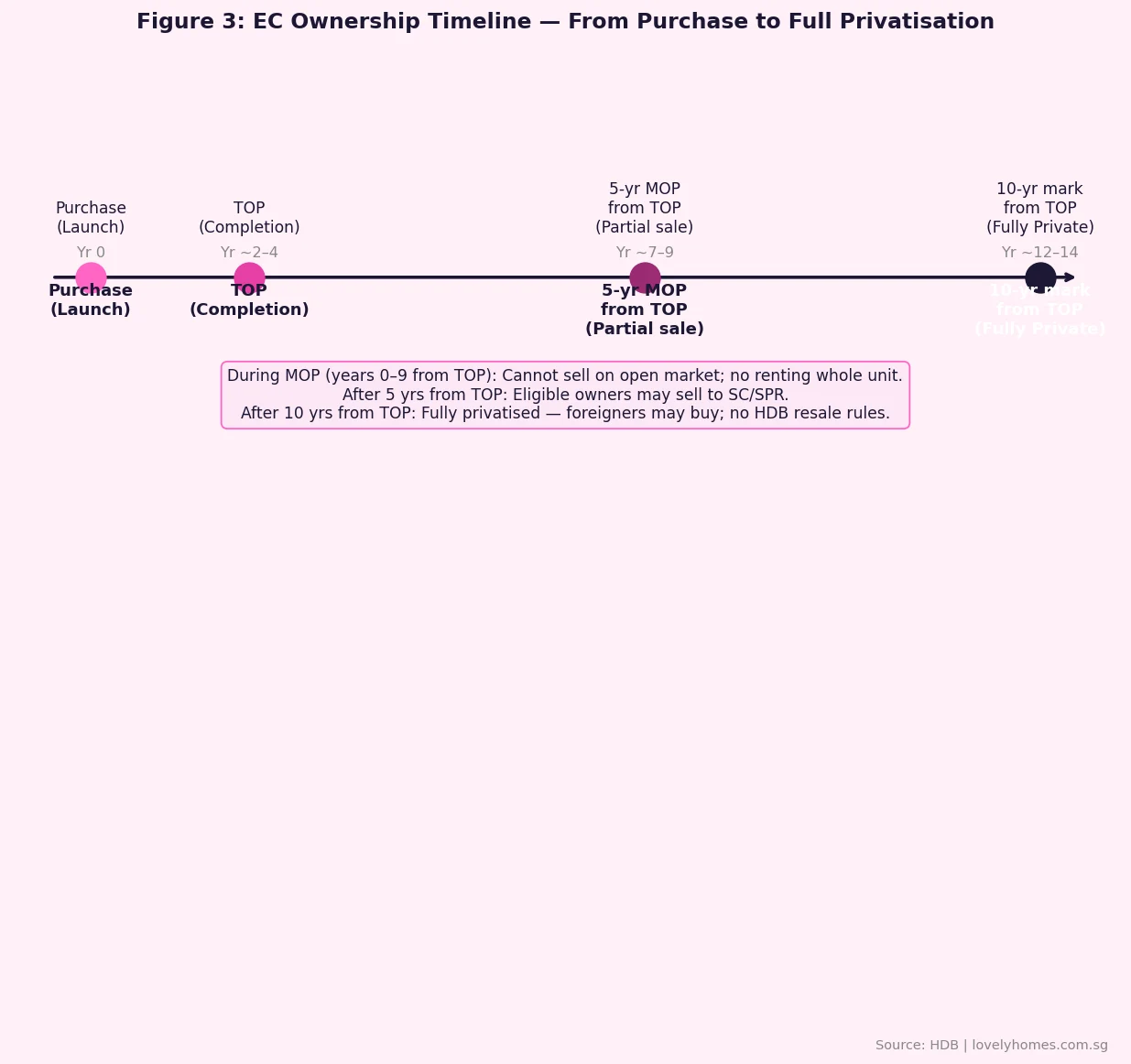
- Figure 3: EC ownership timeline , from launch purchase through 5-year MOP to full privatisation at 10 years from TOP. Source: HDB.