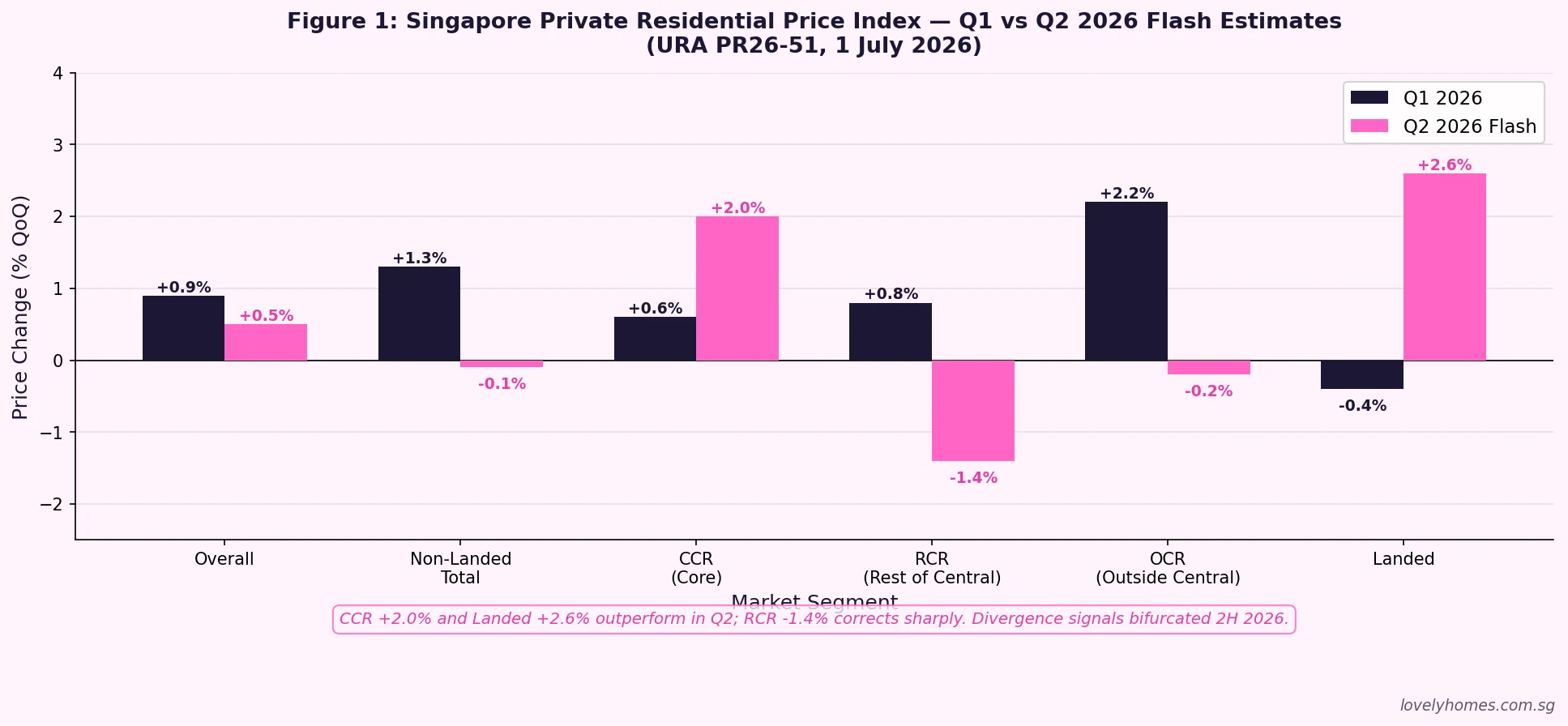
- Q2 2026 private prices: Overall +0.5% QoQ (flash estimate). CCR (Core Central Region) surged +2.0%; Landed properties rose +2.6%. RCR (Rest of Central Region) fell -1.4%; OCR (Outside Central Region) softened -0.2%.
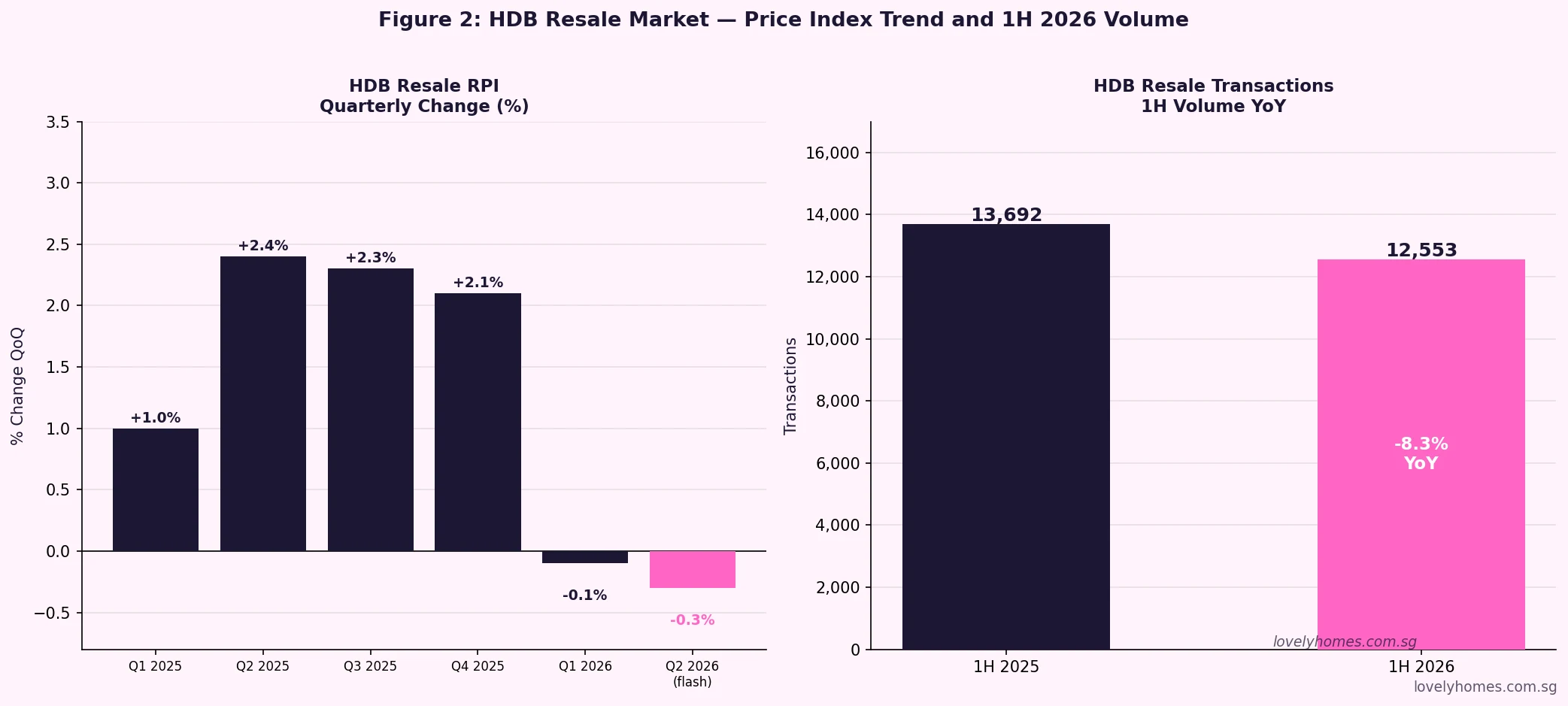
- HDB resale: The Resale Price Index (RPI) slipped to 202.7 in Q2 2026, down -0.3% , the second consecutive quarterly decline since 2018. Resale volumes for 1H 2026 fell 8.3% year-on-year to 12,553 transactions.
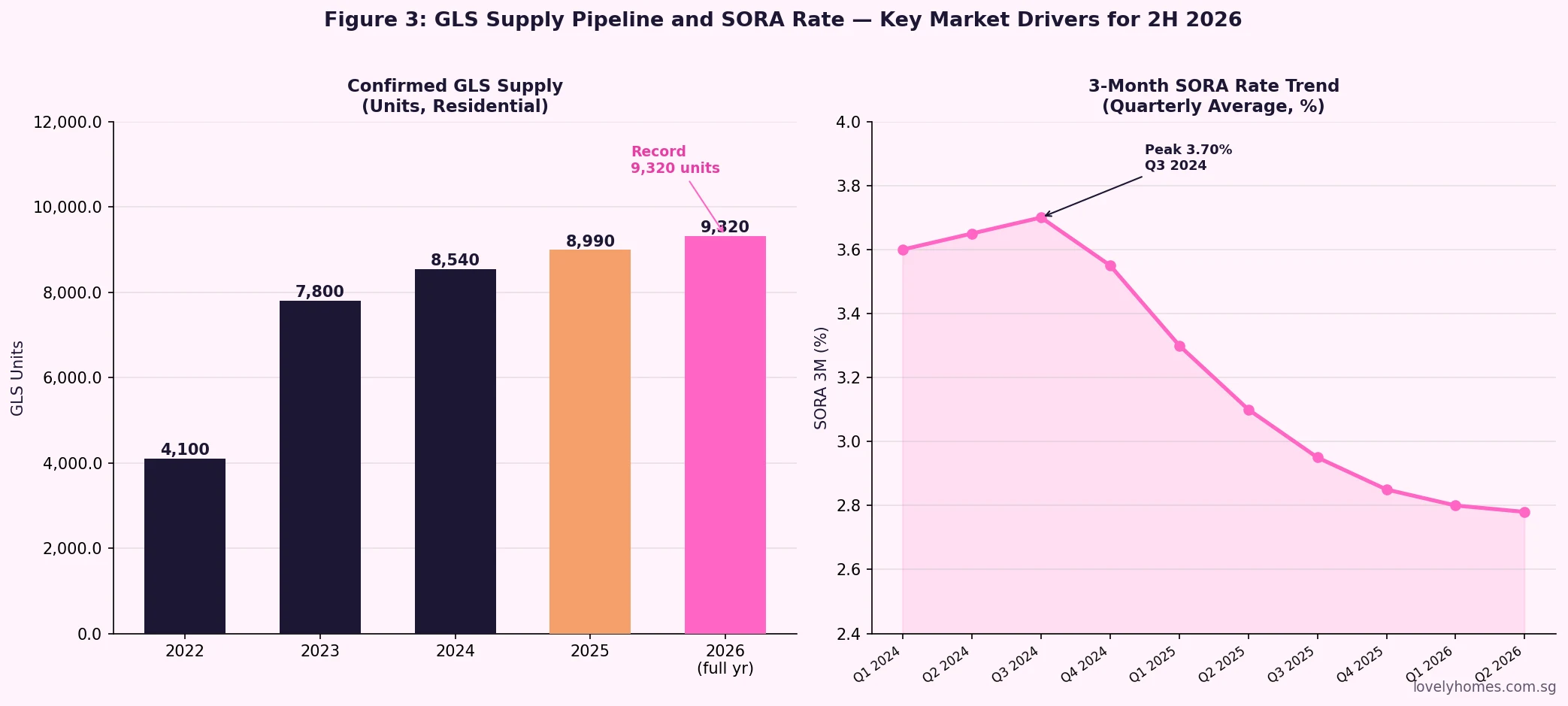
- Supply headwind: Record Government Land Sales (GLS) of approximately 9,320 Confirmed List units in 2026 will put sustained pressure on OCR mass-market prices once completions accelerate from 2027.
- SORA easing: The 3-month compounded SORA has fallen from a Q3 2024 peak of approximately 3.70% to around 2.78% in Q2 2026, materially reducing monthly instalment burdens for new buyers.
- Key watch items for 2H 2026: URA full Q2 data (~24 July), HDB full Q2 resale data (~23 July), the Lorong Puntong and Kitchener GLS tender results, and the first major new launches of the second half.
- LovelyHomes outlook: A market of two halves , CCR and landed supported by safe-haven demand and limited supply; OCR and HDB resale facing a gradual correction as GLS completions build. Selective buying, not blanket avoidance.
Where Singapore Property Prices Stand at Mid-2026
The URA released its Q2 2026 flash estimate on 1 July 2026 (PR26-51), confirming that the overall Private Residential Property Price Index (PPI) rose 0.5% quarter-on-quarter , a deceleration from the 0.9% gain recorded in Q1 2026. Beneath that headline number lies a market fracturing along segment lines: luxury and landed assets are accelerating while mass-market and city-fringe properties are softening.
This bifurcation is not accidental. It reflects the interplay of three structural forces: a record Government Land Sales pipeline adding future supply predominantly in the Outside Central Region (OCR); persistent demand from regional wealth for Singapore's premier residential addresses in the Core Central Region (CCR); and the cooling effect of ABSD on speculative or multiple-property demand in all segments. Understanding which segment you are buying in , and why each segment is behaving the way it is , is the essential starting point for any property decision in 2H 2026.
The CCR Rally: Why Luxury Properties Are Leading
The Core Central Region , comprising the prime Districts 9, 10, and 11, the Marina Bay Financial District, and Sentosa Cove , posted a flash price gain of +2.0% in Q2 2026, the strongest regional performance in Singapore's residential market. This follows +0.6% in Q1 2026, suggesting that the CCR recovery that began in late 2025 is gathering momentum rather than fading.
The drivers are well understood. As one of Asia's most politically stable and legally transparent jurisdictions, Singapore functions as a safe haven for regional wealth. Family offices, of which Singapore had surpassed 2,000 registered by end-2025 according to the Monetary Authority of Singapore (MAS), constitute a consistent source of demand for Orchard Road residences, Nassim Hill bungalows, and Marina Bay service apartments. Unlike retail buyers who are sensitive to monthly instalment affordability, family-office purchasers are frequently cash buyers for whom SORA movements and LTV limits are largely irrelevant.
The supply picture reinforces this demand. Conservation Good Class Bungalows (GCBs) in Districts 10 and 11 are subject to a government-mandated minimum plot size of 1,400 sq m and strict conservation restrictions , the result is a permanently supply-constrained asset class. Similarly, the Orchard Road corridor's freehold apartment inventory does not meaningfully grow: new completions in the CCR represent a small fraction of total pipeline. When global risk appetite is strong and the Singapore dollar holds firm, these segments benefit disproportionately.
RCR Correction: City Fringe Faces Re-Pricing
The Rest of Central Region , covering Districts 1 to 4 (city centre fringe), Districts 7, 8, 12, 13, 14, 15, and 20 , recorded a -1.4% quarterly decline in the Q2 2026 flash estimate, the sharpest segment correction this cycle. This follows a +0.8% gain in Q1 2026, marking an abrupt reversal.
The RCR has been the primary arena for new-launch condominium activity over the past three years. Developers of projects in Toa Payoh, Upper Serangoon, Queenstown, and the River Valley area set aggressive launch prices in 2023 and 2024 on the back of strong take-up. By mid-2026, secondary market sellers in these same estates are discovering that buyers who absorbed aggressive launch prices are now reluctant to transact at further premiums in the resale market , particularly given the mounting GLS supply pipeline and the moderating economic backdrop.
The -1.4% flash reading likely overstates the correction to some degree (flash estimates are based on caveated transactions within a shortened window), but the directional signal is consistent with anecdotal reports from the industry of reduced viewing traffic and longer days-on-market for RCR resale listings in Q2 2026.
OCR Softening: Mass Market Feels Supply Pressure
The Outside Central Region , covering the large residential estates of Woodlands, Jurong West, Pasir Ris, Tampines, Sengkang, Punggol, and Tengah , declined -0.2% in Q2 2026 after posting the strongest Q1 2026 gain of any segment at +2.2%. This sharp reversal from the previous quarter underscores how quickly sentiment can shift in the mass-market segment when buyers perceive that alternative options , HDB resale, new BTO launches, and a growing pipeline of GLS completions , are available at lower effective cost.
The GLS supply factor warrants particular attention. URA released its H2 2026 Confirmed List on 25 June 2026 (PR26-49), adding sites at Lorong Puntong/Sin Ming Avenue (approximately 570 units) and Kitchener Link (approximately 530 units). When combined with the H1 2026 Confirmed List and sites already in the pipeline, total 2026 Confirmed List supply for private residential amounts to approximately 9,320 units , the highest annual volume since 2013, when the government was actively cooling a market running at fever pitch. These units will begin reaching the completion and occupation stages from approximately 2028–2029, adding significant inventory at a time when overall market demand is not expected to grow at the pace it did during the 2021–2022 pandemic-rebound period.
HDB Resale: Second Consecutive Quarterly Decline
The HDB resale market delivered its second consecutive quarterly price decline in Q2 2026, with the Resale Price Index (RPI) falling 0.3% QoQ to 202.7 , the first back-to-back decline since the 2018–2019 cooling measure correction. For the first half of 2026, total HDB resale transactions reached 12,553, down 8.3% from 13,692 in 1H 2025.
The paradox of the HDB resale market in 2026 is that headline RPI softening coincides with a continued surge in million-dollar flat transactions: 902 such transactions occurred in 1H 2026, up 18.2% from 763 in 1H 2025. This apparent contradiction reflects compositional effects , the supply of large (5-Room, Executive) flats in prime locations continues to command premium prices, pulling up the million-dollar count, while the bulk of the market in heartland estates is moderating as fresh BTO supply absorbs first-timer demand that would otherwise have entered the resale market.
Financing Conditions: SORA at Post-Peak Ease
The 3-month Compounded Singapore Overnight Rate Average (SORA) , the benchmark that replaced SIBOR for most bank mortgage packages from 2022 , peaked at approximately 3.70% in Q3 2024. By Q2 2026, the 3-month SORA had eased to approximately 2.78%, reducing the monthly instalment on a S$1 million, 25-year loan by approximately S$500 relative to the peak rate environment.
This easing is meaningful at the margin. A household that found a S$1.5 million HDB resale or OCR condo marginal in 2024 on affordability grounds may find the same unit comfortably within TDSR limits at 2026 SORA rates , and this dynamic is one factor supporting transaction volumes despite softer prices. However, lenders continue to apply a stress-test buffer when assessing borrower eligibility, and MAS has indicated no intention to relax the TDSR of 55% or the MSR of 30% for HDB purchases.
GLS Pipeline and New Launches: What to Expect
The H2 2026 GLS programme confirms Singapore's commitment to supply-side management as the primary tool for long-run price stability. Beyond the record Confirmed List volume, two sites in the pipeline carry outsized significance for 2H 2026 market narrative:
The Lorong Puntong/Sin Ming Avenue GLS tender, launched on 25 June 2026 (PR26-49), closes on 15 September 2026. The site sits adjacent to Bishan-Ang Mo Kio Park and proximate to the Upper Thomson MRT corridor , a location that supports premium pricing relative to typical OCR land. The tender result will signal developer appetite for GLS land at current price levels, and any unusually low bid would be read as a bearish signal for near-term launch pricing.
The Jurong Lake District White Site, launched under the June 2026 programme (PR26-53), closes on 17 November 2026. This is a transformational commercial and mixed-use site that will anchor the second CBD vision for western Singapore. The developer who wins this tender will shape the Jurong East skyline for decades , and the land bid quantum will be a leading indicator of long-term commercial investment confidence in Singapore.
Summary: Market Snapshot at July 2026
| Indicator | Latest Reading | Trend |
|---|---|---|
| Private Overall PPI (Q2 2026 flash) | +0.5% QoQ | Slowing |
| CCR prices (Q2 2026 flash) | +2.0% QoQ | Accelerating |
| RCR prices (Q2 2026 flash) | -1.4% QoQ | Correction |
| OCR prices (Q2 2026 flash) | -0.2% QoQ | Softening |
| Landed prices (Q2 2026 flash) | +2.6% QoQ | Accelerating |
| HDB Resale RPI (Q2 2026 flash) | 202.7 (-0.3% QoQ) | 2nd consecutive decline |
| HDB Resale volume 1H 2026 | 12,553 transactions | -8.3% YoY |
| GLS Confirmed List 2026 | ~9,320 units | Record high |
| SORA 3M (Q2 2026) | ~2.78% | Easing from 3.70% peak |
| URA full Q2 data | Expected ~24 July 2026 | Monitor |
| HDB full Q2 resale data | Expected ~23 July 2026 | Monitor |
Worked Example: How SORA Easing Changes the Affordability Calculation
Mr and Mrs Goh are Singapore Citizens considering a 5-Room HDB resale flat in Bishan at S$850,000. They have no existing property loans. Their combined gross monthly income is S$14,000.
At Q3 2024 peak SORA (~3.70% bank package rate ~4.20%):
- Loan amount (HDB not eligible; income exceeds S$9,000 cap): bank loan 75% LTV = S$637,500
- Monthly instalment at 4.20% over 25 years: ~S$3,450
- MSR: S$3,450 / S$14,000 = 24.6% , borderline
- TDSR headroom: 55% x S$14,000 = S$7,700; used S$3,450 , comfortable
At Q2 2026 SORA (~2.78% bank package rate ~3.30%):
- Same loan S$637,500 at 3.30% over 25 years: ~S$3,110
- MSR: S$3,110 / S$14,000 = 22.2% , comfortably within 30%
- Monthly saving versus 2024 peak: ~S$340
- Total interest saving over 25-year loan: approximately S$102,000
Conclusion: SORA easing has added roughly S$340 per month of headroom for the Goh family , equivalent to bringing approximately 12% more buyers into affordability range for this price bracket. This is a meaningful structural support for HDB resale and OCR condominium demand, partially offsetting the headwind from increased GLS supply.
Why This Matters: Singapore in the Regional Property Context
Singapore's property market is often benchmarked against Hong Kong as the other major established gateway city in Asia. In 2026, the comparison is instructive: Hong Kong's residential market has been in a multi-year correction following the 2019 civil unrest and subsequent COVID-era lockdowns, with prices falling more than 20% from the 2021 peak. Singapore, by contrast, is experiencing a controlled deceleration rather than a correction , the price level in nominal terms remains substantially above any pre-pandemic reference point.
This relative resilience reflects the effectiveness of Singapore's demand-side management toolkit (ABSD, TDSR, MSR) in preventing speculative excess, and the credibility of the government's commitment to using supply (GLS) as a long-run moderator. International investors who choose Singapore over Hong Kong, Tokyo, or Sydney are selecting stability of institutional framework over raw yield or growth potential , and 2H 2026 data continues to validate that preference.
What Might Come Next in 2H 2026
The most significant scheduled data release is the URA full Q2 2026 private residential statistics, expected around 24 July 2026. The full release will confirm the flash estimate, provide transaction volume breakdowns, vacancy rates, and the rental index , the latter being a key lead indicator of future price direction. LovelyHomes will publish a dedicated analysis immediately upon release.
The HDB full Q2 2026 resale statistics, expected around 23 July 2026, will confirm the RPI reading and provide the complete breakdown of transactions by flat type, estate, and price band , including an updated million-dollar flat count that will receive significant media attention regardless of the direction.
On the policy front, no ABSD adjustment is widely anticipated for 2H 2026 given that price levels are moderating rather than surging. Any upward ABSD adjustment would likely be reserved for a scenario where CCR prices re-accelerate materially , a possibility if US Fed rate cuts in H2 2026 trigger renewed capital flows into Asian safe-haven assets. Conversely, any downward ABSD adjustment (e.g., relaxation of the 65% foreigner rate) would be a major bullish signal for the CCR and would likely be announced in the annual Budget Statement (February 2027) if at all.
Frequently Asked Questions
Is the Singapore property market in a bubble in 2026?
The empirical evidence does not support a bubble characterisation. The price-to-income ratio for Singapore private residential property has risen materially since 2020, but the primary driver has been genuine household formation, immigration-driven demand, and supply shortfalls during the COVID construction hiatus , rather than speculative leverage. MAS stress tests continue to show that the mortgage book is resilient at a hypothetical 200-basis-point rate increase. The HDB resale market is now experiencing a controlled moderation, which is the textbook outcome of effective demand management rather than a bubble correction. That said, buyers at elevated entry prices in the RCR and OCR should model their returns conservatively given the supply pipeline.
Should I buy property in Singapore now or wait until 2027?
Timing the market is notoriously difficult and not the approach LovelyHomes advocates. For owner-occupiers, the primary question is whether the property meets your household needs at an affordable instalment given current income and rates , not whether prices will be 5% higher or lower in 12 months. For investors, the relevant question is whether the rental yield after financing costs, taxes, and maintenance is adequate for the risk undertaken , and whether the specific asset class you are targeting (CCR luxury, HDB resale, industrial) has supply fundamentals that support occupancy over your intended hold period. 2H 2026 presents genuinely attractive opportunities in the CCR for cash-rich buyers with safe-haven motivations, and in the industrial space for yield-focused investors. Blanket avoidance is as problematic as indiscriminate buying.
What is the full Q2 2026 URA data release date and what will it cover?
The URA typically releases full quarterly private residential data approximately 3 to 4 weeks after the flash estimate. With the Q2 2026 flash released on 1 July 2026, the full release is expected around 24 July 2026. The full publication will include the finalised Property Price Index for all segments, transaction volumes by project and unit type, vacancy rates, uncompleted unit statistics, new sales and subsales data, rental index by region and property type, and median unit prices by postal district. LovelyHomes will publish a dedicated analysis within 24 hours of the full data release.
How does the record GLS supply affect property prices?
The impact of the 2026 GLS supply on transaction prices is lagged by approximately 3 to 5 years , the time between land tender and project completion. Units from sites awarded in 2026 will typically reach the resale market between 2029 and 2031. In the near term (2H 2026), the GLS supply primarily creates a perception headwind for OCR prices: buyers and sellers both know that future supply is coming, which moderates the urgency of purchase and weakens sellers' ability to hold firm on asking prices. The effect is most pronounced in OCR estates near new GLS sites (e.g., Tengah, Plantation) and less significant in CCR or landed segments where GLS supply is structurally limited.
Will ABSD be reduced in 2026 or 2027?
As at July 2026, there is no publicly signalled intention from the Ministry of Finance or MAS to reduce ABSD rates in the near term. Singapore's Finance Minister has consistently reiterated that ABSD remains necessary to maintain housing affordability for Singaporeans and to prevent a destabilising price surge. For ABSD to be reduced materially, the government would typically need to observe sustained price declines (not just moderation), rising vacancy rates, or a structural change in underlying demand dynamics. None of those conditions is currently met. LovelyHomes will update this analysis immediately if any Budget 2027 ABSD announcement is made.
How do I interpret the CCR vs RCR vs OCR classification?
The URA divides Singapore's residential market into three regions based on planning area and District designations. The Core Central Region (CCR) covers the most prime addresses: Districts 9, 10, 11, the Downtown Core, Sentosa, and Marina Bay. The Rest of Central Region (RCR) covers Districts 1 to 4, 7, 8, 12 to 15, and 20 , essentially the city-fringe and inner-suburb estates. The Outside Central Region (OCR) covers all remaining Districts , the HDB-dominated heartland areas of Woodlands, Jurong, Tampines, Sengkang, Punggol, and Tengah. Property prices and rental yields differ substantially across these regions, and the supply pipeline dynamics discussed above apply differently to each. Buyers should be clear about which region they are investing in before comparing projects by price per square foot alone.
Related Articles
- Singapore Private Property Prices Q2 2026: URA Flash Estimate Analysis
- HDB Resale Prices Q2 2026: RPI Slips to 202.7, Second Consecutive Decline
- Singapore Luxury Homes and Safe-Haven Demand: CCR Surges in Q2 2026
- ABSD Singapore 2026: Complete Guide to Additional Buyer's Stamp Duty
- Singapore Housing Loan Guide 2026: HDB Loan, Bank Loan, TDSR and MSR
- Singapore Property Investment Guide 2026: Strategy, Yield, and Risk
Disclaimer: This article is published for general informational purposes only and does not constitute investment, legal, or financial advice. Price index data is sourced from URA and HDB flash estimates as at 1 July 2026; full official data expected ~23–24 July 2026. SORA figures are approximate quarterly averages based on MAS published data. GLS unit counts are estimates based on URA press releases and are subject to final confirmation. Forward-looking statements and market outlook commentary represent the editorial views of LovelyHomes and should not be relied upon for investment decisions. Consult a licensed financial adviser, mortgage broker, or property professional before making any property purchase or sale decision.
Supporting graphics
Original article illustrations are available below.
- Figure 1: URA Private Residential Property Price Index , Q1 2026 vs Q2 2026 Flash by Segment. Source: URA PR26-51, 1 July 2026. CCR outperforms; RCR corrects sharply.
- Figure 2: HDB Resale Price Index quarterly change (Q1 2025 to Q2 2026 flash) and 1H transaction volumes. Source: HDB flash estimates, 1 July 2026. Two consecutive quarterly declines; volumes down 8.3% year-on-year.
- Figure 3: Annual GLS Confirmed List supply (residential units) and 3-month compounded SORA rate trend. Sources: URA GLS programmes 2022–2026; MAS SORA data. Record 9,320 GLS units in 2026; SORA easing from Q3 2024 peak.