Quick Answer: Is Reverse Mortgage Available in Singapore?
- A reverse mortgage lets an older homeowner borrow against a fully paid-up property without moving out and without making monthly repayments; the loan and accrued interest are only repaid when the home is eventually sold or the owner passes away.
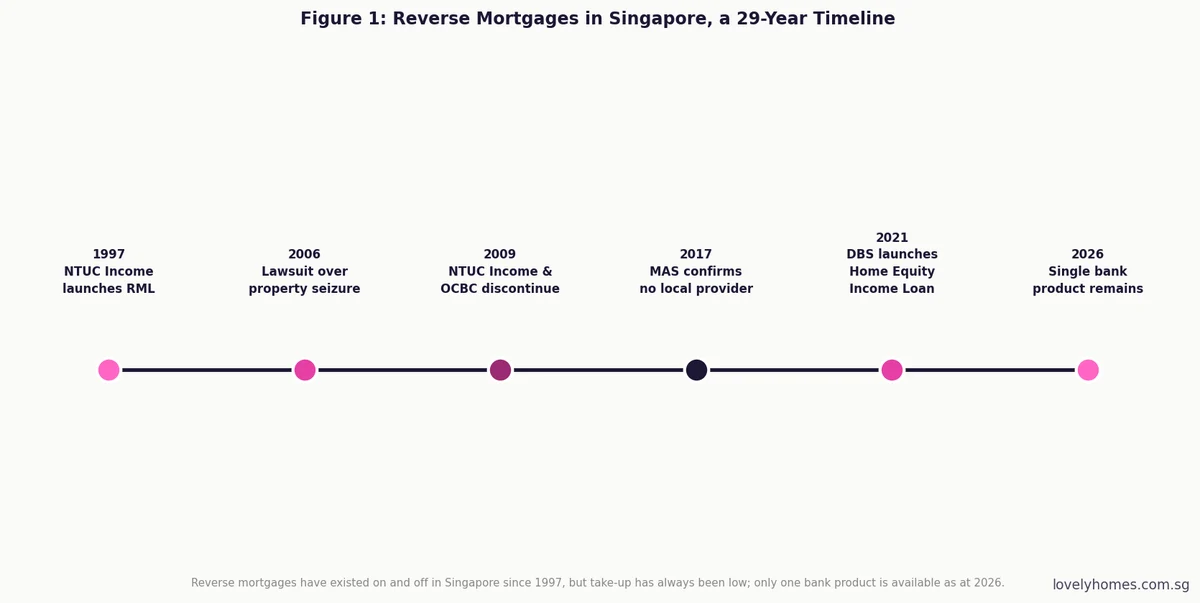
- Singapore has tried this before: NTUC Income launched a reverse mortgage loan in 1997, but it and OCBC both discontinued their reverse mortgage products by 2009 due to persistently low demand.
- As at 2026, there is only one mainstream bank product resembling a true reverse mortgage: the DBS Home Equity Income Loan (HEIL), launched in August 2021.
- DBS HEIL is open to Singapore Citizens and PRs aged 65 to 79 who own one fully paid-up private residential property with at least 30 years of remaining lease.
- The loan tops up the borrower’s CPF Retirement Account, up to the Enhanced Retirement Sum (S$440,800 for those turning 55 in 2026), to boost monthly CPF LIFE payouts for life.
- It charges a fixed rate of 3.88% p.a., runs for up to 30 years or until the youngest borrower turns 95, and requires no monthly repayment; the loan compounds and is settled only at maturity or sale.
- HDB flat owners have their own equivalent: the HDB Lease Buyback Scheme, which sells part of the flat’s tail-end lease back to HDB while the owner continues living there.
- Reverse mortgage take-up remains low worldwide, not just in Singapore; even in the mature United States market, only around 2% to 3% of eligible homeowners ever use one.
For many older Singaporean homeowners, the problem is not a lack of wealth, it is that most of that wealth is locked up in a property they do not want to sell. A reverse mortgage is designed precisely for this “asset-rich, cash-poor” situation: it converts home equity into retirement income while letting the owner continue living in the property, with the loan only becoming due when the home is eventually sold, or on the owner’s death. Despite sounding like an obvious fit for a country with one of the world’s highest home-ownership rates, reverse mortgages have never really taken off in Singapore. This guide explains why, what is actually available in 2026, and the alternatives that most Singaporean seniors use instead.
A Brief History: Why Singapore’s Earlier Reverse Mortgages Failed
Singapore’s first attempt at a reverse mortgage product dates back to 1997, when NTUC Income introduced a reverse mortgage loan aimed at retirees who owned their homes outright but had limited cash income. The product allowed homeowners to draw down their property’s equity as a monthly annuity-style payout, with the loan secured against the property and repaid only when the owner sold, moved out, or passed away. OCBC later offered a broadly similar product as well.
Both products struggled with very low take-up over more than a decade. A high-profile 2006 court case over a disputed property seizure under NTUC Income’s scheme did not help public confidence in the concept. By 2009, both NTUC Income and OCBC had discontinued their reverse mortgage offerings, citing insufficient demand to justify continuing to underwrite the product. For roughly a decade afterwards, Singapore had no reverse mortgage product available at all, and the Monetary Authority of Singapore (MAS) confirmed in 2017 parliamentary replies that no financial institution was then offering one, noting that reverse mortgages have struggled to gain traction in many other mature markets too, not just locally.
The DBS Home Equity Income Loan: Singapore’s 2026 Reverse Mortgage Product
The gap was filled in August 2021, when DBS launched the Home Equity Income Loan (HEIL), marketed as a market-first financing solution built specifically for seniors holding private residential property. As at 2026, it remains the only mainstream reverse-mortgage-style product available from a Singapore bank.
To qualify, an applicant must be a Singapore Citizen or Permanent Resident aged 65 to 79, and must own one, and only one, fully paid-up private residential property with a remaining lease of at least 30 years (freehold properties automatically satisfy this). Unlike a conventional home loan, HEIL does not require any monthly repayment: instead, the loan proceeds are used to top up the borrower’s CPF Retirement Account, up to the prevailing Enhanced Retirement Sum, which was S$440,800 for members turning 55 in 2026. That top-up increases the borrower’s monthly CPF LIFE payouts for the rest of their life. The loan itself carries a fixed interest rate of 3.88% per annum for the full tenure, which can run for up to 30 years, or until the youngest borrower turns 95, whichever comes first. Because there is no monthly repayment, the interest compounds over time and, together with the principal, is only repaid when the property is eventually sold, or when the borrower (or the surviving joint borrower) passes away or moves out permanently.
The HDB Equivalent: Lease Buyback, Not a True Reverse Mortgage
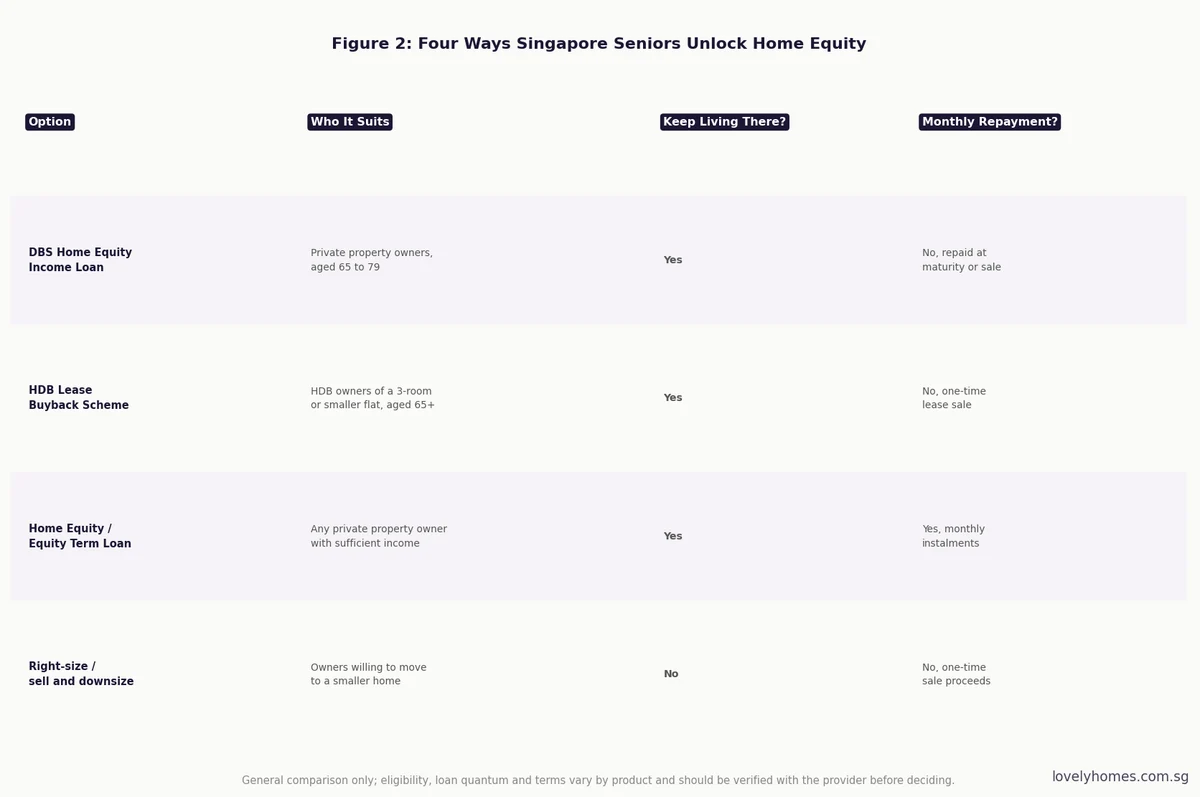
HDB flat owners cannot use DBS HEIL, which is restricted to private property, but they have long had access to a conceptually similar tool: the HDB Lease Buyback Scheme (LBS). Under LBS, an eligible household (generally Singapore Citizens aged 65 and above owning a 3-room or smaller flat) sells the tail end of the flat’s lease back to HDB while retaining a shorter lease that lets them continue living in the same flat. Part of the proceeds must be used to top up the household’s CPF Retirement Account, with the balance paid out in cash, subject to a minimum retained sum. LBS is not, strictly speaking, a loan or mortgage; it is a one-time partial sale of the flat’s remaining lease, so there is no accruing interest balance to worry about, but it also means the household permanently gives up a portion of the flat’s lease term in exchange for the upfront value.
Why Reverse Mortgages Remain a Niche Product
The low take-up of reverse mortgages is not unique to Singapore; even in the United States, where the product has existed for decades and is actively marketed, only around 2% to 3% of eligible homeowners ever take one up. Several factors compound this locally. Many Singaporean retirees view their home as an inheritance to pass on to children rather than an asset to be drawn down, and a compounding, non-amortising loan balance can feel psychologically uncomfortable even when the underlying maths is manageable relative to a typical property’s value. The strict eligibility rules (single property ownership, a 65 to 79 age band, and a 30-year minimum remaining lease) also rule out a meaningful share of potential borrowers, particularly those with shorter-lease older private properties or those who co-own a second property with adult children.
Singapore’s relatively generous suite of alternatives also reduces the pressure to use a reverse mortgage specifically. Between CPF LIFE, the HDB Lease Buyback Scheme, the Silver Housing Bonus for right-sizing, and conventional home equity or equity term loans for those still comfortable with monthly repayments, most seniors have at least one workable path to unlocking home equity that does not involve the specific structure, and specific product risk, of a reverse mortgage.
Summary: Reverse Mortgage Facts at a Glance
| Question | Short Answer |
|---|---|
| Is a reverse mortgage available in Singapore in 2026? | Yes, one bank product: the DBS Home Equity Income Loan, launched August 2021. |
| Who can apply for DBS HEIL? | Singapore Citizens or PRs aged 65 to 79 who own one fully paid-up private property with 30+ years lease remaining. |
| What is the interest rate? | A fixed 3.88% per annum for the full loan tenure. |
| Do I need to make monthly repayments? | No. The loan and accrued interest are repaid only at maturity or when the property is sold. |
| What is the HDB equivalent? | The HDB Lease Buyback Scheme, which sells part of the flat’s tail-end lease back to HDB. |
| Why did earlier reverse mortgages fail here? | Persistently low demand; NTUC Income and OCBC both discontinued their products by 2009. |
Worked Example: Madam Lim Tops Up Her CPF Using Her Condo’s Equity
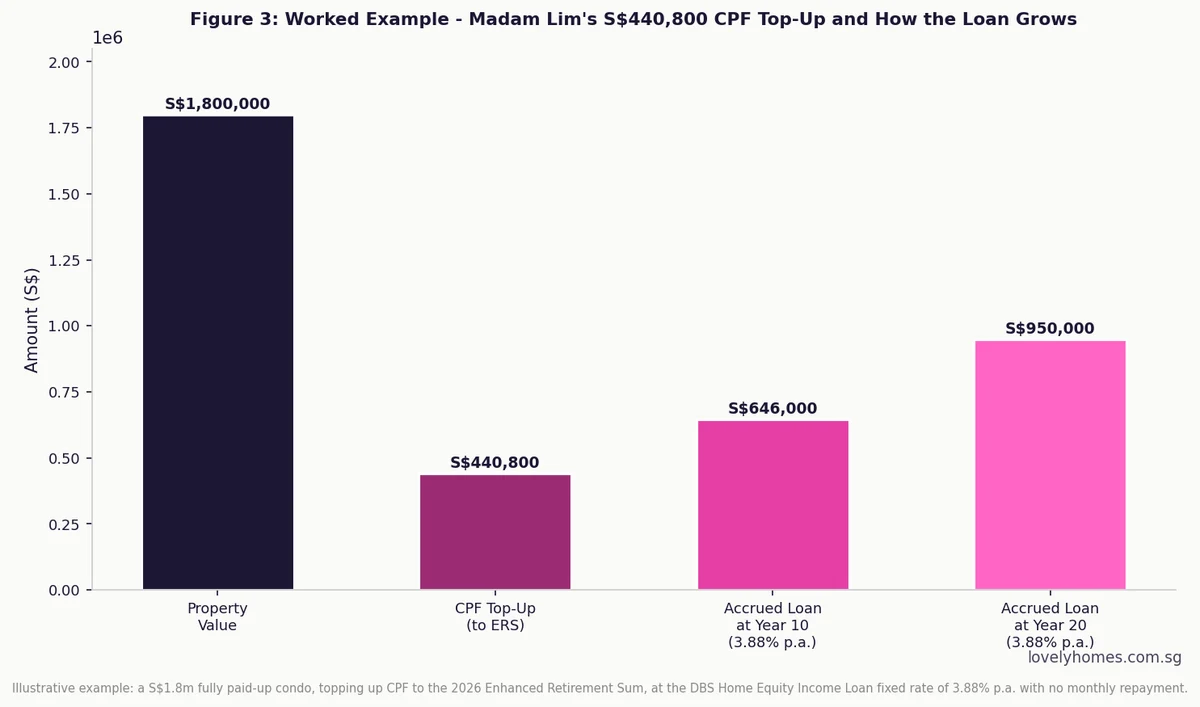
The scenario: Madam Lim is 68, a Singapore Citizen, and owns her S$1.8 million condo outright with no outstanding mortgage. Her CPF Retirement Account balance is below the Enhanced Retirement Sum, and her CPF LIFE payouts feel tight relative to her monthly expenses. She does not want to sell her home or move.
The DBS HEIL option: Madam Lim borrows enough to top up her CPF Retirement Account to the 2026 Enhanced Retirement Sum of S$440,800. This immediately increases her monthly CPF LIFE payout for the rest of her life. She makes no monthly repayments on the loan itself; interest accrues at the fixed 3.88% p.a. rate.
How the balance grows: Left unpaid and compounding, the S$440,800 drawn down grows to roughly S$646,000 by year 10, and roughly S$950,000 by year 20, assuming no partial repayments are made. This remains comfortably below her home’s S$1.8 million value even after 20 years, but the example shows why the loan quantum, the property’s value cushion, and the borrower’s expected tenure in the home all matter when deciding how much to draw down.
These figures are illustrative only and do not account for future property value changes, loan quantum limits, or changes to CPF retirement sum figures, which are reviewed annually.
Why This Matters for Retirement Planning
For homeowners genuinely asset-rich but cash-poor in retirement, a reverse-mortgage-style product can be a legitimate way to convert an illiquid asset into usable income without uprooting their life. But it is a decision with long-term, compounding consequences, particularly for anyone who intends to leave the property to their children, since the eventual sale proceeds will need to first settle the accrued loan balance. Anyone considering DBS HEIL, or comparing it against the HDB Lease Buyback Scheme, an equity term loan, or simply downsizing, should model the numbers over a realistic time horizon (10, 20, even 30 years) rather than focusing only on the immediate monthly payout increase, and should discuss the decision with family members who may have views on the property’s future.
What Might Come Next
The following is informed speculation, not confirmed policy. Given Singapore’s rapidly ageing population and continued CPF policy attention on retirement adequacy, it is plausible that other banks could eventually launch competing reverse-mortgage-style products if DBS HEIL demonstrates sustained demand, though no other bank has announced plans to do so as at the time of writing. It is also plausible that eligibility parameters, such as the minimum remaining lease or the maximum age band, could be reviewed over time as the product matures, or that a similar top-up mechanism could eventually be extended to smaller HDB flat owners as a complement to the existing Lease Buyback Scheme, though this too remains unconfirmed.
Frequently Asked Questions
Can HDB flat owners apply for the DBS Home Equity Income Loan?
No. DBS HEIL is restricted to owners of fully paid-up private residential property. HDB flat owners seeking to unlock home equity in retirement should look at the HDB Lease Buyback Scheme instead, subject to its own eligibility rules on flat type and age.
What happens to the property if the loan balance grows larger than expected?
The loan is a non-recourse-style arrangement secured against the property; the accrued balance is repaid from the sale proceeds when the home is eventually sold. Borrowers should discuss with the bank how loan quantum limits relative to property value are managed over a long tenure.
Can I still leave my home to my children if I take a reverse mortgage?
Yes, but the accrued loan balance must be settled first, typically from the sale proceeds. Children who wish to keep the property may also be able to repay the outstanding loan themselves rather than selling.
Why did NTUC Income and OCBC stop offering reverse mortgages?
Both cited persistently low customer demand after years of offering the product, alongside broader industry caution following a 2006 legal dispute over a property seizure under NTUC Income’s scheme.
Is DBS HEIL the same as a Home Equity Loan or Equity Term Loan?
No. Conventional Home Equity Loans and Equity Term Loans require monthly repayments and are available to a wider age range. DBS HEIL is specifically structured with no monthly repayment, targeted at seniors, and repaid only at maturity or sale.
Do I need to be debt-free to qualify?
The property must be fully paid-up, meaning there should be no outstanding mortgage on it, since the loan is secured against the property’s full equity.
What if I own more than one property?
DBS HEIL requires the applicant to own only one property. Owners of multiple properties would need to consider other options, such as an equity term loan on one of the properties, or selling a second property outright.
Related Articles on LovelyHomes
- Singapore HDB Lease Buyback Scheme Guide 2026: Monetise Your Flat, Stay in Your Home
- Singapore HDB Downsizing Guide 2026: How to Rightsize and Unlock Cash from Your Flat
- Home Equity Loan Singapore 2026: HEL, HLOA & Borrowing Guide
- Equity Term Loan (Cash-Out Refinancing) Singapore 2026: How to Unlock Cash From Your Property
- Singapore Property Downgrade Guide 2026: How to Sell Private and Buy HDB Resale
- Singapore Property Succession Guide 2026: Wills, CPF Nominations, Joint Tenancy and ABSD on Inheritance
Supporting graphics
Original article illustrations are available below.