Quick Answer: Solar Panels for Singapore Homes
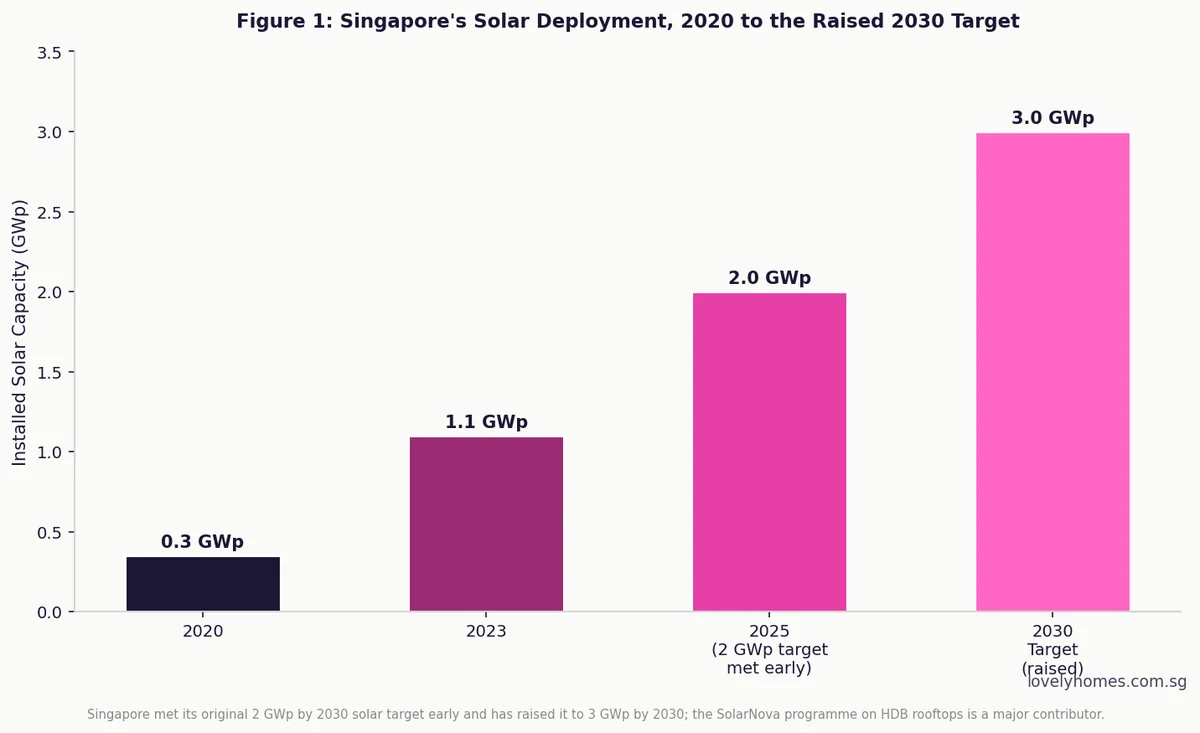
- Singapore has already met its original 2 GWp by 2030 solar target ahead of schedule and has raised its ambition to 3 GWp by 2030, with national deployment at roughly 1.1 GWp as at Q1 2026.
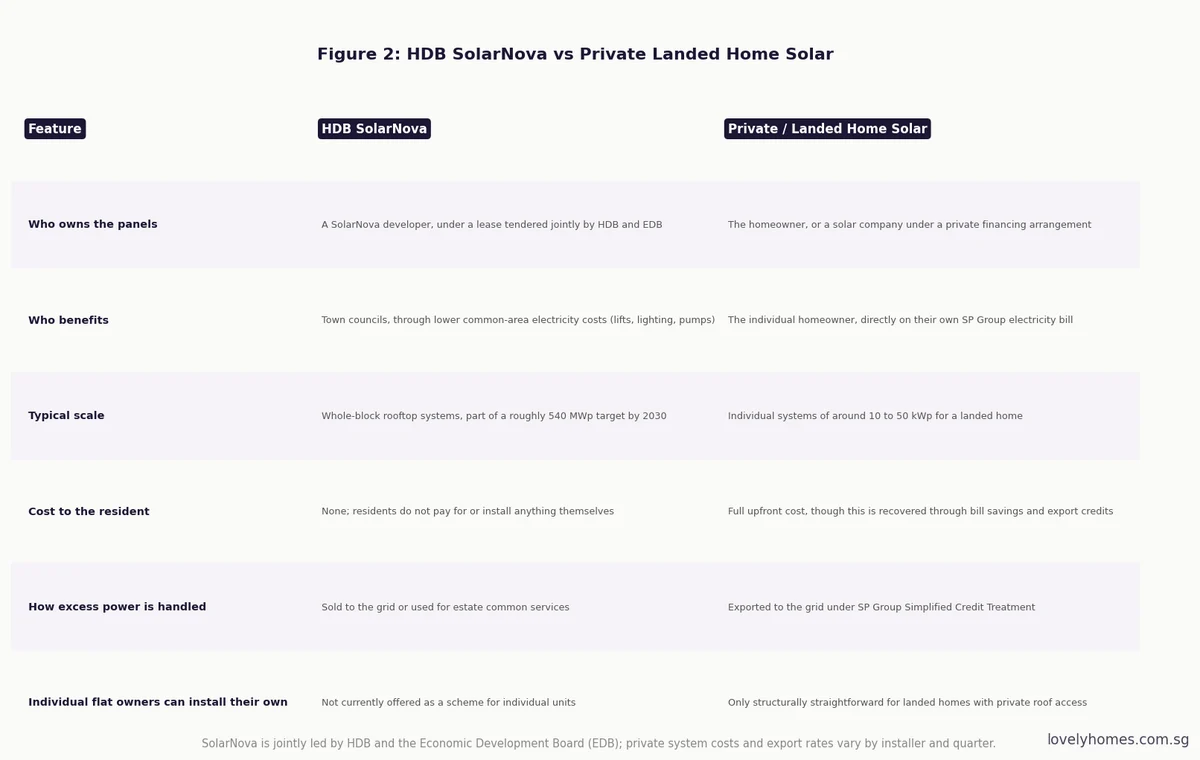
- Most HDB rooftop solar comes from the SolarNova programme, jointly led by HDB and the Economic Development Board (EDB), which tenders rooftop leases to developers, not individual flat owners.
- As at end-2025, around 5,300 HDB blocks, roughly half of all blocks, had rooftop solar installed, working toward a target of about 540 MWp on HDB rooftops by 2030.
- SolarNova power is used to offset common services such as lift operation, corridor lighting and water pumps, which helps moderate increases in Service and Conservancy Charges; individual flat owners do not receive a direct personal bill credit from it.
- Individual homeowners wanting their own solar system generally need a landed property with private roof access; this is not a straightforward option for most condo or HDB flat owners.
- A typical landed-home system in 2026 costs around S$1,200 to S$1,600 per kWp installed, with a 10 to 50 kWp system commonly running S$15,000 to S$80,000 in total.
- Under SP Group’s Simplified Credit Treatment (SCT), self-consumed solar power avoids paying roughly S$0.35 per kWh, while exported surplus earns a credit of roughly S$0.26 per kWh, both adjusted quarterly with the regulated tariff.
- Most landed-home solar systems in Singapore now achieve payback within roughly 3 to 6 years at 2026 tariff rates, after which the system generates ongoing bill savings for the remainder of its typical 20 to 25-year lifespan.
Solar energy has moved from a niche sustainability talking point to a mainstream part of Singapore’s housing landscape. On the public housing side, the SolarNova programme has already put solar panels on roughly half of all HDB blocks. On the private side, rapidly falling equipment costs and rising electricity tariffs have shortened the payback period for a landed home solar system to well under a decade in many cases. This guide explains how the two very different sides of the solar story work, what a homeowner can and cannot control, and what the real costs and savings look like in 2026.
SolarNova: How HDB Rooftop Solar Actually Works
The SolarNova programme, jointly led by HDB and the Economic Development Board (EDB), is the main vehicle for solar deployment on public housing rooftops. Rather than HDB installing and owning the panels itself, SolarNova tenders out rooftop leases to solar developers, who finance, design, install, operate and maintain the systems for an agreed lease period. As at the end of 2025, HDB had installed solar panels on around 5,300 blocks, roughly half of the total housing stock, working toward a target of approximately 540 MWp of installed HDB rooftop capacity by 2030.
Importantly for individual flat owners, the electricity generated under SolarNova is not credited to any single household’s personal electricity bill. Instead, it is used to power common services, lifts, corridor and stairwell lighting, water pumps and other shared estate infrastructure, which are billed to residents collectively through Service and Conservancy Charges (S&CC). Any surplus beyond what the estate’s common services consume is sold back to the grid. The practical benefit to residents is therefore indirect: SolarNova helps moderate increases in S&CC over time rather than delivering a visible, itemised discount, and no individual HDB flat owner can currently apply to install their own personal solar system on the shared block roof.
Private and Landed Home Solar: What an Individual Homeowner Can Actually Install
For homeowners who want the direct bill savings of solar power on their own account, the realistic starting point in Singapore is landed property with private roof access, since condo owners generally cannot unilaterally add panels to shared roofs (any such project would need Management Corporation approval and is uncommon), and HDB flat owners have no individual installation pathway at all. A typical landed-home system in 2026 is sized at roughly 10 to 50 kWp, depending on roof area and household consumption, and costs approximately S$1,200 to S$1,600 per kWp installed, with larger systems achieving a lower cost per kWp because fixed costs, scaffolding, electrical work and the SP Group grid application, are spread over more capacity. In total, this typically works out to somewhere between S$15,000 and S$80,000 for a full installation, before accounting for any available financing.
Once installed, the system’s economics run through SP Group’s Simplified Credit Treatment (SCT) framework. Power the household consumes directly from its own panels avoids paying the prevailing electricity tariff, worth roughly S$0.35 per kWh in avoided cost, while any surplus exported to the grid earns a credit of roughly S$0.26 per kWh, both figures adjusted quarterly in line with SP Group’s regulated tariff revisions. All new systems must also be registered with the Energy Market Authority (EMA) and comply with relevant technical and safety standards before being connected to the grid.
How Fast Does a Landed Home Solar System Pay for Itself?
Payback periods have compressed considerably as equipment costs have fallen and electricity tariffs have risen. Most landed-home customers in 2026 achieve full payback within roughly 3 to 6 years, with high-consumption households that have a large, well-oriented roof sometimes breaking even in as little as 3 years. After the payback period, the system continues generating savings and export credits for the remainder of its typical 20 to 25-year operational lifespan, meaning the bulk of a system’s lifetime financial benefit arrives well after the initial cost has been recovered. The exact payback period for any specific home depends heavily on roof orientation and shading, the household’s daytime electricity consumption pattern (since self-consumed power is worth more than exported power), and the prevailing SCT export rate at the time.
Summary: Solar Panels for Singapore Homes at a Glance
| Question | Short Answer |
|---|---|
| Can I install solar panels on my HDB flat? | Not individually. HDB rooftop solar is deployed estate-wide under SolarNova, benefiting common services, not individual units. |
| Who leads the SolarNova programme? | HDB and the Economic Development Board (EDB) jointly tender rooftop leases to solar developers. |
| What is Singapore’s national solar target? | 3 GWp by 2030, raised after the original 2 GWp target was met ahead of schedule. |
| What does a landed home solar system typically cost? | Roughly S$1,200 to S$1,600 per kWp installed, or S$15,000 to S$80,000 in total for most systems. |
| How is surplus solar power credited? | Under SP Group’s Simplified Credit Treatment, at a rate adjusted quarterly with the regulated tariff. |
| How long until a system pays for itself? | Typically 3 to 6 years at 2026 tariff rates, out of a 20 to 25-year system lifespan. |
Worked Example: A 15 kWp System on a Terrace House
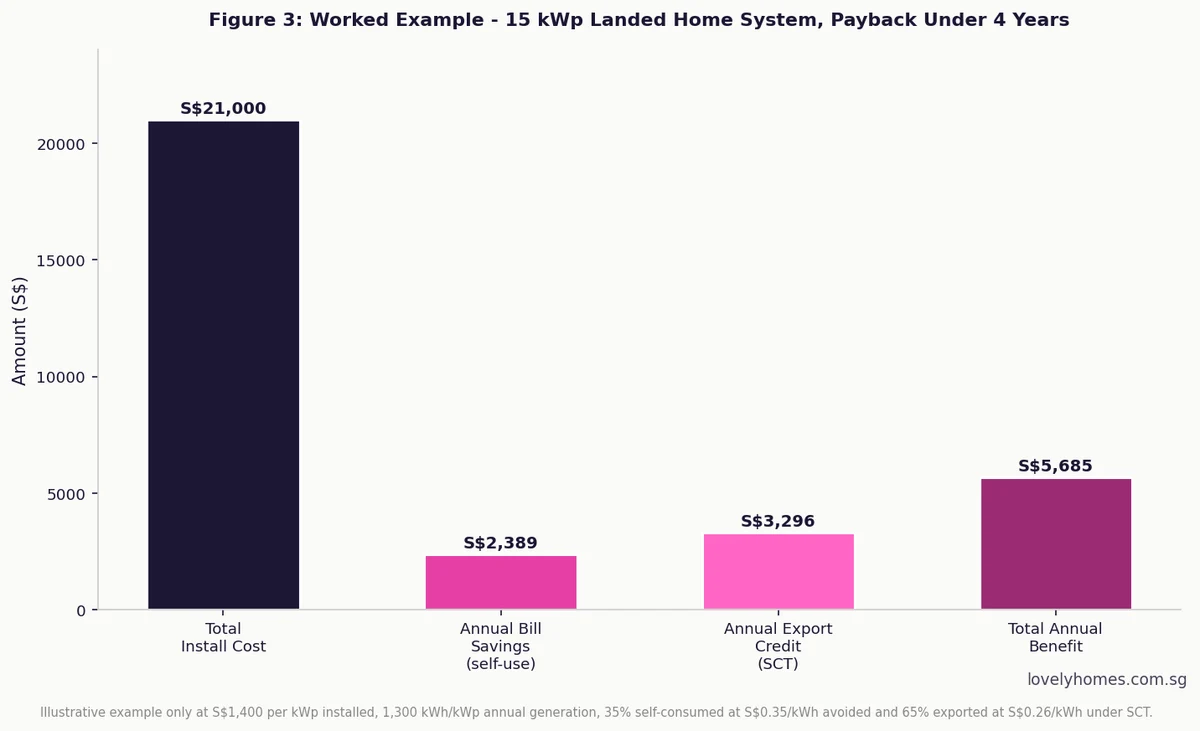
The scenario: A family in a terrace house installs a 15 kWp rooftop solar system, at an illustrative cost of S$1,400 per kWp, for a total installation cost of S$21,000.
Annual generation: At a typical Singapore yield of around 1,300 kWh per kWp per year, the system generates approximately 19,500 kWh annually.
Self-use and export split: Assuming the household self-consumes 35% of the power generated (around 6,825 kWh, valued at roughly S$0.35 per kWh avoided cost, or about S$2,389 a year) and exports the remaining 65% (around 12,675 kWh, credited at roughly S$0.26 per kWh under SCT, or about S$3,296 a year), the household’s total annual benefit comes to approximately S$5,685.
Payback: Dividing the S$21,000 installation cost by the S$5,685 annual benefit gives a payback period of just under 4 years, comfortably within the 3 to 6-year range typical for landed homes in 2026, after which the system continues delivering savings for the remainder of its 20 to 25-year lifespan.
These figures are illustrative only; actual generation, self-consumption ratios and SCT rates vary by household, roof orientation, shading and the quarter in which power is exported.
Why This Matters for Homeowners and Buyers
For landed property owners, solar has shifted from an environmental gesture to a genuine financial decision, with payback periods now well inside the timeframe most households would hold a property. For HDB and condo residents, the practical takeaway is different: solar affects them mainly through moderated S&CC or maintenance fee increases over time, rather than through any action they can take themselves, and buyers evaluating an older landed property should ask whether an existing solar installation is EMA-registered, still under a valid grid connection, and how many years remain on its typical operational life, since a well-documented existing system can be a genuine, quantifiable value-add rather than just an aesthetic feature.
What Might Come Next
The following is informed speculation, not confirmed policy. Given that Singapore has already exceeded its original 2 GWp solar target and raised it to 3 GWp by 2030, it is plausible that SolarNova’s HDB rooftop rollout could be extended to a larger share of the roughly half of blocks not yet covered, and that further tenders could push installed HDB rooftop capacity toward or beyond the current 540 MWp target. It is also plausible that battery storage schemes, allowing landed homeowners to store rather than export surplus solar power, could become more commercially viable and more widely adopted as battery costs continue to fall, though no specific government programme for household battery storage has been announced as at the time of writing.
Frequently Asked Questions
Can condo owners install their own solar panels?
Generally not individually. Condo roofs are common property managed by the Management Corporation, so any solar installation would require MCST approval and is uncommon in practice compared with landed homes.
Does SolarNova reduce my personal HDB electricity bill?
Not directly. SolarNova power offsets common-service consumption billed collectively through Service and Conservancy Charges, rather than crediting any individual flat owner’s personal electricity account.
Do I need approval to install solar panels on my landed home?
Yes. Systems must be registered with the Energy Market Authority (EMA) and connected through SP Group’s approval process, and must meet relevant technical and safety standards before being switched on.
What is the difference between self-consumption and export credit?
Self-consumed solar power avoids paying the prevailing electricity tariff entirely, while exported surplus earns a lower per-kWh credit under SP Group’s Simplified Credit Treatment, so systems sized to match a household’s own daytime usage tend to deliver better returns.
How long do solar panels typically last?
Most systems have a typical operational lifespan of around 20 to 25 years, with panel output gradually degrading over time; inverters may need replacement once or twice during that period.
Does having solar panels increase a landed home’s resale value?
A documented, EMA-registered system with remaining useful life can be a genuine selling point given ongoing bill savings, though as with other home improvements, the exact resale premium varies and is not guaranteed.
Is battery storage available for home solar systems in Singapore?
Battery storage is technically available from private installers, but is not yet common for residential systems given cost; most landed-home systems today rely on the grid export credit rather than on-site storage.
Related Articles on LovelyHomes
- Singapore Landed Property Guide 2026: Types, Rules, Prices
- Singapore Property Renovation Guide 2026: HDB Rules, Costs, Permits and Renovation Loan Explained
- Smart Home & PropTech Guide for Singapore Homeowners 2026: Digital Locks, Costs and Does It Boost Resale Value
- EV Charging Guide for Singapore HDB and Condo Owners 2026: BMSMA Rules, Costs and How to Get a Charger Installed
- MCST Guide Singapore 2026: Management Corporation, Maintenance Fees, Sinking Fund and By-Laws Explained
- Singapore HDB Renovation Guide 2026: Costs, Rules, Timeline and Grants
Supporting graphics
Original article illustrations are available below.